Connected JULY/AUGUST 2018
Reaching the summit
A fresh start for women coping with adversity
ONE COOL FELINE
DINNER TO YOUR DOOR
Meet the man behind Pete the Cat
Meal delivery kits make evenings tastier
INDUSTRY NEWS
Money from home Rural Connections BY SHIRLEY BLOOMFIELD, CEO NTCA–The Rural Broadband Association
Telemedicine is key to rural health
B
roadband internet access is making a real difference in the lives of people across rural America. I see it whenever I travel to the states where telecommunications companies like this one are building advanced networks to reach those in hard-to-serve regions. Broadband supports efforts that are vital to a community’s well-being, such as economic development, education and small-business growth. But broadband’s greatest impact is perhaps seen in the delivery of health care. Robust and sustainable broadband infrastructure is necessary for expanding access to health care in rural America. NTCA has been looking into telehealth applications for a number of years. We have hosted events on our own. We have worked with health care groups to learn about their challenges and to introduce them to our member telcos’ capabilities. We have assisted our members in launching pilot projects of their own. Telemedicine in rural America is truly a win-win proposition. Access to advanced services in a local community brings greater health care options to its residents. As a bonus, telemedicine also makes it easier to attract high-skilled labor, industry and economic development. NTCA is passionate about the role that our member telcos play in telemedicine — and I think we have only scratched the surface of possibilities. Your local telecommunications provider, like hundreds of similar companies across rural America, is building the advanced broadband network that makes telemedicine possible.
2 | July/August 2018
Using the internet to start cottage industries
E
ver been told you can sell those knit caps or great jewelry pieces you’ve made but don’t want to invest the money it takes for a brick-and-mortar location? Look to the internet. More and more people are finding ways to earn a living by building online businesses from their homes. According to Forbes, more than 52 percent of all small businesses in the U.S. are home-based, and most rely on the internet. These jobs can offer flexibility, independence and a way to skirt the traditional 9-to-5. As more Americans board the microbusiness train, the economy is taking notice. While small, these microbusinesses employ 55 million people in the U.S. They also contribute more than $1 trillion in earnings to the U.S. economy, according to Etsy, a global online marketplace for handcrafted and vintage pieces. Many of these entrepreneurs are young, female and live in rural areas, too. Etsy recently polled its network of 1.7 million sellers around the world, and the results are eye-opening. Check out a few of these statistics from the 2017 Etsy Seller Census:
97%
of all U.S. Etsy sellers run their shops from home.
77% are oneperson operations.
87%
32%
say their creative business, both on and off Etsy, is their sole occupation.
are women.
32%
of Etsy sellers have traditional full-time jobs.
28%
live in rural communities.
STUDY: Social media use is growing
f
But so are privacy concerns
l
BY JEN CALHOUN
A
bout seven out of every 10 American adults use some kind of social media, but it doesn’t mean they don’t have worries about it.
A recent Pew Research Center study found that more Americans than ever use Facebook, Twitter, Instagram and other social media platforms as part of their daily lives. They keep in touch with friends and family. They participate in civic and political activities. They even use social media for work or to share health and science research. But the study found that as the number of likes and shares grows, so do concerns about privacy.
PRIVACY ANXIETY Last year, only 9 percent of social media users were “very confident” that social media companies would protect their data, Pew research found. In fact, about half of the users polled “were not at all or not too confident their data was in safe hands.” And while many users said they wanted to do more to
protect their privacy, nearly two-thirds worried that current laws weren’t good enough to do the job. In addition, nearly 65 percent said they support more regulation of advertisers. It’s not just privacy that worries them either. Pew research found that only 5 percent of users trust all of the information that comes to them on social media. They also don’t like the harassment, political bickering, disrespect and incivility that can come with a day in the life of Twitter or Facebook.
HARD HABIT TO BREAK But if social media is so troublesome, why are people sticking with it? Maybe it’s because they feel like they have to, Pew experts suggest. Let’s face it; social media is an easy and convenient way to stay connected to our friends, families and the organizations we love. As a
U //////////////////////////////////// result, some users find it hard to stop. Social media is part of their everyday lives.
NEW RULES However, some privacy advocates say change is coming. One example is the European Union’s General Data Protection Regulation, which was adopted in April 2016 and went into effect in May of this year. The regulation offers data protection and privacy for all those in the European Union, but it could also have a positive effect on U.S. social media users. Pew experts say the GDPR “will give users — even Americans — greater protection about what data tech firms can collect, the data that can be used and how consumers can be given more opportunities to see what is happening with their information.”
Social media use has grown dramatically Percent of adults who say they use social media sites, by age
18-29 year olds
56%
88%
2008
2018
30-49 year olds
18%
78%
2008
2018
50-64 year olds
6%
64%
2008
2018
65+ year olds
2%
37%
2008
2018
SOURCE: PEW RESEARCH CENTER
July/August 2018 | 3
FROM THE GENERAL MANAGER
To whom much is given
T
he past seven days have been a study in contrast. I’ve spoken at a funeral for only the second time in my life and spent several hours over dinner with one of my dearest friends and mentors. Both were profoundly moving moments for different, yet amazingly similar, reasons.
My friend — his name is Dave — quite literally has had the most significant impact on my value structure of any man on earth, other than my father. Even though I see him usually no more than once or twice a year, every time I do he challenges me in ways I generally never see coming. He does it merely by being himself. Being around him, as long as he is not driving, is always an energizing experience for me. We won’t delve further into the driving thing except to simply say, the bus is always a good alternative. (I hope he reads this.) FRED JOHNSON At the funeral, it was my distinct privilege to pay tribute to a Executive Vice President and General Manager dear lady whose life was truly defined by caring for other people, a commitment to her church (the people, not just the buildings) and a remarkable spirit of contentment in her role in this world. I asked those in the room whom she had in some way touched to stand. The result was a powerful demonstration of the difference one woman can make. I truly wish any of us might have the same thing happen at our funeral. That both of these people have touched more lives than is knowable in this life is no surprise. You see, both have long been committed to encouraging and challenging others in meaningful ways. That included caring about folks enough to tell them what they needed to hear even if it might be unpleasant. I was the recipient of that wisdom more than once. Make no mistake; the world has its share of people who will criticize you with selfish motives but not these two. If they told you to get your act together, they did so because they truly cared. We need more people like that in our lives and in our world. We need parents, grandparents, teachers, business leaders, and even politicians with the courage to honestly and compassionately challenge people with real truth. Again, not for self-serving reasons but because as “iron sharpens iron, so one man sharpens another.” It may appear I’m shifting gears here, but I’m really not. I’m merely taking what I just said and focusing on one perspective. It doesn’t require a degree in psychology or sociology to understand that much of what befalls society today is ultimately a result of one generation’s failure to pass to the next a true and proper respect for what is actually important in this life. Namely, I speak of a genuine, selfless respect for the lives and value of other people regardless of any and everything that might make another person a bit different from us. Think about this for one moment. Name one thing you see wrong in the world around you that would not be made better if every single one of us afforded each person with whom we come in contact the same measure of respect and consideration that we, ourselves, would appreciate. Seriously, name one thing that wouldn’t be better. In view of what I’ve written, duty compels me to say one final thing. If either of my dear friends were to respond to what I’ve said about the difference they’ve made in my life, I guarantee you it would go something like this. “Thank you, Fred. I’m glad you feel that way. But if you really mean it, pass it on. I didn’t invest in you just so you could feel good about yourself. I expect you to make a difference in the lives of others. No excuses! That’s what is expected of you. Remember, ‘to whom much is given, much is required.’” 4 | July/August 2018
Connected JULY/AUGUST 2018
VOL. 22, NO. 4
Connected is a bimonthly magazine published by Farmers Telecommunications Cooperative, © 2018. It is distributed without charge to all customers of FTC.
FTC is the state’s largest member-owned provider of telecommunications services. It serves Northeast Alabama with a robust broadband network using world-class optical fiber technology.
Farmers Telecommunications Cooperative, Inc. P.O. Box 217 • 144 McCurdy Ave. N. Rainsville, AL 35986 Telephone: 256-638-2144 www.farmerstel.com
BOARD OF TRUSTEES Randy Wright, President Flat Rock Exchange Garry Smith, Vice President Fyffe Exchange Danny R. Richey, Secretary Geraldine Exchange Lynn Welden, Treasurer Bryant Exchange Kenneth Gilbert Pisgah Exchange Gregg Griffith Henagar Exchange Randy Tumlin Rainsville Exchange Produced for FTC by:
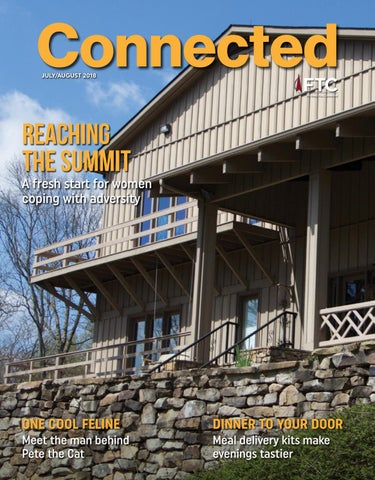
On the Cover: The Summit is a faithbased intensive recovery and discipleship ministry for women struggling to overcome adversity. See story Page 12.
Congratulations! Two awarded FTC scholarships FTC awards two $2,000 scholarships annually. One goes to a deserving high school student, and the other goes to help a student already attending college. The scholarships help pay for tuition, fees and books.
HIGH SCHOOL RECIPIENT Victoria “Tori” Reed lives in Higdon and is a 2018 graduate of North Sand Mountain High School. Her high school activities include basketball, Beta Club, honor court and dual-enrollment classes. Reed plans to attend the University of Tennessee at Chattanooga and earn a nursing degree. Her ultimate goal is to become a pediatric nurse practitioner.
COLLEGE RECIPIENT Meagan Roden is a Rainsville resident attending Northeast Alabama Community College. She earned an associate degree in digital medical sonography from Wallace State Community College, and she works as an ultrasound technician at DeKalb Regional Medical Center. Roden, a wife and mother, is working to earn an associate degree in business. She then plans to pursue a bachelor’s degree from the University of Alabama.
Kelsey Gant awarded FRS scholarship
Scottsboro High School graduate Kelsey Gant, of Pisgah, received a $2,500 scholarship from the Foundation for Rural Service and FTC. Her high school activities include student government, 4-H, FCCLA and HOSA. Gant was an active volunteer throughout high school, and she now works part time and takes dual-enrollment classes through Northeast Alabama Community College.
FTC sends two students to Washington, D.C. Two Plainview High School juniors experienced history in the making at the 2018 FRS Youth Tour in Washington, D.C. Kaitlyn Williams, daughter of Lowell and Jennifer Williams, and Samantha Cornelius, daughter of Steve and Wendie Cornelius, won a five-day, expenses-paid trip to the nation’s capital. They earned the trip by participating in a speaking contest where they gave speeches on the same topic: “Which technology is most important to me and why?” During the June trip, they had the opportunity to experience the nation’s capital and visit famous historical sites, including the Lincoln Memorial, the U.S. Capitol, Mount Vernon and Arlington National Cemetery. They also got an inside look at the telecommunications industry and the legislative and governmental process. FTC sponsors two students annually. It’s just one of the many ways your cooperative supports tomorrow’s leaders today.
Farmers Telecommunications Cooperative
July/August 2018 | 5
TRAVEL
Photo courtesy of Tennessee Museum of Aviation.
A Republic P-47 Thunderbolt from the Tennessee Museum of Aviation.
F
_ Flying High _
light museums around the South take us into the sky, celebrating the history, as well as the future, of flight. Some exhibits immerse us in active simulations, and others challenge us with interactive designs. Still others tell impactful stories. All share a common mission, though, offering insights into how American history is inextricably linked to the early pioneers of our skies. Here are some of the museums that soar high in offering education and fun for children and adults.
6 | July/August 2018
Tennessee Museum of Aviation 135 Air Museum Way • Sevierville, Tennessee Children will love being the pilot as they climb in the cockpit and get their hands on the controls of an authentic A-4 Skyhawk from the Vietnam War era. Aviation enthusiasts will appreciate the massive, 35,000-square-foot hangar with all of its aircraft engines, cockpits, military vehicles and restored vintage Warbirds. These aircraft make up the foundation of the Tennessee Museum of Aviation and were flown on missions during World War II. “They are most impressive, and a number of the Warbirds are still airworthy,” says Rhonda Melton, operations coordinator. Among the aircraft within the museum are two Republic P-47 Thunderbolts — there are less than a dozen of these World War II fighters remaining in the world. Another favorite exhibit is the Douglas A-1H Skyraider, complete with battle scars received from its service during Vietnam. A new “Faith and Courage” exhibit pays tribute to U.S. Military Chaplains from World War II through the present. And a 52-foot display traces milestones in the history of pre-Wright Brothers aviation,
The Lone Star Flight Museum in Texas includes a flight simulator.
Southern Museum of Flight 4343 73rd St. N • Birmingham, Alabama A visit to the Southern Museum of Flight is a walk through time. Learn about a pilot in 1953 who defected from North Korea to an air base in South Korea. Or see a 1925 crop duster flown by Huff-Daland, the company that would become Delta Airlines. The level of detail in the exhibits, combined with their scale — the Korean defection exhibit spans 150 feet — provides visitors with an immersive experience, says museum curator Wayne Novy. And there are a number of activities for children, including sitting in aircraft cockpits, operating the controls of a full-size airplane, and building and flying their own balsa glider. • Admission: Adults: $7. Seniors and students: $6. Kids under 3 and active military and their families: free. • Information: 205-833-8226 or online at www.southernmuseumofflight.org.
The Aviation Museum of Kentucky 4029 Airport Road at Blue Grass Airport Lexington, Kentucky The Bluegrass State is well-grounded in aviation history. Matthew Sellers, of Carter County, Kentucky, invented retractable landing gear, and Solomon Van Meter, of Lexington, is responsible for the creation of lifesaving pack parachutes. These men and others are honored for their contributions and service in the Aviation Museum of Kentucky’s Hall of Fame, one element of the 23-year-old museum. History buffs will enjoy seeing restored barnstormers and vintage airliners, such as a Lockheed L-12 that was used as a
spy plane before World War II broke out. But the museum also looks toward the future of aviation with exhibits such as “Women in Aviation,” which, while telling of women in the past, encourages young women of today to pursue their aviation dreams as pilots and aerospace engineers. Kids will enjoy getting in the cockpit of a Cessna 150 and turning the control wheel to learn about the relationships between control surfaces on the aircraft, such as rudders and stabilizers. • Admission: Adults: $8. Veterans and seniors: $6. Ages 6-16: $5. Members and children under 6: free. • Information: 859-231-1219 or online at www.aviationky.org.
Carolinas Aviation Museum 4672 First Flight Drive at Charlotte Douglas International Airport Charlotte, North Carolina Flight had its beginnings in the Carolinas, and for the past 25 years, the Carolinas Aviation Museum has told its story. Exhibits include the Wright Brothers on the coast of North Carolina at Kitty Hawk and the Airbus A320 that became Flight 1549, the “Miracle on the Hudson.” This is the museum’s signature exhibit, and it leaves people in awe. “Many visitors don’t realize that we have the actual Flight 1549. It’s not a replica,” says museum spokeswoman Jessica Mallicote. “Visitors can see the actual aircraft, hear passenger stories and experience the event in a powerful way.” Visitors will come face to face with an F-14 Super Tomcat, a DC-3 commercial airliner and a CH-46 helicopter transport.
Photo courtesy of Lone Star Flight Museum.
including timelines of military aviation. The wall also features the Volunteer State’s contributions to flight, making the Tennessee Museum of Aviation Tennessee’s official repository and archive of aviation history. • Admission: Adults: $12.75. Seniors: $9.75. Ages 6-12: $6.75. Children under 6: free. • Information: 866-286-8738 or online at www.tnairmuseum.com.
They can also create a new adventure when they get behind the controls of a Cessna 150 to get a feel for what it’s like to pilot an actual aircraft. The museum is located in North Carolina, but it’s an easy road trip from South Carolina. • Admission: Adults: $12. Seniors 60-plus: $10. Veterans: $9. Ages 4-18, college students with ID and active military: $8. Kids 3 and under: free. • Information: 704-997-3770 or online at www.carolinasaviation.org.
Lone Star Flight Museum 11551 Aerospace Ave. at Ellington Airport • Houston, Texas History and the future of aviation meet at the new Lone Star Flight Museum, opened less than a year ago at Houston’s Ellington Airport. This is one museum that takes you into the skies — literally. With a battery of more than 20 restored planes, you can buy a ticket and take a ride. Or, stay grounded and tour the two 30,000-square-foot hangars housing historic aircraft, such as a Boeing B-17 Flying Fortress or a North American B-25 Mitchell. The Aviation Learning Center, the second of its kind in the U.S., immerses visitors in the energy and excitement of flight through a hands-on learning adventure. Designed for students in grades 5-12, the center uses the universal wonder of flight to engage kids in the exploration of science, technology, engineering and math. Students have come from around the world to get a taste of aviation training. There are three replica cockpits, two hang glider simulators and a theater featuring a film about the principles and history of flight development. • Admission: Adults 18-64: $20. Ages 12-17: $18. Seniors 65-plus and kids 4-11: $16. Members and children 3 and under: free. Additional discounts given for advance online purchases. • Information: 346-708-2517 or online at www.lonestarflight.org.
July/August 2018 | 7
HEADING
H ME
James Dean, creator of A best-selling children’s book series, returns to be honored for his accomplishments BY LISA SAVAGE
J
ames Dean, who recalls first painting pictures in first grade, remembers well the portrait that set him on a path to becoming the creator of the best-selling children’s book series “Pete the Cat.” “People always want to know how I turned into the crazy cat guy,” Dean says in an interview recorded on a day when he read to students in his hometown of Fort Payne. “I have loved cats ever since I was in college.” Now, “Pete the Cat” is known through Dean’s art and a series of about 40 storybooks about the life of Pete. The books include favorites such as “I Love My White Shoes” and one of the more recent, “Pete the Cat and the Cool Cat Boogie.” “I always think of James Dean as a modern-day Dr.
8 | July/August 2018
Seuss,” says Connie Fuller, one of the organizers of Pete the Cat Day in Fort Payne on Aug. 4. “Pete the Cat is always a positive role model,” she says. “I fell in love with him years ago. And when I realized the creator is from Fort Payne, that was just a bonus.” Dean was to be the grand marshal of Fort Payne’s Christmas parade last year, but the parade was rescheduled because of the weather, and Dean could not attend on the new date, Fort Payne Chamber of Commerce Executive Director Jennifer McCurdy says. Dean works closely with the Fort Payne Chamber of Commerce to promote literacy and art in the Fort Payne City Schools system. “James wanted to give back to his
community and school and is doing so through a fundraiser selling Pete the Cat T-shirts,” McCurdy says. The money will be used for the library and arts programs in the schools. Dean wanted to return to his hometown for an event, so he spent a day in March at Williams Avenue and Wills Valley elementary schools. He read and signed books for students. “I feel good about the message these books bring to the kids,” he says.
PETE’S BEGINNINGS When Dean left Fort Payne after high school, everyone knew him as James Dean Thomas. He later dropped Thomas to match the name he used when signing paintings. Dean earned an electrical engineering degree from
Auburn University. After college, he settled in Georgia and worked for an electric provider. His wife worked in the press office for Georgia’s governor. When he was 35, he knew he wanted a change. “I wasn’t happy being an electrical engineer,” he says. Both he and his wife left the corporate world in the late 1990s. First, he followed his love for old hot rods, and he tried his hand at buying and selling the speedsters. Then, while working on an image of a car, he started drawing old houses, barns and landscapes. He discovered he still loved drawing and painting. He had a knack for it. Soon, he was selling his work at art shows and festivals, and he decided to quit his job. When he painted a whimsical portrait of his cat, Pete, he Farmers Telecommunications Cooperative
James Dean, creator of “Pete the Cat,” spoke to a group of elementary students on a recent trip to his hometown, Fort Payne.
Dean says he made Pete the Cat blue because some people would be spooked by a black cat.
feared buyers would be spooked by a black cat, so he picked up some blue paint. He hung the painting on the back of the booth at a weekend art festival. “It was so simple, but that’s when I knew this was different,” he says. A woman saw the painting at the show, and she returned the next day. “She said she went home and could not get that painting off her mind, so on Sunday she came back and bought it,” he says.
PETE’S SUCCESS Since then, more than 5 million “Pete the Cat” books have sold in the United States, placing the series among the best in the children’s book genre. More than 90 galleries and shops across the country have sold Dean’s art. He has devoted his paintings to “Pete the Cat” for several years and has turned his natural love for cats into his life’s work. He illustrated his first self-published children’s book, “Pete the Cat: I Love My White Shoes,” in 2008, and he sold 7,000 copies in 10 months before it was picked up by HarperCollins. In 2004, Dean and his wife, Kimberly, sat down at their kitchen table to work on a children’s book together, which eventually resulted in “Pete the Cat and His Magic Sunglasses.” They have worked on the books together ever since. They live in Savannah, Georgia, but Dean loves to visit north Alabama. He always drives through town when he comes back. And while it has changed a lot since he lived in Fort Payne, the area is also familiar. “It still feels like the same place to me,” he says. “I love the way these mountains snuggle you up. You can drive down the mountain at night and see the city’s lights. I always feel like I’m home when I’m here.” Farmers Telecommunications Cooperative
Dean and Fort Payne City School Superintendent Jim Cunningham spoke during Dr. Seuss week, when Dean read to students.
CELEBRATE CREATIVITY Pete the Cat Day Saturday, Aug. 4 Coal & Iron Building • 500 Gault Ave., N. • Fort Payne 9:30 a.m. — Parade: Gault Ave. between 1st St. and 5th St. 10 a.m. - 2 p.m. — Book signing Books, prints and jewelry available for purchase Art activities • stories • inflatables • snow cones • & more Free Lions Club vision screenings Vendors & Food July/August 2018 | 9
& EASY
Good EATS! Subscription services provide first-class meals and convenience
S
ubscription shopping online can save you time and money. In fact, it’s so easy to get a quality meal delivered that you may cut down on long trips to the grocery store. There are subscription services that will provide fresh, healthy ingredients straight to your door. From turkey shepard’s pie to garlic and herb shrimp, these meals are only a few clicks away from your doorstep. But these services wouldn’t be possible without a high-speed internet connection. That’s what’s great about the World Wide Web: It’s truly international. From your living room, you’re connected to recipes inspired by the world’s greatest chefs. And with online subscription services, you can get regular deliveries of the meals you like most. In the next few issues, we’ll feature several online subscription services ... but don’t wait on us. Check them out for yourself. Everything from chic skincare products to children’s toys and vintage vinyl records ship daily.
Blue Apron
Hello Fresh
Freshly
MunchPak
Blue Apron delivers everything you need for a gourmet-quality meal you can cook at home. The step-by-step recipes are paired with unique ingredients to help you feed your family for a fraction of restaurant prices without sacrificing taste. Menu items include spicy smoked trout sandwiches, Caribbean chickpea curry and Mexican-spiced pork.
Much like Blue Apron, Hello Fresh is a competitor with a twist. While you’ll still find high-end meals, Hello Fresh specializes in simple home cooking. But the meals don’t skimp on flavor. The plates include tasty recipes for winner winner chicken orzo dinner, pineapple poblano beef tacos and slow cooker smoky beef chili.
If you’re tired of cooking on the stove but still want to put a satisfying meal on the table every night, Freshly is the perfect option. Packed with protein, Freshly meals can be cooked in the microwave. The natural ingredients are also gluten free. The options don’t disappoint; each chefprepared meal is ready in under three minutes. You’ll find Sicilian-style chicken parmesan, homestyle meatloaf, and spaghetti squash and meatballs on the menu.
If you’re not in the mood for a full meal but you’re curious about what our neighbors across the pond reach for in their pantries, MunchPak is the answer without the cost of the flight. With snacks from around the world, you choose the size of your delivery and customize its contents. Try out Japanese hard candy, wacky new potato chip flavors, drink options and more.
As low as $9.99 per serving!
As low as $8.74 per serving!
As low as $8.99 per serving!
As low as $9.95 per serving!
TECHNOLOGY IN THE GOLDEN YEARS
Your personal ‘techtionary’ Learn the internet lingo basics
WI-FI
S
ometimes the language of technology can seem complex, but it’s an increasingly common, and important, part of day-to-day life. Hopefully, this column will make your use of technology a little smoother. I often describe myself as a translator, and I want to help you create your own “techtionary.” I’ll define some common words associated with the internet and related services, and, hopefully, this will give you a simple reference you can keep handy. XX BROADBAND: This term is meant to define fast internet. The fastest broadband services come from providers that rely on fiber optic networks, although some companies do offer broadband plans through networks reliant on copper cables. I like to think of broadband as a garden hose delivering water. The higher the water pressure — how many megabits per second your plan provides — the faster the speed! XX OVER-THE-TOP (OTT) VIDEO: This term refers to media delivered through an internet connection — often with the help of a smart TV, Roku, Apple TV or other streaming device — as opposed to your standard cable TV or satellite TV. XX WI-FI: This is the way you can connect a computer, television or other device to the
STRE
AMI
OTT VIDEO BROAD
BAND
NG
SS IRELE
W
ER
ROUT
VOIP
internet without using a wire. From your home to the coffee shop, Wi-Fi is increasingly essential as more and more people rely on mobile devices or connected devices, such as a Roku, Amazon Echo or gaming box. Keep in mind, Wi-Fi can be either open for all to access or protected with a password. If you have a home Wi-Fi network, consider using a secure password. XX WIRELESS ROUTER: This device converts a broadband connection into a Wi-Fi signal. Routers need to be maintained and updated regularly to have the best connection. Many broadband providers sell routers or offer plans where they manage the router. Using a router recommended by your broadband provider is a good idea because they typically help
maintain the device and keep it updated. I think of a router as a sprinkler head attached to the end of the garden hose. It distributes the broadband signal to a wider area, much like a sprinkler distributes water. XX STREAMING: This term refers to accessing content, such as television shows or music, over the internet. If you like to watch a video using applications such as Netflix or YouTube, you are streaming video. If you listen to music online through Pandora or Spotify, you are streaming audio. The content is stored online as opposed to you downloading it to your device. XX VOICE OVER INTERNET PROTOCOL (VOIP): While the phone seems to work as it always has, VoIP technology is very different from that used
when copper wires transmit phone calls. With VoIP, calls go through your internet connection. VoIP is becoming more and more common, and in most cases you don’t even know you are using an internet-based phone. These are just a few of the words you may hear in regards to your internet service. Don’t hesitate to ask questions when speaking to your internet service provider, which is a great resource. The internet network can seem like magic at times, but it’s not as mysterious as it may appear. CARISSA SWENSON IS A TRAINING AND EDUCATION CONSULTANT FOR CONSORTIA CONSULTING. July/August 2018 | 11
Hope & healing THE SUMMIT IS MAKING A DIFFERENCE IN THE LIVES OF WOMEN BY LISA SAVAGE
T
wo women found themselves lost in destructive lifestyles. While their lives appeared vastly different on the surface, their journeys led them to the same place — they were each at the end of their ropes.
Jessica is a 38-year-old former college English professor who turned to alcohol. The daughter of a preacher, she grew up in church. In college, she drank socially, but she didn’t think she had a problem. Meanwhile, at 22, Kirstyn had spent much of her adult life in jail, struggling with drug addiction. Her grandmother, a Sunday school teacher, took her to church when she was young, but by the time Kirstyn was 12, she was trying marijuana and had been in and out of foster homes. By 18, she was hooked on methamphetamine and was in and out of jail. Both women found a path to The Summit, a faith-based, 12-month residential discipleship program for women struggling with life-controlling problems. Jessica and Kirstyn are two of 12 women enrolled at The Summit, which opened in February 2017. Three women have completed the program. Jessica and Kirstyn are 12 | July/August 2018
among a group set to graduate in August.
THE GOAL The Summit was the vision of several people long associated with a jail ministry program. “We saw the recidivism rates, and we knew a long-term program was key to breaking that cycle,” says Debbie Garner, executive director at The Summit. The facility is a place for transformation through Christian discipleship, life skills, educational programs and job placement efforts. “It’s a safe place where women can go for hope and healing,” Garner says. Garner has experience as clinical director at treatment facilities and programs.
Kirstyn, left, and Jessica, are scheduled to graduate from The Summit in August.
Most treatment facilities have 14- to 28-day programs with payments driven by insurance. While some residential programs extend for four to nine months, a year of residential treatment is ideal, and these programs are very expensive, she says. However, The Summit, a nonprofit organization, receives support from local churches, businesses and individuals.
SUCCESS Some women enter the program voluntarily, while others are referred by judges through drug court, probation or other means. After a time, the participating women get jobs and passes to visit family on weekends. “Some of the women get back custody of their children or pay their fines and court costs so they’re in a good place to be successful when they complete the program,” Garner says. “I’d love to say it has all worked out for everyone who has come here, but it doesn’t always.” Classes to earn a GED diploma take place two days a week through Northeast Alabama Community College. Volunteers come in and teach exercise, cooking, discipleship, financial management and more. Donated sewing machines are set up for sewing classes in the basement.
Farmers Telecommunications Cooperative
HOW TO HELP: The cost is $1,500 to support one woman for a month. Many of the women are getting out of jail and have no funds to get the help they need. Tax-exempt donations can be mailed to The Summit, P.O. Box 215, Rainsville, AL 35986. You may also set up recurring donations online using personal bill pay through your bank, or you may donate through PayPal on their website at www.summitoffortpayne.com. You may also donate time and/or talents for classes, trainings or services needed. The women at The Summit have a daily prayer circle.
For more information, call 256-364-2191.
HOW THEY ARRIVED Jessica voluntarily enrolled at The Summit when she realized she couldn’t stop drinking on her own. When the issue began to develop, she was married, worked full time and was taking care of her son. She was attending law school and had started teaching part time at a college. She eventually divorced. “I turned to alcohol,” she says. “I didn’t think to turn to God, and I didn’t know how to ask for help.” She plans to get back to her career and to have an active role in her son’s life. It’s no accident she found help at The Summit. “We’re at this beautiful, nice house, and everything is provided for us,” she says. “It’s an example of God’s love, but we see God’s love for the people in this program and their love for us.” A judge referred Kirstyn. She knew she would end up back with her old friends, back on drugs, if she didn’t get help. As a teenager, she was in foster homes, was sexually abused and quit school at 17. By 18, she was addicted to meth and an IV drug user. She was at her lowest point when, through the jail ministry, she asked Christ into her life. “I had never had anything until then that filled the voids in my life,” she says. After almost a year at The Summit, she has taken GED classes and has discovered she has a passion for sewing. She has a job now and can pay her fines. She has another job lined up for after graduation, and she plans to stay with her mother. “I’ve wasted a lot of years,” she says. “God is really moving mountains in my life. I have a new outlook, and I know who I am in Jesus Christ. It’s amazing how God has worked through The Summit and these wonderful people to make such a difference in my life.” Farmers Telecommunications Cooperative
Debbie Garner, seated, is executive director at The Summit. Lisa Frazier is program director.
A miraculous gift
Women involved in a jail ministry in DeKalb County prayed fervently for four years for a home for women struggling with addiction. The answer to those prayers is nothing short of a miracle. The Summit, the home of a 12-month residential program, is a 96-acre estate with a 16,000-square-foot home and two other houses. They were originally built in 1987 by Fort Payne’s Teddy Gentry of the band, Alabama, says Debbie Garner, executive director of The Summit. Chick-fil-A Founder Truett Cathy purchased the estate as a family retreat; it is nestled on a ridge in Fort Payne between Sand and Lookout Mountain. After Cathy’s death in 2014, his family wanted to sell the property, and the jail ministry volunteers heard about it. They submitted a video and proposal for The Summit. Chick-fil-A representatives set up a meeting with The Summit organizers in July 2016. After a presentation, the Chick-fil-A representatives went to another room to talk and pray. “When they came back out, they said, ‘We are going to give you the property,’” Garner says. “At that moment, the presence of the Holy Spirit fell so powerfully in the room, and we erupted in tears, thanksgiving and praise.” The group registered as a nonprofit organization, developed a board of directors and opened the doors in February 2017. “We have seen many women’s lives changed through teaching the Word of God, but there was such a need for a program because many continued to cycle in and out of jail,” Garner says. In many cases, the women have burned bridges with family and friends and have no place to go but back to the addictions that landed them in jail in the first place, Garner says. “The Summit is truly a gift from God,” she says. July/August 2018 | 13
SOUTHERN KITCHENS
Canning 101
D
o you want to get started with canning vegetables, fruits and more? Well, it’s best to pay attention to a few fundamental rules. Ruth Sarro, a former extension agent for the Alabama Cooperative Extension System, says you will need some basic equipment, including a widemouth funnel, tongs, a ladle or dipper, a jar lifter and a water bath canner with a rack inside. The best foods for canning have good structure and won’t fall apart during the process. High-acid foods and pickles don’t need to be pressure canned, but low-acid foods — like vegetables, meats, soups and broths — do. Inspect your fruits and vegetables before canning. “The quality of the food going in determines the quality of the canned product,” says Sarro. Glass jars and rings may be sterilized and reused, but you must purchase new flat lids each time. The “USDA Complete Guide to Home Canning” is available through the National Center for Home Food Preservation’s website.
FOND MEMORIES Sarro recalls childhood summers spent gathering wild blackberries and plums and fresh figs, pears, persimmons and pecans on the family dairy farm in South Alabama. “With seven children to 14 | July/August 2018
feed on a farmer’s wages, my mother taught each of us to harvest, freeze and can fruits and vegetables,” she says. She became a member of her local 4-H club; food preservation was one of her many projects. After college, she worked as an agent for the Alabama Cooperative Extension System. Although she primarily handled 4-H programs, she also answered consumers’ questions about canning and food safety. Now retired, she teaches nutrition classes part time at Jacksonville State University, and she continues to enjoy canning at home. She makes berries into jams, freezes them to use throughout the year or eats them fresh. That’s the beauty of food preservation, she says. Canning and freezing let you enjoy the taste of summer in the dead of winter. “My family prefers homecanned jams and jellies because the taste is more like fresh fruit,” Sarro says. “Homecanned peaches taste much better than commercially canned peaches. Sometimes I make peach jam, too. My daughter calls that ‘liquid gold.’”
HOMEGROWN Retirement has allowed Sarro time to garden, and she’s harvested okra, tomatoes, hot peppers and cucumbers. She grows corn, squash and eggplant, too. What she doesn’t grow she buys at the local farmers market in Anniston, Alabama, or she shops at pick-
Ruth Sarro prepares strawberry jam in her home in Wellington, Alabama.
your-own farms in her area. Canning also frees up freezer space. However, there’s no room in the house for all the full jars, so the Sarros store them on shelves in their workshop. “They’ll stay above freezing temperatures out there in the winter but not too hot in the summer; then we’ll bring them inside and keep them in the pantry as we need them,” she says, adding that she tries to use the food within a year of canning.
The following recipes are some of Sarro’s favorites. They are ones she found in the publication “Food Safety in Alabama” but she says she’s tweaked them through the years. FOOD EDITOR ANNE P. BRALY IS A NATIVE OF CHATTANOOGA, TENNESSEE.
Anything from watermelon rind pickles to tomatoes and pepper jelly can be canned and preserved.
WATERMELON RIND PICKLES 2 1 4 1 5 1 1 6
pounds (about 4 cups) prepared watermelon rind tablespoon pickling lime cups white vinegar, divided cup water cups sugar tablespoon whole allspice tablespoon whole cloves small pieces stick cinnamon
Prepare the watermelon rind by trimming all green and pink portions off. Cut into desired shape or size. Mix pickling lime in a quart (4 cups) of water. Soak prepared watermelon rind in the lime-and-water mixture for 2 to 3 hours. Drain and rinse well, then rinse again to make sure all lime is off the pieces of watermelon rind. Cover rinsed watermelon rind with fresh, cold water and boil for 1 hour or until tender. Drain watermelon rind. Cover with a weak vinegar mixture of 1 cup of vinegar to 2 cups of water. Allow to stand overnight. Discard the liquid the next morning. Make syrup of the 3 cups of vinegar, 1 cup water, sugar and spices by combining and heating to a simmering point. Remove syrup from heat, cover
and allow to steep for 1 hour so flavors of spices can be absorbed. Strain out spices. Add drained watermelon to the syrup and cook gently for 2 hours until syrup is thicker. Using a slotted spoon, pack watermelon rind into prepared standard canning jars. Pour syrup over the watermelon rind in the jars to cover it. Leave 1/2-inch head space in the jar. Wipe jar rims. Adjust jar lids and bands. Process in a boiling water bath canner for 15 minutes for pints and half-pints.
CHILI SAUCE 1 6 3 1 1/2 2 1 1 2 1/2 1 1
peck (about 2 gallons) large ripe tomatoes large onions large bell peppers pints (3 cups) cider vinegar tablespoons cinnamon tablespoon mustard cup brown sugar tablespoons salt tablespoon ginger teaspoon nutmeg
Peel, core and slice tomatoes. Chop onions and peppers. Put into a large saucepan. Add remaining ingredients and cook on top of range, stirring
frequently, until sauce reaches consistency of ketchup (about 4 hours). Pack in hot, clean standard pint jars. Remove air bubbles. Wipe jar rims. Adjust jar lids and bands. Process in a boiling water bath canner for 10 minutes.
BREAD-AND-BUTTER PICKLES 10 cups sliced cucumbers 2 cups sliced onions 1/4 cup salt 2 cups cider vinegar 2 teaspoons celery seed 2 teaspoons powdered turmeric 1 (3-inch) cinnamon stick 3 cups sugar Combine cucumbers and onions, sprinkle with salt and set aside for 1 hour. Drain off all liquid. Put in a saucepan with vinegar, celery seed, turmeric, cinnamon and sugar. Bring to a boil and simmer 20 minutes. Put into clean standard pint canning jars. Remove air bubbles. Wipe jar rims. Adjust jar lids and bands. Process in a boiling water bath canner for 10 minutes. î‚š
July/August 2018 | 15
Presort STD US Postage PAID Permit #21 Freeport OH
P.O. Box 217 • 144 McCurdy Ave. N. Rainsville, AL 35986
Join us for our
ANNUAL MEETING! SATURDAY, AUGUST 4 DeKalb County Schools Coliseum Highway 35 • Rainsville
8:00 A.M. - Registration begins 8:45 A.M. - Entertainment begins 11:00 A.M. - Business Meeting begins
How
CONNECTED
are you living? TELL US YOUR NUMBER! HOW MANY CONNECTED DEVICES DOES YOUR HOUSEHOLD HAVE? The average connected home in the U.S. has 13 devices, and that number is growing daily. Source: comScore, March 2017
FREE UMBRELLA TO THE FIRST 1,000 REGISTERED MEMBERS • Car Show 8-11 a.m. • Homemade Ice Cream • Door Prizes
GRAND PRIZE*: 2007 Chevrolet Colorado Extended Cab *must be present to win