BROADBAND: MILLENNIAL EDITION
Connected JANUARY/FEBRUARY 2019
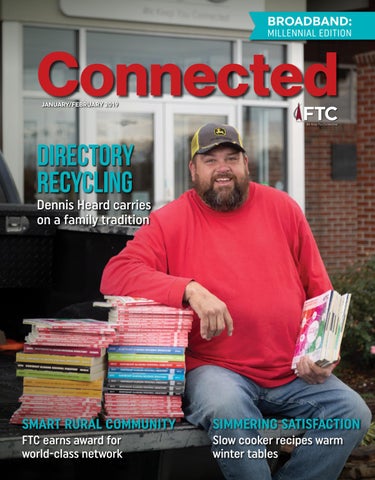
Directory Recycling
Dennis Heard carries on a family tradition
SMART RURAL COMMUNITY
SIMMERING SATISFACTION
FTC earns award for world-class network
Slow cooker recipes warm winter tables
INDUSTRY NEWS
Rural Connections BY SHIRLEY BLOOMFIELD, CEO NTCA–The Rural Broadband Association
What is your broadband story? We just closed out a year when rural broadband was a continuing news item, and I believe that will hold true in 2019. This is good news for those of you reading this magazine, and even better news for the millions of rural Americans not served by a progressive broadband provider like yours. It’s easy to get caught up in the policy behind the issues. After all, the bills Congress debates become the laws that govern rural broadband. It’s so important that rural broadband providers like yours stay involved in the process to ensure that public policy encourages investment in building reliable broadband service to our rural regions. That’s a key function of NTCA as the unified voice of nearly 850 independent, community-based telecommunications companies. But we must always remind ourselves that the reason we work for good public policy is to help communities build the networks needed to support an improved quality of life for real people. In every issue of this magazine, you read stories of people who are using broadband to make a difference in their lives, businesses, families and communities. That is what drives our work. With funding programs in the news, USDA efforts and FCC initiatives — not to mention new providers getting into the telecom business — 2019 is going to be another big news year for broadband. Help us keep our eyes on the human impact by sharing your broadband stories on social media using the #ruraliscool hashtag.
2 | January/February 2019
Fighting cyberthreats together NTCA continues a collaboration with the Department of Homeland Security to provide telcos with critical cyberthreat information Small telecommunications providers mount a strong defense against advanced security threats from criminal elements and overseas enemies. Beyond the professionals on its local staff, your internet provider benefits from the cybersecurity efforts of hundreds of similar companies across the U.S. NTCA–The Rural Broadband Association represents nearly 850 independent, community-based telecommunications companies, helping them collectively work toward solutions to industry challenges and better serve their members and customers. The association recently announced that, in partnership with the Department of Homeland Security and National Institute for Hometown Security, it will explore creating a forum for small, rural telecom operators from across the country to share and receive timely, actionable and relevant cyber information. Bob Kolasky, director of the National Risk Management Center, presented NTCA with a National Infrastructure Protection Program Security & Resilience Challenge award for 2019 to support the project, which will include the creation and beta test of a daily cyber intelligence report. This will be curated to meet the unique needs and interests of community-based telecommunications broadband providers. This new award follows NTCA’s successful collaboration with DHS to create the 2018 Cyber Wise Program that provided free, industry-focused risk management training to rural telcos. “NTCA is proud to support small, rural operators as they navigate an increasingly complex cyber landscape,” says NTCA Chief Executive Officer Shirley Bloomfield. “As we all know, cyberattacks are truly a matter of ‘when,’ not ‘if,’ and this new partnership with DHS and NIHS will help explore a new forum to ensure rural broadband providers are both aware of threats and equipped with the information and tools that they need to respond. I’m grateful for this continued collaboration and look forward to seeing its results.”
Lifeline is a government assistance program that can help pay a portion of your telephone, mobile phone or internet bill each month. Consumers are allowed only one Lifeline program benefit per household.
Lifeline
SERVICE ?
Guidelines will continue to be eligible for a Lifeline program benefit. (State determinations of income will no longer be accepted.) There are no changes to the eligibility criteria for Tribal programs.
How much will Lifeline save me? If you qualify for Lifeline, you will receive a credit of $9.25 each month on your bill.
?
What services are covered by this credit? You have the choice (where applicable) of applying your benefit to one of three types of service offerings: • Fixed or mobile broadband • Fixed or mobile voice-only • Bundles of fixed or mobile voice and broadband NOTE: Lifeline can only be used for one source of communication from the list above.
?
Can I receive more than one Lifeline credit? No, consumers are allowed only one Lifeline program benefit per household.
?
How do I qualify? You are eligible for Lifeline benefits if you qualify for and receive one of the following benefits: • SNAP • Medicaid • Supplemental Security Income (SSI) • Federal Public Housing Assistance • The Veteran’s Pension or Survivor’s Pension benefit. Additionally, consumers at or below 135 percent of the Federal Poverty
NOTE: Some states have additional qualifying programs, allowances and stipulations. Check with your local telecommunications provider for information about benefits that may be available in your state.
?
How do I enroll in the Lifeline program and start receiving this benefit? To find out whether you qualify for Lifeline assistance, please visit www.lifelinesupport.org or call your local telecommunications provider. NOTE: Your telephone company is not responsible for determining who qualifies for these programs or who receives assistance. Consumers must meet specific criteria in order to obtain assistance with their local telephone and/or broadband service, and qualifying is dependent upon government-established guidelines.
? DO YOU QUALIFY? Stay connected with a Lifeline discount. Apply today!
FRS Youth App Challenge Students, it’s time to start thinking about the Foundation for Rural Service’s challenge and the app that could pave the way to your future.
Who: Students enrolled in grades seven to 12. A single student, or teams with as many as five students, may compete.
What: Develop a concept for a mobile app to address a problem or improve a process in your rural community or in rural America at-large. The challenge is concept-based only, and entries will be judged based on how well-researched and wellpresented the app is. It must be possible and not already an app in existence.
When: The submission deadline is March 1, 2019. Why: The winning team will receive $1,000 in gift cards and Codecademy scholarships.
How: Visit FRS.org for more information about submissions. January/February 2019 | 3
FROM THE CEO
Our mission
A
bout two decades ago our Board of Trustees adopted a formal statement of mission. Though we’ve always understood our duty to you, it was refreshing to see it stated in print and in somewhat visionary terms. We sort of wrote down what we aspired to become. This was before the widespread adoption of the public internet and our decision to become an optical fiber provider. Still, the statement guided us well.
FRED JOHNSON Chief Executive Officer
In recognition of the fact we’ve accomplished much of what we set out to do, our Board of Trustees just approved a forward-looking update to this document. It wasn’t merely an exercise in wordsmithing. It was a meaningful and fresh endorsement of our commitment to each of you, to remain faithful to our original purpose. It is a blessing to work for such a company and for you. I am extremely grateful for that and for my colleagues, the outstanding men and women who daily keep you connected. There is much else I would like to tell you, but sometimes the less talk the better. I will let our Mission speak for itself.
THE FTC MISSION We are different. We were created not for profit, but to serve ... to serve you. At Farmers Telecommunications Cooperative, we realize it is not about us. It is about you. We will invest in your future. We will build, maintain and serve you with the region’s premier telecommunications and broadband network. We will enhance and promote economic growth and the quality of life for all we serve — connecting your homes, businesses and communities to the rest of America and the world. We do not merely serve the community. We are part of the community and we are committed to making it a vibrant place in which to live and do business. We will use our time and resources to connect you, to empower you, to create jobs for you, to give charitably, to improve lives — to make our community stronger — all through communication. Because we value you, in all that we are and in all that we do, four principle values — honesty, integrity, fairness, and respect — will guide our every action. We shall not compromise these values, and we expect the same from all who choose to do business with us. We are a cooperative. We are driven by our values and by our principles. We are driven by you. We are many members. We are one force. We are one vision. By keeping you connected we will build a better world. We are FTC.
Connected JANUARY/FEBRUARY 2019
VOL. 23, NO. 1
Connected is a bimonthly magazine published by Farmers Telecommunications Cooperative, © 2019. It is distributed without charge to all customers of FTC.
FTC is the state’s largest member-owned provider of telecommunications services. It serves Northeast Alabama with a robust broadband network using world-class optical fiber technology.
Farmers Telecommunications Cooperative, Inc. P.O. Box 217 • 144 McCurdy Ave. N. Rainsville, AL 35986 Telephone: 256-638-2144 www.farmerstel.com
BOARD OF TRUSTEES Randy Wright, President Flat Rock Exchange Garry Smith, Vice President Fyffe Exchange Danny R. Richey, Secretary Geraldine Exchange Lynn Welden, Treasurer Bryant Exchange Kenneth Gilbert Pisgah Exchange Gregg Griffith Henagar Exchange Randy Tumlin Rainsville Exchange Produced for FTC by:
On the Cover: Dennis Heard, known as Big D, picks up telephone directories each year from local schools and handles recycling for FTC. See story Page 8.
4 | January/February 2019
Rates are increasing.
FTCtv
Broadband
HERE ARE THE FACTS. Why? As consumers’ dependence on broadband continues to climb, we must maintain and upgrade equipment to offer more bandwidth and faster speeds. This is our first increase in
What We’re Doing We are constantly improving our network to provide you the best broadband experience. We are upgrading in-house equipment to faster, better routers to give you improved Wi-Fi coverage.
broadband rates in two years, still below the rate of inflation.
Why? Programmers continue to increase the rates they charge us for their channels. We must pass those increases on to our subscribers.
What We’re Doing We continue to negotiate with programmers to keep costs low, but the truth is, they can charge us whatever they want to charge. You can contact your congressman to express your concerns, but frankly the issue of rising costs of TV programming does not seem to be a priority to the U.S. Congress at the moment.
New TV Reality Viewers are shifting away from traditional TV to streaming channels over broadband. Instead of paying for well over 100 channels to get the 10 or 15 they really want, viewers are turning to streaming services that offer select packages at lower prices.
Our New Direction Instead of spending up to $1 million for needed equipment upgrades to serve just 4,000 FTCtv subscribers, we are putting that money to work expanding fiber internet service. We are no longer adding new FTCtv subscribers, but instead we are building the best broadband network available to support the many viewing options being offered today.
We are adding more redundancy — routes from key points in our network to the outside world to minimize service interruptions.
Increase Amount Broadband Internet Residential service – $3.00 Business service – $4.00
FTCtv Expanded Basic TV – $8.12 Business Premier TV – $6.00 Business Office Video – $5.50 Business Preferred TV – $4.00 Business Office Entertainment – $3.50 Business Office Lite, Business Core TV, Tavern Core TV and Tavern Preferred TV – $3.00 Expanded Basic Lite TV – $2.50 Limited Basic TV and TV Lifeline – $1.50 Showtime, ViewLocal – $1.00 Variety Tier – $0.50 STARZ – $0.25 Hispanic Tier – $0.20
Phone Service
Phone service will also see a slight increase, based on the Consumer Price Index.
Residential service – $0.40 Business service – $0.78 Increases effective either Dec. 31, 2018 or Jan. 15, 2019 depending upon service provider.
As technology changes, our mission remains the same: keeping you connected. Farmers Telecommunications Cooperative
January/February 2019 | 5
TRAVEL
Take a sip of history
Soda bottling tours offer a tasty treat
G
eorge Fletcher boarded a train in New York near his Long Island home and rode for hours until he arrived in Cincinnati. Then, he rented a car and drove 100 miles to his destination: the Ale-8-One plant in Winchester, Kentucky. He patiently waited until the start of the tour, which had also drawn parents with young children, grandparents and others who love Kentucky’s favorite soda.
“I’ve wanted to do this for a long time,” Fletcher says. “I’ve loved Ale 8 for so long, and it will be fun to see how it’s made. Just to see the process will be so interesting.” Fletcher’s quest is not unusual. Guests come from all around to see where and how their favorite soda is made, says DeAnne Elmore, the company’s public relations and field marketing manager.
Crafting a destination
Ale-8-One is a signature Kentucky soda and part of a family-owned business dating to 1902. Tours are available at its plant in Winchester, Kentucky.
6 | January/February 2019
The building now housing Ale-8-One was originally part of a bowling alley. The first soda was produced in 1926, and the company moved its headquarters in 1966. In 1989, an addition enabled increased soda production. There are now four varieties of Ale-8-One: the original, diet, caffeine-free and cherry. Tours began during the soda’s 75th birthday celebration. “We are limited by space, so we try to keep groups at about 30 people,” Elmore says. “That way, everybody gets a good experience and can see our production facility. People get to see up close and personal who’s really making this brand.” The company embraced Kentucky’s legacy of beverage production, which benefits from the popularity of bourbon and the Bourbon Trail tourism guide. “We are a member of the Kentucky Distiller’s Association and an associate member of the Bourbon Trail as Kentucky’s only soft drink,” Elmore says. Guests on the tour take a seat in a large room where they enjoy a video presentation hosted by the company’s CEO, Fielding Rogers, who is the fourth generation of the Rogers family to hold the post. The video offers a history of the brand and the manufacturing processes that are not part of the tour due to OSHA safety regulations. Following the video, a vial of the secret formula that is part of every bottle of Ale-8-One is passed around for sniffing before the tour takes a turn
through the heart of the facility. Visitors see where bottles are filled, capped and prepared for shipping. “We’re still an operating manufacturing facility, so we can’t guarantee that all the lines will be running, but we try to do our best to make sure they are when we have tours,” Elmore says. Following the tour, guests are treated to tastes of Ale-8-One, and if you want to take some home — or a baseball cap, hoodie, koozie, salsa, barbecue sauce or other Ale-8 gear — there’s a gift shop near the entrance/exit. For tours of Ale-8-One, offered on Thursday and Friday mornings, log on to www.ale8one.com.
HOW IT BEGAN George Lee Wainscott started his soft drink company in 1902, making distilled water and flavored drinks. In 1906, he added Roxa-Cola to his inventory, named for his wife, Roxanne. Coca-Cola sued and lost, but even so, Wainscott wanted something new and unique to him, so he invented a new, unnamed soda — a pleasant blend of ginger and citrus. He introduced his creation at the Clark County Fair and sponsored a “name-that-soda” contest. The winning name was “A Late One,” meaning, in Southern vernacular, “the latest thing” or “something new.” The name “A Late One” was then created into a logo pun, Ale-8-One, that would eventually become the colloquial name. But every bottle still carries the original “A Late One” name above Ale-8-One. Following Wainscott’s death, the company passed into the hands of his second wife, Jane Rogers; then to her brother, Frank Rogers; and on to his son, Frank Jr., who left it to his son, Frank III, who left it to his son and current CEO Fielding Rogers. He still uses his great-great-uncle’s handwritten notes to hand-mix the secret original formula.
Sodas around the South TENNESSEE
Double Cola is as synonymous with Chattanooga, Tennessee, as Moon Pies. Double Cola has been made in the downtown area since 1933 by the company that also produces other soft drinks like Ski, Jumbo Chaser and Oranta. Buy a hoodie and other items online and learn more about it at double-cola.com.
SOUTH CAROLINA Since 1903, Blenheim has produced ginger ale in Hamer, South Carolina. But the drink’s origins go back to the 1700s when a man lost his shoe in a water hole. Thirsty, he sampled the water and found it to be excellent. One hundred years later, ginger was added to the water and Blenheim Ginger Ale was born. The soda now comes in three varieties: mild, hot and diet.
ALABAMA Buffalo Rock Ginger Ale was created in the late 1800s and is instilled in the hearts of Alabamians. The Birmingham company of the same name — Buffalo Rock — continues to make its famous ginger ale. It has added more sodas to its line over the years, including Grapico, Wham and Sunfresh. The company remains family-owned and is under the leadership of founder Sidney Lee’s great-grandson, James C. Lee. Interesting fact: Buffalo Rock developed the first 3-liter soda bottles used by many soft drink companies today.
GEORGIA Coca-Cola was created in Atlanta, and a visit to World of Coke teaches you all about the Coke phenomenon. Learn the story behind it, see Coke artifacts, enjoy interactive exhibits, get a behind-the-scenes look at the bottling process and more. For information, visit www.worldofcoca-cola.com.
NORTH CAROLINA L.D. Peeler created Cheerwine in Salisbury, North Carolina, 102 years ago at the height of a sugar shortage in World War I. The wild cherry cola was an immediate hit and is now marketed across the country. The family-owned company is under the leadership of L.D. Peeler’s great-grandson.
January/February 2019 | 7
Dennis Heard has been helping FTC with its directory recycling program since its inception.
Another one for the books FTC gives back to schools through recycling program BY LISA SAVAGE
D
ennis Heard learned the importance of recycling and giving back from his father. So it was natural that the men started a recycling company years ago and also volunteered their time to FTC’s phone book recycling program.
The Heards would haul the first load to a recycling center in Chattanooga. Then, they would continue at the school where they had left off, going from Sylvania north through DeKalb County and on to Bryant, North Sand Mountain, Flat Rock, Pisgah, Dutton and Section in Jackson County. The route took two weeks to complete each year and two trips to the recycling center.
“When we first started, it was D & D Recycling,” Heard says. “That stands for Daddy and Dennis. We would joke that it really stood for dumb and dumber.” But now, it’s just Big D Recycling. Heard works alone, and only one time each year, to collect and recycle phone books for FTC. His father, Eldridge Heard, who was known as Big L, passed away in 2012. Now, Heard continues his father’s legacy. The Heards were on the forefront of recycling in the ’90s. They collected mostly cardboard, but FTC wanted to start a recycling program for the 55,000 phone books it produces each year. Dennis Heard’s aunt, Martha Knight, worked at FTC and thought the two men might like to be involved. Peggy Benefield, now retired from FTC, started the recycling program and had wooden bins placed in each community. It soon became evident, though, that the open bins collected too much water. “They’d get wet, and we were hand-loading them,” Heard says. “They were heavy, and it was tough.” The next year, schools in FTC’s service area collected the phone books. FTC paid about 25 cents to the schools for each of its phone books collected. “We’d start at Crossville, go to Geraldine and then Fyffe,” Heard says. “By the time we got to Plainview, we’d be packed out.”
THE BEGINNING
8 | January/February 2019
Injuries from a wreck in the late ’80s kept the elder Heard from working at the job he had held at the Tennessee Valley Authority for years. To make extra money, he would pick up scrap metal to sell. Students at North Sand Mountain participate in the directory recycling program for FTC.
Farmers Telecommunications Cooperative
After Heard graduated from Pisgah High School in 1996, he started working full time for his father. They recycled cardboard, primarily from sock mills in Fort Payne. But they always volunteered two weeks a year, collecting the telephone books and taking them to a recycling center. With the decline in the sock industry in the late ’90s, the bottom fell out of cardboard recycling, and the men regrouped. Recycling no longer took full-time efforts from both men. While his father continued the recycling operations, Heard went to work for the Jackson County Sanitation Department. He would take a week’s vacation each March and work with his father to recycle the phone books. Sometimes, his father had to scale back his efforts because of his health. That system continued until his father’s death six years ago. Now it’s a one-man job. Heard still takes a week’s vacation. He picks up fewer phone books than when he and his father first started. In the early years, students brought phone books that their parents, friends and neighbors had saved for years. The Heards might pick up between 1,200 and 1,500 books at one school and collect between 4,000 and 6,000 books in a two-week period. Last year, Heard picked up 35 books at one school. The most he picked up was 800 at another school. It only takes a week to make the rounds, and he takes the books to a recycling center in Scottsboro. “Last year, I think I only picked up 5 tons total,” he says.
Even though the numbers are smaller, it’s still an important mission for Heard. Now, FTC pays the schools 50 cents for each phone book. “It helps the schools, and it’s showing the kids that not everything needs to go in the garbage,” Heard says. Those concepts are important to him, and they were important to his father. In the later years, when his father could no longer help, he still wanted an update.
“He started all this, and he was so proud to be a part of it,” Heard says. “He always wanted to know what school had the most and how many pounds we had.” He still gives his father an update each year. “Still today, I go by the graveyard and visit Daddy afterward,” he says. “I’ll sit down and tell him who had the most. I know he’d be proud that we have continued doing this. It’s just a tradition.”
North Sand Mountain School has strong participation in FTC’s recycling program.
FTC proudly sponsors this recycling project that keeps tons of waste out of our landfills and helps schools earn money.
Other phone directories can be dropped off for recycling, but only FTC phone books will earn money for your school. Take books to the school of your choice.
Five tons of old phone books were kept out of landfills last year.
DROP OFF OLD FTC PHONE BOOKS TO ANY OF THESE • B R YA N T • F L AT R O C K • C O R N E R ST O N E C H R I ST I A N • F L O R A L C R E ST ACADEMY • F O R T PAY N E • C R O S S V I L L E • F Y F F E • D E K A L B C O U N T Y S P E C I A L • G E R A L D I N E S E R V I C E S C E N T E R AT F Y F F E • I D E R • D U T T O N • H E N A G A R
PA R T I C I PAT I N G S C H O O L S : • R O S A L I E • P L A I N V I E W • M O U N TA I N V I E W C H R I ST I A N A C A D E M Y • N O R T H S A N D M O U N TA I N • P I S G A H • S Y L VA N I A
DEADLINE MARCH 8TH Farmers Telecommunications Cooperative
January/February 2019 | 9
THE IMPACT OF BROADBAND: MILLENNIALS EDITION
Rethinking
rural
How some millennials are re-evaluating life in rural communities
BY DREW WOOLLEY
“Our plan was to stay in the Austin area,” Rushing says. “That’s where the jobs were, and that’s what I was preparing myself for.” That preference for metropolitan areas is typical for a generation that rural communities have had difficulty holding on to: millennials. But there’s reason to believe millennials may find more to like in rural communities as they age. For many, the term millennial has become synonymous with the silly, and derogatory, stereotype of any young person eating avocados while staring at their phone. But the Pew Research Center works with a more precise definition. They define millennials as anyone born from the years 1981 to 1997. That means even the youngest millennials have likely already entered the workforce, while the oldest probably have 10 | January/February 2019
Photo courtesy of Isabel Reyna.
S
ix years ago, Chase Rushing thought he had his future planned. Living in San Marcos, Texas, between San Antonio and Austin, he and his wife had access to all the entertainment a 20-something couple could want — not to mention a burgeoning tech scene.
a mortgage and kids to raise. As Rushing and his wife began considering the latter, the idea of returning to his hometown of Yantis, Texas, lodged itself in Rushing’s mind. “It was important for me that my son got to experience what I did growing up,” he says. “Being around all your family, the friendships, the bonds you form over that time. It’s like nothing else.”
WIDE-OPEN SPACES Even if millennials are no longer the youngest generation, several characteristics set them apart from those before them. They tend to value experiences over
Chase Rushing wants his own family to experience the smalltown lifestyle he grew up with.
possessions, get their news online rather than from TV, and value work-life balance in their careers. Perhaps most importantly, millennials are the first generation to grow up in the internet age, meaning they have a natural comfort with technology previous generations have not had. That could make them a predictor of how future tech-savvy generations will behave. Millennial trends are of particular interest to Dr. Roberto Gallardo, assistant director of the Purdue Center for Regional Development. While the mainstream consensus has been that millennials are flocking to cities, Gallardo
CROSS-GEN COMMUNITIES John Larson moved to a rural community not because he wanted to work remotely, but because his work could only be done from there. As a ceramic sculptor living outside of Milan, Minnesota, Larson is able to run his own business with low overhead and access natural materials that would be costly or inconvenient in a larger city. “Ceramics is a product of its location. If you use local materials, it will be a reflection of its place,” he says. “I’ve built my small business on reusing bent nails and foraging for materials.” Larson’s work also gets a boost from the established market for ceramics in the Midwest, but finding a place in that market isn’t always easy for young artists.
are the challenges we face and what can we do to address them?” he says. “It’s not millennials versus baby boomers or anyone else. It’s about all of us as a community.”
Photo courtesy of Kirstin Lindstrom.
Fostering more rural development programs is one step Larson believes communities like his could take to better promote the culture that already exists, as well as to help business owners collaborate and learn from one another. As the generation that now makes up the majority of the workforce, millennials will have an important say in those efforts. But Rushing believes that if his generation is going to open up rural communities to more young people, they will have to do so without losing sight of what makes the rural lifestyle special. It may be necessary to break down generational divides altogether. “I think we need to be asking what we can do to impact our community. What
Living in a rural community gives John Larson the chance to share the countryside with his daughter.
Rural America online Millennial population change in southeastern states
Population increase or decrease
believes improved internet connectivity could provide new opportunities in rural areas. “If you have a young family, you may consider moving out of an urban area because of rising housing prices,” he says. “Rural areas have a natural ambiance that can attract younger families if their job allows them to telework.” That draw depends heavily on rural communities building a high-speed internet connection, but there is reason to believe doing so could have a significant impact. A population analysis by Gallardo and two colleagues published in The Daily Yonder shows that, while rural counties across the country are seeing declines in millennial populations, those with highspeed internet service saw millennial populations increase by 2.3 percent from 2010 to 2016. That may not sound like much, but Gallardo points out that this is a process just getting started as millennials grow older. “Younger folks always flock to cities, so if you’re a very rural community, broadband is not a silver bullet,” says Gallardo. “But it is a very key ingredient to attract or retain millennials or younger families.”
0%
2.1% -2.3%
FASTEST INTERNET SPEEDS
-2.4%
-5.3%
-6.4%
SLOWER INTERNET SPEEDS
Nationwide population data shows that rural communities are losing younger residents to larger metropolitan areas. When looking at rural counties that have invested in high-speed internet connections, however, the picture changes significantly. The graph above shows how millennial populations changed in the most rural counties in Alabama, Kentucky, South Carolina and Tennessee from 2010 to 2016. Counties were ranked based on their internet connection, with the column on the far left showing those with the fastest internet speeds and the column on the far right showing the slowest. Over that time, counties with the fastest internet connections saw millennial populations grow by more than 2 percent, while counties with slower connections saw their millennial populations drop by more than 6 percent.
January/February 2019 | 11
FTC receives prestigious
Smart Rural Community honor BY LISA SAVAGE
M
She uses platforms such as Google Classroom and other technologies that allow her to communicate and teach. “I may present an interactive lesson to both the class and the student in Russia and in real time through Skype,” she says. “It is truly amazing to be able to do so 5,000 miles away. The advantages for our rural student population are invaluable.” This is just one example of how communities across North Alabama are improving lives by leveraging the broadband network built by Farmers Telecommunications Cooperative — from economic development strategies, education and health care to government services, public safety and other vital public functions.
RECOGNIZING TECHNOLOGY NCTA-The Rural Broadband Association honored FTC in 12 | January/February 2019
September with the Smart Rural Community Showcase Award at a gathering of more than 1,300 rural telecommunications industry leaders. The association also acknowledged 12 other companies and their communities. NTCA’s Smart Rural Community initiative recognizes the efforts of telecommunications providers across North America to deliver technologies that make rural communities vibrant places in which to live and do business. The selection is a competitive process. A panel of experts in the fields of education, health care, telecommunications, finance and rural economic development reviews applications from across the country. FTC received recognition for its use of broadband to connect the community’s resources and to prepare and enable citizens’
FTC had a ribbon-cutting ceremony in the city of Albertville as part of its gig launch in Marshall County.
Fred Johnson, chief executive officer of FTC, accepts the Smart Rural Community distinction from Shirley Bloomfield, CEO of NTCA–The Rural Broadband Association, at the association’s fall conference.
participation in the global economy. “We are pleased and excited to accept this award,” says Fred Johnson, FTC’s chief executive officer, who represented FTC at the awards presentation. “We have worked hard with our local leaders to ensure that our citizens have access to advanced communications and the many benefits those services enable.”
Photo courtesy of NTCA.
ichele Pettis, a gifted education specialist for Fort Payne City Schools, arranged for her students to Skype with a student in Russia. Pettis regularly takes advantage of the opportunities broadband internet provides to make online interaction possible with a student on the other side of the globe.
ALABAMA’S ACCESS FTC was instrumental in assisting with legislation that brings more broadband access to the state, says state Sen. Clay Scofield, a sponsor of the Alabama Rural Accessibility Act. “I’ve been working on that act for a number of years,” Scofield says. “We finally passed a form of it. Fred Johnson and Farmers were at the Farmers Telecommunications Cooperative
EDUCATION SMALL BUSINESS HEALTH CARE ENTERTAINMENT PUBLIC SAFETY COMMUNITY SERVICE
The benefits of a SMART RURAL COMMUNITY FTC’s world-class broadband network provides the foundation for an improved quality of life in our corner of the state.
heart of helping me understand the more technical aspects of broadband, including why it was a challenge to serve rural areas, how FTC was actively serving rural areas, and what we could do to help them serve rural areas better.” The recognition comes as a result of FTC’s hard work to bring broadband to the forefront in northeast Alabama. “They’re the people who are bringing broadband to these rural areas, which is going to allow our areas to compete with other areas, attracting business and industry and providing jobs,” state Rep. Kerry Rich says.
BROADBAND AND BUSINESS The success of FTC’s efforts is evident in the growth of businesses like The Children’s Place, a 700,000-square-foot distribution center for a leading specialty retailer of children’s merchandise. Located in Fort Payne, The Children’s Place had 150 employees when it opened in 2007, says Jimmy Durham, executive director of the DeKalb County Economic Development Authority. The company moved its internet-based operations from Secaucus, New Jersey, to Fort Payne and now employs as many as 1,175 workers locally, shipping 1 billion units of product annually. “They tapped into Farmers Telecommunications and were able to get great Farmers Telecommunications Cooperative
ECONOMIC DEVELOPEMENT service,” Durham says. “They closed all their distribution centers and moved them to Fort Payne simply because they handle all the sales and logistics via the internet.” In Albertville, Mayor Tracy Honea says many of the 25 industries inside the city use FTC services. “Several are extremely excited for Farmers to come in because of the access to fiber internet and what Farmers has to offer,” Honea says. “I think it’s huge.”
EDUCATIONAL IMPACT FTC’s commitment to better serving the community makes tangible differences for educators like Pettis in Fort Payne City Schools, which began a move toward a digital platform in 2009. Superintendent Jim Cunningham says the change is possible because of FTC broadband services. “It was necessary for our shift from paper and pencil to classroom instruction through digital devices and content,” Cunningham says. FTC also provided hot spots around the city at locations students can use. “This enables students to access the internet who might not have an internet connection at home,” Cunningham says. Boaz City Schools Superintendent Shannon Stanley says FTC coming to Boaz is a game-changer for the school system. “It’s going to heighten our connectivity. It’s going to strengthen our infrastructure,
and we’re going to be able to expand broadband access to our students, hopefully in the surrounding areas where they live,” she says. The gigabit service FTC provides also benefits Northeast Alabama Community College. “It’s fantastic having this type of service here at Northeast,” college President David Campbell says. “We have more than 1,000 personal computers and 25 computer labs, and all our classrooms are equipped with smart boards. We really emphasize technology, and the gig service is what puts us over the top.”
MAKING A DIFFERENCE It’s that kind of service and commitment that is making an impact in the communities FTC serves. “FTC is a prime example of the power of a broadband connection and a steadfast commitment to growth and prosperity,” says NTCA CEO Shirley Bloomfield. “Not only are the people of FTC charting their own path to a more prosperous future, but they are also creating a road map for more communities across the country to follow suit. I commend the people of FTC for these extraordinary efforts.” For FTC, it’s only the beginning. “We look forward to building on our success for many years to come,” Johnson says.
January/February 2019 | 13
SOUTHERN KITCHENS
The joy of
COOKING SLOW
I
n the South, when the weather turns cold and the days are short, we bring our slow cookers out of hibernation to blanket ourselves in comfort food. “Nothing beats a slow-cooked pork butt or roast chicken with all the trimmings,” says Sandra Corbin.
She lives on a farm in Clarksville, Tennessee, and she started using a slow cooker when her children were young and still in school. Her first slow cooker, purchased in the 1970s, was harvest gold with a brown lining and glass top that didn’t seal very well. “It was round and only had two settings — high and low,” she says. But with work on the farm and children’s after-school activities, she appreciated the freedom of not spending time 14 | January/February 2019
laboring over the stove. “A momma is always full time, and a farm momma even more so,” she says. “When my youngest daughter was 16, I worked full time commuting to Nashville five days a week while attending college at night. The Crock-Pot certainly came in handy during that time of my life, too.” Her daughter, Melissa Corbin, a Nashville-based food consultant and freelance journalist, says she remembers coming home to her momma’s
Melissa Corbin learned slow cooker secrets from her mother, Sandra.
cooking. The house would be filled with the smells of delicious foods that had slowcooked for hours. “There were always aromas to be savored in her kitchen,” she says. “She encouraged me from a very early age to cook alongside her. She didn’t
care what mess I might make. It was more important to her that I learn kitchen basics that, to this day, I can remember her teaching me.” Though Sandra Corbin made much use of her slow cooker when she had children in tow, she appreciates it all
SLOW COOKER CANDY Sandra Corbin’s slow cooker candy is adapted from several online sources, such as this favorite from country music star Trisha Yearwood.
2 pounds salted dry-roasted peanuts 4 ounces Baker’s German’s sweet chocolate 1 (12-ounce) package semisweet chocolate chips 2 1/2 pounds white almond bark Put the peanuts in the bottom of a slow cooker. Over these, layer the sweet chocolate, chocolate chips and almond bark. Slow cook on low for about 3 hours. Do not stir the mixture while cooking until after the 3 hours is up. Then, stir with a wooden spoon until smooth. Drop the candy into cupcake pan liners and let cool.
the more as she’s gotten older. “As I’ve aged, I prefer one-pot meals with simple ingredients, like a pot roast, cream of mushroom soup and a package of Lipton Onion Soup Mix with all the veggies simmered on low all day,” she says. As life changes, so do slow cookers. Many come with multiple bells and whistles. “Too many parts prone to breaking,” Melissa Corbin says. “Rather, we have the same slow cookers in different colors from the original Rival Crock-Pot line. Mine is stainless and Momma’s is red. She’s drawn to bright colors.”
FOOD EDITOR ANNE P. BRALY IS A NATIVE OF CHATTANOOGA, TENNESSEE.
POZOLE VERDE A favorite go-to recipe from Melissa Corbin.
3 pounds pork butt, roughly cut into 1-inch pieces Salt and pepper, to taste 1 teaspoon ground cumin 1-2 tablespoons vegetable oil 1/2 cup white wine 1 large onion, diced 3 cloves of garlic, finely chopped 1 poblano pepper, charred and chopped 1 jalapeno pepper, charred and diced 1 pound tomatillo, roughly cut into 1-inch pieces 2 (15.5-ounce) cans hominy, drained Sliced limes, chopped cilantro, freshly sliced jalapeno and chopped red onion for garnish Generously season pork with salt and pepper. Sprinkle with cumin. Heat a large frying pan (preferably cast iron) with 1 tablespoon of vegetable oil, adding extra oil as needed. The pan should be screaming hot to sear the pork without cooking through. Make sure to work in small batches so you do not steam the pork. Look for caramelized edges to the pieces of pork as you brown. Transfer the pork directly into the slow cooker, and then reduce the heat and deglaze the skillet with 1/2 cup white wine and pour over pork. Add to the slow cooker the onion, garlic, peppers and finally tomatillos in the order listed. Cover and cook on high for 3 1/2 hours. Then, stir in the hominy for a final 30 minutes of cooking. Turn the slow cooker to its lowest setting to give the pozole time to rest before serving. Finish with lime, jalapeno, cilantro and red onion. Makes approximately 6 servings.
SLOW COOKER SOUP STARTER This nutrient-rich soup starter recipe will be just what the doctor ordered in the cold months of winter.
3 yellow squash or zucchini, cubed 4 banana peppers or 1 bell pepper, chopped
2 garlic cloves, minced 2 carrots, diced 4 cups chicken or vegetable broth 1 (16-ounce) can tomatoes or 3-4 fresh tomatoes roughly chopped 1/2 tablespoon onion powder 1/2 teaspoon thyme 1 teaspoon salt 1/2 teaspoon pepper 1/2 teaspoon sugar 1 teaspoon olive oil 2 bay leaves Stir all ingredients into a 6-quart slow cooker. After cooking on high for 30 minutes, simmer on low for 4 hours. Remove bay leaves. The starter is ready for immediate canning. Otherwise, let cool thoroughly before freezing in freezersafe bags.
Suggested additions: bb Consider using this starter as a foundation for curry. Heat 1 1/2 cups of full-fat coconut milk with 1 tablespoon curry powder, 1/2 teaspoon powdered ginger, 1/8 teaspoon red pepper flakes, 1 stalk of lemongrass (optional), 1 diced potato and a protein of your choice, such as chicken or shrimp. Stir in 1-2 cups starter and simmer, uncovered, until desired thickness. Remove lemongrass before serving. Garnish with chopped cilantro or green onions. This soup is great on its on but is delicious over a bed of jasmine rice. bb Into a cast-iron skillet, add 1 cup shredded rotisserie chicken, 1/4 cup chopped kalamata olives and 1 teaspoon dried oregano to 1-2 cups of the soup starter. Spoon over grilled bread and top with fresh feta cheese for a Mediterranean twist on bruschetta. bb Minestrone is an Italian soup classic. Combine 1 cup cooked elbow macaroni, 1 (15-ounce) can of drained kidney beans, 2 cups chicken stock, 4 cups soup starter, 1 teaspoon dried oregano and 1 teaspoon dried basil. Simmer on low for 15-20 minutes. Garnish with freshly torn basil leaves and grated parmesan cheese. Drizzle a bit of extra virgin olive oil for the perfect finish. January/February 2019 | 15
Presort STD US Postage PAID Permit #21 Freeport OH
P.O. Box 217 • 144 McCurdy Ave. N. Rainsville, AL 35986
Investi n g in our future! Earn a scholarship from FTC! »» FTC will award one $2,000 scholarship to a deserving high school senior. »» FTC will award one $2,000 scholarship to a student already enrolled in college. »» Applicants must live in the FTC service area and their legal guardian/ parent or applicant must be an FTC customer. »» Applications are available through area guidance counselors and at farmerstel.com. »» Completed applications must be received at FTC’s business office no later than 4 p.m. on March 7, 2019.
FRS scholarships also available! Ask your guidance counselor or visit farmerstel.com for more information about these additional scholarship opportunities available through the Foundation for Rural Service. These applications must be received by February 13, 2019, at 4 p.m. at the FTC office.
High school students could win a trip to Washington, D.C. Foundation for Rural Service (FRS) Youth Tour June 1-5, 2019 »» Students must be in high school, age 16 or 17, at the time of the tour to qualify. »» Applications are available through area guidance counselors and at farmerstel.com. »» Applicants must live in the FTC service area, and their legal guardian/parent must be an FTC customer. »» Completed applications must be received at FTC’s business office no later than 4 p.m. on March 1, 2019.
256-638-2144 • FARMERSTEL.COM