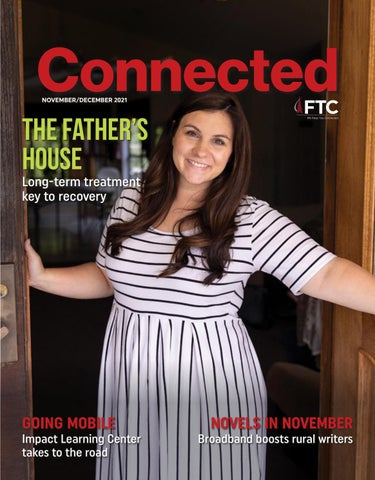
Connected NOVEMBER/DECEMBER 2021
The Father’s House Long-term treatment key to recovery
GOING MOBILE
Impact Learning Center takes to the road
NOVELS IN NOVEMBER
Broadband boosts rural writers
INDUSTRY NEWS
Rural Connections By SHIRLEY BLOOMFIELD, CEO NTCA–The Rural Broadband Association
Committed to a fiber future
F
or several years, NTCA has encouraged policymakers to think with a hand in the present but an eye toward the future. But in Washington, D.C. — where every technology and every interest has lobbyists and political champions — that mission is easier said than done. Many of the nation’s internet providers believe in a fiber-or-bust approach. As long as it's physically possible, which is not always the case in rural areas, fiber should be the goal. As lawmakers weigh infrastructure investments, why should internet providers settle for less? Many NTCA members are working diligently to extend fiber optic networks, despite challenges like slow supply chains limiting access to the materials needed to build these robust networks. They are making strides. In our most recent broadband survey, 70% of NTCA members’ customers enjoyed fiber to the premises. It’s a technology that makes it possible for internet providers such as yours to easily scale their services to meet demand. Fiber infrastructure is also a key component of building a better future that includes higher-performance services, real-time applications, smart communities, precision agriculture, 5G superiority and better access to health care and education. To achieve our goals as a nation, we need a strong foundation of fiber connectivity. Connecting rural communities to the rest of the nation and to the resources they need to excel matters. Broadband matters, because its speed and capacity are the new baselines for working, learning and growing the economy — from wherever we might be. Investment in fiber optic internet ensures rural America will not be relegated to second-class status. It’s more than a worthy investment in infrastructure development, it’s an investment in our nation’s future.
2 | November/December 2021
SOS
FBI program helps keep kids safe online The holidays often bring new gadgets and devices, as well as some free time for kids enjoying a break from school. This time of year is a good opportunity to remind younger technology users of the risks of being online and to share strategies to keep themselves safe. The FBI offers tools to help build a digital defense to protect kids online. These tools include the agency’s free computer literacy program, Safe Online Surfing, or SOS. Designed for children in grades three through eight, it’s available to teachers, administrators and parents, who can introduce children to the concepts one-on-one. The program engages children through a series of online games that mix fun with education on a variety of topics, including online etiquette, managing cyberbullying, the importance of strong passwords and double authentication, and more. Visit sos.fbi.gov to access the guide.
The FBI offers a few additional tips for parents: ➤ Discuss with your children what kind of information, photos and videos are appropriate to post online — and what’s not. ➤ Emphasize that kids should limit the information they post on social media platforms, such as their full name, date of birth and school information. ➤ Teach that, while free software and apps seem enticing, using them may open phones and computers up to malware or worse.
Tech the halls GIVE GREAT GADGETS
G
reat tech gifts don’t have to be expensive. There are plenty of options under $50 that will make the holidays merry. We’ve got some suggestions, whether you’re shopping for a more budget-friendly gift for that gadget-crazy person on your list or a fun stocking stuffer that won’t break the bank.
29.99
$
MSRP at us.tomy.com
KIIPIX PORTABLE PHOTO PRINTER This one’s a neat gadget that reproduces images from your smartphone without the need for Wi-Fi or even batteries. You just place your phone on top of the KiiPix, and it takes a picture of your screen and prints a photo in minutes. Reviews point out that the device can be finicky with ambient light, and the quality will be closer to those instant Polaroid pictures from the ‘70s than a professionally printed photo, but the retro look is part of the fun. Available in pink, blue and black.
8BITDO SN30 PRO+ Any gamer would appreciate the SN30 Pro+, a customizable controller compatible with a variety of systems. Featuring rumble vibration, motion controls and 20 hours of play off a four-hour charge, the controller can also be used wired through USB or wirelessly via Bluetooth. Compatible systems include Windows, macOS, Android, Steam, Nintendo Switch and Raspberry Pi. Free software allows you to customize buttons, adjust stick and trigger sensitivity, and create macros with any button combination. The controller is available in black and in color combinations reminiscent of the classic Nintendo amazon.com Entertainment System and the Super Nintendo.
49.99
$
POWERUP 2.0 PAPER AIRPLANE CONVERSION KIT Even if your design skills are more Wright brothers than Boeing, you can still transform a regular paper airplane into a dream flying machine, while kids can learn about basic principles of physics and working with simple electronics. The POWERUP 2.0 kit includes two sheets of high-quality paper to get you started, a charger, a carbon fiber propeller shaft and an ultratough rear propeller — for those inevitable crash landings. The POWERUP 4.0 model, which is $69.99, comes with stabilization technology and can be controlled with your smartphone. Either way, get ready to take to the skies!
69.99
$
poweruptoys.com
TILE The best Bluetooth finder on the market, the Tile line of products can be attached to your keys, backpack, purse or TV remote — anything that can be lost or misplaced. A free app for iOS or Android can then be used to find the missing Tile within 150 to 400 feet — depending on the Tile size — or you can ask Siri, Google Assistant or Alexa for help. When outside of Bluetooth range, the app will show the Tile’s most recent location, which is updated whenever another Tile user comes within range of your device. You thetileapp.com can also subscribe to Premium service, which includes free battery replacement and smart alerts that warn you when you’ve left something behind, or Premium Protect, which reimburses you up to $1,000 if Tile can’t find your things.
24.99
$
November/December 2021 | 3
FROM THE CEO
The path of least regret
Y
ogi Berra is credited with saying, “When you come to a fork in the road, take it.” In business, we often worry about paralysis by analysis. That is, we spend so much time making a decision that it is irrelevant by the time we choose a direction. Yogi’s advice avoids that problem. I’ll bet some of you are like me, however. Some decisions are hard to make. There is much to be considered.
This time of year, we spend a lot of time looking well into the future of FTC. There are budgets, work plans to update and longterm strategies to evaluate. We try to determine what we know and what we don’t know. We also inevitably worry about those things we do not know that we do not know. Former Secretary of Defense Donald Rumsfeld referred to these factors as the unknown unknowns. They are the ones that can really trip you up. Think global pandemic. We all saw that coming, didn’t we? FRED JOHNSON Most everyone appreciates that critical decisions need thoughtChief Executive Officer ful analysis. The problem is that we must make many of life’s decisions without a complete understanding of all known and unknown factors. That fact causes stress, and the more important the decision, the greater the stress. There is also the reality that no one bats a thousand. No matter how hard we try, some of our decisions will turn out wrong. At FTC, one principle we often employ in decision making, especially on critical matters, is what we call the path of least regret. After examining as many options or alternatives as it is feasible, we will ask ourselves a simple question: In the long run, which choice or decision is the one that we are least likely to ever look back on and say, “Gee, I wish we had not done that.” When the inevitable happens, it helps to understand that you made a call for the right reasons and would have regretted the alternatives even more. This principle works with any type of decision — business or personal. Am I ever going to regret spending that extra time with my spouse or children? Am I ever really going to be sorry I helped that person in need? I am sure you get the point. Life is tough. Decisions are hard, but when we examine alternatives in this manner, we also exercise our priorities, and that is a good thing. Wouldn’t you agree? One thing is important to remember. Do not ever confuse the path of least regret with the path of least resistance. They are not the same thing. The latter is often a cop-out. The former usually involves hard decisions and considerable effort. I recently faced a decision about whether or not to render aid to a person in a measure of distress. Doing so entailed a security risk of which I needed to be aware. I struggled with the decision long enough to experience a significant amount of guilt. When the truth hit with great force, it was really quite simple. Even if helping turned out badly, there was no way I would regret it more than I would regret walking away. Let’s acknowledge the fact that we all have a lot on our plates. My hope is that this principle will help you deal with whatever comes your way. Minimizing regret in life is a worthy objective. I wish you nothing but success in that regard.
Connected NOVEMBER/DECEMBER 2021
VOL. 25, NO. 6
Connected is a bimonthly magazine published by Farmers Telecommunications Cooperative, © 2021. It is distributed without charge to all customers of FTC.
FTC is the state’s largest member-owned provider of telecommunications services. It serves Northeast Alabama with a robust broadband network using world-class optical fiber technology.
Farmers Telecommunications Cooperative, Inc. P.O. Box 217 • 144 McCurdy Ave. N. Rainsville, AL 35986 Telephone: 256-638-2144 www.farmerstel.com
BOARD OF TRUSTEES Randy Wright, President Flat Rock Exchange Garry Smith, Vice President Fyffe Exchange Danny R. Richey, Secretary Geraldine Exchange Lynn Welden, Treasurer Bryant Exchange Kenneth Gilbert Pisgah Exchange Gregg Griffith Henagar Exchange Randy Tumlin Rainsville Exchange Produced for FTC by:
On the Cover: Katina Blanchett, founder and director at The Father’s House, uses her own experiences to help others recover from addiction. See story Page 8.
4 | November/December 2021
FTC NEWS
Thankful
FOR OUR CUSTOMERS! The registration and voting by 1,742 FTC members at this year’s drive-thru annual meeting showed the power of participation, says Fred Johnson, FTC’s CEO. That’s three times more than the typical number who registered and voted at the live events. “It sends a clear message,” Johnson says. “We miss the big gatherings for our annual meeting at the DeKalb Schools Coliseum, and seeing our members, but it’s about what serves you best.” This year, members participated in a weeklong drive-thru under a large tent in the FTC parking lot. Each member who registered and voted received a $20 bill credit for October. The board members reelected were Danny Richey, secretary — Geraldine Exchange; Lynn Welden, treasurer — Bryant Exchange; and Kenneth Gilbert – Pisgah Exchange.
Gary Storie won the grand prize, a truck. » Wireless Speaker: Glenda Smith » iRobot Roomba Vacuum: Bill McMahan » Apple iPad: David Carman » 50” Ultra HD Smart TV: Brent Lahayne » $500 Foodland Gift Card: Angela Richards » FTC Total Connect Security Service: Gerald Ivey » Traeger Pro 575 Wi-Fi Pellet Grill/Smoker: Terry Traylor » One Year of Gig Internet Service: Brooks Smith
“Thank you to all our members for being a part of this year’s annual meeting and choosing FTC to keep you connected.” —Fred Johnson
Do you need assistance paying for your broadband service? You are eligible for Lifeline benefits if you qualify or someone in your household qualifies for and receives one of the following benefits: • SNAP • Medicaid • Supplemental Security Income (SSI)
• Federal Public Housing Assistance • The Veteran’s Pension or Survivor’s Pension benefit.
Additionally, consumers at or below 135% of the Federal Poverty Guidelines will continue to be eligible for a Lifeline program benefit. (State determinations of income will no longer be accepted.) There are no changes to the eligibility criteria for tribal programs.
GET CONNECTED TO THE LIFELINE ASSISTANCE PROGRAM To apply visit: lifelinesupport.org/ get-started.
LIFELINE IS A FEDERAL PROGRAM TO HELP LOW-INCOME AMERICANS PAY FOR BROADBAND SERVICE. This program provides a $9.25 per month discount for broadband services. FTC is not responsible for determining who qualifies for these programs or who receives assistance. Consumers must meet specific criteria in order to obtain assistance with their local telephone and/or broadband service, and qualifying is dependent upon government-established guidelines.
For more details visit: farmerstel.com/lifeline. farmerstel.com/lifeline
Farmers Telecommunications Cooperative
November/December 2021 | 5
TRAVEL
Starry, starry nights Story by ANNE BRALY
T
he evening sky over Clear Creek was speckled with clouds. But as darkness settled across Tennessee’s Cumberland Plateau, the clouds parted and the Big Dipper came out, nodding to the moon as its halo crept closer to Orion and his belt. This scene is played out regularly near Wartburg, Tennessee, at the Obed Wild and Scenic River, a 5,100acre park with 45 miles of waterways snaking their way through canyons guarding the banks of the Obed River, Clear Creek, Daddy’s Creek and Emory River. In 2017, the park was designated as an International Dark Sky Park by the International Dark Sky Association, making it one of only two in Tennessee and one of 69 in the United States. Getting the designation was a five-year process, says Rick Ryan, an interpretive ranger at the park. “It required a lot of patience and persistence,” he says. The process involved, first and foremost, the obvious — being dark. That may sound simple, but a sky-quality meter was used to determine whether or not the park had too much ambient light from neighboring towns. It didn’t. So the park passed that test. “It’s not enough to be dark, though,” Ryan says. “You have to be committed to preserving the night sky.” That’s done through street lighting and lighting paths and parking lots using only dark-sky-friendly lighting fixtures, something that was easy for Obed Wild and Scenic River since there is no outdoor lighting. A Dark Sky Park must also be committed to providing educational programs to teach visitors about the importance of darkness as a resource for plants and animals like owls and other night hunters. A good place to stargaze at Obed Wild and Scenic River is the Lilly Bluff Overlook boardwalk found at the end of the Overlook Trail, a well-marked route once you pass through Wartburg. There’s plenty of parking, and it’s a short walk over to the bluff overlooking the gorge of Clear Creek. There are two boardwalks with platforms where you can set up your chairs and any stargazing equipment you may bring. Before the COVID-19 pandemic, Ryan and a team of volunteers held regularly scheduled stargazing opportunities, providing telescopes and everything needed for visitors to see the universe up close and personal — craters on the moon that look as though you can reach out and touch them, rings
6 | November/December 2021
of Saturn so vivid you could feel as though you can make the planet spin, the “spot” on Jupiter brilliant with color. COVID put a stop to that, but not permanently. Ryan says he hopes to get the programs up and running again as soon as possible. Now, though, the park is open 24 hours a day, seven days a week. Stargazers can go on their own, bringing binoculars or a telescope and maybe a chair, blanket and some hot chocolate to keep them cozy as they marvel at the night sky. The sky changes with the seasons, and winter offers a wonderland of stars and constellations, such as Orion the Hunter and Canis Major — the big dog. And Dark Sky Parks are the best places to see them due to their verified lack of ambient light.
In the West, dark skies are easier to find because there are more deserts and less urbanization. “You know, in places like Utah and Nevada,” Ryan says. “But in the Eastern half of the U.S., up and down the East Coast, you can look at a satellite photo and it looks like a big white blob with cities like New York, Atlanta, Philadelphia and D.C. It’s kind of sad, really. “But when you zoom in a little bit closer, you see there are regional pockets of darkness,” he continues. “It’s important for people in the East to have Dark Sky locations so that those who don’t get to travel out West will have places like this here to experience.”
Stargazing Apps
Several good stargazing apps are available to download on your smartphone, as well. With most of these apps, all you have to do is point your phone toward the night sky and the app will demystify what’s in front of you, be it stars, planets, constellations or man-made objects like satellites, including the International Space Station. Many of them can even alert you to upcoming celestial events, so you’ll never miss another meteor shower again.
National Park Service
yNASA app: Not only can you get the latest NASA photos, videos and features — and watch NASA events in real-time — you can look back down at the earth from the International Space Station. yStar Walk 2: This app uses your GPS to find the exact position of celestial bodies. Just point your phone at the stars and let it do the work. If you’re stargazing with young children, there’s also Star Walk Kids for iPhones and Android. Star Walk 2 is free for Android users but costs $3 for iPhone users. ySkyView Lite: Track your favorite constellations as they move across the sky. This is a preferred app (free) for people who only want to see the major stars overhead and not the ones you can’t see. Rick Ryan is the interpretive ranger at the Obed Wild and Scenic River.
yStar Chart: Like the others, point this free app at the sky to see what’s above you. But then, when you’re done, point it down on the ground to get a view of the sky on the other side of the world. Pretty cool, huh? ySkySafari: SkySafari has all of the tools you expect in a stargazing app — and you can even control them with your voice. Tell it to find Venus and it will. SkySafari is free for Android users and $3 for those with iPhones.
Reach for the stars
Stargazing programs will be held at Obed Wild and Scenic River as soon as groups are allowed to gather again. For updates on when this will happen, check the park’s Facebook or web page at facebook.com/ObedNPS or nps.gov/obed.
November/December 2021 | 7
House The Father’s
Katina Blanchett, director of The Father’s House, helped establish the program in 2017.
A place for hope, healing and restoration Story by LISA SAVAGE | Photography by MELISSA GAINES
Lauren Rucker stocks the pantry at The Father’s House.
Crystal Wilson, foreground, and Jennifer Stephens work on laptops provided by NACC. Each morning at The Father’s House begins with a prayer circle and scripture recitation.
8 | November/December 2021
T
he women gather in a circle in the main room at The Father’s House, holding hands and reciting the Lord’s Prayer and then reciting verses that reflect putting on the armor of God. It’s how each morning starts at the faithbased, 12-month residential intensive program for women struggling with life-controlling issues like substance abuse. Emilee, one of the first graduates of the 12-month program, has been in and out of jails and rehabilitation programs for years because of drug addiction. “This time a year ago, I was in jail,” she says. “I knew from experience six months wasn’t long enough.” After hearing her commitment to seek help, a judge ordered her to The Father’s House for the yearlong program. “It’s changed my life,” she says. She’s now drug free, has a job and took classes through Northeast Alabama Community College to obtain her GED and get a job. That’s the goal for all program participants, says Katina Blanchett, founder and director at The Father’s House. Blanchett knows the struggles firsthand. She’s a recovering addict. A child of drug-addicted parents, she started using at age 11, cooking meth by the time she was 13, and faced felony drug charges. “I didn’t know another way of life,” she says. “I didn’t realize that all the kids didn’t live like I did.”
By the time she turned 16, she had more felony drug charges and was in and out of court and treatment programs. Most programs, however, usually lasted only a few weeks. “I just could not stay clean,” Blanchett says. “It was a vicious cycle. I thought I would die an addict.” Her last arrest came at the age of 24, and a judge ordered her to yet another treatment program. This time, something changed. “I got saved while I was in treatment,” she says. “It was like the weight of the world was lifted off of me. I gave my life to the Lord.” But while in and out of short-term treatment programs, Blanchett learned some valuable lessons. In most cases, when someone gets out of treatment, they’re still homeless, have no job and often have no place to go. “On one occasion, I literally had only the dope man’s house to go to,” she says. Most addicts who go to rehab from jail have burned too many bridges and have nowhere to stay, Blanchett says.
ADDICTS 4 CHRIST Blanchett celebrates being clean for 10 years in February, and during her own recovery process, she completed her GED and went to college. She knew her own experiences could help others, and in 2012 she established a nonprofit organization, Addicts 4 Christ. Farmers Telecommunications Cooperative
With a heart for seeing addicts completely restored physically, spiritually, mentally and emotionally, the organization provides tools to help in that process. But Blanchett knew addicts needed more help, and she wanted to establish a residential treatment program that not only addressed addiction through faith-based counseling but also helps women find jobs, continue their educations, reunite with their families and find housing after completion of the program. It took five years, but plans for The Father’s House came together in 2017, and the facility opened in 2018 as a six-month, 26-bed residential treatment program. In a former assisted living facility near Geraldine, it provided the perfect setting for the program. A board of directors oversees the nonprofit group. While some who enrolled in the program remained drug free, a high relapse rate prompted The Father’s House to extend to a 12-month program.
SUCCESS STORIES Since 2018, 160 women have completed the program. “I was a lost soul when I got here,” one woman says. “The program is built for us to succeed and become drug free, but we have to have an exit plan. We can’t graduate without an exit plan, and that makes all the difference.”
The living room at The Father’s House is a bright, comfortable spot to gather.
The women have the opportunity to confront their destructive choices and their unhealthy behaviors with God’s love and scriptures through intensive daily Bible studies, mentoring, counseling and substance abuse classes. They learn a routine, rotating shifts for cooking and cleaning for all those in the program. After two months, the women are eligible to get a job off-site, and many local businesses partner with The Father’s House to provide jobs. The Father’s House provides transportation to and from those jobs. The Father’s House partners with NACC’s Adult Education Department and the Ready to Work program, along with local businesses. Many other programs and ministries assist in providing the education and life skills enrollees need for a fresh start.
Blanchett, a certified addiction counselor, and the staff — all either certified counselors or peer support specialists — help find the root of the issues. In many cases, someone needs a GED to get a job. Instructors with NACC’s Adult Education and the Ready to Work programs go to The Father’s House weekly to lead classes. The college provides laptops for the students to use, and The Father’s House uses high-speed internet through FTC that makes the online classes possible. The Father’s House program also assists women who have lost custody of their children, providing family wellness classes and going to court as needed on their behalf. “After a woman has gone through a yearlong program, there is nothing more fulfilling than seeing mamas back with their children,” Blanchett says. “Helping these women regain the lives they’ve lost is what the programs are all about.”
Resources
The Father’s House addicts4christ.com | 256-638-5811 Keep up with the latest Addicts 4 Christ news on Facebook. Need help with addiction? Call or email and speak with a recovery minister any time of the day. addicts_4_christ@yahoo.com Or learn about other ministries in Alabama: Internet through FTC provides access to online classes for those at The Father’s House. Farmers Telecommunications Cooperative
y Alabama Association of Christian Recovery Ministries y Aacrm.net November/December 2021 | 9
NaNoWriMo
November challenge helps writers write Story by JEN CALHOUN
10 | November/December 2021
Dani Honeycutt and Ashley Long
G
rowing up in rural East Tennessee, Dani Honeycutt dreamed of writing for a living. She devoured books and wrote poetry as a teen. She’d even study the encyclopedia to pack as much knowledge into her brain as she could. Writing was the natural next step. It was a place to put all her thoughts — a place to create. Then she learned about NaNoWriMo, a nonprofit organization that grew out of an international creative writing event of the same name. Short for National Novel Writing Month, NaNoWriMo gives participants a goal of writing a 50,000word manuscript during the month of November. “I liked the challenge,” says Honeycutt, who grew up in the small town of Rogersville and now lives in Greeneville, Tennessee. “Even though 50,000 words is more like a novella, I liked the challenge of saying, ‘OK, you have 30 days to do this.’ I felt like there was an accomplishment there.”
Writers gather at a local NaNoWriMo write-in at a Florence, South Carolina, coffee shop.
For a few years, she participated in the event but couldn’t quite reach the 50,000word goal. Until she did. So far this year, Honeycutt has published three nonfiction books through Amazon Self-Publishing.
HOW DOES IT WORK? NaNoWriMo events primarily take place online — especially during
pandemic times — but official subgroups are generally paired off regionally within states in the U.S. Honeycutt volunteers as a municipal liaison for one of NaNoWriMo’s East Tennessee groups. In that role, she markets the program regionally, organizes in-person and online events, and generally serves to support other writers in her group.
Ashley Long, another municipal liaison who lives in a small community near Morristown, Tennessee, says she first tried the NaNoWriMo challenge in 2010. “I wasn’t very successful,” she says. “I didn’t go to meet-ups, and I didn’t take advantage of all the resources the nonprofit offered.” But in 2011, things changed for Long. “I was able to write 50,000 words in 30 days,” she says. “It wasn’t a full novel, but it was a good beginning.” Since then, Long has written two rough drafts for two different stories, she says. “NaNoWriMo helps with motivation,” she says. “Writing is a very solo thing. But with this, there’s a collective energy when you do a virtual or in-person event.”
THE BENEFITS OF TRYING While writing 50,000 words in 30 days sounds like it could be difficult, Long believes the event itself can be freeing for burgeoning writers. “NaNo is about getting the words on the page,” she says. “You write as much as you can in those 30 days. It’s about getting something that’s valuable in front of you that you can actually work with instead of having it run around your brain.” NaNoWriMo is also a great way to make lasting friendships, Long says. She and Honeycutt became friends after meeting through the organization. “You get to meet like-minded people with the same goals and interests as you,” Long says. “Some of my best friends now are people I’ve met through NaNo over the years.”
Writing tips for National Novel Writing Month • Just write — Don’t worry about editing, reading and rereading your words. Just get them down. • Don’t listen to THAT voice — You know the one — that overly critical voice of doubt that tells you nothing’s good enough. While constructive criticism is important, there’s no place for THAT voice. • Read — Reading what other writers write can help you structure and build your own words. It can also free up your imagination and allow you to see how they develop characters and move a plot. • Prep — Whether you’re what NaNoWriMo calls a “plotter” or whether you’re a “pantser” who flies by the seat of their pants, it’s generally best to have a scrap of a plot or even a vague character in mind before November arrives.
Finding the muse NaNoWriMo and the Great American Novel
Writing is hard. It’s time-consuming and solitary, and it can fill a person with more doubt in their intelligence and abilities than they’ve ever known. But it can also help stretch the limits of the imagination and bring a sense of accomplishment like nothing else. Chris Baty, the founder of NaNoWriMo, realized this after struggling to write his own book. So, back in 1999, he and a group of friends with similar goals decided to focus on getting words on the page. They gave themselves one month to write a novel. “That was the genesis of the movement,” says Tim Kim, programs director at NaNoWriMo. “Then, word just spread.” Internet spreads the word As the internet grew, so did NaNoWriMo. In 2006, the annual writing event also became a nonprofit, Kim says. “We were seeing so much energy behind National Novel Writing Month, and so many people wanted to give back. So, we started thinking about how we could do so much more.” Now, in addition to National Novel Writing Month for adults, the nonprofit offers a Young Writers Program that serves about 100,000 students and educators across the world in about 2,000 classrooms. In addition, the organization offers Come Write, which helps libraries, bookstores and community centers to double as creative writing centers. Since its beginning, many books that got their start during National Novel Writing Month have gone on to become bestsellers, including “Water for Elephants” by Sara Gruen, “Fangirl” by Rainbow Rowell and “The Forest of Hands and Teeth” by Greenville, South Carolina, native Carrie Ryan. One of the things the NaNoWriMo organizers are proudest of is how it’s helped writers from all walks of life to find their voices, Kim says. “In places like New York City or Los Angeles, there are so many resources for people being creative and writing novels,” he says. “But we’ve seen with our programs that writers are coming from all over the U.S. — urban places and rural places, and across the world, as well.” Getting started National Novel Writing Month challenges people to write 50,000 words in 30 days. Some finish, some don’t. But everyone involved makes more progress than they may have otherwise. It happens every November and is open to everyone. Find more tools, pep talks, help with structure and a writing community near you at nanowrimo.org.
November/December 2021 | 11
MAKING AN
IMPACT Skills on Wheels takes training on the road
The IMPACT Learning Center hosts annual workshops for teachers.
Story by LISA SAVAGE
I
n 1993, 42% of adults in Jackson County did not graduate from high school. That statistic got the attention of community leaders who set out to do something about it. Their efforts led to the creation of the Jackson County 21st Century Council, which established the IMPACT Learning Center. Now, almost 30 years later, the number of high school dropouts has been cut dramatically, and the IMPACT Learning Center has reached thousands and expanded its programs in education and workforce development. According to the latest statistics in 2019, the state’s graduation rate is at 90%, and Jackson County has an 83.7% rate. One of its newest endeavors takes these programs on the road with Skills on Wheels, a mobile computer lab van focused on job skills and training. Skills
12 | November/December 2021
on Wheels will have a big impact in the rural areas of Jackson County, says Cathy Mitchell, executive director at IMPACT Learning Center, located in Scottsboro. “We’re still getting started, but at some point, we will take the van to places such as the community centers throughout the county,” Mitchell says. IMPACT Learning Center obtained a grant for the mobile Skills on Wheels unit, which visits all areas in Jackson County to assist with job searches and applications, resume creation and computer class training. Plans will be developed to provide extracurricular activities to the local school systems as needed. The van, equipped with Wi-Fi and computers, sets up at businesses and industrial plants, community centers and other locations. The center also expects to use the van at rural schools in the future.
The Skills on Wheels van, for which FTC serves as a sponsor, recently went on the road to Northeast Alabama Community College for a job fair, a partnership between the college and chambers of commerce in Jackson and DeKalb counties. For a Coca-Cola job fair in Scottsboro, the van served as a location to assist 37 applicants, Mitchell says. “This is going to be a great addition to the services we already provide,” she says. “We can reach people in more rural areas, such as the communities on Sand Mountain.”
THE BEGINNING IMPACT Learning Center came to be after Scottsboro Rotary Club and Dr. Charles Bradford created a literacy program. Bradford still leads the Impact Learning Center today on the executive committee of the board of directors. Initially, the group looked at the possibility of developing an alternative sentencing program for the judicial system that focuses on adult education. While working closely with Randall White, adult education coordinator at NACC at the time, they learned that issues of adult education went far beyond the jails. White shared statistics revealing that 42% of adults were not high school graduates, one out of seven adults was functionally illiterate, and there was a 10% dropout rate for high school students. Those statistics sparked the idea for a center that addresses education and workforce development. Ann Kennamer was hired as the first director. “Ann was a great asset to our program. Without her Farmers Telecommunications Cooperative
efforts, none of the literacy projects that we attempted would have been possible,” Mitchell says.
A TRAINED WORKFORCE A well-educated and trained workforce is key to economic growth, and the mission of the IMPACT Learning Center is to provide basic education, job skills training and higher education opportunities for the people of Jackson County. The nonprofit organization depends on grants and donations from individuals, businesses, industries and government groups. All donations, large or small, monetary or in-kind, help provide the basic programs that support the mission of the organization, Mitchell says. IMPACT helps adults complete their high school educations through a GED program and helps establish an educational foundation for students in kindergarten through 12th grade by channeling private funds to provide extra education resources in the classroom. While the mobile unit provides access out in the field, many of the IMPACT Learning Center classes take place at its office location in Scottsboro. All types of programs, from beginner and advanced computer classes to job development and job skills training, are available. With the aid of computer-based videos, a self-paced curriculum and hands-on instruction and support, people can brush up on their computer skills, receive career counseling, update resumes, learn how to prepare for job interviews and learn job retention skills. IMPACT also provides English as a second language classes through NACC. IMPACT assists local businesses and industries by offering to evaluate potential employees for job-specific skills and match them to appropriate employers.
AN EARLY START About 45 volunteers help keep various programs running smoothly at IMPACT Learning Center. In addition to the adult education and workforce development offerings, many of the center’s programs emphasize the importance of staying in school, Mitchell Farmers Telecommunications Cooperative
IMPACT Learning Center helps sponsor the Liberty Learning Super Citizen Program in area schools.
The computer lab at IMPACT Learning Center provides assistance with adult education and workforce development.
says. Choices, a program for sixth graders, is one of the most effective programs. The center hosts a career expo, job fairs and other events geared to helping students prepare for their futures. The programs provide hands-on activities that help students learn about various jobs or trades. They also offer professional development for teachers and help with grants for teachers to provide services and equipment. With assistance from grants, the center provided video teleconferencing and interactive white boards for county and city schools, and the newest tool helps students get hands-on experience in the nursing field. The Nursing Anne Simulator covers every aspect of modern nursing education. The simulator offers safe and realistic practice on core nursing skills, from basic assessments and critical thinking to advanced interventions, Mitchell says.
Jeptha Moody, a member of the board of directors, and Carolyn Deerman, education coordinator, represent IMPACT Learning Center at a school event.
“We’re here to provide all types of services. If anyone needs employment training, we’re here to help,” she says. “If we don’t have the type of training that is needed, we’ll find it. We tailor classes for employers to help them train employees. We’re a resource, partnering with businesses and education in workforce development. This is key to making sure we have a trained workforce for years to come.”
About IMPACT Learning Center Through the years the IMPACT Learning Center has changed locations several times and now resides on John T. Reid Parkway in Scottsboro. Learn more about the Jackson County 21st Century Council and the IMPACT Learning Center at impactlearningcenter.org, or call the center at 256-218-2121.
November/December 2021 | 13
SOUTHERN KITCHENS
A tasty tuber
Sweet potatoes offer a holiday treat
S
weet potatoes evoke strong feelings, bringing back tasty memories for some and not-so-good memories for others. It all depends into which camp you happen to fall — pro-marshmallow or anti-marshmallow. Those white, fluffy confections are the go-to topping for many cooks. But have you tried a savory version? Sweet potatoes aren’t necessarily sweet until you begin adding all that sugar and butter to the mix. Instead, consider some recipes that take your holiday sweet potatoes in a different direction. Try adding cream cheese and chipotle peppers to your sweet potatoes, along with onions and celery. Or jazz them up with garlic, herbs and a sprinkling of parmesan. And don’t forget to bake a couple alongside your turkey — mashed and mixed with the turkey drippings, they make an incredible, gluten-free gravy. No matter the recipe, sweet potatoes are one of nature’s superfoods, loaded with an alphabet of vitamins — A, C, B1, B2, B4 and B6 — not to mention fiber, potassium and other minerals important to our diets. Here are some recipes for putting savory into your sweet potatoes this season.
Roasted Parmesan Sweet Potatoes
FOOD EDITOR ANNE P. BRALY IS A NATIVE OF CHATTANOOGA, TENNESSEE.
Roast in the oven until tender, tossing once halfway through, about 30 minutes total. You may want to broil the potatoes during the last 1-2 minutes for more golden-brown, crispier potatoes. As soon as you remove the potatoes from the oven, drizzle and toss them with the melted butter, sprinkle them with parmesan and parsley, and serve. Makes 4 servings.
14 | November/December 2021
Miller Photography
2 1/2 pounds (about 3 medium) sweet potatoes, peeled and diced into 1-inch cubes 3 tablespoons olive oil 3-4 cloves garlic, minced 1 1/2 tablespoons chopped fresh thyme leaves Salt and freshly ground black pepper, to taste 1/2 cup melted butter 1/3 cup finely grated parmesan cheese 1 1/2 tablespoons chopped fresh parsley leaves Preheat the oven to 400 F. Place diced sweet potatoes on a baking sheet. In a small mixing bowl, stir together olive oil, garlic and thyme. Then pour the mixture over the potatoes. Season with salt and pepper to taste, and toss to evenly coat. Spread into an even layer.
Sweet potato rolls SAVORY MASHED SWEET POTATOES 1 stick butter 2-3 stalks celery, diced 1 yellow onion, diced 1 (8-ounce) package cream cheese 1-2 chipotle peppers, chopped, or to taste Salt and pepper, to taste 6-7 sweet potatoes, peeled, cooked and mashed Melt butter in a skillet and add the celery and onion. Saute until tender. Add cream cheese and stir until melted. Add chipotle peppers a little at a time. You don’t want the mixture too spicy. Add salt and pepper to taste, then combine the mixture with the mashed sweet potatoes. Serve warm. Makes 6-8 servings.
TWICE-BAKED GOAT CHEESE & BACON SWEET POTATOES 4 large (about 3 pounds) sweet potatoes, scrubbed and halved lengthwise 2 tablespoons olive oil 8 ounces bacon, cut into 1-inch pieces 2 tablespoons evaporated milk or heavy cream 1/2 teaspoon each salt and pepper 5 1/2 ounces fresh goat cheese, divided 3 tablespoons maple syrup, divided 1 tablespoon chopped chives Preheat the oven to 350 F. Prick the cut side of the potatoes with a fork in a few places. Rub the potatoes all over with oil and put them on a baking sheet, cut side down. Roast the potatoes until they’re tender when pierced with a fork, about 45 minutes. Let them cool until you can handle them easily — about 15 minutes. Meanwhile, cook the bacon in a large frying pan over medium-high heat, stirring often, to very crisp. Drain the bacon on a paper towel, and then roughly chop half of it. Scoop the sweet potato flesh out of the skins and into a bowl, and reserve the skins. Mash the flesh with a fork until smooth. Add the chopped bacon, milk or cream, salt, pepper, half the goat cheese and 1 tablespoon maple syrup to the mashed potatoes. Stir just until blended. Spoon the mixture into the reserved sweet potato skins, dividing evenly and using all of it. Chill. When ready to serve, bake the potatoes at 350 F until they are warm in the center, 15 to 20 minutes. Sprinkle the warmed potatoes with the unchopped bacon, crumbles of the remaining goat cheese, drizzles of the remaining maple syrup and the chives. Makes 8 servings.
1 cup mashed sweet potatoes, unseasoned 3/4 cup milk, divided 2 1/4 teaspoons active dry yeast 1/2 teaspoon plus 1/4 cup granulated sugar, divided 4 1/4 to 4 1/2 cups all-purpose flour 1 1/2 teaspoons salt 2 large eggs 6 tablespoons unsalted butter, partly melted 2-3 tablespoons melted butter (for brushing) If using a whole sweet potato: Peel the potato, chop it into 1-inch cubes and put the cubes in a small saucepan with water to cover. Cook over medium-high heat for 20-30 minutes or until fork-tender. Drain. Mash the potatoes with a few tablespoons of milk. Measure out and set aside 1 cup of the mashed sweet potatoes. Heat the rest of the milk to 115-120 F. Dissolve the yeast and 1/2 teaspoon sugar in the warm milk. Allow to proof for 5 minutes. Meanwhile, combine 1/4 cup of sugar, 4 cups of flour and the salt in the bowl of a stand mixer. With the dough hook attachment in place, turn the mixer on low. Add the eggs, one at a time, followed by 6 tablespoons of butter, the mashed sweet potatoes and the yeast mixture. Increase the mixer speed, mixing until the dough pulls away from the sides of the bowl. If necessary, add up to an extra 1/2 cup of flour. Transfer the dough to a lightly greased large bowl. Cover, and allow the dough to rise in a warm location until doubled in size, 1 to 1 1/2 hours. Grease a 9-by-13-inch pan. Set aside. Divide the dough into 12 equal portions and shape each portion into a ball, pinching the seams together. Place each ball, seam-side down, into the prepared pan. Cover the rolls with a sheet of plastic wrap that has been lightly coated with olive oil or cooking spray to prevent the rolls from sticking to the plastic. Allow the dough balls to rise in a warm location for an additional 60 minutes. Preheat the oven to 350 F. Bake the rolls for 20-25 minutes or until the internal temperature reaches 200 F. Immediately brush them with melted butter. Serve warm or at room temperature. Store remaining rolls in an airtight container.
November/December 2021 | 15
P.O. Box 217 • 144 McCurdy Ave. N. Rainsville, AL 35986
r h i C s t m y r as r e M From our family to
yours, may you
create
many merry
memories this holiday
season! FARMERSTEL.COM | 866.638.2144 | 144 MCC R A E. ., RA S LLE, AL FOLLO S O SOC AL ME A @FARMERSTEL