



By Mike Romano, CEO NTCA–The Rural Broadband Association
Before I begin this column, my first in your magazine, I would like to introduce myself. I am Mike Romano, the new CEO of NTCA–The Rural Broadband Association. I look forward to sharing a national perspective on the vital work your broadband provider does, and there is no better place to start than with the connections that work creates. Of course, I’m not only talking about broadband connections, but community connections, as well.

MIKE ROMANO Chief Executive Officer
Across the country, community-based broadband providers like yours deliver advanced, high-speed networks that keep rural communities connected. But these providers’ impact extends far beyond the technology they deploy. They are also active partners in the communities they serve.
Rooted in their hometowns, these providers are invested in helping their neighbors thrive. That may mean hosting workshops to help teach community members how to use new devices or stay safe online, supporting local schools with back-to-school supply drives, sponsoring sports teams and community events, creating good-paying jobs or partnering with local economic development organizations to build stronger communities. Their success is measured not only by network speeds and connections, but by the opportunities those connections make possible. I am excited to highlight these efforts and the remarkable things happening in rural communities in future columns. When you choose a local provider, you get more than quality high-speed internet. You also have a partner committed to your community’s success, today and for years to come.
Fast, reliable and irreplaceable, your internet service connects you to essential digital services and resources. The pace of change has been blazing.
1. The Dawn of the Internet (1970s–1980s):
Early computer networks connected universities, researchers and government agencies, laying the groundwork for the modern internet.
2. Bringing the Web Home (1990s): Internet access entered the home. Connections were slow by today’s standards, but suddenly information, email and websites were available—even if it took a noisy modem to make it happen.
3. Always-On Connections (Early 2000s): Faster, more dependable internet changed expectations. Users could stay connected without tying up phone lines.
4. The Streaming Era Begins (Mid-2000s): Rising speeds made online video, music and larger file downloads practical for more households and businesses.
5. A More Connected Lifestyle (Late 2000s–2010s): Internet service became essential, supporting smart devices, online gaming, social media and remote work.
6. High-Speed Homes and Businesses (2010s): Growing demand drove another leap in performance, enabling high-definition streaming, cloud services and multiple connected devices running at once.
7. Keeping Pace With Demand (2020s–Present): Today’s networks deliver remarkably fast speeds and reliability, powering everything from telehealth and online learning to smart homes and more.
8. The Future Is Unlimited: Thanks to your broadband service, you’ll have the speed you need.

The best video is the one you practice
Story by LAURA McGILL
Smartphones make it easy to capture video of life’s important moments. From concert footage of your favorite band to milestone events like graduations and weddings, there are so many special moments worth recording. Don’t risk the results by being unprepared.
The video camera on your phone is an amazing tool. And like with any tool, you need to practice to get the most out of it.
l Familiarize yourself with the settings and features to use them effectively. Do test shoots to learn and adjust.
l Holding a phone steady is harder than you think. If you notice your practice videos are shaky, try using a selfie stick, gimbal stabilizer or tripod.
l Take your videos up a notch with editing apps. These apps allow for color corrections and audio adjustments, as well as transitions, cuts and captions to produce an enhanced video.
l Be as prepared as possible by thinking ahead. Start with a full battery. If you are planning to shoot a long video or multiple videos, consider a portable battery pack. Check your phone’s available storage capacity. During a shoot is the wrong time to realize you are out of space.
Once the camera is rolling, be aware of your phone’s settings and your surroundings.
l Switch your phone to airplane mode to avoid interruptions from calls or notifications. Make sure your lens is clean.
l Position yourself in the optimal location. It is better to
be closer to your subject than to use the zoom function. Remember, while filming in landscape mode is best for traditional video, some social media platforms prefer vertical formats. Choose the best approach for your end goal.
l Think about the lighting and sound. Pick a spot that is welllit and close to the sound. If possible, use a microphone to improve sound quality.
l Tap the record button, then double-check that you are recording.
Now that you’ve shot that great video, you’ll want to store it somewhere safe.
Physical external storage options include USB-C flash drives, SD cards and external solid state or hard drives. External storage means a one-time purchase of a device that gives you full control of your files.
Using a cloud storage service means that your videos and other files are stored with a third party. Some may offer a small amount of storage free of charge to their users. For example, Google provides 15 GB free for Google accounts. Additional storage is available for a monthly fee, maxing out at 2 TB for $9.99 per month.
Amazon Prime members have access to 5 GB of free video storage from Amazon Photo. The free level also includes unlimited storage for photos. Additional video storage plans start at $1.99 a month. IPhone users start with 5 GB of free storage through iCloud. They can upgrade to iCloud+ options, which range from 50 GB up to an impressive 12 TB.
As I’m writing this article, we are approaching Memorial Day weekend, a time set aside to remember those who gave their lives in service to our nation. While we at home assemble with friends and family to remember this year, many of America’s sons and daughters are in harm’s way in the latest conflict in the Middle East.
PAUL HIGDON Chief Executive Officer
There’s conflict at home as well. Political polling, news broadcasts and print media indicate that we as a nation are as divided as we’ve ever been, and some at both ends of the spectrum seem perfectly content in perpetuating the rift. Once-valued things, like sincere debate, intellectual honesty and genuine respect for our fellow man, seem to be forfeited daily for political theater.
Even so, our nation will celebrate the 250th anniversary of the signing of the Declaration of Independence by the time you receive this issue of Connected. This milestone is an opportunity for us to reflect on our shared history and the values that have long united our communities. Values so eloquently enumerated in the second paragraph of our country’s founding document as follows:
“We hold these truths to be self-evident, that all men are created equal, that they are endowed by their Creator with certain unalienable Rights, that among these are Life, Liberty and the pursuit of Happiness. That to secure these rights, Governments are instituted among Men, deriving their just powers from the consent of the governed …”
For the cooperative community, this anniversary carries special meaning.
Cooperatives have always represented the power of people working together to create opportunity, strengthen local economies and improve quality of life. Rooted in democratic participation and community ownership, cooperatives embody many of the same ideals that shaped our nation’s founding—self-help, civic engagement and shared responsibility.
Across America, cooperatives continue to make a lasting impact every day. These organizations are more than businesses—they are community anchors built on the belief that people can accomplish more together than alone.
As we look toward America’s 250th anniversary, cooperatives also offer a vision for the future. In this rapidly changing world, communities are searching for sustainable solutions that are locally driven. The cooperative model continues to meet that need by empowering members to participate directly in the economic decisions that affect their lives.
We’re very proud at Farmers Telecommunications Cooperative of those who came before us. We are equally thankful for the opportunity to continue their mission of serving you!
Connected is a bimonthly magazine
by
Telecommunications Cooperative, © 2026. It is distributed without charge to all customers of FTC.

FTC is the state’s largest member-owned provider of telecommunications services. It serves Northeast Alabama with a robust broadband network using world-class optical fiber technology.
Farmers Telecommunications Cooperative, Inc.
P.O. Box 217 • 144 McCurdy Ave. N. Rainsville, AL 35986
Telephone: 256-638-2144 farmerstel.com
Randy Wright, President Flat Rock Exchange
Garry Smith, Vice President Fyffe Exchange
Danny R. Richey, Secretary Geraldine Exchange
Lynn Welden, Treasurer Bryant Exchange
Kenneth Gilbert Pisgah Exchange
Gregg Griffith Henagar Exchange
Randy Tumlin Rainsville Exchange
On the Cover: Clayton Dalton won a $25,000 scholarship for his rocketry expertise, grades and community involvement. See story Page 12.


Reese McCurdy is a graduate of Fort Payne High School and a recipient of this year’s FTC Scholarship. Throughout high school, Reese demonstrated excellence both academically and through her many extracurricular activities and leadership roles. She is a member of the National Honor Society and has received several honors, including the Good Citizen American History Award, First Place Tech Team Website Design Award and First Place Tech Team Multimedia Design Award.
Reese was involved with many school and community organizations, including Key Club, Future Business Leaders of America, Student Council, serving as class vice
president, Fellowship of Christian Athletes, Science Club, Peer Helpers and Prom Committee. She was captain of the soccer team and was recognized as a Distinguished Young Women winner, an Alabama Girls State participant and a Rotary Youth Leadership Awards participant.
Reese plans to attend the University of Alabama at Birmingham to pursue her goal of becoming a naturopathic doctor. She is passionate about health and helping others, and she hopes to use her future career not only to help people heal physically, but also to share her faith and support others wherever they are in life. Reese shared that receiving the FTC Scholarship, along with other scholarships, will help her achieve her educational goals and graduate without student loan debt.
Kolby Dupree, a current student at the University of Alabama, was awarded a 2026 FTC Scholarship. Kolby has excelled academically, maintaining a GPA above 4.0 and earning recognition on the university’s president’s list.
In addition to his academic achievements, Kolby is actively involved on campus
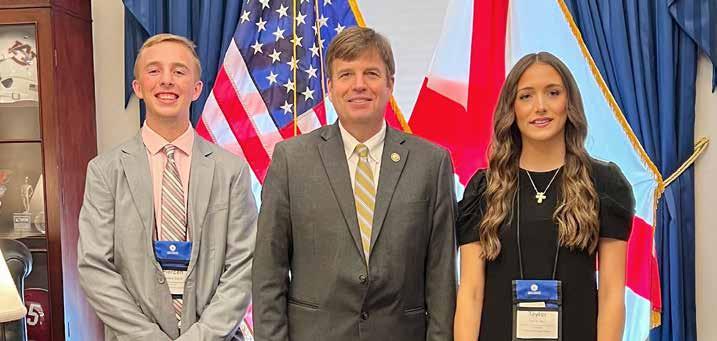
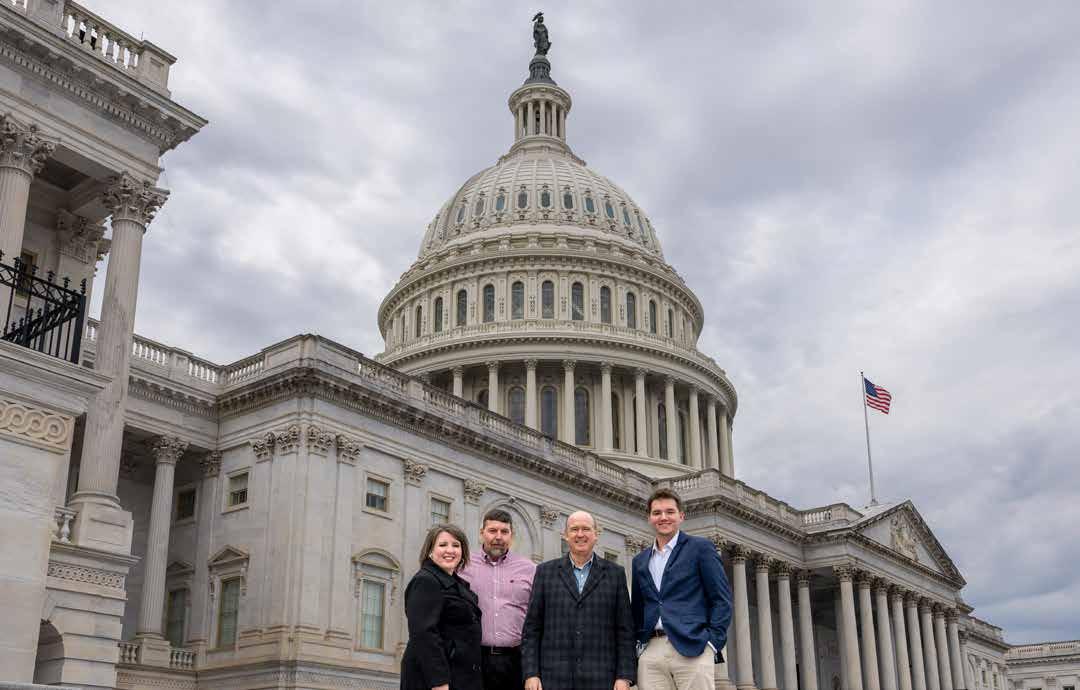
Representing FTC on this year’s Foundation for Rural Service Youth Tour were Taylor Bell, from Pisgah High School, and Piercen Cooper Saint, from Section High School. They earned a five-day trip to Washington, D.C., where they toured the nation’s capital, learned about legislative and agency processes and explored the important role of fiber internet services in rural communities.

through organizations and leadership opportunities, including Camp 1831 as an A-Team Leader, Project Health Advocates, the women’s basketball team practice squad, the Pre-Physical Therapy Society and the Kinesiology Club. He also works at the Crimson Calling Center on campus.
Over the next five years, Kolby plans to earn his doctorate in physical therapy. He is passionate about providing high-quality care to athletes of all levels, especially in rural communities like his hometown of Valley Head. Kolby shared that receiving the FTC Scholarship will help him continue pursuing his educational goals while reducing the financial burden of higher education and minimizing student debt as he works toward his doctorate.
Celebrate America’s 250th anniversary along with us. We will be closed Friday, July 3, in observance of Independence Day. Stay safe while enjoying the holiday.

Story by LAURA McGILL
Nothing ruins a family road trip faster than an unhappy child. Meltdowns at the museum and refusals at restaurants are the stuff of parents’ nightmares. However, with a little planning, family getaways can be enjoyable experiences for everyone.
Consider the ages and tolerance levels of your kids when deciding how many miles you should drive, how many days to stay and what activities to plan. If this is your first family getaway, pick a closer destination and a shorter stay. If everything goes great, you can extend your visit. If things don’t go so well, you can end the trip early and be back home quickly.
Pack a few favorite toys and games and bring along plenty of snacks. Keep a supply of over-the-counter medications for cuts and scrapes, upset tummies and motion sickness handy. Look for convenient stops along the way to take short breaks.
Spend some time getting your children excited about the destination before you leave. Check for coloring pages and puzzles from the tourism office. You can also share details about the places you are going to visit to build interest and to set expectations.
Make sure your plan includes where to stay and where to eat. Pick a family-friendly accommodation close to the places on your itinerary to cut down on time in the car. Do some research in advance to check out restaurant menus, especially if you have a picky eater.
Pace yourself and be flexible because something will likely not work out as planned. Have options in mind if you need to adapt to weather conditions or need to slow things down with a low-key activity.






or are obsessed with their favorite sport.
In addition to a collection of 70 million-year-old dinosaur bones, the museum also features 40 million-yearold whales and the impressive skull of a saber-toothed cat that was unearthed about an hour’s drive from the museum.

The Middle Tennessee Museum of Natural History in Murfreesboro, Tennessee, allows visitors to observe ongoing research while touring exhibits of dinosaur bones and other unique relics from around the world. Cave City, Kentucky, takes the roar outdoors at Dinosaur World, where guests can walk among hundreds of life-sized replicas and enjoy interactive exhibits.
If your trip includes a Saturday near Franklin, Tennessee, stop by Noble Springs Dairy for Baby Goat Cuddling Days. During your visit, you can learn about the farm, pet some adorable baby goats and try some amazing cheese. In Cottageville, South Carolina, Bee City Zoo offers animal encounters with hedgehogs, lemurs, sloths and more.
If your child likes baseball but major league prices aren’t in the budget, try a minor league game. The tickets are more affordable, stadiums are smaller, putting you closer to the field, and the atmosphere is relaxed and family friendly with a children’s play area at many of the ballparks.
Madison, Alabama, just outside Huntsville, is home to the Rocket City Trash Pandas. Bats are swinging in Tennessee with the Nashville Sounds, Memphis Redbirds, Knoxville Smokies and Chattanooga Lookouts. In Kentucky, the Louisville Bats and Bowling Green Hot Rods take to the diamond. Central Indiana welcomes fans to watch the Indianapolis Indians. Fans in South Carolina cheer for six teams, the Greenville Drive, Hub City Spartanburg ers, Augusta GreenJackets, Myrtle Beach Pelicans, Charleston RiverDogs and Columbia Fireflies.
This summer’s biggest sporting event is the FIFA World Cup. With 48 clubs playing games in 16 host cities, it’s generating a lot of excitement. If your child now has soccer fever, consider a clos er-to-home option at an MLS NEXT Pro league match. Huntsville City FC plays its home games in Huntsville, Alabama, and the 2026 season runs through September.


Story by MELANIE JONES
Ever wanted to sleep among the treetops where you can really see the stars? Welcome 60 of your closest friends and family for a lakeview wedding? Eat scrambled eggs and French toast in a stone grotto? Play a game of human foosball while laughing with your buddies?
At Paradise Pointe, you can do all of that and more.
The vacation resort in Bryant, near the Tennessee and Georgia state lines, offers accommodations that are far from rustic. Guests can stay in a cabin with its own slide and landing net, catch up on work emails with FTC’s lightning-fast fiber internet while enjoying sweeping views of Nickajack Lake or relax in a hot tub beside a sunset-colored cabin.
The cabins themselves aren’t the resort’s only grand experiences. Paradise Pointe boasts one of the largest indoor pools in the tristate area, featuring two slides and a tree net suspended over the pool by two towers. It also has a large rock spa hot tub. The amenities don’t stop there.
Guests can have fun on the water outside as well. “We’ve got kayaking, paddleboarding and we’re getting ready to buy some electric surfboards with hydrofoils that are battery operated,” owner Fred Boothby says. No ocean? No problem. The board’s battery drives a propeller, allowing riders to reach up to 30 mph on the waveless Paradise Lake.
Fred says the vacation resort is working
on expanding its online store to allow guests to buy experience packages. Paradise Pointe has wagyu beef, so guests can choose to have the freezer of their cabin stocked with the premium meat for grilling. “They want to buy a filet mignon or a New York strip, a rib eye or smash burgers, we’ll be able to give them a really good price on some premium wagyu beef,” Fred says.
The resort is working with other vendors, so couples can reserve a private chef or a massage in their cabin.
Fred says one of the great things about Paradise Pointe is that large groups can rent several of the property’s 27 cabins at


once for big events like family reunions or church retreats, with entertainment options for the very young to the young at heart. There’s a petting zoo for the tykes or for anyone else who would like to pet a goat or cuddle with a chicken. There’s also a large playground, and volleyball, basketball and pickleball courts are available. There’s even a human foosball court. Instead of two to four people flicking knobs at a table, larger teams of seven on seven or eight on eight can get a little more hands—and feet—on. The walled-in outdoor court has an artificial turf playing surface and cables and pipes running from one wall to the other in rows. “Basically,
every person in your group is one of the people in the game table,” Fred says. “So, it’s like soccer, but you cannot move. You’re stationary in your row on your line. You’re close enough that you’re battling it out for position and kind of get to almost leg wrestling.”
For more sedate affairs, the resort offers three wedding venues. Two can hold up to 60 or 70 people, while the third is perfect for smaller events.
Paradise Pointe was previously two separate properties owned by brothers. As a result, the cabins are divided into two
11211 Alabama 73, Bryant
423-500-7300
stayparadisepointe.com
Find Paradise Pointe on Facebook, Instagram and TikTok.
sections, with nine cabins on one side of the resort and 18 on the other. Having nine cabins grouped together is ideal for weddings because there’s room for all members of the wedding party to stay in the same area. “You’ve got your own private side of the resort,” Fred says. “Then you can have a few more day-of guests that are coming for a small wedding.”
Another cabin, used for weddings of up to 70 guests, has a large, open living room that invites the outdoors in, with a gazebo just outside. Another area where several weddings are scheduled is a remodeled cabin with a stone fireplace, white walls, wooden beams and cove lighting. The third venue available for small weddings or other gatherings is a rock grotto where brides and grooms can feel they’re getting married in a cave. While the walls are painted white, the exterior is all rock with glass garage doors recessed into the “cave opening.”
When the grotto isn’t rented out for events, Fred says the resort plans to offer continental breakfasts there three days a week.
“Paradise Pointe is less than 10 years old, and we have guests coming there for six or seven years. You have a property that’s so special the guests are choosing to come back over and over and over again, and they’re planning their trips one or two years in advance,” Fred says. “That’s very rewarding because it means that you’re providing something to somebody that is so meaningful that they want to keep having that experience and making those memories.”
Story by DREW WOOLLEY
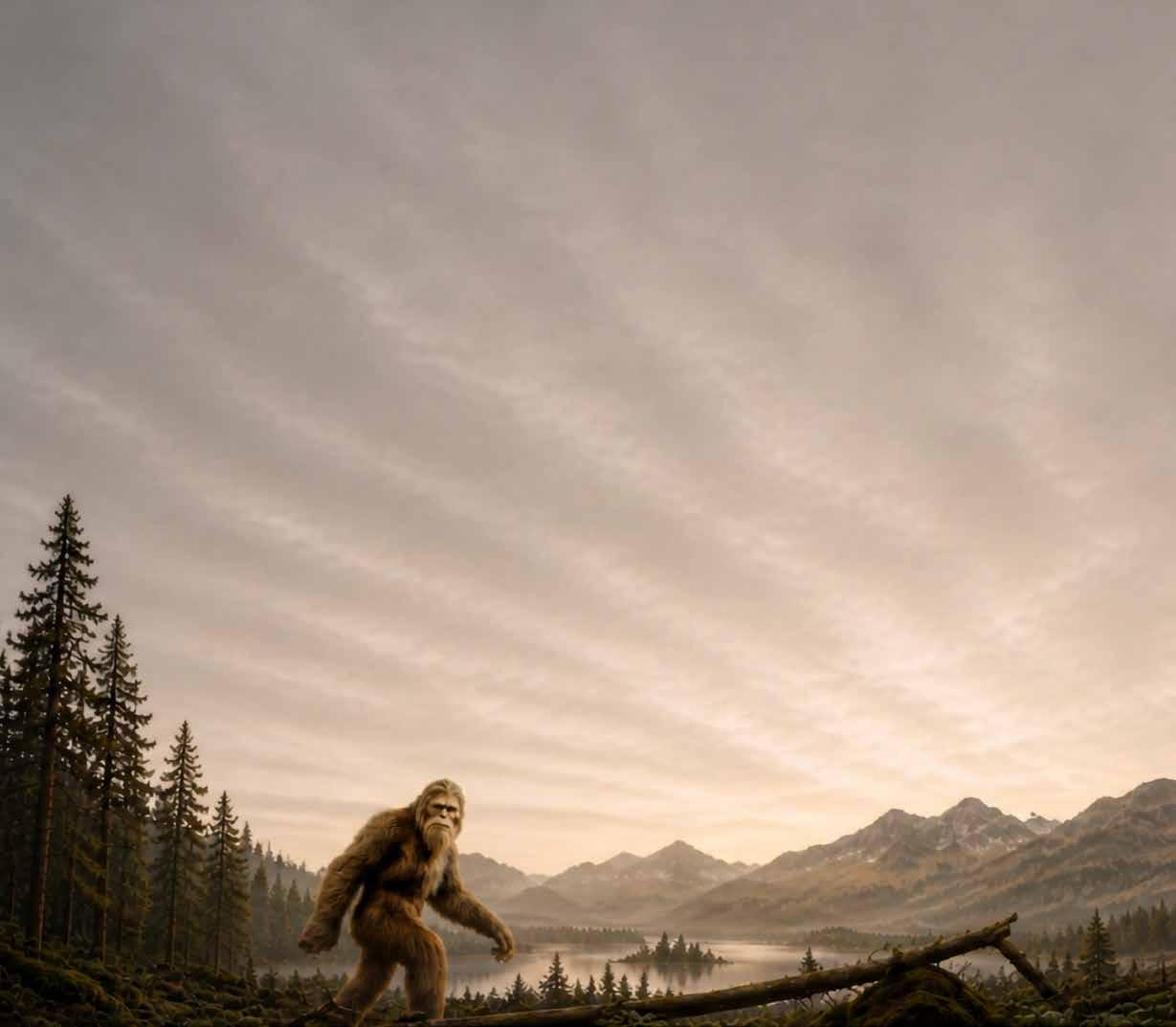
Charlie Raymond knows all the best spots for Bigfoot hunting in Kentucky. As founder of the Kentucky Bigfoot Research Organization, he can tell you where you’re most likely to run into the dark-haired Skunk Man or an Anderson County Sasquatch nicknamed Howdy for its habit of waving at spotters.
So, when a group of Girl Scouts visiting from Ohio wanted to go on their own expedition about 10 years ago, he knew Mammoth Cave was the place to take them. Bigfoot sightings at the edge of the park spiked after a park employee reported seeing what he thought was a bear stand up on two legs and run off.
“I told them Bigfoots are curious, so the best thing to do is go out there with no flashlights and just laugh, talk and act natural,” Charlie says. “Here I’ve got two dozen giddy girls, aged 10 to 14. I said, ‘You’re perfect bait.’”
Much like the skeptical Scout moms who joined them, Charlie didn’t really expect the group to run into Big Mo, the name of the Bigfoot living in the area, according to local legend. But Charlie showed the girls how to knock trees with a baseball bat and make whooping noises, which he believes the creatures use to communicate.
Then, they heard a distant knock and whistle in response. Shortly after, there was a loud bang as something big struck the boardwalk they were standing on. The entire group was so startled that Charlie recalls one of the moms making a break for the parking lot, leaving the girls behind.
“I think it thought we were another Bigfoot calling for help, then it stomped or jumped on the boardwalk as kind of a bluff charge,” Charlie says. “But I heard when they drove back to Ohio, those girls didn’t talk about putt-putt or riding horses.
All they talked about was that night.”
Charlie is just one of many Bigfoot researchers around the country hoping to find definitive proof of the legendary elusive creatures. Driven by true believers, skeptics and gawkers alike, the ongoing hunt has produced hit TV shows, museums and even festivals that bring people together from all corners.
Robert Dobler, a senior lecturer at the Indiana University Department of Folklore and Ethnomusicology, says the lasting power of these creatures is fundamentally human.
“I think it’s human to need to think about things outside of the everyday or the mundane,” he says. “We’re interested in these creatures that exceed language as often as they exceed categories. These stories are how we can take something that is unknown and unknowable and still find ways to talk about it.”
That sense of the unknown is often inseparable from the creatures themselves. For Bigfoot or his Florida cousin, the Skunk Ape, it might be the wilderness of the forests or swamplands where they’re believed to reside. In West Virginia, the dangers of munitions dumps often conjure sightings of the Mothman. Similarly, in Texas, stories of the Chupacabra are more likely to swirl when anxieties about uncontrollable livestock loss due to disease are at their height.
But that doesn’t mean those stories are entirely false.
“A lot of skeptics think these claims are made for attention,” Robert says. “But the reality is most people know they are vulnerable and subjecting themselves to potential ridicule. So, they’re usually reluctant to talk about it and kind of careful about who they tell.”
David Bakara, who owns the Expedition: Bigfoot museum in Blue Ridge, Georgia, has had much the same experience when people share their stories. Some people are still terrified of their experiences. Others are driven by curiosity. But they are all trying to confront something they know shouldn’t exist.
“Almost all the Bigfoot researchers I know used to be just normal people that watched football and cooked ribs in the backyard. Then they saw one of these things, and it kind of happened on accident,” David says. “Some things, the more you dig into them, the more boring they are. But that’s not the case here. The more you look into Bigfoot, the more interested you become.”
That allure of the unknown is one of the reasons Charlie helped start the Red River Gorge Bigfoot Festival, which takes place in Stanton, Kentucky, each May. The idea originated with a drive-in screening of “The Legend of Boggy Creek,” a 1972 docudrama about the Fouke Monster, a Bigfoot-like creature spotted around Fouke, Arkansas.
Now, the festival is an opportunity to gather researchers and cryptozoologists to speak to believers and naysayers alike. The celebration is one of many across the country focused on Bigfoot and other local cryptids that give enthusiasts a chance to gather without fear
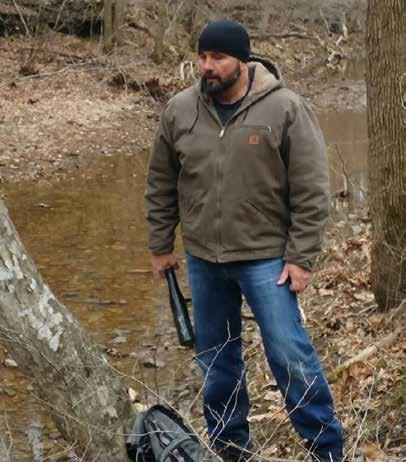
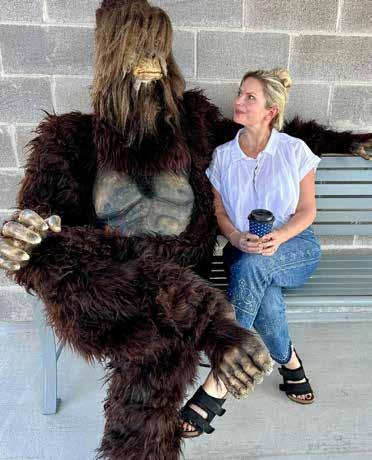
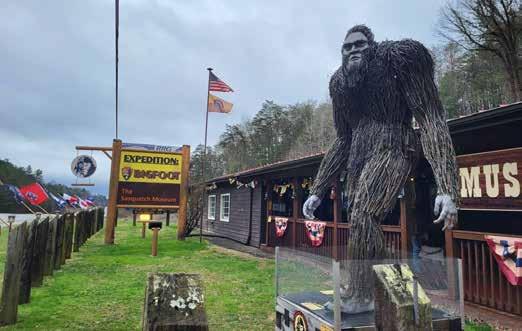
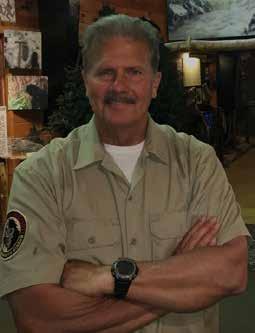
CLOCKWISE FROM TOP LEFT: Charlie Raymond carries along a bat on Bigfoot investigations in hopes of communicating with the creatures through tree knocks. Charlie’s wife, Lyndsey, is a fellow Bigfoot investigator and a police officer with experience in forensics and fingerprint
“There are lots of things in this world we don’t know about. A lot of animals we discover every year,” he says. “We like to say, ‘Leave only footprints. Pick up your trash, stop and smell the flowers every now and then and respect the wilderness.’ Just like Bigfoot.”


A Southern variation on Bigfoot, Sheepsquatch is reportedly a large beast with shaggy white fur and curled horns similar to a ram’s. The creature has been spotted in remote forests and hollows along the Appalachian Mountains and is said to be distinctive for its sulfuric odor.
If you would like to report a Bigfoot or cryptid sighting, in Kentucky or beyond, you can contact Charlie Raymond and the Kentucky Bigfoot Research Organization at info@kentuckybigfoot.com.

The Bigfoot Mapping Project has you covered. The site tracks reported encounters all over the country, with filters for locations where footprints, vocalizations and tree knocks are part of the accounts. Visit bigfootmap.com to find the location of your next adventure. of judgment. But Charlie’s hope is that the experience can also open more people’s minds and encourage them to ask questions. Barring that, it’s an opportunity to step away from technology and gain a better appreciation for all wildlife, whether it’s the creatures we know or those yet to be discovered.
Ready to track down your own Bigfoot sighting?

Story by MELANIE JONES
Sylvania High School graduate Clayton Dalton is wellspoken and self-assured. He knows what he wants to achieve, and he’s on a path to make that happen, starting with a $25,000 scholarship from the National Space Club and Foundation.
Clayton’s career prospects are out of this world. Literally. After he earns a degree in aerospace engineering at Auburn University, he hopes to build rockets and go beyond this planet. “I would love to go to space,” he says.
Watching the Artemis II astronauts return from their mission around the moon in April inspired him. “Knowing that we’re finally getting somewhere, that we’re going back to the moon excites me. We’re now to the point where you have three rockets all trying to claim the largest rocket in the world ever launched with a crew. They’re arguing who has the biggest one. That’s a good thing, that we have three huge rockets out of that.”
Clayton isn’t waiting to work on rockets. He’s been at it since the seventh grade under the guidance of teacher Brett Smith. “He told me I made him work more than any other class did,” Clayton says.
Clayton started making homemade rockets when he was 12. Looking back on his early rockets with the knowledge he has now, Clayton realizes just how dangerous they actually were. Clayton’s rocket-making progressed as he got older. He built Columbia-A and Columbia-B, named for the space shuttle, then he launched BLUR. Short for Big Ludicrous Unnamed Rocket, BLUR had a camera mounted on it. He received his Level 1 certification through the National Association of Rocketry with his Excelsior-1 rocket, which stands about 6 feet tall and flies nearly 1,200 feet high. He plans to move up to Level 2 certification with Excelsior-2.

Like many other kids, Clayton was interested in dinosaurs and trains when he was very young. By elementary school, he knew exactly what he wanted to do.
“When he was in second grade, his class put together a book about what they wanted to be when they grew up,” his mom, Shaunta Dalton, says. “He wanted to be a NASA scientist even then, and that has never changed.”
While Clayton agrees that’s when his fascination with space began, his passion ignited when he watched the Falcon Heavy rocket launch with a Tesla on board in 2018 when he was 10.
Before Clayton can work for NASA or any other space program, he has a plan for his Auburn years. “I’d really like to put together a spaceshot, where the university has a rocketry team that competes,” Clayton says. “I want to be able to put together a spaceshot program to launch a rocket into space within four or five years. That would make Auburn the second-ever college to do so.”
Clayton hopes to both go into space and work in nuclear propulsion. “Nuclear will really enable us to travel farther,” he says.
Shaunta knows her preference. “He would love to be an astronaut,” she says. “I’m hoping he’s too tall. He’s hoping he’s not.”
Clayton isn’t just focusing on only the moon. He has his eyes on Mars, as well. “I definitely think we’ll get there in my lifetime,” he

says. “How far we’ll make it after that? Make missions to Jupiter and Saturn? I could never put an estimate on that because it could be decades or it could be centuries.”
Shaunta and Clayton’s father, Greg, have supported his dreams all along the way. “We have lots of rockets, rocket kits. When Lego sets that were rockets for the space station came out, we bought lots of those,” Shaunta says. “We have visited the Space & Rocket Center many times in his growing-up years. He’s been to Space Camp and to the Aviation Challenge.”
Even Clayton’s time at FTC Camp tied to his desire to go to space. He learned to splice fiber optic cable, which he says can be done better in space.
His parents accompanied him to the Robert H. Goddard Memorial Dinner in Washington, D.C. Clayton was invited to attend with two guests as part of his scholarship award. While in Washington, he met government leaders, scientists and astronauts. He visited the Smithsonian’s National Air and Space Museum and its partner, the Steven F. Udvar-Hazy Center, where the space shuttle Discovery is housed. He visited the Capitol and met Rep. Robert Aderholt.
“I have a key interest in politics and government also because I realize how big of a role it plays, not just in our daily lives but in space policy and the future of space flight,” Clayton says.
His parents couldn’t be prouder. “They say the sky’s the limit,” Shaunta says, “but for Clayton, it’s only the beginning.”



Potlucks call for recipes that can handle travel, sit happily on a table and please a wide range of tastes.
These summer-ready dishes rely on ingredients readily available in July and August, use straightforward techniques and are developed for home cooks. All are budget-conscious, and none require special equipment.



3 pounds chicken drumsticks
1 1/2 cups barbecue sauce
1 tablespoon vegetable oil Salt and black pepper to taste

pepper. Toss with oil and arrange on a foil-lined baking sheet. Bake 30 minutes, turn, brush generously with barbecue sauce and bake 15 minutes more until cooked through and sticky. Serve warm or at room temperature.
6 cups fresh peaches, peeled and sliced
1/4 cup granulated sugar
1 tablespoon lemon juice
TOPPING:
1 cup rolled oats
1/2 cup all-purpose flour
1/2 cup brown sugar
1/2 cup butter, melted


1 pound orzo pasta
1 pint cherry tomatoes, halved
2 cups English cucumber, diced
1/3 cup red onion, finely chopped
1/2 cup crumbled feta cheese
1/4 cup fresh parsley, chopped
DRESSING:
1/3 cup olive oil
2 tablespoons fresh lemon juice
1 teaspoon lemon zest
1 teaspoon dried oregano
Salt and black pepper, to taste


Preheat oven to 375 F.
Cook orzo in salted water until tender.
Drain and rinse with cold water. In a large bowl, combine orzo, tomatoes, cucumber, onion, feta and parsley. Whisk dressing ingredients and toss with salad.
Chill at least 30 minutes before serving.

4 pounds pork shoulder or pork butt
1 teaspoon salt
1 teaspoon black pepper
1 teaspoon smoked paprika
1 cup barbecue sauce
1/2 cup chicken broth
12 slider buns
Season pork with salt, pepper and paprika. Place in slow cooker and add broth. Cover and cook on low for 8 hours until very tender. Shred meat with forks, discard excess fat and stir in barbecue sauce. Serve warm on slider buns.
3 pounds small red or Yukon Gold potatoes
4 tablespoons olive oil
2 tablespoons apple cider vinegar
2 tablespoons whole-grain mustard
1 tablespoon Dijon mustard
1/2 teaspoon sugar
1/2 cup celery, finely sliced
1/3 cup red onion, finely diced
1/4 cup fresh dill, chopped
Salt and black pepper, to taste
Toss peaches with sugar and lemon juice and spread in a baking dish. Mix topping ingredients and sprinkle evenly over fruit.
Bake until golden and bubbly, about 40 minutes. Cool slightly before serving.
Boil potatoes in salted water until fork-tender. Drain and cut into bite-size pieces while still warm.
In a large bowl, whisk together olive oil, vinegar, mustards and sugar. Add warm potatoes, celery and red onion, tossing gently so the potatoes absorb the dressing. Season with salt and pepper. Fold in dill just before serving. Serve warm or at room temperature.



Thursday, August 20
Friday, August 21
Monday, August 24 & Tuesday, August 25
Registration and voting on all business and the election of Trustees from Henagar & Flat Rock for the members

Drive-thru registration and voting available under the big white tent at the FTC office

Times: Each weekday Thursday - Tuesday from 8 a.m. to 5 p.m.