BROADBAND:
HELPING YOU LEARN MARCH/APRIL 2020
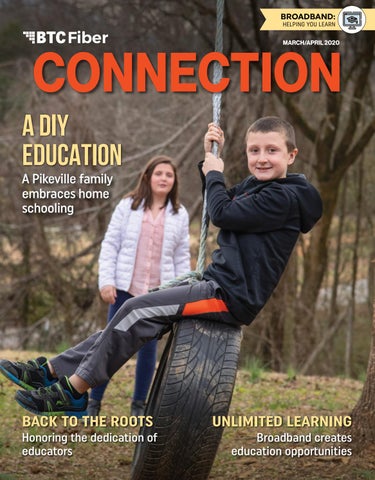
CONNECTION A DIY EDUCATION A Pikeville family embraces home schooling
BACK TO THE ROOTS Honoring the dedication of educators
UNLIMITED LEARNING Broadband creates education opportunities
INDUSTRY NEWS
H
Rural Connections
A count that matters
By SHIRLEY BLOOMFIELD, CEO NTCA–The Rural Broadband Association
Let’s ‘build once’ under RDOF
A
s an organization representing rural broadband providers, we are excited about the FCC’s plans to invest $20.4 billion to bring affordable highspeed broadband to rural Americans. While the agency’s Rural Digital Opportunity Fund (RDOF) is a terrific opportunity for unserved and underserved communities, it is important that as a nation we are investing in networks that can meet broadband needs for the foreseeable future. Services delivered in high-cost rural areas using RDOF funds should be reasonably comparable to those in urban areas — both now and over at least the term of support distribution, if not longer. We believe it is far more efficient to have policies that encourage providers to “build once,” deploying rural networks that are scalable and will offer services at speeds that are still relevant to customers another decade from now. NTCA was one of the biggest and earliest supporters of a program that will promote sustainable networks capable of delivering the best possible broadband access for many years to come. After months of advocacy by our members and staff, including securing bipartisan letters signed by dozens of members of Congress, the FCC announced in January that it will consider rules to fund sustainable and forward-looking networks. This will help strike a terrific balance by looking to reach as many rural Americans as possible while ensuring that the FCC is funding the best possible networks for the available budget. I am energized by the role that NTCA members can play in being a key part of the solution in bridging the digital divide.
2 | March/April 2020
H UNDERSTANDING THE CENSUS H
O
nce a decade, the United States counts its citizens. This results in a treasure trove of data relevant to politics, businesses, schools and much more. For example, federal agencies use census results to distribute more than $675 billion in federal funds annually. Similarly, states use census data to draw congressional district boundaries. The numbers can even determine how many congressional representatives a state sends to Washington, D.C. Locally, many counties, cities and towns lean on census statistics when planning infrastructure such as roads, schools and emergency services. Businesses also factor census data into calculations that determine the locations of new stores, hotels and more. As you can see, the census is an important program and one in which you’ll be asked to participate. For the first time, everyone can complete the census online, as well as by phone or by mail. You will still receive a census form by mail, but you will have the option of visiting respond.census.gov/acs to complete your duty to respond to the census. Census Day is April 1, and census takers will visit households that have not already replied to census questionnaires online, by phone or through the mail. In fact, the U.S. Census Bureau hired thousands of temporary workers to help implement the 2020 census. The bureau also understands the unique challenges of counting people in rural areas. Some rural homes do not have typical mailing addresses, using instead post office boxes in nearby community centers. However, census questionnaires are not mailed to P.O. boxes. In these remote areas, census takers will deliver paper questionnaires to each home and offer guidance on how to respond by phone or online. If there’s no response, expect an in-person follow-up. By law, the Census Bureau must keep your information confidential, using the details to produce statistics. The bureau may not publicly release responses in any way that might identify an individual.
Maybe it’s not so smart? Streaming boxes can add a layer of TV security Story by NOBLE SPRAYBERRY
I
s your TV watching you? Could it be a backdoor to your private information? Those are questions recently posed by the FBI. For people who rely on a smart TV, the answer might be, “Yes.” A smart TV can connect directly to the internet, allowing access to services and applications that provide movies, TV shows, music, videoconferencing, photo streaming and more. It’s all right there in one consolidated interface. But convenience comes with tradeoff. Some smart TVs include microphones and cameras. These features allow voice commands and the potential of using facial recognition to customize content to an individual viewer.
Those innovations, however, raise the possibility of TV manufacturers eavesdropping. Similarly, an unsecured TV has the potential to be used by a hacker as a backdoor into your other Wi-Fi-connected devices. The FBI suggests a range of strategies to ensure a TV protects your security. Do internet research on your specific TV model to check the status of updates and reports of security breaches. Also, if possible, change passwords. Then, learn how to turn off microphones, cameras and the ability of the TV manufacturer to collect personal information. Even placing tape over the camera lens is an option. There’s another strategy, too — do not directly connect your TV to the internet. Instead, consider a third-party device to create a bridge between your television and streaming services such as Netflix, Hulu and more.
HERE ARE A FEW OPTIONS TO CONSIDER:
Roku: Many devices that allow TVs to connect to online streaming services are sold by companies that also offer TV content. As a result, not all services are available on every device. If that’s a concern, consider a Roku, which can generally connect to all content providers. Rokus typically range in price from $30 to $99.
Apple TV: Prices for an Apple TV device range from $149 to $199, with the more expensive options having more storage capacity and the ability to play 4K video. The device will connect to most streaming services, and currently the purchase of a new Apple TV comes with a one-year subscription to the Apple TV+ streaming service.
Amazon Fire TV Cube or Fire Stick: Amazon’s Fire streaming devices cost from about $30 to nearly $200, based on capacity and the ability to offer 4K content. Look for frequent sales to find a bargain. The interface is clean and useful. Fans of Amazon Prime can have easy access to that service’s streaming options. While most streaming services may be available, that has changed from time to time.
Google Chromecast: Google offers its twist on the streaming boxes with a small, hockey-puck-shaped device that allows content to be “cast” from a computer, tablet or phone to the television. Most streaming services are supported, and viewers with a Google Home smart speaker can control programming with voice commands.
March/April 2020 | 3
FROM THE GENERAL MANAGER BTC Fiber
The 2020 census matters for rural America
H
4 | March/April 2020
Fiber
MARCH/APRIL 2020
VOL. 2, NO. 2
BTC Fibe Connection is a bimonthly newsletter published by BTC Fiber, ©2020. It is distributed without charge to all customers of the company.
ow important is the 2020 census? For rural areas like ours, $675 billion is at stake.
In mid-March the U.S. Census Bureau will send postcards to most addresses in Tennessee and across the country. That is one of the more important pieces of mail you will receive in 2020. Why does the census matter to your broadband and telephone provider, and why am I using this space to encourage you to participate? CHARLIE BORING Simply put, our part of Tennessee has a lot to gain from accurate General Manager census numbers — and a lot to lose if we aren’t all counted. These risks and benefits come in three main areas dependent on census data: government funding, political representation and statistics for economic growth. According to the Census Bureau, census data determines the spending of more than $675 billion in federal funds. That can mean anything from schools, roads and equipment for first responders to grants for expanding our broadband network or programs that help those in need. Many of those projects seek to do the most good for the most people — and if we don’t help to create an accurate count of all of our people, that funding may go elsewhere. As you may have heard if you follow political news, the Simply put, our part census data is used to draw and redraw districts for state and federal lawmakers. The number of congressmen and conof Tennessee has a lot gresswomen we have representing Tennessee is dependent on to gain from accurate our population. If we don’t count all of our state’s residents, census numbers — and we would show a lower population and run the risk of losing a lot to lose if we aren’t representation in Congress to a bigger state that may have different interests than ours. all counted.” The same thing is true on a more local level in the state legislature. If the counties in our region come up short on the population count, we could lose a legislator and have a more difficult time making our area’s concerns heard in Nashville. Lastly, our area’s population is a key factor in almost all of the statistics businesses look at when considering a market to build. Whether it’s a fast-food restaurant or an industrial plant, corporate managers are looking at our population when it comes to customer base, workforce and market potential. Showing a lower population on the census because many people weren’t counted would make us less appealing for businesses to locate here. If you want to know more, visit census.gov. I know everyone is busy, and that little postcard later this month may seem like just adding one more thing to your to-do list. But from what I’ve read, the Census Bureau is making things simple, quick and easy for everyone to be counted. As someone who cares deeply about our rural area, I hope you’ll take those few minutes of time to make sure you and your family participate in the census. Our communities are counting on you.
“
BTC CONNECTION
BTC Fiber
is a member-owned cooperative dedicated to delivering advanced telecommunications technology to the people of Bledsoe and Sequatchie counties and portions of Van Buren, Cumberland and Hamilton counties.
BTC Fiber P.O. Box 609 Pikeville, TN 37367 423-447-2121 423-949-2121 Email: customerservice@bledsoe.net
BOARD OF DIRECTORS John Lee Downey, President Danny Wallace, Vice President James Condra, Secretary/Treasurer Rufus Johnson Sandy Burnett Richard Smith Dion Ault
Produced for BTC Fiber by:
On the Cover: Brother and sister Eli and Kaylan Angel, home-schooled students, enjoy time outside at their home in Pikeville. See story Page 8.
BTC NEWS
Bill paying made easy BTC Fiber makes it easy to pay your bill online from the comfort of your home. With online bill pay, you get: • Safe and secure payment options • 24/7 account access via phone, tablet or desktop • Important account notifications Sign up for online billing today at btcbillpay.com.
STAY SAFE THIS SPRING Along with longer days, warmer weather and blossoming flowers, spring often also brings severe weather — including lightning, strong winds and hail.
Here are a few tips for protecting your loved ones and your home.
BEFORE THE STORM » During a storm, using electronics plugged into your home’s electrical system can be dangerous. Charge all phones or other communications devices before inclement weather occurs.
Spring forward!
Don’t forget to set your clocks one hour ahead on March 8.
» Purchase lightning rods, surge protectors or lightning protection systems to safeguard home electronics or appliances. » Identify safe areas in your home, workplaces or other areas you frequent and discuss emergency plans with your families. » Consider using a weather app or weather radio, or sign up for emergency notifications through emails, phone calls or texts.
DURING THE STORM » Continue to monitor weather reports and stay away from doors and windows. Seek shelter in safe areas in case a severe thunderstorm approaches. » Do not use landline phones, running water or other electronics. Lightning can travel through phone lines and plumbing. » Unplug appliances and electronics. » Do not drive on flooded roadways.
AFTER THE STORM » Stay at least 35 feet away from downed utility lines and report any fallen lines to authorities. Avoid items such as a fence, car or tree in contact with a downed power line. » Monitor weather apps and local media for reports of weather-related hazards. Sources: The Electrical Safety Foundation International and the Department of Homeland Security.
BTC Fiber
Good Friday! The BTC Fiber offices will recognize the Easter holiday and close for Good Friday on April 10.
March/April 2020 | 5
TRAVEL
A biblical journey A museum explores the story of Noah
T
Story by ANNE BRALY
he heavens opened, and the rains came down — not in biblical proportions as they did in Noah’s day, but could there have been a better backdrop for a recent visit to the Ark Encounter? This religious attraction in Kentucky opened just over three years ago on an 800-acre site. At a cost of $100 million for Phase I, its primary feature is the massive ark, taller than a four-story building and built to the specifications God laid out for Noah. In keeping with measurements in the book of Genesis, converted from the Hebrew cubits specified in chapter 6, the three-deck ark is 510 feet long, 85 feet wide and 51 feet high. Sitting in a beautifully landscaped area
6 | March/April 2020
just off Interstate 75 in the small town of Williamstown, Kentucky, the Ark Encounter draws more than 1 million visitors annually from around the world who come to learn more about Noah and his family, the animals aboard ship and the ancient flood that most Christians believe engulfed the earth. Ticket booths are located at the 4,000-spot parking lot, which has plenty of room for group buses, and guests take the free shuttle service from the lot to the ark grounds. In addition to the ark, the attraction offers a zip line and the Ararat Ridge Zoo. And you won’t walk away hungry — a tremendous buffet replete with Asian, Cajun and American fare will satisfy your hunger, and there is seating for 1,500.
THE SHIP It took Noah 50 to 75 years to build his ark. It took a team of Amish builders and others just two years to build Kentucky’s
new ark, a project that was the dream of Australian Ken Ham, founder and CEO of the Answers in Genesis ministry, the Ark Encounter and the Creation Museum in nearby Petersburg, Kentucky. Patrick Kanewske, director of ministry and media relations for the Ark Encounter, says much of the ship matches accounts in Genesis, but “ark”-tistic license — imagination — fills in the blanks. Such license includes names of the women/wives onboard, the color of their skin, the placement of rooms and animal cages, and so on. Look up from the first deck to the top of the ship, and it’s easy to see the scope of the Ark Encounter. Sixty-two trees, mostly Douglas firs from Utah that were standing dead timber, went into the frame structure. Throughout each deck are divided rooms, each with a different theme and exhibits — some interactive — telling stories of the ark, the flood and
Photos courtesy of the Ark Encounter and the Creation Museum.
If you go... WHAT: Ark Encounter WHERE: 1 Ark Encounter Drive, Williamstown, Kentucky HOURS: Times vary by season, so please check the website TICKETS: $48 for adults 18-59, $38 for seniors 60 and up, $25 for youth 11-17, $15 for children 5-10 and free for children 4 and under PARKING: $10 for standard vehicles, $15 for oversized vehicles INFORMATION: arkencounter.com
why it happened; what life was like before and after the flood; and the Christian belief that God created Earth in just six days. Movies on the second and third decks depict life then and now. Plan on spending a good half-day at the Ark Encounter to experience all it has to offer. And when your day is through, Kanewske hopes people will walk away with the truth of God’s word and the gospel. “We proclaim that here,” he says. “That’s the bottom line. People will learn a lot about the flood account, Noah and his family and all that, but what we want them to take away is God’s word.”
ALL ABOARD How, one may wonder, did all of the animals fit on the ship? First — according to “Ark Signs That Teach a Flood of Answers,” a book that you can pick up in the Ark Encounter gift shop — you need to consider the term “animal kind,”
referring to a group of animals not related to any other animals. So at the most, Noah, who God only charged with bringing air-breathing animals on board, was responsible for fewer than 6,744 animals to house, feed and clean. “When you see the size of the ship, there’s every possibility that 6,000 to 7,000 animals could fit in a ship of its size without any problem,” Kanewske says. Cages large and small line the walls and center of the lowest deck. Once again, ark-tistic license is used to show how Noah and his team might feed the animals and store grain. For a realistic experience, live animals come from the zoo onto the ship each day. Jose Jimenez, a Naval chaplain from Rhode Island, recently brought his young family to experience the Ark Encounter. “It’s a great place for kids,” he says. “And it’s good for people who have questions. It doesn’t answer all of them, but a lot.”
ARK ENCOUNTER PHASE II Plans are in the works for major expansion of the Ark Encounter, and some of those plans have already been realized. April 2019 brought the opening of The Answers Center, with a snack bar, a gift shop and a 2,500-seat auditorium that hosts daily presentations, movies, special speakers, concerts and more. A new playground has also opened and is designed to accommodate children of all abilities. And the summer of 2019 saw the opening of the zoo expansion, including the addition of more animals — lemurs, sloths, peccaries and a bearcat — and stages for zookeeper talks. “We take things seriously here,” Kanewske says, “from our food to exhibits to how our employees are trained. It’s a world-class experience.”
March/April 2020 | 7
BROADBAND: HELPING YOU LEARN
A comfortable
ENVIRONMENT HOME SCHOOLING PROVIDES OPTIONS FOR FAMILIES Story by LISA SAVAGE | Photography by MARK GILLILAND
J
essica Angel and her children enjoy breakfast each morning before school. Then, it’s off to get the day started at the kitchen table. Angel and the children, Kaylan, a fifth grader, and Eli, a second grader, read a book or work on writing skills. Then, Kaylan goes to her room and works independently for a little while Angel has more one-on-one time with Eli. “We go at our own pace,” Angel says. “We take breaks when we need to and have some flexibility to do what works best for our family. It’s in a comfortable environment, and that enhances their learning.” This is the second year Angel and her husband, Eric Angel, have committed to home schooling for their children. It takes commitment from everyone in the Pikeville family. Jessica Angel worked for several years at Omni Rehab and still worked full time when the family made the decision she would quit work so home schooling would be possible. “I prayed about it and really wanted to do it,” she says. “I felt like it was the best thing for our children, and I felt like I had a clear answer that it was the right thing to do.”
Jessica Angel works with her children, Kaylan, left, and Eli, at the family’s kitchen table at their home in Pikeville.
Angel didn’t have to look far for guidance. Her sister, Laura Keedy, chose home schooling for her children and lives down the road. “I started asking questions and digging for information to find out what’s best for our family,” Angel says. They chose to utilize the umbrella school platform, which allows parents to work with a private school. That option requires English, math, science, language arts, history and other core subjects, but there is flexibility regarding the teaching process. “We can incorporate a biblical curriculum,” Angel says. “Our language arts can be stories from the Bible, or our vocabulary words can be a combination of words that 8 | March/April 2020
BTC Fiber Engineering Manager Matt Boynton explains fiber optic technology to the home-school students who visited BTC Fiber’s office recently.
Photo courtesy of Russ Camp.
HOME-SCHOOL OPTIONS
BTC Fiber
Photo courtesy of Russ Camp.
The home-school co-op group recently visited BTC Fiber’s office as part of a field trip day.
include biblical words.” An umbrella school option also means a student has a high school diploma after completion from an accredited program. Some home-school programs only provide a certificate of completion. “It was important to me to make sure we’re working toward a high school diploma, not just a certificate of completion,” she says. The umbrella school has requirements, such as 180 days of school, and guidelines about the curriculum, but it provides some flexibility. The Angels pay $100 a year for the first child and $25 a year for each additional child. “That’s a small price to pay for the assurance that we’re doing everything the way the law requires,” Angel says. Her experiences in teaching the children showed Angel which techniques work best for each of them. For instance, she found that her daughter has a problem concentrating if others are around, so she learns more easily by herself. “I can see where each child struggles and where we need more one-on-one time,” Angel says. “They learn to work toward goals and getting better with the things they struggle with.” Going from working full time to home schooling has been a drastic change for the family. “In the end, it’s been very rewarding,” she says. “I know they are safe and that I’m able to have a huge part in my children’s education.” BTC Fiber
RESEARCH When Angel sought her sister’s advice, Keedy told her to research and learn what was best for their family. Keedy says that’s the best advice for anyone considering home schooling. “Do your research before stepping off and taking that plunge,” she says. “It’s important to find out what fits your family and your child. Each child is different, and it’s a totally different approach.” Both families also use internet service through BTC Fiber. That means more choices for home schooling. She learned the umbrella plan also worked best for her family, and she learned through the home-school process that each child works differently. Keedy’s oldest daughter, Faith, was home-schooled her eighth and ninth grade years and attended public school during her sophomore and junior years. Last year, she finished her senior year under a home-school program. “She only needed two credits, so it didn’t make sense for her to stay in public school,” Keedy says. “She was able to do it at her own pace, and it was convenient that she could do it online.” Keedy’s other children — Hunter, a sophomore, Ashlyn, a fifth grader, and Sunday, a second grader — are part of a home-school program. Angel worked with her sister to come up with a plan for a co-op, which provides time one day a week for other home-schooled students to come together
for class time, physical education, lunch and activities. The co-op also includes observation days for things like field trips to local businesses and other activities. An average of 23-26 kids participate in the co-op each week. “It gives the children and parents a chance to interact,” Angel says. “One of the things we hear is that home-schooled children don’t have enough socialization, but this gives them lots of time to spend with other kids while we’re all benefitting from providing our children’s education at home.”
Statistics • In 2019, home-schooled students made up 3.4% of school-age children in the United States.
• The most common reasons parents choose to home-school are concern about the environment in other schools, academics and religion. March/April 2020 | 9
BROADBAND: HELPING YOU LEARN
A class of their own Broadband brings education to students on their schedule Story by DREW WOOLLEY
I
n 2012, Aziza Zemrani was busily putting together an accelerated online program for the University of Texas Rio Grande Valley. The curriculum would allow students to complete courses they need in just seven weeks from anywhere in the valley or beyond. But there was a lingering concern about handling presentations using the available online technology. “I needed them to present so I could see their skills and competency in communication,” Zemrani says. “We use Blackboard Collaborate, which allows for face-to-face engagement and interaction. But my colleagues were worried about how it would work if we had a student with a disability.” As if in answer to those concerns, the program’s first cohort group in 2013 included one deaf student, Phillip Robinson. When it came time for each student to present that June, the university’s Center for Online Learning and Teaching Technology worked with the disability office to arrange for a sign language interpreter to present with him. “He presented live with his classmate, and it was beautiful,” Zemrani says. “He was almost in tears telling me this was the first time he was able to present live like that in an academic setting.” Robinson graduated in December, joining hundreds of other students who have
10 | March/April 2020
come through the accelerated online program of the university in Edinburg, Texas. While Zemrani originally expected the program to appeal primarily to students from outside the state or even the country, it has also been popular among local students in the valley looking to fast-track their education. “Some of these students might be working two jobs, so they can’t fit traditional classes into their schedule,” she says. “With the online program, because of the course delivery and structure, students can take up to two more modules and finish in one year.”
A PLACE TO START Online courses like the ones offered at UTRGV are taking off across the country thanks to improved broadband access. But with so many online options available to students, it can be daunting to figure out which one is the best fit. That’s why the Minnesota State Colleges and Universities system contracted with Distance Minnesota to act as a single point of contact for all online students in 2004. Distance Minnesota was founded as a consortium of three local colleges that wanted to offer online courses. Today, the organization partners with 37 colleges and universities throughout
the state, answering any questions prospective or current students may have about their online options. “We do chat, phone assistance and email assistance seven days a week,” says Distance Minnesota Executive Director Lisa Leahy. “In all, we handle approximately 25,000 student inquiries a year.” But more than acting as a helpline for students, Distance Minnesota compiles data on the programs each school offers and the level of interest in each course. This makes the organization a resource for schools deciding which classes to offer online and for students looking to fulfill a specific course requirement. That help is particularly important for making online programs accessible to out-of-state or international students. “Throughout our nearly 20-year history with the school system, we’ve come to understand what each of the individual universities has to offer,” Leahy says. “Many of us have worked closely with the faculty and the administration on these campuses. So if a student has a specialized need for a certain class, we can tell them the best course is at this school, and often we’re able to put them in touch directly, whether they’re in Argentina, California or New York.”
VIRTUAL HIGH College coursework isn’t the only level at which online programs are giving students more flexibility. Connections Academy, a nationwide program that offers tuition-free online K-12 public schooling in 28 states, launched a new online academy last fall in Tennessee. Since it opened, the academy has grown from about 750 students to 1,300 enrolled. The Tennessee Connections Academy is authorized by Robertson County Public Schools, though it is available to students throughout the state. The system was already using a virtual curriculum from Connections Academy’s parent company, Pearson, to offer online classes to approximately 50 students. So it was a natural partnership to work together to bring that same experience to students across the state.
“It’s a unique learning environment with certified teachers in all subject areas for the kids,” says Derek Sanborn, principal at Tennessee Connections Academy. “The students are able to interact with their teachers and other kids with live lessons throughout the week. They receive textbooks and other materials at each level, and it’s all at no cost to the parent.” The online academy is held to the same standards as any public school in the state, and students are required to attend for sixand-a-half hours each day. The program has been a good fit for kids who may be homebound, live in remote areas, or even be on traveling sports teams, allowing students to complete their hours in the evening or on weekends. “We also have students who may have been bullied in their school or didn’t feel safe. Maybe the traditional setting wasn’t motivating for them,” Sanborn says. “I think giving parents that choice is really important because they get to decide what’s best for their kids.”
NEW ENGAGEMENT Even with the increasing quality of online classes, there are still challenges educators work to overcome, including engaging students. One way Tennessee Connections Academy attempts to address this issue is by scheduling in-person field trips, allowing families to meet and connect with their teachers and other students. In her own classes, Zemrani has recorded live classroom sessions and used apps like Flipgrid to allow students to record short intro videos about themselves. While engagement continues to be a challenge for any online course, she believes finding new solutions is well worth the investment. “We have students in the military who may be called to serve somewhere in the middle of their program,” Zemrani says. “The online course is a great opportunity for them to finish their program when they might not otherwise be able to. Broadband is so important to that.”
March/April 2020 | 11
Celebrating a century
Honoring education trailblazers Story by LISA SAVAGE
E
ducation revolves around the teachers and their relationships with students. While much has changed since the early days of one-room schools in rural areas such as Frostbite and Grapevine, the devotion of teachers finding innovative ways to connect to their students remains the same.
Thelma Boynton
As two local retired teachers celebrate 100 years of life, their stories continue to inspire others.
THELMA BOYNTON — GRAPEVINE Thelma Boynton’s inspiration to teach came from her grandmother, Mary V. Wheeler, whose educational legacy still remains strong through the school named for her: Mary V. Wheeler Elementary School. Boynton launched her teaching career during the 1938-39 school year at Grapevine School. She taught at New Harmony for one year and then went to a three-room school at Sampson. And along with the rest of the country, things changed dramatically because of World War II. She and her husband did their part. She joined the Signal Corps attached to the Army Air Forces and found herself at Wright Field in Ohio where she was in the radar and communications testing section. The team worked to create a form of communication that would enable pilots whose planes went down to communicate their locations to their bases. “At the beginning of the war, if you crash landed, you were gone. There was no way to let people know where you were,” she said in an interview in 2015. “We all felt like we had a mission. We were trying to keep people from getting killed.” While at Wright Field, she met Orville Wright, the namesake of Wright Field. She also met Wernher von Braun, who talked to their group about space and space travel. She shook the hands of both men, and she also heard Albert Einstein speak.
MAKING A DIFFERENCE When the war ended, she and her husband came back to the Cumberland Pla12 | March/April 2020
teau. Several years later, she returned to teaching after her children started school. After service during the war, her passion for science expanded, and her enthusiasm carried over to students in Bledsoe County High School, where she taught. She helped lead Bledsoe County High School students to honors like a Navy Science Cruise Award and an Air Force Award for an outstanding science project, and she helped produce a National Science Fair finalist. Boynton made the news pages of Electronics Illustrated in 1960: “When Mrs. Thelma Boynton, an attractive mother of three boys, began to teach at Bledsoe five years ago, there had never been a science fair in the region, the school had no laboratory equipment to speak of, textbooks had not yet recognized the birth of the atomic age, and the students could not have been less interested. Mrs. Boynton realized that the first step was to make the students and town’s people, too, ‘scientific conscious.’” Boynton recalls taking students all over the country for the National Science Fair, doing all sorts of innovative projects. “I taught all this when I was just a youngster,” she says. “They thought I was old, but I was just 40 years old.” Some of the experiments back in those days were a glimpse into the future. Students used white rats to evaluate exposure to cigarette smoke. They exposed seeds to radiation by taking the experiment to the local hospital and putting it under the X-ray machine, and they worked on a hydrogen fuel cell. Boynton arranged for her students to showcase their science projects on a Chattanooga television station, and excitement from the students and the community mounted. Boynton says they also performed BTC Fiber
experiments with fiber optics. “The biggest thing we thought about fiber optic was that the light would follow the tube,” she says in the recorded interview. “We were doing experiments long before they ever thought about doing it for telephone communications.”
ELIZABETH ROBNETT — FROSTBITE Elizabeth Robnett can pinpoint on an old map exactly where she first taught at Frostbite School. Rural schools like Frostbite took the names of the post offices in the areas they served, and most don’t exist anymore. Robnett rode a horse from her family’s home at the foot of Walden’s Ridge to the one-room schoolhouse to teach during the 1938-39 school year. Her mother’s love of history inspired her to learn about her ancestors and the history of their community. It was only natural for her to become a teacher of history as her career continued. She eventually landed at Pikeville Elementary and later, Bledsoe County High School. “Back in those days, it was the only thing you could do to make a living,” Robnett says. She and her sister, Sue Robnett — retired as the librarian at Pikeville Elementary — still live in the farmhouse where they grew up.
She taught for 42 years, 30 of those years at the high school, and obtained a master’s degree in history from Peabody College in 1951. Robnett wrote a book focusing on Bledsoe County’s history, and just about anyone interested in their local roots can find out more about them from her or the book. Most of the county’s records were lost in fires at the courthouse through the years, but Robnett found a way to piece together all the information about those who call Bledsoe County home. “I love history, so I guess it’s just natural that I would do this,” she says.
Elizabeth Robnett
Robnett’s family history and the history of her community are still important to her. Her father served in World War I, and both her grandfathers fought for the Union Army during the Civil War. She has documented much of their history. Her broad knowledge ranges from the history of her family — her ancestors sailed from France, bought land from William Penn in Pennsylvania and eventually headed west to the Cumberland Plateau — to that of her county and state. Her expertise gained her the title of county historian and numerous accolades, including the National Society United States Daughters of 1812 history award on the 200th anniversary of the War of 1812. The Tennessee Society Daughters of the American Revolution also named her a “Tennessee Treasure” in 2017. BTC Fiber
Photo courtesy of Bledsonian-Banner.
LOVE OF COMMUNITY
March/April 2020 | 13
SOUTHERN KITCHENS
Mystery and intrigue
High Point Restaurant chef shares secrets for a great steak
H
igh Point Restaurant opened in January 2000, and Eric Gipson, executive chef, has been there since the second day of business. As a child growing up in Monteagle, Tennessee, he remembers the restaurant when it was a spooky old house — “the kind of rundown, ghost-infested mansion of campfire stories,” he says. Legend has it that mobster Al Capone financed the 1929 home for his bookkeeper/mistress and used it as a place to stop on his bootlegging travels between Chicago and Miami. This was well before Interstate 24 ran up and over Monteagle Mountain, so its hard-to-reach location made for the ideal hideaway. Supposedly, the floors had a lining of sand to muffle the sound of gunfire, and escape routes aided in getting the illegal hooch to its final destination during the days of Prohibition. Today, it’s a place for an amazing meal along the road between Nashville and Chattanooga in a beautiful mountaintop location. But can you duplicate the restaurant’s wonderful steak at home? It’s a familiar scenario: You take the family out to a fancy restaurant and order the steak, and there goes your budget for the week. It’s an amazing steak that sends your taste buds on a trip through culinary heaven — an experience you’re not likely to forget. So, you go home and try to reproduce it, and it’s an expensive disaster. It’s still less expensive than a night out at your favorite steakhouse, but the flavor is less than memorable.
14 | March/April 2020
Eric Gipson, executive chef of the High Point Restaurant, serves up great steaks and other dishes.
What went wrong? How do restaurants get their steaks so tender, so flavorful, so perfect? Gipson says making a great steak involves several keys. “I think it’s mostly attention to detail and knowledge of how best to prepare what you are given,” he says. “A truly good steak is first and foremost a good piece of meat. Proper seasoning and heat can turn it into something great.” It all begins at the grocery store, but customers don’t always go for the best. You may go for the bright red cuts. They look appealing, but they have little fat, and the end result will most likely be a dry, tough piece of meat. Gipson says to look for cuts that are a little paler in color and have fine lines of fat running through
them. “The ones with the faded, almost pink hue are more tender,” he advises. “That may just be optics, as I also look for a cut that has fine white lines of fat that may make it appear less than red.” And there’s one more thing. “People I have spoken to have the misconception that putting salt on the outside of a steak will dry it out,” he adds. Not true. “When heat is applied, the salt on the outside causes the outer layer to tighten up, creating something of a moisture barrier,” he says. “This traps more of the juice inside, making for a more flavorful steak all around.” The steaks at High Point are a main feature on the menu. With nine different
options, the most popular are those that feature filet mignon, including filet mignon with Burgundy mushroom sauce, High Point Oscar, Black and Bruised Steak, Steak and Lobster, Steak and Shrimp, and Steak Diane. And people come from near and far to order them — Chattanooga, Huntsville, Murfreesboro, Nashville, Tullahoma and everywhere in between, Gipson notes. Tennessee’s partnerships with foreign corporations like Nissan and Volkswagen bring customers from around the world, and the nearby University of the South in Sewanee supplies guests from among its student body and their visiting families. “We always strive to deliver an excellent meal at a reasonable price point. Also, our steak seasoning is unique to High Point,” Gipson says. “So the seasoning, combined with fine sauces and compound butters, add to an already excellent cut of meat.” Gipson says grocery stores have improved on the cuts of meat they offer customers. “Of course, that is dependent on where you shop,” he says. “For years, most grocery stores sold only the cheaper USDA grades of beef or meat that wasn’t graded at all. “What we serve is USDA Choice,” Gipson says. “That means that it is closer to USDA Prime,” which is only around 2% of all beef sold. “However, all of our meat has been aged a minimum of 21 days, which makes for a more tender, flavorful steak. I’m sure that with the multitude of high-end grocery stores these days, a comparable steak can be found.”
FOOD EDITOR ANNE P. BRALY IS A NATIVE OF CHATTANOOGA, TENNESSEE.
‘Steakhouse’ Steaks
This recipe is adapted from one by Food Network’s Ina Garten.
2 2 1 1 2
(8-ounce) filet mignons tablespoons peanut or vegetable oil tablespoon kosher salt tablespoon freshly ground black pepper tablespoons unsalted butter, divided
Set the steaks out on the counter at least 30 minutes before you plan on cooking them to take the chill off. Heat the oven to 400 F. Pat the steaks dry and then brush each steak with the oil. Mix the salt and pepper on a plate, then roll each steak in the salt-and-pepper mixture, liberally coating all sides. Heat a well-seasoned cast-iron skillet over high heat — as high as your stove will go. Open your window and turn on your fan. This is a smoky process. Once the skillet is very hot, add the steaks to the pan. Sear them evenly on all sides, getting a nice brown crust all over. It should take about 2 minutes per side to get a good sear. Remove the pan from heat, place a pat of butter on top of each steak, and then transfer the skillet to the oven. Bake the steaks until their internal temperature reaches your preferred doneness — 120 F for rare, 125 F for medium-rare and 135 F for medium. Remove the steaks from the skillet and cover them tightly with aluminum foil. Allow them to rest at room temperature for 10 minutes before serving.
March/April 2020 | 15
BTC Fiber P.O. Box 609 Pikeville, TN 37367
Presort STD US Postage PAID Permit #21 Freeport OH
BTC Fiber
Cut ties WITH YOUR landline! NOW OFFERING BROADBAND-ONLY PACKAGES No phone required!
bledsoe.net For more information, call BTC Fiber.
Pikeville Office: 423-447-2121 Dunlap Office: 423-949-2121