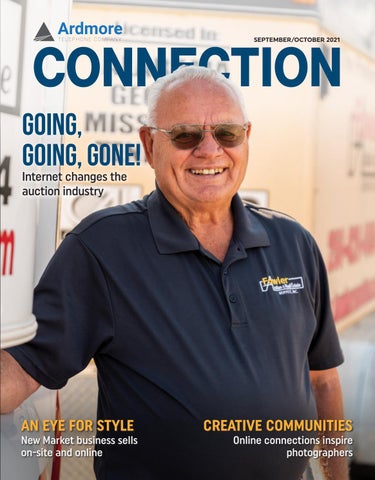
CONNECTION SEPTEMBER/OCTOBER 2021
GOING, GOING, GONE! Internet changes the auction industry
AN EYE FOR STYLE
New Market business sells on-site and online
CREATIVE COMMUNITIES
Online connections inspire photographers
INDUSTRY NEWS
Rural Connections By SHIRLEY BLOOMFIELD, CEO NTCA–The Rural Broadband Association
Building a connected future As the nation’s leaders work to improve the infrastructure that supports our economy and our communities, there is a growing understanding of just how vital broadband service is to rural areas. It’s important rural providers have the resources and regulatory stability they need to connect areas that often have no other options for service. The challenges those providers face go beyond simply building an internet network that must keep pace as the demands of users grow from decade to decade. Recently, representatives of several cooperatives — among them, Golden West Telecommunications Cooperative, South Dakota; the Yelcot Telephone Company, Mountain Home, Arkansas; and Totelcom Communications, De Leon, Texas — made sure members of Congress heard this message. Similarly, months of coping with a global pandemic proved the success of rural broadband. Countless households, businesses, schools and others leaned on their local internet providers during these challenging times. However, there is still work to do in deploying networks and delivering robust and affordable services. This is where public policy can continue to play an important role, setting standards for broadband infrastructure and leveraging the know-how of community-based experts, like the company providing your internet service today. I’ve been delighted at the bipartisan nature of these discussions and the understanding that broadband kept the American economy humming during the pandemic. Now, we just need to ensure the lasting investment needed to future-proof this powerful system. 2 | September/October 2021
‘SIX PILLARS’ OF RURAL BROADBAND Fast internet builds successful communities Rural broadband’s influence extends throughout every community where fast internet networks are available. How many of these “six pillars” of rural broadband play a role in your daily life?
1. ECONOMIC DEVELOPMENT Housing values increase and businesses move more product when rural communities have broadband.
2. PUBLIC HEALTH Instead of driving 50 miles to a health center, a telemedicine visit can bring care into the home.
3. TELEWORKING Remote work creates fresh opportunities.
4. EDUCATION
Educators from grade school to colleges and universities are reaching students remotely.
5. PUBLIC SAFETY Broadband networks can improve the communications systems used by emergency responders.
6. QUALITY OF LIFE Thanks to broadband, young people find rural communities more appealing.
These pillars of rural broadband are based on the work of Christopher Ali, an associate professor in the Department of Media Studies at the University of Virginia. He is also the author of “Farm Fresh Broadband: The Politics of Rural Connectivity.” CORRECTION: In the July-August issue of your magazine, the final word of a travel story on Page 7 about the Red River Gorge was omitted. This is the complete sentence: As the Red River continues through the heart of the gorge, it levels out and provides gentle Class I paddling ideal for beginners.
15
16
Film
15
36
T
15A
16
17
Film
36
16A
17
18
Film
36
17A
18
Better-looking videos are just a few steps away
Film
36
18A
hanks to smartphones, recording and sharing videos has never been easier. Whether you’re capturing precious moments to share with friends and family, showcasing your talents or documenting a moment the rest of the world needs to see, a high-quality video helps get your message across loud and clear.
Here are some tips to help make sure your next video is your best one yet.
• Clean the lens — Sometimes it’s easy to overlook the obvious. We’re touching our phones constantly. We’re taking them out of our pockets and purses multiple times a day, so they’re bound to pick up a few fingerprints and smudges along the way. Take a second and give the lens a couple of swipes with a moistened cleaning wipe. No wipes? No worries — a quick breath and a swab with your shirttail can get the job done, too. • Orientation — Make sure to turn your phone horizontally when shooting videos. Shooting horizontally, also called landscape orientation, results in a more aesthetically pleasing experience for viewers, and it looks great across multiple platforms, especially on wide screens. Shooting this way also allows you to capture more of the surroundings in the video.
• Lighting — When recording indoors have the subject face a window if possible. If there is no natural light, consider purchasing an LED light ring. Light rings have become very popular and are an inexpensive way to make your video look professional. Avoid backlit settings, which can erase a person’s features on video and replace them with a dark figure instead. • Zoom cautiously — While the digital zoom option is a nice feature to have, using it while recording can result in an awkward-looking video. Instead, to keep the image crisp, take the time to frame the shot before recording and avoid using the zoom. Unless you’re planning to use the zoom distortion as an effect, get as close to the subject as you safely can to preserve the image quality.
• Stabilization — Nothing is harder to watch than a shaky video. A simple way to make your video better is by using two hands to hold the phone steady. Instead of extending your arms, tuck your elbows in close to your sides and hold the phone closer to your chest. If a professional-quality video is what you’re after, consider investing in a tripod or a gimbal to give your arms a rest. Also, many newer phones now include image stabilization features that can correct for inadvertent movements during shooting. • Composition — Take a moment to compose your shot before pressing the record button. For example, if you are making a video in a controlled environment, perhaps filming a tutorial in your home, look around and make sure the background is clear of anything you wouldn’t want people to see. September/October 2021 | 3
FROM THE CEO
Competing for jobs
Fast internet service puts us in the game
O
ur world is a competitive place, and not just when it comes to sports. The leaders of every town and county understand they’re in a fight for one of the most desired assets anywhere — jobs. The opposition isn’t just the next county over, either. Every community in the nation is in the game.
Success means bringing any possible advantages onto the playing field, and fast internet service is more than critical. It’s essential because it’s important to businesses of all types and sizes. Small manufacturers benefit from speedy internet service because resources from accounting to customer support often flow through the internet. Similarly, video calls are now just a normal part of business life. For communities hoping to recruit these types of employers, fast internet access is mandatory. Then, think about all the changes we’ve seen in remote work, which was on the rise even before the pandemic. Remote work is more TREVOR common than ever, and if you can work from home, our community is BONNSTETTER Chief Executive Officer highly attractive. After all, the big-city pace isn’t for everyone. So, why not bring those jobs to rural America? ATC is located in a wonderfully unique part of the country. Our service territory isn’t far from Huntsville on the Alabama side and it’s not far from Nashville on the Tennessee side. So while we’re in close proximity to two growing, thriving cities, our customers have the opportunity to live in rural America and enjoy all the benefits that has to offer. We live in a friendly, affordable and beautiful place. And we have the fast, reliable internet network required to make remote work more than just a possibility. The speed and affordability of our internet service is comparable to — and often greatly exceeds — service in major cities. In many ways, we’re a better place for remote work than metropolitan areas. We are expanding fiber connectivity at a rapid pace throughout our service territory. If you’re unsure if fiber is available to you, please give us a call! But it’s about more than just jobs. We’re also building for the future. Our students can learn the skills they need to be competitive, not only for today, but also for tomorrow. A growing number of colleges and universities offer online courses. Students about to enter the workforce can broaden their horizons without ever leaving home. But students aren’t alone in benefiting from classes accessed via the internet. People looking to grow professionally now have similar resources available that allow them to continue their education and open new doors to either advancement or entirely fresh careers. Many of those classes and other resources are best experienced through live video, which needs a high-speed internet connection. While our friends in economic development always keep a watchful eye out for opportunities to attract the attention of large employers, one of the things that excites me most is the entrepreneurs: industrious people putting in the hard work needed to kick-start a business. Our affordable living costs can give young businesses an edge, allowing them to keep overhead lower than their competitors. They can move large amounts of data, share information, hold online meetings and more. Thanks to fast internet access, even home-based startups can link to a worldwide market that was once only accessible to businesses with large staffs in big-city offices. Throughout the nation, there are signs of vitality in rural economies. For all the reasons I’ve described, fast internet service is part of the foundation making it all possible. We’re in the game, and I firmly believe we’re ready to compete.
4 | September/October 2021
CONNECTION SEPTEMBER/OCTOBER 2021
VOL. 9, NO. 5
The Ardmore Connection is a bimonthly newsletter published by Ardmore Telephone Company, © 2021. It is distributed without charge to all customers of the company.
is a hometown service provider delivering advanced telecommunications technology to the people of Giles and Lincoln counties in Tennessee and Limestone and Madison counties in Alabama. The company is managed by Telecom Management Services and owned by Synergy Technology Partners.
Ardmore Telephone Company P.O. Box 549 Ardmore, TN 38449 Telephone: 256-423-2131 or 800-830-9946 www.ardmore.net Ardmore Office: 30190 Ardmore Ave. Ardmore, AL 35739 Monday - Friday 8 a.m. - 4:30 p.m.
Find us on Facebook!
Produced for Ardmore Telephone by:
On the Cover: After 43 years in the auction industry, Mickey Fowler has seen lots of changes and now sets up most of his auctions online. See story Page 8.
ATC NEWS
DOES SOMEONE YOU KNOW NEED HELP? We’ve worked to help you access the free 988 Suicide Prevention Lifeline. In times of crisis, dialing 988 will connect you or a loved one to trained specialists for assistance. The calls are free and private.
DIAL 988
for the National Suicide Prevention Lifeline
IT’S EASY AS PIE!
ALWAYS
CALL BEFORE YOU
DIG
Ardmore Telephone Company makes it easy to pay your bill from the comfort of your home!
With SmartHub, you get:
• Safe and secure payment options • 24/7 account access via phone, tablet or desktop • Important account notifications
Ardmore Telephone Company
www.ardmore.net | 800-830-9946
Safe digging is no accident. Always call before you dig. September/October 2021 | 5
TRAVEL
As Mother Nature intended Okefenokee Swamp is a wildlife watcher’s dream
Story by ANNE BRALY
N
estled deep down in Georgia and stretching into Florida, the Okefenokee Swamp is eerie in places, and just plain spooky in others. It’s a mosaic of vast pine islands, cypress forests and water as black as night — all elements that make up this national treasure.
The swamp, one of the world’s healthiest water ecosystems, is protected from human encroachment by the National Wildlife Refuge System, an organization established to oversee a network of lands and waters for conservation, says Susan Heisey, supervisory refuge ranger of the Okefenokee National Wildlife Refuge. The Okefenokee National Wildlife Refuge has 80% of the Okefenokee Swamp under its jurisdiction, as well as close to 40,000 acres of uplands immediately surrounding the swamp. At 407,000 acres it’s the largest national wildlife refuge in the East. Where there is swampland, there are gators. And alligators love this swamp because they’re protected here. The refuge provides them a safe haven — a wealth of food and shelter to sustain a thriving population of the reptiles. 6 | September/October 2021
“There are generally no problems between man and alligators due to the amount of habitat the refuge provides,” Heisey says. “Generally, when an alligator sees a person, it moves in the opposite direction.” The only times that alligators can be confrontational or dangerous is if they identify people with food, Heisey explains. “So, we try to educate our visitors about the dangers of feeding and approaching wildlife so there are no issues with nuisance alligators.” Alligators can basically be found in any portion of the swamp and most adjacent ponds, ditches or other bodies of water. Alligators do live in the water, but they can also be found on land at times. The females will build up their nests adjacent to
the water where they live. Interesting trivia: Female alligators protect their nests and their young for several years, and they are the only reptiles that do this. And their numbers remain pretty stable, although there has been no recent official count. It’s a matter of water level fluctuation, a limited amount of food sources and competition between males for territorial rights. The largest alligator ever documented was in Louisiana in the early 1900s and was more than 19 feet long. “We do not have a record of the largest alligator in the Okefenokee Swamp, but occasionally there can be individuals at around 14 feet or so,” Heisey notes. Gators aren’t the only creatures found among the swamp’s wetlands and woodlands. The refuge is home to 39 fish species, 37 amphibian species, 63 other reptiles, 234 birds and 50 mammals. Most notable among the animals are wood storks, indigo snakes, gopher tortoises, black bears, endangered red-cockaded woodpeckers and sandhill cranes. The refuge is home to both migratory and resident sandhill cranes, and most recent observation found that there are about 100 nesting pairs in residence. The migratory sandhill cranes are usually present from November through February, at which time they’ll migrate up the Atlantic Flyway to their breeding grounds. Wildlife observation is one of the most common types of recreation for visitors to enjoy while on the refuge. Walking the Chesser Island Boardwalk to the 40-foot observation tower at its end and boating the water trails on a prearranged or selfguided tour are the best ways to see the animals. Finding the cranes is easy. Just listen for their loud bugling calls and look among the refuge prairies where the water is relatively shallow — good hunting grounds for the big, long-legged birds. Look down, not up. Sandhills nest on the ground, not in the trees. “Visitors love seeing those cranes,” Heisey says.
Cutline
The ‘Pogo’ connection Some baby boomers may remember “Pogo,” one of the most popular comic strips of their youth. Pogo was a possum that lived in a tree in the Okefenokee Swamp and came to life weekly in newspapers across America, born from the mind of cartoonist Walt Kelly. At its peak, “Pogo” appeared in nearly 500 papers in 14 countries, and close to 300 million copies of books about Pogo and his friends were sold. Kelly died in 1973, and his widow, Selby, continued the internationally syndicated comic strip until July 1975. After 26 years of syndication, “Pogo” the comic was completely discontinued, but the character lives on today in the welcome center at the Okefenokee Swamp Park in Waycross, Georgia. There, a large room has been turned into Kelly’s studio, complete with a likeness of the man himself and his alter ego, Pogo.
Swamp trivia The Okefenokee is OK, for now, but its future is directly tied to maintaining the integrity of the ecosystem’s complex processes. The future of people and communities surrounding the swamp also is dependent on conserving the swamp. • The swamp is the largest intact blackwater swamp in North America and is more than 7,000 years old. • The swamp is a massive, peat-filled bog inside a huge, saucer-shaped depression that was once part of the ocean floor. • Fire is an important part of the Okefenokee ecosystem, and the refuge has a prescribed burn program in place to accomplish what wildfires once did. The fire staff burns an average of 6,000 to 10,000 acres per year. • Most area residents have ancestors who once lived or worked in the swamp as a part of their heritage. • The Okefenokee Swamp, as the headwaters of both the Suwannee and St. Marys rivers, provides clean water to the most pristine rivers in the Southeast. • A National Geographic publication included the Okefenokee Swamp as among the top 100 most beautiful places on Earth. September/October 2021 | 7
SOLD!
Photo courtesy of Fowler Auction & Real Estate Service.
Photo by Rachel Brister Photography.
Fowler Auction sells on-site and online
Mickey Fowler established Fowler Auction & Real Estate Service 43 years ago.
Fowler Auction and Real Estate Service was at in its heyday in the 1970s.
or collectors and bargain hunters, there’s nothing like the excitement of a live auction — hands waving in the air while an auctioneer speedily calls out the next price for bids. Auctions are equal parts sport and shopping. At least, that’s how it was 43 years ago when Mickey Fowler gave up farming for the auction industry. Back in the 1960s and ’70s, the farming business had slowed. This was way before the modern farm-to-table movement took hold across the nation. In the 1970s, processed foods and frozen dinners were the rage. And farmers suffered. “So I started buying and selling farm equipment,” says Fowler, owner of Fowler Auction & Real Estate Service. Word of mouth spread like the words of a fast-talking auctioneer, and soon folks around the Toney community were bringing their own equipment for Fowler to sell. “And I would get a commission if it sold,” he says. That’s how Fowler transitioned from farmer to auctioneer, and Fowler Auction became reality in 1978. Soon, Fowler was selling more than just old farming tools and other equipment. He also got a real estate license, which enabled him to auction off houses and land. Now, in addition to the auction house, he also sells guns, furniture and other items. Fowler has auctioned such unusual items as a lighthouse, airplanes and horse buggies. He’s even featured a sale of sweet confections — cheesecake, red velvet cake, carrot cake, chocolate fudge, peanut butter fudge, coconut cake, Italian cream. And the proceeds from those sweets all benefited Blanche School in Taft, Tennessee. To Fowler, though, the most important items up for bid have been the estates of friends and loved ones.
CHANGING TIMES
Nickie Randolph, office manager at Fowler Auction & Real Estate Service.
Greg Bottom, auction manager at Fowler Auction & Real Estate Service. 8 | September/October 2021
F
Story by ANNE BRALY
While the items sold at auction haven’t changed a great deal since his business got off the ground, the way things are done certainly has. In the beginning, would-be auctiongoers received brochures through the mail detailing items that would be up for bid in coming sales. Now, Fowler depends heavily on the internet and social media to spread the word. Mailers he once sent out reached as many as 15,000 people. Emails and social media help reach thousands more, he says. Ardmore Telephone Company
Auctions have also gone from on-site to online. In 2019, Fowler Auction held more than 30 live auctions around the South, from Alabama to Tennessee, Mississippi and Georgia — all states where Fowler holds licenses. In 2020, the number of live auctions fell to seven. And so far in 2021, he’s scheduled just a few live auctions. Potential bidders can spend an afternoon reviewing lots, see the latest bids and place their own offers from the comfort of home — though Fowler Auction encourages people to view the items they may be considering in person when possible. Each auction has an online catalog, and bids may be placed online. Bidders must register to bid, and a credit card is required. However, if buyers are paying in person, cash and checks are acceptable. Several years ago, Fowler Auction joined other auctioneers in a global alliance that reaches members as far away as South Africa. And though the company has had “window-shoppers” from overseas, none has ever made a purchase. To date, most of the items have found buyers around the Southeast, primarily within a 100-mile radius. However, thanks to the far-reaching effect of the internet, items have gone to people as far away from Toney as New York, Arizona and Indiana. And during the pandemic, it became evident how much Fowler depended on online access through Ardmore Telephone Company. “We couldn’t have kept the business going without the internet,” he says. Creating a website has enabled Fowler to increase his auction business, adding internet sales to augment live transactions. This move has been particularly helpful over the past year, when live auctions and gatherings were temporarily on hold. Fowler Auction would have been forced out of business had it not been for the internet, he says. To see the latest items on the auction block, visit www.fowlerauction.com. Register, and let the bidding begin.
MICKEY FOWLER INDUCTED INTO THE NATIONAL AUCTIONEERS ASSOCIATION HALL OF FAME Auctioneer Mickey Fowler was inducted into the National Auctioneers Association Hall of Fame in July at the organization’s annual meeting in Minneapolis. Fowler, an auctioneer for 43 years, still believes this method is the best way to turn assets into cash. He is a licensed auctioneer in the states of Alabama, Tennessee, Georgia and Mississippi, and he holds various auctioneer designations. The National Auctioneers Association was founded in 1949. The organization’s Hall Of Fame, established in 1961, recognizes leaders within the auction industry. A bronzeetched portrait plaque of Fowler will join his predecessors in the National Auctioneers Museum located in Overland Park, Kansas, at the organization’s headquarters. The Fowler team assists clients to make the selling of property as stress-free as possible, from the beginning to the end. Auctions range from starter homes to large estates, mini to large farms, small businesses to large commercial complexes, estates, liquidations, boats, cars, trucks, farm and heavy equipment, and more. “It’s an honor to be inducted into the National Auctioneers Association Hall of Fame,” says Fowler, who lives in Toney with his wife, Pat. “I’ve worked in this industry for a long time, and it’s great to be honored by my peers in the industry.”
Ardmore Telephone Company
September/October 2021 | 9
NEW PERSPECTIVES
Jason Stitt sees rural Texas through a different lens Story by DREW WOOLLEY
J
ason Stitt has always seen the world a little differently. Through the lens of his camera, he likes to find new views of the places other people might pass every day without a second thought. “Photography helps me to view the world in ways most people don’t get to. To look at things from different angles, different perspectives and to see things in a way that others may not,” he says. “Mostly, it’s an outlet for me to be creative and to show the world the beauty of God’s creation, whether that be people or nature.” Now, with the help of the internet, he can encourage others in his community to find their own individual perspectives. Social media has been a place for Stitt to grow as a photographer by sharing his work, asking questions and engaging in critiques with other professionals. He even runs his own Facebook group, Tyler Area Photography, with more than 600 members dedicated to growing the
10 | September/October 2021
“I am an introvert by nature,” he says. “So I really enjoy the quiet solitude of being out in nature with just my camera gear.”
IN FOCUS photography community in Tyler, Texas. “I’m still learning and growing and will never stop,” Stitt says. “We don’t have lots of photography shops like you might find in bigger cities. So almost all of my continuing education and growing the craft relies on the internet.” Stitt caught the photography bug 18 years ago while living in California. Working as a graphic designer, he started submitting his shots to a stock photo website before becoming a full-time photographer two years later. After moving back home to New Zealand with his family, Stitt discovered his passion for landscape photography. But it was only a few years before the cost of living caught up with them. They didn’t want to give up the opportunity to have his wife, Ruth, home-school their children. So, Stitt took his newfound talent for capturing natural beauty to Tyler, where he could continue pursuing his career while supporting his family.
When Stitt and his family were deciding where to relocate on their move back to the States, there was one must-have for his business: a strong internet connection. “That was one of the most important factors in choosing a place. It had to have a reliable and fast internet connection,” Stitt says. "Ninety-nine percent of my business I get through either my site or social media. So without the internet, I lose all of that.” Photographer Jason Stitt
He isn’t exaggerating. About a year and a half after moving to Tyler and gradually building momentum as a professional photographer, Stitt and his family visited New Zealand for five weeks to see his parents. Stitt stayed away from social media during the trip and returned to find business had ground to a halt. “I felt like I had just lost all the momentum I had built while we were gone and had to start all over again,” he says. “Now, ideally, I try to post something every weekday to keep business relatively steady and keep getting inquiries. If I’m not posting regularly, those inquiries just stop happening.”
TOOLS OF THE TRADE
Getting the shot Whether you’re just starting out or a seasoned pro, Stitt offers some pointers to make your photos stand out. • Shoot, shoot, shoot — As with any learned skill, the best way to hone it is to do it. Get out and take as many photos as you can to develop a better idea of your interests and style. • Be intentional — Ansel Adams said, “You don’t take a photograph, you make it.” Photography is art, and good art requires forethought and planning. Think about what you want to capture and how you want to photograph it. • Study the greats — Look closely at the work of photographers you admire. Figure out what it is about their work that appeals to you and then try to emulate it. • Master the light — Light is the single most important factor in photography. More than determining how bright or dark your photos are, controlling light also decides the tone, mood and atmosphere of your images. • Learn to edit — Don’t neglect learning how to use your editing software. In today’s world, the ability to edit well is one of the elements that makes for a great photographer. • Find your community — Locate a local camera club or Facebook photography group to join. These can be great places to meet like-minded people from whom you can learn and grow.
The internet is full of resources for aspiring photographers and professionals alike. Whether you’re looking to manage your shots or learn a new skill, there’s something for everyone. • Education — Even the best photographers have something to learn. For professional courses, Stitt turns to sites like CreativeLive and Improve Photography. If you’re looking for something to peruse at your leisure for education and inspiration, he recommends Scott Kelby’s blog. • Editing — With Adobe’s Photography package, anyone can get access to professional-grade software like Photoshop and Lightroom to edit and organize your photos on any device — all for little more than some streaming subscriptions. • Website builders — Every photographer needs a place to share their work with the world. Popular website builders like Squarespace and Portfoliobox make it easy to show off your best shots and even to sell your work. • Storage — As all those photos pile up, you’ll need somewhere to keep them. Flickr offers a substantial 1 TB of free storage, while services like Dropbox and Google can provide up to 16 TB of space as your portfolio grows.
September/October 2021 | 11
Finding a niche
Kelly Sisk owns Southern Decorista.
The Southern Decorista has a flair for design
K
elly Cantrell Sisk began working for her dad when she was in her early 20s, helping him in his store in Hazel Green. It was a flooring store that also specialized in stone countertops and custom showers, and Sisk realized early on that she had an eye for knowing what looked good. She was a natural when it came to design, helping folks refresh entire homes or single rooms — areas that had grown stale from years of living. She would even start designs from scratch, planning decor in newly built homes. But Sisk was a clothes horse, too. She loved fashion. So, she combined her love of interior and fashion design and started selling gifts, clothing and accessories online, while taking continuing education courses in interior design. She called her business The Southern Decorista, a name that embodies her passion for design. “People started asking me about opening a store,” she says. “‘Just put it in your garage and give us a place to try on clothes,’ they said.” So, she did, converting her two-car garage into a boutique with two dressing rooms and, eventually, a bathroom. In the meantime, though, Sisk searched
12 | September/October 2021
her town for a more traditional storefront, and she found the perfect spot in a 1950sera shotgun-style house in downtown New Market. She added her own special touches, making it a cheery place — a green exterior with a pink front door and welcoming front porch. She opened in 2017 and now has four employees. Her store, like many locally owned businesses, is a vital part of the community, offering people something other than the big-box stores that have taken over so many small towns around America. It’s a hometown place where people can come for the things they need to brighten their wardrobes and homes. The Southern Decorista also offers decorating services and wedding decor and planning. Though many of her customers come via word of mouth, the internet service she receives through Ardmore Telephone Company gives her the opportunity to bring more people through the doors in person and online. The Southern Decorista’s user-friendly website allows customers to pick up their orders on the front porch without having to enter the store or have them delivered via priority shipping anywhere in the United States, including Hawaii.
Photography contributed by Southern Decorista.
Story by ANNE BRALY
Social media also plays a major role in Sisk’s marketing strategy, letting people know about sales, specials and other happenings at The Southern Decorista via its Facebook, Instagram and TikTok pages. “I really couldn’t run this business without the internet,” she says. “It’s our access to our customers to bring them into the store by showing them what we have on many platforms.”
About The Southern Decorista 5592 Winchester Road, New Market 256-679-9678 www.thesoutherndecorista.com Follow The Southern Decorista on Facebook, Instagram and TikTok.
Ardmore Telephone Company
Living Connected
Fiber for the speed of life!
Bandwidth vs. speed
A
fiber internet connection travels at close to the speed of light. However, your overall internet experience can suffer over time if you do not have enough bandwidth capacity to handle all the devices connected to your network. So, how much bandwidth capacity and speed are needed? Think of fiber internet coming to your home like water flowing through a pipe. You can liken bandwidth to the size of your water pipe and speed to how fast the water is able to flow through that pipe. If you take a shower, you normally have plenty of water pressure. But the flow of water slows to a trickle if you’re also running the dishwasher, the washing machine is in use and others in the home are taking showers. Your internet connection works the same way. As more devices connect to the network with users simultaneously streaming movies, playing video games and learning or working remotely, there will be a noticeable slowdown if your bandwidth isn’t big enough.
THE SPEED YOU NEED Your fiber internet connection from Ardmore Telephone Company is fast, strong and reliable. However, if you don’t have enough capacity for your family’s needs, you may find buffering delays and spotty video calls continually frustrating your efforts to stay connected. Remember, if your household uses multiple devices at once, you’ll need to consider the activity happening on every device to determine the total bandwidth you’ll need.
WORK Working from home doesn’t mean working in isolation. If you collaborate with clients or co-workers on group video calls, you’ll need about 8 Mbps of download speed and 500 Kbps of upload speed for a smooth experience. When you leave your home, you may want a smart security system to protect it. A video doorbell or high-resolution security camera operates best when you have 2 to 2.5 Mbps download and upload speed available for each camera.
PLAY Without adequate bandwidth, online gaming quickly becomes an exercise in frustration. While some gaming platforms list a minimum recommended speed of around 3 Mbps of download speed and 1 Mbps of upload speed, this is truly the minimum necessary. Many gamers prefer speeds of 15-25 Mbps to ensure minimum lag and seamless gaming experiences.
REST Whether you prefer Disney+, Netflix or some other streaming video platform, the guidelines are roughly the same. In most cases, 3 to 4 Mbps is recommended for standard definition video, 5 Mbps for HD video and 25 Mbps for Ultra HD (4K) video. These recommendations are always per device, so if you’re streaming on multiple screens throughout the house, don’t forget to add them all up for best results.
Fiber-fast internet is the future. And it’s here!
800-830-9946 | www.ardmore.net
Experiencing internet issues? Let us help!
Fiber internet is not yet available in all ATC service areas. Ardmore Telephone Company
If you’re having any issues with your internet, please call us so we can work through any service issues together. We are committed to making your connection an outstanding experience. September/October 2021 | 13
SOUTHERN KITCHENS
Palate pleasers
Pears make perfect sweet and savory dishes
P
ears add a dose of seasonality to dishes this time of year with a sweetness that’s nuanced and subtle yet plentiful. But understanding which type of pear is best for what use will help you choose wisely from the fruit you’ll see in the produce section of your local market. Any type of pear is good to eat as long as it’s ripe enough to bring out its sweetness. But when it comes to using pears in cooking, the variety you choose matters. Do you want the pear to retain its shape when poached? Or do you want it to melt into a sauce? Just remember your pear ABCs — Anjou, Bosc and Comice. Anjou is an all-purpose pear that can be grilled, roasted or eaten as a snack. Bosc pears are best for poaching, as they maintain their shape well when cooked.
Comice pears are best used raw, as their tender flesh will not hold up well under heat. They are a sweet pear to pair with cheese. The best way to ripen pears is on the counter at room temperature, a process that requires patience, since the fruit can take up to a week to reach its sweet peak. Once fully ripe, pears may be stored in the refrigerator for up to a week, if they stick around that long before being used in any of the following recipes. FOOD EDITOR ANNE P. BRALY IS A NATIVE OF CHATTANOOGA, TENNESSEE.
Pear & blue cheese salad 12 cups torn romaine lettuce 2/3 cup balsamic vinaigrette (homemade or store-bought), see note 2 medium pears, sliced (Comice suggested) 2/3 cup crumbled blue cheese 2/3 cup glazed or salted pecans Place romaine in a large bowl. Drizzle it with vinaigrette; toss to coat. Top with pears, cheese and pecans. Serve immediately. Makes 10 servings.
Photos by Miller Photography.
Note: If you can’t get enough blue cheese, substitute blue cheese dressing for the balsamic.
14 | September/October 2021
PEAR & GORGONZOLA PIZZA 1 (16-ounce) package refrigerated pizza crust dough 4 ounces sliced provolone cheese 1 Bosc pear, thinly sliced 2 ounces chopped walnuts 2 1/2 ounces Gorgonzola or blue cheese, crumbled 2 tablespoons chopped fresh chives Preheat the oven to 450 F. Spread the pizza crust dough on a medium baking sheet. Layer provolone cheese on the crust and top the cheese with Bosc pear slices. Sprinkle walnuts and Gorgonzola cheese over the pears. Bake for 8-10 minutes, or until the cheese is melted and the crust is lightly browned. Remove the pizza from the oven, top it with chives and slice to serve.
PEAR PANCAKES 1 1/2 cups baking mix (such as Bisquick) 1 medium ripe pear, peeled and finely chopped 2/3 cup old-fashioned oats 2 tablespoons packed brown sugar 1 1/2 teaspoons ground cinnamon 1 cup milk 2 tablespoons butter or margarine, melted 1 egg 1/2 cup butter or margarine, softened 2 teaspoons powdered sugar Maple syrup, if desired Heat a griddle or skillet over medium heat. Grease it with butter or vegetable oil if necessary. In a large bowl, stir the baking mix, chopped pear, oats, brown sugar and 1 teaspoon of the cinnamon until blended. In a medium bowl, beat the milk, melted butter and egg with a fork or wire whisk. Add the milk mixture to the dry ingredients, stirring just until moistened. For each pancake, pour about 1/4 cup batter onto a hot griddle. Cook the pancakes until bubbles form on top and the edges are dry. Flip, then cook the other side until golden brown. While the pancakes are cooking, make cinnamon butter: In a small bowl, mix 1/2 cup butter, the powdered sugar and the remaining 1/2 teaspoon cinnamon. Serve the pancakes with cinnamon butter and syrup.
BAKED PEARS WITH WALNUTS 2 1/4 1/4 2
large ripe Bosc pears teaspoon ground cinnamon cup crushed walnuts teaspoons honey Vanilla ice cream or whipped cream, optional
Preheat the oven to 350 F. Cut the pears in half and place them on a baking sheet. You may want to cut a sliver off the uncut side so that they sit upright. Using a measuring spoon or melon baller, scoop out the seeds. Sprinkle the pear halves with cinnamon, top them with walnuts and drizzle 1/2 teaspoon honey over each one. Bake for 30 minutes. Remove from the oven, let them cool slightly and serve the pears topped with ice cream or whipped cream, if desired.
PEAR CLAFOUTIS
Think pear cobbler, only easier. Salted butter for the dish 2 ripe but slightly firm Anjou pears (about 1 pound total) 1 cup half-and-half 3 eggs 1/3 cup plus 1 tablespoon granulated sugar 1 1/2 teaspoons vanilla extract 1 teaspoon orange zest 1/8 teaspoon nutmeg 1/4 teaspoon kosher salt 1/2 cup flour Powdered sugar Peel, core and slice the pears lengthwise about 1/3-inch thick. Preheat the oven to 350 F. Butter a shallow 3-quart baking dish and arrange the pears over the bottom — they will rise to the top as the batter bakes. Put half-and-half, eggs, granulated sugar, vanilla, orange zest, nutmeg, salt and flour (in this order) in a blender and whirl until very smooth and frothy, 1 minute. Pour the batter over the pears. Bake until the clafoutis is well browned and a little puffed, about 50 minutes. Let it cool on a rack about 15 minutes. Serve warm, sprinkled with powdered sugar.
September/October 2021 | 15
Presort STD US Postage PAID Permit #21 Freeport OH
P.O. Box 549 • Ardmore, TN 38449
OUR CUSTOMERS ARE AT THE HEART OF WHAT WE DO!
You’re invited to
CUSTOMER APPRECIATION DAY! Door prizes
Barbecue
T-shirts
HELP US CELEBRATE YOU, OUR LOYAL CUSTOMERS!
Wednesday 11 A.M. - 2 P.M.
OCT. 13TH
At our office
30190 Ardmore Ave., Ardmore, AL
Join us! TELEPHONE COMPANY 800-830-9946 | www.ardmore.net