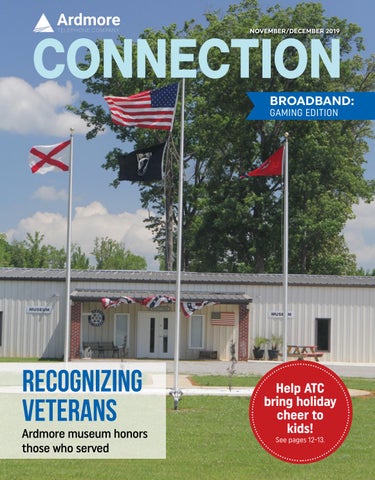
CONNECTION NOVEMBER/DECEMBER 2019
BROADBAND: GAMING EDITION
RECOGNIZING VETERANS
Ardmore museum honors those who served
Help ATC bring holiday cheer to kids! See pages 12-13.
INDUSTRY NEWS
Rural Connections BY SHIRLEY BLOOMFIELD, CEO NTCA–The Rural Broadband Association
We need better mapping data
S
everal states have adopted loan and grant programs to help extend service to those areas of rural America still lacking a reliable broadband connection. Beyond its traditional programs, the federal government continues looking for ways to invest in this critical infrastructure. A challenge associated with deciding where to invest these dollars is identifying where service is or is not already available. The FCC’s broadband maps are the determining resource. The FCC issued an order over the summer that will move away from the overly broad use of census blocks for reporting broadband coverage, instead requiring providers to submit “shapefiles” showing where they actually offer broadband service. I had the opportunity to appear before a Congressional committee in September, where I shared a few key steps to move us toward more accurate mapping. First, we need standardized reporting. It is also important to have a back-end validation process. Finally, a robust challenge process is needed to allow providers and policymakers to do one last “sanity check” on the accuracy of the maps before decisions are reached. Providers like yours are making great progress in connecting rural America. But if we hope for a future where everyone has broadband access, we must have better mapping data.
Celebrate rural health on Nov. 21 Despite the challenges of serving rural America, health care professionals are delivering quality care, embracing technology and finding creative ways to encourage wellness among their rural patients. On Nov. 21, rural health offices will honor these providers — along with the partners and communities who support them — by sponsoring National Rural Health Day.
How can you celebrate National Rural Health Day? Find free, downloadable resources for many of the activities below by visiting www.powerofrural.org/nrhd-tookit. PARENTS: Prepare a healthy meal for dinner, and talk with your kids about the blessings — and the challenges — of living in rural America. Mention the health care providers who service your rural community. PATIENTS: Write a note to your health care team, thanking them for their help and their commitment to serving a rural population. PHYSICIANS: Display National Rural Health Day posters in your office. Provide a staff appreciation lunch. Visit www.WalkWithADoc.org and consider starting this fun, active outreach in your community. FACEBOOK USERS: Share a story about your doctor, a nurse or other health care provider who has made a positive impact on your life. TEACHERS: Give your students coloring book pages. Sponsor a rural health-themed poster contest. Invite physicians or nurses from local hospitals and clinics to speak to students. BROADBAND USERS: Search for health information over your broadband connection. Ask your physician if there are telehealth resources that could help you maintain or improve your health. SMALL BUSINESSES: Show appreciation to your local rural health professionals by providing them with discounts or special offers. YOU!: Make healthy eating choices. Take a walk. Avoid tobacco products. Schedule an appointment to have your cholesterol and blood pressure checked. Share your experiences across social media using the hashtags #powerofrural and #nationalruralhealthday.
2 | November/December 2019
Gaming generation Millennials — the first lifelong gamers
T
he U.S. launch of the Nintendo Entertainment System in late 1985 helped create an entertainment revolution. The oldest millennials at the time were about 4 years old, and that generation would be the first to make gaming a common pastime. Members of this group, also known as Generation Y, are closely tracked by experts such as The Nielsen Company to monitor entertainment and technology trends, because the habits of millennials shape those industries. Today, millennial gamers are finding new ways to play. There are mobile games and online, community-based games. Some people compete, and others enjoy the movielike experiences of modern games. And for millennial gamers, the male-to-female ratio is roughly even.
Thanks to games that emphasize social features, about 70% of millennial gamers and the generation following, often known as Gen Z, turn to multiplayer gaming for the social component. Also, the pastime remains a critical entertainment choice even when the competition ends. About 70% of gamers turn to YouTube or Twitch to watch online videos about gaming. On average, this form of viewing totals nearly six hours weekly. Millennial gamers are willing to pay those who create the content they enjoy, either through subscriptions or by donating directly. A Nielsen report concluded that millennials will not quickly outgrow this form of entertainment, and they will become the first generation of lifelong gamers. î‚š
Games have become a social activity for millennials Thanks to social features that let connected gamers chat and play with each other, a large share of millennials and Gen Zers play multiplayer games to virtually hang out with their friends and families. Members of Gen X and up are, in contrast, far less likely to play multiplayer titles.
Millennial gamers are a wide-ranging demographic group
100 80 60
72%
70%
40
43%
20 0 GEN Z
MILLENNIALS
GEN X
54%
76%
with full-time employment
pay for a movie/TV streaming service
43%
38%
with a bachelor’s degree or higher
pay for a music streaming service
46%
$58,000
with children
average household income
November/December 2019 | 3
FROM THE CEO
Like Nintendo, we go beyond technology
A
t first glance, Ardmore Telephone Company and Nintendo don’t have a lot in common. Nintendo is a video game giant based in Japan, and we are a small broadband provider in rural Alabama and Tennessee.
But a quote I ran across recently made me realize we may have more in common than you’d think. In the pages of this issue, you’ll see a focus on gamers. And though I’m not much of a gamer myself, I know there are hundreds or even thousands of our members who enjoy playing video games on our network. As I hope you’ll read, gaming has certainly become mainstream — to the point where there are college scholarships for esports. For decades now, one brand has been synonymous with gaming: TREVOR BONNSTETTER Nintendo. It’s a company with an interesting history. Like ATC, Chief Executive Officer it evolved over the years to meet customer demand. In fact, many people don’t know that Nintendo started off in 1889 as a small manufacturer of playing cards. Nearly a century and a half later, it’s changed the world with its electronic gaming systems, handhelds and characters like Mario. Similar to the way Nintendo developed, we’ve evolved from party line phone systems to lightning-fast broadband. But a quote from former Nintendo President Satoru Iwata drove home another similarity our two companies share. In discussing his company’s success, the late Mr. Iwata stated that in order to be successful, Nintendo had to look beyond the hardware and software it developed. “Please understand, I am not saying that technology is unimportant,” he told an interviewer. “But if we are just focusing on technology ... we will not succeed.” In order to succeed, Nintendo had to focus not on the processors, electronics and equipment driving its games but instead on what the games did for people. Similarly at ATC, we constantly remind ourselves that the technology our business provides is only part of the equation. What matters most is how our members use that technology and the ways their lives are improved because of it. Maybe it’s when a young adult can enroll in distance learning classes because of our network. Maybe it’s when an entrepreneur connects to markets around the world through our services. Or maybe it’s simply when a customer gets to play a video game online with friends. At ATC, we understand the impact of fast, reliable connectivity. We continue to expand our fiber network in New Market and Elkmont. To date, we've passed about 1,000 locations and our next construction phase will pass about 1,500 more. Meanwhile, our Elkmont project will pass approximately 600 locations. We continue to focus on ways to expand the fiber network in each of our exchanges by pursuing grants through state and federal programs, including U.S. Department of Agriculture loans. Just like with Nintendo, the bits and bytes of our business are secondary. Our primary focus is on the difference that technology can make for you.
4 | November/December 2019
CONNECTION NOVEMBER/DECEMBER 2019
VOL. 8, NO. 6
The Ardmore Connection is a bimonthly newsletter published by Ardmore Telephone Company, © 2019. It is distributed without charge to all customers of the company.
is a hometown service provider delivering advanced telecommunications technology to the people of Giles and Lincoln counties in Tennessee and Limestone and Madison counties in Alabama. The company is managed by Telecom Management Services and owned by Synergy Technology Partners.
Ardmore Telephone Company P.O. Box 549 Ardmore, TN 38449 Telephone: 256-423-2131 or 800-830-9946 www.ardmore.net Ardmore Office: 30190 Ardmore Ave. Ardmore, AL 35739 Monday - Friday 8 a.m. - 4:30 p.m.
Find us on Facebook!
Produced for Ardmore Telephone by:
On the Cover: The 3,500-square-foot Ardmore Veterans Museum is filled with memorabilia from World War I to current service. See story Page 8.
' Tis the season!
ATC WILL CLOSE FOR THE FOLLOWING HOLIDAYS: Thanksgiving Thursday and Friday, Nov. 28-29
Christmas Wednesday, Dec. 25
New Year’s Day Wednesday, Jan. 1
Reminder: When our offices are closed, you can access your account 24/7 with SmartHub! Find out more at ardmore.net!
Statement on nondiscrimination Ardmore Telephone Company is the recipient of federal financial assistance from the U.S. Department of Agriculture (USDA). The USDA prohibits discrimination in all its programs and activities on the basis of race, color, national origin, age, disability, and where applicable, sex, marital status, familial status, parental status, religion, sexual orientation, genetic information, political beliefs, reprisal, or because all or part of an individual’s income is derived from any public assistance program. (Not all prohibited bases apply to all programs.) Persons with disabilities who require alternative means for communication of program information (Braille, large print, audiotape, etc.) should contact USDA’s TARGET Center at 202-720-2600 (voice and TDD).
Thank you
FOR YOUR SERVICE! ATC would like to thank the brave men and women who have served our country. We thank you for your service. Take a moment to thank a soldier in your life on Veterans Day, which is Monday, Nov. 11.
Ardmore Telephone Company
To file a complaint of discrimination, write to USDA, Director, Office of Civil Rights, 1400 Independence Ave., SW, Washington, DC 20250-9410, or call toll free 866-632-9992 (voice) or 800-877-8339 (TDD) or 866377-8642 (relay voice users). USDA is an equal opportunity provider and employer. The person responsible for coordinating this organization’s nondiscrimination compliance efforts is Trevor Bonnstetter, CEO.
November/December 2019 | 5
History comes alive
TRAVEL
North Carolina museum honors soldiers through the years
T
he birth of the U.S. Army Airborne units came about in 1940 with the aid of a batch of borrowed Riddell football helmets from the United States Military Academy at West Point. The helmets, which were used to protect the heads of aspiring paratroopers, came with instructions, however. The team needed them back when football season returned.
With that bit of information, visitors can enter the Airborne & Special Operations Museum in Fayetteville, North Carolina. Situated just a few miles from Fort Bragg, the museum honors the sacrifices of all airborne and special operations units with an extensive collection of memorabilia and military equipment dating from World War II to the present day.
WHY FAYETTEVILLE? Now-retired Gen. James Lindsay led a push for the museum. He served as the first commander of the U.S. Army Special Operations Command, which is located on
One of the Vietnam War-era museum displays re-creates soldiers on a rescue mission jumping out of a helicopter. 6 | November/December 2019
Fort Bragg and oversees various unconventional warfare units. The Army post also serves as headquarters for the XVIII Airborne Corps, which has long presided over some of the most storied Army units in the nation’s history, including the 101st Airborne and the 82nd Airborne All American Division, which is still located on Fort Bragg. “But our museum represents more than the 82nd,” says Jim Bartlinski, museum director. “We represent all U.S. Army Airborne troops and Special Operations. So we tell those histories here.”
FROM PAST TO PRESENT The exterior design of the museum features soaring metal beams that play on the looks of the jump towers paratroopers use to practice. An imposing Iron Mike statue greets entering visitors. Various monuments commemorating American soldiers bear the nickname. This Iron Mike details the look of a World War II-era paratrooper, but it represents all paratroopers and special operations soldiers, Bartlinski says. Inside the museum, visitors get a chronological look at the world of paratroopers and special forces soldiers — from their first test jump in Fort Benning, Georgia, in 1940 to today’s missions in Afghanistan.
A U.S. Army Airborne & Special Operations Museum display re-creates a temporary post in Afghanistan.
There is a special emphasis on World War II, which saw not only the beginning of the Airborne but also the most concentrated use of airborne operations. During that time, paratroopers dropped behind enemy lines to work with groups resisting the Nazi invasion of their countries. They also landed in Normandy just before the D-Day invasion of Europe. Displays include artifacts, true-to-life dioramas, the various types of aircraft used for missions, specialized Jeeps and other equipment used for airborne drops and specialized missions behind enemy lines. One glass-encased display shows a card with an early version of the special forces’ red arrowhead insignia. The cards sometimes turned up conspicuously on the uniforms of dead Nazis as a chilling warning.
Hooah!
The Airborne & Special Operations Museum is at 100 Bragg Blvd., about 8 miles from Fort Bragg, in the heart of historic downtown Fayetteville, North Carolina. It is within walking distance of the North Carolina Veterans Park, a variety of local shops and restaurants, and the new baseball stadium of the Houston Astros’ minor league farm team, the Fayetteville Woodpeckers. For more information, including hours of operation, visit the museum’s website at asomf.org or its Facebook page.
Visit a military museum this Veterans Day Interactive displays are also scattered throughout the museum, including one that gives visitors a chance to sit in the hard, metal seats of a C-47 fuselage and then experience a simulation of jumping out of the cargo carrier. In addition, the museum’s theater shows movies several times a day, and a 25-seat simulator room offers virtual reality experiences that mimic those of paratroopers. The museum offers visitors a chance to refresh their history knowledge and see it in the context of the ongoing military operations of the times. But it also gives them a chance to better understand history from the eyes of a soldier, Bartlinski says. “What we do here commemorates the service of all these paratroopers,” he says. “It points out all their sacrifices in the past and the ways they’ve continued to make sacrifices. It’s important to remember that our troops are still out there in harm’s way.”
Military museums continue to fill visitors with respect and appreciation for the men and women of the U.S. armed forces. But today’s military museums feature dazzling interactive activities, exciting simulations and realistic visual displays that bring history to life and educate visitors about the people who fought. Looking for an inspiring military museum in the Southeast? Here are just a few of the greats:
NATIONAL NAVAL AVIATION MUSEUM Pensacola, Florida The National Naval Aviation Museum is the world’s largest Naval aviation museum. It explores the rich history of Naval aviation with more than 150 beautifully restored aircraft representing Navy, Marine Corps and Coast Guard aviation. These historic and one-of-a-kind aircraft are displayed both inside the museum’s nearly 350,000 square feet of exhibit space and outside on its 37-acre grounds. For more information, visit navalaviationmuseum.org.
NATIONAL INFANTRY MUSEUM & SOLDIER CENTER Fort Benning, Georgia With thousands of artifacts, monuments, interactive exhibits and video presentations on display, the National Infantry Museum is one of the nation’s leading military history destinations. Visitors of all ages can experience firsthand the American infantryman’s journey to defeat tyranny around the globe. For more information, visit nationalinfantrymuseum.org.
U.S. ARMY AVIATION MUSEUM Fort Rucker, Alabama Life-sized dioramas of aircraft and personnel capture the rich heritage of Army aviation, which started during the U.S. Civil War with hydrogen-filled balloons that directed artillery fire. About 50 different aircraft fill this cavernous museum and tell the wild and uplifting stories of U.S. Army pilots. For more information, visit armyaviationmuseum.org.
November/December 2019 | 7
those who served Ardmore Veterans Museum a success
BY LISA SAVAGE
Hundreds of local veterans and their families have contributed service uniforms, photos and other keepsakes from their time in the military.
A
lthough William Kelley, a World War II pilot, went through many battles unscathed, he eventually did meet an unfortunate end while flying. He had returned to the United States, and during a parade commemorating the end of the war, he died in a plane crash. His personal effects, which went back to his family in a trunk, remained unopened for years. When Kelley’s son — 18 months old at the time of his father’s death — learned a group of veterans hoped to establish a museum and were requesting veterans’ artifacts, he donated the trunk. Now, the pilot’s razor, shoes, rifle, metal tin and hundreds of pictures of him and other wartime photos sit among the displays at Ardmore Veterans Museum. “His wife never opened the trunk, and his son brought it to me,” says Ken Crosson, president of the Ardmore Veterans Group, which established the museum in 2018. The museum features many unusual artifacts, including a coconut that local veteran James Butler addressed to his wife and mailed during World War II. Mannequins are used to display uniforms, overcoats and other clothing people have donated to the museum. “There’s one overcoat that must weigh 20 pounds,” Crosson says.
8 | November/December 2019
A man’s Air Force uniform hangs alongside the uniform his daughter, also an Air Force veteran, wore. Memorabilia from a brigadier general from Pulaski fills one corner. He served two tours in Vietnam and had all kinds of items, including coins, medals and pictures. “He donated everything he had, and it fills up one corner,” Crosson says.
A VISION TO HONOR VETERANS The museum, fulfilling Crosson’s vision, started as a veterans memorial with three flag poles placed on a concrete base for the public to see as they drove through Ardmore. There were memory rocks, each with the name of a local military member, their branch of service and other information. The display began with 30 rocks, and now there are more than 400 rocks at the memorial. But Crosson felt Ardmore’s veterans from Alabama and Tennessee needed more. “I thought, ‘If we could have a veterans museum, that would be wonderful,’” he says. Crosson served 20 years in the Army, from 1958 to 1978, and worked at Redstone Arsenal until he retired in 1996 and moved to Ardmore. He and others formed the veterans organization, and he has also served on the city council of Ardmore, Tennessee. Ardmore Telephone Company
HOME FOR THE MUSEUM As ideas for the museum took form, Crosson approached officials with the City of Ardmore, Tennessee, and they agreed to provide space for it. They refurbished a building for the museum’s home on First Street. “Word got around that we were seeking items for the museum, and people started bringing memorabilia from all over,” Crosson says. “People had stuff in closets and drawers.” The museum’s 3,500 square feet is filled with memorabilia from the World War I, World War II, Korea and Vietnam eras, along with items from present-day veterans. A library in the museum includes books, maps and other war- or veteranrelated information. “It has been successful beyond my expectations,” Crosson says. “I never dreamed we’d have that many items donated. We’re able to keep it going by people making donations.” The Ardmore Veterans Group’s annual fundraisers — including a pancake breakfast, Vidalia onion sale and concession sales at both the city’s annual tractor pull and rodeo — help pay for the startup costs and continued expenses. “We want people to come and look,” Crosson says. “It’s a great place to bring your kids and show them things that were their granddaddy’s or other relatives’. It gives a glimpse into the history of our veterans. I believe to know where you’re going, you have to know where our country has been.”
Ken Crosson and other volunteers have put many hours into arranging the displays at the Ardmore Veterans Museum.
One display depicts a VE Day celebration, commemorating victory in Europe.
About Ardmore Veterans Museum On Veterans Day each year, the Ardmore Veterans Group hosts a chicken stew luncheon, which also features a guest speaker, at the Ardmore Community Center in Tennessee. The museum opens up for the day. The museum normally operates from 1 to 4 p.m. Saturdays and Sundays. Group tours are available and can be scheduled for other times. Call Ken Crosson at 256-874-4821. Located on Hamlett Street, behind the Piggly Wiggly at 36100 Main St., Ardmore, Tennessee. “You can’t miss it,” Crosson says.
Ardmore Telephone Company
November/December 2019 | 9
THE IMPACT OF BROADBAND: GAMING EDITION
Esports go
mainstream
High-speed connections create winners
BY JOHN CLAYTON
A
dozen gaming computers provide an ethereal green glow along the stage at Lander University’s Abney Cultural Center in Greenwood, South Carolina, as esports competitors prepare for an early round at the 2019 Peach Belt Conference League of Legends Championship tournament. In traditional sports, the PBC is a member of NCAA Division II and composed of small colleges and universities in the Carolinas and Georgia. But as esports begins to find a larger niche, this is something different and new. While the video game industry has been around for decades, esports continues to evolve with college and professional teams, increasingly stunning games and graphics, and more platforms on which to play. “I grew up playing stick-and-ball sports, and I never saw the difference in intensity between those sports and esports,” says J.T. Vandenbree, associate college esports manager at Riot Games, the creator and distributor of the battle arena game League of Legends. “In esports, all the competitors play the same games, and they all have the same experiences. And they all get to chase the same dream.” Vandenbree spoke during a forum on esports hosted by Lander University during the 2019 PBC tournament. Members of the forum’s panel agreed that esports and video gaming are expected to continue to broaden their reach and market shares. Georgia high schools are now involved in sanctioned esports leagues. Dallas Cowboys owner Jerry Jones bought a stake
10 | November/December 2019
Lander University esports competitors prepare for the Peach Belt Conference League of Legends tournament.
in professional esports team Complexity Gaming in 2017 and moved its training center to the Cowboys complex in Frisco, Texas. In 2017, 240 colleges and universities competed in esports. That number grew to 357 in 2019, and many of those schools offer scholarships to promising video gamers. Despite the growing popularity of esports on college campuses and beyond, the NCAA has not sanctioned esports. Instead, the National Association of College Esports serves as its primary governing body, and the NCSA — Next College Student Athlete recruiting service — has added esports to its portfolio. ESPN signed on as sponsor of the Collegiate Esports Championship and plans to
continue its support of the genre across its platforms, John Lasker, ESPN’s vice president of digital programming, told Cheddar Esports during a regular show dedicated to gaming and esports. “The conversion is happening right before our eyes,” Lasker says. “Sports teams and franchises are evolving into esports franchises and esports teams. As that continues to happen, ESPN expects to continue to be there as we have been in other sports.”
THE NEXT BIG THING Gaming consoles such as Xbox and PlayStation have long incorporated internet connectivity into its gameplay, but Google is taking gaming one huge
Gaming old school in new ways
The Peach Belt Conference League of Legends Tournament took the big screen at Lander University’s Abney Cultural Center.
step outside of the console. Google was to introduce its much-anticipated Stadia online gaming platform — described as a sort of Netflix for gamers — in November. With the cloud-based Stadia, gamers will not even need a gaming console or PC to play. The cost is $9.99 per month in the U.S. “Google may have just UNC Pembroke’s Crystian Amaya and unveiled the future of gaming,” teammates competed at the Peach Belt wrote Tom Warren, a senior edi- Conference League of Legends Tournament. tor for TheVerge.com, following Google’s introduction of Stadia’s beta version at the Game Developers Conference in March. The cloud-based technology, which relies on fast internet speeds, an array of servers placed around the world and special game controllers that relay commands quickly to the servers, puts more pressure on internet companies and cooperatives to deliver. High-speed internet connections make it possible for gamers to compete, and the expansion of broadband services into rural areas makes it possible for more people to enjoy the games and to take advantage of the potential opportunities they offer. In Kerrville, Texas, first-year Schreiner University esports coach Ryan Lucich says he often suffered through frustrating internet speeds and iffy connections while a student and esports competitor at Texas Tech in Lubbock, Texas. “Obviously, the biggest challenge in running a wide, multiplayer online game is the internet connection,” says Riot Games’ Vandenbree. “We have dozens of people at our company who work with telecommunications providers to try to figure out the best way to make our game packets work. Anything that makes our infrastructure stronger in our country, and any other country, is good for the game.”
Using internet connections to play traditional games is an updated take on an old norm. “People used to play chess by mail or by messenger,” says Chris Bellinger, a Staunton, Virginia, resident and avid gamer. He participates in role-playing games with friends and family from across the miles thanks to internet connections and gaming platforms that allow real-time communication and play. Bellinger says members of his groups, which total about eight people in each, are involved in Pathfinder, Dungeons & Dragons and Star Wars role-playing games. He participates in Pathfinder and D&D games with old friends and runs another D&D game with members of his family. Group members include people in Virginia, Florida, South Carolina and Iowa. “We’re pretty spread out, so now it’s pretty cool,” Bellinger says. “It allows us to stay in touch. I don’t know that I would have much contact with my friends otherwise.” One of the current games now played through the popular Roll 20 gaming platform originated from one that Bellinger and his friends started at the College of Charleston in South Carolina. “That game ran for about eight years with different people coming in or going out,” he says. Roll 20 makes game play smooth and easy when coupled with a communications platform called Discord that allows for group chats and messaging. While those platforms are relatively new, Bellinger says traditional gamers have been taking advantage of internet connections since the introduction of the World Wide Web. And before that, players used text-based multiuser dungeons, or MUDs, to meet up online for a gaming experience once confined to table tops or living rooms. “So, there’s always been ways to game online,” Bellinger says.
November/December 2019 | 11
Christmas cheer TOY DRIVE HELPS MAKE HOLIDAYS BRIGHTER FOR AREA CHILDREN
BY LISA SAVAGE
Ardmore Telephone Company collects toys at their office each year to be donated to the Ardmore Police Department’s toy drive.
T
he little boy had one thing on his Christmas wishlist — a Bible. “He didn’t ask for anything else,” says Tammy Posey, one of the coordinators for the Ardmore Police Department’s annual Christmas toy drive. Another child wanted socks and underwear. “They didn’t ask for anything specific other than things they really needed,” Posey says. “It really tugs at your heart.” Those requests motivate the police department personnel as well as businesses and individuals in the community to provide a little extra help for the children who need it at Christmas. “We have the support of the community, and that helps so much,” Posey says. The police department has sponsored the toy drive for several years, but this is the third year that Posey, the wife of Ardmore Police Lt. David Posey, and Brittney Mills, a dispatcher for the department, have worked together to coordinate the drive. Posey and Mills have assistance and support from Police Chief Jimmy Kennedy and other officers from the department. Several businesses also support the drive, giving monetary donations and items to help the department get gifts to as many kids as possible.
A GROWING NEED The program provided Christmas presents for about 55 children in 2018. “We had a lot more applications last year than we’ve ever had before,” Mills says. This year’s applications, which go to the local schools and also can be picked up at the police department, became available Oct. 1 and are due by Nov. 23. Applicants must be a resident of Limestone, Giles or Lincoln counties. 12 | November/December 2019
Ardmore Telephone Company
Only new items can be donated, and no stuffed toys of any kind will be accepted, for sanitary reasons. In the past, used clothes and toys sometimes showed up among the donations. “We appreciate the thoughtfulness behind donating used items, but we want the children that we’re providing for to have new things,” Mills says. “On Christmas morning, we want them to be excited to see something new under the tree.” Applicants need to provide a wishlist, clothing and shoe sizes, and other information that helps determine the best gifts for specific children. “We want that child to get at least one thing they really want,” Mills says. That’s why monetary donations help tremendously. Many items such as bicycles, toys and clothing are collected, but cash gifts help fill in the gaps to provide certain requested items. When the children have something specific on their wishlist, the coordinators try to provide it, along with a variety of other things. “Last year we were able to purchase a specific piece of jewelry a teenager asked for,” Posey says.
BUSINESS PARTICIPATION Ardmore Telephone Company participated in the toy drive last year and plans to do so this year. New, unwrapped toys can go to ATC’s office on Ardmore Avenue. ATC pledges to donate $300 cash to the toy drive if at least 10 items are brought to the office during the drop-off period between Nov. 25 and Dec. 13. “Here at Ardmore Telephone Company, we’re committed to supporting our community and making a difference in the lives of those we serve,” says Karen Jackson-Furman, chief operating officer at ATC. “Supporting our police department’s toy drive is one way we can help do that.” Parents pick up the gifts in mid-December, and the organizers never see the children’s faces. Sometimes, though, a parent will later tell about their child’s excitement on Christmas morning. “It’s nice to hear about the kids since we don’t get to see them,” Posey says. “But that’s not why we do it. We do it for the kids, so they will have a nice Christmas and the parents can provide gifts they might not otherwise be able to afford.”
Ardmore Telephone Company is one of many companies and individuals that donate each year to the Ardmore Police Department’s toy drive. From left are Cathy Whitt, Direct Sales Representative at ATC; Tammy Posey, a coordinator of the toy drive; Ardmore Police Chief Jimmy Kennedy; Brittney Mills, toy drive coordinator; and Alice Davis, Direct Sales Representative at ATC. Front, Ardmore Police Officer Michael Daniels.
ARDMORE POLICE DEPARTMENT’S TOY DRIVE
DONATE A TOY AT ARDMORE TELEPHONE COMPANY
Applications can be submitted through Nov. 23.
Ardmore Telephone Company is one of several businesses participating in the Ardmore Police Department’s toy drive.
Applications can be picked up at the police department at 26704 Main St., Ardmore, Alabama or at the local schools. Parents or legal guardians who submit an application must provide: • Valid identification • Proof of residence — must live in Giles, Lincoln or Limestone counties • Current phone number
How to help: • Drop off a new, unwrapped toy or other gift item at the ATC office at 30190 Ardmore Ave. • ATC pledges to donate $300 cash to the toy drive if they receive 10 items during the drop-off period between Nov. 25 and Dec. 13. • Toys or cash donations also can be dropped off at the Ardmore Police Department at 26704 Main St., Ardmore, Alabama.
Tammy Posey, left, and Brittney Mills coordinate the Ardmore Police Department’s toy drive each year, working to sort donated bicycles and other toys to be distributed to families for Christmas.
Ardmore Telephone Company
November/December 2019 | 13
SOUTHERN KITCHENS
A holiday deligh❄t Baking Christmas cookies makes for a strong tradition
I
t’s the most wonderful time of the year, when cooks around the country take to their kitchens to bake Christmas cookies. “It’s a tradition in families,” says Stephany Houston, baker and owner of WildFlour Bakehouse in Sevierville, Tennessee. “Ours was that we would go to my grandmother’s house — all of us girls — and make cookies. Then we would have them for the whole week before Christmas.” Houston recalls her grandmother, Alva Dell, using an old pastry press to create beautiful shapes for her German spritz cookies. That press is now long gone, but a new “old” one has taken its place. A friend found it at an antiques auction and brought it to Houston so she could re-create that experience she fondly remembers in her grandmother’s kitchen years ago. Spritz cookies are just one confection filling bakery cases during the holiday season, tempting customers as they walk through the bake shop doors. This is only WildFlour’s second year in business, but as word spreads, a
14 | November/December 2019
Baker Stephany Houston re-creates the experience of making cookies with her grandmother.
❄ ❄
❄ ❄ ❄ ❄
❄
Tips for
GREAT COOKIES Stephany Houston, owner of WildFlour Bakehouse, teaches baking classes, where she stresses important steps to take before getting started: ff Read the entire recipe before you begin. A lot of people don’t, and they skip important steps. ff Always cream the butter and sugar together. That’s very important. Then, mix the dry ingredients and incorporate the two together.
growing, loyal customer base has taken root. “Most every neighborhood has their baking lady,” Houston says. “That’s what I am — the neighborhood baking lady, who also has a storefront.” In a previous life, before opening WildFlour, Houston was a 911 operator and “had a lot of downtime,” giving her the opportunity to watch YouTube videos about cookie decorating.
“I pretty much taught myself,” she says. Now, she teaches others at classes at the bakery and makes cookies for customers who bring in their own recipes. “Everybody has their own little cookie recipe they want to have in their homes over the holidays,” she says.
ff Do not overmix the batter, which will result in tough, dry, crumbly cookies. Stop mixing when the ingredients are just mixed together.
FOOD EDITOR ANNE P. BRALY IS A NATIVE OF CHATTANOOGA, TENNESSEE.
STEPHANY’S GINGERBREAD MEN 3/4 cup butter 3/4 cup brown sugar, packed 3/4 cup molasses 1 teaspoon salt 1 teaspoon Chinese five spice 2 teaspoons cinnamon 2 teaspoons ground ginger 1/4 teaspoon cloves 1 large egg 1 teaspoon baking powder 1/2 teaspoon baking soda 3 3/4 cups all-purpose flour In a saucepan over low heat, melt butter, then stir in brown sugar, molasses, salt and spices. Transfer the mixture to a mediumsized mixing bowl, let it cool to lukewarm, then beat in the egg. Whisk the baking powder and soda into the flour, then stir into the molasses mixture. The dough will be very soft and sticky, but don’t be tempted to add more flour. It will firm up once it’s chilled. Divide the dough in half and pat each half into a thick rectangle. Wrap well and refrigerate for 1 hour or longer. The dough may be sticky and hard to roll if not thoroughly chilled, so make sure it’s chilled before continuing. Heat oven to 350 F. Once the dough has chilled, take one piece of dough out of the refrigerator and flour a clean work surface. Roll the dough to a thickness of 1/8 to 1/4 inch. The thinner you roll the dough, the crispier the cookie. Flour both the top and bottom of the dough if it starts to stick. Cut out shapes with a floured cookie cutter, cutting them as close to one another as possible to minimize waste. Transfer cookies to ungreased cookie sheets. Bake the cookies until slightly browned around the edges — 8 to 12 minutes — or until they feel firm. Let cookies cool on baking sheet for several minutes until set. Then, remove to a wire rack to cool completely. Repeat with remaining dough. Decorate cookies as desired.
ALVA DELL’S CHRISTMAS SPRITZ As you can tell by reading, Alva wrote this recipe for her family. 2 cups all-purpose flour 1/2 cup granulated sugar 1/4 teaspoon salt 1 teaspoon vanilla extract 1/2 teaspoon almond extract 1 large egg 1/2 pound unsalted butter at room temperature, cut into small cubes Decorations of choice Heat oven to 350 F. Whisk together the flour, sugar and salt in a large bowl, then sprinkle with vanilla and almond extracts. Crack the egg in the center of the bowl, then dot the flour mixture with the pieces of butter. Mix everything together with your clean hands until you get a dough. Try not to knead too much, as this makes tough cookies. You just want the dough to come together cohesively. Press the dough through a cookie press to make traditional spritz. Put on the die of your choice — star and snowflake
patterns are good for the holidays. Then, load the press with the dough. Ratchet out the dough onto an ungreased cookie sheet. This takes practice, so be prepared to mess up at first. Just return the notso-good ones to the dough ball and start again. Some people like larger cookies that require two or three cranks. Others like a more dainty cookie that requires just one crank of the cookie press. My mum sometimes twisted her wrist a little when making these to get a swirly pattern going on. Bake the cookies at 350 F for 10-12 minutes. As they bake, get your decorations ready, because you’ll need to act fast once they come out of the oven. The cookies will not brown, so don’t wait for that to happen. As soon as they come out of the oven, start decorating them. My favorite toppings are colored sugar and pieces of walnuts stuck in the center of the star pattern. Cool the cookies on the sheet for 5 minutes, then carefully remove them to a rack. Let cool completely before putting them away. These cookies freeze well.
❄
November/December 2019 | 15
Presort STD US Postage PAID Permit #21 Freeport OH
P.O. Box 549 • Ardmore, TN 38449
Make your season bright with Ardmore Telephone Company’s HIGH-SPEED INTERNET!
Get a fast, reliable connection for all your devices — upgrade your speed today!
800-830-9946 | ardmore.net