JULY/AUGUST 2019
CONNECTION
BROADBAND: MAKERS EDITION
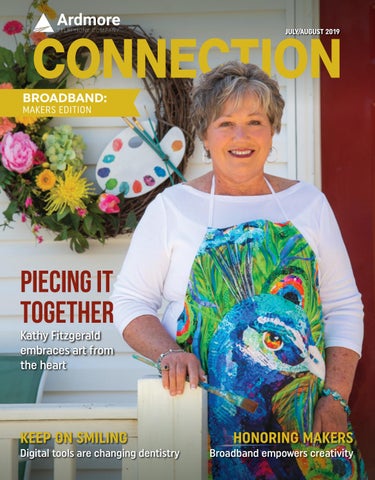
PIECING IT TOGETHER Kathy Fitzgerald embraces art from the heart
KEEP ON SMILING Digital tools are changing dentistry
HONORING MAKERS Broadband empowers creativity
INDUSTRY NEWS
Rural Connections
Precision agriculture Rural broadband creates opportunities
BY SHIRLEY BLOOMFIELD, CEO NTCA–The Rural Broadband Association
Celebrating 65 years
T
his spring telco leaders from across the country gathered in Washington, D.C. We met with regulators and elected officials to not only champion the success of rural broadband providers who are expanding their reach with the support of good public policies, but also to advocate for all the good work our member companies do. We also celebrated our strong legacy of success and commitment to rural America through service excellence, kicking off a number of activities that led up to our big day: On June 1, NTCA–The Rural Broadband Association celebrated its 65th anniversary. While the early rural telephone program was born out of the rural electrification program in the mid-1940s, local providers began to realize that a national organization was needed to represent the unique needs of those new companies (many of them cooperatives) that were borrowing federal dollars to build critical communications services to rural parts of the nation. On June 1, 1954, NTCA was born. We have seen many changes in the ensuing 65 years. Membership in NTCA has grown considerably, with cooperative and independent telcos serving an ever-expanding portion of the population. Regulations and funding mechanisms that impact how communications services are deployed have changed considerably. And, of course, the technology and ways people connect have gone from party lines to broadband. As a member of NTCA, your telco is part of a large family that connects homes and businesses, farms and small towns, country roads and growing cities across rural America. And that’s a reason to celebrate!
2 | July/August 2019
BY NOBLE SPRAYBERRY
T
he difference between success and failure for those who work in agriculture is, as it has ever been, small and frequently dependent on unpredictable factors: Too much rain. Not enough rain. Fickle prices. And more. The goal is to manage the challenges in the best way possible, maximizing opportunity and limiting risk. Increasingly, internet-based technology can better balance the margin between losses and gains. A recent report by the U.S. Department of Agriculture made the case for further extending broadband internet services to rural areas by highlighting the benefits of fast internet for agribusiness. The report “Insights on Rural Broadband Infrastructure and Next Generation Precision Agriculture Technologies” offered a broad look at the possibilities for broadband to make use of data-driven tools to improve results. Farmers and ranchers can follow the path of other modern businesses by using digital tools across the production cycle, according to the report. These new tools can support decision-making with integrated data. Automation can increase efficiency. Real-time insight can improve productivity. And entering into global markets becomes more attainable. The trend can benefit farmers, ranchers and others in agriculture while also supporting technology companies leveraging these new or expanded markets. In fact, they have an opportunity to capture a portion of a global digital agriculture market projected to be between $254 billion and $340 billion. New tools are needed to help farmers and ranchers better estimate the potential profit and economic risks associated with growing one particular crop over another. They may help with decisions about which fertilizer is best for current soil conditions or provide guidance on the best applications for pesticides. There are opportunities to create better water management strategies and to provide ways to use sensors to monitor animal health and nutrition. “Connected devices equip farmers with a clear picture of their operations at any moment, making it possible to prioritize tasks more effectively and to triage the most pressing issues,” according to the report. Rural broadband capable of supporting these data-intensive tools makes it all possible, and the financial potential of the market emphasizes the need to continue to expand broadband networks throughout the nation. If fully realized, fast internet services paired with new “precision agriculture” technologies have the potential to add $47-$65 billion annually to the U.S. economy.
Lifeline
SERVICE
LIFELINE IS A FEDERAL PROGRAM TO HELP LOW-INCOME AMERICANS PAY FOR PHONE OR BROADBAND SERVICE
FAQ: How much will Lifeline save me? Eligible customers will get at least $9.25 toward their bill.
What services are covered by this credit? You have the choice (where applicable) of applying your benefit to one of three types of service offerings: • Fixed or mobile broadband • Fixed or mobile voice-only • Bundles of fixed or mobile voice and broadband NOTE: Lifeline can only be used for one source of communication from the list above.
Can I receive more than one Lifeline credit? No, consumers are allowed only one Lifeline program benefit per household.
How do I qualify? You are eligible for Lifeline benefits if you qualify for and receive one of the following benefits: • SNAP • Medicaid • Supplemental Security Income (SSI) • Federal Public Housing Assistance • The Veteran’s Pension or Survivor’s Pension benefit Additionally, consumers at or below 135% of the Federal Poverty Guidelines will continue to be eligible for a Lifeline program benefit. (State determinations of income will no longer be accepted.) There are no changes to the eligibility criteria for Tribal programs. NOTE: Some states have additional qualifying programs, allowances and stipulations. Check with your local telecommunications provider for information about benefits that may be available in your state.
How do I enroll in the Lifeline program and start receiving this benefit? To find out whether you qualify for Lifeline assistance, please visit www.lifelinesupport.org or call your local telecommunications provider. NOTE: Your telephone company is not responsible for determining who qualifies for these programs or who receives assistance. Consumers must meet specific criteria in order to obtain assistance with their local telephone or broadband service, and qualifying is dependent upon government-established guidelines.
DO YOU QUALIFY
?
Stay connected with a Lifeline discount.
Apply today! Lifeline is a government assistance program that can help pay a portion of your telephone, mobile phone or internet bill each month. Consumers are allowed only one Lifeline program benefit per household. July/August 2019 | 3
FROM THE CEO
Lack of broadband goes beyond being a nuisance
G
one are the days when we would dial up our internet connection to check our email a couple of times each week.
For most of us, our lives and work are so intertwined with online activities, our connection just has to work. In June, I had the opportunity to hear Tennessee’s Governor Bill Lee speak at our Tennessee Broadband Association annual meetTREVOR ing. The governor told our group that despite hard work expanding BONNSTETTER broadband access around the state, he still couldn’t get high-speed Chief Executive Officer internet service at his home in rural Middle Tennessee. The governor said this was a nuisance for him but acknowledged it would be crippling for someone trying to work remotely, start a business, take online classes or receive telemedicine-based health care. “We have a lot of work to do,” the governor said. “Every single person in Tennessee’s life can be improved by the things that we do together.” No matter which side of the state line we’re on, those are the kinds of essential connections we’re proud to provide at Ardmore Telephone. And we’re working hard daily to provide more of those connections. Fiber construction continues in New Market, and we're starting a project in Elkmont soon. When I talk to people about their home internet connections, I always ask the number of connected devices they have. Usually, people will only name their computer and maybe a phone or tablet. But as we talk, they usually begin to think of more — gaming systems; streaming boxes; smart TVs; tablets and phones for children or grandchildren; smart home devices like thermostats, security cameras and light bulbs; digital assistants; and voice-controlled speakers like an Amazon Echo or Google Home. A Cisco study released in February shows that the average number of devices per person in North America was eight in 2017, but that number will increase to 13.4 by 2022. It’s important to note that the number is not per household — that’s per person. And it’s not just the number of devices that demands a strong connection — it’s what we’re doing with them. Robust internet connections are needed to stream high-definition and ultrahigh-definition movies, to make video calls and to play increasingly complex games. Uploading and downloading large amounts of photos or other files from the cloud also requires high speeds. That same Cisco study showed that overall internet traffic in North America is expected to triple from 2017 to 2022. Your average connection will be maxed out by multiple people in the household doing things at the same time. That’s why we’re working hard to build this network for you. We want the online experience ATC offers — for only $2 or $3 per day — to be unmatched. We at Ardmore Telephone Company want you to know that we work every day to make your internet experience as robust as possible. And we appreciate you choosing us to provide you with that service.
4 | July/August 2019
CONNECTION JULY/AUGUST 2019
VOL. 7, NO. 4
The Ardmore Connection is a bimonthly newsletter published by Ardmore Telephone Company, © 2019. It is distributed without charge to all customers of the company.
is a hometown service provider delivering advanced telecommunications technology to the people of Giles and Lincoln counties in Tennessee and Limestone and Madison counties in Alabama. The company is managed by Telecom Management Services and owned by Synergy Technology Partners.
Ardmore Telephone Company P.O. Box 549 Ardmore, TN 38449 Telephone: 256-423-2131 or 800-830-9946 www.ardmore.net Ardmore Office: 30190 Ardmore Ave. Ardmore, AL 35739 Monday - Friday 8 a.m. - 4:30 p.m.
Find us on Facebook!
Produced for Ardmore Telephone by:
On the Cover: Kathy Fitzgerald found new purpose through creating collages that become personal expressions of life and perseverance. See story Page 12.
Do you have the speed you need for the summer?
Fiber build update Ardmore Telephone Company is working to provide fiber broadband to as many homes and businesses as possible. There are crews placing fiber throughout the New Market area, with the goal of having those projects completed during the summer or by early fall. Legacy Homes is constructing residences in the Bellview community in New Market, which will have fiber internet capabilities. For updates on Ardmore Telephone’s fiber build and other information, follow the company on Facebook and Twitter.
Upgrade today! Uploading photos, streaming shows and playing video games can all push your bandwidth to the brink. But with high-speed internet from Ardmore Telephone, you enjoy a reliable connection that can keep up with you.
Congratulations!!! ardmore.net | 800-830-9946
NEW TELEPHONE
DIRECTORY The 2019-2020 Ardmore Telephone Company phone directory will be mailed in September. Be on the lookout for your copy! Ardmore Telephone Company
Let freedom ring! Ardmore Telephone will close in celebration of Independence Day on Thursday, July 4. We wish our customers a safe and happy Fourth of July!
Join Ardmore Telephone in giving Abbey Breland a round of applause. Breland, an Ardmore High School senior, won the 2019 Foundation for Rural Service scholarship. She will attend Jacksonville State University and major in nursing. FRS awards scholarships each year to a group of students from rural areas for their first year of college or vocational school. All applicants require sponsorship by an NTCAThe Rural Broadband Association member company to qualify. July/August 2019 | 5
TRAVEL
Beat the heat Slip and slide through summer BY ANNE P. BRALY
T
he start of summer means travelers will be flocking to beaches and lakefronts in droves. When it comes to enjoying the purity of a dip in the water, there’s no better way to do it than by taking the plunge at a water park that sparkles with fun. So grab a towel — don’t forget the kids — and slip-slide your way to a day of excitement. And they all come to play at Kentucky Splash, a water park that includes an 18,000-square-foot wave pool, a lazy river and a tower with three slides that will take your breath away as you plunge down one of two tube slides or body surf your way down 40 feet to the water below. The Aquatwist is a water ride that is totally enclosed. You twist and turn your way along its 180-foot length from a 30-foot-high starting point, and you’ll get a thrill as it drops you into the water in 10 seconds — or less. Small children have their own place to splash around out of the way of the big kids at play. Tadpole Island features a Caribbean-themed playhouse with kidsized slides and lots of bells and whistles to entertain the little ones. And, of course, mom and dad will enjoy taking it easy on the lazy river. “There’s lots to do, but the park isn’t so big that it’s hard to keep up with everyone,” says manager Diane Bruers.
6 | July/August 2019
Families enjoy the water slides at Wilderness at the Smokies, including the Cyclone Racer.
Kentucky Splash opened in May 2001, so this marks its 18th year of providing aquatic fun for kids of all ages. One thing that sets Kentucky Splash apart from other water parks around the state is price, Bruers says. Tickets are $10 per person, and children 2 and under are admitted free. Prices have not changed in almost 10 years. Like many small towns, Williamsburg, Kentucky, faced a dilemma when it came to deciding what to do with an aging municipal swimming pool that had provided summer fun for families for decades. The choices were to demolish it or transform it into a facility that would attract people from all around. The answer: a water park now named Kentucky Splash that brings visitors from across Kentucky. And because Williamsburg is just 11 miles from the Tennessee line, it attracts folks from the Volunteer State, too. A number of familiar chain hotels are located nearby, along with some that are independently owned. The water park itself has a campground, offering 25 RV sites with full hookups — water, sewer, electricity, Wi-Fi internet and cable TV — along with a fire pit and picnic table. Six tent sites are available for primitive camping, each with a fire pit and picnic table, and there’s a bathhouse on-site. During busy months, reservations are recommended. No outside food or drink may be brought into the park, but there are two full concession stands and several food booths selling burgers, hot dogs, chicken strips, pizza, nachos, cheese fries and more. Online: www.williamsburgky.com (click on the Kentucky Splash link). Families enjoy the numerous water slides at Wilderness at the Smokies.
WILDERNESS AT THE SMOKIES Sevierville, Tennessee www.wildernessatthesmokies.com This state-of-the-art water park offers year-round fun under a glass dome that makes you feel like you’re in the great outdoors. Even during less-than-perfect weather, you can enjoy 66,000 square feet of fun under the dome. Water features include a hair-raising ride on the Storm Chaser — a 55-foot plummet down a dark tunnel before a zero-gravity fall into an oscillating funnel, which gives way to a pool below. Runaway Canyon is a five-story raft ride that rockets you through water curtains, huge tunnels, explosive turns and loops before a 60-foot drop. Wilderness at the Smokies is one thrill after another. Tickets: $49 per person (must be purchased online). Overnight guests at the resort’s hotel receive complimentary admission.
ALABAMA SPLASH ADVENTURE Bessemer, Alabama www.alabamasplash.com Upsurge takes you up, up, then drops you down 216 feet through twists and turns. To take a break from the excitement, tube the lazy river or ride the waves in the 800,000-gallon wave pool. Splash Adventure is an 89-acre water park that operates from May to July, and then on weekends during August and early September. Tickets: $27-$32 (day passes). Season tickets available.
CAROLINA HARBOR WATER PARK Fort Mill, South Carolina www.carowinds.com Located on the grounds of Carowinds Amusement Park, Carolina Harbor is the largest of all noncoastal water parks in the state. There are more than 20 waterslides, two wave pools and a 1,000-foot-long lazy river that takes riders across the state line into North Carolina. Blackbeard gets his revenge on a six-story waterslide that features death-defying twists and turns, along with exhilarating slides. The kids have their own play area, featuring Kiddy Hawk Cove and Myrtle Turtle Beach. It’s all part of your ticket to Carowinds, a park that also features the world’s tallest giga coaster just steps outside the water park. Private cabanas, providing shade and a place to relax, are available for rent. Tickets: $33-$45 (depending on time of day). Discounts available for seniors and military.
The Hal Rogers Family Entertainment Center is home to the Kentucky Splash Water Park.
July/August 2019 | 7
Cutting-edge technology High-speed internet shaping the future of dentistry BY LISA SAVAGE
“
We’re able to use some cutting-edge technology now, and it’s helping improve the comfort and convenience for our patients.
”-
Dr. Matthew McMasters 8 | July/August 2019
I
f you have ever had a crown or braces, you know that gooey stuff dentists use to make an impression of the shape of your teeth. Dr. Matthew McMasters no longer relies on the thick mixture, though, thanks to technology made available through high-speed internet.
Digital impressions are just one example of how technology is changing the world of dentistry. A digital wand scans the area to create an impression of the mouth for crowns, bridges and other dental needs. “We’re able to use some cutting-edge technology now,” McMasters says. “And it’s helping improve the comfort and convenience for our patients.”
CHANGE IN PLANS McMasters didn’t always want to be a dentist. He grew up in Minor Hill, Tennessee, graduating from Giles County High School in 1989. He attended Martin Methodist College and graduated in 1994 from Middle Tennessee State University with degrees in chemistry and biology. Originally, McMasters planned to become a doctor, but that path would have required eight more years of training — four years for medical school and four years of residency. Instead, he chose to work as a research chemist. “By then, I was burned out on school,” he says. McMasters still yearned to return to his hometown to give back in the area he called home and to work in a field where he could be his own boss. “Prior to that, dentistry wasn’t even on my radar,” he says.
He learned he could complete dental school in four years, instead of the eight years required to become a medical doctor. “In dental school, you do your residency while you’re still in school,” he says. “The last two years, 90 percent of your time is spent seeing patients.” He graduated from the College of Dentistry at the University of Tennessee Health Science Center in Memphis in 2001 and opened a dental practice in Pulaski. After he had worked for a couple of years, McMasters wanted to expand. He bought a dental practice in Tracy City, Tennessee, and commuted two days a week. He got married, and he and his wife had their first child. By then, going back and forth to Tracy City was too much. About that time, Dr. Roger Young, a dentist in Ardmore, Tennessee, got hurt and was unable to work. His staff asked McMasters to see Young’s patients. Initially, the plan was for Young’s patients to go to McMasters’ office in Pulaski. But McMasters thought it would be easier for patients if he drove to Ardmore.
Dr. Matthew McMasters in his office in Ardmore, Tennessee.
Ardmore Telephone Company
Dr. Matthew McMasters and staff in front of their office in Ardmore, Tennessee.
Dr. Matthew McMasters uses 3D impression technology in his office.
Two weeks turned into three months, and McMasters realized he couldn’t work from both offices. By then, he had come to love Ardmore and the people there. His mother’s family is from Limestone County, and it seemed like a natural fit to relocate from Pulaski. He joined Young full time. In 2012, Young retired, and McMasters settled in on his own.
TEETH AND TECHNOLOGY McMasters upgraded internet service through Ardmore Telephone Co. a couple of years ago, and it’s making all the difference in the world, he says. He and the staff are mostly paperless and all-digital when it comes to equipment. “When I first started, we were doing X-rays by processing the film in dip tanks,” McMasters says. Now, X-rays use all-digital technology. “It’s less radiation exposure, and you get your X-rays instantly,” he says. Ardmore Telephone Company
The digital impressions make a big difference for the patients. The old way of making an impression was one of the most difficult procedures for patients because the gooey material makes some people gag. The goo had to stay in a patient’s mouth for about five minutes. Now, a wand scans the area in seconds. The best part — no goo required. The staff sends the 3D impression by email to an off-site laboratory. The production process takes much less time at the laboratory because of 3D printing technology. Before digital impression technology, dentists used the thick liquid to make impressions, and it had to harden before it went to the lab. Then the lab made the crown and sent it back — a process that could take a couple of weeks. Now, the lab gets the impression by email and can usually ship to the dentist by the next day, McMasters says. Before the broadband upgrade, the internet would get bogged down and delay communications. Services like digital impressions were not even possible. “We would have upgraded our internet simply because of digital impressions,” he says. Faster internet also provides enough Wi-Fi capabilities for patients to use their devices while they’re at the office. And internet technology means insurance claims are filed directly online, and payments are received electronically. “The insurance companies no longer send us our checks in the mail,” he says. “About 75 percent of our payments come through electronic funds.”
PATIENTS ARE PRIORITY Convenience for patients is important, McMasters says. He continually pursues training in the latest dental techniques to bring patients the best of general, restorative and cosmetic dentistry. Whether it’s fillings, crowns, porcelain veneers or a complete smile makeover, McMasters and his staff work with the patient to personalize the appropriate dental care. One of the most important parts of a good dental health program is learning how to care for teeth and gums. “When you prevent problems, your teeth should stay healthy and useful throughout your life,” McMasters says. “And if dental health is good, it enhances and improves other aspects of a healthy lifestyle. Technology is certainly making a difference in the field of dentistry.”
About Us Hours: 7 a.m. to 2 p.m. Monday & Thursday 7 a.m. to 5 p.m. Tuesday & Wednesday 26741 Main St., Ardmore, Tennessee 931-427-2116 For more information, visit www.ardmoresmiles.com or follow Matthew P. McMasters Family & Cosmetic Dentistry on Facebook.
July/August 2019 | 9
TRAVEL
THE IMPACT OF BROADBAND: MAKERS EDITION
MAKING ART and a living
How the internet helps creative people thrive
BY JEN CALHOUN
F
or centuries, artists gathered in big cities to share ideas, sell their art and connect with other creatives. But with greater access to faster internet, more and more creative people are choosing to live in rural areas where the cost of living is low and connectivity is just a click away. Take John George Larson, for example. He, an accomplished sculptor and painter from rural Minnesota, chose to live with his family in a nearly century-old farmhouse about three hours east of Minneapolis. “Part of my process as a ceramic sculptor involves working with a kiln that uses wood as fuel,” Larson says. “These kilns are kind of dirty and large, and I can’t really do that in a residential area.”
INTERNET EQUALS OPPORTUNITY Larson is one of a growing number of rural residents who use the internet to help fuel creative careers. From candlemakers to photographers to musicians, millions of people have found a way to share their talents and make a living online. According to a recent article on the website The Motley Fool, Etsy, the online marketplace that offers artisans and crafters a place to sell their handmade items, 10 | July/August 2019
Cynthia Parsons, who lives in rural Alabama, uses her YouTube channel to provide instructional videos, inspiration and more.
continues to grow. Revenue in its fourth quarter of 2018 came in at $200 million — an increase of more than $63 million from the previous year’s fourth quarter. The company’s chief executive officer, Josh Silverman, expects more increases through 2019. If it sounds unbelievable that artists are no longer mostly starving, think again, says Mark McGuinness, a poet, podcaster and creative coach. The internet has not only opened doors to creativity, but it’s also opened the doors for artists of all kinds. Period. “We are now living at a time of unprecedented opportunity for artists
While sculptor and painter John George Larson lives a rural lifestyle outside Minneapolis, the internet connects him to other creatives.
and creative professionals,” McGuinness writes in a blog post on his website, wishfulthinking.com. “Once upon a time, if you wanted to get your work in front of an audience, you had to submit it to an editor, agent, manager, curator, talent scout, whoever. A gatekeeper who had the power to open the gate and usher you through, or slam it in your face.” The gateway shouldn’t close anytime soon, either. According to the 2018 Global Digital report, more than 4 billion people around the world now use the internet, making the possibility of sharing ideas and selling creative goods greater than ever before. Today, musicians from Texas can share music or give lessons to someone in Tanzania. Folk artists in Alabama can sell paintings to a collector in Albania.
COUNTRY IS COOL AGAIN For Larson, a rural area offers other benefits. His work requires some solitude, not to mention the natural clay found in the area where he lives. “I don’t use that clay in all my work, but I try to incorporate it as much as possible,” he says. “That’s kind of a big reason why we chose to live in a rural area.” But Larson, who studied ceramics at Utah State University and under the tutelage of a sculptor in Japan, is far from being isolated from other artists or even art buyers. Thanks to a fast fiber optic internet connection provided by a rural broadband company, he learns new things and explores new ideas every day through online articles. He also connects with others and showcases his craft through his Instagram account, @johngeorgelarson, and his website, johngeorgelarson.com. “When we moved here, we didn’t realize this kind of high-speed internet was already offered at the house,” Larson says. “I don’t even think I realized how important it would be until after we started using it. Now, we use it every day, all the time. I use it for research for my own work or commission work that I do for other people and businesses. I read a lot of research articles about different topics, and it helps me develop a project or a design.”
While marketing his work used to tire him, Larson is finding ways to make art through apps. “I just started doing animation of my artwork on Instagram,” he says. “One of the things I’ve been thinking of lately is motion and movement in my work. Some of my pieces are made to be viewed from a variety of different angles. So, if you place them on a shelf one way, they’ll look different than if you place them another way. It’s an allegory for our lives and human experience because we can experience life from different perspectives.”
SPREADING THE WORD Cynthia Parsons, an award-winning artist and painter who lives in a rural region of northern Alabama, says the internet has opened a whole world of connectivity and possibility. On her YouTube channel, Open Art Studio of Cynthia Parsons, she offers videos of students working through challenges during class or clips of cotton fields at sunset so others can paint them. She might film a farmer harvesting his corn or make an instructional video about how to save old watercolor paint. She also records regular videos of her son, Elbert, as he recovers from an injury that nearly took his life years ago. Parsons, who regularly sells her artwork and has taught classes everywhere from Birmingham, Alabama, to France, believes art is everywhere. “You can’t look through your eyes and not see art or the potential of some kind of creation,” she says. “It might be someone doing crafts and using popsicle sticks or carving a bar of soap. All those things are art, and all that creative energy we use when we do it resounds through the universe.” Parsons finds joy in moving her work and the work of others through time, space and physical boundaries. “For me, the internet is about sharing,” she says. “That’s what it’s been able to do for me. It lets me share these moments of decisionmaking from my students. The videos of my students are about one minute or two minutes or maybe three. When I show
people what they’re dealing with, it lets others see how they might solve any problems they might be having with their work.”
Get creative Creative industries and people make jobs for Americans. Here are a few facts: • The value of arts and cultural production in America in 2015 was $763.6 billion, amounting to 4.2% of the gross domestic product. The arts contribute more to the national economy than do the construction, mining, utilities, insurance, and accommodation and food services industries. • Artists are highly entrepreneurial. They are 3.5 times more likely than the total U.S. workforce to be selfemployed. • Arts and cultural goods and services drive industries primarily focused on producing copyrighted content, accounting for just over half of their combined $1.17 billion value. • 97% of U.S. employers say creativity is increasingly important to them. Of the employers looking to hire creatives, 85% say they are unable to find the applicants they seek. Sources: National Endowment for the Arts, Artists and Arts Workers in the United States, 2011, The Conference Board, Ready to Innovate, 2008, National Endowment for the Arts, The Arts Contribute More Than $760 Billion to the U.S. Economy, and U.S., Department of Commerce, Bureau of Economic Analysis, Value Added by Industry as a Percentage of Gross Domestic Product, 2017, U.S. Department of Commerce, Bureau of Economic Analysis, Data for 1998-2015, 2018
July/August 2019 | 11
THE IMPACT OF BROADBAND: MAKERS EDITION
Kathy Fitzgerald creates colorful collages in her studio in Goodspring, Tennessee.
WORDS OF ART COLLAGE ARTIST PAINTS WITH PAPER BY LISA SAVAGE
A
n image of a guitar appears in every art collage Kathy Fitzgerald creates. Sometimes the guitars are small, and it takes good eyes to find them. In others, the instrument is easy to spot. But one thing is for certain — it’s always there. It’s a tribute to Fitzgerald’s son, Phillip, who played guitar and loved music. He died in 2003 from a heart attack brought on by his use of crack cocaine. Fitzgerald has vowed to always be open about his addiction. The year after her son’s death, Fitzgerald’s mother became ill and was living with the Fitzgeralds when their house burned. Her mother died in the fire. Fitzgerald also lost everything in the fire, including their vehicles and all her son’s possessions she had saved.
12 | July/August 2019
Losing her mother and son so close together was almost more than Fitzgerald could bear. “You never recover,” she says. “It’s not that you get over it. It becomes bearable.” But she found she must focus on something. “Art saved me,” she says. Now, years later, she hopes her art inspires others who have lost a loved one or those who need to get back to doing something they enjoy. “Just whatever would make them feel alive again,” she says.
THE LOVE OF ART Fitzgerald grew up in Giles County and always loved art. “I’ve been drawing and painting since I was a child,” she says. Ardmore Telephone Company
She never took professional art lessons, but she painted life-size figures for her lawn art business for 22 years. She also worked at the Giles County Ambulance Service and later transferred to the Giles County Sheriff’s Office. She retired from the county with 30 years of service. “It was time for me to finally do what I loved, and that was to paint,” she says. Her first pieces were a series of guitars in memory of her son. Then, she wondered if she could make a collage that looked like a painting from a distance and if she could place a guitar in memory of her son in that collage. She photographed two of the guitars and reduced the pictures to about an inch in length. She hid one in her first creation, titled “Tennessee Hills.” It’s a collection of things important to Fitzgerald, including the rolling hills of Tennessee, a little log cabin, a map of the Blue Ridge Parkway and, of course, a guitar. It took two weeks to complete. At the age of 60, she entered her first art contest. In 2013, a national art supply company used “Tennessee Hills” on the cover of its catalog.
TELLING A STORY Collage art, a great way to tell life’s stories, became her obsession. “Ideas would flash into my head at night, and I would get up and write them down because, by morning, they would be gone,” she says. She gathers old handwritten letters, along with maps, sheet music, paper doilies and any type of paper that will work. She often uses cheesecloth to represent hair and other elements in the art, glues the papers and other materials, and then paints some portions of the canvas to create the images. “You can incorporate maps of your birthplace, recipes handed down through generations, tickets from a special concert or bits and pieces of letters that have sentimental value,” she says.
Her sense of humor comes out in much of her work. She loves colorful and whimsical themes, and she sometimes adds a funny or inspirational quote to her pieces. In one creation, a young girl walks toward a barn, with two pigs following her. Fitzgerald calls the work “Pigtails.” She used cheesecloth to create the girl’s pigtails and the tails on the pigs. She used a recipe for pork chops on the pig’s shoulder.
WORTH THE WORK Fitzgerald displays and sells her work at art shows in Nashville and Brentwood. She loves the shows, but she could not do them without the help of her sister, Pam Stafford, who usually accompanies her. She also depends on her husband, Clay, a talented carpenter who custom builds her art panels and helps with the 3D designs. Fitzgerald says she loves meeting people at the shows. She recalls one woman who stood out. The woman and her 8-year-old daughter were drawn to a work titled “The Quilters Cup.” The little girl asked Fitzgerald why she had a guitar in her creations, and Fitzgerald explained that her son loved to play guitar before he passed away. “I looked at her mom and knew instantly by the look on her face that she had lost a child,” Fitzgerald says. The woman told Fitzgerald her 12-year-old son had died that year. She explained to Fitzgerald that she was drawn to the piece because she had always loved to quilt. “She told me she missed quilting, but she just couldn’t focus on anything,” says Fitzgerald, who told the woman to look closely at a quote incorporated into the work. It read, “Life’s a patchwork quilt made from bits and pieces of joy and sadness, sewn together with love.” The woman bought the collage. As she was leaving, she told Fitzgerald she planned to start quilting again. “I knew then that I was doing something worthwhile,” Fitzgerald says. “I felt like I had helped someone who needed a little help that day. Maybe I could inspire others who have lost a child to come out of their shell and get back to doing something they enjoyed. If my art brings a smile to your face, then I have accomplished my goal as an artist.” “Romeo” is one piece in Fitzgerald's studio.
ART CLASSES
Kathy Fitzgerald plans to share what she has learned with others, offering a series of three-hour workshops to the public with both day and night classes at her home studio in Goodspring. Keep an eye on her Facebook page, Kathy Hight Fitzgerald, or Instagram for dates, times and registration information.
Ardmore Telephone Company
July/August 2019 | 13
SOUTHERN KITCHENS
LOW AND SLOW
A
BBQ brings friends together
spark ignited one summer afternoon almost 20 years ago when David “Hoss” Johnson and three friends decided to toss a coin and see where it landed on the field of competitive barbecuing. The four men — Johnson, Jeff Chandler, Steve Hatfield and David Schmitt — were all born and raised in Huntsville, Alabama. Johnson played football at the University of Alabama under legendary coach Bear Bryant. Schmitt played football at the University of North Alabama. Hatfield was on the baseball team at the University of Alabama at Birmingham and Columbia State in Tennessee. Only one of the foursome, Chandler, knew anything about smoking meats and competing in the sport of barbecuing. But that’s all it took when he suggested they enter a competition — not on the amateur level, but as professionals. So, the men paid their entry fee for the WhistleStop Barbecue Festival and gave their team a name: Fork Down and Pork, a riff on the football term “fourth down and short.” They came home with a first-place award in the “anything goes” category for their butterflied scallops stuffed with shrimp, wrapped with bacon and drizzled with hollandaise sauce.
14 | July/August 2019
“The next day was for barbecue, and we didn’t do great,” Johnson says. “We came in about 35th out of 60, which wasn’t bad for a first time, but it wasn’t great. We did barbecued pork, ribs and chicken. And we did a brisket, too. But brisket is very hard to do. Just go to Texas if you want good brisket. “I mean, it’s kind of like football. If you want good football, you come to the South. If you want good brisket, you go to Texas,” he says, sipping on a glass of water and recalling the days when the three men would cook all weekend and go back to their daytime jobs and families during the week. Following graduation from Alabama, Johnson played offensive line for the St. Louis Cardinals under coach Gene Stallings and then for the Tampa Bay Buccaneers. He left the NFL to become athletic director for football operations for the City of Huntsville, Alabama. Johnson retired after 25 years and is now a missionary and national football direc-
Barbecue master David “Hoss” Johnson.
tor for SCORE International, a position that takes him on mission trips and to football camps around the world. And in several countries — including Italy, Israel and Costa Rica — he’s fired up a smoker and treated those around him to a taste of the South, complete with barbecue, beans and coleslaw. The Fork Down and Pork team quit the competition circuit in 2010. “We had families and kids. Some had grandkids, changed jobs. You know, life happens,” Johnson says. But he continues to cook not only for those in other countries, but also for friends at home, too. One thing he’s learned from all his years of smoking meats is a creed to which every good smoker adheres: low and slow, meaning to cook the meat at a low temperature and not rush things. Johnson says if he’s cooking meat that needs to stay in the smoker for up to 18 hours, he tries to keep a steady temperature of 185 degrees. For meats that need to cook no more than 12 hours, he keeps
the temperature around 250 degrees. Different cuts of meat call for different woods added to the coals. Johnson likes hickory chunks for pork, mesquite for chicken and applewood chunks for ribs. Another trick he’s learned is not to add the injection liquid or rub to a pork butt until the meat has finished cooking and not to discard all the fat and juices that run off the meat. When the butt has finished cooking, let it sit in a covered pan for an hour or so. Then, remove the bone if there is one, and pull the pork apart. Mix the rub and injection sauce together, and massage it into the meat, adding any accumulated fat and juices back in as needed to make the meat moist. “There’s nothing worse than dry barbecue,” Johnson says. FOOD EDITOR ANNE P. BRALY IS A NATIVE OF CHATTANOOGA, TENNESSEE.
SMOKED PORK
VINEGAR SAUCE FOR SMOKED PORK
1 cup white vinegar 2 tablespoons salt 1 tablespoon brown sugar 1 teaspoon cayenne pepper 1 teaspoon red pepper flakes
Combine all ingredients, taste and add water to dilute, as necessary.
Note: David Johnson combines this sauce with enough of his barbecue rub to make a thin paste. Then, he massages as much as he needs into the smoked, pulled pork after it has been cooked and shredded. As for amounts needed, it’s a judgment call. Taste as you go using your favorite rub.
COLESLAW
HOSS’S PORK AND BEANS
David Johnson says sugar is the key to this coleslaw. “You need to make sure it’s sweet enough,” he says.
1 (28-ounce) can of baked beans (your favorite) 2 tablespoons Karo syrup Salt and pepper, to taste 1 Vidalia or other sweet onion, chopped (about 1/2 cup) 6 tablespoons mustard 6-7 tablespoons ketchup 10 pieces of maple-smoked bacon, chopped 2 tablespoons bacon grease 1 green pepper, chopped 1 cup pulled pork Dash of cayenne pepper, to taste (optional)
1 head of cabbage, shredded 2-3 carrots, shredded Dressing: 1 cup mayonnaise 1/4 cup sugar 1/4 cup white or apple cider vinegar 1 teaspoon celery salt 1/2 teaspoon pepper 1 tablespoon yellow mustard In a large bowl, toss together shredded cabbage and carrots. In separate bowl, mix together dressing ingredients, then add to cabbage mixture, combining thoroughly. Chill before serving. Makes 10-12 servings.
Combine all ingredients, mixing thoroughly, and place in greased baking dish. Bake, covered, for 45 minutes to an hour in a 300 F oven.
July/August 2019 | 15
Presort STD US Postage PAID Permit #21 Freeport OH
P.O. Box 549 • Ardmore, TN 38449
Don’t suffer from buffering!
GET AN INTERNET CHECKUP! Games lagging?
Congested connection?
Movies freezing up?
You need a healthier internet connection — get more done, play more games, binge-watch more shows and share more photos, and that’s just the beginning!
WE WANT TO KEEP YOUR INTERNET EXPERIENCE IN TIPTOP SHAPE!
TELEPHONE COMPANY
800-830-9946 | ardmore.net
Receive a $5 bill credit when you call between now and Aug. 31 for your free internet checkup! *
Call Ardmore Telephone at 800-830-9946!
*An internet checkup involves a series of brief questions about how you and your family use the internet, number of devices, size of your home and current speeds. Once the evaluation is completed, Ardmore Telephone will offer recommendations for you to maximize your internet service.