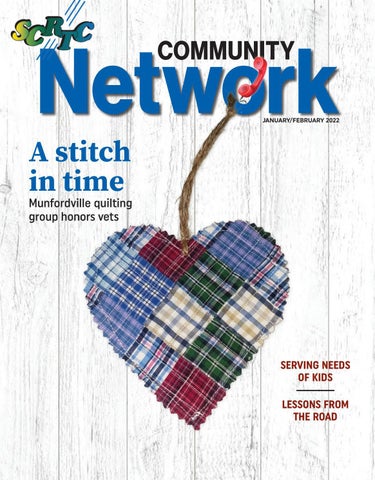
Network COMMUNITY
JANUARY/FEBRUARY 2022
A stitch in time
Munfordville quilting group honors vets
SERVING NEEDS OF KIDS LESSONS FROM THE ROAD
INDUSTRY NEWS
Rural Connections By SHIRLEY BLOOMFIELD, CEO NTCA–The Rural Broadband Association
An investment for the future
Communication at the speed of light Fiber optics make it possible
Expanded broadband access will lift rural communities
I
n order to thrive, all communities — especially those in rural America — require opportunities and the modern communications tools so vital for jobs, education, health and so much more. Thanks to the Infrastructure Investment and Jobs Act, the NTCA's nearly 850 rural, community-based broadband providers now have fresh help as they work to complete their essential mission. This historic investment will go a long way to connecting all Americans, even in areas of the country that are the hardest to reach for service providers. Of course, the work now truly begins to deliver on the promise this law offers. The FCC must prioritize areas of the greatest need. Also, we will work with all key parties to support state leaders as an unprecedented amount of resources flow into their broadband initiatives. Care is needed to vet those seeking funding, to ensure they can truly supply the infrastructure and services they promise. Throughout the effort, we must remember that we need to do more than simply build networks. Our commitment must also be to sustain these vital communications systems and to ensure the services offered over them are affordable and will meet customer demands well into the future. We're confident NTCA members will continue to serve their neighbors by solidifying existing networks and expanding service. No matter where they live, all Americans should have the same opportunity to access vital communications services needed not only today, but also for years to come.
2 | January/February 2022
At the end of the 1970s, Corning Inc. developed a technology that would reshape communications — fiber optics. Today, it’s a critical component in the networks making our hyperconnected world possible. Streaming entertainment, social media, video calls, telehealth, online education, workfrom-home jobs and so much more depend on this technology.
DID YOU KNOW? • Each fiber strand is made up of a glass core thinner than a human hair. • Light signals are transmitted through the glass, just as you might send a signal down the tunnel. • To keep the light from simply passing through the glass when it changes direction, the core is surrounded by a cladding that reflects light back into the glass. • The process is similar to mirrors in a tunnel, bouncing the signal from side to side until it reaches its endpoint. • A single fiber cable — each fiber is much thinner than copper wire — can bundle hundreds, or even thousands, of fiber strands. • While incredibly thin, fiber is not brittle. A single strand is three times stronger than steel and more durable than copper. • The glass core of a fiber cable is so pure that if the ocean was made of the same glass, you could stand on the surface and clearly see the ocean floor miles below.
Take a
STAND! Avoid back and neck pain while working from home
O
ver the past couple of years, working from home has gone from a perk — one that only a few employers offered — to the norm for many. The benefits for employees range from having your dog as a co-worker to adding pajama pants to the professional wardrobe. But working from home can also come with hazards. Whether you’re camped out at a kitchen table, sprawled across the couch or luxuriating in bed all day, odds are your home setup isn’t as ergonomic as that of an office. This may not be a big deal when you’re working from home for short periods. But when those workdays add up to weeks or even months, poor posture and sedentary behavior can create serious back and neck pain. The good news is that with the right furniture and a little daily activity, it’s easy to strike a healthy balance with your workfrom-home routine.
GET ON YOUR FEET Most people tend to hunch forward while sitting, which can put a lot of pressure on your lower back. Standing and
looking at a monitor at eye level, on the other hand, puts little strain on your neck and back, while also burning more calories than sitting. That said, it isn’t comfortable to stand for hours at a time. That’s why the UPLIFT Standing Desk V2 is a good option for any remote office. The design enhances durability and comfort, and easy height adjustment encourages users to keep moving without settling into any position for too long.
LOOK FOR SUPPORT When you do decide to take a seat, getting the proper support can make a big difference. If you don’t have an office chair, try putting a small pillow behind your lower back to maintain an arched posture. This practice will help put your upper body weight on the chair instead of your spine. If you’re ready to invest in a new chair, the Steelcase Gesture has been Wirecutter’s pick for more than five years. However, if you’re looking to spend less, the HON Ignition 2.0 is a more affordable option that makes few sacrifices in comfort.
STAY ACTIVE It’s a good idea to take breaks throughout the day to move around and get the blood circulating. While you’re at it, try some simple exercises like backbends, hamstring stretches and planks that can help strengthen your core and provide additional support for your lower back. If you’re looking for a guided workout, the Seven Home Workout app offers a wide variety of seven-minute routines that you can squeeze into a busy day. Or explore the Yoga Studio app to unwind with yoga classes for all levels of experience and guided meditations that take as few as five minutes.
MOVE AROUND Time can get away from you during a busy workday, so it always helps to have a reminder when it’s time to take a break. If you have an Apple Watch, you set the frequency of these reminders in the Activity app. For everyone else, apps like Stand Up! will schedule notifications throughout your workday to get up and move around. The Wakeout app will even suggest quick exercises for every room of the house. January/February 2022 | 3
FROM THE GENERAL MANAGER
Are you ready for the high-tech fast lane in 2022? We’re here to help you navigate the upcoming year
H
appy new year! From everyone at SCRTC, we hope 2022 is off to a great start. After a season of celebration, the new year gives us a welcome break from weeks of holiday hustle and bustle. It also is a good time to pause and contemplate what’s ahead, whether that’s an upcoming vacation, a new job or major milestones like graduations or weddings. All that potential can be a little daunting. When looking forward, I often find it helpful to look back and appreciate the road that brought us where we are today, whether it’s my own personal journey or the rapid evolution of the communications industry. Consider the internet. Fifty years ago, only researchers had the first inkling of what was to come. In 1972, “All in the Family” was the top-rated TV show in the country. Roberta Flack’s “The First Time Ever I Saw Your Face” was at the top of the music charts. And researcher Ray Tomlinson had recently sent the world’s JEFF EATON first email to himself using ARPANET, a network of computers General Manager linked by phone lines to help Pentagon-funded research stations communicate. Just a decade later, companies like Apple and Microsoft were already leading the personal computer revolution that put desktops in homes and offices. By 1992, people were receiving the first of many AOL software CDs. The squawk of computer modems soon filled homes as people used dial-up internet to connect to email and online message boards. Nineteen years ago, the internet became even more of a social space with the launch of Friendster, a precursor to Facebook. Social networks wouldn’t become fixtures on phones and mobile devices until the arrival of the iPhone in 2007 and the iPad three years later. Even then, the ability to bring medical expertise home with telehealth, take college-level classes from your couch or stream high-quality movies, music and TV shows — things we can take for granted today — would have seemed far-fetched. In just five decades, we have seen online technology grow from computers that could only send a few characters of text into being the center of a deeply interconnected world. At SCRTC, we’re proud to be a part of that story, because we have seen firsthand how the service we provide benefits lives and connects communities. So, as you look ahead to the many possibilities a new year brings, take a moment to consider how far we’ve come. From staying connected with distant friends on social media to planning your next big adventure, how many of your goals wouldn’t even be possible without fast, reliable internet service? And, just as importantly, what innovation will be the next to transform our lives? I don’t expect the pace of innovation to slow down, which is why we’ll be here to make sure the services, tools and connections you need are always up to speed. Here’s to a wonderful 2022 as we all keep our eyes on the road ahead.
4 | January/February 2022
Network COMMUNITY
JANUARY/FEBRUARY 2022
VOL. 7, NO. 1
The SCRTC Community Network is a bimonthly newsletter published by South Central Rural Telecommunications Cooperative © 2022. It is distributed without charge to all customers of the cooperative. South Central Rural Telecommunications Cooperative is a member-owned corporation dedicated to delivering advanced telecommunications technology to the people of Central Kentucky, including Adair, Allen, Barren, Edmonson, Green, Hart, LaRue, Metcalfe, Monroe and Nelson counties. South Central Rural Telecommunications Cooperative, Inc. 1399 Happy Valley Road • P.O. Box 159 Glasgow, KY 42142-0159 270-678-2111 www.scrtc.com SCRTC BOARD OF TRUSTEES Ralph J. Thompson, District I Bonnieville and Munfordville exchanges Billy Smith, District II Canmer and Horse Cave exchanges Jerry Polson, District III Cave City and Hiseville exchanges Ronnie Tucker, District IV Center, Edmonton and Summer Shade exchanges Kevin Bradshaw, District V Glasgow and Temple Hill exchanges Zack Kender, District VI Fountain Run, Gamaliel and Lucas exchanges Robert E. Thompson, District VII Buffalo and Magnolia exchanges Jeff Eaton General Manager Bobby H. Richardson Attorney Produced for SCRTC by:
On the Cover: A sewing group of women in Munfordville put their hearts into creating “Quilts of Valor” for military personnel. See story Page 13.
SCRTC NEWS
EMPLOYEE
LIFELINE SERVICE
Spotlight
Shane Reynolds, a foreman in the north installation and repair department, has worked at SCRTC for 15 years. He and his wife, Heather Michelle Reynolds, have a son, Cody; three daughters, Katey, Preslee and Kennedy; and two dogs, Cash and Cooper. The active family enjoys playing and watching sports, often travelling on weekends with Kennedy playing AAU basketball. Sammy McGuire, a broadband plant technician, has worked for 15 years with SCRTC. He is married to Traci Briggs McGuire. She owns the Green Leaf Nursery in Glasgow. They enjoy spending time on their farm with Addison, Lucas, Kenzie, Matt, Shelby and grandkids Oaklynn and Adalyn. Sammy likes to hunt, and Traci often joins in on fishing trips for white bass or catfish. Thomas Hockensmith is an installation and repair technician who has worked 13 years in areas like Cub Run and Munfordville. He is proud of the work his wife, Whitley, does as a nurse practitioner. Together they have three children: Collins, Campbell and Griffin. Thomas likes to golf and fish. His favorite movie is “Remember the Titans.” Jared Ballard is a broadband plant technician in the Center and Sulphur Well exchanges. He and his wife, April, have a son, Jonas; a daughter, Raye; a dog, Molly; and two cats, Simba and Mittens. Jared Ballard likes to lead worship at local churches, and he sings in a Southern gospel group named Glorified. His favorite show on television is “Marvel’s Agents of S.H.I.E.L.D.”.
SIGN UP FOR SMARTHUB Make bill paying easier for 2022: Pay by phone at 1-844-262-2428. Download the SmartHub Phone App and pay online or from your phone. www.scrtc.com/my-account
Manage Your Account
View and Pay Your Bill
Monitor Usage 24/7
South Central Rural Telecommunications Cooperative
Report Service Issues
Receive Important Updates
LIFELINE IS A FEDERAL PROGRAM TO HELP LOW-INCOME AMERICANS PAY FOR PHONE OR BROADBAND SERVICE. You are eligible for Lifeline benefits if you qualify for and receive one of the following benefits: • SNAP • Medicaid • Supplemental Security Income (SSI) • Federal Public Housing Assistance • VA Veterans Pension or Survivors Pension Additionally, consumers at or below 135% of the Federal Poverty Guidelines will continue to be eligible for a Lifeline program benefit. (State determinations of income will no longer be accepted.) There are no changes to the eligibility criteria for tribal programs. Some states have additional qualifying programs, allowances and stipulations. Check with your local telecommunications provider for information about benefits that may be available in your state. To find out whether you qualify for Lifeline assistance, please visit lifelinesupport.org or call your local telecommunications provider. Note: Your telephone company is not responsible for determining who qualifies for these programs or who receives assistance. Consumers must meet specific criteria in order to obtain assistance with their local telephone and/or broadband service, and qualifying is dependent upon government- established guidelines.
January/February 2022 | 5
TRAVEL
Ancient treasures
Museums showcase geologic adventures
E
Story by ANNE BRALY
ntertaining kids while traveling isn’t easy. But there are places just a smidge off the beaten track, outside the glitz and glamour of big cities, that will spark your child’s interest. Here are some spots around the South that mix history and science in fun and interesting ways.
Falls of the Ohio State Park Clarksville, Indiana Jump over the Kentucky state line into Indiana and hike across one of the world’s most accessible Devonian-age fossil beds. The 390-million-year-old fossil beds are among the largest exposed Devonian beds in the world. The park features a spectacular interpretive center, which features interactive, immersive exhibits. While fossil collecting is prohibited on the beds and river bank, the park staff encourages visitors to explore and discover the many different fossils that can be found on the ancient sea bottom. And you can collect from rock piles 6 | January/February 2022
with fossils from the quarries behind the interpretive center, which is open Monday through Saturday 9 a.m. to 5 p.m. and Sunday 1 to 5 p.m. The park grounds are open 7 a.m. to 11 p.m. Fishing, hiking, fossil viewing, bird watching and picnicking are among the most popular activities. Admission is $9 for ages 12 and up, $7 for ages 5 to 11, and under 5 is free. Parking is $2. For more information, visit fallsoftheohio.org.
Coon Creek Science Center Adamsville, Tennessee Tennessee was once home to giant mosasaurs, sharks, crabs and clams when
the Gulf of Mexico spread its waters across the Volunteer State. Fossils of these early inhabitants reside at Coon Creek in rural McNairy County, one of the most important fossil sites in North America. The Coon Creek Science Center is a great place for kids to visit and discover some amazing things. There are hands-on displays and activities, which allow them to learn through experiments in which they use their senses while having fun. There’s a treasure trove of artifacts on display, so allow enough time to see everything. To learn more, visit memphismuseums.org.
Children learn about the dynamics of science in the Discovery Lab, one of several exhibits at the Hands On Children’s Museum. At right, children can play while learning about science and discovery in the museum’s Scheu Family Exhibit Hall & Art Studio in the General Shale Learning Center.
Folly Beach, South Carolina Finding shark teeth on Folly Beach is a great way to learn about the giants that once roamed the seas — and the many that continue to do so — and Folly Beach is one of the best places to find their teeth and learn how to identify all the different species. Wade into the water and start your hunt, sifting through the sand with special tools for shark teeth — maybe even one from a megladon. For more information, or to book a tour, visit chsfossiladventures.com.
Cook Museum of Natural Science Decatur, Alabama Kids can learn all about the birds, the bees, the flowers and the trees and more by spending a day in Decatur at the Cook Museum of Natural Science, a museum that began with a small collection of insects from John Cook, the founder of Cook’s Pest Control. It’s now grown into a state-of-the-art museum with numerous exhibits including cave systems, the weather, outer space, rivers and streams, oceans and forests and more, including — yes — insects. Many exhibits include hands-on elements to keep kids busy and entertained. Log onto cookmuseum.org for more information and tickets.
Gray Fossil Site Gray, Tennessee There was a time — some 5 million years ago — when small horses, mastodons, alligators, tapirs, rhinoceros, camels, saber-toothed tigers and other creatures roamed the hills and meadows
— sometimes peacefully, others not — around the South. And one of their favorite gathering places was a watering hole in what would become Gray, Tennessee, outside Johnson City. Fast forward a few million years, and today, paleontologists are unearthing a massive amount of bones at the Gray Fossil Site. Experts say they could dig for another 100 years and still not find everything that lies beneath. Now, kids, parents, grandparents and others can come and see what paleontologists have found and learn so much more in the neighboring Hands On! Discovery Center. “The fossil site itself offers an up-close experience where children of all ages can see an active dig site,” says Andy Marquette, the Discovery Center’s president and CEO. “They can come within inches of giant fossils and learn about the process from finding a fossil to putting it in collections.”
Hands On! Discovery Center Johnson City, Tennessee The center grew from a small children’s museum in downtown Johnson City to what it is today: a beautiful, new building with numerous interactive exhibits like the “dig pit” in the Paleo Hall where visitors can dig for themselves and see what actual paleontologists experience. Life-size replica skeletons of many of the creatures that once called the Gray Fossil Site home now surround the hall. In addition to the paleo exhibits, the Main Exhibit Hall is the place where kids can make their own air rockets and air cars
If you go » Where: Hands On! Discover Center and Gray Fossil Site, 1212 Suncrest Dr., Gray, Tenn. » Hours: 10 a.m. to 5 p.m. Tuesday through Saturday; 1-5 p.m. Sunday. Also, open on Mondays from 10 a.m. to 5 p.m. during March, June, and July only. » Information: visithandson.org or 423-434-4263.
and see how fast these creations can go or spend time at the Bernoulli table while exploring the science of how objects are able to fly. They’ll be having so much fun they may not realize they’re learning many of the same things about energy that they learn in school, says the center’s Director of Operations Keith Maultbay. “It makes science fun,” he says. The second floor of Hands On! Discovery Center is all about the dig. Large glass windows allow views of the paleontologists at work, piecing together the intricate bones of a massive mastodon discovered in the center’s backyard several years ago. Also on view in the collection room are more bones and tusks. Buy a ticket and take a paleo tour of the dig site. Another ticket gets you into the Tesla Theater to witness an electrifying, Guinness record-holding experience that honors the great inventor Nikola Tesla. Watch in amazement as the world’s most powerful, musical, bi-polar Tesla coil turns 240 volts into 200,000 volts of pure electricity. January/February 2022 | 7
Commitment to youth Local Kiwanis Club serving kids in our community
A
long-standing civic organization, the Kiwanis Club of Glasgow, came into existence more than 50 years ago. Since then, the club has worked to fulfill its mission of helping underprivileged children in the community. It is working locally to achieve the goal of Kiwanians around the globe, which is to change the world by serving children. Club members do their part through donations and hands-on activities. Over the past few years, these have included helping upgrade and paint the local YMCA, sponsoring a youth soccer league and volunteering for the Build-A-Bed program. “Building and delivering beds to kids who don’t have the kind of amenity that most of us take for granted is an experience that highlights why Kiwanis exists,” says outgoing club president Matt Compton. “Seeing the conditions these kids live in, you always hear about things, and you think, ‘Oh, it’s not that bad in my community.’ And it is that bad.” Members of the Glasgow Kiwanis Club volunteer at a local soup kitchen.
The club also supports youth programs including the Boys and Girls Ranch — a law enforcement camp the Kentucky Sheriffs’ Association sponsors — and Leaders of the Future, a youth leadership program with the local chamber of commerce. Every quarter, club members buy and prepare food at the community soup kitchen, serving about 200 people. For the holidays, the Kiwanis partner with the Boys and Girls Club, helping put on an all-day event where they feed kids breakfast and volunteers take children shopping for Christmas gifts. The pandemic has been a challenge, Matt says. The club basically stopped meeting for a year, and it’s been slow going to ramp back up. This slowdown has compounded a larger problem that threatens civic groups like the Kiwanis: Need in the community has not disappeared, but it feels as if the spirit of service is waning. “We’re in a time now where a lot of people don’t think about civic
Past Kiwanis president Matt Compton, right, passes the gavel to current president Mike Richardson.
Kiwanis Club of Glasgow
Story by LUIS CARRASCO
organizations and when everybody’s focused on themselves and their own problems,” Matt says. “I get that we all have that part of our lives we have to take care of, but there’s still a great need for volunteers.” The investment of volunteering and participating is not limited to improving the community right now. Ideally, it also pays dividends in the future, as those who are helped today — whether it’s by Kiwanis, Rotary or the Boys and Girls Club — can become the helpers of tomorrow, Matt says. “If you can instill a little bit of that into those kids so that when they become adults, they don’t forget it,” he says. “Hopefully, that child takes that and carries it with them. And someday, the cycle continues. They are volunteering, they’re joining these clubs and they’re giving back to the community.” Anyone wishing to join or wanting more information can take part in one of the club’s bimonthly lunch meetings, which start at 11:30 a.m. the second and fourth Wednesday of the month at Willow Oaks Golf Course in Glasgow, Matt says. They’ll save a seat for you. Check out Kiwanis Club of Glasgow Inc. on Facebook to see when their next meeting is and how you can join.
8 | January/February 2022
South Central Rural Telecommunications Cooperative
Kiwanis Club of Caverna
Launching a new club Caverna joins the ranks of Kiwanis Story by LUIS CARRASCO
H
elping children is the driving goal for Kiwanis members across the world, but every club is different. For the Kiwanis Club of Caverna, the focus is not only on improving the lives of kids in Cave City and Horse Cave but also on offering teens the opportunity to become leaders through the student-led Key Club. “A lot of them are just really starving for things to do rather than just go to school and then leave and go home,” says Kerry Mears, Caverna Kiwanis president. “The mission is to develop leadership for the kids — showing them they can do anything they put their minds to and connecting them to their community.” Kiwanis Club of Caverna launched in 2018, so its Key Club was barely off the ground when COVID-19 hit. Cancellation of activities and graduation of members forced the group to start over. Fortunately, Jessica Hampton, a teacher in the Caverna Independent School District, stepped
During the district meeting of Kiwanis clubs, Dale Hawkins and Amanda Abell-Summers pose with Yogi Bear at Jellystone Park Mammoth Cave. South Central Rural Telecommunications Cooperative
The leaders of the Kiwanis Club of Caverna are, from left, Kerry Mears, 2021 president; Gina Lyons, board member; Terry Smith, secretary; Amanda Abell-Summers, board member; and Chris Summers, 2022 president. Not pictured is treasurer Dale Hawkins.
up last summer as sponsor for the Key Club out of Caverna High School. “She has been just amazing about getting kids involved, interested and getting them projects and keeping them focused on what Kiwanis does,” Kerry says. “She was able to get the 30-plus kids we have right now.”
THE KEY TO AN ACTIVE CLUB Those kids have been busy. Recent Key Club activities have included roadside trash pickup, giving out food at a Feed America event and beautifying the playground at Roy Dickey Reynolds Park. The teens also found a sponsor and did the cooking to provide the free chili supper at the Light Up Cave City event in November. The Kiwanis help them raise funds to travel to Key Club events, the most recent being a trip to the Dollywood Fall Rally where teens gathered with other Key Clubs in the district, which covers Kentucky and Tennessee. Tasks like running meetings, planning projects and holding elected positions at the club, district and international levels help hone their leadership skills. Beyond the Key Club, Caverna Kiwanis
works to benefit the community in other ways. The group recently helped send the champion Caverna Middle School football team to the state semifinals and donated to buy a piano for the high school. The splash pad behind center field at Bowling Green Ballpark where the minor league Bowling Green Hot Rods play inspired the club’s next big project — to raise money for improvements to parks in Cave City and Horse Cave. “This would be a really great thing to have a smaller version of that at the parks, for the kids, for the summer,” Kerry says. “The cities have to be on board, but we’ll raise the money to get it built.” The club always welcomes new members and hopes to grow its roster to take on even more ambitious projects. “There’s lots of things we’d like to do, but we are limited because of how many people we have,” Kerry says. “The more people we have, the more we can do. So that’s important.” Visit facebook.com/cavernakiwanis if you would like to know more about the Caverna Kiwanis or the Key Club.
January/February 2022 | 9
Locator apps Connected for safety and security
W
ith the help of a locator app on a mobile phone, parents can be aware of just about anywhere their family members roam — assuming families have reviewed and accepted the app’s policies. While some might find this concept intrusive, these apps can be helpful for busy schedules or a comfort during troubling times, late nights or long trips. Here are a few of the top locator apps on the market and what they can do.
WWLife360 The premium version of Life360 can tell you where your family members’ phones are at any given moment. Notifications
about events like a child arriving at school are easy to receive.
WWGlympse The free Glympse app lets friends and loved ones know your travel status, so you never have to worry if you’re running late. They’ll know. Users can send a Glympse alert to anyone with a web-enabled device.
WWiSharing Know where your friend or family member is at any moment. The iSharing app provides real-time alerts when someone leaves home, work or school. In-app messaging is just one of the features, some of which are only available in the premium version.
CONSUMER FINANCIAL PROTECTION BUREAU The role of the CFPB, which Congress established in 2010, is to hold financial institutions accountable for following federal financial laws and to protect and educate consumers. The bureau’s website, consumerfinance.gov, has a section dedicated to youth financial literacy and offers more than 200 educational activities designed for kids of all ages. The list of topics is extensive and includes entrepreneurship, budgeting, managing credit and preventing fraud and identity theft.
FAMZOO
Money wise
Financial education with digital tools
F
ewer than half of U.S. states require students to complete personal finance education, although there have been recent efforts in many states to focus on this form of education. There is, however, a wealth of online resources and apps to help parents teach children to safely navigate the financial seas. Here are a few of the sites and apps available to parents looking to teach their kids real-world money lessons:
10 | January/February 2022
FamZoo is a comprehensive finance app for families. It creates a virtual family bank with parents in the banker’s seat. Through the app, parents can pay their children’s allowances, track their spending and savings and even encourage charitable giving. FamZoo isn’t free — the cost ranges between $2.50 and $5.99 a month depending on which option you choose. One- and twomonth free trials are available at famzoo.com.
GOHENRY GoHenry, aimed at kids as young as 6 years old, provides parents with a prepaid debit card for their children and an app the whole family can use to keep track of spending, savings and progress toward financial goals. GoHenry offers a one-month free trial, after which, the service charges a monthly fee of $3.99 per child. For more information, visit gohenry.com.
Which
MUSIC STREAMING SERVICE
is right for you?
I
t’s never been easier to discover a new favorite band or find that hidden gem of a song you can’t stop playing on repeat. A wealth of music streaming apps boast exhaustive libraries, classic hits and new buried treasures all at your fingertips. Whether you’re looking for crystal clear audio, curated playlists or a soundtrack to keep up with your runs, there’s something for everyone if you know where to look.
SPOTIFY Spotify is synonymous with music streaming for a reason. Its interface is easy to navigate and always has new recommendations based on what you’re already listening to. If you have friends on the service, you can share your listening activity and see what others are playing from Spotify’s library of 70 million tracks. Audio quality, on the other hand, varies based on your account. Free users can stream at decent qualities if they’re listening on standard headphones or a Bluetooth speaker. Premium users can stream at higher quality for $10 a month, and Spotify has announced plans to roll out a hi-fi tier with lossless audio quality in the future.
APPLE MUSIC Apple Music’s social options are similar to what you’ll find on Spotify, even if there are fewer curated options for discovering new favorites. But the real selling point is audio quality.
Audiophiles can enjoy lossless tracks at the base tier of $10 a month with about 20 million tracks currently available at the highest quality. Apple says the rest of its 70 million-plus track library will be available in that format by the end of the year.
TIDAL TIDAL used to have the crown when it came to lossless audio, but at $20 a month it’s now a tough sell against other more affordable options. If you can’t wait for Apple Music to update its library, TIDAL’s catalog is already fully available in lossless format, with a few even streaming at “Master” quality up to 9,216 Kbps. And while TIDAL may have made its name with major hip-hop artists, the genres available now are about as diverse as other top streaming apps.
AMAZON MUSIC The biggest benefit of Amazon’s music service is that it’s already available to anyone with a Prime subscription. But that may not get you as much as you think. Despite having access to more than 75 million tracks, ad-free tier users may notice certain albums and artists are off-limits without a paid subscription. At least that buys you access to lossless audio, but if you’re looking for easy access and discoverability, there are probably better options.
WHAT IS LOSSLESS AUDIO? Most music streaming services compress audio files to save space. That means some data has to be discarded, and audio quality suffers. Lossless audio still compresses these files but retains all the details of the original audio recording. You can hear the difference most often in frequencies like those from the crash of a cymbal in a rock song or the bass of a hip-hop track. Higher-quality audio tracks are also much larger than lossy audio formats. So make sure you have the necessary data coverage if you’re streaming on the go and adequate bandwidth if you’re listening over the internet at home.
January/February 2022 | 11
Board Chairman Tom Walbert works with his wife, Brenda, who is also the receptionist and treasurer for the family business.
Company president Jon Walbert sold older trucks and is modernizing the fleet with new, efficient technology.
Keep on truckin’ The lifelong legacy of the Walbert family Story by ANNE BRALY | Photography by MATT LEDGER
W
hen Walbert Trucking got its start back in the early 1930s, the only vehicle Earl Walbert had for hauling lumber to the sawmill owned by his father, James D. Walbert, was a 1928 model Chevrolet truck with no trailer on the back — just a box bed. It did the job, though. And it didn’t take long for Earl to expand his enterprise and become a major player in the early trucking business, providing much-needed employment for many in the Glasgow area. The company is now under the leadership of Earl’s grandson, Jon Walbert. Its 55 trucks and more than 150 trailers are on the road across Kentucky, Tennessee, North Alabama and into Southern Ohio and Indiana. “And we’d like to add 25 power units to the fleet over the next year,” Jon says. Like his father before him, Tom Walbert — Earl’s son and Jon’s dad — hauled cattle and tobacco for Walbert Trucking. When he took over the company in 1970, he sold the last bull rack and focused on dry freight with R.R. Donnelly and Sons, an international printing and publishing company, as his major client. “For years,
12 | January/February 2022
we were known for doing things that could not be done by other companies,” Jon says. Now 81, Tom, who only last year gave up his commercial driver license, continues to work at Walbert Trucking daily, along with his wife, Brenda. “I’m very blessed to have him and my mother here every day,” Jon says. “His knowledge of the industry and input is very welcomed — thanks Dad! We don’t get to communicate much due to the pace and environment of the business, but his door is always open.”
TECHNOLOGY DRIVEN The industry has changed drastically since the days when a truck’s headlight was nothing more than a kerosene lantern and the tires were made of solid rubber, as was the case with the original Walbert Trucking Chevy. “Technology has grown at a rapid pace,” Jon says. “The equipment has become very modern and much more efficient.” Fuel mileages, he says, have nearly doubled, going from 4.5 miles per gallon to 7 or 8 mpg. Transmissions, too, have
changed, going from manual to automatic. Trailers can carry a lot more cargo than they once did. The average trailer now measures 53 feet, where most trailers were once just 20 feet in length. And with better suspension — air ride as opposed to spring ride — luxuries are standard now. “Creature comforts have become that of a car,” Jon says. Drivers have also had to keep pace with the times and adapt to new technology, such as the use of electronic logging devices (ELDs) to keep records of their duty status — total work hours and daily routes — a process once done by pen and paper. Communication takes place through dispatch software, and those at the home base in Glasgow can keep tabs on where the trucks are at any time. The fleet’s satellite tracking system also helps with safety while on the road. Last winter was the first time Walbert Trucking ever had to shut down due to hazardous road conditions. “Technology plays a huge role in our business,” Jon says. “Our PBX system has helped internally with efficiency, and with the addition of the fiber optic cable, our inbound and outbound communications are faster. It has really helped to streamline our internal operations.” This family business started small but has become a major partner with international companies like General Motors, Ford, Colgate, Clorox and Nissan. However, it depends on local clientele, too. “Our reputation in the industry is due to our drivers and our internal staff,” Jon says. “We take great pride in being a family-operated business. We are demanding because the business is demanding.” South Central Rural Telecommunications Cooperative
Time-honored traditions
Quilting group finds new popularity for handmade crafts Story by ANNE BRALY
W
hen Mary Coakley of Munfordville, Kentucky, retired from nursing, she took up quilting, but not for the first time. She had made her first quilt with her grandmother when she was 12 years old and then watched as her mother made quilts through the years. After years of nursing, though, she needed to refresh her skills, so she joined the local Sew n Sew Quilters. As her skills improved, she became a teacher for others. “If I can teach a method that helps someone else develop a new skill, I feel really good,” Coakley says. Coni Shepperd, executive director of Munfordville Tourism, is one who benefited from quilting teachers like Coakley. Shepperd organizes the Quilting Bee Quilt Show in Munfordville each May and took up quilting five years ago after taking a class from Sew n Sew Quilters. “It’s amazing to see a quilt come together and end up with something so pretty,” Shepperd says.
QUILTS OF VALOR Quilting bees are a time-honored tradition, a chance for quilters to gather for camaraderie and work at an art that warms the hearts and bodies of countless generations of families. But the Sew n Sew Quilters of
Hart County, Kentucky, come together for another purpose — to honor veterans through the Quilts of Valor program. The Quilts of Valor Foundation is a national program with quilters from around the United States and is now in its 18th year of recognizing the nation’s military members whom war has touched. The Sew n Sew club has participated in Quilts of Valor for the past five years. “The quilts cover the vets and honor their service,” says Sew n Sew member and quilter Yvetta Reynolds. The club has made numerous quilts for veterans, Reynolds says. They could feature one of dozens of designs, from the log cabin pattern to the classic wedding ring. Fabric and colors are always different, but patriotic hues are the favorite colors for Quilts of Valor works. “I’ve made several red, white and blue quilts that I have given to vets that I know or donated to the Quilts of Valor project,” Coakley says. “I feel like this is a small way that I am able to say that I am proud of that vet and thank them for their service.” And the time it takes to create a quilt? That all depends on size and pattern, but quilters can easily spend 80 hours just piecing the squares of fabric together before the actual quilting begins. A label on the back of
South Central Rural Telecommunications Cooperative
Mary Coakley stands in front of a “log cabin quilt,” which required 18 months to combine 2,000 pieces.
The Sew n Sew Quilters display a few “quilts of valor” during a Veterans Day program. They are, from left, Sheryl Bailey, Linda Logston, Doris Roten, Joyce Gonterman, Wilma Johnston, Yvetta Reynolds, Paula Day and Darlene Kersey.
each quilt identifies the group or person who made the quilt. It’s a labor of love. Sew n Sew donates at least a dozen quilts to area vets each year. They present them at Veterans Day programs at six of the county’s schools. Vets put their names in a hat, so to speak, and those who find their names drawn get a handmade quilt. Any veteran attending one of the Veterans Day programs is eligible if he or she hasn’t won before. Each quilt has a label on the back that includes the group or person that made
it, the date presented and the person receiving the quilt. Each year, the group sends the recipients’ names to the Quilts of Valor Foundation. There are many rules and regulations organizations must follow in order for Quilts of Valor to recognize their work. These and more information can be found online at qovf.org. And for more information about Sew n Sew and other quilt guilds, visit quiltguilds.org or the Facebook page of Hart County Cooperative Extension. January/February 2022 | 13
SOUTHERN KITCHENS
ROUX
the day
14 | January/February 2022
of so many dishes, roux becomes a chameleon. It can change from brown to red and to black. The longer the roux cooks, the darker and more intensely flavored it gets. Cooking the roux has two main benefits. First, it gets rid of the raw, starchy flavor of the flour. Second — and this is with darker roux — it adds color to a dish. White and blond roux are used for light-colored sauces, such as cheese sauce and bechamel. Brown roux is used for darker sauces, such as stews and gravies. Here is a recipe for basic roux. Add milk and shredded cheese for a lovely cheese sauce for vegetables. Or, use roux as the foundation for gumbo or mac and cheese. It’s a versatile concoction that’s an important step in making so many good foods.
FOOD EDITOR ANNE P. BRALY IS A NATIVE OF CHATTANOOGA, TENNESSEE.
1 1/2
stick (8 tablespoons) unsalted butter or 1/2 cup peanut oil cup flour
In a large pot or skillet, warm the butter or peanut oil to medium heat and then stir in the flour. Cook for 10 minutes, constantly stirring, to make a lightly browned roux, or continue stirring and cooking for up to 30 minutes for a dark roux. The roux will darken as you stir, from very light brown to copper or peanut butter brown, then to light chocolate brown, then dark chocolate brown and then very, very dark brown.
© deniskarpenkov/Adobe Stock
I
t’s a given that pretty much everything is improved by the addition of a sauce. That’s why we put mustard on hot dogs and ketchup on fries. Good sauces cling to food, which means they need body. There are many ways to achieve this, including making a roux, the foundation for wonderful sauces for meats, fish, poultry and vegetables. But it’s also the beginning of many pots of gumbo, and roux is the underpinning for unbelievably creamy Creole dishes. Roux is nothing more than equal parts of butter or oil and flour. The addition of warm liquid, whether water, stock or milk, works to swell the small granules of flour, which trap the liquid to thicken the roux. Careful though — one of the most important things to remember when making a roux is to avoid adding the flour to a hot liquid. The result is something every cook dreads: a lumpy sauce. In French cuisine, roux is cooked to one of three stages: white, blond or brown. In New Orleans, where roux is the beginning
BASIC ROUX
SEAFOOD GUMBO 1 recipe basic roux (dark brown) Vegetables: 1 tablespoon butter 1 cup chopped celery 1 cup chopped green onions 1 green bell pepper, chopped Tomato sauce: 6 cups water 1 (8-ounce) can tomato sauce 2 tablespoons Worcestershire sauce 2 cloves garlic, minced 2 teaspoons salt, or to taste 1 teaspoon hot pepper sauce, or to taste 1/2 teaspoon dried thyme Seafood and okra: 1 pound fresh or frozen chopped okra 1 pound white fish such as catfish, cut into 2-inch pieces 1 1/2 pounds peeled and deveined shrimp Final seasonings: 1 tablespoon gumbo file powder, or to taste 1/2 teaspoon salt, or to taste
In a large pot, make a basic roux, allowing it to cook to a dark brown stage. In a separate skillet, melt the tablespoon of butter over medium heat. Add and stir the celery, green onions and bell pepper, cooking until tender, about 10 minutes. Add the cooked vegetables to the pot with the roux. Stir the water, tomato sauce, Worcestershire sauce, garlic, salt, hot pepper sauce and thyme into the vegetable mixture. Bring the mixture to a gentle boil, reduce heat to medium low and simmer for 1 hour. Stir okra into the vegetable mixture and cook it until tender, about 15 minutes. Add the fish, stir gently, and cook it until the flesh is easily flaked with a fork, about 5 minutes. Gently stir shrimp into the mixture and cook until the shrimp are bright pink, about 3 minutes. Season with the file powder and more salt; stir. Makes about 8 servings. ©Mark Gilliand
THREE-CHEESE MAC AND CHEESE With Bechamel Sauce 1/3 cup butter 1 shallot, finely chopped 3 cloves garlic minced 1/4 cup all-purpose flour 1 1/2 tablespoon cornstarch 2+ cups whole milk 1 cup heavy whipping cream 1/4 teaspoon white pepper 1/4 teaspoon cayenne pepper 1/8 teaspoon dry mustard, preferably Colman’s 8 ounces Gruyere cheese, shredded 6 ounces sharp white cheddar cheese, shredded 2 ounces Monterey Jack cheese, shredded 1/2 tablespoon salt 2 pounds macaroni, cooked
Melt the butter and saute the shallot, then whisk in the flour and cornstarch to a thick paste. This is your roux. Cook the roux on medium-low heat until it is light brown. Add the milk and cream and cook it, stirring, until the sauce comes to a simmer. Remove from heat and keep stirring about 4 minutes. The sauce will thicken as it cools. This is your bechamel sauce. To the sauce, add and stir in the white pepper, cayenne pepper and dry mustard. Test the temperature with your finger. If it’s too hot to touch, let it cool longer. If it’s just uncomfortably warm, it’s the perfect time to add the cheeses in stages, stirring constantly. Add extra milk if it’s too thick. Taste the sauce, and add salt if it’s needed. Pour the sauce over the cooked and drained pasta and stir. Serve immediately. Makes 12-14 servings. January/February 2022 | 15
1399 Happy Valley Road P.O. Box 159 Glasgow, KY 42142-0159
2022 has
“too”
many reasons to join
Start the year off with SCRTC services
Be more productive working from home
Sign up for two of SCRTC’s services, internet, TV or phone, and save on installation. *Discount for January and February. The package includes connection of two TV’s. Any additional TV will require a $25 connection fee.
Enjoy seamless streaming of movies
81 - $50 discount $ 31
Blast your gaming competition thanks to more bandwidth
$
270-678-2111 | scrtc.com