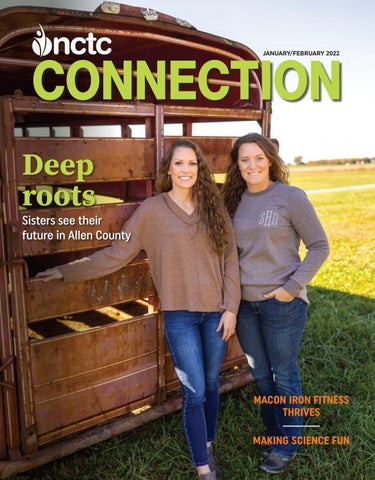
CONNECTION JANUARY/FEBRUARY 2022
Deep roots
Sisters see their future in Allen County
MACON IRON FITNESS THRIVES MAKING SCIENCE FUN
INDUSTRY NEWS
Rural Connections By SHIRLEY BLOOMFIELD, CEO NTCA–The Rural Broadband Association
An investment for the future
Communication at the speed of light Fiber optics make it possible
Expanded broadband access will lift rural communities
I
n order to thrive, all communities — especially those in rural America — require opportunities and the modern communications tools so vital for jobs, education, health and so much more. Thanks to the Infrastructure Investment and Jobs Act, the NTCA's nearly 850 rural, community-based broadband providers now have fresh help as they work to complete their essential mission. This historic investment will go a long way to connecting all Americans, even in areas of the country that are the hardest to reach for service providers. Of course, the work now truly begins to deliver on the promise this law offers. The FCC must prioritize areas of the greatest need. Also, we will work with all key parties to support state leaders as an unprecedented amount of resources flow into their broadband initiatives. Care is needed to vet those seeking funding, to ensure they can truly supply the infrastructure and services they promise. Throughout the effort, we must remember that we need to do more than simply build networks. Our commitment must also be to sustain these vital communications systems and to ensure the services offered over them are affordable and will meet customer demands well into the future. We're confident NTCA members will continue to serve their neighbors by solidifying existing networks and expanding service. No matter where they live, all Americans should have the same opportunity to access vital communications services needed not only today, but also for years to come.
2 | January/February 2022
At the end of the 1970s, Corning Inc. developed a technology that would reshape communications — fiber optics. Today, it’s a critical component in the networks making our hyperconnected world possible. Streaming entertainment, social media, video calls, telehealth, online education, workfrom-home jobs and so much more depend on this technology.
DID YOU KNOW? • Each fiber strand is made up of a glass core thinner than a human hair. • Light signals are transmitted through the glass, just as you might send a signal down the tunnel. • To keep the light from simply passing through the glass when it changes direction, the core is surrounded by a cladding that reflects light back into the glass. • The process is similar to mirrors in a tunnel, bouncing the signal from side to side until it reaches its endpoint. • A single fiber cable — each fiber is much thinner than copper wire — can bundle hundreds, or even thousands, of fiber strands. • While incredibly thin, fiber is not brittle. A single strand is three times stronger than steel and more durable than copper. • The glass core of a fiber cable is so pure that if the ocean was made of the same glass, you could stand on the surface and clearly see the ocean floor miles below.
Take a
STAND! Avoid back and neck pain while working from home
O
ver the past couple of years, working from home has gone from a perk — one that only a few employers offered — to the norm for many. The benefits for employees range from having your dog as a co-worker to adding pajama pants to the professional wardrobe. But working from home can also come with hazards. Whether you’re camped out at a kitchen table, sprawled across the couch or luxuriating in bed all day, odds are your home setup isn’t as ergonomic as that of an office. This may not be a big deal when you’re working from home for short periods. But when those workdays add up to weeks or even months, poor posture and sedentary behavior can create serious back and neck pain. The good news is that with the right furniture and a little daily activity, it’s easy to strike a healthy balance with your workfrom-home routine.
GET ON YOUR FEET Most people tend to hunch forward while sitting, which can put a lot of pressure on your lower back. Standing and
looking at a monitor at eye level, on the other hand, puts little strain on your neck and back, while also burning more calories than sitting. That said, it isn’t comfortable to stand for hours at a time. That’s why the UPLIFT Standing Desk V2 is a good option for any remote office. The design enhances durability and comfort, and easy height adjustment encourages users to keep moving without settling into any position for too long.
LOOK FOR SUPPORT When you do decide to take a seat, getting the proper support can make a big difference. If you don’t have an office chair, try putting a small pillow behind your lower back to maintain an arched posture. This practice will help put your upper body weight on the chair instead of your spine. If you’re ready to invest in a new chair, the Steelcase Gesture has been Wirecutter’s pick for more than five years. However, if you’re looking to spend less, the HON Ignition 2.0 is a more affordable option that makes few sacrifices in comfort.
STAY ACTIVE It’s a good idea to take breaks throughout the day to move around and get the blood circulating. While you’re at it, try some simple exercises like backbends, hamstring stretches and planks that can help strengthen your core and provide additional support for your lower back. If you’re looking for a guided workout, the Seven Home Workout app offers a wide variety of seven-minute routines that you can squeeze into a busy day. Or explore the Yoga Studio app to unwind with yoga classes for all levels of experience and guided meditations that take as few as five minutes.
MOVE AROUND Time can get away from you during a busy workday, so it always helps to have a reminder when it’s time to take a break. If you have an Apple Watch, you set the frequency of these reminders in the Activity app. For everyone else, apps like Stand Up! will schedule notifications throughout your workday to get up and move around. The Wakeout app will even suggest quick exercises for every room of the house. January/February 2022 | 3
FROM THE CEO
Are you ready for the high-tech fast lane in 2022? We’re here to help you navigate the upcoming year
H
appy new year! From everyone at NCTC, we hope 2022 is off to a great start. After a season of celebration, the new year gives us a welcome break from weeks of holiday hustle and bustle. It also is a good time to pause and contemplate what’s ahead, whether that’s an upcoming vacation, a new job or major milestones like graduations or weddings. All that potential can be a little overwhelming. When looking forward, I often find it helpful to look back and appreciate the road that brought us where we are today, whether it’s my own personal journey or the rapid evolution of the communications industry. Consider the internet. Fifty years ago, only researchers had the first inkling of what was to come. In 1972, “All in the Family” was the top-rated TV show in the country. Roberta Flack’s “The First Time Ever I Saw Your Face” was at the top of the music charts. And researcher Ray Tomlinson had recently sent the world’s first email to himself using ARPANET, a network of computers linked JOHNNY MCCLANAHAN by phone lines to help Pentagon-funded research stations commuPresident/CEO nicate. Just a decade later, companies like Apple and Microsoft were already leading the personal computer revolution that put desktops in homes and offices. By 1992, people were receiving the first of many AOL software CDs. In 1995, NCTC launched dial-up internet service. The squawk of computer modems soon filled homes as people used dial-up internet to connect to email and online message boards. Nineteen years ago, the internet became even more of a social space with the launch of Friendster, a precursor to Facebook. Social networks wouldn’t become fixtures on phones and mobile devices until the arrival of the iPhone in 2007 and the iPad three years later. Even then, the ability to bring medical expertise home with telehealth, take college-level classes from your couch or stream high-quality movies, music and TV shows — things we can take for granted today — would have seemed far-fetched. In just five decades, we have seen online technology grow from computers that could only send a few characters of text into being the center of a deeply interconnected world. At NCTC, we’re proud to be a part of that story, because we have seen firsthand how the service we provide benefits lives and connects communities. So, as you look ahead to the many possibilities a new year brings, take a moment to consider how far we’ve come. From staying connected with distant friends on social media to planning your next big adventure, how many of your goals wouldn’t even be possible without fast, reliable internet service? And, just as importantly, what innovation will be the next to transform our lives? I don’t expect the pace of innovation to slow down, which is why we’ll be here to make sure the services, tools and connections you need are always up to speed. Here’s to a wonderful 2022 as we all keep our eyes on the road ahead.
4 | January/February 2022
CONNECTION JANUARY/FEBRUARY 2022
VOL. 9, NO. 1
The North Central Connection is a bimonthly newsletter published by NCTC, © 2022. It is distributed without charge to all member/ owners of the cooperative.
North Central is a member-owned corporation dedicated to delivering advanced telecommunications technology to the people of Northern Middle Tennessee and Southern Kentucky, including Macon County, Tenn., Allen County and Warren County, Ky. NCTC also serves portions of Sumner, Trousdale, Smith and Clay counties in Tennessee. North Central 872 Highway 52 Bypass, East P.O. Box 70 Lafayette, TN 37083 Telephone: 615-666-2151 www.nctc.com BOARD OF DIRECTORS Glen Hardcastle Chairman of the Board Scottsville Exchange West Randy Harston Vice Chairman of the Board Scottsville Exchange East Calvin Graves Secretary of the Board Bethpage/Oak Grove Exchanges Martha Bowser Westmoreland Exchange Kevin Dickerson Defeated/Pleasant Shade Exchanges Donnie Steen Lafayette Exchange East Jeff Flippin Lafayette Exchange West Chad Evitts Hillsdale/Green Grove Exchanges Chad Owens Red Boiling Springs Exchange Johnny McClanahan President/CEO Guy Holliman General Counsel
Produced for North Central by:
On the Cover: Sisters Katie Young Jones and Sandy Young High tell why Allen County is the only place for them. See story Page 12.
NCTC NEWS
JENKINS AND MEADOR WIN NCTC COMMUNITY SERVICE AWARD NCTC Board Secretary Calvin Graves presented Tammy Jenkins and Don Meador with the 2021 NCTC Community Service Award on Nov. 6. The award honors the volunteers who go above and beyond to serve the people of the region. It includes a $1,000 donation to the organizations these individuals champion. Jenkins, a Westmoreland resident, is the driving force behind 37186 Smiles. The group organizes events, decorates the town for holidays, and performs other acts of selflessness in an effort to bring smiles to the people of Westmoreland. Jenkins also heads up the 37186 Smiles Facebook page, which spreads cheer throughout the year. “Celebrating our small towns, promoting them, and taking time to shine them up from time to time are what keeps them going and what keeps them special,” Graves says. “If it weren’t for a few hardworking, caring individuals who lead these efforts, then we would fall by the wayside. Thankfully, there are individuals like our recipient who work hard to make our communities extraordinary places to live and raise families.” Don Meador, an Allen County resident, is a well known minister and a chaplain for several sports teams in the county. He is known for attending all school events, while serving as a pastor and holding down another job. “He does this because he loves Allen County, the people of the county, and the students who are our future,” Graves says. “His willingness to be a servant is something for which we should all strive.”
Birdwell & Shoulders retire NCTC President and CEO Johnny McClanahan and staff recently honored Donnie Birdwell and Randy Shoulders, two dedicated employees who retired from the cooperative after 27 years. Birdwell and Shoulders both started on Sept. 6, 1994. They served on the line crew, in the install and repair department and, most recently, in the cable department. In the cable department, where they’ve spent the majority of their careers, they spliced fiber, found solutions to problems and performed locates for buried fiber. NCTC would like to wish them much happiness as they enjoy well-deserved time with their families.
North Central
LIFELINE SERVICE
LIFELINE IS A FEDERAL PROGRAM TO HELP LOW-INCOME AMERICANS PAY FOR PHONE OR BROADBAND SERVICE. You are eligible for Lifeline benefits if you qualify for and receive one of the following benefits: • SNAP • Medicaid • Supplemental Security Income (SSI) • Federal Public Housing Assistance • VA Veterans Pension or Survivors Pension Additionally, consumers at or below 135% of the Federal Poverty Guidelines will continue to be eligible for a Lifeline program benefit. (State determinations of income will no longer be accepted.) There are no changes to the eligibility criteria for tribal programs. Some states have additional qualifying programs, allowances and stipulations. Check with your local telecommunications provider for information about benefits that may be available in your state. To find out whether you qualify for Lifeline assistance, please visit lifelinesupport.org or call your local telecommunications provider. Note: Your telephone company is not responsible for determining who qualifies for these programs or who receives assistance. Consumers must meet specific criteria in order to obtain assistance with their local telephone and/or broadband service, and qualifying is dependent upon government-established guidelines.
January/February 2022 | 5
TRAVEL
Ancient treasures
Museums showcase geologic adventures
E
Story by ANNE BRALY
ntertaining kids while traveling isn’t easy. But there are places just a smidge off the beaten track, outside the glitz and glamour of big cities, that will spark your child’s interest. Here are some spots around the South that mix history and science in fun and interesting ways.
Falls of the Ohio State Park Clarksville, Indiana Jump over the Kentucky state line into Indiana and hike across one of the world’s most accessible Devonian-age fossil beds. The 390-million-year-old fossil beds are among the largest exposed Devonian beds in the world. The park features a spectacular interpretive center, which features interactive, immersive exhibits. While fossil collecting is prohibited on the beds and river bank, the park staff encourages visitors to explore and discover the many different fossils that can be found on the ancient sea bottom. And you can collect from rock piles 6 | January/February 2022
with fossils from the quarries behind the interpretive center, which is open Monday through Saturday 9 a.m. to 5 p.m. and Sunday 1 to 5 p.m. The park grounds are open 7 a.m. to 11 p.m. Fishing, hiking, fossil viewing, bird watching and picnicking are among the most popular activities. Admission is $9 for ages 12 and up, $7 for ages 5 to 11, and under 5 is free. Parking is $2. For more information, visit fallsoftheohio.org.
Coon Creek Science Center Adamsville, Tennessee Tennessee was once home to giant mosasaurs, sharks, crabs and clams when
the Gulf of Mexico spread its waters across the Volunteer State. Fossils of these early inhabitants reside at Coon Creek in rural McNairy County, one of the most important fossil sites in North America. The Coon Creek Science Center is a great place for kids to visit and discover some amazing things. There are hands-on displays and activities, which allow them to learn through experiments in which they use their senses while having fun. There’s a treasure trove of artifacts on display, so allow enough time to see everything. To learn more, visit memphismuseums.org.
Children learn about the dynamics of science in the Discovery Lab, one of several exhibits at the Hands On Children’s Museum. At right, children can play while learning about science and discovery in the museum’s Scheu Family Exhibit Hall & Art Studio in the General Shale Learning Center.
Folly Beach, South Carolina Finding shark teeth on Folly Beach is a great way to learn about the giants that once roamed the seas — and the many that continue to do so — and Folly Beach is one of the best places to find their teeth and learn how to identify all the different species. Wade into the water and start your hunt, sifting through the sand with special tools for shark teeth — maybe even one from a megladon. For more information, or to book a tour, visit chsfossiladventures.com.
Cook Museum of Natural Science Decatur, Alabama Kids can learn all about the birds, the bees, the flowers and the trees and more by spending a day in Decatur at the Cook Museum of Natural Science, a museum that began with a small collection of insects from John Cook, the founder of Cook’s Pest Control. It’s now grown into a state-of-the-art museum with numerous exhibits including cave systems, the weather, outer space, rivers and streams, oceans and forests and more, including — yes — insects. Many exhibits include hands-on elements to keep kids busy and entertained. Log onto cookmuseum.org for more information and tickets.
Gray Fossil Site Gray, Tennessee There was a time — some 5 million years ago — when small horses, mastodons, alligators, tapirs, rhinoceros, camels, saber-toothed tigers and other creatures roamed the hills and meadows
— sometimes peacefully, others not — around the South. And one of their favorite gathering places was a watering hole in what would become Gray, Tennessee, outside Johnson City. Fast forward a few million years, and today, paleontologists are unearthing a massive amount of bones at the Gray Fossil Site. Experts say they could dig for another 100 years and still not find everything that lies beneath. Now, kids, parents, grandparents and others can come and see what paleontologists have found and learn so much more in the neighboring Hands On! Discovery Center. “The fossil site itself offers an up-close experience where children of all ages can see an active dig site,” says Andy Marquette, the Discovery Center’s president and CEO. “They can come within inches of giant fossils and learn about the process from finding a fossil to putting it in collections.”
Hands On! Discovery Center Johnson City, Tennessee The center grew from a small children’s museum in downtown Johnson City to what it is today: a beautiful, new building with numerous interactive exhibits like the “dig pit” in the Paleo Hall where visitors can dig for themselves and see what actual paleontologists experience. Life-size replica skeletons of many of the creatures that once called the Gray Fossil Site home now surround the hall. In addition to the paleo exhibits, the Main Exhibit Hall is the place where kids can make their own air rockets and air cars
If you go » Where: Hands On! Discover Center and Gray Fossil Site, 1212 Suncrest Dr., Gray, Tenn. » Hours: 10 a.m. to 5 p.m. Tuesday through Saturday; 1-5 p.m. Sunday. Also, open on Mondays from 10 a.m. to 5 p.m. during March, June, and July only. » Information: visithandson.org or 423-434-4263.
and see how fast these creations can go or spend time at the Bernoulli table while exploring the science of how objects are able to fly. They’ll be having so much fun they may not realize they’re learning many of the same things about energy that they learn in school, says the center’s Director of Operations Keith Maultbay. “It makes science fun,” he says. The second floor of Hands On! Discovery Center is all about the dig. Large glass windows allow views of the paleontologists at work, piecing together the intricate bones of a massive mastodon discovered in the center’s backyard several years ago. Also on view in the collection room are more bones and tusks. Buy a ticket and take a paleo tour of the dig site. Another ticket gets you into the Tesla Theater to witness an electrifying, Guinness record-holding experience that honors the great inventor Nikola Tesla. Watch in amazement as the world’s most powerful, musical, bi-polar Tesla coil turns 240 volts into 200,000 volts of pure electricity. January/February 2022 | 7
Bryan Nichols, owner of Macon Iron Fitness, spots his client, Kyle Woodard, on a bench press while another client, Colby Lane, offers encouragement. Below: Nichols also offers physical training sessions at the gym. Chrissy Jenkins is one of his clients.
DREAM GYM Macon Iron Fitness focuses on health and community Story by JEN CALHOUN | Photography by TONY YOUNG
B
ryan Nichols took to the iron early in life. As a teen growing up in Lafayette, he started lifting weights and entering local and regional fitness competitions. He’d drive to shows in Nashville or Kentucky to test his skills. He even built his own gym inside his mother’s two-car garage, creating a popular workout space for him and his friends. “I always tell people, ‘I didn’t pick this. The iron picked me,’” he says. “I just fell in love with lifting.”
8 | January/February 2022
A GYM FOR EVERY BODY Now in his 50s, Bryan still loves to lift. And, after retiring from a 30-year career as a mechanical engineer, he’s transformed that passion into Macon Iron Fitness, a full-service, equipment-filled gym of about 9,000 square feet in Lafayette. Despite Bryan’s love of weightlifting, Macon Iron Fitness isn’t just for weightlifters. It’s for everyone. Built on the grounds of a former Dollar General store, Macon Iron Fitness has two sections. One side holds the weights and bodybuilding
equipment, and the other contains cardio and circuit training machines. The separation was intentional, Bryan says. “Fitness has subcultures. I’ve learned over the years that people that want to do cardio — that’s usually all they want to do. There are also the people who want to do the circuit machines, and they want to figure them out themselves. Then, there are the weightlifters.” With that thought in mind, Bryan situated the rowers, treadmills, bikes and elliptical machines on the left wall and the North Central
PRO TIP SCALE BACK ON THE SCALES When Bryan Nichols trains people, he generally skips the scales and instead measures their progress by clothing sizes. That’s because muscle weighs more than fat, and focusing on weight alone can be misleading. “The scale is not always your friend,” he says.
circuit machines along the back of the left side. He positioned the weightlifting area on the right side, giving his clients a way to tailor their workout experiences to their own needs. The arrangement also gives them a little privacy to do their own thing. “That makes it so the people doing cardio feel comfortable and not exposed,” he says. In addition to the equipment, Bryan says several personal trainers are affiliated with the gym, including himself. Clients can set up appointments with the trainers and work out in the gym for extra fees. Bryan doesn’t take a cut from the trainers, but their clients do need to be members of the gym. “It’s good for them, and it’s good for me,” he says.
months of the year — a figure that generally balances out at about 300 members by the end of the year. It’s a common occurrence in the gym business, but it doesn’t bother Bryan. “If Macon County has about 25,000 people, and I’ve got about 300,” he says, “I can pay my bills, and people in the area have a place to work out.”
LABOR OF LOVE On a typical day, Bryan can spend about 14 or 15 hours at the gym, training people, helping clients, washing towels and cleaning bathrooms. He loves every second. “I worked for 30 years as a mechanical engineer in a job I really liked,” he says. “Now, I make about a third of what I made as an engineer, but I get up every morning with a smile on my face.” A former city council and school board member, Bryan says the gym is just as much a part of the community as he is. Macon Iron Fitness sponsors local sports teams and events to try to help members of the community feel supported. That same sense of service applies inside the gym, too. “I try to make people comfort-
Nicole Miller, a client at the gym, enjoys working out on the treadmills.
able and feel good about themselves,” he says. “I want to help them and orient them with the equipment, so they’ll have a good experience here.”
STRONG START In 2019, Macon Iron Fitness won Macon County Chamber of Commerce’s Small Business of the Year Award. “That made me feel like I had lightning in a bottle,” Bryan says. He estimates that 400 to 450 people usually sign up for membership in the early
GETTING FIT
North Central
Nichols, shown here with Colby Lane, offers a full-service gym.
Macon Iron Fitness is at 102 Church St. in Lafayette. The facility offers 24-hour access to a 9,000-square-foot gym that’s fully outfitted with weights, cardio equipment and circuit training machines. Nonmembers can work out for $5 per day, and trainers are available. The gym offers TVs and free Wi-Fi. For more information and rates, call 615-666-4766, or email maconiron@nctc.com. You can also visit the Macon Iron Fitness Facebook page for the latest gym information and news.
January/February 2022 | 9
Locator apps Connected for safety and security
W
ith the help of a locator app on a mobile phone, parents can be aware of just about anywhere their family members roam — assuming families have reviewed and accepted the app’s policies. While some might find this concept intrusive, these apps can be helpful for busy schedules or a comfort during troubling times, late nights or long trips. Here are a few of the top locator apps on the market and what they can do.
WWLife360 The premium version of Life360 can tell you where your family members’ phones are at any given moment. Notifications
about events like a child arriving at school are easy to receive.
WWGlympse The free Glympse app lets friends and loved ones know your travel status, so you never have to worry if you’re running late. They’ll know. Users can send a Glympse alert to anyone with a web-enabled device.
WWiSharing Know where your friend or family member is at any moment. The iSharing app provides real-time alerts when someone leaves home, work or school. In-app messaging is just one of the features, some of which are only available in the premium version.
CONSUMER FINANCIAL PROTECTION BUREAU The role of the CFPB, which Congress established in 2010, is to hold financial institutions accountable for following federal financial laws and to protect and educate consumers. The bureau’s website, consumerfinance.gov, has a section dedicated to youth financial literacy and offers more than 200 educational activities designed for kids of all ages. The list of topics is extensive and includes entrepreneurship, budgeting, managing credit and preventing fraud and identity theft.
FAMZOO
Money wise
Financial education with digital tools
F
ewer than half of U.S. states require students to complete personal finance education, although there have been recent efforts in many states to focus on this form of education. There is, however, a wealth of online resources and apps to help parents teach children to safely navigate the financial seas. Here are a few of the sites and apps available to parents looking to teach their kids real-world money lessons:
10 | January/February 2022
FamZoo is a comprehensive finance app for families. It creates a virtual family bank with parents in the banker’s seat. Through the app, parents can pay their children’s allowances, track their spending and savings and even encourage charitable giving. FamZoo isn’t free — the cost ranges between $2.50 and $5.99 a month depending on which option you choose. One- and twomonth free trials are available at famzoo.com.
GOHENRY GoHenry, aimed at kids as young as 6 years old, provides parents with a prepaid debit card for their children and an app the whole family can use to keep track of spending, savings and progress toward financial goals. GoHenry offers a one-month free trial, after which, the service charges a monthly fee of $3.99 per child. For more information, visit gohenry.com.
Which
MUSIC STREAMING SERVICE
is right for you?
I
t’s never been easier to discover a new favorite band or find that hidden gem of a song you can’t stop playing on repeat. A wealth of music streaming apps boast exhaustive libraries, classic hits and new buried treasures all at your fingertips. Whether you’re looking for crystal clear audio, curated playlists or a soundtrack to keep up with your runs, there’s something for everyone if you know where to look.
SPOTIFY Spotify is synonymous with music streaming for a reason. Its interface is easy to navigate and always has new recommendations based on what you’re already listening to. If you have friends on the service, you can share your listening activity and see what others are playing from Spotify’s library of 70 million tracks. Audio quality, on the other hand, varies based on your account. Free users can stream at decent qualities if they’re listening on standard headphones or a Bluetooth speaker. Premium users can stream at higher quality for $10 a month, and Spotify has announced plans to roll out a hi-fi tier with lossless audio quality in the future.
APPLE MUSIC Apple Music’s social options are similar to what you’ll find on Spotify, even if there are fewer curated options for discovering new favorites. But the real selling point is audio quality.
Audiophiles can enjoy lossless tracks at the base tier of $10 a month with about 20 million tracks currently available at the highest quality. Apple says the rest of its 70 million-plus track library will be available in that format by the end of the year.
TIDAL TIDAL used to have the crown when it came to lossless audio, but at $20 a month it’s now a tough sell against other more affordable options. If you can’t wait for Apple Music to update its library, TIDAL’s catalog is already fully available in lossless format, with a few even streaming at “Master” quality up to 9,216 Kbps. And while TIDAL may have made its name with major hip-hop artists, the genres available now are about as diverse as other top streaming apps.
AMAZON MUSIC The biggest benefit of Amazon’s music service is that it’s already available to anyone with a Prime subscription. But that may not get you as much as you think. Despite having access to more than 75 million tracks, ad-free tier users may notice certain albums and artists are off-limits without a paid subscription. At least that buys you access to lossless audio, but if you’re looking for easy access and discoverability, there are probably better options.
WHAT IS LOSSLESS AUDIO? Most music streaming services compress audio files to save space. That means some data has to be discarded, and audio quality suffers. Lossless audio still compresses these files but retains all the details of the original audio recording. You can hear the difference most often in frequencies like those from the crash of a cymbal in a rock song or the bass of a hip-hop track. Higher-quality audio tracks are also much larger than lossy audio formats. So make sure you have the necessary data coverage if you’re streaming on the go and adequate bandwidth if you’re listening over the internet at home.
January/February 2022 | 11
Brain
GAIN
Softball hall-of-fame team siblings bring their energy back home Story by JEN CALHOUN | Photography by TONY YOUNG
S
andy Young High and Katie Young Jones could have gone anywhere and done pretty much anything with their lives after graduating two years apart with business degrees from Georgetown College. For one thing, the sisters had always been hard workers. Since they were little kids, they’d been helping out on their family’s farm in Adolphus. They harvested hay, helped with the cattle and did anything else their parents, Joe and Lynn Young, needed. That work ethic and a focus on teamwork, always a big part of their lives on the farm, served them well in softball, too. At Allen County-Scottsville High School, they helped bring the school its first state championship as members of the 2011 Lady Patriots team — recently inducted in the school’s athletic hall of fame — before going on to play softball all four years of their college careers. And when it came time to decide where they wanted to live and work, they chose to move back to the region where they grew up. “I always knew I wanted to come back home,” says Katie, a marketing manager and real estate agent who lives in Fountain Run. “People here want to help you, and they love to see you come back. If I had to choose anywhere, it would be here.” Sandy, now a Tompkinsville resident and founder of the Scottsville-based business Sandy’s Contracting and Design, agrees. “I wanted to be here,” she says. “I never questioned it. I just never wanted to be anywhere else.”
Katie Young Jones uses a laser engraver to creates designs. 12 | January/February 2022
DECADES OF LOSS Coming back home isn’t always easy, however. For more than a generation, rural areas all over the country have faced “brain drain,” a term used to describe the trend of young, skilled and college-educated workers leaving the rural areas of their upbringings for larger cities. Most of the time, they’re looking for jobs with good benefits and enough money to pay off student loan debt. Research from the University of New Hampshire found that 30% of rural counties have experienced significant and ongoing population loss for decades. These counties lost an average of 43% of their 20- to 24-year-olds every decade from 1950 to 2010. “This combination of young adult outmigration, fewer births and more deaths produced a downward spiral of population loss that will be difficult to break,” the UNH researchers reported.
RURAL RESTART But those statistics could change if recent rural migration
Katie Young Jones returned to Allen County to work in marketing and real estate. North Central
THERE’S NO PLACE LIKE HOME For Sandy and Katie, it’s personal. They know the good things that go on in a small town, and they want to be part of them. Both women hope to raise their children the way they were raised — integrating hard work, respect and a strong connection to their faith, family and community. Sandy’s contracting firm keeps her busy, but she still finds time to sit on the board of Will to Way, a
Sandy Young High came back to Allen County to run a construction contracting company.
North Central
nonprofit organization that helps local people get back on their feet after financial difficulties. She’s also active in her church and serves as a member of her local Rotary Club and the Scottsville-Allen County Chamber of Commerce. “I’ve always been involved in a bunch of things all my life, but they all come back to the same fundamentals of teamwork, loyalty and integrity that I learned from my parents,” Sandy says. “My dad was always self-sufficient — always working and always solving problems. I found his life so intriguing, and I wanted to be like that.”
People here want to help you, and they love to see you come back. If I had to choose anywhere, it would be here.
— KATIE YOUNG JONES
In addition to her part-time work in real estate, Katie has a full-time job as marketing manager at CPC, an agricultural company, and coaches middle school and freshman softball teams. She understands why people want to move to small towns and rural areas. The desire for meaningful connections is real. “I can go in and talk to just about anyone around here, and they’ll teach me things I need to know,” she says. “In a larger area, that probably isn’t going to happen. Here, we’re like a big family. You feel secure here, and people want to see you succeed.” Sandy Young High, left, shows her sister, Katie Young Jones, a construction project.
The sisters helped lead the Allen County-Scottsville High School Lady Patriots softball team to a state championship in 2011.
January/February 2022 | 13
© ANDY DEAN, LENETS_TAN, NIGEL/AdobeStock
patterns and trends continue. Gallup, the data gathering organization, found that more people are dreaming of life in the country. Its data showed that 27% of people say they want to live in a rural community, while 12% want to live in a small town. Only 12% say they want to live in a big city, and 21% like the idea of living in the suburbs of a big city. Another 10% prefer life in the suburbs of a small city. The thing is, only 15% of the people polled actually live in rural areas now, according to Gallup. “If Americans did sort themselves according to their desires, there would be an exodus from the big cities and, to a lesser degree, from small cities and towns, accompanying a movement to rural areas,” a Gallup writer says. As a part-time real estate agent, Katie says she sees in real time the race to go rural. “People from Nashville are moving here, and I’ve sold houses and building lots to people from Phoenix, Arizona, and Los Angeles, California,” she says. “It’s like they’re all wanting to escape the high prices and the problems in the big cities.”
SOUTHERN KITCHENS
ROUX
the day
14 | January/February 2022
of so many dishes, roux becomes a chameleon. It can change from brown to red and to black. The longer the roux cooks, the darker and more intensely flavored it gets. Cooking the roux has two main benefits. First, it gets rid of the raw, starchy flavor of the flour. Second — and this is with darker roux — it adds color to a dish. White and blond roux are used for light-colored sauces, such as cheese sauce and bechamel. Brown roux is used for darker sauces, such as stews and gravies. Here is a recipe for basic roux. Add milk and shredded cheese for a lovely cheese sauce for vegetables. Or, use roux as the foundation for gumbo or mac and cheese. It’s a versatile concoction that’s an important step in making so many good foods.
FOOD EDITOR ANNE P. BRALY IS A NATIVE OF CHATTANOOGA, TENNESSEE.
1 1/2
stick (8 tablespoons) unsalted butter or 1/2 cup peanut oil cup flour
In a large pot or skillet, warm the butter or peanut oil to medium heat and then stir in the flour. Cook for 10 minutes, constantly stirring, to make a lightly browned roux, or continue stirring and cooking for up to 30 minutes for a dark roux. The roux will darken as you stir, from very light brown to copper or peanut butter brown, then to light chocolate brown, then dark chocolate brown and then very, very dark brown.
© deniskarpenkov/Adobe Stock
I
t’s a given that pretty much everything is improved by the addition of a sauce. That’s why we put mustard on hot dogs and ketchup on fries. Good sauces cling to food, which means they need body. There are many ways to achieve this, including making a roux, the foundation for wonderful sauces for meats, fish, poultry and vegetables. But it’s also the beginning of many pots of gumbo, and roux is the underpinning for unbelievably creamy Creole dishes. Roux is nothing more than equal parts of butter or oil and flour. The addition of warm liquid, whether water, stock or milk, works to swell the small granules of flour, which trap the liquid to thicken the roux. Careful though — one of the most important things to remember when making a roux is to avoid adding the flour to a hot liquid. The result is something every cook dreads: a lumpy sauce. In French cuisine, roux is cooked to one of three stages: white, blond or brown. In New Orleans, where roux is the beginning
BASIC ROUX
SEAFOOD GUMBO 1 recipe basic roux (dark brown) Vegetables: 1 tablespoon butter 1 cup chopped celery 1 cup chopped green onions 1 green bell pepper, chopped Tomato sauce: 6 cups water 1 (8-ounce) can tomato sauce 2 tablespoons Worcestershire sauce 2 cloves garlic, minced 2 teaspoons salt, or to taste 1 teaspoon hot pepper sauce, or to taste 1/2 teaspoon dried thyme Seafood and okra: 1 pound fresh or frozen chopped okra 1 pound white fish such as catfish, cut into 2-inch pieces 1 1/2 pounds peeled and deveined shrimp Final seasonings: 1 tablespoon gumbo file powder, or to taste 1/2 teaspoon salt, or to taste
In a large pot, make a basic roux, allowing it to cook to a dark brown stage. In a separate skillet, melt the tablespoon of butter over medium heat. Add and stir the celery, green onions and bell pepper, cooking until tender, about 10 minutes. Add the cooked vegetables to the pot with the roux. Stir the water, tomato sauce, Worcestershire sauce, garlic, salt, hot pepper sauce and thyme into the vegetable mixture. Bring the mixture to a gentle boil, reduce heat to medium low and simmer for 1 hour. Stir okra into the vegetable mixture and cook it until tender, about 15 minutes. Add the fish, stir gently, and cook it until the flesh is easily flaked with a fork, about 5 minutes. Gently stir shrimp into the mixture and cook until the shrimp are bright pink, about 3 minutes. Season with the file powder and more salt; stir. Makes about 8 servings. ©Mark Gilliand
THREE-CHEESE MAC AND CHEESE With Bechamel Sauce 1/3 cup butter 1 shallot, finely chopped 3 cloves garlic minced 1/4 cup all-purpose flour 1 1/2 tablespoon cornstarch 2+ cups whole milk 1 cup heavy whipping cream 1/4 teaspoon white pepper 1/4 teaspoon cayenne pepper 1/8 teaspoon dry mustard, preferably Colman’s 8 ounces Gruyere cheese, shredded 6 ounces sharp white cheddar cheese, shredded 2 ounces Monterey Jack cheese, shredded 1/2 tablespoon salt 2 pounds macaroni, cooked
Melt the butter and saute the shallot, then whisk in the flour and cornstarch to a thick paste. This is your roux. Cook the roux on medium-low heat until it is light brown. Add the milk and cream and cook it, stirring, until the sauce comes to a simmer. Remove from heat and keep stirring about 4 minutes. The sauce will thicken as it cools. This is your bechamel sauce. To the sauce, add and stir in the white pepper, cayenne pepper and dry mustard. Test the temperature with your finger. If it’s too hot to touch, let it cool longer. If it’s just uncomfortably warm, it’s the perfect time to add the cheeses in stages, stirring constantly. Add extra milk if it’s too thick. Taste the sauce, and add salt if it’s needed. Pour the sauce over the cooked and drained pasta and stir. Serve immediately. Makes 12-14 servings. January/February 2022 | 15
P.O. Box 70 Lafayette, TN 37083
2022 gives you
“too”
many reasons to upgrade
With NCTC broadband, you will ...
Be more productive working from home
Enjoy seamless streaming of movies
Blast your gaming competition thanks to more bandwidth
So, upgrade your broadband now. You may also qualify for a reduced rate through the FCC’s Affordable Connectivity Program. To find out more, visit fcc.gov.
Call 615-666-2151 or visit nctc.com