Connected JANUARY/FEBRUARY 2022
Jerry’s journey Local author recalls life-changing walk
Little Collinsville Making science fun
INDUSTRY NEWS
Rural Connections By SHIRLEY BLOOMFIELD, CEO NTCA–The Rural Broadband Association
An investment for the future
Communication at the speed of light Fiber optics make it possible
Expanded broadband access will lift rural communities
I
n order to thrive, all communities — especially those in rural America — require opportunities and the modern communications tools so vital for jobs, education, health and so much more. Thanks to the Infrastructure Investment and Jobs Act, the NTCA's nearly 850 rural, community-based broadband providers now have fresh help as they work to complete their essential mission. This historic investment will go a long way to connecting all Americans, even in areas of the country that are the hardest to reach for service providers. Of course, the work now truly begins to deliver on the promise this law offers. The FCC must prioritize areas of the greatest need. Also, we will work with all key parties to support state leaders as an unprecedented amount of resources flow into their broadband initiatives. Care is needed to vet those seeking funding, to ensure they can truly supply the infrastructure and services they promise. Throughout the effort, we must remember that we need to do more than simply build networks. Our commitment must also be to sustain these vital communications systems and to ensure the services offered over them are affordable and will meet customer demands well into the future. We're confident NTCA members will continue to serve their neighbors by solidifying existing networks and expanding service. No matter where they live, all Americans should have the same opportunity to access vital communications services needed not only today, but also for years to come.
2 | January/February 2022
At the end of the 1970s, Corning Inc. developed a technology that would reshape communications — fiber optics. Today, it’s a critical component in the networks making our hyperconnected world possible. Streaming entertainment, social media, video calls, telehealth, online education, workfrom-home jobs and so much more depend on this technology.
DID YOU KNOW? • Each fiber strand is made up of a glass core thinner than a human hair. • Light signals are transmitted through the glass, just as you might send a signal down the tunnel. • To keep the light from simply passing through the glass when it changes direction, the core is surrounded by a cladding that reflects light back into the glass. • The process is similar to mirrors in a tunnel, bouncing the signal from side to side until it reaches its endpoint. • A single fiber cable — each fiber is much thinner than copper wire — can bundle hundreds, or even thousands, of fiber strands. • While incredibly thin, fiber is not brittle. A single strand is three times stronger than steel and more durable than copper. • The glass core of a fiber cable is so pure that if the ocean was made of the same glass, you could stand on the surface and clearly see the ocean floor miles below.
Take a
STAND! Avoid back and neck pain while working from home
O
ver the past couple of years, working from home has gone from a perk — one that only a few employers offered — to the norm for many. The benefits for employees range from having your dog as a co-worker to adding pajama pants to the professional wardrobe. But working from home can also come with hazards. Whether you’re camped out at a kitchen table, sprawled across the couch or luxuriating in bed all day, odds are your home setup isn’t as ergonomic as that of an office. This may not be a big deal when you’re working from home for short periods. But when those workdays add up to weeks or even months, poor posture and sedentary behavior can create serious back and neck pain. The good news is that with the right furniture and a little daily activity, it’s easy to strike a healthy balance with your workfrom-home routine.
GET ON YOUR FEET Most people tend to hunch forward while sitting, which can put a lot of pressure on your lower back. Standing and
looking at a monitor at eye level, on the other hand, puts little strain on your neck and back, while also burning more calories than sitting. That said, it isn’t comfortable to stand for hours at a time. That’s why the UPLIFT Standing Desk V2 is a good option for any remote office. The design enhances durability and comfort, and easy height adjustment encourages users to keep moving without settling into any position for too long.
LOOK FOR SUPPORT When you do decide to take a seat, getting the proper support can make a big difference. If you don’t have an office chair, try putting a small pillow behind your lower back to maintain an arched posture. This practice will help put your upper body weight on the chair instead of your spine. If you’re ready to invest in a new chair, the Steelcase Gesture has been Wirecutter’s pick for more than five years. However, if you’re looking to spend less, the HON Ignition 2.0 is a more affordable option that makes few sacrifices in comfort.
STAY ACTIVE It’s a good idea to take breaks throughout the day to move around and get the blood circulating. While you’re at it, try some simple exercises like backbends, hamstring stretches and planks that can help strengthen your core and provide additional support for your lower back. If you’re looking for a guided workout, the Seven Home Workout app offers a wide variety of seven-minute routines that you can squeeze into a busy day. Or explore the Yoga Studio app to unwind with yoga classes for all levels of experience and guided meditations that take as few as five minutes.
MOVE AROUND Time can get away from you during a busy workday, so it always helps to have a reminder when it’s time to take a break. If you have an Apple Watch, you set the frequency of these reminders in the Activity app. For everyone else, apps like Stand Up! will schedule notifications throughout your workday to get up and move around. The Wakeout app will even suggest quick exercises for every room of the house. January/February 2022 | 3
FROM THE CEO
Historic milestone: FTC completes 100% fiber network
W
E DID IT! Our optical fiber network is now available to EVERY member of the cooperative. With this moment, it bears noting that FTC has become one of the first companies of our size to deploy a 100% optical fiber network in rural America. Optical fiber is the highest aspiration of almost all recent federal legislation to provide billions of funding for broadband expansion. In slightly less than 15 years, we literally rebuilt our network from the ground up. It was no small feat, and now every cooperative member and every customer we serve outside the cooperative territory has access to one of the world’s most modern and robust networks. We fully intend to keep it that way. I must confess, it was an emotional moment for me when I realized that by the time this magazine lands on your doorstep, this much anticipated moment of success would be a reality. It seems but a few short years ago that our trustees made the courageous decision to embark upon this road to improvement. Actually, it was 2007, and it was just before the credit crisis of 2008. There was FRED JOHNSON much uncertainty then over the future of rural communications. Chief Executive Officer There was no guarantee we would ever reach more than about 75% of our members with fiber internet, and even that was not guaranteed. Still, the trustees bet on the one thing they were most sure of — you. They made the best call they could make, and we set off to do our best work. In the years that followed, we learned a lot of lessons. We figured out what worked and what did not. We learned to engineer things more efficiently. We embarked upon a cautious and controlled expansion of our service footprint into competitive areas outside our cooperative territory, and that expansion generated much of the cash we needed to finish the job without burdening our members with large rate increases. There are many people responsible for what we have achieved. There is our Board of Trustees who consistently demonstrate their commitment to serving your interests. There are our employees, capable men and women who take great pride in serving you whether they are learning how to most efficiently engineer and provision our network, talking to you about the services we offer, or quietly filling key office roles that support everything we are doing. Collectively, they are an amazing group of people. They are your friends, relatives and neighbors. They take great pride in bringing you a world-class broadband network. It is an honor to serve with them. Then, there is the matter of divine providence. I know not everyone shares a common faith, but we’ve always asked the Good Lord for guidance in being responsible stewards of those things you’ve entrusted to our care. My experience is that God most always answers sincere pleas for wisdom. I tell people His guidance is responsible for much of our success. It has to be because I am not that smart. There is much more I could say — and I probably will before it is all over — but there is a moment of sober reflection here. The past 15 years have not all been pleasant. I’ve fielded more than a little criticism and frustration over how long this took, and, frankly, I get it. Not everyone understands what is involved, and even those who do are entitled to their opinions. Still, there is a life lesson to be learned from what we have accomplished. Given the state of our society, the timing may be really appropriate. The lesson is simple. If you have a good cause, patience and discipline are still important virtues. Some things in life simply take time to do right. We always knew modernizing our network for you was the smart and right thing to do. We knew it would take time, but we also knew if we didn’t stick to sound financial and technical principles, we would crash and burn. So, with the support of our Board, we did just that. We did what we knew was in your best interest, even if not apparent to all. The result was success. Each of you share in that success, because at the end of the day you stuck with us and, together, we reached our goal. Together, we kept you connected. Thank you!
4 | January/February 2022
Connected JANUARY/FEBRUARY 2022
VOL. 26, NO. 1
Connected is a bimonthly magazine published by Farmers Telecommunications Cooperative, © 2022. It is distributed without charge to all customers of FTC.
FTC is the state’s largest member-owned provider of telecommunications services. It serves Northeast Alabama with a robust broadband network using world-class optical fiber technology.
Farmers Telecommunications Cooperative, Inc. P.O. Box 217 • 144 McCurdy Ave. N. Rainsville, AL 35986 Telephone: 256-638-2144 www.farmerstel.com
BOARD OF TRUSTEES Randy Wright, President Flat Rock Exchange Garry Smith, Vice President Fyffe Exchange Danny R. Richey, Secretary Geraldine Exchange Lynn Welden, Treasurer Bryant Exchange Kenneth Gilbert Pisgah Exchange Gregg Griffith Henagar Exchange Randy Tumlin Rainsville Exchange Produced for FTC by:
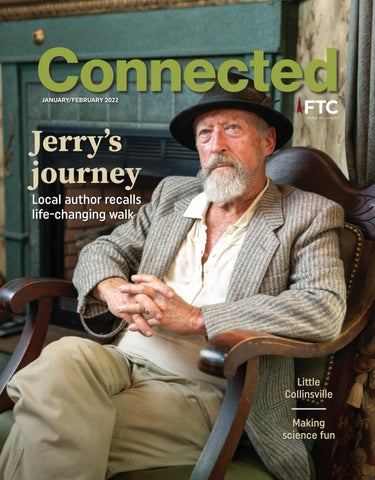
On the Cover: Jerry Ellis published the account of his journey on the Trail of Tears in his Pulitzer-nominated book, Walking the Trail. See story Page 8.
FTC NEWS
Participating schools earn 50 cents for each old FTC phone book collected.
KEEP THE TRADITION GROWING!
Collect old FTC phone books Earn money for your school Keep books out of the landfills Participating schools will earn 50 cents for each old phone book collected! Other phone directories can be dropped off for recycling, but only FTC phone books will earn money for your school. Take books to the school of your choice. The last day to drop off phone books is March 4, 2022.
EVERYONE CAN PITCH IN AND HELP! FTC proudly sponsors this recycling project that keeps tons of waste out of our landfills and helps schools earn money.
Drop off old FTC phone books to any of these participating schools Bryant Cornerstone Christian Academy Crossville DeKalb County Special Services Center at Fyffe Dutton
In the next issue of Connected, we will share how this dream to serve all of our members and customers with a 100% fiber network has become a reality!
Farmers Telecommunications Cooperative
Mountain View Christian Academy North Sand Mountain Pisgah Plainview Rosalie Sylvania
FCC pauses phaseout of Lifeline voice-only support
We did it!
FTC’s goal to build our optical fiber network to every member in our cooperative territory has come full circle.
Flat Rock Floral Crest Fort Payne Fyffe Geraldine Henagar Ider
100%
The Wireline Competition Bureau of the Federal Communications Commission in November paused the phase-out of voice-only Lifeline support, which was scheduled to be eliminated on Dec. 1, 2021. The basic Lifeline support remains available to eligible consumers who subscribe to voice-only service until Dec. 1, 2022. January/February 2022 | 5
TRAVEL
Ancient treasures
Museums showcase geologic adventures
E
Story by ANNE BRALY
ntertaining kids while traveling isn’t easy. But there are places just a smidge off the beaten track, outside the glitz and glamour of big cities, that will spark your child’s interest. Here are some spots around the South that mix history and science in fun and interesting ways.
Falls of the Ohio State Park Clarksville, Indiana Jump over the Kentucky state line into Indiana and hike across one of the world’s most accessible Devonian-age fossil beds. The 390-million-year-old fossil beds are among the largest exposed Devonian beds in the world. The park features a spectacular interpretive center, which features interactive, immersive exhibits. While fossil collecting is prohibited on the beds and river bank, the park staff encourages visitors to explore and discover the many different fossils that can be found on the ancient sea bottom. And you can collect from rock piles 6 | January/February 2022
with fossils from the quarries behind the interpretive center, which is open Monday through Saturday 9 a.m. to 5 p.m. and Sunday 1 to 5 p.m. The park grounds are open 7 a.m. to 11 p.m. Fishing, hiking, fossil viewing, bird watching and picnicking are among the most popular activities. Admission is $9 for ages 12 and up, $7 for ages 5 to 11, and under 5 is free. Parking is $2. For more information, visit fallsoftheohio.org.
Coon Creek Science Center Adamsville, Tennessee Tennessee was once home to giant mosasaurs, sharks, crabs and clams when
the Gulf of Mexico spread its waters across the Volunteer State. Fossils of these early inhabitants reside at Coon Creek in rural McNairy County, one of the most important fossil sites in North America. The Coon Creek Science Center is a great place for kids to visit and discover some amazing things. There are hands-on displays and activities, which allow them to learn through experiments in which they use their senses while having fun. There’s a treasure trove of artifacts on display, so allow enough time to see everything. To learn more, visit memphismuseums.org.
Children learn about the dynamics of science in the Discovery Lab, one of several exhibits at the Hands On Children’s Museum. At right, children can play while learning about science and discovery in the museum’s Scheu Family Exhibit Hall & Art Studio in the General Shale Learning Center.
Folly Beach, South Carolina Finding shark teeth on Folly Beach is a great way to learn about the giants that once roamed the seas — and the many that continue to do so — and Folly Beach is one of the best places to find their teeth and learn how to identify all the different species. Wade into the water and start your hunt, sifting through the sand with special tools for shark teeth — maybe even one from a megladon. For more information, or to book a tour, visit chsfossiladventures.com.
Cook Museum of Natural Science Decatur, Alabama Kids can learn all about the birds, the bees, the flowers and the trees and more by spending a day in Decatur at the Cook Museum of Natural Science, a museum that began with a small collection of insects from John Cook, the founder of Cook’s Pest Control. It’s now grown into a state-of-the-art museum with numerous exhibits including cave systems, the weather, outer space, rivers and streams, oceans and forests and more, including — yes — insects. Many exhibits include hands-on elements to keep kids busy and entertained. Log onto cookmuseum.org for more information and tickets.
Gray Fossil Site Gray, Tennessee There was a time — some 5 million years ago — when small horses, mastodons, alligators, tapirs, rhinoceros, camels, saber-toothed tigers and other creatures roamed the hills and meadows
— sometimes peacefully, others not — around the South. And one of their favorite gathering places was a watering hole in what would become Gray, Tennessee, outside Johnson City. Fast forward a few million years, and today, paleontologists are unearthing a massive amount of bones at the Gray Fossil Site. Experts say they could dig for another 100 years and still not find everything that lies beneath. Now, kids, parents, grandparents and others can come and see what paleontologists have found and learn so much more in the neighboring Hands On! Discovery Center. “The fossil site itself offers an up-close experience where children of all ages can see an active dig site,” says Andy Marquette, the Discovery Center’s president and CEO. “They can come within inches of giant fossils and learn about the process from finding a fossil to putting it in collections.”
Hands On! Discovery Center Johnson City, Tennessee The center grew from a small children’s museum in downtown Johnson City to what it is today: a beautiful, new building with numerous interactive exhibits like the “dig pit” in the Paleo Hall where visitors can dig for themselves and see what actual paleontologists experience. Life-size replica skeletons of many of the creatures that once called the Gray Fossil Site home now surround the hall. In addition to the paleo exhibits, the Main Exhibit Hall is the place where kids can make their own air rockets and air cars
If you go » Where: Hands On! Discover Center and Gray Fossil Site, 1212 Suncrest Dr., Gray, Tenn. » Hours: 10 a.m. to 5 p.m. Tuesday through Saturday; 1-5 p.m. Sunday. Also, open on Mondays from 10 a.m. to 5 p.m. during March, June, and July only. » Information: visithandson.org or 423-434-4263.
and see how fast these creations can go or spend time at the Bernoulli table while exploring the science of how objects are able to fly. They’ll be having so much fun they may not realize they’re learning many of the same things about energy that they learn in school, says the center’s Director of Operations Keith Maultbay. “It makes science fun,” he says. The second floor of Hands On! Discovery Center is all about the dig. Large glass windows allow views of the paleontologists at work, piecing together the intricate bones of a massive mastodon discovered in the center’s backyard several years ago. Also on view in the collection room are more bones and tusks. Buy a ticket and take a paleo tour of the dig site. Another ticket gets you into the Tesla Theater to witness an electrifying, Guinness record-holding experience that honors the great inventor Nikola Tesla. Watch in amazement as the world’s most powerful, musical, bi-polar Tesla coil turns 240 volts into 200,000 volts of pure electricity. January/February 2022 | 7
‘Walking the Trail’ Jerry Ellis celebrates 30 years since the journey that changed his life Story by LISA SAVAGE Photography by MELISSA GAINES
A
Jerry Ellis released the 30th-anniversary edition of “Walking the Trail.” 8 | January/February 2022
s the hot afternoon sun bore down, Jerry Ellis stopped to rest underneath a shade tree. He took off his shoes and socks and rubbed his aching, blistered feet. The 41-year-old, only hours into his walk on the Trail of Tears in September 1989, already felt exhausted. He wondered what he had gotten himself into and even debated whether he could go on. Sitting there hurting and discouraged, he heard a crow’s loud caw. Jerry’s grandfather had taught him when he was a youngster to call crows with his hands and to pay attention to the alerts of the birds. “When I heard that crow, I had the feeling that my grandfather was with me,” Jerry says. Jerry walked the Trail of Tears in reverse from Oklahoma to his home in Fort Payne over the next two months, pitching a tent most nights and walking during the day. The Trail of Tears represents the route used to remove the Cherokee and other Native American tribes from their homelands in 1838. “I was the first person in the modern world to walk the 900-mile route of the Cherokee Trail of Tears,” he says. And those two months on the trail changed his life. Within six months of the walk, Jerry wrote the Pulitzer-nominated book “Walking the Trail: One Man’s Journey Along the Cherokee Trail of Tears.” It sold in two weeks to Random House, and he released the book’s 30th-anniversary edition last year. He’s now working with John Behring, a renowned television director and producer, as he writes a screenplay based on his account. Farmers Telecommunications Cooperative
AT HOME Nowadays, the author of 10 books spends most of his time at Tanager House, the Fort Payne home and retreat he and his late wife built on a ridge near the base of Sand Mountain. He also visits Rome, Italy, in the spring and fall. But it’s at his Alabama home where he feels such a connection to his Cherokee heritage. His great-grandmother, a Cherokee, was born in 1836, and their family arrived in the Sulphur Springs area in 1837. Jerry was born in Fort Payne, and he and his family lived at the bottom of the hill where he now resides. When he was 5, his grandfather gave him his first arrowhead. He left home at age 17 and hitchhiked to New York City to stay with his sister, Sandra Lafferty, whose career as an actress had taken her far from home. After hitchhiking back and forth across the country for a few years, Jerry became a student at the University of Alabama, studying English and history. He obtained a bachelor’s degree there in 1970 and then took graduate classes in Oklahoma. He worked as a screenwriter in the entertainment industry in Hollywood, but his wanderlust eventually took him all over the country to cities like Chicago, Oklahoma City and New Orleans. As he sat in a small, one-room apartment in Los Angeles he had an epiphany. “I knew I must walk the Trail of Tears,” he says. He sold everything he owned and put together about $800 to finance his trip. He prepared for weeks for the physical challenges before him. Farmers Telecommunications Cooperative
Once he arrived in Oklahoma, a man gave him a ride from Muskogee to Tahlequah, and he woke up on a cool September morning, excited to start his journey. But the cool morning quickly turned to a scorching hot day, and that’s when Jerry encountered the crow and felt he was not alone. During his two-month walk, he met several people along the way — many of whom were of Cherokee descent. They opened up, sharing with him their experiences, which became part of his story.
TURNING POINT Jerry detailed his journey through the written word, looking back on the experience that had become a turning point in his life. “Walking the trail renewed my faith in a higher power and in humanity. For me, I honored my ancestors and redeemed myself for things I’ve done in my life,” he says. “I felt like it was my destiny.” Success as a writer has taken Jerry to six continents for lectures about the Trail of Tears book and the Cherokee, and he hosts a writing institute each year. At one of his lectures, at a seminar at Denver Publication Institute, he met his wife. They were together 28 years before her death two years ago. In 2001, the couple designed and built Tanager House, named for the songbird. Jerry also hosts an artist retreat each year at Tanager House on 60 wooded acres, and he leads workshops on writing, publishing and spirituality. The Italian-inspired home reflects the couple’s interests — it’s
filled with ornate carvings, a fountain and art they collected from all over the world. His home may seem remote to some, but it’s conveniently located near town. FTC extended service in that area recently, and having access to fiber internet makes communication much easier. Jerry continues to write and can do much of his research and search for information about his own ancestry while exchanging large files with publishers, producers or directors. “Having fiber internet has made a huge difference for me,” he says. “I can still live in an area I love while having connectivity to the rest of the world.”
Books by Jerry Ell
is include:
Walking the Trai l: One Man’s Journe y Along the Cherokee Trail of Tears On the Trail of the Pony Express Marching Throug h Georgia: My Walk Along Sherman’s Ro ute Walking to Cant erbury: A Modern Journey Through Ch aucer’s Medieval England Ciao From Rom a! Spring in the Et ernal City of Love with Pa olo Canova Cherokee Histor y for Indian Lovers Two Wolves: A Ch erokee’s Journey to Feed the Sacred On e Copies are availabl e online. Autograp hed copies are availabl e locally at the Mentone Cultural Center and at the Depot Museum in Fort Payne.
January/February 2022 | 9
Locator apps Connected for safety and security
W
ith the help of a locator app on a mobile phone, parents can be aware of just about anywhere their family members roam — assuming families have reviewed and accepted the app’s policies. While some might find this concept intrusive, these apps can be helpful for busy schedules or a comfort during troubling times, late nights or long trips. Here are a few of the top locator apps on the market and what they can do.
WWLife360 The premium version of Life360 can tell you where your family members’ phones are at any given moment. Notifications
about events like a child arriving at school are easy to receive.
WWGlympse The free Glympse app lets friends and loved ones know your travel status, so you never have to worry if you’re running late. They’ll know. Users can send a Glympse alert to anyone with a web-enabled device.
WWiSharing Know where your friend or family member is at any moment. The iSharing app provides real-time alerts when someone leaves home, work or school. In-app messaging is just one of the features, some of which are only available in the premium version.
CONSUMER FINANCIAL PROTECTION BUREAU The role of the CFPB, which Congress established in 2010, is to hold financial institutions accountable for following federal financial laws and to protect and educate consumers. The bureau’s website, consumerfinance.gov, has a section dedicated to youth financial literacy and offers more than 200 educational activities designed for kids of all ages. The list of topics is extensive and includes entrepreneurship, budgeting, managing credit and preventing fraud and identity theft.
FAMZOO
Money wise
Financial education with digital tools
F
ewer than half of U.S. states require students to complete personal finance education, although there have been recent efforts in many states to focus on this form of education. There is, however, a wealth of online resources and apps to help parents teach children to safely navigate the financial seas. Here are a few of the sites and apps available to parents looking to teach their kids real-world money lessons:
10 | January/February 2022
FamZoo is a comprehensive finance app for families. It creates a virtual family bank with parents in the banker’s seat. Through the app, parents can pay their children’s allowances, track their spending and savings and even encourage charitable giving. FamZoo isn’t free — the cost ranges between $2.50 and $5.99 a month depending on which option you choose. One- and twomonth free trials are available at famzoo.com.
GOHENRY GoHenry, aimed at kids as young as 6 years old, provides parents with a prepaid debit card for their children and an app the whole family can use to keep track of spending, savings and progress toward financial goals. GoHenry offers a one-month free trial, after which, the service charges a monthly fee of $3.99 per child. For more information, visit gohenry.com.
Which
MUSIC STREAMING SERVICE
is right for you?
I
t’s never been easier to discover a new favorite band or find that hidden gem of a song you can’t stop playing on repeat. A wealth of music streaming apps boast exhaustive libraries, classic hits and new buried treasures all at your fingertips. Whether you’re looking for crystal clear audio, curated playlists or a soundtrack to keep up with your runs, there’s something for everyone if you know where to look.
SPOTIFY Spotify is synonymous with music streaming for a reason. Its interface is easy to navigate and always has new recommendations based on what you’re already listening to. If you have friends on the service, you can share your listening activity and see what others are playing from Spotify’s library of 70 million tracks. Audio quality, on the other hand, varies based on your account. Free users can stream at decent qualities if they’re listening on standard headphones or a Bluetooth speaker. Premium users can stream at higher quality for $10 a month, and Spotify has announced plans to roll out a hi-fi tier with lossless audio quality in the future.
APPLE MUSIC Apple Music’s social options are similar to what you’ll find on Spotify, even if there are fewer curated options for discovering new favorites. But the real selling point is audio quality.
Audiophiles can enjoy lossless tracks at the base tier of $10 a month with about 20 million tracks currently available at the highest quality. Apple says the rest of its 70 million-plus track library will be available in that format by the end of the year.
TIDAL TIDAL used to have the crown when it came to lossless audio, but at $20 a month it’s now a tough sell against other more affordable options. If you can’t wait for Apple Music to update its library, TIDAL’s catalog is already fully available in lossless format, with a few even streaming at “Master” quality up to 9,216 Kbps. And while TIDAL may have made its name with major hip-hop artists, the genres available now are about as diverse as other top streaming apps.
AMAZON MUSIC The biggest benefit of Amazon’s music service is that it’s already available to anyone with a Prime subscription. But that may not get you as much as you think. Despite having access to more than 75 million tracks, ad-free tier users may notice certain albums and artists are off-limits without a paid subscription. At least that buys you access to lossless audio, but if you’re looking for easy access and discoverability, there are probably better options.
WHAT IS LOSSLESS AUDIO? Most music streaming services compress audio files to save space. That means some data has to be discarded, and audio quality suffers. Lossless audio still compresses these files but retains all the details of the original audio recording. You can hear the difference most often in frequencies like those from the crash of a cymbal in a rock song or the bass of a hip-hop track. Higher-quality audio tracks are also much larger than lossy audio formats. So make sure you have the necessary data coverage if you’re streaming on the go and adequate bandwidth if you’re listening over the internet at home.
January/February 2022 | 11
Gail and Charles Moore crafted a small-scale model of Collinsville, and the display lights up at night to create a dramatic scene.
A little piece of history Collinsville couple creates small replica of their hometown Story by LISA SAVAGE | Photography by MELISSA GAINES
G
rowing up in Collinsville in the 1940s, Gail Moore remembers watching from the upstairs window of her family’s apartment as travelers got on and off the Greyhound bus at the gas station next door. Her family, the Joneses, lived in an apartment above the funeral home, and the bus stopped at the gas station to load and unload passengers. The Greyhound Lines went through Collinsville, and a bus stopped usually every hour on the route from Birmingham to Chattanooga. “They sold tickets for the bus at the funeral home,” Gail recalls. “There usually was only about one or two funerals a year, because most people were taken home for viewing and funerals.” Just down the street from the bus stop, taxi driver Charlie Roden usually sat on a bench in front of Traffanstedt’s Meats and Groceries, waiting on his next fare.
12 | January/February 2022
A telephone was in a small cubby, which was in a space just big enough for him to sit on cold or rainy days. For 25 cents a mile, he delivered groceries from the store and merchandise from other businesses. “He was well known in the community for years, and everybody loved Charlie. He died in 1975,” says Gail’s husband, Charles.
COLLINSVILLE’S STORY Gail and Charles, married 63 years, share the stories from those days long ago as they conduct a tour of Little Collinsville, a small-scale replica on display in a building at their home not far from downtown. Much of the history and details come from the couple’s own memories — they both grew up in Collinsville and graduated from Collinsville High School in 1958.
With Charles’ woodworking skills — he’s won blue ribbons at the DeKalb County VFW Agricultural Fair — and Gail’s knowledge of local history, the couple collaborated to create the replica of Collinsville’s Main Street from the 1930s through 1950s. Gail collected more than 100 black and white photos from that era. With those photographs for reference, Charles built a replica of each business and structure, down to the smallest details. Made from cedar trees he cut from their land and sawed into small pieces, each replica depicts the actual building as closely as possible, down to working knobs on doors that open and close, the ornate brick trim of the buildings and the glass windows on the storefronts. Charles used a 1-inch scale, with 30 inches representing 30 feet of the actual Farmers Telecommunications Cooperative
structures. Displayed alongside each replica is the photograph of the original building, and most of the photos show a flurry of activity. The couple even sought miniatures of vehicles of the same make and models in the photos and have those in front of each business in the display. Gail got a copy of the town’s letterhead and used it to create the emblem on a replica of the police car. In those days, the Oliver Hall Co. touted itself as the largest store of its kind in Alabama, and it may have well been. The store sold a little bit of everything and attracted visitors by train, bus and car, especially on Saturdays. Oliver Hall’s store also first hosted Turkey Trot, an event that’s become a major part of Collinsville’s heritage.
The Moores created a replica of their hometown, including the Cricket Theater and Clock Tower. The collection is on display at their home in Collinsville.
DEKALB’S OLDEST TOWN Established in 1887, Collinsville is DeKalb County’s oldest town. Fire destroyed the town in 1900, and the replicas depict the structures the town rebuilt after that. The city’s clock tower, which once sat atop the historic Cricket Theater built in 1946, was the focus of Charles’ first replica project. When the clock no longer worked, the town took it down. It later underwent a complete restoration. Charles built a replica of the tower for the fundraising efforts to save it. He also built a replica of the Cricket Theater with the clock tower on top, and it was on display in Montgomery. Next came a replica of the library as fundraising efforts were underway to move the library to Main Street. “I didn’t plan on doing all of Collinsville, but once I got started, I couldn’t stop,” Charles says. Each replica not only looks like the original structure on the outside, but the inside is decorated with tiny tables, chairs, sacks of potatoes, other food items and whatever represents that particular building. For example, Charles used his saw to cut up an old Reader’s Digest to use for books on the library shelves, and the Moores’ daughter painted toothpicks to Farmers Telecommunications Cooperative
resemble pencils. They bought some items at craft stores, and on Saturday visits to Trade Day, Charles bought and collected things he thought might work in the display.
TOURS In all, the Moores have about 30 structures in the display and offer tours upon request. The scene depicts a town bustling with activity and businesses, but many of those businesses closed over the years, and some of the town’s business activity moved out by the interstate. Little Collinsville’s downtown looks quite a bit different from today’s downtown. Cricket Theater, which the Collinsville Historical Association now owns, still stands on Main Street. But the clock, for many years a symbol of Collinsville, is currently on display at the Museum of Collinsville History downtown. Fourth graders at Collinsville usually tour the exhibit each year as part of their study of Alabama history. “I think it’s important for the students to learn about our little town,” Gail says. “We are the oldest town in DeKalb County, and we’re rich in history.”
W WFor information about tours of
Little Collinsville, call the Moores at 256-524-2593. January/February 2022 | 13
SOUTHERN KITCHENS
ROUX
the day
14 | January/February 2022
of so many dishes, roux becomes a chameleon. It can change from brown to red and to black. The longer the roux cooks, the darker and more intensely flavored it gets. Cooking the roux has two main benefits. First, it gets rid of the raw, starchy flavor of the flour. Second — and this is with darker roux — it adds color to a dish. White and blond roux are used for light-colored sauces, such as cheese sauce and bechamel. Brown roux is used for darker sauces, such as stews and gravies. Here is a recipe for basic roux. Add milk and shredded cheese for a lovely cheese sauce for vegetables. Or, use roux as the foundation for gumbo or mac and cheese. It’s a versatile concoction that’s an important step in making so many good foods.
FOOD EDITOR ANNE P. BRALY IS A NATIVE OF CHATTANOOGA, TENNESSEE.
1 1/2
stick (8 tablespoons) unsalted butter or 1/2 cup peanut oil cup flour
In a large pot or skillet, warm the butter or peanut oil to medium heat and then stir in the flour. Cook for 10 minutes, constantly stirring, to make a lightly browned roux, or continue stirring and cooking for up to 30 minutes for a dark roux. The roux will darken as you stir, from very light brown to copper or peanut butter brown, then to light chocolate brown, then dark chocolate brown and then very, very dark brown.
© deniskarpenkov/Adobe Stock
I
t’s a given that pretty much everything is improved by the addition of a sauce. That’s why we put mustard on hot dogs and ketchup on fries. Good sauces cling to food, which means they need body. There are many ways to achieve this, including making a roux, the foundation for wonderful sauces for meats, fish, poultry and vegetables. But it’s also the beginning of many pots of gumbo, and roux is the underpinning for unbelievably creamy Creole dishes. Roux is nothing more than equal parts of butter or oil and flour. The addition of warm liquid, whether water, stock or milk, works to swell the small granules of flour, which trap the liquid to thicken the roux. Careful though — one of the most important things to remember when making a roux is to avoid adding the flour to a hot liquid. The result is something every cook dreads: a lumpy sauce. In French cuisine, roux is cooked to one of three stages: white, blond or brown. In New Orleans, where roux is the beginning
BASIC ROUX
SEAFOOD GUMBO 1 recipe basic roux (dark brown) Vegetables: 1 tablespoon butter 1 cup chopped celery 1 cup chopped green onions 1 green bell pepper, chopped Tomato sauce: 6 cups water 1 (8-ounce) can tomato sauce 2 tablespoons Worcestershire sauce 2 cloves garlic, minced 2 teaspoons salt, or to taste 1 teaspoon hot pepper sauce, or to taste 1/2 teaspoon dried thyme Seafood and okra: 1 pound fresh or frozen chopped okra 1 pound white fish such as catfish, cut into 2-inch pieces 1 1/2 pounds peeled and deveined shrimp Final seasonings: 1 tablespoon gumbo file powder, or to taste 1/2 teaspoon salt, or to taste
In a large pot, make a basic roux, allowing it to cook to a dark brown stage. In a separate skillet, melt the tablespoon of butter over medium heat. Add and stir the celery, green onions and bell pepper, cooking until tender, about 10 minutes. Add the cooked vegetables to the pot with the roux. Stir the water, tomato sauce, Worcestershire sauce, garlic, salt, hot pepper sauce and thyme into the vegetable mixture. Bring the mixture to a gentle boil, reduce heat to medium low and simmer for 1 hour. Stir okra into the vegetable mixture and cook it until tender, about 15 minutes. Add the fish, stir gently, and cook it until the flesh is easily flaked with a fork, about 5 minutes. Gently stir shrimp into the mixture and cook until the shrimp are bright pink, about 3 minutes. Season with the file powder and more salt; stir. Makes about 8 servings. ©Mark Gilliand
THREE-CHEESE MAC AND CHEESE With Bechamel Sauce 1/3 cup butter 1 shallot, finely chopped 3 cloves garlic minced 1/4 cup all-purpose flour 1 1/2 tablespoon cornstarch 2+ cups whole milk 1 cup heavy whipping cream 1/4 teaspoon white pepper 1/4 teaspoon cayenne pepper 1/8 teaspoon dry mustard, preferably Colman’s 8 ounces Gruyere cheese, shredded 6 ounces sharp white cheddar cheese, shredded 2 ounces Monterey Jack cheese, shredded 1/2 tablespoon salt 2 pounds macaroni, cooked
Melt the butter and saute the shallot, then whisk in the flour and cornstarch to a thick paste. This is your roux. Cook the roux on medium-low heat until it is light brown. Add the milk and cream and cook it, stirring, until the sauce comes to a simmer. Remove from heat and keep stirring about 4 minutes. The sauce will thicken as it cools. This is your bechamel sauce. To the sauce, add and stir in the white pepper, cayenne pepper and dry mustard. Test the temperature with your finger. If it’s too hot to touch, let it cool longer. If it’s just uncomfortably warm, it’s the perfect time to add the cheeses in stages, stirring constantly. Add extra milk if it’s too thick. Taste the sauce, and add salt if it’s needed. Pour the sauce over the cooked and drained pasta and stir. Serve immediately. Makes 12-14 servings. January/February 2022 | 15
P.O. Box 217 • 144 McCurdy Ave. N. Rainsville, AL 35986
INVESTING IN OUR FUTURE! EARN A SCHOLARSHIP FROM FTC! y FTC will award one $3,000 scholarship to a deserving high school senior. y FTC will award one $3,000 scholarship to a student already enrolled in college or vocational-technical school.
FOUNDATION FOR RURAL SERVICE YOUTH TOUR
y Applicants must live in the FTC service area, and their legal guardian/parents or applicant must be an FTC customer.
High school students could win an all-expense paid trip to Washington, D.C. for the Foundation For Rural Service Youth Tour June 1-5, 2022.
y Applications are available through area guidance counselors and at farmerstel.com/scholarships.
y Students must be in high school, age 16 or 17, at the time of the tour to qualify.*
y Completed applications must be received at FTC’s business office no later than 4 p.m. on March 4, 2022.
y Applications are available through area guidance counselors and at farmerstel.com/ scholarships.
FRS SCHOLARSHIP ALSO AVAILABLE! y This year, these applications are being accepted online. Students will need to follow these directions for submitting applications: www.frs.org/programs/youth-programs/ scholarships/faqs y Students are required to create an NTCA account to submit an application. They will need to select Farmers Telecommunications Cooperative (Rainsville, AL) as their NTCA sponsoring company in the employer field.
y Applicants must live in the FTC service area, and their legal guardian/parent must be an FTC customer. y Completed applications must be received at FTC’s business office by March 4, 2022. * All students and chaperones of the 2022 FRS Youth Tour will be required to show proof of Covid-19 vaccination.
y These applications must be submitted online no later than March 4, 2022.
144 McCurdy Ave. N. • Rainsville, AL • 866-638-2144 • www.farmerstel.com FOLLOW US ON SOCIAL MEDIA: @farmerstel