Network COMMUNITY
JULY/AUGUST 2021
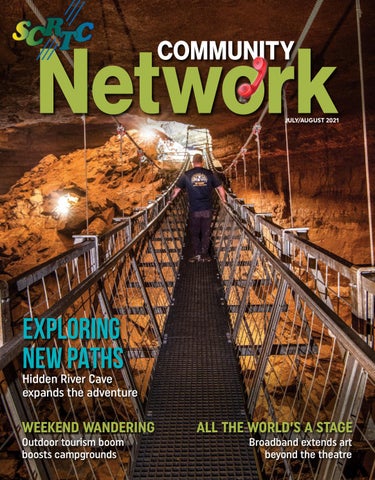
EXPLORING NEW PATHS
Hidden River Cave expands the adventure
WEEKEND WANDERING Outdoor tourism boom boosts campgrounds
ALL THE WORLD’S A STAGE Broadband extends art beyond the theatre
INDUSTRY NEWS
Rural Connections By SHIRLEY BLOOMFIELD, CEO NTCA–The Rural Broadband Association
Partnering to fend off cyberattacks
I
n recent years, we’ve learned even the biggest of corporations, including Microsoft, Target and Marriott, are vulnerable to cyberattack. Then, last year, the pandemic increased the number of remote workers, moving more technology from the office into homes. “The pandemic gave cybercriminals the opportunity to discover new malware families, successful new tactics and ‘double extortion’ strategies,” says Roxanna Barboza, our Industry and Cybersecurity Policy analyst. “And since then, they have further honed their skills to exploit fear, gather intelligence and attack.” If this sounds like the trailer for a horror film you have no interest in seeing, I promise you, the possible impacts of a cyber breach are much more frightening. So, NTCA-The Rural Broadband Association is working to support the security efforts of internet service providers such as yours. NTCA initiated CyberShare: The Small Broadband Provider Information Sharing and Analysis Center as a pilot project five years ago. We now have a robust team focused on the critical topic of cybersecurity, and NTCA members are encouraged to join the effort to recognize, analyze and respond to vulnerabilities, threats and other risks. Also, CyberShare partnerships link us to the owners and operators of critical infrastructure like electric and water systems. More than 90% of CyberShare participants say the information received through the program enhances their ability to combat cyber threats. It is through programs like CyberShare that we help organizations like your service provider protect consumers by creating a safe, secure digital experience.
2 | July/August 2021
TIPS FOR SECURE ONLINE SHOPPING
C
onvenience and a seemingly endless supply of options drives online shopping, which is safe as long as you take a few straightforward precautions. The Cybersecurity & Infrastructure Security Agency offers a few straightforward tips to ensure that no one uses your personal or financial information for their gain.
THE THREATS 1. Unlike visiting a physical store, shopping online opens the doors to threats like malicious websites or bogus email messages. Some might appear as charities, particularly after a natural disaster or during the holidays. 2. Vendors who do not properly secure — encrypt — their online systems may allow an attacker to intercept your information. 3. If your digital device and the vendor’s systems aren’t properly updated and protected, the risk increases.
PROTECT YOURSELF • Before providing any personal or financial information, make sure that you are interacting with a reputable, established vendor. In case of trouble, note phone numbers and physical addresses of vendors. • When shopping, check the address bar of your web browser to be sure the address begins with “https:” instead of “http:” and that it has a padlock icon. These generally indicate a secure site. • Remember, a legitimate business will not use email to request account information or ask you to confirm a purchase. • Use a credit card for purchases, which limits your liability for fraudulent charges. Debit cards do not have the same level of protection. • Keep a record of your purchases and copies of confirmation pages, and compare them to your bank statements. Report discrepancies immediately. • Before providing personal or financial information, check the website’s privacy policy to understand the storage and use of your information.
Summer reading on the go
B
efore you jump online to order your top picks to round out summer reading, you might consider tapping into what could become your own personal librarian. And you might even keep more money in your pocket. Most libraries offer free digital resources. So, all you need is a library card, an internet connection and a digital device. Here are a few other resources that could make the digital literary journey for you or the young reader in your family much easier.
OVERDRIVE:
SORA:
Most libraries buy the digital licenses to book titles they think you would enjoy. Then, you can use your library card to reserve those free e-books. OverDrive can work with apps like Libby so you can send your e-book to a Kindle or other reading device. overdrive.com
OverDrive’s educational reading app offers students access to e-books and audiobooks in multiple languages through participating school and local libraries. The app allows teachers to track the amount of time students spend reading. Sora makes notes as students read and can share those notes with teachers and classmates. meet.soraapp.com
LIBRARY EXTENSION: If you’re crunched for time and enjoy browsing for digital books, Library Extension offers a free browser plug-in so you can see your library’s digital book offerings while skimming titles on sites such as Amazon.com. libraryextension.com
PROJECT GUTENBERG: The oldest digital library features some of the world’s most popular classic literary titles. With more than 60,000 e-books to browse, you can read your favorites online or download them to your device. gutenberg.org
TUMBLEBOOKLIBRARY: This interactive reading program takes existing picture books and turns them into talking, animated e-books. It also offers read-along chapter books. And another neat feature is that each book is offered in English, Spanish and French. Many school and public libraries offer the service to students or card holders. There’s also a new TumbleBooks app. tumblebooks.com
SCHOLASTIC SUMMER READING: If your child needs a more structured summer reading experience, then you might want to check out the Scholastic Summer Reading Program. While mostly web based, it also offers some e-books. You’ll have to create a Home Base account for your child through Scholastic. Home Base is a free, kid-safe, online digital community that offers fun reading-related activities. scholastic.com/site/summer/home.html
NOOK: The Nook app is another option for finding free e-books for children. Just download it in the app store and look for the “Explore Kids” section. You can scroll through a range of topics to find free digital copies for download.
July/August 2021 | 3
FROM THE GENERAL MANAGER
Uniquely rural
Robust internet service helps us keep pace
I
’d like to ask a favor of you. The next time you’re driving through our community, take a few moments to reflect on this place we call home. If you’re like me, you appreciate the breathing room we have, the natural beauty that surrounds us, our unique small towns and the possibility you might be able to really get to know your neighbors.
Much of this nation isn’t so fortunate. In fact, our lifestyle is increasingly rare. About 83% of our nation’s residents live in urban areas. That’s up from roughly 64% in 1950, according to a 2020 report by the University of Michigan’s Center for Sustainable Systems. If the projections prove correct, by 2050, nearly 90% of the nation will live in communities considered urban. What does that mean for places like ours? In many ways, not much. Our way of life is tried, true and much loved. We know who we are and why we live here, and most of us wouldn’t have it any JEFF EATON other way. General Manager There is positive news, too. A couple of years ago, the National Conference of State Legislatures noted an uptick in rural population. There was an increase of 33,000 residents for the entire nation. It was a positive sign but not overly inspiring. While the pandemic has some wondering if more people would consider leaving densely populated cities for places like ours, that is a story that will require the next several years to play out. Meanwhile, we can’t ignore the trends that seem to indicate our way of living is increasingly rare. After all, the money usually goes where the people are. Federal and state governments gauge the population to determine where to invest in infrastructure. Private businesses look at demographics to decide where to locate stores, restaurants and more. Where there are jobs, there is growth. So, we need every tool possible to balance the scales, and it’s here where we are not only making up ground but where we also have the potential to excel. The foundation of that success is built on the people you see around you as you travel the local roads, enjoy a picnic, pick up groceries … those day-in and day-out moments of life. How do I know this? Well, we’re already well down the road. This community makes a company like ours possible. Our one mission is to provide communications services to connect you not only to your neighbors but also to the world. We don’t serve a corporate board of directors hundreds, or thousands, of miles away. Instead, we answer to you. That’s why we’ve focused on offering internet services, which form a bridge between you and a world of opportunities that rural areas simply never enjoyed until now. It’s a system you may well not notice as you drive along our roads. But it’s there. And its presence is reflected in the success and happiness of those you know because we’re doing what we’ve always done, which is working together to build a better home. As you enjoy these long summer days, please do take a few minutes to reflect on all we have. Everyone is not so lucky.
4 | July/August 2021
Network COMMUNITY
JULY/AUGUST 2021
VOL. 6, NO. 4
The SCRTC Community Network is a bimonthly newsletter published by South Central Rural Telecommunications Cooperative © 2021. It is distributed without charge to all customers of the cooperative. South Central Rural Telecommunications Cooperative is a member-owned corporation dedicated to delivering advanced telecommunications technology to the people of Central Kentucky, including Adair, Allen, Barren, Edmonson, Green, Hart, LaRue, Metcalfe, Monroe and Nelson counties. South Central Rural Telecommunications Cooperative, Inc. 1399 Happy Valley Road • P.O. Box 159 Glasgow, KY 42142-0159 270-678-2111 www.scrtc.com SCRTC BOARD OF TRUSTEES Ralph J. Thompson, District I Bonnieville and Munfordville exchanges Billy Smith, District II Canmer and Horse Cave exchanges Jerry Polson, District III Cave City and Hiseville exchanges Ronnie Tucker, District IV Center, Edmonton and Summer Shade exchanges Kevin Bradshaw, District V Glasgow and Temple Hill exchanges Zack Kender, District VI Fountain Run, Gamaliel and Lucas exchanges Robert E. Thompson, District VII Buffalo and Magnolia exchanges Jeff Eaton General Manager Bobby H. Richardson Attorney Produced for SCRTC by:
On the Cover: Hidden River Cave installed elevated walkways and a 100foot long swinging bridge to provide new adventures. See story Page 12.
SCRTC NEWS
Employee Spotlight Johnny Wheeler, who has worked at SCRTC for 14 years, is the General Services Supervisor. He enjoys working with employees in various departments. He and his wife, Angela, have a 13-year-old daughter and a 6-year-old son. He enjoys spending time with his family, working on old trucks and going on off-roading adventures. Tim Bunnell, who has worked more than 20 years with SCRTC, is now the warehouse agent. He enjoys helping people. He married his wife, Rita, 31 years ago. They enjoy training border collies, and his favorite series is “Yellowstone.” As a part-time farmer, he often checks weather apps to know what tomorrow holds.
Make bill paying easier. Save time for more important things. • Pay by phone at 1-844-262-2428. • Download the SmarHub Phone App and pay online or from your phone. https://scrtc.smarthub.coop/Login.html
Take it easy this
SUMMER
Wishing everyone a safe and happy July Fourth holiday. Our offices will be closed July 5, for the holiday weekend.
South Central Rural Telecommunications Cooperative
Statement of Nondiscrimination In accordance with the Federal civil rights law and U.S. Department of Agriculture (USDA) civil rights regulations and policies, the USDA, its Agencies, offices, and employees, and institutions participating in or administering USDA programs are prohibited from discriminating based on race, color, national origin, religion, sex, gender identity (including gender expression), sexual orientation, disability, age, marital status, family/parental status, income derived from a public assistance program, political beliefs, or reprisal or retaliation for prior civil rights activity, in any program or activity conducted or funded by USDA (not all bases apply to all programs). Remedies and complaint filing deadlines vary by program or incident. Persons with disabilities who require alternative means of communication for program information (e.g., Braille, large print, audiotape, American Sign Language, etc.) should contact the responsible Agency or USDA’s TARGET Center at (202)720-2600 (voice and TTY) or contact USDA through the Federal Relay Service at (800)877-8339. Additionally, program information may be made available in languages other than English. To file a program discrimination complaint, complete the USDA Program Discrimination Complaint Form, AD-3027, found online at https:// www.ascr.usda.gov and at any USDA office or write a letter addressed to USDA and provide in the letter all of the information requested in the form. To request a copy of the complaint form, call (866) 632-9992. Submit your completed form or letter by mail to U.S. Department of Agriculture, Office of the Assistant Secretary for Civil Rights, 1400 Independence Avenue, S.W., Washington, D.C. 20250-9410, by fax (202) 690-7442 or email to program.intake@usda.gov
July/August 2021 | 5
TRAVEL
The exquisite scenery of the Red River Gorge Story by ANNE P. BRALY
C
liffs dominating the skyline, rushing mountain streams and a landscape chiseled by millions of years of wind and water erosion bear witness to the forces of Mother Nature in Kentucky’s Red River Gorge Geological Area. Nestled largely within Daniel Boone National Forest along the Cumberland Plateau, the gorge encompasses 29,000 acres filled with history, wonder, excitement and adventure. Matt Vogt, information assistant at Red River Gorge’s Gladie Visitor Center, has no problem identifying the No. 1 prominent feature of the gorge — the landscape. “It’s the gullies, caves, rock shelters, arches, cliffs and all the natural, rugged, scenic beauty,” he says. “And many are drawn to the gorge’s naturally formed arches.” Vogt says the gorge has up to 150 such arches, the greatest number east of the Rocky Mountains. Red River Gorge is a photographer’s dream, a paddler’s fantasy and a hiker’s paradise. Hidden waterfalls and rock houses — rocky overhangs once used as shelter by native tribes like the Shawnee — are the perfect backdrop for a photo to treasure. The many natural features of the gorge can be found along its 77 miles of trails. Take a short day hike or pack your sleeping bag, food and other essentials and
6 | July/August 2021
make an overnight, or longer, journey out of it as you explore the thousands of acres of hills and valleys. Campers must have permits for overnight stays, along with proper food storage equipment to keep black bears at bay. Swift Camp Creek Trail is a good starting point for extended hikes. Descending from the top of the gorge to the lower areas, it’s a 7-mile trek that follows Swift Camp Creek. The dramatic scenery includes cascading mountain streams rushing through dense stands of rhododendron and, at one point, flowing under one of the gorge’s famous arches.
The Red River Gorge Geological Area is a Kentucky treasure, a place for scenic beauty, relaxation and adventure.
Photo courtesy of Mark Vogt.
GORGE-OUS
For even longer treks, the Sheltowee Trace National Recreation Trail extends 319 miles, starting in Daniel Boone National Forest and ending at Pickett State Park in Jamestown, Tennessee. At peak season the trails may be busy, but on weekdays and during the colder months you may not run into a soul. The quiet is only broken by a deer foraging through the brush or sipping from a nearby stream. But there was a time when the raucous sounds of sawmills echoed through Red River Gorge. Early in the 20th century, loggers harvested its hardwood. Sawmills and logging camps sprang up on the hillsides. Railroads snaked through the valleys, and dams were constructed along the Red River and other tributaries to power the sawmills. It was a massive operation. That is, until the gorge was saved, enveloped in the arms of Daniel Boone National Forest in 1937.
The area also includes Clifty Wilderness, named for its towering cliffs and added to the National Wilderness Preservation System in 1985. The section of the Red River that runs through Clifty Wilderness is a Kentucky Wild River, one of nine such river sections in the Bluegrass State. Adding to the pristine charm are numerous creeks that rush through the canyons of the gorge and empty into the Red River. The Red River’s upper reaches provide Class II and III whitewater canoeing. This Wild Rivers section is generally navigable from December to May, but the Falls of the Red River is a 3-foot drop. Unless you’re an expert canoeist, portage your canoe or kayak around them. Just below the falls is the Narrows of the Red River, which in some places is no more than 6 feet wide and littered with large boulders. This section can also be dangerous when water levels are high. As the Red River continues through the heart of the gorge, it levels out and provides gentle Class I paddling, ideal for beginners.
Points of Interest
Digging the past Archaeologists have found a treasure trove of artifacts that reveal life as it was 13,000 years ago when Native Americans lived in the Red River Gorge, including pottery, seeds and tools. In more modern times, the ruins of moonshine stills dotting the hills have been found.
Photos courtesy of Mark Vogt.
You’ll find Mother Nature at her finest throughout Red River Gorge, but there are a few places where she really shines. b Chimney Top Rock is easy to reach — a short, quarter-mile hike — and provides one of the most beautiful overlooks of the Red River as it passes through the gorge. b Sky Bridge is a mile-long road open to vehicles. It offers several good overlook opportunities. The road ends at a traffic circle and parking lot, where you’ll find good picnic spots and the start of a 1.5-mile hike to the largest arch in the gorge. b The Grays Arch Trail is also very popular and leads to one of the most spectacular arches in the forest. It gets busy in peak season, however. b The Auxier Ridge Trailhead follows a narrow ridgeline where it ends with views of several outstanding rock formations.
July/August 2021 | 7
Visitors at Singing Hills RV Park and Campground can spend the morning fishing at a nearby pond.
‘Wherever you park your rig tonight, that’s home’ Visitors to Kentucky’s cave country can camp in comfort Story by MORGAN SIMMONS
J
eff Lawson is no newcomer to making people happy. Before purchasing Cave Country RV Campground in 2008, he worked as a mechanic and service manager at auto dealerships and later ran an old-fashioned diner in his hometown of Oxford, Pennsylvania. “Whether it’s doing bodywork on someone’s car or serving food to hungry customers, it all comes down to how you treat people,” says the 63-year-old Lawson. “You can’t just say you care about them — you have to prove it.” With 51 pull-through sites, Cave Country RV Campground is laid out for big rigs like 45-foot Class A motorhomes. Most of Lawson’s guests are retirees. The campground receives rave reviews for its well-kept grounds and clean bathrooms, and with the addition of a new swimming pool, Lawson says he expects to be busier than ever this summer. Just a few miles from Cave Country RV Campground is Singing Hills RV Park and Campground, owned by Eldon and Beth Brown. With 26 RV sites, plus six sites reserved for tents and small RVs, Singing Hills is smaller than Cave Country but shares the same formula. “Our philosophy is, ‘Wherever you park your rig tonight, that’s home, and you ought to feel like you’re with friends and family,’” Beth Brown says. Visitors to campgrounds can enjoy a range of recreation options. Most famous is Mammoth Cave National Park, which boasts the longest known cave system in the world and remains open year-round. Diamond Caverns and Crystal Onyx Cave are among the smaller nearby commercial caves. And for families with young children, there’s Kentucky Down Under Adventure Zoo, where visitors can stroll through fields among free-ranging kangaroos and emus.
8 | July/August 2021
CAMPER CONNECTIONS Both campgrounds offer free Wi-Fi to their guests, courtesy of South Central Rural Telephone Cooperative. Brown says a reliable internet connection is a necessity for RV travelers working from the road during the COVID-19 pandemic. “We have a lot of people who have to get on Wi-Fi to do their job,” she says. “We’re also seeing a lot of young parents with children out of school who are doing their homework online.” Lawson says Wi-Fi service is equally important at Cave Country RV Campground. “We can’t afford to lose our internet connection, even for a few days,” he says. “People are working from their motorhomes, and kids are playing computer games. We Americans cannot become unplugged now.” Both campgrounds rely on the internet to take reservations through their websites, cavecountryrv.com and singing hillsrvpark.com.
Eldon and Beth Brown enjoy meeting campers at Singing Hills RV Park and Campground. South Central Rural Telecommunications Cooperative
FROM AFRICA TO CAVE COUNTRY The Browns have been married 41 years. They met in 1979 while Eldon Brown was home on furlough as a missionary in Zambia, in southern Africa. After dating three months they returned to Africa as a married couple. They had their first daughter, Amy, in a bush hospital, where an ophthalmologist who specialized in cataract surgery delivered her. When the couple returned to the U.S. in 1982, Eldon Brown found work as a broadcast engineer. Beth Brown taught school and later had their second daughter, Barbara. Eventually, they decided they wanted to buy a campground. In 2007, after extensive research, they discovered Singing Hills RV Park and Campground in the heart of Kentucky’s cave country. “We wanted to make this place special,” Beth Brown says. “We changed some rules and set about sprucing things up. It was hard work, but we were young, and we enjoyed it.” She keeps records of campground reservations in a three-ring binder. Guests are encouraged to stroll the verdant grounds and soak up the calls of birds, frogs and crickets that give Singing Hills its name. There’s volleyball and a horseshoe pit, as well as a pond where kids can catch bass, bluegill and catfish with bamboo fishing rods they can borrow from the campground, free of charge. At Singing Hills RV Park and Campground, men are advised to keep their shirts on, and profanity is prohibited. “Sound travels beautifully through these hills,” Beth Brown says. “I wouldn’t want a child to pick up a new word on my watch.” The honor system is alive and well at the campground. Guests have free access to firewood, ice and propane with the understanding that they’ll settle up before they leave. The campers refer to Singing Hills’ owners as “Mr. Eldon” and “Mrs. Beth,” whose sense of family spirit sometimes extends beyond the campground — like the time Beth Brown got in her car and followed a guest having a heart attack to the emergency room. “One thing I love about this business is I get to deal with people, and I dearly love people,” she says. South Central Rural Telecommunications Cooperative
Suggested apps for happy campers
Whether your interest leans toward tent camping, hiking or traveling by RV, the following are some of the best apps available to help you plan your next trip. • AllTrails — Provides 100,000 trail maps, as well as reviews from hikers, mountain bikers and trail runners. Includes detailed route information. • Commander Compass Go — GPS compass app for outdoors and off-road navigation. • Gaia GPS Hiking Offroad Maps — A valuable GPS tool for navigating and exploring the backroads. • Recreation.gov — The go-to app for making campground reservations on federal lands throughout the U.S. • National Park Service — Provides detailed information on over 400 national parks in the U.S. • The Dyrt: tent and RV camping — Offers reviews and registration information on tent and RV campgrounds. • Rivercast: levels and forecasts — The best way to track river levels and weather for paddling trips. • Night Sky — A handheld planetarium for identifying stars and planets. • Packing List — A list builder for packing everything you need on your next trip.
The ability to “pull through” with long trailers is an important factor when choosing Singing Hills RV Park and Campground.
Campers Brian Means, Karen Means and Allyson Frantz enjoy a spring morning by the campfire at Cave Country RV Campgrounds.
Some full-time RVers work seasonal jobs at Cave Country RV Campgrounds. July/August 2021 | 9
ON WITH THE SHOW
Virtual platforms keep performances going on and off the stage Story by DREW WOOLLEY
L
Photos courtesy of Trey Gilliland and
A production of “Dear Edwina” by the Northeast Alabama Community College Theatre Department went online to reach its audience. 10 | July/August 2021
Lauren Cantrell.
ess than a week before the Northeast Alabama Community College Theatre Department’s virtual spring production of “Dear Edwina,” the show hit a major snag. With just one dress rehearsal left before the musical’s live debut, one of the lead actors had to drop out of the show, leaving assistant director Halle Huber to step in. It was just one more twist in an already unusual season that saw NACC’s Theatre Department in Rainsville, Alabama, put on two virtual productions. Much of the early preparation for “Dear Edwina” occurred over Zoom, an inconvenience that suddenly came in handy when Huber needed to brush up on her part fast. “Because the video and choreography was already online, I was able to look at those and make sure I understood the correct movements,” Huber says. “We even did the vocal rehearsals online, so we had some of those tracks to help me understand what part I needed to sing, as well.” Putting those remote practice sessions together was a challenge for performers used to playing off each other. For Director of Theatre Kayleigh Smith, it often required drawing the movements each
performer needed to make on the back of script pages and holding them up to the screen. “It’s crazy to block a show and do choreography without being on the stage,” Smith says. “Once we did get on stage we realized one girl had learned everything backwards. So she had to flip everything around in her head on the fly.”
VIRTUAL ESCAPE The cast’s final performance didn’t take place in front of an audience but in front of cameras. The entire show was filmed live and made available to stream on demand via the ShowTix4U platform. Additional learning materials for local middle and elementary school students and teachers were also available. While the remote preparations were a challenge, they forced performers to take an even greater degree of responsibility for their parts. “One of the cast members told me they’ve never been in a show before where they were this ready and this prepared for the performance,” Smith says. “I’m really hoping they carry that with them forever.” With one more virtual show on the schedule this summer, NACC
The NACC production of “Dear Edwina” is available to stream on demand through April 19, 2022. Visit showtix4u.com and search “NACC” for more information.
NEW HORIZONS
For Texas Ballet Theater, digital performances provided an opportunity to expand the horizons of ballet beyond the traditional stage. In its two-part “The Poetry of Expression” series, company dancers choreographed their own pieces specifically for the digital medium, using the entire Dallas-Fort Worth area as their backdrop. Dancers and choreographers collaborated with local businesses and nonprofits to bring community landmarks and locations with personal significance into the performances. The result was an innovative showcase filmed at familiar locations like downtown Fort Worth, Firestone & Robertson Distilling, the Benbrook Dam and the Kimbell Art Museum. The prerecorded performances were available for streaming in March and April in lieu of the nonprofit dance company’s traditional spring lineup. For more information, visit texasballettheater.org. “We hope audiences enjoy a new kind of performance experience through these productions,” executive director Vanessa Logan says. “They show us all how the beauty and art of ballet can be found anywhere, even in unexpected places.”
Photos courtesy of Trey Gilliland and Lauren Cantrell.
Theatre is on course for its first entirely virtual season. That wasn’t the department’s ideal plan for the last year but NACC President Dr. David Campbell is impressed with how creatively everyone involved has adapted. “They have done some outstanding virtual productions that have given our students experience and a way to display their talents, while at the same time, keeping everyone safe through all the COVID-19 prevention techniques,” he says. In addition, the digital format opened the doors to greater accessibility to shows and new opportunities for students interested in film. Smith also hopes that it has provided a respite during the pandemic for people who haven’t had the same access to the live experiences they enjoy. “We were able to provide a little bit of art, and hopefully a virtual escape, safely,” she says. “Theater has been healing for us doing it, but also for audiences. I do think it’s an escape from what everyone’s going through right now and it can be a healing thing.”
Digital performances gave the Texas Ballet Theater a new outlet for expression.
SOMETHING NEW
For more information, visit mnopera.org.
More than a year after it put live performances on hold, Minnesota Opera continued to find new ways to connect with its community with the premiere of “Apart Together” in April. The free virtual program featured original performances from members of the opera’s Resident Artist Program and the orchestra, ranging from spoken word to piano pieces. The goal of the project was to give artists a chance to step outside their traditional creative roles within the opera. Resident artists who typically perform pieces composed by others were given the opportunity to pursue their own visions, while audiences could see orchestra musicians perform in a more intimate capacity. “I really think the future is on the internet, video and how you connect with people through this form we’re not used to,” says Joey Leppek, resident tenor. “I think getting these kinds of skills in how to create something that’s effective on screen is helpful for us, and I hope all artists out there feel permission to get out there and try something new.”
July/August 2021 | 11
Adventure awaits
Hidden River Cave keeps visitors in suspense
CROSSING THAT BRIDGE A quarter mile of elevated walkway had to go up in order for Hidden River’s 12 | July/August 2021
1-hour, 15-minute commercial cave tour to reach its awe-inspiring turnaround point — the massive, multicolored room dubbed “Sunset Dome.” In 2018, workers finished the monumental task of erecting a 100-foot-long suspension bridge over a canyon that was 50 feet deep and located 150 feet underground. Requiring two years of engineering and six months of construction to complete, it’s the longest cave suspension bridge in the world. “We raised half-a-million dollars to develop the tour we have today,” Foster says. “We were virtually out of money by the end of the project. We had a deep canyon to cross, and we built a suspension bridge that we didn’t know would be the longest in the world. We had two 800pound steel beams that had to be carried by hand from street level down 188 steps to river level and into the cave. The project took hundreds of volunteers plus a dedicated construction team from Scott and Murphy.” Back in the days when the Hidden River Cave tour wasn’t much more than an entrance visit, only about 10,000 people were attracted to the site each year. This
A group of visitors approach the Sunset Dome.
spring break, visitation doubled. “Decades of hard work are finally paying off,” Foster says. “We now have a world-class attraction and are hoping that our numbers will increase to 20,000, a level that will sustain the operation of the museum and cave.” One of the American Cave Conservation Association’s earliest financial supporters was South Central Rural Telephone Cooperative, the organization’s internet provider, which contributed $1,000 to the project. “Rural areas rely on the internet to be competitive with big city areas,” Foster says. “We can take walk-ins for the Hidden River Cave tours, but it’s nice to book reservations. This is the first year we’ve done that on our website, and we love it.”
Horse Cave is currently home to the world’s longest suspension bridge in a cave.
Photo courtesy of the American Cave Conservation Association.
T
he long recovery of Hidden River Cave is an environmental success story that bridges natural and manmade wonders. Once a source of drinking water and hydroelectricity for the city of Horse Cave, Hidden River Cave offered commercial tours from 1912 until 1943. After that point, groundwater pollution from domestic and industrial sewage, coupled with low visitation during World War II, forced the cave to close. In 1987, the American Cave Conservation Association relocated its national headquarters from Richmond, Virginia, to Horse Cave to tackle twin goals: establishing America’s first cave museum and addressing the pollution problems that had reduced Hidden River Cave to little more than a near-lifeless tunnel in the ground. “We’re a nonprofit with about 400 members, but we have a big mission that targets thousands of caves across the U.S.,” says Dave Foster, president of the American Cave Conservation Association. “We put up cave gates to protect endangered species, and we educate school groups. When we took on the Hidden River Cave project, we did not realize it would take decades to accomplish this incredible challenge.” Polluted water stopped flowing into the cave in 1989, thanks to a new community sewage treatment system. Funding from private and corporate donors helped open the American Cave and Karst Center — now the American Cave Museum — at the mouth of the cave in 1992. And in 2013, an inventory of the site revealed 21 different species in Hidden River’s tunnels, making it one of the most biologically rich cave systems in the world.
Photo courtesy of Brooklyn Sallee.
Story by MORGAN SIMMONS
South Central Rural Telecommunications Cooperative
Maximizing your message
SCRTC’s process for producing commercials is ‘like creating a piece of art’ Story by MATT LEDGER
D
uring a 2019 tour of SCRTC’s offices, the Boys & Girls Club of Glasgow-Barren County asked Nicole Randall about her process for creating commercials. “In a way it’s like creating a piece of art. It all starts with an idea,” she told them. Here, she explains how that initial idea reaches fruition.
THE MESSAGE Teenagers often have challenges staying under a minute on TikTok. However, conveying an effective message in a 30-second window is the gold standard for producing television commercials. “As with anything on television, it starts with a script,” Randall says. Crafting that message takes skill. Randall brainstorms with businesses on the key objective of the commercial. The ideas are woven together with close attention to sentence structure. “You have to show everyone exactly who you are,” she says. “Each business has its own unique personality.” Creativity is crucial in piecing together the commercial message a sentence at a time.
THE VOICE-OVER To avoid sounding like a lawyer’s disclaimer, creators read through the script many times. Adjustments are made so the message is effective, but conversational. Of course, there was one exception to this established rhythm. “We had an auctioneer come in a while ago,” Randall says. “He had put so much into his script I thought there was no way he could get all of it in. He managed to get it all in. So, I had to try reading it, and somehow I did it, but I’ll keep my day job.”
Ready to get your message out there?
THE SPEED OF SOUND Randall partners with each client to create their commercial spots, adapting to each individual need. Some choose to read scripts in the studio, while others record the commercials from their businesses. The voice-over becomes the primary audio track, which serves as the timing for video elements. Then, it’s time to have fun with ambient sounds. The noises of engines, horns and airguns are perfect background notes for a local garage that has a special on vehicle maintenance, for instance. “It all works in layers,” Randall says. “Just like you would do in graphic design, you add in a few layers and adjust as needed.”
THE VISUALS Once the commercial message is complete, it’s time for Randall’s camera to roll. Some clients opt for an on-camera narrative of an upcoming event. Others choose to use candid footage of their production process. “I have one cute shop, and the owner sends in photos of what she’ll be adding next month,” she says.
Answering the basic promotional questions can be handled in different ways. Graphics often go into the display of the business logo, location and phone number. Sometimes, family businesses enlist their kids and grandkids to share small-town values and adorable accents amid reminders to shop local. “The HD cameras make a big difference these days,” Randall says.“Clients are amazed at the process and the results we produce for local businesses.”
Commercial creation is only $150 during July and August. Choose from among 14 channels for your ad insertion, including Fox, ESPN and HGTV. Call Nicole Randall today at 270-678-8243.
South Central Rural Telecommunications Cooperative
July/August 2021 | 13
SOUTHERN KITCHENS
A fresh angle on catfish Catch the secret to a wonderful meal
C
atfish holds a special place in the heart of a Southerner, but take a little care to make sure you get the tastiest results. Bad catfish can be mushy and have a funny, almost metallic flavor. Good catfish is sweet, with firm, flaky flesh. But, go ahead and give your fillets a bath in some buttermilk before cooking to help neutralize any fishy odors. And to ensure even cooking, choose fillets that are meaty with an even thickness from end to end. No fish dinner screams Southern flavor more than a platter of fried catfish, complete with sides of coleslaw and hush puppies. No well-rounded collection of recipes is complete without a good catfish option, such as this one from Whole Foods Market.
FRIED CATFISH
3/4 cup yellow cornmeal 1/4 cup all-purpose flour 2 teaspoons paprika 1 teaspoon fine sea salt 2 teaspoons ground black pepper 1 teaspoon cayenne pepper 4 catfish fillets Canola oil, for frying Tartar sauce: 1/2 cup mayonnaise (store- bought or homemade) 1 small dill pickle, chopped very small (3 tablespoons) 1 tablespoon fresh lemon juice, plus more to taste 1 tablespoon capers, chopped, optional 1 tablespoon chopped fresh dill or 1 teaspoon dried dill 1 teaspoon Worcestershire sauce 1/2 teaspoon Dijon mustard Hot sauce (optional) Combine the cornmeal, flour, paprika, salt and both peppers in a shallow bowl or pan. Coat the fillets with the mixture on both sides, shaking off excess. Fill a heavy skillet or large frying pan with about an inch of oil. Heat the oil to 350 F (ready when a small piece of the fish will bubble and rise to the top).
Fried Catfish
Add the catfish fillets, two at time, and fry until golden, 5 to 6 minutes, turning once. Remove and drain on paper towels. Serve with tartar sauce and a dash of hot sauce, if desired. To make tartar sauce: Combine the mayonnaise, pickles, lemon juice, capers, dill, Worcestershire sauce and mustard in a small bowl and stir until well blended and creamy. Season with salt and pepper. Taste, then adjust with additional lemon juice, salt and pepper. FOOD EDITOR ANNE P. BRALY IS A NATIVE OF CHATTANOOGA, TENNESSEE.
14 | July/August 2021
CATFISH WITH LEMON PASTA Lemon pasta: 1/2 pound fettuccine pasta 1/3 cup olive oil 1/3 cup grated Parmesan cheese 1/4 cup fresh lemon juice 1-2 teaspoons lemon zest 1/4 cup fresh basil leaves, chopped (or 1 tablespoon dried) Salt and freshly ground pepper Catfish: 4 catfish fillets 2 teaspoons salt 1 teaspoon dried, crushed red pepper flakes 5 tablespoons olive oil 1 medium onion, finely chopped 1 (14.5-ounce) can diced tomatoes 1 cup dry white wine (or chicken broth) 4 cloves garlic, chopped 3 tablespoons chopped Italian parsley (or 1 tablespoon dried) 3 tablespoons chopped fresh basil (or 1 tablespoon dried, crushed) 1 teaspoon dried oregano leaves, crushed Cook the pasta in salted water until tender but still firm. Meanwhile, whisk oil, cheese, lemon juice, lemon zest and basil to blend. Drain the pasta, but reserve 1 cup of the water. Toss the pasta with the lemon blend. If needed, add some of the reserved pasta water. Season with salt and pepper. Set aside. Season the fish with salt and red pepper flakes. Heat 3 tablespoons of oil in a heavy skillet over medium-high heat. Add the fish and saute, rounded side down, for 3 minutes; turn and saute 3 minutes or until cooked. Transfer the fish to a plate and set aside.
Catfish With Lemon Pasta SPICY CHIPOTLE CATFISH SANDWICH 4 catfish fillets Zest of 1 lemon 2 tablespoons freshly squeezed lemon juice 2 cloves garlic, minced 1 chipotle pepper in adobo sauce, minced Salt and pepper, to taste 4 regular or multigrain sourdough rolls 4 slices sweet onion Chopped cabbage or Romaine lettuce Chipotle mayonnaise: 1/4 cup mayonnaise 1 tablespoon capers 2 teaspoons smoked paprika Half of chipotle mix Preheat the oven to 400 F. Mix the lemon zest, lemon juice, garlic and chipotle pepper. Divide equally into 2 bowls. Rub a small amount of olive oil on the fish. Top the fish with half the chipotle-lemon mixture, then sprinkle it with salt and pepper. Bake for 8 minutes or until done.
Add the chopped onion to the same skillet and add 1 to 2 tablespoons olive oil. Saute until translucent. Add the undrained can of tomatoes, wine (or chicken broth), garlic, parsley, basil and oregano. Simmer until the sauce is reduced slightly, about 10 minutes. Gently return the fish and any juice to the tomato mixture to absorb the spices, then spoon it over the pasta. Makes 4 servings.
While the fish is baking, make the chipotle mayonnaise by combining the mayonnaise, capers, paprika and half the chipotle-lemon mixture. Assemble sandwiches with fish, chipotle mayonnaise, onion and lettuce or cabbage. Makes 4 sandwiches. — Courtesy of Catfish Institute
July/August 2021 | 15
Presort STD US Postage PAID Permit #21 Freeport OH
1399 Happy Valley Road P.O. Box 159 Glasgow, KY 42142-0159
THE SUMMER SUN IS
SCORCHING
SO ARE SCRTC’S
INTERNET SPEEDS!
NO SPF REQUIRED
270-678-2111 | scrtc.com