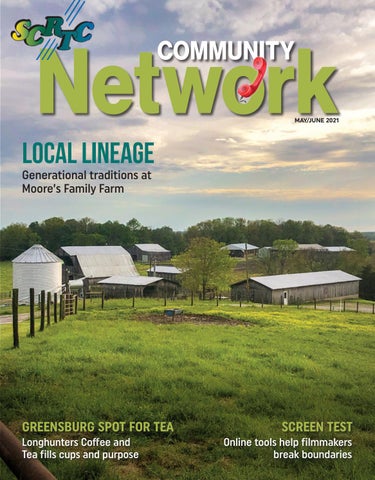
Network COMMUNITY
MAY/JUNE 2021
LOCAL LINEAGE Generational traditions at Moore’s Family Farm
GREENSBURG SPOT FOR TEA Longhunters Coffee and Tea fills cups and purpose
SCREEN TEST Online tools help filmmakers break boundaries
INDUSTRY NEWS
Rural Connections By SHIRLEY BLOOMFIELD, CEO NTCA–The Rural Broadband Association
Broadband is critical for working from home
ASCENT — ELEVATE YOUR BUSINESS A free online resource helps female entrepreneurs
N
early all of us have spent at least some time this past year working from home. And while remote work surged during the pandemic, it certainly isn’t a new idea. Between 2005 and 2017, according to Statista, there was a 159% increase in remote work. Today 11.2% of Americans are working from home, up from 5.7% in 2019. And many are growing to prefer it — 22% of workers say they’d like to work from home permanently. I believe full-time remote work makes it difficult to create and maintain a collaborative work culture, but I do think that work is likely to have a new face when we get back to “normal.” The Foundation for Rural Service recently published a white paper entitled “Rural America’s Critical Connections.” (You can download it for free at www.frs.org.) The report cites a Global Workplace Analytics report that states, “Our best estimate is that 25-30% of the workforce will be working from home multiple days a week by the end of 2021.” What does this mean for broadband, that critical connection that helps us work remotely? It certainly means our country needs to continue the work to get broadband to everyone — and that in doing so we must build robust networks using technology proven to support the speeds and synchronous connections that working from home requires. Regardless of the work patterns and flexibility we see in the coming year, one thing is for certain: NTCA members such as your provider will continue to be at the forefront of connecting rural America. 2 | May/June 2021
About 45% of businesses are owned or co-owned by women. Spanning a range of industries, most of these businesses are small with potential for growth. The federal Small Business Association wants to provide support. The free, information-packed online Ascent program offers a range of helpful resources.
TAKE A JOURNEY Experts in women’s entrepreneurship created informational Journeys. Participants can choose any Journey, opting out of sessions with information they already know. Each Journey includes Excursions filled with resources needed to master a topic.
Exercises and tools
Fireside chats
Infographics
Success stories
?
Discussion guides
Videos
Key insights
Self-assessments
DO YOU NEED HELP WITH YOUR BUSINESS? Visit ascent.sba.gov
Secure your Internet of Things
T
he Instant Pot, a pressure cooker, is one of the most popular small kitchen appliances of recent years. Naturally, there’s a model capable of connecting to the internet via Wi-Fi — an example of the Internet of Things, or IoT. Smart thermostats, door locks and security cameras are just a few devices on the IoT spectrum. Refrigerators, toys and a range of whimsical gadgets are all on the bandwagon. And businesses and industry, including agriculture, manufacturing and medicine, take advantage of connected devices. Like the connected Instant Pot, which lets a cook control it via a smartphone app, IoT devices provide convenience, useful data and new ways of using technology. Cisco, a leader in networking systems, estimates that more than 75 billion such devices will be in use by 2025. The utility of what is sometimes described as the fourth industrial revolution is balanced by the need for mindful caution. These devices offer people with bad intent potential doorways into private homes and businesses that use the internet-dependent gadgets. Meanwhile, companies are finding new ways of leveraging these systems. One example is Amazon Sidewalk, which rolled out earlier this year. Here’s how Amazon described the innovation: “Amazon Sidewalk is a shared network that helps devices like Amazon Echo, Ring security cameras, outdoor lights and motion sensors work better at home and beyond the front door.” Essentially, Sidewalk links your Amazon devices to those of your neighbors through a specialized network. Why? Well, imagine your internet goes down while you’re out of town, making your security-focused Ring Doorbell useless. With Sidewalk, however, your internet-connected doorbell would keep right on working, relying on the internet connections of your neighbors to power the system. Everyone on the Sidewalk
system gives up a little bit of their internet bandwidth to this network. Instead of a smart home, Sidewalk can create a smart neighborhood. Amazon released a detailed white paper outlining the system’s security features. And while security experts have been quoted praising the company’s efforts, others have expressed concern about privacy and the potential for hackers to target the system. Amazon Sidewalk can be turned off in the settings section of the company’s smartphone app. As IoT devices proliferate and offer new, practical ways to leverage the power of the internet, knowledge and a few practical security steps can offset possible risks. In the past, the FBI noted the need for IoT caution. “Unsecured devices can allow hackers a path into your router, giving the bad guy access to everything else on your home network that you thought was secure,” Beth Anne Steele wrote for the Portland FBI office.
Security tips for IoT devices • Change the device’s default password. Consider a different device if instructions for changing the password aren’t readily available. • Long passwords — as long as possible — work best. Make them unique to each IoT device. • Many IoT devices connect to smartphone apps. Take a few minutes to understand the permissions granted to these apps. An internet search will help here, too. • If possible, have a separate network for devices, such as an internet-connected refrigerator and a laptop containing sensitive information. • Regularly update the devices, and turn off automatic updates.
May/June 2021 | 3
FROM THE GENERAL MANAGER
A legacy of service
Network
C
The SCRTC Community Network is a bimonthly newsletter published by South Central Rural Telecommunications Cooperative © 2021. It is distributed without charge to all customers of the cooperative.
Together, we’ve created a foundation for the future onnecting a rural community such as ours to the world has never been easy. Decades ago, crews first strung telephone lines across a landscape that large nationwide companies chose to ignore, deeming the places we call home too rural and unworthy of the effort.
Naturally, we never felt that way. After all, no one understands the importance of our home and places like it better than we do. The countless hours of work to create that first telephone system proved invaluable, opening new doors for businesses and individuals. All of that effort gave us a foundation for the future. As new technologies appeared, we continued that original commitment to serving you by bringing you those innovations. Today, our internet services rival — and often greatly exceed — those found in metropolitan areas. Just as those first crews did when they JEFF EATON General Manager engineered a telephone system, we’ve built and maintained a robust internet network. The depth of my appreciation for the men and women who make these essential services possible only increases from year to year. No matter the challenge, they adapt and overcome. I’d like to, humbly, suggest that you benefit daily from those efforts. Can you imagine not having an option to link a computer or mobile device to the internet? Work, entertainment, medical care, education and more rely on rock-solid service. In just a few decades, we’ve gone from marveling at the idea of being able to speak one-on-one to someone miles away via phone to having a world of information at our fingertips. We’ve never been so connected. In fact, internet services are as essential for many of us as water and electricity. Despite our best efforts, though, no communications and technology company such as ours avoids adversity. It’s how you overcome adversity that matters most. After all, no one escapes the power of nature. Across the nation, we’ve seen tornadoes, hurricanes, fires and more leave communities without the utilities many of us take for granted. Every season of the calendar brings the possibility of an event capable of disrupting our systems. But our team maintains detailed plans to both avoid disruptions and to respond quickly if they do occur. Often, long hours of work are required to restore services after an outage. The environment in the field after an event like a severe storm may be dangerous. Yet, our crews always answer the call. Our office staff willingly puts in long hours to support the efforts. Everyone helps. And they do it gladly, because we understand how much you rely on the services we provide. They’re essential, as is our commitment to you. Our investment in not only expanding our services but also in maintaining existing infrastructure is significant and ongoing. The mission that began with construction of the first telephone lines continues. We believe in you, and our community. We prosper together. Regardless of the challenges, we embrace our commitment to serving you. Everyone at SCRTC is proud of our heritage, a sentiment we wish to carry over to future generations that will continue to provide you the communication tools needed to thrive. Thank you for letting us be part of this community.
4 | May/June 2021
COMMUNITY
MAY/JUNE 2021
VOL. 6, NO. 3
South Central Rural Telecommunications Cooperative is a member-owned corporation dedicated to delivering advanced telecommunications technology to the people of Central Kentucky, including Adair, Allen, Barren, Edmonson, Green, Hart, LaRue, Metcalfe, Monroe and Nelson counties. South Central Rural Telecommunications Cooperative, Inc. 1399 Happy Valley Road • P.O. Box 159 Glasgow, KY 42142-0159 270-678-2111 www.scrtc.com SCRTC BOARD OF TRUSTEES Ralph J. Thompson, District I Bonnieville and Munfordville exchanges Billy Smith, District II Canmer and Horse Cave exchanges Jerry Polson, District III Cave City and Hiseville exchanges Ronnie Tucker, District IV Center, Edmonton and Summer Shade exchanges Kevin Bradshaw, District V Glasgow and Temple Hill exchanges Zack Kender, District VI Fountain Run, Gamaliel and Lucas exchanges Robert E. Thompson, District VII Buffalo and Magnolia exchanges Jeff Eaton General Manager Bobby H. Richardson Attorney Produced for SCRTC by:
On the Cover: Moore’s Family Farm, a generational legacy for Glasgow, has produced pork, beef and other popular meats for several decades. See story Page 8.
SCRTC NEWS
Sara Beth McCown, who started with SCRTC in 2009, is now the Senior Financial Officer. She is responsible for the annual capital credit patronage checks, processing payroll and various accounting processes. “The SCRTC family of co-workers are wonderful,” McCown says. She credits her parents, Max and Judy Morris, for being most influential in her life, including teaching the importance of family and friends. Sara Beth married Bobby McCown 21 years ago, and they have a son, Tyler. Her hobbies include camping, kayaking and painting. Lately, she’s been watching reruns of “Friends” and new episodes of “Yellowstone” with SCRTC’s residential cable TV.
Lifeline Service
LIFELINE IS A FEDERAL PROGRAM TO HELP LOW-INCOME AMERICANS PAY FOR PHONE OR BROADBAND SERVICE
You are eligible for Lifeline benefits if you qualify for and receive one of the following benefits:
Some states have additional qualifying programs, allowances and stipulations. Check with your local telecommunications provider for information about benefits that may be available in your state.
•SNAP •Medicaid •Supplemental Security Income (SSI) •Federal Public Housing Assistance •The Veteran’s Pension or Survivor’s Pension benefit. Additionally, consumers at or below 135% of the Federal Poverty Guidelines will continue to be eligible for a Lifeline program benefit. (State determinations of income will no longer be accepted.) There are no changes to the eligibility criteria for tribal programs.
South Central Rural Telecommunications Cooperative
Mark your Calendar Happy Mother’s and Father’s Day! SCRTC offices will be closed on May 31 in observance of Memorial Day.
To find out whether you qualify for Lifeline assistance, please visit www.lifelinesupport.org or call your local telecommunications provider. NOTE: Your telephone company is not responsible for determining who qualifies for these programs or who receives assistance. Consumers must meet specific criteria in order to obtain assistance with their local telephone and/or broadband service, and qualifying is dependent upon government-established guidelines.
May/June 2021 | 5
TRAVEL
Marvelous vistas
Rhododendron make summertimes scenic Story by ANNE P. BRALY
C
limb to the top of Roan Mountain, a 5-mile ridgetop along the Appalachian Trail, in the month of June, and something magical happens. The view, normally green with vegetation, turns into a blanket of crimson as the rhododendron opens in full bloom. “The views are spectacular — and that’s an understatement,” says Keith Kelley, ranger for the Cherokee National Forest, Watauga District. It’s this view that people have been traveling to experience for generations, according to Jennifer Bauer. She is the author of three books about Roan Mountain. The most recent is “Roan Mountain: A Passage of Time.” As early as the 1700s, botanists made their way up the mountain range to study
the flora and fauna. In 1794, Andre Micheaux discovered alpine species rarely found outside of the New England and Canadian latitudes. Five years later, John Fraser hiked up the mountain, collecting specimens of rhododendron and noting the existence of the fir tree we now know as the Fraser fir. And yet another early explorer was Elisha Mitchell, for whom Mount Mitchell is named. But it wasn’t until the magnificent Cloudland Hotel opened high atop Roan Mountain that it became known to the general public and word of its rhododendron — the largest proliferation of wild rhododendron in the world — spread across the South and beyond. Today, little remains of the Cloudland other than a forest service marker providing information
Where does Roan Mountain get its name? Some say the name refers to the reddish color of the mountain when rhododendron comes into bloom in early summer or when the mountain ash berries appear in autumn. But, according to the United States Department of Agriculture, there’s another theory. Some say it comes from Daniel Boone’s roan-colored horse, because the man and his horse were frequent visitors to the area.
6 | May/June 2021
about the hotel’s glorious heyday. But people continue to come to see the magnificent gardens tended by Mother Nature. Sometimes too many people, Kelley adds, so he offers a suggestion should you go. “South of Carver’s Gap is an area known as the Rhododendron Gardens, which you can drive to, park and hike from there,” he says. “There is a small user fee you have to pay to enter the area, but it is well worth it. That area is accessed by turning south at Carver’s Gap.” Bauer’s attachment to “The Roan,” as she calls it, began in college when she was a student at East Tennessee State University. Her botany professor introduced her to The Roan, and the rest, as they say, is history. She’s now been with Tennessee State Parks for 38 years, the first 21 of which were spent working as an interpretive ranger at Roan Mountain State Park. The position enabled her to conduct research in an effort to learn more about the natural history of The Roan and its people. Bauer is now the park ranger at Sycamore Shoals State Historic Park in Elizabethton, Tennessee. Roan’s highlands, which reach up to 6,285 feet at its peak, is where you’ll find the Rhododendron Gardens — toward the west end of the highlands at the end of a U.S. Forest Service road that turns off from Carver’s Gap at the North Carolina/ Tennessee state line. “When they are in full bloom, you see a sea of crimson flowers in areas where there are not many spruce and fir trees popping up among them,” Bauer says. “But even with the trees, it’s a beautiful sight. In other areas of the mountain, you’ll walk through areas that are in different stages of transition between balds to forests. In these areas the rhododendron reaches for the sun and blooms among the spruce and firs. All of these unique habitats present a feeling of great beauty and a sense of visiting an enchanted forest.” Any time of year is worth visiting, Kelley notes. “But in June, the rhododendron are in bloom, along with some of the other vegetation, which offers incredible, breathtaking scenery.”
Grow it yourself
Rhododendron grows best in cooler climates and acidic soil — definitely not the hard-packed red clay found throughout the South. There are hybrid varieties, though, that have been developed for the southern garden. But that’s no guarantee they will survive. Rhododendrons do not like high heat and wet soil. However, if you’re willing to try, here are some tips from Southern Living. • Start with heat-tolerant plants. • Pay attention to the soil and have it tested for acidity. Also, plant your rhododendron in an area that drains quickly and contains lots of organic matter, such as chopped dead leaves, cow manure and ground bark. Again, no clay. • If your ground is flat, plant the rhododendron in a raised bed. • Finally, choose a location that is lightly shaded in the afternoon and shielded from strong winds.
Balding
The Appalachian Trail travels along the highest ridges of the Roan Mountain range, which separates Tennessee and North Carolina. A portion of the highlands is a red spruce and Fraser fir forest. Other areas of The Roan are described as “bald” communities. Just as the name implies, balds are areas on mountaintops where the forest ends and thick vegetation of native grasses and/or shrubs begins. One of the most popular areas along the entire Appalachian Trail from Maine to Georgia is the portion that crosses the balds of Roan Mountain, says Jennifer Bauer, former ranger at Roan Mountain State Park and a board member of Friends of Roan Mountain. How the balds developed is anyone’s guess, but scientists now believe they may have formed during the last ice age when constant winds and freezing temperatures caused trees to make a hasty retreat down the mountaintop. Mammoths and other beasts acted as Mother Nature’s personal weed eaters, keeping the balds grazed. Now that the woolly beasts are gone and temperatures have warmed, balds are beginning to grow some “hair.” But Roan Mountain’s balds still shine. Among the most popular are the balds starting at Carver’s Gap and going north.
They are, in order: • • • • • •
Round Bald Jane Bald Grassy Ridge Yellow Mountain Little Hump Mountain Hump Mountain
May/June 2021 | 7
History RUNS DEEP The legacy and lineage of Moore’s Family Farm Story by MORGAN SIMMONS | Photography by MATT LEDGER
D
uring his 31-year career as a high school biology and agricultural science teacher, Joe Michael Moore never turned his back on farming. There was livestock to feed in the morning before he left for work, followed by more feeding and watering at the end of the day. A native of Barren County, Kentucky, Moore grew up working on his family’s farm and never doubted his life’s mission, even as he went off to Western Kentucky University to earn a degree in agricultural education. “Dad wanted me to go to school so I wouldn’t have to farm, but I went to school so I could farm,” Moore says. He returned home in 1977 and purchased his first share of the family farm — a 108-acre tract along the Barren River that included a brick house built in 1810 by Benjamin Martin, Moore’s great-great-great-great-great-grandfather. “He was born in 1758 and served four tours in the Revolutionary War,” Moore says. “His last tour was under Gen. George Washington. He’s buried on the farm in an old family cemetery. He received his military pension when he was 74. We discovered most of this on the internet.” Over the years, Moore has continued to purchase additional neighboring tracts, and so today, at age 65, he runs a modern agricultural enterprise covering 475 acres. The land is the family’s gravitational center, not just for Moore and his wife, Kimberlee, but for their children and grandchildren who are among the nine generations of family members who have lived and worked on the farm in its 200-plus years.
8 | May/June 2021
The Moore family home was built on the farm in 1810.
DIVERSE, THRIVING At a time when an increasing number of farms are turning into subdivisions, Moore’s Family Farm isn’t just staying afloat — it’s thriving. Not too long ago, Moore helped his father raise milk cows and grow everything from tobacco and soybeans to wheat. They farmed in the traditional manner with an emphasis on diversity. South Central Rural Telecommunications Cooperative
Moore’s Country sausage is one of several products produced on a generational farm, employing several family members, including brothers Joe Michael Moore, center, and Tony Moore, right, and Joe’s son, Andy Joe Moore, left.
In 2007, Moore and his son, Andy Joe, who holds a degree in agricultural education from Western Kentucky University, as well as a doctorate in educational leadership, decided to think outside the box. Shifting their focus to high-quality meats, they formed Moore’s Country Sausage. Moore continues to grow corn and hay, but just enough to sustain his livestock as part of a carefully managed feeding program. Today, Moore’s Family Farm manages a herd of 125 black angus cattle and slaughters around 55 hogs a year. The meat is all natural — no antibiotics, growth hormones or MSG — and everything sold has been raised on the farm.
Moore is a stickler for getting the right balance of lean meat and marbling in his steaks. However, sausage is the farm’s specialty, and its all-important spice recipe is a blend of what Moore’s grandfather and father used. Moore has also developed his own spice version, which seems to strike the right balance between heat and sweet. “Our older customers say they haven’t had sausage like ours since they were kids,” he says. “Some say it’s the best they’ve ever eaten.” The farm sells about 10,000 pounds of sausage a year. Moore says the few livestock operations that are left these days tend to be large, but that Moore’s Country
Sausage is in many ways a throwback to an earlier, pre-industrial time. “I don’t want to get any bigger,” he says. “I’m just here for the farm. This whole area was dairy country, but everybody got bigger and bigger, and it all went bust. Now, there are just a few dairy farms left, and they’re all huge. It’s the same with hogs.” Whether it’s producing pork sausage, beef or the farm’s most recent offering, all-natural lamb, Moore’s Country Sausage is a farm-to-table enterprise through and through. Customers line up on Saturday mornings from 8 to 10 to buy freshly packed meats, and there’s a waiting list for bacon. While Moore does not sell to grocery stores, he does ship to individuals and families as far away as New York City, Texas and Florida. “We’ve got about 400 animals here now — everything from sows to boar hogs to cattle and sheep,” he says. “I never go to bed until they’re taken care of. On Sunday, we all go to church. We make sure the animals are watered and fed, but we never put up hay or do any farmwork other than making sure the animals have what they need.” Moore’s farm is a family business in the truest sense. His son knows computers and helps with the farm’s Facebook page and website, while his wife, a retired schoolteacher like her husband, specializes in making sausage balls. “We’ve been married 40 years,” Moore says. “She’s been at my side the whole time.”
MOORE’S Family Farm 1630 Berry Store Road Glasgow KY 42141 For “Moore” information, contact Joe Michael Moore at jmmoore@scrtc.com (270) 670-7493 | mooresfamilyfarm.com
Benjamin Martin’s gravestone sits on the family farm, visited by generations of Moore’s, including his ninth generation descendant, Emma Kate. South Central Rural Telecommunications Cooperative
Andy Joe Moore ties bags of sausage. The family’s recipes are used to create more than 10,000 pounds each year. May/June 2021 | 9
Final cut How the freedom of the internet is transforming filmmaking
S
Story by DREW WOOLLEY
ome filmmakers learn their craft by making home movies in the backyard. Others go to film school. Madelaine Turner likes to say she got her education on YouTube. “That’s essentially where I got my film degree,” she says. “Movies were my first love, but filmmaking wasn’t something I pursued for a long time. Until quarantine started.” At 27 years old, the California native considers herself a senior by the standard of apps like TikTok. Of the app’s 500 million active users, nearly half are estimated to be in their teens and early 20s. Originally, Turner’s quick videos were just a way to stay connected with her younger siblings. But she began to view the platform as a way to genuinely flex her creative muscle after a positive response to her Wes Anderson tribute video, “The Anderson Guide to Surviving a Global Pandemic,” filmed using only objects she had in her apartment.
“It gives you really specific boundaries with the content you’re allowed to create, which is 59 seconds,” she says. “So the challenge and excitement as a storyteller, director and creator is getting your point across and making those 59 seconds really enjoyable for your audience.” Within those confines, Turner has explored her wide-ranging creative interests, from short films paying homage to Jane Austen costume dramas and French heist movies to abstract dream sequences and a cyberpunk take on “The Wizard of Oz.” Each new style gives her a chance to learn more about the filmmaking process both during and after filming. “I’d never really used a green screen or After Effects before,” she says. “Now, taking on a new genre is really exciting because it allows me to push the boundaries of what I know how to do and challenges me to figure out how I can convey this effectively without having a whole production crew.”
Madelaine Turner puts her spin on genres ranging from French heist movies to cyberpunk.
10 | May/June 2021
Her growth as a filmmaker hasn’t gone unnoticed. As a freelance screenwriter, Turner has been able to point to her online portfolio and hundreds of thousands of followers to build connections within the movie industry. And thanks to the algorithms of apps like TikTok, Instagram and YouTube, more people are discovering her work every day. “It allows you to come across content from someone with virtually no following,” Turner says. “And from my perspective, I was putting my stuff out there and very quickly engaging an audience that gave me the permission to go bigger, further and more creative.” That audience is one of the reasons Turner doesn’t expect she’ll ever stop making short-form videos online, even as she pursues her larger filmmaking dreams. The real-time feedback she receives on those platforms has already shaped her as a filmmaker and may come to shape the industry itself. “A traditional filmmaker might go years in between films, whereas on TikTok you get this microenvironment of trying new things and getting that quick feedback,” she says. “So I think I’ve been lucky to hyper-develop my style as a filmmaker because of that feedback loop. Hopefully I can be part of a generation of filmmakers that is able to bridge that gap between the internet and the mainstream.”
Long distance For every film festival that was able to pivot to digital in 2020, there were many more that had to be canceled altogether. With so much of the industry on hold, a team of five cinephiles in Brooklyn started the entirely online Long Distance Film Festival, harnessing the power of broadband to give rural and urban filmmakers around the world an outlet for their creativity. “There was a certain freedom to starting an all-online festival,” says Festival Director Elias ZX. “It was much cheaper than doing it in person. We didn’t sell tickets and had unlimited capacity so friends, family and fans of the filmmakers were able to join from around the globe and watch the festival in its entirety.” To pull it off, the team partnered with the independent Spectacle Theater and Kinoscope to stream its 15 selected short films to hundreds of viewers around the world. Plans for a second edition of the festival are already underway, with submissions open for 2021.
Industry standard
Oxford Film Festival Executive Director Melanie Addington was making last-minute arrangements for the Mississippi-based event when the state’s governor banned gatherings of more than 100 people. Using Eventive’s brand-new online festival platform, she quickly pivoted to take the event virtual. “We were one of the first virtual festivals with Eventive and had to learn a lot very quickly, mostly that a lot of our community doesn’t have good internet access,” she says. “That was restricting in some ways, but it also expanded who could see them to a new audience.” Moving forward, Addington anticipates OFF will have a hybrid format, combining the accessibility of a virtual festival with the in-person experience of a live event. “This will be what we do from here on out,” she says. “Not everyone can travel to Oxford, but they can still take part in the experience. It makes absolute sense for this to become a standard in our industry.”
May/June 2021 | 11
Restoring tradition Longhunters brings a savory experience with a side of history Story by MORGAN SIMMONS | Photography by MATT LEDGER
I
n 2011, after serving 30 years in the U.S. Army, Col. Bill Landrum returned home to a town he hardly recognized. Greensburg’s public square had changed, at least as far as Landrum was concerned. The sidewalks seemed empty compared to what he remembered, and the historic courthouse was no longer a place where people gathered just to sit and socialize. “The big-box stores and fast-food restaurants seemed to have sucked the atmosphere out of the public square,” Landrum says. “The element of traditional warmth I knew as a boy was gone. I felt like the cultural heritage of our small town was at risk.” Landrum’s love of history is homegrown. He grew up on a farm in Green County where his dad primarily raised black angus beef cattle and grew about 4 acres of tobacco. Green County has been part of his family since the early 1850s. He and his wife, Justine, have been married 38 years. They met when they both served in the Army — he was with the Army Finance Corps, and she was an Army civilian accountant. After lengthy careers, the plan was to always return to the family farm. “Green County is where my mother and grandparents and great-grandparents are from,” Landrum says. “My mother had 11 brothers and sisters. Early on, I was probably related in some way to a quarter of the county, but most of them have since passed away.” The Landrums’ retirement did not last long. Shortly after returning home, the couple purchased a two-story brick building in Greensburg’s downtown historic district across the street from the oldest courthouse west of the Allegheny Mountains. They turned the building’s second floor into a nonprofit, educationally
12 | May/June 2021
Owners Bill and Justine Landrum made it their mission to help revitalize the Greensburg square by opening Longhunters Coffee and Tea Company.
chartered history museum and began filling the 4,000-square-foot space with pioneer relics, military artifacts and other memorabilia from Green County’s past. On Nov. 15, 2011, the couple decided to open a coffee shop and restaurant on the building’s first floor. “We laid out a business model and a plan of action,” Landrum says. “The initial objective was to provide a facility for the preservation and display of a wide range of historic objects and recorded events of celebrated value to Green County. The museum obviously addresses that, but we wanted the restaurant to play a role, too.”
Bill Landrum’s military service led him to collect a variety of historic items, including a diorama of the Battle of Chickamauga.
South Central Rural Telecommunications Cooperative
FRONTIER SPIRIT Ever the history buff, Landrum named the new eatery after the 18th-century hunters, trappers and surveyors who made extended expeditions across the British frontier from Southwest Virginia into Kentucky. These intrepid explorers were called longhunters. A number of them settled with their families in Green County, so Landrum christened his new restaurant the Longhunters Coffee and Tea Company. The food at Longhunters Coffee and Tea is history made palatable. The menu includes a General Nathaniel Greene sandwich that features turkey breast and provolone cheese topped with roasted red peppers on sun-dried tomato swirl bread drizzled with herbed oil. The Colonel James Knox is a combination of salami, pepper jack cheese, pepper rings and mustard on ciabatta bread. And the Longhunters Hot Brown — the restaurant’s top seller — consists of a turkey breast served on a corn cake with Mornay sauce, tomato and bacon. The menu offers brief explanations of the historical references, and this is how customers who order the Jane Todd Crawford vegetarian sandwich learn that its namesake was a Green County resident who in 1809 became the first person in
the world to undergo abdominal surgery without anesthesia. The Longhunters Coffee and Tea Company serves breakfast, lunch and dinner, with trained baristas on hand to serve up a wide variety of hand-crafted coffees and teas. “With my military background, I wanted to create a strong internal culture of teamwork and respect among the staff,” Landrum says. “Creating jobs and opportunities is the driving force behind what Justine and I do.” The restaurant is also an entertainment venue, with a stage for live performances. In 2013, the couple started catering weddings and rehearsal dinners, and today, the Longhunters Coffee and Tea Company draws hungry customers from a 50-mile radius. During the early days, Landrum — who happens to be an accomplished cook — stayed busy designing the menus and dealing with customers, while his wife managed the books. From 2015 to 2019, while he was away at the state Capitol serving as secretary of the Kentucky Finance and Administration Cabinet, she ran the restaurant. “At first, we had coffee and tea and a few sandwiches,” Justine Landrum says. “Then, we expanded the menu. We’ve been fortunate to keep moving ahead.”
The couple is now adding a 51-seat cocktail lounge and bar on the building’s second floor next to the history museum, as well as a wine store and tasting bar downstairs next to the restaurant. They are calling these new offerings “Tavern on the Square” and are hoping the expansion will bring another round of economic development to Greensburg’s historic downtown district. “We’re hoping people will walk into our building and go, ‘Wow, you wouldn’t think downtown Greensburg would have this kind of thing,’” Justine Landrum says. “Only about 50% of restaurants make it through their first year, and then only 10% make it five years,” she says. “We’ve made it 10 years because of our many loyal customers and by treating everyone we serve with dignity and respect. We don’t rush people and we cater to everyone.”
Longhunters Coffee and Tea Company 115 South Public Square Greensburg, KY 42743 270-932-2351 longhunterscoffeeandtea.com
One can now enjoy craft cocktails or stylish wines in the new sophisticated cocktail lounge that overlooks the historic Greensburg square. South Central Rural Telecommunications Cooperative
May/June 2021 | 13
SOUTHERN KITCHENS
PEA SALAD WITH SMOKED ALMONDS
Perfectly pleasing peas Enjoy a surprisingly flexible legume
I
f you’re denying yourself the simple beauty of peas, it’s time to rethink your weekly menu. Full of healthy benefits and flavor, they should be a part of everyone’s diet. Peas’ nutrition profile includes manganese, protein, fiber, vitamin A and folate, with lots of lesser vitamins to boot. And their neutral flavor allows them to go from smoothies at breakfast to salads for lunch and pot pies for dinner. They’re inexpensive and add a lot of texture and color to any plate. Try tossing them with pasta and a creamy Alfredo sauce. Or use peas as a topping for a baked potato with cheese and sour cream. You can also make an incredible pesto sauce for buttery rounds of crusty bread. Simply add a bag of
14 | May/June 2021
frozen peas to a handful of mint leaves and a half cup of Parmesan cheese, blend them together in a food processor and add olive oil as the machine is running until you get a smooth, thick consistency. If you’re lucky enough to have a garden full of the green pods filled with fresh peas, you’ve done yourself a favor. Just go outside and grab a handful of taste and nutrition. If not, grab a bag of frozen peas — they’re just as good for you. FOOD EDITOR ANNE P. BRALY IS A NATIVE OF CHATTANOOGA, TENNESSEE.
2 (16-ounce) packages frozen peas 6 ounces smoke-flavored almonds, finely chopped 1/2 a sweet onion or more, to taste, finely chopped 1/2 cup mayonnaise (reduced fat OK) 1/2 cup sour cream (light OK) Ground black pepper, to taste 1/2 cup shredded cheddar cheese Place frozen peas in a colander and rinse them under cold water until thawed. Drain and transfer them to a large bowl. Add the almonds and onions. Mix well. Fold mayonnaise, sour cream and black pepper into the pea mixture until evenly coated. Transfer to a serving container and top with shredded cheese. Cover and refrigerate until serving. Before serving, you may want to blend cheese into the mixture, or leave it on top for a prettier presentation.
CREAMY CHICKEN POT PIE
Peas add taste, color and texture to this creamy dish.
GREEN PEA BANANA SMOOTHIE 1/2 cup frozen green peas 1 frozen banana 1 cup spinach 4 mint leaves or more, to taste 1 1/2 cups almond milk 1 tablespoon almond butter, optional Combine all ingredients in a blender. Blend until smooth, about 1 minute. Add more almond milk if needed to achieve your desired consistency.
2 1/2 cups all-purpose flour 1 tablespoon sugar 1 teaspoon salt 1 cup cold unsalted butter, cut into cubes 1/2 cup cold buttermilk 1 or 2 tablespoons cold water 1 large egg, beaten, for the egg wash
Dump the mixture out onto a clean surface and use a rolling pin to roll the butter into thin sheets, combining it with the flour. Use a bench scraper to scrape the rolling pin and to bring the mixture back into a pile as necessary. Continue until all of the butter is incorporated into the flour. The mixture will be very flaky. Return the mixture to the bowl and place it in the freezer for 15 minutes to chill the butter.
For the pot pie filling: 1/4 cup unsalted butter 1/3 cup diced onion 2 medium carrots sliced (about 1 cup) 1 stalk celery sliced (about 1/2 cup) 2 cloves garlic minced 1/3 cup all-purpose flour 1 teaspoon salt 1/2 teaspoon black pepper 1 1/2 teaspoons minced fresh thyme 1 tablespoon minced fresh Italian parsley 1 3/4 cups chicken broth 1/2 cup heavy cream 3 cups shredded chicken or turkey 1 cup frozen peas
Remove from the freezer and add the buttermilk. Use a spoon, and then your hands, to stir the mixture until it comes together into a ball. If the mixture is too dry, add the water a tablespoon at a time. Divide the dough into 2 parts and flatten them into disks. Wrap each disk in plastic wrap and chill in the fridge while you make the filling.
First, make the pie dough. Combine the flour, sugar and salt in a large bowl. Add the cubed butter and toss to coat.
To make the filling, heat the butter over mediumhigh heat in a large skillet. Add the onions, carrots, celery and garlic and cook until tender, stirring occasionally. Whisk in the flour, salt, black pepper, thyme, parsley, chicken broth and heavy cream. Whisk until there are no flour lumps, then simmer over medium-low heat for 10 minutes or until the sauce has thickened. Stir in the shredded chicken or turkey and frozen peas. Remove from heat and set aside. Preheat the oven to 400 F. Remove the pie dough from the refrigerator. On a lightly floured surface, use a rolling pin to roll out the dough into a 12-inch circle. Dough should be about 1/4 inch thick. Transfer the dough to a 9-inch pie pan. Pat with your fingers, making sure it is smooth. Trim the extra overhang of dough with a knife and discard. Pour the filling into the dough-lined pie pan. Roll out the second disk of dough and carefully cover the pie. Trim the extra overhang off the sides. Seal the edges by crimping with a fork or your fingers. With a sharp knife, slice a few small slits in the center of the top crust. Using a pastry brush, brush the crust and edges with a beaten egg. Bake for 45 minutes, or until the crust is golden brown. Cool for 10 minutes, allowing the filling to settle and thicken a bit. Cut into slices and serve. May/June 2021 | 15
Presort STD US Postage PAID Permit #21 Freeport OH
1399 Happy Valley Road P.O. Box 159 Glasgow, KY 42142-0159
SMARTHUB IS A SMART IDEA! Access your account from your computer, tablet or smartphone. View and pay your bill online whenever you want Get accurate, timely account information and billing history Report trouble or ask questions Customize notifications: email, text, phone, mail Shop for services 24/7
Download the SmartHub app today! Download the SmartHub app today! Find it in the app store:
270-678-2111 | scrtc.com