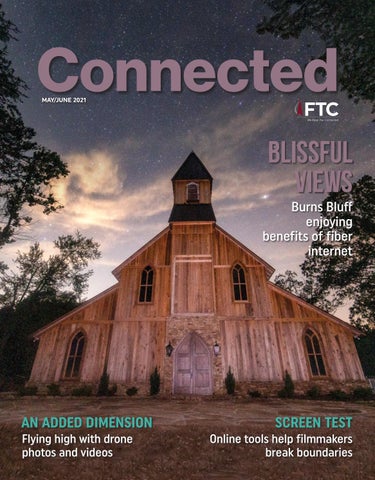
Connected MAY/JUNE 2021
Blissful views Burns Bluff enjoying benefits of fiber internet
AN ADDED DIMENSION Flying high with drone photos and videos
SCREEN TEST Online tools help filmmakers break boundaries
INDUSTRY NEWS
Rural Connections By SHIRLEY BLOOMFIELD, CEO NTCA–The Rural Broadband Association
Broadband is critical for working from home
ASCENT — ELEVATE YOUR BUSINESS A free online resource helps female entrepreneurs
N
early all of us have spent at least some time this past year working from home. And while remote work surged during the pandemic, it certainly isn’t a new idea. Between 2005 and 2017, according to Statista, there was a 159% increase in remote work. Today 11.2% of Americans are working from home, up from 5.7% in 2019. And many are growing to prefer it — 22% of workers say they’d like to work from home permanently. I believe full-time remote work makes it difficult to create and maintain a collaborative work culture, but I do think that work is likely to have a new face when we get back to “normal.” The Foundation for Rural Service recently published a white paper entitled “Rural America’s Critical Connections.” (You can download it for free at www.frs.org.) The report cites a Global Workplace Analytics report that states, “Our best estimate is that 25-30% of the workforce will be working from home multiple days a week by the end of 2021.” What does this mean for broadband, that critical connection that helps us work remotely? It certainly means our country needs to continue the work to get broadband to everyone — and that in doing so we must build robust networks using technology proven to support the speeds and synchronous connections that working from home requires. Regardless of the work patterns and flexibility we see in the coming year, one thing is for certain: NTCA members such as your provider will continue to be at the forefront of connecting rural America. 2 | May/June 2021
About 45% of businesses are owned or co-owned by women. Spanning a range of industries, most of these businesses are small with potential for growth. The federal Small Business Association wants to provide support. The free, information-packed online Ascent program offers a range of helpful resources.
TAKE A JOURNEY Experts in women’s entrepreneurship created informational Journeys. Participants can choose any Journey, opting out of sessions with information they already know. Each Journey includes Excursions filled with resources needed to master a topic.
Exercises and tools
Fireside chats
Infographics
Success stories
?
Discussion guides
Videos
Key insights
Self-assessments
DO YOU NEED HELP WITH YOUR BUSINESS? Visit ascent.sba.gov
Secure your Internet of Things
T
he Instant Pot, a pressure cooker, is one of the most popular small kitchen appliances of recent years. Naturally, there’s a model capable of connecting to the internet via Wi-Fi — an example of the Internet of Things, or IoT. Smart thermostats, door locks and security cameras are just a few devices on the IoT spectrum. Refrigerators, toys and a range of whimsical gadgets are all on the bandwagon. And businesses and industry, including agriculture, manufacturing and medicine, take advantage of connected devices. Like the connected Instant Pot, which lets a cook control it via a smartphone app, IoT devices provide convenience, useful data and new ways of using technology. Cisco, a leader in networking systems, estimates that more than 75 billion such devices will be in use by 2025. The utility of what is sometimes described as the fourth industrial revolution is balanced by the need for mindful caution. These devices offer people with bad intent potential doorways into private homes and businesses that use the internet-dependent gadgets. Meanwhile, companies are finding new ways of leveraging these systems. One example is Amazon Sidewalk, which rolled out earlier this year. Here’s how Amazon described the innovation: “Amazon Sidewalk is a shared network that helps devices like Amazon Echo, Ring security cameras, outdoor lights and motion sensors work better at home and beyond the front door.” Essentially, Sidewalk links your Amazon devices to those of your neighbors through a specialized network. Why? Well, imagine your internet goes down while you’re out of town, making your security-focused Ring Doorbell useless. With Sidewalk, however, your internet-connected doorbell would keep right on working, relying on the internet connections of your neighbors to power the system. Everyone on the Sidewalk
system gives up a little bit of their internet bandwidth to this network. Instead of a smart home, Sidewalk can create a smart neighborhood. Amazon released a detailed white paper outlining the system’s security features. And while security experts have been quoted praising the company’s efforts, others have expressed concern about privacy and the potential for hackers to target the system. Amazon Sidewalk can be turned off in the settings section of the company’s smartphone app. As IoT devices proliferate and offer new, practical ways to leverage the power of the internet, knowledge and a few practical security steps can offset possible risks. In the past, the FBI noted the need for IoT caution. “Unsecured devices can allow hackers a path into your router, giving the bad guy access to everything else on your home network that you thought was secure,” Beth Anne Steele wrote for the Portland FBI office.
Security tips for IoT devices • Change the device’s default password. Consider a different device if instructions for changing the password aren’t readily available. • Long passwords — as long as possible — work best. Make them unique to each IoT device. • Many IoT devices connect to smartphone apps. Take a few minutes to understand the permissions granted to these apps. An internet search will help here, too. • If possible, have a separate network for devices, such as an internet-connected refrigerator and a laptop containing sensitive information. • Regularly update the devices, and turn off automatic updates.
May/June 2021 | 3
FROM THE CEO
Reflections on Moon Lake Early education can shape your life
A
couple of months from now, school doors across our area will close for the summer. At one school, Moon Lake Elementary, the closure is more final as the school ends its run as one of our oldest community schools. This announcement provoked a wave of nostalgia. You see, that was my school for grades 1 - 6, before kindergartens were the norm. Six years, three classrooms, three teachers and a lot of memories. Back then, each classroom held two grades. SomeFRED JOHNSON Chief Executive Officer one asked me recently if that didn’t mean a lot of repetition. I suppose so, but we didn’t seem to mind. Ironically, before this closing was announced, I wrote about my first-grade teacher in my last column. My teacher in the third and fourth grades left an impression on me in two ways. First, she was the first — but not last — teacher upon which I had a crush. I didn’t get over it until I was a teenager. Second, and more productive, she encouraged my interest in vocabulary. Yes, I know what you’re thinking. “Johnson, you were 8.” But really, I actually remember her encouraging me to explore words, to learn their meaning and use them. I still marvel at it actually. And then there were grades five and six. My teacher was the late Charles Bell, who after a distinguished education career became DeKalb County Commission President. The man holds the distinction of having paddled me more than any other human — my mom used a switch; he used a paddle. I think I deserved 86% of them. I narrowly avoided what would have likely been the worst one ever by a sheer stroke of luck and quick reaction. I was late for school and was persuaded by friends, clearly with my best interest in mind, to hide under his desk and “attack” him when he returned to the classroom. It was such a wonderful idea. Meanwhile, a serious ruckus broke out, resulting in almost every boy in the classroom getting a serious whipping. During a break in the action, I quickly retreated from my grand plan and took up normal residence at my desk. Mr. Bell concluded that I should not be punished since, clearly, I was late and not present during the melee. I still can’t believe I wasn’t ratted out. I never confessed. Both my mom and grandmother worked at the school during its early history, and a dear cousin was the lunchroom cook, par excellence, for many years. Frankly, I didn’t really know what a “school lunch” was until 7th grade. Mae Shigley cooked for us at Moon Lake like she cooked for her family. She took pride in making sure her “kids” had a home-cooked meal while in her lunchroom. It never occurred to me at the time that she probably knew things about them I didn’t. Between giving me paddlings, Charles Bell drilled U.S. History and civics into us like our lives depended on it. Perhaps they did. Maybe they still do. He wasn’t afraid to pray in front of us, and if we did something wrong, we heard about why it was wrong. We weren’t merely told it was against the rules. There was no way to avoid being impacted by his example and discipline. Considering that more than a few of his students went on to be responsible moms and dads, business leaders, teachers, military commanders, analysts for the CIA, and generally responsible citizens, I would say he made a difference. Perhaps this is a good summation. In many ways, my memories of Moon Lake are of a bit simpler time, a time with fewer distractions. It wasn’t a utopia that doesn’t exist. Sure, we had our problems. But mostly, parents looked out for kids, both theirs and others. They made cakes and cookies for the annual harvest festivals to raise money for school supplies. They gathered to work on the property. They showed up for the special events. Maybe, just maybe, it was a time when we didn’t need a federal policy to assure that kids weren’t left behind. Maybe they didn’t get lost in the shuffle because at this small community school everyone knew everyone and dedicated teachers were determined to make a difference in their lives. All in all, it wasn’t the worst of times to be sure.
Connected MAY/JUNE 2021
VOL. 25, NO. 3
Connected is a bimonthly magazine published by Farmers Telecommunications Cooperative, © 2021. It is distributed without charge to all customers of FTC.
FTC is the state’s largest member-owned provider of telecommunications services. It serves Northeast Alabama with a robust broadband network using world-class optical fiber technology.
Farmers Telecommunications Cooperative, Inc. P.O. Box 217 • 144 McCurdy Ave. N. Rainsville, AL 35986 Telephone: 256-638-2144 www.farmerstel.com
BOARD OF TRUSTEES Randy Wright, President Flat Rock Exchange Garry Smith, Vice President Fyffe Exchange Danny R. Richey, Secretary Geraldine Exchange Lynn Welden, Treasurer Bryant Exchange Kenneth Gilbert Pisgah Exchange Gregg Griffith Henagar Exchange Randy Tumlin Rainsville Exchange Produced for FTC by:
On the Cover: Burns Bluff at High Falls provides a beautiful backdrop for weddings and future development in South DeKalb County. See story Page 8.
Photo courtesy of Kevin Terrell/SoFly Productions.
4 | May/June 2021
FTC NEWS
SMART COMMUNICATION On the go and in control. SmartHub is a web and mobile app that allows you to do business with us like never before: Manage your account View and pay your bill
Report service issues Receive important notices
All in the palm of your hand and online!
BYLAWS
Farmers Telecommunications Cooperative is required by the Rural Utilities Service. (RUS) to furnish the following information to members prior to the annual meeting. BYLAWS – ARTICLE IV | SECTION 2. Election and Tenure of Office The Co-op is divided into seven (7) geographic service areas and from each such service area there shall be elected one trustee to the Board. Members shall be eligible to vote for every Trustee. The geographic service areas are set forth as follows: Bryant, Flat Rock, Fyffe, Geraldine, Henagar, Pisgah and Rainsville as the same are shown on the map or plat of the service area on file in the office of the Co-op at Rainsville, Alabama to which such map or plat thereof reference is here made for a more complete description of said service areas. The Trustees shall be elected by secret ballot for a term of three years on a rotating basis with the Trustees from the Pisgah, Bryant and Geraldine service areas being elected at the annual meeting of the members of the Co-op in August 1991 and the Trustees from the Rainsville and Fyffe service areas being elected at the annual meeting of the members of the Co-op in August 1992 and the Trustees from the Flat Rock and Henagar service areas being elected at the annual meeting of the members in August 1993 and after their election the Trustees shall continue to serve until the election of Trustees at the annual meeting of the members of the Co-op at which their term expires or if no election shall be then held, the Trustees shall continue to hold office until their successors shall have been elected and shall have qualified. If an election of Trustees shall not be held on the day designated herein for the annual meeting or at any adjournment thereof, a special meeting of the members shall be held for the purpose of electing Trustees within a reasonable time thereafter. Trustees may be elected by a plurality vote of the Farmers Telecommunications Cooperative
Sign up today! farmerstel.com/smarthub
members. Trustees shall be nominated and elected as provided hereinafter. SECTION 3. Qualifications Any member shall be eligible to be nominated, elected and remain a Trustee of the Co-op who: (a) Resides in the geographic area for which the Trustee is elected and has resided there for more than two-hundred-forty (240) days during the preceding twelve (12) month period. (b) Is not an employee of the Co-op or a wholly-owned subsidiary of the Co-op or in any way financially interested in a competing enterprise or a business engaged in the selling of end-user communications services or supplies or maintaining communication facilities, other than a business operating on a cooperative nonprofit basis for the purpose of furthering rural telephony. Provided however that a member of the Board of Directors of any subsidiary corporation wholly owned by the Co-op, who is not otherwise employed by such subsidiary, shall not be considered as an employee of such subsidiary for the purpose of determining qualification to serve as a Trustee of the Co-op. (c) Is not closely related to an incumbent Trustee or an employee of the Co-op. As used herein, “closely related” means a person who is related to the principal person by consanguinity or affinity, to the second degree or less, i.e., a person who is either a spouse, child, grandparent, grandchild, parent, brother, sister, aunt, uncle, nephew or niece, by blood, marriage, adoption or in-law, of the principal. However, no incumbent Trustee shall lose eligibility to remain a Trustee or to be re-elected as a Trustee if such Trustee becomes a close relative of another incumbent Trustee or of a Co-op employee because of marriage to which the Trustee was not a party; neither shall an employee lose eligibility to continue in the employment of the Co-op if he or she becomes a close relative of a Trustee because of a marriage to which he or she was not a party. (d) To remain a trustee, the incumbent must attend
fifty percent (50%) or more of the regular meetings of the Trustees during each twelve (12) month period beginning with the month of a trustee’s election. The President or Secretary shall provide prompt notice of any violation of this section which would disqualify a member from service on the Board, at which time such member’s office shall be deemed vacant. Nothing contained in this Section shall invalidate any prior action taken at any meeting of the Board of Trustees. SECTION 4. Nominations. It shall be the duty of the Board to appoint, not less than forty (40) nor more than seventy (70) days before the date of a meeting of the members at which trustees are to be elected, a committee on nominations consisting of not less than five nor more than eleven members who shall be selected from different sections so as to ensure equitable representation. No member of the Board may serve on such committee. The committee, keeping in mind the qualifications for office, shall prepare and post at the principal office of the Co-op at least thirty (30) days before the meeting a list of nominations for trustees which shall include at least two candidates for each trustee position to be elected. Any fifteen (15) or more members acting together may make other nominations by petition by delivering such petition to the Headquarters of the Cooperative during normal office hours not less than twenty-two (22) days prior to the meeting and the Secretary shall post such nominations at the same place where the list of nominations made by the committee is posted. The Secretary shall mail with the notice of the meeting or separately, but at least five (5) days before the date of the meeting, a statement of the number of trustees to be elected and the name and addresses of the candidates, specifying separately the nominations made by the committee and the nominations made by petition, if any. The ballot to be used at the election shall list the names of the candidates nominated by the committee and the names of the candidates nominated by petition, if any. May/June 2021 | 5
TRAVEL
Marvelous vistas
Rhododendron make summertimes scenic Story by ANNE P. BRALY
C
limb to the top of Roan Mountain, a 5-mile ridgetop along the Appalachian Trail, in the month of June, and something magical happens. The view, normally green with vegetation, turns into a blanket of crimson as the rhododendron opens in full bloom. “The views are spectacular — and that’s an understatement,” says Keith Kelley, ranger for the Cherokee National Forest, Watauga District. It’s this view that people have been traveling to experience for generations, according to Jennifer Bauer. She is the author of three books about Roan Mountain. The most recent is “Roan Mountain: A Passage of Time.” As early as the 1700s, botanists made their way up the mountain range to study
the flora and fauna. In 1794, Andre Micheaux discovered alpine species rarely found outside of the New England and Canadian latitudes. Five years later, John Fraser hiked up the mountain, collecting specimens of rhododendron and noting the existence of the fir tree we now know as the Fraser fir. And yet another early explorer was Elisha Mitchell, for whom Mount Mitchell is named. But it wasn’t until the magnificent Cloudland Hotel opened high atop Roan Mountain that it became known to the general public and word of its rhododendron — the largest proliferation of wild rhododendron in the world — spread across the South and beyond. Today, little remains of the Cloudland other than a forest service marker providing information
Where does Roan Mountain get its name? Some say the name refers to the reddish color of the mountain when rhododendron comes into bloom in early summer or when the mountain ash berries appear in autumn. But, according to the United States Department of Agriculture, there’s another theory. Some say it comes from Daniel Boone’s roan-colored horse, because the man and his horse were frequent visitors to the area.
6 | May/June 2021
about the hotel’s glorious heyday. But people continue to come to see the magnificent gardens tended by Mother Nature. Sometimes too many people, Kelley adds, so he offers a suggestion should you go. “South of Carver’s Gap is an area known as the Rhododendron Gardens, which you can drive to, park and hike from there,” he says. “There is a small user fee you have to pay to enter the area, but it is well worth it. That area is accessed by turning south at Carver’s Gap.” Bauer’s attachment to “The Roan,” as she calls it, began in college when she was a student at East Tennessee State University. Her botany professor introduced her to The Roan, and the rest, as they say, is history. She’s now been with Tennessee State Parks for 38 years, the first 21 of which were spent working as an interpretive ranger at Roan Mountain State Park. The position enabled her to conduct research in an effort to learn more about the natural history of The Roan and its people. Bauer is now the park ranger at Sycamore Shoals State Historic Park in Elizabethton, Tennessee. Roan’s highlands, which reach up to 6,285 feet at its peak, is where you’ll find the Rhododendron Gardens — toward the west end of the highlands at the end of a U.S. Forest Service road that turns off from Carver’s Gap at the North Carolina/ Tennessee state line. “When they are in full bloom, you see a sea of crimson flowers in areas where there are not many spruce and fir trees popping up among them,” Bauer says. “But even with the trees, it’s a beautiful sight. In other areas of the mountain, you’ll walk through areas that are in different stages of transition between balds to forests. In these areas the rhododendron reaches for the sun and blooms among the spruce and firs. All of these unique habitats present a feeling of great beauty and a sense of visiting an enchanted forest.” Any time of year is worth visiting, Kelley notes. “But in June, the rhododendron are in bloom, along with some of the other vegetation, which offers incredible, breathtaking scenery.”
Grow it yourself
Rhododendron grows best in cooler climates and acidic soil — definitely not the hard-packed red clay found throughout the South. There are hybrid varieties, though, that have been developed for the southern garden. But that’s no guarantee they will survive. Rhododendrons do not like high heat and wet soil. However, if you’re willing to try, here are some tips from Southern Living. • Start with heat-tolerant plants. • Pay attention to the soil and have it tested for acidity. Also, plant your rhododendron in an area that drains quickly and contains lots of organic matter, such as chopped dead leaves, cow manure and ground bark. Again, no clay. • If your ground is flat, plant the rhododendron in a raised bed. • Finally, choose a location that is lightly shaded in the afternoon and shielded from strong winds.
Balding
The Appalachian Trail travels along the highest ridges of the Roan Mountain range, which separates Tennessee and North Carolina. A portion of the highlands is a red spruce and Fraser fir forest. Other areas of The Roan are described as “bald” communities. Just as the name implies, balds are areas on mountaintops where the forest ends and thick vegetation of native grasses and/or shrubs begins. One of the most popular areas along the entire Appalachian Trail from Maine to Georgia is the portion that crosses the balds of Roan Mountain, says Jennifer Bauer, former ranger at Roan Mountain State Park and a board member of Friends of Roan Mountain. How the balds developed is anyone’s guess, but scientists now believe they may have formed during the last ice age when constant winds and freezing temperatures caused trees to make a hasty retreat down the mountaintop. Mammoths and other beasts acted as Mother Nature’s personal weed eaters, keeping the balds grazed. Now that the woolly beasts are gone and temperatures have warmed, balds are beginning to grow some “hair.” But Roan Mountain’s balds still shine. Among the most popular are the balds starting at Carver’s Gap and going north.
They are, in order: • • • • • •
Round Bald Jane Bald Grassy Ridge Yellow Mountain Little Hump Mountain Hump Mountain
May/June 2021 | 7
What’s in a name
Burns Bluff at High Falls is home to wedding venue and log cabin community Story by LISA SAVAGE
K
aren Tillery loves old log cabins and the history behind them. She and her husband, Glenn, never dreamed this love, combined with the mountaintop vistas on their land near High Falls in southern DeKalb County, would lead to such an adventure. Yet here they are, hosting weddings with breathtaking views for brides from all over the country, developing a community of vacation homes and working with the DIY Network television show “Barnwood Builders.” They purchased bluff property in 2007, and in 2020, the couple opened Burns Bluff Weddings. The first cabin at their nearby development, Burns Bluff at High Falls, should be completed this year.
THEIR STORY Several years ago, the Tillerys lived in Huntsville and wanted to purchase a house on Lake Guntersville. “My husband said he’d go along with it if we bought an old 8 | May/June 2021
log cabin — something historic,” Karen Tillery says. They found the perfect aging cabin. It was in such bad shape the real estate agent refused to go inside with them. They bought it and went to work. The restoration took a couple of years, and they turned it into a vacation rental. That process sparked Tillery’s love for log cabin restorations. The couple also dreamed of acquiring mountaintop property. They searched for two years. In 2007, Tillery’s husband saw an advertisement in a real estate publication for 22 acres and beautiful views. “We had to hike through the woods to get to it,” she says. “Then it opened up into the most amazing view I’ve ever seen in my life.” They bought the land, moved an old log cabin to the property and began the restoration process. It opened for rental in 2010. A few years later, they restored an 1800s cabin at Burns Bluff. “At that point,
Karen Tillery and her husband, Glenn, are creating a unique area at Burns Bluff at High Falls.
a wedding venue never crossed my mind,” Tillery says.
WEDDING VENUE One weekend, Glenn Tillery walked the Burns Bluff land and prayed over it. While staying in one of their cabins, he read the notes in the visitor books. People had Farmers Telecommunications Cooperative
Burns Bluff at High Falls provides amazing views.
Adam Willoughby, an FTC install and repair technician, installs fiber.
come for honeymoons and anniversaries, and one couple had gotten married at the cabin. After reading the stories, he came up with the idea of the wedding venue. He thought a 30-by-50-foot pole barn already on the property would be perfect. It had green metal siding and a dirt floor and a capacity for 75. Karen’s thoughts were quite different. She researched wedding venues across the country and learned an average wedding guest list ranges from 150 to 200 people. “We decided if we’re going to put this much into this to go ahead and make it something special,” Karen Tillery says. They purchased a neighbor’s adjoining 44-acre parcel in 2018, which included a large lodge-style house. Karen Tillery, a licensed builder, had begun working with “Barnwood Builders” in 2015 on a project in Langston. During the renovation of the original lodge at Burns Bluff, the “Barnwood Builders” crew added a log entry and log skins around the first floor exterior to tie it into the Tillerys’ log cabin business model. Since then, Tillery has designed more than a dozen projects and has appeared on “Barnwood Builders” several times. While planning the wedding venue, Tillery created a computer-generated image of her vision and posted it on Instagram. She learned that a master timber framer had just taken down an old church, circa 1892, in Pennsylvania, and the structure matched her vision. The couple bought the church, and the builder reconstructed it on Farmers Telecommunications Cooperative
their property, adding features that made it larger and more suitable for weddings. “We call it the ‘charn’ because it’s a cross between a church and a barn,” she says.
restrictions require 65% of a structure’s exterior be reclaimed from a historic structure. “We want this community to reflect history, and we’ve reinvented ways to preserve history,” she says.
FAST FIBER
ABOUT THE NAME
Tillery marketed Burns Bluff Weddings as a destination location, advertising in online publications like The Knot and Wedding Wire. The venue hosted its first wedding in June 2020, and there were 13 more by the end of the year. “We have brides from Indiana, Texas, Utah, and several from Florida,” she says. Several challenges had to be addressed along the way to accommodate guests. Cell phone and internet service in the rural area posed an obstacle, and there were no good options. Working with FTC to come up with a way to extend their service to the bluff property, the development qualified for a grant that helped pay the costs. “Now we can boast that we have fiber internet, and it makes such a huge difference,” Tillery says. Last year, the venue even streamed several wedding ceremonies. “Without the fiber internet from FTC, this would have been impossible,” she says. The Tillerys also established 12 building lots to sell for vacation homes. The fiber internet extends to them, as well. Deed
Choosing a name for the property was easy once Tillery learned the history of the land. George Burns, a freed black slave, traded a gun for a portion of the land in 1891. He and his wife, Harriet, lived in a log cabin on the bluff with their daughter, Sarah, who stayed there until her death. “Every single person we have spoken to about our land and about the Burns family speaks of them with such honor and respect,” Tillery says. Some of the old-timers in the area shared stories with Tillery of picnics and adventures on the bluff. “It’s our dream that Burns Bluff at High Falls becomes a place people make wonderful memories once again,” she says. “It’s a place for families, groups, teams and friends to come and gather, for picnics along the stream or for hikes down the mountain. This bluff’s history is now part of our story.”
Learn more about the Burns Bluff wedding venue and the development at their websites. Burnsbluffweddings.com | Burnsbluffathighfalls.com May/June 2021 | 9
Final cut How the freedom of the internet is transforming filmmaking
S
Story by DREW WOOLLEY
ome filmmakers learn their craft by making home movies in the backyard. Others go to film school. Madelaine Turner likes to say she got her education on YouTube. “That’s essentially where I got my film degree,” she says. “Movies were my first love, but filmmaking wasn’t something I pursued for a long time. Until quarantine started.” At 27 years old, the California native considers herself a senior by the standard of apps like TikTok. Of the app’s 500 million active users, nearly half are estimated to be in their teens and early 20s. Originally, Turner’s quick videos were just a way to stay connected with her younger siblings. But she began to view the platform as a way to genuinely flex her creative muscle after a positive response to her Wes Anderson tribute video, “The Anderson Guide to Surviving a Global Pandemic,” filmed using only objects she had in her apartment.
“It gives you really specific boundaries with the content you’re allowed to create, which is 59 seconds,” she says. “So the challenge and excitement as a storyteller, director and creator is getting your point across and making those 59 seconds really enjoyable for your audience.” Within those confines, Turner has explored her wide-ranging creative interests, from short films paying homage to Jane Austen costume dramas and French heist movies to abstract dream sequences and a cyberpunk take on “The Wizard of Oz.” Each new style gives her a chance to learn more about the filmmaking process both during and after filming. “I’d never really used a green screen or After Effects before,” she says. “Now, taking on a new genre is really exciting because it allows me to push the boundaries of what I know how to do and challenges me to figure out how I can convey this effectively without having a whole production crew.”
Madelaine Turner puts her spin on genres ranging from French heist movies to cyberpunk.
10 | May/June 2021
Her growth as a filmmaker hasn’t gone unnoticed. As a freelance screenwriter, Turner has been able to point to her online portfolio and hundreds of thousands of followers to build connections within the movie industry. And thanks to the algorithms of apps like TikTok, Instagram and YouTube, more people are discovering her work every day. “It allows you to come across content from someone with virtually no following,” Turner says. “And from my perspective, I was putting my stuff out there and very quickly engaging an audience that gave me the permission to go bigger, further and more creative.” That audience is one of the reasons Turner doesn’t expect she’ll ever stop making short-form videos online, even as she pursues her larger filmmaking dreams. The real-time feedback she receives on those platforms has already shaped her as a filmmaker and may come to shape the industry itself. “A traditional filmmaker might go years in between films, whereas on TikTok you get this microenvironment of trying new things and getting that quick feedback,” she says. “So I think I’ve been lucky to hyper-develop my style as a filmmaker because of that feedback loop. Hopefully I can be part of a generation of filmmakers that is able to bridge that gap between the internet and the mainstream.”
Long distance For every film festival that was able to pivot to digital in 2020, there were many more that had to be canceled altogether. With so much of the industry on hold, a team of five cinephiles in Brooklyn started the entirely online Long Distance Film Festival, harnessing the power of broadband to give rural and urban filmmakers around the world an outlet for their creativity. “There was a certain freedom to starting an all-online festival,” says Festival Director Elias ZX. “It was much cheaper than doing it in person. We didn’t sell tickets and had unlimited capacity so friends, family and fans of the filmmakers were able to join from around the globe and watch the festival in its entirety.” To pull it off, the team partnered with the independent Spectacle Theater and Kinoscope to stream its 15 selected short films to hundreds of viewers around the world. Plans for a second edition of the festival are already underway, with submissions open for 2021.
Industry standard
Oxford Film Festival Executive Director Melanie Addington was making last-minute arrangements for the Mississippi-based event when the state’s governor banned gatherings of more than 100 people. Using Eventive’s brand-new online festival platform, she quickly pivoted to take the event virtual. “We were one of the first virtual festivals with Eventive and had to learn a lot very quickly, mostly that a lot of our community doesn’t have good internet access,” she says. “That was restricting in some ways, but it also expanded who could see them to a new audience.” Moving forward, Addington anticipates OFF will have a hybrid format, combining the accessibility of a virtual festival with the in-person experience of a live event. “This will be what we do from here on out,” she says. “Not everyone can travel to Oxford, but they can still take part in the experience. It makes absolute sense for this to become a standard in our industry.”
May/June 2021 | 11
BIRD’S-EYE view
Videos provide a unique tourism tool Story by LISA SAVAGE
far for the organization to use on their website and for promotions. “This is such a unique approach,” Dersham says. “These videos and photos show the scenery in a way that we weren’t able to see before. It’s much different than videos or photos taken from a plane. He can capture the images from any height, and it feels like you, yourself, are flying through the air.”
LOVE OF NATURE
I
Kevin Terrell of SoFly Productions captures photos and video images using a drone.
magine the sensation of soaring just above the water before it cascades to a creek below or of floating over the edge of a high overlook. That’s how it feels watching an attention-grabbing video featuring spectacular drone footage of mountain vistas, waterfalls and area landmarks in DeKalb County. The video, offering a vantage point rarely seen before, kicked off a 2019 event surrounding Gov. Kay Ivey’s
12 | May/June 2021
visit to DeKalb County as part of a 67-county tour for Alabama’s bicentennial celebration. Kevin Terrell of SoFly Productions captured the footage and produced the video. DeKalb Tourism, Mountain Lakes Chamber of Commerce in Jackson County and similar organizations use many of Terrell’s videos and photos on their websites in their efforts to attract visitors and promote the region. “The video illustrates why the natural beauty of Northeast Alabama is so critical to the state’s tourism efforts,” says John Dersham, president and CEO at DeKalb Tourism. “Kevin does such a great job.” Terrell was one of the first in the area to use drone videography and photography geared toward the tourism industry, and DeKalb Tourism became his first client when he started SoFly Productions in 2016. He has created 11 videos so
Using a drone for videography and photography seemed like a natural progression for Terrell, a creative who enjoys the outdoors. He grew up near Albertville and hiked many of the local trails, and he loved visiting new places. He began taking photos on the hiking trails and other scenic locations as he honed his photography skills. With an interest in technology, he purchased a drone, obtained his pilot’s certificate and proper documentation, and began videoing and photographing some of the most scenic places in the area. He produced videos of places like DeSoto Falls, High Falls and Buck’s Pocket State Park and started posting the videos on his Facebook page. The unique footage captured a lot of attention, and his videos received thousands of views. Terrell uses the drone to capture images, plugging the transmitter into his phone. “I can see the image the drone sees right on my phone,” he says. He did videography in his spare time while working in the television installation industry. He had already seen a shift from traditional satellite and cable television to internet-based TV with more people watching on their phones, and he worried about the industry that provided an income for his family. That’s when he decided to take a shot at establishing his own business, and he began SoFly Productions. “I basically trusted God and told myself if I need to stop doing this and find another job, God would show me that,” Terrell says. “So far, I haven’t slowed down.”
Farmers Telecommunications Cooperative
A unique view of Little River Falls.
UNIQUE VISION
Kevin Terrell obtained a drone pilot’s certification and started his business, SoFly Productions.
Now, Terrell works long hours trying to keep up with the work, gaining new projects every week. He recently completed a project for the new Sand Mountain Park and Amphitheater in Albertville. He also does wedding videography and photography and has little time for another passion — constellation and star photography. As the business grew, his wife, Tiara — also a photographer — began working with him in editing and photography.
Farmers Telecommunications Cooperative
Kevin Terrell makes it sound easy, but he has a unique vision for productions and what he hopes to accomplish, says Sarah Stahl, marketing and tourism director for the Mountain Lakes Chamber of Commerce in Jackson County. Stahl works with Terrell on a regular basis and often accompanies him on hikes to capture many of the images and videos he creates for the organization. “He believes strongly that this area has so much to offer, and he has partnered with the right people to spread that message in such a unique way,” she says. When Stahl started in the marketing role, she discovered the website and other marketing tools needed new and updated photos. “We didn’t have many images out there of places in Jackson County,” she says. She had worked with Terrell on a project with a previous employer and knew his videography and photography would provide a much-needed boost for showcasing Jackson County. “His work is flawless,” she says. “He’s a videographer, but his work is much better
than someone just shooting a video. It provides a vantage not usually seen in marketing images. Even people who have lived here for a long time see his work and have a new appreciation for the area. They’ve never seen it from that point of view.” In her role, Stahl also represents the municipalities in Jackson County, and she worked with Terrell to create videos representing each area. “People see these videos and share them on Facebook, and it strikes a chord with them,” she says. Stahl says many of the projects with SoFly Productions promote the region’s livability, and that aspect provides tools for companies working to recruit new employees. “This is a wonderful way to showcase our area and offer views that we haven’t seen before,” she says.
Learn more SoFly Productions on Facebook or see the videos on tourism websites. visitlookoutmountain.com Mountainlakeschamberofcommerce.com
May/June 2021 | 13
SOUTHERN KITCHENS
PEA SALAD WITH SMOKED ALMONDS
Perfectly pleasing peas Enjoy a surprisingly flexible legume
I
f you’re denying yourself the simple beauty of peas, it’s time to rethink your weekly menu. Full of healthy benefits and flavor, they should be a part of everyone’s diet. Peas’ nutrition profile includes manganese, protein, fiber, vitamin A and folate, with lots of lesser vitamins to boot. And their neutral flavor allows them to go from smoothies at breakfast to salads for lunch and pot pies for dinner. They’re inexpensive and add a lot of texture and color to any plate. Try tossing them with pasta and a creamy Alfredo sauce. Or use peas as a topping for a baked potato with cheese and sour cream. You can also make an incredible pesto sauce for buttery rounds of crusty bread. Simply add a bag of
14 | May/June 2021
frozen peas to a handful of mint leaves and a half cup of Parmesan cheese, blend them together in a food processor and add olive oil as the machine is running until you get a smooth, thick consistency. If you’re lucky enough to have a garden full of the green pods filled with fresh peas, you’ve done yourself a favor. Just go outside and grab a handful of taste and nutrition. If not, grab a bag of frozen peas — they’re just as good for you. FOOD EDITOR ANNE P. BRALY IS A NATIVE OF CHATTANOOGA, TENNESSEE.
2 (16-ounce) packages frozen peas 6 ounces smoke-flavored almonds, finely chopped 1/2 a sweet onion or more, to taste, finely chopped 1/2 cup mayonnaise (reduced fat OK) 1/2 cup sour cream (light OK) Ground black pepper, to taste 1/2 cup shredded cheddar cheese Place frozen peas in a colander and rinse them under cold water until thawed. Drain and transfer them to a large bowl. Add the almonds and onions. Mix well. Fold mayonnaise, sour cream and black pepper into the pea mixture until evenly coated. Transfer to a serving container and top with shredded cheese. Cover and refrigerate until serving. Before serving, you may want to blend cheese into the mixture, or leave it on top for a prettier presentation.
CREAMY CHICKEN POT PIE
Peas add taste, color and texture to this creamy dish.
GREEN PEA BANANA SMOOTHIE 1/2 cup frozen green peas 1 frozen banana 1 cup spinach 4 mint leaves or more, to taste 1 1/2 cups almond milk 1 tablespoon almond butter, optional Combine all ingredients in a blender. Blend until smooth, about 1 minute. Add more almond milk if needed to achieve your desired consistency.
2 1/2 cups all-purpose flour 1 tablespoon sugar 1 teaspoon salt 1 cup cold unsalted butter, cut into cubes 1/2 cup cold buttermilk 1 or 2 tablespoons cold water 1 large egg, beaten, for the egg wash
Dump the mixture out onto a clean surface and use a rolling pin to roll the butter into thin sheets, combining it with the flour. Use a bench scraper to scrape the rolling pin and to bring the mixture back into a pile as necessary. Continue until all of the butter is incorporated into the flour. The mixture will be very flaky. Return the mixture to the bowl and place it in the freezer for 15 minutes to chill the butter.
For the pot pie filling: 1/4 cup unsalted butter 1/3 cup diced onion 2 medium carrots sliced (about 1 cup) 1 stalk celery sliced (about 1/2 cup) 2 cloves garlic minced 1/3 cup all-purpose flour 1 teaspoon salt 1/2 teaspoon black pepper 1 1/2 teaspoons minced fresh thyme 1 tablespoon minced fresh Italian parsley 1 3/4 cups chicken broth 1/2 cup heavy cream 3 cups shredded chicken or turkey 1 cup frozen peas
Remove from the freezer and add the buttermilk. Use a spoon, and then your hands, to stir the mixture until it comes together into a ball. If the mixture is too dry, add the water a tablespoon at a time. Divide the dough into 2 parts and flatten them into disks. Wrap each disk in plastic wrap and chill in the fridge while you make the filling.
First, make the pie dough. Combine the flour, sugar and salt in a large bowl. Add the cubed butter and toss to coat.
To make the filling, heat the butter over mediumhigh heat in a large skillet. Add the onions, carrots, celery and garlic and cook until tender, stirring occasionally. Whisk in the flour, salt, black pepper, thyme, parsley, chicken broth and heavy cream. Whisk until there are no flour lumps, then simmer over medium-low heat for 10 minutes or until the sauce has thickened. Stir in the shredded chicken or turkey and frozen peas. Remove from heat and set aside. Preheat the oven to 400 F. Remove the pie dough from the refrigerator. On a lightly floured surface, use a rolling pin to roll out the dough into a 12-inch circle. Dough should be about 1/4 inch thick. Transfer the dough to a 9-inch pie pan. Pat with your fingers, making sure it is smooth. Trim the extra overhang of dough with a knife and discard. Pour the filling into the dough-lined pie pan. Roll out the second disk of dough and carefully cover the pie. Trim the extra overhang off the sides. Seal the edges by crimping with a fork or your fingers. With a sharp knife, slice a few small slits in the center of the top crust. Using a pastry brush, brush the crust and edges with a beaten egg. Bake for 45 minutes, or until the crust is golden brown. Cool for 10 minutes, allowing the filling to settle and thicken a bit. Cut into slices and serve. May/June 2021 | 15
Presort STD US Postage PAID Permit #21 Freeport OH
P.O. Box 217 • 144 McCurdy Ave. N. Rainsville, AL 35986
Rainsville
June 26 Free Admission! Gate opens at 1 p.m.
FREEDOM FEST at the Field of Dreams behind Northeast Alabama Agri-Business Center p.m. OUR BIGGEST FIREWORKS SHOW! 9(weather permitting) Made possible by FTC and the City of Rainsville
y Huge car, truck and motorcycle show!
y Free entertainment for the kids — face painting, pony rides, rock climbing wall, inflatables, mechanical bull, dixie swing, slides, magical balloons and caricature art! y Lots of food vendors and arts and crafts!
Entertainment
HEADLINER JOHN STONE TAKES THE STAGE AT 7:30 P.M.
Other entertainment throughout the day includes the Willie Underwood Family, The Sharps, Fortner Brothers 4-Christ, David Dawson and Hunter Kennamer.
For more information call 256-638-7800 | Rainsvillefreedomfest.com