Connected NOVEMBER/DECEMBER 2020
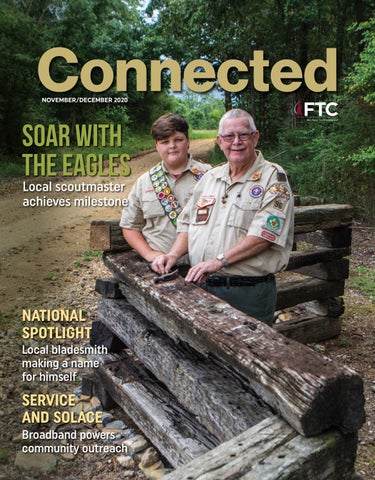
Soar with the eagles Local scoutmaster achieves milestone
NATIONAL SPOTLIGHT Local bladesmith making a name for himself
SERVICE AND SOLACE Broadband powers community outreach
INDUSTRY NEWS
Rural Connections By SHIRLEY BLOOMFIELD, CEO NTCA–The Rural Broadband Association
Being thankful for broadband in 2020
W
hen you’re making your list of things to be thankful for this season, make room for this: “access to broadband from a reliable, community-based provider.” This year has taught us many things, one being that broadband is vital to so many areas of our lives — work, school, health and more. I recently spoke with a journalist who has been covering the gaps in broadband connectivity across our country. She lives in a beautiful community in the mountains of Vermont and is lucky to be able to download emails — forget anything like streaming or VPN access. She has learned from working with NTCA and some of our members that building broadband is not a cheap proposition. There are physical hurdles (Vermont mountains?) that make the task even more formidable. Several months into a remote world, her office is closed and her options for connectivity are limited. She joins the ranks of local school kids in nearby fastfood parking lots trying to complete their homework while she tries to upload her stories. In the most prosperous country in the world, in 2020, she has realized the hard way that having a broadband connection has become a lifeline and a necessity — and that speed and capacity actually do matter. If you are holding this magazine, you are served by a community-based provider committed to keeping you connected. And that’s a reason to be thankful!
2 | November/December 2020
Wired up
C
Hot spots rely on fast internet networks
onnecting rural communities to reliable broadband networks represents a vital challenge for not only individual states but also the nation as a whole. Jobs, education, health care and more increasingly rely on fast internet
access. As state and national policymakers consider strategies to expand broadband networks, weighing the benefits of an often misunderstood technology might prove beneficial. Hot spots are described by NTCA–The Rural Broadband Association as wireless on-ramps to the internet that cover a small area. Many consumers and policymakers associate hot spot technology with cellular phones, because many phones have the capability of becoming hot spots to serve as gateways to the internet for other devices. NTCA, however, notes that these mobile connections represent only one form of hot spot. A fixed hot spot is created by use of a Wi-Fi router connected to a physical internet source such as a fiber optic network. These hot spots are common in homes, coffee shops, offices and more. During the COVID-19 pandemic, many rural telcos used this technology to provide free Wi-Fi connections at schools, churches and public spaces. The important point to remember is that wireless connections do ultimately need wires. Fast broadband networks make these Wi-Fi-based hot spots possible, because those wired links provide the final connections to the internet. NTCA emphasizes it’s important for policymakers to remember that the term “hot spot” is associated with far more than mobile phones. Robust rural broadband networks make Wi-Fi-based hot spots possible, bringing their power and convenience to your homes, businesses and more.
The 2020 gift guide G
SHOP FOR THE TECH THAT’S SURE TO PLEASE etting the right holiday gift for that special person in your life can be difficult. But whether they’re into technology, music, sports or “Star Wars,” our gift guide has something for everyone on your list.
69.99
$
200
$
Senstroke
Giving that budding Buddy Rich in your household a full-size drum kit is the fastest way to put yourself on the outs with your neighbors and less-than-appreciative family members. So, the Senstroke is a great gift for everyone. The Bluetooth sensors attach to drumsticks, as well as to your feet, allowing you to mimic a bass drum and hi-hat. Connect to a free app to play and practice drums on most surfaces. The app includes a learning mode for beginners and can also record, playback and export your performance in MIDI format. Complete kit: $280. Essential kit: $200.
The CrazyCap
The CrazyCap uses ultraviolet light to kill germs inside your water bottle. This means you never have to worry about a smelly bottle again, even if you leave it overnight in your gym bag. It self-cleans every four hours. And forget about running low on water during a hike. The manufacturer claims you can safely disinfect any debris-free water, so you can refill your bottle from rivers, lakes or streams. The rechargeable cap can also disinfect surfaces or objects, such as your smartphone or keys. CrazyCap can be purchased with its bottle or separately, and it fits most cola-style bottles. The company donates 5% of every sale to water.org, a group that helps people around the world have access to clean water. The CrazyCap with 17-ounce bottle: $69.99.
Gadget Discovery Club
96
$
For year-round giving to that tech junkie in your family, you may consider getting him or her a subscription to the Gadget Discovery Club. Every month, the service mails a new mystery gadget for you to discover upon opening the box. The promise from the company is that you will receive a high-quality item at a cheaper price than retail, with a one-year guarantee and a 30-day return period. Don’t expect to get an iPhone, but past deliveries have included gadgets such as fitness trackers, Bluetooth speakers and wireless earphones. Subscriptions range from $96 for three months to $276 for 12 months.
The Child Animatronic Edition
59.99
$
The creators of the hit Disney+ show “The Mandalorian” want you to call him The Child, while the internet knows him as Baby Yoda. Whatever his name is, he is undeniably adorable and ready to come home for the holidays. The Child Animatronic Edition giggles, babbles and makes Force effect sounds. It also features motorized movements, including eyes that open and close and ears that move back and forth. The Child even lifts his arm as he prepares to use the Force, after which he may need a “Force nap.” Demand will be high, so you may need an intergalactic bounty hunter to snatch one up or be quick on the draw at your favorite online retailer. $59.99 MSRP. November/December 2020 | 3
FROM THE CEO
Our reaction to challenges matters most
F
irst, let me thank all of you who were able to join us for our hugely successful “Business Unusual” Annual Meeting. We made some good lemonade out of COVID-19 lemons. With over 2,000 members participating, you made the 2020 meeting the highest attended in-person meeting in the history of the cooperative. Our employees genuinely enjoyed interacting with you, and we are glad you found the $20 bill credit as useful FRED JOHNSON as we hoped. And now to the subject of this column. Chief Executive Officer It seems as if everything I’ve written of late is dominated by the impacts and ongoing concerns connected to COVID-19. Frankly, like many of you, I am growing weary of it all. Still, the serious illness of several friends and colleagues keeps me quite sober in my assessment of the situation. Moreover, I’m coming to realize just how relatively easy a life I’ve experienced. Those of my generation understand that many of our parents had to endure the Great Depression, stave off attempts at world domination during World War II, and in later years suffer the horrors of the Korean and Vietnam wars. Suddenly, seven months of a pandemic, though serious it is, no longer seems like an excuse to feel sorry for myself. Nevertheless, there are moments when I find my stress levels impacting my reasoning and worry dominating my thinking. The national political debate and politicization of everything from masks to wildfires does absolutely nothing to calm my nerves. In the face of this noise, I am reminded of my faith and its teaching about worry. More precisely, worry does nothing but drain us mentally, physically and spiritually. Hopefully some of us have embraced the wisdom from the writer of Ecclesiastes: “There is a time for everything under the sun.” In this concept, there is perspective on the fleeting nature of life and all that we experience. We understand that nothing we experience is ever actually new. We are neither the first nor will we be the last to endure uncertainty and hardship. In short, life happens. It is how we react that matters most. I know many who read this do not share my particular faith, but I still have great respect for you and I sincerely hope you will always have confidence in the ability of good people to rise above their circumstances and do good. In troubling times, I also unapologetically encourage you to challenge people like me on the source of our faith. If we are honest with you, we will tell you we don’t have all the answers, because we don’t. But we’ve learned that asking questions ourselves is part of our journey. For all of us, let us please embrace the moments we are given and enjoy them while we can. Tomorrow will be here soon enough. Let’s take it one day at a time. EDITOR’S NOTE: Fred currently plans to forsake seriousness and spend his next column on a humorous note, sharing with you his efforts at writing a series of revisionist children’s stories for his grandkids.
4 | November/December 2020
Connected NOVEMBER/DECEMBER 2020
VOL. 24, NO. 6
Connected is a bimonthly magazine published by Farmers Telecommunications Cooperative, © 2020. It is distributed without charge to all customers of FTC.
FTC is the state’s largest member-owned provider of telecommunications services. It serves Northeast Alabama with a robust broadband network using world-class optical fiber technology.
Farmers Telecommunications Cooperative, Inc. P.O. Box 217 • 144 McCurdy Ave. N. Rainsville, AL 35986 Telephone: 256-638-2144 www.farmerstel.com
BOARD OF TRUSTEES Randy Wright, President Flat Rock Exchange Garry Smith, Vice President Fyffe Exchange Danny R. Richey, Secretary Geraldine Exchange Lynn Welden, Treasurer Bryant Exchange Kenneth Gilbert Pisgah Exchange Gregg Griffith Henagar Exchange Randy Tumlin Rainsville Exchange Produced for FTC by:
On the Cover: Don Brown, scoutmaster at Tenbroeck Boy Scout Troop 96, assisted Levi Doty, who became the troop's 100th Eagle Scout. See story Page 8.
Lifeline Voice Discount Phase Down
SIMPLIFY YOUR LIFE DURING THE HECTIC HOLIDAY SEASON! SmartHub is smart communication
SmartHub, a web and mobile app, allows you to do business with us like never before: Manage your account • Report service issues • View and pay your bill • Receive important notices
Sign up today!
•
PARDON OUR PROGRESS
during construction at the FTC office
NEW BUILDING
NO ENTRY
NO ENTRY
PARKING AVAILABLE
›››››
farmerstel.com/smarthub
All in the palm of your hand and online!
Pursuant to the FCC’s 2016 Lifeline Modernization Order, the current Federal Lifeline discount of $7.25 for voice service continues phasing down to $5.25 effective Dec. 1, 2020. The phase down of the Lifeline discount will only affect Lifeline customers with voice-only service or a bundle that includes broadband service that does not meet the minimum service standard.
MAIN ENTRANCE DOORS
CONSTRUCTION ZONE PHASE 2
DRIVE-THRU OPEN
CONSTRUCTION ZONE PHASE 1
ONE WAY
ONE WAY
NEW DRIVE-THRU
ENTER HERE HWY. 75
A new drive-thru entrance and customer parking coming soon in 2021! Farmers Telecommunications Cooperative
November/December 2020 | 5
TRAVEL
Visitors to Rock City’s Enchanted Garden of Lights in Lookout Mountain, Georgia, are greeted with traditional holiday cheer.
T
FESTIVALS of
LIGHT
Have a merry time 6 | November/December 2020
is the time for Christmas lights, and cities around the South tend to take the holidays to a whole ’nother level, brightening the season and lighting up the town. It’s time for brightly lit trees, warm cider simmering on the stove and scenting the house, and steam rising from mugs of hot chocolate. And it’s time to revel in the joy of the Christmas season with family, friends and lots of colorful displays of light. Rock City’s Enchanted Garden of Lights, now in its 26th year and named a Top 20 Event for 2019 by the Southeast Tourism Society, is just that — enchanting. There are more than 30 holiday scenes and a million-plus LED lights — more than ever before. As the lights brighten the night, Rock City Gardens’ daytime splendor is transformed into a fantasyland of brilliant wonder. For many, a trip to Rock City atop Lookout Mountain is a holiday tradition. For others, it will be a new experience. For all, it offers popular attractions preserved from years past, along with new adventures through the lights. There are four areas that light up each Christmas season: Yule Town; Magic Forest; North Pole Village, where Santa and Mrs. Claus live and work with their magical elves; and the popular Arctic Kingdom, which has a brand-new look this year, offering one of the world’s first of its kind — walk-through Christmas trees.
Also new this year are the fashions on Inara the Ice Queen and Jack Frost. They will be decked out in colorful, new garments to prepare them for a journey through a stunning display of ice crystals in the Arctic Kingdom with a design reminiscent of the aurora borealis lights. Within this area of the Enchanted Garden of Lights is the Glacier Grotto, which offers a firepit to warm visitors passing through. Treats to warm the body and soul are also found at the North Pole Lodge, where kids of all ages can enjoy gingerbread cookie decorating and sipping hot cocoa while enjoying live music. But that’s not all. Other presents Rock City offers for the season include the chance to enjoy dinner with Santa, storytimes with Mrs. Claus, pictures with Santa and greetings from Jack Frost, Inara the Ice Queen and other characters roaming through the Enchanted Garden of Lights. Whimsical light displays are part of a holiday stroll through Georgia’s Rock City.
Lights around the South Holiday lights shine all around the South this season. Here’s a look at some in your area.
● Magic Christmas in Lights Bellingrath Gardens, Theodore, Alabama Take a tour through the gardens and become illuminated with the more than 3 million lights sparkling throughout the gardens every Christmas. It’s a holiday event that has become a tradition along the Gulf Coast. www.bellingrath.org ● Natchitoches Festival of Lights Natchitoches, Louisiana The city’s historic district lights up with holiday spirit as hundreds of thousands visit annually for fireworks, parades, plays, historic tours and the charm of the oldest community in Louisiana. More than 300,000 lights drape the cobblestone streets decorated with garlands of greens. www. natchitocheschristmas.com ● Southern Lights Holiday Festival Kentucky Horse Park, Lexington, Kentucky Santa on horseback outlined with lights and other scenes are part of the 3-mile driving tour of the Kentucky Horse Park that attracts more than 120,000 visitors each year. www.kyhorsepark.com ● Anderson Christmas Lights Anderson, South Carolina Old Man Winter, Santa Claus, the Anderson Express and a salute to the military are among the 160 displays and 3.5 million lights that brighten the night at Anderson Christmas Lights. Warm up by the fire, roast some marshmallows, sing some Christmas songs and get into the holiday spirit. andersonchristmaslights.org ● Dollywood’s Smoky Mountain Christmas Pigeon Forge, Tennessee The mountains come alive with color and cheer as Dolly’s crew turns on the lights — 4 million of them — throughout the park. They are a backdrop for the amazing Parade of Many Colors and other events, including live shows with a holiday theme, such as the popular “Christmas in the Smokies.” www.dollywood.com
Mountain views are part of the Rock City experience.
Rock City Enchanted Garden of Lights
Nov. 20-Jan. 2, 4-9 p.m. (closed Christmas Eve) Rock City Gardens, 1400 Patten Road, Lookout Mountain, Georgia For information on special events and deals on weekday pricing during the holiday season, visit www.seerockcity.com/lights.
● Galaxy of Lights Huntsville, Alabama The Huntsville Botanical Garden is all decked out in holiday finery as the annual Galaxy of Lights turns the gardens into a fantasyland of lights and color. It’s a driving tour that takes you past nearly 200 animated displays, from those with holiday themes to dinosaurs and nursery rhyme characters for the kids. Special Galaxy of Lights Walking Nights are also available. Walk through snow falling inside a twinkling icicle forest, visit with Santa and enjoy hot chocolate along the way. www.hsvbg.org
November/December 2020 | 7
Flying high Local scoutmaster reaches milestone Story by LISA SAVAGE Photography by MATT LEDGER
G
rowing up, Don Brown worked on the family farm after school, and the weekly Boy Scouts meeting meant one less day of plowing or picking cotton. “The main reason I joined was to get out of farm work,” says the 67-year-old jokester who loves to keep people smiling. But he soon learned he loved everything about scouting, especially camping. “Back then, I even liked sleeping on the ground.” Brown’s love for scouting led to a recommendation from his high school teacher, the late Jimmie Hugh Harris, to become a scout leader at age 20. “She thought I could do it and that I’d be good at it,” Brown says. “She said she thought I could handle a bunch of boys.” It seems she was right. Now, 48 years later, Brown has helped a member of his Tenbroeck Troop No. 96 become the 100th Boy Scout in that troop to achieve Eagle Scout rank — the highest honor in the Boy Scouts of America. Having 100 scouts reach the Eagle Scout rank rarely occurs in the same troop and under the same leader, says David Gilbreath, advancement chairman for the
8 | November/December 2020
Sequoyah District of the Boy Scouts of America. The Tenbroeck troop falls under the guidance of the Sequoyah District. “Don has hit a milestone that very few troop leaders in the United States ever achieve,” Gilbreath says. Only 4% of scouts earn the Eagle Scout rank.
ARRIVING IN STYLE Brown’s inclination to get things done dates back to his birth in 1953. “I was born in the car, going down Highway 35 toward Fort Payne,” Brown says. “I couldn’t wait until they got to Dr. Noble’s office.” His parents, the late Chalmer and Claudia Brown, instilled many of the traits he believes led to his success as a scout leader. His own dedication plays in, too. Even in the early days, Brown made sure the scouts learned first aid, knot tying, cooking over an open fire and other survival skills on camping trips. “They might get scratches from the briars and have to swat mosquitoes, but hopefully, they learned something from that,” he says. Brown, a licensed school bus driver for 40 years, drove the troop’s bus to several
Don Brown has led many Eagle Scouts, including Levi Doty, who completed a split-rail fence as a project.
state and local parks and Boy Scout camps within a 100-mile radius. That’s as far as the troop’s liability insurance allowed. “A lot of times, I don’t think they had any idea they were learning something,” he says. “They just thought they were making memories.” Farmers Telecommunications Cooperative
As much as Brown and most scouts love camping and the fun activities, it’s about much more than having a good time. Boy Scouts in Troop 96 have compiled hundreds of hours of community service during Brown’s tenure. Projects like painting an old church, clearing brush and debris in a forgotten cemetery, building handicapped-accessible ramps at homes and schools, and clearing trails in local parks and at Camp Comer — a Boy Scout camp on Lookout Mountain — are just a few of the projects that keep his scouts busy throughout the year.
100 EAGLE SCOUTS On Brown’s sixth anniversary as scoutmaster, Bruce Wilson attained Eagle Scout, becoming Troop 96’s first scout to reach that goal. More scouts worked to achieve the Eagle Scout rank, and Brown guided them through projects — which the Greater Alabama Council, BSA, must approve. “There’s a lot of paperwork involved for a project to be approved,” Brown says. “It takes a lot of hard work and dedication from the scout.” When one of his scouts became the 50th in the troop to attain Eagle rank, Brown started keeping a tally. By then, many of those Eagle Scouts had moved on to careers and jobs, with several joining the military. Of the Eagle Scouts in the Tenbroeck troop, four have passed away, and a few went down difficult paths, Brown says.
“I had one young man who had to go before a judge for something he did wrong, and he came back to me and told me the whole time he was before that judge, he kept remembering the Scout oath,” Brown says. Levi Doty, the 100th scout in Troop 96 to attain the Eagle rank, says he had no idea his accomplishment marked such a milestone for Brown. “It was a big surprise to me, and I was excited about it because Don’s a great guy. He teaches us so much so that we’re better able to help others.” The Eagle Scout project Doty undertook included refurbishing a handicappedaccessible ramp at a small church in the area. Although the service aspect is part of the requirement, Doty says the reason for a Troop 96 scouts, from left, are Levi Doty, Ethan Burns, Skyler Harris, Cameren Haney, Parker Higgins and scoutmaster Don Brown.
Farmers Telecommunications Cooperative
project doesn’t matter to him. “I just love being part of the group and helping out in the community and knowing that we’re making a difference,” he says. Doty worked hard to earn Eagle Scout rank, and his parents, Ray and Chasity Jackson and Dustin and Amber Doty, say it’s an honor for their family. “It has been an honor for all of us to be a part of Don’s recognition because he does so much for those kids,” Amber Doty says. “He has made a difference in the lives of all these kids.” But Brown says it’s all the scouts — not just those who achieved Eagle Scout — who have made a difference in his life. “Some of these boys have come back and told me how much they appreciate having the Boy Scout experience, and that means the world to me,” he says. “I think they probably helped me more than I helped them.” Tenbroeck Troop 96 has won many state and national awards through the years.
November/December 2020 | 9
BROADBAND: HELPING YOU SERVE
Making a change High-speed connections power service organizations across the country
Chowgirls Killer Catering in Minneapolis leveraged online tools to better serve their community. Story by DREW WOOLLEY
I
n March 2020, Chowgirls Killer Catering in Minneapolis was busy preparing for its Sweet 16 party, complete with signature food and a swing band. Like many events in the early days of the coronavirus pandemic, the celebration was ultimately called off. The next day, while watching Minnesota Gov. Tim Walz recommend against large gatherings across the state, it occurred to co-owner and CEO Heidi Andermack that one canceled party was the least of her problems. “We had a big leadership meeting about what to do, because all our events were canceling,” she says. “Our chef, who had been working with Second Harvest Heartland, thought of calling them to see what they were going to do. We would have a big empty kitchen, so maybe we could work with them.” As service organizations, charities and churches throughout the nation learned,
10 | November/December 2020
creating connections to serve their communities meant relying more on online tools, broadband access and digital communication. They learned to talk, collaborate and succeed with the help of technology. Chowgirls had first partnered with Second Harvest Heartland, a member of the Feeding America network of food banks, on a food rescue program around the 2018 Super Bowl. The two groups met once again and created the Minnesota Central Kitchen to feed families in need. Chowgirls is now one of eight kitchens cooking for Minnesota Central Kitchen, preparing 30,000 meals weekly for hungry populations in the Twin Cities area. Large-scale donors such as restaurants, grocery stores and food distributors contribute ingredients, which are managed using Feeding America’s MealConnect app.
Chowgirls prepared 30,000 meals weekly.
“It’s a lot of meals to keep track of, so our high-speed internet has been pretty key to keeping it all coordinated,” Andermack says. “We also organize all of our meals and what is available using Google Spreadsheets. We’re not just tracking our kitchen but tying together a whole network of kitchens.”
Families & Literacy in Kerrville, Texas, combines GED and ESL classes with computer literacy.
In Smithville, Tennessee, the Rev. Chad Ramsey of Smithville First Baptist Church used online tools to stay connected to members.
WORSHIP ON DEMAND While the importance of online tools is nothing new to service organizations across the country, they have become all but essential over the last year. Rev. Chad Ramsey at Smithville First Baptist Church in Smithville, Tennessee, has relied on the ability to stream services online to reach parishioners who might find themselves homebound. “Streaming is huge everywhere,” he says. “We see that in the media world with Netflix, Disney+ and all the streaming services. But the same is true for the church.” Smithville FBC not only streams live services for parishioners who can’t make it to the church but also has its own studio for recording and uploading training videos for everyone from new members to those preparing for mission trips. With so many demands on the church’s internet service, Ramsey isn’t sure what they would do without a fiber connection. “We saw where things were going in this world and knew that having that ability to connect with each other would be important, whether it’s sharing files, videos, streaming or uploading to social media,” he says. “People are so much more connected than they have been, and if you don’t have that consistent and quality connection, you’re going to be left behind.” That approach has helped Smithville FBC build a church that appeals across generations, attracting millennials and seniors alike. And while their
preferences for how they worship may not break down as neatly as expected, the fiber connection provides the flexibility to meet everyone’s needs. “You might see someone really young who wants things to be done the way they were decades ago, and then there are other people who are much older who want to know why we aren’t making the changes we need to to be around for another 100 years,” says Ramsey. “That’s the challenge: Getting the focus not on style but the purpose. We’re here to serve God, not ourselves. That’s what makes us tick.”
DIGITAL LITERACY At Families & Literacy in Kerrville, Texas, it’s opening doors to people’s futures that makes them tick. The organization serves adult learners throughout the community and inmates of the Kerr County Jail, helping them to earn their citizenship or GED or learn English as a second language. While most of the classes Families & Literacy organizes take place in local churches or other off-campus locations, the in-office broadband connection has been particularly helpful in getting prospective students on the path to learning as quickly as possible. Not every student has access to a reliable internet connection at home, so the organization provides Chromebooks on-site so they can take placement tests and register for the appropriate classes. Families & Literacy even offers an
ESL class that incorporates computer skills, helping prepare students to be ready to communicate in the workplace and to better understand the tools they will be using day to day. “Computer technology is prevalent in pretty much every job you go to now,” says Families & Literacy Executive Director Misty Kothe. “It’s important that not only can our students speak the language and do the work but they can also efficiently use that technology. It just makes them more employable in the future.” Moving forward, broadband connections offer new opportunities for all three organizations. Families & Literacy aims to offer limited-size classes on location, outdoors if necessary, while Smithville FBC is eager to explore the possibilities of Bible study streaming services. Meanwhile, the Minnesota Central Kitchen project has proven so successful that Andermack now plans to incorporate its mission into Chowgirls’ regular operations even when the pandemic has passed. “We have always had a mission of reducing food waste, but now we’re looking at it as hunger relief,” she says. “It’s become essential to our business, helping us give jobs to chefs who would otherwise be unemployed and keep the lights on at our facility. Sometimes you just need to support each other, and it comes back in ways you don’t expect.”
November/December 2020 | 11
CUTTING EDGE
Sims finds fire for bladesmithing with forge Story by JOHN CLAYTON
J
ohn Sims looks back at the first knife he made for himself fresh out of Ider High School in 2016, and he chuckles. He kept the knife, of course. It wasn’t bad for an initial effort, but it was only the beginning for Sims as a bladesmith. The craft has since led him to a national television appearance and to a reputation as one of the top young craftsmen in the arena. “I have a great love and dedication to this craft and want to show the world what it is,” Sims writes in the introduction to his Sims Forge Facebook page. It all started in his parents’ backyard with a makeshift forge, which was admittedly simple and rustic, and a desire for a quality hunting knife. “It was a really simple forge, and I just started trying to make stuff,” Sims says. “It was really hard to do, and it just got me more interested.”
GETTING STARTED The forge was little more than a hole in the backyard, but the fire burned hot enough for Sims to fold and mold steel. At 18, he decided to teach himself the craft, which dates back centuries. He found a few resources online, such as the American Bladesmith Society, but he decided to make his own path. “You can call some of their people and get some advice, but I really didn’t turn to a lot of that,” Sims says. “I just kind of did my own thing.”
John Sims uses an anvil as he hammers a piece of steel into a knife.
When the blade is red hot, Sims strikes it with a hammer to shape the knife. 12 | November/December 2020
Farmers Telecommunications Cooperative
Over the past four years, Sims says he has developed a kinship with other bladesmiths, as well as customers and supporters who appreciate the craftsmanship that goes into firing steel and creating a blade. He delivers something that buyers can’t find in mass-produced knives. “You know, there’s a connection to something somebody has made,” he says. “You get to look at it and see how they are, based on the type of work they do and how tedious they are.” Sims says his meticulous nature comes through on each and every blade that bears his “J. Sims” inscription. Even though he has modernized and relocated his forge to his garage with a broader selection of tools, his work ethic has remained the same. A relatively basic knife can take the better part of a workday to create. “A very simple knife can take me anywhere from five to eight hours to make,” Sims says. “When it starts off, there’s just a bar of steel, and then I have to form it into the nice shape. Then, I go through the machining processes to make it flat, make it sharp. And then I go through more machining processes to create the handle, and after all of that, it’s essentially done.” Other knives are larger and more intricate, especially those that Sims considers his specialties, from utilitarian hunting and skinning knives to “frontier fighting knives” in the style of the famous Bowie knife, which takes its name from the Texas Battle of the Alamo hero Jim Bowie. “They’re just big, beautiful, elegant pieces,” Sims says. “They have simple lines, but they’re made just right. And the aesthetic — they would use really exotic woods for the handles, and they would have wrought iron or antler on the handles.”
AS SEEN ON TV Sims had been making knives for less than two years when he landed a spot on History’s reality television series “Forged in Fire,” which pits bladesmiths against one another in a three-round competition. After interviews, Sims flew to the show’s studio in Brooklyn, New York. He spent five days there with three other craftsmen and made it to the second round before elimination. “That gave me a lot of notoriety in the community and really
John Sims spends hours pounding metal and honing edges for the knives he creates.
got my name out there,” he says of his appearance on the television series. “It gave me a good amount of exposure.” The series has also given the craft a boost, kindling an interest in what could have been a dying art form. “It has started to make a big comeback ever since the show came out,” Sims says. During Sims’ appearances, the contestants created a Roosevelt Rough Rider Bowie knife with added “coffin handles.” They also made a Washington Colichmarde, which is the 40-inch small sword George Washington supposedly carried. “I came here to prove to myself that I am working down the right path of my craftsmanship,” Sims said after his elimination from the competition. “I believe I proved that to myself.” Sims said the experience brought him more than the show’s top prize would have. He formed fast friendships with the other competitors on the show — Andrew Smith, Josh Nicolaides and Dan Bourlotos — and still considers them his best friends. “That was one of the most fun experiences I ever had,” Sims says. “There was pressure from doing the work but not between us as competitors. Everyone was super nice, and we supported each other.”
Sims Forge online
instagram.com/simsforge facebook.com/simsforge
John Sims checks the glow as he shapes a knife.
Farmers Telecommunications Cooperative
November/December 2020 | 13
SOUTHERN KITCHENS
A tart treat Cranberries are a longstanding staple at holiday time
T
hey’re great with turkey and stuffing or baked in your morning muffin. Dried, they’re known as craisins and perfect sprinkled on a salad. A fixture on Thanksgiving tables or even wrapped around trees as a Christmas garland, the jolly red cranberry takes center stage at holiday time. People have been eating cranberries for centuries. Native Americans first used them as food and medicine, well before Pilgrims set foot here. The absence of sugar in the colonies in the early 1600s meant cranberries, which benefit from sweetening, were probably not at the first
14 | November/December 2020
Thanksgiving table. Nonetheless, it didn’t take long for them to become a part of that holiday’s menu, and today, consumers eat more than 80 million pounds of cranberries from Thanksgiving to Christmas. Every year, holiday celebrators enjoy more than 5 million gallons of the canned sauce that jiggles like Santa’s belly, and cranberries are a simple way to add color to your table and a sweet, tart flavor to your turkey. But as Americans are latching on to the farm-to-table trend, fresh cranberries are outselling the canned variety. Here are several tips from Vitamix for cooking with fresh cranberries: z Baking with cranberries — Cut cranberries in half before adding them to baked goods to prevent them from swelling and popping. z Cooking cranberries on the stovetop — Simmer whole berries gently in a small amount of water, uncovered, since
too much steam might cause them to swell and explode. z Freezing cranberries — To freeze and enjoy them throughout the year, spread the berries in a single layer on a cookie sheet and place it in the freezer. Once they are completely frozen, transfer the berries to freezer-safe bags or airtight containers. There’s no need to thaw your cranberries before cooking. Just give them a quick water bath before using. FOOD EDITOR ANNE P. BRALY IS A NATIVE OF CHATTANOOGA, TENNESSEE.
CRANBERRY APPLE HOLIDAY BREAKFAST CASSEROLE Make this casserole a day ahead. Casserole: 2 tablespoons softened unsalted butter, divided 3 large, firm, sweet tart apples, diced 2/3 cup fresh cranberries 8 large eggs 1 cup vanilla Greek yogurt 1/2 cup milk 1/4 cup maple syrup, plus more for serving 2 teaspoons cinnamon 6 cups stale bread cubes, crusts removed Streusel topping: 1/3 cup flour 1/4 cup rolled oats 3 tablespoons brown sugar 1/2 teaspoon ground cinnamon Pinch kosher salt 3 tablespoons unsalted butter, melted 1/2 cup chopped walnuts or pecans Make the casserole: Melt 1 tablespoon butter in a large skillet over medium heat. Add the apples and cook, stirring until they are starting to brown and become tender — 4 to 6 minutes. Remove from the heat. Stir in the cranberries. Grease a 9-by-13-inch casserole dish with the remaining 1 tablespoon of butter. Whisk the eggs in a large bowl. Add the yogurt, milk, maple syrup and cinnamon, then whisk to combine. Add the bread cubes and the apple mixture, and stir until combined. Transfer to the prepared baking dish. Cover it with foil and refrigerate up to 24 hours. Make the topping: Stir the flour, oats, sugar, cinnamon and salt in a medium bowl. Drizzle 3 tablespoons melted butter over the oat mixture, tossing with a fork until the crumbs are evenly moist. Add
Cranberry Crumble Bars Crust and topping: 2 1/2 cups all-purpose flour 1 cup sugar 1/2 cup ground slivered almonds 1 teaspoon baking powder 1/4 teaspoon salt 1 cup chilled butter 1 egg 1/4 teaspoon ground cinnamon Filling: 4 cups fresh cranberries 1 cup sugar Juice of half an orange (4 teaspoons) 1 tablespoon cornstarch 1 teaspoon vanilla Preheat oven to 375 F. Grease a 13-by-9-inch pan. In a large bowl, mix the flour, 1 cup sugar, almonds, baking powder and the nuts and stir to completely combine. Refrigerate. Preheat the oven to 350 F. Remove the casserole and topping from the refrigerator. Bake the casserole, covered, until heated through and steaming, 35 to 40 minutes. Break up any large topping pieces if necessary.
salt. Cut in the butter, using a pastry blender or pulling 2 table knives through the ingredients in opposite directions, until the mixture looks like coarse crumbs. Stir in the egg. Press 2 1/2 cups of crumb mixture in the bottom of the pan. Stir cinnamon into the remaining crumb mixture. Set aside. In a medium bowl, stir together the filling ingredients. Spoon the filling evenly over the crust. Spoon the reserved crumb mixture evenly over the filling. Bake 45 to 55 minutes or until the top is light golden brown. Cool completely. Refrigerate until chilled. Cut into 6 rows by 4 rows. Store tightly covered in the refrigerator.
Remove the casserole from the oven, remove the foil cover, and sprinkle the top with the streusel topping. Continue baking until the topping is golden and the casserole is puffed, 25 to 30 minutes. Allow the casserole to cool 10 minutes before cutting it into squares to serve. Serve with additional warm maple syrup, if desired. î‚š
November/December 2020 | 15
Presort STD US Postage PAID Permit #21 Freeport OH
P.O. Box 217 • 144 McCurdy Ave. N. Rainsville, AL 35986
Maybe Christmas doesn’t come from a store! Maybe Christmas perhaps means a little bit more — like a gig from FTC! BROADBAND INTERNET ACCESS WITH SPEEDS UP TO 1 GIG UPLOAD/DOWNLOAD No phone line required Includes Password Protected BLAST Ultimate Wi-Fi, with Wi-Fi 6 for residential service
1 GIG
$9350/month
FTC’s base Broadband Internet Access Service is based upon the best available speed technically allowed by the serving network — up to 100 Mbps download and 100 Mbps upload speed, unless otherwise specified. Uninterrupted or error-free Internet service, or the speed of your service, is not guaranteed. Actual speeds may vary by customer based upon time of day, network congestion, customer equipment and other factors. Services offered are subject to FTC’s Standard Terms and Conditions and Acceptable Use Policy. Some areas are not technically capable of receiving this service. Please call FTC’s Customer Service for details regarding service availability in your area. In accordance with Federal law and U.S. Department of Agriculture policy, this institution is prohibited from discriminating on the basis of race, color, national origin, sex, religion, age, or disability.
144 McCurdy Ave. N. • Rainsville, AL • 866-638-2144 • www.farmerstel.com FOLLOW US ON SOCIAL MEDIA: @farmerstel