G
E
O
R
G
I
A
LifeLine M
A
G
A
Z
I
N
E
TAKES 2
Every Abortion Involves at Least One Man
Zemmie’s Rescue An Adoption Story
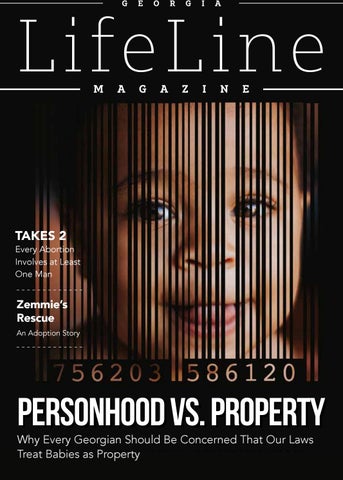
PERSONHOOD VS. PROPERTY Why Every Georgian Should Be Concerned That Our Laws Treat Babies as Property
1
A New Tool to Promote LIFE! Welcome to the very first issue of Georgia LifeLine Magazine.
response to the mainstream media’s cheapening of life.
If you watch the news, you’ve noticed how cheap life is today. The murder rate is up in most major cities. Riots are destroying the livelihoods of hardworking people. But it doesn’t end there.
This new medium will insist on a vigorous and sacrificial nurturing and protection of life in our communities. This isn’t about color, gender, ethnicity, or abilities. This is about the dignity of every innocent human life from conception to natural death.
During the COVID-19 public health emergency, some states trapped the elderly in assisted living facilities with infected patients, resulting in large losses of life. And in many states, including Georgia, churches were closed while facilities offering elective abortion were allowed to stay open – and business was booming. The media does not report about the babies saved in pregnancy centers around Georgia. The centers’ staff members are true heroes who quite possibly save more lives daily than any other frontline workers. Yet the media ignores their stories. So now it’s time for a new medium, one that tells the stories of hometown heroes who save lives every day. It’s time for a medium that values every life. It’s time for a medium that has a powerful
2
Ours is a culture that “commodifies” people – often in the guise of empowering or protecting them. We see the devastating effects of this trend in our neighborhoods and counties. It’s time for a medium that sheds a new light on personhood. Georgia LifeLine Magazine is that medium. It is dedicated to chronicling a holistic vision of Personhood. It starts with a rigorous defense of life from a legal perspective. You are either a Person or you are property. When slavery ended over 150 years ago, the idea of using people as property was supposed to end. Elective abortion shows that our nation still sees some people as property. This must end! Georgia LifeLine Magazine is all about honoring the families, churches, organizations,
leaders, and volunteers who fight for life. These invaluable servants show with their lives and sacrificial service that the God-given inalienable right to life must be cherished and protected from all lethal threats. Our hope is that our readers will be inspired to advance Personhood within their own communities. On a grassroots level, this new medium will help you impact your sphere of influence. You can use this tool to take the stories of LIFE to the streets of your neighborhood. Our hope is that this magazine will be a catalyst to restore the sanctity of LIFE to our communities. It will give HOPE to lives in need. And it will show how the LOVE of Christ can impact all of our lives. We hope this magazine is the tool God uses to help our communities value life, and that it enables generations now living to pass along that vision of advancing personhood to generations yet unborn. Yours for Life,
Ricardo Davis Ricardo Davis
INSIDE Letter From the President: A New Tool to Promote LIFE! . . . . . . . . . 2 Personhood vs Property: Why Every Georgian Should Be Concerned That Our Laws Treat Babies as Property . . . . . . 4 Zemmie’s Rescue: A Story of Hope for 5 Orphans . . . . . . . . . . . . . . . . 8 Jessica’s Story and the Teenbreaks Ministry . . . . . . . . . . . . . . . . . . . . . . . . . . 11
Scripture Verse Open your mouth for the mute, For the rights of all the unfortunate. ~ Proverbs 31:8
Contact information Georgia Right to Life P.O. Box 2665 Norcross, GA 30091 770-339-6880 stateoffice@grtl.org www.grtl.org
Officers •
Ricardo Davis, President
•
Abigail Darnell, VicePresident
•
Daniel Weller, Treasurer
•
Christine Braski, Secretary
State Office Staff •
Zemmie Fleck, Executive Director
•
Steve Bowman, Development Director
•
Wayne DuBois, Media Specialist
•
April Fry, Education Director
•
Elizabeth Greenewald, Communications Director
•
Susan Kennamer, Volunteer Office Assistant
•
Liliana Kiser, Accountant
•
Pat Kozak, Volunteer Office Assistant
Mission Statement
•
Genevieve Wilson, Chapter Development Director
Georgia Right to Life’s mission is to recognize the dignity of and restore legal protection from lethal threats to all innocent human lives, from earliest biological beginning to natural death, through service, education, public policy, and political action.
© Georgia Right to Life Committee, Inc., Fall 2020
Takes 2: Every Abortion Involves at Least One Man . . . . . . . . . . . . . . . . . . . . 12 Chapter Focus: Terry Queen answers the calling to help the pro-life movement in Walton County . . . . . . . . . . . . . . . . . . . . 16
3
Personhood vs Property Why Every Georgian Should Be Concerned That Our Laws Treat Babies as Property By Ricardo Davis Imagine what your life would be like if you were the property of another human. Your owner could do with you as he or she wanted. Today in Georgia, he could use your body for economic gain – sex trafficking. Today she could dispose of you if you became an inconvenience, claiming her complete legal autonomy to do so is “reproductive justice.” Your owner could make lives a business, and amass a lot of money doing so. Yes, he could even make ending your life a sport if he so desired.
4
In the 2000 epic historical drama Gladiator, actor Russell Crowe illustrated this. Many gladiators were sacrificed for an afternoon’s entertainment in the Coliseum. Lesser known today is the Roman contempt for young life. Before birth and well after it, a child’s life was never secure. Both Cicero and Seneca advocated the killing of weak or deformed children. Abortion, infanticide, child sacrifice, and child abandonment were all normal in Greco-Roman culture and widely practiced.
Many are familiar with Lord Acton’s quote, “Power tends to corrupt and absolute power corrupts absolutely.” In his treatise Human Sacrifice, Acton traces from antiquity how different cultures and religions around the world practiced human sacrifices. From my vantage point, the treatise illustrates the corrupting power of stripping fellow humans of their personhood, whether for cultic or civil purposes. W.E.H. Lecky wrote that, “Infanticide was one of the deepest stains of the ancient civilizations.”
Early Christians were notable for their stance upholding the worth of children. They understood that each person was created in the image of God, and lived out that truth even to the point of illegally saving abandoned children and adopting them. They were at odds with the ancient Roman Empire. Another historian, Ferdinand Schenck, wrote that “The intrinsic worth of each individual man and woman as a child of God and an immortal soul was introduced by Christianity.” That concept went deep into the conscience of Rome, and later Europe. After making Christianity legal, Emperor Constantine enacted many laws to protect human life.
Now the exceptions are becoming the rule. Persons are becoming property – things that can be used by more privileged people or the state.
Follow The Money Evidence of the decline of personhood abounds, from erosion of the rule of habeas corpus, to property confiscation without due process, to human trafficking – and much more. But the most serious setback is that certain classes of people
can be deemed non-persons by law. And if they’re nonpersons, they’re property – to be bought, sold, discarded, or used as desired. Just follow the money and you’ll understand why some people want to own other people as property. It’s self-evident in the elective abortion industry. “My body, my choice” is more than just political sloganeering by the abortion lobby. By the end of the 19th century, America had extinguished
Follow The Chain Of Events You’ve probably heard of philosopher Richard Weaver’s famous dictum “ideas have consequences.” The idea that life is sacred – even in the weak, deformed, or unwanted – made its way from Jesus to His followers, to cultures, to governments, and even to laws. It took centuries to happen, but those laws, and that idea, held sway for many more centuries in the West. Today, they’re losing ground. Modern legal systems, particularly in the Western common law nations, see all things as either persons or property. For hundreds of years, with unfortunate exceptions, human beings were held to be persons from conception to their last breath.
5
the resurgence of elective abortion, commonly referred to as “medical malpractice,� by dealing with the corruption in state and local governments that allowed its practice. With the rise of social Darwinism on the one hand and political libertinism on the other, the 20th century ushered in unrestricted elective abortion on Georgia babies during their first three months of life in the womb. Babies in the second and third trimester had only slight protections, easily circumvented by law or practice. Babies became property, and were rendered so by legal constructs that changed their status.
6
Now 21st century America is removing the scant protections as states governments are funding elective abortion and permitting infanticide with those children that survive an attempted abortion. Legislative attempts to declare the personhood of the pre-born child are legal dead ends when the legislation fails to treat elective abortion as homicide.
Legalizing Experimentation and Extermination Much like Germany in the 1940s, the laws in the U.S. allow for experimentation on and extermination of pre-born babies. An experiment conducted in
2008 provides the disturbing proof that babies are considered property. Cornell University researchers experimented with genetic modification in humans. They injected a fluorescent gene from an Australian jellyfish into a healthy pre-born infant. The goal was to see if the child’s cellular division would pass on the fluorescent trait. It did. The baby became the first animal/ human hybrid and glowed in the dark. Later, the baby was killed under regulations that permitted government-funded human embryonic research. To date there are no federal restrictions prohibiting privately funded
research on children at the early stages of their lives. If you find this event chilling, you’re not alone – but the mentality is nothing new. The Nazi medical researcher Josef Mengele experimented in a similarly inhuman way. Like the Cornell researchers, he treated his subjects as property – as things he could manipulate any way he liked. Lutheran pastor and anti-Nazi dissident Dietrich Bonhoeffer’s take on this mentality in German culture was incisive. “Destruction of the embryo in the mother’s womb is a violation of the right to live which God has bestowed upon this nascent life. To raise the question whether we are here concerned already with a human being or not is
merely to confuse the issue. The simple fact is that God certainly intended to create a human being and that this nascent human being has been deliberately deprived of his life. And this is nothing but murder. A great many different motives may lead to an action of this kind; indeed in cases where it is an act of despair, performed in circumstances of extreme human or economic destitution and misery, the guilt may often lie rather with the community than with the individual. Precisely in this connection money may conceal many a wanton deed, while the poor man’s more reluctant lapse may far more easily be disclosed. All these considerations must no doubt have a quite decisive influence on our personal and pastoral attitude towards the
person concerned, but they cannot in any way alter the fact of murder.”
The Way to Advancing Personhood The mentality that classifies some people as property is disturbing. Many people justify it with utilitarian thinking. The history of mankind illustrates that a low view of human life does not confine itself to those we don’t care about. It will eventually affect every one of us. Before long, any one of us could be targeted and stripped of our personhood. The first step to reverse the cheapening of life is restoring the Christian legacy of personhood in our communities. Georgia’s abortion laws are like a longabandoned building: there is little to no protection to the child from the icy death grip of winter. Unless families, churches, social service organizations, businesses, and elected officials in Georgia work to rebuild protections for all innocent human life from lethal threats, no statewide effort or legislation will reverse the trend. In the 19th century, local efforts exerted pressure to end the American slave trade by refusing to obey laws that sustained it on one hand and providing shelter and protection to slaves that escaped on the other hand. Because people aren’t property, it’s time to apply similar pressure to end elective abortion across Georgia.
7
Zemmie’s Rescue
A Story of Hope for 5 Orphans By Zemmie Fleck
THANK YOU to all the amazing and wonderful people in communities across Georgia who have served and loved orphaned or abandoned children by adoption, foster care, or by supporting other involved parents. When I was 13 years old, my Daddy told me this story.
In November of ’64, a little girl became the newest addition to a family in midtown Atlanta. She had two brothers and two sisters – ranging in age from 4 to 14 years. Her oldest brother and sister, invited by school friends, would frequently attend the First Alliance Church. Her father was habitually absent as he struggled with alcohol abuse, periodically demonstrating a violent temper. Her mother, who was quite a bit younger than her father, was cast upon hard times trying to raise a family. None of these children knew what lay ahead for them in the next four months. 8
Several months prior to the little girl’s birth, her mother suffered an injury to her leg that turned gangrenous. She grew increasingly ill and was unable to afford even one visit to the doctor. The children would often be very hungry and lack ability to concentrate in school due to their inadequate diets. In March 1965, the children’s mother died of tetanus that had turned into lockjaw. Sadly, their father was unable to sufficiently provide and care for the children, and took his leave again. For two days after her mother’s death, the fourmonth-old girl’s welfare was in the hands of her older siblings and a family friend. They were alone, abandoned, and unable to comprehend what was happening to them. There were some relatives who lived far away, but they didn’t seem to have
the ability to take on five children. None of them could or would step up to the responsibility. What was going to happen to five abandoned children?
Hope Comes Through a Young Couple God’s providence often comes in a form we don’t expect. This time it was a young couple. He came from middle Georgia; she was from a small southern Alabama town. Their lives converged in Atlanta at the First Alliance Church. At age 32 she was the church secretary. At 37 he was a young men’s leader at the church, and made his living in residential and commercial painting. They were married on July 2, 1964. They began their lives as newlyweds in a one-bedroom apartment in downtown Atlanta. Neither of them could imagine what was in store for them in the next eight months. In March of 1965, the couple was informed through church members that there were five siblings whose mother had died, and had no one to take care of them. The couple was familiar with the two older teens who came to church with friends. They also knew there were other children at home. Once the husband heard about the mother’s death, he jumped into action. While working at her church office, the wife received a surprising directive from her husband. “You need to tell them that you won’t be coming to work as of tomorrow.” He went on to tell her that he was bringing a family of five home to live with them! He didn’t wait for someone from the Department of Family and Children Services to come or allow the children to go into foster care. He drove and picked up all five children and brought them to live in the one-bedroom apartment that he and his wife shared. The boys slept in bunk beds on the screened porch, the two older girls slept on the living room sofas, and the baby girl slept in a crib in the hallway outside the bedroom of her new parents.
Top: 1965 – Author, being held by adoptive father, with her four older siblings. Middle: 1967 – Author, held by adoptive mother. Bottom: 1973 – Author with younger sister and baby brother (born to her adoptive parents.)
And so it began…
9
My days were busy with schoolwork. I loved school and always pursued the best grades possible. I began piano lessons at a young age. Chores and work were part of everyone’s life, and were expected to be done well. We had more than enough food at every meal, and my mother would take hours poring over the store ads to find the best food prices. Grocery shopping was quite the ordeal. My daddy would take trips out to the state farmer’s market and bring home bushels of vegetables in a single visit. We would spend hours prepping and storing the food for canning and freezing.
2012 Family – The author (far left) and her siblings, celebrating their Mother’s 80th Birthday (May 2012)
My Life Changed That Day As you might have guessed by now, the baby girl was me. From that point forward, my life was very different. Growing up in Decatur, Georgia, I experienced one of the best childhoods that anyone could desire. I always felt a specialness embedded in my Mother’s sweet smile and my Daddy’s smiling eyes as they regaled me with stories of my very young childhood days. My memories are full of fun, laughter, hard work, and a priority on church activities, daily prayer, and Bible memorization. I attended the neighborhood public elementary school, where the teachers and principal began each day with Scripture reading or a Bible story. I had many carefree days, and my parents shielded me from much of the evil that was prevalent then. We didn’t have a television in our home for all the years that I lived there. Looking back, I can say that it didn’t hurt me one bit to miss out on TV.
10
My mother spent her days cooking, sewing, baking, washing clothes, and performing bookkeeping tasks for my daddy’s business. As I got older, I went to work with my daddy. The Lord blessed him with a skilled mind and hands to provide for his family. He sometimes worked 20hour days in order to meet the needs of his wife and family. He taught his children that hard work and “doing what you said you would do” were very important. However, the most important thing that my parents taught us was to trust God in everything and wait on His provision. I could give many stories and examples of what my parents did throughout their lives to exhibit God’s love to other people. I attended a private Christian high school and graduated in the top of my class. There were times when I didn’t listen to the advice of my parents. I chose my own way, strayed from the Lord, and thought I knew much better; I learned many things the hard way. I cling tightly now to the lessons and truths that my parents taught me years ago. They have greater meaning and value now than they ever did. As an adult, my life as a mom of three boys has been challenging, but also rewarding. I’m greatly blessed by God’s tremendous love that He has bestowed on me. He expanded my family to include seven beautiful grandchildren. One
grandson bears my father’s middle name, and one granddaughter carries my mother’s maiden name. I pray that my children, my grandchildren, and their children will understand the impact that my parents had on me.
Loving Children – Growing Families The family that was formed in 1964 was blessed with two additions – a sister in 1968 and a brother in 1973. God’s amazing providence created a beautiful family that presently includes seven children, twelve grandchildren, and twenty-one great-grandchildren. Family means everything to me – the laughter, the crying, the grief, the heartbreaks, the joys, and the celebrations. My adoptive parents, Fred and Mary Jane Farr, thought that my siblings and I were worth the sacrifice, and they made all the difference in my life on earth.
Author’s adoptive parents, Fred and Mary Jane Farr
That same spirit of sacrifice on behalf of the vulnerable fuels my service as the Executive Director of Georgia Right to Life. My prayer is that the Lord will use the organization to restore legal protection to all innocent human life, and the recognition that each person is made in the image of God with the inalienable right to life.
Jessica’s Story: How Use of Social Media Reaches Teens for Life Teenbreaks.com is
”I struggled a long time over whether to keep my
created by teens,
baby, but I finally decided to give her up for an open
for teens, to help
adoption. I love my unborn daughter and wanted her to
teenagers dealing
have the best. On January 16, we gave our baby to her
with pregnancy and
new family. It was extremely hard for my boyfriend and
abortion concerns.
me.
Through its partnership with the Rosetta Foundation – the creator of Teenbreaks – Georgia Right to Life successfully engages thousands of young Georgia women through Facebook ads directing them to the website. Here is 15-year-old Jessica’s Teenbreaks story:
I just wanted to thank you for all the support I have gotten through your website. After reading about all the girls who parented, adopted, or aborted, it helped me realize that I am lucky... and that I made the right decision for my daughter.”
11
TAKES 2
12
Every Abortion Involves at Least One Man A few years ago, I was asked to speak at a Baylor University chapel service. And while there were a lot of things I wanted to say to the students, what I felt compelled to let them know was what happened to me there. I told them that I came to the school to get a Christian education, but what happened is that I got a girl pregnant – and I paid for her to have an abortion. By Stephen Arterburn
I didn’t fully grasp what I had done until about three days later. That’s when it really hit me. This shame just came over me. I had destroyed the life of my own child. And I just – I just couldn’t believe it. There was nothing I could do to reverse it or undo it. It was done. I felt like I had sinned too much, gone too far. God could never use me, never forgive me. There was no funeral, no way to grieve, no one I could talk to. The silent shame started ripping
through me, and I had so many ulcers that I ended up in the hospital. I was dealing with the physiological effects of postabortion syndrome – the guilt, the shame, and the silence. It was horrible.
More honesty required A few days after I shared my story with the Baylor students, I received a phone call from the young lady I had been involved with. And she said, “I heard you told our story at Baylor Chapel.” “Yes,” I said. “You know, I – I hope I did it in a way that no
one would know that you were the person.” “Oh, no, that’s not a problem,” she said. “I heard you said that you paid for the abortion.” “Yes,” I said. “I wanted them to believe that I was responsible.” “The next time you tell it,” she said, “maybe you should be a little more honest.” “What do you mean?” I asked. “Well, you didn’t just pay for the abortion,” she said. “You pressured me to have that
13
abortion. You made sure I knew that you wouldn’t be there for me or for our baby that I wanted to bring into this world. You pressured and you pressured. So I just did it because I didn’t think I had a choice.” Well, it was pretty tough to hear just what a coward
I didn’t marry her. Years later, I married, and we very quickly discovered that we were an infertile couple. We could not have children. Seven years and thousands of dollars worth of trying, but every Mother’s Day was worse than the Mother’s Day before.
anything as a result of that shameful thing that I did. The unspoken shame of abortion shows up in so many areas, and so many times the woman takes full responsibility. And yet every abortion involves at least one man. It could be a boyfriend, a husband, a
I’ve learned that the man’s role doesn’t end once a baby is conceived. The man’s role is to provide for and protect the life he’s created. When you don’t do that, and then you move to destroy that life … well, that was a tough reality to face.
I had been! When that wonderful young lady and my baby needed me to be a man, I had been anything but.
Facing reality I’ve learned that the man’s role doesn’t end once a baby is conceived. The man’s role is to provide for and protect the life he’s created. When you don’t do that, and then you move to destroy that life … well, that was a tough reality to face.
14
Then some Christian comes up to me and says, “Have you ever thought maybe that the reason you can’t have children is because you paid for an abortion when you were in college?” As if I didn’t have enough shame and regret! That person, of course, would have me believe that every bad thing in my life is a result of the abortion, and I was just getting what I deserved – that I should be willing to experience
father, a pastor, a physician or a counselor. So often I hear a woman say, “I chose to have an abortion when I was 14.” But the reality is that she didn’t choose it; she had an abortion done to her, put upon her by a man – a cowardly man just like me.
Finding forgiveness And yet there is hope and healing. For those of us who have
chosen to end a life, we can live in that shame and that condemnation. We can focus on what was and what might have been. And we can live in that shame. Or we can live as God wants us to live – free of guilt, shame, and condemnation. Look at what it says in Hebrews 8:12 – “And I will forgive their wickedness, and I will never again remember their sins” (NLT). If you believe the Word of God is true, then you must believe that He wants you to live as if Jesus really did wipe out the consequences and pay the price for your sin. Again, in Hebrews 10:17-18, it says, “I will never again remember their sins and lawless deeds. And when sins have been forgiven, there is no need to offer any more sacrifices” (NLT). You do not need to sacrifice your life. You do not need to do what I did. I thought it was my calling to make God know that nobody felt worse about their sin than me. That’s what Satan wanted. That’s not what God wanted.
Grace for all God has grace for every story – grace for yours, and grace for mine. And that grace began to unfold in the summer of 1990. It
was July 3, and I was in Atlanta for a speaking engagement. That day I had lunch with my publisher, Victor Oliver, and he asked, “What are you going to do about children?” “Well, you know,” I said, “we’ve been doing this for seven years now, and I think we’re gonna look into adoption.” We didn’t know anything about it. Victor said, “Steve, my best friend’s daughter lives here – she’s 16, she’s pregnant. The boy is 16. They can’t raise this child. They’re looking for a Christian couple to be the parents of their baby. Would you like to meet them?”
of God of grace and mercy that we have. A lot of people don’t believe that. They think that God wants us to suffer and that there’s no blessing for those who sin. And Madeline Arterburn was born on Christmas Eve. I have the blessing of being a man who can share his past of death and destruction with acceptance – and to say that every bit of grace and mercy that God has given to me, He has also given to each and every one of us. Copyright © 2019 by Stephen Arterburn. Used with permission.
The best present ever On July 4 we met this couple. They did the courageous thing – they didn’t have an abortion like I had chosen. And they decided that we would be the parents of their baby. So we flew back home and prepared to be parents. We received a phone call on Christmas Eve 1990 … our baby had been born. We flew to Atlanta on Christmas Day. And for some reason, I don’t know why, that nurse brought this darling, gorgeous baby and put her right in my arms. It was like God was giving back to me the very thing that I had destroyed. That’s the kind
Stephen Arterburn is the founder of NewLife Ministries and Women of Faith. He is a bestselling author with over 12,000,000 books in print such as, Every Man’s Battle, Healing Is a Choice, and Take Your Life Back. He is host of NewLife Live and the teaching pastor of Northview Church in Carmel, Indiana. Much of his speaking time is spent raising money for women’s resource centers. He can be reached at sarterburn@newlife.com.
15
Chapter Focus: A Tireless Advocate
Terry Queen answers the calling to help the pro-life movement in Walton County By Patrick Graham
In Proverbs 6, the author, possibly Solomon himself, lists six things the Lord hates or considers an abomination.
protection of the pre-born.
One of the first items on the list, found in verse 17, is “hands that shed innocent blood.”
“I just feel an obligation to help those who can’t help themselves, who can’t stand up for themselves,” Queen said. “I think in some ways I just feel called by God to help save innocent lives.”
This Bible passage is one Terry Queen often cites when explaining why he is so committed to the pro-life movement and so passionate about the
For all he does locally, across the state, and throughout the nation to follow his calling, The Walton Tribune named Queen a 2019 Unsung Hero.
16
affirming mission. “He is so life-affirming in every aspect of his life,” Yvonne Genest, longtime executive director and current development liaison for the PRC, said. “Not just in this ministry but in his relationships in the community, his family relationships, his church relationships. He just takes hold of wherever God has placed him and he gives 150%. It is an honor to know him, to serve alongside him, and without him we would not be the ministry we are today. No doubt about that.”
‘The world would be such a better place if we had more Terry Queens in it.’ – Yvonne Genest, development liaison, Pregnancy Resource Center of Walton
“I just like to inform and educate people about what’s going on,” Queen said. “Sometimes it’s a tough job. I mean, it almost feels like a stand alone job, like you’re a little lonesome sometimes, but it doesn’t stop me from doing what I feel like I am called to do.” Queen is not alone, however. He has been able to put together a strong coalition of like-minded individuals as the president of the Walton County chapter of Georgia Right to Life. In this capacity, which he has served in since coming back to Monroe in 2008, Queen organizes events and meetings throughout the year to promote the pro-life cause. He makes sure local residents have the latest word on proposed and enacted changes to the law, and how they impact the unborn, infirm, or elderly.
Genest said that Queen is one of those rare individuals who makes you a better person just by knowing him. She described him as a caregiver, caretaker, and protector of family, friends, and mission. “He has so much integrity and his motives are so pure,” Genest said. “The world would be such a better place if we had more Terry Queens in it.” The Rev. Jeff Box, the pastor of Queen’s home church, Walker Baptist Church in Monroe, agreed. Queen attends Walker Baptist with his wife, Nancy. The couple has two adult children, Sammy, 50, and Nell, 47. “Terry is a faithful servant, someone you can really count on,” Box said. “He is a Godly man and a champion of life at all stages.” Box said he and his wife, Kristie, recently adopted three young children – Colby, Lydia, and Joy – to
Queen has also been on the Board of Directors of the Pregnancy Resource Center of Walton since 2009, and he has been instrumental in the success of that nonprofit organization’s life-
17
award than Terry,” Box said. Queen moved back to Monroe in 2008. At that point, he had already been involved in the pro-life movement for a number of years.
join their older two biological children – Dalton and Matthew – as part of their family. Box said Queen was a tremendous friend who was supportive every step of the way, most importantly when the long process seemed overwhelming at times. “I can’t think of anyone who would be more deserving of this award than Terry,” Box said. “Even though he is not going to think he deserves it, which is exactly why he does.” Queen was born and raised in Monroe, a selfproclaimed “lint head” from just south of the mill village area of the city. He has three brothers and three sisters, and one of his brothers is his twin, Jerry. They were born in October 1944 in the old Walker Queen Park hospital, with Terry being the younger of the two. “I’m the little brother by 15 minutes,” Queen said. “He always brought to my attention that he had seniority over me.” Queen went on to get a degree from Southern Technical Institute, which later became Kennesaw State, in 1965. He went to work in the mills locally before working at mills in other parts of the southeast and state. “I can’t think of anyone who would be more deserving of this [Unsung Hero]
18
“I’ve met some of the most amazing people in the pro-life arena,” Queen said. “I believe locally we are having an impact, and the pendulum is beginning to swing toward our way of thinking. Statewide and nationally is another story, but we have a little bit of impetus now with what is going on in other places like New York and how that is catching everyone’s attention.” Dan Becker, former president of Georgia Right to Life and founder of the pro-life Personhood Alliance, recently told approximately 100 people attending the Walton chapter’s semi-annual meeting how important Queen was to the cause. “In over 40 years of pro-life activism, I say this sincerely, [Queen] is one of the top 10 pro-life activists I have ever seen,” Becker said. “If we had more Terry Queens, abortion would have already been banned years ago.” Queen said the key to eliminating abortion is changing hearts and minds. It’s even more important than changing the law. “It’s already against the law to kill somebody, to rob somebody, but that still happens because of what is in people’s hearts,” Queen said. “I want to see hearts change toward the issue of life. I want people to see God has made all of us, that He has a plan for all of us, and that we don’t have a right to change or short circuit that.” (C) Reprinted by permission of The Walton Tribune (www.waltontribune.com)
Tiny Billboards That Make a Difference Across Georgia, tiny billboards carry a crucial message. Those who purchase these little ads from the State help fund important services for a particularly vulnerable population – pre-born babies and their mothers who, for any of a myriad of reasons, are not considering motherhood. These billboards are Choose Life license plates. Over 3,000 plates travel along our highways displaying a meaningful logo and the life-affirming message. Every year, Georgians who purchase the plates create streams of income for pregnancy care centers and clinics where pregnant women of all ages receive holistic help and hope for themselves, their families, and their babies. Choose Life and other license plates benefit nonprofits by sharing revenue from an annual specialty tag fee. The Choose Life tags first went “on the road” in fall of 2007. To date, over $400,000 has been given to pregnancy care centers to meet pressing needs. These centers offer women resources they need to make informed decisions about their developing babies. Many offer limited medical services,
including prenatal ultrasound imaging. All offer empowering information and tangible supplies. The goal is to show women that carrying a child to term and either parenting or entrusting them to adoptive parents are life-giving and possible options in what can seem like an impossible situation. Adoption professionals equip staff and front-line volunteers to discuss modern adoption practices accurately. Choose Life of Georgia requires centers receiving funds to provide instruction annually because, while center personnel are comfortable depicting parenting and abortion accurately, presenting adoption is complicated by our culture’s perceptions. Those perceptions are often skewed by the secrecy of previous generations and faulty TV and movie portrayals that cast life-giving options in a negative light. You can buy Choose Life license plates when you register a recently purchased car, or you can exchange your old tag at renewal time. The Choose Life of Georgia website www.ChooseLifeGA.org has all the details.
The new design for the Choose Life license plates illustrates a trusting child’s hand resting in a loving adult’s -- a warm image of parenting or adoption. Previous versions of the plates display two young children. Response to the new design has been excellent. 19
Principled
Professional
Pro-Life
Coverages for all lines of business including: • General and Professional Liability • Auto • Medical Malpractice • Worker’s Compensation • Directors and Officers • Volunteer Accident • Cyber Liability • Umbrella/Excess Coverage • Property • Adoption Liability • Physicians, Nurses and • Sexual Abuse/Molestation Sonographers • And more… • Exclusive access to pro-life insurance company
Compassion, care, and protection for the non-profit community.
20
Patriot Insurance Agency Inc. (800) 859 2724 | www.patriot-insurance.com