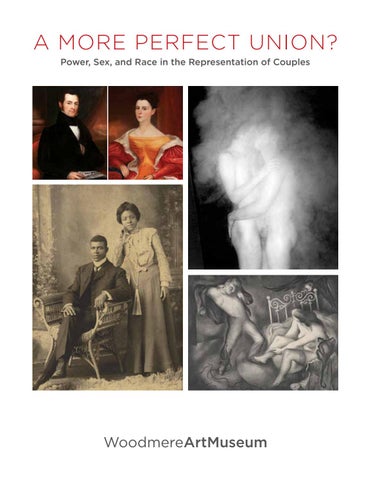
A MORE PERFECT UNION? Power, Sex, and Race in the Representation of Couples
WoodmereArtMuseum
A MORE PERFECT UNION? Power, Sex, and Race in the Representation of Couples
CONTENTS
Foreword 2 A Conversation with the Artists 8 Works in the Exhibition 50
February 4–May 21, 2017 Woodmere extends sincere thanks and appreciation to the William Penn Foundation and Linda Lee Alter for their generous support of this catalogue and exhibition.
WoodmereArtMuseum
FOREWORD
a puzzle of meanings that might require learning
It was from this conversation with Frank that the
new forms of communication (such as the stumps
idea arose to organize an exhibition of work by
of oil stick that communicate in braille one of
artists who either directly question the nature of relationships or reveal how ideas about relationships have been constructed at different moments in
The inspiration for this exhibition came directly from
about the nature of the world that were built on
Keller’s poems), and patient attention to nuances of
a conversation between myself and the artist Frank
sensory and intellectual leaps. Although presented
form and language.
Bramblett (1947–2015). Woodmere was privileged
as a hypothetical marriage, the work of art is also
to work with Frank on an exhibition of his work,
self-referential, a marriage of Alabama, where both
Frank Bramblett: No Intention (2015), and now,
Keller and Bramblett were born, and Philadelphia,
two years after his death, he remains part of our
Bramblett’s home for forty-four years, and the
Museum family. In the course of that exhibition,
city where Duchamp’s legacy is preserved, at the
Frank and I were standing in front of his large
Philadelphia Museum of Art. It is simultaneously
construction of broken mirrors, tiles, and paint,
a meditation on the artist’s own gratitude for
Hypothetical Marriage of Monsieur Marcel Duchamp
his loving partnership with his wife, Karen, and a
and Miss Helen Keller (1982), and I was asking
meditation on the attributes of an ideal marriage:
questions about the symbolism of the imagined
reflective in a figurative and literal way, sensual and
union. This was a marriage of two of Frank’s heroes,
inviting of touch, potentially dangerous (because of
who, in art and poetry, had shared perceptions
the sharp edges of broken glass), visually complex,
Hypothetical Marriage of Monsieur Marcel Duchamp and Miss Helen Keller, 1982, by Frank Bramblett (Woodmere Art Museum: Gift of the artist, 2015)
2
WOODMERE ART MUSEUM
As anyone who knew Frank would attest, to enter into a conversation with him or to give oneself over to his art was to travel on a deep, abstract, and thoughtful journey. Here he was speaking to me about the mystery of the love he experienced in his own life, and, at the same time, describing his wish to propel that personal sense of grounding and fulfilled desire outward to provoke further contemplation on the ideas and drives that form the basis of attachments, marriages, and relationships.
history. In general, the nineteenth-century artists in our exhibition depict couples who would seem to sustain the domestic and economic life of the young, patriarchal nation. The prim and proper figures of Captain and Mrs. Pile, depicted by an unknown artist in a painting on loan to us from the Philadelphia History Museum at the Atwater Kent, are portrayed in the captain’s quarters of their mercantile vessel, the source of their wealth and the nation’s wealth. There is also a romantic ideal that runs through art and literature of both the nineteenth and twentieth centuries, expressing the
Captain (1771– 1811) and Mrs. Samuel Pile (1775–1838), c. 1809, artist unknown (Philadelphia History Museum: Historical Society of Pennsylvania Collection, Gift of the Misses Pile in memory of their father, Morgan Griscom Pile, 1937)
A MORE PERFECT UNION?
3
Top: Before Marriage, 1896, published by Keystone View Company (Woodmere Art Museum). Bottom: Easter Sunday in Rittenhouse Square, Philadelphia, April 18, 1965, by John W. Mosley (John W. Mosley Photograph Collection, Charles L. Blockson Afro-American Collection, Temple University Libraries, Philadelphia, PA)
Parts and Counterparts: Embrace, 1969, by Samuel Maitin (Courtesy of the Maitin Family)
Self-Portrait with Ruth, 1971, by Larry Day (Private Collection)
drama of a love that breaks the rules, transcending
thought, whether coming from Sigmund Freud,
tradition and social boundaries. The sensual
Dr. Albert Kinsey, Dr. Ruth Westheimer, or modern
dimension of courtship and love came into the
advertising, that sexual urges drive a great deal of
This also seemed like a timely exhibition. On the one
grapple with the cultural implications of the recent
public realm in the modern city, as evidenced in
human interaction and activity. Artists as diverse
hand, the Supreme Court’s landmark 2015 ruling in
presidential election and the populist backlash
the work of photographers who documented life
in approach as Samuel Maitin, Ben Kamihira (see
Obergefell v. Hodges guarantees same-sex couples
against diversity in favor of a mostly traditionalist
in Philadelphia, from a depiction of a couple in
page 70), and Larry Day self-consciously explore
the right to marry. On the other hand, as discussed
array of ideas about gender relations and racial
Fairmount Park by the Keystone View Company, to
the interface between art and love, sensuality and
in the conversation published in these pages with
power dynamics.
images by John Mosley and Arlene Love (see page
desire in their work.
eleven of the contemporary artists whose work is
37). There is also an awareness pervasive in modern 4
WOODMERE ART MUSEUM
included in the exhibition, there is an urgency to
A MORE PERFECT UNION?
5
Two Men on Bed, 2015, by Jonathan Lyndon Chase (Collection of Manja L. Lyssy)
Portrait of Violet Oakley, date unknown, by Edith Emerson (Woodmere Art Museum: Gift of Jane and Noble Hall, 1998)
Portrait of Edith Emerson Lecturing, c. 1935, by Violet Oakley (Woodmere Art Museum: Gift of the Pennsylvania Academy of the Fine Arts, 2012)
A More Perfect Union? offers an opportunity to
relative to the acknowledged master, Oakley. It is
internal drives and the subject matter of a particular
resonances. We also thank Linda Lee Alter for her
explore the interplay of these dynamics historically,
tempting to compare Emerson’s painting with that
work of art. There are images of same-sex couples
support. We extend special thanks to the eleven
such that we can be proactive in shaping the
of contemporary artist Jonathan Lyndon Chase,
by straight artists, and opposite-sex couples by gay
artists who contributed to the edited conversation
present and future, all through the lens of
Two Men on a Bed, where seemingly nothing is
artists. There are images of black couples by white
that appears in these pages: Barbara Bullock,
complexity and nuance that artists bring to the
hidden. However, there is a “coding” in the depiction
and black artists alike, and there are collaborative
Donald E. Camp, Sebastian Collett, Kaitlyn Dunphy,
subject of love and relationships. As in all matters
of the men’s hairstyle, their clothing, and the fleshy
interactions between artists and sitters crossing all
Gabriel Martinez, Anne Minich, Peter Paone,
concerning the human heart, there are no straight
awkwardness of their body language. Chase also
categories of race and sexual orientation. Points of
Laurence Salzmann, Sterling Shaw, Christopher
lines. So, for example, marriage equality is now a
shares with Emerson a strategy to portray love
view and the ability to project oneself into another’s
Smith, and Rochelle Toner. John Taylor, therapist,
legal fact, but would have been unimaginable to an
in an array of aggressive colors, and Emerson (as
shoes all come in to play in this exhibition and
professor, and scholar of the history of sexuality,
artist such as Edith Emerson (1888–1981), former
seen through the lens of Chase) appears to be
promise to make for an engaging experience.
helped us immeasurably and contributed to our
director of Woodmere and the life partner of the
lusty and bold after all, depicting Oakley’s breasts
artist Violet Oakley (1874–1961). Today, we would
interspersed with the fertile bounty of fruit at the
say that Emerson’s portrait of Oakley seated across
center of their table. All of this is to say that a
the dining table in their home, Cogslea, is “coded.”
museum exhibition is not a sociological study, and
The repeated symmetries of two candlesticks,
art and artists rise above the social constructs of
two vases of flowers, two dessert dishes, and
their time to create images that are surprising and
two doorways might imply the presence of two
bold. Sometimes we come to understand these
women in the home. Emerson herself actually
surprises when we place works of art in dialogue, as
does appear, but only partially, and a viewer would
in an exhibition like this one.
need to know where to look: in the portion of the painting within the painting, hanging on the wall behind Oakley, Emerson appears dressed as a renaissance page, her younger, protégé role 6
WOODMERE ART MUSEUM
In organizing the exhibition, Woodmere partnered with many artists and collectors, and we are grateful for the generous loans of works of art to the exhibition. We extend special thanks to the Philadelphia History Museum, which lent three important paintings and worked with us early on in developing the concept of the show. The William Penn Foundation has been our generous
conversation with artists in these pages. Finally, Woodmere is blessed with an all-star staff, docents, and volunteers, who rose to the challenge of this new kind of thematic undertaking and shined in every way. Thank you all. WILLIAM R. VALERIO, PHD
The Patricia Van Burgh Allison Director and Chief Executive Officer
sponsor and we are grateful to the Foundation
Another point that should not be lost on readers
for supporting new strategic directions at
of this catalogue or visitors to the exhibition is
Woodmere in the form of an exhibition program
the complex relationship between an artist’s own
that is thematically tied to contemporary social
A MORE PERFECT UNION?
7
A CONVERSATION WITH THE ARTISTS
On Friday, November 18, 2016, William Valerio, Woodmere’s Patricia Van Burgh Allison Director and CEO, and Hildy Tow, the Museum’s Robert L. McNeil, Jr. Curator of Education, together with John Taylor, MACC, LPC, professor, and scholar of the history of sexuality, spoke with eleven contemporary artists whose work is included in the exhibition: Barbara Bullock, Donald E. Camp, Sebastian Collett, Kaitlyn Dunphy, Gabriel Martinez, Anne Minich, Peter Paone, Laurence Salzmann, Sterling Shaw, Christopher Smith, and Rochelle Toner. WILLIAM VALERIO: The works of art in this
making art in Philadelphia today, ever-changing
exhibition are representations of married,
ideas about the nature of desire, race, social class
romantically involved couples and individuals
and power, gender identity, religion, community and
connected through sexual relationships. They date
government’s role in private life, and the science of
from post-revolutionary America to today and
sexuality and reproduction are factors that have an
the work of all of you. The show’s title, A More
impact on the concept of a healthy relationship or
Perfect Union?, comes from the preamble of the
marriage. This exhibition aims to provoke thinking
US Constitution. The founding fathers thought
about those different ideas through works of art
about the union of a couple and the then-current
that pose questions.
structures of family life as metaphors in conceiving of the structure of the nation, which was the union of thirteen colonies. The exhibition reflects on the question of what constituted a union at that time and how those factors changed or were replaced over time, right up to the present. I have to believe that all forms of human sexuality that exist today, existed at the time of the American Revolution, as they did in ancient Greece and China. However, the construction of what it all means would be different. Whether for Charles Willson Peale, Thomas Sully, or Robert Street, working in late eighteenth- or early nineteenth-century Philadelphia, or for all of you
8
WOODMERE ART MUSEUM
Left: Portrait of a Seated Gentleman, 1834, by Robert Street (Woodmere Art Museum: Gift of the Estate of Pauline T. Pease, 2002). Right: Portrait of a Seated Lady, 1833, by Robert Street (Woodmere Art Museum: Gift of the Estate of Pauline T. Pease, 2002)
One of the most inspiring professors I was lucky to study with was Leo Steinberg, an art historian who taught at the University of Pennsylvania in the late 1980s. Leo was already very well known, but he had become famous for his book The Sexuality of Christ in Renaissance Thought and in Modern Oblivion and he wanted to explain to the seminar group the method behind his work. He described an experience in which he was taking a train to New York from Philadelphia and was sitting next to a young woman. She happened to be a graduate student, and when he said he was a professor, she mentioned that she had coursework reading to get A MORE PERFECT UNION?
9
The Mother and Sister of the Artist, 1869/1870, by Berthe Morisot (National Gallery of Art, Washington, DC: Chester Dale Collection) Photograph courtesy of the National Gallery of Art, Washington, DC
An important part of Leo’s analysis was tracing the history back to its iconographic origins, one of which was the depiction of the Virgin Mary at the Annunciation. In traditional representation, Mary is caught in a moment of surprise, reading her Bible, when God impregnates her miraculously from the heavens. From this, we get the phrase “my heart is an open book,” and it denotes the purity of the Virgin Mary. Thinking about Leo’s method, it seemed to me that we could organize an exhibition by looking at pictures of couples, questioning the conventions and symbolism as well as the evolution of imagery
done, but that usually when she opened a book on the train it seemed to invite flirtation. It would usually start with a simple question like, “What’s that you’re reading?” Leo said that he was so taken by the realization that a woman’s experience of riding the train was so different from his own that he started “collecting” images from throughout the history of art in which women are depicted reading. He found that representations of women with books are generally inviting sexual advances. From Rembrandt to Picasso, women with books are depicted in ways that men with books are not. ROCHELLE TONER: Of those images of women
reading books, were there any women artists in
associated with representing men and women who are in love-based relationships. If, for Leo, the representation of women with books evolved from ideas about Mary at the Annunciation, it stands to reason that representations of Adam and Eve are a place to start looking at the representation of couples. As symbolic archetypes, Adam and Eve are the first couple and they represent us all: they come into the world as pure beings, born innocent, like every human. Then, because they succumb to temptation, they are thrown out of Eden and into the hardships and struggles of life we all share.
Adam and Eve, 2010, by Peter Paone (Courtesy of the artist)
Peter, I often reflect on something you’ve said to me more than once: growing up in Italian South Philadelphia, the art of the church was a kind of
sneakers, and he struggles to protect himself from
list of forbidden sins. They broaden and make
visual Surrealism. This foundation of meaning,
his own gesture: he points to himself but pushes
social the idea of what we shall not do, including,
VALERIO: Yes, a culminating point of Leo’s
characters, and emotion continues to play a big role
his own hand away. The tree is also on fire, and you
relevant to this show, adultery and coveting. But
exploration was that women artists of the modern
in your work. For example, in your painting Adam
mentioned to me that you were thinking about
the question is, what are these ideas? Adultery
era changed the representation. As I recall, he used
and Eve (2010), the biblical figures are a kind of
Moses and the burning bush.
has a different meaning for us today relative to
the example of Berthe Morisot’s painting of her
modern bourgeois couple. Though they stand to
mother reading to her sister, describing that there’s
the right and left of the tree of the forbidden
no attempt at titillation. Instead, there is reading,
apples, your Eve has already internalized the apple,
sharing, and reflection. However, the norm would
as represented in the decorative pattern of her
remain.
coat. Adam is dressed like a dandy in pink
Steinberg’s analysis?
10
WOODMERE ART MUSEUM
PETER PAONE: Yes. Adam and Eve’s tree and the
burning bush are both vehicles for delivering rules about the forbidden: the apple represents forbidden sensuality and the Ten Commandments, delivered from above through the burning bush, are a longer
its meaning when the Old Testament was written; back then, men possessed their wives like property, so it’s related to the commandment that we may not covet a neighbor’s property. And coveting? In modern life, our economy is built on the human
A MORE PERFECT UNION?
11
Adam and Eve, 1958, by Jessie Drew-Bear (Woodmere Art Museum: Gift of the Drew-Bear Family, 2014)
Prince Charming and Sleeping Beauty, 1977, from the series A Mythic History, by Walter Erlebacher (Woodmere Art Museum: Gift of Martha Mayer Erlebacher, 2008)
inclination to covet and purchase the things we don’t have. We live at the center of a culture of coveting and desire. VALERIO: The idea that desire and the world of
Meat Market, 1973, by Emlen Pope Etting (Woodmere Art Museum: Museum purchase, 2015)
Adam and Eve (1958) centers on Eve, who smiles
springtime, she is brought to life, reborn through the
contentedly, happily bathing in a tranquil lake
prince’s kiss. Erlebacher, who worked throughout
surrounded by flowers. Her bliss seems so complete
his career to sculpt human forms in an anatomically
that she would be immune to the temptation of
convincing manner, infuses the sleeping princess
the forbidden apple, which is here associated with
with something cold, even medical or scientific.
Adam. Adam strides toward Eve, but he is only
Beauty’s fleshy, soft muscles are shaped by gravity
partially visible, as his form is obscured by the tree.
on the slab on which she sleeps. The prince’s body
Nora Speyer’s Expulsion (1955) couldn’t be more
is an anatomy demonstration.
different. Her figures are engulfed in an abstract
commerce are inextricably linked, or even that it’s
swirl of painterly energy—the wrath of a power that
impossible for the modern mind to disentangle
is larger than humanity.
sexual desire from market exchanges, runs through
Searching through our collection, we found many
the twentieth-century and contemporary work in
other explorations of imagery with deep roots in
the exhibition. One example is Emlen Etting’s Meat
Western mythologies that channel into mainstream
Market (1973), a collage that centers on a handshake
ideas about the nature of men and women and their
that opens into a world of homoerotic desire
relationships. In fact, the difficult part of organizing
expressed through supermarket clippings about the
this exhibition was that it was hard to find works
prices of corned beef and bananas.
in our collection that aren’t relevant on some level.
We also made the decision to include images from popular culture in the exhibition. For example, we’ll
social ladder, according to commercial hurdles, like
show Irving Penn’s advertisement for De Beers’s “A
the price, size, and purity of a diamond.
Diamond Is Forever” marketing campaign, made through the Philadelphia advertising agency N.W. Ayer. In our times, courtship, love, and especially marriage are entwined at different levels of the
12
WOODMERE ART MUSEUM
Looking back at Adam and Eve, other artists in Woodmere’s collection have used them to describe the pre-industrialized, pre-commercialized state of humanity. For example, Jessie Drew-Bear’s painting
[laughter]
CHRISTOPHER SMITH: The slab is also an altar in
its construction. There’s something sacrificial about this sleeping beauty, and that takes the fable to another place. VALERIO: I agree that there’s a mixing of messages
here. One of our main points is that artists continue to reimagine these myths and question the meaning of the imagery of love in relation to the human experience. Erlebacher was acutely engaged with the crossover of art and science, but he builds an awareness that science falls short of explaining love
Walter Erlebacher’s Sleeping Beauty (1977), for
and desire. Sterling, your painting Eighty Percent
example, gives us the passive woman, asleep and
Match (2016), represents a romantic courtship between
in need of a magical kiss from the active man.
figures with a bouquet, a broken string of pearls
My understanding is that traditionally the story is
even, but it is disjointed. The presence of the swan
about the cycles of nature. The sleeping princess
introduces, to my mind, the ugly-duckling myth and
represents nature made dormant in winter. In A MORE PERFECT UNION?
13
the idea that surface appearance and real beauty,
Romeo and Juliet: Lucia and Edgardo in Frederick
inner beauty, are not equivalent.
Rothermel’s Bride of Lammermoor (1873).
One of the most interpreted “couples” of modern Western culture is William Shakespeare’s Romeo and Juliet—lovers whose passion transcends social boundaries, family and class interests, and traditional loyalties. Although I couldn’t find an actual Romeo and Juliet in our collection, we do have an exuberant sculpture, Sans Fin (Without
Rothermel was one of the recognized academic painters of nineteenth-century Philadelphia, and he took his subject from Walter Scott’s novel of the same name, or from Gaetano Donizetti’s popular opera based on the novel. Rothermel selected as his subject the confrontation scene between Edgardo and Lucia’s family, the famous sextet in the opera.
End) (date unknown), a maquette for a planned
A painting in our collection that conveys the
larger work, which I interpret to be Dante’s Paolo
nineteenth-century romantic ideal of all-powerful
and Francesca by Giuseppe Donato, a one-time
love is Faint Heart Never Won Fair Lady (1880),
student of Rodin who made a significant
Thomas Hovenden’s double portrait of himself
contribution to the figurative sculpture of
and his wife, Helen Corson. A courtly woman in a
Philadelphia’s architecture. The story of Dante’s
magnificent yellow dress considers an engagement
Paolo and Francesca is thought to have inspired
proposal; the costumes place it in the eighteenth
Shakespeare’s Romeo and Juliet, and they inspired
century. The tableau is a theatrical send-up. Corson
Rodin too, along with many of the leading artists of
came from one of Philadelphia’s distinguished
the nineteenth century, including Delacroix, Ingres,
Quaker families, and she met Hovenden in Pont-
Doré, Previati, and others.
Aven in the 1870s while studying art there.
We also have a terrific painting in our collection of another “descendent” pair of lovers related to
Eighty Percent Match, 2016, by Sterling Shaw (Woodmere Art Museum: Museum purchase, 2017) Photograph courtesy of Gross McCleaf Gallery
that was expected of the citizens of the young United States. A successful merchant and owner of a flourmill in Annapolis, Maryland, Randall rose to the position of colonel in the Revolutionary Army. He was then appointed by George Washington to the position of collector of the Port of Annapolis,
Hovenden had come to France from Ireland, but his
meaning that he was in charge of customs
family was poor. Lovers from different social classes,
transactions. He was elected mayor of that city
Corson and Hovenden came back to Philadelphia together and married in 1881, a year after the date of the painting. I’ve felt that by setting his love
three times. Deborah, his second wife, was born in Faint Heart Never Won Fair Lady, 1880, by Thomas Hovenden (Woodmere Art Museum: Gift of Nancy L. Corson, 2003)
painting in the past, costuming himself and his wife as cavalier and lady of an indistinct time in the previous century, Hovenden “undoes” the social class difference that would have been apparent to contemporaries in late nineteenth-century Philadelphia. Through the artifice of the setting and the costume, Hovenden makes them social Study for Sans Fin, date unknown, by Giuseppe Donato (Woodmere Art Museum: Gift of Florinda Donato Doelp and David W. Doelp, Sr., 2016)
14
WOODMERE ART MUSEUM
equals. At the same time, in a beautiful way, he acknowledges Corson’s higher status relative to his supplicating pose.
Ireland. She was thirteen years younger than John, and they married in 1783. Little is known about Deborah, other than she and John had fifteen
norms; many commissioned portraits of husband
children, eleven of whom survived to adulthood.
and wife fall into this category because they are
Today we might say that the Randalls were
realizations of couples’ efforts to record best
individuals who knew of risk, political change, and
appearances for posterity. Almost one hundred
tragedy. However, the uncertainties and upheavals
years before Hovenden’s double portrait, Charles
of their time aren’t part of the depiction. Instead,
Willson Peale created his pendant portraits of John
they “represent” as enlightened citizens whose
and Deborah Randall, painted in the immediate
passions, dreams, and nightmares are held in check.
post-revolutionary era. While John came from a family of Southern plantation owners, Deborah
Running counter to the romantic ideal of love is the
(like Hovenden) was born in Ireland. These double
representation of marriages that uphold social
portraits record the composure and self-control
Of interest to me in thinking about these portraits is the degree to which Peale walks the line between showing the links between the two figures through marriage and the degree to which he A MORE PERFECT UNION?
15
Study for Village Tavern, c. 1814, by John Lewis Krimmel (Woodmere Art Museum: Museum purchase, with generous funding provided in part by The Barra Foundation Art Acquisition Fund, 2003)
John Randall, 1789, by Charles Willson Peale (Woodmere Art Museum: Long-term loan from Peter and Louisa Randall)
Deborah Knapp Randall, 1789, by Charles Willson Peale (Woodmere Art Museum: Long-term loan from Peter and Louisa Randall)
shows them to be different as man and woman.
braided, and coiled, but it hangs as if natural in
That they are depicted separately is a convention
front and back. The generous cascades of flowing
in formal portraiture that reaches back to the
pink fabric and the low-cut bodice convey that
Italian Renaissance, and it confers a status of
she is both a woman of sensual beauty and a
individuality on each figure. The accouterments
gentlewoman. That she holds a book suggests that
and the elements of fashionable costume tell
her beauty is balanced by her intelligence, and this
us that they operate in different spheres. John
would have been important because her role in the
Randall, dressed in a jacket, waistcoat, and cravat,
household would be as moral center of gravity for
is ready to venture out into society, and the curtain
the family. The home was her sphere. Peale takes
behind him suggests the possibility of passage
care to make Deborah’s wedding ring prominent,
from inside to outside. He holds a sealed letter, a
but John’s ring is not.
communication—from or to his wife? A business associate? A government colleague? The point is an active engagement with other people. Husband and wife are equally well dressed, and the context of Deborah Randall’s portrait is a moment in the history of American women’s fashion in the years after the American Revolution that favored simplicity and lack of ornament. Her hair is styled, 16
WOODMERE ART MUSEUM
At the same time as each figure’s distinct role is clear, they are complementary. Peale shows that the Randalls are well suited. They face each other, sit on what appear to be chairs from the same set, and they “rhyme” in the visual terms of composition and color. Most importantly, they share confident demeanors; warm but reserved, their facial
expressions suggest that they are comfortable in
through the work of William Hogarth. In the study,
their own skin and, presumably, comfortable with
we see in a well-stocked, busy tavern, and men
each other. In preparation for this conversation, I
of different backgrounds and social classes are
read some of the statements about sexuality made
gathered. They speak to one another, drink, read,
by the Randalls’ contemporary, Benjamin Franklin,
and engage in a lively conversation. Men of different
who was no prude! It seems that, like other practical
dress, including a Quaker, represent different
Americans of his time, he thought of the sexual act
social positions, and this conveys the idea of unity
as a virtuous deed within a marriage. The growth
across the class spectrum of the young nation.
and health of the country depended on procreation
However, the central action in Krimmel’s painting is
and population. Gazing into the eyes of the
a symbolic warning about lack of control and lack
Randalls, and observing Deborah’s fashionably low
of composure. A woman with a bright blue cloak
neckline, I would guess that they were no prudes
attracts our attention. She has entered the all–male
either, and they can serve as a window onto all of
(all white) public tavern with her child to implore
this information about private life in the earliest
her husband to come home and refrain from
years of our country.
drinking. Everything is at stake here. If the husband,
In contrast to the example of manly and womanly virtue expressed in Peale’s portraits is John Lewis Krimmel’s depiction of a family in Study for Village Tavern (c. 1814). Krimmel embraced the role of artist as social commentator, and he built on the tradition of moralizing genre paintings made popular in
who wears a worker’s apron, falls into alcoholism, the family will not survive. Teetering on the edge of disaster, this fictitious working-class family is the foil to the Randalls, whose status is defined as much by the right-placement of their passions as by the luxury of their clothing.
America as in England in the pre-revolutionary era A MORE PERFECT UNION?
17
Left: Stephen Smith (1795–1873), c. 1840, by James Stidun (Philadelphia History Museum at the Atwater Kent: The Historical Society of Pennsylvania Collection, Gift of Henrietta Clemens Mousserone, 1931). Right: Mrs. Stephen Smith, c. 1840, by James Stidun (Philadelphia History Museum at the Atwater Kent: The Historical Society of Pennsylvania Collection, Gift of Henrietta Clemens Mousserone, 1931)
Jumping into the early twentieth century, I’m
twenty-one. He became an important voice in the
excited that our exhibition will “reunite” the pendant
abolitionist movement, and grew wealthy through
portraits of John Frederick Lewis and Ada Lewis,
his lumber business, first in Lancaster and then in
whom Cecelia Beaux painted in 1907 together with
Philadelphia. Like other individuals of wealth and
their two sons (the portrait of John Frederick Lewis
status, the Smiths commemorated their marriage
is a recent addition to Woodmere’s collection). The
by commissioning a set of pendant portraits,
older son, Alfred, is depicted with his father in the
assuring that they would not be forgotten by future
midst of what seems to be an art lesson. Alfred
generations. We will also show an ambrotype, an
endures the lesson like some kind of necessary but
early type of photograph, of an anonymous African
tedious medicine. His father, erect and emotionless,
American couple and their child that dates from the
is teaching him through the example of his aloof
mid-1850s to the mid-1860s.
posture, conveying the idea that culture has value and what it means to be a man. John Frederick, the younger son, stands slightly behind and protected by his seated mother, who engages with the viewer warmly and knowingly. The purpose of the Lewis’s marriage is their children, whom they prepare to inherit the responsibilities associated with their position in society.
These images of black couples—free men and women who lived in the time of enslavement—are self-affirming representations that indicate some level of wealth and an ability to commission and collaborate with the artist and photographer. They also contradict depictions of black people made by white artists for white audiences. In popular white media, the stereotyped image of a black couple
A big part of the story that we want to tell with
involves demeaning comedy at the expense of
this exhibition has to do with the representation
humanity. We chose not to include these images in
of diverse relationships in terms of race and sexual
the exhibition so as not to give them added visibility.
orientation. We have deliberately sought out
Elsewhere, African Americans are depicted “in their
images of African Americans, starting in antebellum
place,” working as servants or in backbreaking
Philadelphia. We will include, for example, James
jobs. In Colonial Wedding (c. 1888, see page 57)
Stidun’s pendant portraits of Stephen Smith
by Frederick James, for example, the black water
and his wife, Harriet Lee Smith, from the 1840s.
carrier and maidservant are excluded from the
Stephen Smith had been born into slavery in
wedding celebration. And in In a Great Pine Forest—
1795 and he purchased his freedom at the age of
Collecting Turpentine, North Carolina, a black couple
18
WOODMERE ART MUSEUM
Left: Mrs. John Frederick Lewis and Her Son, John Frederick Lewis, Jr., 1908, by Cecilia Beaux (Hirschl & Adler Galleries, New York). Right: John Frederick Lewis and Son, Alfred Baker Lewis, 1907, by Cecilia Beaux (Woodmere Art Museum: Museum purchase, 2016)
In a Great Pine Forest—Collecting Turpentine, North Carolina, date unknown, published by Keystone View Company (Woodmere Art Museum)
A MORE PERFECT UNION?
19
Left: Untitled, date unknown, by Ellen Powell Tiberino (Long-term loan from Jason Friedland, Andrew Eisenstein, and Matthew Canno). Right: Untitled, c. 1850, artist unknown (Woodmere Art Museum: Museum purchase, 2016)
Cataclysm, Rebirth New World, 1968, by Roland Ayers (Woodmere Art Museum: Museum purchase, 2015)
performs hard labor. Images like these circulated
as sexual menaces and rapists; this was used as a
widely and helped to sustain a racist social order.
justification for lynchings in the nineteenth and the
Another important dimension of the exhibition concerns interracial relationships. On one hand, marriage between individuals of different races was illegal in most American colonies as of the seventeenth century, when slavery became entrenched in the economy; it is therefore perhaps not surprising that interracial couples are rarely depicted. On the other hand, sex-based interracial relationships did exist. Black women, through enslavement, were subject to sexual exploitation by white men. Conversely, black men were stereotyped
20
WOODMERE ART MUSEUM
twentieth centuries. Among the most fascinating historical documents I read in preparation for this exhibition was Red Record, written by Ida B. Wells in 1895. Wells described the hypocrisy in American culture with regard to sexuality and race. On the basis of public information relating to individual cases, she demonstrates that specific black men who had been lynched were not rapists. In some cases they were involved in established consensual relationships with white women and in other cases there was no evidence of a relationship or contact at all. She also described how white men who
regularly assaulted black women went unpunished. Twentieth-century black artists such as Jacob Lawrence, Robert Colescott, and many others
BARBARA BULLOCK: I knew Roland Ayers.
His draftsmanship was very strong. So was the directness of his thinking.
explore the subject of interracial couples, and in
VALERIO: I’m sorry that I never had the chance
a sense, they add their voices to that of Wells,
to meet him, especially since I was told that he
refuting injustice. Woodmere’s collection includes
frequently attended our exhibitions at Woodmere!
the elaborate, multifigure allegory Cataclysm,
Of interracial couples in Philadelphia, we also
Rebirth New World (1968) by Roland Ayers. Ayers
include Ellen Powell Tiberino’s drawing of herself
imagines the ship of slavery, and out of it pours
and her husband, Joseph Tiberino. Black woman
a sea of people and creatures. The black women
and white man, they sit face to face, touching each
who emerge from it are nude with the exception of
other as a testament to the love and tenderness
stockings, an indication that they are sexual objects,
between them. This was made in the early 1990s, in
the victims of white supremacy.
the last years of Tiberino’s life, when she was
A MORE PERFECT UNION?
21
sit around the house nude like the figures in the
PAONE: The question you pose, though, may
relief (at least not in front of me), but the nudity
be whether or not “it,” the sex itself, has already
of the figures is a metaphor for the depth of open,
happened, and there is mystery generated through
nude, raw relationships. That’s where it came from.
the relationship of that unanswered question and
However, I don’t want viewers to have to know
the unseen presence of the television. Bill, I’m so
anything about my grandparents to get something
glad you have chosen to include a big painting
out of the sculpture.
by Ben Kamihira, a self-portrait with a model. Ben
JOHN TAYLOR: I don’t think that’s a problem. You Dance, Brenda and Helmut Gottschild, 2007, by Donald E. Camp (Courtesy of the artist)
depict a deep part of what would be a healthy relationship, and how couples get comfortable in their spaces over time. They can just be who they are with each other without expectations. SMITH: People have commented to me about the
battling cancer. What I see is a yearning for the
remembered it. The couple, so comfortable in their
distance between the figures, as though they should
palpable physicality of her husband’s fleshy body
nudity, are both united and separated in place
be doing something sensual together, and yet there
as a means to sustain her against the destructive
by the view of the television’s eye. Do I have this
is a gulf and nothing is happening.
cancer within.
right? Here, love is not only a commercialized ritual,
Don, your depiction of an interracial couple is forceful in a different way. There’s something about makes me think about the centuries that came
usually work in the total round, but I wanted to
before and the pull of a history that wrongly made
work pictorially. I don’t paint and I really don’t
problematic this particular configuration of human
like drawing all that much, so I just used relief as
relationship. The strength of the individuals shines
a fallback. I had two models come to my house
through.
and pose separately. Those two chairs and that
American, and they’re both dancers. They composed and performed the emotions of being interracial. Now they have been together as a couple in Philadelphia for about fifty years, like my wife and me.
relationship between physical desire, private space, and a commercial outside world that asserts an inadequate definition of what desire could or should be. VALERIO: The explorations of the ideas in this
exhibition are central to Kamihira’s work, so thank you, Peter, for mentioning his painting. He was an influential artist and teacher, and we felt that his inclusion was essential.
television, which is also the eye of the viewer. SMITH: Well, I wanted to work narratively. And I
Helmut Gottschild. He’s German, she’s African
Coke bottles in his figurative work, playing with the
but also the couple is “created” by the eye of the
the richness and layering in your technique that
DONALD E. CAMP: The couple is Brenda and
often included commercial products, especially
lamp are in my house. When I put it all together, I just thought king and queen, and then went into some family history of my own. When I was a kid my father’s parents would come to visit and they always sat in two identical chairs in the house, and it became the Will and Estelle show. They could banter with each other, not-so-gently bickering
VALERIO: Chris, I’d like to turn to an image I first
back and forth, and in my mind they were like Fred
encountered in your studio in an early state years
and Ethel on I Love Lucy. So the dominant role of
ago: A View from the Box (2016). It’s a tour-de force
television in creating experience, all brought up
of foreshortening in relief sculpture, and I’ve always
family memories like that. My grandparents didn’t A View from the Box, 2016, by Christopher Smith (Courtesy of the artist)
22
WOODMERE ART MUSEUM
A MORE PERFECT UNION?
23
Top: Triad, 2012, by Sebastian Collett (Courtesy of the artist). Bottom: Womb of Creation, 1951, by William Newport Goodell (Woodmere Art Museum: Gift of Lynette Thwaites, 2011)
SEBASTIAN COLLETT: Well, we could call them a
“trouple!” The two men sitting up are the primary The Tarantula Nebula, 2003, by Martha Mayer Erlebacher (Collection of James and Julie Alexandre)
couple, and at times they bring a third partner into their relationship. This portrait was made a few years ago, in their apartment in San Francisco. They are old friends who I know through a community called the Radical Faeries, which grew out of a movement that began in the ’80s in reaction to the assimilationist trend in the modern gay and lesbian movement. This is just one of many groups who are really questioning both heteronormative and homonormative structures, whether it’s through
we somehow feel included in the relationship by
VALERIO: I’m glad you mention Erlebacher’s
their direct gaze. I like to think of it as an expanding
and Goodell’s paintings, because they all express
circle of intimacy that grows to include more and
some form of celestial linkage between figures,
more people.
although there are important differences. Goodell’s
open relationships, polyamory, or other vehicles for
Thinking about the engagement of the viewer in Chris’s A View from the Box, I had thought that another juxtaposition might be your photograph, Sebastian, Triad (2012). You show three men, not a couple, but a trio. From the touching, handholding, and intertwining of bodies there is an expression of total comfort. Who are these people?
intimacy. My work is always about intimacy, and in
I agree the photograph relates well to Chris’s
this case the intimacy is multiplied. Of course, the
couple, as it does to the images of the couples that
picture is about the figures’ relationships with each
are intertwined, swirling through the galaxy by Billy
other, and the matrix they create together. But it’s
Goodell or making love under the Tarantula Nebula
also about my relationship as the photographer
by Martha Erlebacher. I like to think that my portrait
with the triad, which is perhaps a voyeuristic
echoes the cosmic swirling, almost dizzying sort
intimacy. I’m witnessing a relationship that doesn’t
of union between the figures in those works. In my
include me, and my camera allows the viewer to do
picture, the three men become one; it’s like they’re
the same, to morph from viewer to voyeur. And yet,
one creature and yet individuals at the same time.
title is Womb of Creation (1951) and his circular composition of three figures—man, woman, and child— suggests the cyclicality of life and that procreation is the purpose of sexuality. Love between the man and the woman creates the child; the child becomes the man or the woman and the cycle continues. Fifty years later, Erlebacher has moved away from the idea that sex takes place for the sake of procreation; The Tarantula Nebula (2003) offers the cosmos, inspired by photography from the Hubble telescope, as a metaphor of the otherworldly, transcendent nature of love. The
24
WOODMERE ART MUSEUM
A MORE PERFECT UNION?
25
figures lose themselves in each other. I think about
BULLOCK: It represents one of the hardest times in
Shakespeare’s line in Othello, “making the beast
my life being an artist, put it like that. I was doing a
with two backs” when I look at Erlebacher’s spider-
lot of research and I was working on an erotic series,
like configurations of backs and legs beneath the
and I had decided that in doing this series I was
galactic wonder.
going to talk about love, period! I did hundreds of
Sebastian, your image, the most recent of the three, represents another kind of thinking altogether too. The photograph affirms a sense of rightness about the three-way relationship as a vehicle for the individual fulfillment of each figure. A strong individuality results from each figure’s unwavering gaze, while at the same time, an equally strong sense of connection comes from each figure’s subtle gestures and his holding hands with the other two. They also have an ease and comfort with one another. They sink into the softness of the bed. Astronomy is present, too, in the form of the strong
drawings for it. So many different things were going through my mind when I was working on this piece. It felt like it was a struggle between two people, and then it was a male and a female, and then it was a male and a male. I basically accepted it for what it was and let it tell its own story. But I also never had the feeling, where everybody else did, that it was in an abstract space. When I painted it, that’s the way I painted it, and I never thought whether it was grounded or it was floating or whatever. It has a strong, emotional feeling—an embrace. And yes, I was in a lot of trouble when I showed it.
sunlight that serves to reveal.
SMITH: What kind of trouble?
COLLETT: Yes, I agree. It’s also unusual for me
BULLOCK: This is one of three large paintings I
to photograph a couple, let alone a “trouple,” so
did of this subject, and I showed one of the three
it’s important for me that each figure has his own
at a local university. They were really upset about
grounding. At the same time, I wanted to portray
it. They didn’t want to show it—they felt that I had
the “perfect union” of their relationship, and the
crossed the line as a woman. It was during the
balance between openness and protectiveness it
civil rights era and nobody wanted to see warriors
entails. To return to the political, I think this model
making love when they should have been doing
of inclusive love is something I see many people
other things. On the other hand, it was really
moving toward, as they outgrow or find traditional
surprising that a lot of women loved it.
family models to be inadequate.
CAMP: I can imagine that you would have received
VALERIO: Barbara, this is a terrific opening into a
a lot of resistance as a woman doing this. Had
discussion of your spectacular painting, Dark Gods.
you been a man you wouldn’t have received as
This is a work of art in which the freedom of sexual
much resistance to it. Women weren’t supposed to
ecstasy is a metaphor for liberation and social
do that.
power. You once told to me, Barbara, that when you made this painting, people didn’t accept it or feel comfortable with it.
26
WOODMERE ART MUSEUM
Dark Gods, 1982, by Barbara Bullock (Courtesy of the artist)
ANNE MINICH: Yes, it used to be that women
weren’t supposed to do stuff like that.
A MORE PERFECT UNION?
27
be artists who make work to help in the difficult journey of separation, loss, and the death of their partners. We have a series of drawings in the collection by Charlie Kaprelian that he made during his wife’s illness and death. Rocky, could you talk a bit about your portfolio?
with her work on the wall—I appreciate that.
Crow Road, which is just a road down in Maryland that we passed a lot, and we loved the name of the road. She wrote about twenty poems, and I made
more companion pieces. This one happens to say
are not supposed to reveal the sexual nature of their
off at the knees if they said something like that now.
“geese.”
VALERIO: Coming back to your painting, Barbara,
I had a visiting artist gig at the University of South
we’ve shown it before at Woodmere and it becomes
Dakota, and there was an older woman in that
a magnetic focus. It draws people, because of the
program who had a letterpress studio set up, so she
intense color, but also because of the raw energy.
did the letterpress poetry and the students and I
express the power of sex. MINICH: Well, those men have issues!
CAMP: Barbara and I were talking about this,
because we’re often displayed together. And
a chance to be in this exhibition because poets go the opportunity to have Almitra in this exhibition
issues, to me anyway. I think someone would get cut
TONER: Oh I do. Certain men don’t want women to
marriage was legal. I’m actually very happy to have
and this is a portfolio we made together. She was a
TAYLOR: Are you saying that women, unlike men,
MINICH: Well, I don’t think it’s true anymore—
about thirty-six, I guess—and before [same-sex]
partner, Almitra David, she died thirteen years ago—
images weren’t illustrations of particular poems, but
TONER: Well, that’s still true.
years at the time that Almitra died—it would be now
somewhere and read their work and it’s gone, but
ten images, and then we matched them up. So my
relationship with the world?
TONER: Yes, well, our relationship was twenty-three
TONER: Well, this is a poem—some of you knew my
poet and we did a portfolio that was called Annie Geese, from the portfolio Annie Crow Road: Chesapeake, 1988, by Almitra Marino David and Rochelle Toner (Courtesy of the artist)
VALERIO: It’s beautiful that you’re together forever.
printed all the prints during about a week and a half that I was in residence there. This is in the very late ’80s.
VALERIO: Speaking as a gay person today,
there’s something very moving to me about Annie Crow Road and the line that we’ve crossed as a society in such a short amount of time. We’ve had gay marriage since 2014 in Pennsylvania, and we’ll include in the exhibition an Associated Press photograph by Joseph Kaczmarek of the first legal same-sex wedding to take place in the Commonwealth. TONER: I was lucky that I was teaching at Tyler
School of Art at Temple University in a very open atmosphere. I was the dean for the last thirteen years that I was working there, and so there were
sometimes I’m really jealous of the audience that she gets. [laughter] The power that she has is the
TONER: Yes, but I mean there’s still a sector of our
color. She just really reaches out—she grabs you
society, which we may see more of…
with the color, and she pulls you in. It’s beautiful, but
MINICH: I think that what’s happened is that things
have evened out as far as issues of being male and female. I think women can lay open anything about the sexual imagination that men can. VALERIO: Is that what you mean when you say
things have evened out? MINICH: I think the issues are not so much women
issues or male issues; they’re more like people’s
28
WOODMERE ART MUSEUM
then once you’re there, you’ve got to examine what she’s talking about. So it’s a particular power that she has by using color. PAONE: I think the interesting thing about Barbara’s
painting is that it’s not black or white. It’s blue! And that makes the event universal— MINICH: Exactly. Yes. VALERIO: Another element of the exhibition will
Lindsay Vandermay, right, and Ashley Wilson kiss after saying their vows atop the Philadelphia Museum of Art steps just after midnight on Friday, May 23, 2014 published in The Guardian. Photograph by Joseph Kaczmarek (Woodmere Art Museum) A MORE PERFECT UNION?
29
a lot of ceremonial things that I had to do. I felt
acceptance, and an expansion of the privileges that
set out to paint what I would now call a portrait of
GABRIEL MARTINEZ: Yeah, it’s unapologetically
very fortunate that Almitra was able to go with me
come with marriage.
two gay men. Evidently the message went through
queer. [laughter]
to those events and be literally my partner. This wouldn’t have been true if we had been teaching at a lot of other places. She taught at Friends
PAONE: It’s a good time to talk about my gay
painting!
because it was purchased by a gay couple! Over the years, I have come back to the subject again and again, and in the painting you have, I’m now able to
Select, a Quaker school down on the parkway,
VALERIO: Yeah, let’s talk about Peter’s gay
call it a gay Elizabethan wedding. So that’s what has
which was equally open and inviting of me into that
painting!
happened over the years.
PAONE: In 1951, when I was fifteen, I made a
SMITH: Why did you choose Elizabethan times?
community. We were very fortunate in a way that a lot of people we knew were not.
painting of two gay men on a park bench. However, TAYLOR: One of the messages of the exhibition is
in those days we didn’t use the word “gay” to
that definitions of love have changed through the
describe a relationship between two men or
years, with an evolution of love and social
two women, and so it was a difficult painting to title because I also did not want to use negative terms. “Homosexual” sounds too scientific or even specimen-like for a description of people. I had
The Happiest Day of Our Lives, 2008, by Peter Paone (Courtesy of the artist)
PAONE: It was clear to me that gay love was
HILDY TOW: It’s interesting again because the
gender and sexuality norms were different in Elizabethan England. In Shakespeare’s time, plays were performed by men dressed as women, and this was the norm. I love that your men are holding the hydrangea; it’s unusual to think of a wedding bouquet with hydrangea, but its big and declarative.
not only happening now; it always happened. It’s
VALERIO: This idea of different norms and
depicted on Greek vases and in the paintings of
cultural contexts is important in relation to your
Gustave Courbet! It’s a realist approach to the
photography as well, Laurence. What I love about
array of relationships that there just are. Couples
these photographs is the almost sociological
in paintings fall into two categories: there is the
dimension in your exploration of intimacy and the
official, commercial, accepted so-called “normal
physical nature of relationships in different cultures.
couple,” of its time, an artificial ideal. Then there are
In some contexts, male intimacy is sexual, and in
the couples who are interacting in all the ways that
other contexts it’s not at all. We’ll juxtapose your
real people interact, whether they’re holding hands
depictions of Cuban wrestlers and men embracing
(in twosomes or threesomes!), or looking at each
in the Romanian bathhouses with the series you
other, or having sex, or whatever it is. Then that
made of friends in Philadelphia “performing their
becomes a story, and then you can read into that
relationships,” so to speak, over the steam vents of
story. So that’s part of what this painting is about.
the city. I find it provocative. It’s a juxtaposition of
And then there’s the rejected lover.
pictures with some shared atmosphere of steam
TONER: I wondered about that figure, because he
looks a little askance. VALERIO: Peter, Chris asked about why you chose
Elizabethan times, and I’d say there’s an element in gay male American culture today that is dandy-like, taking pleasure in dress and fancy attire. It’s hard to think of a more elaborate time for fancy dress than the Elizabethan era! TONER: That’s what I thought.
and comfort with nudity. However, they make us question our assumptions about what we perceive to be sexual. Can you describe the process behind the steam vent pictures? LAURENCE SALZMANN: I seldom tell anyone
that my steam vent photo series began as a result of my being dressed as a Hershey Kiss. It sounds strange but it is true. My good friend Peanut Butter, a makeup artist and sculptor whose actual name is Robert Woodward, had gotten a job as part of the celebrations at the opening of the new Hershey
VALERIO: And Peter, to be fair, you are all about
Hotel at Broad and Locust Streets in Philadelphia. I
the inner peacock!
was one of three artist friends he recruited to dress as chocolate kisses at the promotional event. It was
30
WOODMERE ART MUSEUM
A MORE PERFECT UNION?
31
Untitled, 1983–85, from the book Vents on Bēhance, by Laurence Salzmann (Courtesy of the artist)
Untitled, 1974, from the book La Baie/ Bath Scenes, by Laurence Salzmann (Courtesy of the artist)
caused by the effect of the flash on the steam. In some ways, they reminded me of my Romanian bath pictures that used steam to create a kind of mystery.
on vents where the homeless were sleeping. I
Candy to be my models and pose in the steam
remember a homeless man waking up and seeing
on another cold winter night. This time we wore
the nude models, and declaring, “I must have died
only our birthday suits and accentuated our looks
and am now in heaven.”
Robert and his then-partner Susan Rosenberg, who
liberating moment for me. There was a real sense
nights with a chill at my back and orchestrating
worked as a cartoonist and photographer under
of interaction with the guests at the party—as
nude models was a kind of liberation and chance
the name of Flash, and Carmela DiCarlo, who is
a documentary photographer, I was used to
to so something very different from the types of
a photographer and artist, and me. We were to
interacting with my subject—but then we were
things I had been photographing until then. It was
prance about as a chocolate kisses that night.
also performing, doing something fun without all
stimulating in the physical, aesthetic, and intellectual
the seriousness of social documentation. I had
sense of the word!
we all I enjoyed it. Each of us was given a Polaroid camera and we circulated and made merry with the guests, taking their photos as a kind of party favor. Masked and disguised as Hershey kisses we could make people laugh and smile and spoof with them. I’d been a documentary photographer my entire career up to that point, so it was a 32
WOODMERE ART MUSEUM
the danger of being out on Philadelphia streets
further and asked Peanut Butter, Flash, and
the Romanian-Bulgarian border. Being out on cold
SALZMANN: I’d never done anything like it, but
of rite of passage, with the makeup, the steam, after midnight! Sometimes we photographed
had a heart attack that left me almost dead on
photographed survivors of the Holocaust, and
SALZMANN: Yes, well, spotters. It became a kind
I thought it would be interesting to explore this
with pancake makeup. A year previously, I had
VALERIO: It sounds like—an awful job. [laughter]
SMITH: Spotters?
I’d like to dedicate my participation in this show to the memory of Randy Dalton, the artist known as Mr. Blue, who recently passed away. He posed many times for me and helped me to secure a steam vent behind Penn’s Palestra on 33rd Street that was protected and enclosed. That space became an outside studio for me. In the photographs from the series that you selected for the exhibition, the two women were dancers, and they were especially
Those first few photos inspired me to do more
interesting models because of their ability to take
sessions with willing friends and models. Very few
unusual poses. The two men were Randy and his
After the party, we four made our way home, still in
people ever turned down my request to pose.
partner.
our Hershey kiss outfits with white pancake makeup
Usually we went out as a group of four or five
on our faces. We continued to frolic and take
people after midnight, wearing just the pancake
photographs in the steam vents we passed through
makeup and nothing else. Some models would hold
on our way home. I noticed that a few of the images
warm, long overcoats while others watched to make
had a kind of uncanny feeling to them, in part
sure we were safe.
people living in welfare hotels in New York.
VALERIO: You said that friends were willing
models for you in the 1980s. However, in a previous conversation you mentioned that you doubt people would be willing to model in the same ways today—
A MORE PERFECT UNION?
33
has something changed about our sense of what’s
VALERIO: My understanding is that Roger was
American and European art in which certain kinds
publications at the time. Can you talk about
private and what’s public?
a gay man, and that the clown, which appears in
of relationships—interracial relationships, same-
the process?
many of his works, represents something of an alter
sex relationships—are rarely or never depicted in
ego, an idealized, beautified self-representation that
the fine arts, or they’re censored out of visibility.
is problematically disconnected from the figures
Gabe, your works in the exhibition demonstrate a
with which it is usually coupled. As an “out” person
reverence for historical photographs of gay couples
today, I read the veiled imagery as the indirect
from the 1970s and 1980s, and a world of places
expression that “the closet” imposed.
that have changed in radical ways: a disco, a protest
SALZMANN: What changed is that everything
can go viral immediately. We didn’t have the internet. Back then, you couldn’t post these pictures anywhere. TONER: Well, also, none of us in this room are
twenty-five or thirty! If you ask twenty-five year olds, “Hey, you want to go out tonight and make some photos over—”, you know… TAYLOR: They just might. Some people are
exhibitionists and into voyeurism, and like being
TONER: It was hard for him. I mean, ostensibly he
was gay, but he was so flamboyant in certain ways that it didn’t really take, so to speak.
TONER: He couldn’t be very much in the closet, just
say yes.
because of who he was and how he acted. But yes,
VALERIO: The delicate pointillism of his technique
pushing boundaries, and participating in an artistic
invites close observation of his surfaces, and his
process. They remind me of the exuberance of
subjects are frequently these mysterious couples: a
youth. Like Greek statues, they’re an ode to an
clown-like figure together with a more flamboyant
eternal beauty that is remembered and recorded
companion figure, either a gypsy dripping with
in art. The prints of the vent series were made
gold or a mannequin. It’s a couple that asks more
first as silver prints, a process that few people use
questions than it answers.
can be made. I’m thinking of reprinting some of the vents photos as much larger prints on Tyvek. I’d like to see how the larger print size might change our perception of them.
VALERIO: The idea of images that are precious
WOODMERE ART MUSEUM
Philadelphia Gay News. I respectfully handled these photos as I documented them within the various
was an aspect of his process, to just work and work
SALZMANN: I have a Polaroid of myself as a kiss!
34
1970s and was the first staff photographer for the
them would be dated with a twenty-year span. It
his mind. The result is something precious.
TONER: Yes, he was at Tyler when I first started.
the LGBTQ movement in Philadelphia during the
spent decades on a single work of art—some of
and work until it reached some level of perfection in
as professors at Tyler.
prints by the late Harry Eberlin. He documented
interesting about Roger’s paintings was that he
CAMP: Are there any photographs of you as a kiss?
Anliker? My understanding is that you overlapped
didn’t have a public representation outside of gay
few boxes containing a collection of gelatin silver
TONER: One of the things that was always
I’d love to see that. [laughter]
VALERIO: Rocky, can I ask you to talk about Roger
like treasured documents of a kind of love that
Community Center in Philadelphia, I discovered a
he wasn’t “out.”
shared experiences: artists working together,
anymore due to the ease with which giclée prints
a white glove holding each photo, cradling them
Wilcox, Jr. Archives at the William Way LGBT
VALERIO: Say that again? [laughter]
seen sexually in public places. They would probably
SALZMANN: In part, the photo sessions were
march, a bar scene. You photograph a hand wearing
MARTINEZ: During my research at the John J.
attracted me to your photography, Gabe. Much of this exhibition is about relationships that are depicted because they affirm the mainstream. As we discussed with regard to images of interracial couples, we go through many centuries in
Fortune Teller and Harlequin, date unknown, by Roger Anliker (Collection of Dale and Lisa Roberts) A MORE PERFECT UNION?
35
Left to right: Kiss and Feel, 2007, by Arlene Love (Courtesy of the artist). Kiss and Steal, 2007, by Arlene Love (Courtesy of the artist)
Photobooth portraits, dates vary (Woodmere Art Museum)
imperative. Lately, I’ve been specifically focused on queer history, particularly the time between the Stonewall riots and the beginning of the AIDS crisis in 1981. I’m thinking about this specific period
arrived at a place where half of the country doesn’t
trajectory of evolution and change in the social
in queer culture—the need for community and the
understand the other half of the country.
construction of American sexuality. A turning
need for camaraderie, a time of sexual liberation and experimentation, a time of activism. I look back at the ’70s with a great sense of admiration and empathy. It was a time of intense struggle, but also
SMITH: The timing couldn’t be better for an
exhibition like this.
point in their argument is the phenomenon of industrialization and modern urban culture that arose, washing away the reserve of the Victorian
VALERIO: Another element of your photographs,
era, the idea that intimacy was confined to
Gabe, and also yours, Laurence, is that they
the bedroom, and that the purpose of sex was
document urban life and the manner in which
procreation. We’ll show some early photographs
romantic interaction and sexuality are on display.
of couples courting in Fairmount Park, Salvatore
In the 1960s and 1970s, there was a new openness
Pinto’s couple on the beach, and John Mosley and
about sex that we describe as a sexual revolution,
Arlene Love’s intimate couples in Philadelphia’s
but historically this phenomenon had roots in
public places. Public expressions of intimacy were
the economic and social structures of earlier
largely a heterosexual phenomenon in the early
modern life. In the late nineteenth and early
decades of the twentieth century, but before long
twentieth centuries, the modern city attracted
new gay districts arose in some cities by the 1920s.
new populations of young men and women from
New York’s Times Square was one. Interestingly,
rural places to work in urban industries. They
some of the earliest representations of same-
VALERIO: Thank you for raising this, Gabe.
needed entertainment, and new parks, dance
sex couples are photo booth photographs that
Whatever side of the political spectrum visitors to
halls, and movie theaters were created. Together
represent moments of private intimacy in a public
spaces of the archives. I then printed them and
the exhibition will come from, I think that everyone
with the romantic content of Hollywood movies,
place. I was amazed to learn that there is a large
sealed the surface of the original Eberlin image
will agree that the election prompts deep reflection
advertisements, and the new intimacy of modern
community of people who collect antique photo
with lightly hand-tinted archival film and tape. I was
and profound questions about a backlash against
dance, there was a new freedom. A fascinating
booth photography on eBay!
interested in the allusion to mending and healing.
multiculturalism, against the progress in marriage
book that inspired some of the thinking behind
These original Eberlin photographs are an important
equality, gender equality, racial equality. We’ve also
this exhibition was John D’Emilio and Estelle B.
of outrageous courage and creativity. With the title of the exhibition being A More Perfect Union?, the elephant in the room is the election of Trump and the assault on multicultural diversity. This political context informs the show in many ways, and I’m proud that my work is part of this conversation about images of unions, equality, and marriage. Images are a form of activism. I’m Top to bottom: Archive (4), 2014, by Gabriel Martinez (Courtesy Samson, Boston, MA). Archive (21), 2014, by Gabriel Martinez (Courtesy Samson, Boston, MA). Archive (9), 2014, by Gabriel Martinez (Courtesy Samson, Boston, MA)
document of our history and their preservation is
36
WOODMERE ART MUSEUM
wondering whether or not my marriage, or yours Bill, will remain legal over the course of the next few years.
Freedman’s Intimate Matters. They describe a long
A MORE PERFECT UNION?
37
reed has a sad tune, a sad voice when we play it.
father, great-great-grandfathers were all mostly
The reed says: Rumi, sadness is really the song of
masons. They cut stones, made sculptures, built
the reed, because I was separated from my source,
mosques with high minarets. My first major in
from the other reeds, from that bed of reeds. I long
Egypt, when I studied art, was sculpture. Then, I
for that bed, and want to go back. And if I may read
didn’t know where to put all the sculptures I made,
just the first few lines from the poem of Jalal al-Din
so I changed to painting. [laughter]
Rumi, translated by Helminski: Listen to the reed and the tale it tells, how it sings of separation. “Ever since they cut me from the reed bed,
SMITH: Wise move. VALERIO: Says the sculptor in the room. AMOUDI: With painting you can stack them!
my wail has caused men and women to weep. I want a heart that is torn open with longing
VALERIO: You mentioned mosques. Is there a
so that I might share the pain of this love.
different understanding of love that you have
Whoever has been parted from the source
from one part of your life’s journey to where you
longs to return to that state of union.”
are now? Our sense of love in the West evolves from centuries of a Judeo-Christian mindset. I’m
The Song of the Reed, 2006–16, by Kassem Amoudi (Courtesy of the artist)
wondering, coming from Islam, coming from the
unite with the source, to become one with one, then
Middle East to Philadelphia, is there a difference
one with the family, with the neighborhood, the
between the way people talk about love here as
city, the country, the whole world, and the universe.
opposed to the way people talk about love in
Spiritual longing, I believe. And this is only the first
Egypt?
step—the more we go higher, it’s really to unite
Kassem, your painting is mysterious—two dark
one will be blue. The rays appear to be different
figures intertwined—and it’s unclear whether
colors but in reality they are all coming from the
they’re male or female. How do they relate to
same sun. When we’re seeking another person in
the modern urban experience? It’s hard to read a
our life to fulfill our longing for intimacy, we want to
gender in either of the figures, but there is an urban,
reunite with the source. All rays are one; this is really
architectural element.
a kind of spirituality, like we go higher when we
KASSEM AMOUDI: Spiritually speaking, when we
In my opinion, to unite with someone is a step to
unite, when we love.
with the universe, to become one with the universe.
AMOUDI: I believe people are the same everywhere.
My painting is not about gender—it’s about the
But culture is different. In Islam, love is really a very
human soul’s need to reunite. To become one. These
important thing. The whole religion is built around
two people can be me, you, or anybody. They are
love. Unlike what we see in some countries now, the
the negative space in the painting. The blueprint
God in the Quran gave women rights more than any
of our existence. The drips that go from top to
other religion. They have rights to work and were
bottom unite and unify these two figures. They are
an active part of society. The prophet Muhammad
metaphors of the reeds, because in the reed bed
worked in his wife’s business. She proposed they
they are standing like this, you know, next to each
marry and he accepted. Stories about lovers are
hunger for intimacy with another human being,
I called this painting The Song of the Reed, which
other. We think we are separated but it’s like a coin;
everywhere; in the West, we have Romeo and Juliet,
we’re longing to connect with the source, with souls
is inspired by a poem by Jalal al-Din Rumi, a Sufi
it has two faces, but in reality it is just one coin.
and in the East, we have Majnun and Layla. In the
like ours. It really doesn’t relate to gender at that
mystic. He talks about the reed, from which we
level; on a soul-level, there is really no gender, but in
make the flute. We cut it from its mother bed, we
the physical world, we may look different. Rays of
make holes in it, and then use it to play music. The
the sun entering a window through a red-colored
sadness of this music is the crying song of the reed
AMOUDI: The architectural allusions in my painting?
glass will look red, and rays coming through a blue
being separated and its longing for intimacy. The
Maybe I carry this with me because my family,
38
WOODMERE ART MUSEUM
Muslim world, people usually do not talk about their VALERIO: What is the role of the archway or portal
affairs, relationships, or love to others. It’s more
in your painting?
private. We are more open in the United States.
A MORE PERFECT UNION?
39
Left: The Great Silence, 1995, by Anne Minich (Woodmere Art Museum: Gift of the artist, 2016). Opposite page, left to right: Bridal Vestment I and II, 2016, by Anne Minich (Woodmere Art Museum: Museum purchase, with funds provided by Robert E. and Frances Coulborn Kohler, 2016)
VALERIO: A rape of the spirit?
VALERIO: That’s interesting. Does this play into
two images, Bridal Vestment I and II (2016). The
the painting?
Great Silence was a very unconscious, instinctual
AMOUDI: Yes, in a way. The two figures are the
negative space actually—what was under the painting. The process relied on separating them, giving them importance by painting around them, making the negative space the main attraction. The figures are like shadows, actually very dark. The blueprint is like the soul, so there is something we see and something we do not see.
picture, and it’s a very rough picture. Don’t look for anything unrough in it. It’s a rough picture. First, there’s a male figure and the young girl figure. I did it at a time when I was living in New York. I didn’t know anything about the picture that I was doing. I started out with a small image on the paper, and I let the piece grow from whatever was coming out of me. I consider it one of the most complicated pieces I’ve ever done, and I think it’s also one of the
VALERIO: This conversation about physicality and
best things I’ve ever done. It’s rough because of what
spirituality is a good way to open the conversation
is happening between the man and the young girl.
about your works in the exhibition, Anne. MINICH: Well, The Great Silence (1995) was made
more than twenty years before I did the other
40
WOODMERE ART MUSEUM
VALERIO: Is it a rape?
MINICH: Well, spirit shouldn’t come into it. Kassem,
your painting, to me speaks of spirituality, and the Rumi poem that you read resonates with it. My piece couldn’t be more opposite. With these more recent works, the diptych, Bridal Vestment I and II, I was much more conscious of doing something that I like to do with images of women’s bodies. I was much more conscious of where I was going with the work. The Great Silence has a lot to do with sexuality gone wrong, or sexuality as its used by people to assert power outside the love context, which is what we’ve been talking about. A lot of the images here in the exhibition have to do, in fact, with different ideas about love. However we keep bumping into the opposite. My work has to do with love of drawing as a vehicle to express
MINICH: Of course. It’s a rough picture, yes. It’s not
the lack of love between people. I would be very
specifically a rape, it’s—
interested, at some point, in a critical evaluation
of this piece. Every time I’ve shown it, people love it but I’ve never been able to figure out what they love about it, because it’s basically a rough picture. I don’t remember why I started the drawing, and I don’t remember which part of it I started first. I think that I was doing something with the mouth on the right profile, and I just let the piece grow. I worked on it for quite a long time, and I let it take its own journey. For instance, the mouth is a riff on the mouth of Saint Theresa, which I’ve done in a number of drawings. The mouth is vulnerable, tender, innocent, and young. The image on the left side to me is quite violent. And maybe that’s just something that I’m thinking about because of what the piece actually came to represent for me, what I eventually figured out what I was doing. I’ve always been fascinated by the fact that extreme innocence and extreme aggression can exist in the same place. With every human being I’ve ever known there’s no such thing as someone who is purely evil or purely A MORE PERFECT UNION?
41
They’re Kissing, 2012, by Lucia Thomé (Woodmere Art Museum: Museum purchase, 2016)
Made from Kodak Negatives, 2016, by Kaitlyn Dunphy (Woodmere Art Museum: Museum purchase, 2016)
subjects and create a relationship between the
last year from the University of the Arts annual
contemporary male and female figure and this idea
student, faculty, and alumni show, Art Unleashed.
of an anonymous past that is preserved in the found
I admire the UArts photography department,
photographs.
good. Most people are a mixture. And that’s what
which is one of the most distinguished, historically
I’ve come to realize the piece has to do with. Bill,
significant photography departments in the country.
I’m very happy that this is a work in Woodmere’s
Together with other members of Woodmere’s staff,
collection.
I was drawn to your pair of photographs. A young
DUNPHY: Yes, that one is a railroad, a railcar
man and a young woman face each other in profile
bearing, and the track going somewhere by
across the space between the images. Juxtaposed
the river.
VALERIO: I saw this drawing many times in your
home, Anne, and I kept coming back to it as an image that perplexed me, made me want to know more. I’m grateful to have had this conversation. I’m just imagining this now, but we might hang your drawing with Edie Neff’s Self-Portrait with Albert
Self-Portrait with Albert, 1969, by Edith Neff (Collection of Michael Guinn)
Kaitlyn, Woodmere purchased your photographs
SALZMANN: The “circle” on the right is a scene
with a bridge and a gorge?
over their faces are circle-shaped prints from older negatives of the American West. I wonder if you
VALERIO: Earlier this afternoon we looked at the
would describe what they are or how you made
pendant paintings of John and Deborah Randall by
these?
Peale, or John Frederick and Ada Lewis be Beaux —they convey a sense of connection between
(1969), which is another woman’s expression of
KAITLYN DUNPHY: The circles are historic
vulnerability. Neff’s awkward compositional and
husband and wife and the unique identity of each.
photographs, glass positives. My father handed me
painterly dynamic is different, of course, from the
Your images assert something different. Each figure
a cigar box, saying, “I don’t know what these are
quivering delicacy of your drawing. Or, thinking
is associated with its own view into a mysterious,
but I thought you would like them.” So I opened
about the words you’ve used—roughness and a
inchoate past. They face off, so to speak, and there’s
the box, and there were about two hundred, four-
non-love context—is also expressed in both Franklin
a puzzle in the relationship of each figure with
by-four-and-a-half lantern slides. Some were fully
Watkins’ Man Laughing at Woman (c. 1934) and
another place and another time. We might show it
intact, made from Kodak negatives, and they
Spruance’s Introduction to Love (1935). These works
together with Lucia Thomé’s They’re Kissing. Her
fascinated me as a view into another time, another
are made by male artists, from a male point of view.
couple is a pair of drills sculpted in paper. Kaitlyn,
moment in history. I wanted to work with them, pay
They seem to be saying that when love goes wrong
your photographs aren’t a battle; instead they
homage to them, so to speak, in part to explore
there is a power-drama of the male ego. Your work
pose the enigma of what it means to be a couple.
the gulf between where we were and where we
and Neff’s are about something internal and visceral
We might face each other squarely, but there’s still
are. However, I was working with a random box of
that changes when love is wrong.
so much about the other—history, memory—we
positives, so the content—who, what, where—is
can’t know.
a mystery. I wanted to juxtapose them with my
42
WOODMERE ART MUSEUM
A MORE PERFECT UNION?
43
His, Hers (The Couple), 2014, by Sterling Shaw (Courtesy of the artist)
Sterling, your painting in the exhibition is titled His,
TAYLOR: It is true. A partner’s shirt or blouse can
Hers (2014). For a while I’ve been imagining that
remind you of them even when they’re away or long
the show would end with a juxtaposition of your
gone. It’s like intimacy: the vulnerability is still there,
painting and Bill Walton’s sculpture of two pieces of
but the person might not be.
fabric hanging on a piece of copper. The pieces of fabric were dipped into a medium that makes them hard. They always seemed to me like a couple: two
MARTINEZ: There’s a fleshiness about it, almost as
if the clothes are the skin.
different beings and we’re invited to ponder the
SHAW: I thought about that too, because, yes,
relationship. What I found so intriguing about your
I painted the red areas like flesh. I painted them
painting, Sterling, is that the people are gone and
separately and debated about whether to put them
what’s left are fragments of clothing that speak to
together or keep them separate. I decided to put
each other. Is this what were you getting at?
them together. I think about the more mundane
STERLING SHAW: Well, I was thinking a lot about
how the things we own, objects and clothing, can take on our identities. For example, I can see a little brown jacket or something and instantly think of my fiancé, so I wanted to see if I could make a portrait
aspects of being a couple, of two people living together. We’ve seen today embraces, kisses, fights, but the day-to-day elements of being together, the routines can be the more tangible fabric of the partnership.
without the actual figure. There is a man’s shirt on the right and a skirt upside down on the left. True to the themes of this show, I was thinking about a couple’s portrait when I made this painting.
West of Roulette #3, date unknown, by Bill Walton (Woodmere Art Museum: Museum purchase, 2016) 44
WOODMERE ART MUSEUM
A MORE PERFECT UNION?
45
TAYLOR: This idea of an exhibition exploring the
between your drawing and the painting by Neff, but
MINICH: Well, tribal control is a better description
way artists think about unions with a big question
I would prefer to see The Great Silence hang with
though because some of the impetus for what’s
mark gets at vulnerability, sexuality, human drive
Cataclysm, because they confront a similar kind of
happening goes back to cave times possibly,
of many kinds, gender and power in relationships,
violence.
protecting what you own, protecting what is going
and race. We have said it in many different ways today: the exhibition points to a history in the visual arts in Philadelphia over several centuries that was unbalanced in terms of the variety of the human experience. The unbalance is a manifestation of a male-dominated power structure that has regulated our social lives, pushing against the grain of love, desire, and emotion. TONER: It seems to me that historically couples
came together for reasons other than love. TAYLOR: Right, for property, family, and social
control, even contributing to larger visions of nation
Likewise, it’s beautiful and important to see the representation of same-sex relationships: frank
to help you survive. Yeah, tribal! I wish we used that word more because I think it’s a more honest word.
and messy, imperfect and beautiful. This is the
TAYLOR: But isn’t it about institutions? You look
multicultural diversity that all of us around the table
at government institutions, churches, schools, and
are unanimously committed to preserving. At the
museums. Those institutions control the agenda,
same time, we can’t say that there is a clear, one-
control what is seen, right?
way progressive march in history to acceptance and greater freedoms.
MINICH: Tribal is still an important consideration.
My church is very tribal. Even though it’s very
VALERIO: The laws and the science regulating
diverse, there’s still a very strict tribal element
homosexuality were probably worse in the US in the
about it.
1950s and 1960s than they were in the 1920s.
PAONE: Well, the other word would be traditional.
TAYLOR: Right. Look where we are specifically
There are traditions that people feel can’t be
today, and there is fear that progress can be
broken because they understand them, and
reversed. Gabe, you pointed us to this elephant
by understanding them, they know what the
in the room: we have elected a man as president
expectations are. Up to the modern era, women
From my perspective, the history of art before our
of the Unites States who brags about being a
in Western societies, and other societies too,
contemporary era was mainly about white people
sexual predator. The wave that put him in power
didn’t have a choice about who they wanted to
in love, so I’m grateful to you, Barbara for your
was in great part a cultural backlash against a
marry. It’s why those images of Romeo and Juliet
big, bold painting of black lovers, and to an artist
powerful woman who was his opponent and a black
are so powerful and so lasting. In most countries,
like Roland Ayers for his picture of the slave ship,
male president.
particularly in Europe, the father decided who the
building. Love might or might not grow. But there was a kind of loyalty involved. In some ways, we haven’t gotten away from that.
Cataclysm, and to you, Don, for your photographs, and for the drawing by Ellen Powell Tiberino, and the painting of interracial love by Mickayel Thurin. After so long, the normalcy of a black woman and a white man brushing their teeth in the same mirror, is powerful, and it is part of a history that needs to be presented and explored. This is the relevance of the exhibition. The women on the slave ship by Ayers represent generations of black women who
CAMP: So I’m wondering how much it’s a matter
of tribal preservation as to which tribe controls what we see. I’m talking about tribe in the sense of
on family, wealth, property. That’s a major change from— MINICH: —a major departure from the tribal
maintain and control. This is about what happened
expectation.
go back to tribal control. MARTINEZ: Or to the good old days?
were enslaved and subjected to sexual violence, not to mention the taking of children or the purposeful
woman was going to marry, and he decided based
an aspect of global community, those who wish to during the 2016 presidential campaign: a desire to
CAMP: To the good old days.
Morning Ritual, 2016, by Mickayel Thurin (Courtesy of the artist)
VALERIO: The idea of tribalism gets to the
emotional depth and blow of the backlash. But it’s hard to accept the idea of returning to the “good old days.” Going back to what? A 1950s definition of gender and sexuality?
killing of babies so as not to bring them into a world of suffering. Anne, I like the connection Bill made 46
WOODMERE ART MUSEUM
A MORE PERFECT UNION?
47
PAONE: If you were gay or black or a woman in the
something elemental about humanity that would
1950s, it’s unlikely those were the good old days.
relate to the idea of the tribal.
TAYLOR: Good old days for whom is the question,
CAMP: That’s what I’m talking about.
right? CAMP: Well, it wasn’t good for anyone really.
Certain tribes felt that it was good, but in reality it wasn’t good for them. If you look at a global view— if you’re looking at the piece that you love, and you look at love as being the oneness of humanity, then this kind of thing where a dominant society is saying “We are it,” depriving the rest of the world of their right to be and to be seen, their need to be heard in the conversation—that’s not good for any of us. This is part of the fear from the 2016 presidential campaign—we’re afraid to talk to each
TONER: Well, it certainly seems like a timely show. PAONE: It’s also about time to have a show like this.
The work has been happening without the show, so now we have the show and we have the work for it, so thank you, Bill. The beauty of Woodmere is that you put on shows that nobody else can because it’s about Philadelphia and what’s happening here. If it were happening at PAFA or at PMA, it would have to be a national or international selection. But because it’s Philadelphia, there’s a certain unity in the power of the image, because it’s all interwoven.
other. We got past each other. That’s what brought
VALERIO: Thank you. All I can say is that we’re
us to this level. Looking at the work that I’ve seen
trying to put it out there and instigate the dialogue.
here, I’m constantly amazed at the quality of the art being made in Philadelphia.
TAYLOR: So, it’s about creating conversations
between people when they leave the Museum, with MINICH: Yes, same here. CAMP: A strength that I see us having is that we’re
not dominated by each other. We’re not dominated by one style. We speak as photographers, sculptors,
their family, their friends, their relationships, the couples they’re in. What did they see? What did you feel in the show? VALERIO: Yes, that’s what it’s about.
and painters. And to me, Philadelphia’s culture of the arts is more powerful than I have seen in any other city in this country, or the world. We’re a powerful group of artists because we have individual voices, and we speak. MARTINEZ: And we are diverse.
The Path, 1999, by Martha Mayer Erlebacher (Woodmere Art Museum: Gift of the Erlebacher Family, 2014)
PAONE: It’s very unusual that artists are gathered
around a table, talking to each other as we are today. We are also talking about the work of artists who are no longer with us. Bill, I noticed you have Martha Erlebacher’s The Path (1999), an important painting by her in Woodmere’s collection. It gets at 48
WOODMERE ART MUSEUM
A MORE PERFECT UNION?
49
WORKS IN THE EXHIBITION
ROGER ANLIKER American, 1924–2013
ROLAND AYERS American, 1932–2014
CECILIA BEAUX American, 1855–1942
Fortune Teller and Harlequin, date unknown Gouache on board, 7 x 9 ¼ in.
Cataclysm, Rebirth New World, 1968 Pen and ink on paper, 27 x 30 in.
John Frederick Lewis and Son, Alfred Baker Lewis, 1907 Oil on canvas, 83 3/4 x 48 in.
Collection of Dale and Lisa Roberts
Woodmere Art Museum: Museum purchase, 2015
Woodmere Art Museum: Museum purchase, 2016
KASSEM AMOUDI American, born Jordan, 1951 The Song of the Reed, 2006–16 Acrylic, 48 x 36 in.
Country Lovers, 1975 Lithograph, 7 x 5 in. From the series ErotiCard Collection of Sheila Whitelaw
Courtesy of the artist
E. & H. T. ANTHONY & COMPANY The Fairy Wedding Group, late 1800s Carte-de-visite, 2 3/8 x 4 in. Reproduced from the original negative made by Mathew Brady, 1822–1896
The Fairy Wedding Group, late 1800s, Reproduced from the original negative made by Mathew Brady, 1822–1896 (Woodmere Art Museum)
FRANK BRAMBLETT American, 1947–2015
Mrs. John Frederick Lewis and Her Son, John Frederick Lewis, Jr., 1908 Oil on canvas, 83 3/4 x 48 3/4 in.
Hypothetical Marriage of Monsieur Marcel Duchamp and Miss Helen Keller, 1982 Floor tile, silicon rubber, mirror, glass, enamel, colored chalk, and felt on panel, 80 x 96 3/4 in.
Hirschl & Adler Galleries, New York
Woodmere Art Museum: Gift of the artist, 2015
BO BARTLETT American, born 1955 View Finder, c. 1989 Oil on canvas, 12 x 15 3/4 in.
BARBARA BULLOCK American, born 1938
Collection of Joly W. Stewart
Dark Gods, 1982 Acrylic on canvas, 72 x 72 in. Country Lovers, 1975, from the series ErotiCard, by Roland Ayers (Collection of Sheila Whitelaw)
Woodmere Art Museum
Courtesy of the artist
For My Mother and Father, 2008 Acrylic paint, watercolor paper, wood, mixed media, 45 x 14 in. From the series Chasing After Spirits Courtesy of the artist and Essie Green Galleries
de beers
IRVING PENN American, 1917–2009 When Love Is New, 1955 Photograph commissioned by N.W. Ayer & Son advertising agency for De Beers Woodmere Art Museum
Man Laughing at a Woman, c. 1934, by Franklin Watkins (Woodmere Art Museum: Museum purchase, 2003)
50
WOODMERE ART MUSEUM
Expulsion, 1955, by Nora Speyer (Collection of Bill Scott)
Wedding Reception of Grinnage Bain at the Pyramid Club, December 27, 1950, by John W. Mosley (Collection of Willadine Grinnage Bain)
de beers
ARTIST UNKNOWN Here Today and Here Tomorrow, 1953 Drawing commissioned by N.W. Ayer & Son advertising agency for De Beers Woodmere Art Museum
DONALD E. CAMP American, born 1940 Dance, Brenda, and Helmut Gottschild, 2007 Earth pigment and casein on 100 percent rag paper, diptych, 30 x 48 in. Courtesy of the artist
JONATHAN LYNDON CHASE American, born 1989 Two Men on Bed, 2015 Acrylic on panel, 60 x 84 in. Collection of Manja L. Lyssy
SEBASTIAN COLLETT American, born 1973 Triad, 2012 Archival pigment print, 22 x 27 1/2 in. Courtesy of the artist
BRUCE CRATSLEY American, 1944–1998 French Figures (Carpeaux’s Ugolino and his Sons), Metropolitan Museum of Art, New York City, 1989 Gelatin silver print, 9 1/2 x 9 1/2 in. Collection of Swarthmore College
The Loneliest Dinner, 1989 Gelatin silver print, 9 3/8 x 9 3/8 in. Collection of Swarthmore College
A MORE PERFECT UNION?
51
Clockwise from top left: Cover illustration for the Saturday Evening Post, April 13, 1957, by Constantin Alajálov (Woodmere Art Museum). Cover illustration for the Saturday Evening Post, January 5, 1957, by Dick Sargent (Woodmere Art Museum). Cover illustration for the Saturday Evening Post, May 25, 1957, by Norman Rockwell (Woodmere Art Museum). Cover illustration for the Saturday Evening Post, December 28, 1957, by John Falter (Woodmere Art Museum)
Left: Loving Couple, 2001, by Peter Paone (Courtesy of the artist). Right: Untitled, 1989, by Gilbert Lewis (Woodmere Art Museum: Gift of Bill Scott, 2016)
JESSIE DREW-BEAR American, born England, 1879–1962 Adam and Eve, 1958 Oil on canvas, 13 1/2 x 23 1/4 in. Woodmere Art Museum: Gift of the Drew-Bear Family, 2014
WALTER ERLEBACHER American, born Germany, 1933–1991
THE DUFALA BROTHERS American (born 1976 and 1981) So Dirty, So Clean, 2017 Soap, pubic hair, 1 x 2 x 5 in. Courtesy Fleisher/Ollman, Philadelphia
KAITLYN DUNPHY American, born 1993 Made from Kodak Negatives, 2016 Inkjet prints, each 20 x 16 in. Woodmere Art Museum: Museum purchase, 2016
JAMES CREMER American, born England, 1821–1893
GIUSEPPE DONATO American, born Italy, 1882–1966
Scenery in Fairmount Park, c. 1875 Stereograph, 3 1/2 x 7 in.
Study for Sans Fin, date unknown Plaster, 11 1/2 x 9 1/2 x 9 1/2 in.
Woodmere Art Museum
Woodmere Art Museum: Gift of Florinda Donato Doelp and David W. Doelp, Sr., 2016
LARRY DAY American, 1921–1998
Their Pride (cover illustration for Harper’s Weekly), 1888, by Thomas Hovenden (Woodmere Art Museum)
MARTHA MAYER ERLEBACHER American, 1937–2013 The Path, 1999 Oil on canvas, 73 x 72 in.
EDITH EMERSON American, 1888–1981
Woodmere Art Museum: Gift of the Erlebacher Family, 2014
Portrait of Violet Oakley, date unknown Oil on canvas, 24 3/4 x 30 in.
The Tarantula Nebula, 2003 Oil on canvas, 62 x 62 in.
Woodmere Art Museum: Gift of Jane and Noble Hall, 1998
Collection of James and Julie Alexandre
Prince Charming, 1977 10 3/4 x 5 x 3 3/4 in. Sleeping Beauty, 1977 5 1/4 x 13 x 4 3/8 in. Lead alloy From the series A Mythic History Woodmere Art Museum: Gift of Martha Mayer Erlebacher, 2008
WILLIAM NEWPORT GOODELL American, 1908–1999 Womb of Creation, 1951 Oil on canvas, 65 x 65 in. Woodmere Art Museum: Gift of Lynette Thwaites, 2011
EILEEN GOODMAN American, born 1937 Untitled [Sidney’s Parents], early 1960s Ink wash on paper, 12 3/4 x 18 in.
EMLEN POPE ETTING American, 1905–1993
Woodmere Art Museum: Gift of the artist, 2016
Looking at Kodachrome Slides (Portrait of Gloria and Emlen), date unknown Watercolor and ink on paper, 5 x 7 1/8 in.
C.H. GRAVES How Dare You Sir!, 1901 Stereograph, 3 1/2 x 7 in.
Woodmere Art Museum: Museum purchase, 2015
Woodmere Art Museum
Meat Market, 1973 Newspaper, chromogenic print, crayon, marker, and ink, 16 x 12 1/4 in. Woodmere Art Museum: Museum purchase, 2015
Self-Portrait with Ruth, 1971 Graphite on paper, 23 1/2 x 28 1/2 in. Private Collection
52
WOODMERE ART MUSEUM
A MORE PERFECT UNION?
53
ALEX KANEVSKY American, born Russia, 1963 Hotel, 2008 Oil on canvas, 66 x 66 in. Collection of John and Judy Cacciola
CHARLES KAPRELIAN American, born 1938 American Holocaust, The Story 6, 2006–8 Graphite on paper, 30 x 22 1/2 in.
View Finder, c. 1989, by Bo Bartlett (Collection of Joly W. Stewart)
GRIFFITH & GRIFFITH One Heart’s Enough for Me, 1900 Stereograph, 3 1/2 x 7 in Woodmere Art Museum
Planning for the Future, 1900 Stereograph, 3 1/2 x 7 in. Woodmere Art Museum
“So, That’s Where My Money Goes!,” 1900 Stereograph, 3 1/2 x 7 in. Woodmere Art Museum
RICHARD GUGGENHEIM American, 1920–2009 Women’s Gloves, early 2000s Wood, 1 1/2 x 10 1/2 x 5 7/8 in.
harper ’ s weekly
THOMAS HOVENDEN American, born Ireland, 1840–1895 Their Pride, 1888 Lithograph, 10 3/4 x 16 1/4 in Cover illustration for Harper’s Weekly, December 8, 1888 Magazine
Woodmere Art Museum
harper’s weekly
AFTER THOMAS HOVENDEN The Old Version, 1882 Lithograph, 16 1/4 x 10 3/4 in. Cover illustration for Harper’s Weekly, April 1, 1882 Magazine
Woodmere Art Museum
Collection of Patricia Born
Men’s Gloves, early 2000s Wood, 2 1/4 x 9 3/4 x 6 1/2 in. Collection of Patricia Born
THOMAS HOVENDEN American, born Ireland, 1840–1895 Faint Heart Never Won Fair Lady, 1880 Oil on canvas, 38 7/8 x 19 7/8 in. Woodmere Art Museum: Gift of Nancy L. Corson, 2003
The Old Version (cover illustration for Harper’s Weekly), 1882, After Thomas Hovenden (Woodmere Art Museum)
FREDERICK JAMES American, 1845–1907 A Colonial Wedding, c. 1888 Oil on canvas, 30 1/4 x 45 1/4 in. Woodmere Art Museum: Bequest of Charles Knox Smith
Woodmere Art Museum: In memory of Inge Kaprelian, 2012
American Holocaust, The Story 7, 2006–8 Graphite on paper, 30 x 22 1/2 in.
Lovers on a Beach, c. 1940, by Salvatore Pinto (Woodmere Art Museum: Museum purchase in honor of Joseph A. Nicholson, 2011)
Woodmere Art Museum: In memory of Inge Kaprelian, 2012
KEYSTONE VIEW COMPANY The Bashful Lover, c. late 1800s Stereograph, 3 1/2 x 7 in. Woodmere Art Museum
JOSEPH KACZMAREK Lindsay Vandermay, right, and Ashley Wilson kiss after saying their vows atop the Philadelphia Museum of Art steps just after midnight on Friday Published in The Guardian, May 23, 2014 Woodmere Art Museum
Before Marriage, 1896 Stereograph, 3 1/2 x 7 in. Woodmere Art Museum
In a Great Pine Forest—Collecting Turpentine, North Carolina, date unknown Stereograph, 3 1/2 x 7 in. Woodmere Art Museum
BEN KAMIHIRA American, 1924–2004 Untitled (Woman with Artist), c. 1980s Oil on canvas, 54 x 60 in. Courtesy of the Kamihira Family
JOHN LEWIS KRIMMEL American, born Germany, 1786–1821 Study for Village Tavern, c. 1814 Oil on panel, 8 1/4 x 11 1/2 in. Woodmere Art Museum: Museum purchase, with generous funding provided in part by The Barra Foundation Art Acquisition Fund, 2003
French Figures (Carpeaux’s Ugolino and His Sons), Metropolitan Museum of Art, New York City, 1989, by Bruce Cratsley (Collection of Swarthmore College)
54
WOODMERE ART MUSEUM
A MORE PERFECT UNION?
55
The Loneliest Dinner, 1989, by Bruce Cratsley (Collection of Swarthmore College) Photograph courtesy of Swarthmore College
GABRIEL MARTINEZ American, born 1967
JOHN W. MOSLEY American, 1907–1969
EDITH NEFF American, 1943–1995
Archive (4), 2014 Archival inkjet print, archival tape, and hand-tinted Grafix Dura-Lar film, 14 x 21 in.
Wedding Reception of Grinnage Bain at the Pyramid Club, December 27, 1950 Gelatin silver print, 10 x 8 in.
Self-Portrait with Albert, 1969 Oil on linen, 57 3/4 x 43 1/2 in.
Courtesy Samson, Boston, MA
Collection of Willadine Grinnage Bain
Archive (9), 2014 Archival inkjet print, archival tape and hand-tinted Grafix Dura-Lar film, 14 x 21 in.
Easter Sunday in Rittenhouse Square, Philadelphia, April 18, 1965 Digital print, 10 x 5 3/4 in.
Courtesy Samson, Boston, MA
John W. Mosley Photograph Collection, Charles L. Blockson Afro-American Collection, Temple University Libraries, Philadelphia, PA
Archive (21), 2014 Archival inkjet print, archival tape and hand-tinted Grafix Dura-Lar film, 14 x 21 in.
Collection of Michael Guinn
Top: A Colonial Wedding, c. 1888, by Frederick James (Woodmere Art Museum: Bequest of Charles Knox Smith). Bottom: Looking at Kodachrome Slides (Portrait of Gloria and Emlen), date unknown, by Emlen Pope Etting (Woodmere Art Museum: Museum purchase, 2015)
Courtesy Samson, Boston, MA
SARAH MCENEANEY American, born Germany, 1955 Bedroom Two, 1985 Intaglio print, 6 x 8 in. Courtesy of the artist and Tibor de Nagy Gallery, New York
JACOB LANDAU American, 1917–2001
GILBERT LEWIS American, born 1945
ARLENE LOVE American, born 1930
Immortal Beloved, date unknown Pastel and charcoal on paper, 6 1/4 x 4 in.
Untitled [8-25-83], 1983 Gouache on paper, 44 1/2 x 30 in.
Kiss and Feel, 2007 Archival pigment inkjet print, 20 x 16 in.
Woodmere Art Museum: Gift of Rosa T. Giletti, 2015
JOHN B. LEAR American, 1910–2008 Untitled (Two Men), c. 1987 Watercolor, colored pencil, and graphite on paper, 14 1/2 x 19 3/4 in. Woodmere Art Museum: Museum purchase, 2013
Woodmere Art Museum: Gift of Bill Scott in honor of Noël Butcher Hanley, 2016
Kiss and Steal, 2007 Archival pigment inkjet print, 20 x 16 in.
Woodmere Art Museum: Gift of Bill Scott, 2016
Courtesy of the artist
Woodmere Art Museum
56
WOODMERE ART MUSEUM
The Artist’s Parents, 1961 Oil on canvas, 42 x 48 in. Collection of Jan C. Baltzell
Courtesy of the artist
Untitled, 1989 Gouache on board, 15 1/2 x 13 1/2 in.
LIBERTY BRAND STEREO VIEWS Mrs. Brown Returns Unexpectedly, c. 1900 Stereograph, 3 ½ x 7 in.
MITZI MELNICOFF American, 1922–1972
SAMUEL MAITIN American, 1928–2004
ANNE MINICH American, born 1934 Bridal Vestment I and II, 2016 Graphite on rag paper, diptych, each 30 x 24 in. Woodmere Art Museum: Museum purchase, with funds provided by Robert E. and Frances Coulborn Kohler, 2016
Parts and Counterparts: Embrace, 1969 Collotype, 30 x 22 in.
The Great Silence, 1995 Graphite, watercolor, and collage on paper, 16 x 16 in.
Courtesy of the Maitin Family
Woodmere Art Museum: Gift of the artist, 2016 A MORE PERFECT UNION?
57
Left: American Holocaust, The Story 7, 2006–8, by Charles Kaprelian (Woodmere Art Museum: In memory of Inge Kaprelian, 2012). Right: American Holocaust, The Story 6, 2006–8, by Charles Kaprelian (Woodmere Art Museum: In memory of Inge Kaprelian, 2012)
Immortal Beloved, date unknown, by Jacob Landau (Woodmere Art Museum: Gift of Rosa T. Giletti, 2015)
58
WOODMERE ART MUSEUM
A MORE PERFECT UNION?
59
VIOLET OAKLEY American, 1874-1961
SALVATORE PINTO American, born Italy, 1905–1966
LAURENCE SALZMANN American, born 1944
Portrait of Edith Emerson Lecturing, c. 1935 Oil on canvas, 35 x 45 in.
Lovers on a Beach, c. 1940 Watercolor and charcoal on paper, 16 x 20 in.
Untitled, 1974 Gelatin silver print, 12 x 17 3/4 in. From the book La Baie/Bath Scenes
Woodmere Art Museum: Gift of the Pennsylvania Academy of the Fine Arts, 2012
Woodmere Art Museum: Museum purchase in honor of Joseph A. Nicholson, 2011
Courtesy of the artist
PETER PAONE American, born 1936 Adam and Eve, 2010 Acrylic on panel, 36 x 24 in. Courtesy of the artist
The Happiest Day of Our Lives, 2008 Acrylic on Mylar on panel, 30 x 39 in. Courtesy of the artist
Loving Couple, 2001 Acrylic on panel, 20 x 24 in. Courtesy of the artist
PETER FREDERICK ROTHERMEL American, 1817–1895 The Bride of Lammermoor, 1873 Oil on canvas, 36 x 43 in. Woodmere Art Museum: Gift of Miss Margaret Banes, 1950
Untitled, 2000–2004 Gelatin silver print, 18 1/2 x 18 1/2 in. From the book La Lucha/ The Struggle Woodmere Art Museum: Gift of the artist, 2017
Untitled, 1983–85 Gelatin silver print, 15 1/8 x 15 1/8 in. From the book Vents on Bēhance Courtesy of the artist
Untitled, 1983–85 Gelatin silver print, 15 1/8 x 15 1/8 in. From the book Vents on Bēhance Courtesy of the artist
Left: Untitled [Sidney’s Parents], early 1960s, by Eileen Goodman (Woodmere Art Museum: Gift of the artist, 2016). Right: For My Mother and Father, from the series Chasing After Spirits, 2008, by Barbara Bullock (Courtesy of the artist and Essie Green Galleries)
Left: Portrait of Reeve Lewis, 1808, by Thomas Sully (Hirschl & Adler Galleries, New York) Right: Portrait of Mrs. Reeve Lewis (née Rachel Waln Thomas), 1808, by Thomas Sully (Hirschl & Adler Galleries, New York).
CHARLES WILLSON PEALE American, 1741–1827 Deborah Knapp Randall, 1789 Oil on canvas, 41 x 32 1/2 in. Woodmere Art Museum: Long-term loan from Peter and Louisa Randall
John Randall, 1789 Oil on canvas, 41 x 32 1/2 in. Woodmere Art Museum: Long-term loan from Peter and Louisa Randall
The Artist’s Parents, 1961, by Mitzi Melnicoff (Collection of Jan C. Baltzell)
60
WOODMERE ART MUSEUM
A MORE PERFECT UNION?
61
Untitled, 1873, artist unknown (Woodmere Art Museum) Untitled, c. 1850, artist unknown (Woodmere Art Museum)
Clockwise from top left: How Dare You Sir!, 1901, published by C.H. Graves (Woodmere Art Museum). Mrs. Brown Returns Unexpectedly, c. 1900, published by Liberty Brand Stereo Views (Woodmere Art Museum). You Bashful Little Creature, 1900, published by Underwood & Underwood (Woodmere Art Museum).The Bashful Lover, c. late 1800s, published by Keystone View Company (Woodmere Art Museum)
saturday evening post
saturday evening post
CONSTANTIN ALAJÁLOV American, born Russia, 1900–1987
DICK SARGENT American, 1911–1979
Cover illustration for the Saturday Evening Post, April 13, 1957 Magazine
Cover illustration for the Saturday Evening Post, January 5, 1957 Magazine
Woodmere Art Museum
Woodmere Art Museum
saturday evening post
JOHN FALTER American, 1910–1982 Cover illustration for the Saturday Evening Post, December 28, 1957 Magazine Woodmere Art Museum
SUZANNE SCHIRESON American, born 1981 Nate and Suzy, 2003 Pastel and graphite on paper, 39 x 27 in. Collection of Bill Scott
STERLING SHAW American, born 1982 His, Hers (The Couple), 2014 Acrylic on panel, 4 x 8 in.
Woodmere Art Museum
62
WOODMERE ART MUSEUM
LUCIA THOMÉ American, born 1991
Stephen Smith (1795–1873), c. 1840 Oil on canvas, 30 x 25 in.
They’re Kissing, 2012 Paper, hot glue, and acrylic paint, 9 x 17 x 3 in.
Courtesy of the Philadelphia History Museum at the Atwater Kent, The Historical Society of Pennsylvania Collection. Gift of Henrietta Clemens Mousserone, 1931
Woodmere Art Museum: Museum purchase, 2016
BENTON SPRUANCE American, 1904–1967
Mrs. Stephen Smith, c. 1840 Oil on canvas, 30 x 25 in.
Eighty Percent Match, 2016 Acrylic on panel, 48 x 48 in.
Introduction to Love, 1935 Lithograph, edition of 35, 10 3/8 x 13 1/2 in.
Woodmere Art Museum: Museum purchase, 2017
Woodmere Art Museum: Museum purchase, 2017
Courtesy of the Philadelphia History Museum at the Atwater Kent, The Historical Society of Pennsylvania Collection. Gift of Henrietta Clemens Mousserone, 1931
CHRISTOPHER SMITH American, born 1958
ROBERT STREET American, 1796–1865
A View from the Box, 2016 Plaster model cast, 28 x 54 in.
Portrait of a Seated Gentleman, 1834 Oil on canvas, 30 1/8 x 25 1/8 in. Woodmere Art Museum: Gift of the Estate of Pauline T. Pease, 2002
saturday evening post
Cover illustration for the Saturday Evening Post, May 25, 1957 Magazine
JAMES STIDUN American, active 19th century
Courtesy of the artist
Courtesy of the artist
NORMAN ROCKWELL American, 1894–1978
The Bride of Lammermoor, 1873, by Peter Frederick Rothermel (Woodmere Art Museum: Gift of Miss Margaret Banes, 1950)
NORA SPEYER American, born 1922 Expulsion, 1955 Oil on canvas, 32 x 34 1/2 in. Collection of Bill Scott
Portrait of a Seated Lady, 1833 Oil on canvas, 30 1/4 x 25 1/4 in.
THOMAS SULLY American, 1783–1872 Portrait of Mrs. Reeve Lewis (née Rachel Waln Thomas), 1808 Oil on canvas, 29 x 24 in.
MICKAYEL THURIN American, born 1987 Morning Ritual, 2016 Mixed media on canvas, 32 x 20 in. Courtesy of the artist
ELLEN POWELL TIBERINO American, 1938–1992 Untitled, date unknown Graphite on paper, 17 1/2 x 13 1/2 in. Long-term loan from Jason Friedland, Andrew Eisenstein, and Matthew Canno
Hirschl & Adler Galleries, New York
Portrait of Reeve Lewis, 1808 Oil on canvas, 29 x 24 in. Hirschl & Adler Galleries, New York
Woodmere Art Museum: Gift of the Estate of Pauline T. Pease, 2002
A MORE PERFECT UNION?
63
Untitled, 1983–85, from the book Vents on Bēhance by Laurence Salzmann (Courtesy of the artist)
Untitled, 2000–2004, from the book La Lucha/ The Struggle, by Laurence Salzmann (Woodmere Art Museum: Gift of the artist, 2017)
Hotel, 2008, by Alex Kanevsky (Collection of John and Judy Cacciola)
64
WOODMERE ART MUSEUM
Top left: Men’s Gloves, early 2000s, by Richard Guggenheim (Collection of Patricia Born). Bottom left: Women’s Gloves, early 2000s, by Richard Guggenheim (Collection of Patricia Born) A MORE PERFECT UNION?
65
ROCHELLE TONER American, born 1940 ALMITRA MARINO DAVID American, 1941–2003 Geese, 1988 Etching, 5 x 3 3/8 in. From the portfolio Annie Crow Road: Chesapeake Courtesy of the artist
UNDERWOOD & UNDERWOOD You Bashful Little Creature, 1900 Stereograph, 3 1/2 x 7 in. Woodmere Art Museum
BILL WALTON American, 1931–2010 Untitled (Two Men), c. 1987, by John B. Lear (Woodmere Art Museum: Museum purchase, 2013)
West of Roulette #3, date unknown Copper, cotton, and gesso, 16 1/2 x 14 1/4 x 1 1/2 in. Woodmere Art Museum: Museum purchase, 2016
FRANKLIN WATKINS American, 1894–1972 Man Laughing at a Woman, c. 1934 Oil on canvas, 30 1/4 x 40 in. Woodmere Art Museum: Museum purchase, 2003
So Dirty, So Clean, 2017, by The Dufala Brothers (Courtesy Fleisher/Ollman, Philadelphia)
Bedroom Two, 1985, by Sarah McEneaney, (Courtesy of the artist and Tibor de Nagy Gallery, New York)
H. C. WHITE CO. The Proposal Dressing the Bride The Wedding March The Bride “With This Ring, I Thee Wed” The Blessing Congratulations The Wedding Breakfast “To the Health of the Bride” Alone at Last 1903 Ten stereographs, each 3 1/2 x 7 in.
ARTIST UNKNOWN Captain (1771–1811) and Mrs. Samuel Pile (1775–1838), c. 1809 Oil on canvas, 40 1/2 x 56 3/4 in. Philadelphia History Museum: Historical Society of Pennsylvania Collection, Gift of the Misses Pile in memory of their father, Morgan Griscom Pile, 1937
ARTIST UNKNOWN “Merry Christmas from Fly and Fritz,” c. 1908 Carte-de-visite, 2 5/8 x 3 3/4 in.
ARTIST UNKNOWN Untitled, c. 1850 Daguerreotype, 2 3/4 x 2 3/16 in. Woodmere Art Museum
ARTIST UNKNOWN Untitled, c. 1850 Ambrotype, 2 5/8 x 2 1/8 in. Woodmere Art Museum: Museum purchase, 2016
Woodmere Art Museum
Woodmere Art Museum
66
WOODMERE ART MUSEUM
A MORE PERFECT UNION?
67
Untitled [8-2583], 1983, by Gilbert Lewis (Woodmere Art Museum: Gift of Bill Scott in honor of Noël Butcher Hanley, 2016)
Left: “Merry Christmas from Fly and Fritz,” c. 1908, artist unknown (Woodmere Art Museum). Right: Untitled, late 1800s, artist unknown (Woodmere Art Museum)
ARTIST UNKNOWN Untitled, 1873 Stereograph, 3 1/2 x 6 1/2 in.
ARTIST UNKNOWN Untitled, late 1800s Tintype, 3 1/2 x 2 3/8 in.
Woodmere Art Museum
Woodmere Art Museum
ARTIST UNKNOWN Untitled, late 1800s Tintype, 3 3/8 x 2 1/2 in.
ARTIST UNKNOWN Untitled, c. 1900 Cabinet card, 5 5/8 x 4 in.
Woodmere Art Museum
Woodmere Art Museum: Museum purchase, 2016
68
WOODMERE ART MUSEUM
Photobooth portraits, dates vary Woodmere Art Museum
A MORE PERFECT UNION?
69
Left: Nate and Suzy, 2003, by Suzanne Schireson (Collection of Bill Scott). Right: Untitled, late 1800s, artist unknown (Woodmere Art Museum)
Untitled (Woman with Artist), c. 1980s, by Ben Kamihira (Courtesy of the Kamihira Family)
70
WOODMERE ART MUSEUM
Left: Here Today and Here Tomorrow, Drawing commissioned by N.W. Ayer & Son advertising agency for De Beers, 1953, artist unknown (Woodmere Art Museum). Right: When Love Is New, Photograph commissioned by N.W. Ayer & Son advertising agency for De Beers, 1955, by Irving Penn (Woodmere Art Museum) A MORE PERFECT UNION?
71
Top left to bottom right: The Proposal, Dressing the Bride, The Wedding March, The Bride, “With This Ring, I Thee Wed”, The Blessing, Congratulations, The Wedding Breakfast, “To the Health of the Bride”, Alone at Last, 1903, published by H.C. White Co. (Woodmere Art Museum)
© 2017 Woodmere Art Museum. All rights reserved. No part of this publication may be reproduced or transmitted in any form or by any means without written permission of the publisher.
Woodmere Art Museum receives state arts funding support through a grant from the Pennsylvania Council on the Arts, a state agency funded by the Commonwealth of Pennsylvania and the National Endowment for the Arts, a federal agency.
Support provided in part by The Philadelphia Cultural Fund. 72
WOODMERE ART MUSEUM
Photography by Rick Echelmeyer unless otherwise noted. Catalogue designed by Barb Barnett and Kelly Edwards and edited by Gretchen Dykstra. Printed by CRW Graphics. Front cover: Clockwise from top left: Portrait of a Seated Gentleman, 1834, by Robert Street (Woodmere Art Museum: Gift of the Estate of Pauline T. Pease, 2002); Portrait of a Seated Lady, 1833, by Robert Street (Woodmere Art Museum: Gift of the Estate of Pauline T. Pease, 2002); Untitled, From the book Vents on Bēhance, 1983–85, by Laurence Salzmann (Courtesy of the artist); Introduction to Love, 1935, by Benton Spruance (Woodmere Art Museum: Museum purchase, 2017) Photograph courtesy of the Free Library of Philadelphia, Print and Picture Collection; Untitled, c. 1900, artist unknown (Woodmere Art Museum: Museum purchase, 2016) A MORE PERFECT UNION?
73
WoodmereArtMuseum 9201 Germantown Avenue, Philadelphia, PA 19118
| woodmereartmuseum.org