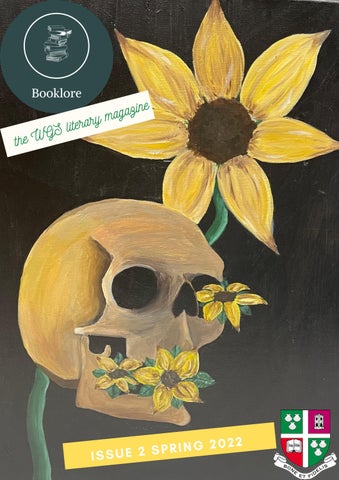
e n i z a g a m y r a r e t i l S G W e h t
2 2 0 2 G N I R P S 2 E U ISS
Welcome to booklor e
This is the second iss ue of our and we ho literary m pe you'll e agazine njoy read reviews, r ing it. You eading sug 'll find gestions, d and poetr ebates, wr y in this l iting tips atest issue team of w , all writt riters fro en by our m through out the ye ar groups at wgs. If you're in spired by what you why not j read in th oin the te ese pages, am? The bo on Fridays oklore wr in E6, from iters meet meeting? N 4-4.30pm. Can't make o problem ; just spea i t Bates or s t o a k t end a Team o Mrs Goo dwins message with your Anyone's w ideas. elcome.
LOOK OUT FOR ISSUE 3 IN T HE SUMMER TERM, WHEN WE'LL BE BRING ING YOU A SUMMER READING SPECIAL.
Contents BOOKLORE SPRING 2022
4. Review: 'Song of Sorrow,' reviewed by Emily 6. Four Romance Novels that Don't Suck, by Bella 9. Book Cover Debate by Isobel & Leisha 11. Poetry by Leisha 13. Review: 'If We Were Villains,' reviewed by Bella 16. How to Write a Protagonist, by Ash 19. Bookcrime review: 'Eeny Meeny' by M.J. Arlidge, investigated by Izy Cover design by Mimi, year 11
BOOK REVIEW: EMILY, YEAR 7
'SONG OF SORROW' BY MELINDA SALISBURY The amazing author of The Sin Eater’s daughter series, Melinda Salisbury, has written yet another incredible young adult book. Song of Sorrow is the sequel to State of Sorrow and the standard is just as high. In the perfectly imagined ‘Laethea’, this extraordinary book follows Sorrow Ventaxis, Chancellor. She has ‘won the election – and in the process lost everything’. With the curse of Sorrow’s name heavily impacting her life and hope, she fights to escape the cleverly laid trap set by none other than the unique and mysterious villain of the story – Vespus Corrigan. With plot twists, familiar faces and nothing as it seems, Song of Sorrow is a book that is impossible to put down. The unusual and incomparable idea of this book is impossible to explain in just one sentence so I am going to try to do it in a whole paragraph... The last book ended on a bit of a cliff-hanger with Sorrow winning the election and thinking she may never see Mael – who could be her brother – again. Now, she is Chancellor but, as anyone who has read the first book will know, she is ‘governing under the sinister control of Vespus Corrigan’. After her illegal relationship with Vespus’s son – Rasmus – she is in danger of being exposed for not only that but also for being an ‘imposter’. Sorrow knows that Vespus is aware of these things and that if she does not do as he says then he could tell everyone. Alone and desperately hoping that Luvian Rathbone, who readers will remember as being an imposter himself, will at least come and see her, she is trapped. With shock and hurt and friendship and love, this book makes a gripping read that will always leave you on the edge of your seat. Why read this book? After all, there are plenty of books out there. My answer is simply that there are millions of books but very few that immediately make you want more. There is a very small amount of authors who, after reading one of their books, leave you thinking “when is their next one coming out?” I would say that Melinda Salisbury is one of those authors. You can never be bored with her ideas and plot twists and you can never predict what is going to happen next. This is a book that I’m going to read over and over again. I will never tire of Melinda’s genius.
'SONG OF SORROW' REVIEW A little bit more about the author
Melinda Salisbury is the author of books The Sin Eater’s Daughter, The Sleeping Prince, The Scarecrow Queen, The Heart Collector, Hold Back the Tide (which I would personally recommend), State of Sorrow and of course Song of Sorrow. All of these books are some of my favourites. She was an avid reader from an early age, who astounded the local librarians, and her grandfather often referred to her as Matilda by mistake so she got the idea that ‘Matilda’ by Roald Dahl was her biography! It wasn’t a far-off estimate other than the telekinetic powers… Melinda lives in the south of England and ‘likes medieval castles, non-medieval aquariums, Richard III, and all things Scandinavian’. An adventurous person, Melinda enjoys travelling. Her books are definitely ones to look out for.
FOUR ROMANCE NOVELS THAT DON'T SUCK BY BELLA, YEAR 12
Anyone who has read a book or watched a movie or a TV show in their life has probably been exposed to a romance subplot. Most stories have them, even if they’re otherwise about something entirely different (and much more interesting to me) like dragons or murder. And, after a while, you start to realise that most of them are the same. While there are good romance plots out there, too often authors seem to think that romance is a mandatory part of books, shoving in half-hearted will-they-won’t-they subplots between characters with little chemistry to appease some rule they’ve made up for themselves. As such, I tend to avoid romance novels and books with lots of romance whenever I can. These are my exceptions: four “romance” books that don’t completely suck.
I'LL BE THE ONE BY LYLA LEE I’ll Be the One is the story of Skye Shin, a Korean American teenage girl who finally gets the chance she’s always dreamed of to enter the world of K-Pop when she aces her audition to a new reality TV show. Skye is confident, fashionable, and she’s been singing and dancing since she was a kid - she should be the perfect pick for the winner, and the fans adore her. The only problem? Skye’s fat, and that means no one will take her dreams seriously, including her mother. And, while managing the constant and demanding auditions, fatphobic judges and oppressive media attention, Skye realises she’s also drawn the attention of her absurdly famous and absurdly handsome fellow competitor, Henry Cho. Although it deals with the sometimes harsh realities of being fat (or queer, or black) in modern society, I’ll Be the One is at its heart a lighthearted, hopeful coming of age romance. Skye is a vibrant, fun main character with a unique voice and perspective. Her friends are kind and supportive, and Henry is one of the most compelling love interests I’ve ever read in a romance novel. Henry and Skye’s unusual circumstances, vastly different experiences and sometimes conflicting personalities keep the romance plot moving forward and feeling somewhat tense without making you want to strangle them for their inability to communicate. If you’re looking for a classic sweet teen romance that doesn’t feel stuck in the last century, I highly recommend I’ll Be the One.
THE GENTLEMAN’S GUIDE TO VICE AND VIRTUE - MACKENZI LEE In The Gentleman’s Guide to Vice and Virtue, Henry “Monty” Montague is going on one last adventure before he settles down to run his father’s estate - his grand tour of Europe. Along for the ride are Monty’s best friend and long-term crush, Percy Newton, and his clever younger sister Felicity. Everything seems set to be a year of excitement, drama, adventure (and far too much flirting) until one of Monty’s poor decisions draws entirely the wrong kind of attention and the three find themselves on a dangerous supernatural quest across Europe. And as their lives are put on the line, more and more of what Monty understands about the world and himself is put into question… The romance in The Gentleman’s Guide to Vice and Virtue was the only thing I knew about the book going into it - Monty and Percy are the classic romance novel couple, complete with constant pining and sometimes ridiculous complications. Despite this, they’re one of the few romances I’ve read where I genuinely believed that the characters loved each other and wouldn’t immediately break up after the end of the story. Not only does the romance not suck, but the characters in this book are just as compelling. Percy and Monty are interesting, complex characters, but it’s Monty’s younger sister Felicity that steals the show for me. She’s confident and smart and, despite being a woman, wants more than anything to be a doctor. There’s even a sequel book (Lady’s Guide to Petticoats and Piracy) about her!
THEY BOTH DIE AT THE END ADAM SILVERA Mateo Torrez and Rufus Emeterio are both going to die in the next 24 hours. They’ve been called by a company called Death-Cast, who gave them a simple warning: you’re going to die today, and there’s nothing you can do to stop it. When both of them are faced with the prospect of dying alone and go looking for someone else to spend their End Day with, Mateo and Rufus find each other. Determined to tie up all their unfinished business and live their lives to the fullest before their time is up, they travel across the city, encountering other people in similar situations and getting to know each other as well. Though they would never have even met without Death-Cast, knowing you won’t see tomorrow makes it much easier for the two boys to live to the fullest, together, for their last day. They Both Die at the End is not a plot-driven book - it’s about the characters of Rufus and Mateo, and about how they grow closer over the space of only 24 hours. Character-driven books aren’t for everyone, but if you just want a well-written romance between two equally well-written characters, this is a great book for you. Both of the boys are developed through their own perspective chapters so that neither feels like they exist purely to be a love interest for the other. They both have different, unique personalities and struggles, and the best part of the book for me was watching them learn to understand and love each other despite their differences. Most of the book feels like a feel-good romance if you forget the ending that waits for them (and you). There is no happily ever after for Rufus and Mateo. As the title says, They Both Die at the End.
FANGIRL - RAINBOW ROWELL Fangirl by Rainbow Rowell is a story about what it means to be a fan of something, and what it means to move on from that. Cath, the protagonist, and her twin sister Wren have both been huge fans of the Simon Snow series since they were young. They wrote fanfiction together for years. The fan community is what got them through the death of their mother. Now they’re both starting at university, and Wren is ready to move on from the series that defined her childhood. Cath isn’t. But her new writing teacher thinks fanfiction ruins literature, and she’s got two handsome boys vying for her attention. Maybe it’s time to stop worrying about the past and stop relying on her family and Simon for support. But does Cath even want to grow up and move on if it means no more Simon Snow in her life? The book that later inspired the Carry On series, Fangirl is a great novel for anyone who has any experience with fandom and fan content, and it’s clear Rainbow Rowell cares a lot about those communities. Cath is a flawed, realistic but still undeniably likeable protagonist, and her relationship with her sister and the Simon Snow books (which are very much intertwined) are complicated and, in my opinion, well portrayed. In terms of the romance in this novel, though, I can’t say much without spoilers - Cath has two love interests, though not in a traditional love triangle sense. I can say that I liked how much the characters involved seemed to care about and like each other, and how supportive Cath’s love interests was of her interests and hobbies. Romantic partners in books so often dismiss or control what the protagonist likes and spends their time on, so this was a very refreshing change for me.
BOOKLORE DEBATE: BOOK COVERS
Book covers are one of the most important and vital parts of a book. Nearly everyone judges a book by its cover, even if they don’t want to. The cover decides who reads the book and can give you an idea of what the book is about.
With this in mind it is surprising that majority also stated that they like detailed art on the cover. So how do you feel about book covers? Read on for our opinions…
BY ISOBEL & LEISHA, YEAR 7
You would think the majority of people would say bright colours make book covers effective, but is this really the case? Out of the people interviewed, most said they are drawn to bright colours, and a majority stated that colours that match the theme are best as they give a clear idea of the context of the book.
BOOKLORE DEBATE: BOOK COVERS Isobel (dark and simple)
I think dark and simple designs are more effective as they stick to a basic colour scheme and have a sleek design. 15% of people interviewed said they like simple designs however I think that even though the number of people claiming that they like dark is low, that dark colours are eye catching as they stand out against bright covers. Simple designs are most effective in the sense that because they are so basic they have to give you a clear idea of what’s happens in the story and aren’t overwhelming while doing so.
Leisha (bold and intricate)
Intricate designs engage the reader and bold colours outline the story in a specific and contrasting way. Bold colours really complement and catch the human eye, I personally like to trace my fingertips along the intricate design and it is smooth. 14% of people who were interviewed stated that they like detail and contrasting colours. But usually people don’t like mazes of patterns, they would more like simple colours that match the theme and simple designs. I, however still prefer arranged, intricate and detailed covers.
POETRY BY LEISHA
BOOK REVIEW
If We Were Villains BY M.L. RIO REVIEW BY BELLA, YEAR 12
“ACTORS ARE BY NATURE VOLATILE—ALCHEMIC CREATURES COMPOSED OF INCENDIARY ELEMENTS, EMOTION AND EGO AND ENVY. HEAT THEM UP, STIR THEM TOGETHER, AND SOMETIMES YOU GET GOLD. SOMETIMES DISASTER.” Anyone who reads a lot has one question they dread more than any other: “What’s your favourite book?” For most of my life, I’ve responded to this question with everything other than an honest answer, simply naming whichever book I think of first or whichever one I just finished. Sometimes I just responded with a shrug or incoherent mumbling. I’ve never been able to pick a favourite book, because I’ve read so many good books and compelling characters in my life that none stands out enough to be my favourite. That was before l I read If We Were Villains by M. L. Rio. When If We Were Villains begins, Oliver Marks has just finished serving ten years in prison for the murder of one of his closest friends. The thing is, Oliver didn’t do it. As he finally tells his true story to the detective who investigated the death all those years ago, Oliver describes the world of Dellecher Classical Conservatory – an elite acting school where he was one of only seven fourth-year students. Each of his friends managed to endure Dellecher’s intense competition, finding niches for themselves both on and off stage, but when their next play casts them in unfamiliar roles, not all of them will be able to survive the turmoil that follows. Who’s truly to blame, and how will they all deal with the guilt of their part in what happened? And why did Oliver, always the supporting character, end up taking the fall? Like the Shakespearean plays that it features so heavily, If We Were Villains is a dark, tragic story that puts its characters and the relationships between them centre stage. The focus of the story is on Oliver himself and his enduring friendship with the star actor in the class, James Farrow. James is always the hero in their performances, with Oliver as his righthand man, and the way the book deals with the complicated feelings Oliver has towards James is fascinating. They might be best friends, but there’s so much more to the messy details of their relationship that turns Oliver into a far more compelling protagonist and James into my favourite of the seven fourth years. Bring the mixed emotions that come from the death of a “friend”, and you’ve got a recipe for an incredible story.
Even beyond Oliver and James, though, every single character in this book is interesting to read. The roles each one plays in the school’s plays – Alexander as the villain, Meredith as a femme fatale – serve as the basis for an exploration of what it feels like to be forced into the same stereotype, and what people are really like under the masks they always wear. I can’t go into all the characters without making this article as long as the actual book, but there is one other character worth mentioning: Richard. The king and tyrant of the fourth years, Richard is the major antagonist of the beginning of the book, and I loved every scene he was in just as much as I hated the character himself. He’s arrogant and confident, charming and awful in equal measure, and it’s easy to understand why Oliver and the others feel so conflicted about him. He’s a complex character without necessarily being a likeable one, which is something I’ve rarely seen in other novels. What really makes both the characters and this book as a whole stand out to me the most is the way they, and it, are written. Everything in If We Were Villains was at once very down to earth and realistic in its portrayals, but also otherworldly and unusual in the way it used Shakespearean allusions as part of the story itself. It’s a tragedy that deals with some pretty difficult topics about death and trauma, so I wouldn’t recommend it to younger readers or anyone looking for an easy, light-hearted novel, but it will definitely leave an impression on you. The way M L Rio depicts guilt and grief, especially for someone who arguably deserves neither of those things, is something I’ve yet to see in another book, and as you read, you’ll almost forget you know how the story ends as you get caught up in Oliver’s story. There are very few books I would recommend as highly for anyone who loves literature or dark academia, or who just wants a book that they’ll think about for weeks after they finish it, as If We Were Villains. Between the vivid descriptions, intense and compellingly messed up character dynamics, and genuinely painful emotional beats, it might possibly be the best book I’ve ever read.
“BUT THAT IS HOW A TRAGEDY LIKE OURS OR KING LEAR BREAKS YOUR HEART—BY MAKING YOU BELIEVE THAT THE ENDING MIGHT STILL BE HAPPY, UNTIL THE VERY LAST MINUTE.”
How to write a
Protagonist
Protagonists are the general ‘main character’ in a piece of media, and the character who the audience follows throughout. It’s often hard to find the right type of persona for the protagonist, but if you follow these general tips- it may help!
by Ash, year 8
Make the Character Relatable (by adding flaws) A crucial thing in protagonist writing, is ensuring that you make the audience actually like them. The main way of doing this is by adding flaws to the character. No one is perfect- and therefore no one would relate to this perfect hero with no hardships or negative traits. A compelling character is one who feels like a person to the reader; they are not one dimensional, but have strong opinions, complexities and biases. People generally hate a character who’s always perfect, as a lot of people subconsciously feel jealous, and would never be able to empathise with the character. Empathy is a key emotion you need the audience to feel if you want them to like a character. The audience should be able to react with them in different ways. People should connect to the protagonist- cheering for them, getting annoyed at them, falling in love and fearing for them. They need to feel like a proper person in every sense. Main characters shouldn’t be too one sided, and this goes for antagonists too. Not too evil, nor too good. The classic ‘good guys’ shouldn’t have to be forced into the classic ‘good’ option all of the time, otherwise you have a flat character where people can predict their every move. A good character is someone who surprises us in some way, even subtly. You should never be able to guess their next move all of the time, yet still feel like you know them enough as a person to empathise to how they’re feeling.
Give Them Motivation Motivation is the reason behind a character’s actions and behaviours. Main characters need to have a goal to achieve- one that they’ll achieve at the end of a novel or series. This spurs them onwards with the plot, and gives purpose to the entire book. These goals can be relatable to the audience in a literal or metaphorical sense, or a more ‘quest’ approach. If the protagonist doesn’t have said motivation, the whole structure of the book would fall apart. Why would this character want to go to the extent to do this, if they don’t have a reason to? You don’t even have to make this ‘motivation’ explicit, but make it part of the mystery- like in a horror film. People have different experiences, values, personalities and upbringings- so people’s motivations should differ and reflect this. Some characters might make rational decisions based on their motivations, while others make impulsive decisions based on an unconscious drive to complete their goals. You should always be able to distinguish characters from their goals- as they should never be EXACTLY the same.
Give Them Diverse Characteristics Characters shouldn’t be cardboard cutouts of one personality trait, but be rich and complex. Never over do it- a character with too many distinct traits can be come a bit cluttered and confusing. However, never under do it either. It’s obvious to tell when each member of the leading group are all stereotypes of one specific wordE.g. the smart one, the strong one, the funny one, the nice one No character should be the same as one another, nor too distinct, so it’s quite hard to get the right balance. If you make characters too different, they can never relate to one another or feel real and human- yet if you make them too similar, there’s no point in the both of them in the first place.
Make Them Evolve Over Time If a character is truly relatable to the audience, the audience would be inclined to see them grow and mature over the novel, changing as people through events and new people in their lives. This is usually a key point in the protagonist’s story; they may overcome an obstacle, or realise that they were wrong. No matter how big or small, change in character makes the character feel real- as no one stays exactly the same. This is another reason why you should never make the protagonist ‘perfect’, as they always need time to grow and evolve as a person.
Allow Them to Interact With Other Characters Another important thing is that we see the conflicts and interactions between characters. Here are some basic character interaction ideas that you should make sure to include in a book, 1. Always explain what the protagonist is thinking about other characters. Never assume that the reader already knows. 2. Don’t just make the main character discuss and adapt to the world around them, but also other characters. 3. Flesh out relationships between the protagonist and their companions. Build a meaningful relationship up over time- don’t just immediately make them best friends. 4. Show the upbringing in character relationships. Don’t just build up the chemistry off screen- show don’t tell. 5. Allow the protagonist to challenge their own reasoning. Why do they hate/like this character? What differentiates the two? Is there something that the hero can learn from the other characters?
Choose the right
Protagonist This seems too easy. Why would you ever choose the ‘wrong’ protagonist? How can there even be a ‘wrong’ protagonist in the first place? Well, don’t be fooled. This happened to me once, when I was writing a short book around a year ago. I was halfway through and realised that one of the supporting characters introduced would be a superior protagonist. A lot of factors play into finding the ‘correct’ main character, but these are some that helped me realise that my protagonist wasn’t the best they could be. 1. Are they just watching the events play out? In my case, I realised that my hero was literally just watching other characters do important things like fight villains and interact with the world. They always took a back seat and were never the one DOING the adventure, but the tag-a-long. 2. Are they interesting or just an average person? The protagonist should never be just the ‘ordinary’ one, even if that’s the effect you may be going for. They should still have something unique and special about themselves, even if that thing is being the ‘normal’ one in the group. They should never be a bore to watch, and always should have a REASON to be the protagonist, that the supporting cast don’t have. 3. Are they the character that changes? Is your protagonist the one who changes over the story, or do they just simply watch other people change? Obviously, the main character should help other people develop into better people, but they should also make a significant change themselves, otherwise there isn’t a point. You should always be able to tell the difference between the character at the beginning of a novel/series, and the end.
Conclusion Overall, every protagonist is wildly different, but each should be relatable, have motivation, and change over a period of time. The protagonist is a fascinating role, and they play a huge part in the quality of the story being told. If someone hates the protagonist, they’ll enjoy the book significantly less, as they won’t be rooting for the person you WANT them to root for. So have a think. Is your protagonist novel-worthy? Or should you have a deeper think about the character within…?
[bookcrime] review by Izy, year 9