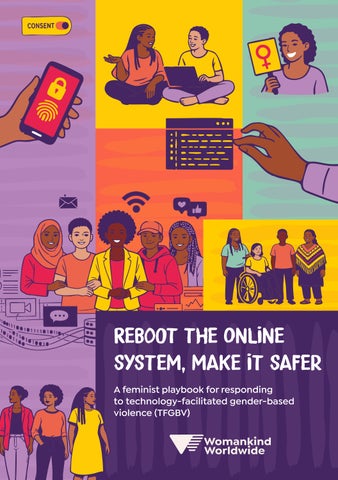
This playbook is designed for feminist organisations, partners, donors, and human rights practitioners responding to technology-facilitated gender-based violence (TFGBV). It brings together evidence and practical guidance from: Unsafe by Design: An Analysis of the TFGBV Continuum , a report grounded in Womankind Worldwide’s mandate to end violence against women and girls and informed by work with partners across Afghanistan, Ethiopia, Kenya, Nepal, Uganda, and Zimbabwe.
Through prompts and exercises, the playbook aims to support survivor-centred responses, strengthen collective care, and sustain feminist movements under growing digital threats.
Acknowledgements
This is a Womankind Worldwide publication
Writer: Clemmy Manzo
Design: Stanley KabichoLulu Kitololo Studio | Studio Njano
A special recognition to our partners whose voices and experiences have enriched this playbook.
About Womankind Worldwide
Womankind Worldwide is an international women’s rights organisation and funder, working with women’s rights groups and feminist movements across the world to end gender inequality. We take collective action alongside women’s rights organisations, feminist movements and activists in Eastern and Southern Africa and South Asia. We support them to challenge inequality at home, in communities and the workplace. We fund and strengthen these movements and advocate for change alongside them.
What is TFGBV and why does it matter?
Technology-facilitated gender-based violence (TFGBV), as defined by UN Women, refers to ‘any act that is committed, assisted, aggravated, or amplified by the use of information communication technologies or other digital tools, that results in or is likely to result in physical, sexual, psychological, social, political, or economic harm, or other infringements of rights and freedoms.’
This includes abuse carried out not only on online platforms, but also through tools such as mobile phones, GPS tracking, cameras, and AI-enabled technologies.
TFGBV matters because it causes serious harm in every area of people’s lives. It disproportionately affects women and girls, reflecting how technology is used to exploit and reinforce inequalities linked to gender and sexuality. Naming TFGBV makes these harms visible, strengthens accountability, and supports more effective, survivor-centred responses.
Why is TFGBV such a risk to women’s rights? Because it rarely stays online.
Abuse that begins or is carried out through technology often escalates into offline harm, such as stalking or physical violence. Research shows that online and offline violence are closely connected, driven by the same gendered power dynamics, and often experienced together. TFGBV can occur as isolated incidents, repeatedly over time, across borders, or alongside other forms of gender-based violence.
Who is most at risk of experiencing TFGBV?
Intersectionality and TFGBV TFGBV and organised anti-rights backlash
While TFGBV can affect anyone, some women face higher risk and fewer protections because of discrimination and exclusion. Research from: Unsafe by Design: An Analysis of the TFGBV Continuum shows that women and gender-diverse people with intersecting identities - including Indigenous, Black, disabled, LBTQI+, migrant, religious, and rural women - experience more frequent and more severe abuse. The report also highlighted cases where low-income women were targeted through non-consensual intimate image abuse, including situations where images shared to meet basic needs were later used to blackmail, coerce, or extort them. In these contexts, technology is not only used to harass or silence, but to take advantage of vulnerability and cause harm across both online and offline spaces.
Targeting visibility: politicians, journalists, and public voices
TFGBV often targets women and genderdiverse people who are publicly visible, including politicians, journalists, activists, and human rights defenders. Harassment, threats, doxxing, and coordinated abuse are used to intimidate individuals and punish them for speaking on political issues, women’s rights, or LBTQI+ rights. Beyond individual harm, this targeting sends a clear message about the risks of being visible, making others think twice about speaking out or participating in public life.
TFGBV is also used as part of broader antirights mobilisation. In countries including Ethiopia, Kenya, Ghana, and Uganda, political figures, influencers, and bloggers fuel moral panics around “family values” and LBTQI+ rights, particularly during elections or debates over new laws. Online abuse in these contexts is often organised and strategic, with shared messaging, hashtags, and coordinated attacks across platforms - and sometimes across borders - making TFGBV a political tactic rather than isolated harassment.
Five interlinked forms of TFGBV
1. Online harassment and abuse
This includes repeated or targeted harassment such as sexual harassment, gender-based hate speech, threats, stalking, doxxing (publishing private information), impersonation, and outing (revealing someone’s sexual orientation or gender identity without consent). These acts are often used to intimidate, silence, or control women and gender-diverse people.
2. Coordinated attacks and platform manipulation
TFGBV is often organised and can involve brigading (coordinated mass harassment campaigns), coordinated false reporting, review bombing, or networked abuse across platforms. These attacks are designed to overwhelm individuals and damage reputations, often forcing people offline.
3. Privacy violations and surveillance
Technology is frequently used to monitor and control. This includes spyware or stalkerware (installing monitoring software on devices), GPS tracking (unauthorised location monitoring through apps/devices), account hacking, smart-device abuse (using IoT devices for monitoring/control), and nonconsensual access to personal data. These forms of TFGBV often take place alongside intimate partner violence and can escalate into offline harm.
4. Sexual exploitation and coercion
TFGBV can involve grooming, coerced sexting (pressuring for intimate images/videos, financial exploitation (such as romance scams), sextortion (blackmail using intimate images), using social media or dating apps for trafficking, or forced participation in online sexual activity. Through technology, abuse can spread and follow people across borders, leaving digital traces that last.
5. Image-based and symbolic violence
This includes non-consensual intimate image sharing, cyberflashing (sending a photo or video of genitals without permission), voyeuristic recordings, deepfakes, and other AI-generated abuse. It also includes misogynistic memes, gendered disinformation (false narratives about feminists and/or women leaders), and content that normalises or glorifies violence against women and girls, which results in unsafe digital environments.
Case example: AI-generated image abuse and platform accountability
In a January 2026 Independent article, women reported that users of X’s AI tool, Grok, were creating sexualised images of them without consent by digitally altering existing photos. Survivors described feeling violated and humiliated. In some cases, women were told the content did not breach platform rules, exposing serious gaps in moderation and accountability.
As one survivor said: “It feels like an attack on your sense of self. You don’t have ownership over your body — it’s objectifying.”
The reporting prompted public and regulatory pushback, with the UK government condemning the images and Ofcom making urgent contact with X to assess compliance with the Online Safety Act. The case showed how image-based abuse is being enabled through new AI tools, and how platforms currently fall short when it comes to preventing harm or responding effectively.
Womankind Worldwide , alongside other women’s rights organisations, raised concerns about the rise in AI-enabled image abuse and its impact on women’s safety and wellbeing, calling for stronger safeguards and greater accountability from technology companies.
TFGBV and economic consequences
While the psychological and social impacts of TFGBV are well documented, too little attention has been paid to its economic consequences.
Technology-facilitated gender-based violence has direct economic impact for women and gender-diverse people. Survivors often lose income, work opportunities, and professional visibility as a result of abuse.
For women in public-facing roles - including journalists, activists, politicians, and influencers - online visibility is often central to earning a living. Being forced offline can mean losing both current work and future opportunities. Survivors of non-consensual intimate image abuse can face long-term reputational harm. Images are often hard to remove, limiting job opportunities and sometimes being used to blackmail or coerce survivors.
TFGBV is a global issue*
TFGBV affects millions of women and girls worldwide each year. According to UN Women, between 16% and 58% of women have experienced some form of digital abuse.
Did you know that…
• In Arab States: 60% of women internet users report having experienced online violence
• In Eastern Europe & Central Asia: Research across 12 countries found that more than 50% of women over 18 have experienced TFGBV in their lifetime.
• In Sub-Saharan Africa: a study of five countries found that 28% of women had experienced online violence
• Europe, USA & New Zealand: a survey across eight countries revealed that 23% of women aged 18–55 report at least one experience of online abuse or harassment
*Statistics from UN Women , Association for Progressive Communications and Amnesty International
Case studies from Womankind Worldwide’s report: Unsafe by Design: An Analysis of the TFGBV Continuum
Doxxing = Publishing private information (address, phone, workplace) with malicious intent Dogpiling/brigading = Coordinated mass harassment campaigns
“I handled one case where someone simply responded to a user that was spreading a lot of online hate about queer people. When they responded to this person, they started receiving a lot of hate on Twitter, then a blog actually doxxed their home address online and they started receiving threats. The people who were DMing them on Twitter found them offline and were threatening to beat them.”
Interview respondent
Power, technology & ethics
TFGBV is not unavoidable. Instead, it is shaped by the ways digital technologies are designed, governed, and used within unequal social and political systems.
Platforms that prioritise profit over safety often amplify harm, while weak regulation and inconsistent enforcement leave survivors without enough protection. These unsafe conditions are often worse for women and gender-diverse people who already face discrimination based on race, disability, sexuality, religion, migration status, or geography.
In many settings, technology reinforces existing power imbalances rather than challenging them: from spyware and GPS tracking used in intimate partner violence, to AI-enabled tools that facilitate imagebased abuse and mass harassment. And when reporting systems are inadequate, survivors and civil society are left to deal with harm that institutions and companies should be responsible for.
Visibility: two sides of the coin
Many digital platforms are built around visibility, encouraging people to share and be seen. For some individuals - including marginalised people - being visible online can be a lifeline. It can also support organising, connection, and political participation for feminist and human rights movements.
But visibility online comes with risk. Being seen can increase exposure to harassment, doxxing, surveillance, and offline harm. For many people, self-censorship or retreating from platforms is not a choice, but a way of staying safe in digital environments that are often hostile.
Understanding TFGBV as a product of design, governance, and structural inequality shifts the focus away from individual behaviour and towards collective responsibility. It highlights the need for survivor-centred approaches shaped by people’s lived realities that question how technologies are built, who they serve, and who is placed at risk.
Platform accountability
TFGBV cannot be addressed without holding technology platforms responsible for the harm that happens on their services. Too often, moderation is weak or inconsistent, and safety rules are applied unevenly.
These failures affect survivors everywhere, but they particularly impact people in the Global South. For example, reporting systems often do not work in local languages or
reflect local risks, making them hard to use or ineffective. Evidence also shows that powerful or high-profile users are more likely to avoid consequences for abuse.
Relying on platforms to police themselves is not enough. There is a need for clear regulation and greater transparency about how decisions are made and enforced. Global South organisations and experts must be meaningfully involved in shaping platform policies, and their knowledge must be acted on.
Questions for feminist digital practice
Use these questions to reflect on how power, safety, and responsibility show up in your digital work.
1. Whose consent do we prioritise (and whose might we miss)? 2. When something goes wrong online, who actually carries the risk? 3. When does visibility support our work and when does it increase risk or exposure?
Who is more likely to be excluded by the platforms or systems we rely on?
Survivor-centred responses
A survivor-centred response recognises that survivors are best placed to judge what is safe for them. It respects their choices about if, when, and how they seek support.
Why reporting isn’t always an option
For many survivors, reporting violence to the authorities is not safe. Fear of retaliation, stigma, criminalisation, or being disbelieved can make seeking support from the police or courts risky or impossible. Some survivors face hostility from authorities and their communities, while others risk losing housing, income, or custody of their children. This means that approaches built around reporting alone do not work for many survivors.
Access for all survivors
Support only works if survivors can actually access it, which is why taking an intersectional approach is key; one that recognises how factors like disability, migration status, race, gender identity, sexuality, class, and language shape people’s experiences of violence and their access to help. Responses that don’t address these realities are less likely to work and risk causing more harm.
Safety and consent
Digital spaces can help survivors find support, but only when safety and consent are prioritised. Survivors need control over their information and clarity about how their data is used. They also need to be aware of surveillance risks. In many contexts, women and LBTQI+ people rely on digital security skills to manage these dangers.
But digital skills alone are not enough. TFGBV is systemic, and survivor-centred responses depend on institutions such as the police and the law understanding how technology is used to cause harm and responding without retraumatising those seeking support.
Legal recognition and definitions
Addressing TFGBV starts with clearly naming it in law. Legal systems need clear definitions that recognise TFGBV as gendered violence and acknowledge that it can move across platforms, borders, and online and offline spaces. Without this clarity, institutions struggle to respond in ways that are consistent or effective.
Because TFGBV can be carried out from a distance, legal responses also need to work across borders. When countries use different definitions or approaches, survivors face serious barriers to justice. Greater alignment in how TFGBV is defined and addressed would make cooperation easier and improve accountability, which in turn prevents further harm.
A practical accessibility & inclusion checklist
Questions to ask when designing survivor-centred responses
1. What support is available, and who provides it?
2. Can survivors access support in languages they understand?
3. Is support inclusive of people with disabilities?
4. Are there options to seek help while staying anonymous?
5. Are digital services designed with privacy, security, and informed consent?
6. Are survivors involved in shaping and reviewing the support offered?
Feminist support when systems fail
When technology platforms and state systems fail to respond to TFGBV, feminist organisations and other civil society groups are often the first - and sometimes the only - place survivors can turn to. With limited resources, they provide support that institutions do not: emotional care, help gathering digital evidence, guidance on legal options, and support navigating platforms that are often unresponsive or hostile. For LBTQI+ people in countries where their identity is criminalised, these organisations are frequently the only support available.
As online attacks such as hacking, account takeovers, outing, and doxxing have increased, these groups have also developed practical ways to reduce harm, including setting internal guidelines and managing access to digital accounts. Much of this work happens quietly, carried by organisations that act as unpaid intermediaries with platforms and absorb the emotional and administrative costs of response.
Community care makes survival possible when formal protections fall short. But it cannot replace properly resourced support systems or meaningful accountability from platforms and states. Without sustained funding and structural change, the responsibility for responding to TFGBV continues to fall on those already facing the greatest risk.
Who carries the burden of work?
When TFGBV happens, a lot of work happens behind the scenes. Take a moment to reflect on your own context:
1. Who steps in to provide care or support?
2. Who deals with platforms, authorities, or fallout?
3. Who carries the emotional, financial, or safety costs when systems fail?
4. Reflection: Often much of this work is unpaid or invisible. What would need to change for this burden to be shared more fairly or be properly resourced?
Reimagining feminist responses to technology
Designing technology for safety over profit
Platform design plays a direct role in enabling TFGBV. Features that prioritise growth and engagement can increase the risk of harassment, while group functions and sharing tools are too often used to circulate non-consensual images. In-platform reporting and moderation systems can be unreliable, especially in Global South contexts, leaving survivors and organisations to navigate platforms that fail to account for local language or risk. Feminist responses challenge this model and call for design choices that start from the realities of those most at risk - ones that build in safeguards, clearer reporting pathways, and responses that reduce harm rather than amplify it.
AI, data, and privacy
Emerging technologies, including AI, are increasingly being used to facilitate harm such as image-based abuse. Survivors also have limited control over how their data, images, and personal information are handled by digital platforms such as messaging apps and social media. Feminist approaches to AI and data governance must centre consent and accountability, recognising that weak data practices can deepen risk and harm.
Whose experiences shape technology
The people most affected by TFGBV are often those least protected by digital systems. As Unsafe by Design: An Analysis of the TFGBV Continuum shows, Indigenous, disabled, queer, migrant, and Global South women face heightened risk, while platform responses frequently fail to reflect their realities or contexts. Feminist tech responses acknowledge these experiences to build safer and more accountable technology.
There is also recognition of the limits of trying to make unsafe systems work better. As funding for digital safety shrinks and platforms increasingly prioritise profit or political agendas over care, feminist movements are questioning whether mainstream technologies can ever meet their needs.
Digital literacy: knowledge as power
In the absence of effective platform or legal protection, many women rely on their own knowledge to stay safe online. Building digital literacy helps people understand risks and make informed choices about where and how they engage. However, access to this knowledge is limited for many women. That’s why feminist approaches emphasise digital literacy that is locally relevant and accessible for all, also moving away from one-off training that does not reflect changing technologies.
Activity: Designing a digital literacy workshop
Reflect on how digital safety learning could work in your context:
1. What would women in your community need to feel safer online?
2. Which platforms or digital spaces pose the greatest risks?
3. Who could deliver this learning in a trusted and accessible way?
A digital feminist future
Most of this playbook focuses on risk and response. This page makes space for something else: imagining what feminist digital spaces could be.
Feminist work has always involved imagining different ways of living and organising. In the context of TFGBV, that means asking not only how to reduce harm, but how digital spaces could actively support safety, wellbeing, and collective power.
Across movements, women and genderdiverse people are already doing this in everyday ways. Knowledge is shared between generations and communities. Storytelling helps make sense of harm and keep people connected. Art and creativity open space when other spaces feel unsafe or closed. Care becomes part of how people work together, not something added on later.
A feminist digital future does not depend on individual users managing risk alone, or on a single platform getting it right. Instead, it looks to alternatives: digital spaces built by feminists and for movements, grounded in feminist principles rather than profit. In these spaces, access is designed in from the start, safety is prioritised over engagement, and feminist expression is protected rather than suppressed.
These futures also reject the false divide between online and offline harm. They recognise TFGBV as part of a continuum, and respond with clear boundaries, shared responsibility, and accountability. Most importantly, they make room not only to survive digital harm, but to organise, rest, imagine, and build power together.
Exercise: Creating a digital feminist vision boarD
Individually or as a group, create a simple vision board that captures what safety, joy, and belonging online look like for you. You can use words, images, or symbols that represent safety and care. Your vision board does not need to be polished or shared. Its purpose is to make space for imagination and to remind us what we are working towards.
Strengthening the movement in the face of harmful tech
TFGBV does not only affect individuals. It is often used deliberately to disrupt organising and weaken movements. Coordinated harassment, doxxing, and platform manipulation are frequently aimed at entire networks, not just single people, making collective responses essential.
We know that harm is not experienced equally. Groups in rural areas and the Global South, and those facing multiple forms of discrimination, are often more exposed while having fewer options for support. When movements respond in isolation, the same people can end up carrying the greatest risk again and again. Working in solidarity, with an intersectional approach, helps spread responsibility more fairly.
Staying connected is part of what makes this possible. Sharing information about emerging risks, learning from how others respond when attacks escalate, and coordinating messages in the face of organised backlash can all help limit harm and strengthen shared responses. Accessibility, too, shapes how effectively movements respond together: making coalition work accessible in language, format, and practice helps movements stay connected when it matters most.
Finally, responding to TFGBV over time means being clear about how responsibility is shared. Agreeing on roles and ways of working can help protect smaller or less-resourced partners and reduce the disproportionate burden on those who are most exposed.
Checklist for sustaining coalitions under digital attack
1. Have we named uneven risk clearly? Do we acknowledge who faces greater exposure and harm?
2. Do we have clear response roles? Is it agreed who supports, who responds, and who leads when harm occurs?
3. Are we choosing visibility intentionally? Have we discussed who speaks publicly and when?
4. Are our coalition spaces accessible and safe? Are language, format, and platforms usable for all partners?
5. Are we sharing the load? Is response work and care spread fairly, not concentrated on the same people?
How funding must change
Responding to TFGBV is ongoing work, not a one-off intervention. However, funding rarely reflects this reality. Support for this work is shrinking at the same time as needs are growing, particularly for rural women, displaced people, and LBTQI+ communities. Short-term and inflexible funding makes it difficult for the organisations - who are stepping in where systems and platforms fail - to sustain digital security training, respond to emergencies, or provide survivor support over time. Increased, multi-year flexible funding is essential to maintain this work and reduce the unpaid burden placed on organisations already carrying the greatest risk.
References & resources
Helplines, toolkits, and further research on TFGBV
1. Womankind Worldwide, Disrupting the continuum of violence: Combatting TFGBV (2024)
2. UN Women, FAQs: Digital abuse, trolling, stalking, and other forms of technologyfacilitated violence against women and girls (2025)
3. UN Women, Global Knowledge Platform to End Violence against Women (2016)
4. UN Women, Toolkit: Youth Guide To End Online Gender-Based Violence (2024)
5. UNFPA, An Infographic Guide to TFGBV (2024)
6. Refuge UK helpline for GBV (2026)
7. UN Women, TFGBV: Developing a Shared Research Agenda (2024)
This playbook has been adapted from Womankind’s research: Unsafe by Design: An Analysis of the Continuum