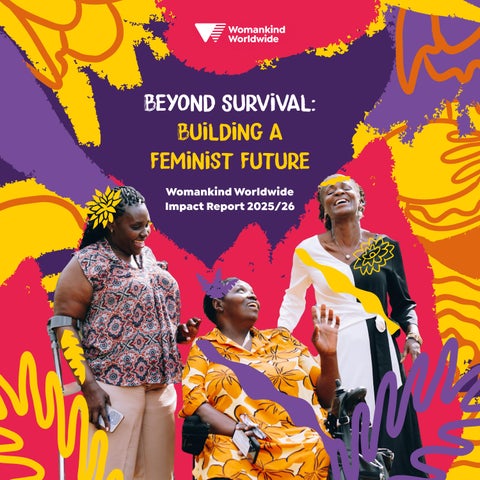
Beyond Survival: Building a Feminist Future Womankind Worldwide Impact Report 2025/26
“
Another world is not only possible; she is on her way. On a quiet day, I can hear her breathing.
Letter from our Co-Chairs
~ Arundhati Roy
Dear reader, There have been moments this year with little hope to hold onto. In those moments, we found ourselves returning to Arundhati Roy’s words: “Another world is not only possible; she is on her way. On a quiet day, I can hear her breathing.”
Front cover image credit: Grahame Kimani / Womankind. Lucy Nkatha, Jane Kiungi and Millicent Juma from Women Challenged to Challenge (WCC) in Nairobi, Kenya. Read Millicent’s story on page 32.
2
The challenges have taken many forms: a pervasive antirights agenda that continues to spread in public discourse and policies, and global funding cuts that have continued causing strain on feminist work. Across our focus countries, this was compounded by restrictive legislation and political unrest (turn to page 12 for more on this). Against this backdrop, all of our 60 partners have weathered the year, though some have suspended programmes or reduced staffing to keep their doors open. It’s in this context that Womankind Worldwide’s role within the global feminist movement is needed more than ever. Through flexible grantmaking, feminist partnership, policy and advocacy, learning and exchange, we support our partners across our focus countries to continue their expert, innovative and vital feminist work. Together, we’re on the path to achieving a feminist future – one that is rooted in joy, choice and dignity for all.
That path was tested last year. At the start of 2025, we woke up to unprecedented aid cuts. But as a result, we saw our partners and the feminist movements they are part of stepping back to reflect on their inherent strengths and working collaboratively – pooling resources and networks to survive the moment as a movement. That was remarkable: not just recognising what had happened, but moving to broaden collaborations, bringing resources back to the table and keeping momentum going. Our three flexible funds were a crucial support for our partners through this moment. Trustbased, no-strings-attached funding has always been a core principle at Womankind, and over the years, we’ve strengthened our ability to deliver on this commitment. We have also seen a growing recognition within philanthropy spaces of the importance of trust-based and feminist funding approaches, though there’s still a lot of advocacy needed – and that’s where Womankind and our partners play an important role.
This same principle of movement strengthening underpins everything we do at Womankind. Throughout 2025 into this year, we saw this brought to life through coalition building, intergenerational mentoring and feminist wellbeing initiatives. As a result of Womankind’s support, partners have reported stronger relationships across movements and increased capacity to mobilise collectively. This work took shape in other ways too. We spoke out on ending tech-facilitated genderbased violence (TFGBV), gathering data, research and convening those with the power to alter its course – our demands for change are being heard. In the year ahead, we’re taking that work, reshaping it and pursuing even greater impact by aiming to change laws and policies in real, tangible ways. Also during the year, Advancing Women’s Engagement: Strengthening Opportunities to Mobilise for Equality (AWESOME), a five-year
3
Netherlands Ministry of Foreign Affairs funded programme that strengthened the women’s movement across Ethiopia, Kenya and Uganda, came to a planned close. Its legacy will continue, including how women and girls – particularly disabled women – have reported strengthened confidence, leadership and participation in public life. Alongside this external work, we also undertook internal changes to strengthen Womankind so we can be an even better feminist partner, building an organisation that is financially resilient, centres feminist partnership and is equipped for the challenges ahead as we journey to achieve our vision for a feminist future. Looking ahead, in the coming year we are excited to implement the recommendations born from deep analysis of our grantmaking and partnerships. These developments will be rooted in power sharing, flexibility, accountability and equitable partnership.
4
If you are here to understand the impact of our work with our partners, that means, like us, you want to see a world where women, girls and people of all genders and the communities they are part of, live with joy, choice and dignity. We continue to be humbled by the breadth and diversity of our network of supporters and allies – all passionate, committed feminists, like you. We’re thrilled to have you with us. Katie Ghose & Lusungu Kalanga Co-Chairs of the Board – Womankind Worldwide
Who we are
Womankind Worldwide has been part of the global feminist movement since 1989. From then until now, we have supported our partners in the majority world to drive bold, urgent and transformative work. Like tackling femicide in Kenya, creating safe spaces for LBTQI+ activists in Zimbabwe, securing land rights for women in rural Uganda, advancing women into political leadership in Nepal, ensuring disabled women influence decisionmaking in Ethiopia and creating spaces of connection in Afghanistan. These are just a few of many examples.
5
Over our 37-year history, our partnerships have led to major advocacy wins – from introducing domestic violence laws in Albania, Ghana and Zimbabwe to strengthening action against Female Genital Mutilation / Cutting (FGM/C) in Kenya. These changes have brought transformative legal reforms, greater political representation, and global policy gains that will protect and advance women’s rights for generations. Today, our role as an international women’s rights organisation and funder continues to support our partners in Afghanistan, Ethiopia, Kenya, Nepal, Zimbabwe and Uganda to end gender inequality. Our partners are at the core of everything we do. This is because centring women’s rights organisations and movements is critical to achieving gender equality. They are the experts, and that will always be the case. We’re working towards a world where women, girls and people of all genders don’t just survive, but thrive – free
6
from violence, with the power to make decisions, shape their futures, and live with freedom, joy, choice and dignity. Together with our partners, we’re working towards this feminist future. We do so by consistently reaffirming our intersectional feminist values, with flexible funding, long-term solidarity, equitable partnerships, and anti-racism at the heart of our movement strengthening. We take a values-led approach that challenges systems of power, rooted in trust and feminist analysis. We do this work in three ways, through: •
grantmaking and feminist partnerships
•
policy and advocacy
•
learning and exchange
Our small yet mighty team of staff are based in Kenya and UK and trustees are spread across Botswana, Kenya, India, UK and Zambia. We’re a dedicated group of passionate feminists, bringing varied experience and expertise to the table. We all believe in the same vision for change.
Delivering our strategy to 2030
E V E R Y T H I N G W E D O I S W O R K I N G T O WA R D S O U R 2 0 3 0 S T R AT E G Y – OUR FEMINIST FUTURE.
In building our feminist future, we are guided by five strategic goals: SHARE POWER WITH PARTNERS Womankind’s partnerships share power and resources with diverse feminist organisations and movements
INFLUENCE THE AGENDA Womankind influences a transformative feminist agenda for change, in solidarity with feminist movement partners and allies.
DECOLONISE OUR PRACTICE Womankind learns, adapts and grows with humility as a feminist, anti-racist organisation working to decolonise our practice
RESOURCE THE REVOLUTION
VALUE OUR TEAM
Womankind contributes financially to making change, with core and flexible funding
Womankind’s team is diverse, accountable, inspired and lives its values.
Our theory of change
Photo credit: Charmaine Chitate. Members of the Women and Land in Zimbabwe team.
9
OUR THEORY OF CHANGE
Movements towards a Feminist Future We believe…
Through collective action with women’s rights organisations we advance…
Women’s rights organisations are how movements are built, supported and grow and are key to achieving women’s rights
Anti-racism and decolonisation
Together wit partners we women’s mov
Developing and support intersectional approach
Connecting within move build relationships Self and collective care
When women join together in movements, their voices are stronger and they create longlasting change in their societies
Women’s movements ac flexible funding
Participatory grant-making
Unrestricted and flexible funds
Accepting uncertainty and unpredictability
Collaborating on femini and documentation Learning and exchange women activists
Supporting feminist lea WROs and movements
Communications and IC
Our approach 10
OUR VISION A world where all women, girls and people of all genders enjoy equal rights and freedoms and live with joy, choice and dignity
th our strengthen vements by…
ting hes
ements to for women’s rights
ccessing
ist research by connecting
adership of activists,
CT support
STRONG, AUTONOMOUS WOMEN’S RIGHTS MOVEMENTS LEAD TO… Global and regional institutions and national governments that respect and protect women’s rights Diverse women, girls and people of all genders enjoying human rights without discrimination Women, girls and people of all genders who are aware and claim their human rights and work collectively to challenge gender inequalities at home, communities and workplaces
11
Our Focus Countries In 2025/26
There is so much to be inspired by in this impact report. Stories of feminist change, caring communities and bold action. But it’s also important to understand the specific contexts that our partners had to adapt to during the year. Contexts, often designed to disrupt their work and deny the rights of women, girls and their communities. 2025 was also the year that international aid (Official Development Assistance – ODA) experienced its largest ever contraction - the biggest reduction since records began. The global impact of this on human rights work cannot be overstated. In Afghanistan, gender apartheid continued to deepen under the de facto Taliban authorities. The 2024 Promotion of Virtue and Prevention of Vice (PVPV) law increased restrictions on women’s freedom of movement, dress, speech and participation in public life. These restrictions have deepened over the past couple of years, with women being systematically
12
erased from education and employment. This is a sustained attack on women’s autonomy, legal protection and justice. In Ethiopia, the environment for feminist organising became increasingly complex and uncertain. Ongoing conflict in Amhara and Oromia, conflictrelated sexual violence, displacement and inflation continue to harm women and girls. Kenya’s Gen Z protests in 2024 marked a lasting shift in political engagement and state accountability. But, since the protests, human rights and civic space remain strained, with activists facing intimidation, extra judicial killings and enforced disappearances. Increased femicide and gender-based violence also continue to drive public outrage. Feminist movements are maintaining pressure on the government to secure safety commitments, but face persistent accountability gaps. Communities are also recovering from climatechange shocks deepening inequalities for women and marginalised groups.
In September 2025, Nepal’s youth-led “Gen-Z” protests against political corruption and social media bans led to 19 unlawful protester deaths at police hands, with many more injuries. A direct result of the protest was the lifting of the social media ban and the resignation of the prime minister. Around the same time, the government tabled a draft bill that would replace the Social Welfare Council and create unnecessary barriers for civil society organisations to carry out crucial work with communities. The NGO Federation of Nepal called it ‘retrograde and cumbersome’. Young Dalit people are increasingly challenging caste-based discrimination and hierarchies - though greater visibility has brought backlash, including stigma and institutional resistance. Uganda’s 2026 elections confirmed President Museveni’s 40th year in power. Heightened surveillance and repression, activist arrests, and mounting pressure on civil society are fuelling fear and selfcensorship, limiting feminist organising and democratic
participation. An emerging threat, the Protection of Sovereignty legislation, would regulate foreign-funded organisations, expanding state control over civic engagement and risking criminalising women’s rights advocacy, sexual and reproductive health rights (SRHR) and LBTQI+ rights. In Zimbabwe, partners faced intensifying scrutiny under the Private Voluntary Organisations (PVO) Amendment Act 2025, threatening work supporting women and LBTQI+ communities. This is compounded by rising living costs, economic instability and inflation, making organisational sustainability increasingly difficult. Through every challenge, Womankind stands beside our partners - providing flexible, trust-based funding, championing bold policy and advocacy, and creating spaces for learning, exchange, solidarity and collective care.
13
From April 2025 to March 2026, Womankind...
Our year in numbers
60 moved £1,108,727 to 60 women’s rights organisations, networks, activists and movements.
3 86% advocated for women’s rights in 3 global advocacy spaces
14
Afghanistan – 4 partners
10
Ethiopia – 7 partners
7
Nepal – 13 partners
14
projects / grants
£18,000
Kenya – 16 partners
21
projects / grants
the average flexible fund grant size was £18,000. The maximum was £30,000 and minimum £4,000.
Uganda – 10 partners
14
projects / grants
Zimbabwe – 15 partners
19
projects / grants
Regional – 2 partners
3
88
managed 88 feminist initiatives with women’s rights organisations across 6 focus countries
remained committed to flexible funding with 86% of our funded initiatives being through our flexible funds
projects / grants
projects / grants
projects / grants
15
A year of milestones
JULY APRIL 2025
MAY 2025
JUNE 2025
We kicked off the year by coming together as a staff team to ‘Grow our Feminist Culture’.
We strengthened collaboration with Afghan women-led partner (FARAGEER) to document the impact of gender apartheid in Afghanistan and amplify their evidence in international advocacy and policy discussions.
We were delighted that Katie Ghose joined our board of trustees as Co-Chair.
Woma visited partne wome workin challe
MARCH 2026 » Womankind and our partners campaigned to end tech-facilitated gender-based violence (TFGBV) during International Women’s Day 2026 and at CSW70 through the launch of the first feminist playbook on ending techfacilitated gender-based violence » Our 9th annual gala raised over £1.2 million » We renewed Strategic Grants, providing core, flexible funding for 24 partners.
16
JANUARY 2026 FEBRUARY 2026 We committed £64,500 in out-of-cycle HVF grants to five partners, supporting feminist advocacy initiatives.
Photo credit: Charmaine Chitate. Gloria Makahwi, a member of Women and Land in Zimbabwe’s advocacy team.
We launched a new Business Model and Operating Model strengthening organisation’s ability to deliver its 20 Strategy and deepen its impact.
Y 2025
AUGUST 2025
SEPTEMBER 2025
ankind’s Co-CEOs d Zimbabwe to deepen erships and learn from en’s rights organisations ng in increasingly enging contexts.
We received our first Ford Foundation grant, providing core support for gender-based violence prevention.
We held a webinar which saw 200+ donors, allies and partners dig into the impact of the global funding cuts and how we can take collective action to advocate for change.
g the 030
OCTOBER 2025 » Our annual staff gathering ‘Feminist Futures Week’ took place – a space for collective care, wellbeing, reflection and connection.
NOVEMBER 2025 DECEMBER 2025 » Over 81,000 people demanded change for Afghan women and girls and added their name to our campaign. » The AWESOME programme came to a close after five years, culminating in the launch of the book Seeds of Change. » We launched Cycle 5 of HVF, committing £400,000 to 14 partners for feminist advocacy initiatives.
» Movement Strengthening Fund grantees came together for a feminist storytelling workshop in Nepal held in collaboration with Voices of Women Media. We focused on how narrative change is a crucial part of achieving a feminist future.
» We provided flexible emergency funding to Afghan partners (AWN & KOO) to support women’s needs in response to deadly flooding in eastern Afghanistan. » We launched Cycle 5 of MSF, sending £179,557 to 9 partners to help strengthen their movements.
» We launched our anchor research ‘Disrupting the Continuum of tech-facilitated gender-based violence (TFGBV)’ pushing for safety by design in digital spaces during 16 Days of Activism.
Photo credit: Grahame Kimani / Womankind. Lucy Nkatha, Director for Women Challenged to Challenge’s (WCC) Kiini group in Kenya, with her daughter, Abigail.
17
Grantmaking & Feminist Partnerships
Womankind shares power, resources and decisionmaking with women’s rights organisations, feminist movements and the activists we work with. We do this through flexible, trust-based funding, which enables our partners to determine how best to use the resources in response to their own priorities, opportunities and the contexts they are working in.
“
A feminist partnership is supportive and meaningful when it embodies equity, transparency, and a genuine commitment to sharing power and decentring traditional hierarchies. It moves beyond transactional funding relationships to foster mutual respect, trust, and collective growth. We have consistently seen this in practice with Womankind ~ Latifah Namutebi, Women’s International Peace Centre, Uganda
Here are just a few examples of the impact of our grantmaking and partnerships in 2025/26. 18
Photo credit: Conrad Roy. Biggie and Amor from Freedom and Roam in Uganda (FARUG) team.
Weaving resistance – Afghan women create community through tailoring In a rural village in the outskirts of Kabul, Afghanistan, our partner Afghan Women’s Network (AWN) provided 35 women with tailoring and business skills training. But, the skill development here was not the only important part of the project. In a context where women face increasing and unparalleled restrictions on movement, education and employment, this training offered something deeper. It created a safe space where women could regularly come together and support one another. For many women, opportunities to leave their homes are limited. Through six months of training, the women built friendships, discussed shared challenges and developed support networks. As a result, many reported feeling less isolated, more confident and more hopeful about their future.
Families saw the women’s achievements and became more supportive of women learning new skills and earning an income. Communities attended opening and graduation events to publicly recognise the women’s accomplishments.
The impact of flexible grantmaking
Recognising the increasingly restrictive environment, Womankind provided flexible trust-based funding so that AWN could adapt activities based on local realities and women’s priorities. By investing in local women’s leadership and keeping women’s organisations active and open (which is one of the hardest challenges), Womankind and AWN helped ensure that women continue to have opportunities, despite the shrinking space for women in public life.
Her Voice Fund (HVF)
We continued our commitment to flexible grantmaking this year, through Her Voice Fund (HVF), Strategic Grants and Movement Strengthening Fund (MSF).
Cycle 5 of HVF awarded and committed 14 grants to partners. As inclusive trustbased funding, this is reaching women’s groups who are often excluded from traditional funding streams and enabling more diverse feminist voices – like women with disabilities, LBTQI+ women, young women, indigenous women and incarcerated women – to shape agendas at community and national levels.
“
Before joining the programme, I rarely had the chance to leave my home or meet other women. The training gave me not only practical skills, but also a reason to go out, meet others, and feel more confident in myself ~ Woman (anonymised) who took part in AWN’s training
19
Highlights include: •
•
•
20
Kumbekumbe Arts Trust (Zimbabwe) contributed to a visible shift in how communities engage with gender equality issues through the #ProjectMhururu initiative. They used a creative, community-led advocacy approach centred on storytelling and public art. National Association of Professional Environmentalists (NAPE, Uganda) strengthened land rights advocacy for women in oil-affected districts in Western Uganda. Their grassroots ecofeminist movement engaged directly with district officials, land boards, and cultural leaders to demand recognition of their land rights and inclusion in decision-making processes. Women and Land in Zimbabwe (WLZ) contributed to a growing shift in how women’s roles in seed systems, food sovereignty, and climate
justice are recognised and engaged within policy and community spaces.
equitable feminist movements in an increasingly contested global environment.
We also committed 5 additional out-of-cycle grants to respond to urgent needs, emerging opportunities, and contextspecific challenges faced by grassroots organisations. This is rooted in our commitment to trust-based partnerships, adaptive grantmaking, and being responsive to the evolving nature of feminist organising.
Strategic Grants
We captured valuable learning from HVF in an evaluation report.
•
Respond quickly and flexibly to emergencies, contextual changes and strategic opportunities.
•
Fill critical funding gaps.
•
Pilot innovative approaches or fund work that was “less attractive” to other donors.
•
Participate in national, regional and international advocacy and movement spaces.
•
Strengthen internal systems, structures and governance.
The report highlights HVF’s role as a catalyst for systemic change. It shows that when activists are resourced with flexible, feminist funding, and when they are trusted to set their priorities, shape their strategies, and lead their work, this is when transformative change takes root. It also identifies critical challenges, such as language barriers and activist burnout, and offers actionable lessons for sustaining inclusive,
Strategic Partner Support Grants contribute to our partners’ sustainability and resilience by making long-term, core funding available. Last year, all 24 grantees had their grants extended from two to three years and we saw that partners used this core funding to:
All 24 partners chose to use part of their grant towards essential operating costs. This reflects the chronic under-funding of their work and reinforces the importance of offering flexible core funding to keep doors and services open. Four grantees chose to pilot initiatives focused on women’s economic and climate resilience. For example, Women’s Coalition of Zimbabwe (WCoZ) provided 82 women from marginalised communities with seed funding to develop community businesses. WCoZ has identified this as a successful model to both improve women’s financial autonomy, and as a gateway to bring marginalised communities into the women’s movement in Zimbabwe. The Tashinga Group in Mwenezi is now selling 30 loaves of bread a day and has collectively earned a profit of $5,400. They then returned the initial capital, demonstrating a sustainable model of economic support.
“
Flexible funding like that from Womankind is not just supportive, it is radically necessary. In a world that often demands we flatten our work into outputs and logframes, this kind of funding dares to trust our knowledge. It meets us where we are, holds space for what we carry, and stretches to match the complexity of feminist and queer organising ~ Minority Womyn in Action (MWA), Kenya
Movement Strengthening Fund (MSF) The Movement Strengthening Fund provides flexible funds to women’s rights and feminist organisations for their work to strengthen intersectional feminist movements in their own contexts and transnationally. From creative writing projects for youthled movements in Nepal, to organising a feminist forum to build a more inclusive feminist movement in Ethiopia,
MSF funds a dynamic array of grassroots movement strengthening work. MSF cycle 5 awarded grants to 9 partners, including Womankind’s first flexible funding grant to an Afghan partner. These grantees are cofunded by the Ing Foundation, who are supporting enhanced learning and exchange opportunities for movements over the next 3 years. We also published an MSF learning paper to share our insights from five years of MSF’s flexible grantmaking. Through the analysis, we identified five effective approaches to movement strengthening: •
Cross movement strengthening – nationally and internationally.
•
Intergenerational dialogue and mentoring.
•
Grassroots movement strengthening.
•
Growing feminist political awareness.
•
Creating safe spaces to build trust during times of crisis.
21
Last year, we saw how movements are working to be safe and well through MSF. For Freedom and Roam in Uganda (FARUG), this was reflected in how they hosted the annual Uganda Lesbian Forum (UGALEF). UGALEF is a rare safe space for the LBTQI+ community to connect and support each other. Safety and security are a constant theme for the LBTQI+ movement in Uganda, given the AntiHomosexuality Law which creates fear, surveillance and risks. FARUG addressed their community’s fears by holding detailed security briefings, enforcing consent and boundaries, limiting public exposure and embedding a wellness corner with on-site psychosocial support. Safety was a collective practice, not an afterthought. This shifted care from something private to something organised and intentional. As a result of UGALEF, LBTQI+ activists are organising with more political discipline. They are mapping threats, documenting harm, and choosing language more carefully in advocacy spaces. Organisations are taking 22
security more seriously and participants are changing how they use digital platforms, how they convene, and how they protect each other online and offline.
“
UGALEF reminded me that resistance is collective. I left feeling stronger, not alone ~ UGALAEF participant, Uganda
Seeds of Change – five years of movement strengthening In December 2025, Advancing Women’s Engagement: Strengthening Opportunities to Mobilise for Equality (AWESOME) came to a planned close. This five-year consortium programme was implemented in Ethiopia, Kenya, and Uganda, led by Womankind Worldwide in partnership with Federation
of Women Lawyers Kenya (FIDA), Forum for Women in Democracy (FOWODE), Siiqqee Women’s Development Association (SWDA), Women Challenged to Challenge (WCC) and Ethiopian Women with Disabilities National Association (EWDNA). Funded by the Dutch Ministry of Foreign Affairs. The programme focused on preventing sexual and genderbased violence and advancing women’s participation and leadership. Across diverse and often constrained contexts, AWESOME strengthened feminist organising by investing in collective action, leadership development, and inclusive advocacy. Through collaboration between women’s rights organisations and disabled women’s rights organisations, the programme contributed to more representative and coordinated women’s movements. This, in turn, enabled diverse groups of women, including women with disabilities, grassroots activists, and young women, to engage more effectively in civic and political processes.
247 women in Uganda declaring their intention to contest political positions, increased participation of women with disabilities in leadership and advocacy platforms in Ethiopia and expanded grassroots legal awareness in Kenya.
Over the five years: •
16,881 women were supported to understand and claim their rights, through safe spaces such as women’s groups, trainings and savings clubs.
•
52,885 community members changed their attitudes to women’s rights, thanks to work with community leaders, community theatre and media campaigns.
•
27 laws, policies and strategies were influenced to support women’s rights, such as the Makueni Disability Policy in Kenya, and 14 by-laws in Uganda including on mandatory sexual and gender based violence training for police officers.
The programme: •
Strengthened women’s agency, leadership capacity and political participation, particularly for those previously excluded from decision-making spaces. This included building new leadership pipelines with
•
•
Challenged harmful norms and strengthened community responses to violence through community dialogues, media engagement and partnerships with local leaders and male allies — increasing reporting, survivor support, and engagement in prevention and accountability. Pushed for policies that better include women and other groups, by advocating for labour rights, disability inclusion, and preventing gender-based violence. This included ongoing work on the International Labour Organisation’s Convention 190 (C190) — leading to Uganda ratifying it in 2023, continued progress in Ethiopia, and renewed political support in Kenya.
In 2025, through the #SafeInEverySpace campaign and publications like Why Feminists Should Lead and Seeds of Change, we strengthened collective advocacy and positioned diverse women as key actors in policy debates. Seeds of Change is a co-created book and feminist archive of the AWESOME programme, sharing the struggles, victories, and ongoing journey of women and girls who refuse to be silenced. Despite shrinking civic space, political instability, and funding constraints, AWESOME demonstrated the continued relevance of feminist, movement-centred approaches. The programme’s legacy lives on through stronger organisations, leadership pipelines, and advocacy platforms, positioning partners to continue advancing gender equality beyond the programme lifecycle.
23
Policy & Advocacy
Our policy and advocacy work is partner-centred, decolonial and grounded in an intersectional feminist perspective. Through this, we’re working to address discrimination against women and girls and how it shows up in laws, policies and practice. We fight the inequality that stops women from meaningfully engaging in decision-making, living safely, being autonomous, and accessing the resources they need.
Photo credit FOWODE. Jennifer Kamande from Women Challenged to Challenge (WCC) at the Seeds of Change book launch in Kampala, Uganda.
24
In 2025/26: •
•
•
We worked with our partners to address the limited participation and leadership of women and girls in decision-making spaces at all levels. We called for change in policies that limit access to economic rights for women – driven by unpaid care work, unjust tax systems and limited public spending on the priorities that give women autonomy over their lives and resources. We advocated for better access to flexible, trust-based funding for organisations, activists and movements in our focus countries to advance advocacy priorities at all levels.
Here are some examples of the impact of our feminist advocacy.
Demanding change for trafficking survivors Each year, tens of thousands of Nepali women are trafficked into forced sex work or labour. When reintegrating into society, social stigma makes it difficult for survivors to speak openly and participate fully in public life. Her Voice Fund (HVF) grantee Sunita Foundation exists to change this. Between 2024 and 2026, the foundation worked with survivors of human trafficking in Nepal to advocate for their reintegration into society and work. As a result of regular meetings and advocacy — expertly planned around municipal planning and budgeting processes — two local government authorities (Melamchi and Dupcheshwor Rural) increased their commitment to this issue. In 2025/26, both municipalities introduced dedicated budget lines for survivors of human trafficking. This was a key step toward more systematic and reliable government support. A key learning was that regular
and long-term engagement with local government is necessary to turn policy commitments into real budgets and services. At the same time, survivors who took part in leadership development activities became more confident and actively engaged with local government, with some successfully accessing municipal health support and livelihood programmes. Survivors’ advocacy secured both a concrete shift in local government practice, and a growing recognition of survivors as active citizens who can speak for their needs and access their rights. Despite these successes, challenges remain. Sunita Foundation will continue to advocate for these policy commitments to be put into practice, and for the budget set aside for survivor reintegration to meet the actual need.
25
Advocacy to end tech-facilitated gender-based violence Technology-facilitated genderbased violence (TFGBV) is no longer just an emerging risk but an escalating reality targeting, silencing and harming women and girls. Throughout 2025/26, we strengthened our advocacy efforts on TFGBV, building on our feminist approach to ending violence against women and girls. Rather than treating online abuse as a standalone digital issue, our work situates TFGBV within the wider continuum of genderbased violence and is grounded in partner-led evidence, lived experience and feminist movement expertise. This included: •
26
The #SafeInEverySpace campaign, where every Thursday we shared messages in solidarity with survivors of gender-based violence and called for safety, dignity and justice. Reaching over 300,000 people, the campaign
covered TFGBV and its links to women’s participation and leadership, women’s economic rights and femicide. Our International Women’s Day (IWD) campaign ‘Reboot the online system, make it safer’, where we launched a feminist playbook for responding to TFGBV and the research report ‘Unsafe by Design: A Tech-Facilitated GenderBased Violence Analysis’. The report and playbook provide a framework for advocacy and action, offering strategic guidance to women’s rights organisations, policymakers, and other decision-makers to strengthen their commitments and collective efforts to address TFGBV. The two publications serve as tools for feminist organisations to hold governments accountable for their commitments to ending violence against women and girls. The playbook was launched at an International Women’s Day event in London and in New York at the UN’s 70th Commission on the Status of Women (CSW70).
The CSW70 launch brought together five partners as panellists: Centre for Rights, Education and Awareness (CREAW), FARAGEER, Forum for Women in Democracy (FOWODE), Femicide Count Kenya and Feminist Dalit Organisation (FEDO). The discussion advocated for institutional reforms, resource allocation and strengthened national and global legal frameworks by recognising TFGBV as part of the continuum of violence against women and girls. We brought our TFGBV work to life through artivism, collaborating with Marianne Oldham, a UK-based director, on the creation of a powerful play ‘The Malfi Project’ in London. Our work on TFGBV was picked up by BBC Africa Daily and BBC World Service (67 million listeners), the BBC Tech Life podcast (a reach of 148 million people,), The Independent and The Guardian. Getting our voice heard on international media platforms is an important part of our work of influencing a feminist agenda.
Strengthening the movement through women’s participation and leadership Womankind’s movementstrengthening approach recognises that sustainable change is driven by resourced feminist leaders connected to broader movements. In 2025/26 we published ‘Violence Against Women in Politics – Feminist Perspectives from Uganda, Kenya & Ethiopia’, a policy brief and factsheet that examined the issue of violence against women in politics and provides clear recommendations for addressing it more effectively. We launched the research with a webinar in October 2025, looking at lessons from different contexts and how leaders can use those lessons to build more inclusive, transformative movements. Moderated by Purity Kagwiria, Founder of the Pan African Girls Fund, the conversation was grounded in a shared conviction: when feminists lead, societies transform.
From the webinar, there was a recommendation to convene in person. In December 2025, in collaboration with the Pan African Girls Fund, we brought together 17 feminist partners and allies in Kenya for a discussion on flexible funding, feminist leadership and participation. Together, we refined an agenda for future learning and began the ideation of a movement-strengtheningfocused community of practice.
Photo credit: Womankind. Swostika Danuwar is with survivors of trafficking at a rally for Nepal’s National Anti-Human Trafficking Day, which is observed every year on September 5.
27
Last year, we took a deep dive into the progress of our strategy to 2030– Our Feminist Future. Womankind undertook reviews of our grantmaking, partnerships, operations and financing.
Learning & Exchange
Our partners have been instrumental in shaping how we work and design our processes. Their input informs our collective advocacy and influencing at the global level. We are grateful for how they both keep us grounded in the realities of feminist organising and ensure our funding approaches reflect their priorities and lived experiences, rather than being driven by donors. Last year, we responded to requests for learning and exchange from our partners. Here are two examples:
Collective leadership and advocacy
28
Photo credit: Voices of Women Media. Participants at the feminist storytelling workshop in Kathmandu, Nepal.
Collective learning is a core way to strengthen movements and expand women’s participation and leadership. In February 2026, we kicked off the second iteration of a partner advocacy and leadership training under the Accelerate Programme
offered by the Nguvu Collective. Three partners, Sunita Foundation, Ethiopian Women with Disabilities National Association (EWDNA), and Kabul Orthopaedic Organisation) have been part of the programme. Together, they are focusing on global advocacy, movement building and feminist leadership. They are developing skills in narrative building, influencing policymakers, media strategies including running advocacy and communications campaigns. Facilitating this type of focused and adaptive space for learning and exchange is a central part of how our feminist partnerships operate. It is how we all continue to learn and grow together within the feminist movement and stay on track to achieving a feminist future.
Feminist storytelling for change in Nepal As a commitment to sharing power with partners and decolonising our practice, we surveyed all Movement Strengthening Fund (MSF) grantees in early 2025 to ask them what movement
strengthening topics they would like to learn about. Partners responded with an overwhelming preference to learn about feminist storytelling, and to be involved in the design and leadership of future sessions. Across our focus countries, we have one partner whose work is entirely dedicated to feminist storytelling - Voices of Women Media (VOWM) in Nepal. We chose to pilot the learning session in collaboration with VOWM through a two-day workshop in November 2025 in Kathmandu. 15 participants from across the women’s rights movement in Nepal took part, with strong representation from indigenous women based outside of Kathmandu. Day One of the workshop created a safe space for participants to discuss the moment of political change and tension happening at the time and understand how feminist storytelling links to this. Day Two provided technical training on a range of participatory storytelling techniques. Womankind and VOWM listened to participants who said they would like further training in
technical camera usage. A further workshop was held in March 2026 and focused on photography and videography using resources available to all participants such as cameras and mobile phones. After the workshops, 100% of participants felt their confidence in feminist storytelling had increased and that they would be applying the skills learned to their work. With feminist storytelling being a critical way to disrupt and change anti-rights narratives that are growing as part of the backlash to women’s rights, resourcing learning and exchange on this is movement strengthening in action.
“
The model for this workshop (with Womankind) was equal and collaborative and empowered VOWM. The partnership was not intrusive and there is still an ongoing need to be in real connection and learn about partner’s work. ~P ooja Pant, Voices of Women Media
29
“
We are the guardians of land, life, seed and love ~C hengetai Zonge
Stories from the movement Chengetai Zonge is a 58-yearold widow, mother of three and grandmother of three, farming communal lands in Manicaland Province, Zimbabwe. She is a member of the Rural Women’s Assembly (RWA), a movement established by Women and Land in Zimbabwe (WLZ). Photo credit: Charmaine Chitate
30
“I depend on farming and I have income generation projects like processing sunflower oil. We were given the oil processing machine by Women and Land in Zimbabwe. Now we are selling the oil and cake for stock feeds. I practice agroecology and I’m a seed saver and multiplier for our traditional seeds. It has been called ‘the small grain’, but as rural women in Zimbabwe, we no longer call it that — we feed the nation, so we call it indigenous or traditional seed. Our traditional seeds resist climate change, unlike the hybrid seeds from multinational companies, which are bred for business, not for human survival. That’s why we’ve engaged in traditional seeds
— as rural women, we are the innovators of our own climate solutions.
and now I’m a mentor with my own mentee, who is learning to lead trainings and meetings.
I joined the Rural Women Assembly (RWA) in 2010. Women and Land have trained us in confidence building, marketing, decision making and advocacy, so we can lobby for ourselves. After having that confidence, I now realise I’ve got the right to my seeds. My seed is my dignity. My seed is my heritage. My seed is my life and my identity.
Women and Land give us space as rural women. They give us exposure, but they don’t speak for us — they take rural women from the ground so we can speak for ourselves, at community, district, national and regional level.
When I joined RWA, there was a lot of change in my confidence. I contested as an MP and as a councillor. WLZ trained us in mentorship — I was mentored,
My hope is that every corner of Zimbabwe is reached, every rural woman included — no woman left behind.” Women and Land in Zimbabwe are a Womankind partner and the Rural Women’s Assembly has been supported through MSF and HVF.
31
“
Disability is not a barrier. I can do everything you do ~ Millicent Juma
Millicent Juma is a 38-year-old woman from Southeast Alego ward in Siaya County, Kenya. She is a Director of Friends of Siaya Disability, a member organisation of Women Challenge to Challenge (WCC Kenya). Photo credit: Grahame Kimani
32
“I was 17 when my father died, and three years later my mother died. I was self-raised, and I raised my other three siblings. It wasn’t easy, but it built resilience in me, and strength, and focus. My right leg is shorter — I lost about two inches to polio when I was five. I sometimes forget I have a disability. When I went for my disability certificate, even my own children were surprised. I relocated to Siaya in 2018 and put in my papers for nomination to represent people with disabilities, even though I had no idea who the Chair for people with disabilities was at the time. I joined the Organisation of Persons with Disabilities (OPD) to understand
the disability landscape in Siaya, and was later selected as a mobiliser and coordinator through WCC. Women Challenge to Challenge (WCC) has impacted my life by building my confidence. I wanted to be a leader initially just looking for a job, but now it’s a passion. I’ve learned to attend public participation meetings, do budget analysis, and confidently say ‘this is wrong’ without fear. There’s boldness. I believe society should give people with disabilities opportunities, because when given that opportunity, we are able to perform. When given an accommodative environment, we may achieve what they may think is not achievable by
people with disabilities. There is improvement, especially toward women with disabilities. We have formed grassroots self-help groups to assist with everything happening in the villages, so we know what’s going on. Previously, we would only know about incidents in the town area — but what about those in the villages? Now we’ve gone to the villages and raised awareness. Even if something happens and they don’t know what to do, at least we know, and can follow up with other partner organisations working in Siaya.” WCC are a Womankind partner and were part of the AWESOME programme.
33
Income and expenditure In 2025/26, for every £1 we spent... 54.9p went to our grantmaking and feminist partnerships, policy and advocacy and learning and exchange work* Including For every £1 invested in fundraising,
£1,108,727 in grants to partners
Womankind raised £3.47*
*Our expenditure on our programmes, policy and advocacy work was lower than in previous years due to the majority of the large grant we received from the Netherlands Ministry of Foreign Affairs having to be reflected in the previous financial year in line with accounting practices. We also postponed some flexible grantmaking to partners to the start of 2026/27. We carried out a review of business model in 2025/26 to ensure more flexible funds are available to partners in future years and will be reflected in 2026/27 figures. **Our return on investment for our fundraising in 2025/26 was lower than in previous years due to a large 5-year grant from the Netherlands Ministry of Foreign
34
22.5p was invested
22.6p covered governance
into fundraising
and supports costs
Affairs coming to a planned end. Our predictions for fundraising in 2026/27 see this figure increase.
Income
Expenditure
Total - £4,260,771
Total - £4,835,276
Legacies and in memory donations - £767,472 (18.0%) Community and events £19,105 (0.5%)
Government grants £58,852 (1.4%) Investment income £18,361 (0.4%) Other Grants £222,195(5.2%)
Individual giving £1,042,140(24.5%) and gift aid £242,728 (5.7%)
Major gifts - £24,850 (0.6%) Trust and Foundations - £373,884 (8.8%)
Invested in Fundraising £1,090,111 (22.5%).
Grantmaking & Feminist Partnerships, Policy & Advocacy, Learning & Exchange £2,652,511 (54.9%)
Governance and support costs £1,092,654 (22.6%)
Corporate donations £270,494 (6.3%) Gala event - £1,220,690 (28.6%)
35
Our supporters
Our supporters are an integral part of Womankind’s community. Their financial support not only enables our work, their engagement, feedback and advocacy help us strengthen our impact and hold ourselves accountable to our feminist values. Creating lasting change is a collective effort. We are deeply grateful to the supporters, funders, partners and friends who stood with Womankind in 2025/26. Together, we are helping build a world where women, girls and people of all genders can live with joy, choice and dignity. Photo credit: Charmaine Chitate. Catherine and Agness from Deaf Women Included (DWI) are building a safe shelter for disabled women and girls. In 2025/26, DWI were supported through Strategic Grants and MSF for
36
disabled women and girls in Guruve, Zimbabwe.
Building a feminist future through legacies Gifts left in wills are vital to the future of Womankind’s work. Last year, almost one-fifth of our income came from legacy gifts, providing long-term, flexible funding that enables women’s rights organisations and movements create lasting change. Choosing to leave a gift to Womankind in a will is a powerful expression of solidarity with women and girls everywhere. It is a commitment to a future where women and girls enjoy equal rights, can shape their own lives and communities, and live free from violence and discrimination. We are honoured by the trust our legacy supporters place in Womankind. Their generosity is helping to build a feminist future and ensuring that the push for gender equality continues for generations to come.
Womankind Annual Fundraising Gala On Thursday 12 March 2026, we welcomed over 400 guests from the UK’s leading banks, investment firms and law practices to celebrate International Women’s Day at the Natural History Museum in London. Now in its ninth year, the Gala raised over £1.2 million in unrestricted income. Unrestricted funding gives Womankind and our partners the flexibility to respond to changing priorities and invest where resources are needed most, while remaining fully accountable for how funds are used. This flexible approach enables our partners to decide how best to use resources and is one of the most tangible ways we put our commitment to feminist partnership and locally led development into practice. The evening was hosted by comedian Katherine Ryan, whose presence brought warmth, humour and a fresh energy to the event. Our CoCEOs, Diana Njuguna and Disha Sughand , spoke about a year of coordinated attacks on women’s rights, from shrinking civic space to the largest cuts
to international aid on record. They reminded us that when women’s rights organisations are resourced with no strings attached, they find ways to adapt, reimagine and protect their communities. We are enormously grateful to everyone who made this evening possible: our sponsors, the generous prize donors who power the auction, the companies who return each year, and our Gala Committee, whose passion and dedication made this event such a success.
Investing in feminist change Progressive funders continue to play a vital role in advancing Womankind’s mission. We are particularly grateful to William and Flora Hewlett Foundation, Ing Foundation and Ford Foundation for their commitment to feminist change. Their trust-based funding enables us to strengthen grassroots women’s rights organisations and movements through flexible funding, while also advancing policy and advocacy to end violence against women and girls. 37
Gratitude list
Photo credit: Mthabisi Onias. Members of Women’s Coalition of Zimbabwe (WCoZ).
38
We send our deepest gratitude to our partners, staff, trustees, supporters, donors and allies. Together, we are all dedicated to our vision of a feminist future. Through our collaboration we seek a world where women, girls and people of all genders live with joy, choice and dignity. Everyday, we’re working to reach it.
Our Partners
Kenya
Nepal
Afghanistan
Bungoma Big Sisters Self Help Group
Feminist Dalit Organization (FEDO)
Afghan Women’s Resource Centre (AWRC)
Centre for Rights Education and Awareness (CREAW)
Fresh International
Afghan Women’s Network (AWN)
Equality Vanguard
Mitini Nepal
Federation of Women Lawyers Kenya (FIDA Kenya)
National Indigenous Disabled Self-Employment Women Association Nepal (NID SEWA)
Kabul Orthopaedic Organization (KOO) Equity for Peace and Development Organization (EPDO) FARAGEER Ethiopia Centre for Accelerated Women’s Economic Empowerment (CAWEE) Ethiopian Women Lawyers Association (EWLA) Ethiopian Women with Disability National Association (EWDNA)
Femicide Count Kenya Girlkind Kenya Innovators 4 Climate Action (ICA) Foundation Inua Kike
LOOM
National Indigenous Women’s Federation (NIWF) Nepal Disabled Women Association (NDWA)
Kenyan Network Advocating for the Rights of Women and Girls with Disabilities (KNWGD)
Saathi
Kisumo Grassroots Friends Self Help Group
Sunita Foundation
Minority Womyn in Action (MWA)
Voices of Women Media (VOW Media)
Nyeri Disability Network
Women for Human Rights Group (WHR)
Polycom Girls
Light for the Vulnerable Organization (LVO)
Women Challenged to Challenge (WCC)
Setaweet
Women Collective Kenya
Siiqqee Women’s Development Association (SWDA)
Young Women’s Leadership Institute (YWLI)
Sankalpa - Women’s Alliance for Peace, Justice & Democracy Tewa
Synergy for Action Ethiopia (SAFE)
39
Uganda
Zimbabwe
Our Trustees
Care For Us Uganda (CFU)
Adolescent Girls and Women Rights Forum (AGWRF)
Alison Stiby Harris
Deaf Women Included (DWI)
Dumiso Gatsha
Empowered At Dusk Women’s Association (EADWA)
Female Prisoners Support Trust (FEMPRIST)
Faith Nkatha
Forum for Women in Democracy (FOWODE)
KumbeKumbe Arts Trust
Katie Ghose
Musasa
Lauren Dark
Freedom and Roam Uganda (FARUG)
Pakasipiti
Lusungu Kalanga
Mentoring & Empowerment for Young Women (MEMPROW)
She Decides Zimbabwe
Maria Andrisani
Womandla Foundation Trust
Olga Ghazaryan
Women and Land in Zimbabwe (WLZ)
Rebecca Olschner-Wood
Women in Politics Support Unit (WiPSU)
Susana Leith Smith
Centre for Domestic Violence Prevention (CEDOVIP)
National Association for Women’s Action in Development (NAWAD) National Association of Professional Environmentalists (NAPE) National Association of Women’s Organisations in Uganda (NAWOU) Women’s International Peace Centre (WIPC)
Women’s Action Group (WAG) Women’s Coalition of Zimbabwe (WCoZ) Zimbabwe Blind Women’s Trust (ZBWT) Zimbabwe Chamber of Informal Economy Associations (ZCEIA) Zimbabwe Women Lawyers Association (ZWLA) Pan-Africa African Women’s Development and Communication Network (FEMNET) The Strategic Initiative for Women in the Horn of Africa (SIHA)
40
Jasmine George
Scheaffer Okore Tamara Palamakumbura Vanessa Rice Yasmine Basilli
Our donors and supporters
The Gala Committee
Alan and Babette Sainsbury Charitable Fund
Denise Gibson
Alison Jaques
Federica Gironi
Doune Fairfax
Lia Larson
Durham Students Union
Lubna Qunash
Eleanor Holloway
Maria Andrisani
Emma Wise
Susana Leith-Smith
Fitch Ratings
Yasmine Bassili
Catalina Stoica Emma Barrier
Ford Foundation Goldman Sachs International Helen Carter Ing Foundation Jane and Gavin Anderson Katie Kirwan Leri Charitable Trust Michaela Christine Wolf Nick Leith-Smith Optibac Proskauer Rose LLP Soroptimist International of The Wrekin Weil, Gotshal & Manges LLP White & Case LLP William and Flora Hewlett Foundation Photo credit: Voices of Women Media (VOWM). Pooja Pant, Director of VOWM in Nepal.
41
42
43
Womankind Worldwide Shoreditch Exchange Gorsuch Place, 97-101 Hackney Road London, E2 8JF hello@womankind.org.uk UK Registered Charity No. 328206, Company Limited By Guarantee Reg. No. 02404121
www.womankind.org.uk Design and illustration by Studio Njano (www.lulukitololo.com)