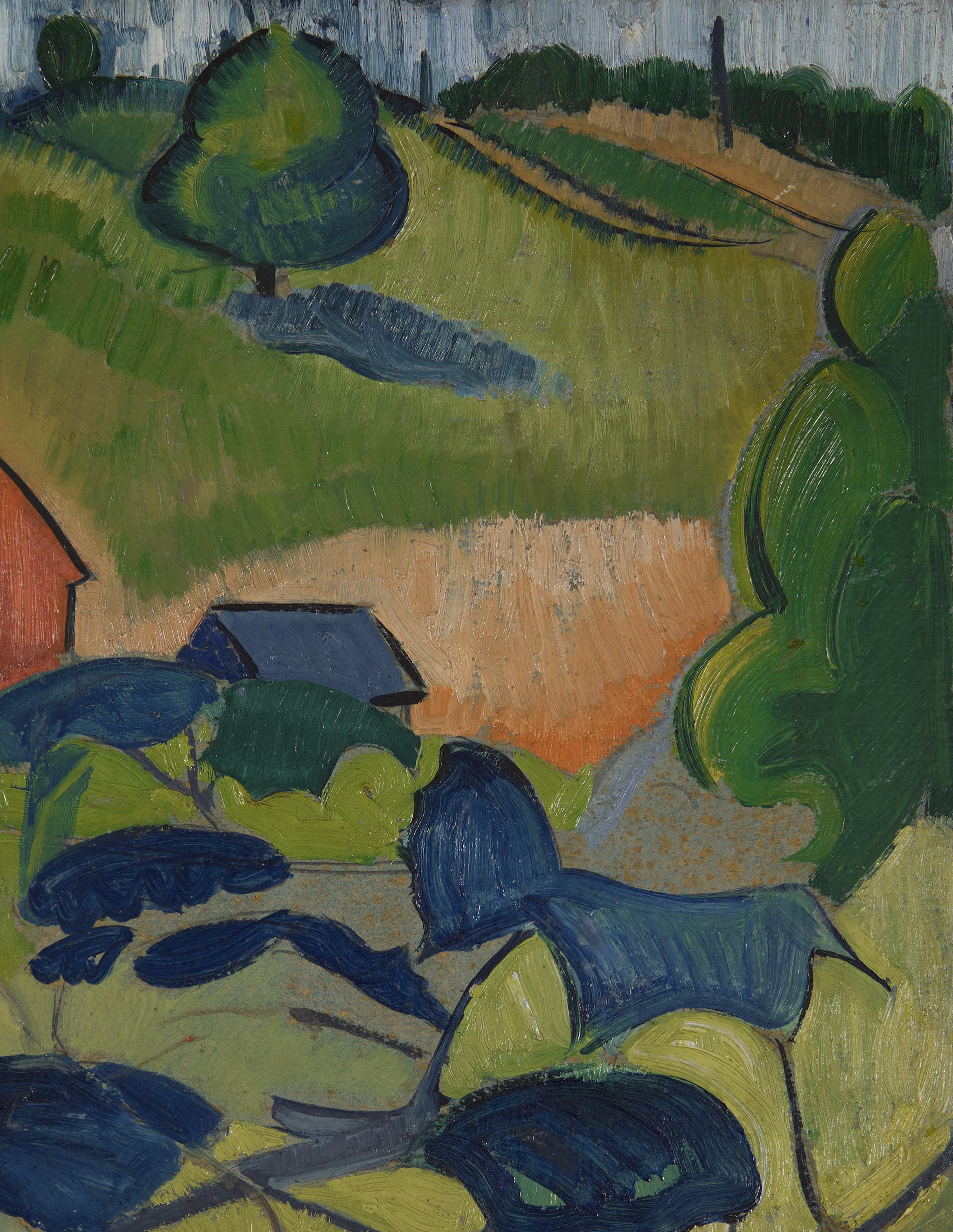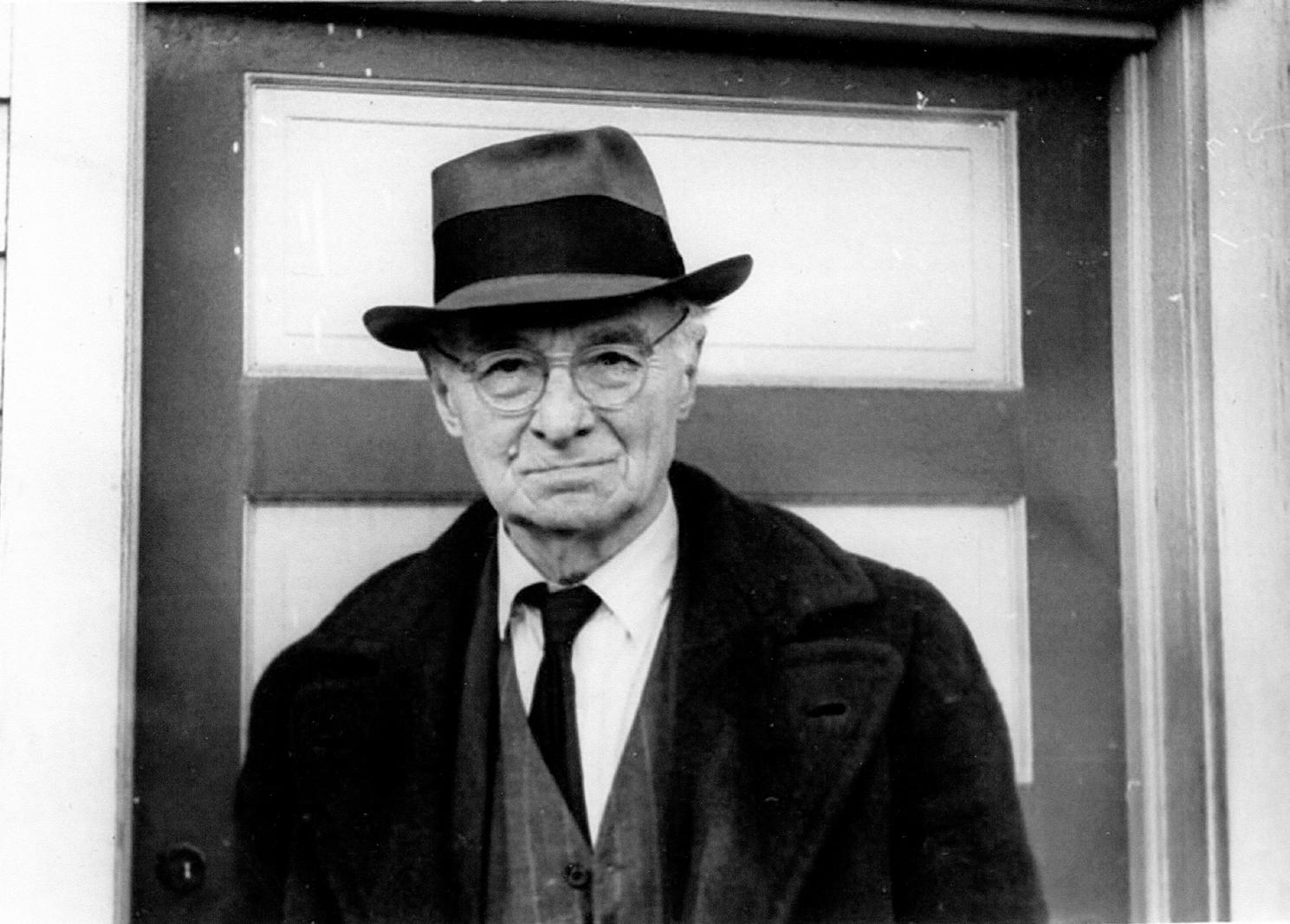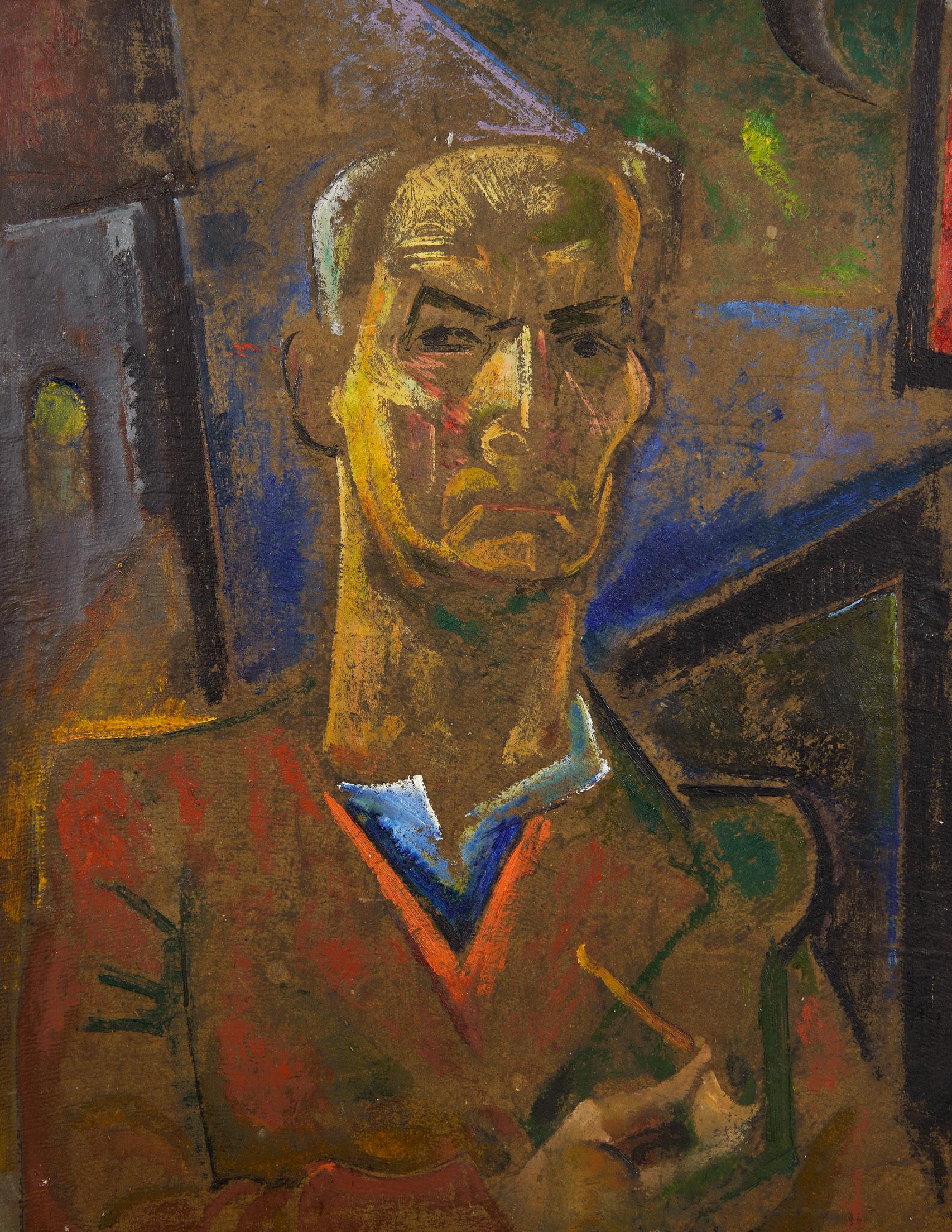
WILLIAM SOMMER:
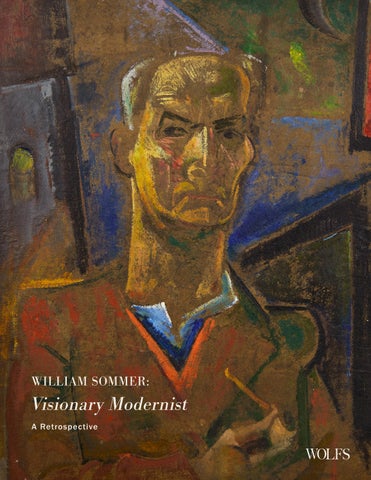
WILLIAM SOMMER:
A Retrospective
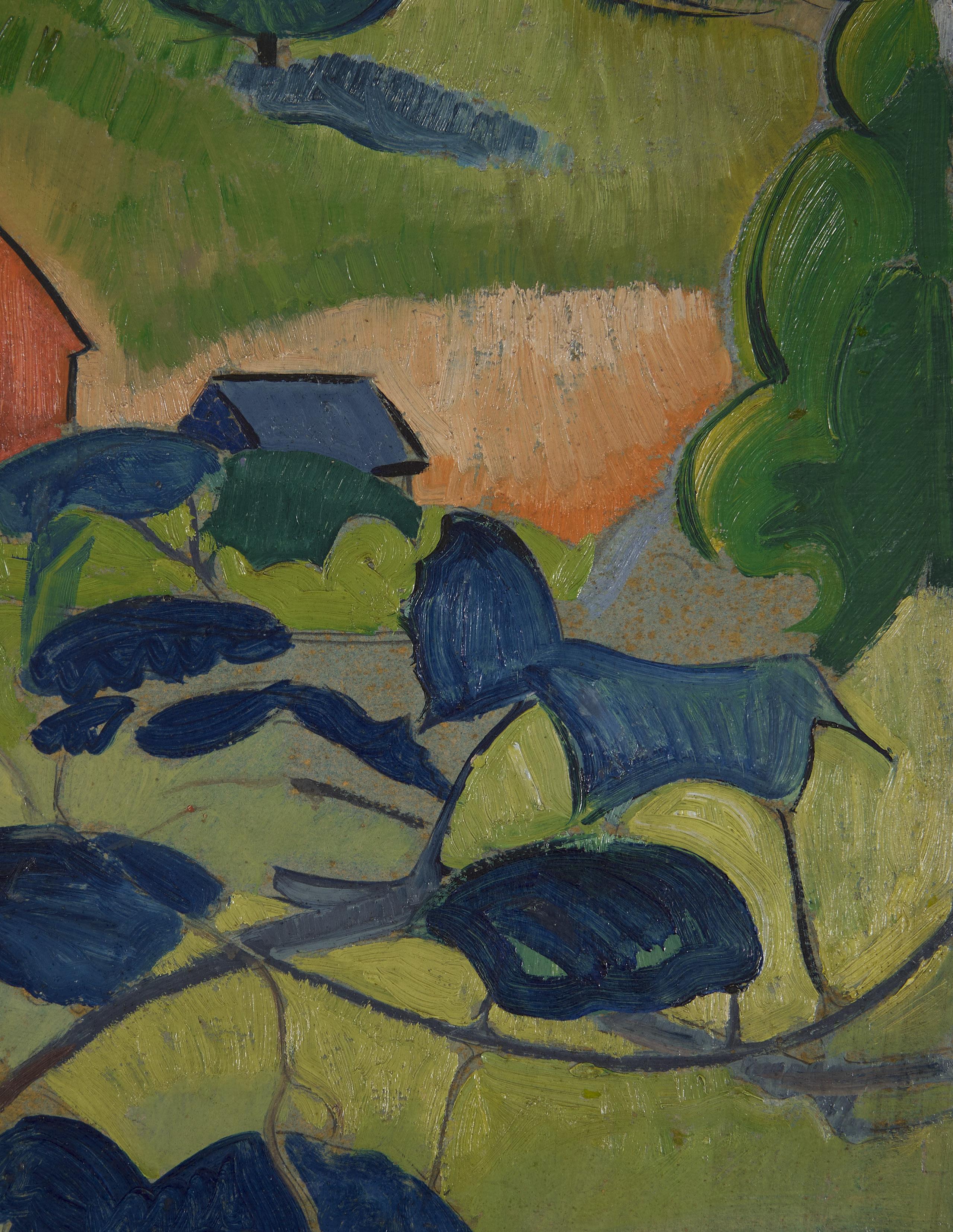
MAY 8 - AUGUST 15, 2026
Foreword by Martin Lerner
Introduction by Michael Wolf & Raquel Flecha Vega, PhD Essay by William H. Robinson, PhD
William Sommer: Visionary Modernist
Published in conjunction with the exhibition at WOLFS Gallery May 8 – August 15, 2026
© 2026 McKinley Madison Publishing House, LLC. All rights reserved. No part of this publication may be reproduced, stored in a retrieval system, or transmitted in any form or by any means, electronic, mechanical, photocopying, recording, or otherwise, without prior written permission from the publisher.
By William H. Robinson, Ph.D., Raquel Flecha Vega, Ph.D., Michael Wolf and Martin Lerner
ISBN: 979-8-9933316-1-4
Library of Congress Control Number: 2026910846
Published by McKinley Madison Publishing House, LLC Cleveland, Ohio
In association with WOLFS Gallery
Contact: info@mmphpub.com | www.mmphpub.com
Printed in the United States of America First Edition

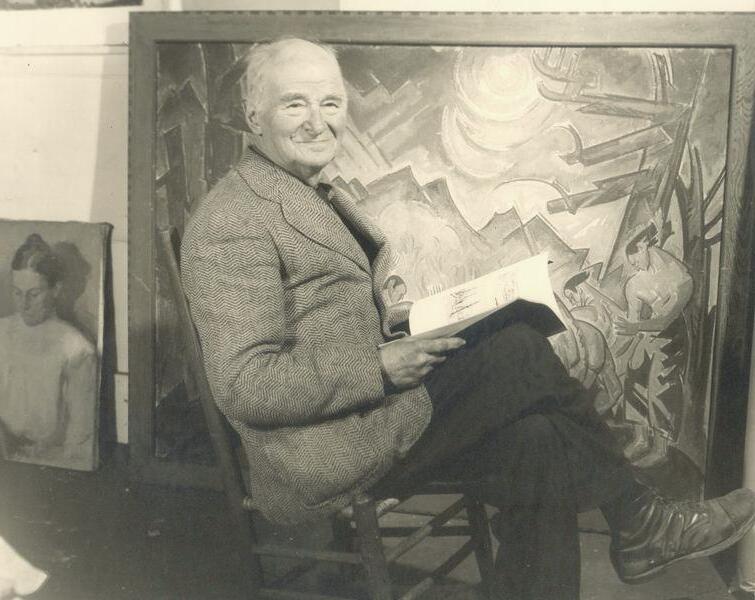
Iwashired by Sherman Lee to join the curatorial staff of The Oriental Department at The Cleveland Museum of Art in 1966. While Indian and Southeast Asian art were my professional areas of expertise, the emphasis of my studies in graduate school, I was very much interested in the arts of other cultures, including American painting of the 20th century. As an undergraduate Art History major at brooklyn College, I had taken courses in American art with Milton W. brown and, in graduate school at NYU’s Institute of Fine Arts, with Robert Goldwater.
In 1962, while in graduate school, I was hired by the Munson-Williams-Proctor Institute to help research their forthcoming exhibition: a 50th-anniversary recreation of that extraordinary, revolutionary 1913 exhibition, which came to be known as “The Armory Show.”
That exhibition, in addition to featuring so many great modern European artists, many of whom were barely known to the American public at that time, included many American artists. They ranged from artists relatively well-known in 1913 to virtual unknowns. Today, some are acknowledged as masters of American Modernism--John Marin, Maurice Prendergast, Marsden Hartley, for example--while others are barely remembered. My mandate was to identify the actual paintings from the original 1913 exhibition and search for their present locations.
In addition to my research for the Munson-Williams-Proctor Institute, I was hired by my former Professor, Milton W. brown, to do research for an important book he was working on, The Story of the Armory Show.
The point of all this is to acknowledge my experience with American artists of the first quarter of the 20th century, both obscure and wellknown, prior to my coming to Cleveland.
Theentrance to the Cleveland Museum of Art’s research library at that time was situated on an upper level in a slightly outof-the-way area, and, to reach it, one had to go through some unassuming galleries, including a small exhibition space where the art of local artists was exhibited. This was my first experience with the artists of “The Cleveland School.” I was pleased to see a few paintings by artists who were in The Armory Show, such as Henry Keller, Alex Warshawsky, and William Zorach. There were a few other artists whose work I was familiar with, such as Charles burchfield. but, as I regularly walked through this small gallery to go to the library, there was one artist whose works invariably made me stop and look carefully. He was a Cleveland artist I had never heard of. Despite all my previous research on early 20th-century American painting, I didn’t remember coming across his name in any of the standard histories of American art. And what was most surprising to me, he was the outstanding artist in that gallery. His name was William Sommer.
To my eye, Sommer was the most aesthetically satisfying, the most visually interesting of all the artists exhibited in that small gallery. He was clearly a very gifted artist of considerable skill and technical proficiency whose singular vision and artistic imagination resulted in some extraordinary paintings. It was puzzling to me why I had never heard of him. Why wasn’t he included in the 1913 Armory Show?
When I started to research Sommer, I was pleased and somewhat surprised to come across The New York Times review of The Cleveland Museum’s 1950 memorial exhibition for Sommer. Written by Aline b. Louchheim, it started with the following: “It is astounding that an artist of the stature of William Sommer should be so little known
outside the Cleveland area in which he made his home. For this artist, who died last year at the age of 82, surely deserves a place high in the roster of American artists. Perhaps the big memorial show…will bring this work the wide audience it warrants.” (Nov. 5, 1950).
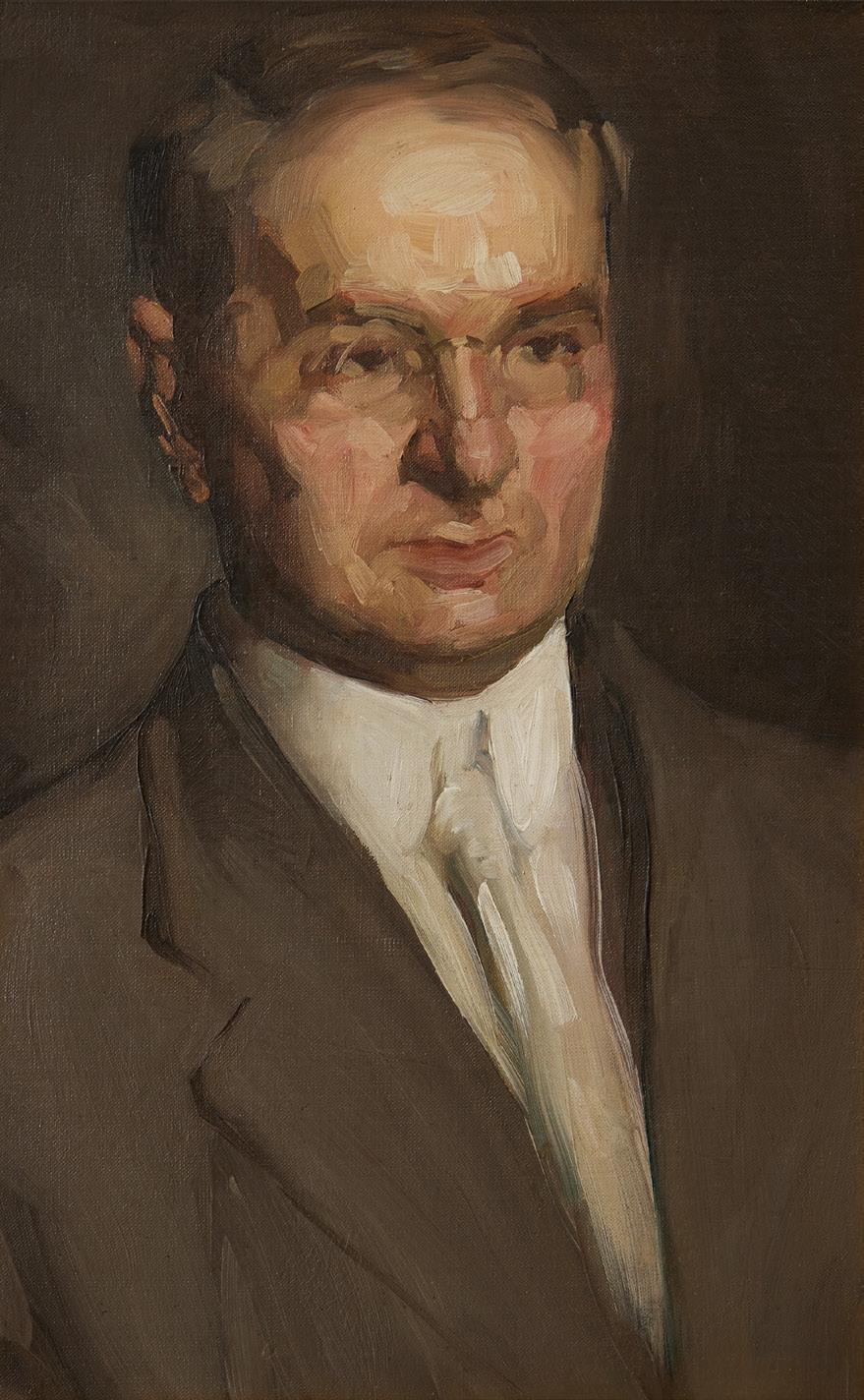
I was particularly intrigued by the single painting chosen to accompany this important review. It is both a strikingly sensitive and artistically innovative portrait of his favorite model, one of the children from the large Polish family who were Sommer’s neighbors, Tess Dominski (fig. 112). I eventually came to own this picture.
Actually, Sommer could have exhibited in the 1913 Armory Show if he had wanted. William Zorach, who was not originally invited to participate, arranged to be included after learning about the plans for this groundbreaking exhibition. In Sommer’s case, as a friend of Henry Keller, who was part of the early planning for the show, it would not have been difficult to be included as well. but he was not sufficiently interested. Sommer saw The Armory Show in New York in March 1913, and the exposure to Matisse, Cézanne, Picasso, and others was a major influence on his later work.
I purchased my first painting by William Sommer in 1967 and my last one in November 2025. I am very pleased that many of these pictures are now being publicly exhibited. It is also very gratifying to see so many from the great, landmark Cleveland Museum’s 1950 William Sommer Memorial Exhibition reunited for this exhibition. This would not have been possible without the very enthusiastic participation of Michael Wolf. It was Michael’s idea to do this exhibition, and his total commitment to this project has been inspiring.
Martin Lerner
“It
is astounding that an artist of the stature of William Sommer should be so little known outside the Cleveland area in which he made his home. For this artist…surely deserves a place high in the roster of American artists.”
– ALINE B. LOUCHHEIM, THE NEW YORK TIMES , NOV. 5, 1950.
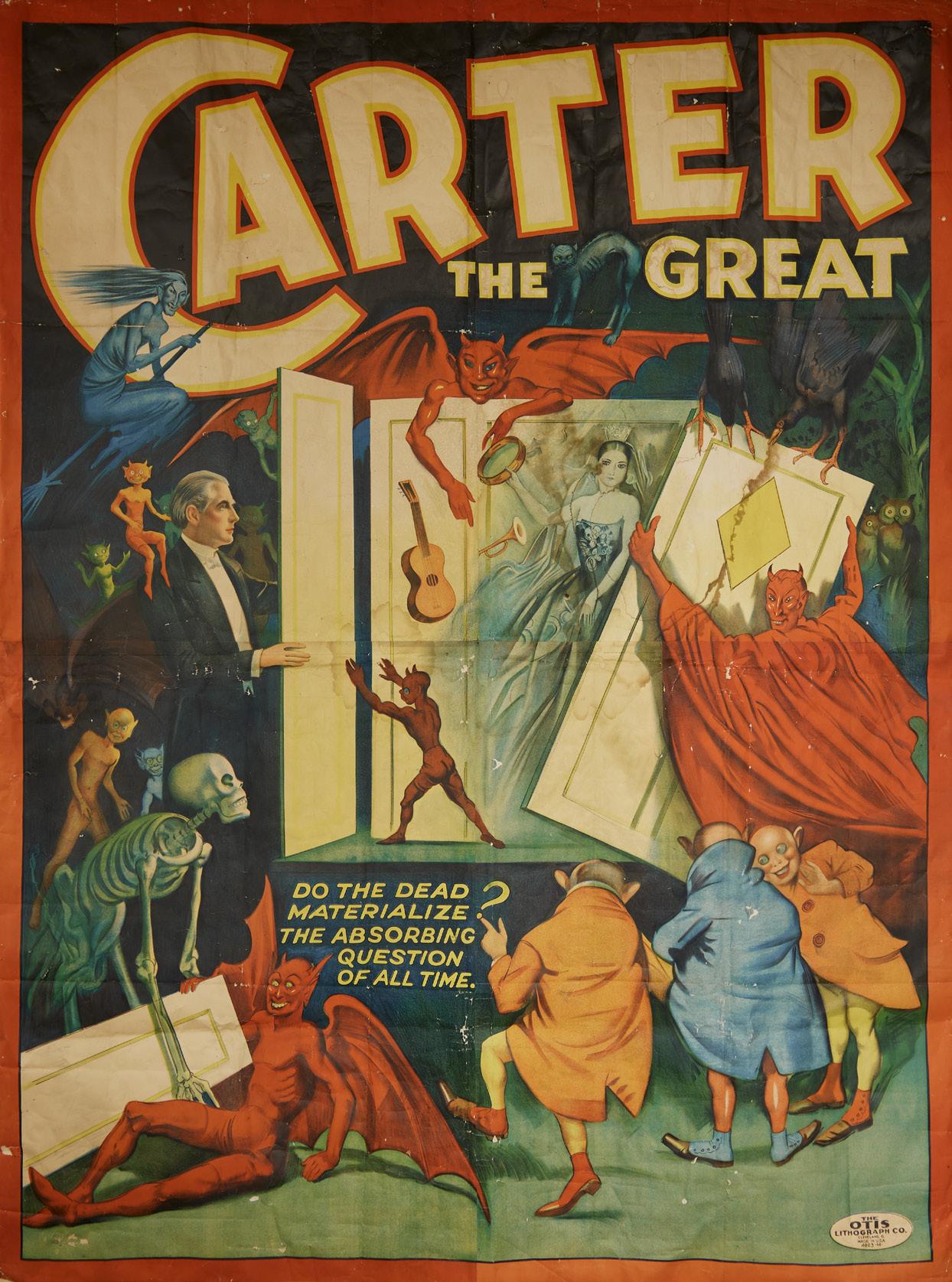
Carter the Great, Do the Dead Materialize? The Absorbing Question of All Time, The Otis Lithograph Co., ca., 1920’s
Only in Cleveland could a small gallerist like me have an honor such as this. Only in Cleveland, where artistic discoveries still abound, does such a rare opportunity to present largely unseen images by a pioneering artist still remain. Perhaps the best of such opportunities is this: a William Sommer retrospective. Can I complain that this opportunity still exists and yet be so happy to take advantage of it? Well, I guess so; it’s what we call a Cleveland thing.
Whenyou say retrospective, you can’t equivocate; you have to portray a full and complete picture, and so we have made every effort to do just that. William Sommer, now at least regionally famous, has been the subject of many one-man shows and much writing. Now, having stood the test of more time, offering even greater perspective, we endeavor to squeeze this important artist into his proper place in the echelons of American art. before embarking on this journey, another side of William Sommer, equally as brilliant and successful, must be presented here in the introduction. Meet William Sommer, master lithographer. While always covered briefly in the many bios and essays, bill Sommer’s five-decade career in lithography is rarely heralded for its significance.
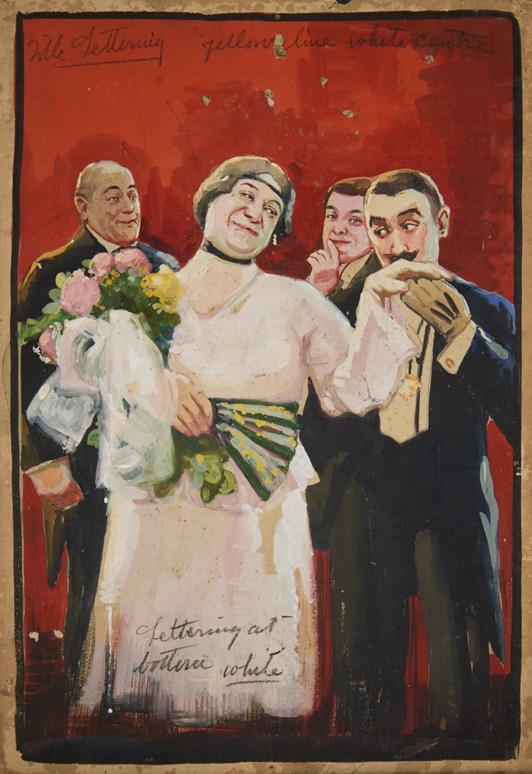
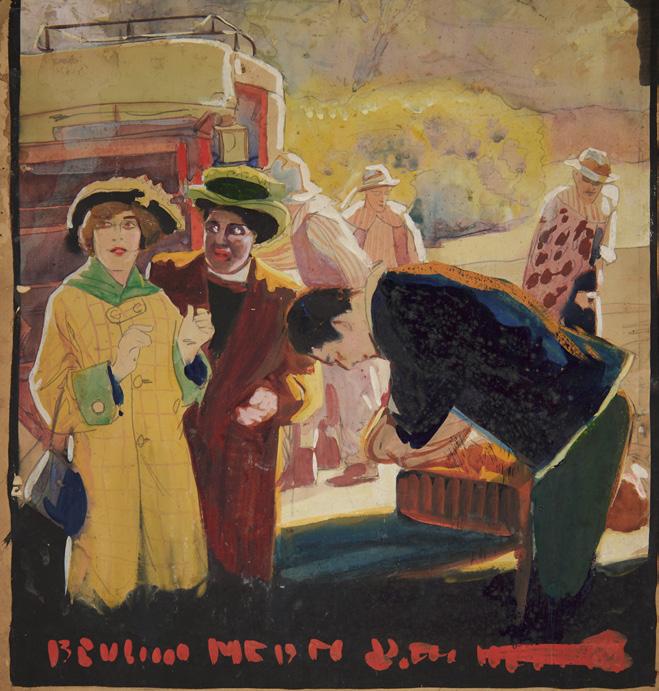
That career began, in earnest, in 1907, when The Otis Lithograph Company hired Sommer as a lead draftsman (see page 18).
At the time, The Otis Lithograph Company, along with The Morgan Lithograph Company and Continental Litho, were among the more prominent lithographic houses in the United States, such as New York’s Greenwich Litho Company and J. H. Tooker Litho. After securing a large Hollywood contract, Otis recruited Sommer and his colleague Carl Moellmann, who was hired as the workshop manager, from J. Ottman Lithograph in New York City. In Cleveland, the artists took the company in a more modern direction, elevating the quality of
the work and captivating larger audiences. In the workshop, Otis employed several specialized artists and craftsmen, such as poster artists and pressmen, each responsible for a different step in the color lithography process. This meant that a master draftsman, or poster artist, was responsible for designing the image and drawing the design directly onto the stone with a greasy crayon. Junior draftsmen were responsible for filling in the backgrounds according to the lead draftsmen’s design. A master printer, or pressman, would then apply ink to the various stones, one for each color, and would run the print off on the press. In larger workshops like Otis, assistants and apprentices were responsible for preparing stones, mixing inks, and helping with the pressing of prints. Within this workshop hierarchy, master draftsmen were an elite artistic class of about 100 lithographers nationwide. Sommer was among their ranks. His status among poster artists was attested to time and time again by those who worked with him at Otis. Among his colleagues, he was revered as a “Master.” Commenting on his masterful dexterity in the workshop, his colleague at Otis, Philip Kaplan, once exclaimed, “bill could draw a head eight feet high with the ease and grace of an acrobat flying through space.” If the story of Sommer’s career highlights his significant role in modernizing poster art, it also underscores his place at the center of a major center of printmaking in the United
States. The Otis Lithograph Company of Cleveland alone produced some 55 million posters per month at its height in the 1920s, with the Cleveland industry accounting for up to twothirds of the printmaking industry nationwide.
In addition to these lucrative movie poster contracts, Otis secured contracts with two famous illusionists of the time, Carter the Great and Thurston the Magician. based on accounts from Sommer’s friend and colleague at Otis, Richard Sedlon, we know that Sommer was entrusted by his manager, Moellmann, to consult with Thurston on the posters’ requirements and to create the original designs.
Though many artists and craftsmen were involved in creating lithographic posters at Otis, Sommer’s role as a master poster artist is unmistakable. Indeed, during his career at the Otis Lithograph Co. from 1907 to 1929, Sommer would have been responsible for some of the most high-profile projects, par-
ticularly poster art for high-grossing popular shows like Carter the Great and Thurston the Magician.
Other sources from the period confirm Sommer’s role as a master poster artist at Otis and his wide impact on artists and audiences alike. Recalling a moment when the virtuosity of Sommer’s skill was on full display, Sedlon recounted, his “line was so beautiful; it was part of the background, part of the head. He didn’t need values. He gave birth to a line.” Another admiring note, written by fellow draftsman Earl Neff, was inscribed on the back of an original poster design by Sommer. Neff describes in the note that, upon discovering the original art for a Thurston the Magician ad, he cut out the image of a “Fantom Head” and had Sommer sign it. Neff then displayed it in a custom-made lead frame that he designed and cast himself. Neff concluded his note with simple but fitting words, “bill taught
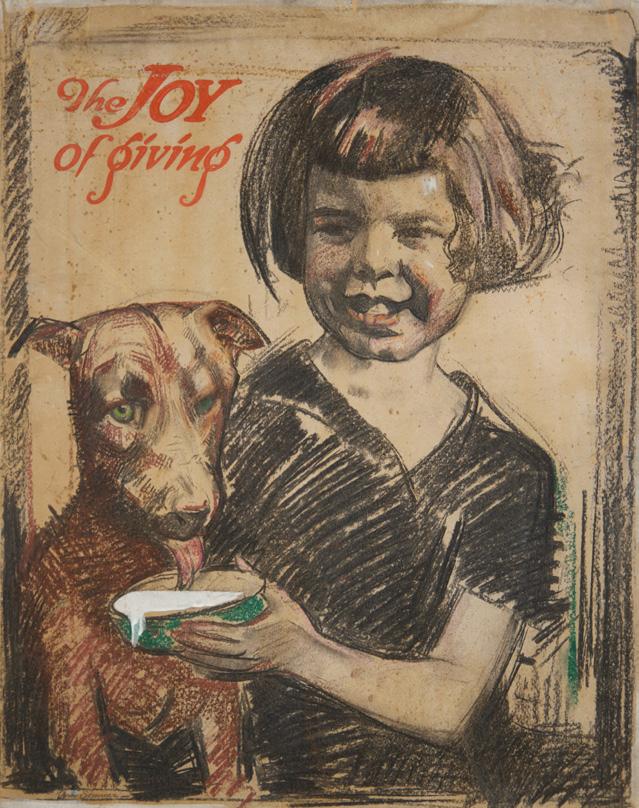
me so much in art,” attesting to his high esteem for the master printmaker and painter. Another poster attributed to Sommer, Million Dollar Mystery, c. 1925, advertised a grand European tour, evidencing the wide reach of Sommer’s commercial art. Sommer left a major impact on his artistic community at home, while his poster art was seen by audiences worldwide (see page 20).
Sommer was not simply a master of modern art and printmaking in Cleveland, Ohio. His artistic legacies in fine and commercial arts are central to the histories of magic, Hollywood, printmaking, and modern art worldwide. If his life straddled the grey area between art and commerce, he did so, albeit imperfectly, by balancing both. In fact, what we learn from his accomplished body of work and decades of printmaking is that his fine art practice had an immense impact on his mesmerizing poster designs, just as his commercial practice
propelled his artistic pursuits. On the occasion of this retrospective, it is a distinct honor to present an artist of The Cleveland School, both as a lithographer who helped modernize poster art across the globe and a painter who helped pioneer modern art.
In the following essay on Sommer’s life and artistic journey by Dr. William Robinson, we learn about Sommer as the self-avowed “ultramodernist.” An artistic philosophy that Sommer rendered in spectacular forms and compositions on paper, canvas, and board. Robinson eloquently explores how Sommer championed modernist principles through sustained experimentation and the expression of feeling through form. This exhibition reveals an artist of astonishing complexity whose full achievements have yet to receive full recognition.
Michael Wolf and Raquel Flecha Vega, Ph.D.
By William H. Robinson
“Art is no longer a sensation we take up with the eyes alone. Art is the creation of our spiritual, inward vision, nature just starts us off. Instead of working with the eyes we conceive with the unconscious and thus the [artist’s] complete changing of nature.”
WILLIAM SOMMER 1
Few American artists articulated the ambitions of modernism as clearly—or pursued them as relentlessly—as William Sommer. Yet despite a body of work that engaged the defining aesthetic and intellectual currents of twentieth-century art, he remains largely absent from standard narratives of American modernism. “big bill Sommer,” as friends affectionately called him, spent his most productive years working in Cleveland and the rural community of brandywine, Ohio—settings that, despite
their vitality, lay outside the more recognized centers of avant-garde innovation. His pursuit of visionary experience grounded in inward perception rather than outward description persisted across decades, even when his colleagues turned toward more commercially viable realism. Sommer’s relative absence from prevailing historical narratives reveals a significant oversight, one that underestimates both the originality and the sustained experimentalism of his contributions to American modernism. ™
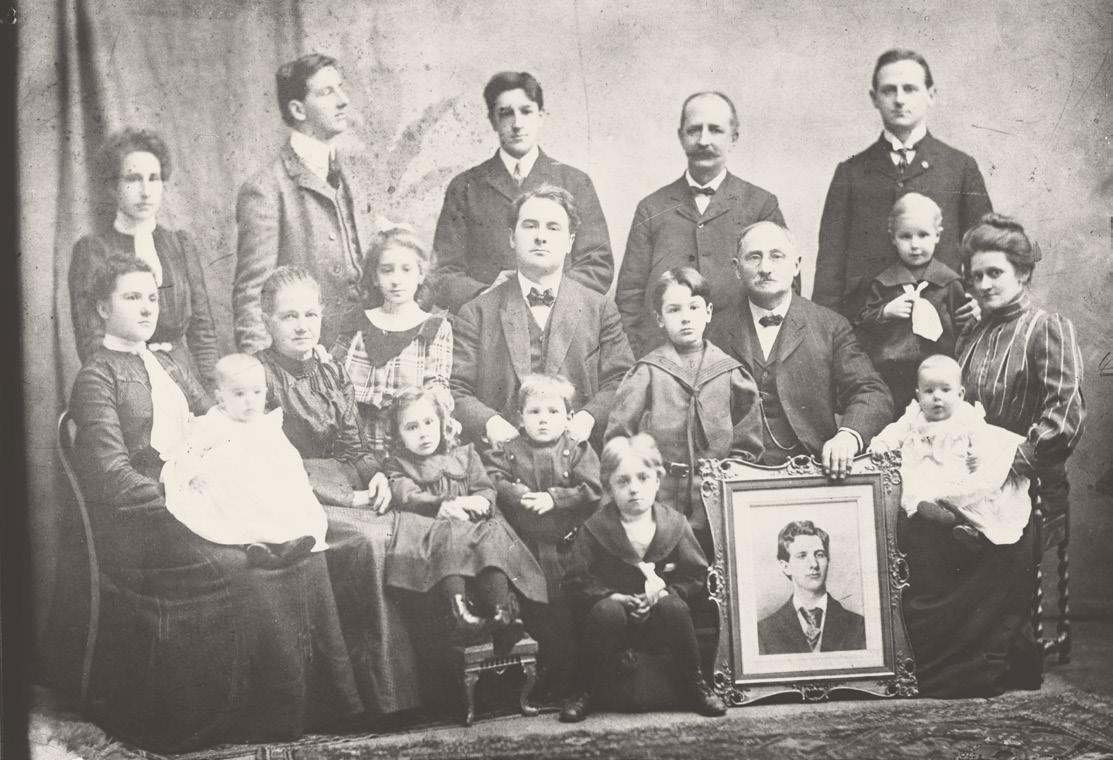
Sommer was born in Detroit, Michigan, on January 18, 1867 to German immigrant parents. A photograph of the family taken when he was about thirty-three shows him in the center, surrounded by his extended family, including his parents, and his wife Martha on the far left.
Sommer’s father, Joseph Sommer, was a typesetter and later a grocery store owner. He described his mother, Christina Zoph Sommer, as “intelligent, retiring, unassertive, well-built, hard-working, excelling in cooking and fancy needlework.”2 He felt a closer affinity to his mother—who exhibited a flair for creative activities—than to his father. Joseph was more materialistic and business-oriented, at times clashing with his son over his artistic ambitions. Perhaps the most lasting legacy from his parents was fluency in German, which allowed him to develop a deep knowledge of the philosophies of Arthur Schopenhauer and Friedrich Nietzsche without the need for translated texts.
Sommer attended public schools in Detroit, loved sketching, and at age eleven began attending the Sunday drawing classes of Julius
Melchers, father of the American Impressionist Gari Melchers. Recognizing Sommer’s talent and zeal, Julius let him take classes even when he could not afford the meager tuition. In 1881, Julius helped Sommer obtain a seven-year apprenticeship at the Calvert Lithography Company in Detroit. Although this ended his formal education at age fourteen, it could not quelch his lifelong passion for learning.
Upon completing his apprenticeship in 1888, Sommer moved to boston to take a job at The bufford Lithographic Company. In 1890, he made an extensive trip abroad, travelling first to England and taking a job at Dangerfield Printing Company in Netherfield, St. Albans, about 20 miles northwest of London.3 He painted Boy with a Guitar (fig. 1) and probably Seated Man (fig. 2) during this period. At Dangerfield, Sommer struck up a friendship with Fred Hager, an American artist who had inherited money from his family. With an offer to finance the trip, Hager persuaded Sommer to accompany him to Germany to study at the Munich Kunstakademie under Professor Johann Herterich. Known for his portraits and genre scenes, Herterich’s late-nineteenth
century academic realism emphasized the importance of careful observation and precise, rigorous drawing.4
Sommer’s surviving works from the Munich period reflect the same rigorous discipline. Head of a Woman (fig. 3)—a charcoal drawing signed “Sommer” and inscribed “Prof. Herterich” at the upper left—already displays a confident command of line and tonal modeling for a twenty-three-year-old artist. Standing Nude (fig. 4), a studio sketch of a model that includes a vignette of a man working at an easel, demonstrates remarkable skill in rendering the human figure. A comparable sensibility appears in Sommer’s impressive Seated Nude (fig. 5), dated 1902 in the lower left. Taken together, these works attest to Sommer’s early mastery of draftsmanship—one of the crucial foundations of his later experimental modernism.
Sommer took advantage of his time in Germany to make excursions to the Alps, Venice, and the Netherlands. He may have also studied briefly with Adolph Menzel and painted cows with Heinrich von Zügel.5 While at the Munich Kunstakademie, Sommer became acquainted with another American student, Henry Keller from Cleveland, Ohio. They later reunited and emerged as leaders of the modernist movement in Cleveland.
After over a year abroad, Sommer returned to New York in April 1891. He spent the next sixteen years working in the city as a commercial lithographer, first at the Metropolitan Company, then at the Gillom Company and the J. Ottmann Lithographing Company.6 In 1895, he married Martha Obermeyer, whose steadfast support allowed him to pursue his artistic ambitions through difficult times, whether through periods of financial distress or bouts of heavy drinking. During this period, the Sommers lived mostly at 255 West 20th Street and 478 West 22nd Street, where they raised three sons: William Jr. (b. 1896); Edwin (b. 1899); and Raymond (b. 1902).7
Sommer’s activities in New York are poorly documented, but there is sufficient evidence
to confirm that he was active in the fine arts and familiar with recent developments in modern art. In 1892, he was invited to join the Kit Kat Club, a gathering place for artists to meet, sketch, and exhibit. “That’s where I got all my early art—models, nudes, etc.,” Sommer recalled.8 In 1901, he contributed a painting titled Love to an exhibition of the New York Water Color Club.9 He also participated in the National Water Color Society’s annual exhibition of 1903, and claimed that the National Academy of Design hosted his first solo exhibition, although there is no record of the event.10 At Ottman Lithography, Sommer developed a close friendship with Carl Moellmann. Originally from Cincinnati, Moellmann was a student of Frank Duveneck and helped John Sloan and the Ashcan artists learn lithography. Moellmann later moved to Cleveland and became Sommer’s supervisor at Otis Lithography. Sommer probably painted Martha (fig. 6), an early portrait of his wife, around 19001905. If so, it belongs to a handful of surviving oil paintings from the period. Having already developed formidable skills as a graphic artist, he turned his attention to oil in this depiction of Martha set against a spare, dark background. While the black dress and background are thinly painted, the face is built up with thick strokes of pink, white, and green. The slight tilt of her head, the pursed lips, and the downcast eyes invest the portrait with a moody psychological presence. This solitary figure captured in a somber moment of inward reflection is far from the glittering society portraits made to flatter sitters with projections of wealth and social status. The dark palette and expressive brushwork suggest the influence of the Ashcan artists who scandalized the public with their brutal naturalism. The unease in Martha’s expression is echoed by the rough handling of her clasped hands, barely defined by wide swaths of paint and daringly abstract—perhaps left intentionally unfinished. Sommer’s willingness to ignore conventional notions of beauty and academic “finish” was a harbinger of things to come. ™
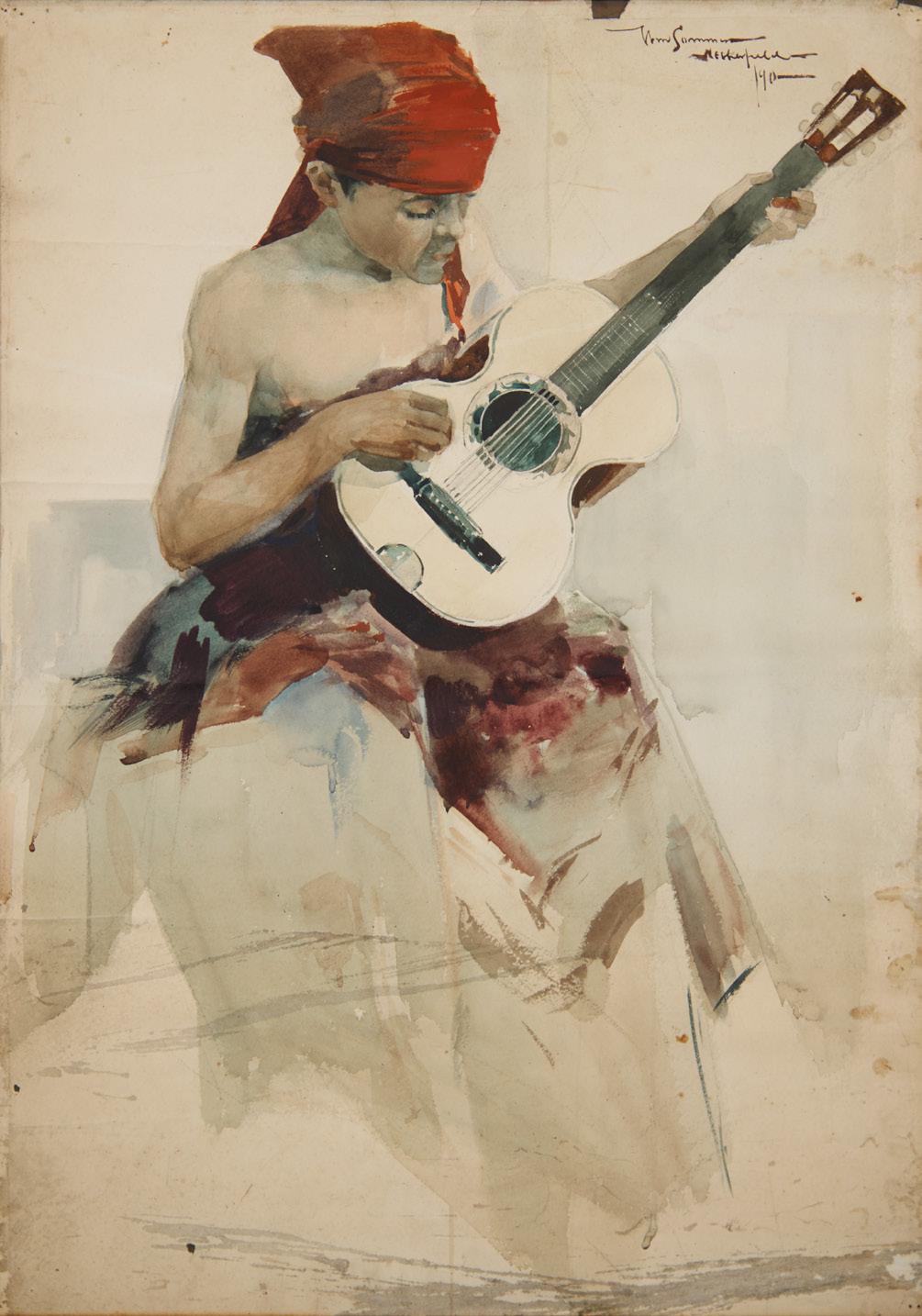
Watercolor on paper
Signed and dated upper right, inscribed 'Netherfield' 30 x 20 inches 1
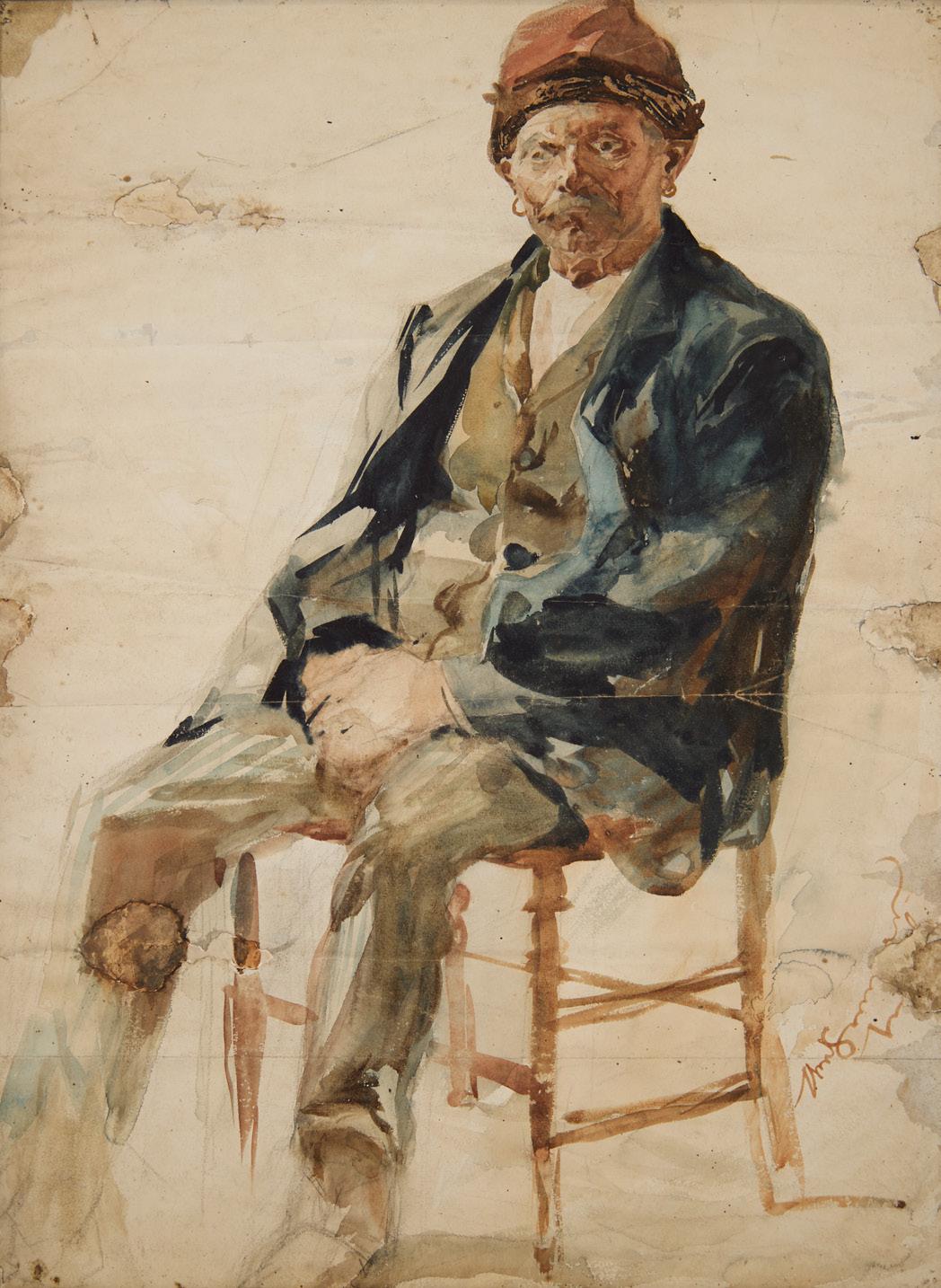
Seated Man, c. 1890
Watercolor on paper
27 x 20 inches
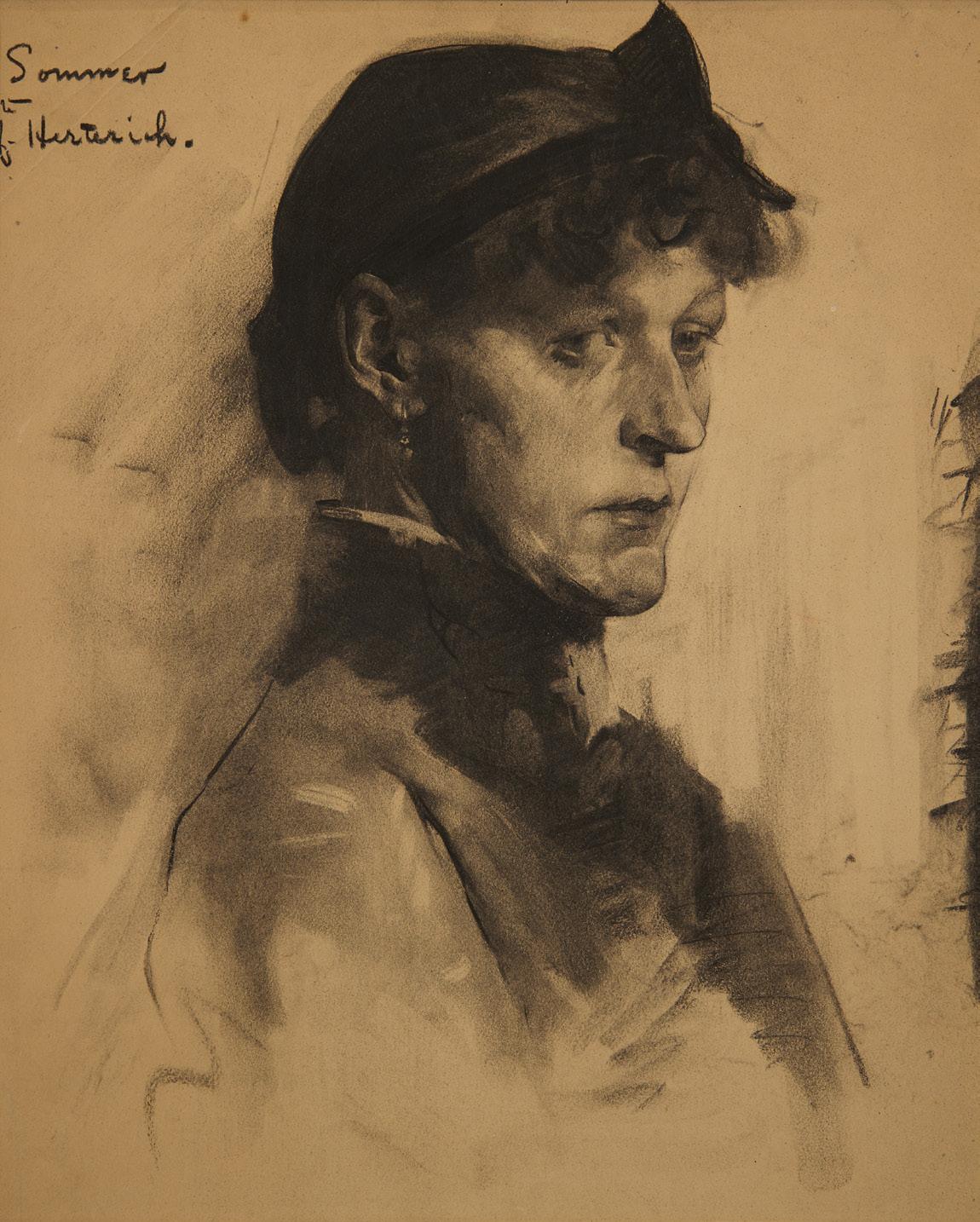
Head of a Woman, 1890-91
Charcoal on paper
Signed upper left, inscribed 'Professor Herterich' 19 x 15 inches
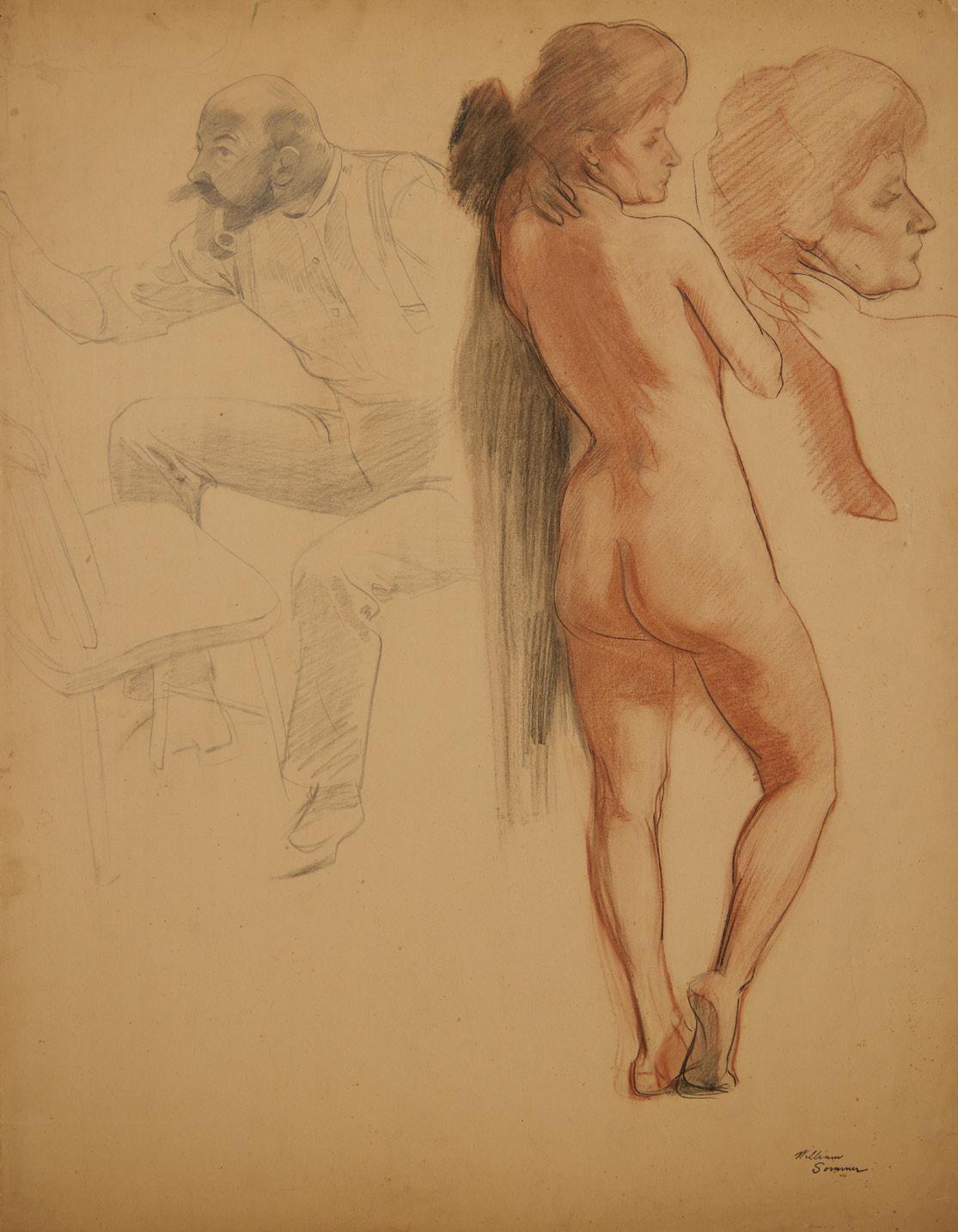
Standing Nude, 1890-1900
Conté and graphite on paper
Signed lower right 24 x 19 inches 4
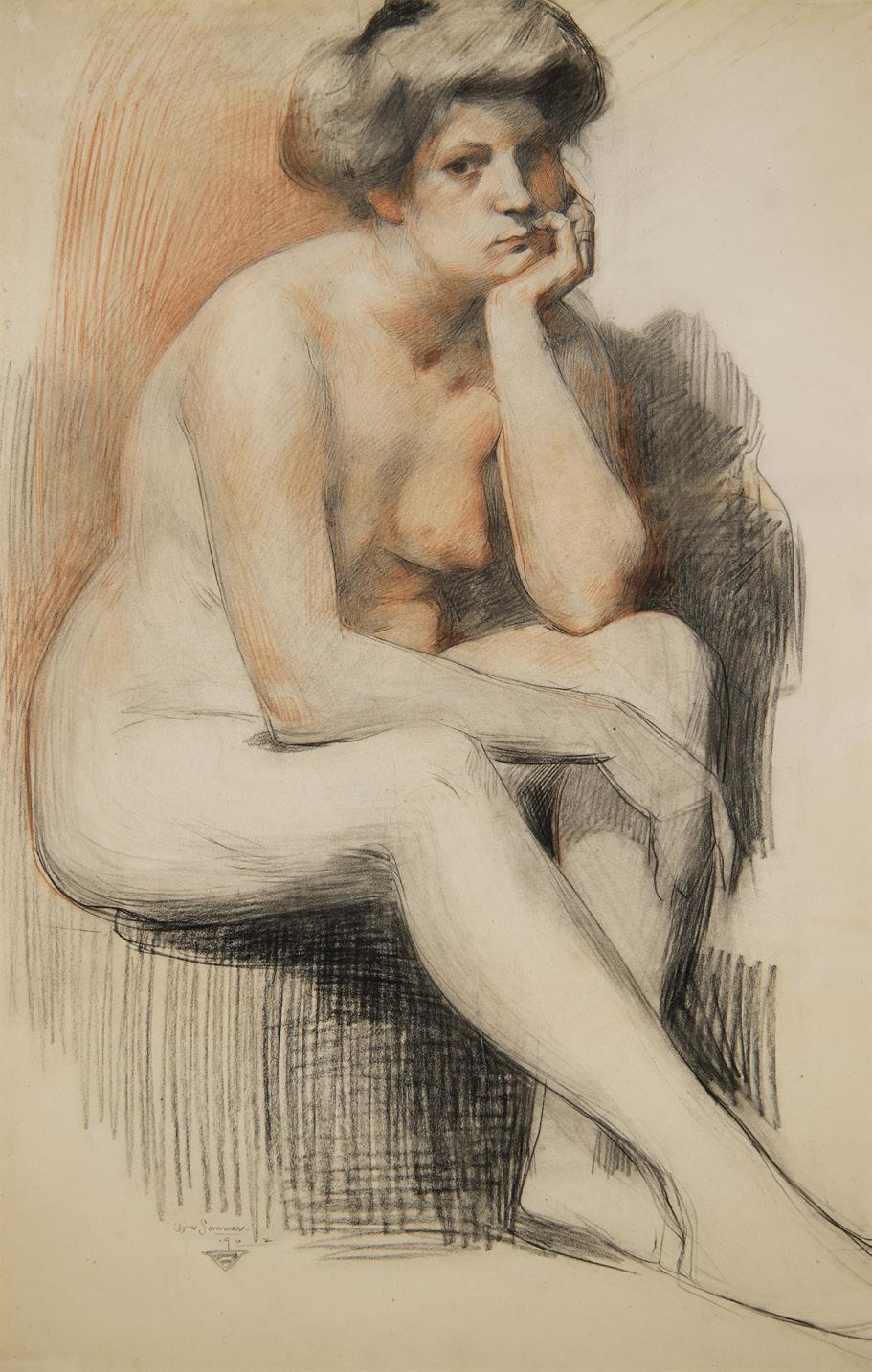
5
Seated Nude, 1902
Charcoal and conté crayon on paper
Signed and dated lower left
28 x 18 inches
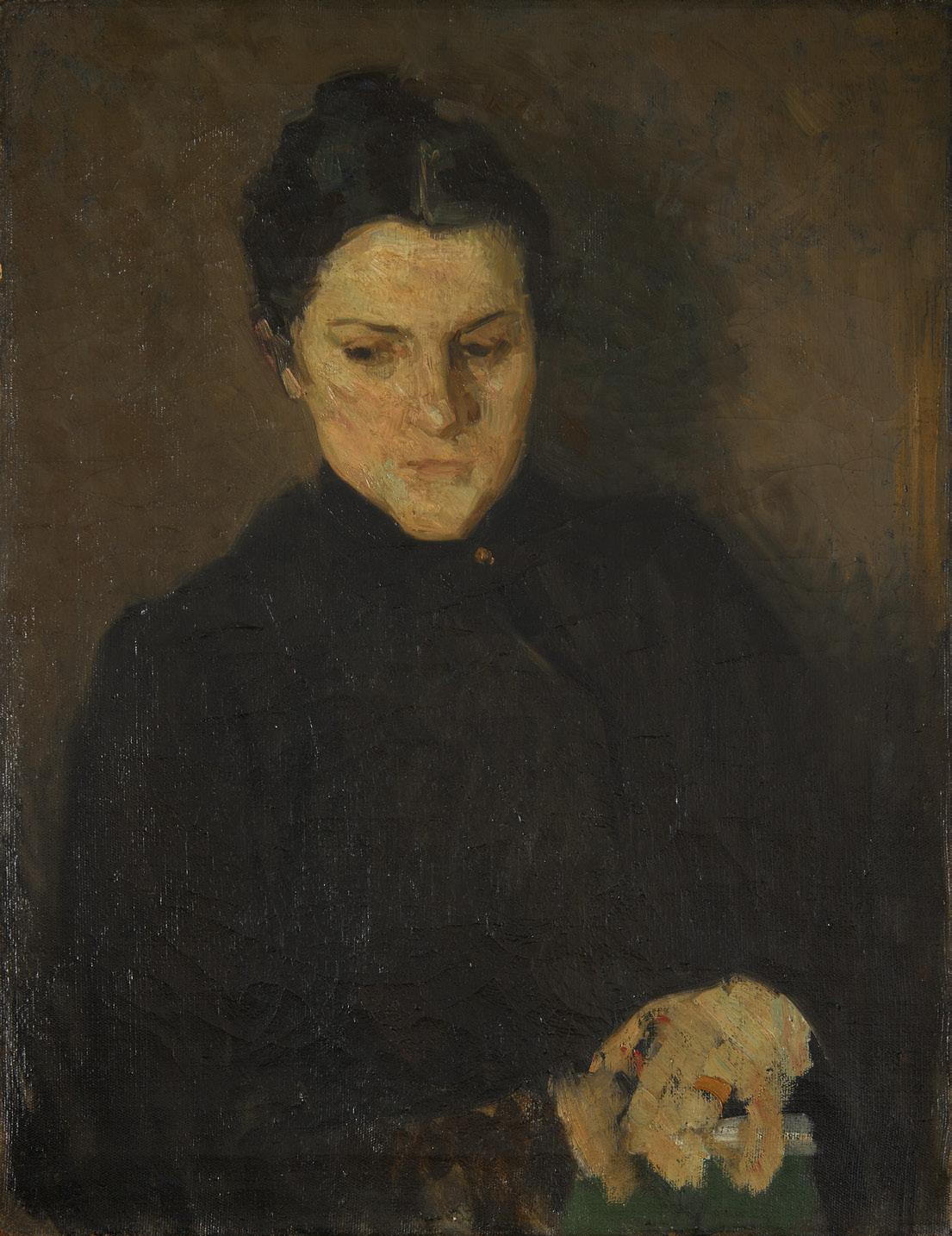
6
, c. 1905
Oil on canvas
26 x 20 inches
In
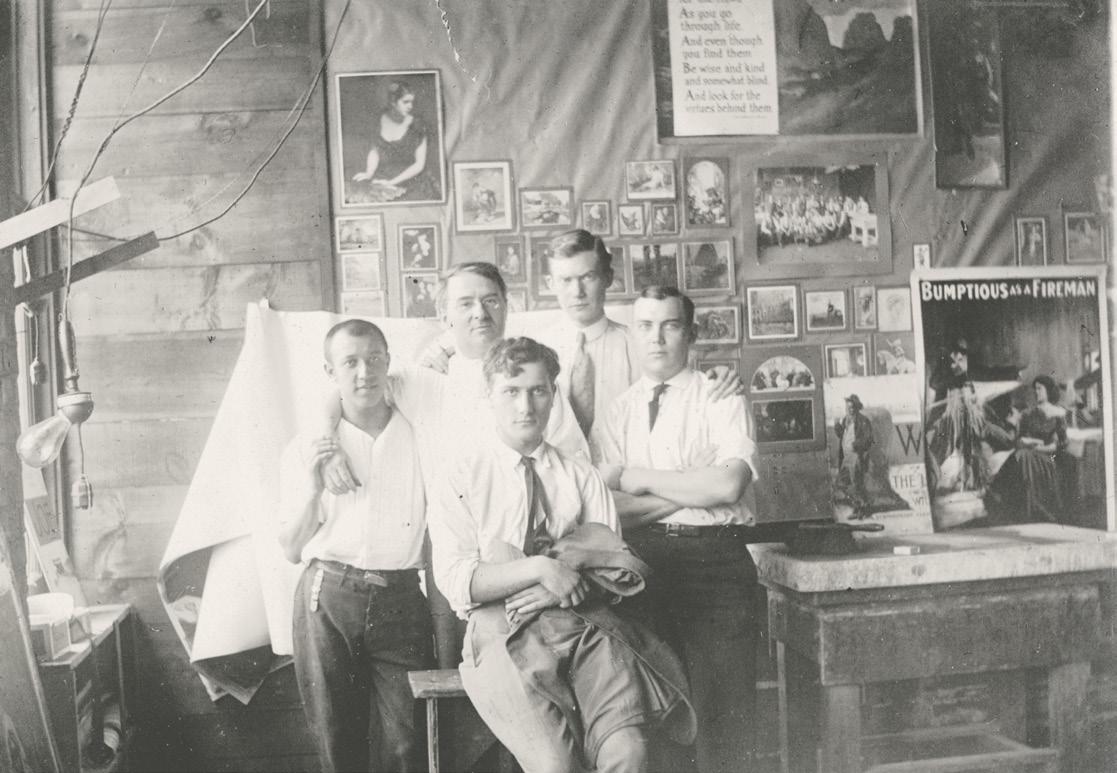
1907, Sommer and Moellmann moved to Cleveland to work for the Otis Lithography Company. They had been recruited by the firm’s owner, William brewster, who sought the finest lithographers in the country to expand his thriving business producing theatrical, advertising, and movie posters. Sommer appears in a photograph taken at Otis standing at the center, wearing glasses. Moellmann, the tallest member of the group, stands to the right beside Clifford Crowl, while William Zorach is seated in the foreground. At the far right hangs a poster for the silent film Bumptious as a Fireman (1910), a comedy about a selfimportant man who responds to a small kitchen fire by throwing the burning pan out the window, alarming passersby in the street. Zorach painted a portrait of Sommer around this time using the lively brushwork and tonal palette of Ashcan realism.
Sommer was now forty years old and a highly accomplished lithographer. Otis rewarded him with a generous salary—enough to buy an
attractive two-story house at 1371 Westlake Avenue in Lakewood, a middle-class suburb just west of the city. The home was accessible to Cleveland by electric trolley and within walking distance of Lake Erie. With both a front and a backyard, there was ample room for a garden and pets. The family lived there for the next seven years, a period marked by dramatic transformation in Sommer’s art.
The Sommers arrived at an auspicious moment. Cleveland was among the wealthiest and fastest-growing cities in America, the hometown of John D. Rockefeller and Standard Oil. The city’s economy thrived on steel, oil, auto, and paint manufacturing. The city’s location on major rail lines between New York and Chicago, shipping access across the Great Lakes, and connections to the Erie and Ohio Canals made it a national transportation hub. Iron ore arrived from Minnesota, coal from West Virginia, and crude oil from western Pennsylvania. “Millionaire’s Row” on Euclid Avenue was reportedly the wealthiest street in America.
Yet, Cleveland was more than an industrial powerhouse. It supported a vibrant cultural life that ranged from theater and vaudeville to an emerging community of fine artists. The Cleveland School of Art, founded in 1882, trained generations of painters and designers, and in 1913 construction began on the Cleveland Museum of Art—an ambitious civic project that signaled the city’s cultural aspirations. Of particular significance to Sommer was Cleveland’s national prominence in commercial printmaking and poster production. A fellow artist at Otis recalled that when the celebrated magician Thurston performed in the city, Moellmann insisted that “none other than bill” design the advertising posters.11 Sommer was probably responsible for Thurston the Great Magician, Wonder Show of the Universe (c. 1920).
Despite working six days a week at Otis, Sommer’s true ambitions lay in the fine arts. He devoted evenings and Sundays to his independent work, sketching incessantly— passengers on trolley cars, street workers, and views of the lake. Within a remarkably short span of time, roughly between 1910 and 1913, his style evolved through stages of Impressionism and Post-Impressionism to a boldly personal form of Fauvism. It is worth noting that although influenced by the French Fauves, Sommer and his colleagues rarely used the word. Instead, they described themselves as Post-Impressionists or “ultramodernists,” the latter term aligned with the international avant-garde.
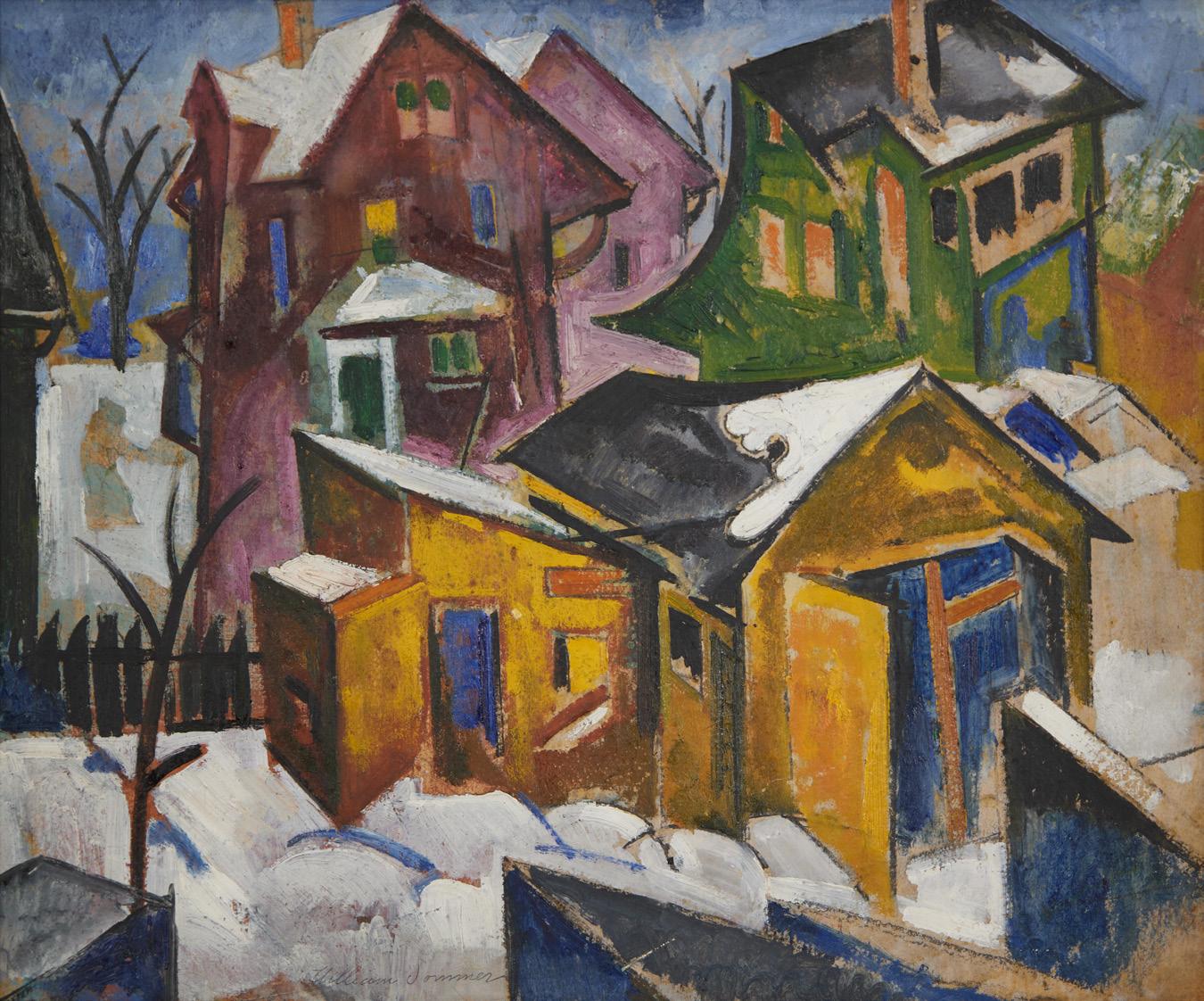
The shift in Sommer’s art over just a few years was remarkable. He painted Lakewood in Winter—dated 1907 in the lower right (fig. 7)—the year he arrived in Cleveland. While there is subtle mastery of perspective in the buildings, the painting’s most notable features are the strong color and the vigorously applied strokes of thick paint. The rocks in the foreground and the snow on the house are only suggested by quick flicks of the brush. Two years later, he painted a similar scene, Backyards, Lakewood, dated “1909” in the
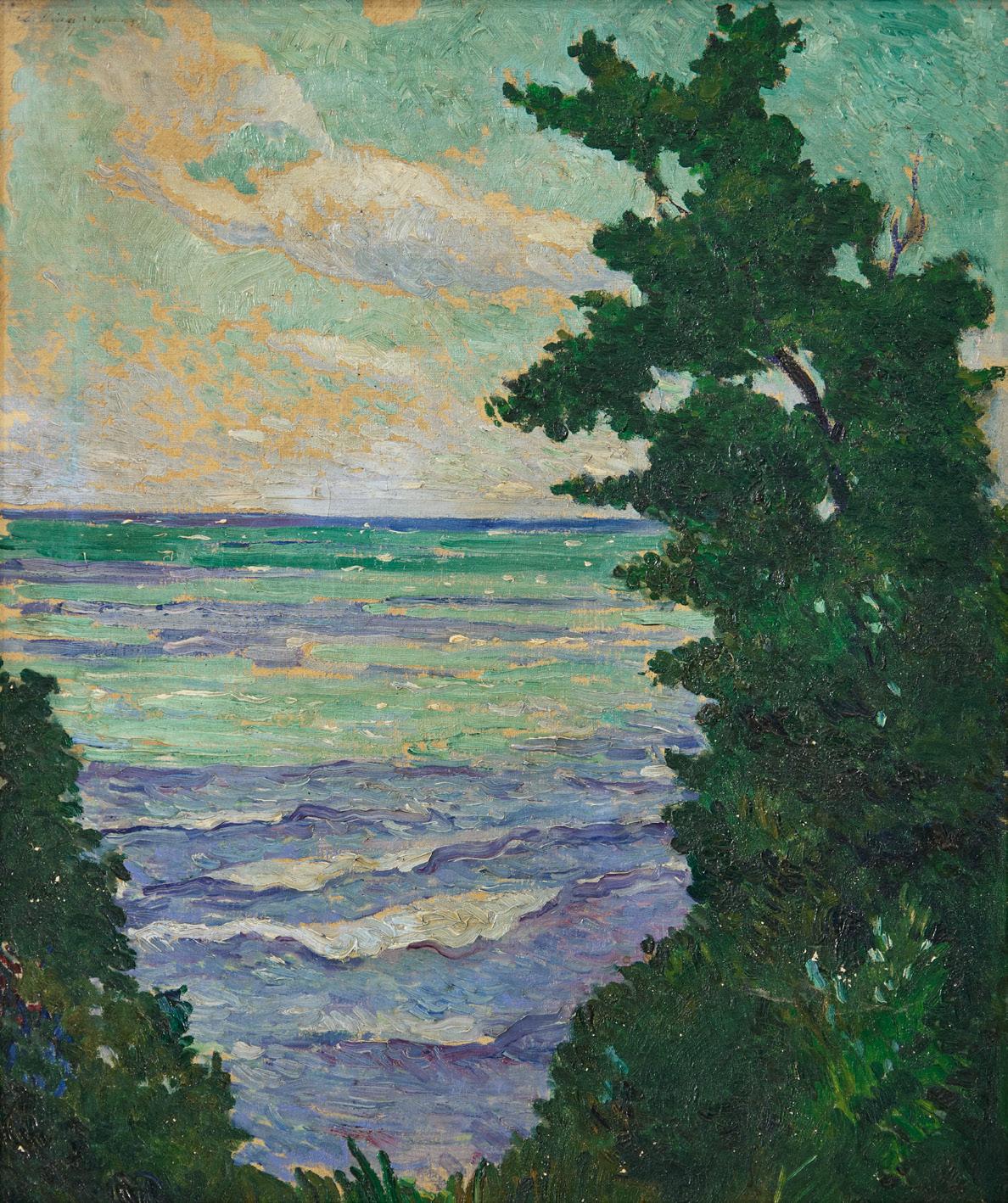
lower right (fig. 8). The elevated viewpoint of these paintings suggests that Sommer probably painted them looking through an attic or second-story window at his home. by 1911, Sommer had abandoned Ashcan realism in favor of full-fledged Impressionism. The change is evident in High Bridge (fig. 9) and Lake Erie Cliff, Lakewood (fig. 10), the latter dated “1911” in the upper right.12 both were probably painted outdoors in accordance with Impressionist practice. High Bridge depicts an elevated train track connecting Lakewood to the adjoining suburb of Rocky River. The view looks from north to south, across the river toward the Rocky River shore on the opposite bank. The Rocky River bridge—built in 1910 and proclaimed the “largest concrete span bridge in the world”—appears in the background.13 To capture the intensity of natural sunlight, Sommer applied color in quick, unblended strokes, often leaving areas of white ground exposed. Shadows are rendered with intense blues and violets rather than neutral, graduated tones. Lake Erie Cliff similarly dazzles with vibrant color flowing through foliage and water, infusing the entire surface with energy and life.
by 1912, Sommer was exploring the stronger forms and the heightened color of Post-Impressionism. The change is evident in Woman in a Pink Blouse (fig. 15), especially the thick, black outlines and the unmodulated pink, green, violet, and red in the face. The bold lines and the decorative background in Ray (fig. 17)—a portrait of the artist’s son— suggest familiarity with the Post-Impressionist portraits of Paul Gauguin, Vincent van Gogh, and perhaps Picasso’s blue Period paintings. Martha (fig. 16), a portrait of Sommer’s wife, is daringly abstract, the blouse defined by broad strokes of blue separated by areas of gray and white. The effect is deliberately crude and jarring. by conventional standards, the painting seems unfinished. but Sommer’s bold signature indicates otherwise. The painting’s radical departure from traditional expectations of “finish” aligns with Fauve methods
of leaving large areas of white canvas visible as a means of increasing the intensity of surrounding colors.
Under the influence of Post-Impressionism, Sommer also began compressing space and suggesting volume through warm/cool color contrasts. In Berlin Heights (fig. 18), radically simplified forms are arranged as flat, decorative shapes that move vertically up the picture surface rather than back into recessional depth. The complementary color contrasts of blue and orange in Gaunt Pines—dated 1912 in the lower right (fig. 20)—together with the pure reds in the background, further demonstrate that Sommer has replaced blind adherence to observed nature with invented or arbitrary color.14 He acknowledged this new direction in comments recorded in Cleveland Town Topics: “Since I dropped the old way of painting and have become free from conventions, I have developed myself in an original way. We post-impressionists are beyond copying.”15
Sommer advanced Fauvist principles of abstraction and arbitrary color to new heights in 1913. The evolution can be followed in a
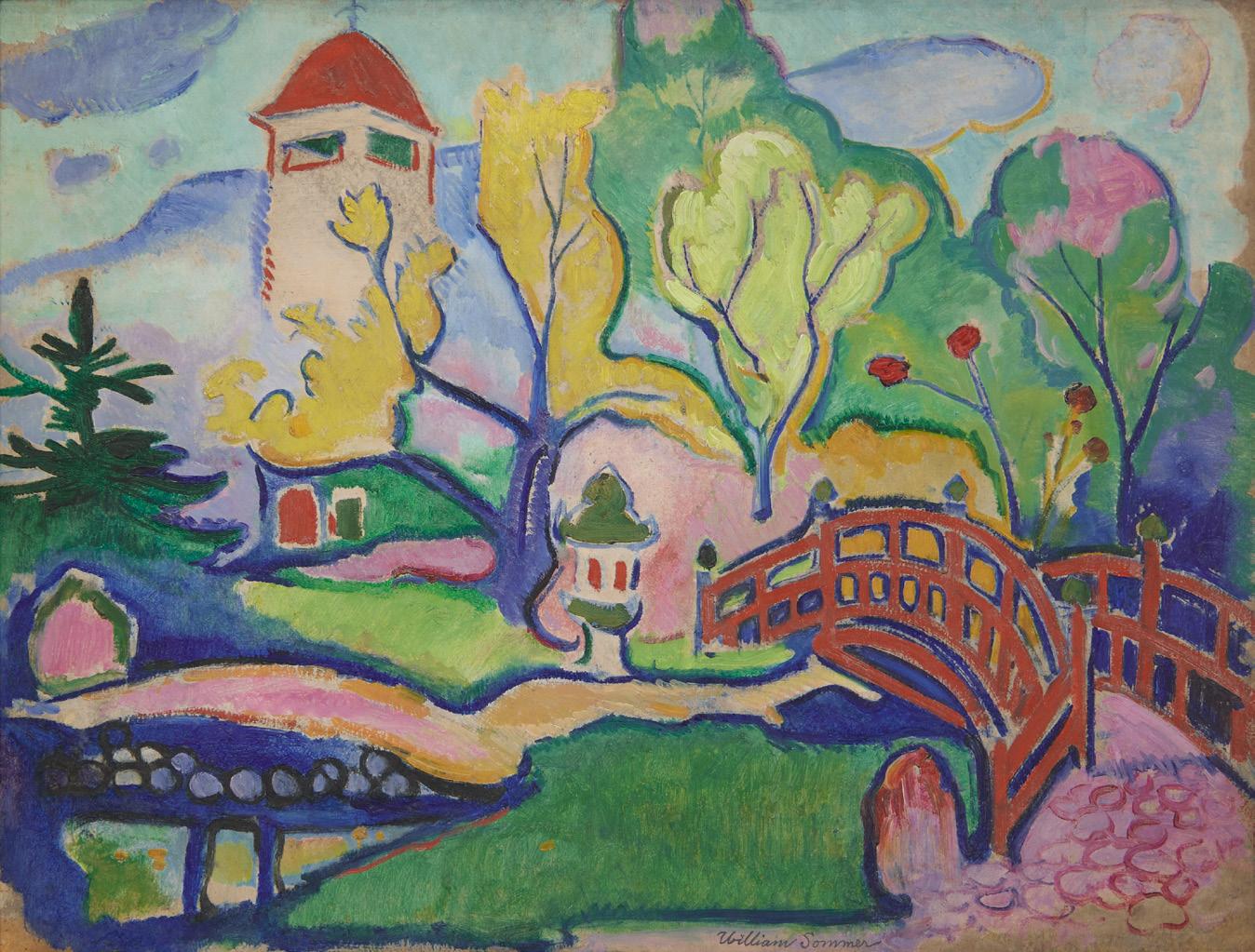
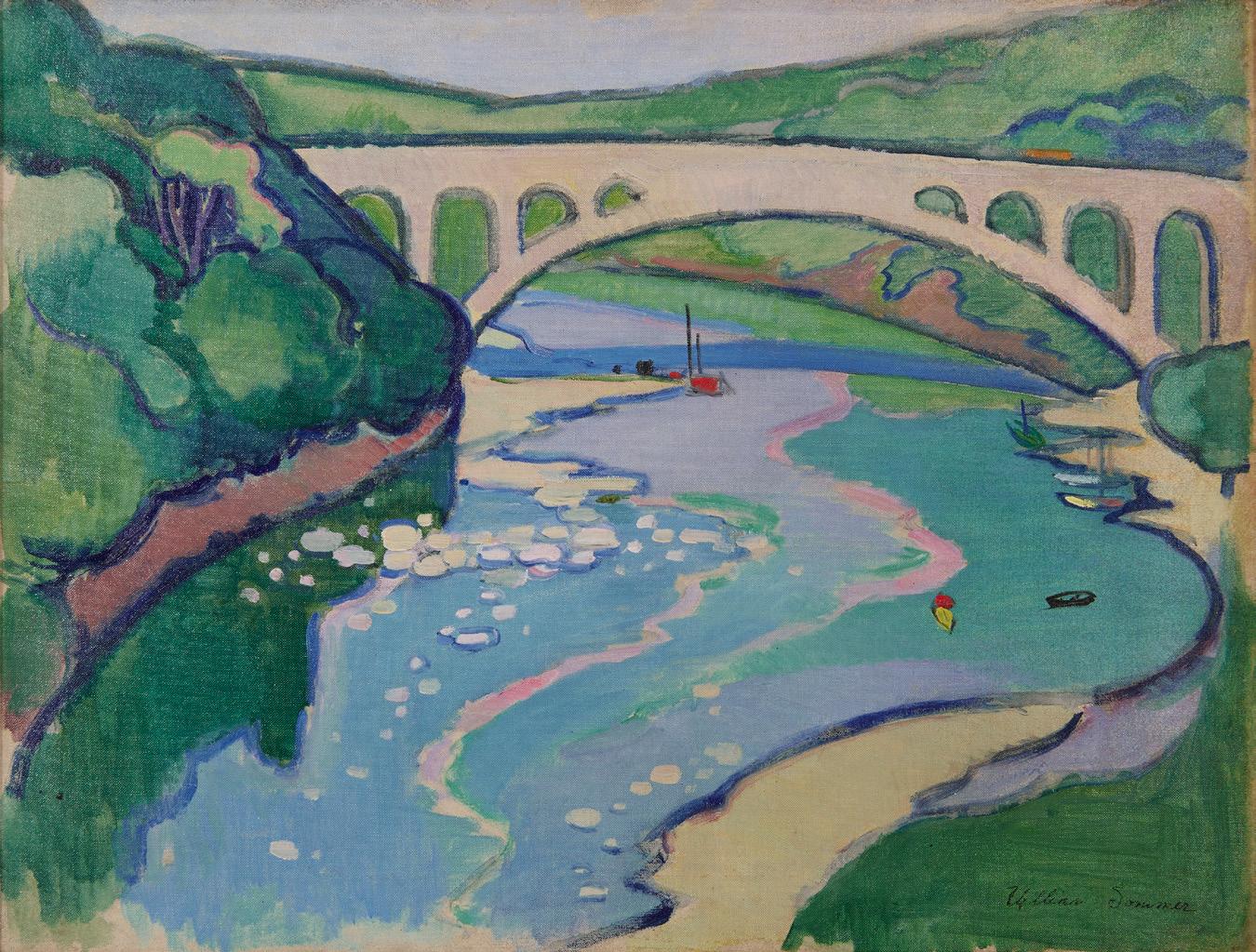
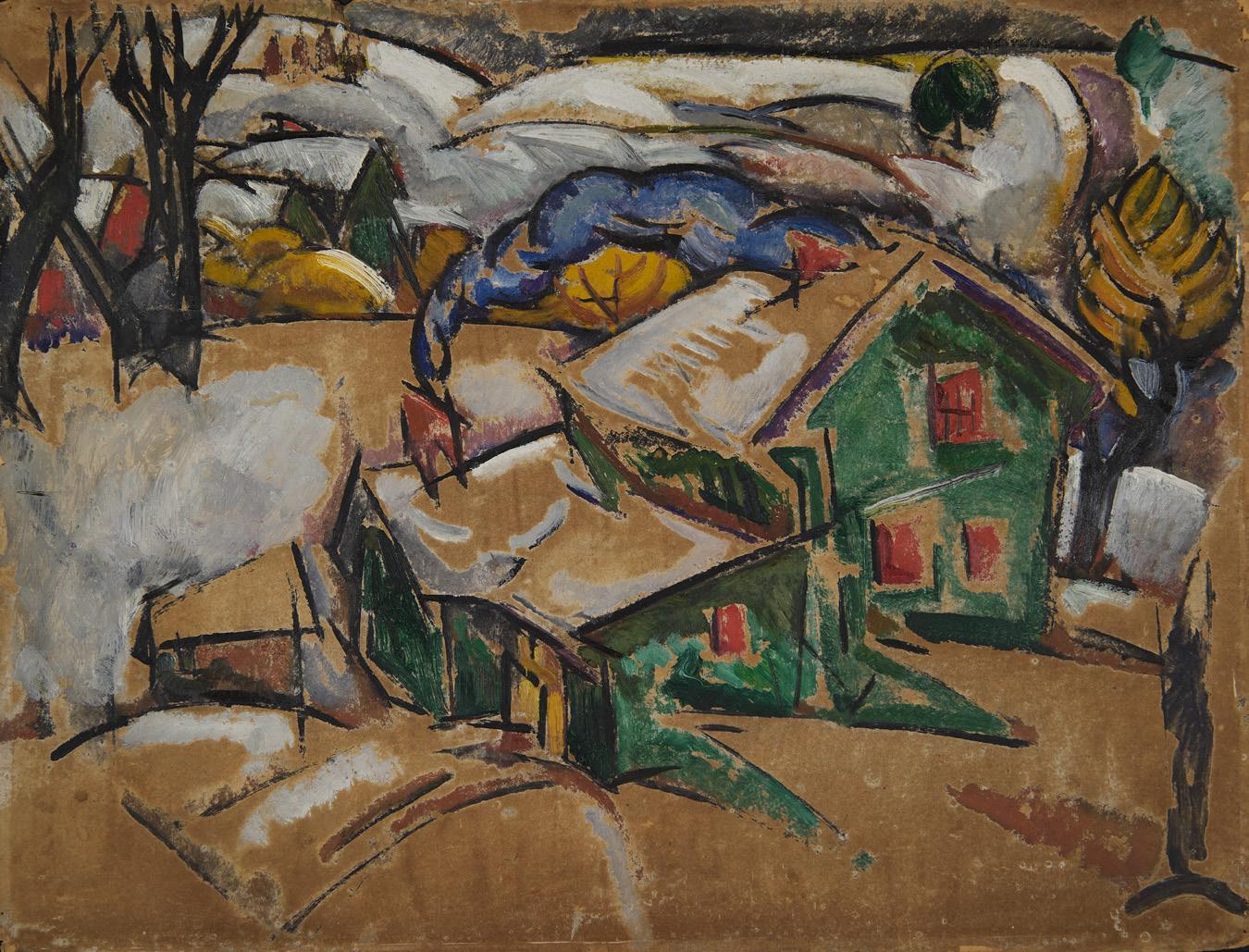
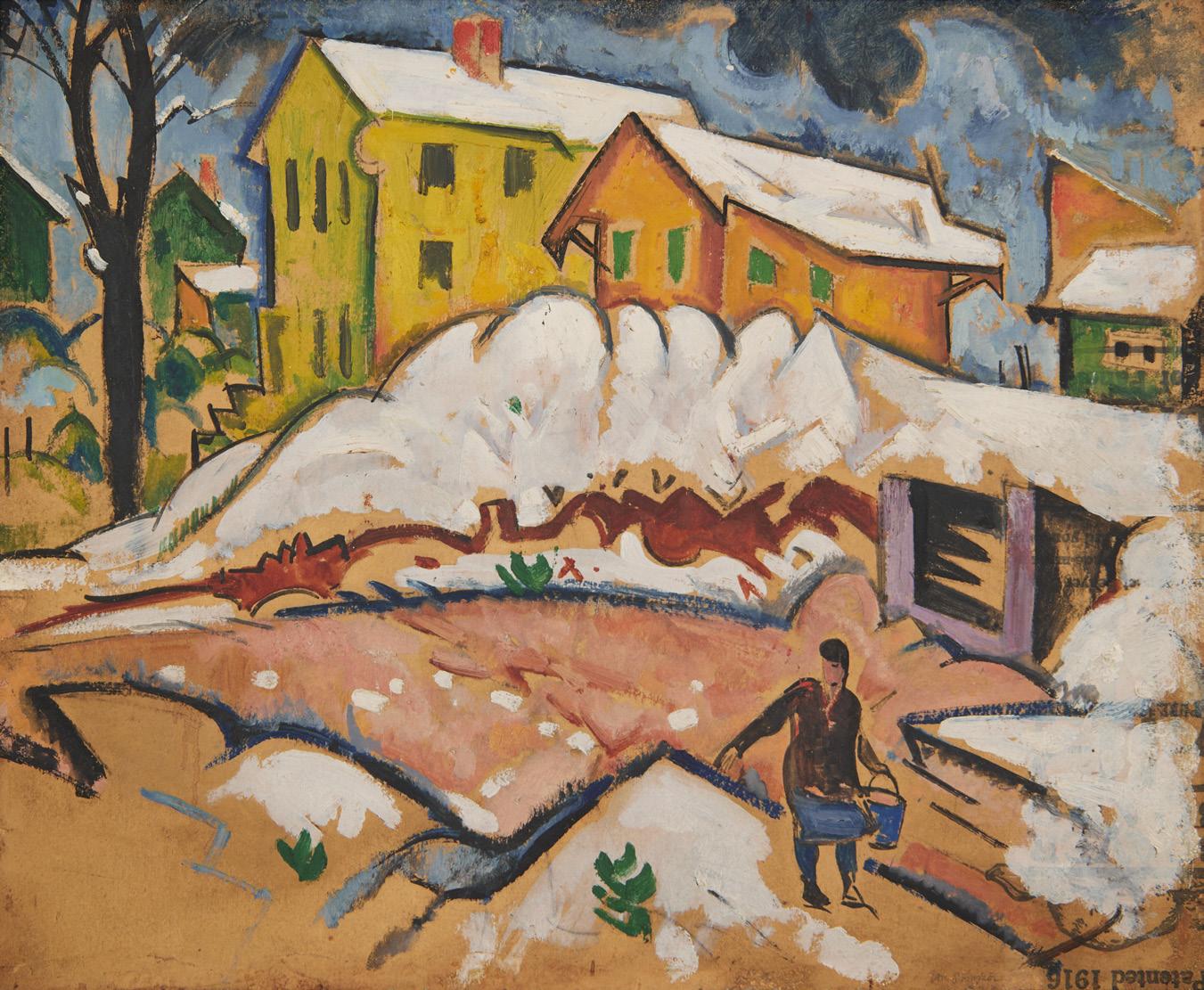
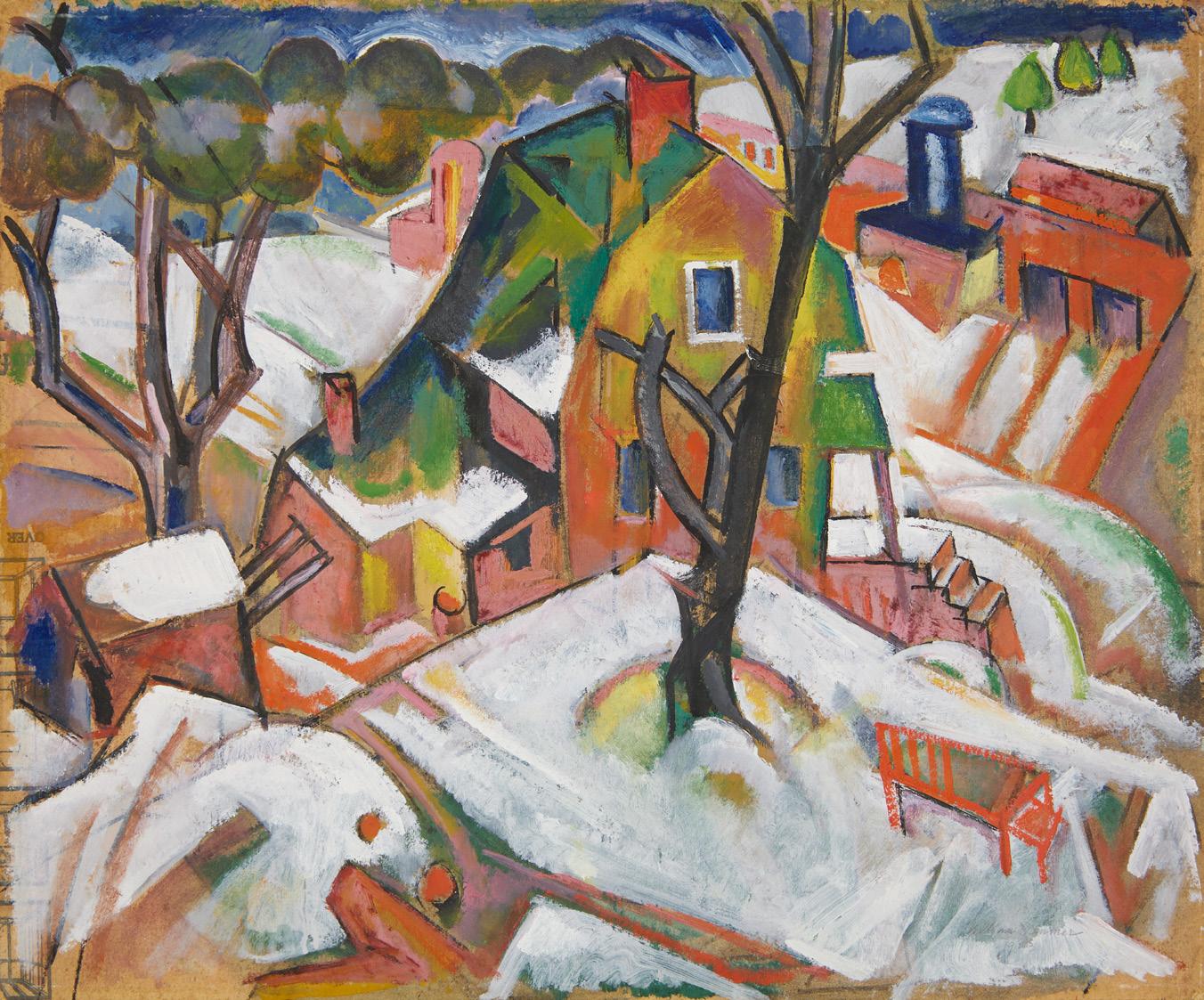
series of paintings of a watch tower in Rocky River, most notably The Watch Tower, The Purple Tower, and The Japanese Bridge (figs. 21-23).16 The influence of Matisse and his Fauve colleague André Derain is strongly felt in the decorative forms and pure, arbitrary color of The Japanese bridge. An instructive comparison may be made between Rocky River Bridge (fig. 24) and Sommer’s earlier Impressionistic view of the same structure in High Bridge c. 1911 (fig. 9), as the flickering brushwork and spatial depth of the earlier canvas have given way to radically condensed, flattened forms. Fully-realized Fauvism is also evident in Winter c. 1913 (fig. 30) and Construction in Lakewood c. 1913 (fig. 31).
Naturalistic colors have been replaced in Construction in Lakewood by complementary color contrasts of intense red/green and violet/yellow, while forms are surrounded by thick blue and black lines. In their chromatic intensity and structural simplification, these paintings align Sommer with the most advanced currents of American modernism in the years just before the First World War. ™
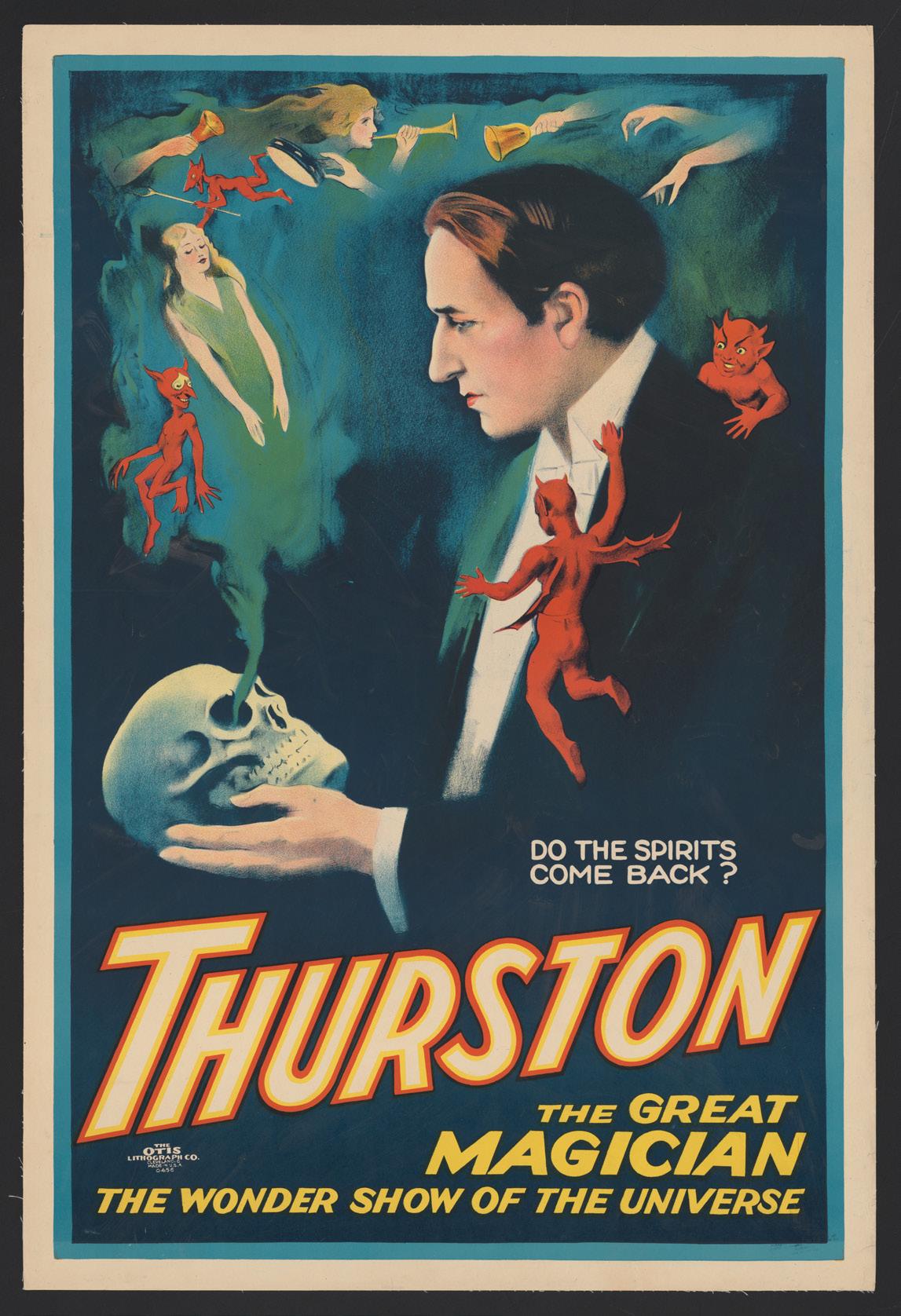
Attributed to William Sommer, Thurston the Great Magician, Wonder Show of the Universe, c. 1920, Color lithograph printed at Otis Lithograph, Cleveland, Ohio, Collection of the Library of Congress, Washington, DC. Not in the exhibition
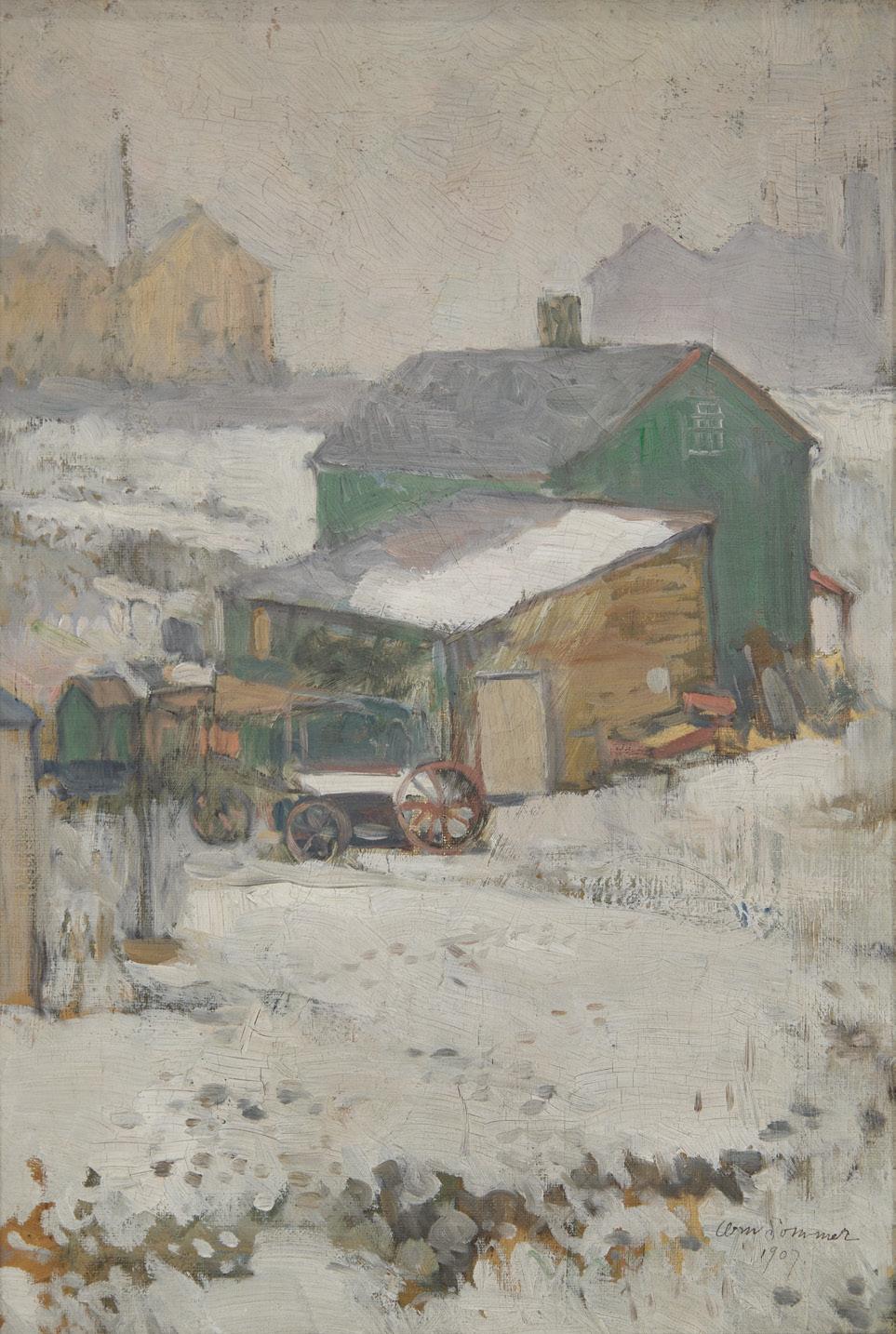
Lakewood in Winter, 1907
Oil on canvas
Signed and dated lower right 13 x 19 inches 7
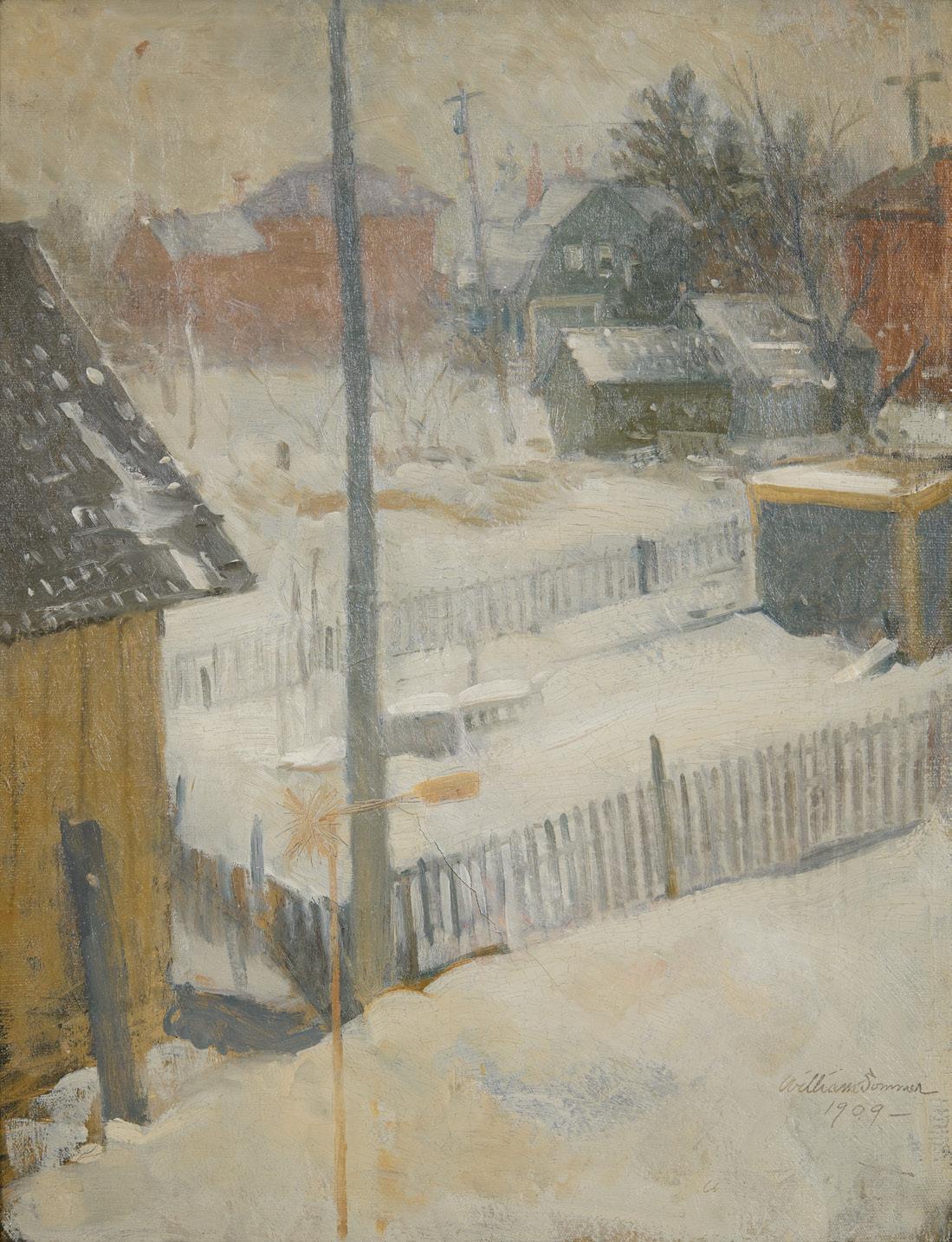
Backyards, Lakewood, 1909
Oil on canvas
Signed and dated lower right
26 x 20 inches 8
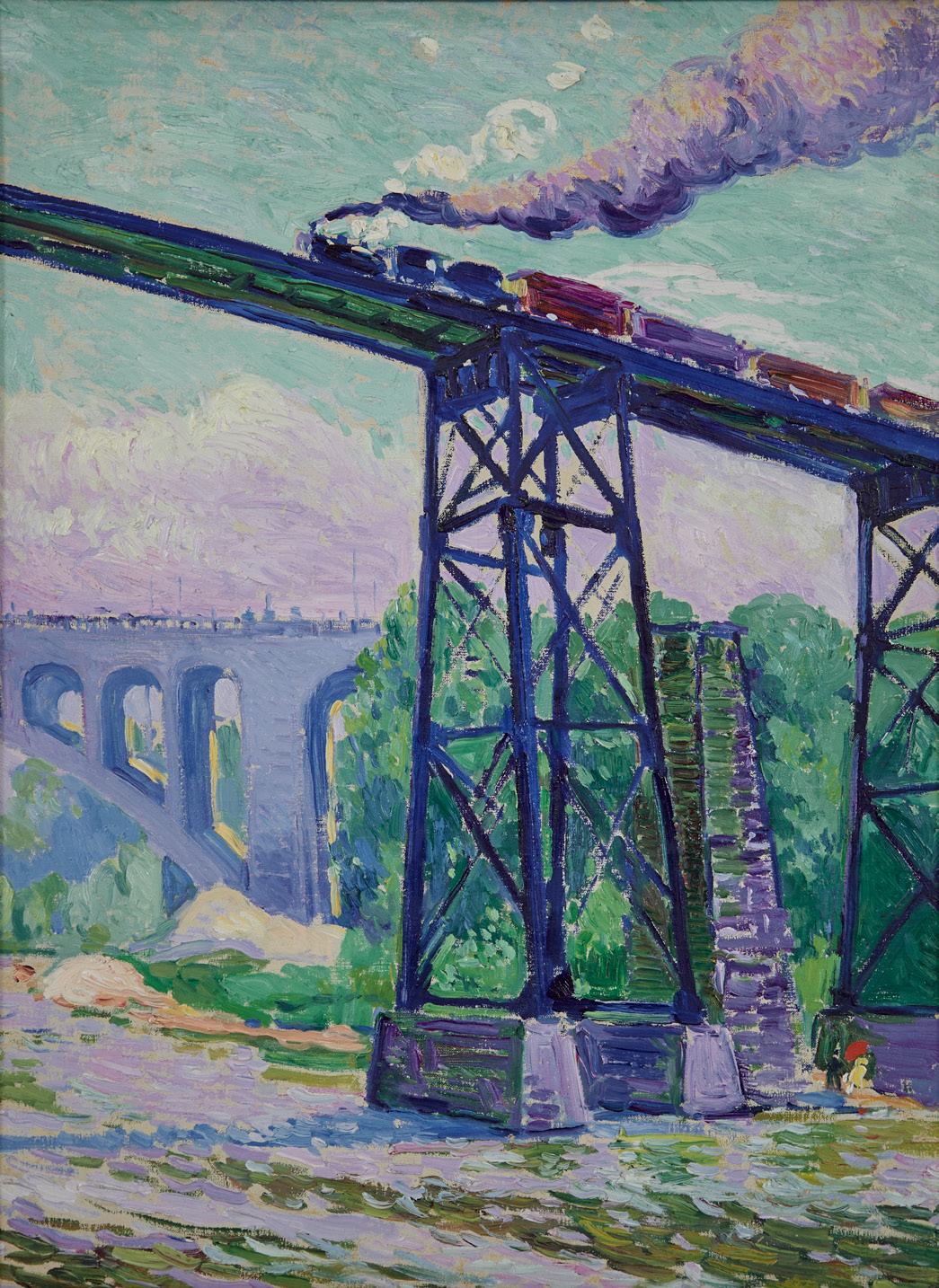
9
24 x 18 inches
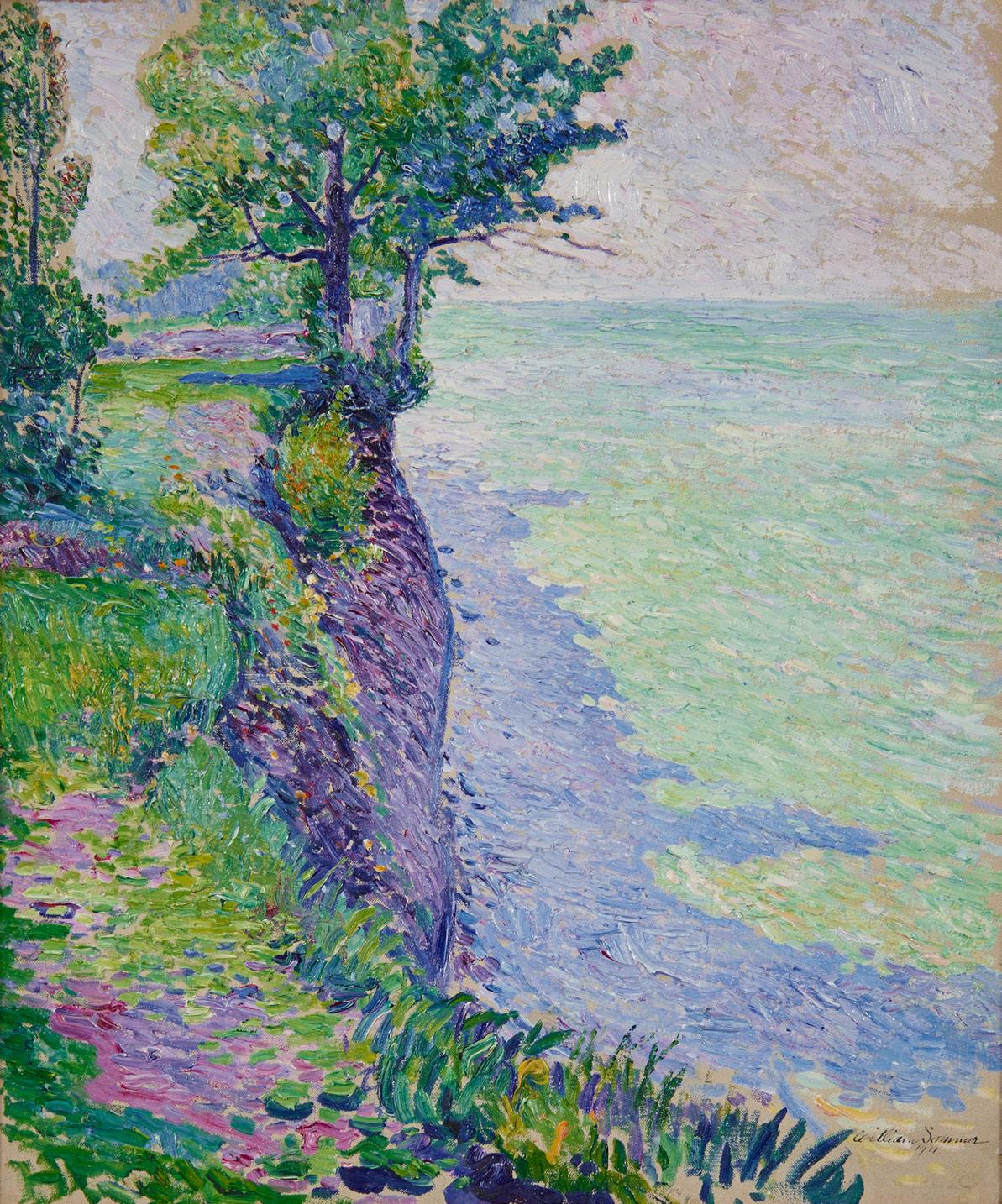
, 1911
Signed and dated upper left 24 x 20 inches
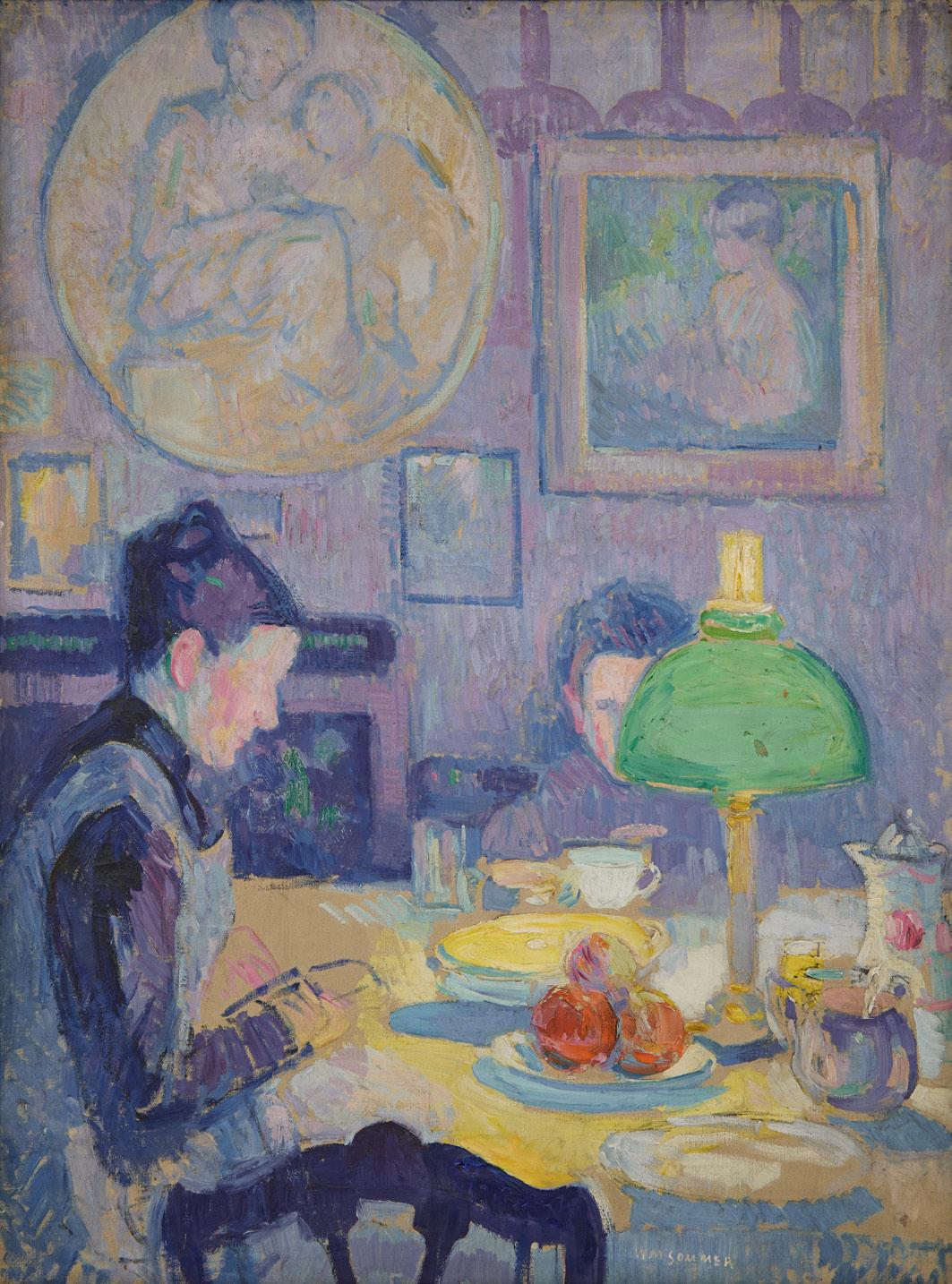
Oil on canvas
Signed lower right, titled verso
40 x 30 inches 12
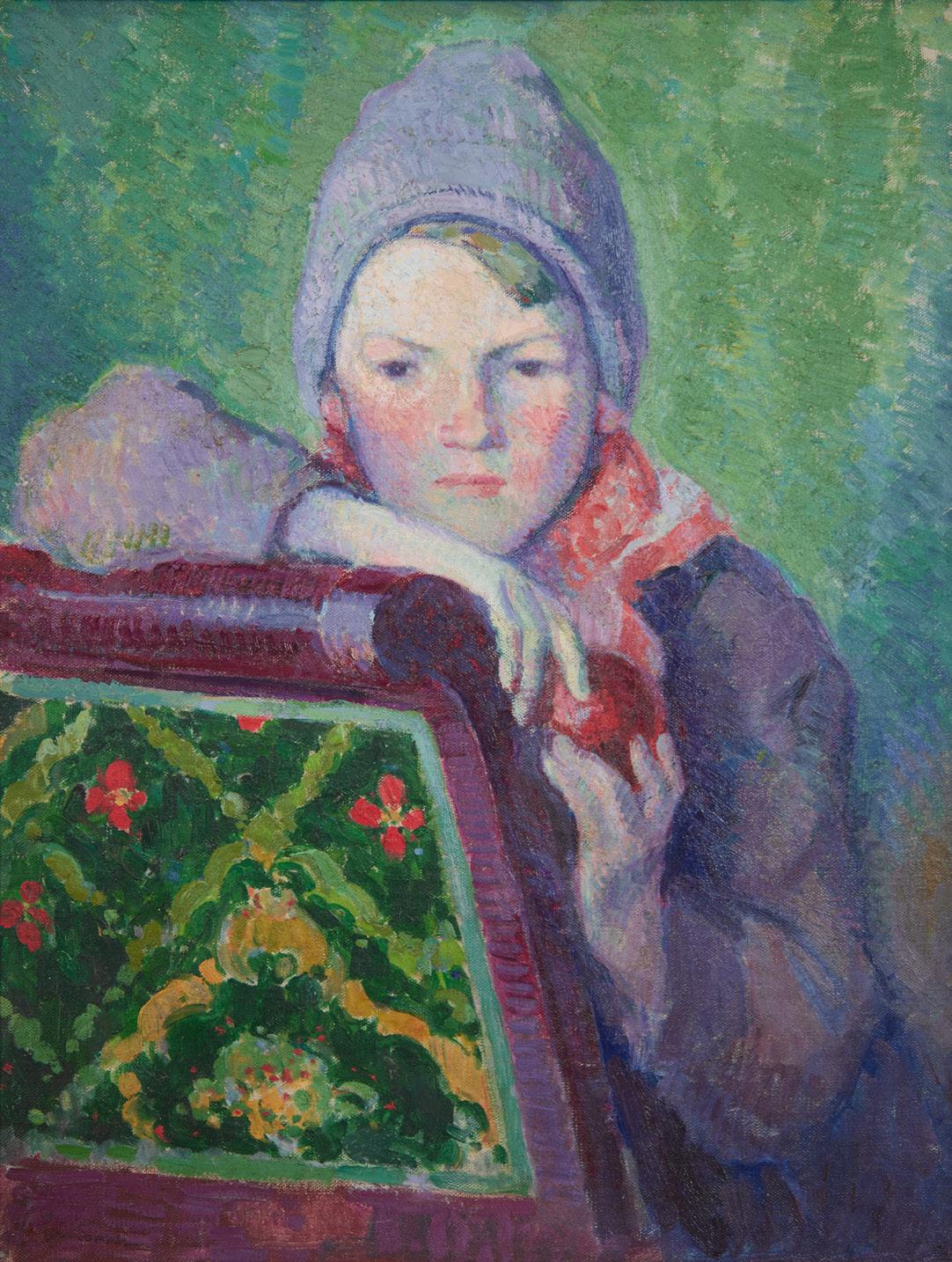
Signed lower left 26.5 x 20.5 inches
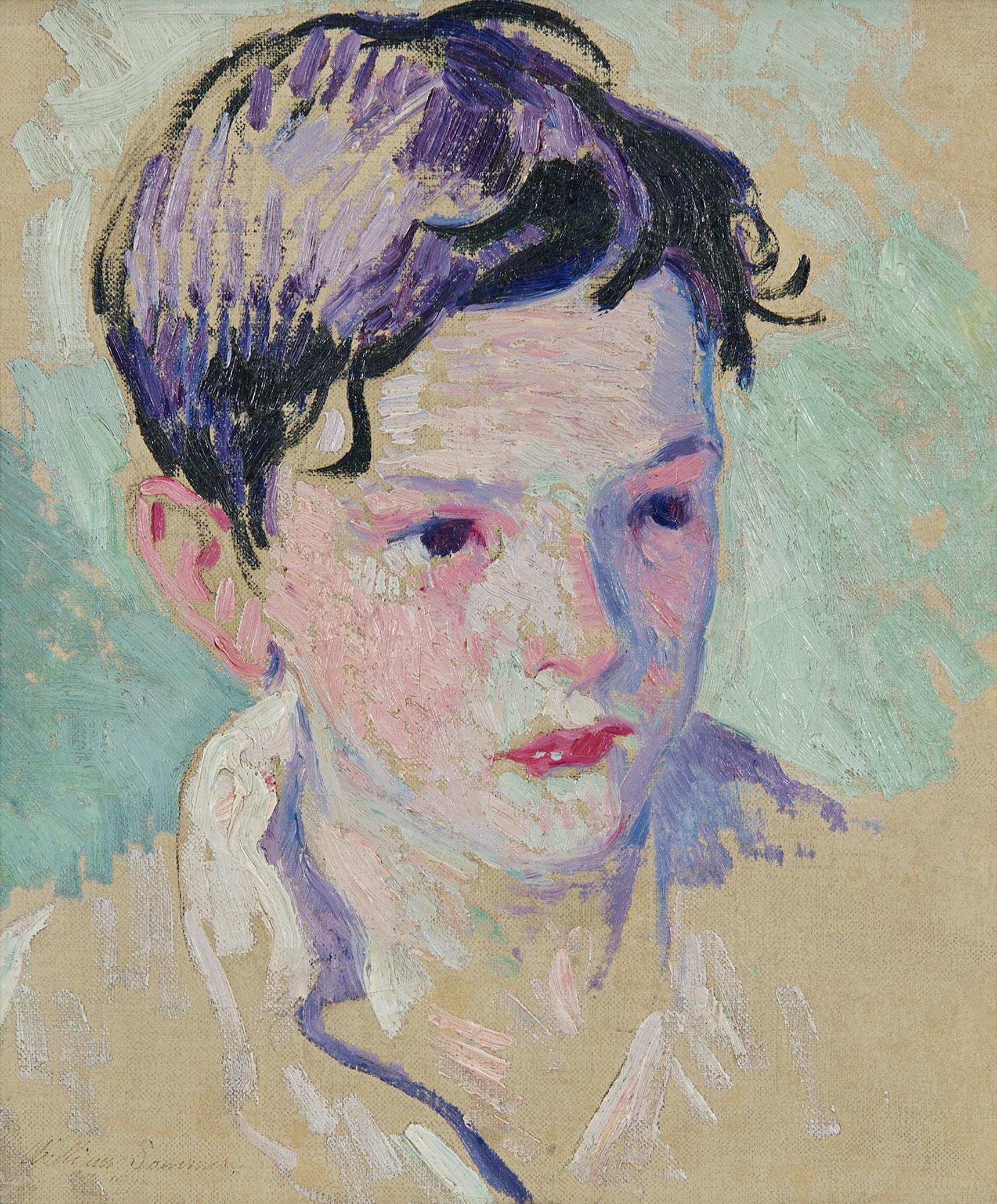
Signed lower left 14 x 12 inches 14
Raymond, 1911 Oil on canvas
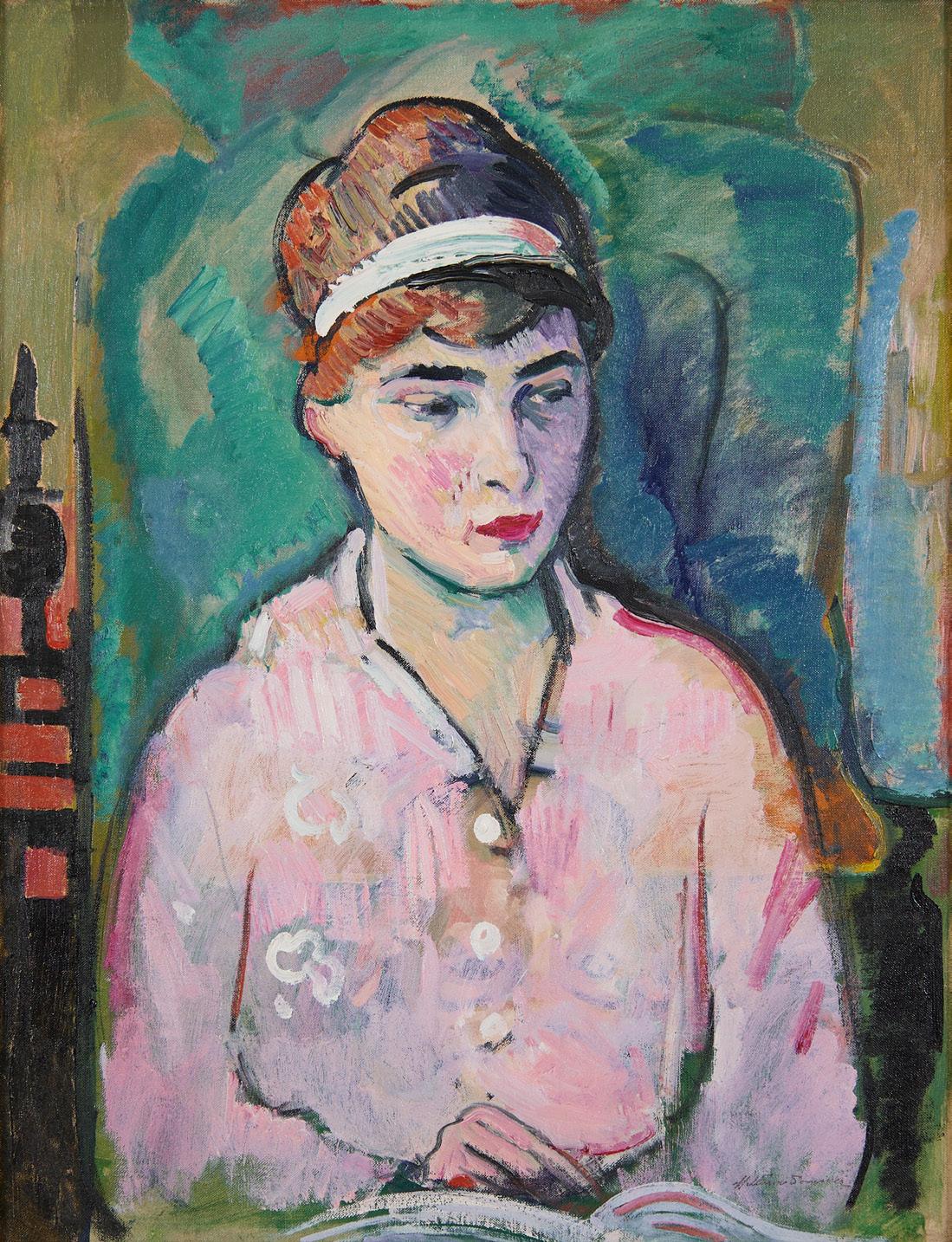
Oil on canvas
Signed lower right
x 20 inches
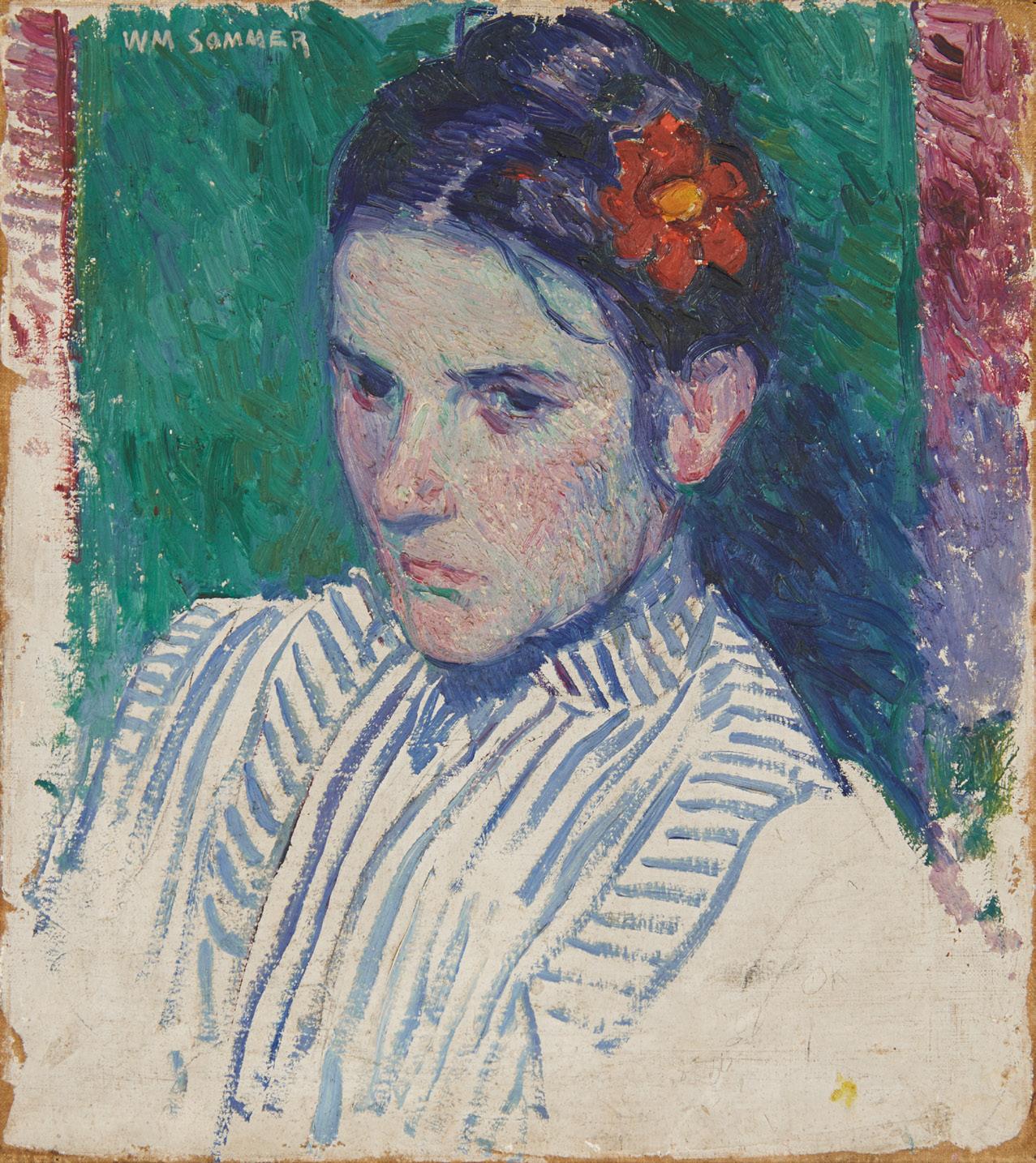
Martha, c. 1910
Oil on canvas
Signed upper left 18 x 16 inches 16
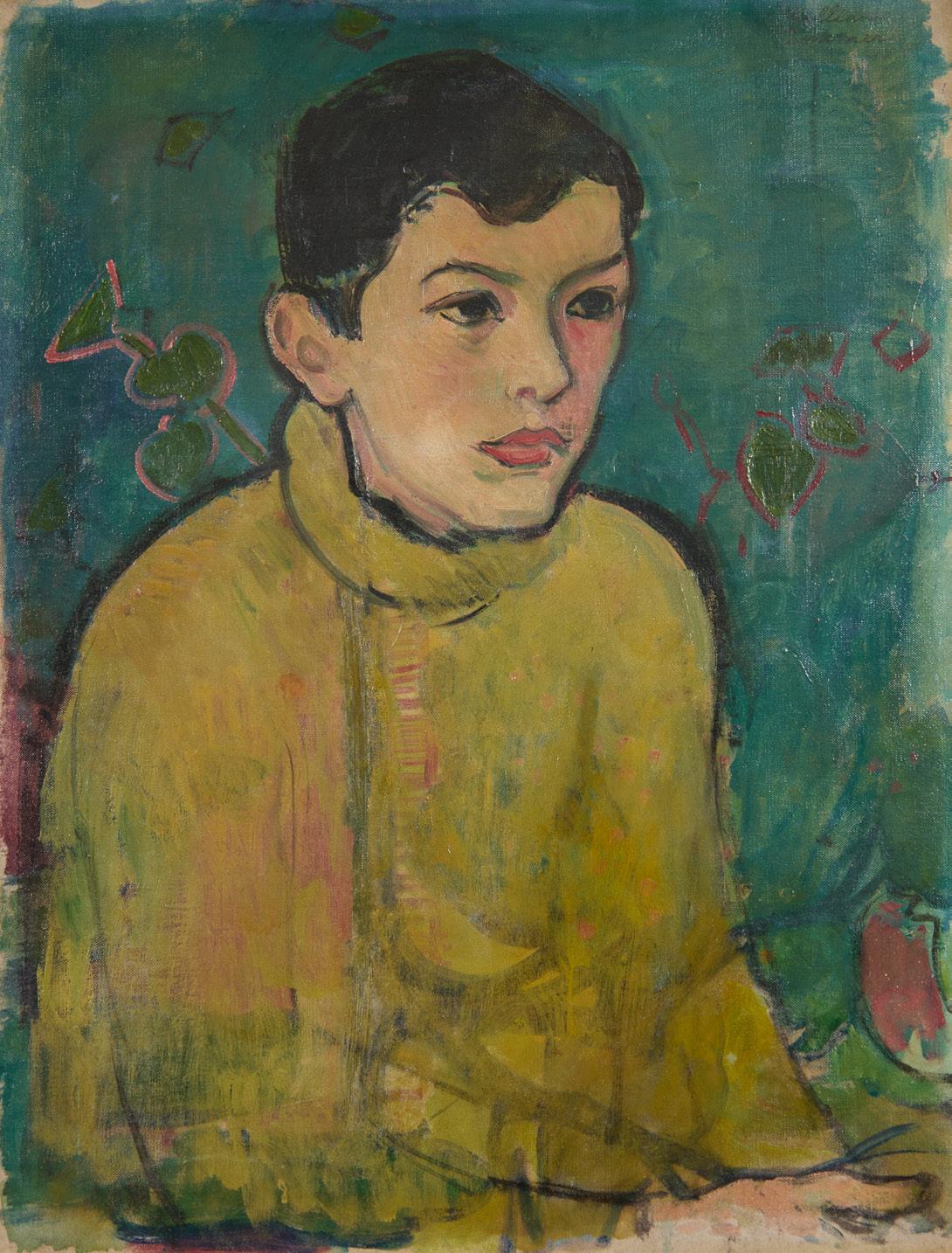
Signed and dated upper right 26 x 20 inches 17
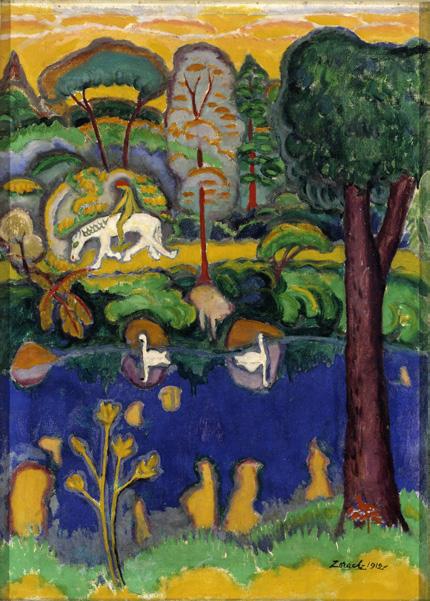
1889-1966) Untitled, 1912
Oil on canvas 30 x 21 inches
Smithsonian American Art Museum, Gift from the collection of Tessim Zorach, 1970.65.3 Not in the exhibition
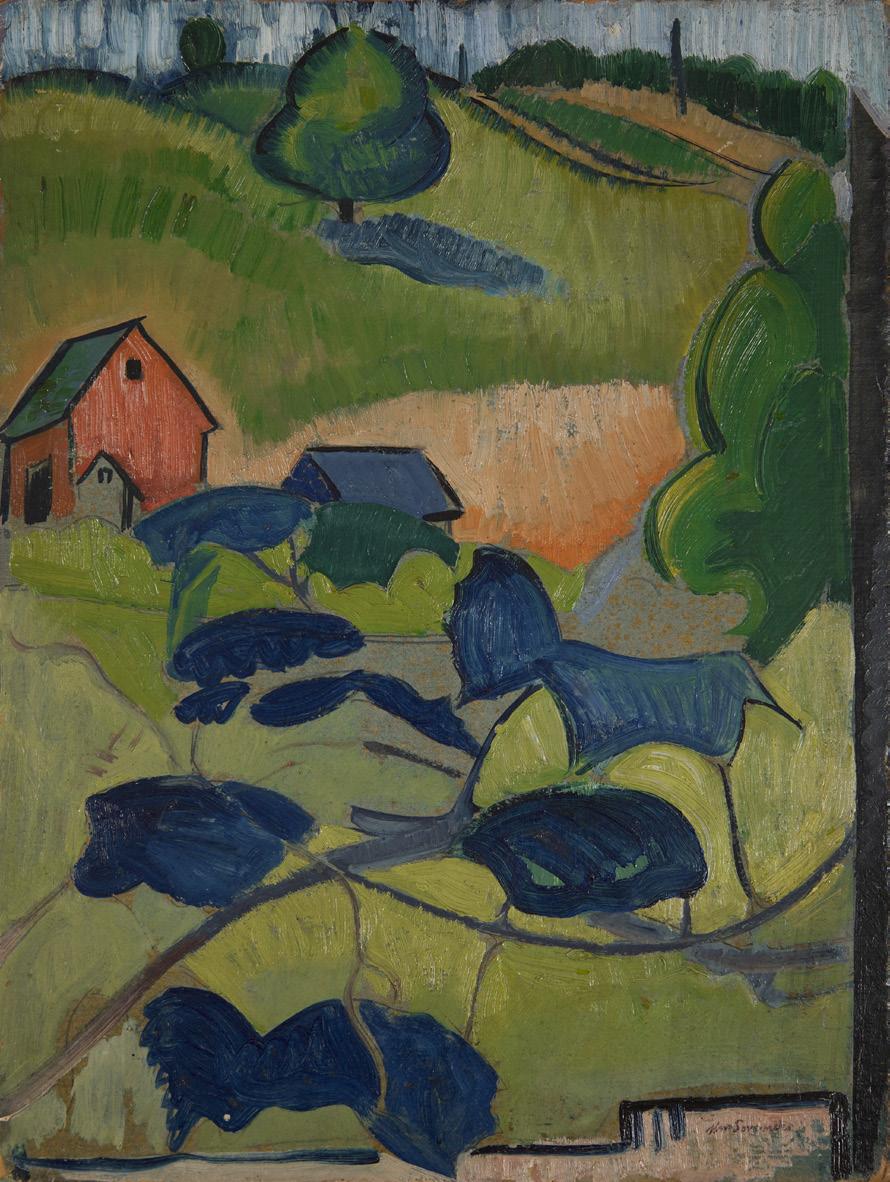
Berlin Heights, c. 1912
Oil on board
Signed with estate stamp lower right 16 x 12 inches 18
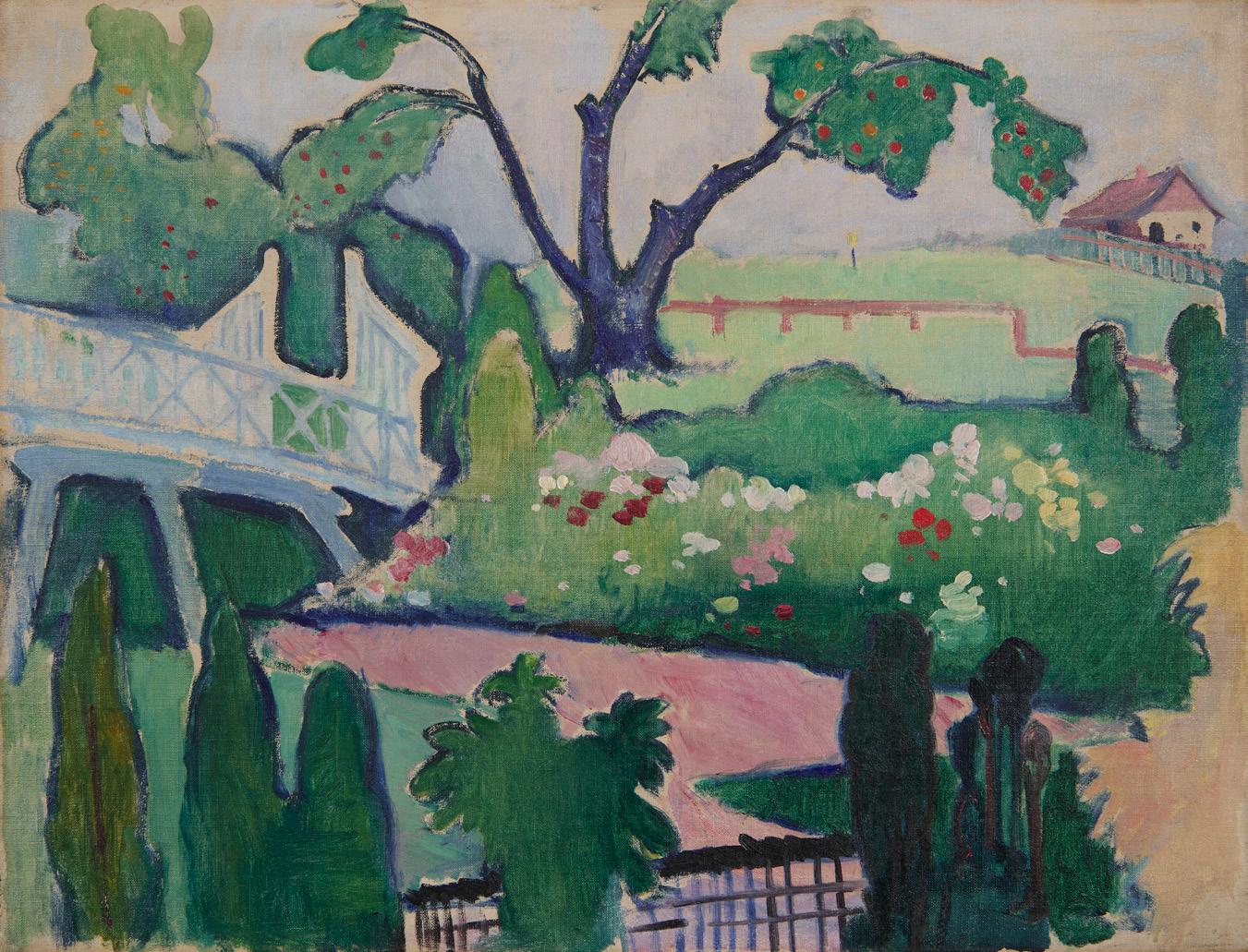
Signed with estate stamp verso 20 x 26.26 inches
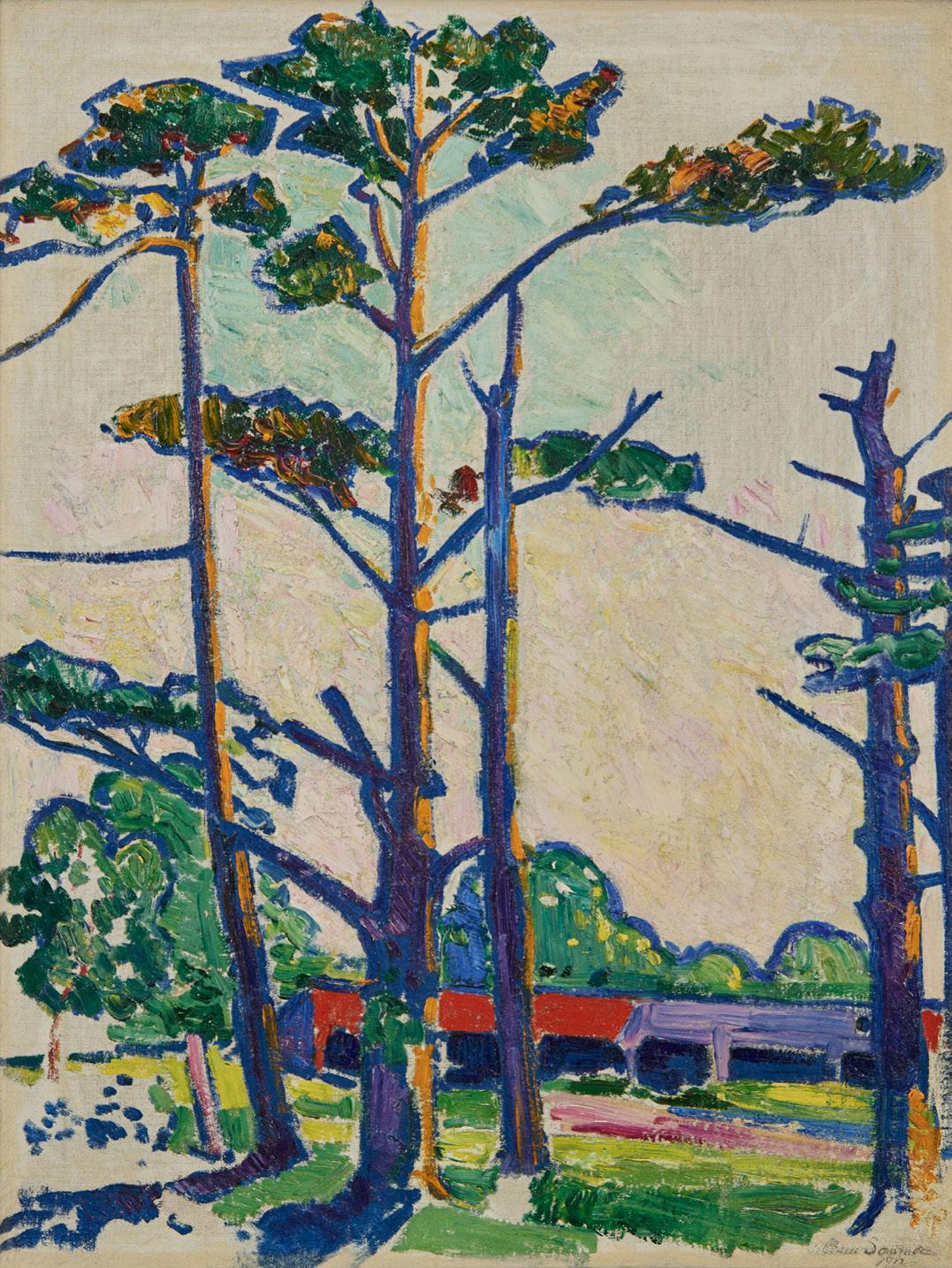
Gaunt Pines, 1912
Oil on canvas
Signed and dated lower right
28.5 x 22.5 inches
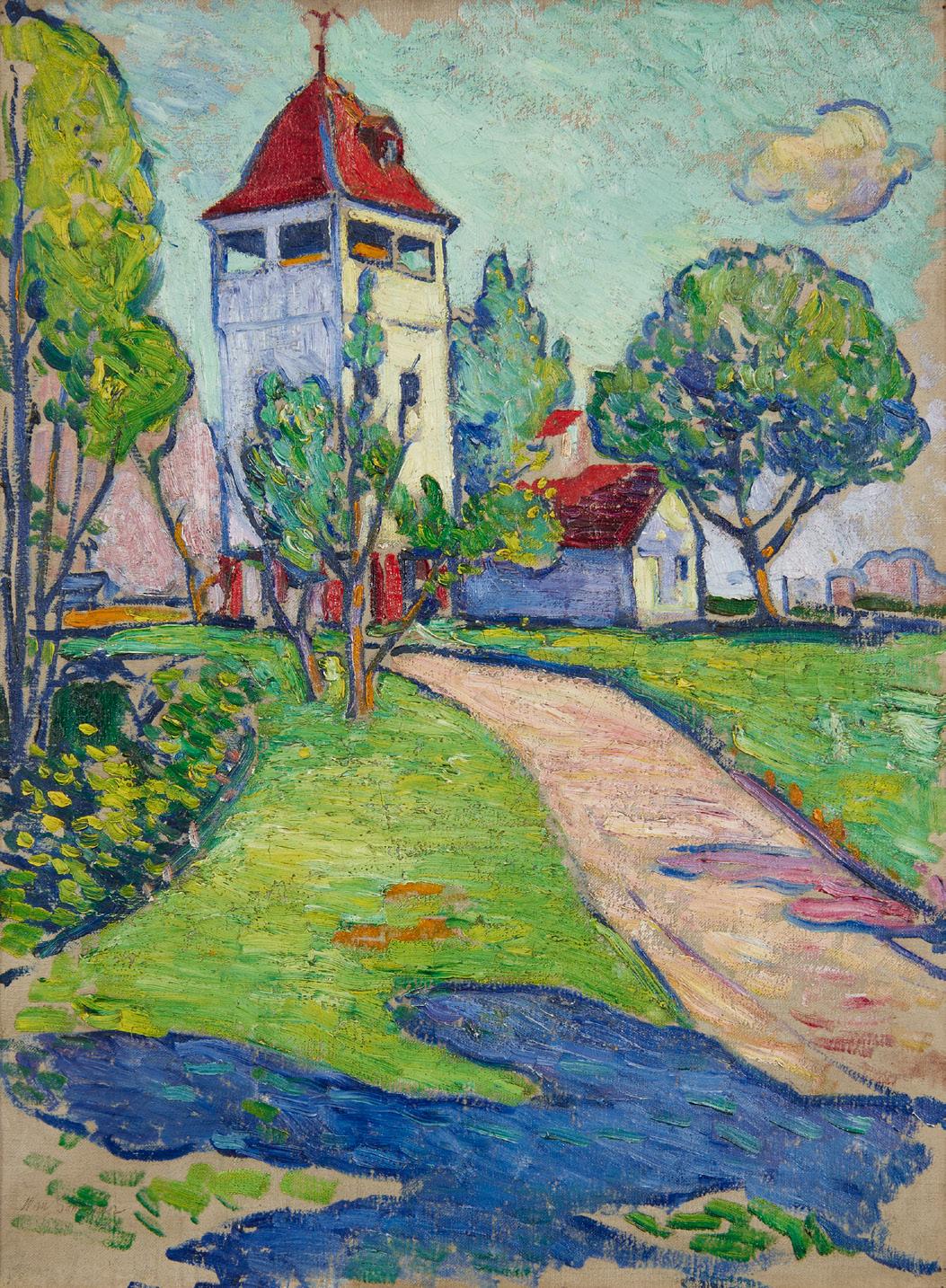
21
Oil on canvas
Signed lower left
24 x 17 inches
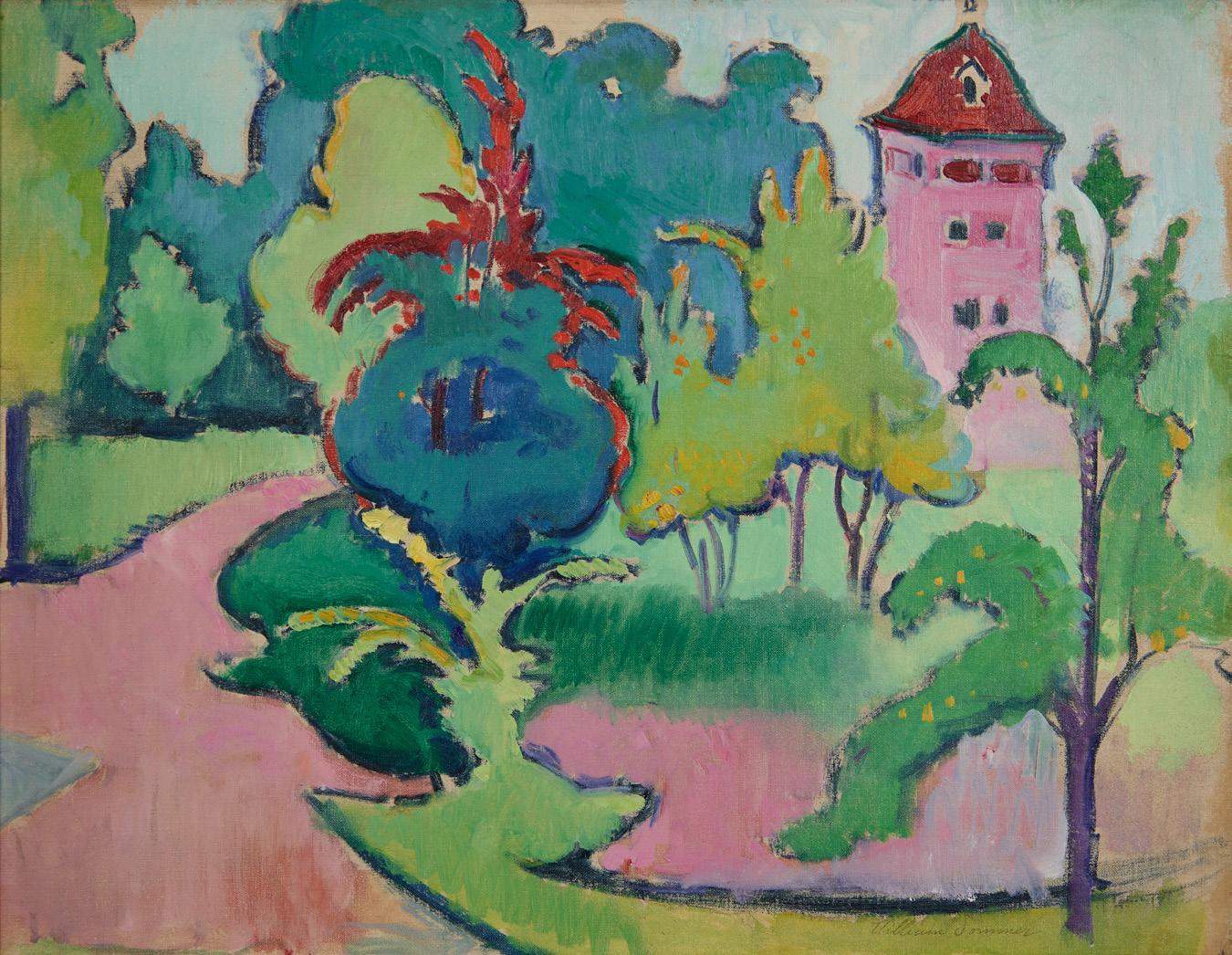
The Purple Tower, c.1913-14
Oil on canvas
Signed lower right
20.25 x 26.25 inches
Henri Matisse (French, 1869-1954)
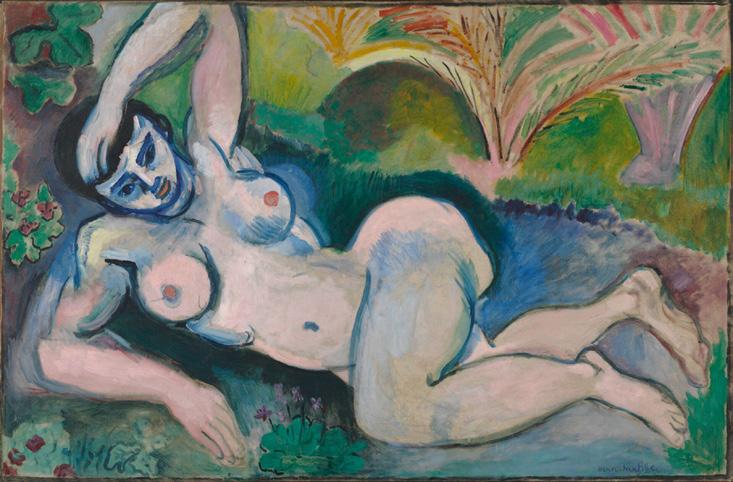
Blue Nude (Memory of Biskra), 1907
Oil on canvas
36 × 55 inches
Baltimore Museum of Art, The Cone Collection, formed by Dr. Claribel Cone and Miss Etta Cone of Baltimore, Maryland, 1950.228
Not in the exhibition
24
Rocky River Bridge, c. 1913
Oil on canvas
Signed lower right
20 x 26 inches
25
26
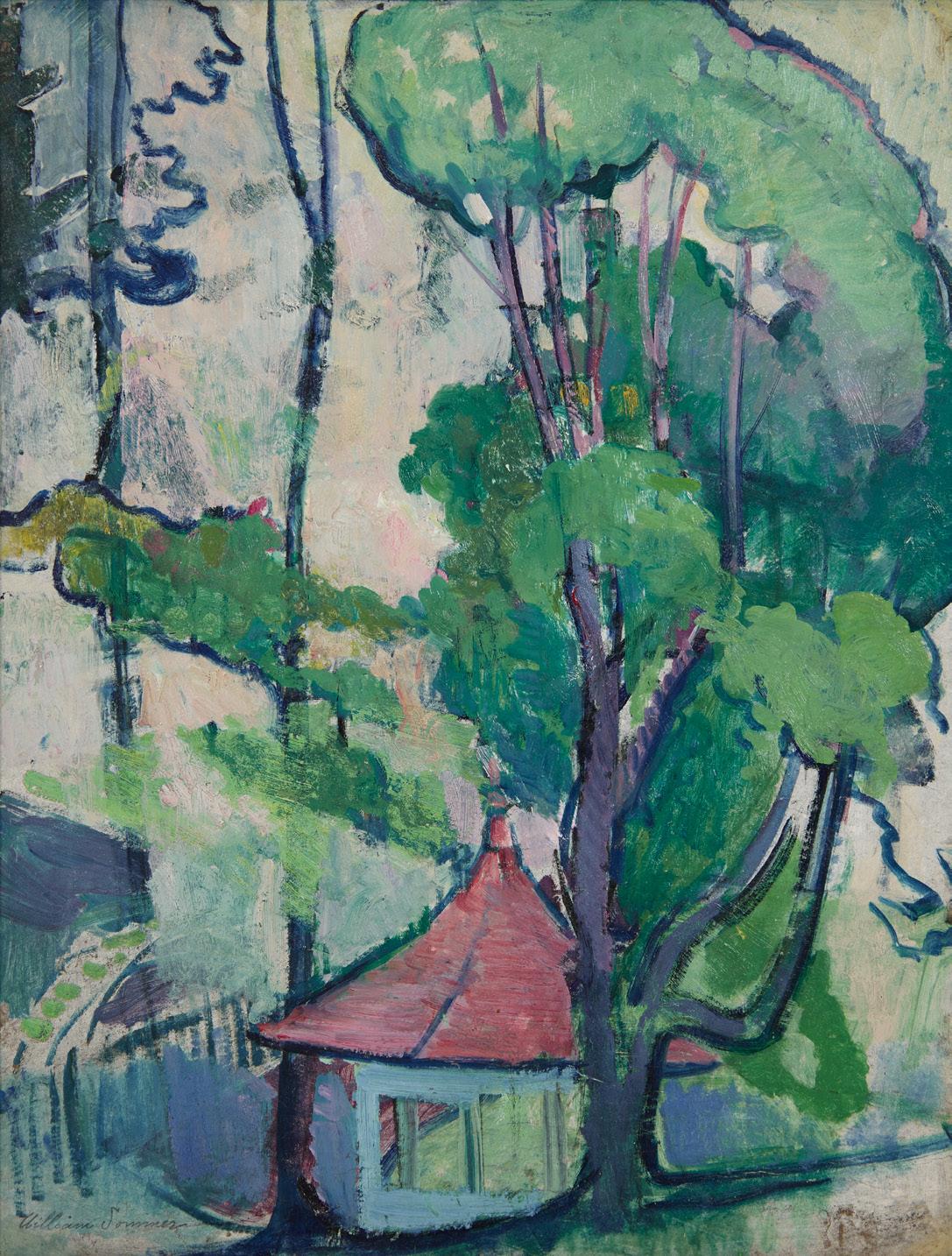
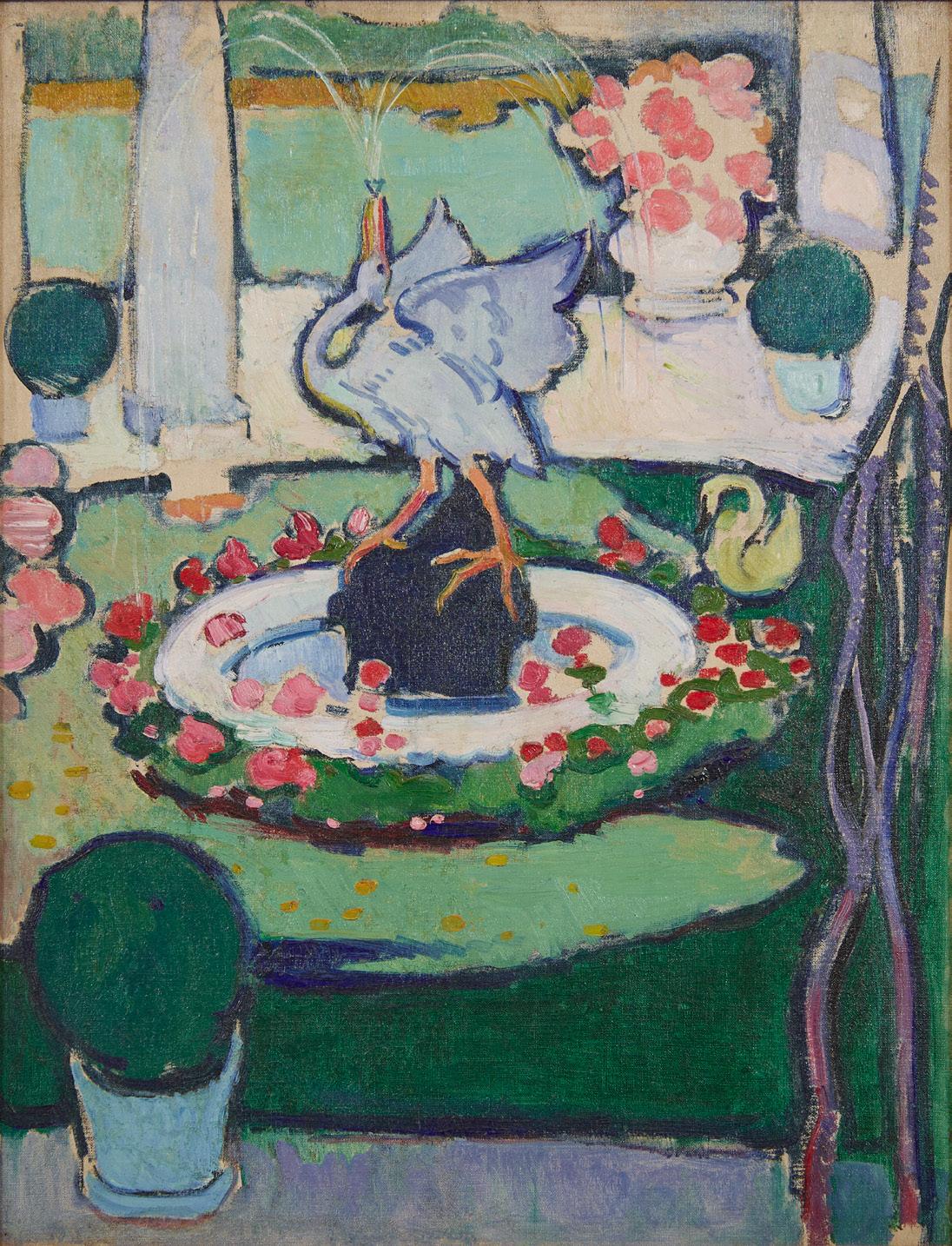
The Blue House in the Woods, c. 1914-15 Oil on board
Signed with estate stamp lower left
x 23 inches
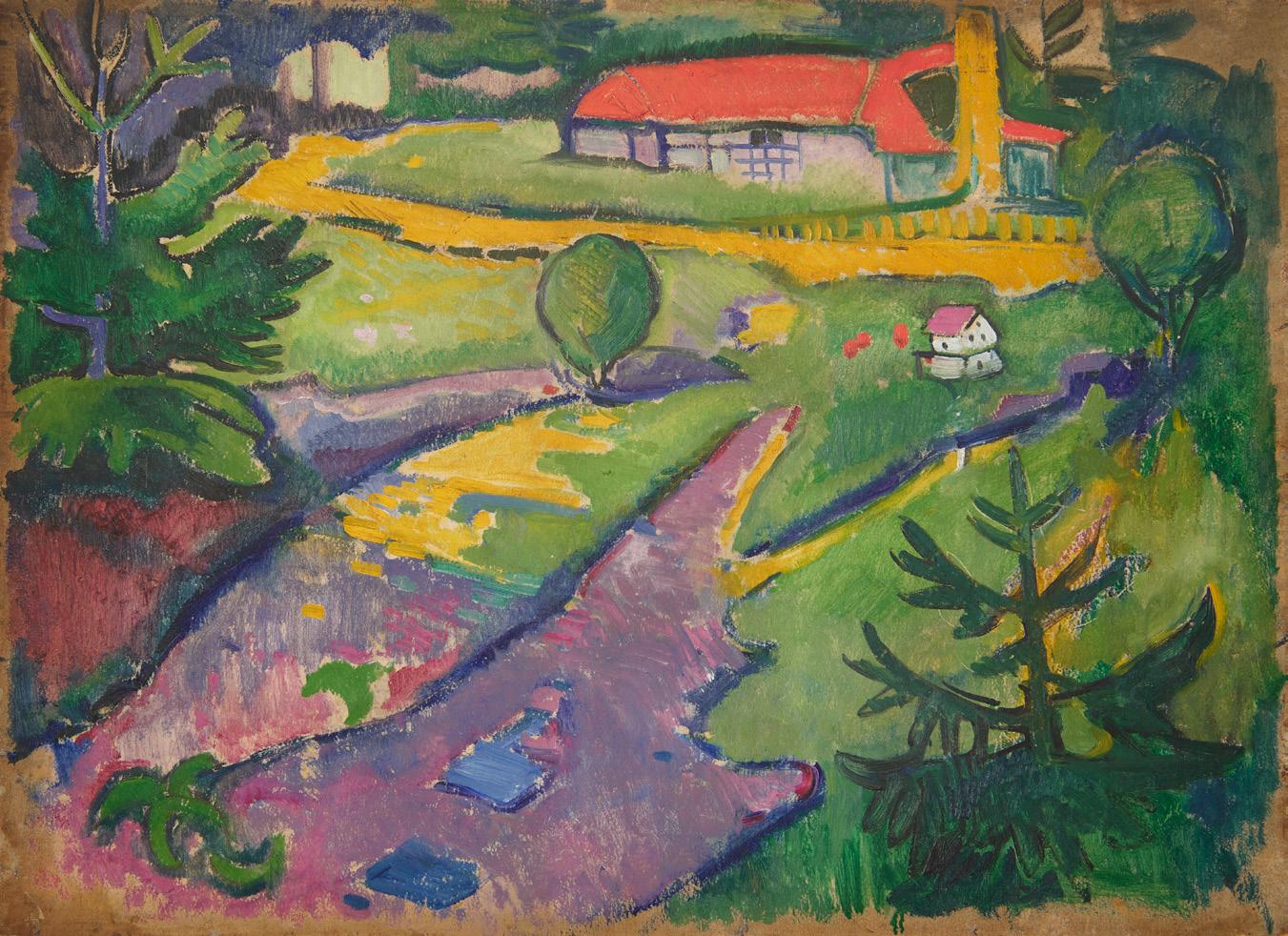
23 x 31.75 inches
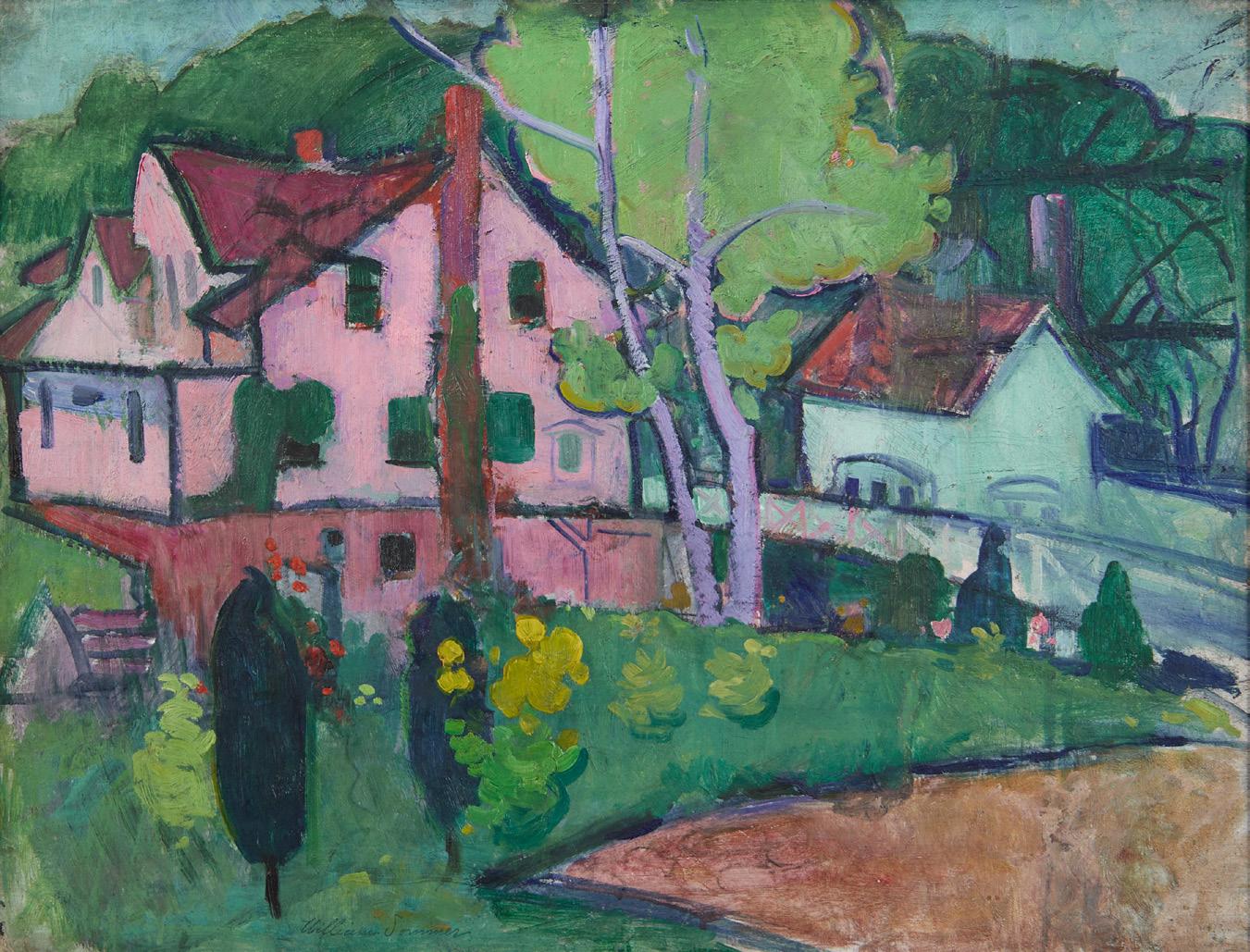
House on the Hobson (Schlather) Estate, c. 1913-14 Oil on board
Signed lower left
x 26 inches
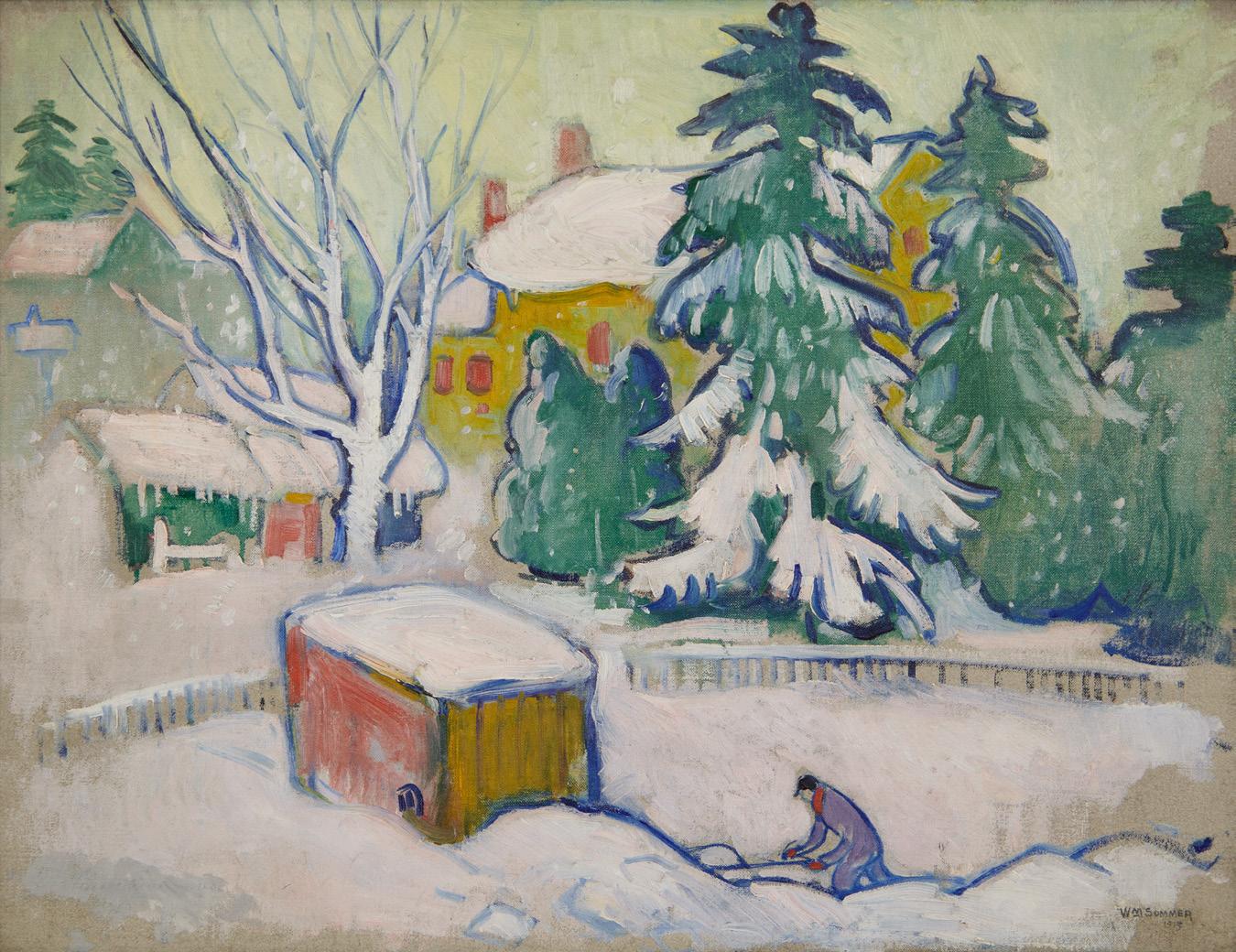
Signed and dated lower right
20.5 x 26.5 inches
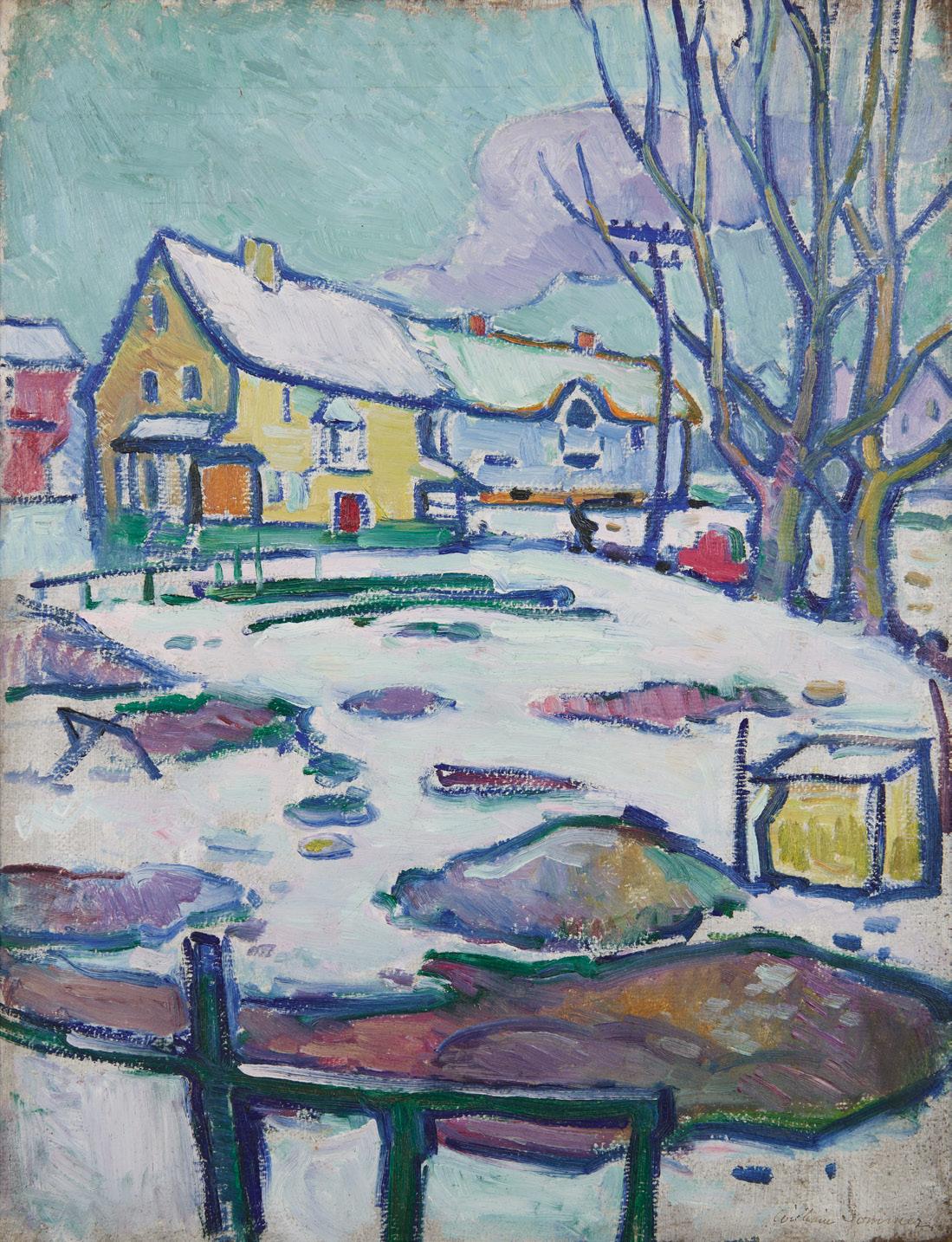
Winter, c. 1913
Oil on board
Signed lower right
26 x 20 inches 30
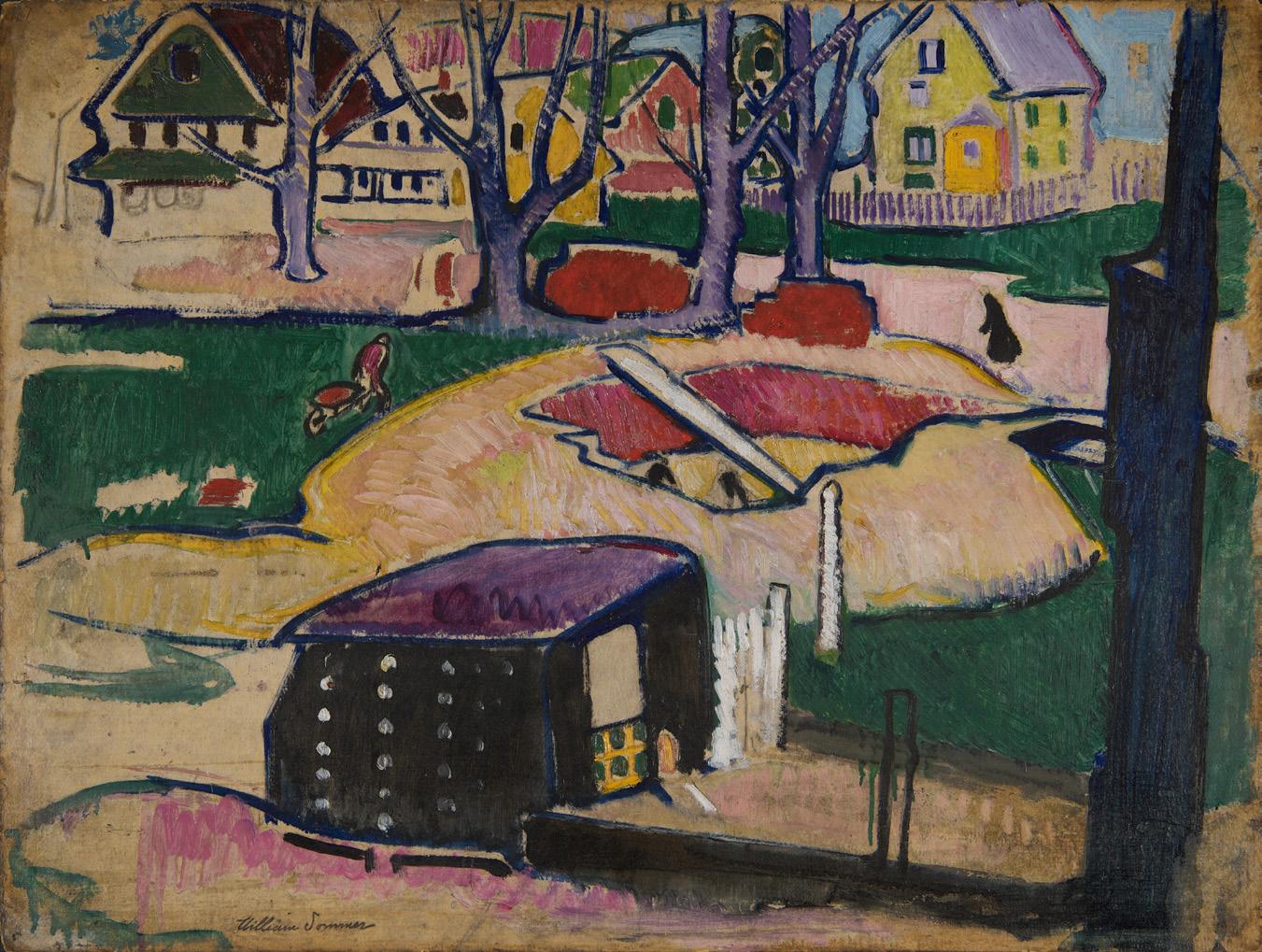
Construction in Lakewood, c. 1913
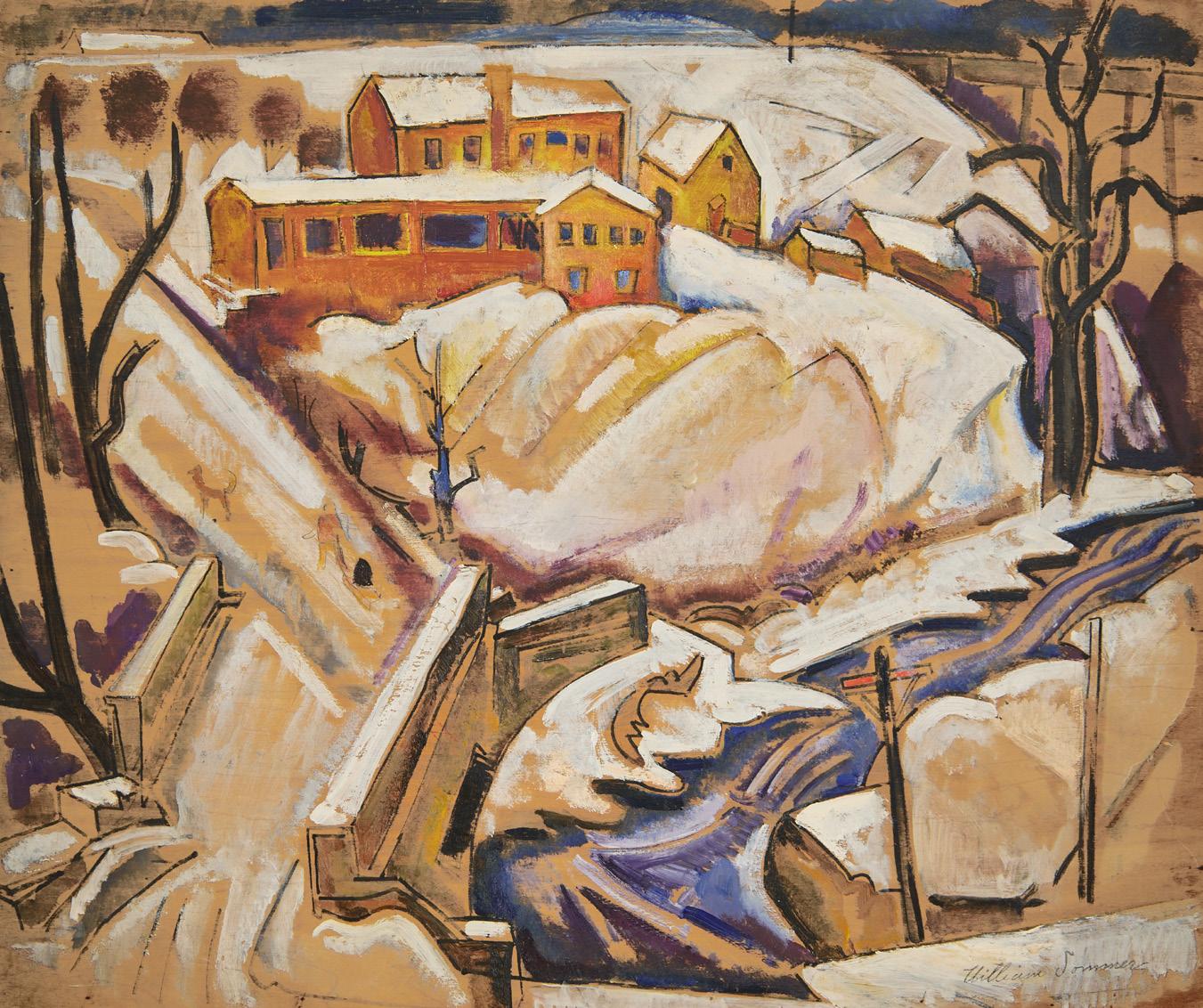
Winter, Brandywine, c. 1916
Oil on board
Signed lower right 32
Sommer’s embrace of modernism can be partly attributed to his relationship with three Cleveland artists—Abel “buck” Warshawsky, William Zorach, and August biehle. After studying at the Cleveland School of Art, Warshawsky went to Paris in 1908 and began painting with the high-keyed colors of Impressionism. Upon returning to Cleveland in November 1910, he exhibited his recent paintings at the Rowfant Club and the Rohrheimer-brooks Studios. Newspapers described the brilliantly colored works as “extremely daring.”17 Sommer and Zorach were so impressed that they convinced Warshawsky to offer private classes in the evenings and on Sundays.18 According to Warshawsky, he taught Sommer “the elements of cool and warm colours, the juxtaposition of colour, breaking hue colour into the surfaces instead of gray and colourless planes.”19
Zorach played an even more important role in Sommer’s swing toward modernism. The son of Lithuanian immigrants, Zorach grew up in the Cleveland slums and found work as an apprentice lithographer at Otis. He was already there when Sommer arrived in 1907.20
Although Sommer was twenty-one years older, they quickly became friends based on a shared outlook on life and a mutual desire to advance in their independent work. Zorach later wrote, “It was bill Sommers who when I was only a young apprentice in the Lithograph shop made me conscious of the difference between commercial and real art—and the idealism which is the basis of the true artist.”21
In March 1911, Sommer, Zorach, Warshawsky and eight other Cleveland artists formed an independent organization dedicated to promoting freedom and individuality in the arts. They called themselves the “Secessionists,” and later that month held their first exhibition at the Rohrheimer-brooks Studios. Inspired by the Independents in New York and European Secessionist movements, the Cleveland group
viewed their association as a progressive alternative to government-sponsored academies, whose annual exhibitions were controlled by conservative juries. The Cleveland Secessionists countered by holding exhibitions without juries or prizes, although to maintain quality they restricted participants to members and invited colleagues.
Seeking greater contact with European modernism, Zorach left for Paris in March 1911. During nine months abroad, he met Gertrude Stein and discovered Fauvism and Cubism in the paintings of Matisse and Picasso. While attending art classes at the progressive art school La Palette, Zorach met his future wife, Marguerite Thompson, who was already exploring Post-Impressionism in her own paintings and attending exhibitions of the Fauves and Cubists. Marguerite played a crucial role in connecting Zorach with the leaders of the European avant-garde.
In December 1911, Zorach returned to his job at Otis Lithography and resumed his friendship with Sommer. Zorach also began painting in a modernist style that impressed his colleagues, noting: “Upon my return bill [Sommer] immediately swung into the more abstract type of painting.”22 Equally important, Zorach showed his colleagues about twenty Post-Impressionist paintings by Marguerite, which she had given him for safe-keeping while she traveled abroad. Henry Keller was amazed, and as documented by Henry Adams, Marguerite’s paintings had a “profound effect” on Cleveland artists.23
An untitled painting by Zorach—dated 1912 in the lower right (see page 33)—offers evidence of how deeply he had embraced the radically simplified forms and arbitrary color of Fauvism. A nude figure rides a horse through a bucolic landscape on the far side of a cobalt blue pond or river. Mirrored reflections of two swans establish a symmetrical arrangement of horizontal and vertical shapes in the middle. A radiant yellow sky shoots golden reflections across the pond, evoking a feeling of utopian bliss, comparable to Matisse’s The
Joy of Life (1905-1906). “It is the inner spirit of things that I seek to express,” Zorach wrote, “the essential relations of forms and colors to universal things. Each form and color has a spiritual significance to me.”24
In February 1912, the Secessionists— including Sommer and Zorach—held their second exhibition at the Taylor Gallery in Cleveland. An article in Cleveland Town Topics (March 1912) reported that visitors broke into discussions of Matisse when standing before Zorach’s “wonderful roses and other primary arrangements.”25 The comment is noteworthy because it confirms that Cleveland artists were aware of Matisse and Fauvism nearly a year before the opening of the 1913 Armory Show in New York. Although Zorach moved to New York in December 1912 to marry Marguerite, he maintained a presence in Cleveland by sending his paintings to exhibitions in the city.26
Sommer’s embrace of ultramodernism was also influenced by his relationship with August biehle. biehle was born in Cleveland to a family of German immigrants. After studying at the Cleveland School of Art, he made two trips abroad to study at art schools in Munich—the first in 1903, the second in 1911. During his second visit, he discovered the paintings of the German Expressionists at two exhibitions of the blue Rider group, a collective of avant-garde artists led by Wassily Kandinsky and Franz Marc. In their search for art driven by “inner necessity” rather than outward appearances, blue Rider artists synthesized ideas from Fauvism, Cubism, and Futurism.
Upon returning to Cleveland in August 1912, biehle exhibited his new modernist paintings at the Rohrheimer-brooks Studios and the Korner & Wood Galleries. He also amazed his colleagues by sharing his copy of the famous Blue Rider Almanac (1912), featuring essays by leading theorists of experimental art and reproductions of works by leading European modernists, including Picasso, Matisse, the German Expressionists, and the Russian Futurists. Sommer was
deeply impressed and began painting together with biehle at sites in Lakewood and Rocky River, joined at times by Zorach. Sommer also led his colleagues on painting excursions to the brandywine Valley. Early the next year, biehle began a three-year apprenticeship with Sommer at Otis Lithography.
In November 1912, Sommer, biehle, and Zorach participated in another large group exhibition at the Taylor Galleries near the old arcade in downtown Cleveland. Art critic Spencer Adams commented in Cleveland Town Topics: “Probably the most pronounced examples of post-impressionism that have ever been shown in Cleveland are contributed by Mr. William Sommer.”27 In a letter to Marguerite, Zorach also noted Sommer’s rising prominence as the city’s leading ultramodernist: “Almost everybody is trying to paint in pure color . . . Sommer is the wildest of them all.”28
Sommer was already a committed modernist when he visited the New York Armory Show during its run from February to March 1913.29 He also visited the recently married William and Marguerite Zorach, who were both represented in the exhibition. While the Armory Show ran the gamut from French Impressionism to Ashcan realism, Sommer was drawn to the masters of modern art—Cézanne, Gauguin, Van Gogh, Picasso, and Matisse. He wrote a few notes about the exhibition in his sketchbooks: “Gauguin knew design,” and, “Van Gogh was the first man that realized color expression.”30 He must have been astonished by Kandinsky’s Improvisation 27 (The Garden of Love II), a composition on the verge of total abstraction. The impact would last. Sommer’s son Ray later recalled that his father “used to put on a record of Wagner and then paint an abstraction, a Kandinsky.”31
Visitors to The Armory Show were particularly shocked by the distorted forms and anti-naturalistic colors of Henri Matisse’s Blue Nude (Memory of Biskra) (see page 39).
The painting struck many as a violent assault against all conventional notions of beauty, prompting art students who saw the show in
Chicago to hang Matisse in effigy. As for Sommer, Matisse’s painting came as a revelation. He took note of its raw power, the audacious color, and the dynamic rhythms that surge through every inch of the composition. This vision of a nude set in a Garden of Eden—a paradise of free, instinctual desire and emotion—must have also struck Sommer with the force of a thunderbolt. Paintings of nudes in utopian landscapes soon came to embody his growing revulsion against the materialist values of modern capitalist society. Zorach offered insight into Sommer’s state of mind, “I remember how fed up he got working day and night in the shop and the long trips on the street cars back and forth home and to work again and how depressed he was to get some
painting done on Sundays—and on holidays.”32 Sommer’s struggle to find release from the drudgery of his daily life as a commercial lithographer took its toll. “It was at this time,” Zorach recalled, “that every now and then bill would disappear and go off on long drunks for a month at a time and not show up for work. It seemed a necessity and a release from the tension and commercialism of the shop.”33 The strain reached a breaking point in 1912 when Martha left him for several weeks, only to return after he sent her a pleading letter.34 While she remained a calming presence in his life, the tension and the struggle between his artistic aspirations and more mundane matters—between paying the bills and his fervent striving for beauty and creativity—continued. ™
In 1914, Sommer purchased a fouracre property with a farmhouse and an abandoned one-room schoolhouse in the brandywine Valley, a rural community about twenty miles south of Cleveland. Located near brandywine Falls, just south of Macedonia, the property was accessible by the interurban rail line connecting Cleveland and Akron. Sommer converted the schoolhouse into his studio and cultivated an apple and pear orchard. In addition to selling the fruit for supplemental income, Martha used the fruit to bake pies, and William used them for making hard cider. Their home on Vinegar Hill appears in Brandywine House (fig. 33) and Brandywine Landscape (fig. 37), depicted in both paintings with a triangular, Greek-revival roof. Around 1919-1920, Sommer replaced that structure with the Dutch gambrel roof seen in Brandywine Country (fig. 40), Bach Chord (fig. 44), and Winter Landscape (fig. 45).35 The house and studio were demolished in the 1960s to make way for the construction of Interstate 271.
Sommer found endless inspiration in the beauty and peaceful solitude of the brandywine Valley.. Long walks through the rolling hills deepened his love for nature and became entwined with his passion for painting and music. He owned a self-playing pianola and later a record player that spun out music by his favorite composers. He wrote in his notebooks:
These days am working out in nature, at sunrise or noonday . . . I feel happiest when my heart is filled with music by Bach, Haydn or Handel . . . I will sometimes put on a record before going into the sunlight
to sketch, and under their influence my vision takes on a different slant.36
Writer Robert bordner took note of Sommer’s synesthetic association of nature, art, and music while describing an evening spent with the artist and the poet Hart Crane:
Crane, Sommer and I were walking on the dirt road under a starry early winter sky from Brandywine to the Interurban car line . . . We had been listening to Bill’s Bach records, and Bill was declaring that he could SEE in color the various movements of the music as it played . . . Crane was fascinated and we got into whether poetry could be heard in colors too.37
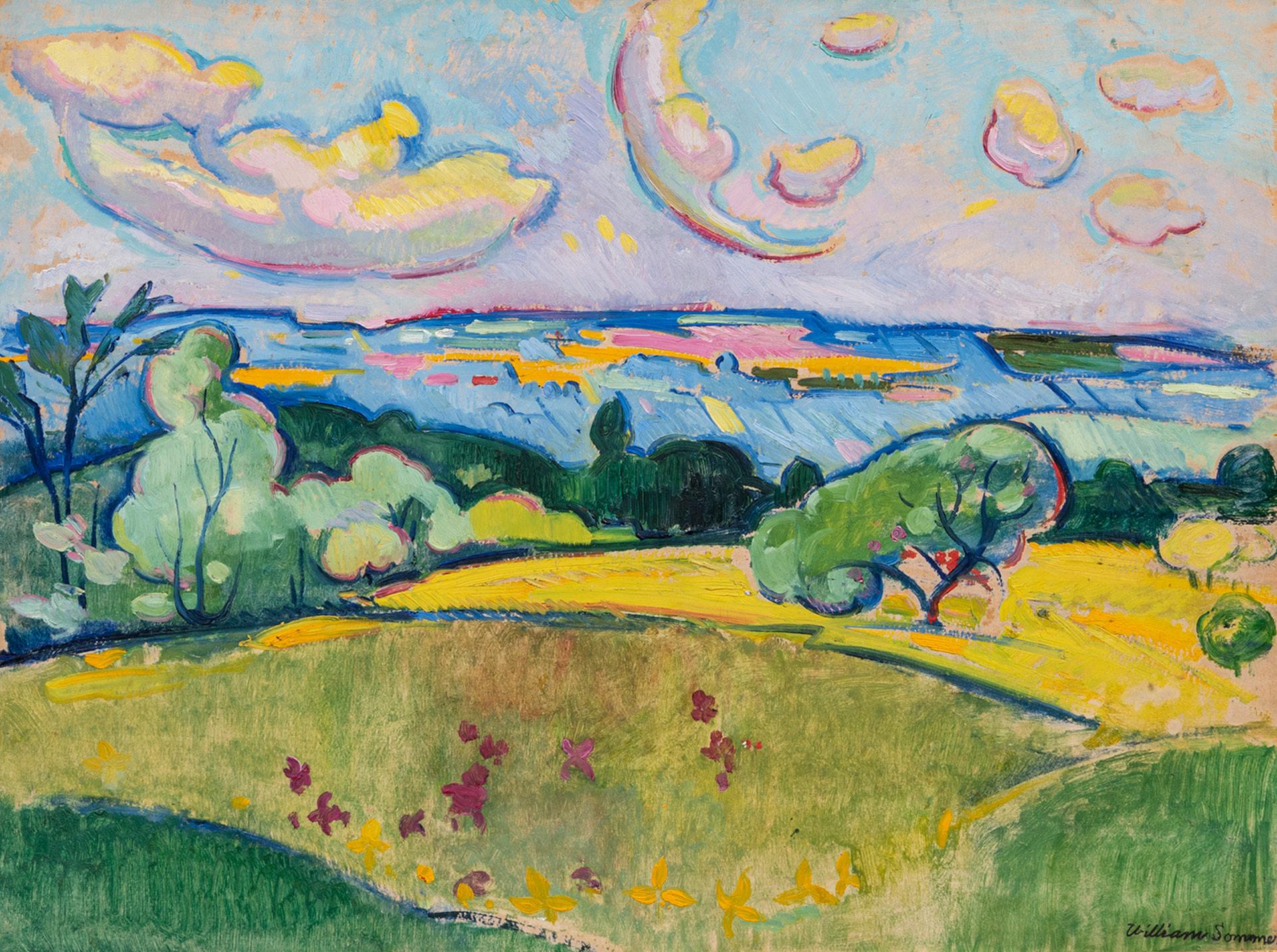
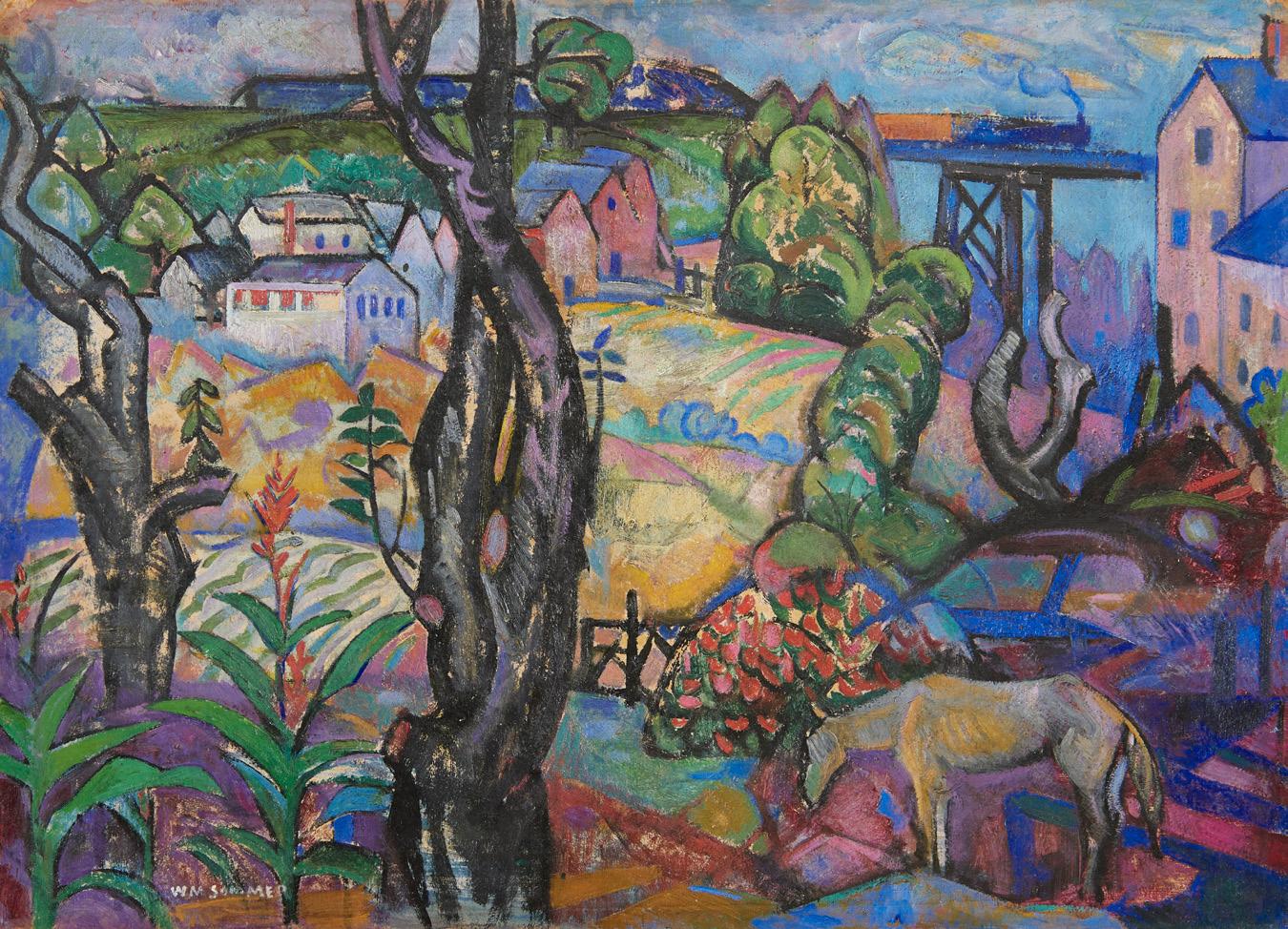
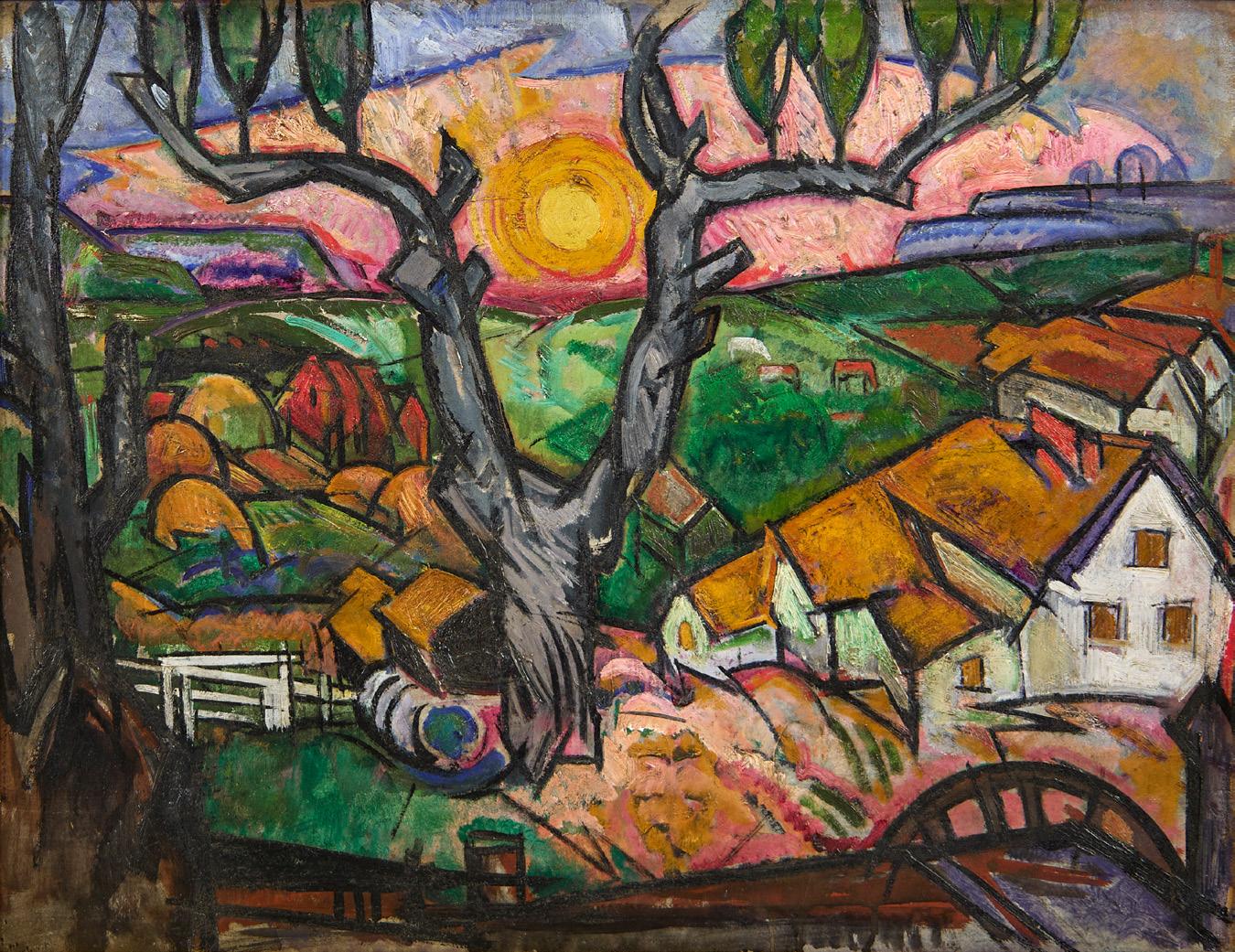
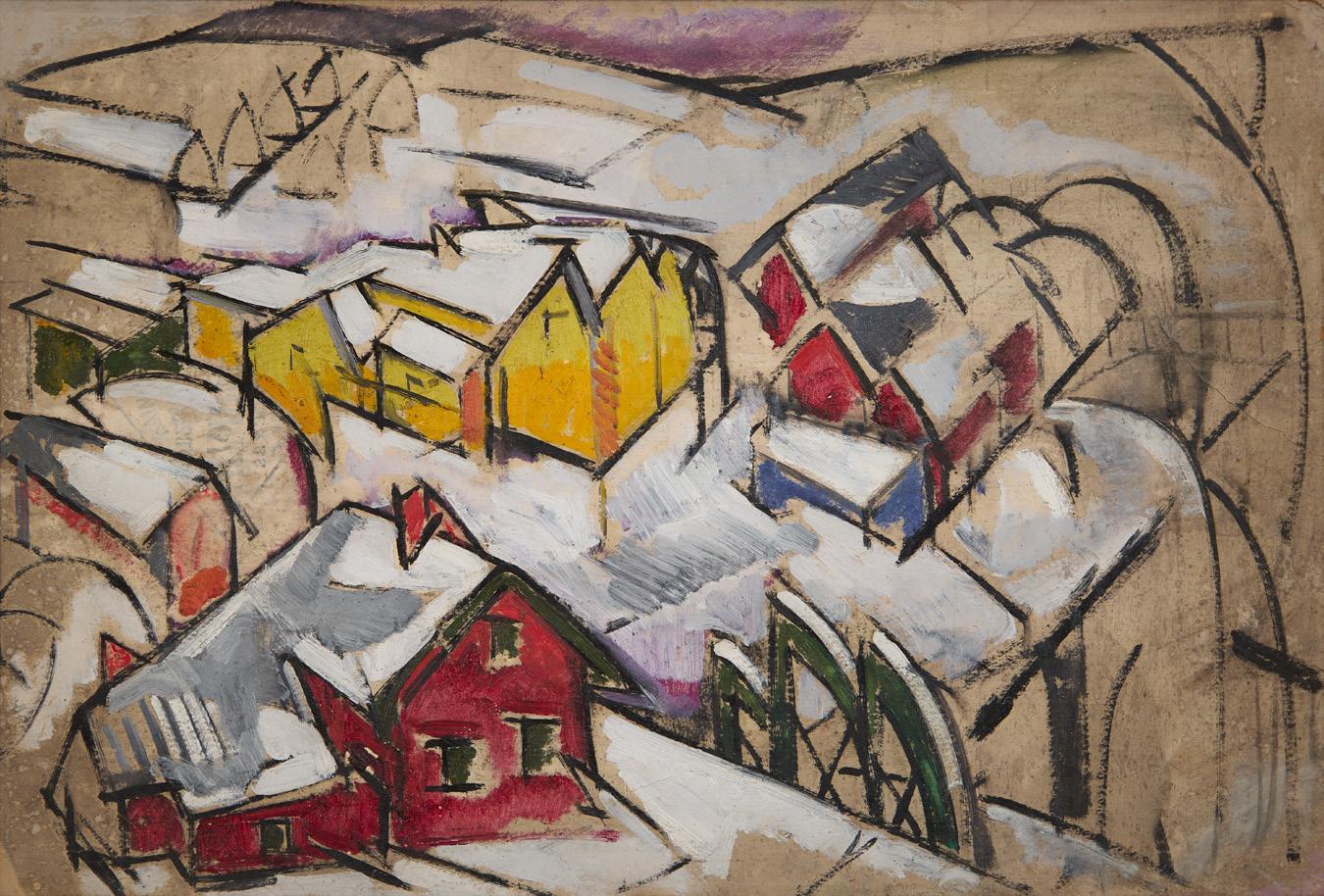
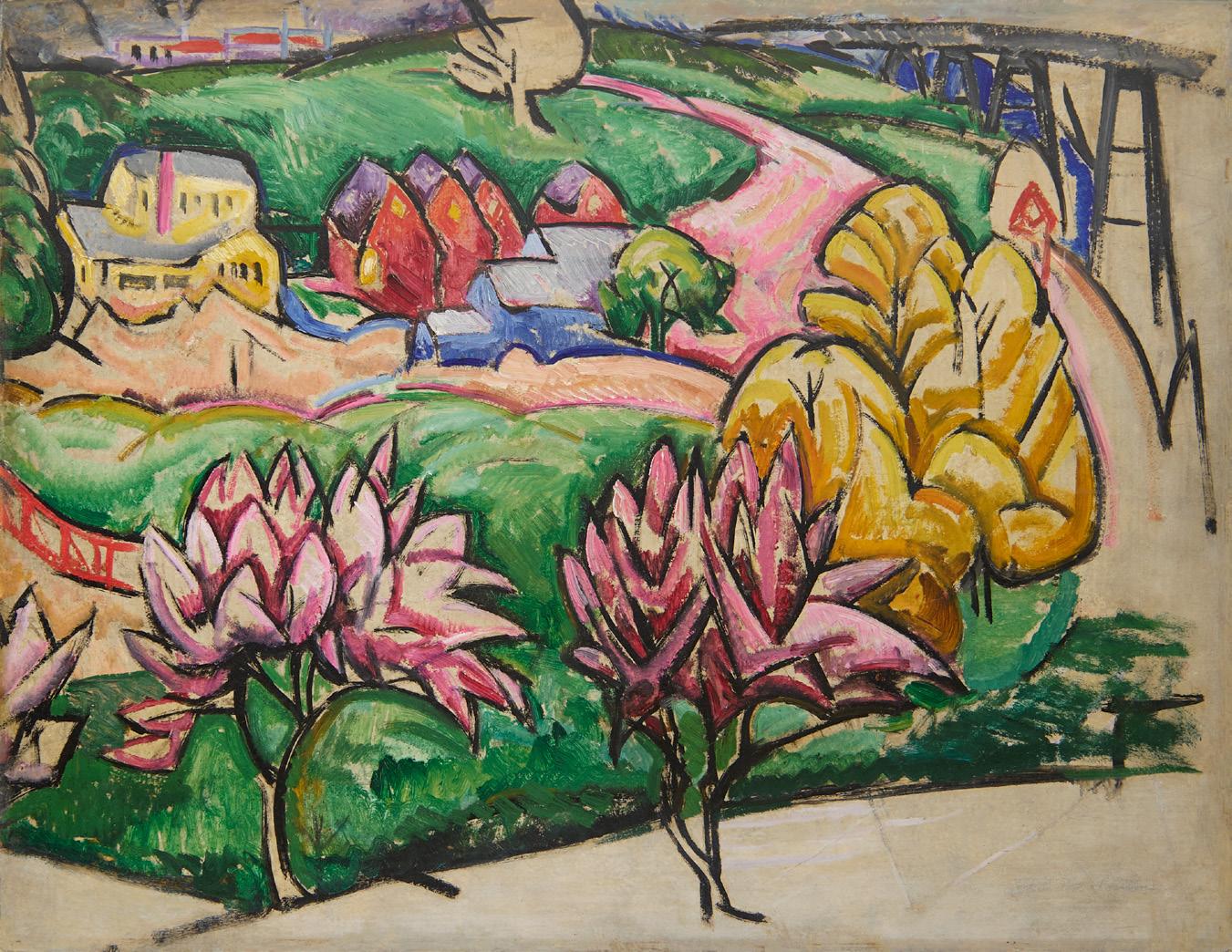
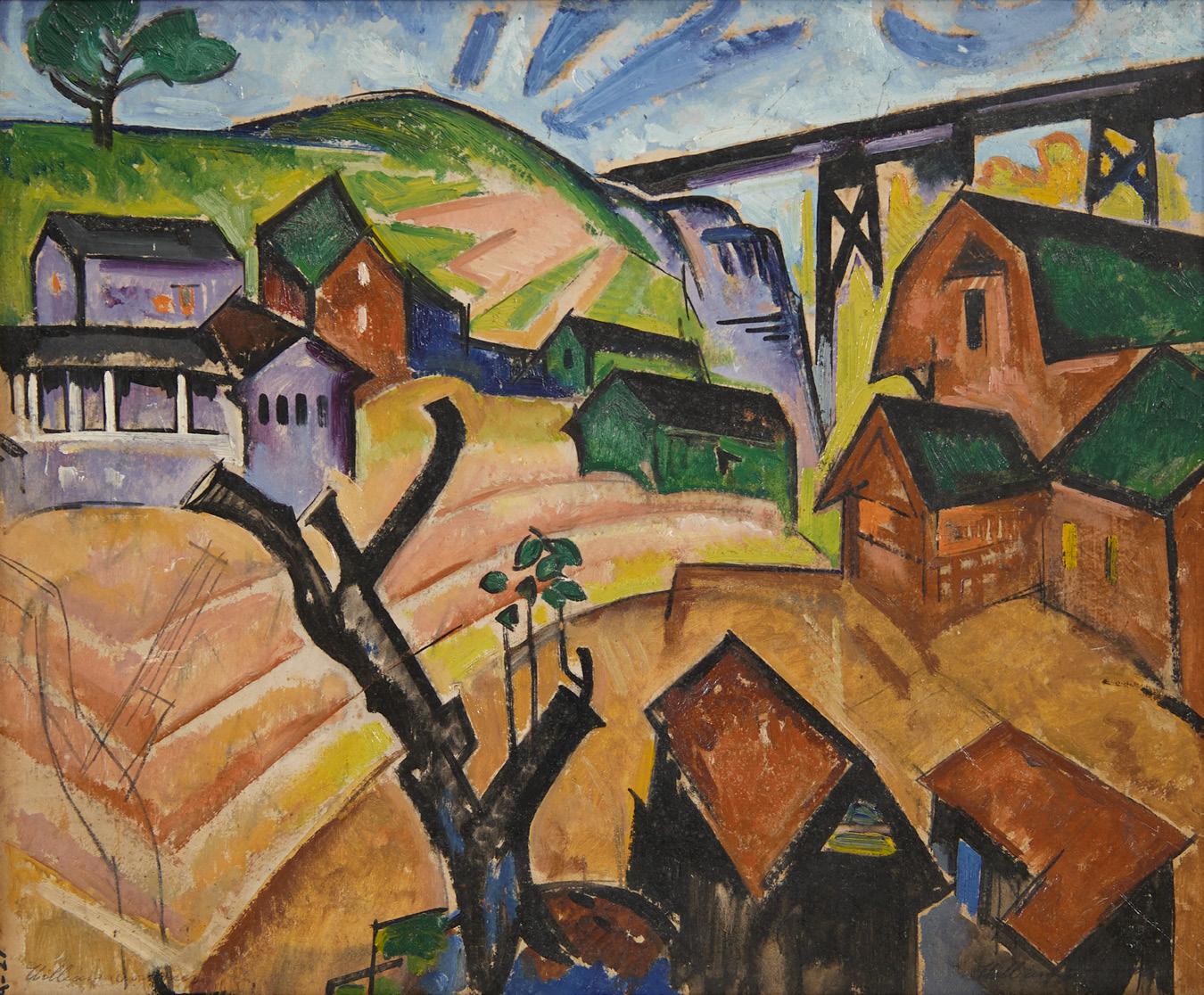
Sommer painted the brandywine Valley in all seasons—the blossoming of spring, the heat of summer, the glorious colors of autumn, the houses covered with snow in winter. He sought increasing chromatic intensity and emotional resonance in these paintings. “The colours of a picture,” he wrote in his notes, “should have all of the richness and general appearance of a beautiful bird or a peacock with its gorgeous plumage, its depth of colour, colour used in its full intensity.”38 His views of the valley vibrate with electric energy. A dark tree anchors the foreground of Train on High Bridge (fig. 36), providing a foil to the surrounding landscape that erupts with dazzling color, as if a metaphor for the artist’s spiritual awakening in this self-fashioned Eden. A blazing sun in Brandywine Landscape (fig. 37)—recalling the
radiant discs of Van Gogh—bursts between the gnarled limbs of another dark tree whose twisted trunk reaches upward like an ecstatic figure.
Around 1917, the decorative lyricism of Sommer’s Fauvist phase yielded to the sharper geometric structures of Cubism and Vorticism. This stylistic shift allowed him to integrate sky, buildings, trees, and figures into unified, interlocking planes. The transformation is evident in the daringly abstract Brandywine in Winter c. 1920 (fig. 38). While the painting may appear unfinished to some, its open structure and linear scaffolding create an extraordinary sense of rhythmic cohesion, binding the composition through intersecting vectors of energy.
In the late 1920s, Sommer turned increasingly to watercolor, a medium that demands speed, decisiveness, and no reworking. He found watercolor ideal for infusing his paintings with greater freedom and spontaneity. “I believe art should be as spontaneous as the song of a bird,” he remarked. “No one taught the bird to sing. I do not care a snap for academic proportions.”39
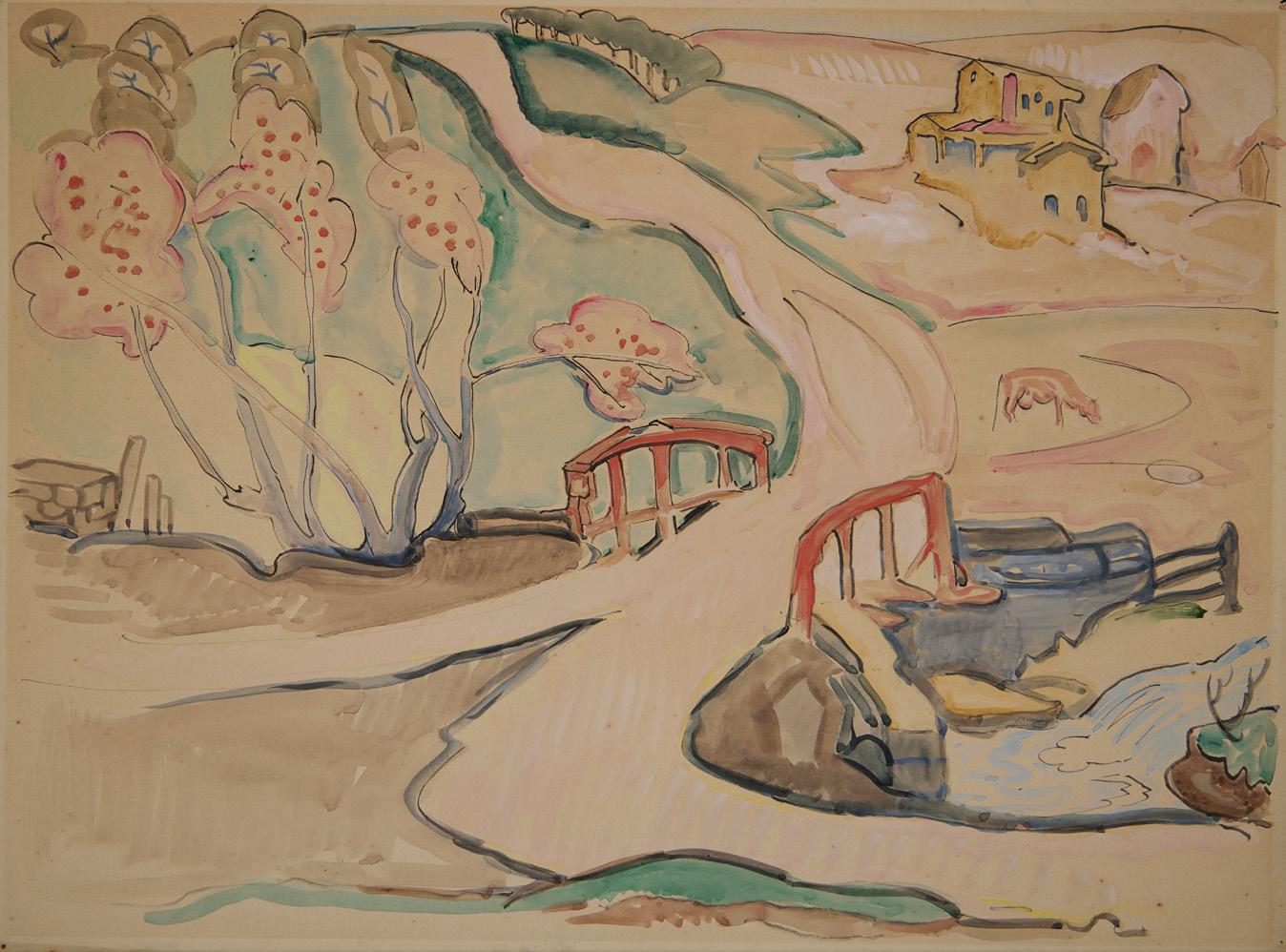
He also exploited the transparency of watercolor to create compositions animated by luminous planes of color flowing around delicate pencil drawing and passages of unpainted paper. While often praised for their color harmonies, Sommer’s watercolors are equally indebted to his masterful draftsmanship, honed through a lifetime of sketching and work in commercial lithography.
The freedom Sommer sought in brandywine was not merely technical but spiritual. His ultimate aim was the intensification of perception—the search for unity between inner life and external nature. He prized immediate sensation and what he
described as “the commonplace made unique because [it is] violently felt.” 40 Nature was only a point of departure, a veil through which eternal reality might be glimpsed. “Art,” he wrote, “is the reproduction of what the senses perceive through the veil of the soul.”41
Despite its rural setting, Sommer’s brandywine home became a gathering place for progressive artists and writers. Fellow artist Richard Sedlon commented, “His studio was an artistic laboratory of creative investigation for artists, musicians, poets and writers, with one in common — ‘Inquiry’.”42 In 1915, Charles burchfield—who was studying at the Cleveland School of Art—took the interurban to meet “big bill Sommer” in brandywine.43 He was accompanied by a small group of Cleveland artists. Others flocked to the artist’s rural home, often bearing books and alcohol, making it a particularly congenial refuge during Prohibition.
Hart Crane (fig. 108) was perhaps the most distinguished writer to frequent brandywine. After dropping out of East High School in Cleveland, Crane spent the next seven years working in advertising and dividing his time between Cleveland and New York. He met Sommer in 1921 through Samuel Loveman, a poet and dramatist who spent the first thirtyseven years of his life in Cleveland. Crane was deeply impressed with Sommer’s art and tried to bring it to the attention of prominent writers and dealers in New York. “I have lately run across an artist here,” Crane wrote to a friend, “whose work seems to carry the most astonishing marks of genius that have passed before my eyes in original form . . . I have taken it upon myself to send out some of his work for publication, an idea that seems oddly, never to have occurred to him.”44
Crane was astonished that Sommer
showed no interest in promoting himself or courting favor with society patrons, even in his native city. “Sommer has tried Cleveland people,” Crane commented, “and found them so indifferent that he didn’t even send one canvas or sheet to this last exhibition here.”45 Hoping to generate support, Crane forwarded a number of watercolors to Sherwood Anderson and William Carlos Williams, commenting in a letter, “Williams wrote bill a memorable letter accompanying his check (for $25.00) in which he said that bill got under his underdrawers—and went on to say that he was potentially greater than Marin.”46 Crane also arranged for the publication of three Sommer drawings in The Dial, though Alfred Stieglitz criticized Sommer’s work for a lack of finish.47
Crane biographer John Unterecker recognized that Sommer and Crane shared a conviction that art could reveal an underlying coherence beneath modern dislocation—a vision accessible only to the artist and the mystic.
What they felt they had experienced on both their alcoholic and their aesthetic benders was a glimpse into the heart of things. There, beneath the disordered surface of the modern world, they looked into a coherence which gave them the courage not to deny the artist’s vocation. For only the artist and the mystic, they felt, could penetrate to that ordered place—and only the artist in his structured works could
reproduce for the rest of the world something of the inner world’s glowing possibilities.48
Crane’s poem Sunday in Morning Apples (1922) hints at the closeness of their relationship.
The leaves will fall again sometime and fill The fleece of nature with those purposes That are your rich and faithful strength of line.
But now there are challenges to spring In that ripe nude with head reared Into a realm of swords, her purple shadow Bursting on the winter of the world
From whiteness that cries defiance to the snow.
A boy runs with a dog before the sun, straddling Spontaneities that form their independent orbits, Their own perennials of light In that valley where you live (called Brandywine).
I have seen the apples there that toss you secrets,Beloved apples of seasonable madness That feed your inquiries with aerial wine.
Put them again beside a pitcher with a knife, The apples, Bill, the apples!49
Despite his best efforts, Crane failed to advance Sommer’s career largely because the artist resisted publicity and self-promotion. Perhaps it was for the best, as Sommer found not retreat but constant renewal in brandywine—a modern Eden where nature, music, fellowship, and experimentation converged to shape his mature vision. ™
“The rolling hills of that beautiful countryside were to be his horizon until his death. What no other painter of Cleveland has done, he had made this part of the Cleveland area come to life much as Cézanne did Aix-en-Provence. As subject material it was inexhaustible, and the hills, fields, flowers and fruits, the farm animals, the houses and their inhabitants, are the leitmotifs which he used endlessly in abounding variations. He had the genius for wringing the eternal from the everyday.”
right
x 23 inches
Train on High Bridge, c. 1916
Collection of the Speed Art Museum, Louisville, KY
Signed lower left and right
x 23.5 inches
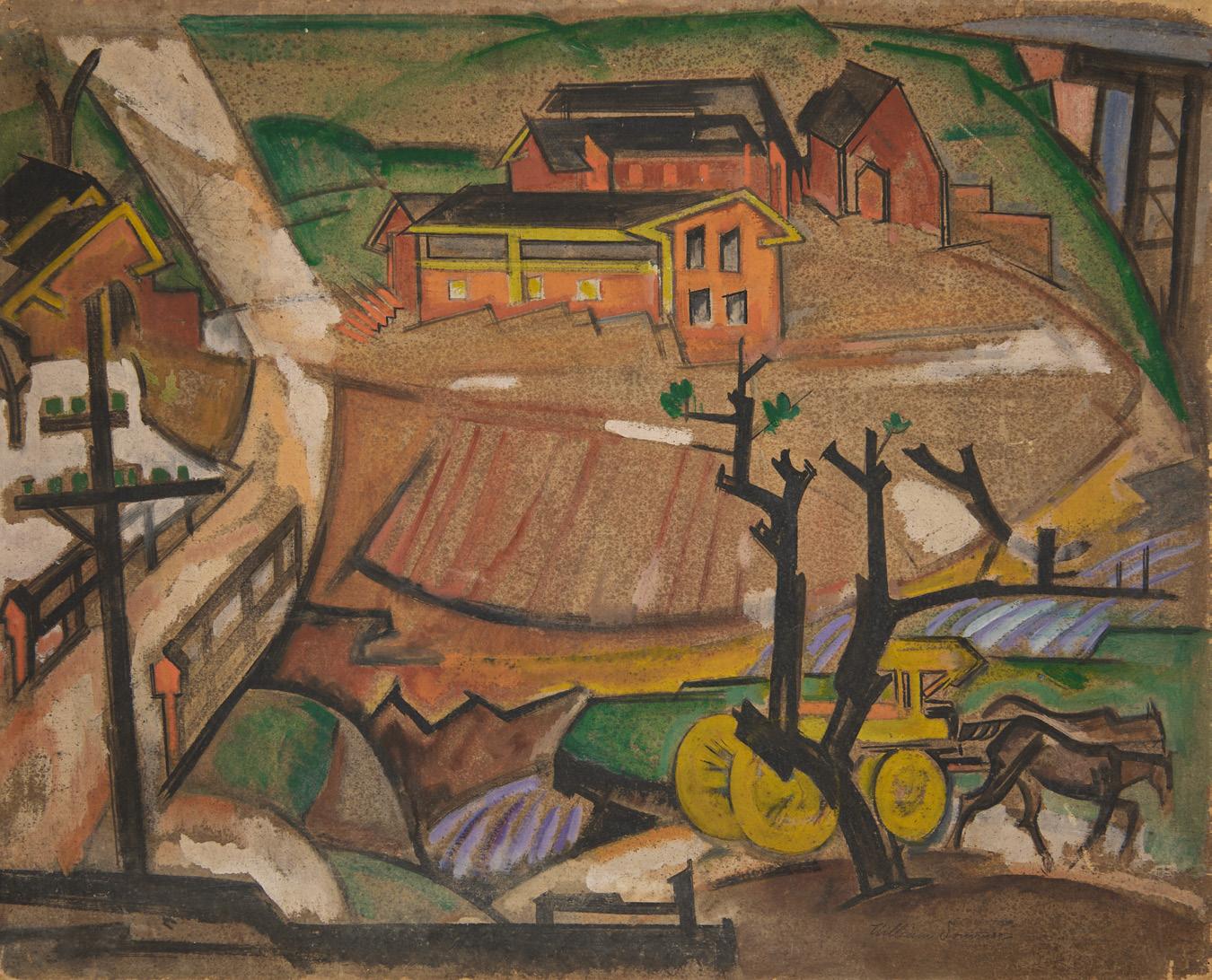
Across the Brandywine Creek, c. 1920
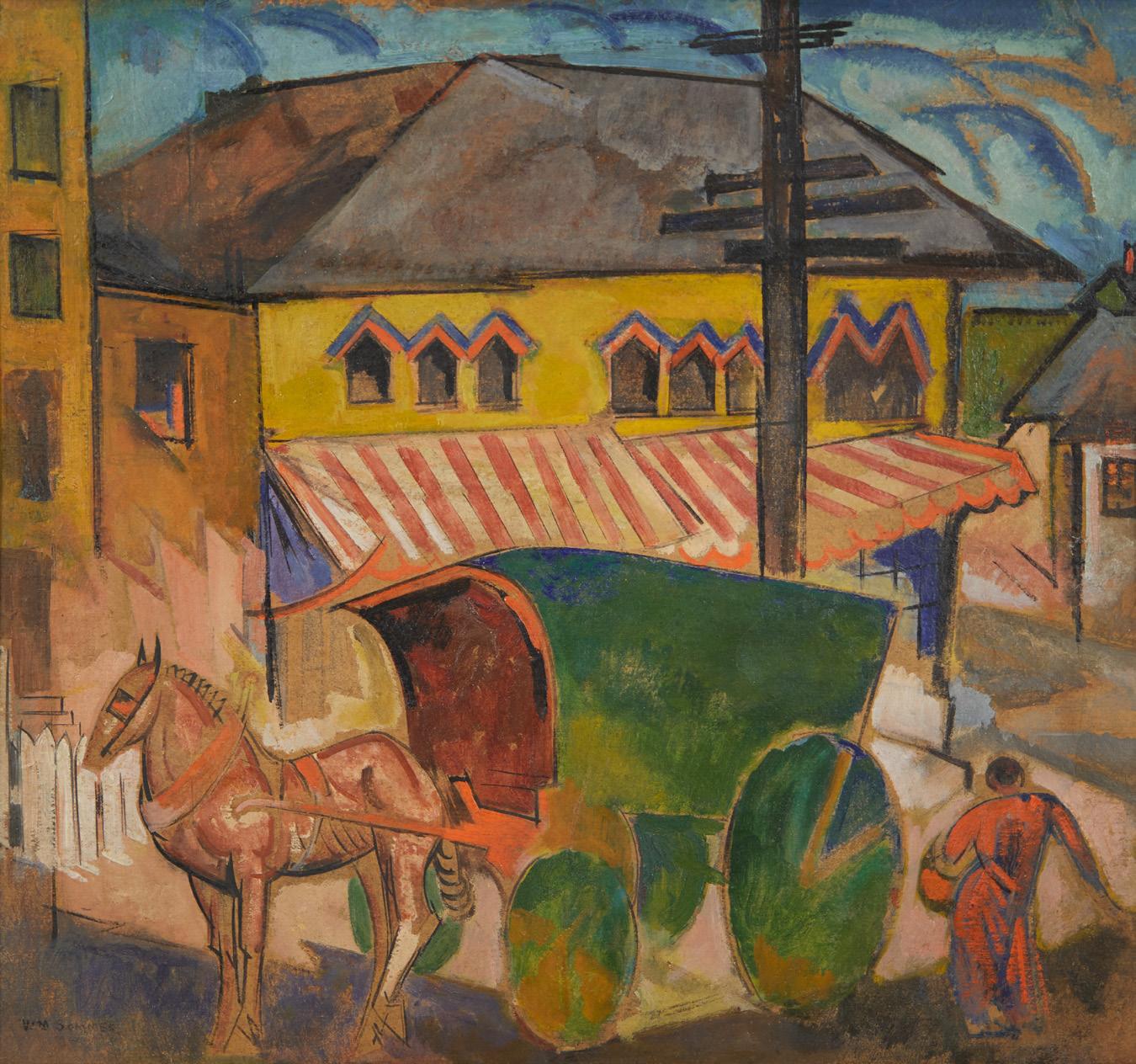
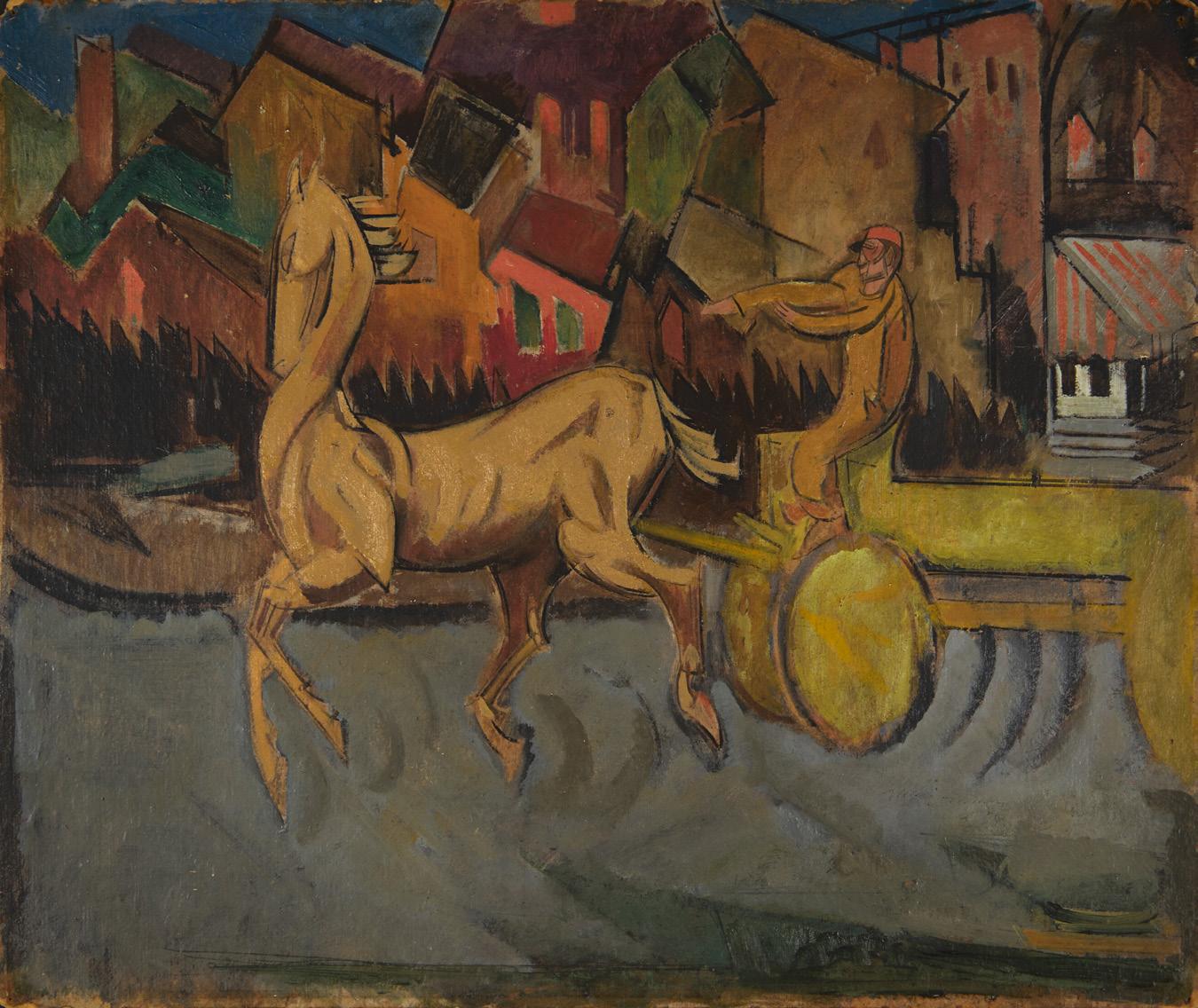
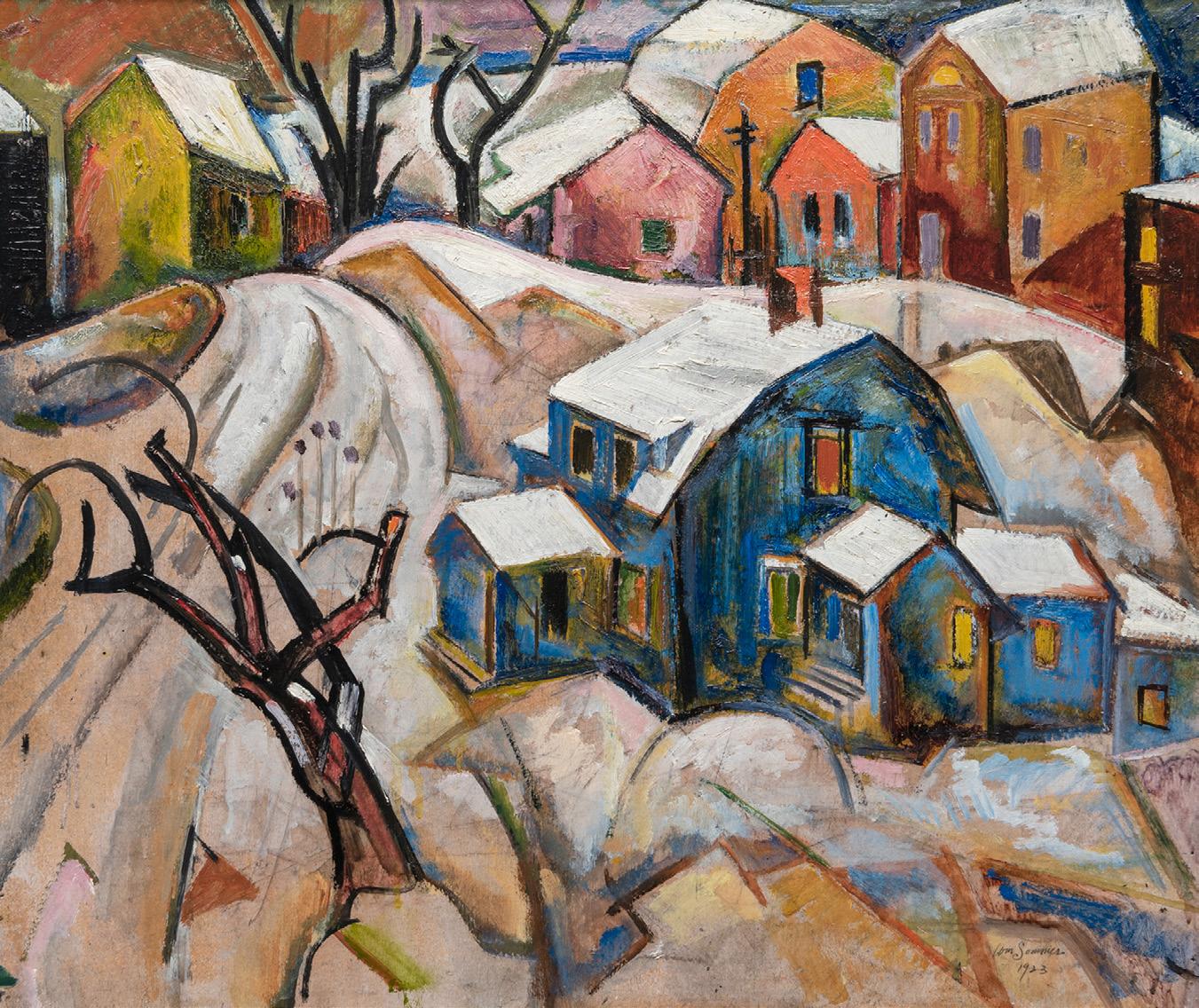
Oil on composition board
20 x 23.75 inches
Collection of the Akron Art Museum, Akron, OH
Houses, c. 1923-24
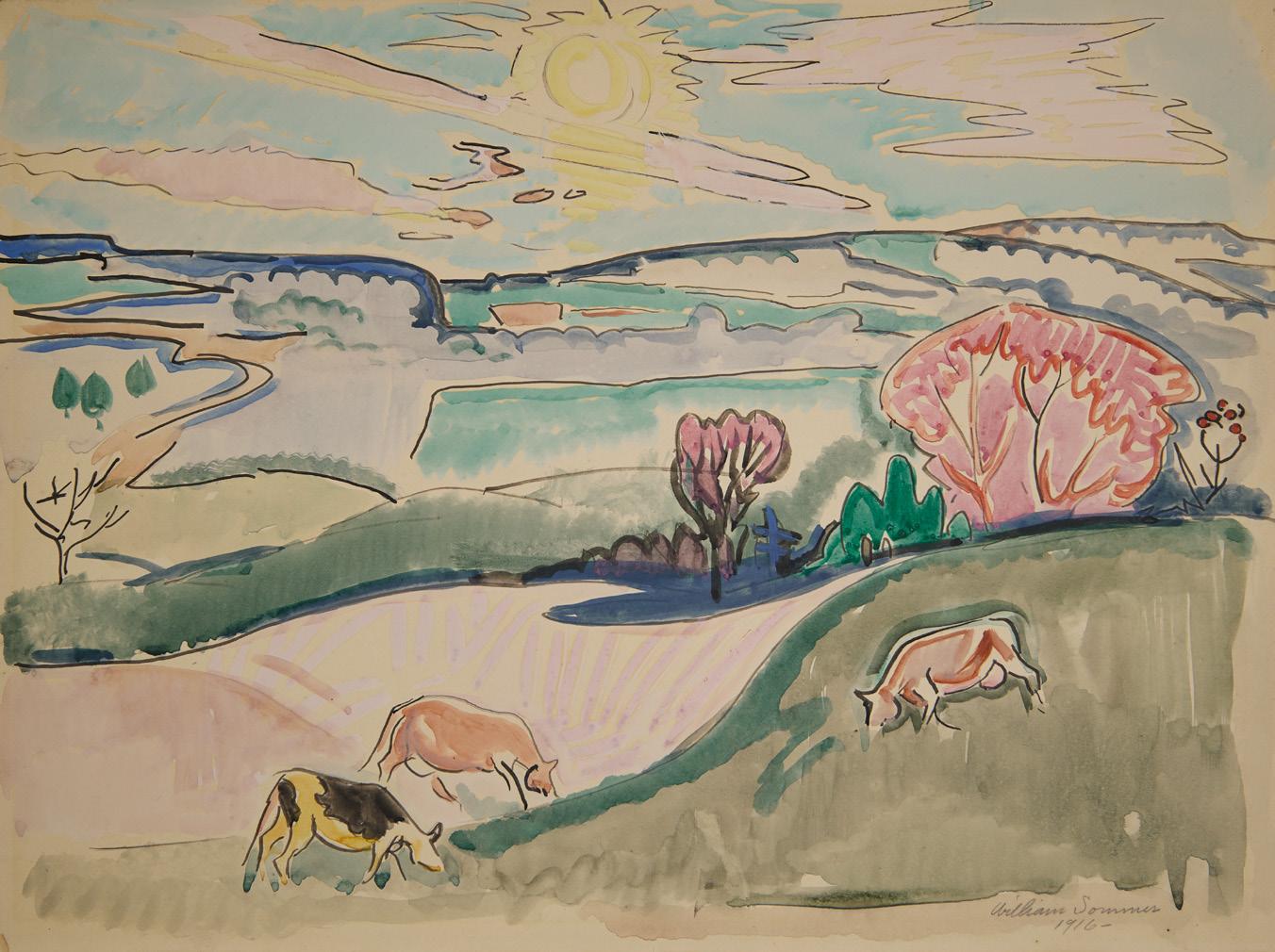
Ohio Hills, 1916
Watercolor on paper
Signed and dated lower right 11.75 x 15 inches
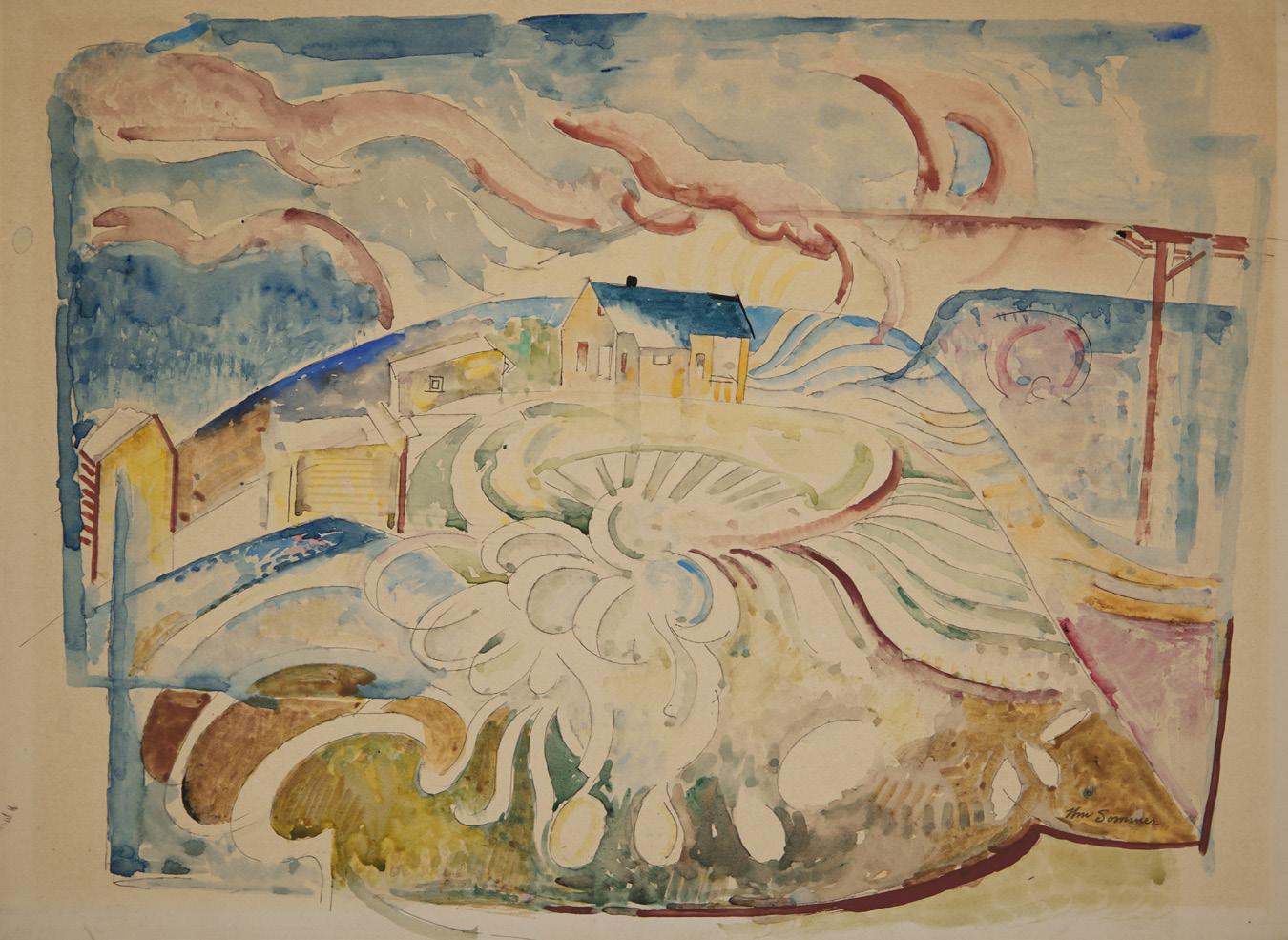
Ornamental Landscape, c. 1935
Watercolor, gouache, and ink on paper
Signed lower right
11 x 15 inches
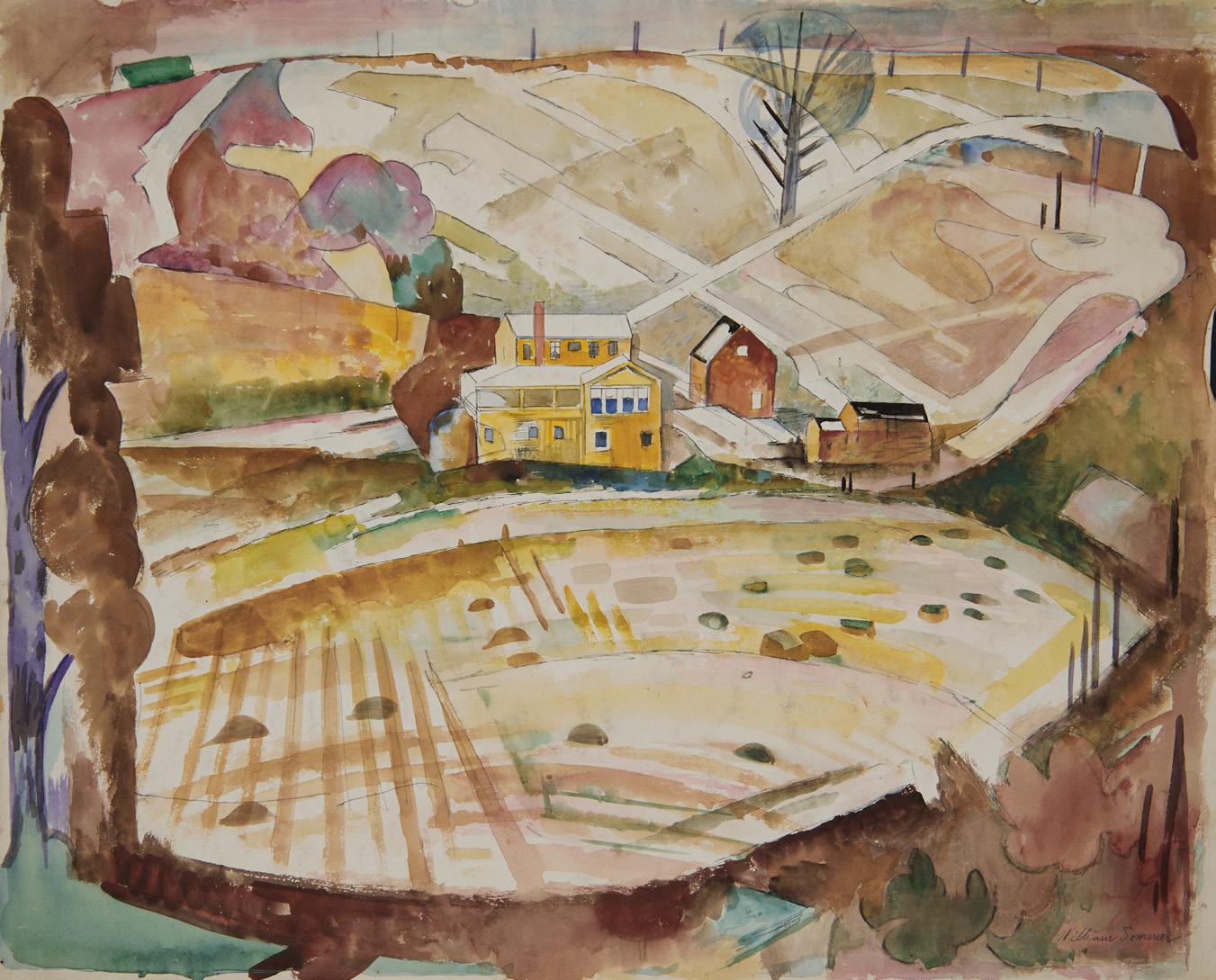
50
Signed lower right
15.5 x 19.75 inches
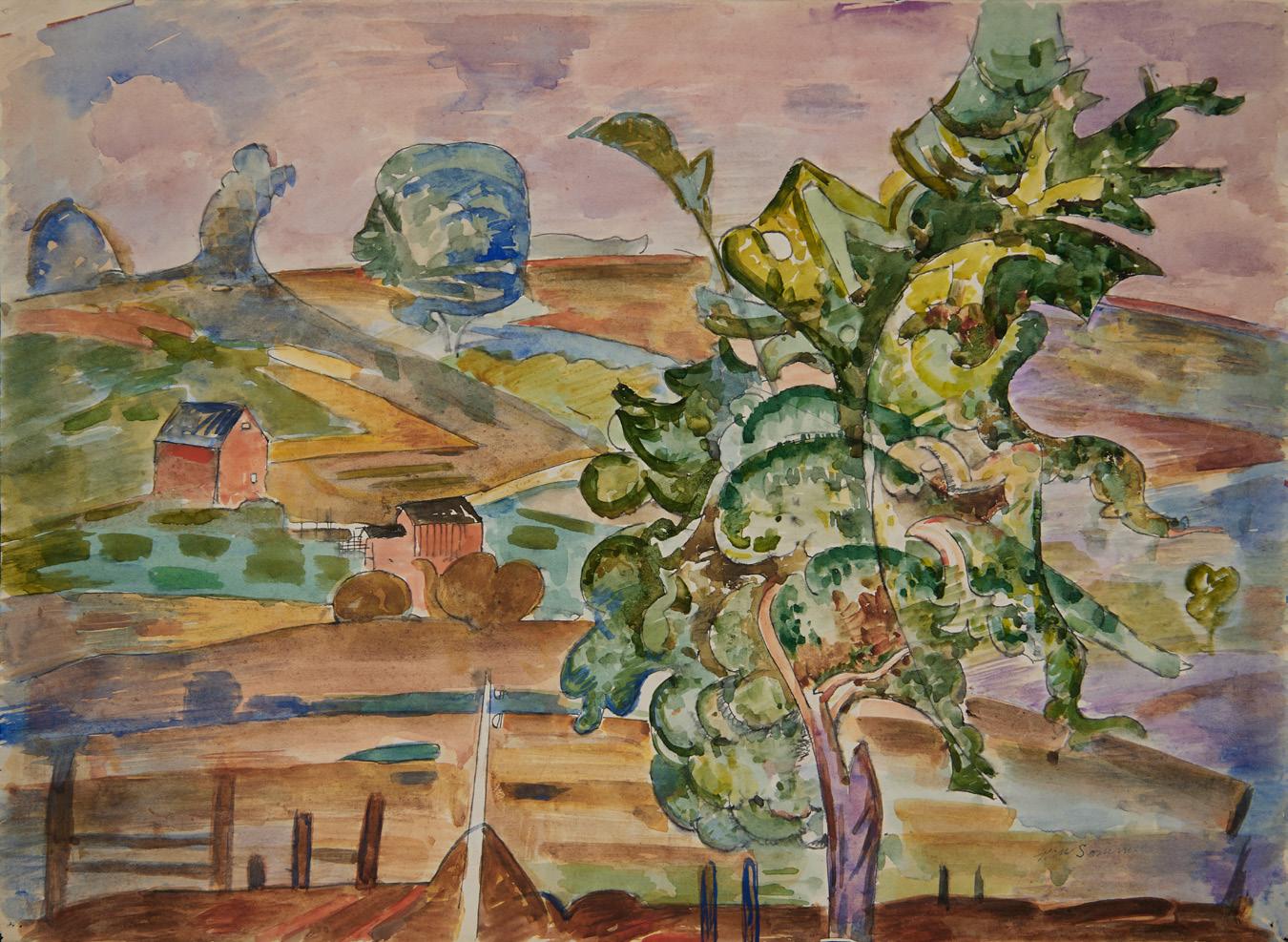
The Spinach Tree, c. 1930-35
Watercolor, gouache, and ink on paper
Signed lower right
12.5 x 17 inches
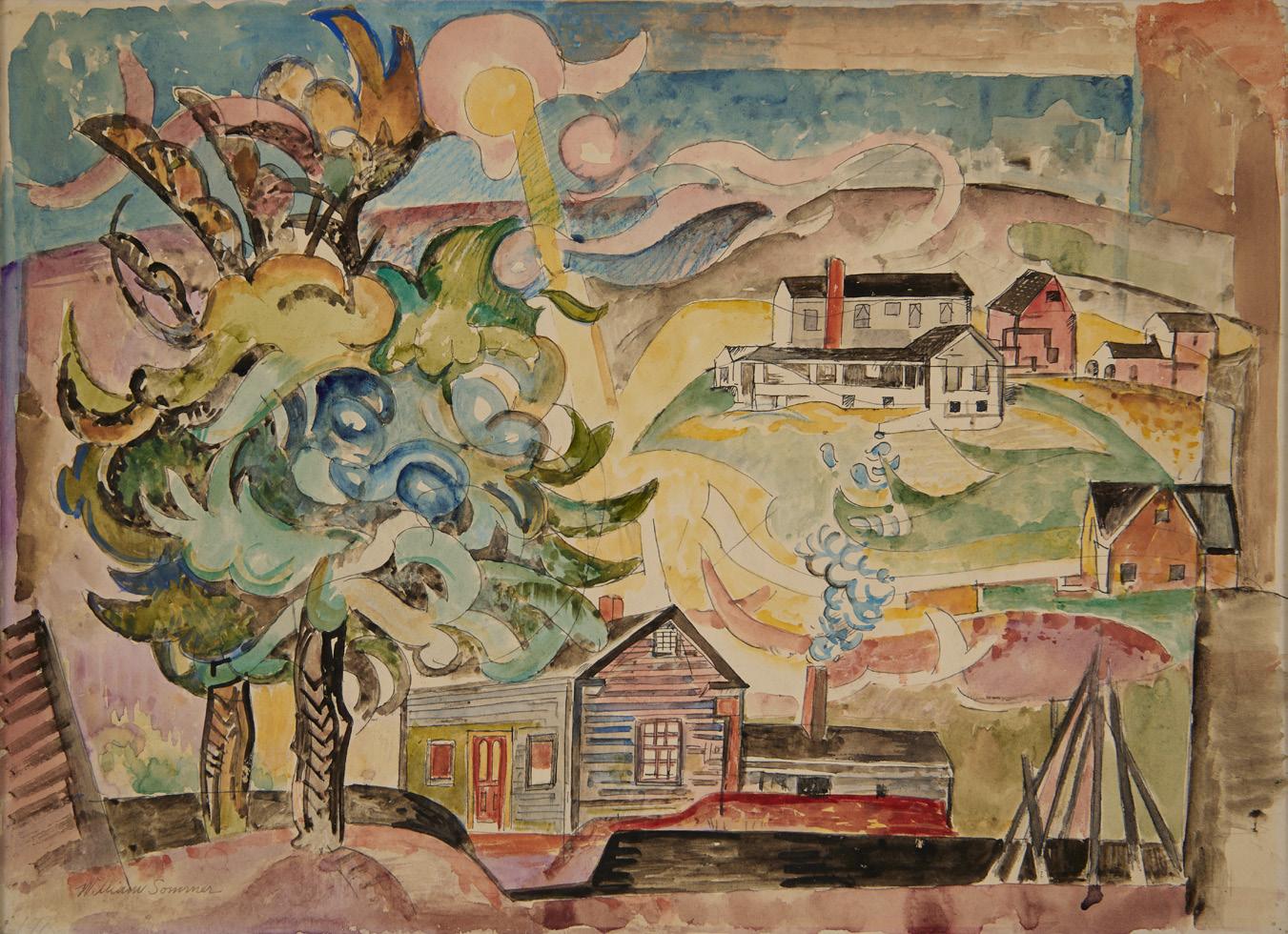
52
Watercolor, ink, and graphite on board
Signed lower left
12 x 16 inches
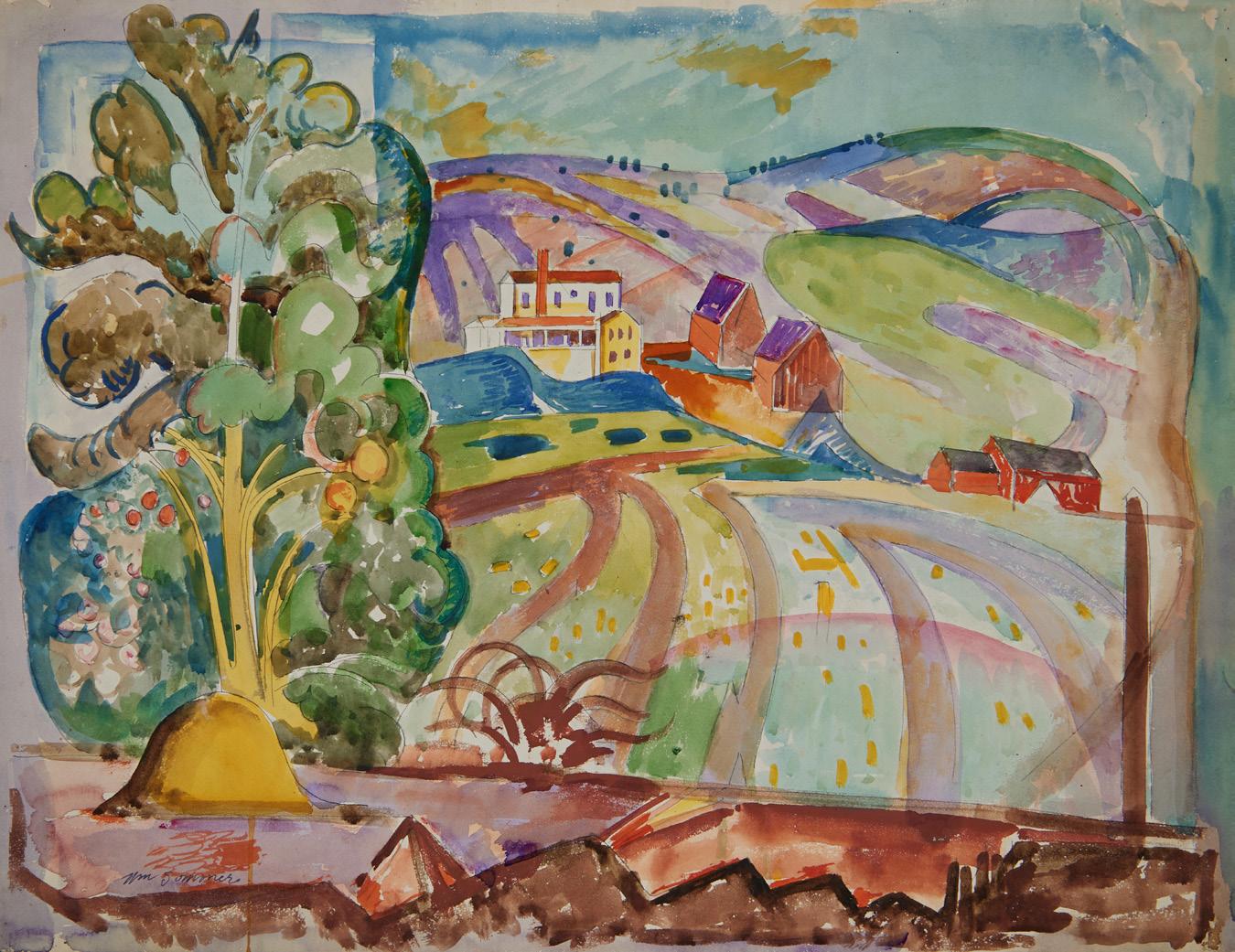
Summer Christmas Tree, c. 1935
Watercolor and ink on paper
Signed lower left, titled verso
15.5 x 20 inches
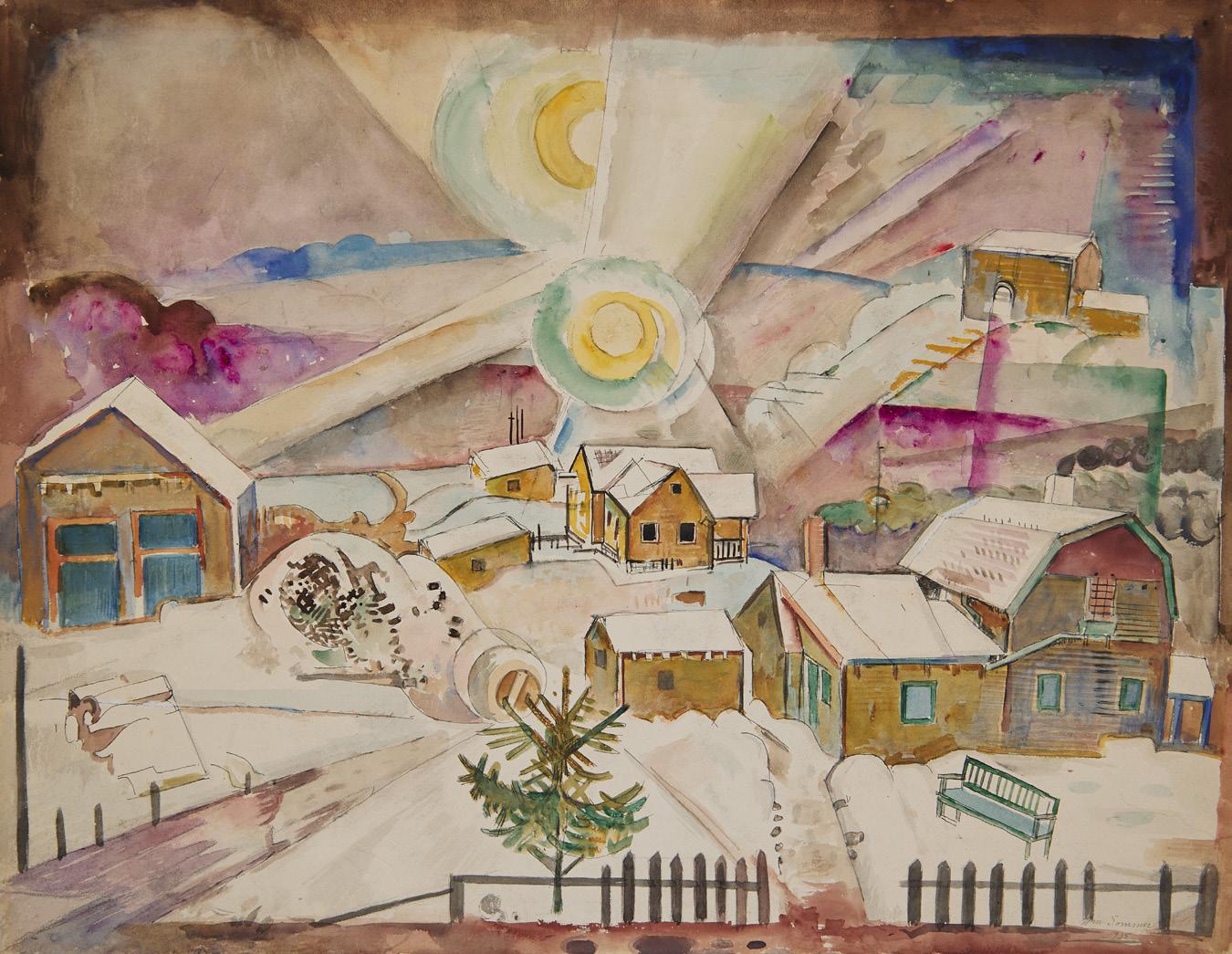
Winter Sun, 1935
Watercolor and ink on paper glued to board
Signed and dated lower right
15.75 x 20 inches 54
“Art is the creation of our spiritual, inward vision . . . We conceive with the unconscious.”
WILLIAM SOMMER50
Modernism for Sommer was never merely a matter of style or formal invention. “bill was a soul with many facets,” observed Richard Sedlon, a close friend and fellow artist at Otis Lithography, “He was a philosopher, a dedicated artist, music lover and rascal who was never above observing a well-turned ankle.”51 Sedlon described Sommer’s art as imaginative, allegorical, and mythical, noting that everywhere around the studio he pinned scraps of paper with bits of philosophy.52 After moving to brandywine, Sommer’s art became increasingly entwined with his search for a metaphysical reality beyond what we perceive with the senses . This quest was driven partly by his extensive readings in literature and philosophy, which led him to conclude that as limited mortals we may never unravel the mysteries of life.
The visionary and mystical works Sommer produced between 1913 and 1925 are among his most original achievements. Notable examples include Adam and Eve (fig. 55), Fire Worshippers (fig. 64), The Brandywine Waterfall (fig. 65), and Tubes in Landscape These paintings reflect his deep engagement with philosophy and literature, particularly the writings of Arthur Schopenhauer, Friedrich Nietzsche, and P. D. Ouspensky. Sommer amassed an extensive library devoted to art, literature, and philosophy, and he filled his copies of Nietzsche’s The birth of Tragedy, beyond Good and Evil, and The Twilight of the Idols with copious handwritten annotations.
Like many progressive Cleveland artists
of the period, Sommer was strongly drawn to Nietzsche’s exaltation of energy and power over the conventionally beautiful. He embraced the philosopher’s insistence that art could at times be ugly, brutal, or even barbaric. Cleveland critic Raymond O’Neil quoted the “wise Nietzsche” as observing that “to the existence of art, to the existence of any aesthetic activity, a preliminary psychological condition is indispensable, namely ecstasy”—a state of intensified sensation, emotion, and “the ecstasy of the surcharged will.”53
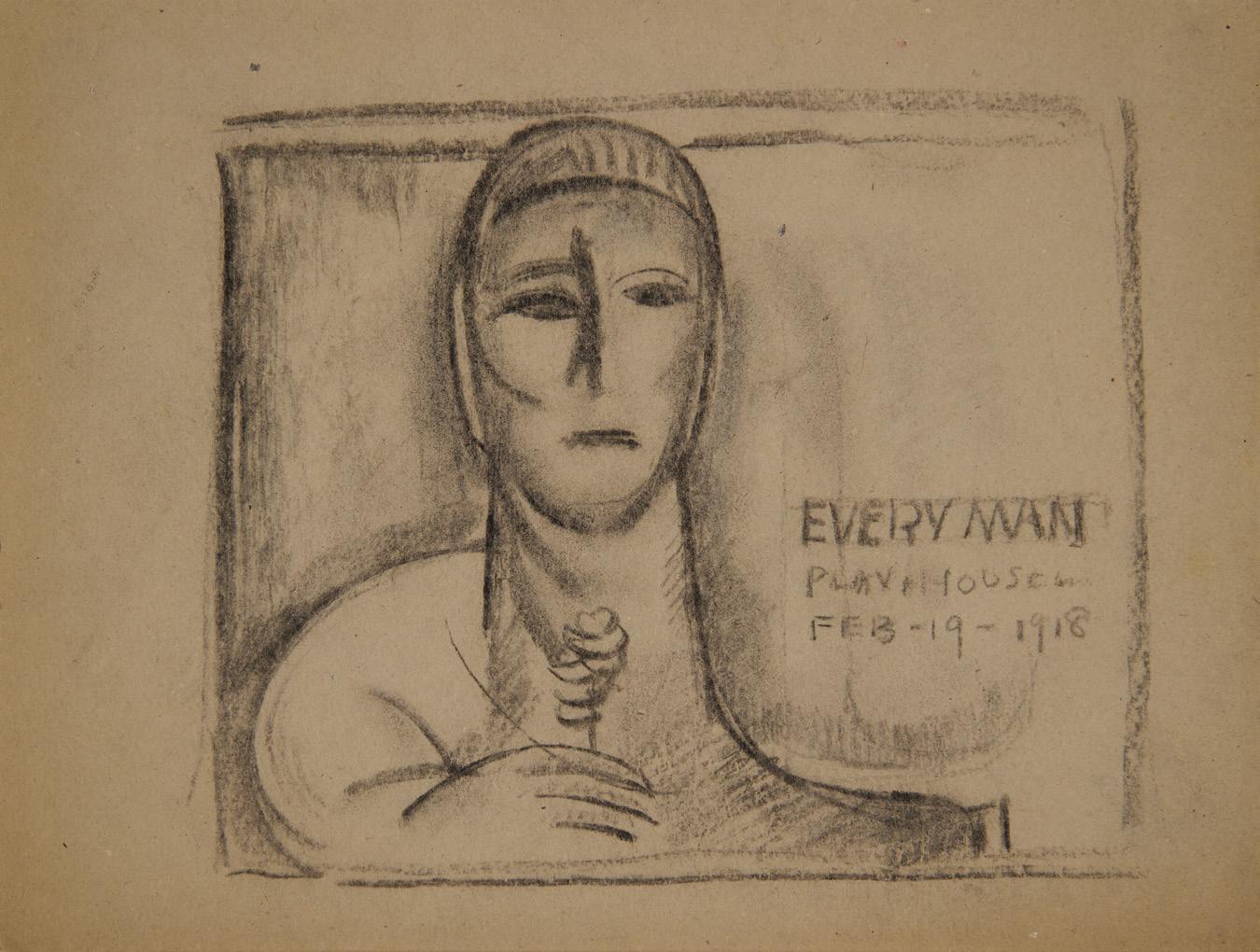
Sommer’s dive into mystical themes was accompanied by a shift in style. It is difficult to pinpoint exactly when this occurred due to the lack of dates on Sommer’s paintings, but around 1917 increased geometricization of form can be observed. This heightened Cubist inflection appears in a book plate dated 1917 that Sommer created for his copy of Nietzsche’s Thus Spake Zarathustra.54 The change reflects the influence of british Vorticism, strongly evident in Dancing Nudes (fig. 62) and Incantation (fig. 63). Seeking maximum energy and aggressiveness, the short-lived Vorticist movement in art and literature—led by Wyndham Lewis and Ezra Pound—combined the geometric structure of Cubism with the dynamic “lines of force” of Futurism. Sommer probably discovered the british movement through its publication blast, available at Richard Laukhuff’s bookstore in Cleveland. The influence of Vorticism is strongly felt in the sets, costumes, and program
Sommer designed for a performance of the play Everyman, 1918 (fig. 60) at the Cleveland Play House. The Play House had been founded in 1916 as a workshop for experimental art, music, poetry, and dance. It welcomed immigrants and organized events celebrating the city’s diverse cultures. The organization’s director, Raymond O’Neil, modeled the Play House after Max Reinhardt’s avant-garde theater in berlin and the Moscow Art Theater. One reviewer described Sommer’s curved set as a “cyclorama,” the costumes as “symbolic rather than historical,” and the lighting as “ultra-modern.”55 In December, Sommer designed the program cover for a Play House production of The Dumb Messiah (fig. 61), a play concerning the suffering of Israel.
Sommer’s art reached a new level of engagement with Nietzschean concepts in Fire Worshippers, 1921 (fig. 64). The painting was commissioned by Philadelphia philanthropist Albert barnes, but upon arrival he refused to accept it, saying his wife did not like it.56 Rooted in myth and literature, this Promethean vision appears related to Nietzsche’s writings on the “will to power” and humankind’s arrogant bid to rival the gods. The theme was especially shocking at a time when American Scene realism was ascendant. Sommer was also reaching for greater formal abstraction in Fire Worshippers. Heads, hands, and bodies are transformed into abstract, geometric forms and subordinated to decorative rhythmic structures that dominate every aspect of the composition. The overall aesthetic aligns more closely with German Expressionism or Vorticism than with prevailing tendencies in American art.
Sommer’s mystical themes were further shaped by the writings of the Russian philosopher P. D. Ouspensky (Petr Uspenskii), who argued that true reality exists at a mysterious “fourth-dimensional” level beyond the world of ordinary perception. Ouspensky’s Tertium Organum (A key to the enigmas of the world) inspired Sommer to seek spiritual
experience and the vital “life force” of objects beyond their material form. This search for an eternal, primordial unity within nature became fundamental to Sommer’s imaginative “dream pictures.” Echoing shapes in his paintings may have been partly inspired by Ouspensky’s theory that as three-dimensional objects move through time, they leave traces of their movement. Sommer also read the bhagavad Gita, the central text of Hindu philosophy, which offers an alternative to Christianity by presenting ideas about spirituality, the nature of reality, and the purpose of human life. Sommer also shared Carl Jung’s belief in the collective unconscious as a repository of universal images and symbols common to all humanity.57
Sommer’s quest for mystical or metaphysical reality reached a new peak with Tubes in Landscape (c. 1925, see page 91). In this apocalyptic scene, gigantic cylindrical forms roll across a fractured terrain of buildings, as if crushing them beneath a glowing sun that barely pierces the tumultuous sky. Since the original title is unknown, Sommer scholar Hunter Ingalls proposed the speculative designation of Landscape for Orpheus 58 In Greek mythology, the poet-musician Orpheus descended into Hades to reclaim his dead wife Eurydice, but lost her when he disobeyed the command not to look back as they returned to the world of the living. Although the title cannot be attributed to Sommer, the painting’s charged imagery—a cataclysmic storm blotting out the sky over brandywine—implies that modern life unfolds in a shadowed realm where humanity is suspended between revelation and catastrophe, subject to vast forces beyond its control. In this haunting vision, abstraction and personal vision fuse into a daringly original and ambitious statement of modernist intent. ™
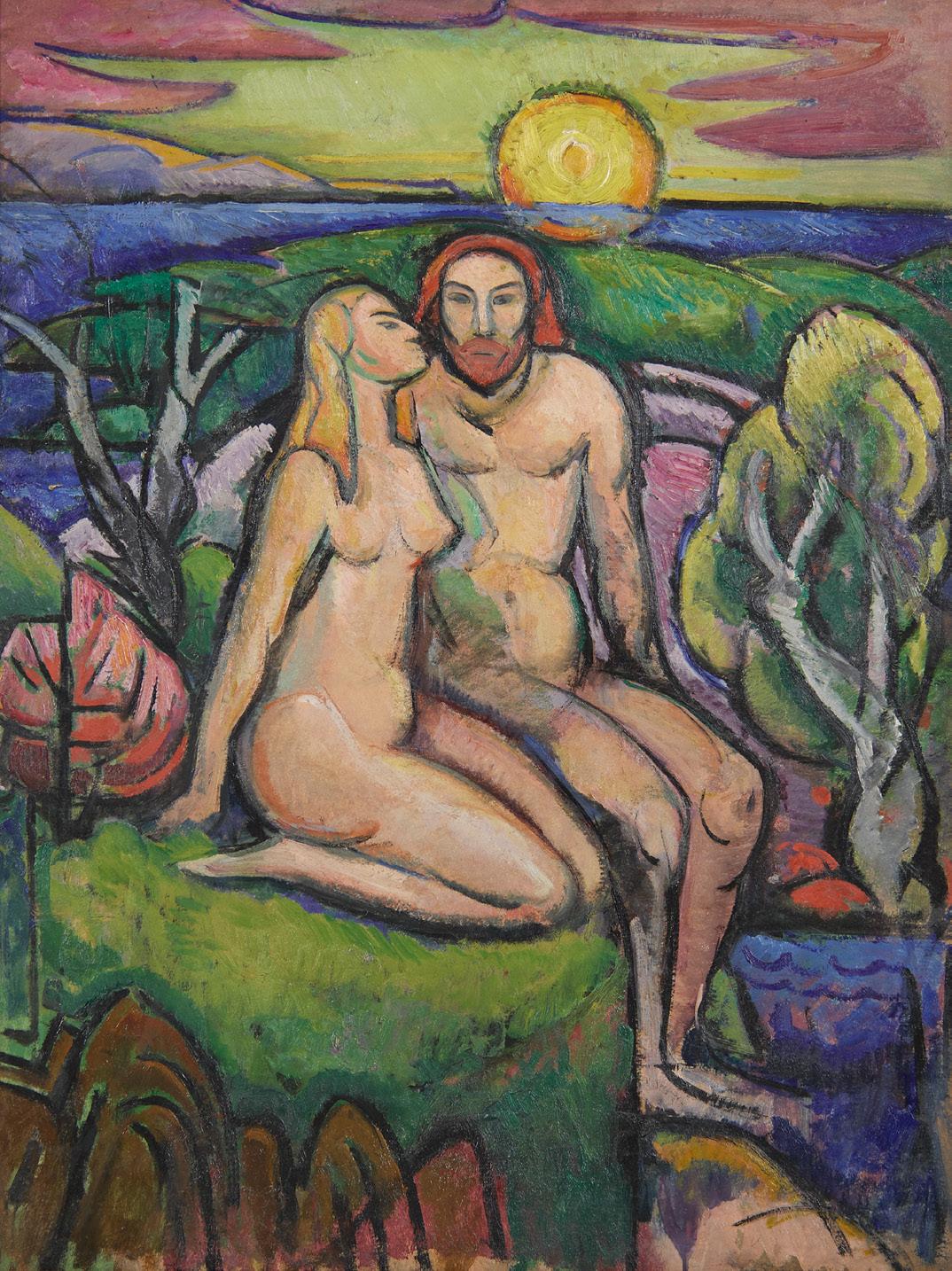
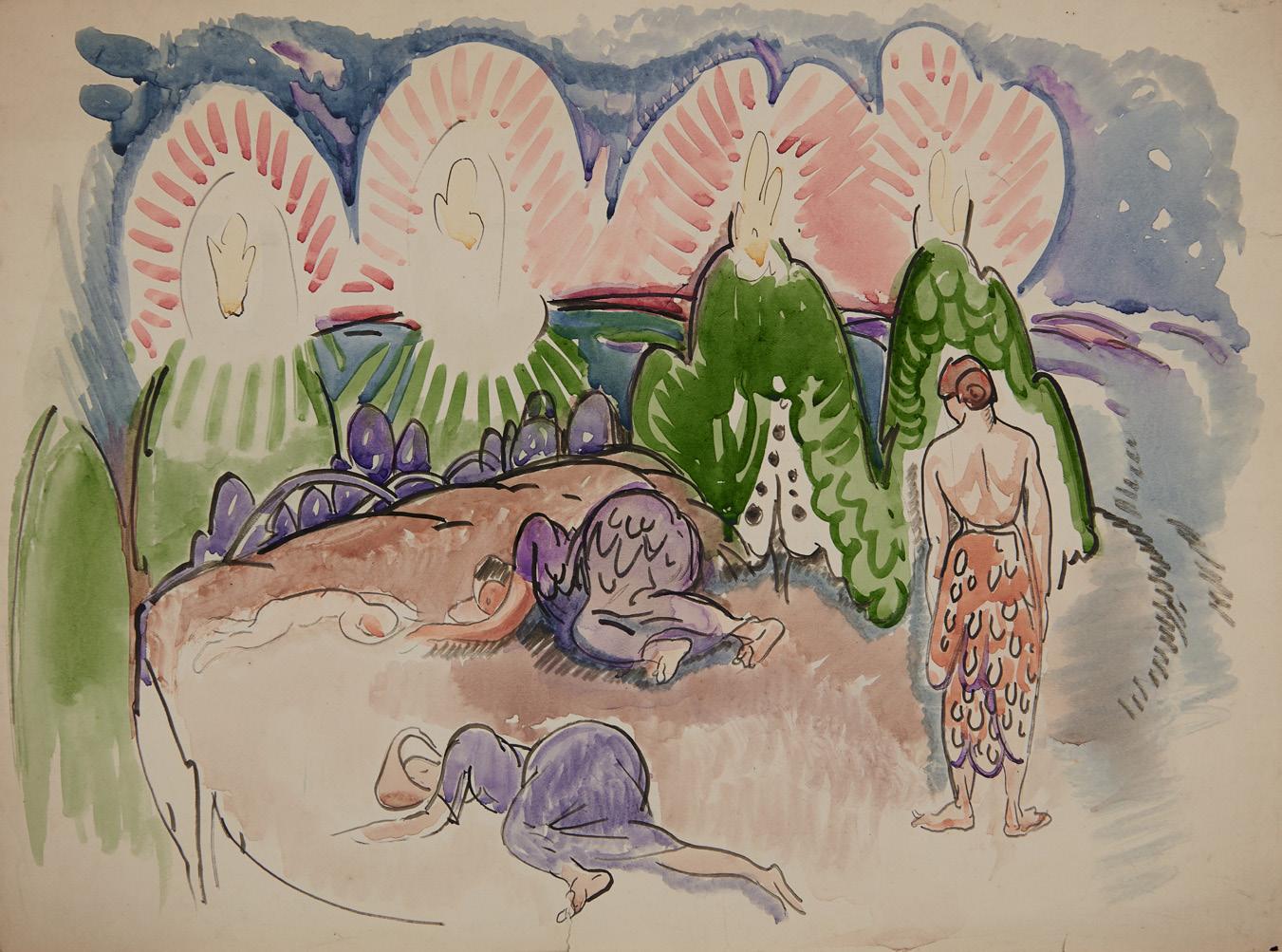
Vision, c. 1915 Watercolor and ink on paper Signed with estate stamp verso
x 16.25 inches
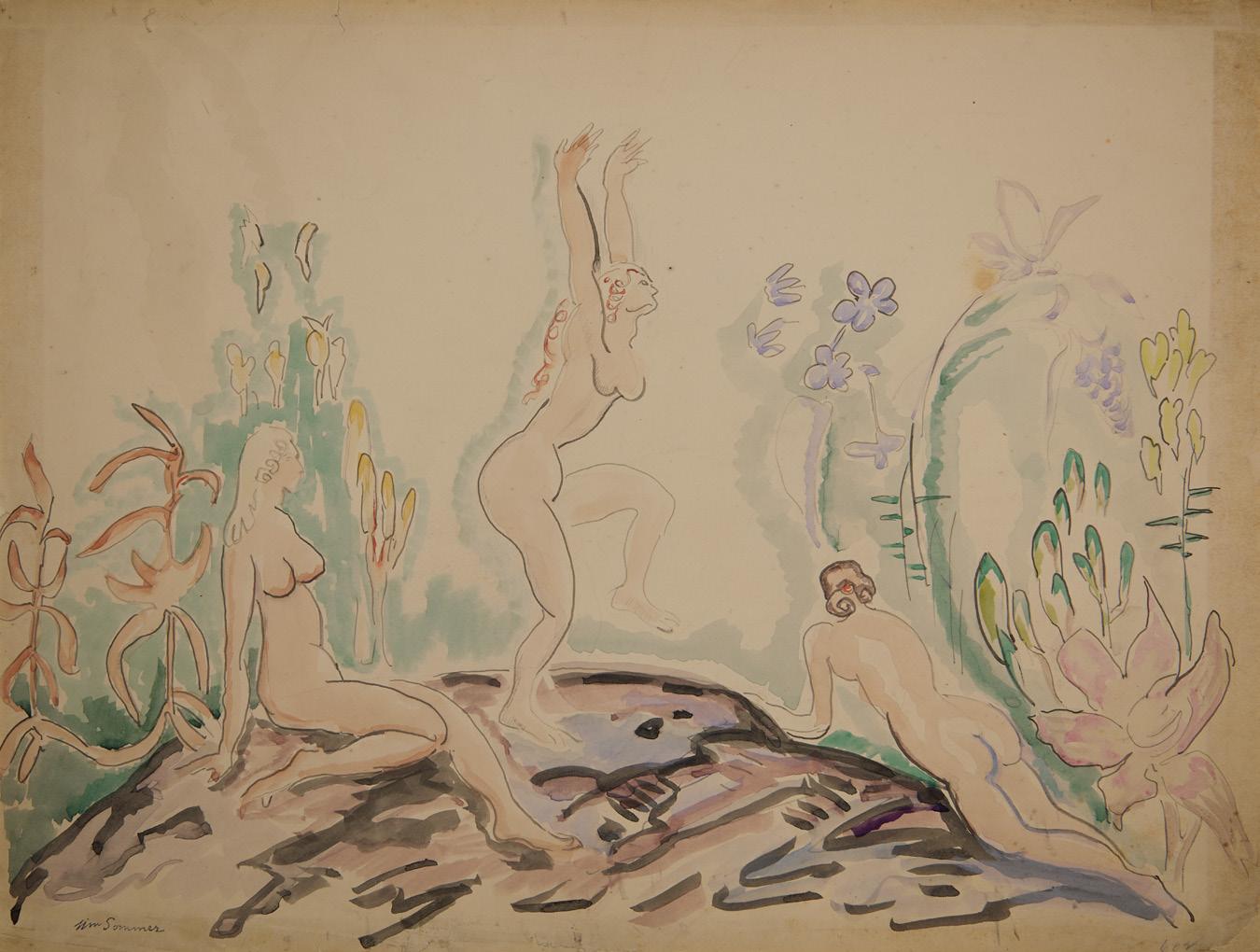
Nudes in a Landscape, c. 1915
Watercolor, graphite, and ink on paper
Signed lower left
12 x 15.75 inches
58
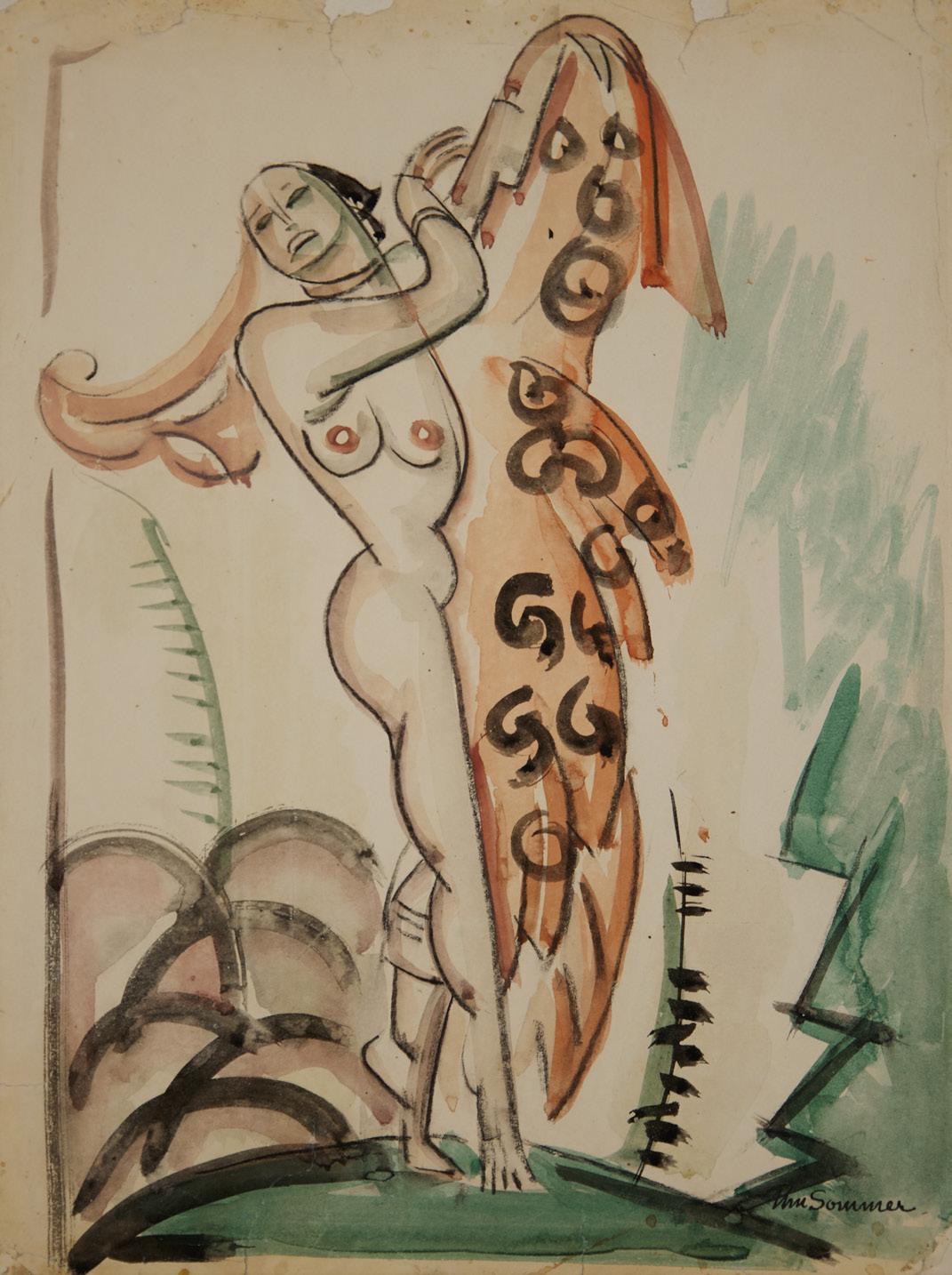
Nude in a Landscape, c. 1917
Watercolor and graphite on thick paper
Signed lower right 12 x 9 inches
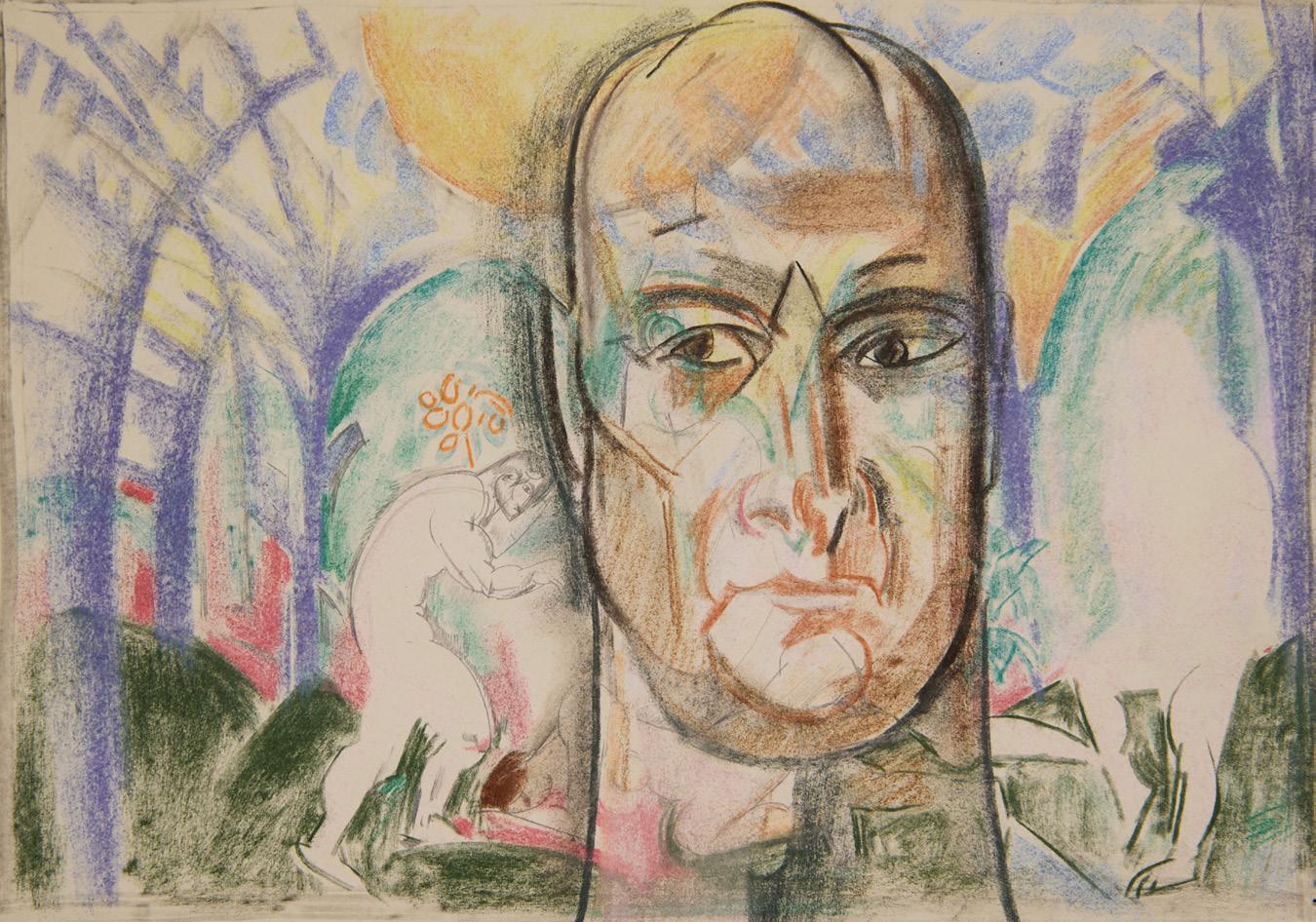
Mixed media on paper
Signed and dated lower right
11.75 x 18.5 inches
60
Everyman, The Play House, 1918
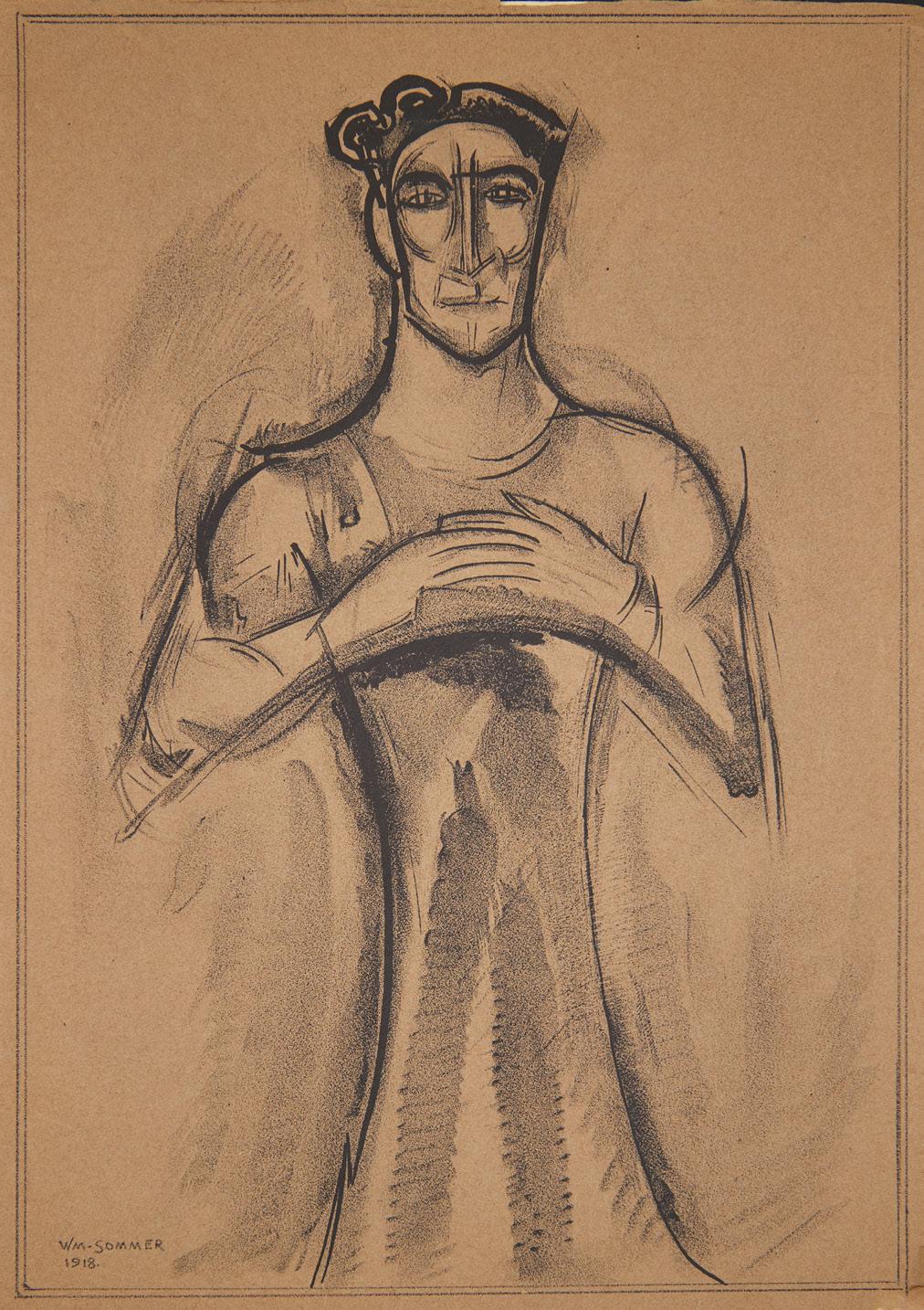
Dumb Messiah, 1918
Lithograph on paper
Signed and dated in litho plate lower left 12.5 x 9 inches 61
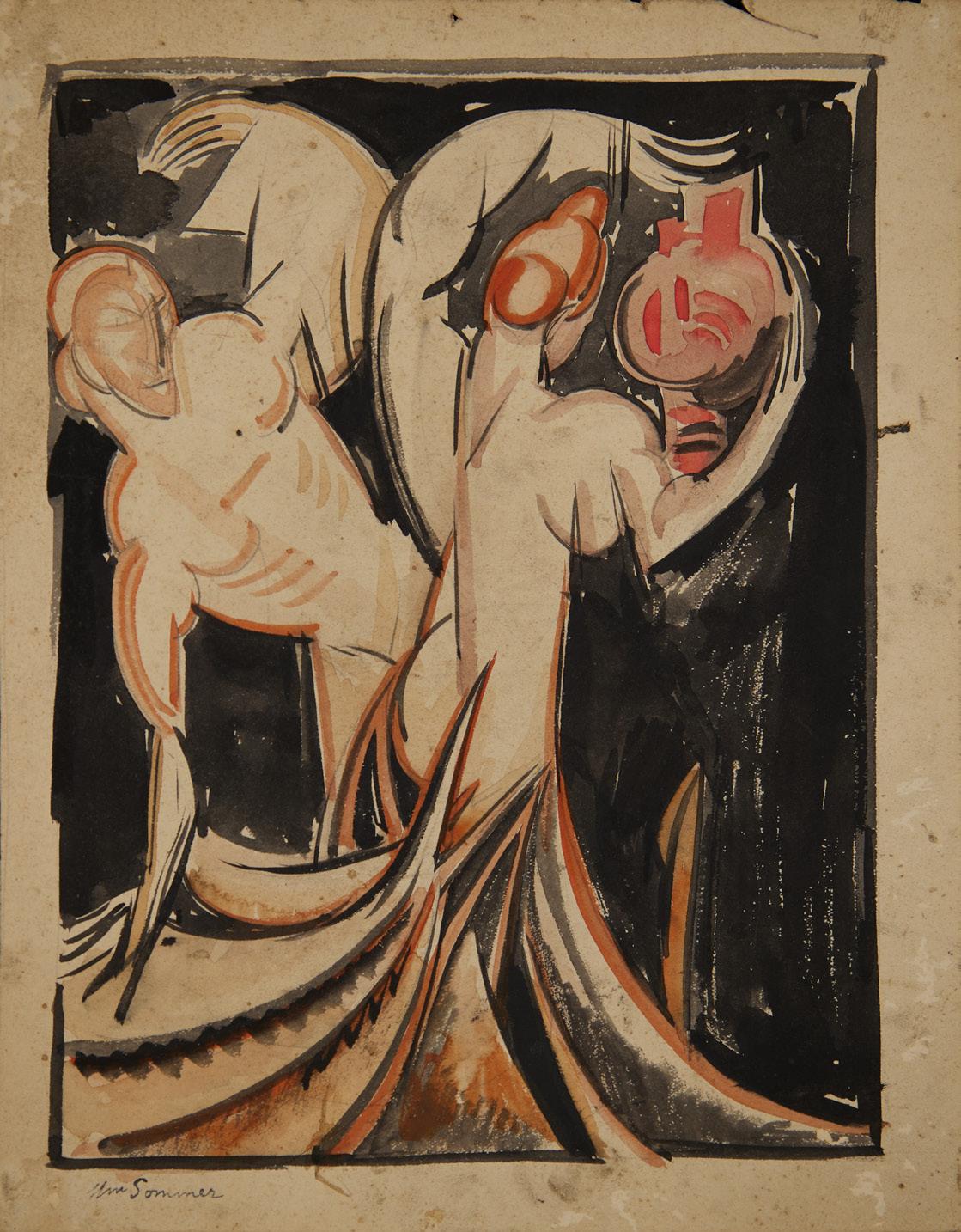
62
Dancing Nudes, c. 1918
Watercolor, gouache, and ink on thick paper
Signed with estate stamp lower left
10 x 8 inches
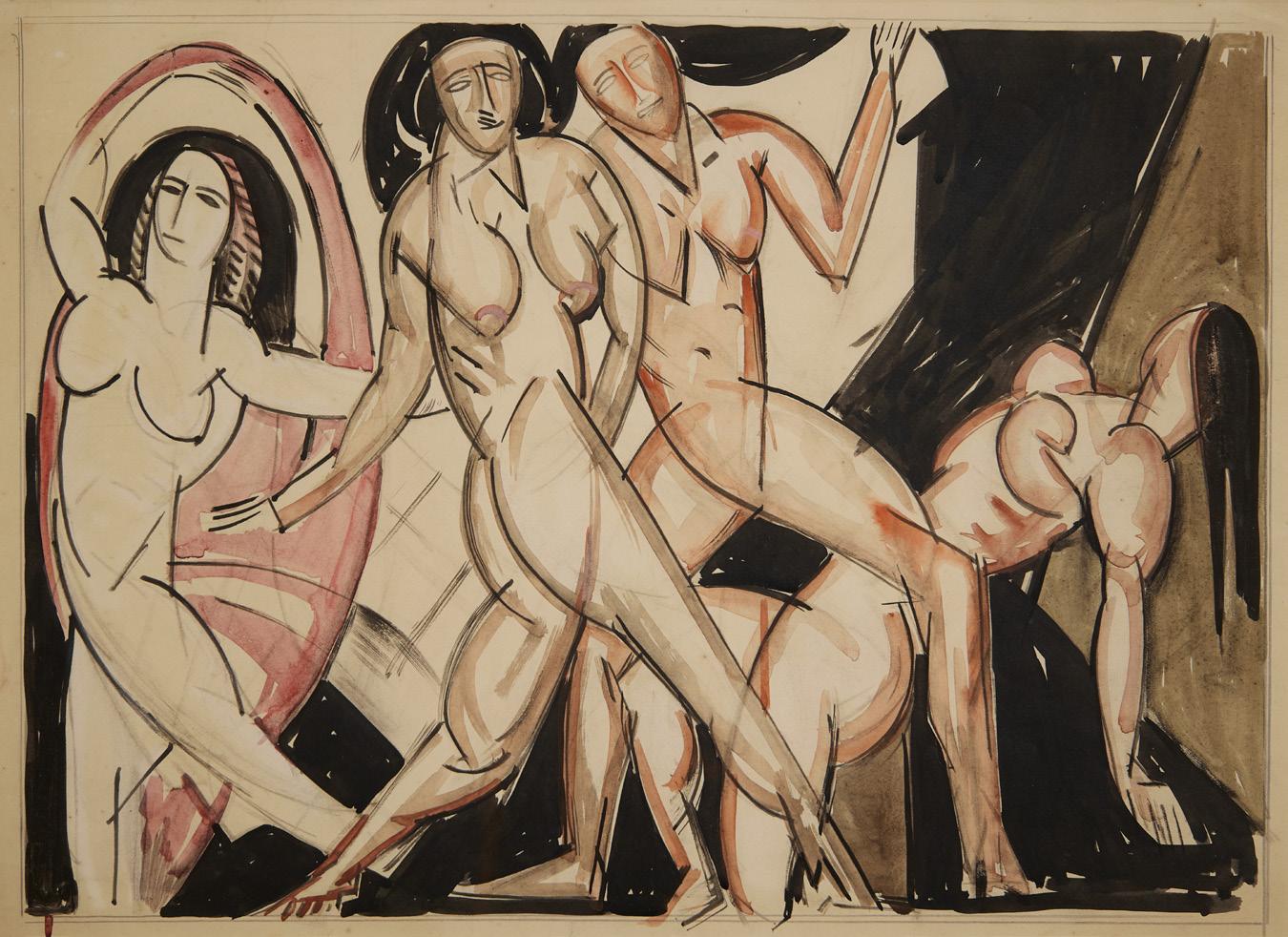
Incantation, c. 1918
Watercolor on paper
11 x 15 inches
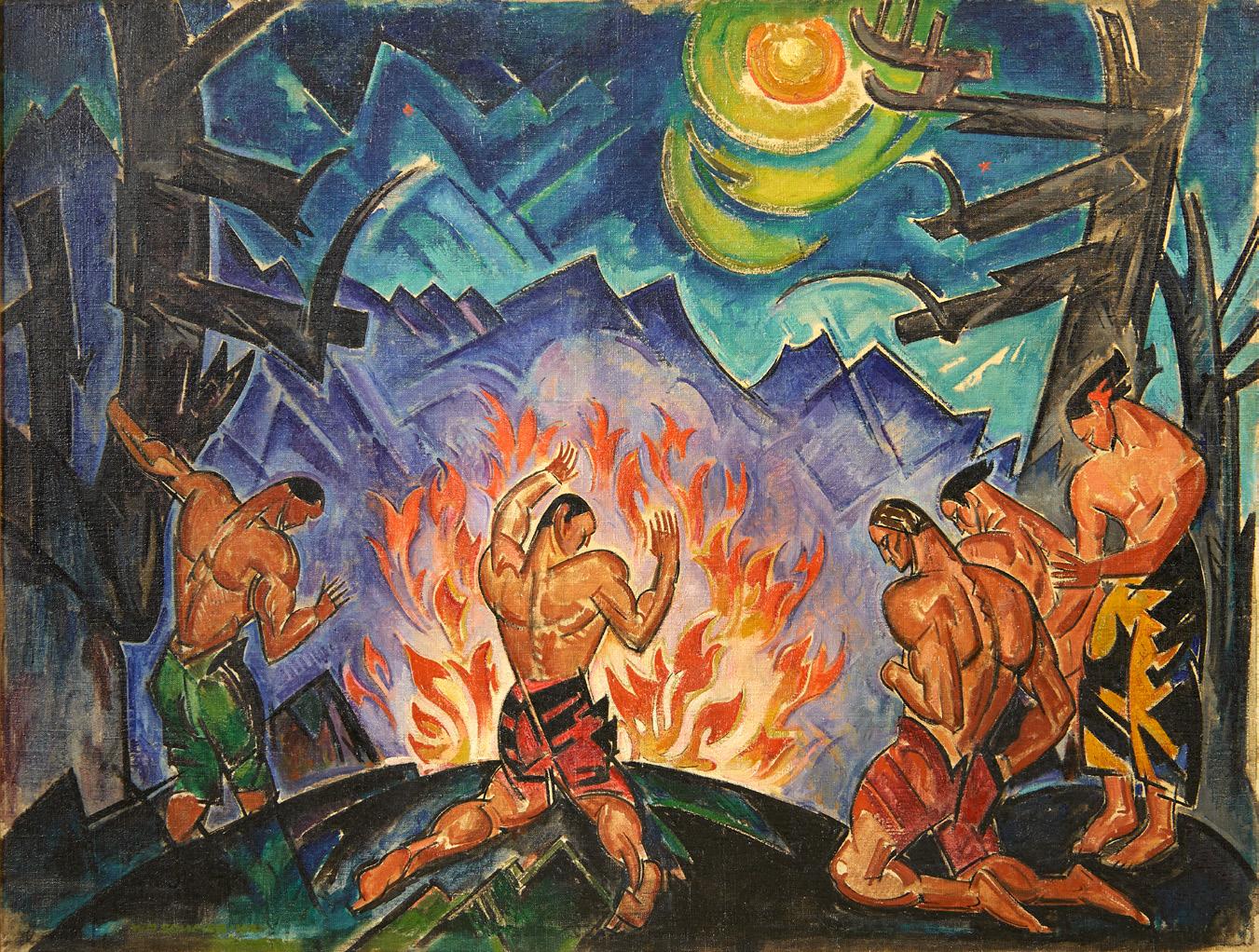
Fire Worshippers, 1921
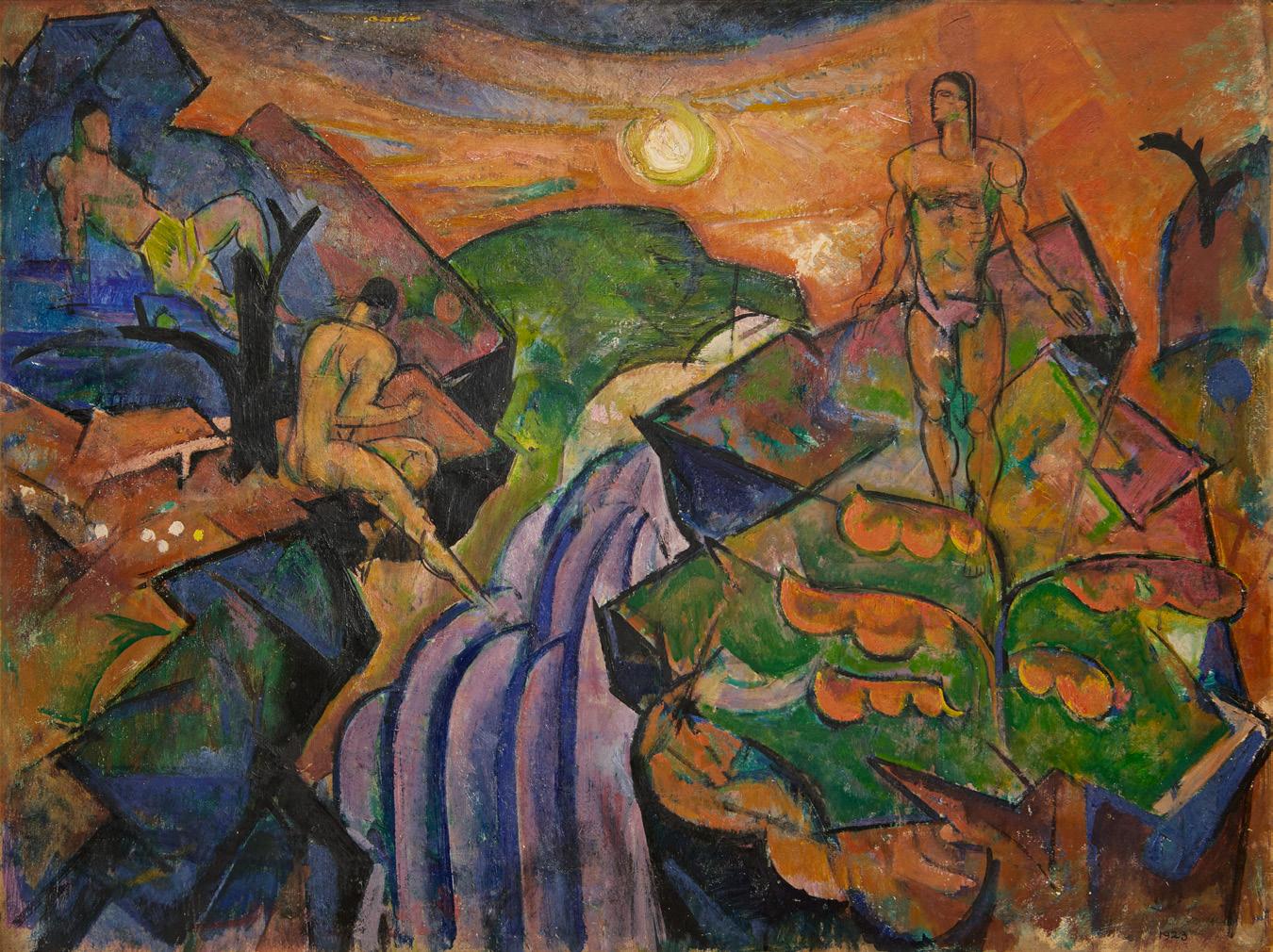
Dated lower right, signed verso
x 31.75 inches
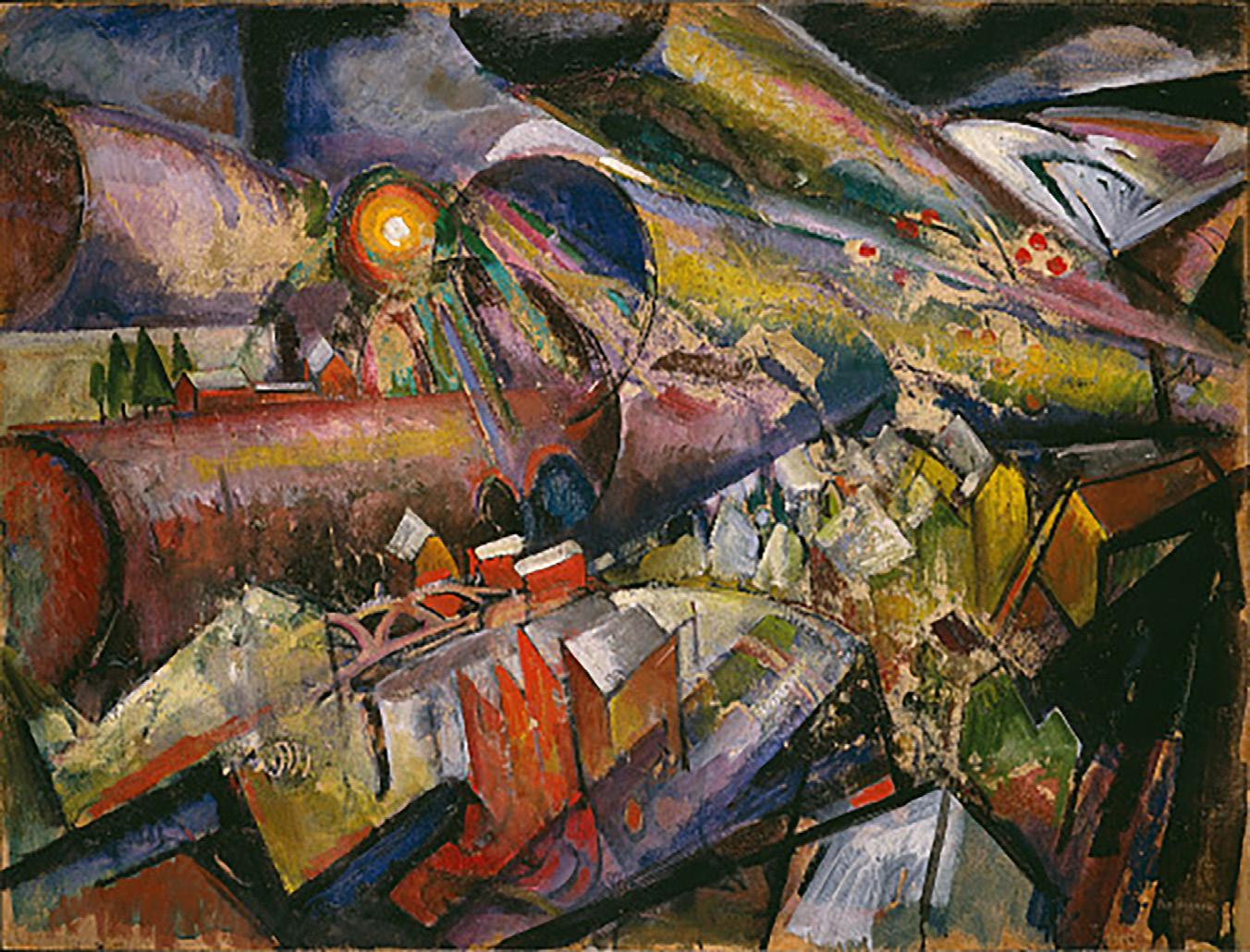
Tubes in Landscape, c. 1925
Oil on paperboard
24 x 32 inches
Hirshhorn Museum and Sculpture Garden, Smithsonian Institution, Washington, DC, Gift of Mr. Joseph M. Erdelac, Cleveland, OH, 1979
Not in the exhibition
Sommer made drawings and paintings of animals of all kinds—rabbits, birds, horses, cows, chickens, and dogs. He wrote in his sketchbooks, “An artist expresses himself according to the experience he has drawn from life.”59 After moving to brandywine, his focus shifted from the caged rabbits he painted in Lakewood to animals living outdoors in harmony with the nature. In this rural environment, animals became not merely subjects but conduits—means of revealing the invisible energies that bind all living things into a unified whole. He wrote in the margin of an article published in The Forum (June 1916): “A great work of art presents itself to us as a whole,” and that its purpose is to “give us a quality of emotion different from what we receive from life.”60
As Sommer immersed himself in the rhythms of brandywine, he sketched impressions of falling water, shifting wind, and birds singing at daybreak. He even made drawings of different types of wind, endowing each with its own temperament and force. In a 1920 article for Cygnet, he praised artists who seek inspiration directly from nature, “This grand privilege is granted to those who feel the wonders of nature and hear the august symphonies made by the music of its movements.”61 For Sommer, sustained attention to the natural world was not passive observation but a path toward spiritual insight.
Sommer’s encounter with Franz Marc’s The Yellow Cow at the 1913 Armory Show provided a striking model for representing animals as emblems of spirituality. Marc’s ecstatic, chromatically charged animal forms resonated deeply with Sommer’s own metaphysical leanings and the writings of Ouspensky, who urged artists to depict the inner essence of things rather than their outward appearance. Like Marc, Sommer had little use for formal religion. Instead, he sought the vital life force within nature, regarding it as a metaphysical reflection of a deeper, universal reality. He also shared Marc’s pantheistic conviction that the divine is not separate from the universe but
inherent within it—manifest in every element of the natural world, and especially evident in the purity and innocence of animals.
Sommer translated these ideas into a distinctly personal visual language. The horses in Big Red Barn and Plowing (figs. 66, 67) function less as specific, observed creatures than as embodiments of rhythmic, elemental forces. The Blue Horse (fig. 70) invokes the symbolic color language of Marc and Kandinsky, both of whom depicted blue horses as emblems of spiritual aspiration. Through his library of books on German Expressionism, Sommer knew that both Marc and Kandinsky considered the blue the most spiritual and emotional of all colors, associating it with heaven, infinity, and transcendence. The blue Rider group itself adopted the blue horse and rider as its emblem, underscoring the spiritual charge of the motif.
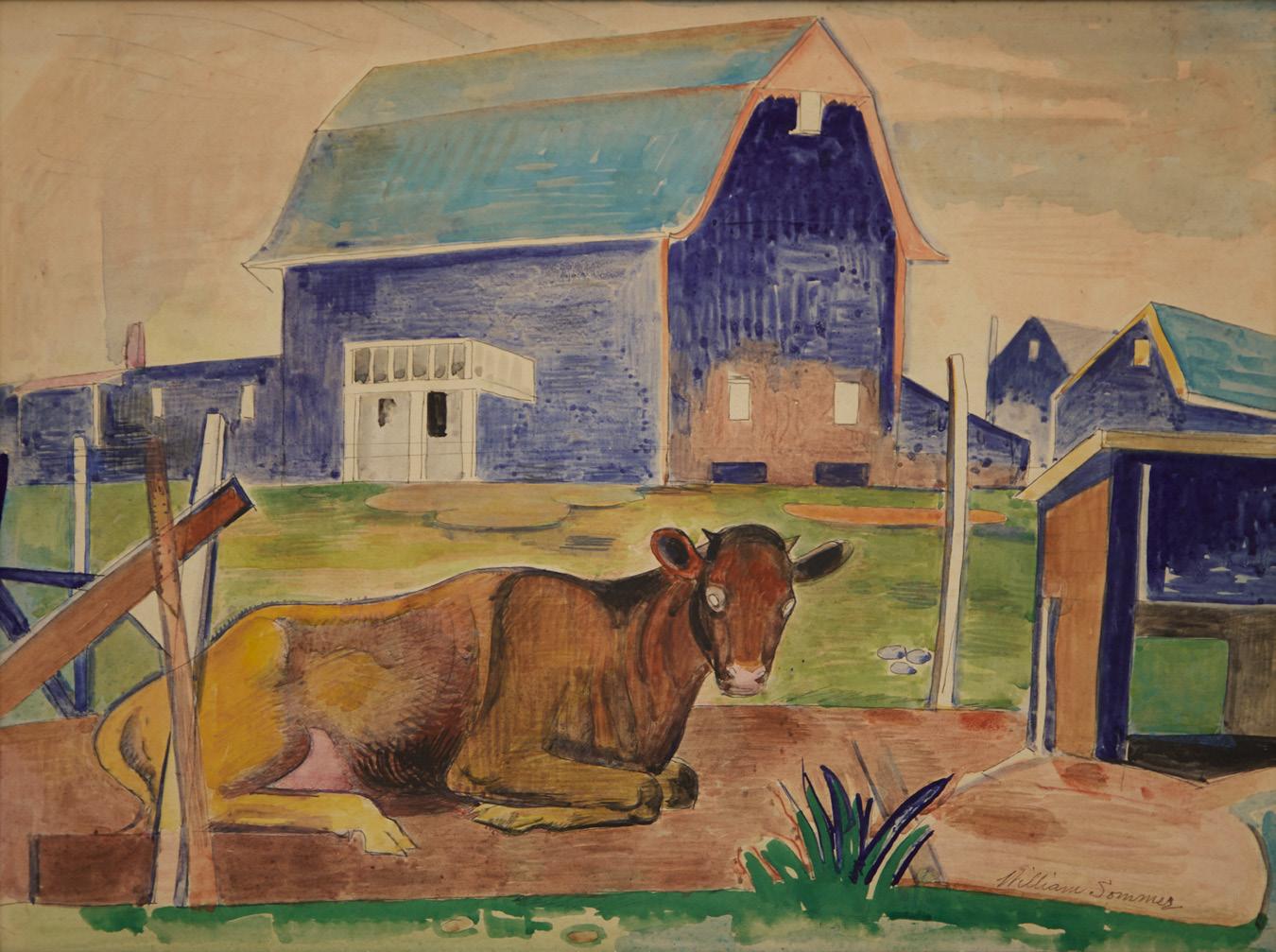
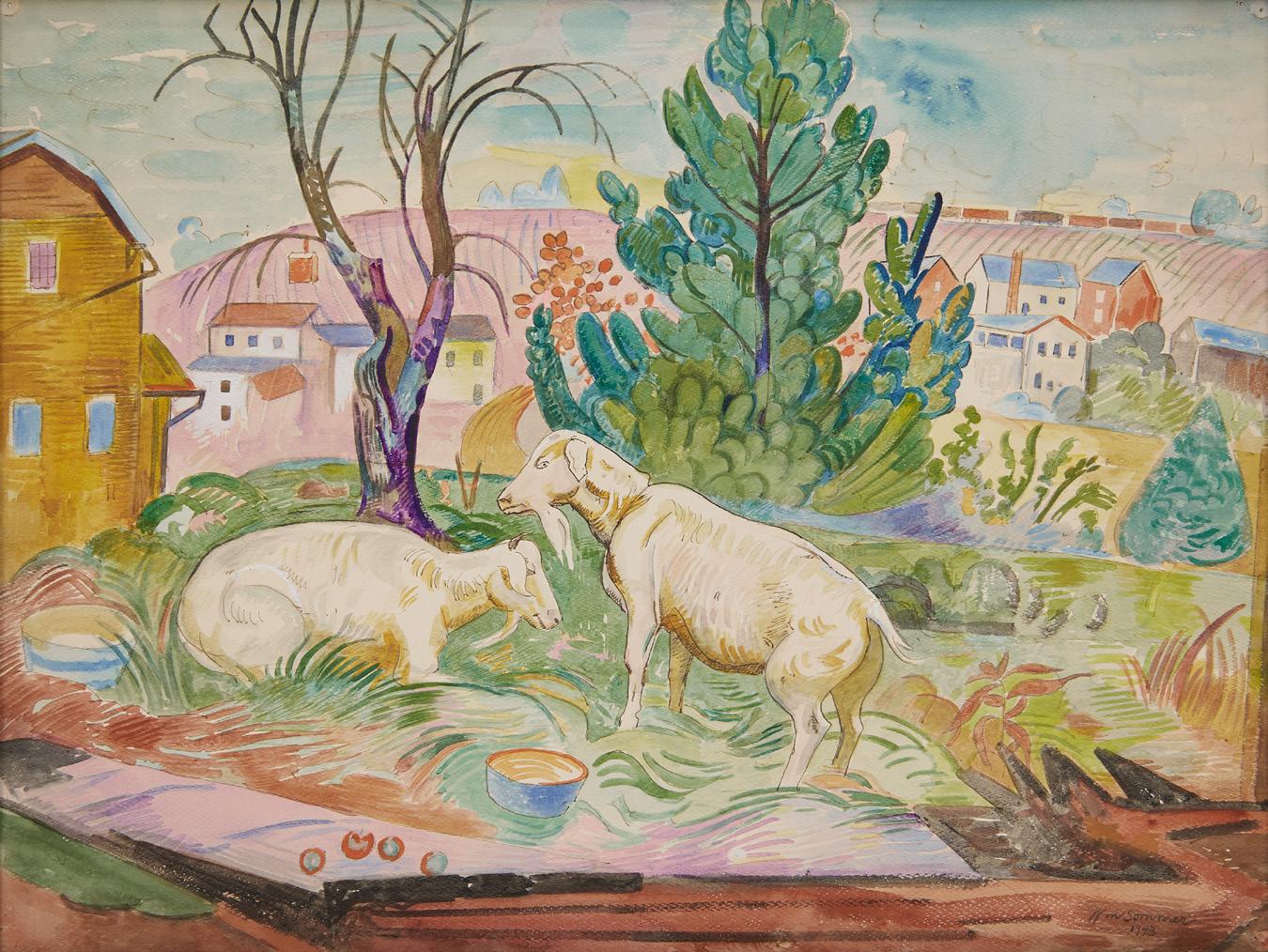
During the 1930s—as Sommer turned increasingly toward scenes of everyday life— animals assumed even greater prominence in his art. His cows took on an almost human presence, gazing directly at the viewer with expressions that appear quizzical, sympathetic, even melancholic. Though gently humorous, these images carry an undercurrent of vulnerability, as Sommer’s cows exist in an agricultural world in which their fate is not entirely their own. Waiting in Bethlehem (fig. 73) depicts two cows resting before a shed resembling a manger. Given Sommer’s well-documented skepticism toward organized religion, the title invites speculation about a potentially layered meaning—perhaps reverent, perhaps ironic. Humorous depictions of animals also appear in Brandywine Landscape with Goats (fig. 75) and Tyrannus (fig. 76), the latter an affectionate portrayal of the family’s Scottish Terrier. Even in these lighter works, animals serve as more than anecdotal subjects; they remain vessels of presence and personality, participants in the larger spiritual ecology that animated Sommer’s art. ™
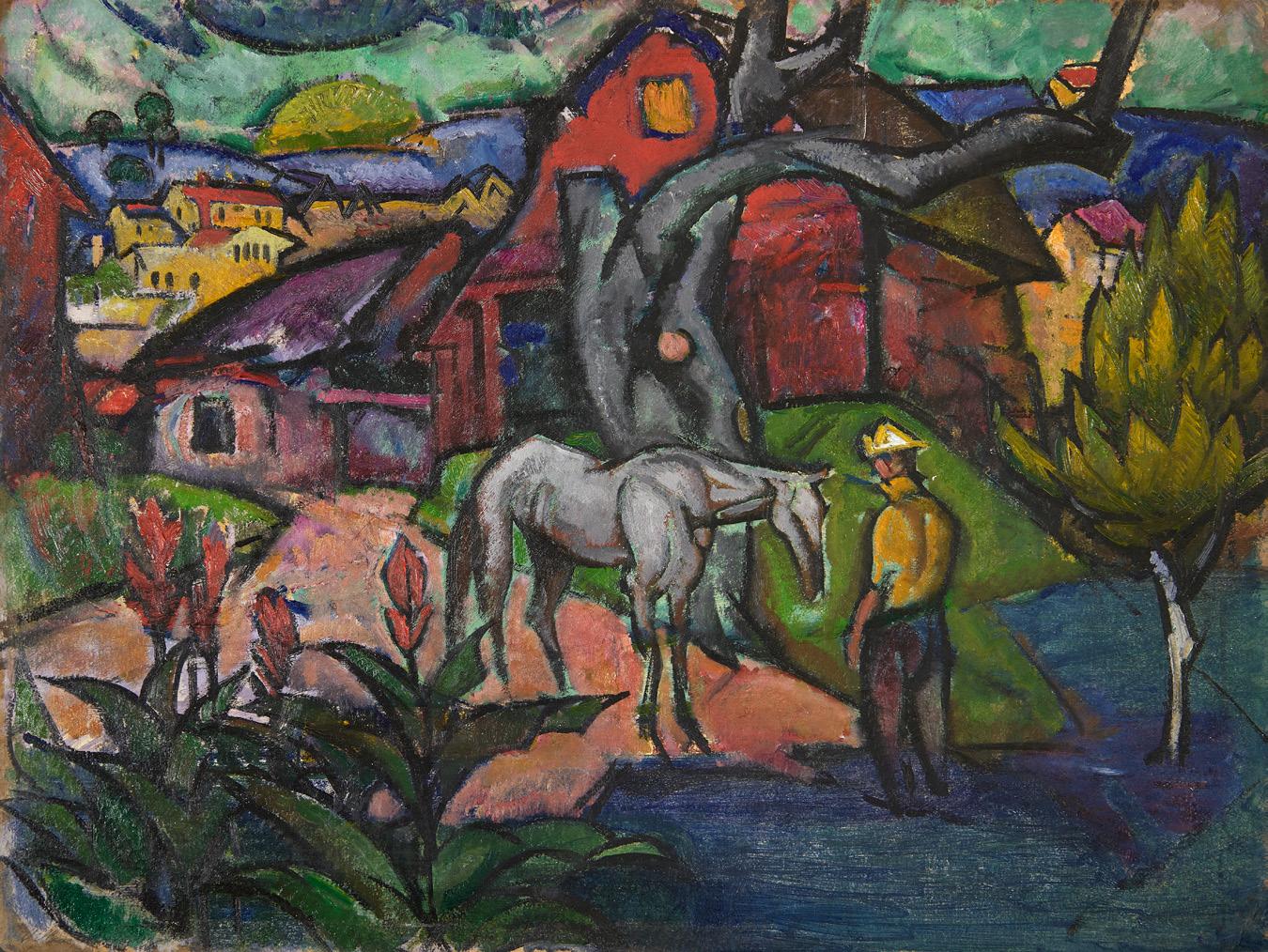
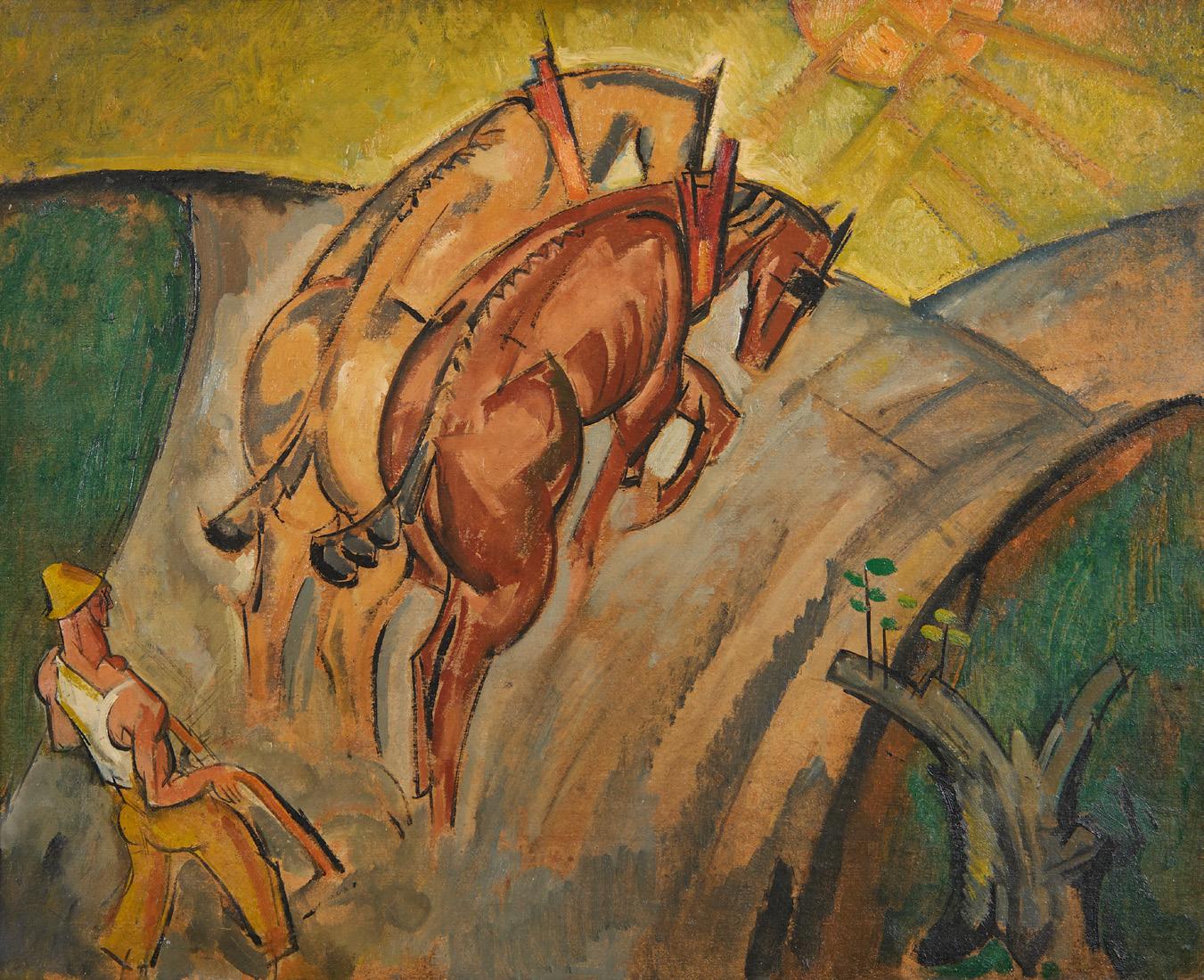
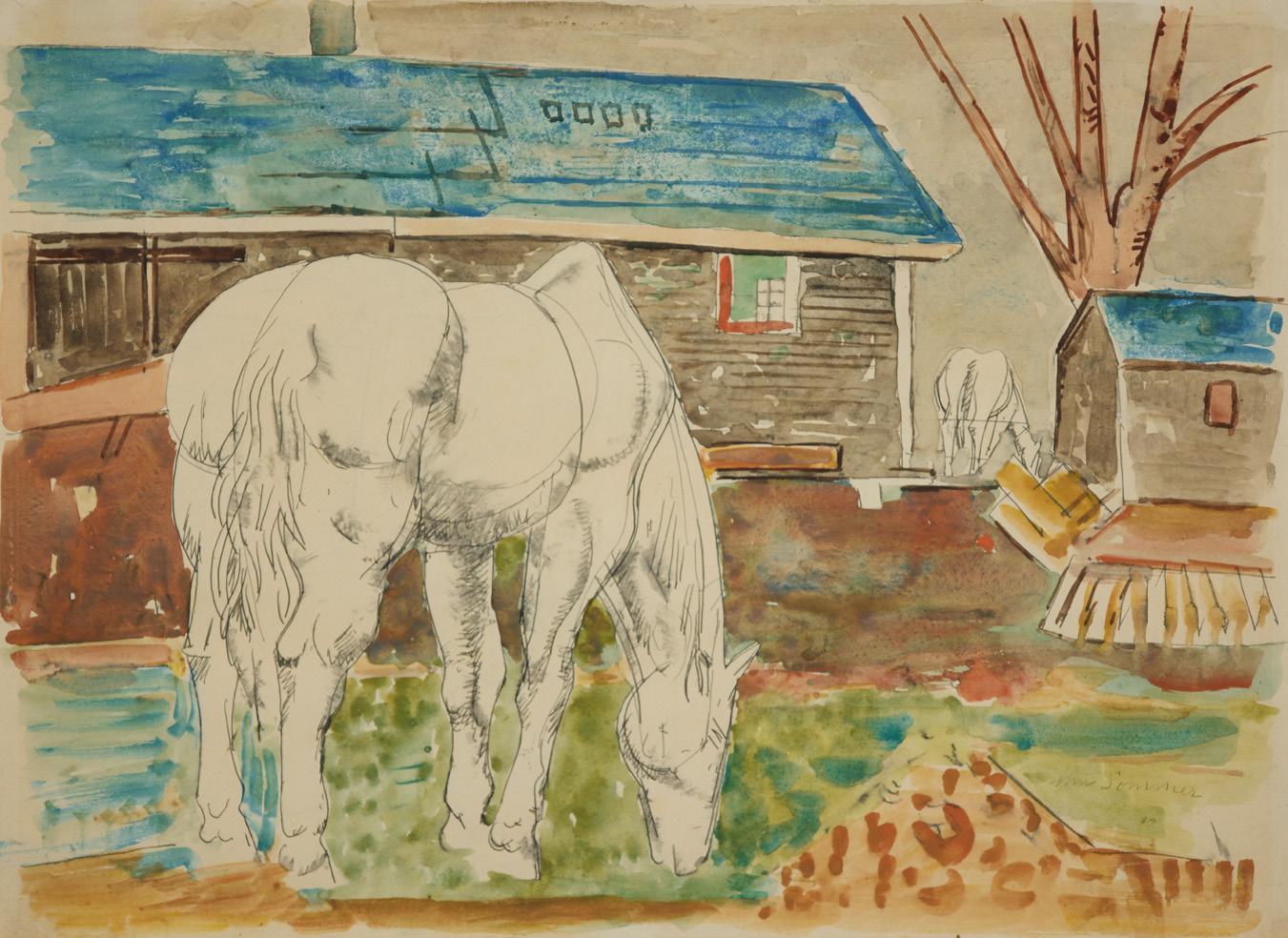
68
Watercolor with pen and ink on paper
Signed lower right
11 x 15 inches
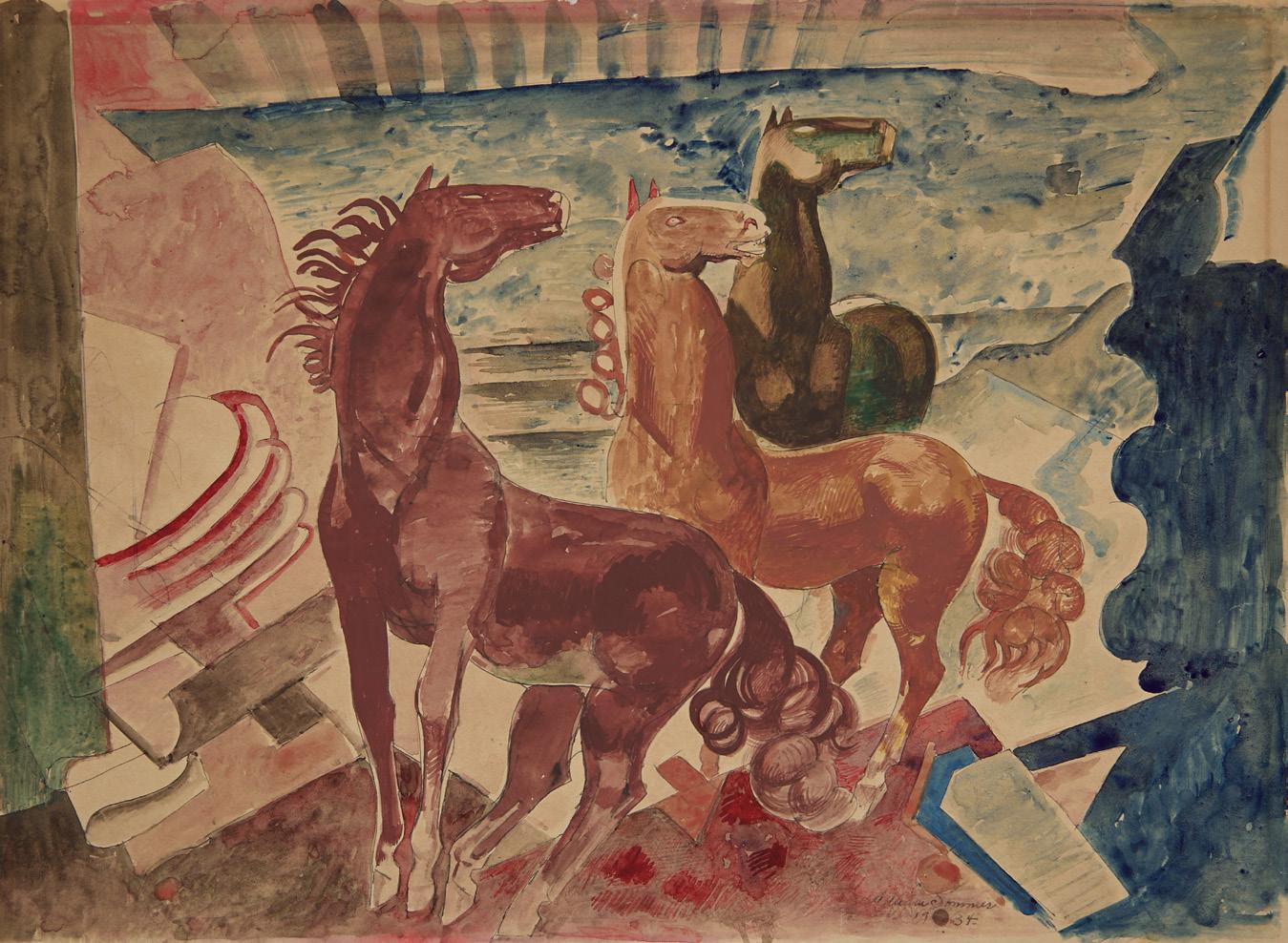
Watercolor, gouache, and ink on paper
Signed and dated lower right
12.5 x 17 inches
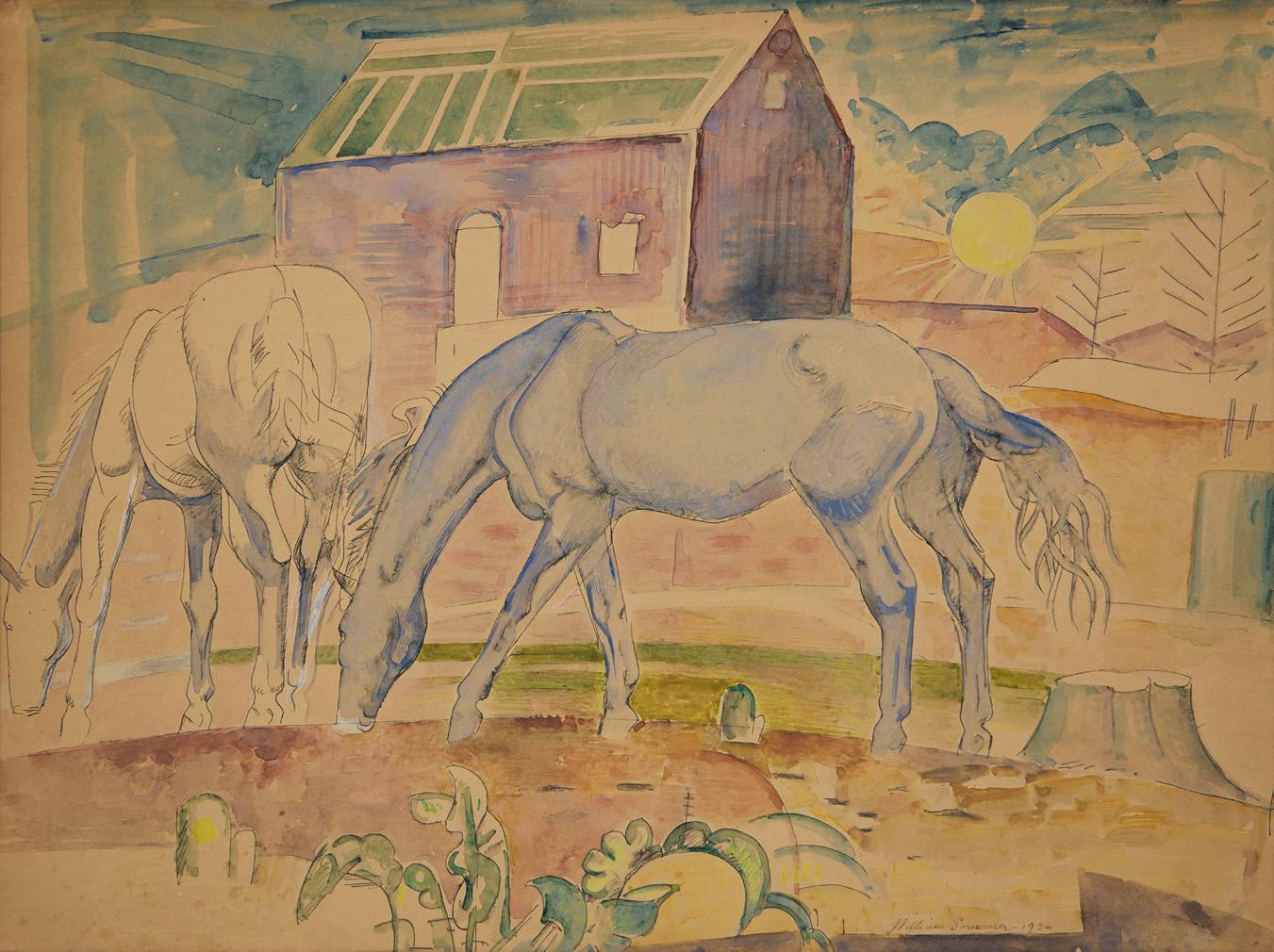
11.5 x 15.5 inches 70
and watercolor on paper
Signed and dated lower right
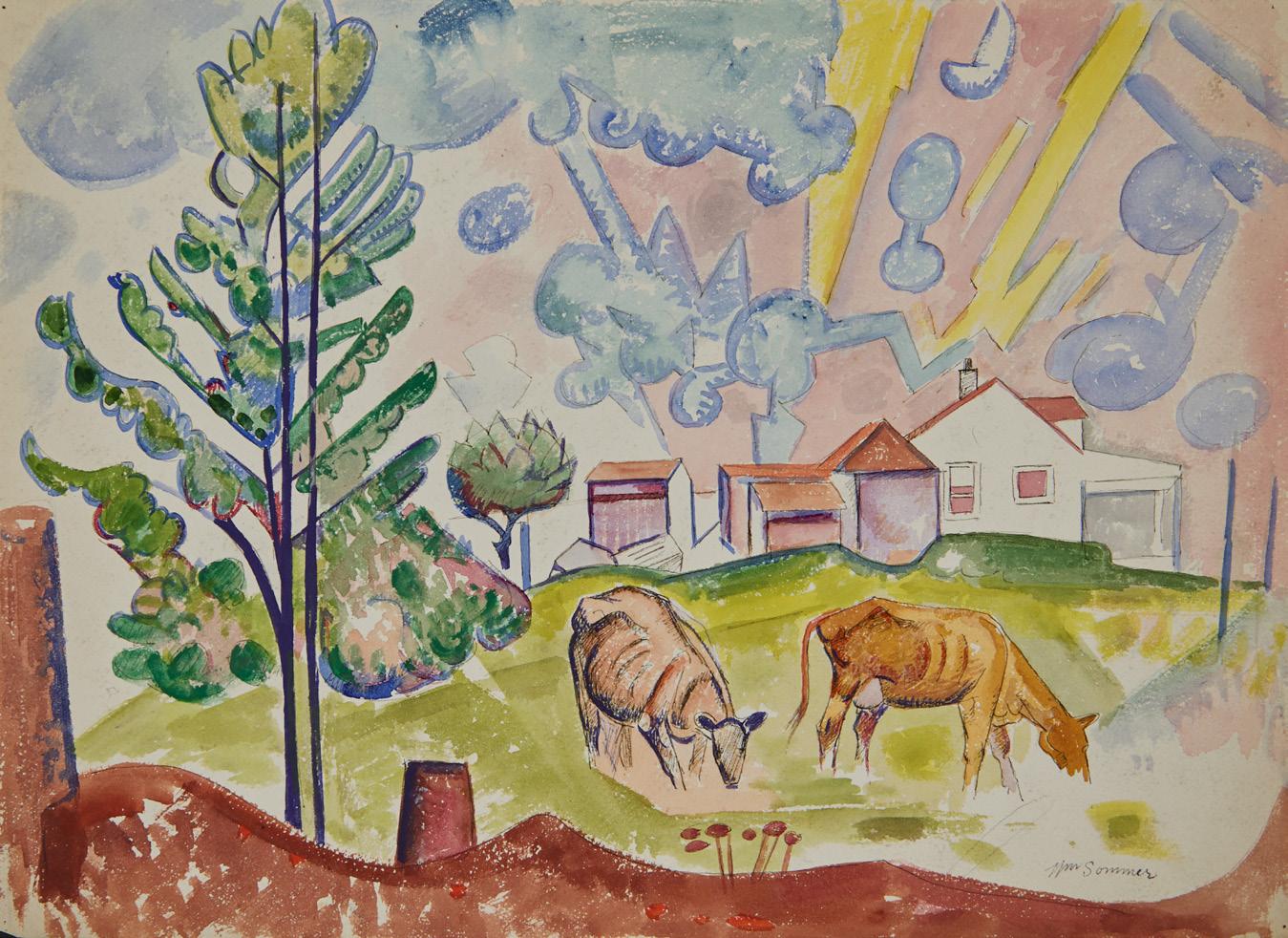
Horses in Cosmic Landscape, c. 1938
Watercolor, gouache, and ink on paper
Signed lower right
13 x 18.25 inches
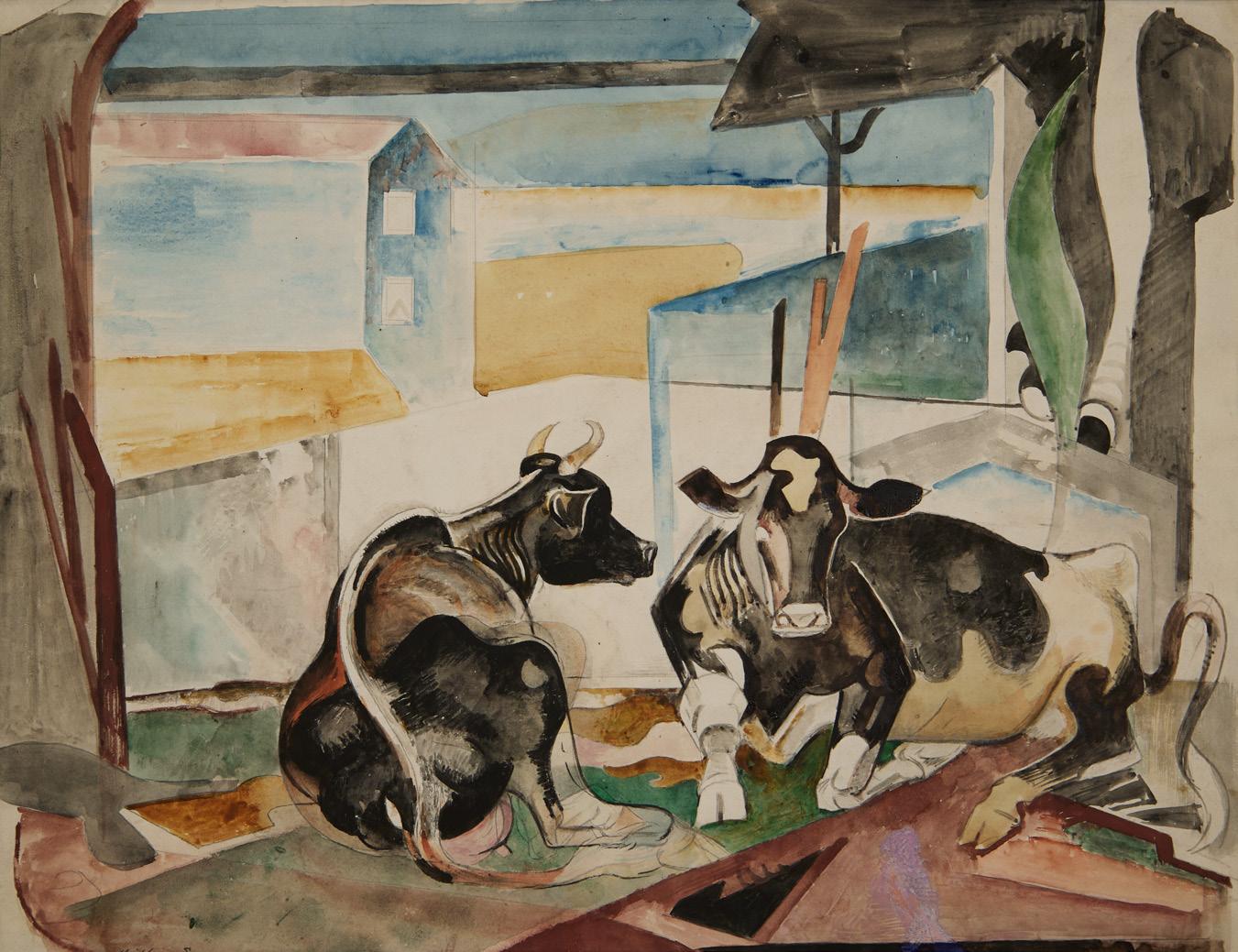
Waiting in Bethlehem, 1940
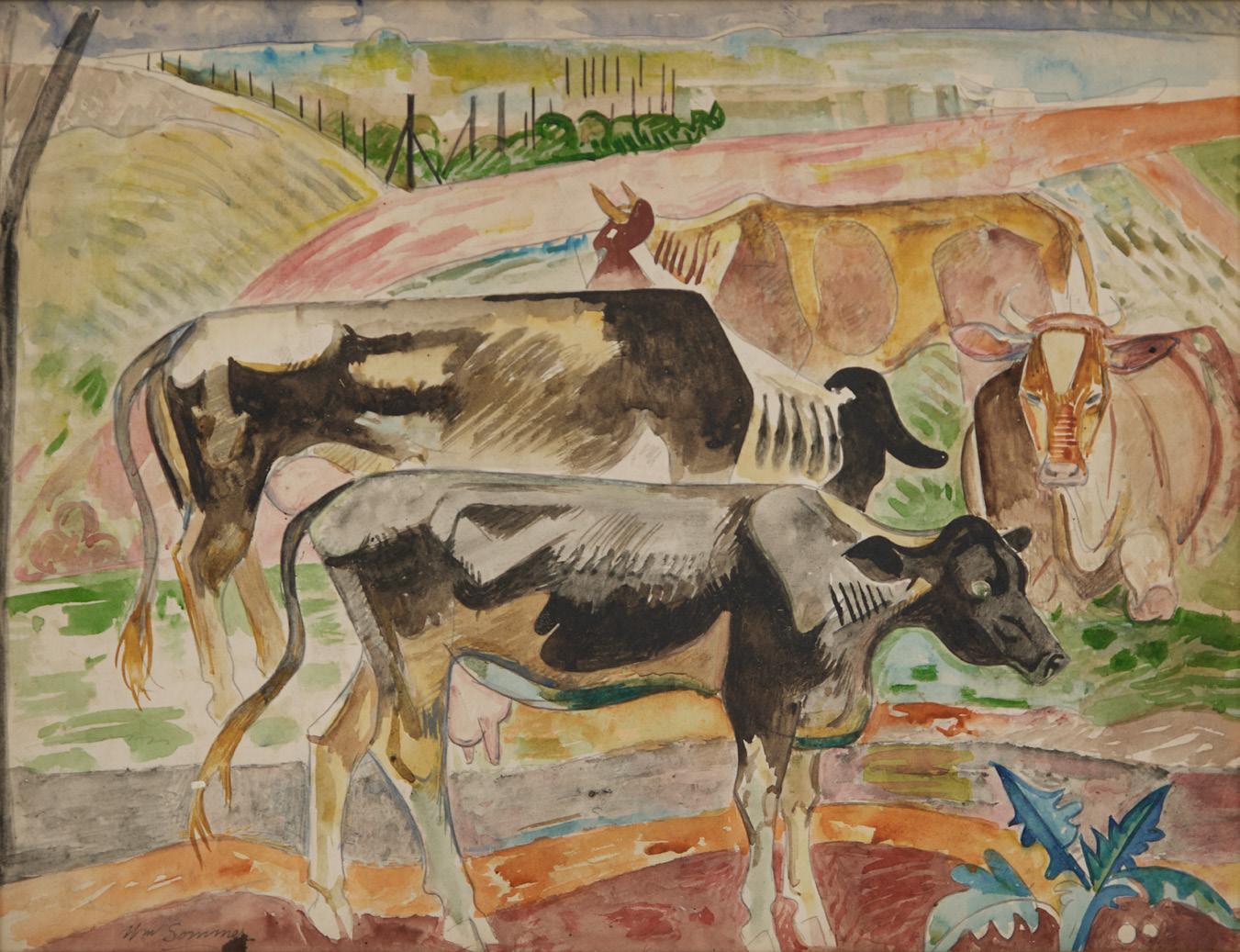
Cows in a Field, c. 1941
Watercolor on paper
Signed lower left
11.5 x 15.5 inches 74
Signed and dated lower right
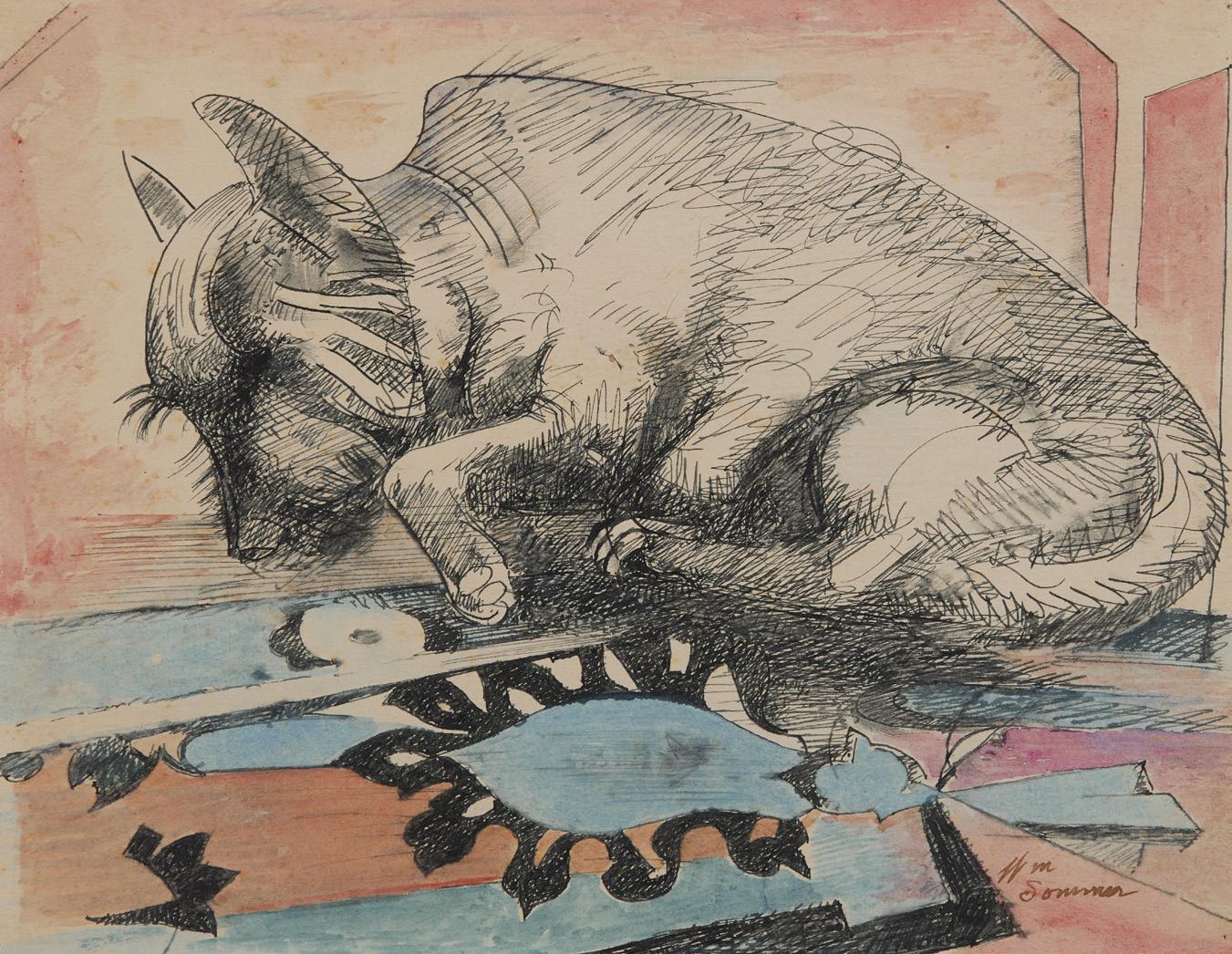
76
Watercolor, pen, and ink on paper
Signed lower right
7.5 x 9.5 inches
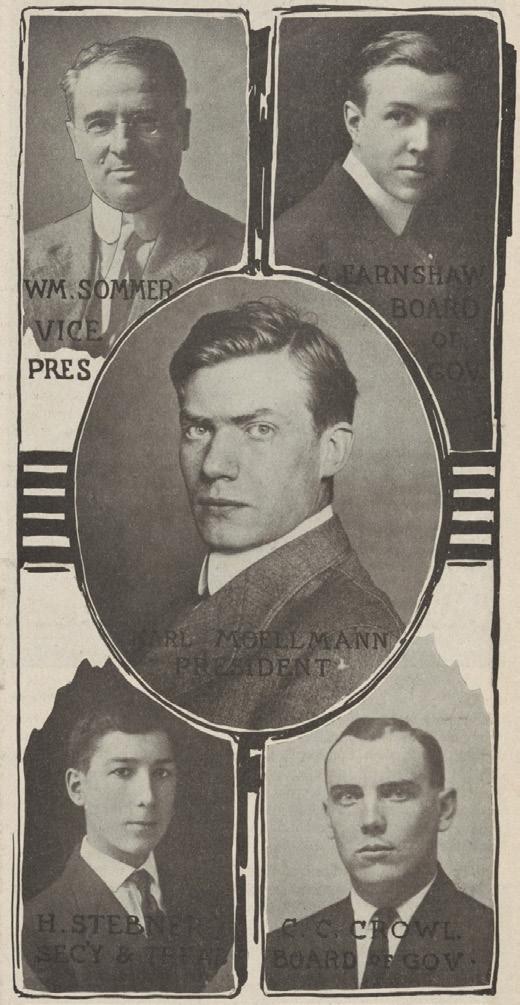
In August 1911, Sommer joined Carl Moellmann and eleven other artists in founding the Kokoon Arts Klub, an organization dedicated to promoting freedom and individuality in the arts. An article and captioned photograph in Cleveland Town Topics indicates that Moellmann served as the club’s first president and Sommer as vicepresident.
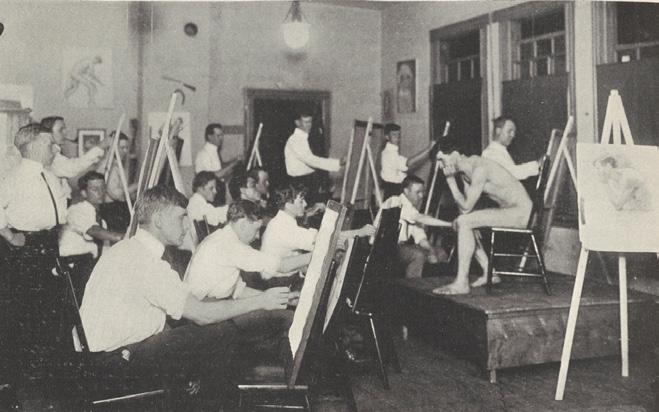
62 Another article explained that the artists chose the word “kokoon” because it symbolized “protecting the embryo of individual genius so it could break free of the naturalist tradition.”63 Members converted the back room of a tailor’s shop into a working studio where they could paint, draw from live models, and mount their own exhibitions.
The club quickly became a magnet for artists employed in commercial industries who needed a place for experimental work. For decades to come, the organization would serve as the nexus of modernist activity in the city.
Sommer quickly emerged as the Kokoon Klub’s leading artist and most impassioned advocate. Richard Sedlon recalled that when he entered the room “the very air was charged with the aura of his personality,” and when he drew, “it seemed as though the lines were guided by the universal rhythms of musical themes.”64 Sommer’s favorite exhortation to fellow members was “get the universal into painting.”65 Like many members, Sommer relied on the club as a necessary escape from the drudgery of his daily work in commercial lithography. Artist Philip Kaplan observed, “bill hated to go back to his job. He reminded us constantly that he was being crucified every day at the lithography plant.”66
Sommer played a prominent role in the Kokoon Klub’s first group exhibition at the Taylor Galleries in March 1912. Determined to distance themselves from commercialism, members displayed their paintings without titles or signatures. The exhibition attracted large crowds and extensive press coverage, provoking both admiration and alarm. Spencer Adams wrote in Cleveland Town Topics: “The Kokoon fellows buy paint by the wholesale, and puts it on their canvases—judging by appearances—with shovels. They are a bunch of anarchists who defy academic traditions, and see nature arrayed in all the colors of the solar spectrum.”67 Wilson Smith offered a more favorable assessment, remarking that “sincerity in artistic impulse breathes out of every canvas; colors explode with a brilliancy that dazzles the eye of the uninitiated, for the exhibit is notable and revolutionary.”68 Such polarized reactions only heightened the club’s notoriety.
In late 1913 or early 1914, Sommer designed a poster for another Kokoon Klub exhibition at the Taylor Galleries (fig. 77). It
features a bare-breasted woman who wraps one arm around a large mirror with a radiant sun in the center, while figures below stand on a staircase, as if ascending or descending from the light. The standing woman may be holding a palette in her other hand. The poster’s modernist visual language—radically simplified and flattened forms, contrasts of bold, complementary colors—mirrored the club’s aesthetic ambitions.
Sommer continued to develop this style of flowing, decorative rhythms in his poster for the Kokoon Klub’s bal Masque of 1917 (fig. 78). Founded in 1913 to raise funds for the group’s artistic activities, the annual masked ball quickly became the centerpiece of bohemian social life in the city. Each event featured a distinctive theme—such as the Nuit Futuriste or the bal Dynamique. The organizing artists competed to outdo one another with avant-garde décor, inventive costumes, experimental music, and risqué dances infused with Dadaist irreverence. Plans for the 1923 masked ball proved so controversial that the bishop of Cleveland denounced the event for “immoral excesses,” and the mayor cancelled the festivities before they began— an episode that only heightened the club’s growing notoriety.
beyond its exhibitions and festivities, the Kokoon Klub served as a laboratory for artistic experimentation. Sommer spent many evenings there drawing from the nude. Though widely praised as a colorist, he was equally distinguished as a draftsman and championed what he called the “living line.”
The technical discipline he acquired through decades of independent sketching is evident in such works as Standing Nude with Hanging Scroll (fig. 84) and Seated Nude with Hanging Scroll (fig. 85). The energetic lines that flow continuously around the figure are deftly varied in thickness to suggest spatial depth. While selective applications of color animate the composition, large areas of paper are left blank, thereby emphasizing the expressive autonomy and vitality of line.
Fellow Kokoon artists spoke reverently of Sommer’s abilities. Philip Kaplan claimed that “bill could draw a head eight feet high with the ease and grace of an acrobat flying through space.”69 Paul Travis described him as “a force of nature” who “needed only one glance to see where the essential line was hiding.”70 Richard Sedlon remembered Sommer’s aphorisms: “A line must be a living element,” “A line is an emotional element as well as a form builder,” and, “ A Line must come from eternity, tell us its story, then return from whence it came.”71 Sedlon also recalled that Sommer was the first Cleveland artist to employ the matchstick method of drawing with India ink, a technique that required extraordinary discipline and control.72 He may have adopted the method after seeing Matisse’s matchstick drawings in the 1913 Armory Show.
The Kokoon Klub (sometimes spelled “Club”) remained a vital presence in Cleveland’s artistic life throughout the 1920s, though membership gradually declined during the late 1930s. The final bal Masqué took place in 1946, and the organization formally disbanded in 1956. Yet the spirit that had animated the club—its irreverence toward academic tradition and its commitment to artistic independence—continued to shape the city’s modernist culture long after its doors closed. For Sommer and his fellow artists, the Kokoon Klub provided far more than a meeting place: it was a crucible in which new ideas, new forms, and new ambitions for art in Cleveland first took shape. ™
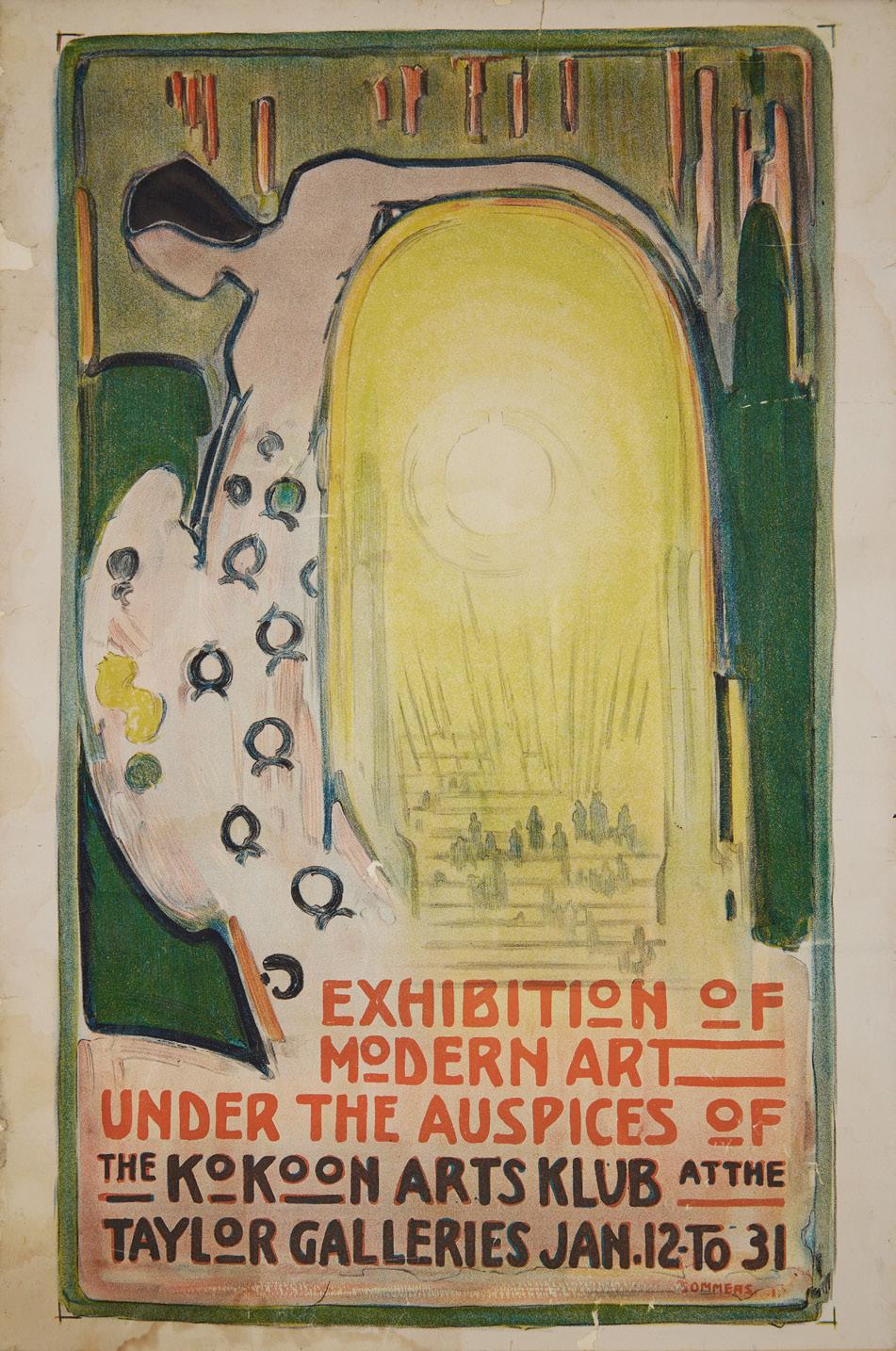
Klub, Exhibition Poster, c. 1913
Lithograph on paper
Signed in litho plate lower right 21.5 x 14 inches
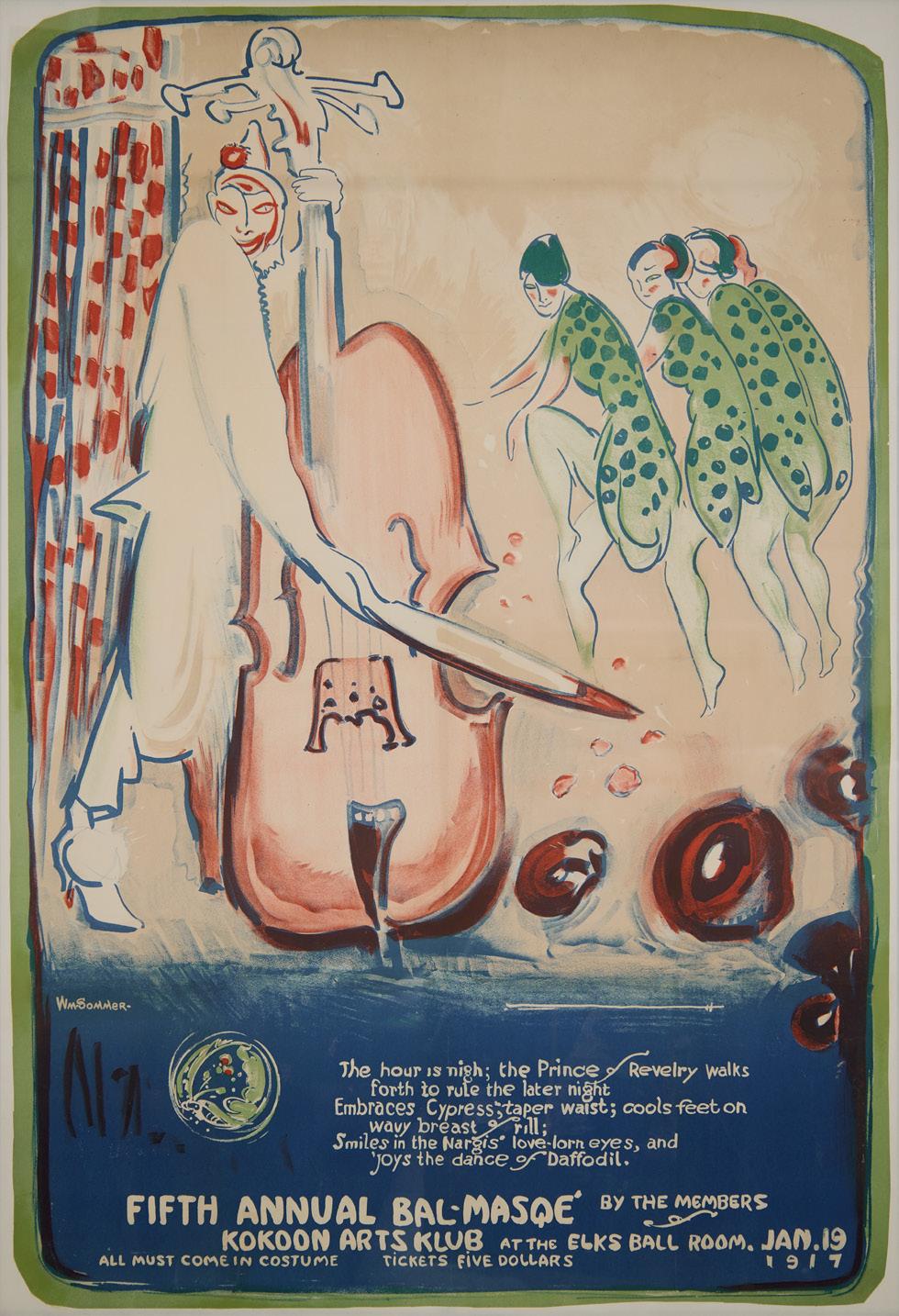
Signed in litho plate lower left
48 x 33 inches
79
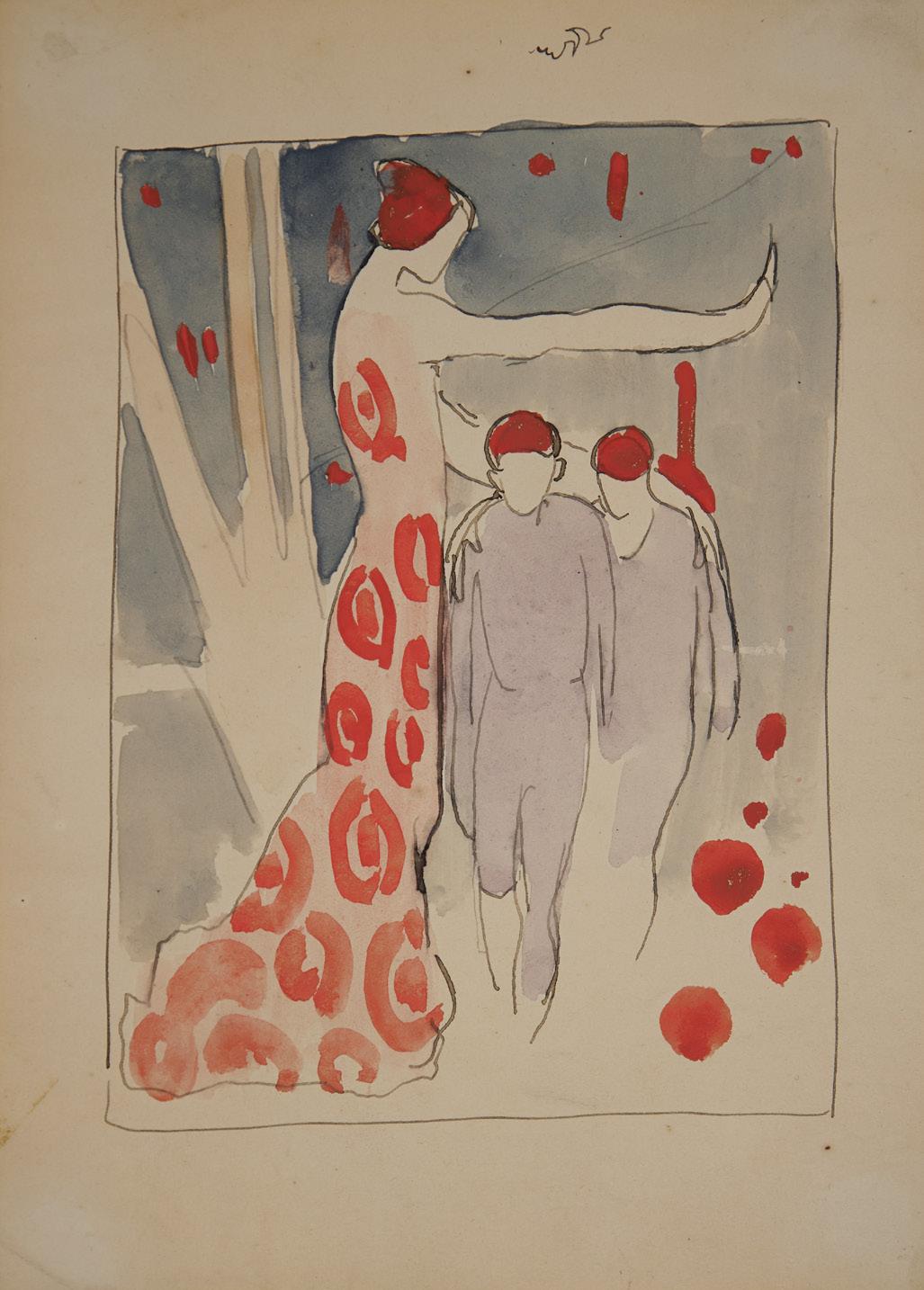
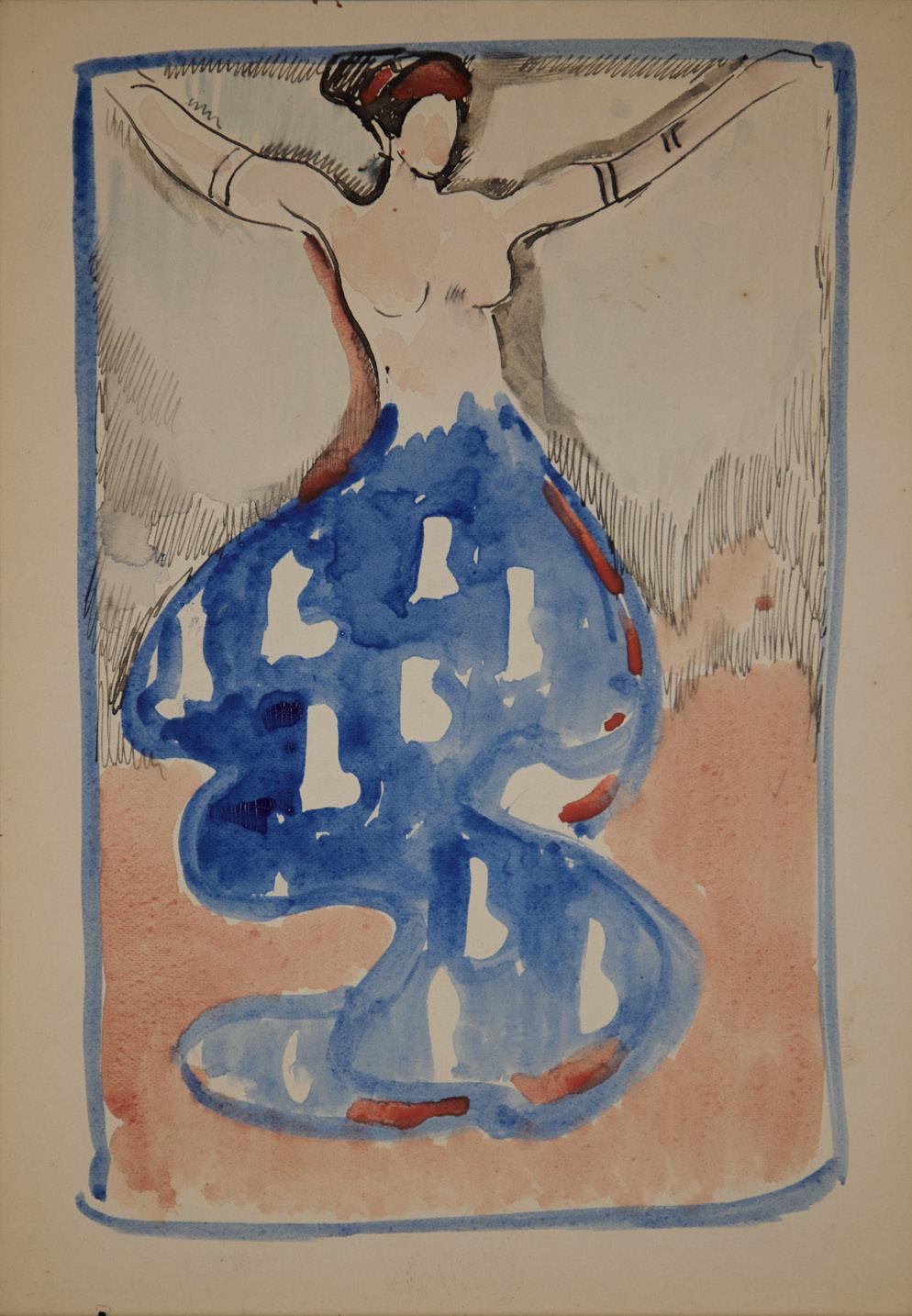
Figures, c. 1915
8 x 5.5 inches
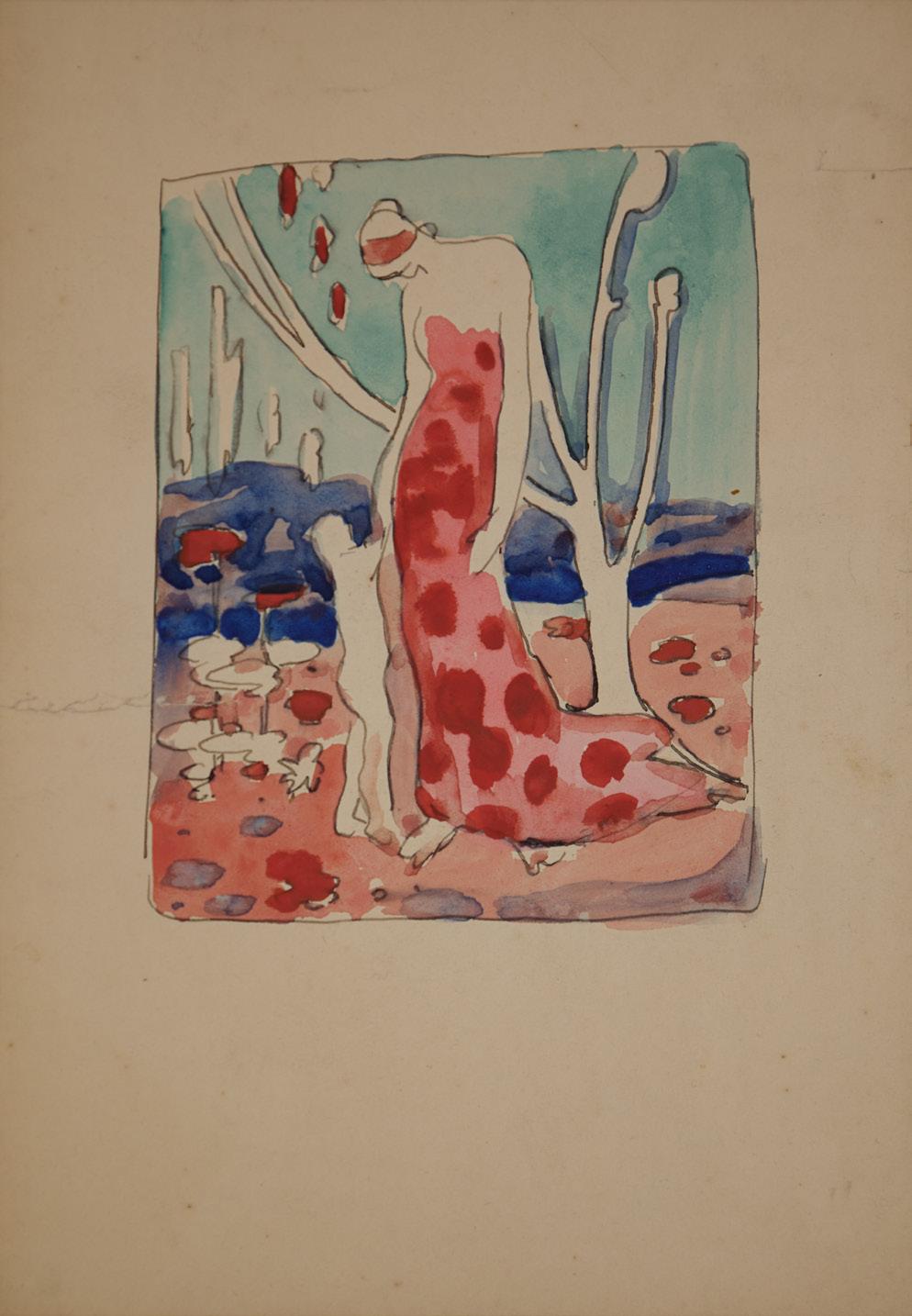
Woman and Child, c. 1915
Watercolor, gouache, and ink on paper
8 x 5.5 inches 81
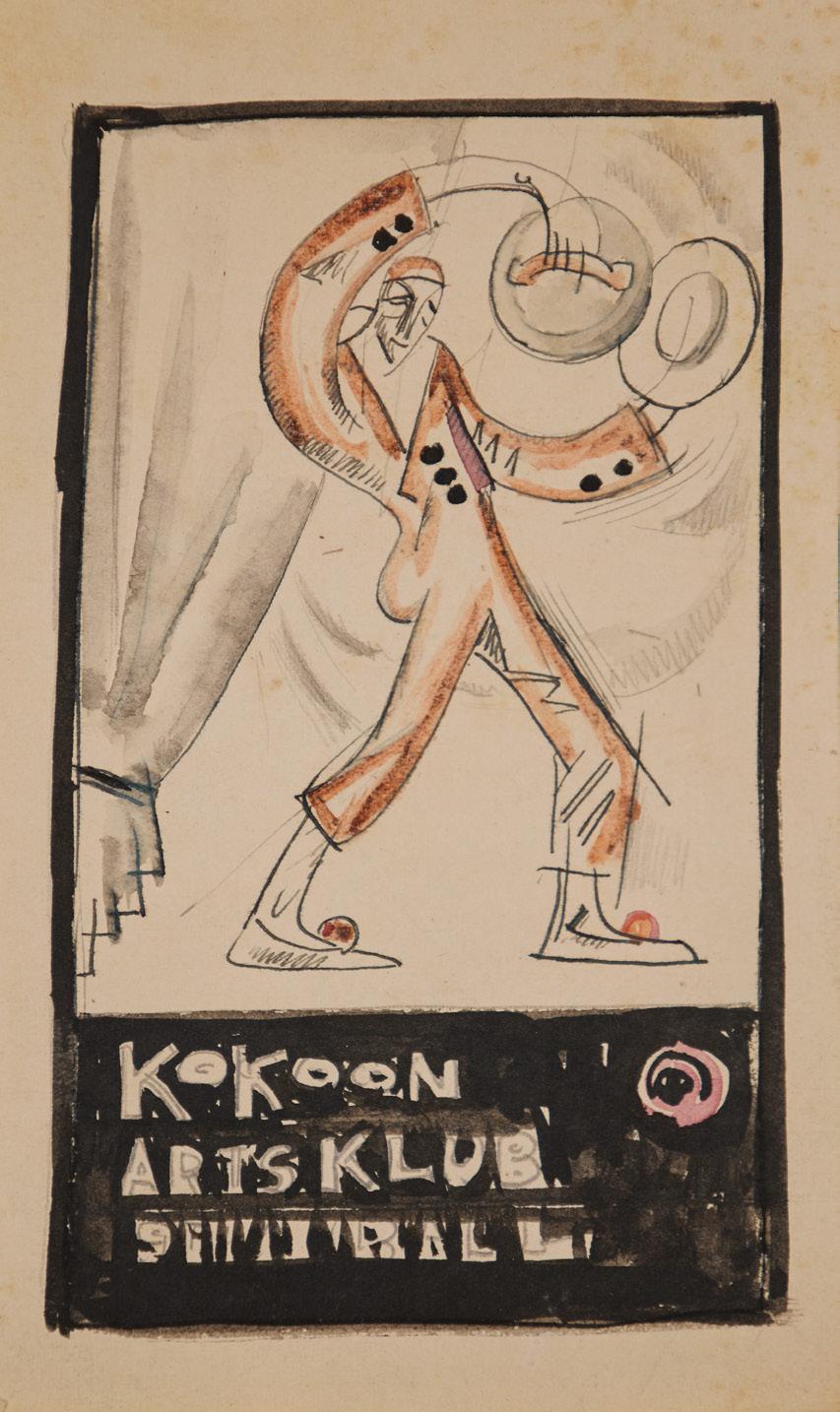
Kokoon Klub Announcement, 9th Bal Masque, 1921
6 x 3.75 inches
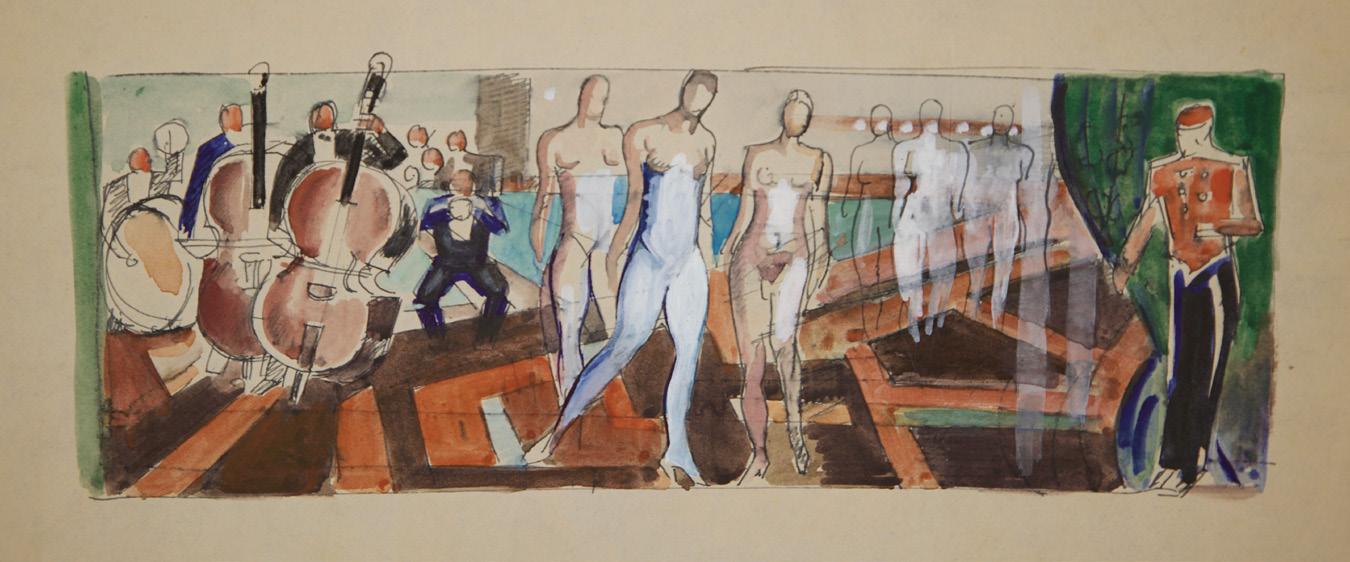
Orchestra and Dancers, c. 1922
Watercolor, gouache, and ink on paper
Signed with estate stamped verso 8.5 x 11 inches
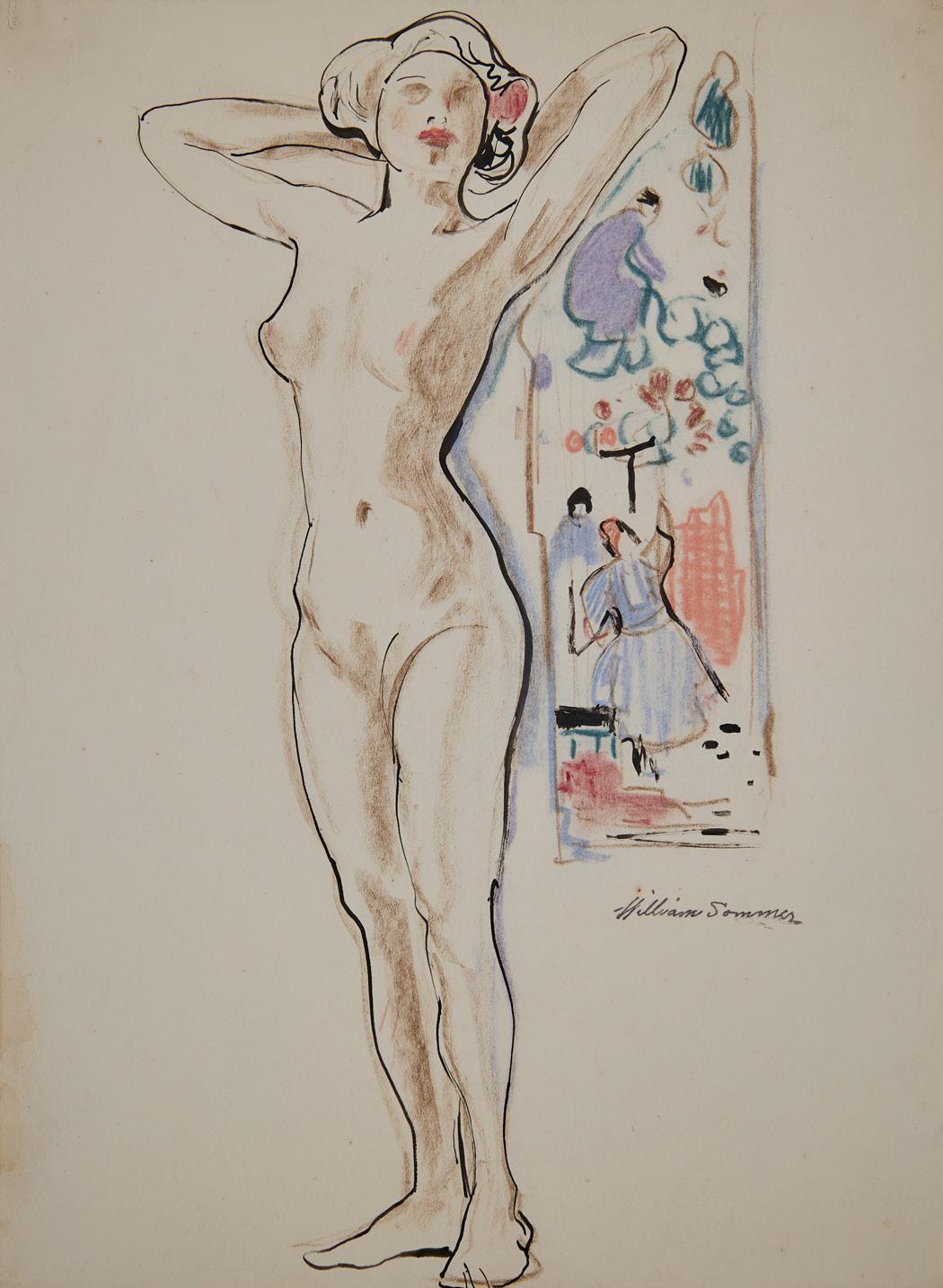
Standing Nude with Hanging Scroll, c. 1923
Ink and colored pencil on paper
Signed middle right 16.25 x 12 inches
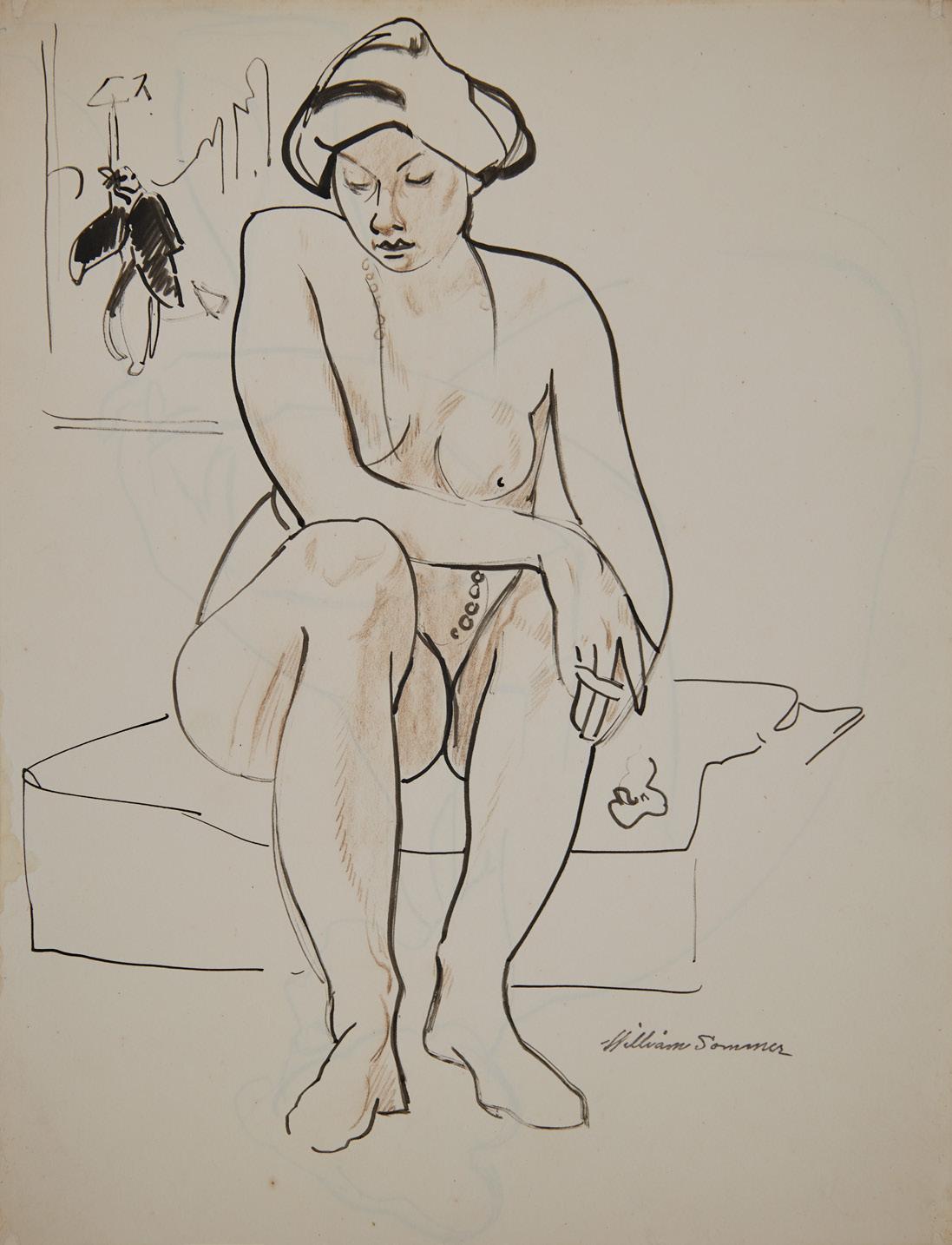
Seated Nude with Hanging Scroll, c. 1923
Ink and colored pencil on paper
Signed lower right
16.25 x 12 inches
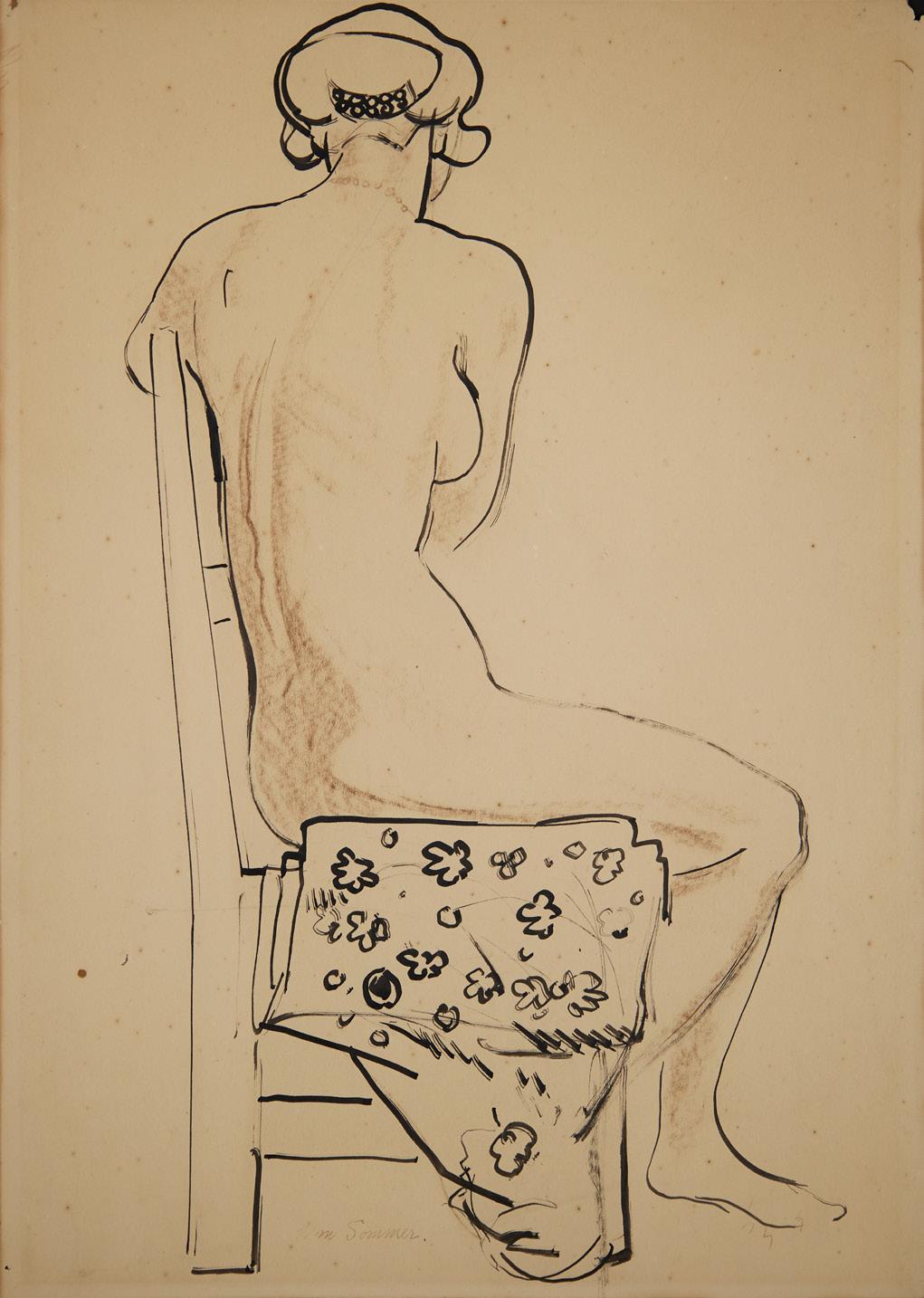
Seated Nude, c. 1925
Ink and colored pencil on paper
Signed lower middle 16.25 x 11.75 inches
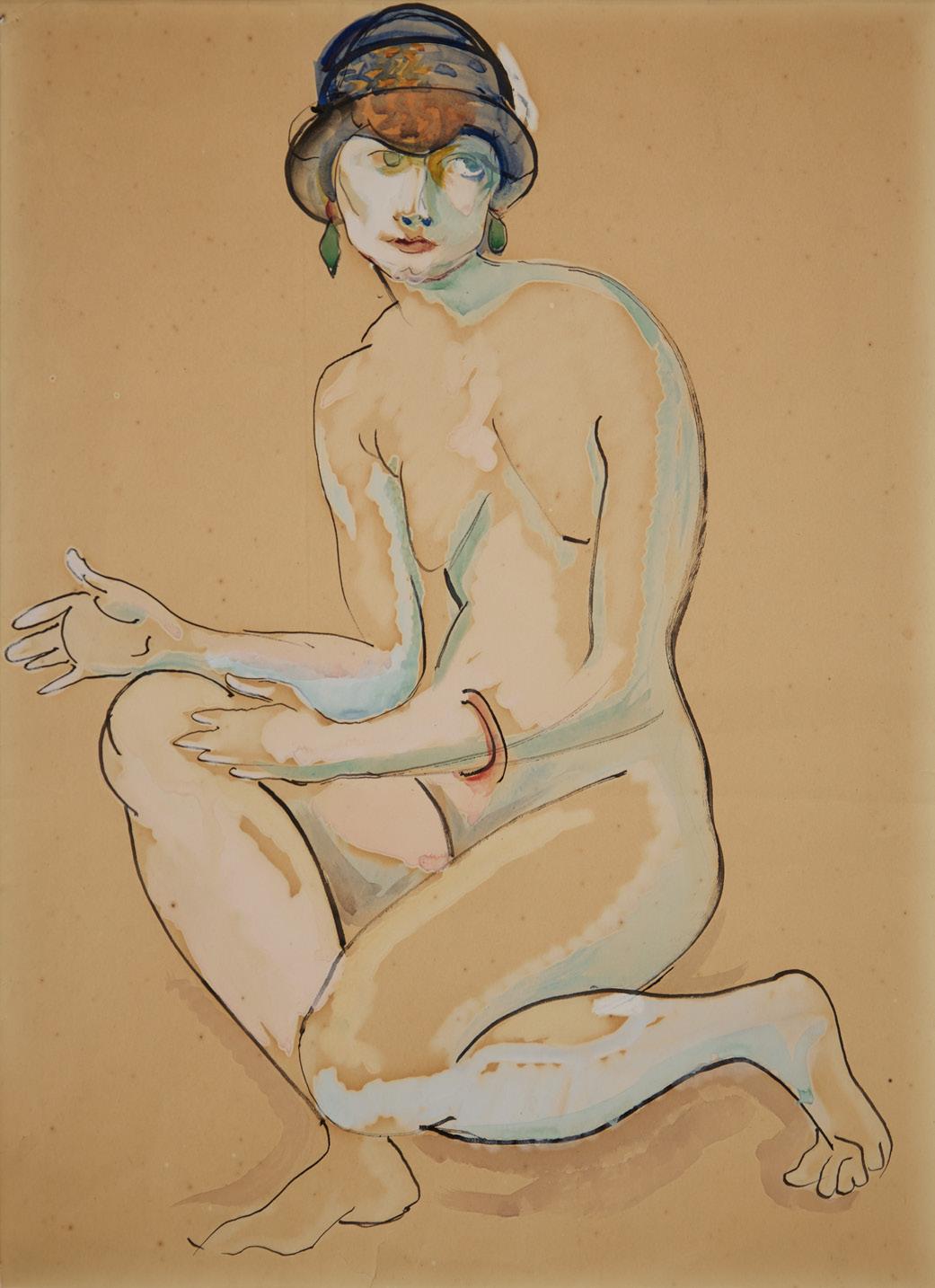
87
Crouching Nude, c. 1925
Watercolor, gouache, and ink on paper
16 x 12 inches
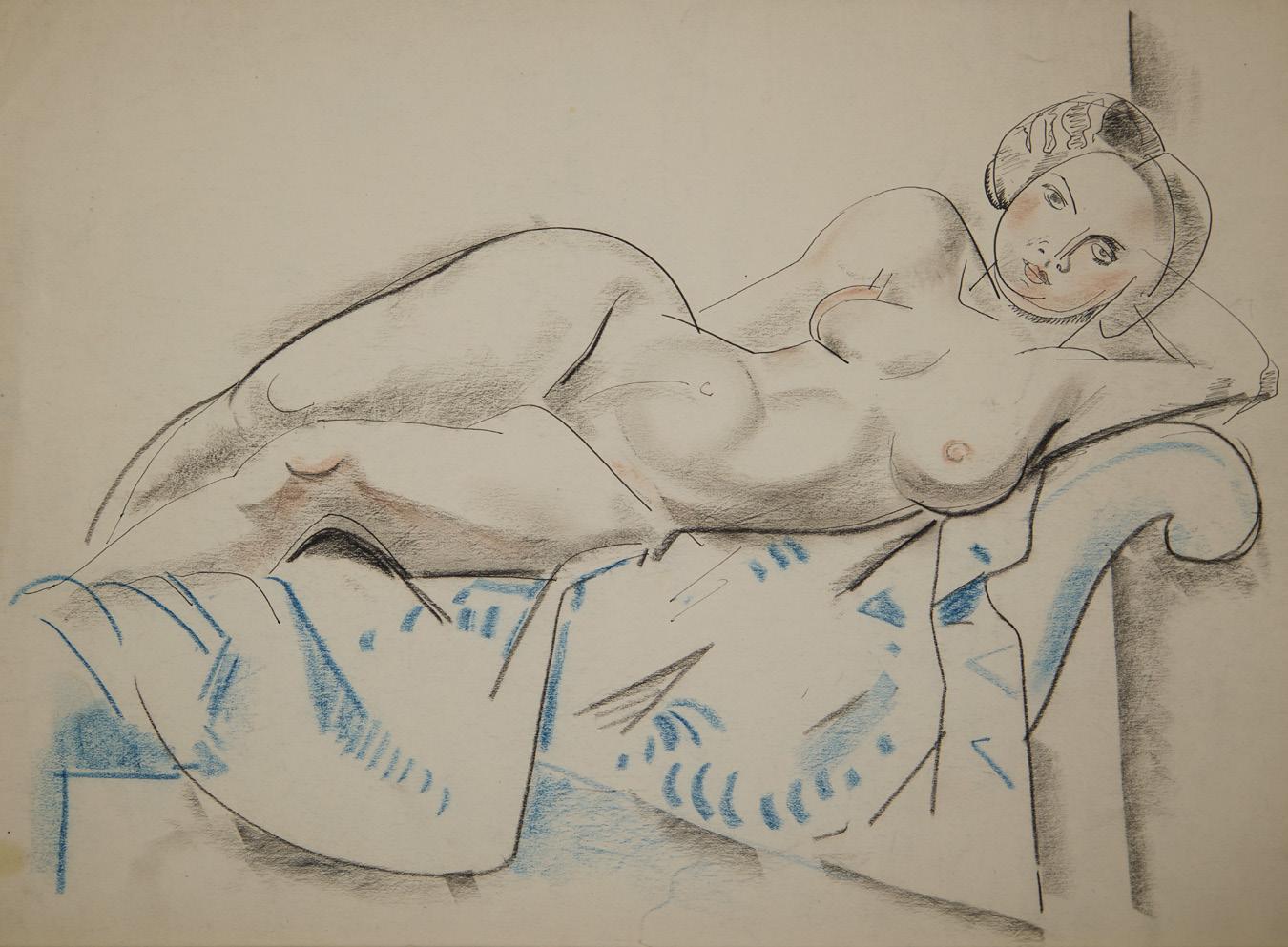
Reclining Nude, c. 1920
ink, and colored pencil on paper
11 x 15 inches
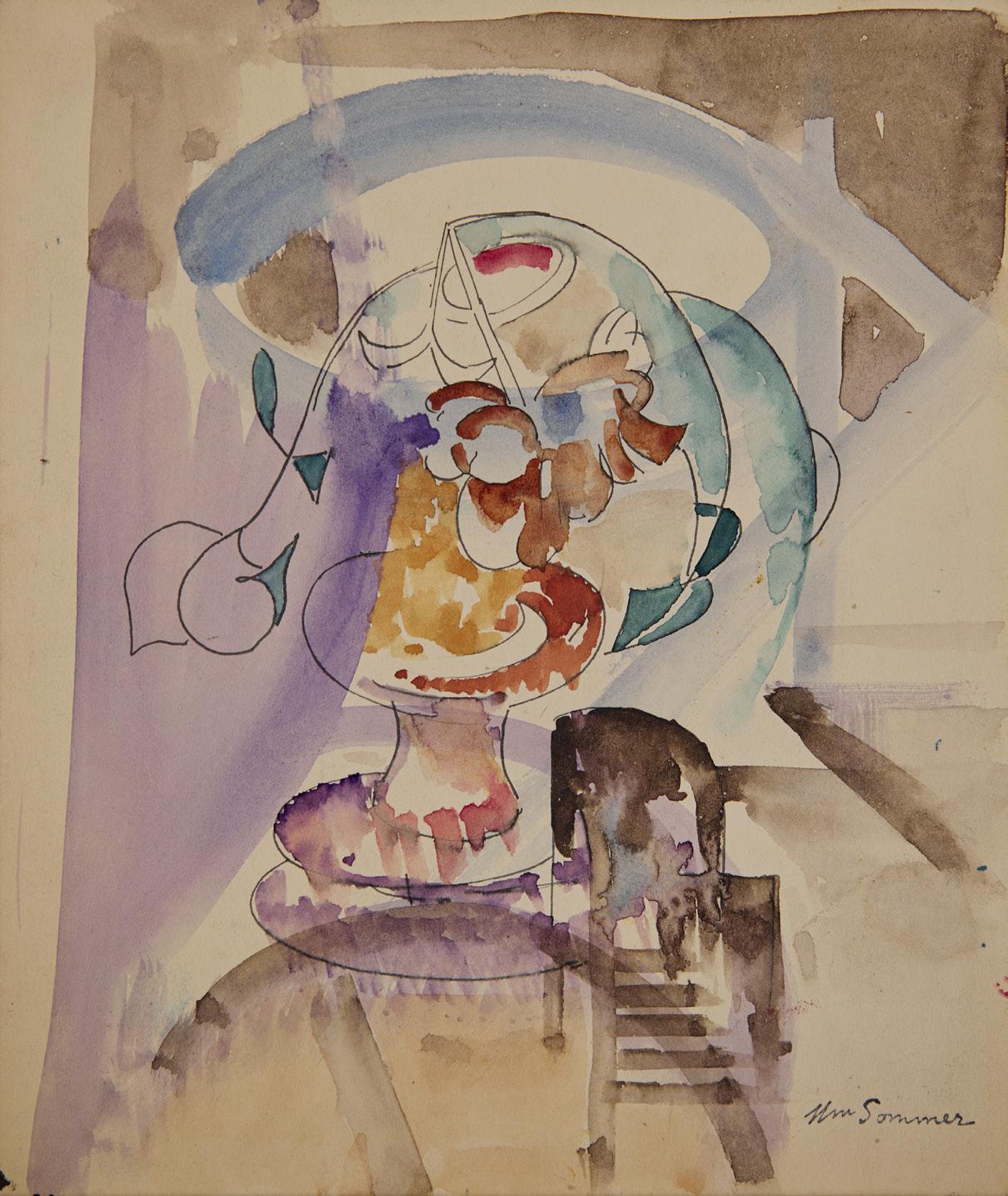
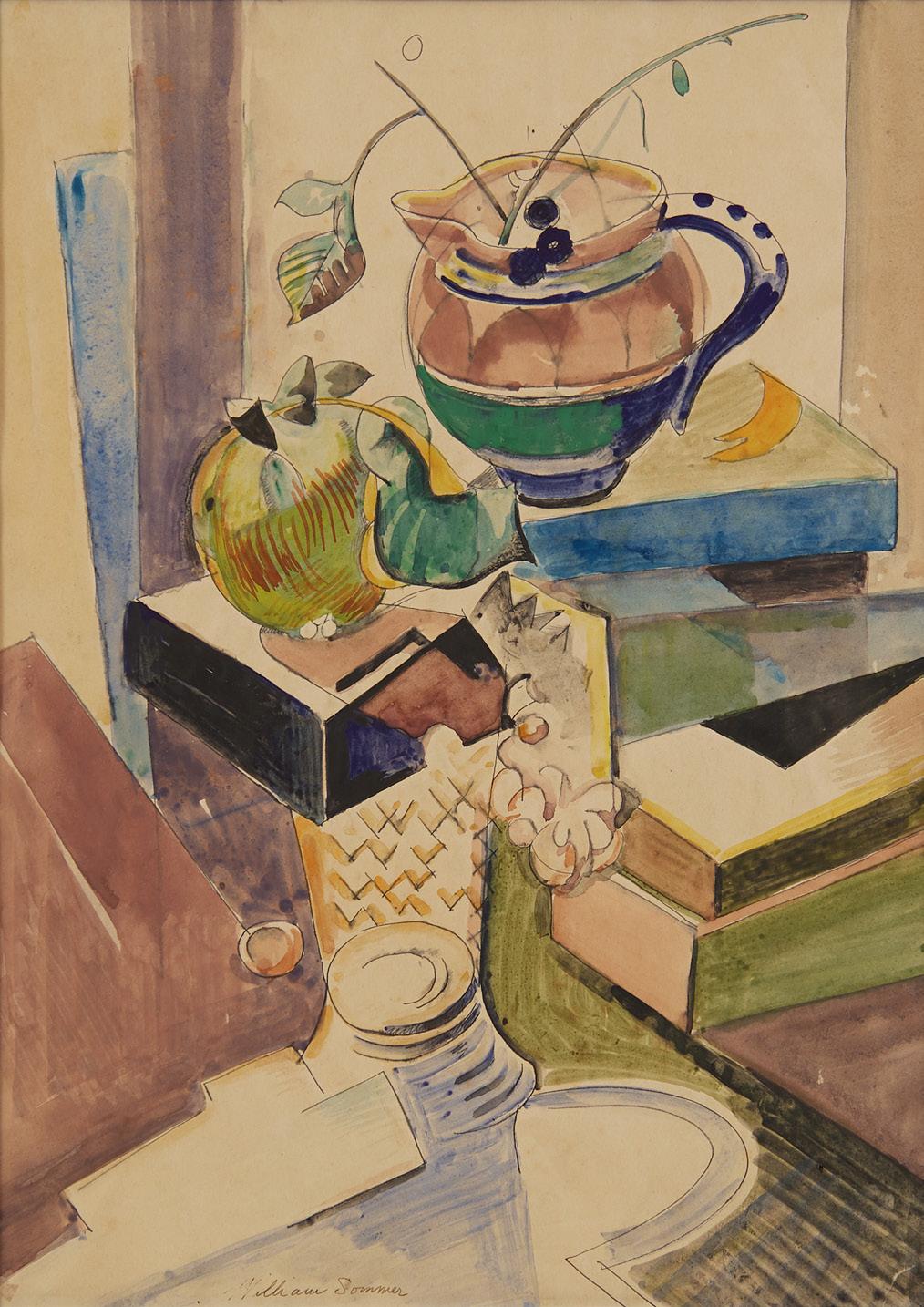
During the 1920s, still life became an increasingly important subject in Sommer’s art. As he gradually moved away from overtly mythological imagery, he found renewed inspiration in the common objects of the studio. Ceramic pots, water pitchers, drinking glasses, flowers, and apples from his orchard became subjects of intense scrutiny. Richard Sedlon observed, “He was preoccupied with the search for drawing out the eternal from the commonplace . . . He loved life and saw beauty in the seemingly insignificant objects such as a shriveled leaf or a dried seed pod.”73 Yet, still life did not mark a retreat from Sommer’s metaphysical ambition; rather, it redirected that quest into the formal and perceptual structures of everyday experience.
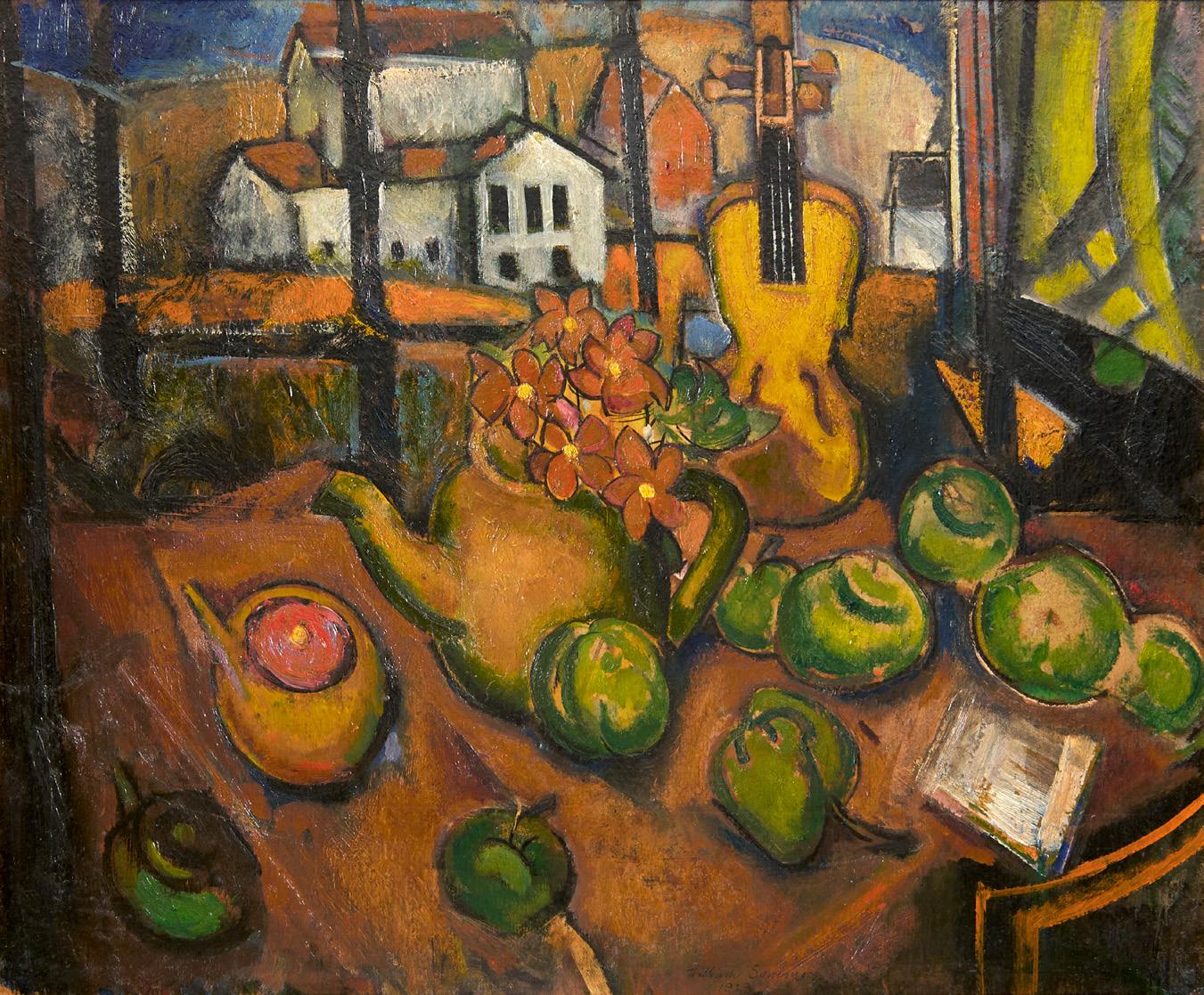
Still Life with Ceramic Pot, Flowers, and Fruits (fig. 89)—an oil on canvas dated 1920—depicts an arrangement of ordinary objects resting on shelves in the corner of his studio. The shallow, compressed space is organized through powerful forms defined not by graduated modeling, but by saturated planes of color and complementary contrasts—green against red, violet against yellow. Dark, emphatic contours suggest the influence of Paul Gauguin’s cloisonnism, a decorative technique inspired by stained glass and enamel work, also found in the Fauve paintings of Georges Rouault and André Derain.
If Sommer’s early still lifes emphasized
decorative contour and chromatic intensity, his works of the mid-1920s reveal a deeper engagement with the structural concerns of Paul Cézanne. Space in Green Apples, 1923 (fig. 90) is constructed through the optical interaction of warm-cool color contrasts rather than conventional modeling. Cézanne’s influence on Sommer has been underestimated. He owned books on the French master and filled his notebooks with observations about his paintings. Several passages praise Cézanne’s focus on formal issues:
His colour is personal and rhythmic. He was absorbed in the handling of his materials not in the lyrical drama anecdote or rhetorical to look for the elements, he often thinks profoundly on unimportant matters, he is master of edges. He advised [Emil] Bernard to look for the contrasts and correspondences of tones; he paints for the sake of beauty.74
Sommer was particularly struck by Cézanne’s willingness to ignore naturalistic color:
Cézanne—cared nothing about local colour . . . he changed
color to suit himself and bring harmony to the whole. He painted in sunlight but did not try to paint sunlight.75
These reflections illuminate Sommer’s own practice of subordinating observed reality to concerns with chromatic harmony and structural unity. Like Cézanne, he pursued formal coherence rather than optical transcription.
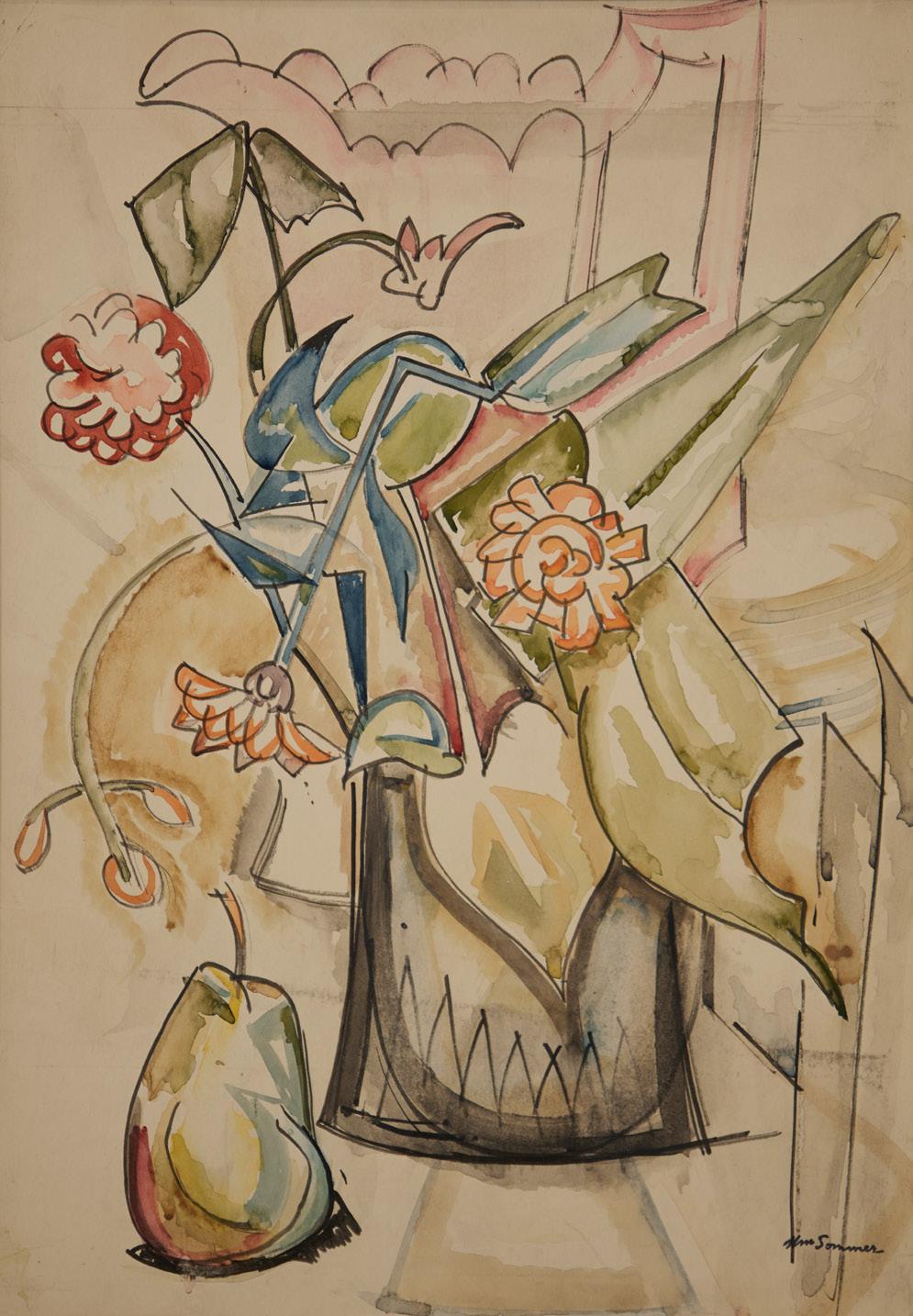
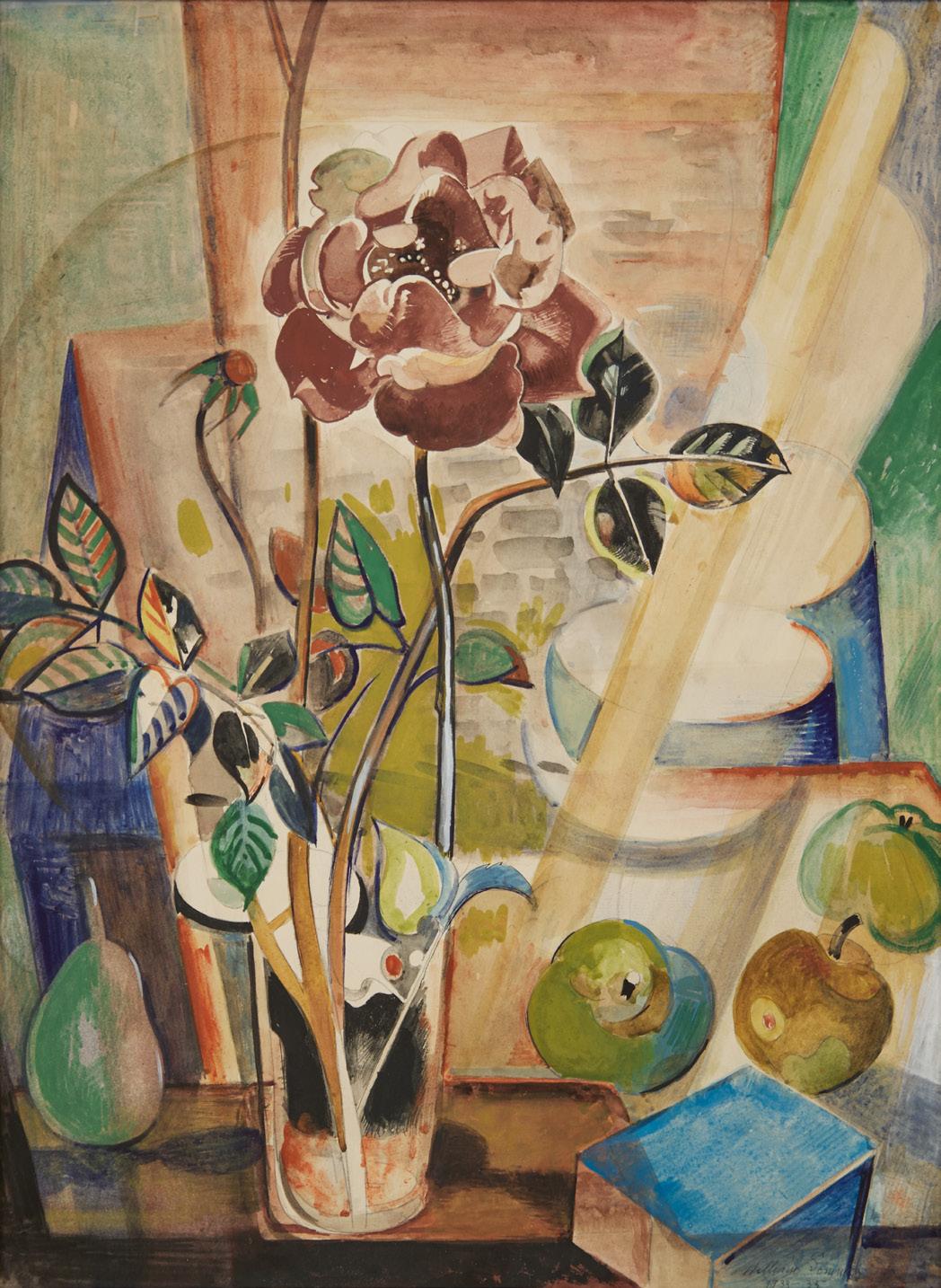
Sommer proved especially adept at exploiting the translucency of watercolor in his still lifes. The medium enabled him to layer luminous washes over ink drawing, allowing planes to overlap and interpenetrate in ways impossible with opaque oil. In Still Life with Zinnias and Pears (fig. 91), translucent color and calligraphic line merge into a unified rhythmic structure. His more mysterious Cubist Still Life (fig. 98) presents a group of apples—one almost floating in space—set before either a beveled mirror or a window opening onto a landscape, punctuated by a tree that blossoms among sharply faceted hills. The ambiguity between mirror and window destabilizes the boundary between interior and exterior, reflection and reality. What began as a simple arrangement of fruit became a meditation on perception itself— an exploration of how space is constructed, fractured, and reimagined through the act of painting. ™
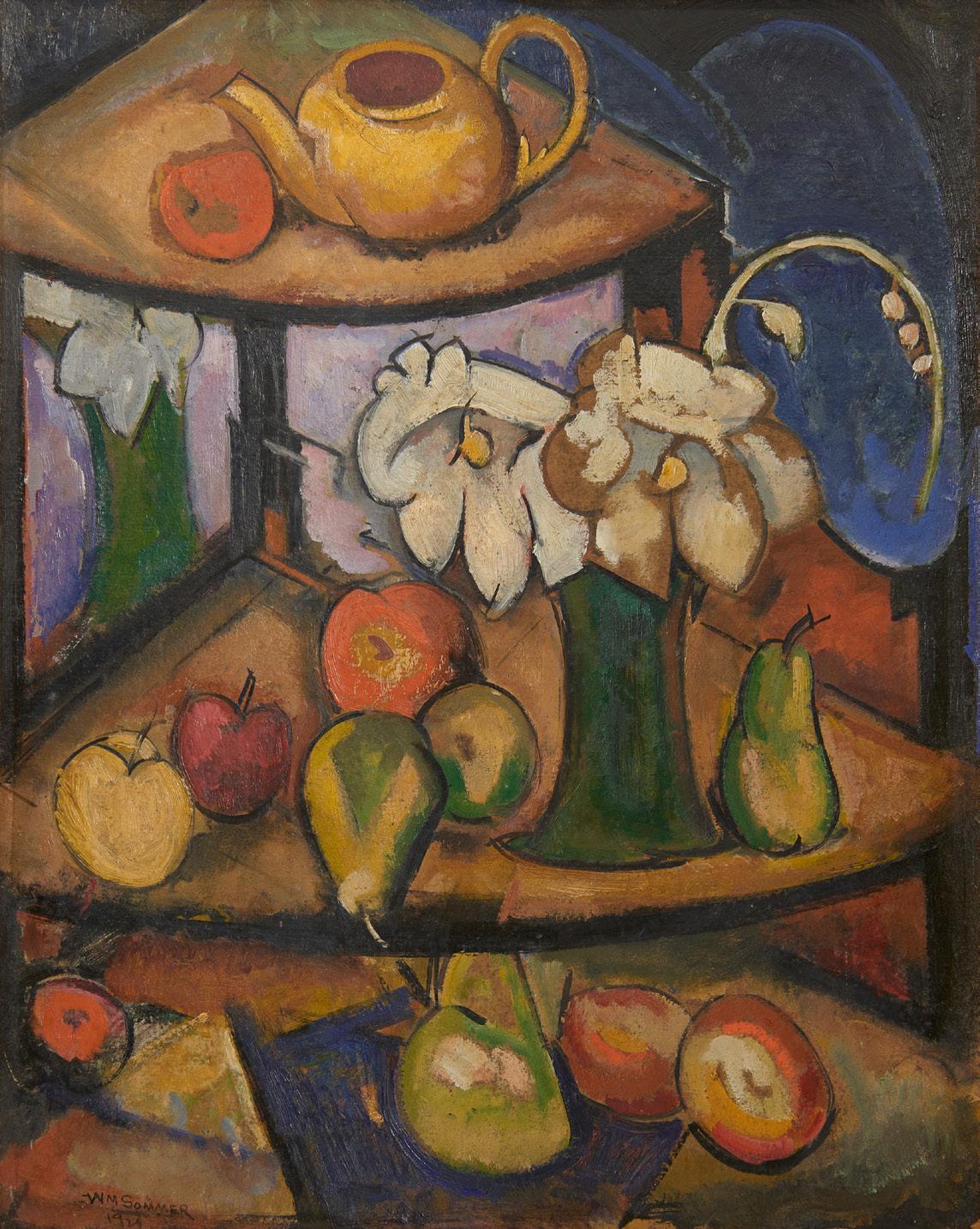
91
Watercolor on paper
Signed lower right 15 x 11 inches
Ornamental Still Life, c. 1930
Watercolor and ink on paper
Signed with estate stamp lower right 8 x 6.75 inches
Turreted Pitcher, 1928
Watercolor, gouache, and ink on paper
Signed lower middle, dated verso 17 x 13 inches 93
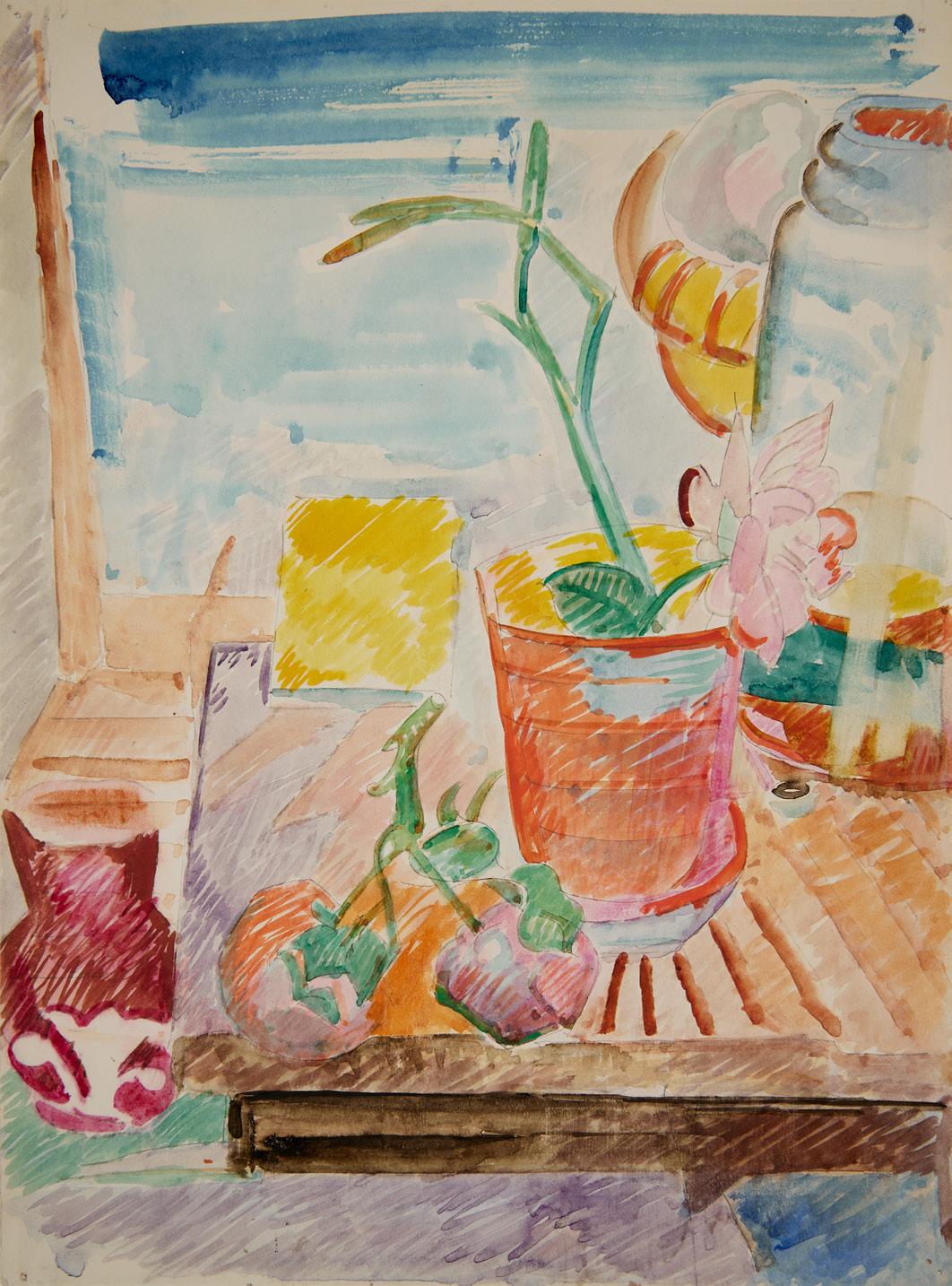
Still Life with Vase, Bottle and Fruits, c. 1930
Watercolor and graphite on paper
15 x 11 inches 94
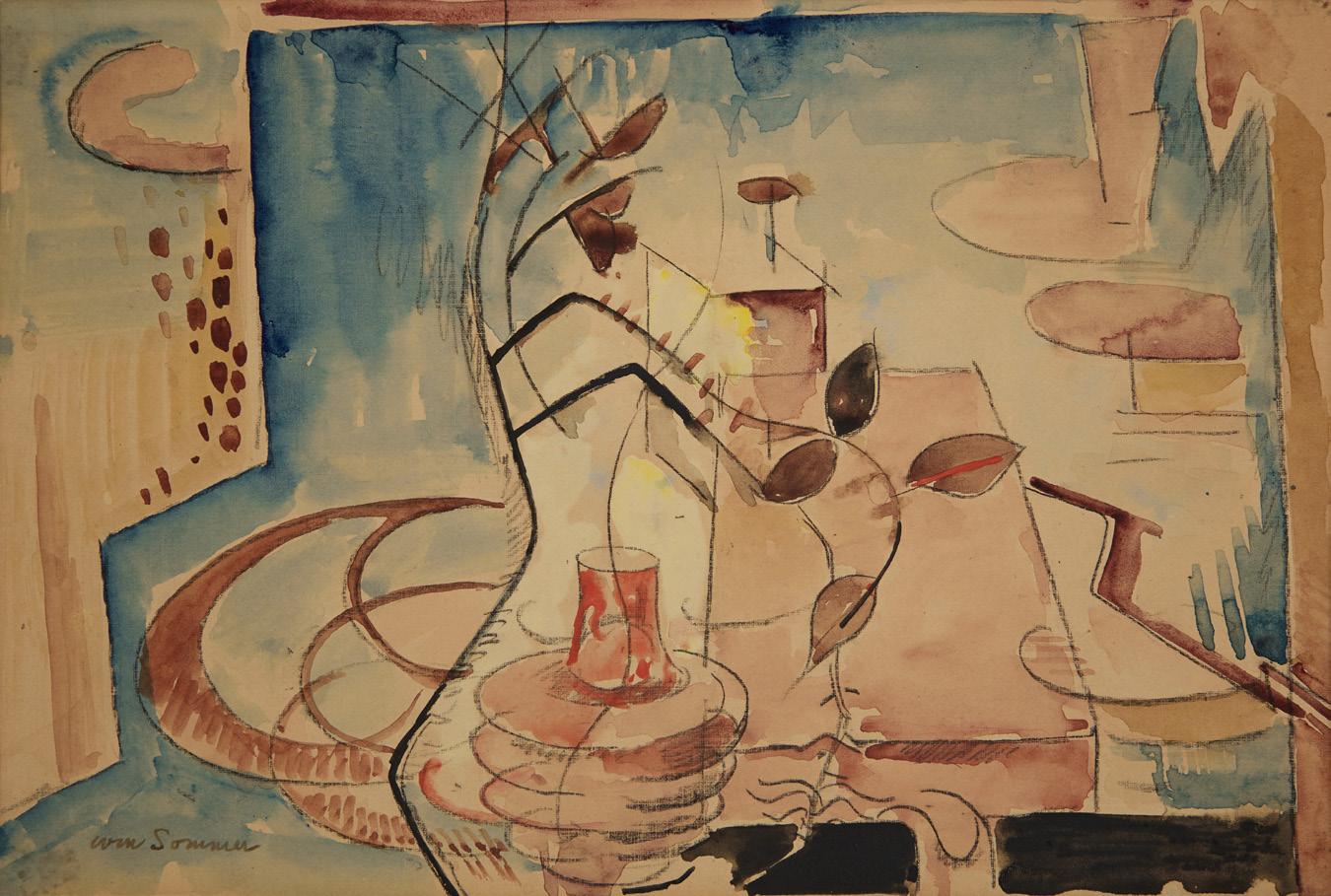
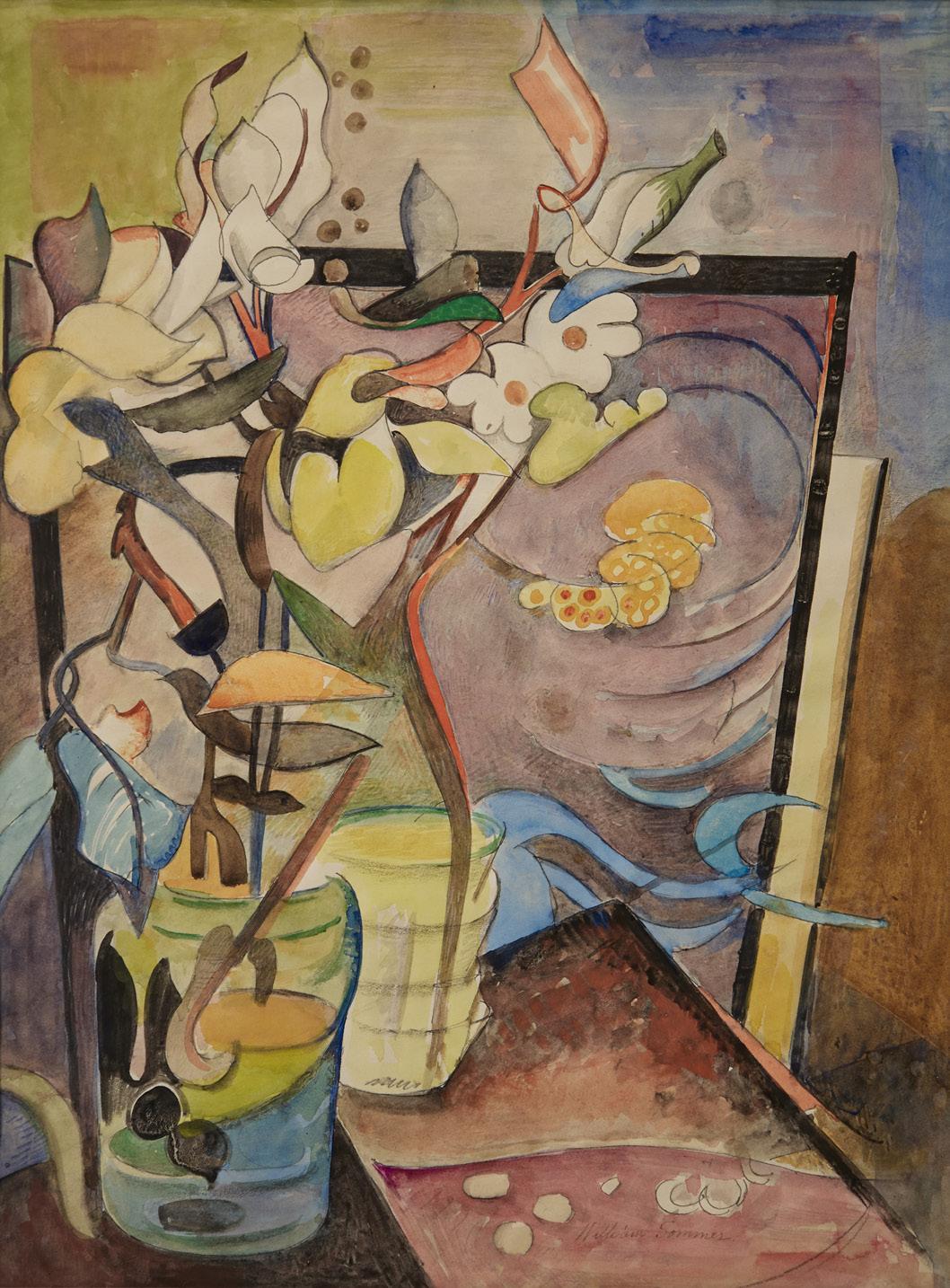
Forms in Fantasy, c. 1930
Watercolor on paper
Signed lower right
x 11.5 inches
97
Still Life with Flowers and Fruit, 1933-35
Watercolor, gouache, and ink on paper glued to artist board
Signed and dated lower right
21 x 16 inches
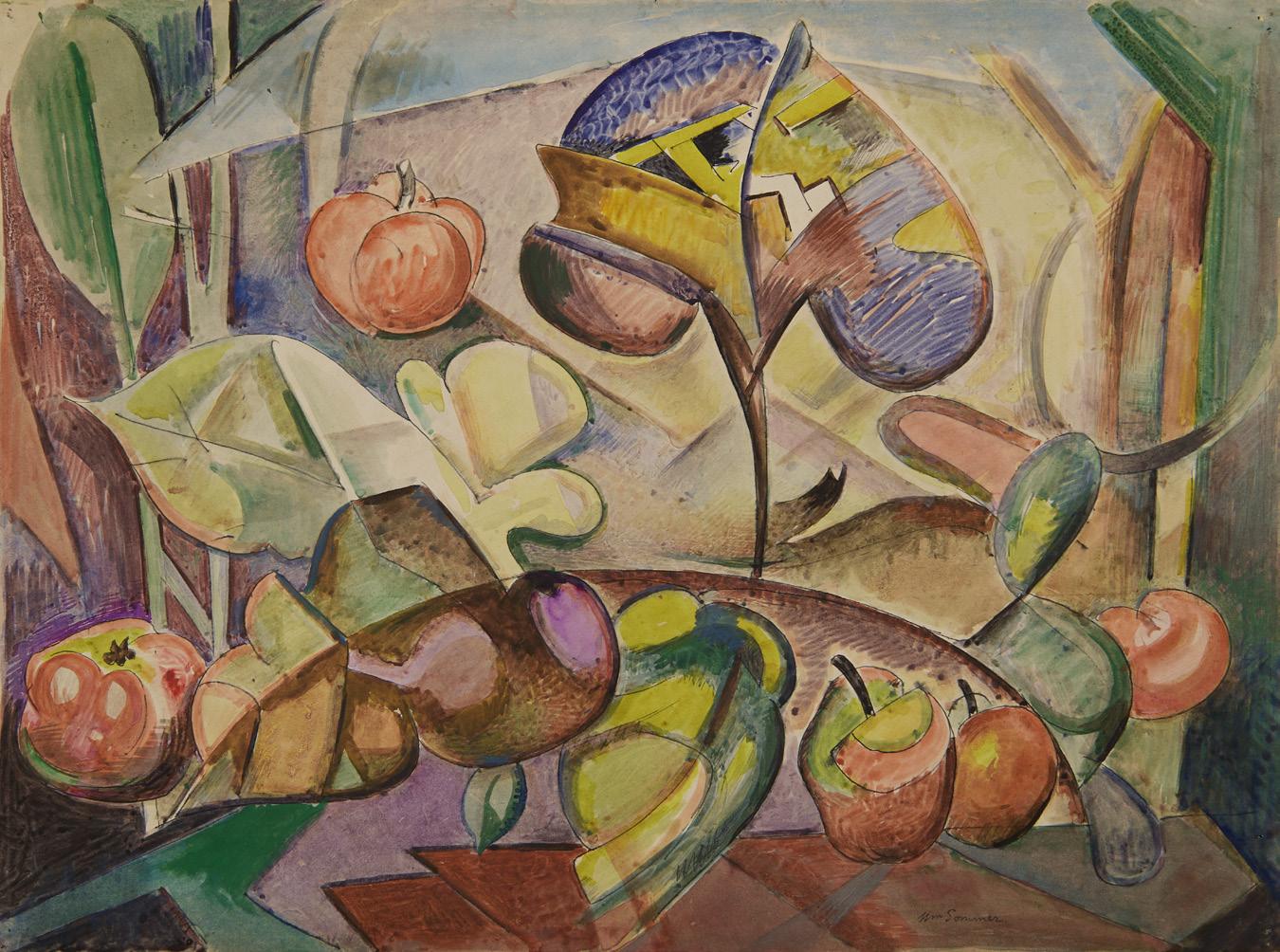
Cubist Still Life, c. 1930-35
Watercolor, gouache, and ink on paper
Signed lower right
12.5 x 17 inches 98
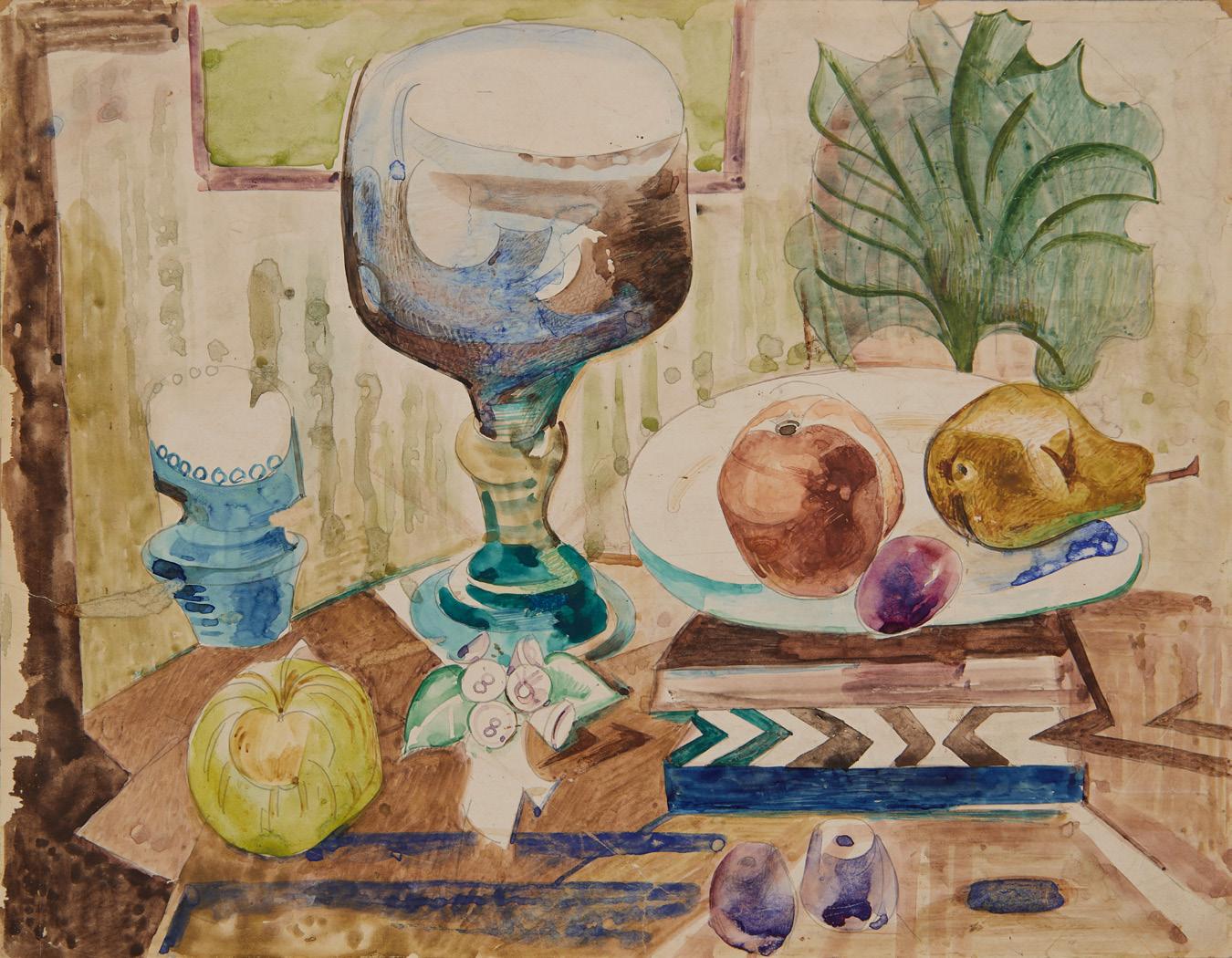
Life with Goblet, 1941
Signed illegibly, lower right
10.75 x 14 inches
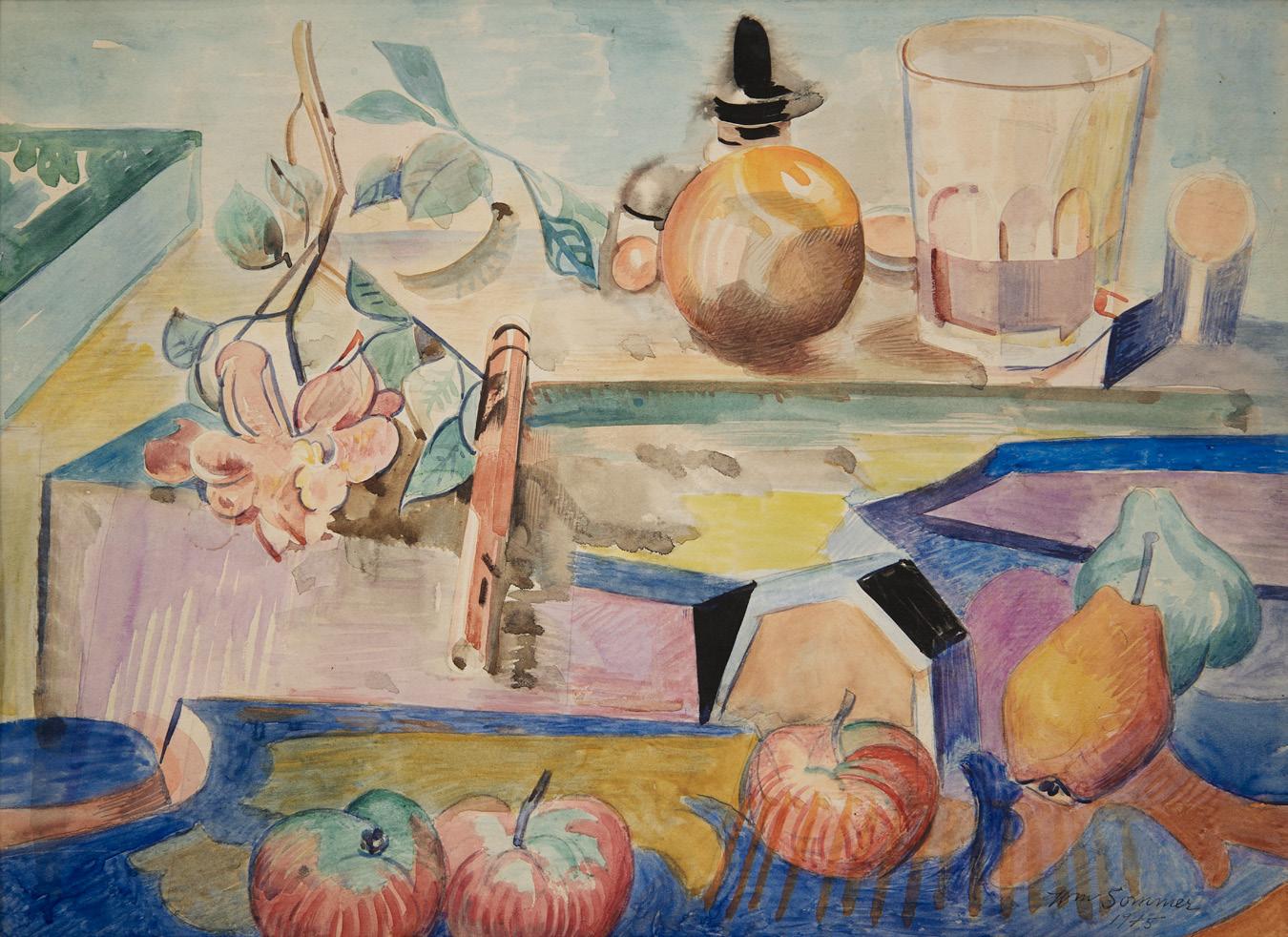
Watercolor on paper
Signed and dated lower right
11 x 15 inches 100
In 1926, W. J. Morgan Lithography acquired Otis Lithography, taking control over the staff and the facilities on East 30th Street near Payne Avenue.76 Sommer continued working at Morgan for another four years. In 1929, he lost his job when the company converted to offset lithography—a photomechanical process that rendered traditional stone lithography obsolete.77 The timing could not have been worse. Following the stock market crash of 1929, Cleveland’s economy collapsed. by 1931, more than one-third of the city’s workforce was unemployed; by 1933, nearly half faced joblessness. Like many artists dependent on commercial work, Sommer suddenly found himself without a steady income.
Sommer weathered the hardships of the Depression in part through federal relief programs that provided employment for artists. Programs administered by the Public Works of Art Project (PWAP, est.), the Federal Art Project of the Works Progress Administration (FAP/WPA, est. 1935), and the U.S. Treasury Department provided a lifeline to the unemployed by funding large-scale public murals. Many artists seized the opportunity to address the crisis and shifted their focus from private experimentation toward social commentary.
In 1933, Sommer received a PWAP commission to paint a monumental lunette for the brett Hall in the Cleveland Public Library. Entitled The City in 1833, the mural presents an idealized vision of Cleveland as it appeared one-hundred years earlier (see page 134). Historic buildings, some still standing today, are neatly arranged around Public Square, here depicted as a modest grass field surrounded by a white picket fence. Sommer left a written description that associated key buildings with symbolic concepts: the Old Stone Church with religion; the Court House with the law; the Academy with culture; and the Hotel with hospitality and welcome for
travelers. Small houses represent the life of the common people—horses, cows, and blossoming apple trees in the surrounding countryside. “Then we look up at the sun,” Sommer explained, “stretching arms down to embrace the city and carry into eternity all past attainments . . . The sun’s rays act as spokes of a wheel that will keep the movement of the circle—the Lunette—going on forever.”78 Civic history is thus transformed into spiritual allegory. The circular format of the lunette reinforces the theme of continuity, while the sun—an enduring symbol in Sommer’s work—converts municipal progress into cosmic affirmation.
Sommer remained an active muralist throughout the 1930s and early 1940s. Under the PWAP, he completed two lunettes for Cleveland Public Hall in 1933. Later commissions include a mural for the post office in Geneva, Ohio (1938) and a large composition for the board of Education building in Akron (1941). The Akron mural juxtaposes scenes of classroom education on the left with images of industrial labor and modern agriculture on the right (fig. 102), implying that knowledge provides the foundation for civic life and economic vitality. In 1944, Sommer extended his public work into an overtly religious setting by painting a mural for Community Church in boston, Ohio. The same spirit of optimism expressed in the brett Hall and Akron murals appears in two watercolor studies for an unrealized mural project (figs. 103, 104). Each features an allegorical figure holding a radiant sun that casts golden light across fertile farmland. Created during years of profound national suffering and hardship, Sommer’s murals convey messages of hope, renewal, and spiritual resilience. These public statements reaffirmed his conviction that human endeavor participates in a larger, sustaining cosmic order. ™
“Sommer’s murals convey messages of hope, renewal, and spiritual resilience. These public statements reaffirmed his conviction that human endeavor participates in a larger, sustaining cosmic order.”
- WILLIAM ROBINSON
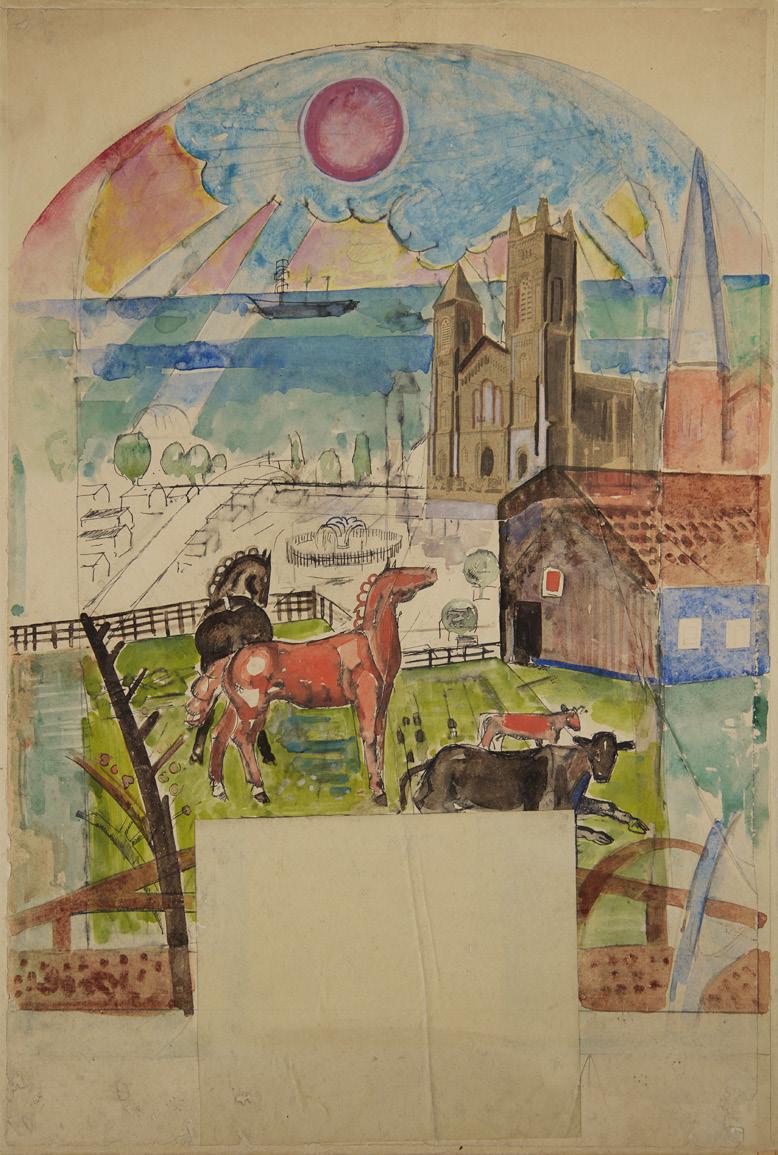
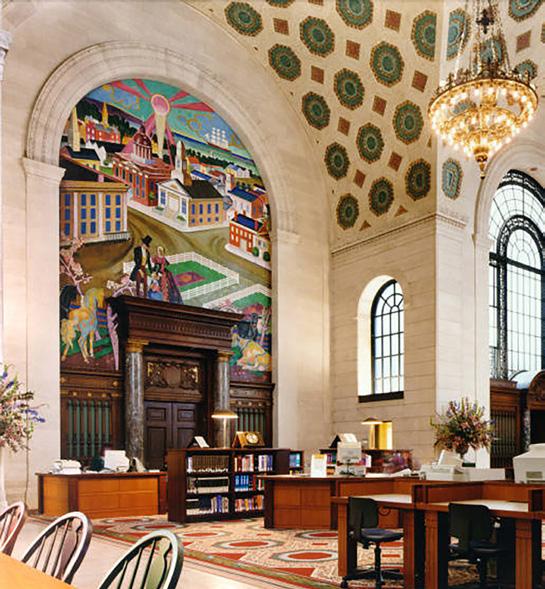
Watercolor, gouache, ink and collage on illustration board
19.25 x 13 inches
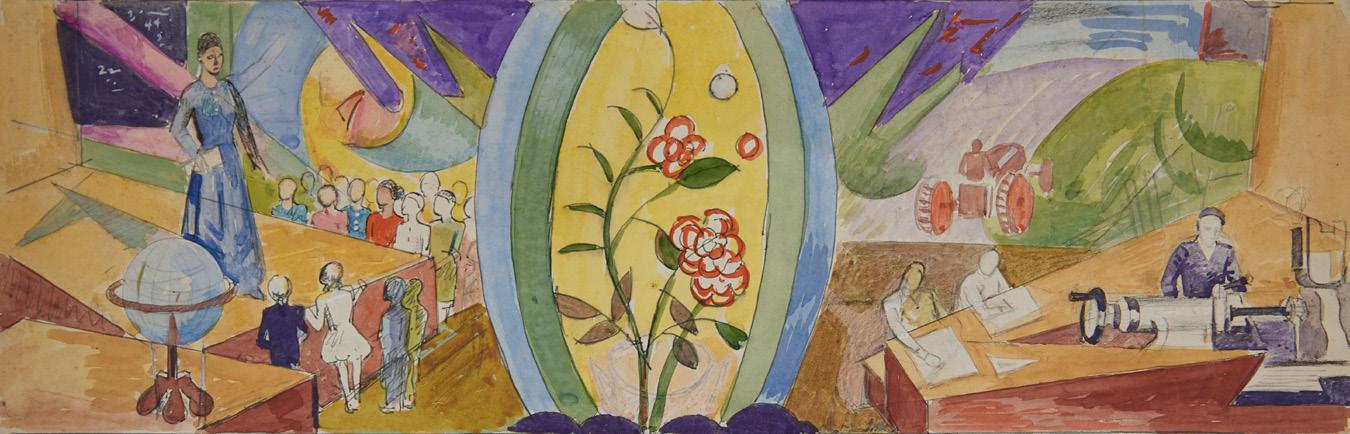
Watercolor, gouache, ink and graphite on paper
Signed with estate stamp verso
12.5 x 18 inches
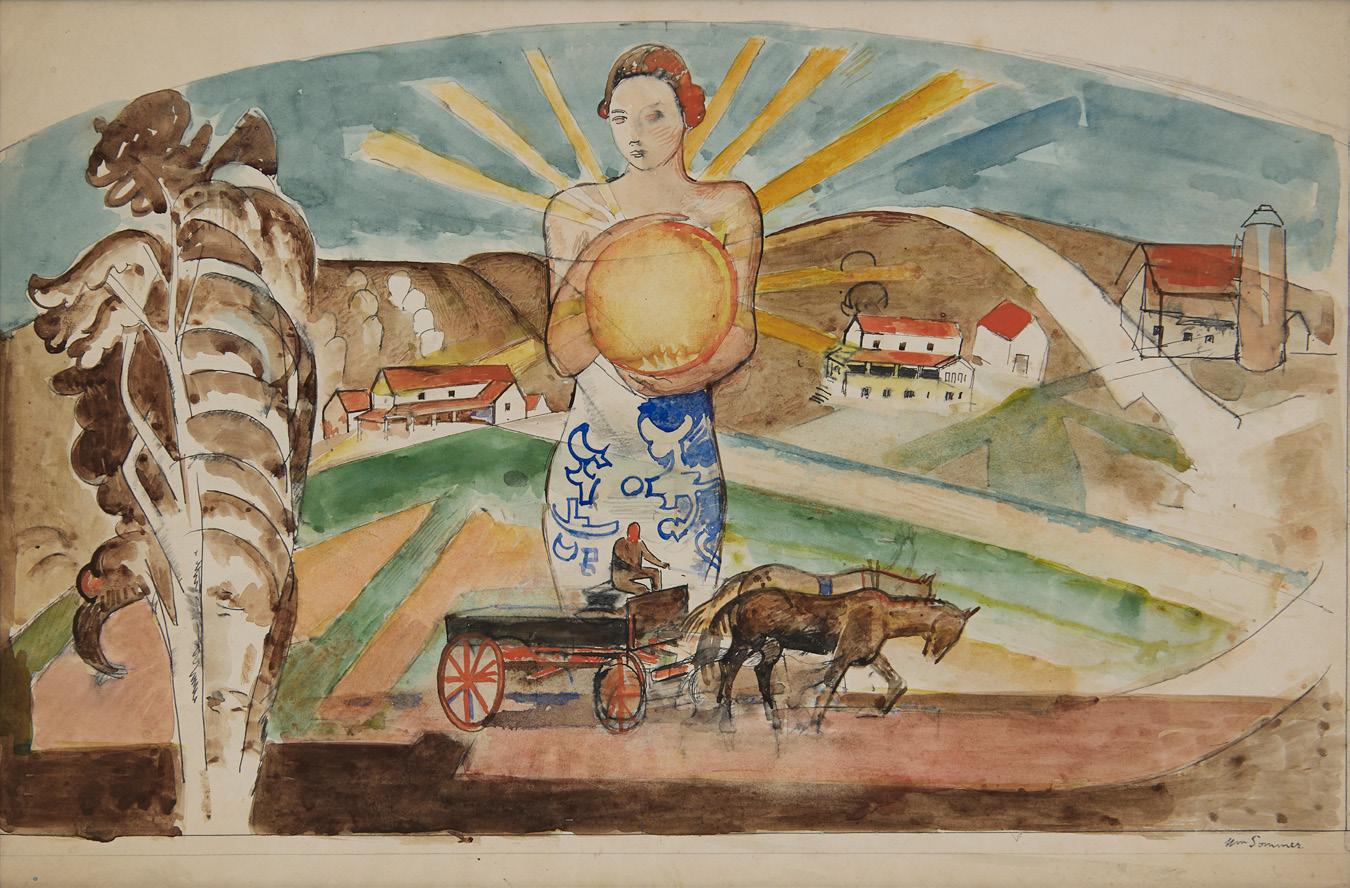
Design for a Mural, c. 1935
Watercolor, gouache, and ink on paper
Signed lower right
12.5 x 19 inches
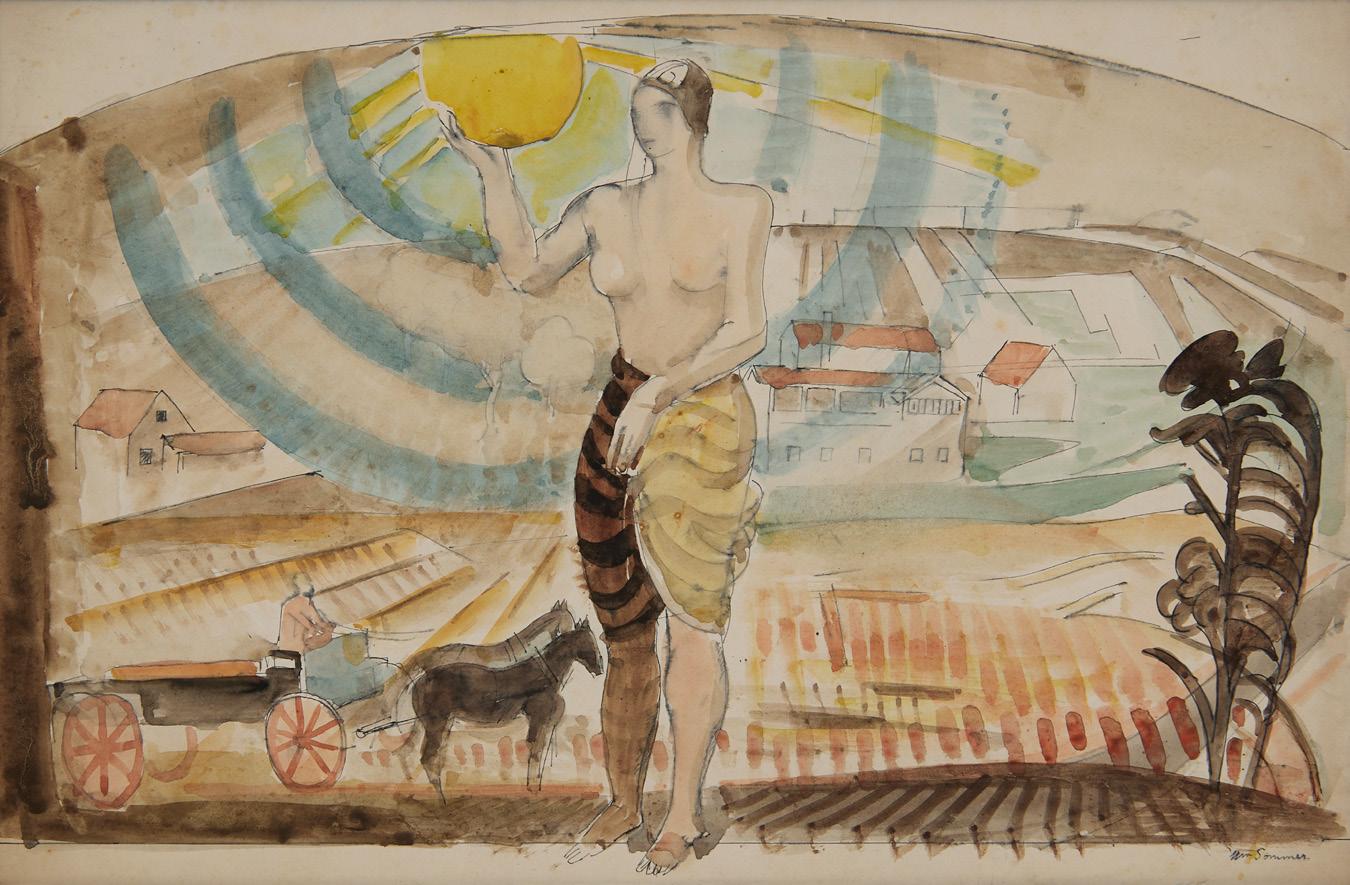
104
Watercolor, gouache, and ink on paper
Signed lower right
12.5 x 19 inches
Sommer painted portraits throughout his life, yet rarely on commission or for commercial gain. He reserved the genre almost exclusively for recording images of family and friends, as seen in his early portraits of his wife, Martha, and their sons.
A highly skilled draftsman, he could render a physical likeness with great precision. His note on a drawing of Madam Hortense Cézanne (fig. 105) reflects the French artist’s emphasis on structural unity: “Cezanne sought the large masses, the broad shadows and the important accents, unity of composition is more important than the model.” Yet, Sommer’s inscription in the upper left of the same drawing indicates an equal concern with philosophical issues: “Unity means being, existence, real substance.” This short note reflects Sommer’s conviction that portraiture was about more than recording appearances—it was a means of exploring the inner life of the sitter. Likeness was secondary to revelation. Expressive force, humanistic interpretation, and spiritual presence took precedence over naturalistic detail.
As Sommer absorbed the lessons of modernism, he increasingly emphasized the essential structure of faces and bodies. Forms became simplified and abstracted; figures were unified with their surroundings through bold color relationships and rhythmic line. He reconceived his own features as a constellation of sharply faceted planes in a self-portrait of about 1918 (fig. 106). Although the composition recalls the angular language of Vorticism, the work is also psychologically charged. Dark triangular eyebrows—distorted in size and shape—draw attention to the eyes, whose slanted pupils suggest a moment
of inward reflection. Similar geometrization informs Man in a Helmet (fig. 107), likely a portrait of the artist’s son William Jr., who served in the army during the First World War and returned home in 1919.
Sommer’s fascination with portraits of children emerged during his early years in New York, perhaps inspired by watching the growth and maturation of his sons. The interest deepened in the 1920s, when he produced a series of portraits exploring the inner psychology of childhood. Richard Sedlon recalled that when Sommer drew children “his lines were full of compassion . . . tender and delicate, yet bore a well-executed strength.”79 Martin Lerner observed that Sommer sought to capture the “quintessential character” of each sitter, noting that his portraits of children “stand apart from anything else produced in America during the first half of the century.”80
Sommer’s remarkable Tiger Boy (fig. 109) is far removed from conventional, sentimental images of childhood. The expression is severe, even unsettling: slanted green eyes— stylized in a manner echoing the modernist fascination with African sculpture—confront the viewer with disarming directness. The oversized hands resemble those of a grown man. A red jacket set against a green chair creates chromatic tension that heightens the portrait’s emotional edge. The boy’s hair unfurls in ribbons of yellow and gold, colliding in rhythmic arcs like wind-tossed waves or the carved locks of an antique sculpture— an imaginative transformation that evokes the restless thought of a powerful interior life. It is tempting to compare the painting with portraits by Amedeo Modigliani, whose elongated faces and stylized features likewise
depart from naturalism. Yet in contrast to the lyrical refinement of Modigliani’s figures, Tiger Boy is more confrontational and emotionally charged, its distortions expressing not elegance but an intensity of inner life.
The contrast between two undated self-portraits offers insight into Sommer’s psychological state during the later stages of his life. The heavy black contours and bold colors of Self-Portrait with Pipe (fig. 120), probably painted in the mid to late 1930s, project strength and rugged self-confidence. The more delicate drawing and softer pastel tones of Self-Portrait in a Purple Robe (fig. 121) correspond more closely with Sommer’s work of the 1940s. His physical appearance supports this dating: the fuller face and lower hairline in Self-Portrait with a Pipe are distinctly different from the thinner face and receding hairline in Self-Portrait in a Purple Robe. The frailty and introspective mood of the latter are especially poignant. Wearing a strange robe with a low circular collar, Sommer appears almost as a visionary figure—a prophet or the high priest of some celestial cult. Most compelling is the haunting stillness of the gaze, suggestive of profound inward contemplation.
Across decades of experimentation, Sommer returned repeatedly to portraiture as both a formal laboratory and a spiritual inquiry. Whether depicting family members, close friends, or confronting his own aging face, he sought not merely to describe but to reveal. Modernist abstraction merges with profound humanism, making portraiture one of the most searching and enduring dimensions of his art. ™
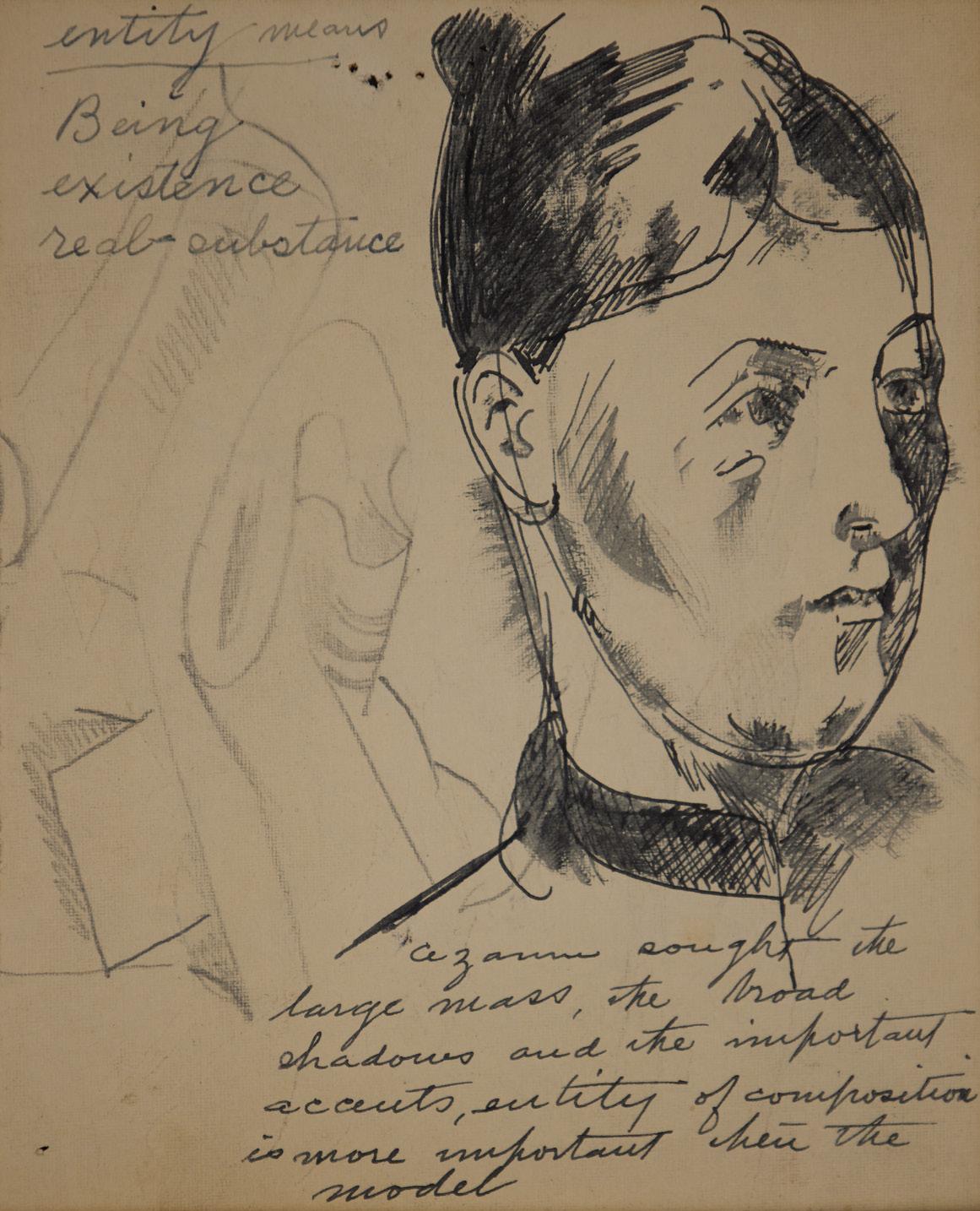
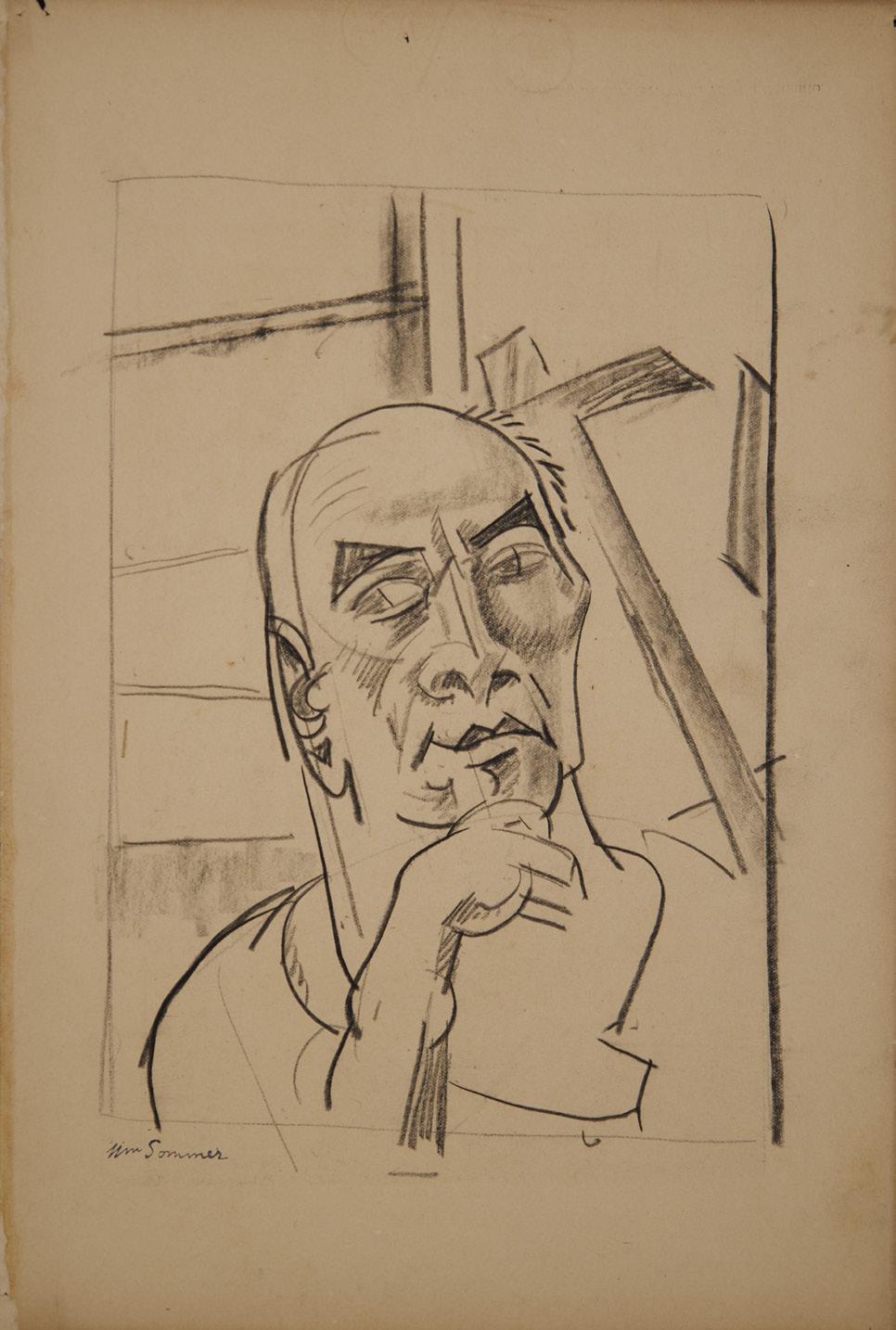
Self-Portrait, c. 1918
Graphite on paper (book page)
Signed lower left 11.5 x 8 inches
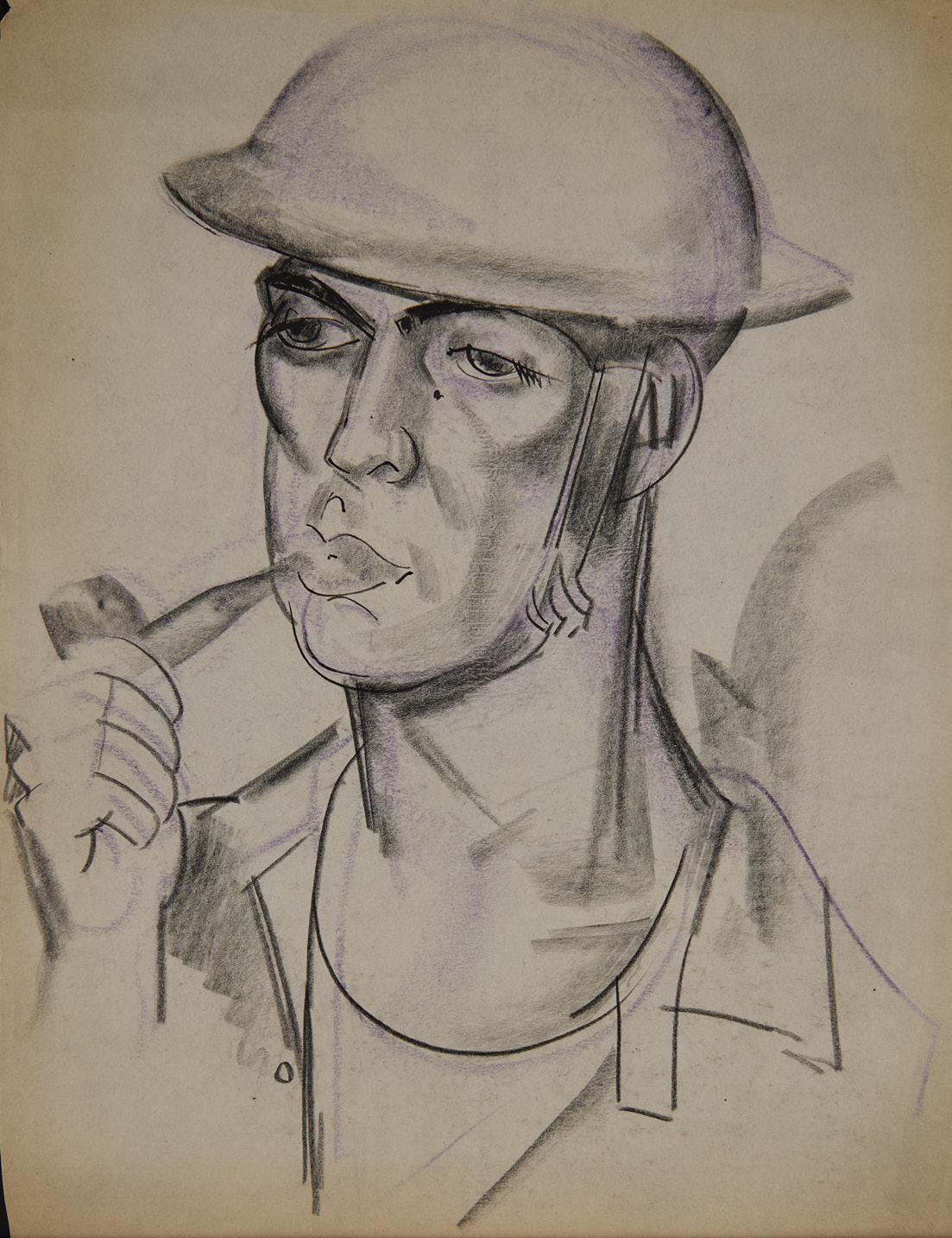
Signed with estate stamp verso 22 x 17 inches 107
Colored pencil, graphite, and ink on paper
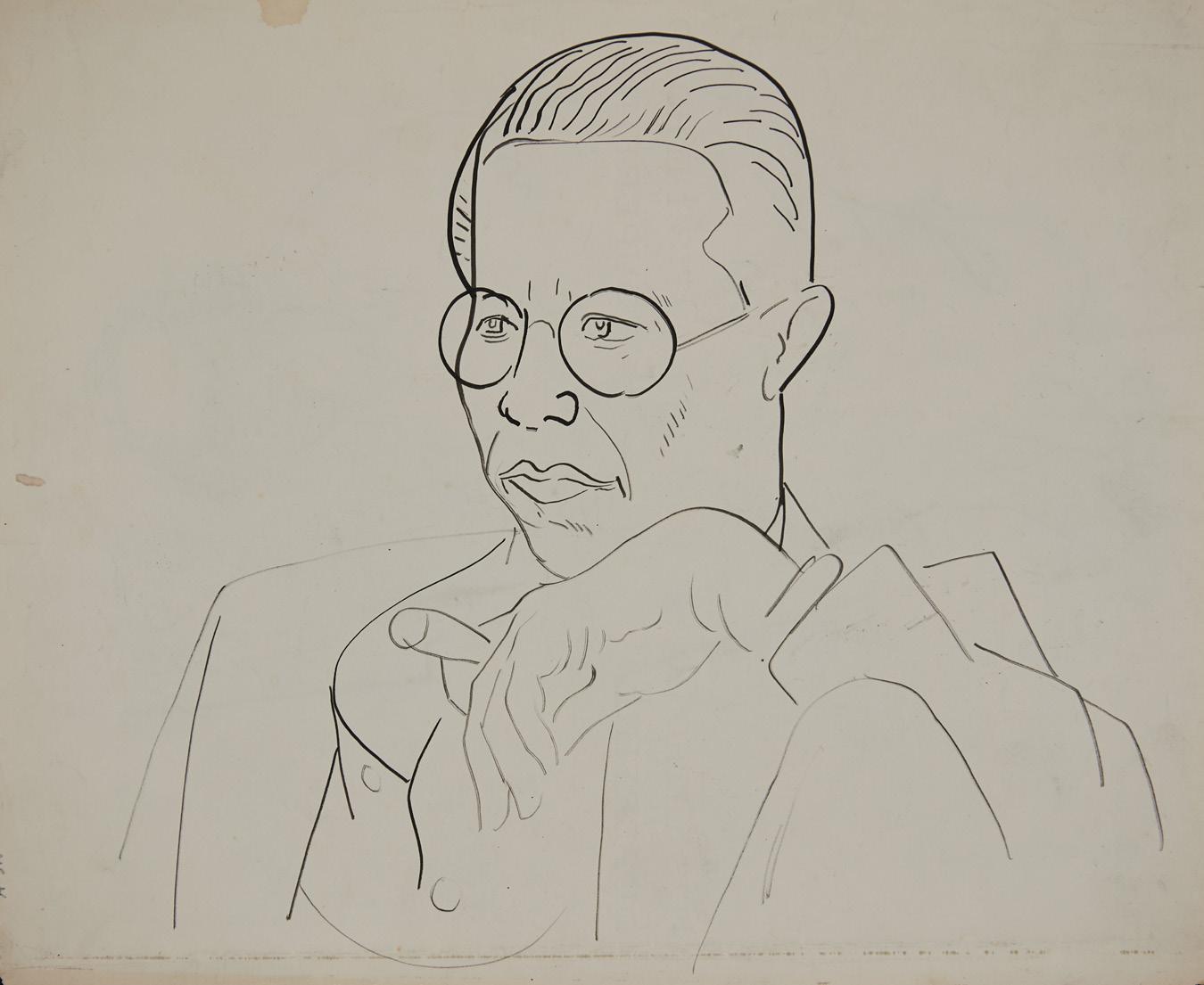
Ink on paper
Signed with estate stamp verso 14 x 17 inches 108
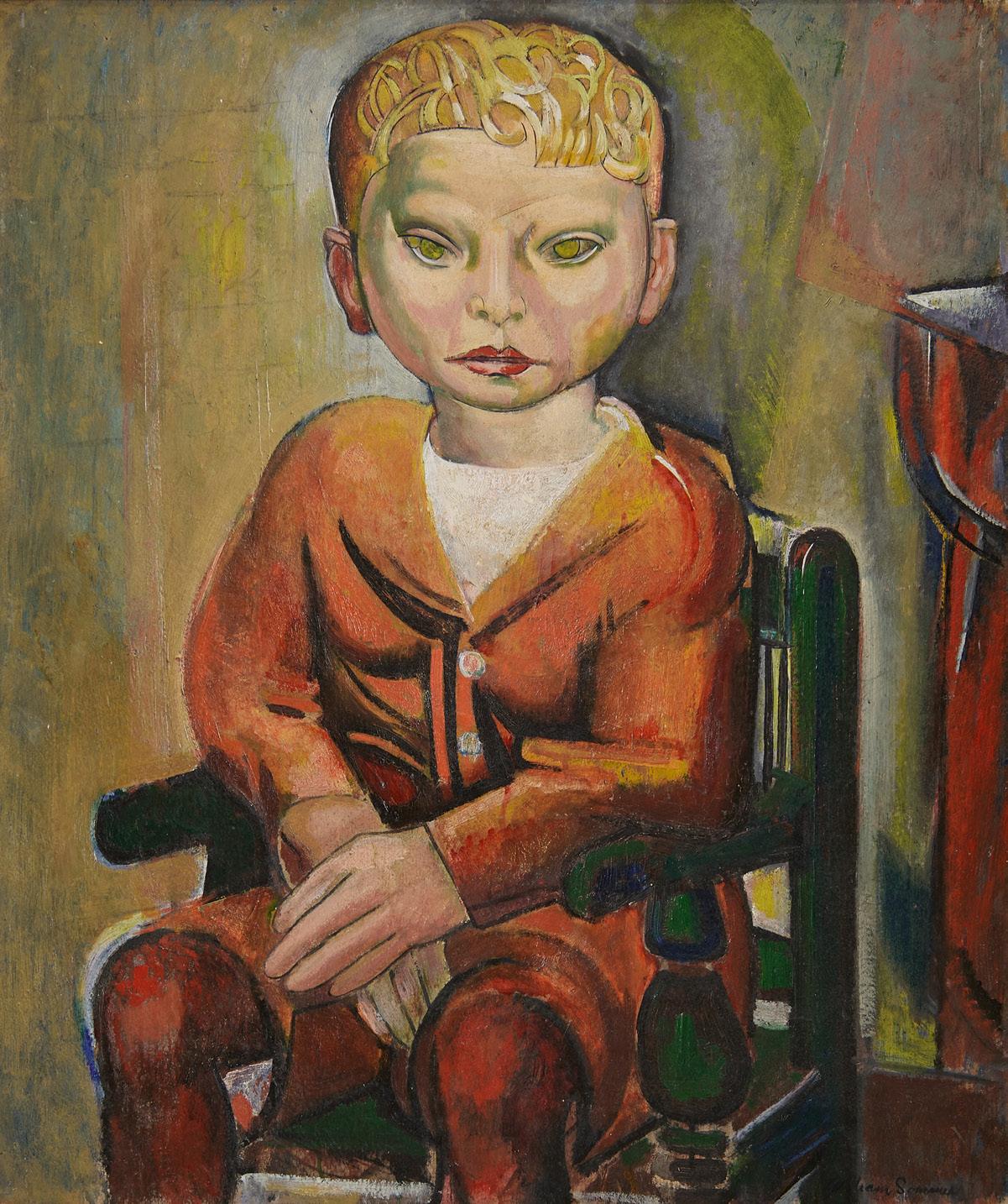
Signed with estate stamp verso
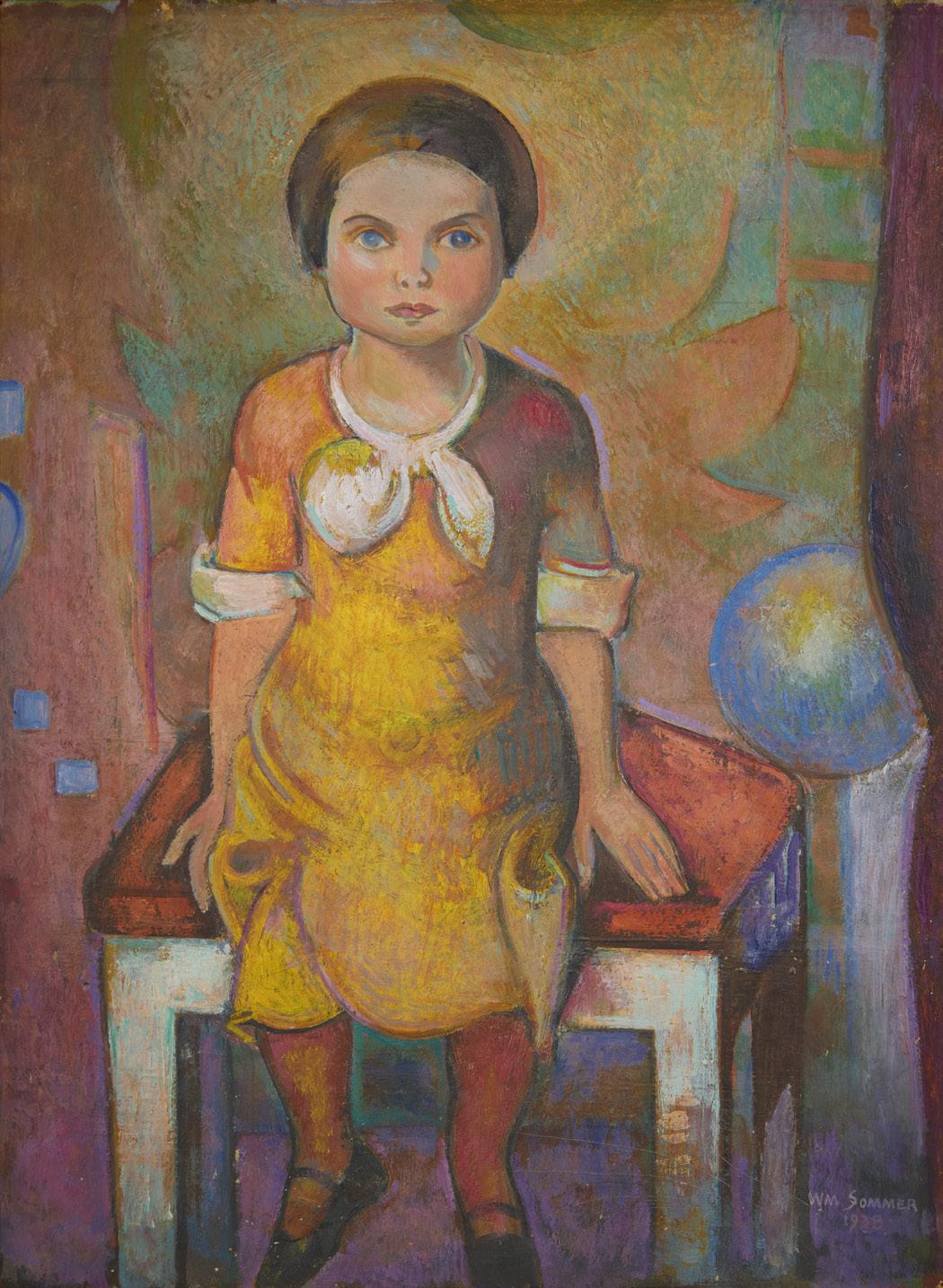
Portrait of June, c. 1928
Oil on board
Signed and dated lower right
24 x 18 inches 110
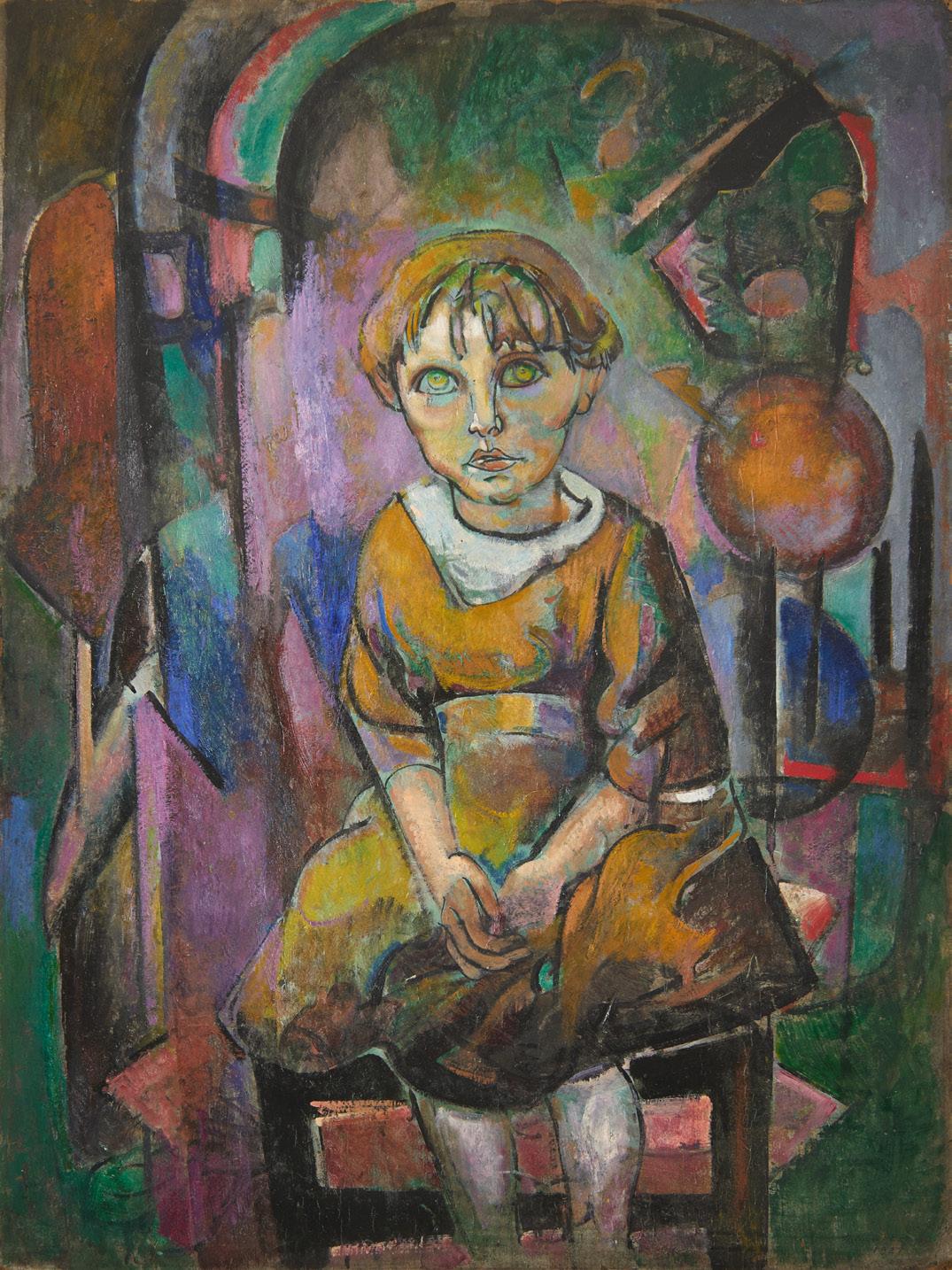
Seated Tess, 1927
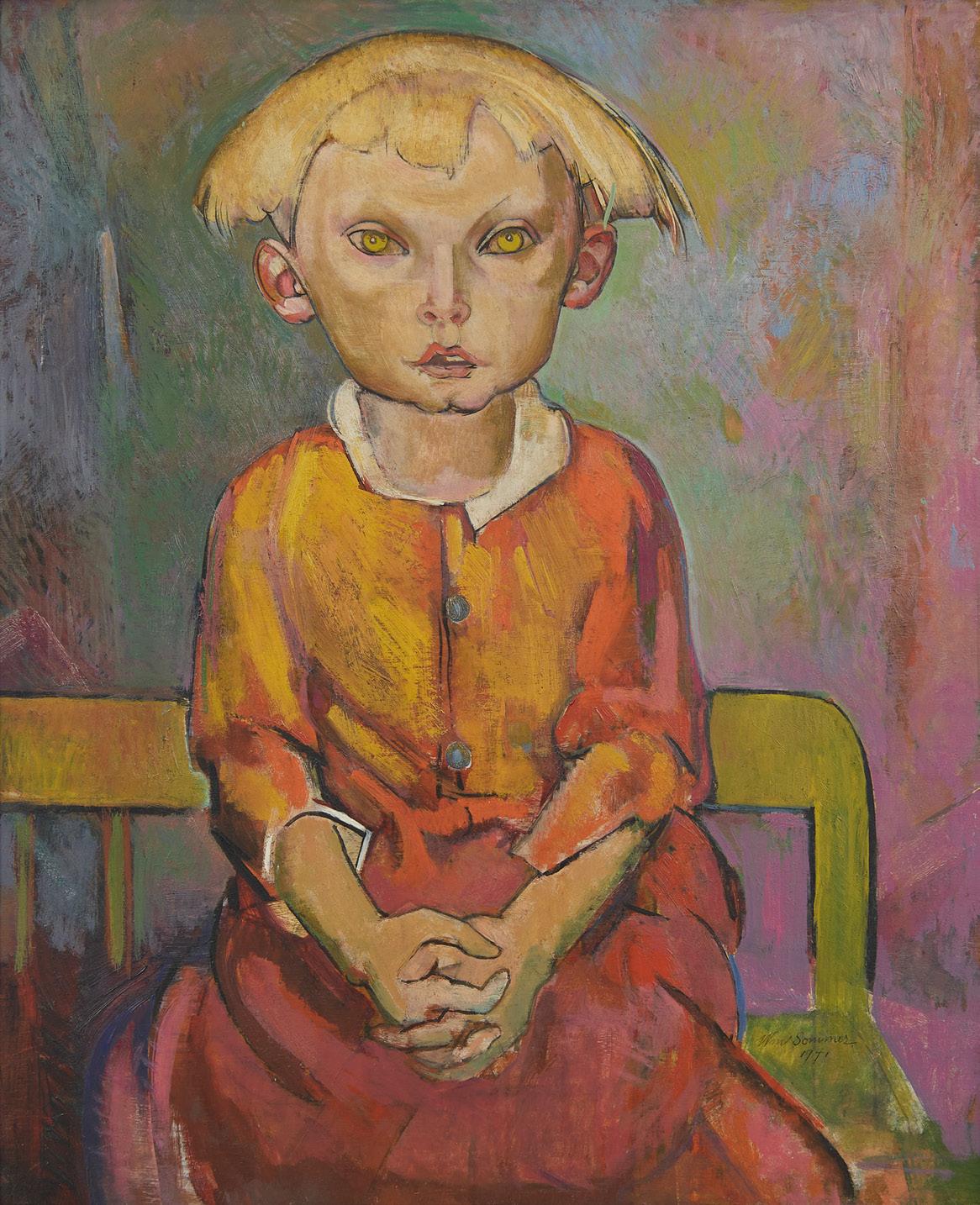
Signed and dated lower right 19.25 x 15.75 inches
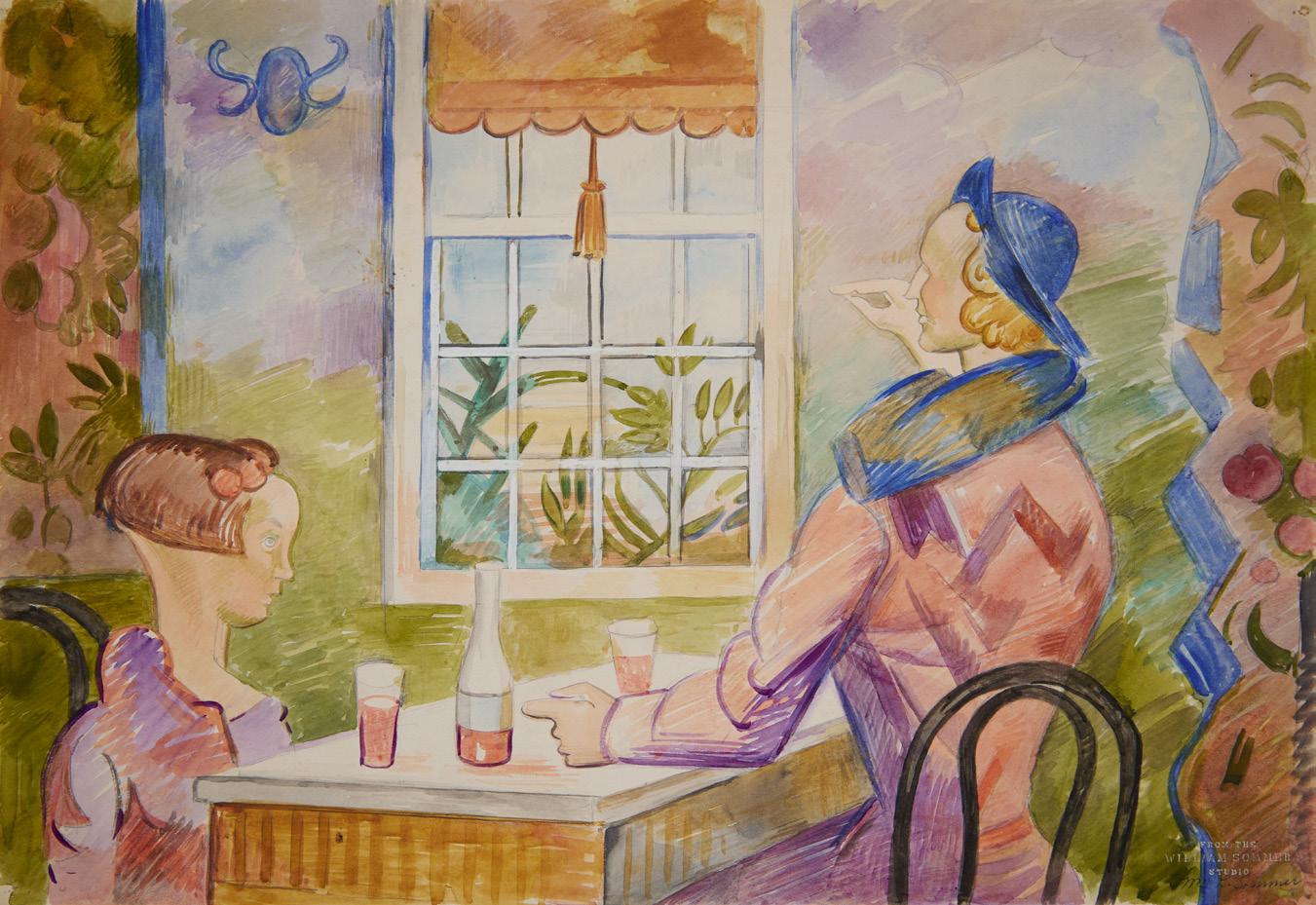
Afternoon Tea, c. 1940
Watercolor on paper
Signed lower right
12.5 x 18 inches
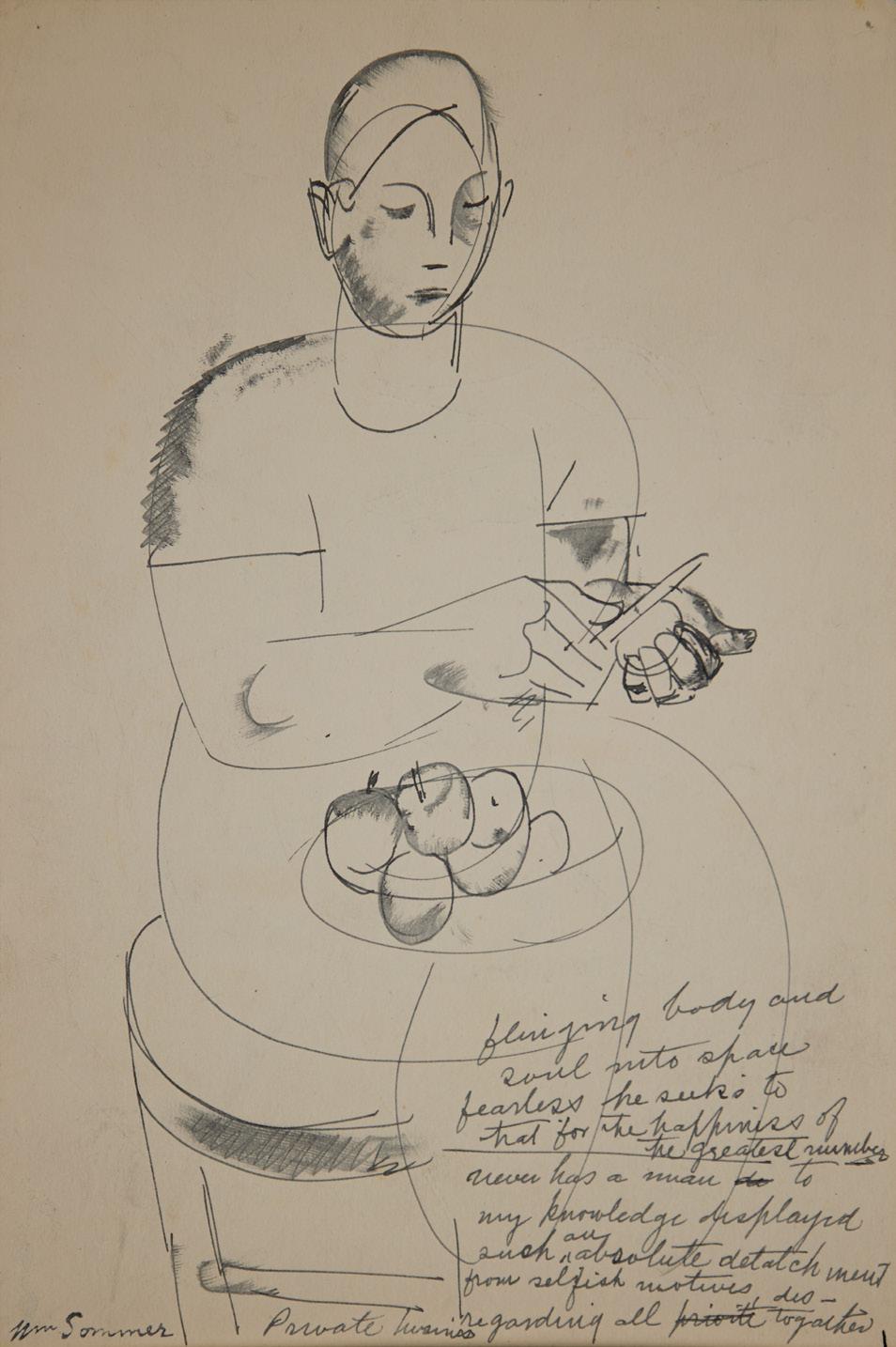
Ink and graphite on paper
Signed with estate stamped lower left 9 x 6 inches 114
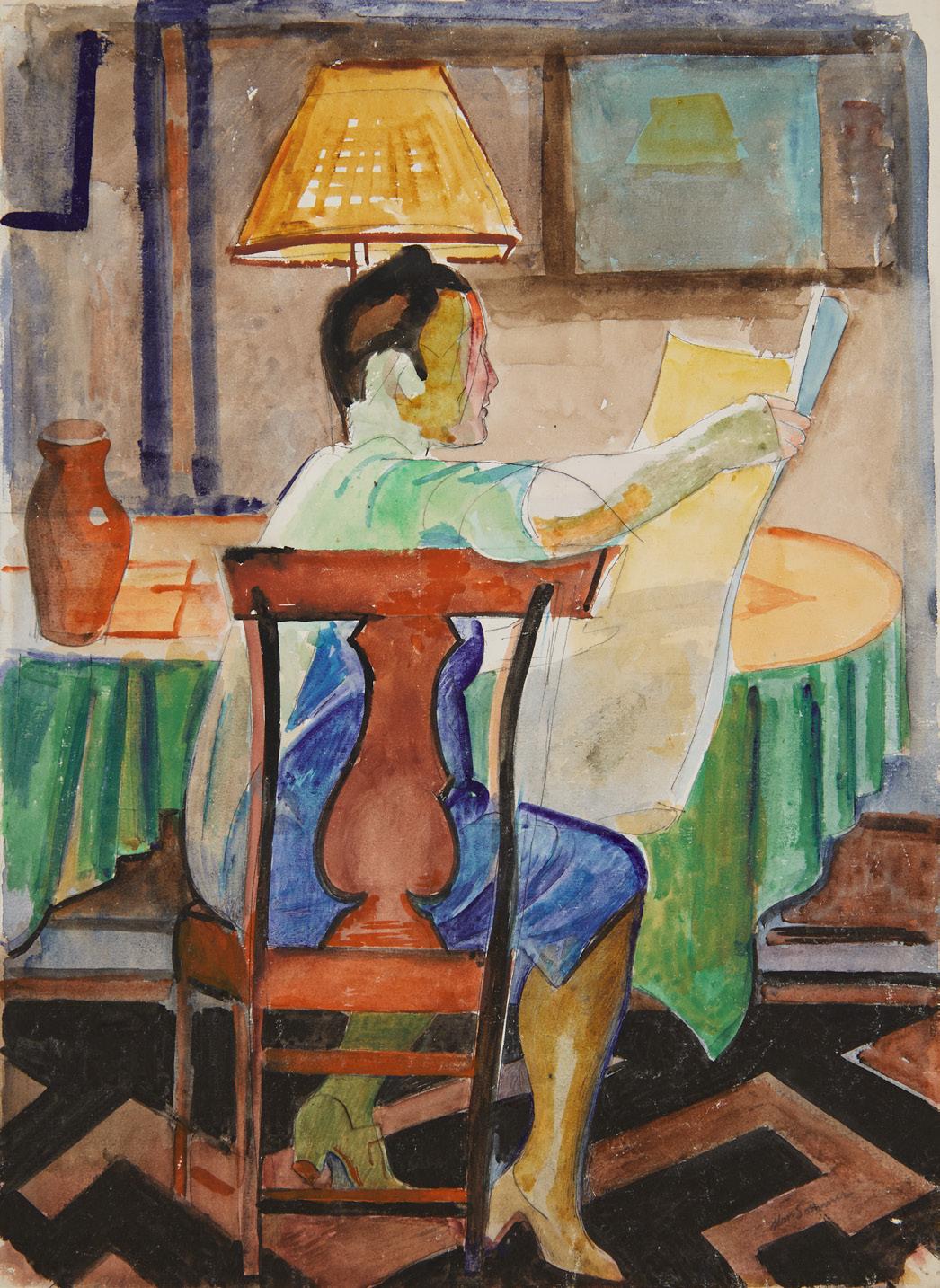
Martha Reading a Newspaper, c. 1920
Watercolor and ink on paper
Signed lower right 16 x 12 114A
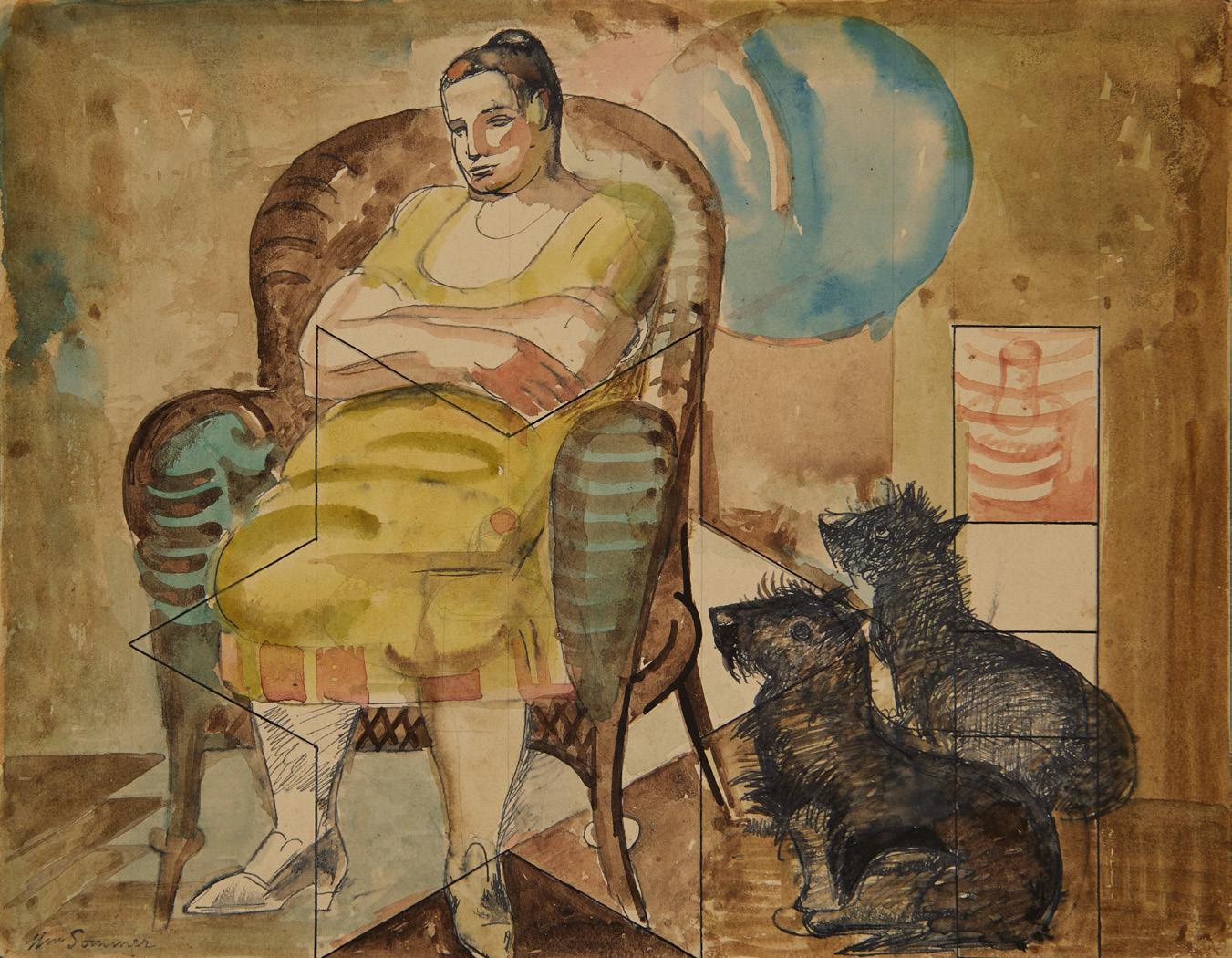
Martha and Scotties, c. 1923-26
Watercolor and ink on paper
Signed with estate stamp lower left
9.5 x 12 inches 115
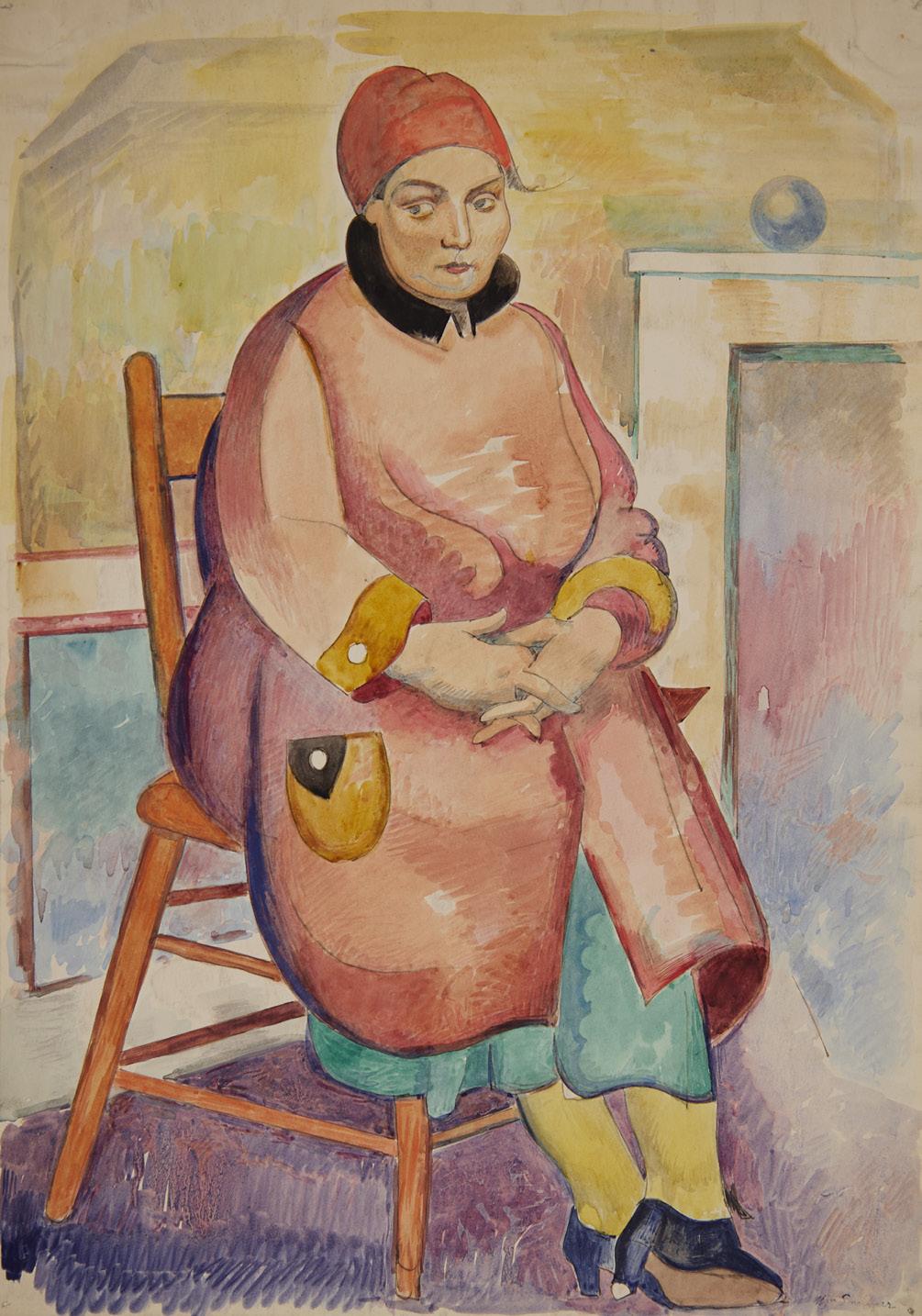
116
Martha in a Winter Coat, c. 1925
Gouache, watercolor, and ink on paper
Signed with estate stamp lower right
18 x 12.25 inches
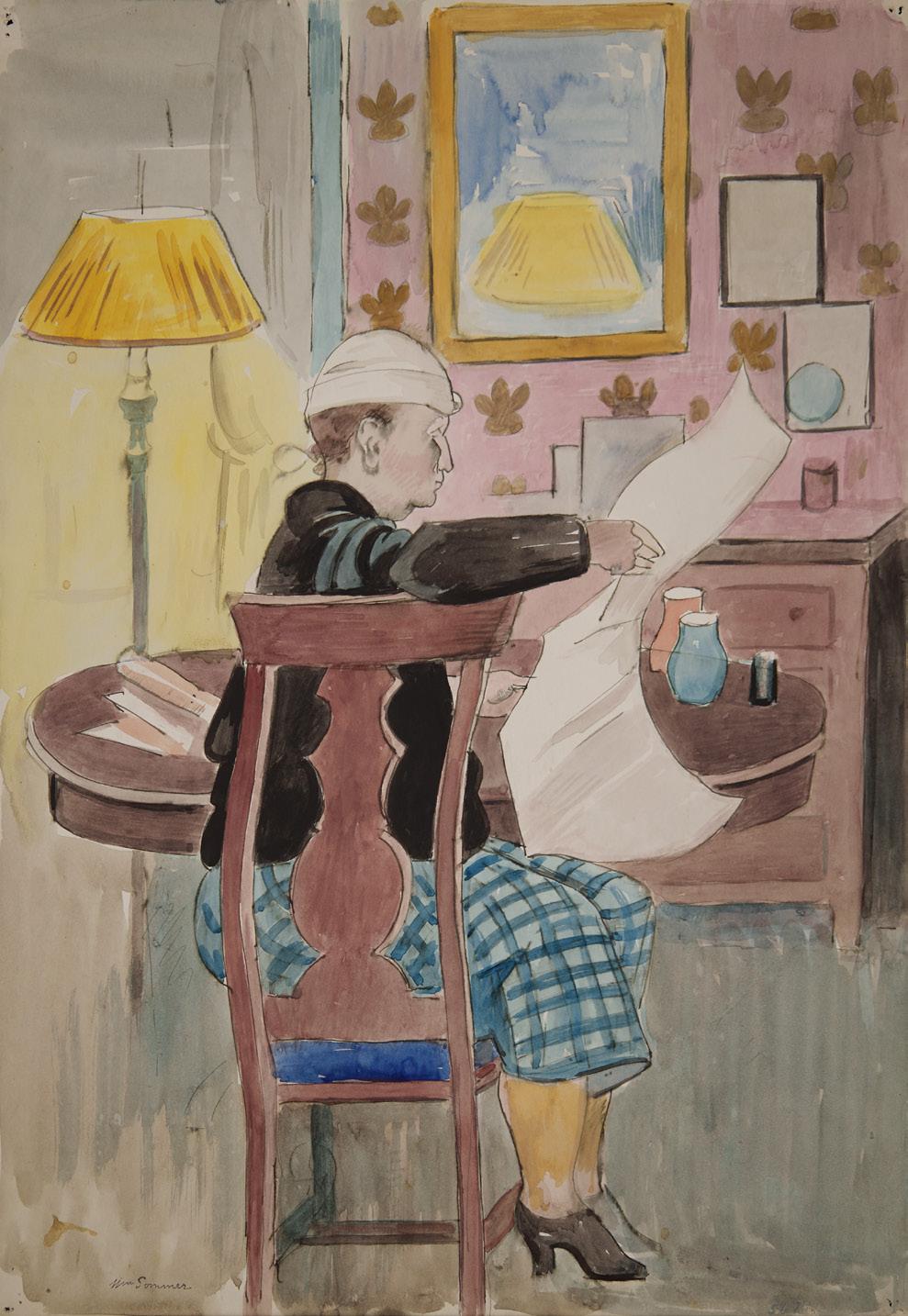
117
Martha Reading a Newspaper, c. 1940
Watercolor, gouache, and ink on paper
Signed lower left
18 x 12.5 inches
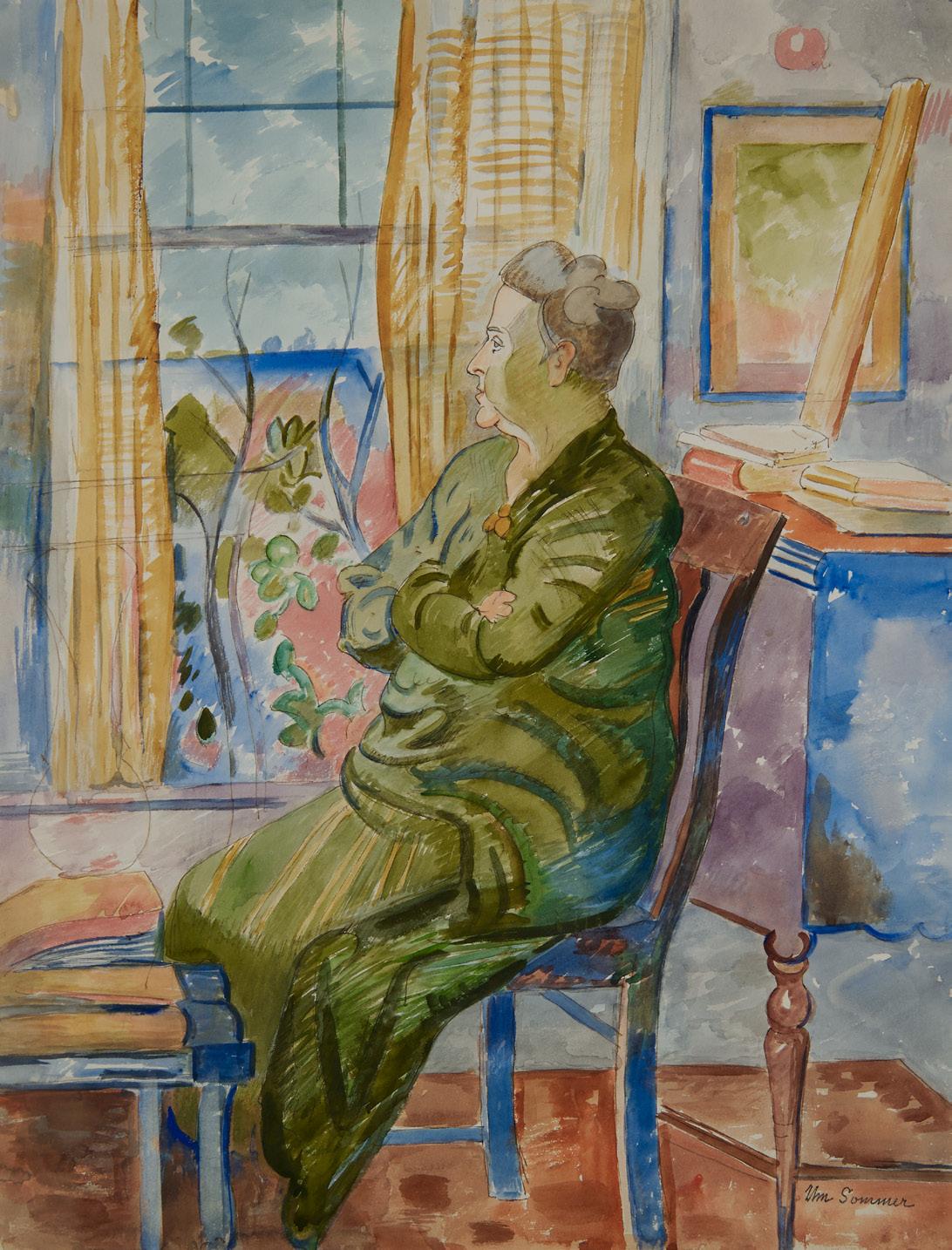
118
in a Green Dress, c. 1944
Watercolor on paper 14 x 19 inches
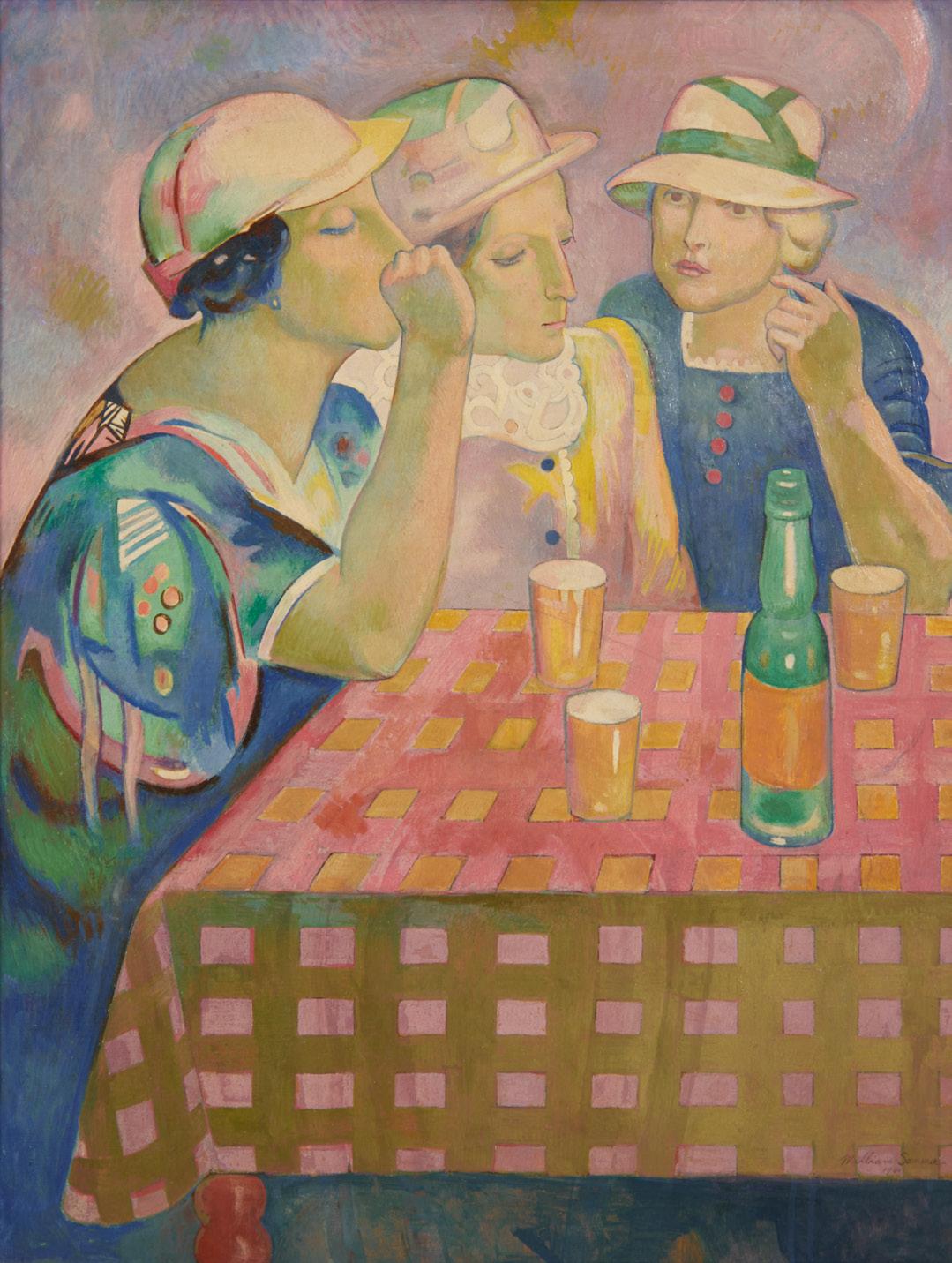
Three Friends, 1941 Oil on canvas
Signed and dated lower right 26 x 20 inches 119
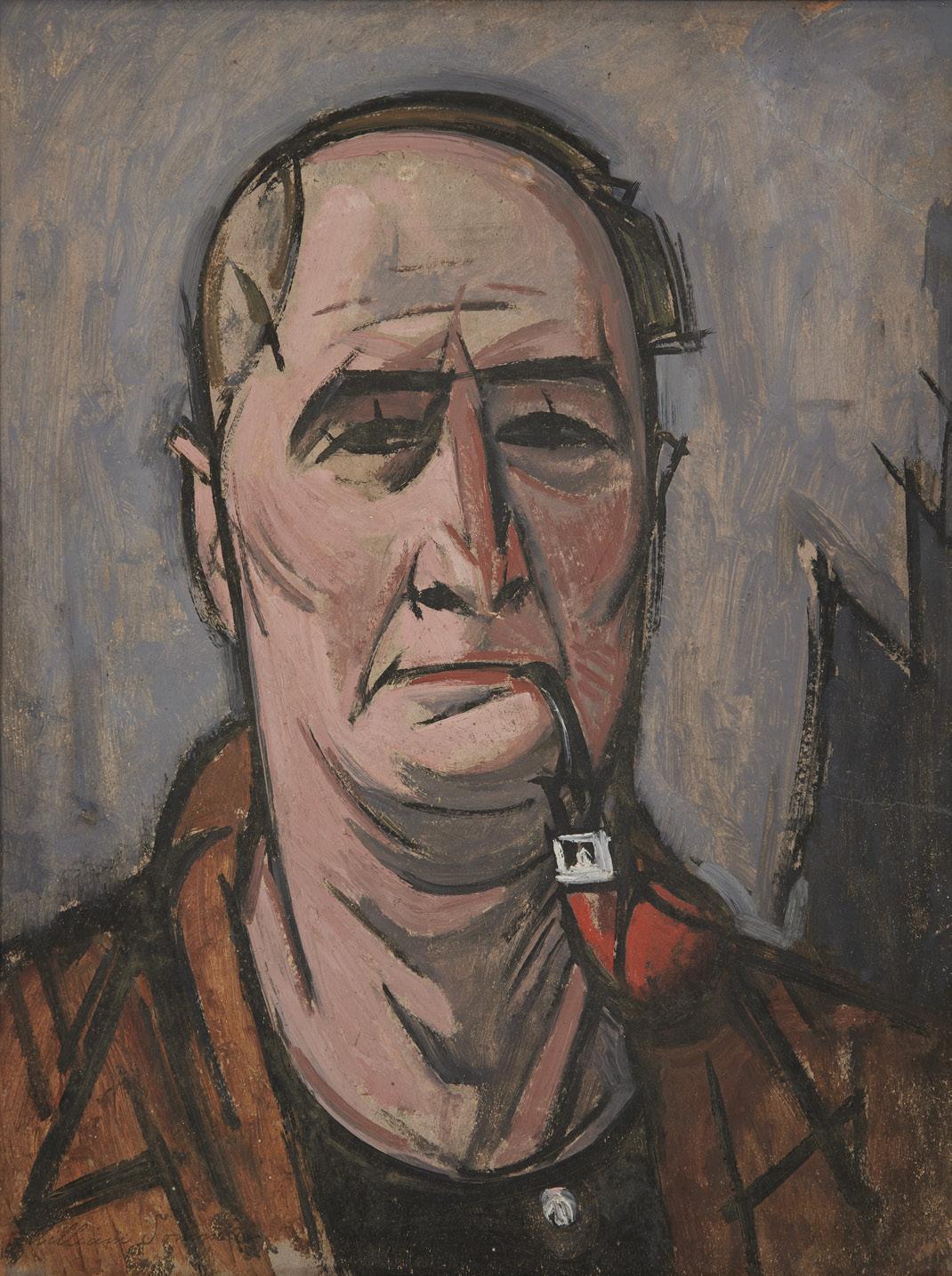
120
Self-Portrait with Pipe, c. 1935
Oil on paper panel
Signed lower left
19 x 14.5 inches
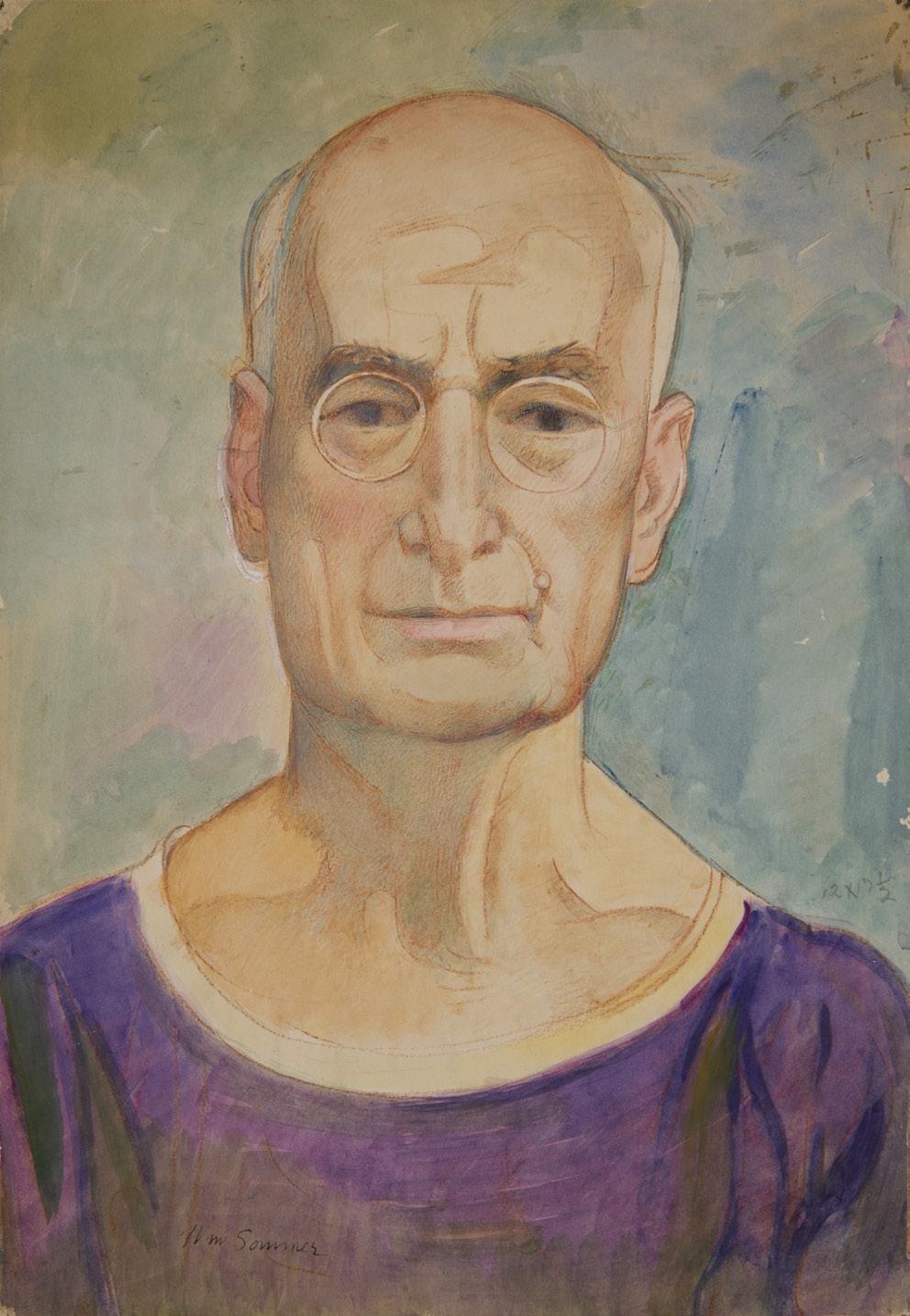
Watercolor on artist board
Signed lower left 17.5 x 12 inches
Sommer was devastated by the death of his wife Martha in February 1945. In a letter written soon afterward, he confessed that “the most terrifying suffering we have gone through in 50 years was when our Mart passed out to the beyond; all energy left our soul.”81 Overcome by grief, he sank into recurring bouts of depression and heavy drinking. Her death marked a profound rupture in his emotional and artistic life. For nearly a year he was unable to paint and depended heavily on friends for support. In 1946, a probate court appointed the Akron Art Institute (now the Akron Art Museum) the custodian of his works, ensuring their preservation and allowing his slow return to normal life. As part of a project to photograph Cleveland artists, Henry boynton captured Sommer at his easel around 1947. Carefully lit and composed, the image reveals a kind, gentle presence, but little of the inner turmoil that shadowed his final years.
On June 20, 1949, Sommer died peacefully in his sleep at his home in brandywine. A year later, the Cleveland Museum of Art mounted a large memorial exhibition that prompted Aline Louchheim to publish an eloquent tribute in the New York Times (November 5, 1950). “It is astonishing,” she wrote, “that an artist of the stature of William Sommer should be so little known outside the Cleveland area for which he made his home. For this artist... surely deserves a place high in the roster of American artists.”82 Three decades later, Hilton Kramer praised Sommer’s mastery of the “Cézannean lesson of combining color and drawing,” though his assessment did not fully acknowledge the originality with which Sommer synthesized Fauvism, Cubism, and Vorticism.83
Like many critics writing from a national perspective, Kramer had limited exposure to the full range of Sommer’s achievements.
Although Sommer participated in large group exhibitions outside Ohio, his works were mostly lost in these vast surveys, and he remained best known among artists, collectors, and art historians in Cleveland.84 As Hart Crane observed, Sommer showed little interest in promoting himself or cultivating influential dealers and wealthy patrons. He was notorious for refusing to compromise his principles or his work. When asked by a client to alter one of his paintings, he refused, remarking that “art is a spirit voice and once its identity is known . . . it would be a sacrilege to touch it.”85 Such statements reflect a temperament guided less by career ambition than by fidelity to inner conviction.
One recurring criticism of Sommer’s art was voiced by Alfred Stieglitz when he told Crane that his paintings often appear “unfinished.”86 Yet this charge overlooks the modernist redefinition of finish itself. Like Cézanne and Picasso, Sommer rejected academic polish in favor of immediacy and structural vitality. What some perceived as incompleteness was, in fact, an embrace of ambiguity and becoming—a deliberate openness that preserved the pulse of perception. His paintings privilege energy over refinement, revelation over resolution.
A fuller view of Sommer’s oeuvre reveals an artist deeply committed to the primacy of perception and the essential unity of humanity and nature. Intellectually engaged with music and philosophy, he sought through art a heightened state of awareness—an echo of the Dionysian “will to life.” The writer and critic
Richard Sedlon described him as a “most unusual soul” and a “philosopher of life,” whose convictions shaped every stroke of his brush.87 For Sommer, art was not illustration but manifestation—a spontaneous creation of the spirit, grounded in lived experience yet reaching toward the transcendent.
Seen in its fullest scope, Sommer’s achievement extends far beyond stylistic innovation or regional identity. Largely selfeducated, he fashioned a personal philosophy of art grounded in intuition, observation, and an expansive vision of universal spirituality. In the rhythms of landscape, the vitality of animals, and the charged harmonies of color and line, he sought evidence of a living energy animating the natural world. Painting became an act of discovery—an effort to approach the deeper order he believed lay beneath the visible world. His brush moved with a freedom often compared to music: improvisational,
passionate, and responsive to the pulse of experience.
For Sommer, art was never merely descriptive; it was a metaphysical reflection of reality itself, an attempt to reveal the deeper energies linking humanity, nature, and spirit. His paintings stand not only as singular contributions to American modernism but also as enduring meditations on life, freedom, and the generative power of the creative spirit.
Rooted in the landscape and community of Ohio—yet conversant with the most advanced European movements of his time—William Sommer forged one of the most original and distinctive bodies of work in American art, a testament to the enduring vitality of his visionary modernism.
William H. Robinson
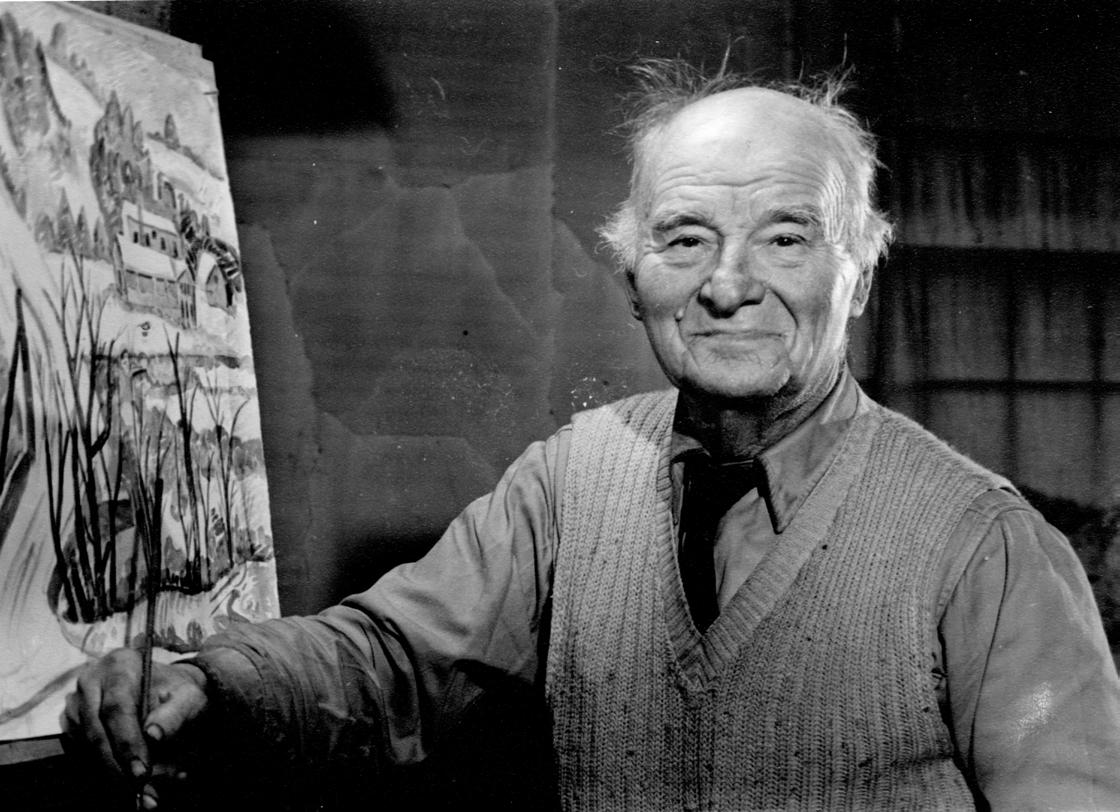
1 William Sommer Papers, Archives of American Art, Smithsonian Institution, Washington DC.
2 James L. Kocour, “bill Sommer Data,” typed manuscript, transcribed in Hunter Ingalls, “Several Dimensions of William Sommer,” PhD dissertation, Columbia University, New York, 1970, 230. Dr. Kocour was a personal friend of the artist.
3 boy with a Guitar is inscribed “[18]90 Netherfield.” In 1911, Sommer later told Spencer Adams that he worked at the Forbes Lithograph Company in boston and the Stafford Lithography Company in Nottingham, England. The reason for the discrepancy between this account and what Sommer told later biographers, such as James Kocour, is unclear. See Spencer Adams, “Kokoon Klub,” Cleveland Town Topics (August 26, 1911), 13.
4 Johann Herterich is sometimes confused with his younger brother, Ludwig van Herterich, who also taught at the Munich Academy of Fine Arts, but not until 1898.
5 Elizabeth McClelland, William Sommer: Cleveland's Early Modern Master (Cleveland: John Carroll University, 1992), 10.
6 Some sources say he moved to New York before going to England, but this seems to be incorrect. See Kocour’s detailed account of the period, reprinted in Ingalls, 232-233.
7 Sommer also lived in New Jersey during this period; see McClelland, 13.
8 William L. Milliken, The William Sommer Memorial Exhibition (Cleveland: Cleveland Museum of Art, 1950), 12.
9 Twelfth Annual Exhibition, New York Watercolor Club (1901), 7, no. 227.
10 Robert bordner, “William Sommer—the Artist,” Cleveland Press (August 6, 1932), 5. The National Academy has no record of the exhibition; see Ingalls, 32.
11 Richard Sedlon, “William Sommer,” typed manuscript, Sommer Papers, Archives of American Art, 6.
12 Sommer rarely dated his paintings and sometimes post-dated them to conform with rules for the Cleveland Museum of Art’s annual May Show. However, the date of 1911 for Lake Erie Cliff, Lakewood seems consistent with Sommer’s artistic development.
13 This claim about the bridge appears on a postcard dated 1912. The bridge began to deteriorate in the 1960s and was replaced by a new bridge just to the south in 1980. The original bridge was subsequently demolished, leaving only the west piers, now providing the foundation for a UbS financial services building.
14 The painting was sold at auction under the title Fauve Trees with Moorings, but this is probably not the original title as Sommer would not likely have included the word “Fauve.”
15 Quoted in Spencer Adams, “He Joined the Post-Impressionist Ranks,” Cleveland Town Topics (October 14, 1916), 19.
16 The watch tower, formerly on the estate of Ann Schlater Gibson, no longer exits. Sommer’s painting Rocky River bridge (c.1913, Shoreby Club, Cleveland, Ohio) depicts the tower at the southwest base of the Rocky River bridge, a site now occupied by a modern apartment building. The watch tower should not be confused the clock tower in Clock Tower Park at the intersection of Lake Road and Avalon Drive in Rocky River.
17 Henry Adams, Painting in Color (Cleveland: Cleveland Artist’s Foundation, 2013), 36. In response to rising antiGerman and anti-Jewish attitudes during the First World War, Louis Rohrheimer (1872–1939) changed his name to Rorimer in 1917. He was the father of James Rorimer (1905–1966), director of the Metropolitan Museum of Art from 1955 to 1966.
18 Abel G. Warshawsky, The Memories of an American Impressionist, ed. ben L. basham (Kent, Ohio: Kent State University Press, 1980), 138.
19 Raymond T. Evans, “William Sommer—Poetic Artist,” bA Thesis, Princeton University, 1957, 9.
20 In 1907 and 1908, Zorach studied at the National Academy of Design during the fall and winter year and worked at Otis Lithography in Cleveland during the summer. He was known as William Finkelstein until December 1912, when he changed his last name to Zorach.
21 Sommer Papers, Archives of American Art.
22 William Zorach to Henry Francis, June 1, 1950, reprinted in Ingalls, 236.
23 Adams, Pure Color, 62.
24 Artist’s statement in The Forum Exhibition of Modern American Painters, exh. cat. (New York: Forum Gallery, 1916), 1.
25 Spencer Adams, “Secessionists Again,” Cleveland Town Topics (March 2, 1912), 9.
26 In March 1914, Zorach lent his painting Spring (1913, Art Institute of Chicago) to a group exhibition at the Taylor Gallery in Cleveland.
27 Adams, “Secessionists Again,” 9-10.
28 William Finkelstein (Zorach) to Marguerite Thompson, November 12, 1912, quoted in Adams, Pure Color, 79. In April 1913, Sommer’s painting The Rabbit Hutch was also singled out for praise in a review of a group exhibition at the Rowfant Club; see Waldman chronology in Pure Color, 113.
29 Sommer said that he did not “begin to live until I saw the international exhibit of the new art in New York last winter.”
See “Paint Square like an Ant Hill, Not Pavement, Says Sommer,” Cleveland Leader, January 18, 1914, cited in Adams, Out of the Kokoon, 37.
30 Sommer note/sketchbooks, Kelvin Smith Library, Case Western Reserve University, Cleveland, Special Collections, quoted in McClelland, 25.
31 Ingalls, 128.
32 Zorach letter to Mrs. Henry Francis, June 1, 1950, reprinted in Ingalls, 236.
33 Ibid.
34 McClelland, 31-33.
35 I would like to thank Nick Janigian for sharing his research on Sommer’s house and other sites in brandywine.
36 William Sommer notes, Cleveland Museum of Art, quoted in Ingalls, 94.
37 John Unterecker, Voyager: A Life of Hart Crane (New York: Farrar, Strauss and Giroux, 1969), 203.
38 Sommer Notes, Cleveland Museum of Art, quoted in Ingalls, 197.
39 Spencer Adams, “He Joined the Post-Impressionist Ranks,” Cleveland Town Topics (October 14, 1916), 19.
40 Sommer Notes, Erdelac Collection, quoted in Ingalls, 199.
41 Ibid.
42 Sedlon, 2.
43 Charles E. burchfield Journal, March 18 and 20, 1915, burchfield-Penny Art Center, buffalo, New York.
44 Hart Crane to Gorham Munson, April 10, 1921; see brom Weber (ed.), The Letters of Hart Crane (New York: Hermitage House, 1952), 54-55.
45 Crane to Munson, May 16, 1921, Weber, Letters, 57.
46 Crane to Munson, October 12, 1922, Weber, Letters, 102
47 Crane to Munson, January 5, 1923, Weber, Letters, 113.
48 Unterecker, 270.
49 Langdon Hammer (ed.), Hart Crane: Complete Poems & Selected Letters (New York: The Library of America, 2006), 6.
50 Sommer Papers, Archives American Art.
51 Sedlon, 2.
52 Ibid.
53 Although O’Neil made the comments in a review of a Henry Keller exhibition, admiration for Nietzsche was widely shared among the city’s progress artists, including Sommer, Zorach, and burchfield. Raymond O’Neil, “Keller Gives the best One Man Exhibition,” Cleveland Leader (April 25, 1915), IV-5.
54 Ingalls, 123, plate 44.
55 “Play Group to Stage ‘Everyman,’ Uniquely,” Cleveland Town Topics (May 18, 1918), 17.
56 Ingalls, 209-210.
57 Swiss psychologist Carl Jung (1875-1961) presented these concepts in Symbols of Transformation (1912) and The Structure of the Unconscious (1916).
58 The current title Tubes in Landscape was apparently given by the Hirshhorn Museum. Several Kokoon Klub artists
jokingly dubbed the painting “the flying sewer pipes.” Sommer explained that it depicts a storm coming over the valley. See Ingalls, v, x, 215, 217.
59 Sommer Papers, Archives of American Art.
60 Ingalls, 104.
61 Ingalls, 135.
62 Spencer Adams, “Secessionists Again,” (March 2, 1912), 9.
63 D. Undine baker, “An Evening with the Klub,” Cleveland Town Topics (March 27, 1915), 15-16.
64 Richard Sedlon, “A Memoir of William Sommer,” unpublished manuscript, April 19, 1970, cited in Henry Adams, Out of the Kokoon (Cleveland: Cleveland Public Library, 2011), 39.
65 Sedlon, 4.
66 Philip Kaplan, “Look for the Miracle!” undated typed manuscript, William Sommer Papers, Archives of American Art.
67 Adams, “Secessionists Again,” 9.
68 Wilson Smith, article from an unidentified newspaper, cited in Ingalls, 53.
69 Kaplan, “Look for the Miracle!” William Sommer Papers, Archives of American Art.
70 Adams, Out of the Kokoon, 38.
71 Sedlon, 4, 5, 18.
72 Sedlon, 10.
73 Sedlon, 3.
74 William Sommer, notes in undated sketchbook, Sommer Papers, Archives of American Art.
75 Ibid.
76 The building at 1771 East 30th Street was designated a historical landmark in 2021.
77 Sommer may have continued to work intermittently at Morgan during the 1930s.
78 Milliken, 81.
79 Sedlon, 6.
80 Lerner, 4.
81 McClelland, 76.
82 Aline b. Louchheim, “For a Native Son: Cleveland Museum Opens Memorial Show of the Work of William Sommer,” New York Times (November 5, 1950), 10, section two.
83 Hilton Kramer, “An Early Provincial Modernist,” New York Times (June 29, 1980), 26, 28.
84 Sommer was a frequent contributor to the annual May Shows at the Cleveland Museum of Art, the Kokoon Arts Klub, and other Ohio venues. His works were also included in large group exhibitions at the New York Water Color Club (1901); the New York Watercolor Society (1903); the Montross Gallery in New York (1916); the brooklyn Museum (1931); the Los Angles Country Museum of Art (1931); the Art Institute of Chicago (1933); the Museum of Modern Art in New York (1936); the Whitney Museum of American Art in New York (1937); and the Tate Gallery in London (1946). Modest one-man exhibitions were organized by the Kraushaar Galleries in New York (1951); the Hudson Library and Historical Society (1956); the Norton Galleries in New York (1961); the Currier Gallery of Art in Manchester, New Hampshire (1970, travelled to Kansas City and Iowa City); and the Robert Miller Gallery in New York (1980).
85 Sedlon, 8.
86 Weber, Letters, 113.
87 Sedlon, 1.
Introduction
Adams, Henry. Cleveland: A Cultural Center. Cleveland, Ohio: WOLFS Gallery, 2018.
Adams, Henry with Lawrence Waldman. Out of the Kokoon. Cleveland, Ohio: Cleveland Public Library, 2011. Exhibition catalog.
bell, Clive. Since Cézanne. New York: Harcourt, brace and Company, 1922.
Ingalls, Hunter. The William Sommer Book [Alternative Title: The Several Dimensions of William Sommer], Manuscript draft, Part 1 & 2, December 17, 1984, Series 6, box 22, Folders 12 & 13, Hart Crane Collection, Special Collections, Kelvin Smith Library, Case Western Reserve University, Cleveland, OH.
Rebello, Stephen and Richard Allen. Reel Art: Great Posters from the Golden Age of the Silver Screen. New York City: Abbeville Press, 1988.
Sedlon, Richard. “William Sommer Papers, 1890-1972.” August 1974, Microfilm copy, Archive of American Art, Smithsonian Institution.
Shaw, Frank L. The Printing Trades. Philadelphia, Pennsylvania: W.M.F. Fell Co. Printers, 1916.
Sommer, William. “Fantom Head” from Thurston The Magician poster, 1926. Note on verso written by the owner of the painting, and Otis draftsmen Earl Neff.
William Sommer: Visionary Modernist
Adams, Henry. Painting in Pure Color: Modern Art in Cleveland before the Armory Show, 1908-1913. Cleveland, Ohio: Cleveland Artists Foundation, 2013. Exhibition catalog.
Adams, Henry with Lawrence Waldman. Out of the Kokoon. Cleveland, Ohio: Cleveland Public Library, 2011. Exhibition catalog.
Adams, Spencer. “He Joined the Post-Impressionist Ranks.” Cleveland Town Topics, October 14, 1916.
--------.“Kokoon Klub.” Cleveland Town Topics, August 26, 1911.
--------.“Secessionists Again.” Cleveland Town Topics. March 2, 1912.
baker, Undine D. “An Evening with the Klub.” Cleveland Town Topics, March 27, 1915.
bordner, Robert. “William Sommer—the Artist.” Cleveland Press, August 6, 1932.
Evans, Raymond T. “William Sommer: Poetic Artist.” bA Thesis, Princeton University, 1957.
Flory, June McCune. The Cleveland Play House. Cleveland, Ohio: Press of the Western Reserve, 1965.
Francis, Henry. William Sommer. Cleveland, Ohio: Ten Thirty Gallery, 1946. Exhibition catalog.
Hammer, Langdon ed. Hart Crane: Complete Poems & Selected Letters. New York: The Library of America, 2006.
Holt, Nancy. “Portrait of an Artist at Home.” Sunday Magazine, The Cleveland Plain Dealer, December 31, 1931.
Ingalls, Hunter. “The Several Dimensions of William Sommer.” PhD Diss., Columbia University, 1970.
--------. William Sommer/Master of Watercolor, edited by Rober Doty. Manchester, New Hampshire: Currier Gallery of Art, 1979. Exhibition Catalog.
--------. William Sommer Retrospective. Akron, Ohio: Akron Art Institute, 1970. Exhibition Catalog.
Kaplan, Philip. “Look for the Miracle! Some Early Memories of William Sommer, From 1924-1936.” Serif Vol. 8, No. 2 (1971): 3.
Kendall-Hess, Wendy. The Art of William Sommer. Akron, Ohio: Akron Art Museum, 1993. Exhibition catalog.
Kocour, James L. “Appendix: bill Sommer Data.” In “The Several Dimensions of William Sommer,” by Hunter Ingalls, PhD Diss., Columbia University, 1970.
Lerner, Martin. Sommer’s Children beachwood, Ohio: WOLFS Gallery, 2021. Exhibition Catalog.
Louchheim, Aline b. “For a Native Son.” New York Times, November 5, 1950.
Marling, Karal Ann. Federal Art in Cleveland 1933-1943. Cleveland, Ohio: Cleveland Public Library, 1974.
McClelland, Elizabeth. William Sommer: Cleveland’s Early Modern Master, edited by Roger A. Welchans. Cleveland, Ohio: John Caroll University, Cleveland Artists Series, 1992.
Milliken, William M. The William Sommer Memorial Exhibition. Cleveland, Ohio: Cleveland Museum of Art, 1950. Exhibition catalog.
Robinson, William H. William Sommer: The Modernist Muse in Ohio. Columbus, Ohio: Ohio Arts Council, 1994.
Robinson, William H. and David Steinberg. Transformations in Cleveland Avrt, 1796-1946. Cleveland, Ohio: Cleveland Museum of Art, 1996. Exhibition catalog.
Sedlon, Richard. “William Sommer,” William Sommer Papers, 1890-1972, Microfilm copy, Archive of American Art, Smithsonian Institution, Washington, DC.
Sommer, William. “The New Art.” Cygnet 1, No. 2 (February 1920): 18.
Unterecker, John. Voyager: A Life of Hart Crane. New York: Farrar, Strauss and Giroux, 1969.
Warshawsky, Abel G. The Memories of an American Impressionist, edited by ben L. basham. Kent, Ohio: Kent State University Press, 1980.
Weber, brom ed. The Letters of Hart Crane. New York City: Hermitage House, 1952.
Zorach, William. Art is My Life: An Autobiography. Cleveland and New York: World Publishing Company, 1967.
William Sommer. Cleveland, Ohio: Ten-Thirty Gallery. Exhibition catalog.
“William Sommer Papers, 1890-1972,” Microfilm copy, Archive of American Art, Smithsonian Institution, Washington, DC.
Additional Sources
A Clevelander Collects Clevelanders: An Exhibit from the Collection of Joseph M. Erdelac and Elsie Erdelac. Lakewood, Ohio: Kenneth C. beck Center for the Cultural Arts, 1984. Exhibition catalog.
Adams, Henry. The Golden Age of Cleveland Art: 1900 to 1945. Cleveland, Ohio: Cleveland History Center, Western Reserve Historical Society, 2022. Exhibition catalog.
“Akron Art Museum: The Art of William Sommer,” Dialogue, Nov/Dec 1993, 34.
Cullinan, Helen. “Drawings Recapture Magic of Cleveland School Giants,” The Plain Dealer, July 25, 1976.
--------. “Retrospective Rediscovers the Sage of brandywine.” The Plain Dealer, January 10, 1988.
--------. “Sommer’s Works bring Top Dollar.” The Plain Dealer, May 1993.
Cunningham, William. “Akron Art Museum Exhibits Ohio Artist’s Individualistic Vision.” West Side Leader, November 11, 1993.
Doty, Robert ed. William Sommer/Master of Watercolor. Manchester, New Hampshire: The Currier Gallery of Art, 1979. Exhibition catalog.
“European Modern Art Meets ‘Green Acres?’” Avenues, November 1993.
Hershey, Rice. “Sommer in the City.” Northern Ohio Live, 1993.
In A Clear Light, The Triumph of Ohio Watercolor Painters: 1880 to 1967. Canton, Ohio: Canton Museum of Art, 2003. Exhibition catalog.
Kendall-Hess, Wendy. “The Art of William Sommer.” American Art Review, Winter 1994.
“Local Artists Show Work at Rowfant Club.” The Cleveland Leader, April 20, 1913.
Lit, Steven. “Locals Were Hip to Modernism Ahead of Curve, Exhibit Shows,” The Plain Dealer, June 12, 2013.
--------. “Salute That’s Much Deserved.” The Plain Dealer, November 14, 1993.
Rebello, Stephen and Richard Allen. Reel Art: Great Posters from the Golden Age of the Silver Screen. New York City: Abbeville Press, 1988.
Robinson, William H. “The Cleveland School: Watercolor and Clay.” Canton, Ohio, Canton Museum of Art, 2013. Exhibition catalog.
Robinson, William H. and Nannette V. Maciejunes, Ruth Dancyger, Frank N. Wilcox. A Brush With Light: Watercolor Painters of Northeast Ohio. Cleveland, Ohio: The beck Center for the Arts, 1998. Exhibition Catalogue.
Schaefer, Karen. “A City and its Artists.” Northern Ohio Live, May 1, 1996.
Shinn, Dorothy. “Artist Little Known in big Cities, but Ohio Keeps His Work Alive.” Akron Beacon Journal, November 14, 1993.
Shinn, Dorothy. “It’s Sommer Time at Museum with Slide Show, Exhibit.” Akron Beacon Journal, November 30, 1993.
The Art of William Sommer. Akron, Ohio: Akron Art Museum, November 1994. Exhibition catalog.
The Sage of Brandywine, William Sommer: A Retrospective Exhibition, Drawings, Prints & Painting. Cleveland, Ohio: The Northeast Ohio Art Museum, December 4, 1988. Exhibition catalog.
The William Sommer Memorial Exhibition. Cleveland, Ohio: The Cleveland Museum of Art, 1950.
Thompson, Charlene. “William Sommer at Akron.” Ohio Historical Decorative Arts Association, Fall 1993.
Thurston, Howard. My Life of Magic. Philadelphia: Dorrance & Company, Inc., 1929.
Travis, Paul. “Radio Talk, William Sommer.” The Cleveland Museum of Art, November 12, 1950.
Waldman, Lawrence. “The Commercial Arts in Cleveland, 1908-1938.” In Out of the Kakoon, by Henry Adams. Cleveland, Ohio: Cleveland Public Library, 2011.
William Sommer (1867-1949). New York, NY: Robert Miller Gallery, 1980.
1867 January 18, born in Detroit to a German-immigrant family.
1873-1881 Attends Washington Public School in Detroit.
1878-1883 Studies drawing in Sunday classes of Julius Melchers.
1881-1888 Serves apprenticeship at Calvert Lithograph Company in Detroit; ends formal schooling at age 14.
1888-1890 Journeyman lithographer at the bufford Company in boston.
1890-1891 Travels to England, obtains job at the Dangerfield Printing Company in Netherfield, St. Albans, north of London. Studies under Professor Ludwig von Herterich at the Kunstakademie in Munich; meets Henry Keller in Herterich’s class.
1891 Returns to the United States. Works as a lithographer at the Metropolitan Company, the Gillom Company, and J. Ottmann Lithographing Company. While living in New York (1891-1907) attends the Kit Kat Club and exhibits with the New York Water Color Club and the New York Water Color Society.
1895 Marries Martha Obermeyer. They have three children: William Lester, Jr. (b. 1896), Edward (b. 1899), and Ray (b.1902).
1907 Moves to Cleveland, Ohio, to work at Otis Lithography. buys a house at 1371 Westlake Avenue in Lakewood. Develops friendship with apprentice lithographer William (Finkelstein) Zorach.
1910 Impressed with Abel Warshawsky’s Impressionist paintings, attends the artist’s private classes.
1911 Exhibits with the Cleveland “Secessionists” at the Rorheimer-brooks Studios. Co-founds the Kokoon Arts Klub with Carl Moellman.
1912 Exhibits with Secessionists at the Taylor Galleries. Singled out in the press as the leader of the Cleveland PostImpressionists or Ultramodernists. Zorach’s paintings are compared with those of Matisse.
1913 Visits the Armory Show in New York. Continues to develop personal style influenced by Matisse and the Fauves.
1914 buys a rural property with a farmhouse and a deserted, one-room school in brandywine, Ohio.
1917 Increased geometrization of form influenced by Cubism and Vorticism.
1918 Designs stage sets and costumes for the Cleveland Play House production of Everyman and the program cover for The Dumb Messiah.
1921 beginning of friendship with poet Hart Crane.
1922 Exhibits in the first of many annual May Shows at the Cleveland Museum of Art. (Wins prize for freehand drawing in 1924).
1923 Three drawings published in The Dial.
1926 W. J. Morgan Lithograph Company takes over Otis Lithograph.
1929 Loses job at Morgan when the company changes to offset lithography.
1933 Paints murals for Cleveland Public Hall and brett Hall at the Cleveland Public Library, both funded by the Public Works of Art Project (PWAP).
1938 Paints mural for the Post Office in Geneva, Ohio.
1941 Paints mural for the Akron board of Education building.
1944 Paints mural for Community Church in boston, Ohio.
1945 February, wife Martha dies.
Struck with recurring bouts of depression and heavy drinking.
1946 Probate court appoints the Akron Art Institute (today the Akron Art Museum) custodian of his art.
1949 June 20, dies in brandywine at age 82.
1950 William Sommer Memorial Exhibition at the Cleveland Museum of Art. Praised by Aline b. Louchheim in a New York Times article.
1901
Twelfth Annual Exhibition of the New York Water Color Club, Galleries of the American Fine Arts Society, New York, NY.
1903
Thirty-Sixth Annual Exhibition of the American Water Color Society, Galleries of the American Fine Arts Society, New York, NY.
1913
Exhibition of the Work of Cleveland Artists, The Rowfant Club, Cleveland, OH.
1914
Cubist Art Exhibit, Taylor Gallery, Cleveland, OH.
1916
Fifty Pictures by Fifty Artists, Montross Gallery, New York, NY.
Exhibition of the Contemporary Group, Folsom Galleries, New York, NY.
Exhibition of Graphic Art, Laukhuff’s Book Store, Taylor Arcade, Cleveland, OH.
1917
Exhibition of the Work of William Sommer, Laukhuff’s book Store, Taylor Arcade, Cleveland, OH.
1926
Exhibition by William Sommer, Cleveland’s Ultra-Modern Painter, Kokoon Art Club, Cleveland, OH.
1927
Exhibition of Drawings by Old and Modern Masters, The Cleveland Museum of Art, Cleveland, OH.
1931
Exhibition of Water Colors, Pastels, Drawings, and Miniatures by American and Foreign Artists, brooklyn Museum, brooklyn, NY.
1933
A Century of Progress Exhibition of Paintings and Sculpture, The Art Institute of Chicago, Chicago, IL.
First Biennial Exhibition of Contemporary American Sculpture, Water Colors, and Prints, Whitney Museum of American Art, New York, NY.
Painting and Sculpture from 16 American Cities, The Museum of Modern Art, New York, NY.
1934
Exhibition of Public Works of Art Project, Cleveland Public Auditorium, Cleveland, OH, 1934.
1936
New Horizons in American Art, The Museum of Modern Art, New York, NY.
William Sommer, Creative Painter, The Old White Art Gallery, White Sulphur Springs, WV.
1937
Paintings and Prints by Cleveland Artists, Whitney Museum of Art, New York, NY.
American Painting from 1860 Until Today, The Cleveland Museum of Art, Cleveland, OH.
1938
The Little Gallery, Cleveland College, Cleveland, OH.
1939
Great Lakes Exhibition: Paintings by Artists of the Great Lakes Region, Assembled by the Albright Art Gallery, buffalo, NY, aided by the Great Lakes Museums, Toledo, OH, for The Patteran Society.
1940
Annual Art Exhibition, The Cleveland Art Club, Cleveland, OH.
1941
Exhibition of William Sommer, The Dudley Peter Allen Memorial Museum, Oberlin, OH.
1944
A Retrospective Exhibition of the Work of William Sommer, Ten-Thirty Gallery, Cleveland, OH.
1945
Paintings and Drawings by William Sommer, Sculpture by Sol A. Bauer, Ten Thirty Gallery, Cleveland, OH.
1946
William Sommer: Exhibition of Paintings, Ten Thirty Gallery, Cleveland, OH.
Eleventh Annual New Year Show, The butler Art Institute, Youngstown, OH.
American Painting—from the Eighteenth Century to the Present Day, Tate Gallery, London, UK.
New Accessions, U.S.A., Colorado Springs Fine Arts Center, Colorado Springs, CO.
1948
Brandywine Show with Heny P Boynton, Ten Thirty Gallery, Cleveland, OH.
The Life and Works of William Sommer, Akron Art Institute, Akron, OH. Works also exhibited in 1946 and 1947.
1949
William Sommer Memorial Exhibition, Akron Art Institute, Akron, OH, 1949.
Exhibition of Work by William Sommer and Samuel Bookatz, Ten Thirty Gallery, Cleveland, OH.
1950
The William Sommer Memorial Exhibition, The Cleveland Museum of Art, Cleveland, OH, 1950.
1951
William Sommer, Kraushaar Galleries, New York, NY.
Farewell at Brandywine, Schoolhouse Studio, brandywine, OH. Show also exhibited in 1964.
1956
William Sommer, The Museum of The Hudson Library & Historical Society, Hudson, OH.
1961
William Sommer: An American Individualist, Norton Galleries, New York, NY.
1964
Sommer, Cleveland Institute of Art, Cleveland, OH.
1969
The Several Dimensions of William Sommer, The Cleveland Public Library and The Friends of the Cleveland Public Library, Cleveland, OH.
1970
William Sommer Retrospective, Akron Art Institute, Akron, OH.
1974
Federal Art in Cleveland: 1933-1943, Cleveland Public Library, Cleveland, OH.
1977
A Study in Regional Taste: The May Show 1919-1975, The Cleveland Museum of Art, Cleveland, OH.
1979
William Sommer: Master of Watercolor, the Nelson Gallery and Atkins Museum, Kansas City, MO.
William Sommer: Master of Watercolor, The Currier Gallery of Art, Manchester, NH.
William Sommer: Master of Watercolor, University of Iowa Museum of Art, Iowa City, IA.
1980
William Sommer (1867-1949), Robert Miller Gallery, New York, NY.
1983
William Sommer Watercolor Exhibition, Massillon Museum, Massillon, OH.
1984
A Clevelander Collects Clevelanders: An Exhibit from the Collection of Joseph M. and Elsie Erdelac, Kenneth C. beck Center for the Cultural Arts, Lakewood, OH.
1986
The Cleveland School: Artists of the Western Reserve, Lake Erie College, Cleveland, OH.
1988
The Sage of Brandywine, William Sommer: A Retrospective Exhibition Drawings, Prints & Painting, The Northeast Ohio Art Museum, Cleveland, OH.
1993
The Art of William Sommer, Akron, Ohio: Akron Art Museum, 1993.
1994
The Art of William Sommer, Akron Art Museum, Akron, OH.
William Sommer: The Modernist Muse in Ohio, Riffe Gallery, Columbus, OH.
1996
Transformations in Cleveland Art, 1796-1946, Cleveland Museum of Art, Cleveland, OH.
1999
A Brush With Light: Watercolor Painters of Northeast Ohio, The beck Center for the Arts, Lakewood, OH.
William Sommer and the Brandywine Vision, Cleveland Artists Foundation and the beck Center, Lakewood, OH.
2002
The Many Faces of Cleveland: A Century of Portraiture, Cleveland Arts Foundation, Cleveland, OH.
2003
In A Clear Light, The Triumph of Ohio Watercolor Painters: 1880 to 1967, Canton Museum of Art, Canton, OH.
The Art of Collecting, Flint Institute of Arts, Flint Township, MI.
2005
Artful Mementos of a Writer’s Life—Helen Cullinan Collection, Heights Art Gallery, Cleveland, OH.
2010
William Sommer Exhibition, The Cleveland Arts Foundation, Lakewood, OH.
2011
Out of the Kokoon: Cleveland’s Festival of Modern Art and Dance, 1911-1938, Cleveland Public Library, Cleveland, OH.
2013
Modern American Painting 1907 – 1936: The Maria and Barry King Collection, El Paso Museum of Art, El Paso, T x.
Pioneering Modernism: Post-Impressionism in Cleveland, 1908-1913, Cleveland Arts Foundation, Cleveland, OH.
2018
Cleveland: A Cultural Center, WOLFS Gallery, Cleveland, OH.
Sommer in Winter, WOLFS Gallery, Cleveland, OH.
2021
Sommer’s Children, WOLFS Gallery, beachwood, OH.
The Golden Age of Cleveland Art: 1900 to 1945, Cleveland History Center, Western Reserve Historical Society, Cleveland, OH.
1922-1936; 1938-1950
Annual Exhibition of Work by Cleveland Artists and Craftsmen, May Show, Cleveland, OH.
1923; 1929; 1931; 1940
Exhibition of Contemporary American Oils, Cleveland, OH.
1928-1936; 1938-1949
The Traveling Exhibition of Water Colors by Cleveland Artists, Cleveland, OH.
1931; 1932; 1938-1947
The Traveling Exhibition of Oils by Cleveland Artists, Cleveland, OH.
1930-1936
Ohio State Fair, Columbus, OH.
1931; 1938; 1939
International Water Color Exhibition, The Art Institute of Chicago, Chicago, IL. (Awarded the William H. Tuthill Purchase Prize of One Hundred Dollars in 1931)
1. Boy with a Guitar, c. 1890
Watercolor on paper
Signed and dated upper right, inscribed 'Netherfield' 30 x 20 inches
Exhibited:
The Art of William Sommer, Akron Art Museum, Akron, OH, 1993-1994, Illustration 1.
Published: Elizabeth McClelland, William Sommer: Cleveland's Early Modern Master, John Caroll University, 1992, Plate 2.
The Collection of Dannie Sommer
2. Seated Man, c. 1890
Watercolor on paper
27 x 20 inches
The Collection of Dannie Sommer
3. Head of a Woman, 1890-91
Charcoal on paper
Signed upper left, inscribed 'Professor Herterich' 19 x 15 inches
Exhibited:
William Sommer Retrospective, Akron Art Institute, Akron, OH, 1970, Illustration 10.
The Collection of Martin and Roberta Lerner
4. Standing Nude, 1890-1900
Conté and graphite on paper
Signed lower right 24 x 19 inches
The Collection of Martin and Roberta Lerner
5. Seated Nude, 1902
Charcoal and conté crayon on paper
Signed and dated lower left 28 x 18 inches
Exhibited:
William Sommer Retrospective, Akron Art Institute, Akron, OH, 1970, Illustration 17.
The Collection of Martin and Roberta Lerner
6. Martha, c. 1905 Oil on canvas
26 x 20 inches
Exhibited:
The William Sommer Memorial Exhibition, The Cleveland Museum of Art, Cleveland, OH, 1950, Illustration 7.
The Collection of Martin and Roberta Lerner
7. Lakewood in Winter, 1907 Oil on canvas
Signed and dated lower right 13 x 19 inches
The Collection of Martin and Roberta Lerner
8. Backyards, Lakewood, 1909 Oil on canvas
Signed and dated lower right 26 x 20 inches
Published: Hunter Ingalls, "The Several Dimensions of William Sommer." PhD Thesis, Columbia University, 1971, Fig. 23.
The Collection of Martin and Roberta Lerner
9. High Bridge, c. 1911 Oil on canvas 24 x 18 inches
Exhibited:
William Sommer Retrospective, Akron Art Institute, Akron, OH, 1970, Illustration 22, Plate 5.
Pioneering Modernism: Post-Impressionism in Cleveland, 1908-1913, Cleveland Artists Foundation, Cleveland, OH, 2013, Illustration 38.
The Collection of Dan bush and Hilary Gent
10. Lake Erie Cliff, Lakewood, 1911
Oil on canvas
Signed and dated lower right
26 x 22 inches
Exhibited:
The Art of William Sommer, Akron Art Museum, Akron, OH, 1993-1994.
A Clevelander Collects Clevelanders: An Exhibit from the Collection of Joseph M. and Elsie Erdelac, beck Center for the Cultural Arts, Lakewood, OH, 1984. Pioneering Modernism: Post-Impressionism in Cleveland, 1908-1913, Cleveland Artists Foundation, Cleveland, OH, 2013, Illustration 37.
Published: Elizabeth McClelland, William Sommer: Cleveland’s Early Modern Master, Cleveland, OH: John Caroll University, 1992, Plate 4. (Dated 1912).
Rice Hershey. “Sommer in the City.” Northern Ohio Live, 1993.
The Collection of Robert and Diane Sakuda
11. Lake Erie, 1911
Oil on canvas board
Signed and dated upper left
24 x 20 inches
The Collection of Martin and Roberta Lerner
12. Lamp Light, c. 1911
Oil on canvas
Signed lower right, titled verso 40 x 30 inches
The Collection of Martin and Roberta Lerner
13. My Son, 1912 Oil on canvas
Signed lower left
26.5 x 20.5 inches
Published: Elizabeth McClelland, William Sommer: Cleveland's Early Modern Master, Cleveland, OH: John Carroll University, 1992, Plate 12.
The Collection of Martin and Roberta Lerner
14. Raymond, 1911
Oil on canvas
Signed lower left 14 x 12 inches
Exhibited:
Pioneering Modernism: Post-Impressionism in Cleveland, 1908-1913, Cleveland Artists Foundation, Cleveland, OH, 2013, Illustration 39, Plate 3.
The Collection of Dan bush and Hilary Gent
15. Woman in a Pink Blouse, c. 1912
Oil on canvas
Signed lower right 26 x 20 inches
Exhibited:
William Sommer: The Modernist Muse in Ohio, Riffe Gallery, Columbus, OH, 1994.
The Collection of Robert burns
16. Martha, c. 1910
Oil on canvas
Signed upper left 18 x 16 inches
The Collection of Larry and Toni burruel
17. Ray, 1914
Oil on canvas
Signed and dated upper right 26 x 20 inches
Exhibited:
The William Sommer Memorial Exhibition, The Cleveland Museum of Art, Cleveland, OH, 1950, Illustration 20, Plate I.
William Sommer Memorial Exhibition, Kraushaar Galleries, New York, NY, 1951, Illustration 6.
The Collection of Martin and Roberta Lerner
18. Berlin Heights, c. 1912
Oil on board
Signed with estate stamp lower right 16 x 12 inches
The Collection of Martin and Roberta Lerner
19. Noontime, c. 1912-1913
Oil on canvas
Signed with estate stamp verso 20 x 26.26 inches
Exhibited:
The William Sommer Memorial Exhibition, The Cleveland Museum of Art, Cleveland, OH, 1950, Illustration 18.
The Collection of Martin and Roberta Lerner
20. Gaunt Pines, 1912
Oil on canvas
Signed and dated lower right
28.5 x 22.5 inches
Exhibited:
Hollis Taggert Galleries, New York, NY, Fall/Winter, 2001.
Pioneering Modernism: Post-Impressionism in Cleveland, 1908-1913, Cleveland Artists Foundation, Cleveland, OH, 2013, Illustration 82
The Art of Collecting, Flint Institute of Arts, Flint Township, MI, 2003, Illustration 164.
Modern American Painting 1907-1936: The Maria and Barry King Collection, El Paso Museum of Art, El Paso, T x, 2013-2014, Illustration 28.
The Collection of Martin and Roberta Lerner
21. The Watch Tower, c. 1912
Oil on canvas
Signed lower left 24 x 17 inches
Exhibited:
Pioneering Modernism: Post-Impressionism in Cleveland, 1908-1913, Cleveland Artists Foundation, Cleveland, OH, 2013, Illustration 67.
The Collection of Terri and Paul Wagoner
22. The Purple Tower, c. 1913-14 Oil on canvas
Signed lower right 20.25 x 26.25 inches
Exhibited:
Cleveland Artists Foundation, Cleveland, OH, 1914.
William Sommer Retrospective, Akron Art Institute, Akron, OH, 1970, Illustration 36, Plate 7.
William Sommer Retrospective, Akron Art Museum, Akron, OH, 1993.
William Sommer and the Brandywine Vision, Cleveland Artists Foundation (beck Center), Lakewood, OH, April 1999.
Hollis Taggart Galleries, New York, NY, Fall/Winter, 2001. (Titled "Fauve Landscape with Tower,"1914)
Published:
Elizabeth McClelland, William Sommer: Cleveland's Early Modern Master, Cleveland, OH: John Caroll University, 1992.
Hunter Ingalls, "The Several Dimensions of William Sommer." PhD Diss., Columbia University, 1971.
(Listed as "Landscape with a Purple Tower"), Fig. 31.
The Collection of Martin and Roberta Lerner
23. The Japanese Bridge, c. 1913-14
Oil on canvas
Signed lower middle 24.25 x 31.75 inches
Exhibited:
Pioneering Modernism: Post-Impressionism in Cleveland, 1908-1913, Cleveland Artists Foundation, Cleveland, OH, 2013, Illustration 69, Plate 64.
The Collection of Timothy beyer
24. Rocky River Bridge, c. 1913 Oil on canvas
Signed lower right
20 x 26 inches
24.25 x 30.5 inches, framed
Exhibited:
Pioneering Modernism: Post-Impressionism in Cleveland, 1908-1913, Cleveland Artists Foundation, Cleveland, OH, 2013, Illustration 68, Plate 65.
The Collection of Martin and Roberta Lerner
25. The Crane Fountain, c. 1913 Oil on canvas
26 x 20 inches
The Collection of Robert and Diane Sakuda
26. The Blue House in the Woods, c. 1914-15 Oil on board
Signed with estate stamp lower left
29 x 23 inches
Exhibited:
William Sommer: The Modernist Muse in Ohio, Riffe Gallery, Columbus, OH, 1994.
The Collection of Martin and Roberta Lerner
27. The Red Roof, c. 1915 Oil on board
23 x 31.75 inches
The Collection of Martin and Roberta Lerner
28. House on the Hobson (Schlather) Estate, c. 1913-14 Oil on board
Signed lower left
20 x 26 inches
The Collection of Timothy beyer
29. Big Snow, Lakewood, c. 1913 Oil on canvas
Signed and dated (1915) lower right
20.5 x 26.5 inches
Published:
Hunter Ingalls, “The Several Dimensions of William Sommer,” Ph.D. Diss., Columbia University, 1971, Fig. 41.
The Collection of Martin and Roberta Lerner
30. Winter, c. 1913 Oil on board
Signed lower right
26 x 20 inches
Exhibited:
Exhibition of the Work of Cleveland Artists in Rowfant Hall, The Rowfant Club, Cleveland, OH, 1913, Illustration 30.
The Collection of Martin and Roberta Lerner
31. Construction in Lakewood, c. 1913 Oil on board
Signed lower left
24 x 31.75 inches
The Collection of Martin and Roberta Lerner
32. Winter, Brandywine, c. 1916 Oil on board
Signed lower right
18.5 x 22.5 inches
The Collection of Don boncella
33. Brandywine House, c. 1916 Oil on board
14.5 x 19 inches
WOLFS
34. Winter Brandywine, c. 1920
Oil on board
Signed lower right 19 x 23 inches
The Collection of Martin and Roberta Lerner
35. Landscape with Yellow Clouds, c. 1915
Oil on board
24 x 30 inches
Collection of the Akron Art Museum, Purchased, by exchange, with funds from Mr. and Mrs. William J. Laub, Mr. and Mrs. Charles S. Reed II, and Mr. J. Frederick Seiberling 2004.59 © Field Studio
36. Train on High Bridge, c. 1916
Oil on board
Signed lower left 24 x 32 inches
Exhibited:
William Sommer Memorial Exhibition, Akron Art Institute, Akron, OH, 1949.
The William Sommer Memorial Exhibition, The Cleveland Museum of Art, Cleveland, OH, 1950, Illustration 187.
William Sommer Memorial Exhibition, Kraushaar Galleries, New York, NY, 1951, Illustration 69.
The Collection of Martin and Roberta Lerner
37. Brandywine Landscape, c. 1917
Oil on panel 20.25 x 26 inches
Collection of the Speed Art Museum, Louisville, KY
38. Brandywine in Winter, c. 1920
Oil on board 13 x 22 inches
The Collection of Martin and Roberta Lerner
39. Brandywine Valley, c. 1918 Oil on board
Signed with estate stamp lower right 20 x 26 inches
Exhibited:
The Golden Age of Cleveland Art: 1900-1945, Western Reserve Historical Society, Cleveland, OH, 2022, Illustration 43.
The Collection of Gary and Rosalyn bombei
40. Brandywine Country, c. 1920 Oil on board
Signed lower left and right 20 x 23.5 inches
The Collection of Timothy beyer
41. Across the Brandywine Creek, c. 1920 Oil on board
Signed lower right 24 x 29.5 inches
The Collection of Martin and Roberta Lerner
42. Horse and Covered Cart in Town, 1921 Oil on beaver board
Signed lower left 23.75 x 25.75 inches
The Collection of Timothy beyer
43. Winery Wagon, c. 1919 Oil on board 20 x 23.5 inches
The Collection of Jeffrey and Hallie Wasserman
44. Bach Chord, 1923
Oil on composition board 20 x 23.75 inches
Exhibited:
The Art of William Sommer, Akron Art Museum, Akron, OH, 1993-1994.
Collection of the Akron Art Museum, Gift of Russell Munn in memory of Helen G. Munn 1992.45 a,b.
© Field Studio
45. Winter Landscape, 1923
Oil on board
Signed and dated lower right 20 x 23.5 inches
Exhibited:
The William Sommer Memorial Exhibition, The Cleveland Museum of Art, Cleveland, OH, 1950, Illustration 32, Plate IV.
The Collection of Martin and Roberta Lerner
46. Cubist Houses, c. 1923-24
Oil on board
Signed with estate stamp lower right 18 x 22 inches
The Collection of Rod Keen and Denise Horstman
47. Pink Spring, c. 1915
Watercolor, gouache, and ink on paper 12 x 16 inches
The Collection of Martin and Roberta Lerner
48. Ohio Hills, 1916
Watercolor on paper
Signed and dated lower right 11.75 x 15 inches
Exhibited:
William Sommer Retrospective, Akron Art Institute, Akron, OH, 1970, Illustration 38.
The Collection of Nick Janigian
49. Brandywine, Ornamental Landscape, c. 1935
Watercolor, gouache, and ink on paper
Signed lower right 11 x 15 inches
Exhibited:
The William Sommer Memorial Exhibition, The Cleveland Museum of Art, Cleveland, OH, 1950.
The Collection of Martin and Roberta Lerner
50. Brandywine Farm House, c. 1935
Watercolor, gouache, and ink on paper
Signed lower right
15.5 x 19.75 inches
The Collection of Martin and Roberta Lerner
51. The Spinach Tree, c. 1930-35
Watercolor, gouache, and ink on paper
Signed lower right 12.5 x 17 inches
The Collection of Martin and Roberta Lerner
52. Brandywine Landscape, c. 1935
Watercolor, ink, and graphite on board
Signed lower left 12 x 16 inches
Exhibited:
Henry S. Francis, William Sommer, Ten Thirty Gallery, Cleveland, OH, 1946, Page 10.
The William Sommer Memorial Exhibition, The Cleveland Museum of Art, Cleveland, OH, 1950, Illustration 144, Plate xxxVIII.
William Sommer Memorial Exhibition, Kraushaar Galleries, New York, NY, 1951, Illustration 69.
The Collection of Martin and Roberta Lerner
53. Summer Christmas Tree, c. 1935
Watercolor and ink on paper
Signed lower left, titled verso 15.5 x 20 inches
The Collection of Martin and Roberta Lerner
54. Winter Sun, 1935
Watercolor and ink on paper glued to board
Signed and dated lower right 15.75 x 20 inches
The Collection of Martin and Roberta Lerner
55. Adam and Eve, c. 1915
Oil on artist's board
Signed lower right
31 x 23.5 inches
Exhibited:
The Golden Age of Cleveland Art: 1900-1945, Western Reserve Historical Society, Cleveland, OH, 2022, Illustration 42. Cleveland: A Cultural Center, WOLFS, Cleveland, OH, 2018, Illustration 21.
Published: Elizabeth McClelland, William Sommer: Cleveland’s Early Modern Master, Cleveland, OH: John Caroll University, 1992, Plate 9.
The Collection of Thomas bodnar
56. Mystical Vision, c. 1915
Watercolor and ink on paper
Signed with estate stamp verso 12 x 16.25 inches
The Collection of Martin and Roberta Lerner
57. Nudes in a Landscape, c. 1915
Watercolor, graphite, and ink on paper
Signed lower left 12 x 15.75 inches
The Collection of Martin and Roberta Lerner
58. Nude in a Landscape, c. 1917
Watercolor and graphite on thick paper
Signed lower right 12 x 9 inches
The Collection of Martin and Roberta Lerner
59. Mystical Self-Portrait, 1922
Mixed media on paper
Signed and dated lower right 11.75 x 18.5 inches
The Collection of Gary and Rosalyn bombei
60. Everyman, The Play House, 1918
Graphite on paper
8.75 x 11.75 inches
The Collection of Martin and Roberta Lerner
61. The Dumb Messiah, 1918
Lithograph on paper
Signed and dated in litho plate lower left 12.5 x 9 inches
The Dumb Messiah by David Pinski. Performed at The Play House, Cleveland, December 1918
Exhibited:
Out of the Kokoon: Clevland's Festival of Modern Art and Dance, 1911-1938, Cleveland Public Library, Cleveland, OH, 2011, Illustration 12.
The Collection of Martin and Roberta Lerner
62. Dancing Nudes, c. 1918
Watercolor, gouache, and ink on thick paper
Signed with estate stamp lower left 10 x 8 inches
The Collection of Martin and Roberta Lerner
63. Incantation, c. 1918
Watercolor on paper 11 x 15 inches
Exhibited:
Celebrating the Cleveland School, WOLFS Gallery, Cleveland, OH, 2024.
The Collection of Albert Wasserman
64. Fire Worshippers, 1921
Oil on canvas
Signed and dated lower left
42 x 56 inches
Exhibited: May Show, Cleveland Museum of Art, Cleveland, OH, 1922.
The Collection of Timothy beyer
65. The Brandywine Waterfall, 1923
Oil on board
Dated lower right, signed verso
24 x 31.75 inches
The Collection of Martin and Roberta Lerner
66. Big Red Barn, c. 1918
Oil on board
24 x 31.5 inches
Exhibited:
William Sommer Memorial Exhibition, Akron Art Institute, Akron, OH, 1949, Illustration 26.
The William Sommer Memorial Exhibition, The Cleveland Museum of Art, Cleveland, OH, 1950, Illustration 186.
The Collection of Martin and Roberta Lerner
67. Plowing, c. 1919
Oil on canvas
24 x 30 inches
Exhibited: Cleveland: A Cultural Center, WOLFS, Cleveland, OH, 2018, Illustration 22.
The Collection of Thomas bodnar
68. Barnyard with White Horse, c. 1932
Watercolor with pen and ink on paper
Signed lower right
11 x 15 inches
Exhibited:
The William Sommer Memorial Exhibition, The Cleveland Museum of Art, Cleveland, OH, 1950.
The Collection of Dan bush and Hilary Gent
69. Three Horses in Alarm, 1934
Watercolor, gouache, and ink on paper
Signed and dated lower right
12.5 x 17 inches
Exhibited:
The William Sommer Memorial Exhibition, The Cleveland Museum of Art, Cleveland, OH, 1950, Illustration 121, Plate xxxVII.
The Collection of Martin and Roberta Lerner
70. The Blue Horse, 1936
Ink and watercolor on paper
Signed and dated lower right
11.5 x 15.5 inches
Exhibited:
The William Sommer Memorial Exhibition, The Cleveland Museum of Art, Cleveland, OH, 1950, Illustration 154, Plate L.
71. Horses in Cosmic Landscape, c. 1938
Watercolor, gouache, and ink on paper
Signed lower right
13 x 18.25 inches
The Collection of Martin and Roberta Lerner
72. Spring Beauty, c 1940
Watercolor on paper
Signed lower right
12.5 x 17 inches
Exhibited:
The William Sommer Memorial Exhibition, The Cleveland Museum of Art, Cleveland, OH, 1950, Illustration 172.
WOLFS
73. Waiting in Bethlehem, 1940
Watercolor on paper
Signed and dated lower right
15 x 19 inches
Exhibited:
William Sommer Retrospective, Akron Art Institute, Akron, OH, 1970, Illustration 189, Plate 30.
The William Sommer Memorial Exhibition, The Cleveland Museum of Art, Cleveland, OH, 1950, Illustration 169, Plate LV.
William Sommer Memorial Exhibition, Kraushaar Galleries, New York, NY, 1951, Illustration 65.
The Collection of Martin and Roberta Lerner
74. Cows in a Field, c. 1941
Watercolor on paper
Signed lower left
11.5 x 15.5 inches
WOLFS
75. Brandywine Landscape with Goats, 1943
Watercolor on paper
Signed and dated lower right
21.5 x 29.5 inches
The Collection of Cindy and Michael Resch
76. Tyrannus, c. 1944
Watercolor, pen, and ink on paper
Signed lower right
7.5 x 9.5 inches
Exhibited:
Celebrating the Cleveland School, WOLFS Gallery, Cleveland, OH, 2024.
The Collection of Albert Wasserman
77. Kokoon Klub, Exhibition Poster, c. 1913
Lithograph on paper
Signed in litho plate lower right
21.5 x 14 inches
Exhibited:
The Sage of Brandywine, William Sommer: A Retrospective Exhibition Drawings, Prints & Painting, The Northeast Ohio Art Museum, Cleveland, OH, 1988, Illustration 19.
The Collection of Lee Sommer
78. Kokoon Klub, Fifth Annual Bal-Masque Poster, 1917
Lithograph on paper
Signed in litho plate lower left
48 x 33 inches
The Collection of Dan bush and Hilary Gent
79. Three Figures, c. 1915
Watercolor, gouache, and ink on paper
8 x 5.5 inches
The Collection of Martin and Roberta Lerner
80. Dancing Woman, c. 1915
Watercolor, gouache, and ink on paper 8 x 5.5 inches
The Collection of Martin and Roberta Lerner
81. Woman and Child, c. 1915
Watercolor, gouache, and ink on paper
8 x 5.5 inches
The Collection of Martin and Roberta Lerner
82. Kokoon Klub Announcement, 9th Bal Masque, 1921
Watercolor, gouache, and graphite on paper 6 x 3.75 inches
The Collection of Martin and Roberta Lerner
83. Orchestra and Dancers, c. 1922
Watercolor, gouache, and ink on paper
Signed with estate stamped verso 8.5 x 11 inches
The Collection of Martin and Roberta Lerner
84. Standing Nude with Hanging Scroll, c. 1923
Ink and colored pencil on paper
Signed middle right
16.25 x 12 inches
The Collection of Martin and Roberta Lerner
85. Seated Nude with Hanging Scroll, c. 1923
Ink and colored pencil on paper
Signed lower right 16.25 x 12 inches
The Collection of Martin and Roberta Lerner
86. Seated Nude, c. 1925
Ink and colored pencil on paper
Signed lower middle 16.25 x 11.75 inches
The Collection of Martin and Roberta Lerner
87. Crouching Nude, c. 1925
Watercolor, gouache, and ink on paper 16 x 12 inches
The Collection of Martin and Roberta Lerner
88. Reclining Nude, c. 1920
Graphite, ink, and colored pencil on paper 11 x 15 inches
The Collection of Martin and Roberta Lerner
89. Still Life with Ceramic Pot, Flowers, and Fruits, 1920 Oil on board
Signed and dated lower right 23.5 x 19 inches
Exhibited:
The Golden Age of Cleveland Art: 1900-1945, Western Reserve Historical Society, Cleveland, OH, 2022.
The Collection of Dan bush and Hilary Gent
90. Green Apples, 1923 Oil on board
Signed and dated lower right 21 x 25 inches
Exhibited:
A Clevelander Collects Clevelanders: An Exhibit form the Collection of Joseph M. and Elsie Erdelac, Kenneth C. beck Center for the Cultural Arts, Lakewood, OH, 1984.
The Collection of Robert and Diane Sakuda
91. Still Life with Zinnias and Pears, c. 1918
Watercolor on paper
Signed lower right 15 x 11 inches
The Collection of Martin and Roberta Lerner
92. Ornamental Still Life, c. 1930
Watercolor and ink on paper
Signed with estate stamp lower right 8 x 6.75 inches
The Collection of Martin and Roberta Lerner
93. Turreted Pitcher, 1928
Watercolor, gouache, and ink on paper
Signed lower middle, dated verso 17 x 13 inches
Exhibited:
The William Sommer Memorial Exhibition, The Cleveland Museum of Art, Cleveland, OH, 1950, Illustration 54, Plate Ix
The Collection of Martin and Roberta Lerner
94. Still Life with Vase, Bottle and Fruits, c. 1930
Watercolor and graphite on paper 15 x 11 inches
The Collection of Sean McGuan
95. Prismatic Still Life, c. 1930
Watercolor and graphite on paper
Signed lower left
7.25 x 10.75 inches
The Collection of Martin and Roberta Lerner
96. Forms in Fantasy, c. 1930
Watercolor on paper
Signed lower right
15.5 x 11.5 inches
Exhibited:
32nd Annual May Show, Cleveland Museum of Art, Cleveland, OH, 1950.
The William Sommer Memorial Exhibition, The Cleveland Museum of Art, Cleveland, OH, 1950, Illustration 170.
William Sommer Retrospective, Akron Art Institute, Akron, OH, 1970.
The Collection of Martin and Roberta Lerner
97. Still Life with Flowers and Fruit, 1933-35
Watercolor, gouache, and ink on paper glued to artist board
Signed and dated lower right 21 x 16 inches
Exhibited:
32nd Annual May Show, Cleveland Museum of Art, Cleveland, OH, 1950.
The William Sommer Memorial Exhibition, The Cleveland Museum of Art, Cleveland, OH, 1950.
The Collection of Martin and Roberta Lerner
98. Cubist Still Life, c. 1930-35
Watercolor, gouache, and ink on paper
Signed lower right
12.5 x 17 inches
The Collection of Martin and Roberta Lerner
99. Still Life with Goblet, 1941
Watercolor on paper
Signed illegibly, lower right 10.75 x 14 inches
WOLFS
100. Still Life with Water Glass, Flowers, and Apples, 1945
Watercolor on paper
Signed and dated lower right 11 x 15 inches
The Collection of Martin and Roberta Lerner
101. Study for the Brett Hall Mural, 1933
Watercolor, gouache, ink and collage on illustration board
19.25 x 13 inches
The Collection of Martin and Roberta Lerner
102. Study for Akron Board of Education Mural, c. 1941
Watercolor, gouache, ink and graphite on paper
Signed with estate stamp verso 12.5 x 18 inches
Exhibited: A Brush With Light: Watercolor Painters of Northeast Ohio, The beck Center for the Arts, Lakewood, OH, 1998, Illustration 50.
The Collection of Martin and Roberta Lerner
103. Design for a Mural, c. 1935
Watercolor, gouache, and ink on paper
Signed lower right 12.5 x 19 inches
The Collection of Martin and Roberta Lerner
104. Design for a Mural, c. 1935
Watercolor, gouache, and ink on paper
Signed lower right 12.5 x 19 inches
The Collection of Martin and Roberta Lerner
105. Madam Hortense Cézanne, c. 1914
Graphite on paper
6.5 x 4.5 inches
Inscribed by Sommer: “Entity Means being, existence, real substance Cezanne sought the large mass, the broad shadows and the important accents, entity or composition is more important than the model.”
The Collection of Martin and Roberta Lerner
106. Self-Portrait, c. 1918
Graphite on paper (book page)
Signed lower left 11.5 x 8 inches
The Collection of Martin and Roberta Lerner
107. Man in a Helmet (Possibly William Sommer, Jr.), c. 1918
Colored pencil, graphite, and ink on paper
Signed with estate stamp verso 22 x 17 inches
The Collection of Martin and Roberta Lerner
108. Hart Crane, c. 1922
Ink on paper
Signed with estate stamp verso 14 x 17 inches
The Collection of Martin and Roberta Lerner
109. Tiger Boy, c. 1925 Oil on board
Signed with estate stamp verso 26 x 22 inches
Exhibited:
Akron Art Institute, Akron, OH, 1945-1946.
The William Sommer Memorial Exhibition, The Cleveland Museum of Art, Cleveland, OH, 1950, Illustration 37.
William Sommer, Kraushaar Galleries, New York, NY, 1951, Cat. 12.
The Cleveland School: Artists of the Western Reserve, Lake Erie College, Painesville, OH, 1986.
Martin Lerner, Sommer's Children, WOLFS, Cleveland, OH, 2020, Illustration 4.
Published: Akron Beacon Journal, December 23, 1945
The Collection of Martin and Roberta Lerner
110. Portrait of June, c. 1928 Oil on board
Signed and dated lower right 24 x 18 inches
Painted c. 1928 and later dated 1938 to establish eligibility for the Cleveland Museum of Art 1938 May Show
Exhibited:
May Show, The Cleveland Museum of Art, Cleveland, OH, 1938.
Martin Lerner, Sommer's Children, WOLFS, Cleveland, OH, 2020, Illustration 8.
Published:
"The Likeness of Youth," American Fine Art Magazine, Jan./Feb. 2021, 63.
The Collection of Martin and Roberta Lerner
111. Seated Tess, 1927
Oil on board
Signed and dated lower right
39.75 x 30 inches
Exhibited:
The William Sommer Memorial Exhibition, The Cleveland Museum of Art, Cleveland, OH, 1950, Illustration 49.
William Sommer Memorial Exhibition, Kraushaar Galleries, New York, NY, 1951, Illustration 18.
The Collection of Martin and Roberta Lerner
112. Tess, c. 1926
Oil on board
Signed and dated lower right
19.25 x 15.75 inches
Painted c. 1926-27 and later dated 1941 to establish eligibility for the Cleveland Museum of Art 1941 May Show
Exhibited:
May Show, Cleveland Museum of Art, Cleveland, OH, 1941, First Prize.
Paintings and Sculptures from 16 American Cities, The Museum of Modern Art, New York, NY, 1933.
The William Sommer Memorial Exhibition, The Cleveland Museum of Art, Cleveland, OH, 1950, Illustration 42, Plate VII.
William Sommer Retrospective, Akron Art Museum, Akron, OH, 1970, Illustration 36, Plate 7.
Published:
Hunter Ingalls, “The Several Dimensions of William Sommer.” Ph.D. Diss., Columbia University, 1971, Illustration 89.
Aline b. Louchheim, "For a Native Son," The New York Times, November 5, 1950.
The Collection of Martin and Roberta Lerner
113. Afternoon Tea, c. 1940
Watercolor on paper
Signed lower right
12.5 x 18 inches
The Collection of Sean McGuan
114. Woman Slicing Apples, c. 1925
Ink and graphite on paper
Signed with estate stamped lower left 9 x 6 inches
The Collection of Martin and Roberta Lerner
114A. Martha Reading a Newspaper, c. 1920
Watercolor on paper
Signed lower right 16 x 12 inches
The Collection of George C. Harvilla and Nicole A. Walker
115. Martha and Scotties, c. 1923-26
Watercolor and ink on paper
Signed with estate stamp lower left 9.5 x 12 inches
The Collection of Martin and Roberta Lerner
116. Martha in a Winter Coat, c. 1925
Gouache, watercolor, and ink on paper
Signed with estate stamp lower right 18 x 12.25 inches
The Collection of Martin and Roberta Lerner
117. Martha Reading a Newspaper, c. 1940
Watercolor, gouache, and ink on paper
Signed lower left 18 x 12.5 inches
Martin and Roberta Lerner
118. Martha in a Green Dress, c. 1944
Watercolor on paper 14 x 19 inches
The Collection of Richard Seeger
119. Three Friends, 1941 Oil on canvas
Signed and dated lower right 26 x 20 inches
Exhibited:
A Clevelander Collects Clevelanders: An Exhibit from the Collection of Joseph M. and Elsie Erdelac, beck Center for the Cultural Arts, Lakewood, OH, 1984.
William Sommer: The Modernist Muse in Ohio, Riffe Gallery, Columbus, OH, 1994.
William Sommer and the Brandywine Vision, Cleveland Artist Foundation, Cleveland, OH, 1999.
The Collection of Martin and Roberta Lerner
120. Self-Portrait with Pipe, c. 1935 Oil on paper panel
Signed lower left 19 x 14.5 inches
Published: Elizabeth McClelland, William Sommer: Cleveland's Early Modern Master, Cleveland, OH: John Caroll University, 1992. Plate 31.
The Collection of Dan bush and Hilary Gent
121. Self-Portrait in a Purple Robe, c. 1945 Watercolor on artist board
Signed lower left 17.5 x 12 inches
The Collection of Martin and Roberta Lerner
Martin Lerner
William H. Robinson, PhD
WOLFS staff:
Megan Arner
June DePhilips
Kristen Newell
Raquel Flecha Vega, PhD
Hillary brown
Hamid Fahim
Nikki Mokrzycki, graphic design
Kristen Newell, photography
Clara Wolverton, Cerulean Conservation, LLC
Lenders:
Akron Art Museum
Speed Art Museum, Louisville, KY
Timothy beyer
Thomas bodnar
Donald boncela
Gary and Rosalyn bombei
Dan bush and Hilary Gent
Robert burns
Larry and Toni burruel
Nick Janigian
Rod Keen & Denise Horstman
Martin and Roberta Lerner
Sean McGuan
Cindy and Michael Resch
The Collection of Robert and Diane Sakuda
Richard Seeger
Dannie Sommer
Lee Sommer
Albert Wasserman
Jeffrey and Hallie Wasserman
Terri and Paul Wagoner
George C. Harvilla and Nicole A. Walker
To all those, anonymous and otherwise, who have selflessly contributed to this worthy endeavor – thank you.