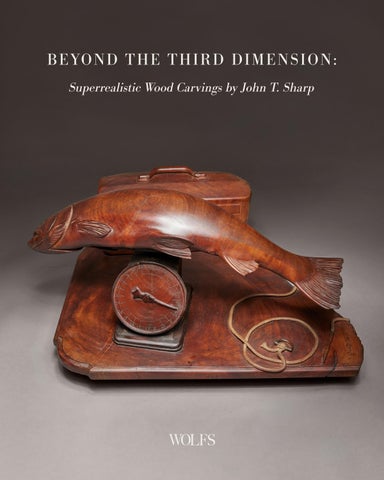
BE YOND T HE T H IR D DIMENSION: Superrealistic Wood Carvings by John T. Sharp
B E YON D T H E T H I R D DIM EN SION : Superrealistic Wood Carvings by John T. Sharp OCTOBER 16, 2026 - JANUARY 30, 2027
WWW.WOLFSGALLERY.COM 23645 MERCANTILE ROAD CLEVELAND, OHIO 44122
Beyond The Third Dimension: Superrealistic Wood Carvings By John T. Sharp Published in conjunction with the exhibition at WOLFS Gallery October 16, 2026 – January 30, 2027 © 2026 McKinley Madison Publishing House, LLC. All rights reserved. No part of this publication may be reproduced, stored in a retrieval system, or transmitted in any form or by any means, electronic, mechanical, photocopying, recording, or otherwise, without prior written permission from the publisher. By Raquel Flecha Vega, Ph.D. ISBN: 979-8-9933316-3-8 Library of Congress Control Number: 2026925560
Published by McKinley Madison Publishing House, LLC Cleveland, Ohio In association with WOLFS Gallery Contact: info@mmphpub.com | www.mmphpub.com
Printed in the United States of America First Edition
A rtist Statement, J ohn T. S harp
5
Contents: Artist Statement, John T. Sharp
5
A Studio Visit With The Master Wood Carver John T. Sharp, by Raquel Flecha Vega, PhD
6
Plates
14
Exhibitions, Awards, and Collections
44
Acknowledgements
48
4
WO L F S
John T. Sharp Artist Statement METHODS AND PROCESS
A lifelong fascination with nature and the organic form, combined with 20-years’ experience in the industrial model and pattern trade, has been my inspiration and educational lead into wood sculpture. I work primarily in black walnut and cherry, both locally abundant hardwoods near my northeastern Ohio home, and I maintain a large stockpile of logs, most of which I cut and haul home myself. The wood requires seasoning for years before it can be carved. I visualize and compose relative to the central axis and grain pattern of the chosen log section. Although carvings are roughed out with a chainsaw, the bulk of the work is accomplished with hand cutting tools, many of which are of my own make and design. Great attention is given to surface textures and values within the piece. A mix of linseed oil and turpentine is my basic finish which requires a good deal of time to establish. I prefer the discipline of using hand cutting tools and the constant maintenance and attention that they require. My approach to sculpture is one of classical realism in which my handling of the subject matter and medium are a direct appeal to the viewer’s sense of beauty and the appreciation of the skill of human hands.
WO L F S
5
A Studio Visit With The Master Wood Carver John T. Sharp By Raquel Flecha Vega, PhD
O
n a sunny August afternoon, I arrived at an idyllic country homestead overlooking an old quarry lake. At its center stood a modest white farmhouse filled with art, natural specimens, and fresh produce, surrounded by barns and sheds containing an extraordinary stockpile of logs in every size and shape. Flower and vegetable gardens flourished among the remnants of old livestock corrals. It was an environment in which art, nature, and daily life appeared almost inseparable—and an especially fitting setting for the studio of John T. Sharp (b. 1943, Cuyahoga Falls, Ohio). Even before entering his studio barn, I found myself distracted by the curated objects surrounding it: stacks of antlers, turtle shells, squirrel tails, and other naturalia collected over decades. Inside, fishing rods lined the walls, bottles of turpentine and beeswax crowded the worktables, and drawers overflowed with hundreds of carving tools. Everywhere were the materials, implements, and objects of observation that have informed Sharp’s remarkable fifty-year career. I wanted to learn more about this ten-time “Best in World” champion of the Ward World Championship Wildfowl Carving Competition and his place in the specialized tradition of wildlife wood sculpture. The genre has deep roots in American folk traditions, from whittling and wildfowl decoys to the highly refined decorative carvings of the twentieth century. What quickly became evident was that Sharp had pushed well beyond those conventions. By bringing wildlife carving into dialogue with the traditions of still life and landscape painting, and by treating
6
WO L F S
the wood itself as the inspiration for the composition, he has developed a distinctive form of sculptural realism that occupies its own place within contemporary American art. When I asked Sharp about his attraction to the medium, his answer was immediate: “I have a love for the medium, for trees, and wood. Wood in any form,” he continued, “firewood, furniture, construction, fine art.” For Sharp, this affinity for wood is far more than a craftsman’s appreciation of his material. The American hardwoods he favors, predominantly black walnut and cherry, often determine the subject and composition of his works. From his stockpile of locally sourced wood, Sharp carefully selects an individual section of log for its proportions and distinctive grain patterns, allowing the natural character of the material to inspire and ultimately shape the finished sculpture. A Y-shaped log, for example, might give rise to a bird with spread wings, ready to take flight, he explained, as he gestured at a seagull piece in the corner of his studio (see opposite). He went on to describe how, without a single sketch, and from a single portion of log, he roughs out the form with a chainsaw. Then, working around the central axis of the grain to exploit the patterns formed by decades of natural growth, he subtracts the wood until the material reveals the most whimsical nature scenes: a bird going fishing, a snake slithering sneakily under the water’s surface, a pair of pheasants perched on a log in search of their next meal. The apparent spontaneity of these scenes, however, conceals their complexity. Sharp must conceive not merely the subject, but the entire
A Studio V isit W ith T he M aster Wood C arver J ohn T. S harp
sculpture in three dimensions before much of it exists. Every projecting wing, beak, branch, feather, wave, and architectural element must be found within the finite limits of the original section of log. Nothing can be added back once it has been removed. This reductive process gives his most ambitious sculptures a quality that can only be appreciated in the round: the realization that an intricate assemblage of seemingly independent forms has been conceptualized and carved from a single section of wood. Though Sharp’s remarkable ability to model form derives in part from decades of close observation as an outdoorsman, it is equally rooted in the technical precision he developed during eighteen years as a commercial woodworker. After studying industrial design at Kent State University, he worked in the field for 18 years as a model and pattern maker in Akron. Particularly formative, Sharp
recalled, was his training with Korean master pattern maker Rak Suh Kim, with whom he carved small figurines and miniatures. Kim introduced him to the Asian style of toolmaking and woodworking, broadening Sharp’s understanding of what could be achieved through the disciplined use of hand tools. Kim also introduced Sharp to the work of renowned Maine woodcarver Charles Greenough “Chippy” Chase (1908-1998). Sharp reflected on his meeting with Chippy in 1972, a brief encounter that would profoundly redirect his approach to carving. Chippy’s stylized wildlife sculpture and woodworking methods, Sharp recollected, opened his eyes to the expressive possibilities of carving in life-scale. This shift would become central to his career and mature style. These experiences encouraged Sharp to imagine a life beyond the commercial workshop, one that would give him
Arist pointing at Seagull in his studio, 2026
WO L F S
7
A Studio V isit W ith T he M aster Wood C arver J ohn T. S harp
Artist’s tools, 2026
greater freedom to develop his own work and remain close to the natural world that inspired it. “As my career developed,” Sharp shared, “I wanted to be free to pursue my own interests daily rather than punching the clock at the commercial workshop. I wanted to be free to hunt, fish, garden, and pursue my sculpture.” And though he had never consciously set out to become a fine artist, Sharp came to recognize that the path had been taking shape for years, admitting, “Everything in my life has led up to it.” These experiences, and Sharp’s growing desire for artistic and personal independence, would eventually inspire him to turn his formidable technical abilities toward a full-time fine art career in the early eighties. As we continued through the studio, I became increasingly fascinated by Sharp’s remarkable collection of hand
8
WO L F S
tools and the vital role they play in his sculptural process. Many were not simply purchased, he explained, but modified or entirely customized by himself—carefully forged, shaped, hardened, and tempered—to achieve the precise contours and details his sculptures demand. Each tool, he continued, evolved in response to a particular challenge of form, making the instruments of his craft almost as personal as the sculptures they produce. The discipline required is extraordinary: a single work may call upon thirty to forty different hand tools, including gouges in an array of radii, right and left-beveled chisels, planes, and spokeshaves individually bent, ground, and sharpened to exacting angles. This intimate command of traditional and customized tools gives Sharp remarkable control over the wood, allowing him to render increasingly subtle transi-
A Studio V isit W ith T he M aster Wood C arver J ohn T. S harp
Water Lilies, 2000
tions, curves, and details. When I inquired about the highly refined, polished finish Sharp achieves, he explained how he meticulously sands the surface and applies layers of linseed oil, sometimes finishing with a final coat of beeswax. The resulting finish brings remarkable depth and luminosity to the wood, revealing grain and color variations that make every sculpture inherently unique. In simple yet profound words, Sharp expounded, “The refined finish emphasizes the form and conveys the subject.” He calls it a “distinctive form of stylized realism” that balances exceptional craftsmanship with an appreciation for the material's natural beauty. Sharp’s surface treatment became more nuanced in the mid-to-late nineties. He began experimenting with a selective finishing process—leaving certain areas of the sculpture deliberately unpolished while bringing others to a highly refined sheen. The resulting contrasts in texture, value, and reflectivity become an expressive element in their own right. This approach is particularly effective in Water Lilies (2000), a work that enters into a compelling dialogue with Claude Monet’s late paysages d’eau (waterscapes). Like Monet’s Nymphéas (1897–98), Sharp abandons the conventional horizon line and perspectival viewpoint in favor of an intimate experience with the surface and a focus on light. In Sharp’s immersive relief sculpture, two delicately textured, unpolished water lilies emerge from a highly polished expanse of wood. Each lily pad is carved with an almost paper-like delicacy, its veins, subtle irregularities, and undulating edges catching the shimmering light as they float gently on placid waters. Here, Sharp uses varied surface treatments to create a subtle study of light, while the bird’s-eye view transforms
Still Life with Grouse and Apples, 1995
the water itself into the field of composition. As Sharp developed his finishing techniques in the nineties, he also pushed his sculptural vocabulary in new directions. Moving beyond wildlife scenes, he turned to carefully staged arrangements drawn from everyday life, producing some of his most accomplished and visually arresting subjects in wood. Among the finest is Still Life with Grouse and Apples (1995), now held in a private collection. The sculpture presents an intimate kitchen vignette of remarkable naturalism: a freshly killed ruffed grouse lies belly-up upon a cabinet, its head and neck falling limply over a partially opened drawer. A jug and five gleaming apples provide a striking counterpoint to the bird’s richly articulated plumage. Here, Sharp exploits the wood’s natural qualities with extraordinary sensitivity. Rather than relying solely on carved detail, he varies the surface and finish to distinguish texture, color, and material. The grouse’s body remains comparatively matte, allowing the intricately carved feathers and wood grain to remain prominent, while carefully applied linseed oil enriches the beak, talons, and tail. Nearby, the jug receives a mid-level polish, while the apples are brought to a rich, lustrous finish. Together, these gradations of surface and sheen create subtle shifts in tone and reflectivity, heightening the interaction of texture, form, and light. These contrasts—feather and fruit, matte and polished—demonstrate Sharp’s ability to create remarkable visual variety from a single material.
WO L F S
9
A Studio V isit W ith T he M aster Wood C arver J ohn T. S harp
Seven Pound Trout, 2016
In both subject and composition, the work recalls the great tradition of eighteenth-century French still-life painting, particularly the work of Jean Siméon Chardin. Like Chardin’s Still Life with Partridge and Pear (1748), Sharp’s Still Life with Grouse and Apples achieves its impact through pictorial restraint, compositional balance, and meticulous precision. Each element occupies its place with convincing weight and proportion. Yet Sharp introduces an engaging sculptural detail uniquely his own: the cabinet drawer rests slightly ajar, inviting the viewer to reach for the carved knob to pull it open and peek at the contents within. It is this combination of technical virtuosity and visual wit that distinguishes Sharp’s finest work. Occupying a fascinating place between wildlife sculpture and traditional still life, Seven Pound Trout (2016) is among Sharp’s most engaging compositions. The sculpture captures a familiar moment in the angler’s ritual—the weighing of a prized catch—with the trout resting flaccid on the scale, accompanied by a tackle box and rope stringer. By assembling these carefully observed objects around the fish, Sharp transforms a fleeting moment after the catch into a richly detailed sculptural still life, balancing narrative, craftsmanship, and an extraordinary command of form and surface. Beyond his remarkable wildlife subjects and meticulously conceived still lifes, Sharp’s work encompasses a third, and particularly compelling theme: the encounter
10
WO L F S
Dead Cuckoo, 1995
between nature and the human-made world. These sculptures rank among his most inventive compositions, bringing organic forms into dialogue with architecture, marine gear, and other human-made elements. They also provide Sharp with an opportunity to demonstrate the extraordinary versatility of his medium, transforming a single piece of wood into convincing illusions of feather, tile, stone, metal, rope, and water. During my visit, Sharp showed me one such work: an uncannily lifelike cuckoo lying motionless upon a highly polished tile floor. He explained that compositions like Dead Cuckoo (1995) allow him to explore the tension between organic and geometric forms and the visual opposition of soft and hard surfaces. The contrast is striking. The irregular, delicate contours of the bird interrupt the ordered geometry of the tiled floor. At the same time, subtle variations in carving and finish persuade the eye that feather and polished tile, both carved from the same material, possess entirely different physical qualities. This interplay of nature and the human-made world takes on a more contemplative character in Robin (2008), in which an American robin pauses atop a headstone, its beak filled with grasses gathered for a nest. The imagery is simple but resonant: a living bird engaged in the instinctive act of building a home rests momentarily upon a mon-
A Studio V isit W ith T he M aster Wood C arver J ohn T. S harp
Robin, 2008
ument to the dead. Sharp avoids sentimentality, allowing the juxtaposition itself to suggest themes of mortality and the persistence of life. In the monumental City Pigeons (1994), carved from American sycamore and standing seventy inches high, Sharp turns his attention to one of the most familiar encounters between wildlife and the urban landscape. A group of pigeons occupies the upper reaches of an imposing stone façade, roosting along its projecting cornice. The architectural elements—with their smooth masonry, prominent corner quoins, and strong geometric structure—give the sculpture a sense of permanence and monumentality. Against them, Sharp gives each bird an individual presence: some stand alert, others sleep, while others survey the city from their elevated perch. An ordinary urban observation is transformed into an unexpectedly elegant and commanding sculptural composition. Perhaps nowhere is Sharp’s mastery of contrast more dramatically realized than in High Tide (2002), an ambi-
City Pigeons, 1994, The Ward Museum of Wildfowl, Salisbury, MD
High Tide, 2002
WO L F S
11
A Studio V isit W ith T he M aster Wood C arver J ohn T. S harp
tious work measuring fifty-five inches across. A small shorebird stands among rocks at the water’s edge, positioned between a heavy knotted rope and a taut metal chain. The composition is remarkable for the number of materials Sharp appears to conjure from a single length of hardwood. Rough, comparatively pale rocks and rope contrast with the lustrous surfaces of the tidal water, the bird, and the seemingly metallic chain. Matte surfaces meet polished ones; soft forms oppose hard edges; nature's irregularities confront the geometry of the human world. The visual tension is matched by a palpable physical tension. The delicacy of the shorebird is set against the massive anchor rode, whose rope and chain imply tremendous weight and force beyond the boundaries of the sculpture. The bird appears almost weightless by comparison—a fleeting living presence poised beside objects designed to restrain enormous physical power. Sharp turns this contrast of scale and materials into one of the work’s most compelling qualities. These sculptures reveal an important dimension of Sharp’s achievement. His mastery lies not simply in his ability to reproduce nature with astonishing precision, but in his capacity to make a single material assume entirely different identities. Wood becomes plumage, polished tile, masonry, water, metal, and rope, each distinguished through carving, texture, grain, and finish. Yet, Sharp intentionally preserves the live edge of the wood, subtly disrupting the sculptures’ near-trompe-l’œil illusion, reminding the viewer of the organic material from which they were carved and the presence of the artist’s hand. The pleasure of encountering these works lies partly in recognizing the illusion and then moving closer to understand how it was achieved. Beyond the play of illusion and reality, Sharp orchestrates a sophisticated series of oppositions—polished against textured, soft against hard, light against dark, organic against geometric, and nature against the built environment. The result: sculptures of remarkable technical accomplishment and visual presence that reward prolonged looking. Familiar scenes become unexpected, ordinary materials become extraordinary, and the natural world becomes inseparable from the human environments
12
WO L F S
it has learned to inhabit. It is through these tensions of material and the subject matter that Sharp’s craftsmanship, imagination, and keen observation emerge, giving his finest carvings their distinctive character and enduring appeal. As our visit drew to a close, I asked Sharp what projects lay ahead. His answer began with a story. He had recently gone out onto Lake Erie intending to fish. Instead, he found himself captivated by the water, spending hours studying the movement of the lake and the constantly shifting patterns of its waves. “If I had to carve one thing for the rest of my life,” he told me, “it would be water.” Then he added simply, “Wood lends itself to water.” It is a revealing observation. The concentric growth rings of a tree seem almost naturally suited to suggesting ripples, currents, and waves, yet capturing the restless surface of water in a solid section of wood presents an extraordinary challenge. I was struck that an award-winning sculptor who has already achieved such remarkable command of realism remains so intent on testing the limits of both his abilities and his medium. For Sharp, mastery is not an end point, but an invitation to attempt something still more difficult: to observe nature closely enough to understand its rhythms and then translate them convincingly into wood. Wolfs could not be more honored to present the carvings of Master Carver John T. Sharp. The single-piece reductions selected for the show bring the traditions of folk craft and decorative sculpture into conversation with the two-dimensional genres of still life and landscape painting. The result is a stylized sculptural realism that plays with illusion and reality, contrasts forms and textures, and brings the natural and human-made worlds together in sophisticated compositions drawn from everyday life. In transforming these familiar subjects, Sharp reveals both his technical virtuosity and artistic vision. His virtuosity lies in making us momentarily forget that bird, feather, stone, water, rope, chain, and architecture are all carved from wood. His artistry lies in making us look at familiar things anew, with a reawakened sense of joy and wonder.
A Studio V isit W ith T he M aster Wood C arver J ohn T. S harp
Sources: Basile, Karen, “John Sharp,” Ward Foundation News Vol. 8, No. 1 (Winter 1983/84): 2-5. Basile, Kenneth and Cynthia Doerzbach. American Decorative Bird Carving. Baltimore, MD: The North American Wildfowl Art Museum of the Ward Foundation at Salisbury State College, 1981. Brodell, James David and Louis A. Zona. “A Circle of Life: The Magical, Spiritual American Hardwood Sculptures of John T. Sharp.” Hunting and Fishing Collectibles Magazine Vol. 12, No. 2 (March - April 2012): 8-15. Chardin, Jean-Baptiste Siméon, Still Life with Partridge and Pear, 1748, Oil on canvas, 15.43 x 17.91 inches, Städel Museum, Frankfurt, Digital Collection, https://sammlung.staedelmuseum.de/en/work/still-life-with-partridge-and-pear Kent, Robert A., et al., Birds In Art. Wausau, WI: Leigh Yawkey Woodson Art Museum, 1996. Monet, Claude, Nympheas, 1897-1898, Oil on canvas, 26 x 41 inches, Los Angeles County Museum of Art, Collections, https://collections.lacma.org/ object/22092 “Rhythms of Nature: New Work by Thomas Aquinas Daly, James Prosek and John T. Sharp.” Gerald Peters Gallery Magazine (Spring 2006): 26. Sharp, John T. John T. Sharp: Fine Carvings in American Hardwoods, Artist’s Website, Accessed August 1, 2026, https://www.johntsharp.com/ Sharp, John T. (Sculptor), in discussion with the author, August 21 and September 16, 2026. Rubin, James Henry. Why Monet Matters: Meaning Among the Lily Pads. University Park, PA: Pennsylvania State University Press, 2021.
WO L F S
13
-
1
Leaping Trout, 1980
Black cherry and linseed oil Signed and dated 11 x 19 x 12 inches
14
WO L F S
-
2
Watersnake, 1986
Black walnut and linseed oil Signed and dated 3 x 19 x 13 inches
WO L F S
15
-
3
Green Heron, 1993
Black cherry and linseed oil Signed and dated 20 x 32 x 14 inches
16
WO L F S
-
4
Grebes, 1998
Black walnut and linseed oil Signed and dated 6 x 29 x 20 inches
WO L F S
17
-
5
Loon, 2000
Black walnut and linseed oil Signed and dated 13 x 41 x 31 inches
18
WO L F S
-
6
Blue Herons, 2001
Black walnut and linseed oil Signed and dated 39 x 32 x 22 inches
WO L F S
19
-
7
Watersnake, 2002
Black walnut and linseed oil Signed and dated 6 x 20 x 14 inches
20
WO L F S
-
8
Two Steelhead, 2008
Black cherry and linseed oil Signed and dated 37 x 9 inches
WO L F S
21
-
9
Two Teal, 2005
Black cherry and linseed oil Signed 18 x 15 x 5 inches
22
WO L F S
-
10
Kingfisher, 2006
Black walnut and linseed oil Signed and dated 20 x 32 x 9 inches
WO L F S
23
-
11
Mallard Pair, 2009
Black walnut and linseed oil Signed and dated 14 x 19 x 42 inches
24
WO L F S
-
12
Yellow Legs, 2010
Black walnut and linseed oil Signed and dated 10 x 12 x 15 inches
WO L F S
25
-
13
Chukars, 2012
Black walnut and linseed oil Signed 10 x 23 x 15 inches
26
WO L F S
-
14
Goldeneye, 2012
Black walnut and linseed oil Signed and dated 10 x 24 x 20 inches
WO L F S
27
-
15
Mallard, 2013
Black walnut and linseed oil Signed and dated 18 x 24 inches
28
WO L F S
-
16
Mallard and Young, 2018 Black walnut and linseed oil Signed and dated 10 x 23 inches
WO L F S
29
-
17
Ringbill, 2020
Black walnut and linseed oil Signed and dated 11 x 16 x 24 inches
30
WO L F S
-
18
Three Canvasbacks, 2024 Black walnut and linseed oil Signed and dated 20 x 36 x 24 inches
WO L F S
31
-
19
Water Lilies, 2000
Black walnut and linseed oil Signed and dated 5 x 21 x 25 inches
32
WO L F S
-
20
Goose Tracks, 2001
Black walnut and linseed oil Signed and dated 5 x 32 inches
WO L F S
33
-
21
White Tail Skull, 2003 Black walnut and linseed oil Signed and dated 11 x 20 x 22 inches
34
WO L F S
-
22
Waterhole, 2004
Black walnut and linseed oil Signed and dated 4 x 12 inches
WO L F S
35
-
23
Wave Study, 2026
Black walnut and linseed oil Signed and dated 4 x 23 x 19 inches
36
WO L F S
-
24
Dead Cuckoo, 1995
Black walnut and linseed oil Signed and dated 6 x 16 inches
WO L F S
37
-
25
High Tide, 2002
Black walnut and linseed oil Signed and dated 14 x 50 x 45 inches
38
WO L F S
-
26
Parakeets, 2005
Black walnut and linseed oil Signed and dated 15 x 31 x 26 inches
WO L F S
39
-
27
Robin, 2008
Black cherry and linseed oil 19 x 22 x 7 inches
40
WO L F S
-
28
Still Life with Grouse and Apples, 2003 Black cherry and linseed oil Signed and dated 14 x 26 x 15 inches
WO L F S
41
-
29
Seven Pound Trout, 2016 Black cherry and linseed oil Signed and dated 14 x 22 x 25 inches
42
WO L F S
-
30
Still Life with Apples, 2003 Black cherry and linseed oil Signed and dated 6 x 17 x 12 inches
WO L F S
43
Exhibitions, Awards, and Collections
44
1976
Two-person Show with Painter Diane Pierce, Vance Glassworks, Peninsula, OH.
1977 – 1986
Annual Group Exhibition, The Ward Foundation Wildfowl Carving & Art Exhibition, Salisbury, MD.
1979
Solo show, The Garden Center of Greater Cleveland, Cleveland, OH.
1981
Two-person Show with Painter Art LaMay, Tatler Gallery, Hilton Head, SC.
1981
Group Exhibition, The Connecticut Audubon Society, Fairfield, CT.
1981
Invitational Exhibition, The Academy of Natural Sciences Philadelphia, Philadelphia, PA. (Silver Medal Award)
1982 – 1985
Annual Group Exhibition, The Easton Waterfowl Festival, Easton, MD.
1982
American Decorative Bird Carving Group Exhibition, The Maryland Historical Society, Baltimore, MD.
1982
Birds in Art Annual Exhibition, The L.Y. Woodson Art Museum, Wausau, WI.
1983
Solo Show, The Cleveland Museum of Natural History, Cleveland, OH.
1984
Annual Exhibition, The National Sculpture Society, New York, NY. (Silver Medal Award)
1984
Invitational Exhibition, The Academy of Natural Sciences, Philadelphia, PA. (Certificate of Excellence)
1984
The North American Sculpture Exhibition, Foothills Art Center, Denver, CO. (The North American Sculpture Award)
1985
Group Exhibition, The Cape Cod Museum of Natural History, Brewster, MA.
1985
Group Exhibition, National Exhibition of Alaskan Wildlife, Anchorage, AK.
1985
The North American Sculpture Exhibition, Foothills Art Center, Denver, CO. (Colorado Bankshares Award)
1986
National Exhibition of Alaskan Wildlife Group Exhibition, Anchorage, AK.
1987
Group Exhibition, Society for Wildlife Art of the Nations, London, England.
1987
Wildlife in Art Group Exhibition, The L.Y. Woodson Art Museum, Wausau, WI.
1987
The World Championship Wildfowl Carving Competition, Roland E. Powell Convention Center, Ocean City, MD. (Second in World, Interpretive Life-size Sculpture)
1988
The World Championship Wildfowl Carving Competition, Roland E. Powell Convention Center, Ocean City, MD. (First in World, Interpretive Life-size Sculpture)
1989
Three-person Show with Painters Ray Sexton and Charles Harper, The Cincinnati Museum of Natural History, Cincinnati, OH.
1989
The World Championship Wildfowl Carving Competition, Roland E. Powell Convention Center, Ocean City, MD. (Second in World, Interpretive Life-size Sculpture)
1989
Wildlife: The Artist’s View Group Exhibition, The L.Y. Woodson Art Museum, Wausau, WI.
1989
Two-person Show with Painter Thomas Aquinas Daly, Grand Central Art Galleries, New York, NY.
1990
The World Championship Wildfowl Carving Competition, Roland E. Powell Convention Center, Ocean City, MD. (Second in World, Interpretive Life-size Sculpture)
WO L F S
E x hibitions , Awards , and C ollections
1990
The Wooden Bird: An American Folk Art Tradition, The Cincinnati Museum of Natural History, Cincinnati, OH.
1990
Animals in Art Group Exhibition, Scheele Galleries, Inc., Cleveland, OH.
1990
Group Exhibition, The Butler Institute of American Art, Youngstown, OH.
1991
The World Championship Wildfowl Carving Competition, Roland E. Powell Convention Center, Ocean City, MD. (First in World, Interpretive Life-size Sculpture)
1991
Group Exhibition, The Canton Art Institute, Canton, OH.
1992
The World Championship Wildfowl Carving Competition, Roland E. Powell Convention Center Ocean City, MD. (First in World, Interpretive Life-size Sculpture)
1992
Two-person Show with Painter David Rankin, The Audrey Feinberg Gallery, Cleveland Hts., OH.
1992 – 1993
Group Exhibition, The World Bird Carving Exhibition, Inami Woodcarving Museum, Nanto City, Japan.
1993
The World Championship Wildfowl Carving Competition, Roland E. Powell Convention Center, Ocean City, MD. (First in World, Interpretive Life-size Sculpture)
1993
Two-person Show with Charles Greenough Chase, Wendell Gilley Museum Southwest Harbor, ME.
1993
Birds in Art Annual Exhibition, The L.Y. Woodson Art Museum, Wausau, WI.
1994
The World Championship Wildfowl Carving Competition, Roland E. Powell Convention Center, Ocean City, MD. (First in World, Interpretive Life-size Sculpture)
1994
Birds in Art Annual Exhibition, The L.Y. Woodson Art Museum, Wausau, WI.
1995
The World Championship Wildfowl Carving Competition, Roland E. Powell Convention Center, Ocean City, MD. (Second in World, Interpretive Life-size Sculpture)
1995
Birds in Art Annual Exhibition, The L.Y. Woodson Art Museum, Wausau, WI.
1995
Flight of the Cranes, Artists for Nature Foundation, Trujillo, Spain. (Two-week workshop on site)
1996
The World Championship Wildfowl Carving Competition, Roland E. Powell Convention Center, Ocean City, MD. (First in World, Interpretive Life-size Sculpture)
1996
Birds in Art Annual Exhibition, The L.Y. Woodson Art Museum, Wausau, WI.
1996
Two-person Exhibition with Debrah Butler, The Hermitage Foundation Museum, Norfolk, VA.
1997
The World Championship Wildfowl Carving Competition, Roland E. Powell Convention Center, Ocean City, MD. (First in World, Interpretive Life-size Sculpture)
1998
Solo Exhibition, The Genesee Country Museum, Mumford, NY.
1998
Solo Exhibition, The Wildfowl Art Museum, Salisbury, MD.
1998
Birds in Art Annual Exhibition, The L.Y. Woodson Art Museum, Wausau, WI.
1998
Natural Habitats: Contemporary Wildlife Artists of North America Group Exhibition, Spanierman Gallery, New York, NY.
1999
The World Championship Wildfowl Carving Competition, Roland E. Powell Convention Center, Ocean City, MD. (First in World, Interpretive Life-size Sculpture)
1999
Birds in Art Annual Exhibition, The L.Y. Woodson Art Museum, Wausau, WI.
WO L F S
45
E x hibitions , Awards , and C ollections
2000
Birds in Art Annual Exhibition, The L.Y. Woodson Art Museum, Wausau, WI.
2001
The World Championship Wildfowl Carving Competition, Roland E. Powell Convention Center, Ocean City, MD. (Master Artist Award, Interpretive Life-size Sculpture)
2001
Animal Art in the Park Group Exhibition, The Algonquin Gallery and Museum, Huntsville, Ontario, Canada.
2002
The World Championship Wildfowl Carving Competition, Roland E. Powell Convention Center, Ocean City, MD. (Master Artist Award, Interpretive Life-size Sculpture)
2002
Birds in Art Annual Exhibition, The L.Y. Woodson Art Museum, Wausau, WI.
2002
Call of the Wild Group Exhibition, The McMicheal Canadian Art Collection, Klienburg, Ontario, Canada.
2003
The World Championship Carving Competition, Roland E. Powell Convention Center, Ocean City, MD. (Best in World, Interpretive Sculpture)
2003
Birds in Art Annual Exhibition, The L.Y. Woodson Art Museum, Wausau, WI.
2004
The World Championship Carving Competition, Roland E. Powell Convention Center, Ocean City, MD. (Best in World, Interpretive Sculpture)
2004
Birds in Art Annual Exhibition, The L.Y. Woodson Art Museum, Wausau, WI.
2005
The World Championship Carving Competition, Roland E. Powell Convention Center, Ocean City, MD. (Best in World, Interpretive Sculpture)
2005
Birds in Art Annual Exhibition, The L.Y. Woodson Art Museum, Wausau, WI.
2005
Wildlife Art for a New Century Group Exhibition, The National Museum of Wildlife Art, Jackson, WY.
2006
Birds in Art Annual Exhibition, The L.Y. Woodson Art Museum, Wausau, WI.
2006
Three-man Show with Painters James Prosek and Thomas Aquinas Daly, Gerald Peters Gallery, New York, NY.
2007
Solo Show, Academy Art Museum, Easton, MD.
2007 – 2016
Birds in Art Annual Exhibition, The L.Y. Woodson Art Museum, Wausau, WI.
2016
Four-man Show with Tony Angell, Ron Kingswood, & Jim Morgan, Gerald Peters Gallery, Santa Fe, NM.
2017 – 2026
Birds in Art Annual Exhibition, The L.Y. Woodson Art Museum, Wausau, WI.
John T. Sharp is a 10-time "Best in World" winner of the Ward World Championship Wildfowl Carving Competition in Ocean City, MD. In 1996, John was presented the Master Wildlife Artist Award by the Leigh Yawkey Woodson Art Museum in Wausau, WI. His work can be found in private, corporate, and public collections, including: The Cleveland Museum of Natural History in Cleveland, OH; MBNA Bank; The Leigh Yawkey Woodson Art Museum in Wausau, WI; The Genesee Country Museum in Mumford, NY; The Ward Museum of Wildfowl Art in Salisbury, MD; Algonquin Gallery and Museum in Ontario, Canada; and Nature in Art, located in Gloucester, England.
46
WO L F S
E x hibitions , Awards , and C ollections
WO L F S
47
Acknowledgements The entirety of this catalog would not have been possible without the hard work and dedication of: WOLFS staff: Megan Arner June DePhilips Kristen Newell Raquel Flecha Vega, PhD The Raymond & Elenore Smiley Collection Nikki Mokrzycki, graphic design Kristen Newell, photography To all those, anonymous and otherwise, who have selflessly contributed to this worthy endeavor – thank you.
Acknowledgements
WO L F S
49