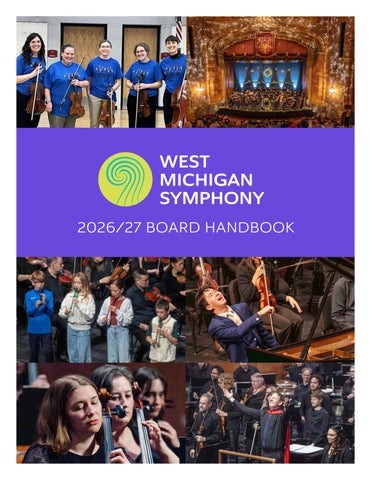
WEST MICHIGAN SYMPHONY 2026/27 BOARD HANDBOOK
VISION
We are a catalyst for a music-infused West Michigan: leading, facilitating, connecting and collaborating with the community to stimulate cultural vibrancy, inclusivity and pride of place.
MISSIO N STATE M E N T West Michigan Symphony connects and enriches our diverse community through the transformative power of music We fulfill this primarily through three core offerings: • Professional, live symphonic performances in a welcoming environment • The Block, a gathering space that sparks curiosity, inspiration and fellowship through the shared experience of uncommon live music • Music Education that enriches the lives of children and adults through exploration, participation and performance
VA L U E S CURIOSITY. We foster a culture of continuous learning, exploration, creativity, thoughtful risk-taking and openness to new ideas. PASSION. We enjoy what we create together, especially when we are having fun, laughing, talking, communicating and listening. We feel excited, fulfilled and at our best when we see the art form lifting up the hearts of our audience. COMMUNITY-FOCUS. Our orientation is toward the impact the art form has on our audience, students and donors: fostering access, involvement, and “wow”! We look for partnership opportunities that infuse and elevate the arts throughout the community. SHARED OWNERSHIP. Everyone helps. We enjoy working together within clear roles and lanes—but not in silos. We communicate openly and have each other’s backs. The outcomes belong to all of us. RESPECT. We value, recognize and thank our patrons and volunteers, and treat our musicians as the professional artists they are. We regard each other with respect, celebrating our triumphs and supporting our challenges. We hold ourselves accountable yet honor finite bandwidth.
TABLE O F C O N TE N TS SCOTT SPECK.....................................................3
ADMINISTRATION..............................................18
ABOUT WEST MICHIGAN SYMPHONY...............3
ORGANIZATION CHART ...................................20
COMMUNITY MUSIC ENCOUNTERS...................4
ELEVATOR SPEECH..........................................20
LEAGUE STATEMENT OF COMMON CAUSE.......6
AUDIENCE COMMENTS....................................21
MUSICIANS..........................................................8
COMMITTEE CHARTERS...................................22
BOARD OF DIRECTORS....................................10
2025/26 BUDGET SUMMARY............................26
PROFILE AND COMMITMENTS.........................15
FUND DEVELOPMENT.......................................27
THE COMPASSPOINT BOARD MODEL.............16
RESTATED BY-LAWS.........................................28
2 • BOARD HANDBOOK
SCOTT SPE CK M U SIC D IRE C TO R
Now in his 22nd season as Music Director, Scott Speck is the co-author of three of the world’s best-selling books on classical music for a popular audience, Classical Music for Dummies, Ballet for Dummies and Opera for Dummies. These books have received stellar reviews in both the national and international press and have garnered enthusiastic endorsements from major American arts organizations. In addition to WMS, Speck holds leadership positions with the Mobile Symphony (AL), Joffrey Ballet (IL), and Chicago Philharmonic and is a frequent collaborator with such illustrious artists as Yo-Yo Ma, Itzhak Perlman, Joshua Bell, and Renée Fleming. Although his work keeps him on the road, Scott regards Muskegon as home, where he lives in the Amazon apartments. When in Muskegon Speck gives unstintingly of himself, dividing his time between rehearsing the orchestra and reaching out to patrons to attract new audiences, garner support, and make classical music accessible to everyone.
Making music with Scott Speck is a joy for the mind and the body.
Born in Boston, Speck is a Fulbright Scholar, a summa cum laude graduate of Yale University, and an Aspen Conducting Fellow. He is fluent in English, German and French, has a diploma in Italian, speaks Spanish and has a reading knowledge of Russian. Musicians respect him for his artistic excellence, courtesy and preparedness. The audience loves him for his warmth, friendliness, and the way he communicates and makes “classical music for everyone!”
YO-YO MA
scottspeck.org facebook.com/ConductorScottSpeck
ABOUT WES T M IC H IG A N SYM PH O N Y An anchor cultural organization headquartered in Muskegon, WMS is a resident performing group at the Frauenthal Center, where its eight-concert season is the most visible part of a larger artistic enterprise of far-reaching community benefit. At its live listening room The Block, just down the street, it mounts 15 performance events annually featuring jazz, classical and “curious” offerings. WMS concerts and Community Music Encounters learning events bring 18,000 people—more than 30% of whom are children and students— downtown annually, making it the largest performing arts organization on the West Shore. Audiences come from throughout Muskegon, Ottawa, Kent, Oceana and surrounding counties. (continued) West Michigan Symphony | 360 W Western Ave, Suite 200 Muskegon, MI 49440 | 231.726.3231 | westmichigansymphony.org
WEST MICHIGAN SYMPHONY • 3
(continued) The Mainstage Series at the Frauenthal Center features the 64-member symphony orchestra which, under Music Director Scott Speck’s cultivation, has mastered the full Classical-Romantic repertoire and performs at a level normally associated with much larger metropolitan areas. WMS players are professional musicians from Michigan and other states who make their living teaching and performing in a variety of orchestras and ensembles. This provides WMS with the energy and versatility so central to its artistic personality. The musicians are individually contracted on a “per-service” basis (as opposed to the salaried players in a full-time orchestra like Detroit). The series also features guest artists of international profile whose visit often includes educational programs and other community activities. Their residency culminates with a performance or dual performances: a Friday evening concert with the orchestra at the Frauenthal Center and a Saturday evening solo appearance at The Block. The Block is a 115-seat listening room for the musically curious located on the second floor of the Russell Block Building in downtown Muskegon. First opened in 2013, The Block in its second decade continues to grow and innovate artistically and as a community center. Its core 12-concert series includes regional, national and international artists as well as WMS musicians. During summer The Block hosts a sold-out jazz series featuring legendary regional drummer Tim Froncek and a changing cast of musician colleagues. In addition to The Block’s primary performance series, it serves as the home for several youth music ensembles: Debut Strings and Premier Strings and the West Michigan Symphony Children’s Choir. WMS makes the venue available for rental on open days or nights. For nonprofit community groups, rent is offered at reduced rates or waived entirely. Users include Third Coast Trombone Retreat, Muskegon Rotary, the Poppen Foundation, Harbor Hospice, Greater Muskegon Economic Development and the GVSU Piano Chamber Series, to name a few.
COMMUNIT Y M U SIC E N C O U N TE RS The organization reaches deeply into the community through a variety of learning activities and placemaking projects to inspire the next generation of music lovers. Provided free or at very low cost to foster wide access, these programs impact more than 5,000 people annually from young children to adults, including students in 50 area schools spanning six counties.
Click Clack Moosic WMS’s unique musical storytime program for families with young children that introduces basic music concepts.
Link Up Free in-school partnership with Carnegie Hall curriculum teaching 3-5 graders to read music and play recorders along with the Symphony.
WMS Children’s Choir
Tune Up Free after-school string orchestra program for underserved students in partnership with Muskegon Public Schools.
Choral program for children ages 8-13 with multiple performance opportunities, both stand alone and with West Michigan Symphony.
Debut & Premier Strings String orchestra programs for beginning through advanced young musicians, offering ensemble training and performance opportunities.
Lunch n’ Learn Scott Speck and guests lead free, hour-long conversations with behind-the-scenes insights to enrich Masterworks concert experience.
Community Music Encounters progression of offerings for children and youth.
4 • BOARD HANDBOOK
Side-by-Side Community musicians join the WMS Orchestra for a day of side-byside rehearsals, culminating in an evening performance.
CLICK CLACK MOOsic WEST MICHIGAN SYMPHONY
CLICK CLACK MOOSIC
Based on books by Doreen Cronin and Betsy Lewin, this series introduces children ages 3-8 to instrumental music in a storybook format. A host/narrator introduces the small ensemble of WMS musicians, teaches the children about
musical concepts, and then reads the story aloud—accompanied by incidental music written specially for the series.
DEBUT AND PREMIER STRINGS Debut Strings introduces beginning and intermediate students to string orchestra through challenging and diverse repertoire. Students who audition to join Debut Strings have one to two years of playing experience and strong note reading skills. Premier Strings is an advanced string orchestra whose players act as mentors to the Debut Strings members, represent the WMS’s learning programs throughout the community, and even perform on stage with WMS at the spring Link Up concert. Led by Angela Corbin, Orchestra Director at North Muskegon Public Schools, both ensembles rehearse weekly from September through May and prepare fall and spring performances.
CHILDREN’S CHOIR WEST MICHIGAN SYMPHONY
CHILDREN’S CHOIR
Audition-based for children ages 8-13, WMS Children’s Choir performs in its own concerts, collaboratively with Debut and Premier Strings, and on stage with the Symphony during Home for the Holidays and the spring Link Up concerts. The choir rehearses weekly from September through May at The Block. Director Beth Slimko also leads the North Muskegon Public School choir program.
LINK UP
This beginner music education program pairs the orchestra with local community schools in six West Michigan WEST MICHIGAN SYMPHONY
LINK UP
counties. Students in grades 3-5 learn to read and play music on the recorder and gain an understanding of orchestral repertoire. They benefit from regular contact with Music Mentors: WMS musicians who visit classrooms to work with students and help them learn. The program culminates with an interactive concert at the Frauenthal Center during which the students perform on recorders along with the Symphony. More than 50 elementary schools participate each year.
TUNE UP Filling a gapSYMPHONY in the local elementary education system, this beginning string orchestra program for underserved WEST MICHIGAN students was launched in the fall of 2022 in Muskegon elementary schools. Beginning in 3rd grade, students receive use of a musical instrument, learn to play that instrument, participate in ensemble and sectional lessons, build friendships, and receive instruction and support from experienced and dedicated teaching artists. Under the supervision of Lead Teaching Artist Dr. Lauren Garza, Tune Up is embedded within the previously existing 21st CCLC IMPACT after school program.
TUNE UP
LUNCH ‘N SYMPHONY LEARN WEST MICHIGAN
LUNCH ‘N LEARN
Each season free Lunch ‘n Learn sessions invite the community to get better acquainted with upcoming concert repertoire by experiencing a live conversation with Music Director Scott Speck and an invited musician or guest artist. Lunch ‘n Learn is held in The Block at noon on Wednesdays prior to each of the five Masterworks concerts. Delicious small bites are provided. Everyone is invited, including those who already have tickets to the concert, those who are curious and want to learn more, downtown community businesses and area residents.
SYMPHONY SIDE-BY-SIDE
WEST MICHIGAN SYMPHONY Every summer, usually in late July, fans and community members who play an instrument—or used to—are invited to
SIDE-BY-SIDE
dust off their fiddles, flutes and horns for a day of music making in the Frauenthal Center, side by side with members of WMS. Led by Scott Speck, the musicians—amateur and professional—gather in the morning for sectional practice and in the afternoon for full orchestra rehearsal. The concert itself is free to the public and takes place the same evening.
WEST MICHIGAN SYMPHONY • 5
LEAGUE STAT EM E NT O F C O M M O N C A U SE Orchestras Support In-School Music Education Music education improves the learning environment and engages teachers and caregivers in children’s learning. Students who participate in ensemble music-making create joy, human connection, and expressions of individual and shared cultural identities. America’s orchestras are committed to advocating for equitable access to comprehensive and sequential music education in our nation’s schools. Research has proven that arts education provides academic and social benefits and is essential to a complete education for all students, preparing them for success in school, work, and life. There is also clear proof that musical training during childhood can lead to markedly accelerated brain development. The status of music education in our nation’s schools has short- and long-term consequences for both student achievement and the future of orchestras. Educational activities in orchestras have grown exponentially over the past two decades. Starting from the tradition of stand-alone school-day and family concerts, orchestras now offer small ensemble performances, residencies and long-term partnerships, after-school and summer camps, intensive instrumental instruction and ensemble experiences, early childhood and teen programs, and a host of other activities occurring during the school day as well as during out-of-school time. In addition to more than 1,200 professional and community orchestras, there are now nearly 500 youth orchestras in communities across the United States. Orchestra programs strive for deeply embedded partnerships with local school systems and community-based music (and other) organizations that are informed by current and emerging community needs, and responsive to local, state, and national arts and academic standards. While these programs and initiatives of orchestras provide an opportunity for young people to develop and deepen a lifelong relationship with music and to learn more about themselves and the world around them through the orchestral tradition, they do not and cannot, nor should they, replace a standardsbased K-12 music education.
6 • BOARD HANDBOOK
LEAGUE STAT EM E NT O F C O M M O N C A U SE America’s Orchestras are Committed to: Advocating for In-School Music Education
Orchestras believe: • A child’s education is not complete unless it includes the arts. The arts are an academic subject essential to a well-rounded education, and music is vital to maximizing a child’s potential. Ensemble music-making in schools is an important part of a complete education. • Schools are in a unique position to deliver comprehensive, high-quality, systemic music education to all students. Orchestras will serve as a resource in this effort, supporting the work of school-based music educators. • Beginning at a very young age, robust education related to music of many genres and cultures is a key ingredient to youth development, and to creating opportunities for equity and access for all students through the arts. • After-school hours are a vulnerable time for many young people, and orchestras support initiatives with intensive music learning for students regardless of economic status. • The needs of students should be at the center of education advocacy efforts. Orchestras’ education programs are most effective when developed to address the needs of student learners in partnership with school leaders (teachers, administrators, caregivers), local arts organizations, and other stakeholders.
Being Informed Advocates
Orchestras commit to: • Understanding the status of in-school music education in their communities and in local districts, and advocating for accurate data and accountability about how much and what kind of music instruction students receive. • Discovering, implementing, and sharing best practices in advocacy for comprehensive, high-quality in-school music education through sustainable partnerships with all advocates in the community. • Consulting with educators, administrators, and community leaders to understand how orchestra resources and strengths can best address the unique needs of students, schools, and communities.
Taking Action
Orchestras seek to improve the status of in-school music education by: • Ensuring music education advocacy is a role for everyone in the orchestra family—staff, musicians, trustees, volunteers, and audiences. • Advocating for policies that support the presence of qualified in-school music educators and that demonstrably improve access to high-quality music education for all students, particularly in low-income and underfunded schools. • Proactively forming sustainable advocacy relationships with school partners, policy leaders, and community stakeholders to secure the success of every child’s music education. • Participating in forums where local, state, and national education policies are determined by listening to community needs and communicating the benefits of systemic K-12 music education.
Adopted in 2007, Refreshed in 2018 www.americanorchestras.org WEST MICHIGAN SYMPHONY • 7
WMS PRINCIPA L M U SIC IA N S
STEFAN HUBENOV Concertmaster
GENE HAHN
Associate Concertmaster
CARMEN ABELSON
Assistant Principal – Violin 2
IGOR CETKOVIC
JACIE ROBINSON
Assistant Concertmaster
WENBO XIN
REBECCA BOELZNER
Principal – Viola
JILL MARIE BROWN
ELIZABETH KAPITANIUK Principal – Clarinet
RILEY LINDSEY
Principal – Tuba
REBECCA MILLER
ROBERT JOHNSON
CAMERON SLAUGH
ASAKO FURUOYA
EDWARD HICKMAN
Principal – Violin 2
Assistant Principal – Viola
Assistant Principal – Cello
Principal – Trombone
AMANDA DYKHOUSE
Associate Principal – Viola
Principal – Cello
Principal – Oboe
ADAM LIEBERT
Assistant Principal – Violin 1
Principal – Bass
CHLOE ROBBINS
Principal – Bassoon
LEO TAYLOR
Principal – Timpani
8 • BOARD HANDBOOK
Principal – Flute
BILL BAXTRESSER
Principal – Trumpet
MATTHEW BECK
Principal – Percussion
SYLVIA NORRIS Principal – Harp
ORCHE S TRA RO STE R Music Director Scott Speck
Mike & Kay Olthoff Endowed Chair
First Violin
Stefan Hubenov concertmaster Gene Hahn assc. concertmaster Gust and Mary Theodore Danigelis Endowed Chair
Jacie Robinson asst. concertmaster
Cello
Igor Cetkovic principal
Sponsored by Steve & Deb Olsen
Open assc. principal
Sponsored by David & Darcy Dye
Cameron Slaugh asst. principal Sponsored by Dr F Remington & Ginny Sprague
Lee Copenhaver
Sponsored by Dr Mark D & Kristina M Clark
Horn Open principal
Jeffrey Lake Johnson Endowed Chair
Greg Bassett
Sponsored by Allen & Sandy Beck
Lisa Honeycutt
Sponsored by Allen & Sandy Beck
Leah Brockman
Sponsored by Karen & John Wells
Adam Liebert asst. principal
Andrew Gagiu Karen Krummel
Hannah Christiansen
Grace Mockus
Bill Baxtresser principal
Ebedit Fonseca Robbie Herbst Jennifer Kotchenruther
Calin Muresan
Kai-Chun Chang
Bass
Trombone
Sponsored by Bruce & Donna Hood Sponsored by Dr Alan Steinman Sponsored by Evelyn Geile
Sponsored by Bob & Charlotte Chessman
Maya Shiraishi Oxana Sourine
Sponsored by Darlene Collet in memory of Lee Collet
Lena Vidulich
Second Violin
Amanda Dykhouse principal Warner Norcross + Judd LLP Endowed Chair
Open assc. principal Carmen Abelson asst. principal Katie Bast Sponsored by David & Darcy Dye
Patrick Foley Karen-Jane Henry
Sponsored by Elinore Verplank
Sponsored by Susan Rehrer Sponsored by Cynthia Mazurek Sponsored by Elinore Verplank & Thomas Knight
Robert Johnson principal
Frank E. & Flora M. Johnson Endowed Chair
Open assc. principal Brett Armstrong Stephen Kilpatrick Stephen Reichelt
Flute
Jill Marie Brown principal Sponsored by Anonymous
Abigail Peel
Leslie Deppe piccolo
Sponsored by David & Beth Pickard
Oboe
Asako Furuoya principal
Emily Nardo Britta Bujak Portenga
Natalie Feldpausch
Sponsored by Waddell & Reed Financial Advisors Jackie Engel, CFP®
Sponsored by Ellie Williams
Clarinet
Elizabeth Kapitaniuk principal
Viola
Stephanie Hovnanian
Sponsored by Jan & Laura Deur
Rebecca Boelzner assc. principal Sponsored by Anonymous
Rebecca Miller asst. principal Csaba Erdélyi
Sponsored by JoLee Wennersten
Josh Holcomb Jane Mockus Ben Perez Teddy Schenkman
Sponsored by Tom Knight
Edward Hickman principal
Sponsored by Stephen & Debra Jackson
Joe Radtke Carter Woosley bass trombone Sponsored by Joel & Linda Engel
Tuba Riley Lindsey principal
Sponsored by Dr. Chris Jansen-Yee
Timpani Leo Taylor principal
Douglas & Janet Hoch Endowed Chair
Sponsored by Joanne & Amy Bensinger
Luis Vivas
Wenbo Xin principal
Sponsored by Roger & Rebecca Tuuk
Sponsored by Mary E Malek
Natalie Hockamier
Sponsored by Mark & Karla Lange
Trumpet
Sponsored by Susan Cloutier Crain Sponsored Anonymously in honor of Jane Blyth
Percussion Matthew Beck principal
Sponsored by Jill Sanders
Fabian Correa Isabella Butler
Sponsored by Cornelia Holley & Sheryl Wescott
Lisa Raschiatore bass clarinet
Sponsored by Don & Kathy Dahlstrom matched by the Charles Stewart Mott Fundation
Bassoon
Harp Sylvia Norris principal Sponsored by Valerie & Fred Church-McHugh
Chloe Robbins principal
Sponsored by Sheila & Patrick Miller
Jason Kramer
Sponsored by Eric & Merica Dobry
WEST MICHIGAN SYMPHONY • 9
Music Librarian Amanda Dykhouse
BOARD O F D IRE C TO RS Kate Kesteloot Scarbrough, Chairperson Retired Executive Director, Mediation & Restorative Services A resident of Muskegon, Kate is an active community volunteer in West Michigan. In addition to her engagement with WMS, she is current chair of True North Community Services and active in Muskegon Rotary as a member of its DEI Committee. She has lent her expertise and experience in the not-for-profit sector to help guide WMS’s Audience Committee efforts to build patron loyalty. She is inspired by downtown Muskegon’s revitalization and believes WMS and the other arts and culture organizations play a vital role. Previously, Kate served as Executive Director of Mediation & Restorative Services. Susan Cloutier Crain, Immediate Past Chairperson Retired Executive Director, Disability Network A West Michigan resident by birth and upbringing, Susan began attending WMS years ago, while working in a commuting job, as a way to stay connected to her beloved lakeshore community. Attending concerts and bringing friends has become an important part of her life and a way of self-enrichment. Past Executive Director of Disability Network/West Michigan, past president of Muskegon Rotary and former trustee of Harbor Hospice, Susan brings a community engagement sensibility to her work with WMS. Even before joining the WMS Board, she and her late husband Orville spearheaded the campaign to bring outdoor all-weather musical instruments to eight Muskegon parks. Since joining, she has been a leader in fostering an organization-wide focus on Diversity, Equity, and Inclusion. Merica S Dobry, Secretary Senior Council, Warner Norcross + Judd LLP Growing up with three brothers, Merica learned the art of negotiation early on; “you should be a lawyer!” was a frequent family refrain. Taking this advice, Merica attended Michigan State College of Law, launched a solo practice in the Muskegon area, and today is an attorney at Warner Norcross + Judd LLP, practicing in the trusts and estates field. She loves creating tailored solutions for her clients, preventing future headaches and fostering peace and ease. No stranger to the performing arts, Merica sang in the Smith College Glee Club and various community choirs, and is a veteran of Muskegon Civic Theatre. She met her husband Eric on the golf course, a sport they continue to enjoy together (her skill level gives him plenty of opportunity to practice patience). They also love to spend time at the beach with their two young children. Merica enjoys event planning, and also supports the Harbor Hospice Foundation and the Rotary Club of Muskegon as a volunteer. Bob Garretson, Treasurer CEO, Embark Financial Partners A former Navy officer, Bob has lived and traveled to many places, but Muskegon is his favorite—and working to improve its quality of life is a strong passion. In 2019, he and his wife Heather moved back after several years in New York City; one of the primary draws was Muskegon’s vibrant arts scene, including WMS. He is CEO of Embark Financial Partners, a relatively new venture that he has been growing gradually since returning to Muskegon. Bob is a creative, energetic person who loves to generate ideas that bring people together. His special focus is to make the Symphony more visible, accessible and inclusive. His other great loves are his family, cooking, golfing and scuba diving. Larry Fife Retired Infotainment Director, Siemens and Continental Automotive Larry grew up as a resident of Muskegon Heights and he and his wife Lynette moved back to their hometown after his retirement. Previously, he served as Infotainment Director for Siemens and Continental Automotive. Originally, Larry was a volunteer member of the WMS/Muskegon Rotary collaborative campaign to purchase and install permanent all-weather outdoor musical instruments throughout Muskegon and Muskegon Heights. He was inspired to join the Board due to his passion for music and his interest in furthering WMS youth education programs. Larry is a vocal proponent of WMS helping to connect the organization to neighborhood associations, city leaders, school board members and educators. He is a team player who wants to make sure the arts thrive and are accessible to everyone throughout the community.
10 • BOARD HANDBOOK
BOARD O F D IRE C TO RS Donna Joyce Advancement Director, DOOR International Donna, a Muskegon native, moved to the Lakeshore in 2018 from the Grand Rapids area, where she had a 21-year career in Advancement at Calvin University and served on numerous community boards. Following Calvin, Donna spent two years as a development officer for Muskegon Rescue Mission and currently works for DOOR International, an international ministry serving the Deaf. This experience, along with her interests in community engagement, philanthropy, and the arts, drew her to support the initiatives of WMS. Bob Kwiecien Retired Vice President of Sales, Amstore Corporation Bob is a life-long resident of Muskegon. After graduating from Western Michigan University, a 42-year career at Amstore followed. Bob has served on several boards—the Education and Foundation Boards of Muskegon Catholic Central, the Golf Association of Michigan, and the Muskegon Country Club serving as a past president. Bob and his wife, Dee, have two children and three grandchildren. They love golf and traveling the world making friends and experiencing new cultures. Bob’s passion for the arts in Muskegon has inspired him to join the Board to spread the “Good News” and expand awareness of the West Michigan Symphony. Resherra McKissack Executive Assistant, Blue Cross Blue Shield of Michigan Resherra is a proud Muskegon native with a lifelong passion for the arts and music. Raised in a musically inclined family, she developed an appreciation for the performing arts at an early age while attending West Michigan Symphony performances as a child. Community service has been the cornerstone of her life through active community engagement. She formerly chaired several committees within the Women’s Division Chamber of Commerce, co-owned Life House Life Group Recovery Home, which provided support and resources to individuals in recovery for more than 17 years, and actively volunteer with YES, Inc. - Youth Empowerment Services to inspire and mentor young people. Her husband Bryan and she are the proud parents of two children. Family is at the heart of everything they do, and they enjoy traveling, attending sporting events, and making memories through experiences and adventures. Stacy Mellema, CPA Shareholder, Hungerford Stacy joined the firm in 2020 as a Senior Manager in the Assurance and Tax departments and became a shareholder in January of 2023. She specializes in assurance and accounting solutions services related to for-profit, not-for-profit, and employee benefit plan industries. Stacy earned a Bachelor of Science in Business Administration degree with accounting from Central Michigan University and has 24 years of public accounting experience and 5 years in the private industry. Stacy has served as the Director of Operations for a local not-for-profit organization and foundation for over five years. She is a member of the American Institute of CPAs (AICPA), Michigan Institute of CPAs (MICPA), the current Treasurer for the United Way of the Lakeshore and member of the Davenport University Accounting Advisory Board. Jason Olthoff Vice President of Sales, Nichols The West Michigan native found out early on that his path would run heavily through music and the arts. Jason spent the beginning part of his career performing and learning the backstage trade in Los Angeles. This led to a production specialty of over 25 Super Bowl halftime shows, 3 Opening and Closing Ceremonies and countless other special events. For 10 years he led a brand strategy and experiential marketing agency in Chicago, and is currently glad to be back in West Michigan as the VP of Sales for Nichols. Jason has served on the boards of Muskegon Civic Theater, The Block, The Young Americans and also the United Way of the Lakeshore.
WEST MICHIGAN SYMPHONY • 11
BOARD O F D IRE C TO RS Emma Peterson Director of Philanthropy, Trinity Health As a youngster, Emma attended WMS concerts with her grandpa, Sterling, a longtime subscriber. Early in her career, she spent three years on the WMS staff as Finance Manager. She was a charter member of The Block Advisory Board and served as its Chair from 2019 through 2021. All four of her daughters have participated in the Debut Strings and Premier Strings ensemble programs, and one in Children’s Choir. With this level of engagement, it felt like a natural fit for Emma to join the WMS Board at the time of the merger of WMS and The Block. She sees WMS as an anchor organization of Muskegon and wants to help it continue, grow and adapt. Given the impact it has had on her family, she is particularly excited about the expansion of the education programs, especially the addition of Tune Up. Emma is the Director of Philanthropy at Trinity Health Muskegon where she loves working with donors, who she says “lift us up and allow us to do more.” Cora Russ Human Resources & Facilities Manager, Grand Haven Area Community Foundation Cora is a lifelong resident of Muskegon. She is motivated by a dedication to uplifting others and fostering positive transformation. People and relationships make a difference in how she grows, heals and develops Raised in a musically active household, she and her siblings participated extensively in concert and marching bands, with family members also performing in jazz and symphonic bands. Cora participates seasonally in the Grand Rapids Symphony Community Chorus which is accompanied by the Grand Rapids Symphony. The opportunity to make a difference in the community through music and change lives drives her. Cora is a vibrant, welcoming person who enjoys connecting with people and looks forward to bringing her passion for diverse community connection to the WMS. She also enjoys spending time with family and friends, formal dance, and traveling. Dr. John Severson Executive Director, Michigan Association of Intermediate School Administrators Dr. John Severson is a lifelong champion of the arts whose connection to the West Michigan Symphony is rooted in a deep musical heritage. Growing up with a mother who sang opera, a grandfather who was a composer, and having been a former classical piano student himself, John has experienced the performing arts from the perspectives of the creator, the performer, and the audience. As the former Superintendent of the Muskegon Area ISD, he fostered extensive collaborations with community groups and recognized the arts as a cornerstone of a thriving community. Furthermore, John is a vocal advocate for West Michigan’s cultural identity. He believes in a “deep-dive” approach to service, focusing on meaningful, mission-driven involvement. As a board member, John aims to leverage his passion for the arts to serve as a community ambassador—helping to sustain the amazing work of the WMS, expand the next generation of listeners, and ensure this regional “cultural gem” continues to flourish. Tom Trzaska Retired, Director of Strategic Technology, RENK A longtime patron and supporter of WWS, Tom accepted the invitation to join the Board because of his desire to make an even deeper contribution to its sustainment and growth. He brings the unique perspective of an engineer and a business professional, along with the willingness to challenge and ask hard questions. Tom is recently retired as the Director of Strategic Technology at Muskegon-based RENK America, the leading global supplier of mobility solutions for tracked combat vehicles, a company driven by a sense of pride and purpose in our country and our community. He is also an experienced volunteer with a variety of community organizations, including serving currently on the boards of Muskegon Catholic Schools, North Muskegon Planning Commission; and previously on the boards of Family Promise of the Lakeshore and Prince of Peace Catholic Community Finance Council.
12 • BOARD HANDBOOK
BOARD OF DIRE CTO RS C O N TA C T L IST Kate Kesteloot Scarbrough, Chairperson
Term Expires: 28/29
Larry Fife
Spouse: Lynette
Term Expires: 26/27
Home: 328 Terrace Point Circle Muskegon, MI 49440
p: (231) 288-2838 kmkkscarbrough@gmail.com
Home: 657 E Lincoln Ave Muskegon Heights, MI 49444
p: (231) 220-9372 c: (224) 501-0501 larryfife2102@comcast.net
Retired Executive Director, Mediation & Restorative Services ___________________________________________________________
Susan Cloutier Crain, Immediate Past Chairperson Term Expires: 27/28
Home: 349 Terrace Point Circle Muskegon, MI 49440
p: (231) 722-4930 c: (231) 282-1818 susancrainmkg@gmail.com
Retired Executive Director, Disability Network ___________________________________________________________
Merica S. Dobry, Secretary
Retired Infotainment Director, Siemens and Continental Automotive ___________________________________________________________
Donna Joyce
Term Expires: 28/29
Home: 6900 Windwater Court Norton Shores, MI 49444
p: (616) 460-4390
Work: DOOR International 1142 44th Street SE Grand Rapids, MI 49508
w: (616) 741-7200 donnajjoyce1@gmail.com
Spouse: Eric
Term Expires: 27/28
________________________________________________________
Home: 754 Mills Avenue North Muskegon, MI 49445
c: (231) 750-4365 Merica.dobry@gmail.com
Bob Kwiecien
Work: Warner Norcross & Judd LLP 700 Terrace Point Road Suite 350 Muskegon, MI 49440
w: (231) 727-2610 mdobry@wnj.com
Spouse: Denise
Term Expires: 27/28
Home: 1428 N Robinhood Drive Muskegon, MI 49445
p: 616-510-6060 kwiecien.bob@gmail.com
Retired VP of Sales, Amstore
___________________________________________________________
________________________________________________________
Bob Garretson, Treasurer
Resherra McKissack
Spouse: Heather
Term Expires: 27/28
Home: 1727 Jefferson Street Muskegon, MI 49441
c: (616) 402-1905 rrgarretson@gmail.com
Spouse: Bryan
Term Expires: 28/29
Home: 4760 Marshall Rd Norton Shores MI 49441
c: (616) 560-3061 resherra@gmail.com
Work: Embark Financial Partners 380 W Western Ave, Suite 250 Muskegon, MI 49440
WEST MICHIGAN SYMPHONY • 13
BOARD OF DIRE CTO RS C O N TA C T L IST Stacy Mellema Spouse: Eric
Term Expires: 26/27
Home: 4480 Greenfield Street Norton Shores, MI 49441
c: (231) 329-4005
Work: Hungerford CPA + Advisors 4927 Stariha Drive Suite A Norton Shores, MI 49441
Cora Russ
w: (231) 798-7500 smellema@hungerford.com
___________________________________________________________
Jason Olthoff Spouse: Jayme
Term Expires: 28/29
Home: 1570 Rood Point Muskegon, MI 49441
c: (231) 955-2838
Term Expires: 28/29
Home: 889 Woodside Road Apt. 4 Muskegon, MI 49441
c: (231) 903-5122 russc2023@gmail.com
Work: Grand Haven Area Community Foundation 6 Sherman Ave. Grand Haven, MI 49417
___________________________________________________________
w: (616) 842-6378 cruss@ghacf.org
___________________________________________________________
Dr. John Severson
Work: VP Sales/Marketing, Nichols 1391 Judson Spring Lake, MI 48456
Emma Peterson
Spouse: Elaine
Term Expires: 28/29
Home: 1102 Moulton North Muskegon Michigan 49445
c: (231) 720-5794 husavik11@gmail.co
Work: Michigan Association of Intermediate School Administrators 1001 Centennial Way Ste. 300 Lansing MI 48917
Spouse: Frank
Term Expires: 26/27
__________________________________________________________
Home: 1593 Jefferson St Muskegon, MI 49441
c: (231) 343-9066
Tom Trzaska Spouse: Liz
Term Expires: 26/27
w: (231) 672-4814 emma.torresen@mercyhealth.com
Home: 1110 Lake Ave North Muskegon Michigan 49445
c: (231) 855-1533 tjtrzaska@aol.com
Work: Director of Philanthropy Mercy Health 1150 E Sherman Blvd Suite 2100 Muskegon, MI 49444
Retired Chief Engineer, Renk America
___________________________________________________________
14 • BOARD HANDBOOK
PROFILE & C O M M ITM E N TS The Board of Directors represents the public trust and serves as the governing body of the WMS. Its purpose is to safeguard the public interest and provide the resources that will enable WMS to deliver on its mission. Responsibilities of the Board: • Determine, periodically reassess, and maintain focus on the mission and vision • Secure the financial support required to fulfill the mission and vision • Review, approve and track budgets and plans • Select, support and review the Music Director and Executive Director • Engage in self-evaluation • Select, orient and review Board members • Provide a supportive environment that empowers musicians, staff and volunteers • Advocate on behalf of WMS
Responsibilities of individual Board members: • Participate in governance by attending as many Board meetings as possible; serve on at least one Standing Committee; participate in discussions and make informed decisions; actively support majority decisions of the Board • Purchase season tickets and attend as many concerts as possible • Participate in the annual Gala by buying or selling a table • Make the WMS a charitable priority by pledging or making a gift to the Annual Fund by September 30 (the end of the first quarter); this show of commitment and support is important to grant solicitation efforts • Support WMS Fund Development programs and projects in ways best suited to you as an individual • Serve as an advocate and ambassador on behalf of WMS in the community • Become familiar with the artistic and educational “footprint” of WMS (its subscription concerts and education and outreach programs), its basic business model and revenue drivers
Our commitment to you: In order to empower Board members to be successful, the leadership and staff commit to providing: • Accurate and timely financial and operational reports • Straightforward and clear answers to all questions • Appropriate notice of meeting dates as well as advance information and meeting materials • Advance notice of any significant news prior to its public release • Information about industry trends, issues and best practices
WEST MICHIGAN SYMPHONY • 15
T HE COMPASS P O INT BO A RD MO D E L FOR GOVERN A N C E & SU PPO RT Responsibilities of nonprofit boards are of two fundamental types: governance and support. On one hand, the board, acting as the formal representative of the public, governs and provides oversight to the organization’s affairs. At the same time, board members as individuals support the organization by volunteering, raising money, and advising. Let’s look first at how the board acts to govern the organization, that is, to ensure that the community’s interests are represented within the organization. These governing responsibilities include: • Determining mission and purpose, and overall strategies, policies and priorities • Monitoring program performance and impact • Overseeing compliance with laws and regulations and fulfillment of contractual obligations • Safeguarding assets from misuse, and ensuring maximum use of resources • Financial oversight • Selecting/monitoring/evaluating/terminating the executive director [and music director] • Approving a fundraising strategy and monitoring its effectiveness These governing responsibilities are performed by the board as a body or group: for example, while the board hires and evaluates the executive director, the board president does not have the same authority as a supervisor has over a subordinate. Instead, the board president acts as a convenor and facilitator for the board, which as a group provides feedback and direction to the executive director.
Next, how board members—acting as individuals—work to support the organization: • Contributing to the organization’s fundraising success as appropriate to the individual (such as making a financial contribution, volunteering at fundraising events, making business contacts for the organization, soliciting cash and non-cash contributions, etc. • Assisting staff in raising funds • Acting as ambassadors to the community on behalf of the organization and its clients • Volunteering and volunteer recruitment • Advising staff in areas of expertise, act as a sounding board for executive director and other executive staff • Lending names and personal credibility to the organization These supporting activities are performed by board members acting as individuals. As a result, there are two types of role-switching that go on. On one hand, the board acting as a group is “the boss in charge” when determining overall organizational strategy, but as individuals, board members act to support staff in the implementation of that strategy, for example, by calling a list of donors given to them by staff.
16 • BOARD HANDBOOK
T HE COMPASS P O INT BO A RD MO D E L FOR GOVERN A N C E & SU PPO RT On the outside looking in, or on the inside looking out? When acting in its governing role, the board represents the interests of the community. It asks: Is this organization using public and private resources to benefit the community and the public? In a sense, the board stands in the community, looking through the door into the organization. But at the same time, board members also represent the organization’s interests to the community—acting as ambassadors to the community.
Who’s in charge? Who’s in charge now? In organizations with paid staff, there are times when the board acts in its governing role—“the boss and in charge”—and other times when individual board members act to support the staff. Boards and staff often get confused over these differences. For example, in many boards there is tension over whether and how the board should be involved with fundraising. This tension can be cleared up through the CompassPoint Board Model: In its governing role, the board—acting as a body—is responsible for seeing that there is a realistic plan for bringing in the funds the organization will need, and for monitoring progress on the plan. This plan might include fundraised (contributed) dollars, but could also include fees, interest income from investments, foundation grants, the sale of books, and so forth. What’s important is that ensuring the existence of the plan is a governance responsibility—one in which the board acts as the “boss” and oversight to the staffdeveloped plan. But in the support role, board members as individuals also help carry out that plan. In this role, they often act with direction from staff. For example, staff might generate a list of people who need to be called for an upcoming event, and distribute those names among the board members who have volunteered to do so. In this kind of work, the staff organizes and is responsible for the work, and delegates it to board members acting as individual volunteers. Try distinguishing between the board’s governing role and board members’ supporting role in discussions. This simple approach—based on a complex understanding of governance—can often clear up confusing and frustrating discussions. — CompassPoint Board Café www.boardcafe.org
WEST MICHIGAN SYMPHONY • 17
ADMINIS TRATIO N Andy Buelow President / CEO Andy has dedicated his professional life to revitalizing orchestras and building strong connections with patrons and communities. Since his arrival in 2018 he has fostered the development and adoption of Strategic, DEI and Artistic frameworks to guide the organization’s mission delivery, inclusion and concert curation. He has collaborated with Board leadership in revising and revitalizing governance and committee structures, expanded staffing in the areas of audience development and community engagement, and led a campaign that increased the endowment and reserves to $4.5 million. Previously he led the orchestras in Tacoma and Traverse City and was a marketing and PR administrator with the Milwaukee Symphony Orchestra. Andy is a keyboardist, contemplative, sailor and Great Lakes historian. He and his wife Beth live in Muskegon and have a rustic cottage in the woods north of Traverse City. Amanda Dykhouse Music Librarian In addition to serving as music librarian since 2011, Amanda is Principal Second Violin of WMS and Concertmaster of the Holland Symphony Orchestra. She performs frequently throughout the area, including several appearances as a soloist with the HSO. She also plays regularly on the Free@3 recital series and the Chamber Music Festival of Saugatuck. She maintains a violin studio in Holland. Her students have won numerous local awards, including the Holland Symphony Orchestra’s concerto competition, have appeared on the NPR program, “From the Top,” and have been admitted into highly competitive undergraduate music programs. In addition to her musical activities, Amanda has served as a pastor (RCA) at two churches in Holland. She attended Oberlin Conservatory and graduated with highest honors from Rice University in Houston, Texas, with degrees in music and religious studies. Dr. Lauren Garza Lead Teaching Artist/Tune Up Manager Lauren Garza is the founding Lead Teaching Artist and Manager of WMS’s Tune Up, a beginning strings after-school program in Muskegon Public Schools. In addition, she serves as a Music Mentor in WMS’s Link Up program and is regularly deployed to support and supplement existing middle and high school orchestra programs throughout the area. Lauren received both her Doctorate of Musical Arts and her Master’s Degree in performance from Michigan State University and her Bachelor’s Degree from Hope College. An active orchestral performer, she serves as Principal Violist of the Holland Symphony Orchestra and appears frequently with WMS. She freelances in the West Michigan area, plays regularly on the Free @ 3 Chamber Music Series and has also performed with Chamber Music Festival of Saugatuck. Lauren has a private studio of violin and viola students, and has conducted viola sectionals for schools in the Holland Area. She has been the General Manager of Holland Symphony Youth Orchestras since 2007. Lauren and her husband Benji have three children, Simon, Manuel and Ramona. Megan James Marketing & Design Manager A graduate of Kendall College of Art and Design, Megan thrives in the creative process—from early-stage research, collaboration, and brainstorming to crafting layouts and graphic elements. As Marketing & Design Manager, she serves as a full-service in-house creative agency, overseeing visual communications, publications, digital marketing, web design and more—all to support and elevate the WMS brand. Outside of work, she can be found chasing two boys alongside her husband, adding to her ever-growing TBR, trying new recipes, and crafting with friends. Karen Mueller O’Neill Vice President of Development & Marketing Karen’s 30-year career in nonprofit management includes leadership roles in media consulting, education and the performing arts sectors. Her specialty is building, engaging and growing patron bases to create sustainable revenue streams for small to mid-size nonprofit organizations. Prior to joining the WMS team, Karen led the marketing, ticket sales and communications efforts for two other professional American orchestras. Highlights of her twenty years as VP of Marketing and PR for the Grand Rapids Symphony include presenting the orchestra at Carnegie Hall and launching the outdoor Picnic Pops series. More recently, she led the marketing and patron experience initiatives of the Charlotte Symphony, serving on the leadership team responsible for the orchestra’s financial turnaround. Karen is a cellist rediscovering the joy of playing again after a long hiatus. She and her husband Jim live in Spring Lake, are serial home renovators, foodies and new grandparents. They enjoy gardening, golfing and taking walks with their golden retriever.
18 • BOARD HANDBOOK
ADMINIS TRATIO N Maris Myers Patron Services Manager Maris Myers’ extensive passion for music and the arts has led to a lengthy career supporting arts organizations for over 40 years. After taking education at Davenport College and ONU Maris began working for the Frauenthal Theater taking on various roles from Ticket Manager, Stage Manager, and Front of House Manager. She transitioned her career to the Grand Rapids Symphony and continued to fulfill her love of people and the arts by running the ticket office. Now back in Muskegon, Maris holds the role of Patron Service Manager at the West Michigan Symphony. Her commitment to the arts has extended to many volunteering roles with the St Cecilia Great Artist series, Summer Celebration Festival and Irish and Unity Festivals in Muskegon. She is a multi-instrumentalist, playing the cornet, baritone, saxophone, and piano. She enjoys playing the euphonium at Festival of the Trees and singing in church. Gabe Slimko Vice President of Operations & Orchestra Gabe is a graduate of Butler University, where he earned a BS in Arts Administration with a concentration in violin performance. A native of Grosse Pointe Park in Michigan, he has been working in the arts in West Michigan since 2001. He served as Development Director and International Program Assistant at Blue Lake Fine Arts Camp and was an intern with both the Dallas and Indianapolis symphonies. In 2010 Gabe joined WMS as Orchestra Personnel Manager and later Youth Symphony Manager. His current responsibilities span artistic planning and logistics for all WMS performances at the Frauenthal Center and The Block. Gabe has been involved with the community as a former member of the City of North Muskegon Planning Commission, a volunteer for the North Muskegon Public Schools Choir Program, and a youth sports coach. In his free time he enjoys boating, downhill skiing, travel, and home improvement projects. He lives in North Muskegon with his wife Beth and sons Logan and Jonas. Lisa Tabaczka Finance & Office Manager Lisa holds a Bachelor of Business Administration from Muskegon College (now Baker College), beginning her career in cost accounting and transitioning to government/grant accounting. She was attracted to join the WMS team through her love of music and her eagerness to embrace a fresh challenge. As Finance & Office Manager, Lisa oversees day-to-day operations with functional responsibility for accounting, accounts payable and vendor relations, payroll and benefits, budget compliance and grants administration. Her responsibilities encompass production of financial reports, maintenance of accounting records and accurate processing of financial transactions. A quiet person who likes working behind the scenes, she enjoys helping make live music happen and attending the concerts. A native of Manistee, Lisa lives in Muskegon with her dog Ellie, an Australian Kelpie. Karen Vander Zanden Vice President of Community Learning & Engagement For 20 years Karen has poured her passion for education and love of music into building a vibrant and robust array of education and community programs at West Michigan Symphony, all under the umbrella of the Community Music Encounters platform. Using her background in business and her musical experiences as a drummer, vocalist and educator, Karen has developed and now directs seven successful learning programs with a staff of six teaching artists. Her leadership of the Carnegie Hall Link Up program has provided over 75,000 students from 50 area elementary schools with free beginner music education since its 2004 launch. She created the popular Click Clack Moosic series of musical story-time shows for WMS and continues to find new ways to bring music to families and children. In her spare time Karen drums at church and in her family band with her husband, two sons and daughter-in-law; partners with her husband in working their organic farm; and spends as much time as possible outdoors.
WEST MICHIGAN SYMPHONY • 19
ORGANIZATIO N C H A RT Board of Directors
President/CEO
Finance & Office Manager
VP of Community Learning & Engagement
VP of Development and Marketing
Marketing & Design Manager
Patron Services Manager
Music Director
Tune Up Teaching Artists
Debut Strings Conductor
Children’s Choir Conductor
VP of Operations and Orchestra Personnel
Orchestra
Orchestra Librarian
TALKING A BO U T W M S Familiarize yourself with these talking points and use them in conversation whenever you are asked about your service on the WMS Board. WHY LIVE MUSIC MATTERS • Now more than ever, live music brings people together to share beauty. • People are hungry for authentic experiences of community. We provide a welcoming, inclusive gathering space. • Muskegon is striving for year-round vibrancy. WMS brings 18,000 people downtown annually. WHAT’S SPECIAL ABOUT WMS • Scott Speck is approachable, friendly and a fantastic communicator • WMS is an amazing quality orchestra with professional musicians from more than 10 different states • Our orchestra can play it all: Classical and Celtic, Beethoven and Beach Boys, and more. • Performances in a stunning historic renovated theater with warm, lush acoustics. (Scott Speck declares: ”the finest concert hall between Chicago and Detroit!”) • Learning programs that enrich students and adults through exploration, participation, and performance. (Carnegie Hall national education program administrators claim: “WMS is our poster child!”) WHAT’S UNIQUE ABOUT THE BLOCK • A listening room for the musically curious—where every concert is immersive! • Great sound, casual atmosphere where you can enjoy music with your favorite drink —and take in the sunset from the downtown’s only roof garden • We book the artists but we don’t tell them what to play • A mixture of jazz, classical, and “curious”—you never know what you’ll hear WHAT’S VITAL ABOUT WMS COMMUNITY MUSIC ENCOUNTERS • WMS Community Music Encounters take place in the concert hall, classroom and community for all ages —from toddlers to adults. • It’s like a “Community Music Center” without walls. • Through the generous support of our donors and the community, we are able to provide these learning encounters free or at very little cost to schools and parents. • We’re building a community of listening and learning, starting with children. 20 • BOARD HANDBOOK
COMMU NITY BU Z Z WHAT THE AUDIENCE SAYS ABOUT THE SYMPHONY • “One of the cultural foundations of a developing Muskegon.” • “I love how Scott Speck talks to the audience and help us understand the music.” • “I am so proud of WMS and grateful to those who support its existence.” • “We are so fortunate to have Scott Speck and the WMS in our community.”
THE BUZZ ABOUT THE BLOCK • “So professional—I felt like I was sitting in a club in Chicago!” • “The Block is a wonderful atmosphere where audience and musicians can interact.”
WHAT TEACHERS SAY ABOUT LINK UP • “I work for an urban school where not many students are exposed to the arts. Link Up is very therapeutic for my students, as many of them have endured trauma at home.” • “My students LOVED meeting the orchestra player that visited them this year. When the player was introduced at the concert they all cheered and were abuzz with excitement!” • “Many of my students had never been to a performance hall or heard an orchestra before.”
WHAT PARENTS SAY ABOUT OUR YOUTH ENSEMBLES • “Having our daughter be a part of the Children’s Choir has been great for expanding her love of music. There was never any hesitation in including her, despite her hearing challenges.” • “Debut Strings offers a wonderful opportunity for our children to practice and perform music outside of school. By learning new pieces with student musicians from several area schools, they are challenged to grow in their playing.”
WEST MICHIGAN SYMPHONY • 21
AUDIENCE C O M M ITTE E Purpose: Optimize audience development, experience, loyalty and retention. Method: Align organizational culture and resources toward retaining existing and attracting new audiences through creative promotional techniques, exemplary customer care and systematic engagement. Type: A standing committee of the Board Membership: The Committee will consist of not less than three nor more than five Board members and may be augmented by community ex officios providing needed competencies and expanded reach. Committee Chairperson: Appointed by the Board Chairperson Activities & Responsibilities: • Lead Board participation in audience engagement activities • Collaborate with staff in annual audience development goal setting and planning and advocate for appropriate revenue goals in annual budget • Ensure that audience building and retention goals and objectives in the Strategic Plan and DEI Framework are being continually reviewed and translated into ground level strategies and tactics • Participate in single ticket, repeat buyer and subscriber cultivation, engagement and stewardship; encourage and empower other Board members to do the same • Assist in brainstorming and executing ideas for effective and creative concert curation and promotions Meetings: Held monthly or as determined by issues and needs, on a schedule determined annually by the committee chair. The committee will maintain minutes and provide these to the full Board, and make reports and presentations to the Board periodically as needed. Current Timing: 4:00pm on 2nd Mondays at WMS Chair: Kate Kesteloot Scarbrough
22 • BOARD HANDBOOK
COMMUNITY C O M M ITTE E Purpose: Foster community-wide relationships and engagement activities to build awareness, relevance and impact. Type: A standing committee of the Board Membership: The Committee will consist of not less than three nor more than five Board members and may be augmented by community ex officios providing needed competencies and expanded reach. Committee Chairperson: Appointed by the Board Chairperson Activities & Responsibilities: • Lead and participate in public affairs and community engagement activities, ensuring that organization is a collaborative, participatory, inclusive and relevant community resource • Oversee effectiveness of WMS Community Music Encounters and DEI Framework and ensure consistency with organizational mission, vision and values • Identify underserved areas in regional music ecology and, when appropriate, help to foster opportunities for WMS to extend service Meetings: Meetings held monthly or as determined by issues and needs, on a schedule determined annually by the chair. The committee will maintain minutes and provide these to the full Board, and will make reports and presentations to the Board periodically as needed. Current Timing: Fluctual Chair: Larry Fife
WEST MICHIGAN SYMPHONY • 23
GOVERNA NCE C O M M ITTE E Purpose: Ensuring the optimal and effective performance of the Board of Directors and its direct reports, the Music Director and CEO. Type: A standing committee of the Board Membership: Staffed primarily by Board members, the Committee may consist of not less than three nor more than five members and may be augmented by community ex officios providing needed competencies. Chair: Appointed by the Board Chairperson from among the slate of Officers Activities & Responsibilities vEstablish and lead process for annual performance review and goal-setting for the Board as a collective and for individual members to enhance engagement, participation and impact • Provide continual opportunities for Board development to ensure that members have the knowledge, skills and resources to fulfill their responsibilities • Develop and recommend to full Board for approval an annual slate of nominees for all officer positions as required by organizational Bylaws, as well as chairmanship and membership of each committee. • Develop and recommend to full Board new nominees for membership and term renewal for existing members to ensure continual refreshment of Board membership • Regularly review and recommend updates of Bylaws, Policies & Procedures. Monitor on an ongoing basis organization’s adherence to these practices. • Establish an inclusive and organization-wide process for performance reviews of both Music Director and CEO and ensure that this process is conducted annually. • Ensure appropriate human resources policies and procedures that facilitate productivity, effectiveness and retention • Ensure that Board operations are conducted in accordance with the WMS Diversity, Equity and Inclusion Framework • Oversee facility management and lease, including office and Block, to ensure appropriate overhead costs and optimal utilization, as well as positive relations with lessor and fellow tenants Meetings: Held monthly or as determined by issues and needs, on a schedule determined annually by the committee chair. The committee will maintain minutes and provide these to the full Board, and make reports and presentations to the Board periodically as needed. Current Timing: 4:00pm on 1st Mondays at Warner Norcross + Judd Chair: Susan Cloutier Crain
24 • BOARD HANDBOOK
RESOURCE S C O M M ITTE E Purpose: Ensure adequate financial resources needed to fulfill organizational mission Method: 1.) Lead creation of annual budget and monitor compliance; 2;) Maintain oversight of financial reporting and controls; 3.) Lead programs relating to Major Gift/Sponsorship cultivation and solicitation Type: A standing committee of the Board Membership: Staffed primarily by Board members, the Committee may consist of not less than three nor more than five members and may be augmented by community ex officios providing needed competencies. Chair: Treasurer of the Board Activities & Responsibilities • Oversee staff development of annual budgets and present final proposed budgets to Boards for adoption • Review monthly financial reports and monitor performance against budget; provide regular written and/or verbal reports to the Board • Ensure observance of appropriate financial controls, gift acceptance and acknowledgment, and adherence to GAAP and other appropriate not-for-profit policies and procedures • Collaborate with staff leadership in planning and implementing annual Major Gift/Sponsorship program and encourage Board-wide participation in annual campaigns to generate increased support • Formulate investment policies and maintain prudent and effective investment of working capital and endowment funds Meetings: Held monthly or as determined by issues and needs, on a schedule determined annually by the committee chair. The committee will maintain minutes and provide these to the full Board, and make reports and presentations to the Board periodically as needed. Current Timing: 8:00am on 2nd Thursdays at WMS Chair: Bob Garretson
WEST MICHIGAN SYMPHONY • 25
2 02 6/2 7 BU D GE T SU M M A RY REVENUE Individuals: 28% Admissions: 24% EARNED REVENUES: CONTRIBUTED REVENUES: ENDOWMENT EARNINGS:
580,055 1,123,302 178,281
Institutional/Project: 14%
TOTAL REVENUES:
1,881,558
Other: 8%
PROGRAM SERVICES: ADMINISTRATION/OVERHEAD: ADVANCEMENT:
1,241,042 316,119 318,250
TOTAL EXPENSE:
1,875,411
Events: 13% Investments & Fund Distributions: 13%
EXPENSE Artistic: 48% Community: 18% Administration & Overhead: 17% Marketing: 11% Development: 6%
BUSINE S S M O D E L The best-practice business model recommended by the League of American Orchestras calls for 45% contributed revenue, 35% earned, and 20% investment/endowment earnings. The Board has been working to bring the WMS Business Model into closer alignment with this ideal. As you can see from the 2026-2027 Budget pie-chart, 55% of WMS’s $1.88mm revenue goal is to be raised from contributed revenue; 32% from earned; and 13% from investment/endowment. This is a significant improvement over WMS’s budget model prior to the 2020 Play Your Part Campaign, when investment/endowment earnings amounted to less than 3% of budget. Our fund development goals for 2026-2027 break out into the following: SOURCE
AMOUNT
Gifts from Individuals
529,000
Corporate Gifts
186,900
Foundation Grants
83,400
Special Events
236,000
TOTAL
1,035,300
26 • BOARD HANDBOOK
FUND DEV E L O P ME NT AT W M S Our Fund Development Strategy Even the most sophisticated organizations sometimes lose sight of the fundamental concepts that shape good fundraising. We can all benefit from periodically refreshing our understanding of the field’s best practices, which are grounded in research. Here are six overarching concepts that we use to shape our fund development strategy: • Spend more time on seeking individual contributions than sponsorships or grants. Individual donors are more likely to give on an unrestricted, sustained basis. • Pay the most attention to the people closest to the organization, not those outside. It is more effective to focus on those who already believe in our cause and are already contributing toward it. • Prioritize retaining-upgrading current donors and re-activating lapsed donors over acquiring new donors. See above. • Focus attention on donors who have given the most money. Treat every donor with respect and honor—while concentrating our time and resources on those whose giving level sustains and furthers our mission. • Invest more energy deepening donors’ relationships with our work than asking. Ask only when we know people are ready to say yes. This is why it is called fund development. While small, one-time gifts result from letter appeals and special events, sustained giving comes from our nurturing of advocate/investors. • Emphasize lower-cost-per-dollar-raised methods over high-cost methods. The highest-cost method of all is the special event, while the lowest-cost is the direct major gift appeal. Adapted from Boards on Fire! by Susan Howlett
How you can help: Every Board member helps to support the fund development program, and this can be done in a variety of ways. We request that all Board members participate in these ways: • Make a gift that reflects WMS as one of your top giving priorities—whatever that means to you. • Fill a Gala table, either by sponsoring a table yourself or by inviting friends to join you at your table by purchasing their own tickets. • Subscribe to the concert season and attend as many concerts as possible while encouraging friends and colleagues to join you Beyond this, board members support the development effort in these ways: • Identification: Help the staff to identify donor prospects • Engagement: Invite a prospect to engage with the organization through attendance or volunteering • Cultivation: Invite a prospect to meet with you and the CEO for an informational meeting • Solicitation: Join the CEO or another Board member at a meeting in which a prospect will be invited to consider a gift • Stewardship: Thank donors for their support A healthy Fund Development program has many facets, and asking for a gift is only the final step in a process. We spend far more time on engaging, cultivating and thanking than we do on asking. You can support the process in many ways!
WEST MICHIGAN SYMPHONY • 27
RESTATE D BY- L AW S RESTATED BY-LAWS West Michigan Symphony (A Michigan Non-Profit Corporation) Effective September 18, 2024 ARTICLE I: Purpose The purpose of the West Michigan Symphony (“Corporation”), is to serve as a catalyst for a music-infused West Michigan: leading, facilitating, connecting, and collaborating with the community to stimulate cultural vibrancy, inclusivity and pride of place. In furtherance of this purpose, the objectives of the Corporation will be to: (1) offer a full range of performances of quality music that will be accessible to and will attract a diverse audience; (2) cooperate with other organizations connected with the arts; (3) work with educational institutions at all levels to train and encourage area composers, musicians, and audiences; (4) enrich its service to the art of music and to the area and to the state; and (5) sponsor and administer a symphonic orchestra of the highest possible quality. ARTICLE II: Offices The principal office of the Corporation will be located at such locale as the Board of Directors (hereinafter “Board”) designates. The Corporation may have other offices at such other places as the Board determines. ARTICLE III: Directors Section 1. General Powers and Duties. The Board will have and exercise all the usual powers of directors of a Michigan not-for-profit corporation and will be responsible for the governance and direction of the affairs of the Corporation. It will make all rules and regulations that it deems necessary and proper for the governing of the Corporation and for the orderly conduct of its affairs and the management of its property, not inconsistent with its Articles of Incorporation and these Bylaws. Section 2. Election and Number. The Board will be comprised of not less than 9 nor more than 17 Directors. New Directors will be elected by the then sitting Directors at any regular or special meeting and will serve without compensation for terms of three years each. A Director’s term will end on the last day of the Corporation’s fiscal year, currently June 30. A Director whose service commences after June 30 but on or before the following December 31 will have a term which expires on the third June 30 following such commencement date. A Director whose service commences after December 31 but prior to the following June 30 will have a term which expires on the fourth June 30 following such commencement date. Except upon the unanimous vote of the Board, the spouse or domestic partner of a current Board member, or a member of a current Board member’s family, may not be elected to the Board. For this purpose a domestic partner is defined as an unrelated and unmarried person who shares common living quarters with the current Board member and lives in a committed intimate relationship that is not legally defined as marriage by the state in which the partners reside. For this purpose, a member of a current Board member’s family includes only her or his lineal ancestors and lineal descendants, whether by blood or by adoption. Section 3. Resignation or Removal. Any Director may resign at any time by delivering his or her resignation in writing to the Corporation and acceptance of such resignation (unless required by the terms thereof) will not be necessary for it to be effective. The Board may remove a Director at any time with or without cause. Section 4. Multiple Terms. Although Directors will be eligible to serve an unlimited number of successive terms, there is an expectation that a newly-elected Director will serve two (2) consecutive terms. Section 5. Regular Meetings. 28 • BOARD HANDBOOK
RESTATE D BY- L AW S Regular meetings of the Board will be held on days and at times set by the Board. Business conducted at any regular meeting is not limited to matters contained in the notice of meeting. Section 6. Special Meetings. Special meetings of the Board may be called by the Chairperson, or by the Secretary at the request of three (3) Directors. Business conducted at any special meeting will be limited to matters contained in the notice. Section 7. Notice. Notice of the date, time, place, and purpose of regular or special meetings will be given at least three (3) business days prior to such meetings by written notice delivered personally, mailed, or electronically, to each Director at his or her address of record. If mailed, such notice will be deemed to be delivered when deposited in the United States mail in a sealed envelope so addressed, with postage prepaid. If notice is given by facsimile, such notice will be deemed to be delivered upon proof of successful transmission. If notice is given electronically, such notice will be deemed delivered upon proof of transmission to the address last provided by the Director. Any Director may waive notice of any meeting. The attendance of a Director at any meeting will constitute a waiver of notice of such meeting, except where such Director attends the meeting for the express purpose of objecting to the transaction of any business because the meeting is not lawfully called or convened. Section 8. Quorum and Required Vote. A majority of the Directors will constitute a quorum for the transaction of business. The vote of a majority of Directors present at a meeting at which a quorum is present constitutes the action of the Board. Section 9. Participation by Communication Equipment. A Director or a member of a committee may participate in a meeting by means of conference telephone or similar communications equipment by means of which all persons participating in the meeting can hear one another. Participation in a meeting pursuant to this provision constitutes presence in person at the meeting. Section 10. Informal Action by Board of Directors. Action required or permitted to be taken pursuant to authorization voted at a meeting of the Board or of a committee thereof may be taken without a meeting if a majority of all Directors or a majority of committee members consent thereto in writing or electronically. The written consent will be filed with the minutes of the proceedings of the Board or committee. The consent has the same effect as a vote of the Board or committee of the Board for all purposes. Section 11. Manifestation of Dissent. A Director who is present at a meeting of the Board at which action on any corporate matter is taken will be assumed to have assented to the action taken unless his/her dissent will be entered in the minutes of the meeting or unless he/she will file his/her written dissent to such action with the person acting as the Secretary of the meeting before the adjournment thereof or will forward such dissent by registered mail to the Secretary of the Corporation immediately after the adjournment of the meeting. Such right of dissent will not apply to a Director who votes in favor of such action. ARTICLE IV: Officers Section 1. Officers of the Corporation and Their Election. The Officers of the Corporation shall consist of a President and three (3) volunteer Corporate Officers. The volunteer Corporate Officers of the Corporation will be a Chairperson, a Secretary, and a Treasurer, elected by the Directors from among their number. Such Officers will be elected for two (2) year terms and until their successors have been duly elected and qualified. Volunteer Officers may be removed by the Board at any time and for any reason. It is the intention of the Board that a Chairperson who has completed her/his term shall remain a member of the Board for a period of at least one (1) year after the end of the term and shall be designated as the Immediate-Past Chair.
WEST MICHIGAN SYMPHONY • 29
RESTATE D BY- L AW S The Board will select and hire a professional Executive Director, who shall serve as the President of the Corporation. Such Executive Director need not be a member of the Board. Section 2. Chairperson of the Board. The Chairperson of the Board shall preside at all meetings of the Board and will be an ex-officio member of all standing committees. In the absence of the Chairperson, the Immediate-Past Chair, if present, shall preside at all meetings of the Board. The Chairperson shall select chairpersons of the standing committees, as discussed in Article V below. The Chairperson is not an agent of the Corporation, except as such agency may be specifically delegated to the Chairperson by the Board. Section 3. President. The President shall be the chief executive officer of the Corporation, but he or she may from time to time delegate all or any part of her/his duties to another officer. The President shall have general management and supervision of the affairs of the corporation, shall be an ex-officio member of all standing committees, shall sign bonds, mortgages, and other contracts and agreements on the Corporation’s behalf, except when the Board specifies the same to be done by some other officer or agent, and shall see that all orders and resolutions of the Board are carried into effect. The President shall be the Executive Director and chief operating officer of the Corporation, shall have direct supervision of all staff of the Corporation and shall undertake such duties and responsibilities as the Board or the Chairperson may delegate from time to time. The President shall report directly to the Board. The President shall attend meetings of the Board and of the standing Committees, except in circumstances where the President’s presence is deemed by the Chairperson to be inappropriate, given the nature of the matters to be discussed. The President shall be the chief operating officer of any wholly-owned subsidiary, whether nonprofit or for profit. The Board shall appoint and may remove the President, in its discretion, and in compliance with any contractual agreement with the President. Such actions shall be taken only upon a favorable vote of a majority of the total number of Directors then serving, at any meeting in which a quorum has been reached, provided notice that such an action may be taken is given to each Director with the notice of the meeting. Section 4. Secretary. The Secretary shall cause to be recorded and maintained minutes of all meetings of the Board and Board committees. The Secretary shall cause to be given all notices required by law, these bylaws, or resolutions of the Board and shall perform other duties that the President assigns or the board prescribes. Where requested by the President, the Secretary shall serve as the legal compliance officer of the Corporation. Section 5. Treasurer. Except as otherwise prescribed by the Board, the Treasurer shall oversee the custody of the corporate funds and securities; cause to be kept in books belonging to the corporation a full and accurate account of all receipts, disbursements, and other financial transactions of the corporation; and deposit all funds to the credit of the corporation in such depositories as the board designates. The Treasurer shall perform other duties that the President assigns or the board prescribes. Section 6. Vice Chair. The Board may designate a Vice Chair to perform the duties and exercise the authority of the Chair during the Chair’s absence or disability. A Vice Chair shall perform other duties that the Board or the Chair requests. The term of the Vice Chair position shall be determined by the Board and is subject to change at the Board’s discretion. The Vice Chair does not automatically become Chairperson. Section 7. Compensation. All officers except the President shall serve voluntarily and without compensation. The President’s compensation shall be established by the Board and in compliance with the terms of any contractual arrangement with the President.
30 • BOARD HANDBOOK
RESTATE D BY- L AW S ARTICLE V: Committees Section 1. Committee Structure. There will be four (4) standing committees of the Board: Audience; Governance; Resources and Community. Chairpersons of the standing committees will be selected by the Chairperson of the Board. Members of the Standing Committees will be selected by the chosen Chairperson of that committee, subject to the approval of the Chairperson of the Board. Each standing committee shall have at least three (3) members of the Board of Directors as members. Additionally, the Chairperson of the Board may designate ad hoc committees as may appear necessary or proper, from time to time. The Chairperson of the Board will specify the number and appoint the members of each ad hoc committee so established, including the chairperson of such ad hoc committee. The term of all committee members, whether serving on a standing committee or an ad hoc committee, will end at the conclusion of the Corporation’s fiscal year. Committee members may serve an unlimited number of successive terms. The President and Chairperson of the Board shall, ex officio, be nonvoting members of each standing committee. A member of a standing committee need not be a member of the Board, so long as three (3) members of the committee are members of the Board. Each standing committee will meet at such time and place as is determined by the Chairperson of that standing committee. A member of a standing committee may be removed, for any reason, by the Chairperson of that standing committee. Section 2. Audience Committee. The Audience Committee will seek to optimize audience development, experience, loyalty and retention, by aligning organizational culture and resources toward retaining existing and attracting new audiences through creative promotional techniques, exemplary customer care and systematic engagement. By way of example without limiting the foregoing, the Audience Committee will: • Lead Board participation in audience engagement activities. • Collaborate with staff in annual audience development goal setting and planning and advocate for appropriate revenue goals in annual budget. • Ensure that audience building and retention goals and objectives in the Strategic Plan and DEI Framework are being continually reviewed and translated into ground level strategies and tactics. • Participate in single ticket, repeat buyer and subscriber cultivation, engagement and stewardship; encourage and empower other Board members to do the same. • Assist in brainstorming and executing ideas for effective and creative concert curation and promotions. Section 3. Governance Committee. The Governance Committee will ensure that the Corporation has the optimal and effective performance of the Board and its direct reports, the music director, and the Executive Director. Each member of the Governance Committee must be a current or former member of the Board of Directors. Without limiting the foregoing, the Governance Committee will: • Establish and lead process for annual performance review and goal-setting for the Board as a collective and for individual members to enhance engagement, participation and impact. • Provide continual opportunities for Board development to ensure that members have the knowledge, skills and resources to fulfill their responsibilities. • Develop and recommend to full Board for approval an annual slate of nominees for all officer positions as required by organizational Bylaws, as well as chairmanship and membership of each committee. • Develop and recommend to full Board new nominees for membership and term renewal for existing members to ensure continual refreshment of Board membership. • Regularly review and recommend updates of Bylaws, Policies & Procedures. Monitor on an ongoing basis organization’s adherence to these practices.
WEST MICHIGAN SYMPHONY • 31
RESTATE D BY- L AW S • Establish an inclusive and organization-wide process for performance reviews of both Music Director and CEO and ensure that this process is conducted annually. • Ensure appropriate human resources policies and procedures that facilitate productivity, effectiveness and retention. • Ensure that Board operations are conducted in accordance with the WMS Diversity, Equity and Inclusion Framework. • Oversee facility management and lease, including office and Block, to ensure appropriate overhead costs and optimal utilization, as well as positive relations with lessor and fellow tenants. Section 4. Resources Committee. The Resources Committee will oversee all internal and operational issues coming before the Board, including issues related to finance, budgeting, investments, and capital acquisitions. Without limiting the foregoing, the Resources Committee will: • Oversee staff development of an annual budget and present final proposed budget to the Board for adoption. • Review monthly financial reports and monitor performance against budget; provide regular written and/or verbal reports to the Board. • Ensure observance of appropriate financial controls, gift acceptance and acknowledgement, and adherence to GAAP and other appropriate not-for-profit policies and procedures. • Collaborate with staff leadership in planning and implementing annual Major Gift/Sponsorship program and encourage Board-wide participation in annual campaigns to generate increased support. • Formulate investment policies and maintain prudent and effective investment of working capital and endowment funds. Section 5. Community Committee. The Community Committee will foster community-wide relationships and engagement activities to build awareness, relevance and impact. The Committee will consist of not less than two nor more than five Board members, and may be augmented by community members providing needed competencies and expanded reach. Without limiting the foregoing, the Community Committee will: • Lead and participate in public affairs and community engagement activities, ensuring that organization is a collaborative, participatory, inclusive and relevant community resource. • Oversee effectiveness of WMS Community Music Encounters and DEI Framework and ensure consistency with organizational mission, vision and values. • Identify underserved areas in regional music ecology and, when appropriate, help to foster opportunities for WMS to extend service. ARTICLE VI: Music Director The Board will engage a Music Director who will formulate and carry into effect musical and artistic programs submitted by him or her and approved by the Board. The Music Director will perform all duties usually incident to the position of Music Director, including but not limited to the selection, training, supervision, and termination of musicians, and selection and musical programming of all concerts within the parameters of the musical and artistic programs submitted to and approved by the Board. The Music Director will also support and participate in the promotional and developmental activities of the Corporation and provide artistic supervision, advice, and assistance for the Corporation’s educational and outreach activities. ARTICLE VII: Financial Accountability Section 1. Fiscal Year. The fiscal year of the Corporation will begin on the first day of July and end on the last day of June of the following calendar year. 32 • BOARD HANDBOOK
RESTATE D BY- L AW S Section 2. Audit and Report. The accounts of the Corporation will be audited by an independent certified public accountant appointed by the Directors at the end of each fiscal year, and at such other times as the Board may deem necessary. A financial report, based on the audit, will be made to the Board by the Treasurer at least once annually, and will be made available to the Directors. ARTICLE VIII: Waiver of Notice Whenever any notice is required to be given under the provisions of these Bylaws or of any law, a waiver thereof in writing, signed by any persons entitled to such notice will be effective as notice to such persons. Neither the business to be transacted at nor the purpose of any regular or special meeting need be specified in the waiver of such notice of such meeting. ARTICLE IX: Dedication of Assets The Corporation will hold and administer all its assets and accumulated income to effectuate its tax-exempt purposes. No part of the income or assets of this Corporation will inure to the private benefit of any individual or Director, except that the Corporation may pay reasonable compensation for services rendered and make payments of distributions in furtherance of its purposes as set forth in these Articles. If the Corporation's purposes fail or if the Corporation ceases to be approved as a tax-exempt organization under the Internal Revenue Code, and any such defect is not cured by appropriate amendment, or if the Corporation voluntarily dissolves, then all of the Corporation's assets and accumulated income will be distributed to such other organizations as the Directors (or in default of designation by the Directors, by the Circuit Court for the County of Muskegon, Michigan) will designate as best accomplishing the purposes for which the Corporation was formed, provided that each organization receiving such assets is then qualified as tax-exempt under Section 501(c)(3) of the Internal Revenue Code of 1986, as amended, or the corresponding provisions of any subsequent federal tax laws. The Corporation will be dissolved after all its property has been so distributed. ARTICLE X: Indemnification Section 1. Liability and Indemnification. (A) Liability to Corporation. A Director who is a volunteer Director (as defined in the Michigan Nonprofit Corporation Act) is not personally liable to the Corporation or its Directors for monetary damages for breach of the Director’s fiduciary duties; provided, however, this does not pertain to and the Director remains liable for: (1) Breach of the Director’s duty of loyalty to the Corporation or its Directors; (2) Acts or omissions not in good faith or that involve intentional misconduct or a knowing violation of law; (3) A violation of Section 551 (1) of the Michigan Nonprofit Corporation Act; (4) A transaction from which the Director derived an improper personal benefit; or (5) An act or omission that is grossly negligent. (B) Claims by Third Parties. The Corporation assumes liability to any person other than the Corporation for acts or omissions of a Director who is a volunteer Director (as defined in the Michigan Nonprofit Corporation Act) incurred in the good-faith performance of the Director's duties. WEST MICHIGAN SYMPHONY • 33
RESTATE D BY- L AW S The Corporation also assumes the liability for all acts or omissions of a non-Director volunteer if all the following are met: (1) The volunteer was acting or reasonably believed he or she was acting within the scope of his or her authority. (2) The volunteer was acting in good faith. (3) The volunteer's conduct did not amount to gross negligence or willful and wanton misconduct. (4) The volunteer's conduct was not an intentional tort. (5) T he volunteer's conduct was not a tort arising out of the ownership, maintenance, or use of a motor vehicle for which tort liability may be imposed under Section 500.3135 of Michigan Compiled Laws. (C) Indemnification. The Corporation indemnifies all Directors, Officers, and non-Director volunteers of the Corporation in any action, suit or proceedings referred to in Sections 561 and 562 of the Michigan Nonprofit Corporation Act in the manner permitted and to the extent not prohibited either by the Michigan Nonprofit Corporation Act, or by Chapter 42 of the Internal Revenue Code. The Board of Directors may contract for the purchase of insurance against liability as permitted by Section 567 of that Act. The Board may authorize indemnification for employees and agents in such actions or proceedings. Section 2. Reimbursement. (A) To the extent that a Director, Officer, employee, or non-Director volunteer of the Corporation has been successful on the merits or otherwise in defense of any action, suit or proceeding referred to in Section 1 or in defense of any claim, issue or matter therein, he or she will be indemnified against expenses (including attorneys' fees) actually and reasonably incurred by him or her in connection with the defense. The Board may authorize reimbursement of expenses actually and reasonably incurred by employees or agents in connection with a defense to an action, suit or proceeding referred to in Section 1. (B) Any indemnification under Section 1 (unless ordered by a court) will be made by the Corporation only as authorized in the specific case upon a determination that indemnification of the Director, Officer, employee, nonDirector volunteer, or agent is proper in the circumstances because he or she has met the applicable standard of conduct set forth in Section 1. Such determination will be made in either of the following ways: (1) B y the Board by a majority vote of a quorum consisting of Directors who were not parties to such action, suit or proceeding; or (2) I f such quorum is not obtainable, or, even if a quorum is obtainable if a quorum of disinterested Directors so directs, by written opinion of independent legal counsel. Section 3. Advancement of Expenses. Expenses incurred in defending a civil or criminal action, suit or proceeding described in Section 1 may be paid by the Corporation in advance of the final disposition of such action, suit or proceeding as authorized in the manner provided in subsection (B) of Section 2 upon receipt of an undertaking by or on behalf of the Director, Officer, employee, non-Director volunteer or agent to repay such amount unless it will ultimately be determined that he or she is entitled to be indemnified by the Corporation.
34 • BOARD HANDBOOK
RESTATE D BY- L AW S Section 4. Limitations. The Corporation will make no provisions to indemnify Directors, Officers, employees, non-Director volunteers, or agents in any action, suit or proceeding referred to in Section 1 that will be in conflict with the provisions of this Article. Nothing contained in this Article will affect any rights to indemnification to which persons other than Directors, Officers, and non-Director volunteers may be entitled by contract or otherwise by law. The indemnification provided for in this Article will continue as to a person who has ceased to be a Director, Officer, employee, non-Director volunteer, or agent and will inure to the benefit of the heirs and personal representatives of such person. Section 5. Insurance. The Board may, in the exercise of its discretion, from time to time authorize by resolutions duly adopted, purchase and maintain insurance on behalf of any person who is or was a Director, Officer, employee, nonDirector volunteer, or agent of the Corporation, or is or was serving at the request of the Corporation as a Director, Officer, employee, non-Director volunteer, or agent of another corporation, partnership, joint venture, trust or other enterprise against any liability asserted against him or her and incurred by him or her in any such capacity or arising out of his or her stature as such, whether or not the Corporation would have power to indemnify him or her against such liability under Section 1 of this Article. Section 6. Merger and Reorganization. For the purpose of Sections 1 through 5 of this Article, references to the Corporation include all affiliated organizations or constituent corporations absorbed in a consolidation or merger and the resulting or surviving corporation, so that a person who is or was a Director, Officer, employee, non-Director volunteer, or agent of such affiliated organization or constituent corporation or is or was serving at the request of such affiliated organization or constituent corporation as a Director, Officer, employee, non-Director volunteer, or agent of another corporation, partnership, joint venture, trust, or other enterprise will stand in the same position under the provisions of this Section with respect to the resulting or surviving corporation as he or she would if he or she had served the resulting or surviving corporation in the same capacity. ARTICLE XI: Amendments These By-laws may be amended at any regular meeting or at a special meeting of the Board called for the purpose. Amended and approved at the Board Meeting September 18, 2024 Certified true and correct this 18th day of September, 2024 by Merica S. Dobry, Secretary of West Michigan Symphony. Merica S. Dobry 17429946-
WEST MICHIGAN SYMPHONY • 35