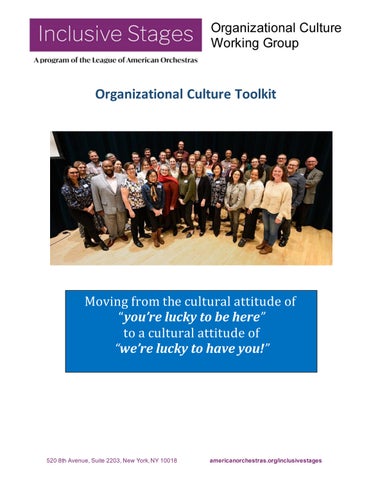
Organizational Culture Working Group
Organizational Culture Toolkit
Moving from the cultural attitude of “you’re lucky to be here” to a cultural attitude of “we’re lucky to have you!”
520 8th Avenue, Suite 2203, New York, NY 10018
americanorchestras.org/inclusivestages
Inclusive Stages Organizational Culture Toolkit A Working Draft of the Organizational Culture Working Group Working draft — October 2026
This toolkit draws on the ongoing conversations of the Inclusive Stages Organizational Culture Working Group into a practical resource that orchestras can adapt to their own size, structure, and stage of readiness. It covers Sections 1 through 21 of the toolkit structure agreed to by the working group, and it is designed to be used alongside a set of companion worksheets that organizations can fill in, revise, and return to. This is a living draft. It is built to move from a set of Word documents into an interactive, adaptable resource hosted on the League website, so organizations of every size and stage can find the parts most useful to them without wading through material meant for a different context.
Inclusive Stages Organizational Culture Toolkit — Working Draft, October 2026
Contents Contents......................................................................................................................................................................................................................... 2 1. Introduction: Why Organizational Culture Matters...................................................................................................................3 2. Connection to Inclusive Stages ...............................................................................................................................................................3 3. Shared Language and Key Terms ..........................................................................................................................................................4 4. Who This Toolkit Is For ..................................................................................................................................................................................4 5. How to Use the Toolkit ...................................................................................................................................................................................5 6. Adapting This Toolkit to Your Organization ..................................................................................................................................5 7. Core Values.............................................................................................................................................................................................................6 8. Where Are We Now? Organizational Readiness Assessment .......................................................................................... 7 9. Common Orchestra Culture Assumptions ...................................................................................................................................... 7 10. Culture Shifts We Are Working Toward ....................................................................................................................................... 8 11. Roles, Lanes, and Decision-Making Power ....................................................................................................................................9 12. Dialogue and Listening Tools ..................................................................................................................................................................9 13. Accountability, Conflict, and Repair ..................................................................................................................................................9 14. Culture Action Plan Template............................................................................................................................................................. 10 15. Resourcing the Work ................................................................................................................................................................................. 10 16. Board and Leadership Accountability ........................................................................................................................................... 10 17. Metrics, Evaluation, and Data Ethics .............................................................................................................................................. 10 18. Implementation Roadmap ...................................................................................................................................................................... 11 19. Annual Review and Reporting .............................................................................................................................................................. 11 20. Connection to Welcome & Onboarding and Musician Buddy Tools ........................................................................ 11 21. Appendices (Worksheets) ..................................................................................................................................................................... 12 References and Further Reading .............................................................................................................................................................. 14 Orchestra-Specific and Field Context .............................................................................................................................................. 14 Arts, Culture, and Racial Equity Toolkits........................................................................................................................................ 14 Governance, Board Accountability, and Nonprofit Leadership ..................................................................................... 14 Psychological Safety, Team Culture, and Onboarding ......................................................................................................... 14
Inclusive Stages Organizational Culture Toolkit — Working Draft, October 2026
1. Introduction: Why Organizational Culture Matters Organizational culture is the everyday system of habits, norms, power, communication, and decision-making that shapes who feels welcomed, valued, and able to contribute inside an orchestra. It is evidenced in who speaks first in a rehearsal disagreement, whose schedule gets protected, whose feedback changes a program, and who is quietly expected to be grateful just to have a seat. Inclusive Stages exists to increase the racial diversity of musicians in American professional and community orchestras. Hiring is necessary, but it is not sufficient. If the culture a new musician enters has not changed, gains made through auditions and fellowships do not last. This is the central goal of this guide: to encourage equity work that fosters a true paradigm shift in how the organization operates, rather than a bandage stuck onto an otherwise unchanged existing culture. Two things make this work more difficult, and more urgent, than it may first appear. First, musicians of every background carry real trauma around job security, fitting in, and audition pressure; for musicians of color, these pressures compound with the added burden of being asked to represent a group, being watched more closely, or being the "first" or "only" in a section. Second, distrust between musicians and management in this field is not new. It traces back at least thirty to forty years and remains active today, as evidenced in recent contract negotiations that have received national attention. A culture toolkit will not resolve that history in one reading. It can, however, give organizations a shared vocabulary and a concrete set of tools for doing the slower work of rebuilding trust.
2. Connection to Inclusive Stages Inclusive Stages is a national initiative, recently renewed for three additional years, that has expanded its coalition to include youth orchestras, educational partners, and additional professional and community orchestras. The initiative has two primary areas of work: building a National Coalition aligned around measurable, field-wide change, and gathering data that gives the field a clearer picture of its current state. Culture work supports both. Within coalition orchestras, culture change is what allows measurable progress on musician diversity to hold rather than reverse. Field-wide, culture practices piloted inside coalition orchestras are the models other orchestras adopt. Inclusive Stages is also collecting data through four connected projects: the Audition & Tenure Practices Survey, the Audition Applicant Demographics Survey, the Inclusion Index, and the Orchestra Demographics Survey. The Inclusion Index in particular is a tool for orchestras to assess and benchmark their own organizational culture. This toolkit is designed to give organizations best practices to act on, whether they are preparing for the Inclusion Index, responding to what it shows them, or working on culture independent of any single assessment.
Fellowships and Organizational Culture Fellowships and similar bridge positions only accomplish their purpose if the organizational culture around them supports musicians once they arrive. A fellowship built on strong onboarding, real mentorship, transparent decision-making, and a genuine path toward a permanent seat functions as an on-ramp into the field. A fellowship without those supports functions, at best, as a temporary placement that a musician outgrows or leaves. Sections 14 (Culture Action Plan), 15 (Resourcing the Inclusive Stages Organizational Culture Toolkit — Working Draft, October 2026
Work), and 20 (Welcome & Onboarding) all apply directly to how an organization builds fellowship experiences that lead somewhere.
3. Shared Language and Key Terms Companion to Worksheet 1
Culture conversations break down when people use the same words to mean different things. Before an organization begins planning, it helps to agree on a shared vocabulary. The full glossary is provided as Worksheet 1, and the core terms are introduced here. • Belonging: the felt experience of being valued as you are, not only tolerated or accommodated. • Racial equity: the condition where race no longer predicts outcomes, opportunities, or
treatment, and past disparities are actively corrected rather than simply not repeated. • Inclusion: the practice of sharing power, voice, and decision-making, not just presence in the
room. • Organizational culture: the everyday habits, norms, and unwritten rules that shape behavior,
distinct from stated values or policy. • Psychological safety: a shared belief that it is safe to take interpersonal risks, such as raising a
concern or admitting a mistake, without being punished or humiliated for it. • Accountability: a clear, consistent connection between commitments made and
consequences that follow, positive or corrective. • Engagement vs. outreach: outreach invites people in on the organization’s existing terms;
engagement changes those terms in response to who is invited in. • Musician leadership: musicians holding real authority in decisions that affect them, not only
advisory input. • Shared power: decision-making authority that is distributed rather than concentrated in one
role or department. • Microaggression: a brief, everyday comment or action, intentional or unintentional, that
communicates a demeaning or othering message to someone based on their identity. • Macroaggression: a larger, often structural pattern (a repeated tenure outcome, a consistently
overlooked section, a recurring programming choice) that produces the same exclusionary effect as a microaggression, at scale.
4. Who This Toolkit Is For This toolkit is written for everyone who shapes an orchestra’s culture, even when their formal authority over it looks different. Role
Typical relationship to culture work
Board (as a whole)
Sets policy direction, approves resourcing, and holds the ED/CEO accountable for culture outcomes. Inclusive Stages Organizational Culture Toolkit — Working Draft, October 2026
Role
Typical relationship to culture work
Individual board members
Model the organization’s stated values in how they engage with staff and musicians.
Executive Director / CEO
Owns organization-wide implementation and reports progress to the board.
Music Director
Shapes artistic decision-making culture, repertoire choices, and rehearsal-room norms.
Musician leaders (committees, union representatives)
Represent musician experience in decisions and hold organizations accountable to commitments.
Staff
Carry out day-to-day practices; often first to notice where culture and stated values diverge.
Volunteers
Shape the informal, day-to-day welcome many musicians and patrons experience first.
Patrons and donors
Influence culture through the expectations they bring and the programming they support.
Community partners
Experience firsthand whether engagement is reciprocal or transactional.
5. How to Use the Toolkit Companion to Worksheet 2 & Where Should We Start?
This toolkit is a guide for conversation, planning, action, and evaluation. It is not a one-size-fits-all policy, and no organization is expected to implement all 21 sections at once, or in order. Because this is a large amount of material, start with the one-page Self-Assessment (companion document, "Where Should We Start?"). It takes about five minutes, produces a simple score, and points you toward a Foundational, Building, or Advanced starting place. From there, Worksheet 2, the Toolkit Level Finder Questionnaire, adds detail on organization type and capacity so you can go directly to the sections and worksheets most relevant to you rather than reading the whole document in sequence. Working alone or with a small team? Sections 6, 8, 12, 14, and 18 include a short callout with a lighter-weight version of that section’s tool, so a single staff or musician lead can make real progress without a full task force.
6. Adapting This Toolkit to Your Organization Companion to Worksheet 14
Orchestra structures vary widely, and so should the pace and format of culture work. The table below is a starting point. Worksheet 14 goes further for per-service and volunteer-led organizations specifically, since the working group heard directly that these organizations need distinct guidance. Inclusive Stages Organizational Culture Toolkit — Working Draft, October 2026
Organization type
What is different
Where to start
Full-time, tenured/salaried
Longer institutional memory, with higher stakes around tenure and seniority.
Section 13 (Accountability, Conflict, and Repair), Section 16 (Board and Leadership Accountability).
Per-service
Musicians hold multiple jobs; limited shared meeting time; harder to sustain multi-session processes.
Worksheet 14; Section 12 with the compressed listeningsession format.
Union
Formal grievance and negotiation channels already exist and should be coordinated with, not duplicated by, culture work.
Section 11 (Roles, Lanes, and Decision-Making Power).
Non-union
Fewer built-in structures for musician voice; culture tools may be the primary channel available.
Section 11; Section 13.
Community / volunteer-led
Governance and artistic roles often overlap; capacity is almost entirely volunteer time.
Section 8 with the solo-lead adaptation; Section 15 (Resourcing the Work).
Youth
Culture work includes students, families, and educators, not only adult musicians; onboarding starts much earlier.
Section 20 (Welcome & Onboarding); Section 4, adapted for student and family roles.
Higher education / collegiate
Culture work intersects with academic structures, faculty roles, and degree requirements.
Section 4, adapted for faculty and student roles; Section 11.
Mixed-model
Different tiers, ensembles, or perservice and salaried musicians may experience culture differently within one organization.
Section 8, run separately for each tier before combining results.
7. Core Values These values, drawn from the working group’s discussions, underlie every section of this toolkit. Value
What it means in practice
Fairness
Processes and outcomes hold up to scrutiny regardless of who is affected.
Access
Opportunity is not limited by unstated assumptions about who belongs.
Inclusive Stages Organizational Culture Toolkit — Working Draft, October 2026
Value
What it means in practice
Historical clarity
Current practices are understood in light of the history that produced them, including decades of musician distrust.
Systemic perspective
Problems are addressed as patterns, not only as isolated incidents.
Accountable change
Commitments are tracked and reported on, not only announced.
Rigor
Culture work is held to the same standard of seriousness as artistic or financial work.
Transparency
Decision-making processes are visible to the people they affect.
Collaboration / interdependence
Authority is shared across roles rather than concentrated in one.
Ambition with constraint
Goals are real and stretch the organization, while staying honest about current capacity.
Stewardship of the field
Each organization’s culture work strengthens the orchestra field as a whole, not only itself.
8. Where Are We Now? Organizational Readiness Assessment Companion to Worksheet 3 & Where Should We Start?
Before choosing priorities, it helps to know where your organization currently stands. Worksheet 3 offers a one-page self-assessment across five domains: board understanding, musician feedback, onboarding, leadership accountability, and reciprocal community engagement. Each domain is scored as Not Yet, Emerging, In Progress, or Strong. Solo lead adaptation If you are completing this alone, fill it out based on your own honest perception of the organization, then ask two or three trusted colleagues in different roles (a musician, a board member, a staff member) to fill it out independently before comparing notes. The gaps between perspectives are often more informative than any single score.
9. Common Orchestra Culture Assumptions Companion to Worksheet 11
Every organization carries inherited, often unspoken norms. Naming them is the first step toward deciding which ones to keep and which to change. • "You are lucky to be here." The expectation that musicians, especially substitutes, freelancers,
and newer members, should be grateful for a seat rather than treated as valued colleagues from day one. Inclusive Stages Organizational Culture Toolkit — Working Draft, October 2026
• Staff overwork as a badge of honor. Burnout is normalized rather than named as a culture and
resourcing problem. • Centralized artistic power. Repertoire, guest artist, seating, and other artistic decisions sit
with very few people, with little structured input from musicians. • Narrow definitions of excellence. "Excellence" is defined in ways that quietly exclude non-
traditional training paths, repertoire, or backgrounds. • Distrust as permanent. The assumption that the divide between musicians and management
is intractable, rather than a condition that can be actively changed. • Microaggressions as too small to address. Everyday comments or slights are dismissed as
unintentional or minor, so no one names them or checks whether they are part of a pattern. • Macroaggressions as isolated incidents. A repeated tenure outcome, a consistently
overlooked section, or a recurring casting pattern is treated as a series of unrelated events rather than a structural signal.
10. Culture Shifts We Are Working Toward Each assumption above has a corresponding shift. These are not slogans; they describe what a different set of practices would look like in daily operation. From
To
"You are lucky to be here."
"We are lucky to have you." Onboarding and daily practice communicate that the musician’s presence strengthens the organization, from their first rehearsal.
Staff overwork as normal
Sustainable workload treated as a condition for good culture work, not a competing priority.
Centralized artistic power
Collaborative artistic leadership, with structured musician input into repertoire and casting decisions.
Narrow excellence
A broader, explicitly examined definition of artistic excellence.
Distrust as permanent
Distrust as historical and addressable, met with consistent, visible follow-through over time.
Microaggressions ignored
Microaggressions named and interruptible in the moment, without requiring a formal complaint.
Macroaggressions unexamined
Patterns tracked over time and reviewed structurally, not dismissed case by case.
Inclusive Stages Organizational Culture Toolkit — Working Draft, October 2026
From
To
Fellowship as temporary slot
Fellowship as a genuine on-ramp, paired with mentorship and a visible path to a lasting role in the field.
11. Roles, Lanes, and Decision-Making Power Companion to Worksheet 4 & Worksheet 11
Many culture conflicts are really disagreements about who had the authority to decide, who should have been consulted, and who was affected but never asked. Worksheet 5, the Decision-Making and Shared Power Map, gives organizations a repeatable way to answer five questions for any significant decision: Who makes the decision? Who is affected? Who has historically been left out? Who should be consulted? How will the final decision be communicated? Running real decisions, past or upcoming, through this worksheet is more useful than discussing decision-making in the abstract.
12. Dialogue and Listening Tools Companion to Worksheet 5
Structured listening is different from an open-ended conversation. Worksheet 4 provides a facilitation agenda, sample community agreements, and stakeholder prompts for a 60- to 90minute session. One caution raised repeatedly by the working group: gathering feedback should never become unpaid emotional labor, particularly for musicians of color who are often asked, informally and repeatedly, to explain the same problems. Compensate participation where you can, limit how often the same individuals are asked to speak for a whole group, and always close the loop by reporting back what was heard and what will (or will not) change as a result. Solo lead adaptation A single lead can still run a listening session by shortening it to a 30-minute structured conversation with three prepared questions, and by rotating which small group is invited each time so no one person carries the full burden of representing musician experience.
13. Accountability, Conflict, and Repair Companion to Worksheet 6 & Worksheet 11
A culture toolkit has to describe what happens when the desired culture breaks down, not only what the culture should look like. Worksheet 6 lays out concern pathways, confidentiality practices, follow-up expectations, pattern tracking, repair options, and criteria for bringing in outside facilitation. Microaggressions and macroaggressions call for different tools. A microaggression usually needs an in-the-moment response: a way to name what happened, without requiring a formal complaint or putting the burden entirely on the person harmed. A macroaggression, because it is a pattern rather Inclusive Stages Organizational Culture Toolkit — Working Draft, October 2026
than a single event, needs structural review: tracking over time, looking across cases, and asking whether a process (tenure, casting, scheduling) is producing a consistent, unequal effect. Treating a macroaggression like an isolated incident is itself part of how patterns go unaddressed. It is critical to establish protocols for logging and tracking ongoing repetition and patterns of microaggressions. Recurring microaggressions become macroaggressions.
14. Culture Action Plan Template Companion to Worksheet 7
Once priorities are chosen, they need to become concrete commitments. Worksheet 7 converts each priority into an action with a named owner, a timeline, required resources, a measure of progress, and a report-back date. Solo lead adaptation Limit the plan to three priorities at a time. A short list that is actually completed and reported on builds more trust than a long list that stalls.
15. Resourcing the Work Companion to Worksheet 8
Culture commitments fail when they are not connected to real resources. Worksheet 8 asks organizations to name the staff time, money, authority, and support each commitment requires, including musician compensation for meetings, facilitator fees, board education time, accessibility needs, translation, data tools, and community partner honoraria. Naming a resourcing gap honestly, even when the organization cannot yet close it, is more useful to planning than leaving it unstated.
16. Board and Leadership Accountability Companion to Worksheet 9
Culture change holds only when leadership is accountable to it. Worksheet 9 provides board questions for quarterly or annual reflection, and evaluation language for ED/CEO and Music Director roles that includes culture outcomes alongside artistic and financial ones. This connects directly to the Music Director Engagement Plan that Inclusive Stages asks coalition orchestras to complete. Whether an organization’s current Music Director is continuing in the role, in a search process, or already transitioning to a successor, the organization should be able to state clearly how the Music Director is or will be involved in this work, including in any case where hiring, tenure, or retention decisions sit with a different person, group, or entity.
17. Metrics, Evaluation, and Data Ethics Companion to Worksheet 10
This toolkit distinguishes internal metrics that an organization tracks for itself from the field-wide data Inclusive Stages is gathering through the Audition & Tenure Practices Survey, the Audition Inclusive Stages Organizational Culture Toolkit — Working Draft, October 2026
Applicant Demographics Survey, the Inclusion Index, and the Orchestra Demographics Survey. The two complement each other: field-wide data shows how your organization compares to the field, while internal metrics show whether your own commitments are moving. Any data collection, internal or field-wide, should follow basic ethical practice: informed consent, confidentiality, care with demographic data, avoiding placing unpaid emotional labor on the people providing feedback, and reporting findings back to participants rather than only upward to leadership. Worksheet 10 provides a sample dashboard and a short data ethics checklist.
18. Implementation Roadmap A phased approach keeps this work from becoming overwhelming, or from stalling entirely. 1. Learn: build shared language using Section 3 and Worksheet 1. 2. Assess: complete the Readiness Assessment (Section 8, Worksheet 3). 3. Listen: run structured listening sessions (Section 12, Worksheet 4). 4. Choose priorities: select a small number of focus areas based on what you learned. 5. Resource: name what each priority requires (Section 15, Worksheet 8). 6. Implement: put the Culture Action Plan into motion (Section 14, Worksheet 7). 7. Measure: track progress using agreed-upon metrics (Section 17, Worksheet 10). 8. Report: share results with the board and with the people who gave input (Section 16, Section
19). 9. Revise: adjust based on what was learned and repeat the cycle (Section 19, Worksheet 12). Large task force vs. solo lead A large task force can run several phases in parallel and dedicate separate committees to each. A single lead should move through phases mostly in sequence, spend proportionally more time on Learn and Assess before committing to priorities, and expect the full cycle to take longer, which is a reasonable trade-off for sustainability.
19. Annual Review and Reporting Companion to Worksheet 12
An annual cycle keeps culture work from becoming a one-time event tied to a single grant or initiative. Worksheet 12 asks four questions every year: what changed, what was measured, what feedback was received, and what remains unresolved, alongside next year’s priorities. The working group has discussed directly how to sustain this work beyond the three-year span of Inclusive Stages, so that it does not become a standalone event that ends when the initiative does. An annual review built into your organization’s regular planning calendar, rather than treated as a special project, is the most reliable way to do that.
20. Connection to Welcome & Onboarding and Musician Buddy Tools Inclusive Stages Organizational Culture Toolkit — Working Draft, October 2026
Companion to Worksheet 13
Section 9 named "you are lucky to be here" as an assumption worth changing. Onboarding is where that shift becomes concrete. The working group’s Onboarding Subcommittee has been drafting a framework organized by what, why, and how for each stage of the onboarding journey, built around musician voice and grounded in the value "we are lucky to have you," extending to substitutes, freelancers, and full-time musicians alike. Two reflection questions are worth asking on a regular basis, not just once: What do your musician onboarding practices actually look like in the first 30, 60, and 90 days? And honestly, are they creating a positive culture, or are they simply processing paperwork?
The Musician Buddy / Mentor Connection The working group’s Musician Mentor Subcommittee has partnered with Equity Arc to map musician career milestones as a framework for matching mentors and mentees. One clear finding so far: pairing people at adjacent career milestones works better than pairing people whose experience is far apart. The subcommittee is considering two deliverables: a guide any organization can use to build its own internal buddy program, and a proposal for a cross-organization buddy program coordinated through the League. Career arcs in this field are frequently non-linear. Musicians step away and return for many reasons, and buddy programs should be built to support re-entry, not only forward progress along a single track. This matters for the same reason fellowships matter: roughly 80 to 85 percent of orchestra audiences were once school musicians themselves, so the field has a strong interest in not losing people at the points where their path diverges from a straight line. Worksheet 13 offers a short alignment worksheet connecting your onboarding practices to your (existing or planned) buddy program.
21. Appendices (Worksheets) The tools referenced throughout this toolkit are provided as separate documents, so they can be filled in, copied, or shared independently of the full toolkit. Worksheet
Ties to section
Where Should We Start? (one-page Self-Assessment)
Sections 5 and 8
1. Glossary and Shared Language
Section 3
2. Toolkit Level Finder Questionnaire
Section 5
3. Organizational Readiness Assessment
Section 8
4. Decision-Making and Shared Power Map
Section 11
5. Stakeholder Listening Session Agenda
Section 12
6. Accountability, Concern Pathway, and Repair Worksheet
Section 13
7. Culture Action Plan Template
Section 14
Inclusive Stages Organizational Culture Toolkit — Working Draft, October 2026
Worksheet
Ties to section
8. Resourcing the Work Worksheet
Section 15
9. Board and Leadership Accountability Questions
Section 16
10. Metrics, Evaluation, and Data Ethics Dashboard
Section 17
11. Case Studies and Scenarios for Discussion
Sections 9, 10, 13
12. Annual Culture Review
Section 19
13. Musician Onboarding and Buddy Program Alignment Worksheet
Section 20
14. Per-Service and Volunteer-Led Orchestra Adaptation Guide
Section 6
Inclusive Stages Organizational Culture Toolkit — Working Draft, October 2026
References and Further Reading These sources informed the toolkit structure and are recommended for further reading. Keep hyperlinks active in the electronic version.
Orchestra-Specific and Field Context • League of American Orchestras — Inclusive Stages • League of American Orchestras — Equity, Diversity, and Inclusion Resource Center • League of American Orchestras — EDI Data Hub • League of American Orchestras — Musician Diversity • League of American Orchestras — EDI Reports and Publications • Black Orchestral Network — Dear American Orchestras, Part II • Black Orchestral Network — Open Letter and Ten Steps Toward Equity in the Tenure
Process
Arts, Culture, and Racial Equity Toolkits • Race Forward — Creating Cultures and Practices for Racial Equity • Race Forward — Racial Equity Impact Assessment Toolkit • Equity in the Center — Awake to Woke to Work • Equity in the Center — Awake to Woke to Work (accessible PDF) • Government Alliance on Race and Equity — Racial Equity Toolkit • GARE Racial Equity Toolkit (Othering & Belonging Institute archive PDF) • American Alliance of Museums — Facing Change • American Alliance of Museums — Facing Change: How to Use This Report
Governance, Board Accountability, and Nonprofit Leadership • BoardSource — Nonprofit Board Resources • BoardSource — Initiatives • BoardSource — Board Leadership Research • Leading with Intent — BoardSource Index of Nonprofit Board Practices
Psychological Safety, Team Culture, and Onboarding • Amy C. Edmondson — Psychological Safety and Learning Behavior in Work Teams (1999) • Harvard Business School — Faculty citation for Edmondson’s article • Google re:Work — Understand Team Effectiveness • SHRM — New Employee Onboarding Guide • Talya N. Bauer / SHRM Foundation — Onboarding New Employees: Maximizing Success
Inclusive Stages Organizational Culture Toolkit — Working Draft, October 2026
Where Should We Start? A One-Page Self-Assessment Companion to Sections 5 and 8 — Inclusive Stages Organizational Culture Toolkit
Rate your organization honestly on each statement below, using this scale: 1 = Not Yet, 2 = Emerging, 3 = In Progress, 4 = Strong. Write a number in the blank, then add up your total at the bottom. This takes about five minutes and works whether one person or a full task force is completing it. Statement
Score (1–4)
1. Board members understand why organizational culture matters to our Inclusive Stages goals. 2. Musicians have a real channel to give feedback, and leadership acts on it. 3. New musicians — including substitutes and freelancers — get structured onboarding, not just paperwork. 4. Leadership (ED/CEO, Music Director) is held accountable for culture outcomes, not only artistic or financial ones. 5. Concerns raised by musicians or staff are tracked and followed up on. 6. Our decision-making is clear about who decides, who is consulted, and who is affected. 7. We know what resources — time, money, compensation — our culture work would need. 8. Our community partnerships are reciprocal, not one-off or transactional.
Total score (add all 8 numbers):
What your score means Score
Your starting point
Start here
8–14
Foundational — you’re building shared ground.
Sections 1–4 and 7; Worksheet 1 (Glossary). Then move to Section 8 and Worksheet 3 for the full Readiness Assessment.
15–24
Building — the basics are in place; it’s time to structure the work.
Section 11 (Roles and Decision-Making) and Sections 14–15 (Action Plan and Resourcing); Worksheets 5, 7, and 8.
Inclusive Stages Organizational Culture Toolkit — Working Draft, October 2026
Score
Your starting point
Start here
25–32
Advanced — focus on accountability and sustaining progress.
Sections 16–17 (Board/Leadership Accountability and Metrics) and Section 19 (Annual Review); Worksheets 9, 10, and 12.
Two more things worth checking If your organization is per-service or volunteer-led, go directly to Worksheet 14 regardless of your score. If one person is leading this work rather than a task force, look for the "Solo lead adaptation" notes in Sections 6, 8, 12, 14, and 18 before you begin.
Notes
Inclusive Stages Organizational Culture Toolkit — Working Draft, October 2026
Worksheet 1 Glossary and Shared Language Companion to Section 3 — Inclusive Stages Organizational Culture Toolkit
Use this glossary at the start of any culture conversation so participants are working from the same definitions. Add organization-specific terms at the bottom. Term
Working definition
Belonging
The felt experience of being valued as you are, not only tolerated or accommodated.
Racial equity
The condition where race no longer predicts outcomes, opportunities, or treatment, and past disparities are actively corrected.
Equity vs. equality
Equality gives everyone the same resources; equity gives people what they specifically need to reach the same outcome.
Inclusion
The practice of sharing power, voice, and decision-making–not just presence in the room.
Organizational culture
The everyday habits, norms, and unwritten rules that shape behavior, distinct from stated values or written policy.
Psychological safety
A shared belief that it is safe to take interpersonal risks, such as raising a concern, without being punished or humiliated for it.
Accountability
The obligation or willingness of an individual or organization to accept responsibility for their actions, decisions, and policies .
Engagement vs. outreach
Outreach invites people in on the organization’s existing terms; engagement changes those terms in response to who is invited in.
Musician leadership
Musicians holding real authority in decisions that affect them, not only advisory input.
Shared power
Decision-making authority that is distributed rather than concentrated in one role or department.
Microaggression
A brief, everyday comment or action, intentional or unintentional, that communicates a demeaning or othering message based on identity.
Macroaggression
A larger, structural pattern that produces the same exclusionary effect as a microaggression, at scale (a repeated tenure outcome, a consistently overlooked section).
Inclusive Stages Organizational Culture Toolkit — Working Draft, October 2026
Term
Working definition
Tenure / probationary process
The formal process by which a newly hired musician moves from probationary status to a permanent seat.
Per-service musician
A musician paid per rehearsal or performance rather than on salary, often holding multiple positions.
Non-linear career arc
A musician’s path that includes pauses, returns, or shifts, rather than a single continuous trajectory.
Coalition (Inclusive Stages)
The group of League of American Orchestras member orchestras, youth orchestras, and educational partners working together on Inclusive Stages goals.
Inclusion Index
An Inclusive Stages tool that allows orchestras to assess and benchmark their own organizational culture.
Add your organization’s own terms
Inclusive Stages Organizational Culture Toolkit — Working Draft, October 2026
Worksheet 2 Toolkit Level Finder Questionnaire Companion to Section 5 — Inclusive Stages Organizational Culture Toolkit
This toolkit covers 21 sections and 14 worksheets. Most organizations should not try to use all of it at once. Answer the questions below to find your starting point, then go directly to the matching sections and worksheets.
Part A: Your organization ☐ We are a youth orchestra or include students and families in our culture work. ☐ We are a higher education / collegiate ensemble. ☐ We are primarily per-service or per-project. ☐ We are primarily full-time, salaried, or tenured. ☐ We are community or volunteer-led. ☐ Our musicians are unionized. ☐ We are a mixed-model organization with more than one tier of musicians.
Whichever boxes you checked, go to Section 6 (Adapting This Toolkit to Your Organization) and, if you checked per-service or volunteer-led, go directly to Worksheet 14.
Part B: Your capacity ☐ One person (staff or musician) is leading this work with little dedicated time. ☐ A small committee (2–5 people) is leading this work. ☐ A larger task force with representation from board, staff, and musicians is leading this work.
If you checked "one person," look for the "Solo lead adaptation" callouts throughout the toolkit (Sections 6, 8, 12, 14, and 18) before starting.
Part C: Where you already stand ☐ We have not yet had an organization-wide conversation about culture. ☐ We have talked about culture but have not assessed where we stand. ☐ We have assessed where we stand but have not chosen priorities or resourced them.
☐ We have utilized the Inclusion Index or another tool to solicit anonymous feedback from musicians and staff. ☐ We have chosen priorities and are implementing an action plan. ☐ We have completed at least one full cycle and are reviewing annually.
Inclusive Stages Organizational Culture Toolkit — Working Draft, October 2026
Your starting point If Part C answer was…
Start here
We have not yet talked about culture
Foundational level: Sections 1–4, 7; Worksheet 1 (Glossary)
We’ve talked but not assessed
Foundational/Building: Section 8; Worksheet 3 (Readiness Assessment)
We’ve assessed but not resourced or planned
Building level: Sections 11, 14, 15; Worksheets 5, 7, 8
We’re implementing an action plan
Building/Advanced: Sections 13, 16, 17; Worksheets 6, 9, 10
We’ve completed a full cycle
Advanced level: Section 19; Worksheet 12 (Annual Review)
Inclusive Stages Organizational Culture Toolkit — Working Draft, October 2026
Worksheet 3 Organizational Readiness Assessment Companion to Section 8 — Inclusive Stages Organizational Culture Toolkit
For each domain, mark where your organization currently stands: Not Yet, Emerging, In Progress, or Strong. Add a short note explaining your answer — the notes are often more useful later than the rating itself. Domain
Not Yet
Emerging
In Progress
Strong
Board understanding of culture work
☐
☐
☐
☐
Musician feedback channels
☐
☐
☐
☐
Onboarding practices
☐
☐
☐
☐
Leadership accountability
☐
☐
☐
☐
Reciprocal community engagement
☐
☐
☐
☐
Notes on each domain
Solo lead adaptation Fill this out yourself first, then ask two or three colleagues in different roles to complete it independently before comparing. Disagreement between perspectives is useful information, not a problem to resolve immediately.
Inclusive Stages Organizational Culture Toolkit — Working Draft, October 2026
Worksheet 4 Decision-Making and Shared Power Map Companion to Section 11 — Inclusive Stages Organizational Culture Toolkit
Use this worksheet for any significant upcoming or recent decision — a repertoire choice, a hiring or tenure decision, a schedule change, a budget priority. Answer all five questions before finalizing or reviewing the decision. Decision being mapped: Who makes the decision? Who is affected by it? Who has historically been left out of decisions like this? Who should be consulted before it is finalized? How will the final decision be communicated, and to whom?
Copy this table for each decision you want to map. Over time, look across several completed maps for patterns in who is consistently left out or under-consulted.
Inclusive Stages Organizational Culture Toolkit — Working Draft, October 2026
Worksheet 5 Stakeholder Listening Session Agenda Companion to Section 12 — Inclusive Stages Organizational Culture Toolkit
A 60- to 90-minute structure for gathering input from musicians, staff, or board members. Adjust the timing to fit a shorter, 30-minute session if needed (see the solo lead note in Section 12). Time
Segment
5 min
Welcome, purpose of the session, and how input will be used.
10 min
Review community agreements (below) and invite additions.
20–30 min
Facilitated discussion using stakeholder prompts (below).
15–20 min
Small-group or paired conversation for those less comfortable speaking in the full group.
10 min
Report-out and identification of common themes.
5–10 min
Close: what happens next, and when participants will hear back.
Sample community agreements ● One voice at a time; step up, step back.
● Listen to understand rather than respond. ● Speak from your own experience rather than generalizing for a whole group. ● What is shared stays in the room unless the group agrees otherwise. ● Disagreement is expected and welcome; personal attacks are not. ● It is fine to pass on any question.
Sample stakeholder prompts 1. What has your experience of onboarding, decision-making, or feedback been like here? 2. Where have you seen this organization’s stated values match its everyday practice? Where
have you seen a gap? 3. If you could change one thing about how decisions get made here, what would it be? 4. What would make it easier, or safer, for you to raise a concern? Reminder Compensate participants where possible, avoid repeatedly asking the same individuals to represent an entire group, and always report back what was heard and what will change as a result.
Inclusive Stages Organizational Culture Toolkit — Working Draft, October 2026
Worksheet 6 Accountability, Concern Pathway, and Repair Worksheet Companion to Section 13 — Inclusive Stages Organizational Culture Toolkit
Concern pathway Describe, in plain language, how a musician, staff member, or volunteer raises a concern in your organization today.
Confidentiality and follow-up practices ☐ People know who receives concerns and how confidentiality is handled. ☐ There is a stated timeframe for an initial response. ☐ The person who raised the concern is told what happens next, even if the answer is "not yet
resolved." ☐ Concerns are logged in a way that allows pattern tracking over time.
Handling microaggressions vs. macroaggressions Type
Typical response
Microaggression (a single comment or moment)
In-the-moment naming or a brief private conversation; does not require a formal complaint; logged briefly for pattern tracking.
Macroaggression (a repeated pattern across time or cases)
Structural review: look across cases, examine whether a process is producing a consistent unequal effect, and involve leadership or the board.
Repair options • Direct conversation facilitated by a neutral party • Written acknowledgment of harm and a specific commitment to change • Policy or process change addressing the root cause Inclusive Stages Organizational Culture Toolkit — Working Draft, October 2026
• Restorative circle or facilitated group conversation • Referral to outside facilitation (see criteria below)
When to bring in outside facilitation ☐ The concern involves organizational leadership directly. ☐ Internal attempts at resolution have not worked. ☐ The pattern is systemic rather than a single incident. ☐ Participants do not trust an internal process to be neutral.
Inclusive Stages Organizational Culture Toolkit — Working Draft, October 2026
Worksheet 7 Culture Action Plan Template Companion to Section 14 — Inclusive Stages Organizational Culture Toolkit
List no more than three to five priorities at a time. A short list that gets completed and reported on builds more trust than a long list that stalls. Priority
Owner
Timeline
Resources needed
Measure of progress
Inclusive Stages Organizational Culture Toolkit — Working Draft October 2026
Report-back date
Worksheet 8 Resourcing the Work Worksheet Companion to Section 15 — Inclusive Stages Organizational Culture Toolkit
For each category, name what is currently available, what is missing, and a realistic plan to close the gap. It is more useful to name a gap honestly than to leave it unstated. Resource category
Currently available
Gap
Plan to close it
Staff time Musician compensation for meetings Facilitator / consultant fees Board education time Accessibility accommodations Translation / interpretation Data or survey tools Community partner honoraria
Inclusive Stages Organizational Culture Toolkit — Working Draft, October 2026
Worksheet 9 Board and Leadership Accountability Questions Companion to Section 16 — Inclusive Stages Organizational Culture Toolkit
Quarterly or annual board questions 1. What culture commitments did we make this year, and what is the status of each? 2. What did we hear directly from musicians, and how did it change our decisions? 3. Where did leadership model our stated values, and where did it fall short? 4. What is our Music Director Engagement Plan, and is it being followed? 5. What will we do differently in the coming year?
ED/CEO evaluation addendum • Culture commitments were resourced, not just announced. • Concerns raised by musicians or staff were addressed and followed up on. • Progress was reported to the board and to participants, not only internally.
Music Director evaluation addendum • Repertoire and artistic personnel decisions reflect structured musician input where applicable. • The Music Director’s role in the organization’s Inclusive Stages work is clearly stated and
current, including during any transition between Music Directors. • Rehearsal-room norms support psychological safety.
Inclusive Stages Organizational Culture Toolkit — Working Draft, October 2026
Worksheet 10 Metrics, Evaluation, and Data Ethics Dashboard Companion to Section 17 — Inclusive Stages Organizational Culture Toolkit
Sample dashboard Metric
Data source
Onboarding completion / satisfaction
Post-onboarding survey
Musician retention (by tenure stage)
HR / personnel records
Concerns raised and resolved
Concern log (Worksheet 6)
Board and leadership follow-through
Action Plan (Worksheet 7)
Reciprocal community partnerships
Partnership review
Frequency
Current value
Target
Data ethics checklist ☐ Participants gave informed consent for how their data or feedback will be used. ☐ Demographic data is collected and stored with care for confidentiality. ☐ No individual is asked, repeatedly and without compensation, to represent an entire group. ☐ Findings are reported back to participants, not only used internally. ☐ Field-wide data (Audition & Tenure Practices Survey, Audition Applicant Demographics Survey,
Inclusion Index, Orchestra Demographics Survey) is used alongside, not instead of, internal metrics.
Inclusive Stages Organizational Culture Toolkit — Working Draft, October 2026
Worksheet 11 Case Studies and Scenarios for Discussion Companion to Sections 9, 10, 13 — Inclusive Stages Organizational Culture Toolkit
Use one scenario at a time in a staff, board, or musician conversation. Each includes discussion questions rather than a "correct" answer.
Scenario 1: The new substitute musician A substitute musician arrives for a single rehearsal with no introduction, no seating information in advance, and no one assigned to answer questions. She spends the rehearsal unsure whether she is doing anything wrong. • What assumption from Section 9 is showing up here? • What would "we are lucky to have you" look like in practice for this musician?
Scenario 2: The tenure concern A musician on tenure track believes the process has been inconsistent compared to how it was applied to colleagues. She is unsure whether to raise it, worried it will affect the outcome. • Is this best addressed as a single incident or a pattern? • What does your concern pathway (Worksheet 6) actually offer her right now?
Scenario 3: Staff burnout A staff member responsible for community engagement is also expected to lead most of the organization’s culture work, on top of an already full workload. • What does Worksheet 8 (Resourcing the Work) suggest is missing here? • What would need to change to make this workload sustainable?
Scenario 4: Board role confusion A board member, uncertain of their role, begins directly emailing musicians about repertoire preferences, bypassing the Music Director and staff. • What does Worksheet 5 (Decision-Making and Shared Power Map) clarify about this situation? • What role should this board member actually play?
Scenario 5: The transactional community partnership An organization partners with a community group for a single concert, takes promotional photos, and does not reach out again until the next similar event a year later. • Is this outreach or engagement, using the definitions in Worksheet 1? • What would a reciprocal version of this partnership look like? Inclusive Stages Organizational Culture Toolkit — Working Draft, October 2026
Worksheet 12 Annual Culture Review Companion to Section 19 — Inclusive Stages Organizational Culture Toolkit
Complete this review on a fixed annual schedule, built into your regular planning calendar, so culture work does not become a one-time event tied to a single initiative.
What changed this year?
What did we measure, and what did it show?
What feedback did we receive, and from whom?
What remains unresolved?
Inclusive Stages Organizational Culture Toolkit — Working Draft, October 2026
Next year’s priorities Priority
Why it matters
Owner
Inclusive Stages Organizational Culture Toolkit — Working Draft, October 2026
Worksheet 13 Musician Onboarding and Buddy Program Alignment Worksheet Companion to Section 20 — Inclusive Stages Organizational Culture Toolkit
Use this worksheet to reflect honestly on current onboarding practice and to align it with a musician buddy or mentor program, whether yours already exists or is still being planned.
What do your onboarding practices actually look like? Stage
What happens (what)
Why it matters
How it is delivered
Pre-arrival First rehearsal / first week First 30 days First 60 days First 90 days
Reflection Are these practices creating a positive culture, or are they mainly processing paperwork? Does this cover substitutes and freelancers, as well as full-time musicians?
Buddy / mentor program alignment ☐ Mentors and mentees are paired at adjacent career milestones, not distant ones. ☐ The program supports non-linear career arcs, including musicians returning after a break. ☐ Substitutes and freelancers are included, not only full-time musicians. ☐ There is a clear point of contact if a pairing is not working well.
Inclusive Stages Organizational Culture Toolkit — Working Draft, October 2026
Worksheet 14 Per-Service and Volunteer-Led Orchestra Adaptation Guide Companion to Section 6 — Inclusive Stages Organizational Culture Toolkit
Per-service, community, and volunteer-led orchestras face a real constraint the rest of the toolkit does not always account for: musicians and volunteers hold multiple jobs, and shared meeting time is scarce. This guide adapts the toolkit’s heavier tools into a lighter-weight version. Toolkit tool
Standard version
Adapted version
Readiness Assessment (Worksheet 3)
Group discussion across several domains
A form musicians complete on their own time, reviewed by one designated lead
Listening Session (Worksheet 4)
60–90 minute in-person session
20–30 minute session before or after a rehearsal, or a short written survey
Culture Action Plan (Worksheet 7)
Five or more priorities tracked by a committee
One to two priorities tracked by a single named owner
Board Accountability (Worksheet 9)
Full quarterly review
One standing agenda item at each board meeting
Practical suggestions • Compensate musicians for meeting time whenever the budget allows, even a modest stipend,
since this work is happening on top of other paid jobs. • Offer asynchronous ways to participate (written surveys, short recorded prompts) alongside
any in-person session. • Combine roles where necessary: one volunteer or staff member can hold responsibility for
culture work as part of a broader role, provided it is named explicitly rather than absorbed invisibly. • Set expectations around pace: a full implementation cycle (Section 18) will likely take longer
than in a full-time organization, and that is an appropriate trade-off for sustainability, not a sign of failure.
Inclusive Stages Organizational Culture Toolkit — Working Draft, October 2026