MASTERWORKS.1
A MESSAGE FROM CONCERT SPONSOR
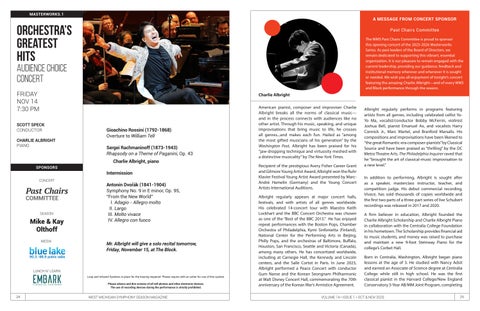
Orchestra’s Greatest Hits
Past Chairs Committee The WMS Past Chairs Committee is proud to sponsor this opening concert of the 2025-2026 Masterworks Series. As past leaders of the Board of Directors, we remain dedicated to supporting this vibrant, essential organization. It is our pleasure to remain engaged with the current leadership, providing our guidance, feedback and institutional memory wherever and whenever it is sought or needed. We wish you all enjoyment of tonight’s concert featuring the amazing Charlie Albright—and of every WMS and Block performance through the season.
Audience Choice Concert FRIDAY NOV 14 7:30 PM
Charlie Albright
SCOTT SPECK CONDUCTOR CHARLIE ALBRIGHT PIANO
Gioachino Rossini (1792-1868) Overture to William Tell Sergei Rachmaninoff (1873-1943) Rhapsody on a Theme of Paganini, Op. 43 Charlie Albright, piano
SPONSORS CONCERT
Past Chairs COMMITTEE SEASON
Mike & Kay Olthoff MEDIA
Intermission Antonín Dvořák (1841-1904) Symphony No. 9 in E minor, Op. 95, “From the New World” I. Adagio - Allegro molto II. Largo III. Molto vivace IV. Allegro con fuoco
Mr. Albright will give a solo recital tomorrow, Friday, November 15, at The Block.
LUNCH N' LEARN Loop and Infrared Systems in place for the hearing impaired. Please inquire with an usher for use of this system. Please silence and dim screens of all cell phones and other electronic devices. The use of recording devices during the performance is strictly prohibited.
24
WEST MICHIGAN SYMPHONY SEASON MAGAZINE
American pianist, composer and improviser Charlie Albright breaks all the norms of classical music— and in the process connects with audiences like no other artist. Through his music, speaking, and unique improvisations that bring music to life, he crosses all genres...and makes each fun. Hailed as “among the most gifted musicians of his generation” by the Washington Post, Albright has been praised for his “jaw-dropping technique and virtuosity meshed with a distinctive musicality” by The New York Times. Recipient of the prestigious Avery Fisher Career Grant and Gilmore Young Artist Award, Albright won the Ruhr Klavier Festival Young Artist Award presented by MarcAndré Hamelin (Germany) and the Young Concert Artists International Auditions. Albright regularly appears at major concert halls, festivals, and with artists of all genres worldwide. His celebrated 14-concert tour with Maestro Keith Lockhart and the BBC Concert Orchestra was chosen as one of the “Best of the BBC 2015.” He has enjoyed repeat performances with the Boston Pops, Chamber Orchestra of Philadelphia, Kymi Sinfonietta (Finland), National Center for the Performing Arts in Beijing, Philly Pops, and the orchestras of Baltimore, Buffalo, Houston, San Francisco, Seattle and Victoria (Canada), among many others. He has concertized worldwide, including at Carnegie Hall, the Kennedy and Lincoln centers, and the Salle Cortot in Paris. In June 2023, Albright performed a Peace Concert with conductor Gum Nanse and the Korean Seongnam Philharmonic at Walt Disney Concert Hall, commemorating the 70th anniversary of the Korean War’s Armistice Agreement.
Albright regularly performs in programs featuring artists from all genres, including celebrated cellist YoYo Ma, vocalist/conductor Bobby McFerrin, violinist Joshua Bell, pianist Emanuel Ax, and vocalists Harry Connick Jr., Marc Martel, and Branford Marsalis. His compositions and improvisations have been likened to “the great Romantic-era composer-pianists” by Classical Source and have been praised as “thrilling” by the DC Metro Theatre Arts. The Philadelphia Inquirer raved that he “brought the art of classical-music improvisation to a new level.” In addition to performing, Albright is sought after as a speaker, masterclass instructor, teacher, and competition judge. His debut commercial recording, Vivace, has sold thousands of copies worldwide and the first two parts of a three-part series of live Schubert recordings was released in 2017 and 2020. A firm believer in education, Albright founded the Charlie Albright Scholarship and Charlie Albright Piano in collaboration with the Centralia College Foundation in his hometown. The Scholarship provides financial aid to music students, and money was raised to purchase and maintain a new 9-foot Steinway Piano for the college’s Corbet Hall. Born in Centralia, Washington, Albright began piano lessons at the age of 3. He studied with Nancy Adsit and earned an Associate of Science degree at Centralia College while still in high school. He was the first classical pianist in the Harvard College/New England Conservatory 5-Year AB/MM Joint Program, completing
VOLUME 14 • ISSUE 1 • OCT & NOV 2025
25
a bachelor’s degree as an Economics major and PreMed student at Harvard, and a Master of Music Degree in Piano Performance at NEC, having studied with Wha-Kyung Byun. He graduated with the prestigious Artist Diploma (A.D.) from The Juilliard School, having studied with Yoheved Kaplinsky. Albright is an official Steinway Artist. For the latest information, please visit CharlieAlbright.com Youtube.com/CharlieAlbrightPianist Facebook.com/CharlieAlbrightPianist Instagram.com/CharlieAlbrightPianist
some of his classical predecessors, he composed works on a grand scale—and with unapologetic romanticism during the highly experimental early 20th century era that saw the emergence of impressionism, neoclassicism and atonality. Best known to most audiences as containing the poignant love theme from the 1980 movie Somewhere in Time, the Rhapsody on a Theme of Paganini contains a wide range of equally memorable moments. Composed in a flurry of activity during July and August of 1934, the Rhapsody is structured as a theme and 24 variations. The theme is drawn from the final caprice of Paganini’s Twenty-Four Caprices for Unaccompanied Violin, Op. 1, composed in 1805. Rachmaninoff was not the only composer to seek inspiration of this particular caprice; Brahms, Schumann, Liszt and Busoni also utilized Paganini’s lyrical themes. The variations are not always clearly demarcated, instead flowing into one another naturally. Emotions run from dramatic to lyrical, reaching their peak during the 18th variation, which is based on a simple inversion of the opening of Paganini’s theme. Of particular interest is Rachmaninoff’s insertion in the seventh and tenth variations of the dies irae, the chant that portrays the final judgment day in a traditional Latin requiem mass. His decision to include it was outlined in a letter written to the choreographer Fokine, who was planning to set the Rhapsody to ballet:
Sergei Rachmaninoff (1873-1943) Rhapsody on a Theme of Paganini, Op. 43 Rachmaninoff has a secure place in music history as one of the greatest pianists of the 20th century. He contributed significantly to the piano literature, composing numerous piano concerti, etudes, preludes, sonatas and suites. While less prolific than 26
“ Why not resurrect the legend about Paganini who, for perfection in his art and for a woman, sold his soul to an evil spirit? All the variations that have the ‘dies irae’ represent the evil spirit … Paganini himself appears in the theme.” Premiered in November 1934, the work was an instant success with audiences. Rachmaninoff performed it frequently throughout his career, and it has remained a staple of the repertoire ever since.
WEST MICHIGAN SYMPHONY SEASON MAGAZINE
BY WEST MICH I G AN SY MP H ONY
Antonin Dvořák (1841-1904) Symphony No. 9 in E minor, op. 95 "From the New World” The “New World” Symphony, Dvořák’s best known work, was written during the Czech composer’s sojourn in the United States, beginning in 1892, during which he served as director of the National Conservatory of Music in New York City. By this time Dvořák had achieved great fame as an ardent champion of the music of his beloved homeland. His main goal for his US sojourn was to identify a distinctly American style of music. As he had found the essential Czech personality encapsulated in that country’s peasant music, Dvořák proffered the folk music of the Native and African American peoples as the foundation for a distinctly American sound.
Charlie Albright Classical Piano
NOV 15 Charlie Albright’s solo program at The Block features his trademark on-demand improvisation, where he’ll invite audience input then spontaneously compose a new work.
His Symphony No. 9 “From the New World,” commissioned by the New York Philharmonic in 1893, emerged as an exposition of this approach. Rather than directly quoting American folk melodies in the symphony, the composer said, “I merely tried to write in the spirit of those national melodies.” However, if you listen closely, you may hear melodies that remind you of “Swing Low, Sweet Chariot,” “Three Blind Mice,” or even a bit of “Yankee Doodle.” The two middle movements were inspired by Longfellow's poem, “The Song of Hiawatha”: the Largo by the funeral of Minnehaha, “deep in a snow-bound forest,” and the Scherzo by the dance of Pau-Puk-Keewis at the wedding feast. The finale is all power and fury. Dvořák gave no specifics, but it has been speculated that this is the battle between Hiawatha and PauPuk-Keewis. Here, Dvořák introduces numerous new ideas and recounts all the major ideas of the earlier movements. The work ends with powerful surges of music, developing the main theme in a romantic and glorious wash of sound. Notes © 2025 by Beth L. Buelow
WEST MICHIGAN SYMPHONY
Superheroes at the Symphony JAN 30 Music transports us on epic adventures and emotional journeys. Experience the legendary themes of cinematic superheroes, along with two symphonic masterpieces that inspired the iconic film scores. Williams Superman March Elfman Batman Suite Gregson-Williams Wonder Woman Suite Elfman Spider-Man Main Title Prokoviev Romeo & Juliet Suite Stravinsky The Firebird Suite
WESTMICHIGANSYMPHONY.ORG
VOLUME 14 • ISSUE 1 • OCT & NOV 2025
27