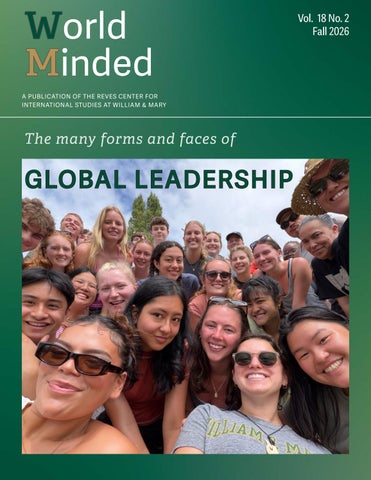
World Minded A PUBLICATION OF THE REVES CENTER FOR INTERNATIONAL STUDIES AT WILLIAM & MARY
The many forms and faces of
GLOBAL LEADERSHIP
Vol. 18 No. 2 Fall 2026
IN THIS ISSUE
3 FROM THE DIRECTOR
IN THEIR OWN WORDS 4 Barry Keith ‘92, P’20: Language, Culture and Competitive Scrabble
FEATURES
Vol 18 No 2 Fall 2026
9 Building trust and confidence one word at a time 12 Saidah Nash Carter ’96: Innovating for inclusion and impact 16 The global dimensions of preserving heritage and fostering collaborative scholarship 21 Global civic engagement
STUDENT ACHIEVEMENTS & OPPORTUNITIES 22 Government majors flourish on Freeman Intern Fellows program 24 Paying it forward, one soccer ball at a time 28 Reves Center’s 2026 International Student Achievement Awards
FACULTY ACHIEVEMENTS 34 2026 Reves and Drapers’ Faculty Fellows 37 2025 Faculty Fellow Update: Kevin Weng
ALUMNUS ABROAD 40 Q&A with David Link ‘89
REVES GLOBAL ENGAGEMENT BOARD 47 Reves Global Engagement Member list and Reves mission
WORLD MINDED STAFF Editor: Kate Hoving, Associate Director of International Communications, Reves Center Contributing Writers: Susan Corbett, Communications Specialist, University Content & Strategy; Nicholas Valyayev ‘27 ON THE COVER Mandy Joyce ‘26 took this photo during the winter faculty-led ‘25-’26 Auckland program. She was a recipient of a Reves Study Abroad Scholarship.
FROM THE DIRECTOR Teresa Longo Associate Provost for International Affairs, Senior International Officer and Executive Director of the Reves Center for International Studies
Founded in 1989, the Wendy and Emery Reves Center for International Studies was established to educate students and prepare them for careers in international affairs and positions of global leadership and responsibility in a rapidly changing world. This founding ideal remains key to the work we do today in this still rapidly changing world. This edition of World Minded highlights the many forms and faces of leadership. It also brings to the fore the values inherent in leadership, and the distinctive role the Reves Center plays. For Saidah Nash Carter ‘96, leader and co-founder of Bright Insights Global LLC, curiosity is a driving force. As a student at W&M, Carter focused on International Relations and Chinese. She studied abroad in China and worked as a translator on cruises on the Yangtze River in the summer. Her first job out of college was as a sale assistant at Thompson Reuters. Always following her curiosity, she moved from sales to marketing, and from marketing to product development for global media. She became the senior vice president of innovation and founder of Thompson Reuters Data and Innovation Labs in Cape Town and Head of Innovation in Africa. She is a recognized leader and innovator in the mobile revolution, with the determination to make the world and the planet better. In the age of AI, Carter’s contributions include ‘small and slow’ community data sets, regenerative agriculture, and collaborations with leading African universities. The values-based form of leadership evident in Saidah Carter’s story also shines brightly among our international students. This edition of the magazine features Nia-Patrice Lewis, a history apprentice from the United
Kingdom and Jonas Darko, an anthropology doctoral student. Lewis and Darko were the first international students to contribute to William & Mary’s Lemon Project, which produces research on the 300 year relationship between African Americans and William & Mary. Lewis and Darko brought new global perspectives to the project while also uplifting our shared values, integrity and respect first and foremost. Historical accuracy and human connectedness are hallmarks of their work. In 2026, the Year of Civic Leadership at William & Mary, the Reves Center has played an important role. We hosted the 2026 Global Democracy Fellows — rising leaders from twenty different countries. We supported Hixon scholar and student athlete Zeta Kromah ‘28 in her ongoing development of Tribe (soccer) Stars Liberia. We honored international students whose achievements are an inspiration to the community on campus and abroad. We supported professors whose research is both groundbreaking and civically minded: Ameni Mehrez and her students engaged young Moroccans during the 2026 parliamentary elections; Kevin Weng and Kianne Benjamin’s research on the endangered dragon shark strengthened USTaiwan-Indonesia partnerships in conservation; Angelina Dichiera and her students fostered international collaborations while studying Chimaerid Sharks in Canadian waters; and Archana Kaku’s research addressed the meaning and possibilities of non-violent resistance. In the pages that follow, you will find even more faces and forms of leadership, always with a global dimension at the core. Please read on.
FALL 2026 3
IN THEIR OWN WORDS Language, Culture and Competitive Scrabble
4 WORLD MINDED
Barry Keith ‘92, P’20
Barry Keith came to our attention last spring, when he aced the 2026 Reves One Tribe One Day Trivia Contest. He was at the Williamsburg Lodge July 31 – Aug 5, competing in the 2026 Word Cup, an annual Scrabble championship co-sponsored by the Collins Coalition (CoCo) and the Word Game Players’ Organization (WGPO), two of North America’s three sanctioning bodies for competitive Scrabble. (Although Scrabble was invented in the U.S., it’s played internationally and in many languages.) Keith finished seventh in the NWL (North American) Division. I met with him during a break in the tournament. - Kate Hoving
Above: Keith at the 2026 Word Cup. Left: A close-up of Keith’s board. (Photos by Kate Hoving) FALL 2026 5
La Place de la Comédie in Montpellier
KH: What is your profession – when you’re not competing in tournaments? BK: I teach French and Spanish at Monticello High School, a public high school in Albemarle County, outside Charlottesville. It’s just a stone’s throw from Mr. Jefferson’s Monticello and from James Monroe’s Highland. I teach all the levels of French, and I usually teach a couple of Spanish courses each year as well. KH: Are you originally from Virginia? Yes. I was born in Richmond, but we moved to Charlottesville when I was three, so I consider that home. KH: When you came to William & Mary, did you know you wanted to specialize in languages? I was actually at a crossroads, because I also enjoyed math quite a bit. That first year at William & Mary, I took multivariable calculus and linear algebra, and I kind of hit a wall. I was thinking, “This is starting to get really, really abstruse.” I was studying pretty esoteric subject matter in order to help high schoolers learn algebra and geometry. So, my other love -- from having been inspired by two really good French teachers in my high school career -- was French. So, I decided to focus on that. KH: Tell me about your study abroad in France. Studying abroad was a critical experience for me. Right after high school graduation, we took a family trip to France and England. I really enjoyed that opportunity, and I wanted to go back and study and see if I could become even more proficient and culturally aware. I was on William & Mary’s junior year abroad program to Montpellier from 1990 to 1991. That was the year of the Gulf War. I think we might’ve had two or three students go back at semester break, but I stayed for the whole year. 6 WORLD MINDED
I understand there’s an impressive menu of study abroad opportunities these days, but it was the one program through William & Mary at that time. Rob Welch was the program director, and he was great. We stayed in touch for many years until his death. There were a few students in my group who chose to have their own individual dorm room, but I found a room on the lower floor of a private home. There was a French student who had a different room. I was at the Faculté des Lettres, and he was at the law school, so we didn’t actually see each other all that much. But the house and the room were great. It was right downtown, near a row of stone arches that were part of an aqueduct hundreds of years ago and under which I could pass locals playing pétanque. I could walk anywhere I wanted to go; I could walk to the university in about half an hour. The train station is downtown, so I could easily travel on my own by train. It was really cool and easy to live independently in Montpellier, though Dr. Welch invited us to his apartment every month or so and was always available for a check-in. Some days I got some tickets to eat in the student cafeterias, and some days I just went and got groceries. KH: How were your language skills when you started the program? They were pretty good. After my junior year in high school, I participated in Virginia’s Governor’s French Academy, which had just started in 1986, the year before I was admitted. The French Academy has been residential and full immersion since it started, and is held for three weeks during the summer between June and July. At the beginning, students take a pledge that they will only interact in French, except in an emergency. They’re allowed to write handwritten letters in English to their families or friends, but they’re not allowed to have cell phones or access to computers in English. It was rewarding to return to the Académie as a teacher each year from 2010-20; I made a guest appearance last month to share
(Photo by Jorge Franganillo, https://bit.ly/4AlzqpF, CC BY 2.0, https://commons.wikimedia.org/w/index.php?curid=121427702)
information about changes to the AP exam with this year’s students and a couple of friends who invited me. After that experience, when I got to W&M, I was able to start out in the 300 level courses in French. KH: So, you started at William & Mary in a very strong position. How did studying abroad affect your skills and confidence? By the time I went to Montpellier, I felt fairly confident about my ability to communicate and understand. But my time there was also culturally fulfilling, and joining the Scrabble club there helped me to learn quite a bit more vocabulary than I otherwise would have. KH: Scrabble in Montpellier – in French? How did that happen? One Saturday, very soon after we got there, they had what they call a local association fair. There’s a big central place in Montpellier called La Place de la Comédie. And they had rows and rows of tables of different activities that people do in town, and I already had the mindset that I didn’t want to hang out only with American students and talk English. I really wanted to be immersed, and so I went to this fair and learned about the different organizations. I saw there was a Scrabble club, and I thought, “That’s really cool. I want to try that.” The first night, I wasn’t quite sure where it was and got there a little bit late. Then I learned that the way people play in France is actually quite different. It’s a version called “duplicate.” In the U.S. we have what the French call “le Scrabble classique,” where it’s one player against another. In duplicate Scrabble, each individual player has a board, and there’s a referee, and there’s a big demonstration board in the front of the room. The referee draws letters for everyone, and you draw the same letters for your own board, and you have slips of paper, and each turn, you turn in your paper with the highest scoring move you can find. And so the winner of the game is the player who is the closest to the top maximum possible score after all those turns. After each turn, the referee takes the highest possible move and puts it on the demo board, and then you add that to your board, and then you keep going. So it’s a way of playing that completely eliminates the luck factor. Some people don’t like to play “le Scrabble classique”, our version, because they feel like the other players always get the better letters, and certainly that can happen. But in the French version, there’s no luck. It’s purely a question of your word knowledge, your board vision, and so forth. KH: And how did that feel as a first-time player, and with no expectations? It was really cool. Of course, there’s a learning curve, so I didn’t worry about how I was placing. I wanted to learn how to do it, which I got by the end of the first session. And then I just kept going back once or twice a week. KH: Had you much played Scrabble in the U.S.? Did you find you were comparing the approaches or getting confused? Above: A French Scrabble Classique game from 1989.
It wasn’t my first experience with Scrabble. I had played casually with my parents, and when I was a freshman in Nicholson, I had a dorm mate, and he and I played 200 games over that first year. We kept track of our scores and such. But in France, of course, it’s completely different. You’ve got different words. But I was able to find some word sources and learn all the little words which are important. And of course, the French language has many verb inflections, and some of those verbs have the common letters where you can get the 50-point bonus for using all your letters. So just by knowing some verbs and by knowing the little words, I wasn’t too far behind everyone else. And it’s really good because you get to make friends in French. KH: Scrabble seems to transcend national borders. There’s a gentleman in Bangkok, in Thailand, who ran the biggest Scrabble tournament to date just a few months ago, and drew 500 players from all over the world. It used the Collins dictionary, because it’s only in the United States and Canada that we play with the more Restricted North American word source. There’s a movement afoot among a number of players here in North America to try to wean everyone toward the Collins Dictionary so that everyone can play under a universal word source. But there are a number of players who push back because they don’t ever see themselves venturing outside North America to play, and they don’t want to have to learn somewhere on the order of 30,000 new words. It’s been a debate now for a few decades. 1 KH: What draws you to languages? I think just the beauty of words. From a very young age, I would always have a book in my hand. I was the kid who never knew where we were going in the car because I was always reading something. And even today, even for a short bus ride, I’ll have something I’m reading or an audiobook or something. But I just enjoy words. I like figuring out how other people express their ideas, and I’m fussy about my 1 The official international English Scrabble dictionary used in Europe and most of the world is Collins Scrabble Words (CSW). North America uses the Official Scrabble Players Dictionary by Merriam-Webster for casual play and the NASPA Word List (NWL) for competitive tournaments. FALL 2026 7
I just enjoy words. I like figuring out how other people express their ideas.
Above: Keith at the Besançon Scrabble Club. (Courtesy photo)
own word choice, what I want to say. It’s fun to learn new words. At W&M, I also took Spanish, because I was already thinking, quite apart from the requirement, that it would be good to have another language. And that turned out to be important because I couldn’t find a French teaching position right away. Once I went back and got my Spanish certification, as well as my master’s in teaching, I was able to get a job directly. I definitely recommend that students learn multiple languages for teaching or work in international studies; you’ll have more options and make more friends! But as far as Scrabble goes, one of the other secrets is that it’s really more of a math game than a word game. The words are the playing pieces. Apart from the arithmetic to get the scores, you use quite a bit of geometry. Having the letters on the board laid out to give or to restrict opportunities…and probability, just looking at the tile pool to what you might be likely to draw, whether you should play an A or an I, and just looking and seeing what’s to come, and making educated guesses. KH: Have you been back to France since your junior year? Together with some colleagues in Besançon, which is Charlottesville’s sister city in France, I established a homestay exchange program between students at Monticello High School and those of the Lycée Ledoux, which was named after an eighteenth-century French architect who inspired Thomas Jefferson during his time in France. Besançon is in the Franche-Comté region in northeast France, about halfway between Dijon and the Swiss border.
8 WORLD MINDED
Every couple of years, they bring a class of students, typically in October, and they stay with our families, and we set up an itinerary and a program that they can do, sometimes in school, but also a fair amount of time on field trips discovering Charlottesville. And then I recruit students to travel on a return trip to Besançon. We go there during our spring break, spend seven or eight days in Besançon and then a couple of days in Paris before coming home. I think that’s really worked well and helped students on both sides learn about cultural things that we have in common and those things that are different. KH: What about a longer stay? My brainstorm up until several years ago, when the program was discontinued, was to do a Fulbright faculty exchange. They stopped the full-year teacher exchange about 10 years ago. I had thought about teaching abroad very early in my career, but my kids were small. Now, my oldest is Hannah ’20, and I have a “P” next to my name. I wouldn’t exclude the idea, after I retire, of going abroad for a stretch and seeing if there are educational opportunities over there. KH: Thanks for this interview, Barry. It was fun to meet you. Come see us at the Reves Center when you’re back on campus! Thank you for taking time to speak with me, Kate!
Building trust and confidence one word at a time
BY KATE HOVING
I
f you have ever tried to speak in something other than your native language, you know how easy it is to get tongue-tied or embarrassed. And negotiating life in a new environment while also getting used to a new academic routine and expectations is challenging in any language. Various apps promise simultaneous translation and conversational fluency in just a few weeks, but they’re not much help when you’re trying to chat casually with a fellow student over coffee or speak up in a class. And then each time it doesn’t go easily, you’re more likely to retreat further into silence or worse, isolation. For international students, not being able to communicate well or navigate a new system can have real consequences for their degree and career outcomes. To address this need, the Office of International Students, Scholars and Programs (ISSP) at the Reves Center, manages two programs: the Virtual Conversation Partner Program (VCPP), for help in language skills; and the International Peer Leader Program, which provides guidance and friendship to new, incoming students. Lauren Devan is International Programs Coordinator & Advisor at the Reves Center and matches student partners for both programs in June in preparation for fall semester. The conversation program is voluntary and meetings are virtual. Students are matched from all across campus, regardless of school affiliation. So, a student in the College of Arts & Sciences may be matched with a student from the Business
School. Or two students within the same college with different academic programs may be matched together, such as a history major and an anthropology major. However, in general, undergraduates are paired together and graduate students are paired together. The VCCP has a clear framework and process. “After I pair the students, I send them both a template for an agreement, where they not only affirm their commitment to the program, but also lay out the parameters. They agree how many times they will meet, at what time. They also decide what things they are and aren’t going to talk about. They decide these things between themselves.” Once they have crafted their agreement, the students send it to Devan. “Then I’ll begin sending them bi-weekly emails, where I suggest a fun topic for them to discuss, just in case they get stuck.” They’re not obligated to keep to the suggested topic, but the emails help to give the program structure and also help Devan stay in touch with the students to see how things are progressing. Once the students arrive on campus the program officially ceases. “Usually just before orientation, my emails stop. I do encourage people to stay in contact with one another, but it’s really in their hands after that.” COMING TO W&M Sulaiman Khan is a PhD student in applied science in William & Mary’s School of Computing, Data Sciences & Physics(CDSP) with a focus on biomaterials, musculoskeletal disorders and tissue engineering. He is from Pakistan and in the second year of his program at William & Mary.
L-R: Lauren Devan, Sulaiman Khan and Zhi Yang at the Reves Center. (Photos by Kate Hoving)
FALL 2026 9
For their first meeting, they stuck to the fundamentals. They introduced themselves, learned how to pronounce each other’s names and talked about their research. But it was a major step for Yang. “In our first conversation, my English was not very good, and there were so many words I couldn’t understand,” she remembers. “But when the conversation continued, suddenly I could understand some of what he said, and I began to talk. Before that, I hadn’t talked to anyone in English for that long. Sulaiman has helped me improve a lot.” Khan established an easy pace, understanding that the first and most important thing he needed to do was establish a bond and trust between them. “I was trying to be friendly and also keep that professional distance between us,” he explains. “I wanted to help her feel that this was a safe space to communicate with me.” He is both an International Peer Leader and a Virtual One thing that helped establish an initial comfort levConversation Partner, and he volunteers because he underel, was that Khan had learned stands the challenges for a first-time intersome Chinese during an innational student. It was not his first time ternship in Taiwan. “I spoke a studying abroad when he came here -- he few words– words like Xièxiè, had done his master’s in Malaysia, an inI was trying to be which means thank you – so ternship in Taiwan – and he was proficient that she would see me as a good in English, but it was his first time studyfriendly and also keep partner.” ing in the U.S., and he still felt he needed to improve his skills. “We’re taught British that professional He also resolved not to rush English in Pakistan, so it could sometimes Yang or the process. be confusing, with the different words of distance between us. American English.” He took theater and “It was important to be papresentation classes to improve his public I wanted to help her tient, to wait for her, to prospeaking. nounce the correct words and feel that this was a safe help her understand the differThis past summer, he was in Williamsburg, ent meanings. I wanted to let busy going to the lab every day for his respace to communicate her take her time.” search, but he missed being able to talk with family and friends back home because with me. They met six or seven times of the time difference. “I was looking for a over the summer, and their way to connect with people, and although talks became easier and more I had a couple of conversation partners alcomfortable. The length of ready, I said to Lauren, ‘Oh, I can take one their meetings varied – 30 or 40 minutes or sometimes an more.’” And so Devan matched Khan with Zhi Yang, also a PhD hour – depending on what they were discussing. “We were student in CDSP, but with a concentration in data science. flexible with the time,” Yang says, “and that made it more She was arriving at William & Mary this fall from China, comfortable. If we had to fill a set amount of time, it might and although she had visited the U.S. once before with a have felt more forced.” friend as a tourist, this would be her first time as a student. ADJUSTING TO BEING ON CAMPUS Because Khan is also Yang’s International Peer Leader, A DIALOGUE BEGINS Yang signed up for VCCP because she felt she needed their connection continued after VCPP finished. “I’ve been to improve her spoken English skills. “I knew to succeed I guiding Zhi’s transition to William & Mary.” needed to talk in class or need to attend a conference or give It isn’t common for conversation partners to be Peer a talk in public,” she explains. “If I were afraid to talk with other people, it might affect my PhD program. I needed to Leaders, too, but in this case, it has made Yang’s experifind the courage to practice communication, so I joined the ence even smoother. “The International Peer Leader (IPL) program to improve my English. I also wanted to know dif- Program is a virtual summer program where IPLs mentor a group of new undergraduate or graduate international ferent people from different countries.” 10 WORLD MINDED
students by answering questions before and after their arrival and helping to welcome new students to the W&M community,” Devan explains. “IPLs introduce new students to the university from a student perspective and help guide new students through their William & Mary experience. It differs from the VCPP program in that VCPP is specifically for English conversation. It just so happens that in this case Khan is both her peer leader and conversation partner.” The two met in person during orientation. Khan began including her in activities right away. “We were having a dinner that included international students from all over -- China, India, Pakistan, Bangladesh -- so I invited her.” He cooked roast lamb, and other students brought dumplings and assorted delicacies. Yang appreciated his invitation and learned something new and unexpected about her conversation partner. “He’s a chef! It was delicious!” She also learned that although she had worried about meeting people and fitting in, thanks in large part to Khan’s mentorship, she already was feeling she belonged. LIFE AS STUDENTS Khan has continued to assist Yang with guidance in matters – large and small – that are new for her, for example reminded her to pay her health insurance premium before the deadline. Both students have support from their graduate supervisors as well. It’s helped Yang, that she was able to work with her supervisor, Jindong Wang, assistant professor of data science, before she came to campus. “He is also from China, so we can communicate very well.” But Wang has found other ways to help her feel at home. “On weekends, he will ask me whether I need to go to the supermarket, and he will take me there.” According to Khan that kind of thoughtfulness from faculty is not uncommon, although it may come in different forms. “My supervisor is Assistant Professor of Applied Science Indranath Mitra, who is from India,” Khan explains. The relationship between Pakistan and India is complex and often tense. “When I was gaining admittance to William & Mary and getting my visa, there was a border war between the countries. And [Professor Mitra] emailed me, ‘You don’t have to worry about these things. We are good to each other. Just ignore the politics. Come to the U.S.” LIFE IN VIRGINIA There will always be adjustment in moving to a new place, especially when it’s to Williamsburg. It’s a radical change for Yang. “I used to live in Shenzhen, and it’s a big city, and quite different from Williamsburg,
which is a small town.” And the difference for Yang is not just in square miles and amenities. “The buildings are very low compared to where I lived before. I was on the 18th [LD1.1]floor. It was very stressful for me. I couldn’t see the sky. But when I came here, I could see the sky and the sunset. I can see very far away, with a clear view of the horizon. It opens my mind and comforts me when I go home after class.” Khan has also embraced the differences. “I’ve been to a lot of places. I was in Malaysia. I’ve been to Taiwan, The Netherlands, Singapore, my home country, Pakistan. I love Williamsburg. And really, it all depends on your circle and on the activities you do and the people you meet. I feel as if I’m home.” MEASURING SUCCESS So how is success measured in these programs? For Devan and the staff of Reves, the goal of VCPP and the International Peer Leader program is to make sure the new students get connected to other people and resources on campus. That surely happened. Yang began the summer with the goal of feeling more comfortable speaking in English and making friends with other international students. She has achieved that. Khan, who feels deeply his commitment and responsibility in both programs, measured success a little differently, and his feeling of accomplishment came from an astute and characteristically sensitive observation. It came to him at that first party on campus to which he’d invited Yang, when he saw her taking photos with the other guests. “She told me, ‘I got a lot of friends!’ Then she connected with everyone on Instagram. They exchanged numbers, and she has been quite busy with them ever since. And I thought to myself, ‘That was my goal. She’s okay now.’” FALL 2026 11
Innovating for inclusion and impact “Before you become too entranced with gorgeous gadgets and mesmerizing video displays, let me remind you that information is not knowledge, knowledge is not wisdom, and wisdom is not foresight. Each grows out of the other, and we need them all.” — Arthur C. Clarke
BY KATE HOVING
E
very day brings another news analysis, commentary or meme focused on AI and machine learning and its effect.
It can be difficult to discern fact from fearmongering and real potential from marketing hype. There is someone who can provide insights and guidance based on experience, but that person is not in Silicon Valley. She is in Cape Town, South Africa. Saidah Nash Carter ’96, co-founder of Bright Insights Global LLC and self-described Intentional ML/AI Evangelist, has built a successful and singular career in innovation, development and communication. Carter’s mission is not about proselytizing as much as it is promoting the understanding, adoption and ethical use of Artificial Intelligence and Machine Learning technologies. “For me, it means that I believe deeply in the power of technology to help solve human challenges,” Carter explains. “It is, at its core, a tool; one that can -- and should -- be used for the betterment of humanity. Machines learn through training data sets, and the more intentional we can be about how we train these machines, and for what purposes we are doing so, the more useful these technologies will be.” She also thinks beyond just the technology to the tools that can be built with these technologies. “We will be able to build tools for restoring, for being more responsible, for not harming and, ultimately, for being more regenerative as we think about resources moving forward and the relationship between resources and technology and social impact and technology.” 12 WORLD MINDED
A GLOBAL MINDSET Carter came to W&M not for computer science studies, but for international relations and Chinese, which she had studied in high school in Washington, DC. “William & Mary had a very robust Chinese program and at the time, a relationship with Beijing Normal University (BNU).” Carter studied abroad in China over a summer and fall semester. And then the following summer, she worked for Victoria Cruises as a translator for the mostly English-speaking passengers on a cruise up and down the Yangtze River. “I’ll never forget it. It was incredible.” She grew up in a family that valued and enabled international experience and had been a foreign exchange student in Seoul in high school, but what she found through W&M was something new and transformational. “The experiences in China changed my life, my relationship with the world. It was such a shift. In an interesting way, it also made me thankful for home. I had a new appreciation for my American roots, my family and culture. I discovered that I could like and live in China and still be grounded in my country and my patriotism; that I could be connected with home but also connected with the rest of the world. Travel really opens you up to your place in the world as a global citizen.” FOLLOWING CURIOSITY TO BECOME A LEADER IN INNOVATION Carter’s first job out of college wasn’t in Chinese studies or international relations or AI development. But it turned out to be the perfect launch pad. She began her career at Thomson Reuters as a sales assistant, working for the senior vice president of sales for the Americas. “I only did that job for a year and a half, but looking back, I can see it was a foundational role, because it showed me what the revenue engine was the sales team. Every company of that size will have
FALL 2026 13
some version of a sales team, and it was helpful to understand that early.” Thomson Reuters is an information services company -- a data business – though it is known by many for its media business that initially sold its services to newspapers. “Eventually they developed a website and a brand, but the business model was to sell news to news outlets. You see the Reuters byline in the New York Times, or wherever else you read your news.”
She had been lobbying for an innovation lab in Africa for a year already and had a plan in place, so when she got the go-ahead from the C-Suite she was ready to go. “We ended up being the only Thomson Reuters Labs in an emerging market within a global ecosystem of seven labs total.” CREATIVITY AND INNOVATION WITH A PURPOSE “My professional work has always been in line with the UN’s Sustainable Development Goals and innovation with purpose. It is about making the world and the planet better than we found it for our children and for future generations.”
Although she did not want to continue in sales, it was a valuable experience. “When I talk to young people about my career, I explain that I try to follow my curiosity and keep it interesting.” My professional work So, following her curiosity and the needs of the organization, Carter moved from sales into marketing and ultimately migrated to product development for global media. From there, she worked in strategy and business innovation, ultimately taking her to senior vice president of innovation and founder of Thomson Reuters Date & Innovation Labs in Cape Town and Head of Innovation in Africa.
has always been in line with the UN’s Sustainable Development Goals and innovation with purpose. It is about making the world
Carter is pragmatic about what making the planet better entails. Both at Thomson Reuters and now as head of her own business and member of the boards of NGOs and foundations around the world, she sees herself as part of a larger team. “Thankfully, there are many organizations I work closely with that are committed to—and doing the good work of — leaving this place better than we found it. We must work across many disciplines, industries, governments and academia. It will take an interdisciplinary and radically collaborative approach to solve our biggest challenges.”
OPPORTUNITIES FOR INNOVATION and the planet better than we IN THE MOBILE REVOLUTION “Innovation is one of those words found it for our children and that means everything and nothing all at once,because it’s so broad. Initially, for future generations. it meant building new news products BUILDING A BETTER PRESfor what was then the early internet. ENT AND FUTURE So it was asking questions like, ‘How Carter describes Bright are people going to read news online? What does that even look like, because they’re used to hold- Insights Global as a boutique consultancy with a portfolio ing a newspaper?’ I am in that bridge generation. I remem- of projects at the intersection of innovation, inclusion and ber newspapers being delivered but also adapting to con- impact. suming content very differently.” Big Labs for Good, which is essentially Bright Insights Working on product development and innovation — and Global’s research arm, is an example. “We’re builders, we that curiosity of hers— propelled her beyond news content love to tinker around and imagine buildable solutions to delivery to the broader data and financial business and the world’s biggest challenges. I’m loving our work with machine learning with smaller language models; “small what would become the “mobile frontier.” and slow” community data sets; regenerative agriculture “My journey to Cape Town was linked to the belief that the and collaborating with leading African universities in data company should be innovating in Africa during the mobile science. All of this is in service of university and industry revolution. There is good space to innovate in emerging collaboration for responsible R&D. markets. And we got really excited about the opportunity She is drawn to data science innovation, given her backto tap into what was a very mobile-first and almost mobileonly environment. It was an opportunity to connect mobile ground at Reuters. “I am intrigued by the space to innotools and solutions relevant across markets. We built some vate data science -- to think about data more expansively and also to think about building AI that is pro-nature and really leading edge and impactful products.” sustainable.
14 WORLD MINDED
For example, the Bankable Farmer Research Initiative (BFRI) is dedicated to leveraging data science, alternative data sets, and innovative risk modeling approaches to improve financial service accessibility for small commercial farmers in sub-Saharan Africa. This commitment aims to tackle the ongoing issue of restricted credit access for these farmers, which arises from a lack of credit history and profile.
DATA AND STORIES: REMEMBERING AND ENGAGING ACROSS GENERATIONS Another project Carter and her team have developed is Ask An Elder, a crowd-sourced, intergenerational, storytelling initiative. “I work with young people in Cape Town as much as I can. One of the programs that we work on here is storytelling, because I am fascinated by storytelling and stories as data sets within the contexts that we’re talking about, such as training data. Ask an Elder is about gathering knowledge and sharing stories and wisdom from lived experience.”
I am intrigued by the space to innovate data science — to think about data more expansively and also to think about building AI that is pronature and sustainable.
“I wasn’t sure that that the young people were going to be interested, but I was blown away by their level of interest. They have inspired me by the stories they have discovered and by their entrepreneurial spirit.” The inspiration Carter derives from that and from all her projects, sparks creativity for future ideas. But the thread that flows through every idea and innovation Carter and her team explore is how to make the world better for future generations. “It’s our North Star.”
FALL 2026 15
The global dimensions of preserving heritage
BY KATE HOVING
S
ince 2018, three graduate students – from history, anthropology and American studies – have been assigned to the Lemon Project, a program founded in 2009 that contributes to scholarship on the 300-year relationship between African Americans and William & Mary, building bridges between the university and the surrounding community. The “surrounding community” grew broader in the 2025–2026 academic year, when, for the first time, the Lemon Project hosted two international students: Nia-Patrice Lewis, a history apprentice from the United Kingdom; and Jonas Darko, an anthropology doctoral student from Accra, Ghana. “Both students immersed themselves in archival research and community engagement, serving as outstanding ambassadors for the Lemon Project,” recalls Dr. Jajuan Johnson, Interim Robert Francis Engs Director of the Lemon Project at the time. “They also brought unique perspectives that broadened the scope of our work, encouraging us to consider the global dimensions of commemorating unfree laborers, preserving heritage and fostering collaborative scholarship.”
16 WORLD MINDED
RECOGNIZING THE WILLIAM & MARY DIFFERENCE Lewis’s journey to Williamsburg began in London. She came to the U.S. to study as an undergraduate thanks to the Sutton Trust Fulbright US Programme, a fully funded higher education scholarship covering all costs for studying in the U.S., including travel, residential events, accommodation and food. “The Sutton Trust is a charity that focuses on students age 16 to 18 in low-income households that want to study in the U.S. I got into that program when I was about 17, and it enabled me to get my undergraduate degree in history and Africana studies at Colgate University,” Lewis explains. After graduation from Colgate, she looked to William & Mary for ways to use her interest in history besides becoming a professor. “Public history and digital humanities are emerging fields that I found myself getting really interested in, and William & Mary offered the opportunity to get experience in hands-on work in addition to learning the theoretical side. That was a major part of why I wanted to apply. The presence of the Lemon Project on campus was also a big pull for me.”
L-R: Nia-Patrice Lewis and Jonas Darko spent a large percentage of thier time engaging with the public. (Photo courtesy of the Lemon Project)
Darko’s path from Ghana to William & Mary also started thanks to a scholarship. Commonwealth Scholarships in the U.K. support candidates of outstanding ability based in low- and middle-income countries of the Commonwealth, who want to attend university in the U.K. He applied for graduate work in museum studies. “There’s just one slot [for museum studies], and I was the one who got nominated and selected for it,” he says. He went to the University of Leicester for his master’s degree. After that program, he knew he wanted to further his education, so he began exploring Ph.D. programs. He received offers from Syracuse University and William & Mary. “Both options were interesting – they all teach historical archaeology; they’re great places to live and study – but the programs were very different.” But the real W&M difference – and the deciding factor -turned out to be not so much the program, but the faculty, who recognized Darko’s potential. “Neil Norman [associate professor of anthropology] and Gérard Chouin [associate professor of history] reached out to me in Ghana and encouraged me, and so I came.” Darko arrived on campus in fall 2025, and he was assigned to work with the Lemon Project. THE PROJECTS Although members of the same team, Lewis and Darko had different individual projects. “When I signed on to come to William & Mary, there’s a section where they ask you what kind of apprenticeships you are interested in, and I had put that public history was something that I wanted to do, and I was fortunately assigned to the Lemon Project.” Because this would also be her introduction to the field of public history, Lewis needed to learn about more than just the details of the memorial. “A lot of it was gaining really valuable hands-on experience through both the training -- we had direct one-on-one meetings -- and also being involved in the meetings about what would happen around the Lemon Project itself.” Lewis’s assignment was to help to design an interpretive plan for the Hearth Memorial to the Enslaved. “It’s a document that explains the work being done, how the space is supposed to be used, what it has been used for-basically a massive document compiling all of this information about the space itself.”
“Throughout the year I spent time during each of our events where we would table. I would speak to people; I would observe.” Her work also included partnering with Tribe Innovations, a consulting group of Mason School undergraduate business majors, who ran focus groups with students. “We asked them what their thoughts were about how the space itself was being used and what visions they had for how it could potentially be used. We wanted to get feedback on how we’d been doing thus far and input on how to move forward with it. Having that input from different areas of the community has been an essential part of the project and also a massive part of my skill building and learning about what it means to work in public history in and of itself. It’s been a transformative experience and project for me, both professionally and personally.” While Lewis worked on the interpretive manual, Darko was assigned a restoration and advocacy project involving an African American cemetery located behind Berkeley Middle School. “When I was given the letter with my duties, I thought, ‘How am I going to work on a cemetery?’ I knew it was going to be difficult, but I decided to give my best effort, and it’s been a great learning process.” He started working in the archives to try to get to know the families and the history behind the cemetery. “It was gradual, but I was able to write a report, and I submitted it to Dr. Johnson.” During his research, Darko was taking a class with Michael Blakey, NEH Professor of American Studies, Africana Studies and Anthropology, and he began to see his project had dimensions and scope that went beyond the creation of an accurate historical record.
Building such a manual involved a lot of interaction with the William & Mary community.
“It was very new to me, but Professor Blakey has a lot of experience. In his course, I studied how he managed the New York African Burial Ground project. I learned from his experience and tried to incorporate his methodology in my project.”
Above: Hearth: Memorial to the Enslaved (Photo by Timothy D. Sofranko)
FALL 2026 17
Blakey’s focus is on public archaeology. “He used one model, the clientage model, where the communities you study take charge of the projects you are undertaking. So even in the archival process, I had to make sure the community or the family I was studying felt they were represented accurately in what I was writing. It’s important to remember that when you’re writing history, your perspective may change the story.” But Darko was learning that determining historical accuracy was just part of the process. His next step was learning from Dr. Johnson how to communicate that story into oral history. “I have had a mix of the best methodologies from my professors to use for the project.” THE STRENGTH OF THE INTERDISCIPLINARY MODEL AT W&M That interdisciplinary collaboration has been both unique and essential. Lewis contrasts W&M with her experience in the UK. “There tends to be a pathway that you’re supposed to stay on. I’ve learned in my time in the U.S. that there is a lot more ownership because of the liberal arts system here. I found it immensely valuable to be engaged in a space that relies so heavily on interdisciplinary, intercultural and intergenerational space.” The interdisciplinary nature of education and research here that inspired Lewis has also helped Darko determine his focus. “I’m coming from a political science background, an archaeology background, and a museum studies background. And now I’m working in historical archaeology. Initially I didn’t know which one to choose,” he says about his dilemma. “I knew I needed to write something, do something, but in which area?” But the beauty of the Lemon Project has been that he hasn’t had to choose just one thing. “I realized I could lean on my interdisciplinary background, use the skills I have gained from all of those areas, and even learn a lot at the same time.” HANDS-ON LEARNING AND ENGAGEMENT In a world where virtual opportunities increase access, there is still a place for in-person connections in public history. “At the Hearth Memorial, there are the six bricks that Susan Kern discovered [when she was executive director of Historic Campus],” Dr. Johnson explains. “When we tell that history -- that the last people who touched these bricks before they were discovered were probably enslaved people—people will come up to touch them. They want to feel them. They want to connect. When people actually see the physical evidence, they interact with it in different ways. They understand this is real. This is not an idea. I’m touching it.” For Lewis, creating and curating digital information was just one aspect of telling the story.
18 WORLD MINDED
Top and Middle: Jonas Darko; Tyler Lewis, ‘26, Lemon Project Society student; and Nia-Patrice Lewis at the at the 16th Annual Lemon Project Spring Symposium in March 2026. Bottom: L-R: Lewis; Dawn Morris, Lemon Project administrative & fiscal coordinator; Johnson; Sarah Thomas, associate director, Lemon Project; and Darko. (Photos courtesy of the Lemon Project)
“I do think that digitizing has a great role to play in terms of making documents accessible,” Lewis acknowledges. “From my experience as an undergrad, where my school was, and not having access to a car, having access to digital archives and digital records bridged a massive gap. But a lot of what I did in my year with the Lemon Project was being able to be tactile with everything, to see things in person. And it is a really different experience.”
the one facilitating and not only engaging with people, but also creating the resources that people take with them to be able to refer back to, you realize there’s so much intentionality within this space.” INTENTIONALITY Intentionality and integrity are the hallmark of both Lewis and Darko.
“We can take so many aspects of public history for grantWhether tabling in public spaces or at the Hearth, public engagement was hands-on. “People were very curious. ed. Consider the plaque on the wall -- somebody had to sit They would pick up a pamphlet, or they would pick up a down, think about, budget for, and write the grant to get copy of some of the genealogical work that we had and read the money for the plaque to be able to have somebody else through it themselves. I think there’s value in both ways read it. All these different kinds of ways that you can engage with people, and how intentionally – when you’re being guided through that interpretation must be done. There something or when you are invesis a great deal of intricacy that goes on tigating yourself. I don’t think it’s a in this process. But being able to see the matter of which one’s better. I think I had to make sure difference in guests in the space that we it’s two different things that are have from the beginning to the end, and equally valuable.” the community or the sense of intimacy with self and empathy and compassion for other people But incorporating that personal the family I was through what they learn has been just engagement as part of public histoa great thing to be able to be a part of,” ry requires the historian to step out studying felt they were Lewis says. from the archives. That role was new for both Lewis and Darko. represented accurately For Darko, there was also the interaction with families who had a very person“In Ghana and at the University of in what I was writing. al and meaningful relationship with the Leicester, I’d always preferred workcemetery. ing behind the scenes,” Darko says. It’s important to “I’m not that type of person that “I used to think archaeology consisted wants to be front and center”. For remember that when of collecting your data, analyzing the data, him, that tendency to stay back is writing it down. And that’s it; it is what it just part of being an archaeologist. you’re writing history, is. But now, I feel archaeology is more pub“We mostly don’t like talking to the lic facing. You need to consider a whole lot public. We like to work from behind your perspective may of things before writing something down the scenes.” or publishing something. And when it change the story. comes to histories --emotional histories or But with his work on the Lemon histories that are painful -- you need to be Project, although he started with archival research, he did have to put himself forward. “It was careful with what you write and how you tell the story.” very hard at first, because I was interacting with the famiAs he worked in the archives of the cemetery, Dr. Blakey’s lies. Dr. Johnson and I met with one of the family members to discuss what we wrote,” he recalls. “It was helpful, but it class was introducing him to literature on slavery and on was intimidating, too, because I wanted to make sure that African American history, which was new to him. He learned what I took from the archives corresponded with the fam- about the stories behind the histories he was uncovering, and he felt them deeply. ily’s account.” In typical fashion, he didn’t shy away from the challenge. “This is a new skill I’m gaining. It’s good for me.” Lewis had similar challenges with this new role of public historian. In fact, she describes her pre-William & Mary self as a kind of “passive engager.” “With most of public history, you grow up, you go to museums, you hear people speak,” she explains. “But one thing I’ve learned-- that I always knew on some level as a history student-- is history’s ability to inspire compassion and empathy. Being on this side of public history where you are
“At a point it affected me and I wanted to show less of myself. Sometimes it felt depressing, but then I told myself I needed to do this. So, I took a break and came back.” And he persists through the discomfort. “I learned from going through these documents that we need to study our history, so we don’t repeat it.” EXCHANGE WORKS BOTH WAYS The work has also nurtured robust conversations and friendships. FALL 2026 19
I’d initially anticipated just respecting the project, from an observational and also from a worker’s standpoint, but there was a place for me. “There was a rich exchange of ideas, with Nia-Patrice coming from the UK, and Jonas from Ghana, having a different cultural perspective, and different ideas about the field. It’s an exchange. We’re learning from them, they’re learning from us. Conversations beyond academic conversations, just our experiences, where we’ve lived, the cultural connections. Our lives overlap. We learn, I think, so much beyond just the academic enterprise to include our day-today interactions, how we learn about each other’s worlds and each other’s perspectives.” For Lewis, the experience has a very personal dimension. “Everything about the Lemon Project has been about building bridges. It’s a journey of reconciliation but also of cross-cultural connection, and that is an unspoken but deeply important facet of the project. My family’s Jamaican, and throughout my research with the project and the nature of my degree, I learned a lot about the connections between Virginia, Jamaica and inter- American trade historically. I’d initially anticipated just respecting the project, from an observational and also from a worker’s standpoint, but there was a place for me.” The impact of the work and the relationships formed are not merely professional. “Jonas has certainly grown to be one of my dearest friends since this experience,” Lewis says. “He had just come from the UK, and I had just done a brief study abroad excursion in Ghana, so it was just a bit of coincidence that we connected here.” “When it came to working on projects, the tabling and the public-facing side of it, where we would have to interact with people and educate about what we were doing, that was mainly where we would work together. Then during our time in office, we would speak to each other about how our projects were going, what we had learned, that sort of thing. A lot of that time in the office was spent just watching each of our perspectives grow week by week as we were encountering things that we wouldn’t have come across without this kind of experience. It was a great space for intellectual conversation as we were growing, but also just building a deeper sense of purpose for the work that we were doing and getting to connect that to our academic studies.”
20 WORLD MINDED
PREPARATION FOR CAREER As universities work to balance the benefit of study with career outcomes, Dr. Johnson points out an important feature of the work: “The Lemon Project has expanded its global reach while creating meaningful applied-learning opportunities that contribute to students’ professional development and career placement after graduation.” Lewis is continuing her work towards her Ph.D. at Rutgers University. “The subject itself is history, but they offer a public humanities graduate certificate, which I am looking into pursuing alongside. I still have a passion for the historical research aspect of things, but I also want to pursue cultural heritage management and public education, just my own interest and also career prospects.” Dr. Johnson is now Director of the Smithsonian’s Shared Pasts, Shared Future Initiative with the Office of the Under Secretary for Education. The initiative is designed to engage communities, scholars, museums, and other partners in exploring race, history, and the influences that shape our shared future. Darko will continue his work here at William & Mary, but he has also shifted some of his focus. “Colonial legacies of West African foodways was my original research interest. However I have decided to pivot to African American diaspora studies. I’m going to use grains – maize and wheat -- to tell the stories of what people ate on plantations.” Although in different locations this year, the bonds are still strong and essential in work that is not always easy. It’s Lewis whom Darko calls whenever he feels discouraged. “We still keep in touch. If I read history, and I feel agitated, I call her, I talk to her about it. She calms me down, and I’m good to go.” He also draws inspiration from mentors as well as the people whose story he is telling. “Looking at Dr. Blakey, looking at people ahead of me, I feel I need to do it. I have to do it.” And as Lewis, his friend, who has walked a similar path and grown alongside him says: “If you don’t do this, who’s going to do it?”
Global Civic Leadership: Global Democracy Fellows
T
his summer, the Presidential Precinct, of which W&M is a partner member, hosted 20 of the world’s rising leaders at the 2026 Global Democracy Fellowship, a program designed to build leadership skills in Fellows ready to create a better world. Building on the legacy of the Mandela Washington Fellowship, this program has expanded beyond the African continent to represent countries across the globe. The Fellowship is open to social movement leaders, civil society leaders, government officials, parliamentarians, journalists, creatives, and democracy and human rights defenders with at least three years of experience in democracy-building and proficiency in English. The six-week immersive fellowship is designed for rising and established leaders committed to strengthening democracy in their communities and countries. The program combines academic and practical learning with deep engagement in the history and practice of democratic leadership.
The 2026 Presidential Precinct Global Democracy Fellows were on campus for almost two weeks this summer, participating in sessions led by faculty and visiting experts across the university. They were welcomed to campus July 6 by Dr. Teresa Longo, who led their opening session at the Reves Center on Arts, Creativity and Democracy. Friday, July 17, they spent the morning at Blow Hall for a session on the role memory plays in advancing democracy and human rights in post-conflict settings. It was led by Silvia Tandeciarz, vice-dean for social sciences & interdisciplinary studies and Chancellor Professor of Hispanic Studies; and Betsy Konefal, associate professor of history and W. Taylor Reveley, III Interdisciplinary Faculty Fellow. Tandeciarz and Konefal are collaborating on a teaching and research project, “State Terror and Its Memory: Argentina and Guatemala Then and Now.”
2026 GLOBAL DEMOCRACY FELLOWS Isaac Aboah, Ghana
Hisan Matta, Indonesia
Olga Caballero, Paraguay
Gabriel Marmentini, Brazil
Yuliia Dychuk, Ukraine
Francisco Mendoza, Ecuador
Hakob Gabrielyan, Armenia
Nehrin Mustofa, Bangladesh
Jemhra Rose Garcia, Philippines
Wendy Ong’are, Kenya
Kesaria Gogua, Georgia
Aayush Pantha, Nepal
Valeria Hernández, Chile
Thomas Sangungi, Namibia
Norwell Hinds, Guyana
Nestor Alejandro Torres, Guatemala
Alphia Kemokai, Liberia
Yanique Tracy, Jamaica
Doruntina Maliqi, Kosovo
Alethea Wong, Malaysia
Professors Konefal (L) and Tandeciarz present their research to the Global Democracy Fellows. (Photo by Kate Hoving)
FALL 2026 21
Government majors flourish on Freeman Intern Fellows program
BY NICHOLAS VALYAYEV This story originally appeared in W&M News
S
tudying abroad is a classic part of the college experience. Indeed, William & Mary prides itself on consistently being the No. 1 public university for study abroad participation. Several Government students recently demonstrated this love for global adventure during their summer internships in Asia. All Freeman Fellows, these students interned at organizations located in countries as far and wide as Taiwan, Cambodia, and Indonesia. They worked and travelled across the continent for eight weeks before returning to the U.S. The students received their internships through the Freeman Intern Fellowship, a program administered by the Reves Center for International Studies. The program started after a grant from the Freeman Foundation made it possible for up to twenty-four W&M students to conduct internships in Asia. Since the summer of 2018, a new cohort of students has flown across the Pacific to work every year.
22 WORLD MINDED
As compensation, students receive a stipend to facilitate travel and living expenses. Among the Government students who went abroad, Nicholas Valyayev ‘27 and Hannah Yang ‘28 spent their summer working at the Affiliated Network for Social Accountability (ANSA) Cambodia, along with prospective major Charles Miller ‘29. They supported ANSA’s mission to give Cambodian citizens the tools to advocate for themselves. Nicholas researched cashews, a major Cambodian export, investigating labor rights and environmental concerns and recommending solutions for policymakers and NGOs. Hannah wrote stories highlighting the success of ANSA’s programs in elevating youth leaders and teaching useful skills in advocacy and entrepreneurship to underprivileged communities. Charles interviewed leaders of oppositional political parties in Cambodia, reporting on the impact of the one-party Cambodian state on civil society.
L-R: Charles Miller ‘29, Nicholas Valyayev ‘27 and Hannah Yang ‘28 with San Chey, their supervisor at ANSA Cambodia (Courtesy photo)
They hope their deliverables aid ANSA’s mission to cultivate good governance and fight corruption in the country. Across the border, Government student Nolan Jansorn ‘27 spent his summer working in the rural village of Mae La Noi in northern Thailand. Interning with History major Landon Miles ‘28, he worked at the village’s Daroonsik School through Global Playground, an organization devoted to improving educational infrastructure and facilitating cross-cultural student exchange. Nolan and Landon instructed students in English by playing games and helping teachers enact their lesson plans. Though they cycled through different classrooms on a regular basis, their efforts contributed to an enriching English education for the students.
Nolan Jansorn ‘27 with two teachers he assisted, Kru Monggone (left) and Kru Kadsanee (right). (Courtesy photo)
Summer 2026 Freeman Intern Fellows Government majors weren’t the only students who were Freeman Fellows. Here’s a list of all the fellows last year, along with their majors: • Lucas Fernandez ‘28, Institute for National Policy Research, Taipei, Taiwan (International Relations) • Nico Giro-Martin ‘27, People for Successful Corean Reunification, Seoul, South Korea (International Relations) • Pranjali Gupta ‘27, Thailand Development Research Institute, Bangkok, Thailand (Data Science and Finance) • Nolan Jansorn ‘27, Global Playground-Mae La Noi Daroonsik School, Rural Thailand (Government) • Aliyana Koch-Manzur ‘28, Transitional Justice Working Group, Seoul, South Korea (International Relations) • Eryn McKendree ‘27, Institute for National Policy Research, Taipei, Taiwan (Government and Interdisciplinary Studies) • Sophia Mekbeb ‘29, Philippines Social Science Council, Quezon City, Philippines (Undeclared) • Landon Miles ‘28, Global Playground-Mae La Noi Daroonsik School, Rural Thailand (History) • Charlie Miller ‘29, ANSA-Cambodia, Phnom Penh, Cambodia (Government and Data Science) • Asha Nair ‘27, Central Tham, Bangkok, Thailand (Public Policy and Interdisciplinary Studies) • Sam Newell ‘28, ANSA-EAP, Quezon City, Philippines (Government and Economics) • Emma Newill ‘27, Institute For Peace and Unification Studies, Seoul National University, Seoul, South Korea (History) • Sam Nossen ‘28, American Indonesian Exchange Foundation (AMINEF), Jakarta, Indonesia (Government and History) • Vera Pande ‘27, HekaBio, Tokyo, Japan (Biology) • Ava Shafer ‘28, Kyoto Brewing Company, Kyoto, Japan (Government) • Cameron Swartz ‘28, Philippines Social Science Council, Quezon City, Philippines (Government) • Nicholas Valyayev ‘27, ANSA-Cambodia, Phnom Penh, Cambodia (Government and History) • Hannah Yang ‘28, ANSA-Cambodia, Phnom Penh, Cambodia (International Relations) Learn more about the Freeman Fellowships on the Reves Center website:
FALL 2026 23
Paying it forward, one soccer ball at a time A William & Mary student-athlete creates opportunities for youth in her native Liberia
BY SUSAN CORBETT This story originally appeared in W&M News
W
hen Zeta Kromah ’28 boarded a plane to Liberia over winter break in December 2025, she wasn’t just going home. She was carrying an idea that had been building since she first set foot on William & Mary’s campus: What if she could bring the best of her Tribe experience to the kids who needed it most? That thought became Tribe Stars in Liberia, a series of clinics that offered underserved young people instruction in soccer, school, and leadership. In its first summer, the program reached more than 400 youth through day-long workshops that emphasized not just scoring goals but the importance of civic leadership and academic success. Tribe Stars hosted camps in underserved communities in and around the Liberian capital, Monrovia, including West Point, Chicken Soup Factory and Careysburg. Participants ages 12 to 18 took part in team-building activities and soccer training sessions led by coaches and alumni from LEAD Monrovia Football Academy (LEAD MFA). The first camp attracted 105 participants. At the end of each event, every young person received a soccer jersey, shorts and a backpack filled with school supplies collected through donations from the William & Mary community. Kromah also collected more than 30 pairs of cleats to donate. 24 WORLD MINDED
TWO PATHS INTERSECT The project represents a full-circle moment in Kromah’s journey. She grew up in West Point, one of the most densely populated and economically challenged communities in Monrovia. In 2015, at just 9 years old, she joined the inaugural class of LEAD MFA, the first school in Liberia to combine high-quality academics with elite soccer training. Founded by William & Mary alumnus Will Smith ’14, a former captain of the Tribe soccer team, LEAD MFA was built around a simple but ambitious idea: Sports can be a vehicle for educational opportunity and the development of civic leadership skills. The summer before his senior year, Smith had traveled to Monrovia to conduct research for his honors thesis which took him into fishing villages that most outsiders never visited.“Trust didn’t come easily until, one day, he joined a pickup soccer game,” recounted Mike Tierney, director of William & Mary’s Global Research Institute, an incubator that supports applied research. But, “a few tricks with the ball, and the ice was broken instantly. Soccer was the fastest way into the community.”
Zeta Kromah ‘28 is juggling school, a civic project in her native Liberia and soccer. (Photo by Katie Warner)
I thought, instead of putting smiles on the faces of my family and friends, what if I create something that would be impactful for a lot of young people in Liberia?
And the start of something bigger. Smith went on to found LEAD MFA after earning his MSc in African Studies from Oxford University. “Zeta’s story is so remarkable,” Smith said. “She was one of the first student-athletes to join LEAD MFA in 2015 when we were just getting off the ground.”
Today, Kromah is an outside back for the Tribe women’s soccer team and the recipient of a Hixon Family Enrichment Scholarship, underwritten by Jim Hixon J.D. ’79, M.L.T. ’80 and his daughter Kate Hixon ’08 and administered by the Reves Center for International Studies. Kromah is majoring in international relations with a minor in business marketing, has twice earned recognition on the Coastal Athletic Association Commissioner’s Honor Roll.
The academy’s focus on discipline and service shaped Kromah both on and off the field. She became valedictorian of LEAD MFA’s first graduating class in 2024, captained Liberia’s U17 Women’s National Team and earned opportunities with the country’s U20 and senior national teams.
But while juggling college courses and competing at the Division I level, Kromah remained focused on giving back: How could she create opportunities for young people at home?
Kromah says a pivotal memory is that, when she was in eighth grade, Smith gave her a notepad imprinted with William & Mary’s logo at the top. Dreaming of seeing the campus in person motivated her.
AN EPIPHANY AT TARGET The answer came during a visit to Target while shopping for gifts before her trip home to Liberia at winter break in 2025.
“LEAD is basically where I learned everything,” Kromah said. “I learned how to be a leader, work hard and dream big.”
“I thought, instead of putting smiles on the faces of my family and friends, what if I create something that would be impactful for a lot of young people in Liberia?” she said. Within days, she began building Tribe Stars. Support quickly followed.
A LIFE-CHANGING INTRODUCTION Through Smith’s connection to William & Mary, Kromah was introduced to women’s soccer Head Coach Julie Cunningham Shackford ’88 and Associate Head Coach Marsha Lycan ’87. Although the roster was already full and scholarship funding was limited, the coaching staff recognized something special. “I have never met somebody so effusive, so articulate,” Shackford said. “I felt like we couldn’t get her here fast enough.”
William & Mary Athletics rallied behind the effort, collecting equipment and supplies. The Reves Center found funds available in the Hixon Scholarship Enrichment Endowment to support her program. The Global Research Institute provided grant funding by making Kromah a GRI Summer Fellow, supporting her research into community organization best practices. She started a GoFundMe account to raise money to purchase hundreds of backpacks and pay to transport donated gear to Liberia. LEAD MFA coaches, alumni and volunteers joined Tribe Stars as instructors.
Top: Kromah with donations at a Tribe Stars in Liberia event. (Photo courtesy Tribe Stars)
FALL 2026 25
“Like William & Mary always does, we all chipped in,” Shackford said. “It’s a perfect example of how one person makes a difference.” The impact became tangible during one of the camps when a young boy arrived wearing jeans and slippers because he had no soccer gear. Rather than turn him away, Zeta gave money to two instructors and asked them to take the boy to purchase shorts and sneakers so he could participate. Kromah said his joy was unmistakable. “He came back after 15 or 20 minutes. He was so excited,” she said. “At the end of the day, he went home with a backpack, a notebook and a pencil. I know that day meant a lot to him, but it meant a lot to me, too.” For Kromah, moments like that capture the purpose of Tribe Stars. Coming from an underserved community herself, she understands what it means to be overlooked. Through the initiative, she hopes every participant feels seen, supported and capable of pursuing their dreams. “We want every kid possible in Liberia to know that we see them,” she said. “We appreciate them, and we want to support them.” Kromah envisions Tribe Stars growing beyond her years at William & Mary, becoming a community-driven movement that continues creating opportunities for Liberia’s next generation. “This is just the beginning,” she said. The organization is raising funds to stage the camps again next summer. From a young girl learning leadership on a soccer field in Monrovia to a William & Mary student bringing new opportunities back home, Kromah has lived both sides of the story. Now, she is working to help more young people write their own stories.
26 WORLD MINDED
Top: A photo of Kromeh in the classroom in Liberia 2016, which appeared in the fall issue of World Minded. (Courtesy photo) Bottom: Will Smith ’14 and Zeta Kromah ’28 on campus in 2024 (Courtesy photo)
2016
2026
of World Minded, as
Zeta Kromah:
Zeta Kromah:
part of a story about
A STUDENT AT MONROVIA FOOTBALL ACADEMY
A STUDENT AT WILLIAM & MARY
“Zeta Kromah is an 11-year-old girl from the Bye Pass Community in Monrovia. Her dream is to become a professional football player, but that does not distract her from her studies; she sits atop the 5th-grade class with a 95% average.
Kromah gave a presentation on Using Sports to Create Opportunity at the 2026 Inclusive Excellence Symposium at the School of Education.
WHAT A DIFFERENCE A DECADE MAKES Kromah was featured in the Fall 2016 issue
Will Smith written by Rachel Sims.
In October 2026, she posed with the 2016 issue before she gave a presentation on Tribe Stars at the School of Education.
Left: Excerpt from the Fall 2016 issue of World Minded. Right: Kromeh at the School of Education, October 16, 2026. (Photo by Kate Hoving)
“Zeta provides a great example of the impact MFA can have on Liberia’s youth. Before joining MFA, she attended a school with large class sizes, unqualified teachers, and ill-equipped classrooms. She says that most of her learning occurred after school, when her older brother would take her through her lessons. Now, she is receiving a quality education that encourages her to explore new ideas and challenge herself.
She spoke about the Tribe Stars program as well as her goals for the future. The leadership qualities Smith perceived so astutely when she was a child — intelligence, determination, empathy and a vision for the future — still flourish ten years later.
“While Zeta has excelled on tests and quizzes, we’re most excited about her leadership. She is vocal both on the pitch and in the classroom, always encouraging her friends to do their best. That positive attitude has played a central role in her early success, and it has contributed to the creation of a dynamic environment in the classroom.” —Will Smith FALL 2026 27
Reves Center’s 2026 International Student Achievement Awards Each year, the Reves Center bestows International Student Achievement Awards of $700 each on W&M and W&M's Batten School & VIMS international students who have been nominated by faculty or staff as having distinguished themselves as exemplary in their academics, leadership and service to the community.
Abhishek Dhanraj M.B.A ‘26 (India) Field of Study: Business
into academic growth, using the MBA curriculum to deepen his analytical and leadership capabilities rather than treating the degree as a credential alone.
Nominator: Amanda Barth, associate dean of graduate admissions and recruitment, Raymond A. Mason School of Business
His academic performance is further evidenced by his upcoming induction into Beta Gamma Sigma, an honor reserved for top-performing business students. That recognition aligns with what I have seen in Abhishek: a student who brings intellectual curiosity, work ethic, and high standards to everything he does. Additionally, Abhishek successfully earned a highly competitive internship and subsequent outcomes through Amazon’s Pathways program—an achievement that requires strong academic and professional preparation. He has consistently connected his MBA learning to real outcomes, reflecting the kind of student who internalizes learning and applies it effectively. As an international student and first-generation student from Bihar, India, he has not only navigated a significant personal transition but has also actively used his experience to support others who are considering a similar path.
I have known Abhishek Dhanraj since Fall 2024 in my role as associate dean of graduate admissions and recruitment. I first became aware of Abhishek through his outreach to our admissions team, where he proactively offered to support prospective student engagement by sharing his personal journey and experience in the MBA program. While my direct role is not in the classroom, I have had the opportunity to observe Abhishek’s academic excellence through his demonstrated academic milestones, professional development, and the way he reflects on the rigor of the program in conversations with our team. He entered the MBA program with a strong technical foundation as a Chemical Engineering graduate and more than six years of professional experience across complex industries, including paints, chemicals, and steel. He has effectively translated that experience
28 WORLD MINDED
What makes Abhishek especially exemplary is how he contributes to the Mason community beyond his coursework. He proactively offered to support our admissions and recruitment efforts by sharing his story with prospective students, recognizing that student-to-student communication is often the most impactful. He was thoughtful in how he approached storytelling—focusing on honesty, accessibility, and inspiration rather than polish. He has demonstrated resilience and upward mobility through education, and he uses that experience to encourage others—particularly prospective students from underrepresented and global backgrounds— who may doubt whether they “belong” in a program like William & Mary’s. Nominator: Tonya Boone, Life of Virginia Professor, Raymond A. Mason School of Business Abhishek was a student in my Spring 2025 Operations and Supply Chain course. He distinguished himself through consistent preparation, and participation. He is one of the most thoughtful students I’ve taught, of-
ten seeking me out after classes to ask questions about the underpinnings of classroom lectures or exercises. He was driven to connect theory with real-world operations. Based on his academic performance, analytical maturity, and professional background, I invited Abhishek to serve as my Graduate Assistant. Through both the classroom and his GA responsibilities, Abhishek has demonstrated reliability, initiative, and a deep commitment to learning. He approaches responsibilities with the mindset of a practitioner, drawing on his prior industry experience while remaining open to academic rigor and feedback. As my Graduate Assistant, Abhishek has taken ownership of complex academic tasks with minimal supervision. Notably, he developed case materials based on his summer internship. This included a structured description of a challenging operational context, relevant data and a video walk-through. His goal was to provide an experience that would help more students secure supply chain related jobs and internships. Beyond formal academic roles, Abhishek has demon-
strated leadership through mentorship and peer support, particularly among international students. Having navigated the transition to the U.S. academic system himself, he is attentive to the challenges faced by students adjusting to a new educational and cultural environment. He offers guidance formally as a Graduate Ambassador and informally, helping peers think through academic expectations, career preparation, and professional norms. His peers indicate that they view him as a principled professional who is willing to positively engage with tough ethical dilemmas - both in class discussions and real-life situations. Abhishek’s trajectory from a first-generation student from Bihar, India to successful matriculation at the Mason School of Business reflects tenacity and resilience. Moreover, he has a commitment to helping others. He consistently articulates a commitment to applying his learning toward broader societal and economic impact, particularly in emerging markets. He is the kind of student who benefits deeply from global scholarship opportunities and who, in turn, will use those opportunities responsibly and thoughtfully.
Ima Hosseinzadeh, Graduate Student (Iran) Field of study: Marine Science Nominator: Nicole Millette, associate professor, William & Mary’s Batten School & VIMS I have served as Ima’s PhD advisor since fall 2022 but started interacting with her in fall 2021 when she contacted me about joining my laboratory group at VIMS. Ima has done well academically but what is not reflected in her GPA or professional presentations is that she has worked harder than anyone for every grade she has earned in a class. When Ima started in the graduate program 3.5 years ago, it was her first time she was living in a place that spoke only English. While she could read, write, and speak English well, it was clear that it would take effort for Ima to become comfortable with her new situation. She has worked diligently by taking writing boot camps, putting in extra effort for her class, and engaging with others; the student Ima is now compared to fall 2022 is unrecognizable. Her improvement is amazing. Last year Ima easily passed her comprehensive and qualifying exam and had her prospective approved - she is now a PhD candidate.
FALL 2026 29
Ima is a true leader at VIMS and W&M, she wants to help people feel like they belong, especially within the international community. Ima currently serves on four (!) committees at VIMS and W&M - the VIMS graduate student association research grant committee, VIMS international student committee, International Student Advisory Board of W&M, and a hiring committee for a faculty position at VIMS. I have talked to faculty members on the hiring committee, and they have told me how Ima’s insights are so thoughtful that they forget she is a student. Beyond Ima’s work on committees, she loves sharing her culture, especially through food. On her own, she once set up a Nowruz celebration for VIMS where people could stop by, and she would tell them all about the holiday.
Natalie Kruczkowski, Graduate Student (Canada) Field of study: Law Nominator: Anna Perez Chason, professor of the practice of law, William & Mary Law School I have known Natalie since August 2023. She was a student in my Legal Research & Writing class. It is a year-long, small-section class that is intensely focused on writing. Natalie is an outstanding student with many strengths. She is an excellent writer and one of the most professional and thoughtful students I have ever taught. Natalie’s insightful perspective as an international student contributed significantly to the classroom. Her writing skills and work ethic won her a spot on the William & Mary Journal of Race, Gender and Social Justice. Natalie also serves as a Research Assistant for Professor Nancy Combs, a position of trust based on strong academics. Natalie serves the community in several ways. She is the President of the International Student Alliance and serves as an Executive Board Member of the Phi Delta Phi International Legal Honor Society. She was a representative of the Student Bar Association and was the1L Alumni Relations Executive Board Member for the Business Law Society. In addition, she has interned at the U.S. Institute of Peace.
30 WORLD MINDED
Ever since Ima came to VIMS, her home country (Iran) has experienced political unrest, violence and negative attention in the US media, and now war. At the start of this year, large protests started up again in Iran and their government enacted a complete communication blackout. She could not get in touch with her parents for weeks, and now communication remains limited Very few people can truly grasp the type of stress and anxiety that comes with such a situation. I have seen how all of this has impacted Ima, but I have also seen how she has not let it slow her down. Anyone who has interacted with Ima knows how special she is; she is one of the kindest people I have ever met, while also establishing herself as a great scientist. Ima embodies the values of W&M and we are lucky to have her as part of our community.
Ying Li, Graduate Student (China) Field of Study: Computer Science Nominator: Yifan Sun, assistant professor, computer science, School of Computing, Data Sciences & Physics I have known Ying Li since 2020, when she joined William & Mary as a Ph.D. student in Computer Science. I have served as her doctoral advisor in the past 4 years, guiding her research, mentoring her professional development, and working closely with her on multiple research projects and publications. Ying Li has established an exceptional academic record during her Ph.D. at William & Mary, demonstrating research excellence at the highest levels of our field. What distinguishes Ying’s work is her intellectual independence and first-principles thinking. This willingness to challenge established approaches and arrive at elegant solutions demonstrates exceptional academic maturity. Ying combines a publication record at the field’s top venues, research that challenges conventional wisdom and attracts federal funding, demonstrated teaching ability, and substantial professional service. Ying has emerged as a research leader and mentor in our lab. She has directly mentored junior Ph.D. students, guiding them through the full research process from problem formulation to paper writing and figure generation. What distinguishes Ying’s mentoring is her understanding of the big picture—she helps students see how individual contributions fit into larger research narratives, a skill that is difficult to teach. Ying is deeply committed to supporting underrepresented students in computing. Through her mentoring, Ying pays particular attention to students facing structural barriers—including international scholars
navigating visa challenges and students from non-traditional backgrounds entering computer science. Ying thinks strategically about her research contributions. She articulated a clear vision: to become a key person providing intelligent decision support for next-generation large-scale AI infrastructure. She has acted on this vision by building collaborations with industry (Meta, Lightmatter) and national laboratories (Jefferson Lab). Her work contributed directly to a successful $1.1 million NSF grant, demonstrating that her research opens new directions that attract federal investment. She works at the intersection of AI systems and research infrastructure—both national priorities for NSF, DOE and the broader U.S. government. On a personal level, Ying is a pleasure to work with. She is generous with her time and expertise, always willing to help teammates meet deadlines. In summary, Ying combines exceptional academic achievements with personal qualities—resilience, independence, strategic thinking, and warmth—that make her a truly outstanding representative of William & Mary’s international student community.
FALL 2026 31
Kira Mulatu ‘26, (Ethiopia) Major: Bachelor of Business Administration in Business Analytics (Data Science) and Bachelor of Arts in Government Nominator: Peter Atwater, adjunct professor of economics
him, and to do it with eagerness and cheerful energy. Part of his role as student representative was to introduce Ms. Szostak at the public talk, and I arranged to meet him at the theater so he could see the space and practice at the podium. I was immediately struck by what a poised and gracious young man he was, mature and centered – for any age. Kira has excelled in his classes and has a challenging double major, maintaining his GPA all while working as a financial assistant for W&M Athletics. He is a Sharpe Scholar, Wren Scholar and a Hixon Family Scholar, which has provided him with a full, four-year scholarship for academically exceptional students from Africa. Kira has thrived here.
I have known Kira since the spring of 2023 when he was a student in my ECON 150 class. What makes Kira exemplary in his academics is his fearlessness more than his GPA. Unlike many of his peers, he hasn’t played it safe. He has taken not only a wide range of classes, but he has done so on campus, in DC and in Barcelona. He is not afraid to put himself into situations where he must learn on the spot. He has maximized his Hixon Scholarship opportunities. Kira has been active in the Black Male Collective, the African Culture Society, and the International Student Advisory Board (ISAB). These groups are not only meaningful to him, but in Kira’s mind, they represent an opportunity for him to help those who come after him. He wants others to learn from the opportunities he has had. Nominator: Kate Hoving, associate director of international communications, Reves Center I first met Kira in October 2024, when Stephanie Szostak ‘94, who had been an international student, returned to W&M to give a talk and asked to meet with some current international students. Kira was the first to answer our call for interested students. As I was to learn, Kira is ready and willing to do anything asked of
32 WORLD MINDED
Last year some Reves colleagues and I participated in NAFSA’s Advocacy Day on Capitol Hill (the largest international education organization does an annual visit to promote international education, study abroad and exchanges). I was thrilled that Kira, once again, stepped up and was going to be our student representative. Kira was flawless. He studied the material and was articulate and compelling. He listens intently and communicates with care and precision, and although he was the youngest, he was one of the most effective members of the team. He represented the best of William & Mary. I also enjoyed his company. He has a lively sense of humor and is so easy to get along with. He doesn’t get upset when things change or go awry; he simply adapts and changes course when needed. William & Mary attracts very smart, hard-working and ambitious students. Kira is all those things, but he also has a delightful personality and a good heart. He also is not looking for accolades or praise. Kira is someone who stands out as one of the most talented people I’ve known. He can do anything he sets his mind to, and I look forward to watching his life and accomplishments unfold.
Glory Munthali, Graduate Student (Malawi) Field of study: Counselor Education and Supervision, School of Education
Nominator: Amber Pope, assistant professor in counselor education I have known Glory for three years as a doctoral student in Counselor Education and Supervision and have come to know her well through teaching her in research methods courses and informal mentorship. Glory has continually demonstrated excellence in scholarship, leadership and professional commitment to the field of mental health counseling. Her scholarly achievements, extensive clinical experience, and dedication to advocacy make her an exceptional candidate for this award. During her doctoral studies, Glory has already made significant scholarly contributions in trauma-informed education and multicultural counseling. Notably, she has presented her work on trauma-informed practices at state and national levels, such as the Law and Ethics in Counseling, Faculty Women of Color, American Mental Health Counseling Association (AMHCA), and Virginia Association for Counselor Education and Supervision (VACES) conferences. She also has one peer-reviewed publication and four currently under review in academic journals on topics of trauma-informed and culturally responsive counseling practices in counselor education. Beyond her scholarly achievements, Glory demonstrates a commitment to professional leadership and service. Glory serves as a member of the awards committee for the Association of Counselor Education and Supervision (ACES) and the college/university relations committee for VACES. She is the co-President for the Chi Sigma Mu chapter of Chi Sigma Iota at William & Mary.
Leader by the North Atlantic Region Association for Counselor Education and Supervision (NARACES) and received the Virginia Counselors Association Pete Warren Fellows Scholarship and the ACES Conference Diversity Scholarship. These state, regional, and national professional recognitions underscore her dedication to advancing the field through research, advocacy, and mentorship. What truly sets her apart as a graduate student and future leader in our field is her positive, calm presence, which shines through in every interaction and in her work as a counselor, educator, and researcher. She is also highly creative and innovative. With a background in organizational leadership and a global perspective, Glory consistently brings fresh ideas to the table and demonstrates an unwavering commitment to making a meaningful impact in the profession. I have no doubt that Glory will continue to make a profound impact in mental health counseling practice and advocacy as she finishes her Ph.D. this year and enters the field as a counselor educator.
Glory has shown an unwavering commitment to serving diverse populations through trauma-informed care and advocacy. She is actively engaged in service with the William & Mary community, serving as a panel member of the School of Education Honor Council, a SOE Graduate Education Association Mentor, and a Virtual Conversation Partner for international students during the 2025-2026 academic year. In 2025, Glory received AMHCA Donald Matteson Outstanding Student Award, which honors students who exemplify academic excellence, professional contributions, and the values of the mental health counseling profession. She also was selected as an Emerging
FALL 2026 33
2026 Reves Faculty Fellows Leading innovative faculty-student research around the world Each year, a committee of faculty and Reves staff awards Reves and Drapers' Faculty Fellowships to support faculty-student research and collaboration on internationally-focused, engaged scholarship. The initiative is open to full-time William & Mary faculty in all academic units. Proposals are invited from faculty with significant experience in the international arena as well as those seeking to expand the focus of their work to include international, global and/or trans-national approaches.
ANGELINA DICHIERA, ASSISTANT PROFESSOR, WILLIAM & MARY’S BATTEN SCHOOL & VIMS
Project: Chimaerid Sharks in Canadian Waters: A Missing Link in Respiratory Phenotype Diversity
Carbonic anhydrase (CA) is a ubiquitous enzyme that catalyzes the reversible hydration of carbon dioxide and plays a central role in respiratory gas exchange. In fishes, two major respiratory CA phenotypes are recognized: ancestral lineages such as sharks and rays retain plasma-accessible CA at the gills (branchial paCA) for gas exchange; whereas most modern bony fishes rely instead on high-activity CA within red blood cells (RBC CA). These strategies are assumed to be mutually exclusive, yet this paradigm is based on incomplete data from fewer than 0.1% of fish species. Chimaerids (relatives of sharks and rays), challenge this assumption by exhibiting evidence for both branchial paCA and high-activity RBC CA. If confirmed, this finding would indicate that respiratory phenotypes in fishes are not binary but span a broader continuum. The overarching objective of this research project is to generate the first integrated molecular, biochemical, and phylogenetic characterization of CA isoforms in chimaerids. A major challenge is limited access to these species, which are bottom dwelling and often found in the deep sea. During summer months,
34 WORLD MINDED
however, spotted ratfish (Hydrolagus colliei) can be reliably found near Bamfield Marine Sciences Centre (BMSC) on Vancouver Island, British Columbia. The Reves Fellowship supports a critical international research trip to BMSC, while leveraging the proximity to the premier biennial conference for fish physiologists (International Congress on the Biology of Fish in Vancouver), allowing students to collect thesis data, expand their professional network and develop international collaborations, seeking additional chimaerid samples from the global community. Students: Second year M.S. Bypass (Ph.D.) students Shyane Masters and Grace Hancock and M.S. student Kelly Gonzalez
AMENI MEHREZ, ASSISTANT PROFESSOR OF GOVERNMENT
Project: Youth, Democracy and Elections in Morocco
This project examines how young Moroccans engage with democratic politics during the country’s September 2026 parliamentary elections. Through interviews and a nationally representative post-election survey, it asks how youth in hybrid regimes — where competitive elections coexist with monarchical authority — perceive political parties, electoral participation, and prospects for change. Recent youth-led mobilizations, from the Rif Hirak to the GenZ212 movement, point to a politically engaged generation, yet little systematic research examines how that activism intersects with electoral politics. The project addresses this gap through mixed-methods fieldwork in Rabat, Casablanca, and Marrakesh during the summer of 2026, followed by a face-to-face survey of Moroccan voters immediately after the election. Key questions include how young Moroccans envision political change, whether existing parties represent their views, how beliefs about change translate
into voting or other forms of participation, and how perceptions differ across generations and between citizens and political elites. The project is part of the Arab Elections study, which I co-direct in partnership with the Comparative Study of Election Surveys (CSES), a global network of electoral research spanning more than fifty countries. Covering Morocco for the first time contributes original data to this international infrastructure while advancing comparative work on democratization. Two William & Mary undergraduates joined the project as full research partners, gaining hands-on training in comparative methods and cross-cultural fieldwork. Findings will be shared at William & Mary and international conferences, and the project lays the groundwork for ongoing collaboration with Moroccan research institutions. Students: Meghan Savage ’27 and Chloe Smith ‘28
FALL 2026 35
2026 Drapers' Faculty Fellow A limited number of fellowships are provided through the generosity of the Drapers’ Company. Founded over 600 years ago, the Drapers’ Company is incorporated by Royal Charter and is one of the Twelve Great Livery Companies in the City of London. Supporting education has been one of the primary aims of The Drapers’ Company for centuries and continues to be the main focus of the Company’s grant making today. The Drapers’ Faculty Fellowship, administered by the Reves Center, provides support for archival research by the fellows, with the potential involvement of W&M graduate and/or undergraduate students at institutions in the United Kingdom.
ARCHANA KAKU, ASSISTANT PROFESSOR OF GOVERNMENT
Project: Anticolonialism and the Queer Politics of Empire
This project places queer and anticolonial theory in conversation through the archive that constellates around Maharaja Jai Singh of Alwar, a late colonial-era Indian prince who evolved rapidly from being a vaunted favorite of the British Raj to one of its most loathed antagonists, only to end as little more than a marginal note in history books. This research will be based on the India Office Records, particularly the files of the Rajputana Office, which are housed at the British Library in London.
foremost, it asks how we might rethink the meaning and possibilities of nonviolence resistance through a character like Jai Singh, whose opposition to the British colonial government largely took the form of biting pranks, veiled slights, and petty inconveniences. It rethinks the colonial education project through the lens of queer critiques of developmental narratives. Finally, examining the ways in which Jai Singh was “cast” as an Orientalist fantasy, the project addresses the way that queer desires might structure both colonial and anti-colonial projects.
The project stages a series of encounters between queer theory and anticolonial politics. First and
For a list of previous faculty fellows and ways to support the program, visit the Reves website:
36 WORLD MINDED
2025 Reves Faculty Fellow Update KEVIN WENG, ASSOCIATE PROFESSOR, W&M'S BATTEN SCHOOL & VIRGINIA INSTITUTE OF MARINE SCIENCE ( VIMS )
2025 Project: The Endangered Dragon Shark: Building US-Taiwan-Indonesia Partnerships in Conservation Note: Since the first proposal was submitted, the team and research project expanded to include a study site in Indonesia as well as Taiwan.
Kevin Weng and Kianne Benjamin aboard an Indonesian fishing vessel in Karimunjawa. (Photo credit: Kianne Benjamin)
This project studies wedgefishes, critically endangered marine fishes in the elasmobranch group (sharks and rays, Batoidea, Rhinopristiformes). In Taiwan they are known as “Dragon Sharks”, and in the Karimunjawa area of Indonesia, called “Junjunan.” Wedgefishes are among the most threatened vertebrates globally and are vulnerable to bycatch in commercial fisheries. The project has already yielded the first-ever behavioral data for the bowmouth guitarfish (Rhina ancylostomus), revealing unexpected vertical movement patterns that inform conservation strategies. (William & Mary IACUC 2023-0104)*
William & Mary team
International collaborators and in-country specialists
Reves Faculty Fellow Kevin Weng, faculty member in the Natural Resources Section of VIMS focusing on fish ecology
Jan McDowell, Virginia Institute of Marine Science (VIMS), W&M, USA
Kianne Benjamin, VIMS MA student from the Caribbean nation of Dominica with a passion for marine conservation (she has since graduated)
Wei-Chuan Chiang, Fisheries Research Institution (FRI), Taiwan Nan-Jay Su, National Taiwan Ocean University (NTOU), Taiwan Faqih Alghozali, Elasmobranch Project Indonesia (EPI) Yayasan Hiu Pari Lestari
*An official Institutional Animal Care and Use Committee (IACUC) approval protocol number assigned by William & Mary.
FALL 2026 37
Close collaboration with in-country specialists is the foundation of this program. The project began with a established partnerships with Taiwan’s Fisheries Research Institute, National Taiwan Ocean University, and commercial fishing industry, enablinged access to live specimens of these rare species. Their collaboration expanded with the conservation NGO Elasmobranch Project Indonesia (EPI). Taiwan and US scientists visited EPI’s research site at Karimunjawa to offer training in electronic tagging methods. EPI researchers subsequently tagged several wedgefishes with satellite and acoustic transmitters. Their research aims to provide managers with information to help conserve these endangered species.
38 WORLD MINDED
Above: Captain Penyu (left) and Divemaster Sirin (right) deploy and acoustic receiver while Kevin Weng (center) provides guidance. (Photo credit: Kianne Benjamin) Below: An endangered wedgefish is tagged and released to the wild. (Photo credit: Kevin Weng)
Opposite page Top: Dr. Riyar Chiang (right) attaches a pop up satellite tag to a bowmouth (R. ancylostomus), with the assistance of Dr. Shian-Jhong Lin (center) and Roy Lai (left). The bowmouth was at the Chenggong FRI research facility, en route to release back to the wild on the east coast of Taiwan. (Photo credit: Zola Chen) Middle: L to R: Kevin Weng, Yue-Feng Sung, Yang-Yi Lin, Kianne Benjamin, aboard Captain Huang's gillnet vessel near Changhua, Taiwan. (Photo credit: Kevin Weng) Bottom: Kevin Weng provides guidance on surgical tagging for the EPI team. Clockwise from lower left: Kianne Benjamin’s hands, Huda (holding head of wedgefish), Mahardika, Captain Penyu, Kevin Weng, Lead scientist Faqih Alghozali, Jumain, and Pandega (top of head visible). (Photo credit: Kevin Weng) FALL 2026 39
ALUMNUS ABROAD David Link ‘89
Q: Where were you born? What do you consider your hometown? I was born in Charlottesville, Virginia, and wherever we have lived — and we have lived outside the United States for nearly thirty years now — I have considered myself a Virginian first and foremost. More than ten of my ancestors are documented patriots of the Revolutionary War; others fought, on both sides, in the Civil War. They originally came from Germany, France, England and Ireland, from the 1600s through to the 1800s. I carry that link to America’s past with gratitude. I feel at home in – and consider myself a Washingtonian, a Manhattanite, a Parisian, and a Melburnian — and why I hold, with real thankfulness, the citizenship of three democracies: the United States, France and Australia. Q: Why did you choose to attend William & Mary? My father went to William & Mary, and so W&M was already a part of our family’s story. And besides the in-state tuition, I also chose it because it was demanding and considered the most rigorous university in Virginia. And it was smaller and more human in scale than other Virginia schools, and it carried three centuries of history with it. I wanted somewhere that would challenge me – and W&M did. Q: What was your major? Any reason(s) you chose it? Business, with a concentration in management. I knew I was drawn to the world of business but I didn’t yet know which part of it. William & Mary’s business school was fantastic as it was both broad and deep in what it offered — and the liberal-arts setting around it exposed me to areas well beyond my core area of study.
40 WORLD MINDED
Clockwise from top left: Link in San Francisco with Scott Morrison, former Prime Minister of Australia as founder of an award-winning Australian startup when expanding to the U.S.; Link presenting at Plug and Play Tech Center in Silicon Valley, CA; Link, Accenture Managing Director, leading a global industry discussion in Singapore on the future of national payment systems. (Courtesy photos) FALL 2026 41
Q: Did you have a favorite course or courses while you were at W&M? Yes – the ones taught by the most notable professors! “Cocktails with Coles,” taught by one of the business school’s iconic long-serving professors, taught me that serious material and joy are not opposites. “Business Law”, taught by Professor Ned Waxman, was absolutely brutal and the first time that I had been exposed to what the real legal world can be like – and the importance of always being 200% prepared. The sociology class I took due to the liberal-arts curriculum required of me interested me in areas that I was surprised to find my interest drawn to. And the French courses that I took that were taught by Professor Ronald St. Onge. I began French to satisfy the freshman requirement; then because of something I liked in his teaching I eventually ended up taking one or two classes a year pass-fail in whatever Prof. St Onge taught. In my senior year I even ended up taking a graduate-level seminar – way above my skill-level - in seventeenth-century French poetry (I won’t quote Bill Murray from Groundhog Day here). I am grateful for Prof. St. Onge, as his teaching eventually played a part in my living and working in France for many years. Q: Did you study abroad while you were a student? If so, where and why? I did not — though I have now spent a good part of my life since making up for it! My window onto the world as a student was Professor St. Onge’s classes, and also a really good course on modern business relations between Japan and the United States. It was only four years after graduation, when Accenture sent me to Switzerland, that I first worked abroad — and discovered how much I had to learn. Q: Do you think international experience as a student is helpful in future life and career? It is close to indispensable. I say that carefully, because I know not every student has the means or the freedom to go — which is exactly why universities must keep supporting international exposure in every way that they can. What prolonged international experience teaches, above all, is humility: the discovery that the way you assumed things should be done is simply one way among many, and that different is usually neither better nor worse — only different. It teaches you how decisions are actually made in other cultures, and that type of pattern-recognition makes you faster, wiser and more useful everywhere. The founders educated at William & Mary understood this — Jefferson could not have imagined the American experiment without having seen and learned from the world beyond it. It remains true: no one becomes the leader they could be by staying home. Q: You currently live in Melbourne, but you have also lived in multiple countries in Europe and Asia. When did you move to Australia, and what was it that led you to settle there — job? 42 WORLD MINDED
Family? Lifestyle? Combination of factors? My wife is Australian — an opera singer; we met in Vienna, Austria just before I moved to France. We were introduced in Vienna by a fellow classmate and very close friend who had moved to Austria to work with Mars, Inc. By 2008, we were living in between Paris and Amsterdam with our first child, and I had reached a glass ceiling as a non-bornand-bred naturalised Frenchman (ie, I wasn’t going to become the head of our French practice as a French-American!). So I asked Accenture’s senior leadership whether I could serve in Asia as I had in Europe, and the answer was: come straight away. So we made our home in Melbourne while I worked across Asia. We had spent plenty of time in Melbourne before and knew it to be an incredible city. It was one of the best decisions that we ever made together. Q: You did graduate work in French and hold U.S., French and Australian citizenship. What drew you to France? The honest answer is that France found me. I took French in high school because a language was required; at William & Mary I took it again for the same unromantic reason — and encountered Professor Ronald St. Onge, and requirement became interest. Years later, after my Accenture colleagues and I had helped manage the successful merger of Chase Manhattan and Chemical Bank and I then lost a bit of thrill as I went to work on much smaller projects, I asked to be sent where I could be challenged again - to do what I was previously doing but in a new country - and ended up pushing myself into Accenture’s French practice. Middlebury’s graduate level summer French immerAbove: Link with his family in Australia. (Courtesy photo)
sion program and my subsequent move to Paris swiftly cured me of the illusion that I was fluent in French and able to work at the same level, speed and effectiveness in French as in English. So I studied in every spare hour, had a tutor most days, used Post-it notes on every surface of the apartment — until after a few years I was finally ‘working-at-speed level’ fluent. In time I helped manage the merger that created the largest insurance company in France, led many other projects with French clients and eventually served on our leadership team across France Benelux. But what France really gave me was a second home and a lasting lesson: fluency in another culture is earned the same way trust is — daily, humbly, over years. It is difficult to be arrogant in your life when your garbageman – and rightfully so - feels the need to correct your French grammar. Q: Your volunteer and board consulting activities seem as substantial and “intense” as your job. Has that been a goal of yours, or has your ability to analyze and assess and problem-solve just led to organizations’ seeking your advice and wise counsel? I’ve been lucky enough to have teachers, institutions and colleagues who generously invested in me long before I could repay them. So I see my board and volunteer work as a sort of repayment schedule. For example, our family unfortunately spent real time at the Royal Children’s Hospital in Melbourne, so serving six years on the translation and commercialization committee on the board of the Murdoch Children’s Research Institute — among the finest children’s research institutes in the world — was a debt I owed. The same is true of Randolph-Macon Academy, where I serve on the Board of Trustees, and of William & Mary, where I serve on the Reves Global Engagement Board and help as an advisor to the AUKUS Center of Excellence as an Affiliate of the Whole of Government Center of Excellence. All these great institutions helped shape me into the person I am today. I try to serve only where I can genuinely add value and with people, causes and institutions about whom I genuinely care. Q: One of the threads through your professional life has been a commitment to “education, global best-practice research, and international collaboration.” You also are special, I think, in your understanding of the role public policy plays in research and partnerships with industry and academia. I’m thinking of Funding Australia’s Future IV, which you co-authored. Why did you participate in that project, and what do you think is its importance? Because the question it asked was real, and the people asking it were serious. The Australian Centre for Financial
Studies is a rare institution — a university-anchored body where government, industry and academia can think together rather than past one another. Its founder, Kevin Davis of the University of Melbourne, who has taught a remarkable share of Australia’s central bankers, asked me to chair the fourth Funding Australia’s Future study, and I considered it a deep honour. My whole professional life has been about the discipline of execution — making sure change actually happens effectively rather than simply being written about in Powerpoint. Research earns its importance the same way: when it clarifies a hard question, in language every party can act on. That is what the first study did superbly, and what we tried to live up to in the fourth iteration.
Q: There’s a stereotype that business and especially finance is in opposition to government. You see opportunities. Is that an accurate assessment, and how did you come to that understanding? I don’t accept the opposition at all. Finance, left entirely to itself, behaves like water: it flows downhill, maximizing every profit available, and in doing so it can quietly raise the level of risk for everyone. That is not a moral failing of the people in it; it is the nature of the current. Government’s role is to build the banks and the dams of the river — and good regulation is not the enemy of finance but the foundation of trust in it. Australia taught me this by example: they have a firmly regulated financial system that grew more slowly than America’s and came through the Global Financial Crisis with its people largely unharmed. Some of the best opportunities of our time sit precisely at that meeting point of business, government and the public good — but only for those willing to respect all three.
Above: Link and retired Professor Ronald St. Onge, who as David’s French professor, helped inspire his eventual overseas move to Paris. (Courtesy photo)
FALL 2026 43
Right: Link and representatives from William & Mary and Adelaide University sign a memorandum of understanding. Leaders from both institutions gathered at the William & Mary Washington Center to formalize the agreement and map out follow-on collaboration opportunities. Standing L-R: Monty Mason ‘89, Senior Director of Community Affairs and Partnerships; Julia Jester ‘98, MA ‘00, PhD ‘03, Director of Federal Affairs; Link; Kathleen Jabs, Special Assistant to the President, Military and Veteran Affairs; Professor Todd Mansell, Executive Director, Defence and National Security and ADTA, Adelaide University. Seated L-R: Dr. Kathryn H. Floyd, Director, Whole of Government Center of Excellence; and Professor Anton Middelberg, Deputy Vice-Chancellor and Vice-President. Research and Innovation. (Courtesy photo)
No one becomes the leader they could be by staying home.
Q: You have skill in large-scale transformations and collaborations and in streamlining and increasing efficiency, but it seems you also see that as a means to a better end, rather than an end in itself. You work to put things in a larger context. Would you say that’s true? Yes — and I would go further. Efficiency is a fine servant and a horrible master. It is one thing to climb the ladder faster; if the ladder leans against the wrong tree, speed only gets you to the wrong place sooner. The questions that matter come first: why is this being done, whom does it serve, and is it the thing that ought to be done at all? Only then is it worth doing well. Q: You maintain ties to business schools — both at W&M and in Australia. What have you learned and gained from those continuing relationships? What is appealing to you? I find that being around universities keep me honest and alive – I enjoy it. Leaders can easily grow stale without noticing and being around students and researchers is refreshing. Whether guest lecturing at HEC in Paris, serving as an Honorary Fellow at the University of Melbourne, or guest teaching at William & Mary, I have always received more than I gave: the questioning, the newness, the refusal to accept that things must be as they are. Teaching makes you question what is most important in what you do – and why you do it. Plus -- the professors, researchers and doctoral students at the best global institutions are asking the questions the rest of us will be forced to answer in ten years. Being near that is an awesome privilege, and I treat it as one. Q: Do you have a current project that excites you? Something you’d like to do? 44 WORLD MINDED
Very much so. The work I am doing now with William & Mary is very meaningful. With Teresa Longo and her team at the Reves Center, we are refreshing the strategy of a center whose contribution to the university is far larger than most people know. And with Dr. Kay Floyd and Captain Kathleen Jabs – two amazing leaders - I have been helping to connect William & Mary — as the U.S. Center of Excellence for AUKUS — with its Australian counterparts, including brokering a partnership with Adelaide University that we hope will open research collaborations, studyabroad pathways and student linkages across the Pacific. AUKUS is sometimes described as a submarine deal. It is actually much much more: a trilateral framework supporting the security of the US, UK, and Australia for the twenty-first century, built as much on shared knowledge and shared people as on shared platforms. That a 333-year-old Virginia college stands as the US Center of Excellence for it — and that I can help — fills me with genuine excitement. Q: Do you have a favorite memory or memories of your time at W&M? I enjoyed attending W&M, loved being in Williamsburg, and especially appreciated the incredible friends that I made. I stayed in Williamsburg after graduation racing motorcycles before beginning my career, in part because I was reluctant for my experience to end. In Washington, D.C. afterwards, a townhouseful of William & Mary friends became a circle of twenty or so close friends that has now lasted a lifetime — through weddings, continents and decades. I also loved that the college was hard. I remember Paul’s Deli and the College Delly with great affection. William & Mary’s real genius is the people it gathers and what it plants in them: ask any alumnus, anywhere in the world,
and you will find the same love — for the college, for Williamsburg, and for the college’s singular place in the history of our country. And of course, love for the Cheese Shop and for house dressing with bread ends.
Q: How do you think your experience at W&M has affected your life and decisions you have made? It changed my life, and I suspect most alumni would say the same. I arrived from a military prep school; William & Mary is where I grew up. It surrounded me with people of remarkable calibre, professors who demanded more than I thought I had, and a liberal-arts education that marched me — sometimes protesting — out of my comfort zone and opened my eyes. Everything since has drawn on it: the career it prepared me for and more deeply the habit of rigor and the respect for learning. Q: You worked many years at Accenture. Did you find that experience valuable? How? Immensely. Accenture taught a generation of us that excellence and decency can be the same culture. The people were extraordinary — for years the firm was among the largest recruiters of graduates in America, and it chose well. I began in change management when it was a brandnew discipline: the craft of making change actually succeed rather than merely announcing it — and that craft has shaped everything I have done since. Two things marked me most. First, the firm’s refusal of vanity: leaders like George Shaheen, Joe Forehand and Pierre Nanterme — Pierre with whom I was privileged to work closely — kept changing the firm from the top, stripping away corner offices and trappings so that a partner’s worth could never hide behind furniture. Second, its standard: we were premium, so everything we delivered always had to be worth far more to our clients than it cost — and we often walked away from work that wasn’t. Serving the largest institutions in each country, in France-Benelux and then across Asia, alongside people I admired without exception, often doing very large or very difficult things hand-in-hand with amazing clients — I look back on those years with nothing but gratitude. Q: Do you have any advice for current students? The world is changing radically — AI today, quantum computing tomorrow — but that said, the world has always been changing, and the counsel that served past generations still serves. Three things. First: while you are at university, seek out what is uncomfortable — courses, people, causes beyond your comfort zone. Everything worthwhile I’ve ever achieved came from constantly placing myself in difficult, uncomfortable, and challenging environments. Second: begin with the end in mind, and make the end large, bold and worthwhile. It costs the same effort to attempt something truly bold that delivers real value for others as to attempt something incremental — so be bold. Always. Third: keep good people close, try and always do good for others, and keep your word. Your word and your integrity are the only assets that appreciate every time
What prolonged international experience teaches, above all, is humility: the discovery that the way you assumed things should be done is simply one way among many, and that different is usually neither better nor worse — only different.
you live up to them — and so when you fail, as you will if you are working towards bold and worthwhile goals, admit it plainly, act with integrity and keep carrying on in your mission and in doing good for others. That, in the end, to me, is the whole of it. Q: Is there any advice you wish you had received? The advice I just offered is precisely the advice I wish someone had given me: treasure your relationships and build them deliberately; be bold on purpose rather than by accident; decide where you are going and go; be good and do good where you can; and try to add extraordinary value to every person you touch or commitment you make. And have fun – wherever you are and in whatever you are doing – as life is short. And also remember, all that matters is what you do now – the past has already happened and you can’t change it. I stumbled into those truths through good fortune — through safe harbors and generous people who let a young man explore. Not everyone is so lucky. That is rather the point of passing advice on: so the next person needn’t rely on luck. Q: Anything else you would like to add? Only gratitude, and an invitation. Gratitude — to William & Mary, which gave me my education, my dearest friendships and my direction, and which now allows me to give something back through teaching, the Reves Center and the AUKUS Center of Excellence. And an invitation to my fellow alumni: the college does not need your money so much as it needs you. Give your time, your experience, your involvement — in whatever measure you can. A place that has given all of us so much deserves nothing less; and I have found that in giving back, we receive the best of it all over again.
FALL 2026 45
Our work transforms lives
At the Reves Center we develop, promote and sustain global initiatives that engage students, alumni, faculty and staff at William & Mary by: •
Sponsoring and funding internationally-themed lectures, conferences, and forums;
•
Forging robust international partnerships and financing faculty-student research around the world; and,
•
Awarding scholarships to help alleviate financial need, make educational opportunities possible, recognize achievement and attract and engage top students from around the world.
•
The Reves Center provides more than $700,000 in scholarships for study abroad and international internships.
Our work is personal and life-changing — but we need your help.
Learn how you can support the Reves Center:
46 WORLD MINDED
The Reves Center advances global engagement at William & Mary. Global education, support for international students and scholars and the promotion of global perspectives throughout the university are at the heart of the Reves Center’s work. Established in 1989, the Reves Center is today one of the premier international centers in higher education. William & Mary is the number one public university for undergraduate study abroad participation, with more than half of the university’s undergraduates studying outside the U.S. before graduation. Approximately 500 international students, scholars, and their families from 65 places of origin come to William & Mary each year.
THE REVES GLOBAL ENGAGEMENT BOARD Ike Adams '01 Washington, DC
Valerie Hopkins ’09 Moscow, Russia
Gregory H. Parker ’96 New York, NY
Kem Alily '11 New York, NY
Reggie Jones ’91 Hamilton, VA
Alexa Poletto ’02 New York, NY
Julianna Valeska Benedick ’87 Palm Coast, FL
Ducie Le ’94 Arlington, VA
Ben Pratt ’95 Minato-ku, Japan
John S. Dennis ’78 Geneva, Switzerland
David Link ’89 Melbourne, Australia
Scott D. Rhodes '89 Winston-Salem, NC
Bill Eisner ‘86 The Woodlands, TX
Matthew Morrison ’84 Vienna, Austria
Susan Rutherford ’89, Chair Valencia, Spain
Denzel Hankinson '94 Leverett, MA
Sue Snediker Newman ‘79, P ‘12 Falls Church, VA
Maya Sapiurka ’10 Arlington, VA
Bennett Hawley '23 Oxford, UK
Stafford Nichols MPP & MBA ‘10, PhD(c) Porter Ranch, CA
Jon Stauff '86 Brookings, SD
Jen Volpe Herink ’95, Vice Chair Bellevue, WA
David Nowland '89 Richmond, VA
Nancy Hill ’89 Yorktown, VA
Connie O'Hare '84, P' 22, P '24 Natick, MA
Karen Van de Castle ’81 Green Brook, NJ Madeline Wagoner ’20 Ashburn, VA Kirsten Schmidt Weick ´88 Munich, Germany
FALL 2026 47
#1 WILLIAM & MARY IS THE TOP-RANKED PUBLIC UNIVERSITY IN THE NATION FOR STUDY-ABROAD PARTICIPATION* 200 South Boundary Street Williamsburg, VA, 23185 Telephone: 757-221-3590
*Ranking is based on the percentage age of undergraduates in study abroad programs compared to other public universities in the U.S.
STUDY ABROAD PROGRAMS offered by the REVES CENTER* Anticipated Summer Faculty-Led Programs (Summer ‘27) Australia: Sydney Canada: Nova Scotia China: Beijing Czech Republic: Prague Ecuador: Palugo England: Cambridge France: Montpellier France: Paris Germany: Berlin Greece: Athens/Nafplio (Summer 2027) India: Bengaluru/Goa Ireland: Galway Ireland: Dublin Lithuania: Vilnius Scotland: St Andrews South Africa: Cape Town South Korea: Jeju Spain: Cádiz
Winter Break Programs (2026-27) Argentina: La Plata Brazil: Salvador England: London Germany: Heidelberg Japan: Osaka New Zealand: Auckland Peru: Cusco Scotland: Edinburgh South Korea: Incheon Switzerland: Geneva Southeast Asia Business: Cambodia, Thailand, Vietnam
INTERNATIONALWM
@INTERNATIONALWM
Embedded Programs (2026-27)
Belgium & France: Brussels and Paris (Spring 2027) India: Delhi (Winter 2026-27) South Africa: (Spring 2027)
W&M-Sponsored Semester Programs Argentina: La Plata England: Oxford France: Montpellier Spain: Sevilla
Undergraduate Exchange Programs
Austria: Vienna University of Economics & Business China: Tsinghua University England: University of Exeter England: University of Nottingham France: L’institut d’Études Politiques de Lille France: Université Paul-Valéry Montpellier III Japan: Akita International University Japan: Keio University Netherlands: Leiden University Scotland: University of St Andrews Singapore: National University of Singapore South Korea: Yonsei University Wales: Cardiff University
Assisted Enrollment Program
Réunion Island (France): Université de la Réunion
International Internships & Fellowships
Argentina: La Plata Human Rights Summer Intern Fellowship East and Southeast Asia: Freeman Intern Fellowships
*Program offerings vary each year, and this list may be updated. Current list is available at studyabroad.wm.edu
REVES CENTER FOR INTERNATIONAL STUDIES
WMREVESCENTER