HISTORIC
Nantucket
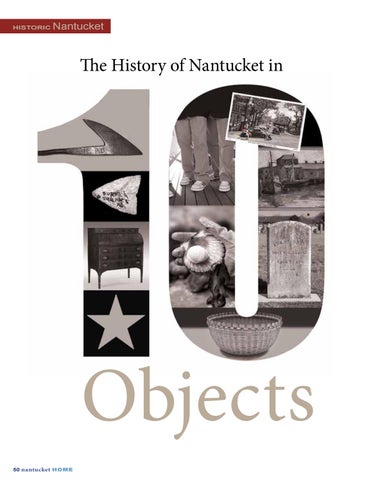
The History of Nantucket in
Objects 50 nantucket home
You
Native American arrowheads and tools ca. 1,000 BC – 1100 AD The first humans on Nantucket probably roamed its glacier-formed hills and valleys before it became an island around 5,000 years ago after the oceans rose to isolate it from the mainland. Primarily a hunting and fishing culture, Nanucket’s Native Americans were Pokanokets, more commonly called to this day the Wampanoags. Indian relics can be found just about anywhere on the island, but old hands at the hunt know of a few sites where camps were probably set up, so they yield more discoveries. According to archeologists, Native American implements found locally are similar to those found on Cape Cod and Martha’s Vineyard and can date back to 1,000 BC, although most found these days are from around 1,000 years ago. Most arrowheads are made from quartz, while larger implements might be fashioned from granite or sandstone. For details of Nantucket’s geological and natural history, see Nantucket: A Natural History, by Peter Brace, or visit the natural science collections of Maria Mitchell Association on Milk Street, www.mariamitchell.org. For more on the rich history and artifacts of Native Americans on Nantucket, visit Nantucket Historical Association and its Whaling Museum on Broad Street, www.nha.org.
Photo by Jeffrey Allen
No 1 Arrowheads:
Courtesy Nantucket Historical Association
can chart the history of Nantucket, through its ups and downs, by the people who’ve lived on the island, the influence of Nantucketers in the world or, in many cases, by the objects created here. For this issue of Nantucket Home, we chose 10 objects that we think well represent the island at various times in its history. Each one was greatly valued when it was created and, often, beyond that time and into the present. From the largely utilitarian nature of Native American arrowheads and tools to the highly decorative quality of works by Nantucket fine artists to our delicious native scallops, our list is neither exhaustive nor definitive. But it’s a good place to start a conversation about what you might include on a list of objects that embody the history and spirit of Nantucket.
nantucket home 51
No 2 Harpoons and whaleship snatch:
Whaleship harpoon and cutting spade, ca. early-mid 19th century. Whaleship snatch block, ca. late 17th- to mid-19th century.
Photo by Robert Hellman
Photo by Robert Hellman
Courtesy of Sylvia Antiques
Boats first set out from Nantucket in hunt for whales in the late 1600s. By 1766, more than 100 whaling vessels sailed out of Nantucket, part of the island’s rise to being among the world’s leading whaling ports from the mid-1700s to around 1830, with over150 vessels eventually sailing from the island for ocean voyages of up to two to three years. Concurrently, Nantucket’s ocean-going vessels became an important part of the burgeoning China Trade. These Nantucket made whaling tools, from the collection of Robert Hellman, were crafted by Nantucket blacksmiths. The spade, probably made in the first quarter of the 19th century, was forged by Samuel Brown Folger, whose initials are hammered above an eagle’s outstretched wings. Th e single-flued harpoon, or “iron” as their makers called them, was made by Elisha Parker, said to have been the last whalecraft blacksmith on Nantucket, probably in the mid 1800s. The whaling harpoons and cutting spade were important tools in the killing and harvesting of whales, with the harpoon used to land the whale and the spade used to cut it up and help peel away the whale’s valuable blubber. Descended in the family of Nantucket whaling Captain Charles Grant, the whale ship snatch block would have been part of the intricate system of ropes and winches used to hoist the carcasses of whales onto deck for processing.
To see more marine artifacts including whaling-era tools and memorabilia, visit the galleries of Sylvia Antiques at www.SylviaAntiques.com and see Nina Hellman Marine Antiques at www.hellmanantiques.com.
No 3 R. H. Macy’s red star: ca. late 1850s
Rowland Hussey Macy, native son of Nantucket and founder of Macy’s department store, knew better than anyone else the n ostalgic power of the island’s whaling era. He harnessed it in the form of a single red star, which he first packaged with a sailor’s yarn when he opened his Manhattan store in 1858. Born in 1822, Macy was only a boy of about 15 and expected to assist in the island’s whaling industry when he set off on his first voyage as a cabin boy for the Emily Morgan. According to Macy company history: “While he was with the ship, there was a bad storm and the only navigational tool they had to go by was the North Star, which in this storm appeared to have a reddish glow to it. That’s how they got their bearings and stayed on course. After that trip, R.H. Macy never went back to the sea, but he got a red star tattoo because he always considered that to be a lucky thing for him.” Macy began using images of the star in his advertising copy shortly after he opened his first New York City store in 1858. The earliest existing images date to 1863. 52 nantucket home
Macy used variations of the star in his logos for the first 12 years. It wasn’t until the 1870s that he settled on its current, solid red incarnation, which he used for a private in-store label with which he sold popular books, clothing and food, and transferred it to the store’s façade. Although historic records cast doubt on the legend, after Macy passed away in 1877, the store continued to perpetuate the lore. (Contributed by Marli Guzzetti) For more on the legend and lore of R.H. Macy’s red star, see the 2009 book Macy’s: The Star. The Store. The Story. Square One Publishers.
Courtesy of Nantucket Historical Association
Courtesy of Rafael Osona Auctions
No 4 Nantucket Desk and silver: Cylinder-fall desk, Heman Ellis, 1808 Silver spoons, Benjamin Bunker, early 1880s Silver ladle, J. Easton, ca. 1840 Thanks to trading by sea along coastal New England and beyond, Nantucket in the 18th and 19th centuries had a steady supply of the fine woods and hardware needed to build substantial pieces of furniture. Besides craftsmen with refined furniture making skills who moved to the islands, local craftsmen drew inspiration from items imported to the island to be sold by local merchants. By the 18th century, furniture made on Nantucket compared favorably with the finest pieces made elsewhere in New England and the Mid Atlantic states. John Jackson (ca. 1705-1772) was the first silversmith known to have lived on Nantucket, although others from off island had regular Nantucket customers. By the mid-18th century, silver was a common household item on Nantucket, and by the 19th century several silversmiths practiced on the island including, prominently, James Easton (1807-1903),
Frederick Sanford (mid 1800s) and William Hadwen (1791-1862). Much of Nantucket silver, used especially in Quaker households involved in the whaling industry, consisted of spoons, cups and other basic utensils of everyday life. The cylinder-fall desk was made by Heman Ellis on Nantucket in 1808, for Sylvanus Ewer (1767-1836), a wealthy Nantucket ship owner who lived at 19 Union Street. Materials used include mahogany, cherry, poplar and pine, with brass hardware. For more on Nantucket furniture, see Harbor and Home: Furniture of Southeastern Massachusetts, 1710 – 1850, by Brock Jobe, Gary R. Sullivan & Jack O’Brien. For more on Nantucket silver, visit Rafael Osona Auctions at www.nantucketauctions.com. For an excellent overview of historic Nantucket-made furniture, silver and other crafts, see the now out-of-print The Decorative Arts and Crafts of Nantucket, by Charles and Mary Grace Carpenter. Copies are usually available at Mitchell’s Book Corner on Nantucket.
nantucket home 53
Courtesy of Rafael Osona Auctions
No 5 Open-form Nantucket Lightship Basket: Late 19th century
Most would agree on Nantucket’s most famous handcrafted item, which bears the island’s name, the Nantucket Lightship Basket. Adopted by sailors from traditional Native American basket forms to wile away their time at sea, the lightship basket is often seen today in a handled-version, carried on the arm of fashionable women. This elegant and rare open-form basket, made at the end of the 19th century, features stave ends protruding through the hoops and above the rim in the form of decorative heart shapes. Crisscrossed reeds form the rim wrap; two concentric circles form its base. It measures 9 1/8” in diameter and 4” high. In 2005, it set a world-record for lightship baskets sold at auction when it was hammered down by Rafael Osona Auctions on Nantucket for $115,000. For more fine examples of historic Nantucket Lightship Baskets, see Rafael Osona Auctions at www.nantucketauctions.com. For the history and craft of making lightship baskets, visit the charming Nantucket Lightship Basket Museum at 49 Union Street on Nantucket, www.nantucketlightshipbasketmuseum.org.
54 nantucket home
No 6 Headstone of Eunice Ross 1895
Members of Nantucket’s early African American community played important roles in Massachusetts and U.S. history. Absalom Boston, a third generation Nantucketer, was one of only two known black captains of whaling ships. Eunice Ross, a Nantucket schoolgirl who was forced along with other local African American children to attend their own separate school, became one of the trailblazers for public school integration in Massachusetts and on the island. Her personal petition, along with others from Nantucket, urged state legislatures to allow African Americans entry to Nantucket’s then whites–only schools. Ross’ appeal was instrumental in Massachusetts passing a law in 1845 prohibiting discrimination in public schools. By the mid 1800s, most of the Nantucket’s black citizens of color lived in so-called New Guinea, the area around today’s Five Corners. Nearby, a “coloured cemetery” was established behind today’s Nantucket Cottage Hospital, and a separate African American school was built in the neighborhood around 1825. That building, the African American Meeting House on Nantucket, served as a blacks-only school and church for the island’s African American community for more than a hundred years. Today, this restored historic architectural gem is home to readings, concerts and even the occasional small wedding. The Colored Cemetery—its now official name was urged by Nantucket residents including African Americans—holds the graves of Eunice Ross and Absalom Boston along with other African American citizens of Nantucket. Although Boston’s marker is lost, stones for other members of his family are located in the southwest corner of the cemetery.
Photos by William Ferrall
For more, see White’s excellent scholarly and enjoyable study “The African School and the Integration of Nantucket Public Schools,” available at Nantucket Atheneum. For more on the African Meeting House on Nantucket, see http://www. afroammuseum.org.
nantucket home 55
Courtesy of Sylvia Antiques
Courtesy of Nantucket Historical Association
“Artist and Model in the Studio” Oil on canvas, 29” X 24 ½” Elizabeth Rebecca Coffin, ca. 1890
“Fishing Vessels at Island Service Wharf ” Oil on canvas, 18” x 22”, sight Janet Ball McGlinn, c.1945
No 7 Paintings by Nantucket artists:
Renowned artists and artisans have long found inspiration on Nantucket and have considered it a haven in which to work productively. The descendant of a Nantucket family, Elizabeth Rebecca Coffin (1850-1930) attended Vassar College, where she studied under famed Nantucket astronomer Maria Mitchell. Pursuing painting as a career, Coffin traveled extensively and studied under renowned 19th-century American realist painter Thomas Eakins. She was also close friends with artist William Merritt Chase and was part of an elite circle of accomplished American women artists in the late 19th century. Later in life, she moved to Nantucket and painted numerous island scenes and portraits. Along with Eastman Johnson and W. Ferdinand Macy, Coffin led a group of prominent artists working on Nantucket in the late 19th and early 20th centuries. Their presence laid the groundwork for the burgeoning Nantucket Art Colony that flourished on the island from around 1920 – 1945. Janet (Ball) McGlinn (1915–88) was one of the most
56 nantucket home
talented postwar WWII artists working on Nantucket. She founded the Nantucket Printmakers in 1969 with Schuyler Bradt (1909–79) and taught printmaking, especially the technique of collograph. A Philadelphia native, McGlinn attended the Pennsylvania Academy of the Fine Arts and the Art Students League in New York City. Her stunning print series, created in 1972 and first exhibited in 1980, vividly highlights key scenes and characters from Melville’s whaling epic MobyDick. Today, Nantucket’s artist and artisans continue to thrive artistically and commercially in dozens of individual studios and group galleries on the island. For more on historic Nantucket artists, visit www.nha.org. To see works created during the Nantucket Art Colony period and by today’s local artists, see the Artists Association of Nantucket at www.nantucketarts.org or visit their Joyce & Seward Johnson Gallery at 19 Washington Street, two blocks off Main Street. McGlinn’s painting can be found at Sylvia Antiques, lower Main Street, Nantucket, www.SylviaAntiques.com
No 8 Tourism Postcards: Early-20th century - present
By the turn of the 20th century, Nantucket was annually welcoming thousands of visitors on vacation including an actors’ colony in ‘Sconset. The steam car had taken over island roads. Liquor saloons were allowed to open. Retail stores targeted to tourists flourished. Forty or more boarding houses, inns and hotels were included in a directory of 1915. Despite ups and downs during war times, recessions and depressions, the business of tourism on Nantucket, in the long run, continued to grow substantially. Today, the industry is one of the top two generators of income for the island along with the real estate business. What the stereoscope had done to increase awareness of Nantucket’s charms and vistas in the 19th century, the modern postcard has done since the early 1900s. From scenes of historic homes and public buildings to the island’s beautiful beaches to bucolic images of Main Street, Nantucket’s appeal is captured for thousands to see and pass along in hand-held, vivid color.
Courtesy of Nantucket Historical Association
For more on the history of tourism on Nantucket, see Holiday Island, by Nantucket Historian Clay Lancaster and usually available at Mitchell’s Bookworks on Nantucket. For a colorful compendium of Nantucket postcards, see Nantucket Memories: That Far Away Island, by Laszlo Felsobu Nagy, available in the museum shop of Nantucket Historic Association at 11 Broad St., Nantucket.
No 9 Nantucket Reds: ca. 1940s
Nantucket Reds™ are a trim, tailored style of trousers produced and distributed by Murray’s Toggery Shop, located on Main Street on Nantucket. Made of brick-red sailcloth, they were reportedly inspired by uniforms worn by the New York Yacht Club. First conceived as shorts, the clothing line of Nantucket Reds™ has since expanded into trousers, caps, jackets, ties and other apparel for both men and women. After a few wearings and washings, the pants fade to a light pink. In fact, Nantucket reds ™ are “Guaranteed to Fade.” The book The Official Preppy Handbook, published in 1980, helped to boost their popularity. Today, Nantucket Reds™ are considered an important part of the quintessential preppy wardrobe, often worn in tandem with leather or canvas boat shoes. Despite the many imitators that have appeared, there is only one source for official Nantucket Reds™: Murray’s Toggery Shop, 62 Main Street, Nantucket. For store hours, call 800-368-2134 or 508-228-0437, or visit www.NantucketReds.com
Photo by Brea MacDonald / www.breamcdonald.com
nantucket home 57
Barbara Gookin Barbara Gookin
Rob Benchley
No 10 Nantucket Bay Scallop:
Few objects embody so many aspects of Nantucket as the island’s best known marine product, the Nantucket Bay Scallop, argopecten irradians. In it can be found the rich history of Nantucket as a commercial fishing location, the influence and name recognition of Nantucket throughout the world, and the challenges of preserving the island’s natural beauty and assets. Known for its natural buttery sweetness, the scallop fished from Nantucket’s bays and harbors might be more sought after than any other type of scallop. For those who usually experience large, blander sea scallops, a bite into a fresh Nantucket Bay Scallop can be an epiphany. For more than a century now, they’ve been prized as a delicate and rich seafood, with those caught on Nantucket commanding among the highest prices at the fishmonger, in supermarkets and on restaurant tables. If you can get them. Threats to scallop beds up and down the East Coast have included overfishing, stormy weather and pollution. Nantucket’s remoteness helps the local crop to
58 nantucket home
rebound after most bad years, although the annual harvest has dropped significantly in the last two decades. According to many biologists, development and pollution have reduced and continue to threaten the important eel grass breeding grounds for the Nantucket Bay Scallop. Today, scallop fishing on the island is heavily regulated, including size and quantity limits, through oversight by the Nantucket Harbor and Shellfish Advisory Board. Fishing can be done only by permit, with the commercial season open during cold weather months from November 1 to May. Recreational or family scalloping, also by permit, begins one month sooner and ends in March. For more information on licenses for scalloping and other shell fishing on Nantucket, see www.http://nantucket-ma.gov/ or call 508-228-7261. For the best book about scalloping on Nantucket, with beautifully photographed images, see Scallop Season, A Nantucket Chronicle, by Jim Patrick and photographer Rob Benchley, available at Nantucket Atheneum or Mitchell’s Book Corner on Nantucket.