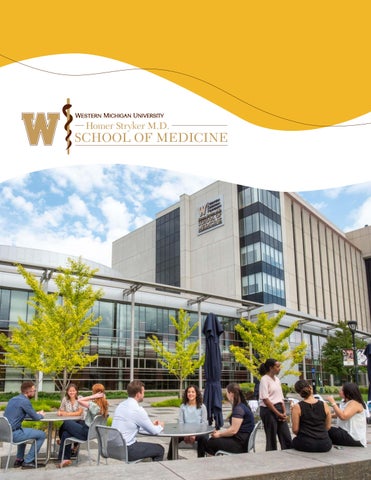
TOGETHER WE LEARN A Message from the Dean Congratulations, and thank you for choosing to enter the healthcare profession. The path you have chosen will have a profound impact on the health of individuals and the communities where you will one day live and practice. Now comes an important decision: where you will spend the next four years preparing to become a physician. I hope you will consider making that place WMed. Established in 2012, Western Michigan University Homer Stryker M.D. School of Medicine, known as WMed, is a partnership between Western Michigan University, Beacon Kalamazoo, and Bronson Healthcare. We are fully accredited by the Higher Learning Commission and the Liaison Committee on Medical Education. What sets us apart is not only our talented faculty and staff, our state-of-the-art facilities, and our rigorous curriculum, but the Kalamazoo community around us, one with a long history of providing high-quality medical education and care to the people we serve. WMed is committed to excellence and health equity through transformative medical education, high-quality patient- and family-centered care, innovative research, and community partnerships, all within a culture that draws strength from our differences and works to ensure that everyone has the opportunity to achieve their best possible health. It is this shared commitment, held by our students, residents and fellows, graduates, faculty and staff, and the Kalamazoo community, that positions us to achieve our vision: health equity for all in Southwest Michigan through innovation in the practice and study of medicine. Our faculty have built a modern, integrated, competency-based curriculum. It is taught through a team-based approach, mirroring the way you will practice medicine and preparing you to lead strong teams. WMed is learner centered and community focused, and our faculty are medical educators who have devoted themselves to the art of teaching. Through our curriculum, your experiences in student interest groups and organizations, and the mentorship of our faculty, staff, and more than 1,000 community physicians who devote their time and talents to teaching, you will graduate as a leader ready to shape the future of medicine, whether through science and discovery, education, clinical care, or advancing health equity in the communities we serve, both local and global. At WMed, you will be welcomed, supported, and valued. We know that the success of our medical students is the truest measure of our own success as a school, and we are here to ensure you thrive. Join us at WMed; I look forward to welcoming you on our journey toward health equity for all.
J. Adrian Tyndall, MD, MPH, FACEP The Hal B. Jenson, MD Dean, President and CEO Western Michigan University Homer Stryker M.D. School of Medicine
1
Points of Pride
The W.E. Upjohn M.D. Campus in downtown Kalamazoo boasts: • a 350,000-square-foot, state-of-the-
art learning environment • a 25,000-square-foot simulation center that is one of the largest in the nation • gross anatomy and multipurpose labs • two 90-seat team-based learning halls • 14 classrooms • a fitness center • ample study space
Take a virtual tour
Our small medical school class size of 86 allows for individual attention and a highly supportive environment that is committed to student success.
WMed provides many opportunities for support and mentorship, including four student learning communities as well as peer, faculty, and community physician mentors.
Our collaborative and team-oriented environment allows you to learn medicine in the same way you will practice it: working with others.
Get experience in our simulation center starting your very first month on campus during the Medical First Responder certification course, which sets the stage for the hands-on learning opportunities you will continue to engage in throughout our curriculum.
WMed cultivates a culture of community engagement. Our students, faculty, and staff live out our vision of health equity in Southwest Michigan by supporting and leading outreach and service initiatives in the greater Kalamazoo community.
2
Kalamazoo Listed in
Student Life and Kalamazoo WMed is nestled in the heart of downtown Kalamazoo, Michigan, a vibrant city that offers endless opportunities for outdoor recreation, festivals, the arts, and awardwinning restaurants. The city has a rich history of excellence in education, healthcare, research, life-science exploration, and leadership in the pharmaceutical and medical sciences. Within walking distance of campus are a thriving farmers market, local library and museum, trails and parks, community theaters, locally-owned restaurants, and art studios. Our students become integrated in the Kalamazoo community in both medical and personal capacities. At WMed, students have ample opportunities to develop their leadership skills while making a difference. WMed hosts over 100 student interest groups, ranging from national organization chapters to medical specialty or special topic interest groups. WMed values your experience inside and outside the classroom, including your personal well-being. Our team provides a range of group and individual services, including academic support, career development, wellness activities, student engagement opportunities, and campus events.
to name a few… American Medical Association – Medical Student Section · Arts in Medicine · Bioethics Interest Group · Cardiology Interest Group · Gaming Night Interest Group · Latino Medical Student Association · Medical Student Pride Alliance · Street Medicine Kalamazoo · Student National Medical Association · Surgery Interest Group · Volleyball Interest Group · Yoga and Wellness
TOP 3
Cities for College Graduates According to a SmartAsset survey, the Kalamazoo-Portage area ranked third on the list of top cities for new college graduates. The survey attributed the top ranking to the high number of young people and restaurants in the area.
Kalamazoo Named One of the
TOP 10
Most Affordable Cities with High Salaries and Low Cost of Living in the Midwest The Ascent released its list of the 10 most affordable places to live in the Midwest based on the income to expense ratio, a measurement of how a city’s median income compares to its cost of living. Kalamazoo made the list because it is the cheapest city in the Midwest and the second-cheapest nationwide, with a cost of living 22.5% less than average expenses nationwide. Housing, in particular, is very inexpensive, beating the national average by a whopping 49% and having a low median home price.
I have loved living in Kalamazoo. Although I miss the mountains back home, there is so much to do here. Summers in Michigan are remarkable. I’ve loved discovering Lake Michigan’s beautiful beaches, and the local hiking trails and restaurants have become some of my favorite spots to unwind. The town is a great size and easy to get around (when I hit ‘rush hour’ traffic, it takes me 11 minutes to get home instead of 10). Kalamazoo is such a fantastic place to be for medical school!” Isaac Pingree, MD Class of 2028, Salt Lake City, UT
3
Applying to WMed The MD application process opens in May through AMCAS. Since WMed uses rolling admissions, prospective students are encouraged to apply early. Through our mission-aligned admissions process, we are seeking well-rounded future physicians and leaders who have strengths in the following categories:
Primary Application
Supplemental Application
Experiences Tell us your story. We are looking for leaders who bring pre-medical experience in: • Medical settings • Community and volunteer settings • Teamwork and leadership • Extracurricular activities
Experiences Review
Telephone Interview
Attributes We are seeking students who: • Are team players • Can problem solve • Show compassion and service • Communicate well • Make decisions with integrity
Metrics
Virtual Interview (Includes a one-on-one Interview and group activity)
Admissions Committee Decision
• Minimum GPA: 3.0 • Minimum MCAT: 499
Competencies Medical students must possess a broad range of competencies to successfully learn and develop in medical school and become effective physicians. WMed utilizes the AAMC Premed Competencies for Entering Medical Students in our review process.
Learn more about Admissions
Recommended Coursework Specific prerequisite coursework is not required. To be well prepared, we recommend applicants complete a broad base of coursework in the humanities and social sciences, accompanied by coursework in: Biochemistry • Genetics • Human Anatomy • Human Physiology • Statistics
As a private, nonprofit medical school, WMed enrolls bright and talented students from throughout the U.S. WMed has established preferred relationships with Western Michigan University, Kalamazoo College, Grand Valley State University, and Albion College.
4
Curriculum: Foundations of Medicine
Fundamentals of Biomedical Sciences 1
MFR 2
Fundamentals of Biomedical Sciences 2
October
Decem
November
Immunology and Infectious Diseases
Hematology and Oncology
Clinical Skills; Principles of Medicine; Engagement and Discovery; Meaning in Medicine; Professional Development
Renal and Genitourinary Systems
September
Gastrointestinal System
October
Endocrine and Reproductive Systems
Decem
November
Behavioral Medicine
Clinical Skills; Principles of Medicine; Engagement and Discovery; Meaning in Medicine; Professional Development
Vacation
Elective/Flex
Medical First Responder
Biomedical Sciences Courses
Longitudinal Courses
• Our innovative, contemporary 18-month preclinical phase of the curriculum integrates biomedical sciences with clinical application. • In biomedical sciences courses, dedicated teaching faculty use interactive lectures, asynchronous learning modules, and case-based learning to promote student understanding. These courses utilize a team-oriented environment that prepares students for a successful career in medicine. The application of basic science to clinical decisions is continuously emphasized. • At WMed, clinical experiences start with a Medical First Responder (MFR) training. In addition to the highly integrated curriculum, one-week electives during the first two years allow for additional clinical experiences and exploration. WMed students are fully immersed in the clinical environment after completing 18 months of basic science coursework. • The Meaning in Medicine and Support and Policy courses provide a broad education in the social determinants of health and positions WMed students to be future advocates and leaders. • WMed’s decompressed curriculum runs year-round, focusing on one biomedical science course at a time and offering a one-week break following most 5- to 6-week courses. These “green weeks” can be used for electives or to recharge and focus on wellness. • Students can participate in clinical, community-based, laboratory, and medical education research.
Learn more about WMed
Clinical Applications
Term Final
August
Elective/Flex
July
Year Two
September
Year One
August
MFR 1
July
Transition to Medical School
June
Transitions
5
January
March
February
Musculoskeletal System
Nervous System
June
May
April
Cardiovascular System
Pulmonary System
Term Final
mber
Clinical Skills; Principles of Medicine; Engagement and Discovery; Meaning in Medicine; Professional Development
Clinical Reasoning 1
May
April
Adv Elective or MED/SURG
March
February
Adv Elective or MED/SURG
January
Transition to Clinical Applications
mber
Core Clerkship Rotation 1
Meaning in Medicine; Professional Development
Core Clerkship Rotation 2
Sample curriculum maps on this and following pages. Dates and sequence subject to change.
WMed offers MD-MBA and MD-PhD dual-degree options.
Academic Distinctions Academic Distinctions give WMed students the opportunity to pursue and be recognized for areas of interest and scholarship. Each Academic Distinction requires 30–40 hours of curriculum, which could include electives, parallel co-curricular work, and scholarship in the form of publication or project. • Advocacy and Leadership in Patient Safety and Quality Improvement • Clinical Informatics • Clinical or Translational Research • Global and Public Health • Interprofessional Focus in Community Health • Medical Ethics, Humanities, and Law • Promoting Excellence in Medical Education • Well-Being in Medicine
6
Curriculum: Clinical Applications
Core Clerkship Rotation 3
Core Clerkship Rotation 4
October
Core Clerkship Rotation 5
November
Elective/Flex
September
Elective/Flex
August
Elective/Flex
Core Clerkship Rotation 6
Support and Policy; Professional Development
April
May
Advanced Anesthesiology
Year Four
July
Elective/Flex
Year Three
June
July
June
Elective/Flex
August
Advanced Neurology
Elective/Flex
September
Elective/ Flex
October
Advanced Critical Care
Support and Policy; Professional Development
Vacation
Elective/Flex
Biomedical Sciences Courses
Longitudinal Courses
Clinical Applications
Transitions
Core Clinical
Advanced Clinical
Core clerkships are traditionally considered to be one of the most clinically transformative periods in a physician’s career. Core clerkships begin in January of Year Two and are organized into seven blocks—six clinical rotations plus a block dedicated to clinical reasoning for USMLE Step preparations. Rotations occur in Southwest Michigan.
Advanced clerkships and selectives continue to build clinical skills and allow students to explore and finalize their desired area of practice. The transition into advanced clerkships and selectives begins with ACLS certification.
Core Clerkships • Family and Community Medicine • Medicine • Obstetrics and Gynecology • Pediatric and Adolescent Medicine • Psychiatry • Surgery
4-week Required Advanced Clerkships and Selectives • Advanced Anesthesiology (1 week) • Advanced Critical Care Medicine (4 weeks) • Advanced Emergency Medicine (4 weeks) • Advanced Hospital-Centered Medicine (4 weeks) • Advanced Neurology (2 weeks) Students have the opportunity during advanced clerkships and selectives to explore specialty options with a variety of local elective offerings, flexible time to accommodate residency interviews, and vacation weeks that you build into your schedule. Each student has the option to spend four to eight weeks at an international medical school to experience the health system in other parts of the world as part of our Engagement and Discovery course. WMed currently has established relationships with institutions in Honduras, India, Liberia, Peru, Philippines, Portugal, Puerto Rico, and South Korea.
Students may be assigned to the Kalamazoo campus or the Corewell Lakeland regional campus for their Clinical Applications phase, consisting of core clinical and advanced clinical clerkships.
7
Health Systems Science
March
February
Clinical Reasoning 2
Elective/Flex
January
Transition to Adv Clinical Mgmt
December
April
Elective/Flex
Support and Policy; Professional Development Graduation
Advanced Emergency Medicine
Elective/Flex
December
January
Advanced Hospital-Centered Medicine
March
February
Elective/Flex
Capstone
April
Elective/Flex
May
Transition to Residency
November
Support and Policy; Professional Development
Clinical Affiliates WMed collaborates with nationally-recognized clinical partners Beacon Kalamazoo, Bronson Healthcare, and Corewell Health Lakeland. Their award-winning commitment to quality-of-care standards translates into a level of training experience that rivals major university medical centers while providing the advantage of a community-based, diverse patient population. Beacon Kalamazoo and Bronson Healthcare are based in Kalamazoo and carry a long history of clinical education in the city. Corewell Health Lakeland, based in Saint Joseph, is a regional campus of WMed. In addition to these hospital systems, clinical rotation sites include WMed Health, Grace Health, and almost 200 other training sites throughout Southwest Michigan and Northern Indiana, allowing our students to experience a variety of clinical settings and patient types. Together, these environments offer a full spectrum of clinical experiences.
WMed offers residency and fellowship programs in Emergency Medicine, EMS Fellowship, Family Medicine, Forensic Pathology Fellowship, General Surgery, Hospice and Palliative Medicine Fellowship, Internal Medicine, MedicinePediatrics, Obstetrics and Gynecology, Orthopaedic Surgery, Pediatrics, Psychiatry, Simulation Fellowship, and Sports Medicine Fellowship.
8
The Hal B. Jenson MD Master of Science in Biomedical Sciences
Capstone/PLS
August
Transition to MBS
July
Cellular Biochemistry
September
October
Molecular Genetics
December
November
Principles of Immunology
Anatomy and Physiology I
Capstone; Professional and Learning Skills; Advances and Perspectives in Medicine
Vacation
Biomedical Sciences Courses
Longitudinal Courses
Transitions
The Hal B. Jenson MD Master of Science in Biomedical Sciences (MBS) Program is a one-year master’s program designed for students looking to strengthen their foundational knowledge in basic sciences before beginning medical school.
Program Features • MBS students are automatically accepted to the MD program the following year, contingent upon successful completion of the MBS program. • Each MBS student may receive a full-tuition scholarship and may be offered a cost-of-living stipend while completing the master’s degree. • A small cohort of up to eight students per year provides a highly supportive environment. • The MBS curriculum runs alongside MD students, and instruction is provided by medical school faculty. • Priority will be given to applicants who have overcome significant adversity, are first generation college graduates, are socio-economically disadvantaged, or who reside in or have strong ties to the Southwest Michigan area.
Metrics • Minimum GPA: 3.0 • Minimum MCAT: 497
Application Process There are two ways to apply to the MBS program:
1
Be considered for the MBS program with a traditional MD application through AMCAS. This option enables you to be considered for both the MD and the MBS program. Applicants applying to the MD program who wish to be considered for the MBS program should inform admissions directly at admissions@wmed.edu.
2
Apply directly to the MBS program. Direct applications open on the program website each January.
Learn more about the application process
I loved the MBS program specifically because of the faculty. Every person involved in my education genuinely cared about my growth and had their doors open always to vent about struggles outside of school.” Mfoniso Ekpo, MD, MBS Class of 2019, MD Class of 2023 Resident Physician, Neurology, Duke University Medical Center
9
January
March
February
May
April
Anatomy and Physiology II
Anatomy and Physiology III
Anatomy and Physiology IV
Capstone
Graduation
Capstone; Advances and Perspectives in Medicine
The MBS program was honestly the opportunity I prayed for. It gave me the chance to prove myself. I entered my first year of medical school with not only the confidence to succeed, but the tools to hit the ground running. The professors, mentors, and friends I made during the program have been an integral component of my medical school experience. I will forever treasure the memories I made in the MBS program and how they helped shaped me into the aspiring leader I am today.” Rosemary Vergara, MBS Class of 2021, MD Class of 2025 Resident Physician, General Surgery, University of New Mexico School of Medicine
Class of 2026 Residency Placement
85
Graduating Students
98%
46%
Match Percentage
Primary Care
54%
Specialties
Number of Placements by Specialty Anesthesiology · 5 Dermatology · 2 Emergency Medicine · 6 Family Medicine · 9 General Surgery · 13 Internal Medicine · 14 Medicine-Pediatrics · 5 Neurology · 3 Obstetrics & Gynecology · 3 Ophthalmology · 1 Orthopaedic Surgery · 3 Pediatrics · 11 Pediatrics – Medical Genetics · 1 Physical Medicine & Rehabilitation · 1 Psychiatry · 5 Transitional Year · 3 Urology · 1 = multiple residents
Questions? Please contact the WMed Office of Admissions at admissions@wmed.edu or 269.337.6100.
Find us on
@WMUMedicine
@WMUMedicine
WMed complies with all applicable federal and state laws regarding nondiscrimination. For more information, see our full Notice of Nondiscrimination at wmed.edu/studentpolicies. 09.2026