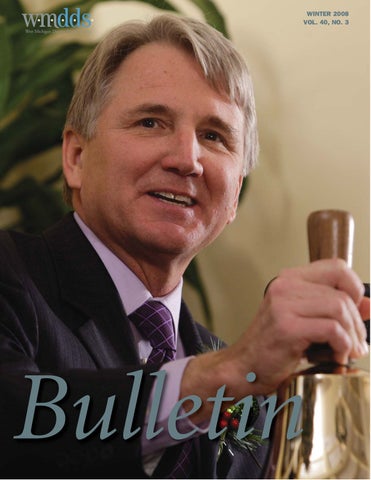
WINTER 2008 VOL. 40, NO. 3
Bulletin
Contents Editor
Bruce Weny
Associate Editors
Jeff Smith Tara Meachum Seth Vruggink Aric Smith James Papp
President’s Message ...................................................................................................... 2
Elaine Fleming Executive Secretary WMDDS 511-F Waters Building Grand Rapids, MI 49503 (616) 234-5605 efwmdds@aol.com
Trustee Report .............................................................................................................. 6
Advertising Editor
West Michigan District Dental Society Executive Board 2007-2008 President Amy De Young President-Elect Doug Killian Vice President Douglas Klein Secretary-Treasurer Joseph Kirkwood Editor Bruce Weny Immediate Past John Frey President Directors Seth Vruggink Larissa Bishop Tyler Wolf Area Representatives Kent County Paul O’Grady Ionia-Montcalm Christopher Morgan County Mecosta County Margaret Gingrich Ottawa County Ryan Lebster MDA IV District Trustees
Connie Verhagen Norman Palm
Big Rapids Dental Study Club Officers, 2007-2008 President Erick Perroud Vice President Erick Perroud Secretary Christa Stern Treasurer Erick Perroud Holland-Zeeland Dental Society Officers, 2007-2008 President Ryan Lebster Treasurer Robert Ankerman Secretary Immediate Past President Ionia-Montcalm Dental Study Club Officers, 2007-2008 President-Secretary Lowell Swartz Vice PresidentKirkwood Faber Treasurer Kent County Dental Society Officers, 2007-2008 President Paul O’Grady Vice President Brad Van Hoose Secretary Brant Erbentraut Treasurer David Armbrecht West Michigan Dental Foundation Officers, 2007-2008 President Tom Harmon Vice President Don VanderLinde Secretary Matt Gietzen Treasurer Carl Kruyswyk The Bulletin of the West Michigan Dental Society is published six times a year (directory, holiday, winter, spring, and summer). The opinions expressed in The Bulletin are not necessarily the opinions of the West Michigan District Dental Society. Contributions to The Bulletin are welcome and should be addressed to The Bulletin Editor, 255 Washington SE, Grand Rapids, MI 49503. Requests for purchase of advertising space should be directed to the Advertising Editor, Elaine Fleming, (616) 234-5605. The deadline is the 1st of the month prior to publication. © 2007-2008 West Michigan District Dental Society Bulletin
Editor’s Thoughts......................................................................................................... 5
2008 Silent Bell Recipient ............................................................................................ 8 Michigan Dental Foundation Scholarship Recipients ...............................................12 Peters for MDA Speaker of the House........................................................................14 Baxter Community Center ..........................................................................................19 Adult Suicide ................................................................................................................20 Age-Reversing Dentistry and Longevity.....................................................................24 GRCC News..................................................................................................................28 Classified Ads................................................................................................................30 Advertiser Index ...........................................................................................................31
About the Cover Cover photo and photos from Holiday Awards Dinner courtesy of Adam Bird, Man in the Hat Productions.
Mission Statement The Bulletin is the newsletter of the WMDDS and its mission is to inform the membership of upcoming and recent events, state & local issues related to dentistry, and as a forum for its officers, representatives, and members to discuss appropriate topics of interest to the membership. Communication & Advertising Policy The Bulletin will publish submitted articles from members and others that relate to the practice of dentistry, small business, social, or political issues affecting dentists, or other subjects of interest to the membership. All published items are subject to space restrictions and the community standards of the WMDDS. The editors reserve the right to reject any article or advertisement deemed inappropriate and to edit submissions as they see fit. Submission & Publication Policy: Articles and advertisements must be submitted no later than the 1st of the month preceding publication date. The Bulletin has six publications: the directory issue, fall issue, holiday issue, winter issue, spring issue, and summer issue. Direct submissions or correspondences to: Dr. Bruce Weny • 255 Washington SE • Grand Rapids, MI 49503 Phone: 616.451.2336 FAX 616.222.1345 • Email: Bweny@aol.com Include “Newsletter” in the subject line
WEST MICHIGAN DISTRICT DENTAL SOCIETY | WINTER 2008
1
PRESIDENT’S MESSAGE
A Few Good Men By Dr. Amy De Young, WMDDS President moving to Michigan in 1974. Gary’s pastimes include the restoration and racing of vintage automobiles, studying game film of the post-Cooper Ohio State/Michigan football games, and spending time with his two young grandchildren (one of whom, James Lynn, was born several weeks ago).
W
hat an honor and privilege I had to introduce the new ADA and MDA life members at the WMDDS Holiday Awards Dinner. This year, fourteen individuals were granted life membership into the ADA, MDA, or both. Eleven of the fourteen individuals were able to come to the event. I will admit that I was very nervous when I heard that I would be introducing so many new life members. These professionals have been practicing for 35 years or more and have experienced so much more than I can ever imagine. How would I be able to properly and respectfully introduce these gentlemen? Then I had the idea of having them each write their own short biographical sketch. The results were fantastic! I learned so much about each of these members that I would not have known before, and I was able to share this information with the rest of the members of the WMDDS who were present at the event. Since the event, I have had many members comment on how wonderful it was to hear about the varied interests, accomplishments, and the families of our new life members. I would like to share these members’ biographies with all of our members who read our Bulletin. I would also like to offer my sincere congratulations to all of these gentlemen for their wonderful support of dentistry, their families, and their communities. Dr. Gary Armbrecht Dr. Gary Armbrecht has had the privilege of practicing orthodontics locally for 33 years, the last three with his son, David. Gary is a native of Ohio, having received his undergraduate degree from Case Western Reserve and his dental degree from Ohio State University. He completed his orthodontic training at the Eastman Dental Center in Rochester, New York before
2
Dr. Arnold Baker Dr. Arnie Baker and his wife, Nancy, are native to the West Michigan area, leaving the area for schooling and military service. Arnie attended Calvin College and graduated from the University of Michigan Dental School with a DDS in 1968 and MS in Fixed Prosthodontics in 1975. He served in the United States Army in Germany from 1968-1971 and was an instructor at the University of Michigan Dental School from 1971-1977. Arnie, Nancy, and family moved back to Holland in 1977, and for the past 30 years he has enjoyed practicing prosthetic and implant dentistry. He has also had the privilege and honor of serving the dental profession in many different capacities. He acknowledges that the support and encouragement of his friends, acquaintances, colleagues, and especially Nancy, enabled him to have a successful and rewarding career. Arnie would like to extend a special thank you to all his WMDDS friends. Dr. John Conklin Dr. Conklin graduated from Manistee High School in the spring of 1960 and then went on to three years of “undergrad school” at Albion College. Dr. Conklin entered the University of Michigan Dental School in 1963 and graduated four years later. He enlisted in the Army and served two years in Panama before being discharged in 1969. At that time he started working in Rockford, MI where he still continues to practice. Dr. Conklin’s favorite hobby is golf. He would really enjoy being a golf teacher after he retires. Dr. Thomas Dancey Dr. Thomas Dancey attended Flint Community College from 1960-1962 and University of Michigan School of Dentistry from 1962-1966. He has practiced in the United States Air Force from 1966-1968, and in Grand Rapids from 1969 to the present. Tom’s family consists of his wife of 44 years, Pat, and his three children, Mark, Eric, and Beth. Mark is an artist and WEST MICHIGAN DISTRICT DENTAL SOCIETY | WINTER 2008
PRESIDENT’S MESSAGE
illustrator, Eric is a nephrologist, and Beth is an attorney. Tom is involved in many associations, including the American Dental Association, Michigan Dental Association, West Michigan District Dental Society, Kent County Dental Society, the Flying Dentists Association, and the Vedders Society. Tom’s hobbies are flying, skiing, running, and biking. Dr. James Draper Dr. Jim Draper has lived and practiced in Lakeview for the past 40 years. He and his wife, Susan, have a combined family of seven children and three granddaughters. His hobbies include gourmet cooking, reading, playing bluegrass banjo, and flying either his Cessna 210 or Stearman biplane. Jim is a member of the Flying Dentists Association and flies for Wings of Mercy. Dr. Draper loves his life, and is most proud of mentoring many high school students along the way – resulting in two dentists, two medical doctors, three dental lab tech owners, and many hygienists and assistants. Dr. James Howell James Howell graduated from dental school in 1969. He and his wife, Faye, settled in Grandville where he has practiced in a solo practice ever since. Many years ago, in addition to his regular practice, he worked in the children’s retreat at Pine Rest Christian Hospital. He has also volunteered his time in medical dental mission trips to Mexico, Romania, and the Ukraine. Family has always been important to Jim. He and Faye have three married daughters, seven grandchildren, and are soon to have twin granddaughters. Dr. Kenley Lee Ken Lee was born to a family of eight children on a farm near Bangor, Michigan. He did his undergraduate and Master of Science work at Western Michigan University and worked for six years at Dow Chemical Company. In 1970, he entered the University of Michigan School of Dentistry and upon graduating in 1974, he began a practice in Jenison. Recently, his son Erik joined the practice, and Ken now works on a part-time basis. Ken has chaired the Peer Review Committee for the WMDDS. He has also served on numerous mission trips and currently volunteers at Health Intervention Services in Grand Rapids. WEST MICHIGAN DISTRICT DENTAL SOCIETY | WINTER 2008
Life members honored. Front row: Jim Draper, Lawrence Marcotte, Gary Armbrecht, John Roush, Kenley Lee. Back row: Arnold Baker, Norris March III, Thomas Dancey, William Rocker, James Howell.
Ken and Mary have three married children. His hobbies are flying his Cessna Cardinal, and playing with his seven tremendous grandchildren. Dr. Norris E. March III Norris received his BA from Albion College and his DDS from the University of Detroit. After graduation he served in the United States Air Force at McGuire Air Force Base. He established a general dentistry practice in Zeeland in 1971. He has been married to his wife, Susan, for 42 years. They have four children. Norris IV is a general surgeon in Hillsdale, Michigan; Lynne is a prosthodontist in San Diego, California; Meredith is a teacher/full-time mother; and Nathan is a family physician in Traverse City, Michigan. Dr. March was a Holland-Zeeland representative to the West Michigan dental board. He also served on the dental education committee of the Michigan Dental Association. Civic organizations include the Zeeland Jaycees, Zeal, Zeeland Chamber of Commerce, and the Zeeland Ambucs. His other interests are traveling, boating, fishing, camping, and spending time with his children and granddaughters.
3
PRESIDENT’S MESSAGE
Dr. Lawrence Marcotte Dr. Larry Marcotte was born and raised in Lake Linden, which is in the Copper Country of Michigan’s Upper Peninsula. He is still very proud of his “Yooper” heritage. He graduated from the University of Michigan with a DDS degree in 1967 and an MS in Endodontics in 1972. In between was two years in the United States Air Force. Larry came to Grand Rapids to join Dr. Gerald L. VanderWall in the practice of Endodontics in May of 1972. He has thoroughly enjoyed a busy and professionally rewarding dental career ever since. He retired December 20th. Larry and his wife, Mary, are blessed with three married children and seven grandchildren. They want to thank all the colleagues and friends that have made Grand Rapids such a rewarding place to practice and to raise a family. Dr. William F. Rocker Bill was born and raised in Plymouth, Michigan and graduated from high school in 1960. He attended Western Michigan University and graduated from the University of Michigan School of Dentistry in 1967. He moved to Holland and assumed the general dentistry practice of Dr. Edwin Fuder. Dr. Rocker has completed 40 years of private practice. Bill has served on the board of WMDDS, was a member of the Legislative Committee, and was a Grassroots Legislative Volunteer for the ADA. He has been active with the HollandZeeland Dental Society and volunteered for the Miles of Smiles Dental Van. The MDA awarded him the Public Service Award for his help in rewriting the Boy Scout Dentistry Merit Badge booklet. Bill had an article published on dentistry in England in the early 19th century. It was based on letters written by Jane Austen and period dental primary sources. His community service has been varied. He served on the United Way Board of Directors and worked on several campaigns. He was involved with two strategic plans for the City of Holland. A Lion’s Club member for 40 years, he has held many leadership positions. Bill has been an active member of the Holland First United Methodist Church. A 50-year veteran of the Boy Scouts, he currently serves as Vice President of Progams for the Gerald R. Ford Council and on the Board of the Central Region of the National Council. He was awarded the Silver Beaver and the Silver Antelope for distinguished service to
4
youth at the council and regional levels. Dr. Rocker is married and has two children and three grandchildren. Dr. John D. Roush John was born and raised in Pontiac, Michigan. After taking his undergraduate training at Central Michigan University, he graduated from Case Western Reserve University School of Dentistry in 1969. He then served as a dentist with the United States Army for three years stationed in Frankfort, Germany at the 97th General Hospital. After his military obligation and through an MDA brochure, he was assisted with finding and purchasing his dental practice in Holland. John participated for many years with the Holland Head Start Program, including the Miles of Smiles Dental Van. John and his wife, Cathy, have two grown daughters. John enjoys reading, fishing, camping, and travel. John is very thankful for the blessings and opportunities provided to him in the family of organized dentistry. Dr. Robert E. Smith Dr. Smith graduated from Marquette University School of Dentistry on June 4, 1967. One month later he was a dentist in the United States Army at Fort Jackson in Columbia, South Carolina. After one year, Bob was sent to South Korea for 13 months and practiced in a Quonset hut near the demilitarized zone between North and South Korea. He returned to South Carolina and married Carol, who he has been married to for 38 years. Bob and Carol have two children, Angie and Todd, and one grandchild, Noah. In 1971 upon discharge from the Army, Bob set up his practice above Konkle’s bar on the corner of Stocking and Lexington. After five years he moved to his present location. Bob’s rite of passage upon turning 65 this year was sea kayaking for the first time and circumnavigating Grand Island in Lake Superior. Bob has enjoyed his life in dentistry, although not all of it. But he has learned from it and what he mainly learned and continues to learn is the complexity of human nature.
WEST MICHIGAN DISTRICT DENTAL SOCIETY | WINTER 2008
EDITOR’S THOUGHTS
Mirror, Mirror on the Wall, Who’s The Fairest of Them All? By Dr. Bruce Weny, WMDDS Editor
W
ho is the top dentist in the Grand Rapids area? This was a question asked in a questionnaire that came out on November 9, 2007. It is from a company called “Top Dentist, Inc.” We, as general dentists, were to vote for the specialist we would refer to given experience, continuing education, manner with patients, and use of new techniques as well as results. The specialists were to do the same for the general dentists. This appeared to be limited to the Grand Rapids or Kent County area, as this was to go into the Grand Rapids Family Magazine. The survey stated that, if there were any questions, we were to feel free to contact the office at 706-421-4057. We could also nominate other professionals who were not on the list. This process is not new. Another magazine, Grand Rapids Magazine, has done this for lawyers and physicians. It is claimed to be a peer review method. Well, what could be better than to see who we, as the professionals, would vote for? Who would we go to? This is sort of like the “Oscars” of dentistry. This presupposes that we have seen all of our colleagues’ work. Unlike the Oscars, I don’t get to see everybody’s work. Some of the specialists are out of my area. I can’t make a valid judgment on something I have not seen. I know the lists are inaccurate and incomplete, though that is not the point. How can I vote on this, not knowing all of the specialists and their work? How could this be a level playing field? It’s a guess! This is a disservice to many excellent dentists who are not well known. Another curious part to this is that the President of the West Michigan District Dental Society tried to contact “Top Dentist, Inc.” and was unable to do so. Is this an ethics violation? I don’t see where it is. It is an open ballot with some names printed and places where others
WEST MICHIGAN DISTRICT DENTAL SOCIETY | WINTER 2008
can be added. Can this be stopped? No, I don’t think so. Freedom of the press would rule. Do we have to comply? No, although some of our three-hundred plus dentists who received the survey will send in something. We don’t need to support this. Is this a disservice? Yes. Who is the fairest of all? We will find out in March of 2008. As they say in the Navy, “Stand By.” On another note, a comment on the Age Reversing article. Some years ago I attended a dinner with a speaker on a subject of interest to me. The speaker was seated some twenty to thirty feet from me. At the very least he was a very intense individual. He ate his chicken dinner with a pounding force as his masseter muscles bulged out to the sides. When he spoke to us, he spoke in a staccato forceful manner. It was noticeable that he had a fair amount of wear on his teeth. At least one third of his centrals were worn off. Given his background and what he did, I was not surprised. His smile was curious though. It was a grimace more than a smile. It looked like the butterfly pattern talked of in the Age Reversing article in this issue. When I attended the lecture given by Dr. Morley, I could not help but remember this person. I have since looked at many pictures of the person and they must edit out what we all saw that evening. If you see a picture of Bo Schembechler smiling, see if you see what I saw.
5
TRUSTEE REPORT
The Board of Trustees December 2007 Meeting By Dr. Norm Palm, MDA Trustee
I
hope your New Year is off to a good start. My best wishes to your health and success in 2008! My report will be a review of the actions of the Board of Trustees at its most recent meeting in December. The state’s Certificate of Need program has been a barrier to the wider use of dental CT scanners. There are currently nine such dental units in the state of Michigan, and others have been proposed but certificates from the CON oversight board have not been forthcoming. The MDA has moved to use our legal counsel and lobbyists to draft legislation in an attempt to exempt dental services and equipment from current CON requirements. The Committee on Peer Review/Ethics has proposed an advisory opinion to be added to the MDA code of ethics regarding after hours or emergency availability of a treating dentist. The proposal basically says a dentist is obligated to provide reasonable arrangements for patients of record to reach their dentist outside of published office hours. This would at minimum be a telephone number where the dentist or his/her covering dentist can be reached. After discussion, the BOT voted against the proposal as written. The proposal will now go to the 2008 MDA House of Delegates with a recommendation not to adopt. It has been a number of years since the BOT has completed a strategic plan, and the process of strategic review was started with the authorization to hire a consultant to help the Board work thru the process of strategic plan development. Organizational Performance Improvements Systems was chosen as the consultant. This process will start with the Board’s input at the February Board meeting.
6
The Board Committee on Finance, of which I am a member, recommended and the BOT adopted an increase in the Association’s reserves to 40% of total annual expenditures. This change was viewed as appropriate as the Association will be starting construction and securing a mortgage for its new headquarters soon, and membership growth projections are static, reflecting the demographics of the membership and the state’s economy at large. The MDA’s Insurance and Financial Group has been busy and had a very successful 2007. The glove program encountered a glitch when the endorsed company went out of business. IFG quickly found a new source for supply and will be expanding the program with a greater variety of glove products. A considerable amount of time was spent discussing access to care and activities related to access that are causing concern. Federally qualified health care clinics are not only expanding, but also treating private-pay patients in addition to their Medicaid patient base. Mobile dentistry is visible across the state where a limited amount of care is provided to school age children by Medicaid dentists without making local referral for definitive restorative care that these children often need. Previously, the Board heard from the Michigan Department of Community Health on its desire to develop pathways for children in our state to get preventive care services as part of a broader effort to improve residents’ overall dental health. The Board has authorized a Task Force on Access to Care to come up with potential solutions to the access to care problem in the state of Michigan and report back to the BOT at its June meeting with recommendations. Both Connie Verhagen and I will be members of this task force. The last major topic on the Board’s agenda was mercury in the waste water. As you know, the 2007 ADA House added the use of amalgam separators to its best management practices. The MDA has become concerned over the most recent activity of a number of local waste water treatment plants (WWTPs) and the discharge limits they are seeking to impose on dentists in the their local communities. In our area, Holland, Muskegon, Grand Haven, Wyoming, Grandville, Kentwood, and Greenville dentists have heard from their WWTPs about discharge limits and the testing of effluent from dental offices. Complicating the matter further has been the inclusion of the “vat system” as an option for dentists to use to contain their WEST MICHIGAN DISTRICT DENTAL SOCIETY | WINTER 2008
TRUSTEE REPORT
waste water. This has been the case in our area. There is no science on the effectiveness of this system, and there may be some conflict of interest with the developer of the vat system and the other WWTP operators. Although not endorsing the vat system, the Michigan Department of Environmental Quality has spoken favorably of it as an option for mercury containment. The EPA standard for mercury in the wastewater in the Great Lakes watershed is 1.3 parts per trillion. However, the MDEQ is currently setting the WWTP mercury effluent at 30 parts per trillion if a Mercury Minimization Plan is in force. Testing is part of a MMP, which is something dentists in the above communities have been hearing about. The MDA’s publication “Member Guide to Amalgam in the Dental Office Wastewater” is something you should get a copy of and review before your WWTP operator comes calling. It will help you write a MMP, which is needed from you as part of your WWTP qualifying for its license from the EPA, which renews on a five year cycle. Obviously, this can get complicated and the matter is handled separately with each WWTP in the state, of which there over 400! The biggest problem is a 1.3 ppt mercury discharge limit that will eventually be imposed on dental offices, and this level of mercury reduction is not
attainable with current technology. With this all in mind, the BOT will pursue tax credits for dentists who install amalgam separators before December 31, 2008, and will seek preemption from MDEQ for all WWTPs of a standard more stringent than is currently applied. Upcoming events include the Oral Health Legislative Day on February 26, sponsored by the MDA. This gives dentists, hygienists, and assistants an opportunity to meet and greet our legislators in Lansing and press them on issues we feel important to oral health. Although the balloting is incomplete as I write this piece, I want to thank those who will be serving in our West Michigan delegation to the MDA House of Delegates. The MDA Annual Session is in Grand Rapids this year, April 16 thru 19. I hope you and your staff will plan to attend the meeting, the exhibits, and participate in the continuing education opportunities that this meeting affords. Look for detailed information from the MDA as the date approaches. At this MDA Annual Session, I will begin serving my second three-year term as your trustee. Thank you for the opportunity to serve. I view it a privilege to work with many capable people across the state in furthering MDA member dentists’ interests and the safeguarding of our great profession.
Call for Nominations The West Michigan District Dental Society’s Distinguished Service Award committee is requesting nominees for the 2009 Silent Bell award (to be presented 12/08). The Silent Bell, our Society’s highest honor, is awarded to WMDDS members, active or retired, who have made outstanding contributions to the dental profession and the community. Candidates should have high moral and ethical character. Contributions over a lifetime will be given greatest consideration. To submit a name for consideration, please send a letter stating why this person should be considered for the Silent Bell award along with a CV (if available). Information should be sent to the WMDDS office: Attn: Elaine Fleming West Michigan District Dental Society 161 Ottawa Avenue NW, Suite 511-F Grand Rapids, MI 49503 or by email to efwmdds@aol.com
WEST MICHIGAN DISTRICT DENTAL SOCIETY | WINTER 2008
7
2008 SILENT BELL RECIPIENT
Michael “Reggie” VanderVeen: A Man of Vision, Action and Caring
A
s most everybody knows, Michael was tagged with the nickname of Reggie, or Reg for short, in the second grade and it has stuck with him throughout his life. “My buddies gave me the nickname, Reggie, because there was a character on the ‘Rough and Reddy’ show named Reggie Van Gramps. Because my last name was similar, my friends thought that Reggie would be an appropriate nickname for me. My Mom would only call me Michael and when my friends would call and ask for Reggie she would tell them that Reggie did not live here. My friends would have to call back and ask for Michael before she would let them talk to me.” Despite his Mom’s wishes, the nickname persisted, and somehow, Reggie just seems to fit. Reggie was born in Grand Rapids on July 18, 1950, to Donald and Ilene VanderVeen. His parents’ home was on the southeast side near Burton and Plymouth, right across the street from the family parish. Reg recalls it was a safe neighborhood in which to live and play with lots of friends. Reg was the middle of three children. His sister Judith Ann is the oldest, and she became a nun. His younger sister is Jane Elizabeth. The two girls and Reggie were seven years apart in age. There were two other sisters that died at or soon after birth. Dad, Donald Nicholas VanderVeen, was nicknamed Dutch and he worked for Van Wood Chemical selling janitorial cleaning supplies. His Mom, Ilene Rose VanderVeen (Cuddohy), was 100% Irish. Mom was a homemaker and the life of the party. She couldn’t cook very well, but could she clean house! Reg remembers that when his Mom baked cakes, they would always have large cracks. She would then fill the cracks with frosting, cementing all the pieces together. Reg later discovered that when layering the cakes, she would put the two curved sides together and, naturally, they would always crack. Stories about Mom’s cooking are well-known family favorites. Ilene lost her mother when she was only nine years old and raised her two younger sisters. Ilene truly
8
admired her father and had to grow up fast. She was the stabilizing influence in Reg’s family and his Dad was the disciplinarian. Mom passed away in 1990. Both Mom and Dad finished high school with no other formal education except what life would teach. Don served in the Navy during World War II on a naval escort ship as a cook. Reg recalls one of Dad’s early life lessons occurred when he accidentally fell overboard while at sea. At the time, Dad’s ship and a mail ship were side by side exchanging mail. With Dad floundering in the ocean, the two ships moved ever closer, causing the waves to swell. As the waves grew higher and higher, a fellow cook was able to reach down and grab Don, pulling him to safety. The shipmate that saved him happened to be black. Gratitude cemented the lesson of racial equality into his life, a lesson which Dad passed on, along with many others, to Reg and the family. Reg recalls his Dad as a hard working person. Don would put in sixty hours, or more, per week and then tend to family or other charitable obligations. Reg recalls that it was very hard on the family because Dad was gone a lot. If anyone knew Dutch, they know he was always helping the church or people in the community. Dutch would never be without some raffle tickets in his pocket for a good cause. If you saw Dutch VanderVeen, it was time to get your wallet out because he was going to hit you up for a donation. Reg remembers times when he would ride with his Dad to take food to the Little Sisters of the Poor. “My Dad was selfless in his giving, probably because he didn’t have anything when he grew up as a kid.” Don had lost his father when he was ten years old and that had a very large impact on his life. “My Dad taught me how to work hard and appreciate others that had less than we did.” Reg’s Dad died in 1996 at the age of 83. Grade school was a time of learning and mischief. Reg went to school at Immaculate Heart of Mary through the eighth grade and then to Grand Rapids Catholic Central. “Those WEST MICHIGAN DISTRICT DENTAL SOCIETY | WINTER 2008
2008 SILENT BELL RECIPIENT
were good times and I had a wonderful upbringing.” Reg was always a good student or, more accurately, a quick learner. Learning came easy because of his good memory. He remembers a friend, Pat Gerry, that could read the Readers Digest in the second grade, and that accomplishment challenged Reg to excel academically. He has many fond memories of family summers at the cottage on Lake Michigan. “We would go fishing at the Grand Haven pier and catch perch. Mom would cook the fish we caught. If there were no fish, she would make chicken and pop popcorn.” “Mom and Dad always expected me to go to college after high school.” Reg attended the University of Detroit, run by the Jesuits. “I always had trouble with authority when I was growing up – until I became the authority.” Does this surprise anyone? After college, Reg attended the University of Michigan Dental School. Reg tested himself and the dental school. It was said that Reg had a photographic memory. Reg would sometimes go to class but, more often, would grab a classmate’s notes before the test, read them once, and get his ‘A’. That would generally be after a much-too-late night of partying the night before the test. He remembers challenging the authorities at the dental school once, which got him into some big trouble. Without getting into details, Reg tried to prove a point that didn’t get very far. His life lesson? “You can be right, but remember where the power comes from.” This lesson would later serve him well in dental politics. Following dental school and graduation in 1976, Reg took his first dental job in Saginaw as an associate with Dr. Reid Calcott. After a year as an associate, he moved back to Grand Rapids and started his own practice in Wyoming on Clyde Park Avenue. “The best decision I ever made was to go into the dental profession. I have been blessed to surround myself with good professional mentors that guided me through my career.” Reggie named Dr. Jack Alberts, Dr. Bob Streelman, Dr. Bob Karl, Sr., and his family dentist, Dr. Don Goris, who had picked Reg to buy his Burton Street office. “These men mentored me and challenged me.” Reg met his wife Gayle in 1977 only three days after she had moved here from her home in Whitinsville, Massachusetts near Wooster. They met by good fortune at the Last Chance Bar. Upon discovering that Gayle was a trained dental assistant, Reg gave her his card. He needed a dental assistant and WEST MICHIGAN DISTRICT DENTAL SOCIETY | WINTER 2008
Silent Bell recipient Reggie Vander Veen with one of his professional mentors, Dr. Bob Streelman.
so she began to work for Dr. VanderVeen. Reg recalls that “she was the best dental assistant I ever had.” Gayle played it cool but the attraction was there and they began to date after two years of employment. Their first date was at the Intersection Bar owned by a friend, Tom Zanella. Reg and Gayle married on May 28, 1983 at La Grave Church. Their first house was on Raymond SE, where Reg lived with his roommate, Dr. Tom Northway. Reg explained that he had to kick Tom out before Gayle could move in. They raised their two children, Nicholas and Gina Rose, at that residence and the kids attended local Christian schools. Nicholas was born on September 28, 1984 and Gina Rose on May 31, 1988. Nick attended Grand Rapids Christian High School and graduated from the University of Michigan in 2007. Nick studied political science and intends to study law. Nick is a highly personable young man with an insightful sense of humor. Perfect for the profession of law, because he likes to argue. Gina Rose also went to Grand Rapids Christian High School and is currently a sophomore at Hope College. Gina would like to pursue a degree in dentistry and is studying the Spanish language. Gina loves life and is an amazing young woman. There was a rebellious young stage to Gina, always probing, playing the squeaky wheel. In grade school, she was caught
9
2008 SILENT BELL RECIPIENT
putting rocks in her book bag and, when questioned, she said It is very hard to get anything accomplished that’s meaningful. it was to hit the boys with when they bothered her. My biggest concern is that dentistry doesn’t succumb to Gayle grew up in Whitinsville where she went to high patient ‘wants-based’ dentistry and maintains ‘diseased-based’ school and attended Wooster Community College to study dentistry. Young dentists are coming out of school with such dental assisting. Gayle states that Reg was always “one step ahead” great debt and the temptation is to make treatment plan deciwhen it came to his dental practice and continuing dental sions based on income needs.” Reg believes the best way to education. She is overwhelmed with his generosity in time strengthen the profession is to mentor young dentists. spent mentoring his staff and young dentists. “There was never Currently, Reggie is in the process of selling his dental pracany expectation in return.” Reg has been involved in his profestice because of a neck and back disability. He is actively mension, community, and church. toring Dr. Jason Dew in the art After they married, Gayle conand skill of successful general tinued to manage Reg’s office practice. Reg is a firm believer and the business aspects of the in staying connected with your practice. Gayle is financially peers, patients and staff. In a savvy, whether it is running self assessment, Reg states that the practice or the finances he possesses the following at home. Reg has great admiraattributes: humorous, good tion for Gayle. “She can assert leader, risk taker, embraces herself when necessary and she change and a lifelong learner. is not a quitter.” It is note He also adds that he is not worthy that Gayle has a talent patient. “I don’t like to teach, for home interior decorating, but I like to mentor.” In recently proven with their new descending order, his life priThe VanderVeen family – Reggie’s sister, Judith; wife, Gayle; daughter, Gina condominium. Gayle enjoys orities are God, spouse, family Rose; son, Nicholas; and Reggie. being a mom to her children. and friends and, lastly, his Now that the kids are on their way, Gayle can devote more practice and peers. With private practice behind him, Reg time to her love of reading, tutoring kindergartners at Martin plans to work on his golf game, spend more time with Gayle Luther King School, and exercising. She struggles a little with and travel to Florida. Professionally, he will continue to work not working, and fills a little of that loss by spending more on regional clinical licensure examinations, volunteer with time at their Lake Michigan cottage. Gayle’s one regret is that neighborhood clinics, and extend his knowledge of dental she never met her desire of obtaining a college degree. management. To these ends and more, we can be assured that In addition to building a successful private practice and Reg will be passionately engaged in helping the public, mentorobtaining master clinical skills, Reg was involved in all aspects ing young dentists, and making a difference in his community. of organized dentistry at the local, state and national levels. Attention to detail and his pursuit of perfection inspired his Text from the Silent Bell Program, written by Dr. Timothy H. expertise in bylaws review. Reggie lives—and nearly dies by— Gietzen. the bylaws of an organization, whether it is the local dental society or a community organization. Reggie feels that organized dentistry will prosper if the patient is the main focus. He also believes that if dentistry takes care of the profession, the profession will prosper. While working on the State Board of Dentistry, he discovered that, “Government works too slowly.
10
WEST MICHIGAN DISTRICT DENTAL SOCIETY | WINTER 2008
2008 SILENT BELL RECIPIENT
Silent Bell Past Recipients Otto Lee Ricker, D.D.S., M.S. . . . . . . . . . . . . . . . . . . . . 1981 Willard B. Ver Meulen, D.D.S. . . . . . . . . . . . . . . . . . . . 1981 Clifford T. Nelson, D.D.S. . . . . . . . . . . . . . . . . . . . . . . . 1982 William M. Creason, D.D.S. . . . . . . . . . . . . . . . . . . . . . 1983 Vernor H. Eman, D.D.S., M.S. . . . . . . . . . . . . . . . . . . . 1984 Julius Franks, Jr., D.D.S. . . . . . . . . . . . . . . . . . . . . . . . . 1985 Henry L. Homan, D.D.S. . . . . . . . . . . . . . . . . . . . . . . . . 1986 Ray E. Stevens, Jr., D.D.S. . . . . . . . . . . . . . . . . . . . . . . . 1987 Orren A. Bolt, D.D.S. . . . . . . . . . . . . . . . . . . . . . . . . . . . 1988 Robert F. Streelman, D.D.S. . . . . . . . . . . . . . . . . . . . . . . 1989 Gerald L. Vander Wall, D.D.S., M.S. . . . . . . . . . . . . . . 1990 David H. Seibold, D.D.S. . . . . . . . . . . . . . . . . . . . . . . . . 1991 Donald G. Hallas, D.D.S. . . . . . . . . . . . . . . . . . . . . . . . . 1992 Robert E. Reagan, D.D.S. . . . . . . . . . . . . . . . . . . . . . . . . 1993 John R. Cook, D.D.S. . . . . . . . . . . . . . . . . . . . . . . . . . . . 1994
WEST MICHIGAN DISTRICT DENTAL SOCIETY | WINTER 2008
Eugene L. Bonofiglo, D.D.S. . . . . . . . . . . . . . . . . . . . . . 1995 Lawrence R. Marcotte, D.D.S., M.S. . . . . . . . . . . . . . . . 1996 Laurence J. Jensen, D.D.S. . . . . . . . . . . . . . . . . . . . . . . . 1997 Harry H. Luton, D.D.S., M.S. . . . . . . . . . . . . . . . . . . . . 1997 Robert W. Browne, D.D.S., M.S. . . . . . . . . . . . . . . . . . . 1998 Harold O. Steele II, D.D.S., M.S. . . . . . . . . . . . . . . . . . . 1998 Lawrence J. Manning, D.D.S., M.S. . . . . . . . . . . . . . . . 1999 Arnold Baker, D.D.S., M.S. . . . . . . . . . . . . . . . . . . . . . . 2000 Robert D. Mitus, Jr., D.D.S . . . . . . . . . . . . . . . . . . . . . . 2000 Robert W. Klinesteker, D.D.S. . . . . . . . . . . . . . . . . . . . 2001 Timothy H. Gietzen, D.D.S. . . . . . . . . . . . . . . . . . . . . . 2002 James L. Wieland, D.D.S. . . . . . . . . . . . . . . . . . . . . . . . . 2003 Charles R. Caldwell, D.D.S., M.S. . . . . . . . . . . . . . . . . . 2004 Henry J. Milanowski, D.D.S. . . . . . . . . . . . . . . . . . . . . . 2005 John J. Stepanovich, D.D.S. . . . . . . . . . . . . . . . . . . . . . . 2006 Lonnie E. Zietz, D.D.S., M.S. . . . . . . . . . . . . . . . . . . . . .2007
11
MDF NEWS
Michigan Dental Foundation Presents Scholarship Recipients Academic Year 2007-2008 By Dr. Grace Curcuru, Secretary, Michigan Dental Foundation
T
he Michigan Dental Foundation annually awards student scholarships to dental, dental hygiene, and dental assisting students through the generous donations of individuals and partner organizations. Applicants to all Michigan Dental Foundation scholarships must be U.S. citizens, residents of the state of Michigan and currently enrolled in a dental education program in the state of Michigan. There are the Robert D. Mitus, John G. Nolen, George Bletsas, Bill Schumann/MDA Insurance & Financial Group Scholarships. The Robert D. Mitus Scholarship Program The family of Dr. Robert D. Mitus formed the Robert D. Mitus Scholarship. The late Dr. Mitus, an honorary MDA past president, was a leader in efforts to form the Michigan Dental Foundation in the late 1990s. He was also instrumental in developing the West Michigan Dental Foundation, a former president of the West Michigan District Dental Society, and a Michigan Dental Association Board of Trustee. He also helped establish West Michigan Dental Society’s Adult Dental Services Program as well as the statewide Michigan Donated Dental Services program. The Michigan Dental Foundation Robert D. Mitus Scholarship recipients for the academic year 2007-2008 are Scott Snyder and Daniel Armstrong from the University of Michigan School of Dentistry. John G. Nolen Scholarship The Dr. John G. Nolen Scholarship is awarded annually to a third-year dental student attending the University of Michigan School of Dentistry. The family of Dr. John G. Nolen formed the John G. Nolen Scholarship. The late Dr. Nolen served as executive director of the Michigan Dental Association from 1969 until 1990. Previously, a general dentist from Lansing, Dr. Nolen was a longtime member of the MDA Board of Trustees and served as MDA secretary prior to his appointment as executive director. The Michigan Dental Foundation John G. Nolen Scholarship recipient for the academic year 2007-2008 is Senior Dental Student Jason Dulac from the University of Michigan School of Dentistry.
12
John G. Nolen Scholarship Recipient Senior Dental Student Jason Dulac is a senior year dental student at the University of Michigan School of Dentistry from Grand Rapids, Michigan. He received a BA in biology from Illinois Wesleyan University. He became interested in dentistry when he received an invitation from his hometown dentist, Dr. Tom Lambert, to shadow him in his office. He was truly the first to ignite his passion in the profession. Jason quotes, “I would like to thank the Michigan Dental Foundation and the family of Dr. John Nolen who has made this scholarship possible for me. I plan on joining the US Navy upon completion of my program and hope to serve in organized dentistry in the future.” Jason hopes to pursue his private pilot’s license after dental school, once he has some spare time.
Robert D. Mitus Scholarship Recipients Junior Dental Students Scott Snyder is a third year dental student at the University of Michigan School of Dentistry from Byron Center, Michigan. He received a BA in biology from Wheaton College. His father is a general dentist in Byron Center and has served to be Scott’s mentor and inspiration for pursuing the profession. “My father is an active member in the community and an excellent representative of the dental profession. He has shown me how to serve others. It is the interactions and relationships built with families and the community that I most enjoy.” Scott recently got married and said, “the Michigan Dental Foundation scholarship is greatly appreciated at this time and will help decrease my debt. I am thankful.” Scott hopes to continue in an AEGD residency or GPR after graduation and then ultimately join his father in Byron Center to practice dentistry. He enjoys golfing, bowling, and spending time with his new wife.
WEST MICHIGAN DISTRICT DENTAL SOCIETY | WINTER 2008
MDF NEWS
Daniel Armstrong is currently a third year dental student at the University of Michigan School of Dentistry from Grand Rapids, Michigan. He was home schooled until college, then attended Cornerstone University, Grand Rapids Community College, and Grand Valley State University to complete a B.S. in Biomedical Sciences. Early on, Daniel knew dentistry was the right profession for him. He enjoyed interacting with people, working with his hands, and the medical sciences. Mentors along the way included his father, an internal medicine doctor, and brother,
who also is in dental school at the University of Pennsylvania, and his family dentist, Dr. Michael Wicksall (U of M alumna). “Practicing as a dental professional is a wonderful opportunity in which a significant positive impact can be made on people and communities. I enjoy making that impact,” states Daniel. “Winning the Michigan Dental Foundation scholarship will help slow down the rate of which I am going into debt. I entered dental school with essentially no savings or assets, and I have been steadily accumulating debt ever since.” Daniel enjoys singing, playing drums, computer games, and performing in drama productions.
MARK YOUR CALENDAR West Michigan Dental Foundation Annual Golf Outing Monday, May 19, 2008 at our new location – Kent Country Club WEST MICHIGAN DISTRICT DENTAL SOCIETY | WINTER 2008
13
PETERS FOR MDA SPEAKER
An Update on our Candidate for Speaker By Dan Peters, DDS
H
i everyone. I have not written anything for the Bulletin since my period as editor ended, and I hope you are all ready to hear from me again as I have an important subject to speak about. As I hope everyone knows, my better half, Deb Peters, is running for Speaker of the House of the Michigan Dental Association. It is my pleasure to update the members of the WMDDS on the progress of her campaign as the situation has recently changed. After announcing her intentions of running for Speaker before the House last spring, it appeared that Deb would be unopposed and “cruise” to victory in the campaign. However, shortly before the New Year, another candidate threw his hat into the race, so now we face a contested election! Deb has worked at every level of organized dentistry from local to state and national committees. She is a past President of the WMDDS. She served as MDA New Dentist Committee chair, she served in the MDA House and the ADA House for many years. She recently finished her term on the ADA Council on Membership which she chaired last year. She has proven to be an effective participant and leader at every position that she has undertaken. Anyone that has worked with Deb on any task for the sake of our profession knows that she has an unwavering passion for all areas of organized dentistry, but most of all for the MDA House of Delegates. She is articulate, able to remain neutral, respectful, and most of all she has a vision to restore enthusiasm in the House to help foster reasoned debate and develop sound ideas to lead our association forward. Anyway, enough “tooting the horn” about my wife’s qualifications. Here in her home district, I’m sure that you all realize that she is exceptionally qualified and would be a passionate facilitator to assist the House. I write this piece today to let you know how humbled we have been by the support and encour-
14
agement we have received. Thank you to those who have sent campaign contributions or have volunteered to help call their friends from other areas in the state to spread the word about Deb. Now that this is a contested election, the campaign would benefit from any additional networking you might be willing to provide with colleagues about Deb and her passion for this position. There is no larger tool a successful campaign can have than people spreading the word to colleagues through personal endorsements. If you have friends representing another district from around the state in the House of Delegates, please call them in support of Deb! The Speaker of the House of the MDA has three main roles. The first is to Chair the Annual Meeting of the MDA House of Delegates. The second is to be an advocate for the House at MDA Board of Trustees and Executive Committee meetings. The third is to serve as a Delegate to the ADA House of Delegates (Deb has already effectively served this body for many years). Deb is enormously qualified to serve as MDA Speaker of the House and she has the vision to “restore the roar” of enthusiasm in the House to make it a vibrant place for our members to hold reasoned debate and bring forth the ideas needed to make our Association relevant to the needs of our profession. If you would like to contribute to help Deb’s campaign, please contact Erick Rupprecht at 2554 Woodmeadow Drive, S.E., Grand Rapids, MI 49546. Please also check out her website at www.petersforspeaker.com and you are always welcome to e-mail Deb at DebPeters@SmileMichigan.com or call her at (616) 698-6663. We greatly appreciate all the support and encouragement.
WEST MICHIGAN DISTRICT DENTAL SOCIETY | WINTER 2008
WEST MICHIGAN DISTRICT DENTAL SOCIETY | WINTER 2008
15
16
WEST MICHIGAN DISTRICT DENTAL SOCIETY | WINTER 2008
WEST MICHIGAN DISTRICT DENTAL SOCIETY | WINTER 2008
17
18
WEST MICHIGAN DISTRICT DENTAL SOCIETY | WINTER 2008
VOLUNTEERISM
Baxter Community Center By Katie Hudson, R.D.H.
C
ome share the vision! We, in the dental community, can have a lasting impact on the hearts and health of those in need. Baxter Community Center is located south of Wealthy near Eastern in a Grand Rapids neighborhood where 42% of households have an annual income of less than $25,000. Besides a Wholistic Health Clinic, which includes a dental suite, Baxter offers after-school programs, counseling, family assistance, and day care programs that support spiritual and physical growth. In each program, we strive to reveal God’s love by responding to human needs. For more than 20 years WMDDS members have volunteered at Baxter, providing dental services and supporting the development of the new dental clinic in 2006. Concern for the whole person, relief of pain, and preventive education that stresses a person’s ability and responsibility to achieve oral health, are of primary importance at Baxter. Building relationships with the dental community and encouraging patients to see oral care as possible and critical to general health are goals that enrich all those involved. In 2007, in response to the high African American infant mortality rate in Grand Rapids, we have developed and added the “Brush Up For Baby” Program for at-risk mothers. Black infants in our city die at three times the rate of white infants, and preterm birth is the number one cause. Preterm births
Diona Bracey helps out at the dental reception area. WEST MICHIGAN DISTRICT DENTAL SOCIETY | WINTER 2008
Eileen Laar and Dr. Norman work on a patient.
result in high rates of cerebral palsy, respiratory disease, and vision impairment, with 50% of premature infants eventually needing special education. With current literature suggesting that treatment of periodontal disease in pregnant and at-risk women may decrease preterm birth as much as 8.27%, we in the dental community have the opportunity to be a part of the solution to this Grand Rapids health crisis. Baxter is smack dab in the middle of the neighborhood with the highest infant mortality rate and perfectly situated to offer treatment for those without access to dental care. This program stresses education and treatment, and lays the groundwork for a healthier future for mothers and children. Presently, twenty-two area dentists volunteer 2-4 half days a year on Wednesday afternoons or Friday mornings. There is need and room for twice as many volunteer dentists, hygienists, and assistants to expand our hours and reach the disadvantaged. At Baxter, our patients find hope and a new way of thinking about their health, their importance, and their future. Our volunteers find the chance to grow in ways that may not be possible in their own office setting. If you can offer a few hours of your time, come, you’ll see! “A life unlike your own can be your teacher.” – St. Columban Please call Eileen Larr at 452-7549. Your help can make all the difference!
19
HEALTH & WELL BEING
Adult Suicide By Lorie Vander Schuur White, R.N.C., B.S.N.
N
eal is 65. He has just retired, and instead of enjoying his retirement, he finds himself bored and irritable. He doesn’t know what to do with all his time, and he feels he doesn't have a meaning or purpose in life. Michael is 43 and has been a vice president of his firm for three years. He feels the challenges are gone from his work, and he’d like to make a change. But the house is mortgaged, one child is in college, and another needs braces. His responsibilities don’t allow him to risk his job security and try something new. Sue is 27. Five months ago she gave birth to a healthy baby daughter, but Sue is deeply depressed. Mary is 54. She has terminal cancer. Doctors say treatments are no longer effective for her. Sue, Michael, Neal, and Mary are typical of people who attempt suicide. Suicide is no respecter of sex, age, race, or religion. Potential suicide attempters work in your business, live in your neighborhood, attend your church, and perhaps sit at your dinner table. What do you need to know to help an adult who is contemplating suicide? First of all, it helps to be educated about some of the facts. More women than men attempt suicide, but more men than women actually commit suicide. Men make more serious attempts; they are more likely to use means that insure success such as gunshot or hanging. Women more typically choose a means less lethal (like overdosing on pills) and after doing so, may call someone. Throughout an adult woman’s life span, her suicide risk factor remains fairly consistent. Men, however, are high risks from age 18-25. Then it levels off and peaks again for high risks after age 65. There are many reasons people contemplate suicide. Remember, however, these “reasons” may not make sense to you. They aren’t logical because a person contemplating suicide usually doesn’t think logically. When people get to the point of attempting suicide, their thinking is unclear and their reasoning is muddled. There are four main factors that help explain why someone might attempt suicide. Suicide is an attempt to communicate. If people can’t say what’s going on inside them, then suicide is an indirect way of expressing their turmoil, an attempt to call attention to their plight. It’s a cry for help.
20
Suicide is a mastery over fate. People who are deeply depressed often believe they have no control over their fate. One way to gain some control is by taking their own life. Suicide can be anger/rage turned inward. A person might think, “I’m so angry, I’m going to harm myself.” Suicide is also a way of “murdering” someone with whom the attempter is angry. For example, maybe I’m furious with my husband. I feel I can’t deal with that anger directly. Or perhaps I’ve tried to deal with it and I don’t get anywhere – my husband isn’t listening and we’re not resolving our problems. I get so angry and obsessed that I incorporate in myself what angers me about my husband. Therefore, suicide is a rage reaction to feeling a loss of control with another. Suicide is a way to escape from a painful or humiliating situation. This is sometimes called “culturally- or sociallysanctioned” suicide. If people are terminally ill, they may consider suicide to spare the family the expense of long hospital care and the pain of watching them suffer and die. Or if someone has an illness they fear might bring embarrassment to the family – such as AIDS – that person may consider suicide a preferable option to dying from the illness. Sometimes suicide is seen as a way to reunite with a relative or friend who has already died. This is often true for older people who want to rejoin a dead spouse. To a logical, clear-thinking person, these reasons may not make sense. But even if you can’t understand the reasoning, it’s important you know the warning signs so if someone around you is considering suicide, you will be able to pick up the signals before it is too late. Here are some common behaviors that may indicate a person is thinking about suicide. Watch for: • hopelessness and helplessness • depression • anger or hostility (This has to be consistent hostility with no resolution.) • anhedonia (Nothing in life gives the person pleasure.) • guilt leading to a wish to be punished • isolation or withdrawal • insomnia • impulsiveness (This is out-of-character; it means someone who usually is careful is suddenly making impulsive decisions.) WEST MICHIGAN DISTRICT DENTAL SOCIETY | WINTER 2008
HEALTH & WELL BEING
• ambivalence (The person can’t decide whether or not to commit suicide.) • preoccupation with death or suicide (The person seems intrigued with the idea of dying and with people who have committed suicide.) • displaying thoughts, words, or actions that are “end centered.” (Normally we say we’ll be “happier” when we reach a certain goal. “End-centered” people will make statements like: “I’ll finally be happy when I complete college,” or “Once I have a baby, I’ll be happy.” They think they’ll feel some ultimate emotion or will have achieved the ultimate goal when something is done.) • giving items away (This can mean suddenly making a will and checking into life insurance.) • termination of significant relationships or commitments (Someone who has always been involved in church, job and has close friends suddenly cuts off all contact and ends all involvement, ending things and preparing to die.) • sudden uplift in mood (People suddenly have a sense of happiness when previously they were very depressed. They have made the decision to commit suicide and feel peaceful now they’ve finally made a choice. This attitude differs from people emerging from a true depression who undergo a slow, gradual process to recovery and are not suddenly happy.) Taken separately, these signs may not mean anything. Any of us can exhibit any one of these on certain days in our lives. But concerned friends and relatives will watch for signs in loved ones. If you see these signs in someone you care about, what do you do? You can be vital in helping someone. First, deal with the feelings of suicidal people. Probably the most common feeling is ambivalence. Any person contemplating suicide is ambivalent – this is what makes helping and saving a person possible. People need reinforcement of their will to live. Be willing to talk with them. Focus on the fact that they are ambivalent. That’s all right because you can help them think of the reasons they don’t want to die. Help them express their feelings of hopelessness and helplessness. If you can increase their hope without giving false reassurance, their suicide wishes will decrease. Help by pointing out the areas in their lives where they do have control. Help them realize hopelessness is a part of a depression. Depression is a time-limited disease; it’s not terminal. People have control WEST MICHIGAN DISTRICT DENTAL SOCIETY | WINTER 2008
over getting help and dealing with depression. If someone says, “I feel hopeless about my marriage,” don't say, “Your marriage will survive.” That’s false reassurance. You can say, “There’s help available to work on problems in your marriage.” Giving hope can be a particular challenge when the suicidal person is retired. If he/she had a high priority on work throughout life, retirement was probably traumatic. Help them understand they will be depressed while they’re adjusting. Don’t lie, but remind people this isn’t a permanent condition. Suicidal and depressed people have often turned their anger inward. They must learn to recognize and express that anger. Many know they’re angry, but don’t know why and don’t know where to go with it; they feel stuck. Give them permission for dealing with and expressing the anger so it doesn’t eat away inside them. Probably your most important role is staying supportive. Sometimes people help encourage a friend to get professional counseling, but then back off. Initially be willing to talk and say, “You need help, and I’ll help you get it.” Then be willing to continue the relationship. Many suicidal people are struggling with low self-esteem. They need increased self-esteem, self-respect, acceptance, and a feeling of belonging. Some of these feelings can come from a therapist, but they’re most meaningful when lay people and peers reinforce them. Many suicidal people ask, “Do people really care? Sure my therapist cares, but that’s his/her job. But what about my fellow church members? Fellow employees?” If peers care, that’s tremendously reinforcing for the suicidal person. Being accepted after a suicide attempt is a big issue for many people. Peers need to be able to accept people who have made the attempt and not be afraid of them and not view what they’ve done as an unforgivable sin. It’s important for you to know when and where to get help for someone contemplating suicide. “When” is best defined by “whenever.” Whenever you have a feeling a person is contemplating hurting her/himself, that’s the time to get help. It’s even all right to say, “Some of your actions lately have made me wonder – are you thinking about harming yourself?” There are good agencies all over. Look in the telephone book. Call a hotline or helpline. Remember, you should take all suicide comments seriously. This can be difficult. What if you’re dealing with someone
21
HEALTH & WELL BEING
who is typically down and typically talking hopelessly? It can be difficult to figure out whether the person is serious or not. The best advice is: if the person is talking about harming themselves, take it seriously no matter if this is the first or hundredth time they’ve talked that way. Once the risk of suicide is over, people need help looking at the underlying problems that brought them to the point of contemplating suicide. Maybe they’ve called a crisis line or hotline and they’ve decided not to commit suicide, but they still need help. Encourage them to get professional help. The hotline might have been a start, but they need counseling to get to the underlying problem. Christians deal with the same problems that would lead someone to suicide as much as non-Christians do. I believe Christians struggle more trying to decide if suicide is an acceptable option for them. They ask themselves questions like: “How will God judge me? How will God feel about this act? How will God feel about my choosing this way to deal with the problem?” They will experience more ambivalence than non-Christians. However, it’s important to remember suicidal persons aren’t thinking rationally. If they were thinking rationally, they might say, “I’d never consider suicide an option. God wouldn’t want me to do that.” After people have attempted suicide and then understand the underlying problem, they see the suicide attempt as part
of their illness. They feel bad it happened, but know it was a result of an illness, not necessarily a non-Christian event. However, they struggle with the acceptance of the people. They think, “How am I ever going to go back to church and face all those people knowing that they know I did this? How are we ever going to get past that? Will they judge me?” For Christians, going back to church after a suicide attempt can be extremely stressful. It’s important to not be judgmental and to support a Christian who has survived a suicide attempt. Depression is linked to suicide, but not a necessary component. People commit suicide when they’re under the influence of a drug, when they have a terminal illness, when there are problems at work or at home, or for any number of reasons. As someone who cares, you must pay attention to warning signs and help someone who is suicidal to get professional help. Remember to stay supportive throughout the whole process so the person feels Christian love and acceptance. It’s not easy – not for you nor for the person you care about – but it’s worth it. Reprinted with the permission of Pine Rest Christian Mental Health Services.
For an in-depth look at depression, attend Eric Hipple’s class during the Michigan Dental Association’s Annual Session at DeVos Place in Grand Rapids. For more information or to register, visit www.smilemichigan.com or call 1.800.589.2632 ext. 403.
Group Discounts Largest Selection of Fashion Scrubs in Western Michigan Personalized Fitting of Your Office Staff from Selected Brands •
•
4485 Plainfield NE Grand Rapids, MI 49525 616 361 7300
22
Hours: M–F 9:30am – 6pm Sat. 10am – 4pm
WEST MICHIGAN DISTRICT DENTAL SOCIETY | WINTER 2008
WEST MICHIGAN DISTRICT DENTAL SOCIETY | WINTER 2008
23
W H AT ’ S H O T
Age-Reversing Dentistry and Longevity A lecture by Dr. Jeff Morley of the San Francisco Institute at the ADA meeting in Las Vegas 2006
I
n the past, the dental profession’s focus on geriatric care was limited to root caries and oral manifestations of systemic problems. The majority of patients over the age of 50 were either partially or completely edentulous. But the demographics of the American population is changing dramatically. Today, an increasing majority of the Boomer generation (born between 1946 and 1964) has a complete complement of teeth or what we would all recognize as a “full” dentition. By the year 2050, the population of eighty-fiveyear-olds in America is expected to quadruple, again with a large segment of them having full dentitions. Health care spending is also expected to increase dramatically with a larger percentage of services in dentistry falling outside of the insurance network. Most of this treatment will be fee-forservice care. What treatments will be required or requested by this older population aside from the typical root caries and crowns for teeth with large restorations and fractured cusps? Will tooth wear emerge as a higher priority in this older population and provide the dental profession with a unique opportunity to improve the health and appearance of our aging patients? New science will allow dentists to provide treatment that helps patients look and feel younger and has the potential to tap into patient motivations that can enhance longevity of the dentition, periodontium and jaw joints. The consequences of tooth wear in an aging population Wear of the dentition can cause changes in patient facial musculature and smiles. Vertical dimension of occlusion also seems to have an impact on the musculature responsible for creating the smile. However, the profession currently has no clear definition for tooth wear. What is: minimal wear, extreme wear or catastrophic wear? How often do we see patients who appear to be “tooth grinders” only to have them reject our clinical assessment and ultimately our recommendations? One problem clinicians face is that tooth wear, no matter how severe, is not usually associated with acute pain. Further, there appears to be a bias by patients and dentists alike, that tooth wear is “normal” and an inevitable part of the aging process. But is it? And are there more effective ways to communicate tooth wear issues to patients that captures their attention and imagination? One successful approach has been
24
to focus on tooth “damage” instead of “tooth grinding.” When a health professional speaks to the issue of damage, be it eye damage, heart damage or brain damage, it usually gets the patient’s attention. We do not know how long the adult dentition is supposed to last, but most dental professionals believe it should last the life of the patient. Fluoridation, periodontal treatment, and greater access to care have saved countless numbers of teeth and the new buzz word in dentistry is “longevity.” The question becomes: how can we predict and influence longevity? We know there is a relationship between longevity, time, and force. Excessive force, no matter what the cause, will eventually wear things down or make them fail. In the mouth, force comes from three major sources: 1) muscles; 2) physics; and 3) habits. To the extent that dentists and patients can manage these forces, the potential exists to increase the longevity of the entire masticatory system. The role of vertical dimension of occlusion and muscles Excessive tooth wear can also impact changes in vertical dimension of occlusion with associated changes in the length of the muscles of the face and how they work with one another. Dr. Morley has identified three basic categories of tooth wear as they relate to vertical dimension of occlusion and musculature: Type 1 – Passive Super Eruption. In this circumstance, as the teeth wear down slowly, they also super erupt slowly. This phenomenon is known as a “compensatory change.” In other words, the body’s own “self-righting” mechanism allows for the continual eruption of teeth to compensate for their loss of tooth structure and the vertical dimension of occlusion does not significantly change over time, even though the teeth wear. Type 2 – Osseous Compensation. In this case, as teeth slowly wear, the teeth and the alveolus around them drift in a way to compensate. An example of this would be the patient missing lower molars on one side where the upper opposing molars have drifted downward along with the turborosity. Patients who experience osseous compensation are also less likely to have experienced a loss of vertical dimension of occlusion although simple observation of their dental casts would seem otherwise. Type 3 – Actual Loss of Vertical Dimension of Occlusion. Patients suffering from this condition may have also experiWEST MICHIGAN DISTRICT DENTAL SOCIETY | WINTER 2008
W H AT ’ S H O T
enced tooth wear, but there has been little or no other compensatory changes in the dentition. Their teeth get shorter and their chins get closer to their noses. The muscles of the face The superficial muscles of facial expression can also serve to help with diagnosis and treatment planning related to aging and function. The key muscle groups are: Orbicularis Oris – circular muscle around the mouth. When contracted, closes the lips and puckers. Orbicularis Occuli – circular muscles around the eyes. When contracted, squints the eyes. Levator Anguli Oris – straight muscles attached superiorly to the Occuli and inferiorly to the oris. When contracted, pulls the upper oris muscle towards the eyes. Zygomaticus Major – straight muscles connecting the corners of the oris to the zygomatic arches. When contracted they pull the oris muscle outward. Any and all of these muscles can also be linked to the other muscles of mastication, which similarly can be working harmoniously or in various states of imbalance. When part of this muscular system is stressed, the results can be played out on any other part of the dentition, periodontium, joints or related muscles; often exhibiting as muscle tension in the superficial muscles of the face. Chronic muscle tension in the face, while not typically uncomfortable enough to warrant a trip to the dentist, can have the effect of aging the appearance of the patient. One area where clinicians can spot clues for underlying muscular imbalance is in the appearance of the lips during smile. Normal smiles come in three basic shapes: 1) Oval; 2) Crescent shape; and 3) Heart shaped. In all three cases, the obicularis oris muscle releases during smiling while the other facial muscles relax. Dr. Morley describes a fourth smile shape he calls the “butterfly” smile. This smile is characterized by being a narrow smile, showing WEST MICHIGAN DISTRICT DENTAL SOCIETY | WINTER 2008
very little of the anterior teeth and also being crimped or narrowest in the center. Most importantly, this smile is created by the obicularis oris muscle contracting instead of releasing on smiling. When the obicularis oris muscle is contracting during smiling, the obicularis occuli muscles and the anguli levitor muscles brace and strain in an attempt to pull the oris muscle apart to smile. This results in obvious eye strain and facial muscle tension that can be seen by the trained and untrained observer. Further this aberrant muscle pattern can also be seen on patients with Type 3, actual loss of vertical dimension of occlusion. When patients suffer from Type 3 loss of vertical dimension of occlusion, they may also report an acquired difficulty in swallowing pills. This may have happened over a period of time as tooth wear increased, resulting in an inability of the back teeth to touch (and thus trigger) the swallowing reflex. Occlusion, muscles and switches The pattern of how teeth touch during mastication can also play a significant role in muscular activity. Dr. Morley describes a series of muscular “switches” linked to the proprioceptive network contained in the periodontal ligaments of the teeth and within the TMJ’s. This network is sophisticated enough to distinguish between lateral forces and forces directed along the long axis of each tooth (axial load) and operates in normal tooth contact (centric occlusion) as well as during par functional activity. In this theory, these tooth contacts act as switches to turn masticatory muscles off. For example, an axial load on a molar created by contact against the opposing tooth on a cusp tip and fossa has the effect of compressing the molar during contact. This can have the resultant effect of switching off the masseter and temporalis muscles. However, if contact on that same tooth is located on the incline of a cusp, the molar shifts laterally in its socket, thereby creating a reciprocal compression within its periodontal ligament. This pattern can be interpreted to
25
W H AT ’ S H O T
switch on muscle activity. The brain, trying to “equilibrate” or self right the tooth contacts, sends signals to various muscles to shift slightly to eliminate flexure (interferences) on closure. This could be called “background muscle force.” It might involve just one muscle or a few sarcomer groups. Increased force over time would be expected to decrease longevity and thereby “age” the system. Interestingly, this same system of switches operates within the anterior teeth as well. Lateral forces upon closure or excursive movements on the upper central incisors tend to switch on the lateral pterygoid muscles. Axial forces on the upper lateral incisors tend to switch off the lateral pterygoid muscles as well as the masseter and temporalis muscles. Further research on this phenomenon could ultimately prove useful in diagnosis and treatment of muscular abnormalities associated with bruxism and tongue-thrust. A word of caution when applying these theories in treatment: Be careful in the restoration of patient where Type 2, osseous compensation is suspected. Even though casts taken on these patients can often have the appearance of a loss of vertical dimension of occlusion, these patients may not actually have such a loss. Indiscriminately “opening the vertical” on these cases could “stretch” the muscles beyond their neutral lengths with unpredictable results. The bonus zone and bite stabilization A better strategy for these cases might incorporate what Dr. Morley has called the “Bonus Zone.” The bonus zone is defined as the space that opens up anteriorly (and often posteriorly) to the teeth in first contact when healthy condyles are seated within their sockets (what dentists often call centric relation or CR). At this position, the muscles of mastication are not stretched beyond their neutral lengths while most teeth are slightly apart, allowing additional room to build restorative cases. The so-called vertical dimension at this position is a reliable place to build restorative cases and allows for additional working room, even in the most severely worn dentition situations. Dr. Morley has outlined a technique for transitionally restoring wear cases with composite, whether to the bonus zone or beyond. The technique called “Bite Stabilization” utilizes various anterior deprogrammers to achieve the desired vertical dimension of occlusion while both condyles are seated followed by the application of posterior hybrid composite to
26
the teeth to bring them back into contact. The process begins with the first bicuspids by bonding composite cones on cusps and/or new occlusal stops in a fossa. From there, the process is repeated on each tooth posteriorly until all of the back teeth are in simultaneous axial contact. At this point, the anterior deprogrammer is no longer necessary and can be removed. Composite is then added to either the cingulums of the upper anterior teeth or the edges of the lower anterior teeth (or both) to bring them into simultaneous contact on closure and to perfect anterior guidance on excursive movements. The bite stabilization is finished off by utilizing flowable composite to create smooth contours around the new cusps and fossa followed by polishing with rubber points and cups. When properly executed, this technique has shown to be very effective in rapidly releasing facial muscle tension and often, the associated muscle pain that goes with it. Patients are comfortable, they look younger (via a noticeable relaxation of facial muscles) and their dentitions become stable, thereby setting the stage for a predictable phased reconstruction over time at a pace that fits a wide range of patient budgets. Esthetic components of young teeth Teeth, like eyes, get “crows feet,” that lay people and dentists can see. A simple list includes: • The darker the teeth, the older they look. • Height to width ratio changes in anterior teeth as they wear. • Smile line gets flat in an older smile. • When considering how much of the upper front teeth show when patients smile (intra lip volume) the more showing, the younger the patient looks. • The more of the upper anterior teeth that show below an imaginary line drawn between the corners of the mouth while smiling (intercommisure line), the younger the patient will look. These basic age-reversing principles can be applied to anterior restorative cases in conjunction with effective facial muscle management techniques to literally make patients look younger. Effective communication with the dental laboratory through digital images becomes essential when implementing these age reversing strategies. Casts alone are inadequate in effecting more global esthetic changes for patients. The technician must also be able to visualize the lips, eyes, and the entire face to create maximum esthetics in restorative cases. WEST MICHIGAN DISTRICT DENTAL SOCIETY | WINTER 2008
W H AT ’ S H O T
Summary Current dental science allows dentists the opportunity to turn back the dental clock on an increasing number of patients over the age of fifty. Longevity of the dentition and entire masticatory system is now an achievable goal for many patients. The gift of a more youthful appearance can now be offered in conjunction with gift of oral health by following a simple strategy: • Manage muscles of mastication and facial expression. • Diagnose and anticipate a predictable vertical dimension of occlusion. • Stabilize the bite. • Make teeth look pretty.
WEST MICHIGAN DISTRICT DENTAL SOCIETY | WINTER 2008
Submitted with the permission of Dr. Jeff Morley Past Associate Editor of the Journal of the American Dental Association (JADA) Co-founder of the American Academy of Cosmetic Dentistry Founder of the San Francisco Institute www.jeffmorley.com
27
GRCC NEWS
Grand Rapids Community College Continuing Education and Professional Development By Bunny L. Bookwalter, CDA, RDA, RDH, MS GRCC and Henry Schein Dental have teamed up in presenting the “JC-Bignall Commemorative Series.” In 2008, four “explore and experience” workshops will be presented celebrating the rich history shared by these two organizations since 1964 when Bud Fairbrother, Maureen Munger, and other visionaries from the West Michigan dental community conceptualized the GRCC dental auxiliary programs. The first workshop on March 14th will be for dental hygienists wanting to explore the many options available to them outside of the traditional clinical positions. “Beyond the Scaler: Expanded Practice Options for Dental Hygienists,” will gather experts from around the state who have been there and done that! Dr. Sheila Semler will be joined by Bonnie Nothoff, Jackie Balcom, Peggy Sloma, Lisa Darrow, and other panelists who will share their experiences and be available to advise others considering similar ventures. This Friday workshop will run from 8:30 am thru 3:00 pm. The registration fee includes a continental breakfast, a light lunch, resource materials, wonderful networking opportunities, and 5 CEUs. The fee for RDH’s is $50.00, educators $25, and dental hygiene students are free. On Wednesday, April 30th, the second workshop in the series, “Image-ine That: Digital Imaging in Dentistry,” will
28
feature an exploration overview of the multitude of digital systems and products now available to the dental practitioner. Additionally, attendees will have the opportunity to talk with many vendors marketing these items and actually experience them by trying them on each other or our dental clinic manikins/typodonts. The workshop will run from 3 pm to 8 pm. Registration includes all components of the presentations, resource materials, an opportunity to meet with multiple vendors under one roof, refreshments, and 4 CEUs. The fee is $50 per person or $150 for the entire staff per office. Plans are underway for two more workshops in the fall of 2008. Look for more information on “Shakin’ It Up: Ultrasonics in Dentistry” and “The Gadget Bazaar: Try It Before you Buy It.” Also, ongoing courses include our administration of local anesthesia for dental hygienists, administration of nitrous oxide for RDH’s and monitoring nitrous oxide for RDA’s, and our popular one-on-one personal training sessions: “LA (local anesthesia) Boutique” and “Technique Boutique.” For more information or to register go to www.grcclearn.com, or call (616) 234-4000, or Bunny Bookwalter at 234-3125.
WEST MICHIGAN DISTRICT DENTAL SOCIETY | WINTER 2008
Presents
FREEHAND COMPOSITE BONDING: THE “ULTIMATE ESTHETICS” COURSE Presented by Corky Willhite, DDS | March 14, 2008 Frederik Meijer Gardens & Sculpture Park, Grand Rapids | 8:00am to 4:00pm | 7 CEU’s Dr. Willhite has enjoyed the opportunity to share his knowledge on cosmetic dentistry with colleagues through published articles and lectures around the world. His experience is based on a dedication to the belief that “excellence” and “esthetics” are not only compatible, but can take dentistry to a new level of satisfaction and success. No more trial and error! This comprehensive seminar will benefit each of us by sharing an organized, step-bystep approach that includes operative techniques as well as vital diagnostic and marketing skills to achieve “Ultimate Esthetics” with freehand composite restorations. Use it Monday morning! You will see solutions for common dental problems, and how to relate occlusion and excellent function to cosmetic procedures that will enhance value for your patients. Learn polishing techniques for an incredibly natural finish and maintenance techniques for many years of happy smiles. For additional information and registration, call Elaine Fleming at 616.234.5605. Thank you to our sponsors who have helped to make this program available to us. Platinum Sponsors:
Supporting Sponsor:
Registration Form Freehand Composite Bonding: The “Ultimate Esthetics” Course Corky Willhite, DDS | March 14, 2008 | Frederik Meijer Gardens & Sculpture Park, Grand Rapids NAME
ADDRESS
ADDITIONAL REGISTRANT(S) AT THIS ADDRESS
per MDA-member dentist – $175 per staff – $100 per non-member dentist – $350 TOTAL: Make checks payable to: West Michigan District Dental Society. Remit to: Elaine Fleming | c/o WMDDS | 161 Ottawa NW | Suite 511-F, Waters Building | Grand Rapids, Michigan 49503 | Questions? Call 616.234.5605. WEST MICHIGAN DISTRICT DENTAL SOCIETY | WINTER 2008
29
CLASSIFIED ADS
The classified ad rate is $10.00 up to and including 30 words; additional words 15¢ each. Space permitting, WMDDS members may place ads free of charge as a membership service. Ads should be submitted in writing and sent with payment to Elaine Fleming, WMDDS, 511-F Waters Building, Grand Rapids, MI 49503. Telephone numbers and hyphenations count as two words, abbreviations count as one word. Ads received after the first of the month prior to publication may appear in the following issue. Grand Rapids – Our very busy, well established general practice has an immediate opening for a full- or parttime dentist. Our stand-alone facility has eight operatories and a fully staffed denture laboratory. This is an excellent opportunity to practice in a diversified and growing practice. Salary based on percentage of production for an experienced, self-motivated individual. 150k to 200K annually. Please email: grandvalleydental@sbcglobal.net or call Pam at 616.245.2767. Storage Space for Lease – Safe, secure, 24/7 access. Ideal for records, models, or just stuff you need to store. Located in the basement at 1151 East Paris Ave. Contact Dr. Sam Bander at 616.949.5980 or drsam@sbcglobal.net for more information. Dental Practice For Sale – Jenison, Michigan. Established and growing dental practice on major Jenison traffic route. Great income potential. Call for details 616.245.2767 or cell 616.485.1348. Half of Building (2,424 Square Feet) for Lease. Other half is a full-service dental laboratory. Two year old building, excellent for a dental practice. Great location in Kentwood on the corner of Breton and 32nd Street. If interested please call 447.0190. For Sale – 1998 Gendex GX-Pan, $4500. Also available: 1970 Moss Lateral Ceph. Make offer. Call 538.5920 Mon.–Thurs.
30
Established Dentist with an Existing Office in Grand Rapids Wants to Buy – in or partner with another dentist. Open to all options. Please contact P.O. Box 141661, Grand Rapids, MI, 49514-1661. Grandville: 2000+ sq. ft. office space available for lease in exclusive professional office building. Other tenants include endodontist, family dentist, pediatric dentist, oral surgeon and orthodontist. Building partnership buy-in also possible as investment. Call 616.531.6377 or 616.531.1260. Wanted – Kavo handpiece motors – new or used. I am looking to obtain one or more Kavo 182 slow-speed motors. If you have an old one available for sale, please call John Hanks, DDS, at 364.7039. Office Space for Lease – Great location! 2426 Burton St. SE, 915 sq. ft., 3 operatories, lab, private office, reception, business office, basement. Contact Dr. Sam Bander at 616.949.5980 or email at drsam@sbcglobal.net Space for Lease – Holland (great north side neighborhood location). Previous tenant was a family practice dentist. High visibility sign available. Building interior is ready for equipment installation. Three ops and small lab. Owner is willing to adapt building to needs. Call 616.245.9098 or 800.669.0717.
Dentist Needed – to provide services on state-of-the-art Mobile Dental Unit. Mobile Unit provides comprehensive dental services at schools throughout Ottawa County (Grand Haven, Holland, etc.) Dentist needed 1–2 days/week beginning immediately. Competitive wage. Please send resume to: Dental Program, Ottawa County Health Department, 12251 James Street, Suite 400, Holland, MI 49424. For Lease – 1,500 sq. ft. (approx.) dental office suite with three operatories in newer (5-year-old) building. Beautiful water views. Located on Forest Hill Avenue south of Burton. Convenient, highly visible location. For more information, please call Janie at 616.942.3343. Dent-X 9000 Automatic X-ray Film Processor complete with installation operation and maintenance manual. The processor includes approximately 200 #2 bitewing films and approximately 30 mounts (bwx/fmx) 7 snapa-rays, 25 Stabes, 25 Panoramic films and Kodak roller transport cleanup film. We are asking $250 O.B.O. Milestone Scientific “The Wand” dental product along with 11 disposable anaesthetic handpieces. We are asking $100 O.B.O. Coming June ’08 we will have 2 MCC lower cupboards w/2 sinks each, 1 Coachman dental chair and 3 G.E. x-ray heads. Please contact us at Chambers Dental Excellence – 949.4650 or chambersdental@sbcglobal.net.
WEST MICHIGAN DISTRICT DENTAL SOCIETY | WINTER 2008
CLASSIFIED ADS
For Lease – Desirable SE Grand Rapids location. Some shared space (reception room, lab, etc.) with two other general dentists. Great opportunity for general, specialty, or start-up. Excellent terms. Call 616.949.8990. Associate/Partnership – Great opportunity for a full / part time general dentist. Profitable, fee for service office. This is a well established family practice. Excellent location in Spring Lake/ Grand Haven area. Call 616.842.1562 or e-mail dmirwin@chartermi.net. Current student at the University of Michigan School of Dentistry, graduating in May 2008, looking for an associate position in the Grand Rapids and surrounding areas. Please contact me, Katie M. Beougher, via email at kbeoughe@umich.edu or phone 734.308.3493. Looking for an Associate or Buyer for Your Practice? For over fifteen years, Peak Performers has assisted hundreds of practices in finding the right candidates. The NEW Peak Associate Placement and Transition Programs allow you to customize the services you need for your search. You select the options that fit your individual needs and your budget. These options range from doing it yourself, to our renowned full service support. Utilize as little or as much of our resources and experience as you need. See additional information at www.peakdental.com or call 888.477.7325.
Kentwood, Muskegon, Fowlerville – We have three practices for sale. These opportunities are excellent starters and satellite offices. Kentwood and Fowlerville have buildings also for purchase. Starting gross of $470,000 to $600,000. Financing and working capital available. Contact Dr. Jim David, Henry Schein PPT Sales at 586.530.0800 or daviddental@comcast.net. Busy Dental Practice for Sale – NW lower Michigan, beautiful and growing community, good school system, yearround recreation. Transition and terms negotiable. Contact Elaine Fleming at 616.234.5605 for information.
ADVERTISER INDEX
The Bulletin wishes to thank our valued advertisers who support organized dentistry by helping to defray the cost of printing and mailing. Advertising in the Bulletin is seen by over 90% of the dentists in the West Michigan District. This includes five of the fastest growing counties in the state: Kent, Ottawa, Ionia, Montcalm and Mecosta. For information on advertising rates, call Elaine Fleming, WMDDS Executive Secretary at 234-5605. Target your Market – advertise in the Bulletin! Centric Laboratories............outside back cover Davis Dental Laboratory................inside front cover Founders Bank & Trust.....................11 MDA IFG...........................................23
Dental Office Suite/Three Operatories for Lease – Desirable SE Grand Rapids location. Some shared space (reception room, lab, etc.) with two other general dentists. Great opportunity for general, specialty, or start-up. Excellent terms. Call 616.949.8990. Would Like to Find in 2008 – A retiring dentist or a partner in the Grand Rapids area,I have had lots of experience. Please call Dr. Doug Martin 616-975-0464.
WEST MICHIGAN DISTRICT DENTAL SOCIETY | WINTER 2008
National City Bank ...........................15 Professional Solutions.......................18 ProNational...............inside back cover Prudential Financial..........................25 Saturn Orthodontics, Inc. ................32 Scrubs for Success .............................22 Sullivan-Schein .................................17
31
32
WEST MICHIGAN DISTRICT DENTAL SOCIETY | WINTER 2008
WEST MICHIGAN DENTAL SOCIETY 511-F Waters Building Grand Rapids, MI 49503
PRSRT STD US POSTAGE PAID GRAND RAPIDS, MI PERMIT # 657