First Friday Letter The World Methodist Council
November 2026
Greetings from the General Secretary
Greetings to the people called Methodists, in the name of Jesus Christ, the travelling preacher, who continues to invite his disciples today to leave behind their settled lives and embrace a life of discipleship on the move, following wherever he leads.
I write to you from Beirut, Lebanon, where the Conference of Secretaries of Christian World Communions is taking place. This is a fellowship and gathering that has met annually since 1957. It brings together representatives of the Roman Catholic and Old Catholic Churches; the Eastern and Oriental Orthodox Churches; the Anglican Communion; the Methodist and Salvation Army traditions; the Lutheran and Reformed Churches; the Pentecostals, Moravians and Adventists; and the Society of Friends. Other ecumenical organisations and Christian networks are also represented, including the World Council of Churches, the Global Christian Forum and the World Evangelical Alliance. We are gathered in Lebanon in response to the invitation of the Armenian Apostolic Church’s Catholicosate of the Great House of Cilicia. We were warmly received by His Holiness Aram I, Catholicos of the Great House of Cilicia, who addressed the Conference. The Armenian Apostolic Church has two principal Catholicosates: the Mother See of Holy Etchmiadzin, in Armenia, and the Catholicosate of the Great House of Cilicia, now based in Antelias, Lebanon. The latter was re-established in Cilicia in 1930 after the Armenian Genocide and the forced displacement of the Armenian people 1915-1923, eventually finding its home in Lebanon. Today, His Holiness Aram I leads this Catholicosate, which has a significant presence throughout the Armenian diaspora around the World.
This is the spiritual journey of learning to love as God loves. It is a calling to love because we were loved first, and to go and do likewise. It is a journey of compassion, understanding and transformation through the encounters with others. As Methodists, we are called to leave behind prejudice and indifference and to embrace hospitality, welcome, solidarity and compassion wherever they are most needed. Our Methodist heritage reminds us that discipleship is never a journey undertaken alone. We travel together, accompanying one another, learning from one another and discovering Christ in those we meet along the way. Sometimes we are the ones on the move; at other times, we are called to welcome and walk alongside those who have been forced to leave their homes. This November First Friday Letter brings together a rich collection of reflections and articles on precisely this theme. They resonate with the profound address His Holiness Aram I delivered to the Secretaries of the Christian World Communions, challenging us to reflect on migration not merely as a social or political reality, but also as a deeply human, spiritual and ecumenical concern. May these reflections inspire us to rediscover our calling as a people on the move: a people who follow Christ, cross boundaries, welcome the stranger and make God’s love visible wherever the journey takes us. Rev. Dr. Reynaldo Ferreira Leão Neto (Léo) General Secretary
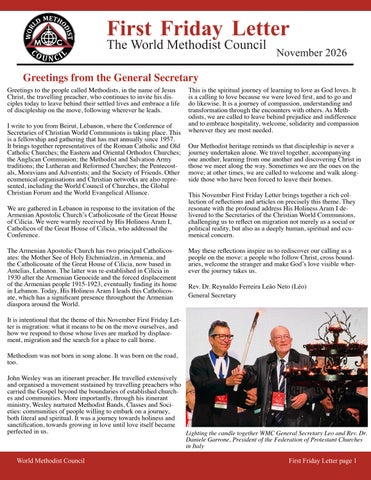
It is intentional that the theme of this November First Friday Letter is migration: what it means to be on the move ourselves, and how we respond to those whose lives are marked by displacement, migration and the search for a place to call home. Methodism was not born in song alone. It was born on the road, too. John Wesley was an itinerant preacher. He travelled extensively and organised a movement sustained by travelling preachers who carried the Gospel beyond the boundaries of established churches and communities. More importantly, through his itinerant ministry, Wesley nurtured Methodist Bands, Classes and Societies: communities of people willing to embark on a journey, both literal and spiritual. It was a journey towards holiness and sanctification, towards growing in love until love itself became perfected in us. Lighting the candle together WMC General Secretary Leo and Rev. Dr. Daniele Garrone, President of the Federation of Protestant Churches in Italy World Methodist Council
First Friday Letter page 1
God on the Move, People on the Move
“And are we yet alive, and see each other’s face?”
So begins Charles Wesley’s well-loved hymn, written for Methodists gathering after seasons of separation and dispersion. The hymn celebrates more than reunion. It gives thanks for God’s sustaining grace among a people scattered across distances yet held together in fellowship. In an age marked by migration, immigration, and diaspora, Wesley’s question speaks with renewed relevance. How do people remain connected across separation? How do communities sustain life together amid movement? How do those dispersed find belonging? The World Methodist Council has recently offered two important contributions to this conversation. In 2019, God Is on the Move: A Call to Be the Church in a New Way reminded Methodists and Wesleyans that God accompanies people on their journeys through history. More recently, the Council’s pastoral statement marking the fortieth anniversary of the World Methodist Social Affirmation situated migration justice within a broader vision of human flourishing, affirming the dignity of migrants and calling the church to build both an infrastructure of welcome and hospitality and an architecture of solidarity and protection. Together, these affirmations invite us to deepen the conversation. God is not only present with people on the move. God, by divine nature, is on the move. Scripture begins with the Spirit of God moving over the waters of creation. Throughout the biblical story, God creates, calls, sends, accompanies, liberates, reconciles, and renews. Abraham journeys to an unknown land. Israel wanders through the wilderness. Exiles seek return. Jesus travels among towns and villages proclaiming good news. The early church crosses linguistic, cultural, and political boundaries. Human movement likewise belongs to the story of creation. People have always migrated in search of food, safety, livelihood, family, community, and hope. Wherever they go, God goes with them, accompanying them through places of origin, transit, and destination.
At its core, migration is a matter of human flourishing. Migrants, refugees, asylum seekers, stateless persons, and all uprooted peoples are human beings first. Their dignity is inherent and inviolable. Human dignity is God’s gift; human rights are humanity’s protections of that gift. Human flourishing cannot exist where people are uprooted by violence, denied participation, subjected to discrimination, or deprived of the protections necessary for a life of dignity. For this reason, the church is called to build both an infrastructure of welcome and hospitality and an architecture of solidarity and protection. Hospitality creates spaces of accompaniment, care, sanctuary, and belonging. Protection secures the legal, social, economic, and political conditions necessary for dignity, participation, and flourishing. Hospitality without protection is fragile; protection without hospitality is incomplete. Together, they embody a vision of migration justice rooted in human dignity, human rights, and social holiness. One important act of public witness available to the Methodist and Wesleyan family today is to encourage governments that have not yet done so to sign and ratify the International Convention on the Protection of the Rights of All Migrant Workers and Members of Their Families and to encourage those that have already ratified it to implement its provisions faithfully. Such action strengthens the protections necessary for millions of migrant workers and their families to live in dignity and security. Ultimately, migration is about more than movement. It is about people. It is about being: the affirmation that every person bears the image of God and possesses an irreducible dignity. It is about becoming: the exercise of human agency in the search for safety, opportunity, participation, and more abundant life. And it is about belonging: the human yearning for community, recognition, welcome, and a place within the human family.
What is old is that God is on the move, and so are God’s people. What is new is that millions today are compelled to move under conditions not of their choosing.
Hospitality nurtures belonging. Protection safeguards being. Together, they create the conditions under which becoming is possible.
Wars and armed conflicts, political persecution, economic injustice, environmental degradation, climate-related disasters, and other forms of violence have produced unprecedented levels of displacement, dispersal, and dislocation. Human mobility itself has become increasingly securitized, militarized, criminalized, racialized, and politicized. Xenophobia and fear too often replace hospitality and welcome.
God is on the move, and God’s people are on the move. The church is called to accompany them faithfully, building communities where dignity is honored, rights are protected, and all people may flourish more fully in being, becoming, and belonging. In doing so, we participate in God’s work of healing the nations, renewing the whole creation, and advancing the flourishing of all.
Methodists and Wesleyans should recognize something of their own story in the experience of people on the move. Methodism began as a movement before it became an institution. It crossed boundaries, gathered scattered societies, connected distant communities, and sustained fellowship across geography and circumstance. Long before globalization became a defining feature of our age, Methodists learned how to sustain connection amid dispersion. Charles Wesley’s hymn offers more than a memory of Methodist history. It provides a spiritual lens through which to view migration, immigration, and diaspora. Separation need not result in abandonment, and dispersed communities can remain bound together by grace.
Rev. Dr. Liberato C. Bautista is Assistant General Secretary for United Nations and International Affairs of the General Board of Church and Society of The United Methodist Church, based at the Church Center for the United Nations in New York City. He is a World Methodist Council delegate from the Philippines Regional Conference of The United Methodist Church and serves as a member of the Council’s Social and International Affairs Committee.
World Methodist Council
First Friday Letter page 2
The Euro-Mediterranean Project: Building a Network of Churches in the Mediterranean The Euro-Mediterranean Project, initiated by the Methodist Churches in Italy, aims to progressively involve the EMC, with the goal of strengthening relationships among Methodist Churches across the Mediterranean and Latin regions: Spain, Algeria-Tunisia, Albania, Italy, and Portugal. The idea behind the project is to foster a sense of fellowship among Churches that, despite operating in very different national contexts, share similar experiences, challenges, and concerns. Through greater mutual understanding, dialogue, and cooperation, the project seeks to promote shared growth while also providing inspiration and encouragement for the work of the EMC as a whole. From this perspective, the EMC should increasingly become a network of Churches that actively and proactively embrace their common belonging, making a concrete contribution to the work of the Executive Committee and supporting its initiatives.
How can we become Churches that encourage greater participation by young people and lay members? These questions concern not only individual national contexts, but also the identity and mission of Methodist Churches throughout the Mediterranean region and, more broadly, across Europe. Towards a New Phase of the Project Following this initial period of mutual understanding and relationship-building, the project envisages the organisation of a first online meeting. This will provide an opportunity to share ideas, experiences, and perspectives, and to define the next steps together.
A Journey of Mutual Understanding and Relationship-Building
Following this discussion, consideration will be given to organising an in-person seminar in Rome or Velletri. During the seminar, participants will be able to identify and explore in greater depth some of the issues of particular relevance to the Churches involved.
During 2026, it was possible to begin a first phase of mutual understanding and relationship-building. In particular, formal meetings were held with Bishop Zürchert, visits were made to the Churches involved in the project, and two pastors from Tunisia and Algeria were hosted in Rome.
One possible theme that has been identified is “The Church in the Face of the Challenges of Democracy and Migration”. This topic would provide an opportunity to explore the relationship between Christian witness and some of the major transformations currently affecting Mediterranean societies.
These encounters provided an opportunity to deepen our understanding of the different ecclesial contexts and to identify a number of significant common features. All the Churches involved share certain characteristics: they are located within the same geographical region, they represent Christian minorities in their respective contexts, and some of them are living through, or have experienced, situations of persecution or significant pressure from the state. This shared experience provides an important foundation for developing more systematic dialogue and cooperation, while valuing the different experiences that have emerged in each country. The Challenges Facing Minority Churches One of the project’s main objectives is to establish an ongoing dialogue both on public issues affecting contemporary societies and on matters more closely related to the life and mission of the Churches. Among the key questions identified are the following: How can we live out our Christian witness as minority Churches?
A Contribution to the Life of the EMC The Euro-Mediterranean Project is intended to be more than simply a space for encounters among Churches that share a particular geographical location or similar experiences. Its ambition is to build a stable network of relationships capable of transforming local experiences into a shared resource. Dialogue among minority Churches, the exchange of good practices, reflection on social and political challenges, and the search for new forms of participation for young people and lay members can all provide valuable insights for the wider Methodist community. The hope, therefore, is that the journey initiated through the Euro-Mediterranean Project will, over time, become a source of inspiration for the work of the EMC as a whole, helping to strengthen fellowship among the Churches, their presence in society, and their ability to face the challenges of the present together. Revd. Luca Anziani President OPCEMI (The Methodist Churches in Italy)
How can we be Churches present in the public sphere in the face of challenges such as the crisis of democracy, questions of justice, populism, and racism? What is the relationship between the witness of our Churches and the phenomenon of migration? How can we respond today to the challenges of interreligious and ecumenical dialogue in our respective contexts?
World Methodist Council
First Friday Letter page 3
Changing the narrative around Migrants and Diasporas
Lord Leslie Griffiths is a retired Methodist minister and, since “sitting down”, he has become an active politician. He is a member of the House of Lords in the British parliament and an elected member of the UK parliamentary delegation to the Council of Europe where He sits on its Migration Committee. At the end of September, while the Council was in session (in Strasbourg), he received an ecumenical group representing the Churches’ Commission for Migration in Europe who spent a day with him. They had a working lunch together, spent time in the prayer room, engaged in discussion with senior officers of the Council of Europe who specialise in questions relating to migration. And then, finally, they sat in the public gallery listening to a debate on “the role of diasporas and migrants in developing social cohesion and democratic engagement.” He says “It was a thrill to have the group present. The debate was on a report which I’d been working on over the last two years. One of the emphases I made was on the contribution of faith-based groups in achieving social harmony. 47 people were registered to speak. I’m happy to say that the report was carried unanimously. I was able to counter some comments from the far right in a robust manner.” After 18 months hard work on the role of diasporas across the entire continent of Europe, he presented his final report in Strasbourg in the last week of September. 36 countries had sent details of the programmes and policies under way with them. After a long analysis of this material, Lord Griffiths set to work. He recognised a need to listen to the voices of those who are intended to be the beneficiaries of those programmes. The Council of Europe was set up to focus on the rule of law, democracy and human rights. With that in mind, he set about articulating the needs of people in our diasporas - and sought to establish a counter-narrative to the toxic debate currently prevailing on the subject of migration. He paid special heed to the voices of young people. And also to members of faith groups. He was fantastically supported in all this by Marie Martin and Marc Montany Daufi from the Strasbourg secretariat. And by his very own staffer, Andrew Draper too. Lord Leslie Griffiths on changing the narrative around migrants and diasporas: https://www.youtube.com/ watch?v=Ba952aTR2dY&list=PPSV&fbclid=IwY2xjawU9wmFleHRuA2FlbQIxMQBwZG9mAXNydGMGYXBwX2lkEDIyMjAzOTE3ODgyMDA4OTIAAR4a6VolKnSRX2pKCROqFHIbKWgZdwgR4Avl3obL259fcN-cLwJFLe4ESBxs1g_aem_AAmPSxT1jrmvAzSXxeQLXw
Peace Award Nominations open for 2027, 2028 and 2029! Nominations for the 2027, 2028, and 2029 Peace Award are now open! Nominate someone who exemplifies Courage, Creativity, and Consistency for the World Methodist Peace Award. The nominee should show courage in regard to physical danger or putting personal interest at risk. Creativity should include opening new initiatives and attracting others in working for the cause of peace. Consistency is judged by effort over a period of time and intensity, despite setbacks. Here is the link to read the full criteria: http://worldmethodistcouncil.org/whatwedo/world-methodist-peace-award/ The recipient receives a medallion, citation and US $1000 which is symbolic of the larger recognition achieved in working for peace, justice and reconciliation. The laureate is included in the World Methodist Council Peace award booklet. Go to www.worldmethodistcouncil.org and click on the “About the WM Peace Award” tab on the left side of the homepage and complete the online application. Please send all nomination forms to General Secretary at communications@worldmethodistcouncil.org today!
World Methodist Council
First Friday Letter page 4
Methodist Leaders Participate in 40th International Meeting of Peace in Assisi Rev. Dr. Reynaldo Ferreira Leão Neto, General Secretary of The World Methodist Council and The Rev. Matthew A. Laferty, director of the Methodist Ecumenical Office Rome and representative of the World Methodist Council to the Holy See attended the International Meeting of Peace, organized by the Sant’Egidio Community, held in Assisi, Italy, from 25-27 October 2026. The meeting celebrated its 40th anniversary and was initially convened in 1986 by Pope John Paul II.
The closing ceremony was held in outside the Basilica of St. Francis of Assisi. Prior to the closing ceremony, each religious group gathered in various locations around Assisi for prayers for peace according to their own religious traditions. Christians met in the Lower Basilica above the tomb of St. Francis for prayers. H.Em. Cardinal Matteo Zuppi and His All-Holiness Bartholomew I preached during the Christian prayers, while other senior church leaders led the service. Bishops from various Christian churches leading the prayers in the Lower Basilica on 27 October 2026 At the conclusion of the meeting, the religious leaders issued an appeal for peace, stating “enough of wars! Enough of the culture of war! Let us choose the creativity of dialogue and the boldness of peace, to heal the world of the disease of war and reduce social conflicts. We call for an end to the cult of force and the pedagogy of fear and blood, which blur the line between good and evil, numb our sense of humanity and foster a culture of death. It is time to rehabilitate peace.” The appeal for peace further declared, “no war is holy. War can never be waged in the name of God! Yes, only peace is holy.”
Rev. Matthew Laferty (left), Prof. Marco Impagliazzo (center), President of the Sant’Egidio Community and Rev. Dr. Reynaldo Ferreira Leão Neto (right). The international meeting brings leaders from various Christian churches and from all major world religions together with political leaders, diplomats, activists, and business leaders for dialogue, learning, fellowship, and prayer. The aim is to find common solutions and build durable relationships which will foster peace-making and peace-building globally.
The Community of Sant’Egidio is an international lay Catholic association of the faithful dedicated to social service, peacebuilding, and prayer. Following the initial 1986 meeting, Pope John Paul II entrusted the Sant’Egidio Community to develop and plan the annual international meeting. Matthew A. Laferty, Director of the Methodist Ecumenical Office Rome
A series of panel discussions were held during the three-day meeting. Rev. Dr. Leo spoke on a high-level panel on the theme “Christian Unity: An Open Question” with H.H. Patriarch Mar Awa II of the Assyrian Church of the East, Bishop Kristina Kuehnbaum-Schmidt of the Evangelical Lutheran Church in Germany, and H.Em. Senior Metropolitan Emmanuel of the Ecumenical Patriarchate.
Rev. Dr. Leo speaking in a panel discussion during the 40th International Meeting for Peace in Assisi. World Methodist Council
First Friday Letter page 5
From the Diary of the General Secretary
International Prayers for Peace in the Spirit of Assisi 2026 World Methodist Council General Secretary’s Contribution to the Panel Christian Unity: An Open Question
From my perspective, the question is this: Why can we not recognise the validity of one another’s churches and denominations while continuing to honour our differences? In Mark’s Gospel, John tells Jesus: “Teacher, we saw someone casting out demons in your name, and we tried to stop him, because he was not following us” (Mark 9:38). The disciples wanted to protect the boundaries of their own group. But Jesus responds: “Do not stop him” (Mark 9:39). What might Jesus be saying to us today? Should we prevent others from serving in his name simply because they do not belong to our denomination or tradition? Jesus challenges us not to assume that God’s work is confined to our own communities. As he tells Nicodemus, “The wind blows where it chooses” (John 3:8). The Spirit of God cannot be confined to the boundaries we establish for ourselves. In my Methodist tradition, John Wesley addressed this issue in his sermon A Caution Against Bigotry, challenging the tendency to reject God’s work simply because it occurs among people outside ones own group. Wesley develops this vision further in The Catholic Spirit: “Though we cannot think alike, may we not love alike? May we not be of one heart, though we are not of one opinion?” This is not a call to indifference towards truth or to abandon our convictions. It is an invitation not to make agreement on every matter a precondition for Christian love and mutual recognition. We may disagree about theology, worship, governance and tradition. Yet must these differences prevent us from recognising one another as fellow disciples of Jesus Christ? This question becomes particularly important at the Lord’s Table. What prevents us from recognising one another as Christians who share faith in Christ and long to participate together in Holy Communion? I recognise that eucharistic sharing involves genuine theological and ecclesial differences. Nevertheless, should we not approach these differences through prayer, dialogue and mutual discernment, rather than allowing them to become permanent barriers to recognition? Let me offer two examples from my own experience. 1. The flowers of Corpus Christi My father was a Methodist minister in a small town in Paraná, Brazil. In the garden of our Methodist manse there was a plant World Methodist Council
known locally as pico-de-papagaio, with beautiful red flowers or leaves. In Brazil, there are decorations associated with the feast of Corpus Christi, when Catholic communities create elaborate, colourful carpets depicting religious scenes along the streets for the procession. Our Catholic neighbours would come to ask my father for the red flowers to decorate the images carried in the procession. I remember him welcoming them and saying, “Come in. Take as many as you wish. Take the best ones.” Corpus Christi was not a Methodist celebration. Yet my father did not allow denominational differences to prevent him from supporting his neighbours. Looking back, I recognise in my father’s actions an early lesson in what we might call receptive ecumenism: offering our gifts generously and receiving the gifts of others with joy and gratitude. My father did not have to become Catholic In order to appreciate the celebration, nor abandon his Methodist identity to support it. He recognised his brothers and sisters in Christ and offered them what he had. In turn, we received the opportunity to appreciate something beautiful in another Christian tradition. That simple gesture did not resolve every theological difference between Methodists and Catholics. It created a relationship of generosity, respect and shared Christian humanity. 2. A sign of recognition from the universal Church: Nicaea More recently, I had the privilege of participating in commemorations of the 1,700th anniversary of the Council of Nicaea, in Constantinople (Istanbul) and Nicaea (İznik), at the invitation of Ecumenical Patriarch Bartholomew and Pope Leo XIV. These celebrations offered Christians from different traditions an opportunity to give thanks for our shared inheritance of faith, expressed in the Nicene Creed. On the second day, in a beautiful Syriac church in Istanbul, twenty-two representatives of different churches gathered around a circular table. We came together as representatives of Christian world communions to reflect on the Council of Nicaea and the Creed we cherish as a common inheritance. Our traditions differed in theology, liturgy, vestments and governance. Yet we shared a desire to honour the Creed as a common legacy of our shared faith. The gathering did not resolve every disagreement, but it demonstrated that we could meet in humility, gratitude and mutual respect. Continue to next page... First Friday Letter page 6
From the Diary of the General Secretary continued... Our traditions differed in theology, liturgy, vestments and governance. Yet we shared a desire to honour the Creed as a common legacy of our shared faith. The gathering did not resolve every disagreement, but it demonstrated that we could meet in humility, gratitude and mutual respect. There was, however, a troubling moment. One speaker adopted a belligerent tone in denouncing heresy, focusing particularly on Nestorianism and questioning why representatives associated with this tradition were present. Afterwards, I apologised to the archbishop to whom the remarks had been directed. His Grace responded graciously, explaining that it was a matter of translation. It had contributed to continuing misunderstandings concerning the human and divine natures of Christ. I made clear that the hostile remarks did not represent my own position or the spirit of our gathering. Our theological differences deserve serious engagement, but not hostility. Later, I noticed that His Grace had sat beside the very person who had criticised him. I asked why he had done so. His answer was simple: he had seen an older man sitting alone and isolated and had felt compassion for him. For me, this gesture captured the spirit of ecumenism more powerfully than any formal statement. A man who had been treated with hostility responded with compassion rather than
retaliation. During the same visit, I received a pectoral cross from Metropolitan Filüksinos Yusuf Çetin of the Syriac Orthodox Church, in the presence of Patriarch Ignatius Aphrem II. For me, this gift was a meaningful sign of recognition: an expression of welcome affirming that the World Methodist Council and the churches it represents have a place within the wider Christian family. No demand was made that I defend every aspect of Methodist doctrine before the gesture could be offered. There was simply generosity and welcome. I do not suggest that this gift resolves all questions of ecclesial recognition or doctrinal difference. Its significance was symbolic, but no less powerful for that. An ancient Christian tradition had offered a gesture of embrace to a representative of Methodism, a much younger movement within Christianity. “There is one body and one Spirit, just as you were called to eh one hope of your calling, one Lord, one faith, one baptism, one God and Father of all, who is above all and through all and in all.” (Ephesians 4: 4-6) Rev. Dr. Reynaldo Ferreira Leão Neto
This years ‘Prayers in the Spirit of Assisi’ took place at Assisi itself. This was the 40th anniversary celebration. The Forum of Ecumenism; an open question reaffirmed a sense of belonging in the fellowship of the Universal Church. World Methodist Council
First Friday Letter page 7
Bound Together in Humanity: Reclaiming Ubuntu in the Face of Anti-Immigrant Sentiments in Cape Town, South Africa The anti-immigrant sentiments that periodically flare across South Africa present the Church with far more than a socio-political crisis. They pose a profound theological question. When anti-foreign anxiety metastasized into politicized violence, leaving hundreds of vulnerable human beings stranded in the harsh winter elements, the Church was forced to confront a foundational issue: What does hostility towards the stranger reveal about our understanding of God, our neighbours, our shared humanity (Ubuntu), and the meaning of salvation? South Africa’s post-apartheid narrative is built on the promise of human dignity and universal rights. Yet, persistent structural inequality, high youth unemployment, and poverty have created fertile ground for xenophobia. Local politicians and social actors frequently exploit these desperate conditions, scapegoating foreign nationals (God’s children) for systemic service delivery failures, crime, and economic hardship. When this rhetoric turned into intimidating anti-immigrant protest and displacement in Cape Town, the reality was devastatingly human. Large numbers of foreign nationals; seeking safety, shelter, or repatriation; found themselves exposed to the harsh, wet Cape winter. In the midst of uncertainty, administrative processes and arrangements for departure women, infants, and elderly refugees were forced to sleep on cold city pavements, stripped of security and basic necessities required to preserve their dignity. For those of us in the inner city, this was not simply a migration or immigration matter. It was a humanitarian crisis unfolding in front of us; at the doorstep of worship services. It was impossible to remain indifferent to the sight of women and children attempting to find shelter against the cold, families uncertain about their future and people whose immediate needs were not being met. In that moment, the central challenge was clear: the foreign national was no longer being encountered as a human being with a name, a family, a history, and hopes for the future. Instead, they had been reduced to a political projection—a screen upon which society projected its deepest anxieties about survival and insecurity. The vulnerability of these, our sisters and brothers, confronted us with a fundamental question of Christian discipleship: What does it mean to be the Church when human beings are suffering on our doorstep? The church then realized its calling had to be two-fold: •
•
Pastoral to those who suffer: Providing physical protection, food, blanket distribution, and spiritual sanctuary to mothers, children, and displaced fathers who had been rendered homeless by mob intimidation and policy failures. Prophetic against hatred and violence: Refusing to remain silent while political rhetoric polarized and incited violence against vulnerable communities, as well as demanding accountability from state authorities.
By offering pastoral and prophetic presence for the displaced, the ecumenical coalition declared that no human being created in the image of God is expendable.
World Methodist Council
Our response as the Central Methodist Mission and ecumenical partners was rooted in deep theological convictions that challenge both individual prejudice and structural injustice. 1. The Brokenness of the Ego and the Illusions of Boundaries Human ego constructs security by dividing the world into “us” and “them,” building identity around who supposedly belongs and who does not. But xenophobia is not merely a failure of social tolerance; it is a spiritual failure to recognize our divine interconnectedness. While governments have legitimate responsibilities to manage migration and immigration laws can be debated, no legal framework or political arrangement can ever justify mob violence, dehumanization, or the denial of fundamental dignity. Violence only begets violence, and we cannot secure a citizen’s dignity by humiliating, excluding, or attacking our sisters and brothers classified as migrants 2. Reclaiming Ubuntu as a Theological Imperative The African concept of Ubuntu—that our humanity is bound up in the humanity of others—mirrors the biblical vision of relational flourishing. We become fully human through mutual recognition, compassion, and responsible care. Human flourishing is inherently relational; our lives are sustained by networks of care, labour, culture, and interdependence. To diminish the humanity of the stranger is to erode our own. 3. Global Politics and the Traps of Scapegoating The economic crises driving youth unemployment and hunger in South Africa are deeply intertwined with global political and economic structures. Regrettably, global systems often leave the poor hungry, only for local rhetoric to turn the poor hungry against the poor hungry. Instead of asking only, “What do foreign nationals take from our country?”, the Church is compelled by the Gospel to ask harder, more truthful questions: What suffering do migrants endure as they seek safety, employment, and belonging? What happens to a nation’s soul when people who are already poor are manipulated into turning on one another? Who benefits politically or economically when the marginalized blame each other rather than confronting the structures that perpetuate their collective suffering? In these situations what does love for neighbour look like? (Luke 10: 25-37) Continue to next page...
First Friday Letter page 8
Bound Together in Humanity: Reclaiming Ubuntu in the Face of Anti-Immigrant Sentiments in Cape Town, South Africa continued... 4. The Cross and the Alternative Community
genuine conversion, reconciliation, and prophetic discipleship.
The cross of Christ is not a passive symbol or an object of private devotion. It exposes the cruelty of worldly systems that sacrifice vulnerable people to preserve the power, privilege, and comfort of others.
The Question of Scapegoating: What fears and insecurities are currently being projected onto foreign nationals within our own communities and churches?
The credibility of the Christian faith is tested by its willingness to stand with those whom society treats as expendable and to confront the powers that profit from their exclusion. The Church cannot merely call for peace after violence has occurred. It must actively resist the manipulation of legitimate grievances, demand justice, protect threatened communities, and embody an alternative community where the stranger is welcomed, the victim is protected, the perpetrator is held accountable, and political power is judged by its commitment to the dignity of the poor and vulnerable.
The Question of the Divine Image: Can we truly recognize the image of God (Imago Dei) in someone whom our political or social identity has taught us to fear?
Questions for Reflection As we move forward, the events in Cape Town force every local congregation and believer to move beyond mere tolerance toward
The Question of Identity: How does our natural desire to protect our social, national, or cultural identity become a justification for excluding or dehumanizing others?
The Question of being Neighbour: In a society marked by inequality, unemployment, and social fragmentation, who are we genuinely willing to recognize and treat as a neighbour to be loved? Rev. Sikawu Makubalo Superintendent Table Bay Circuit, Methodist Church of Southern Africa
Seeing Jesus in each other –blessings of working with people on the move Migration: Such a big topic. Where to start? I will share a few experiences and learnings of recent encounters:
September 26, one of our members in our congregation shared a testimony. More than ten years ago, she and her husband came as asylum seekers from Iran to Germany. Methodists supported refugees like them in the camp where they first had to stay. When they had to move to a camp in our neighborhood, the Methodist pastor gave them the address of our United Methodist Church. In her testimony, our sister looked back to her journey since they entered Germany. She told us how much it meant for her and her husband to be welcomed by people of these congregations.
Today, they are church leaders in their home countries in other parts of Asia. Because they speak multiple languages and are acquainted to two cultures, they are living bridges countries, cultures and churches. In Korea and in countries where the UMC is well established, migrants are also networkers to their peers and naturally multiply opportunities to serve different communities. Migrants are not merely recipients of the gospel, but co-workers in mission.
They helped to navigate a difficult process to receive asylum, to learn the language and understand the culture, to find a job, and so on. And these congregations became a spiritual home. I remember the feast when this couple was baptized in our church. Because of them and other siblings we are learning: Together as people of many nations, cultures and social backgrounds, we are the church. Two weeks later, I attended a Mission Consultation of the mission boards of the Korean Methodist Church and the United Methodist Church. We met in Sokcho in South Korea to strengthen the relationship between our churches and to explore how to work together in mission and ministry. Several presenters suggested that serving with migrants might move us forward as we engage in mission. We heard examples of people who spent part of her life as migrant workers or students in Korea. World Methodist Council
The choir of the United Methodist Church congregation sang during the worship service at the latest UMC meeting in Vancouver - all of the choir are migrants who came from the Philippines to Canada. Continue to next page...
First Friday Letter page 9
Seeing Jesus in each other continued... Currently, I spend ten days in Canada attending two different United Methodist meetings. In 1925, Methodists, Reformed and Congregationalists formed The United Church of Canada. A century later, there are several United Methodist congregations, and their numbers will most likely increase. Migrants from Africa and from the Philippines created faith communities with strong links to the UMC in their mother lands. They know that Methodists belong to the UCC and they receive support from the UCC. Yet they wish to be United Methodists.
After years in the diaspora, they are like strangers in their homelands. Their communities in their land of birth are also facing economic hardships because of those returns. The money they received from relatives working in South Africa helped them to find a more decent life. Reconnecting deported migrants with communities in the country which they once called home will become an increasing demand in the future. And again, the humanitarian task comes along with the need of pastoral care and spiritual support.
When I was leading consultations on migrant congregations for the World Methodist Council and heard what was happening in Canada, I wished for my United Methodist siblings to integrate themselves in the UCC. Yet I had to admit that it is not me to define how people on the move worship and express their faith shaped by worship traditions and culture different from what they find in the new places. Today, in conversations with all partners involved, we are intentionally building relationships between these United Methodist migrant congregations and the United Church of Canada, while allowing for the differences.
These examples speak into what Wesleyan people call “connectionalism”: One congregation in Germany sends refugees to another one, trusting that the newcomers would be received with love and openness. Churches that partner in mission develop programs with migrants who are actively expanding connections. Churches that have a long presence in a certain country are open to developing new models of cooperation for those arriving in their land. And churches in the countries of origin of these migrants encourage their members not only to create new faith communities, but also to build relationships with Methodists in their new places. Where we are facing deportations of migrants and violence forces people to leave, churches provide humanitarian and spiritual support in both places.
For me, the UCC is a role model in becoming an intercultural and relational church that “treasures the different contexts that God gives to different communities” and “values diverse expressions of faith. At the edges of our meetings in Canada, I talked with Bishop Gift Machinga from The United Methodist Church in Zimbabwe and Malawi. In recent months, many Zimbabweans, Malawians, Mozambicans and others were expelled from South Africa. Violent riads, damages of their houses and businesses and the dramatic increase of hostility forced them to go, although many were legal residents in South Africa. In Zimbabwe, churches assist those who now must start once more from zero.
Most of all: Migrants, like all other groups that are often pushed to margins, are vital actors in the web of relationships in the body of Christ. I as a privileged white European citizen can learn much from these migrant siblings. They know better than I to follow Christ who was a migrant himself. Indeed: We are church together! Rosemarie Wenner
Photo taken at a meeting of Farsi speaking Methodists (all from Iran) in Germany which took place in September 2026.
World Methodist Council
First Friday Letter page 10
We Protest Against the Drastic Increase in Residence Permit Fees and the Tightening of the Permanent From October 1, 2026, the fees for changing status of residence, extending the period of stay, and obtaining permanent residence for foreign residents were substantially increased. On the same day, the “Guidelines on Permission for Permanent Residence” were revised, and the “Guidelines on Revocation of Permanent Resident Status” were established. The 30 churches and organizations affiliated with the National Christian Council in Japan (NCCJ) are communities where people of diverse nationalities and ethnic backgrounds gather to worship and work together. Among us are missionaries and clergy who were sent to Japan from overseas churches and have served Japanese churches and society for many years. Among our members of foreign nationality and their families, some were born and raised in Japan, while others have worked here, raised children, and lived for many years as members of their local communities. This institutional change places a direct and heavy burden on the lives of these people. The burden becomes even greater when multiple members of a family need renewals, not just one individual. For Christian churches, welcoming missionaries sent from overseas churches and sharing in ministry together is the very embodiment of the partnership with churches around the world that Japanese churches have cultivated over many years. However, for small churches and Christian organizations, this drastic fee increase makes it difficult to invite missionaries and to continue supporting their residence. We cannot overlook the fact that imposing such high costs for residence economically constrains even the question of whom churches may invite and with whom they may work. For foreign church members, residence status is not an abstract qualification. It is bound up with daily life itself: whether they can continue to work, whether they can live together with their families, and whether they can continue to raise their children in Japan. Permanent residence is an important foundation for building one’s future in the country where one has lived for many years. Imposing a high fee of 200,000 yen (or USD1,300) on such an application, twenty times the previous amount, and further tightening the requirements for permanent residence, threatens the stable lives of people who have lived in Japan for a long time and narrows their path to continuing to live in this society. This institutional change further intensifies the control and exclusion of foreign residents that has been repeated time and again. We strongly protest it. We cannot accept an institutional change that imposes excessive burdens for the sake of residing in Japan on people who have lived, worked, and built society together with us here, and that narrows their path to a stable life. We therefore make the following demands: 1. Withdraw or reconsider the drastic increases in fees for changing or renewing status of residence and for permanent residence permission. 2. Review the tightening of the requirements for granting and revoking permanent residence. 3. Hold a renewed forum to hear the opinions of the foreign residents directly affected by this institutional change, as well as the churches, citizens’ groups, and others who support their lives and activities. Rev. Kano Yoshitaka, Moderator
Rev. Kaori Oshima, General Secretary
Rev. Akio Lee, Chair, The Committee on Human Rights of Foreign Residents
World Methodist Council
First Friday Letter page 11
MERCIC Steering Committee Meets and Plans for 13th Round of Dialogue The steering committee of the Methodist-Roman Catholic International Commission, the official dialogue commission between the World Methodist Council and the Roman Catholic Church, met from 19-22 October 2026. The steering committee – composed of the co-chairs and co-secretaries – spent two days in London and Cambridge, England, United Kingdom, and two days in Rome, Italy. The purpose of the meeting was to promote MERCIC’s work and speak about the Commission’s new document “One in Faith and Ministry to the World: Reflecting on Unity and Diversity for the Mission of the Church.”
On Wednesday, 21 October, the steering committee met Pope Leo XIV following the General Audience and offered a brief update about their work.
They also met Cardinal Kurt Koch, head of the Vatican’s ecumenical department, to discuss the Commission’s newly approved document “One in Faith and Ministry to the World: Reflecting on Unity and Diversity for the Mission of the Church” on Wednesday. The co-chair – Prof. Edgardo Colon-Emeric and Archbishop Shane Mackinlay – presented the document at the Pontifical University of St. Thomas Aquinas in their Tillard Chair Lecture Series on Wednesday afternoon. The steering committee concluded their meetings in Rome on Thursday with planning for the 13th round of dialogue. About the Methodist-Roman Catholic International Commission
Rev. Prof. Edgardo Colon-Emeric (left) and Archbishop Shane Mackinlay (right) presenting the documents “One in Faith and Ministry to the World: Reflecting on Unity and Diversity for the Mission of the Church” and “We Believe in One God: Sixty Years of Methodists and Catholic Walking Together” to Rev. Dr. Reynaldo Ferreira Leão Neto in the presence of Fr. Martin Browne OSB and Rev. Matthew A. Laferty.
Members of the steering committee of the Methodist-Roman Catholic International Commission are Rev. Prof. Edgardo Colon-Emeric (Methodist co-chair), Archbishop Shane Mackinlay (Catholic co-chair), Rev. Matthew A. Laferty (Methodist co-chair), and Fr. Martin Browne OSB (Catholic co-chair).
The Methodist-Roman Catholic International Commission (MERCIC) – formally called the Joint Commission for Dialogue between the World Methodist Council and the Roman Catholic Church – was constituted in 1966 to engage in dialogue on behalf of the World Methodist Council and the Roman Catholic Church. The commission is comprised of 16 members – 8 Methodist and 8 Catholic – who are senior church leaders or scholars in a wide range of fields, including systematic theology, church history, canon law, and practical theology. The commission works in a five-year cycle, meeting annually in-person for the first four years and online in the final year. At the beginning of each new phase, a topic is selected and developed during the succeeding 5 years, leading to a comprehensive report. Each report seeks to identify convergences, divergences, and areas where more time is needed for prayer and accompaniment. Eleven reports have been published by the joint commission on topics like the Eucharist, authority, ecclesiology, and apostolicity, in addition to two synthesis documents.
The committee met with Rev. Dr. Reynaldo Ferreira Leão Neto, general secretary of the World Methodist Council, on 19 October at his office in Methodist Central Hall Westminster, and officially presented Dr. Neto a copy of the new document. On Monday afternoon, Abp. Shane and Prof. Colon-Emeric presented the report at an event at Wesley House, Cambridge, followed by a dinner of the steering committee with members from the British national Methodist-Catholic dialogue. The steering committee finished their UK trip on Tuesday morning with a visit to Wesley’s Chapel and Leysian Mission in London, where they toured The Museum of Methodism & John Wesley’s House and prayed at John Wesley’s tomb. Before concluding their UK journey, the steering committee stopped by Aldersgate Street and the site of Charles Wesley and John Wesley’s evangelical conversion.
World Methodist Council
MERCIC Steering Committee on 21 October 2026
Matthew A. Laferty, Director of the Methodist Ecumenical Office Rome
First Friday Letter page 12
Behind Every Migration Lies a Human Story Migration, Human Dignity and the Pursuit of Peace
Migration is one of the defining human, social, political and spiritual realities of our time. Millions of people leave their homes seeking opportunities, family reunification, safety or the possibility of living with dignity. While some migrate by choice, others are compelled to flee poverty, persecution, armed conflict, inequality, climate change or insecurity. Behind every migrant lies a human story that deserves to be heard. Families are separated, communities transformed and cultures brought into encounter. Migrants also contribute skills, knowledge and hope to their host societies. My engagement with migration, diasporas and their human consequences is rooted in a fundamental question: how can we transform fear of the other into mutual recognition, exclusion into coexistence, and the wounds of violence into opportunities for peace? This question connects migration with dialogue, social cohesion and peacebuilding, particularly in Colombia, where decades of armed conflict have forced millions to abandon their homes. Displacement and Peace in Colombia
Colombia’s Unified Victims Registry (Registro Único de Víctimas, RUV) records more than eight million victims of forced displacement in its historical register. Figures vary according to registration criteria and administrative updates. These numbers represent disrupted lives, separated families and communities uprooted from their territories. Indigenous peoples, Afro-descendant communities and rural families have fled threats, armed confrontations, dispossession and territorial control by armed groups. Displacement means far more than changing residence. It can involve losing one’s home, land, livelihood, support networks and cultural identity. In receiving cities, displaced people may encounter discrimination, insecure employment and barriers to housing and essential services. Peace, therefore, cannot mean merely the cessation of hostilities. It must also include the restoration of rights, the rebuilding of livelihoods, the recovery of trust and meaningful community participation. Diasporas: Bridges Across Borders
Diasporas maintain connections with their places of origin through remittances, organisations, development initiatives and collective memory. They can support victims, strengthen community initiatives and foster dialogue across borders. Colombia has experienced significant growth in remittance inflows in recent years. These transfers support households and local economies, although they remain private resources and cannot replace the responsibilities of the state.
World Methodist Council
Beyond financial contributions, diasporas can challenge prejudice, connect societies and become valuable partners in social cohesion and peacebuilding. Faith, Hospitality and Human Dignity
The Bible offers profound reflections on migration, exile and hospitality. Abraham and Sarah journey towards the unknown, while the people of Israel remember their experience as foreigners. Jesus declares: ‘I was a stranger and you welcomed me’ (Matthew 25:35). These narratives invite Christians to recognise the dignity of strangers and respond to vulnerability with compassion, protection and love. The Wesleyan tradition emphasises the inseparable relationship between personal holiness and social holiness. Prevenient grace reminds us that human dignity cannot depend on nationality or immigration status. Works of mercy involve both accompanying those who suffer and transforming the structures that perpetuate exclusion. Churches are therefore called to welcome migrants, challenge injustice and foster communities where displaced people can participate fully and develop their capabilities. This commitment complements, rather than replaces, the responsibilities of governments and civil society. From Compassion to Peace
Migration and displacement confront us with a decisive question: what kind of societies do we wish to build? In Colombia, peacebuilding requires restoring rights, recognising collective memories and rebuilding relationships damaged by violence. Dialogue and social cohesion create spaces where different experiences can be heard, grievances acknowledged and trust gradually restored. A biblical and Wesleyan perspective invites us to transform compassion into justice, listening into participation, and hospitality into peaceful coexistence. Behind every migration lies a human story. Recognising that story means seeing migrants and displaced people not merely as recipients of assistance, but as individuals with rights, knowledge and the capacity to contribute to the common good. Building peace means creating communities where nobody loses their dignity because they have left their home, crossed a border or sought protection far from their homeland. Dr. Humberto Martin Shikiya WCC Special Envoy for Peacebuilding and Cooperation in Colombia 2026 WMC Peace Award Laureate
First Friday Letter page 13
European Methodist Lecture Program (EMLP) 2026 LEAD Hubs Europe and Britian General Board of Higher Education and Ministries The United Methodist Church
Methodist-related Schools in Europe (MTSE) Wesley House Cambridge (GBHEM LEAD Hub Britain) | Reutlingen School of Theology (GBHEM LEAD Hub Europe) supported by the General Board of Higher Education and Ministry of The United Methodist Church (UMC)
Blessed are the Peacemakers? Struggling for Peace in Uncertain Times
The 6th series of the European Methodist Lecture Program (EMLP) will explore the role of the church and the responsibility of each Christian in democracy and peace building. In these uncertain times where war, violence, intense nationalism, and authoritarianism are tearing at the social fabric, the need for intentional democracy and peacebuilding is urgently required. These lectures offer an opportunity for us to reflect theologically, practically and from a Methodist perspective upon how we can be a people of peace in a divided world. These lectures will explore a variety of themes including reconciliation, democracy, and the need for intercultural communities who embody an alternative narrative within a xenophobic landscape. Join us in the struggle to build hope and long-term frameworks for peace in these violent times. The European Methodist Lecture Program is an online program. Speakers from various continents, Methodist traditions, theological expertise, and ecumenical contexts will give their insights and present their perspectives and research on peacebuilding and democracy from a Methodist theological perspective. The lectures are followed by discussions in groups and in plenary sessions. The EMLP brings together students, theologians, clergy, and lay persons from all over Europe and beyond – from different backgrounds and cultures. It offers an international and intercultural learning space.
The sessions take place on the dates indicated from 6:15 p.m. to 7:45 p.m. (CET) via video conference (90 minutes). The language of the lectures and the discussions is English. The link for the video conferences will be provided to those registered shortly before the beginning of the program. To register, please follow these steps: 1. “Create new account” (first time users) or “Log in” at OpenCampus | Reutlingen School of Theology: https://th-reutlingen.opencampus.com/user/login (Select between English or German on the top right side.). 2. Register for the “European Methodist Lecture Program” (1. Add your contact address; 2. Register for the course): https://th-reutlingen.opencampus.com/de/node/42020 . For any questions, please contact Prof. Dr. Stephan von Twardowski | LEAD Hub Europe: stephan.twardowski@th-reutlingen.de. Click here to read more about the speakers and topics included in the online program.
World Methodist Council
First Friday Letter page 14
Human Mobility and Church Life
Introduction Human mobility and migration are hallmarks of our time, and the signs of the times need to be interpreted in the light of God’s Word. According to the 2024 UN data, there are 304 million migrants globally (IOM Annual Report 2024), alongside 123 million people on the move due to conflicts, violence, and disasters (UNHCR, Global Trends report 2024). Forced migration has reached the highest levels ever recorded in modern history. This is not a new phenomenon but one that increasingly defines our era. Western Churches in general, have undeniably contributed a lot to the initial reception and social integration of migrants and in framing a culture of hospitality, resisting entanglement by institutional or national policies as they interpret the signs of the times seriously as a prophecy—a vision for the future. Welcoming: not only a duty but also a gift
Beyond the economic need for workers, which should rationally guide our countries, welcoming migrants is not only a duty but also a “gift”. Numerous initiatives for migrants and refugees undertaken by Western associations have Christian roots. Language schools run by church organizations - Sant’Egidio started a network of schools in eighties - have also played a crucial role. They have taught generations of migrants and refugees not only to speak the host country’s language but also to use words as powerful tools for dialogue. They have served as a gateway to understanding and participating in the social and relational life of the host country, creating a true laboratory for coexistence. Churches have also played a significant role in providing first reception. Amid Europe’s migrant influx following the Arab Spring and the Syrian war, Pope Francis called in 2015 (Angelus on 6 September) for every parish to host refugees. While the response at parish level was limited, the vision was clear: those who opened their doors experienced a transformation in their own lives and communities, showing compassionate generosity, helping refugees at sea landings or along the ground routes. “They showed us unusual kindness” (Acts 28:2) was the theme of the 2020 Week of Prayer for Christian Unity, a call for intelligent compassion. Pope Francis made a powerful statement when traveling to Lesbos (April 16, 2016), accompanied by the Archbishop of Athens and the Ecumenical Patriarch. This gesture refocused the Churches’ responsibility for welcoming refugees within an ecumenical framework. In a creative effort to envisioning a prophetic, yet very practical, alternative to the deaths of refugees on sea and land on their way to safety and freedom, the experience of the Humanitarian Corridors has united Catholic, Evangelical and Reformed Churches. Sant’Egidio and the Waldensians initiated a movement that led to the Humanitarian Corridors, in agreements with governments, joined also by the Federation of Evangelical Churches in Italy (FCEI), the Italian Bishops’ Conference (CEI), Caritas, and ARCI a secular organisation. This “Made in Italy” excellence has been exported to other European countries, maintaining its ecumenical character: in France in 2017 and in World Methodist Council
Belgium in 2018. Altogether, nearly 10.000 people were transferred to safety in Europe: Syrians, Afghans, and asylum seekers from across Africa, entering via Lebanon, Libya, Ethiopia, Niger, Pakistan, Iran, Turkey, Greece, and Cyprus. They arrived with regular visas, supported entirely by the Churches and the civil society. On the Christian Style of Hospitality From an existential perspective, welcoming others challenges our identity. In fact, those who choose to do so see their own lives transformed. They are faced with the living Gospel of poor Lazarus, the migrant, who stands at the gate, feeding on what falls from the comfortable table where we eat. Jesus’ vision is realistic when he describes the rich man’s future: the solitude of Hell. This lonely rich man is our wealthy part of the world wasting its values and collective rights. Wasted because not shared. Christian hospitality is personalized, “tailor-made” for both hosts and guests. Building a network of hospitality requires bringing together diverse resources and sensitivities across the political spectrum because humans are inherently diverse. A thoughtful policy of hospitality involves the transition from “I” to “We”. Welcoming migrants is not an irenic experience, rather is a step-by-step construction. In the increasingly “single shaped” social structure, welcoming others rebuilds the local community. Every community is born and strengthened through dialogue. A very difficult art. The Diaspora – The challenge of Ecclesial Citizenship of Immigrants Pope Gregory the Great managed to integrate Romans and barbarians, allowing invaders to become part of the Roman religious fabric. Western churches today are revitalized by the presence of immigrant Christians. The challenge of this Latin Father of Church concerns the presence of migrants and refugees within our churches. While the Church has been generous in offering spaces for immigrant communities to gather, it has yet to fully integrate migrants into daily pastoral life. Migrant churches are sometimes just left to maintain their “ethnic” characteristics. Spaces of memory, where language and traditions of the homeland are preserved, providing an environment against uprootedness and relational poverty. Communities like Sant’Egidio today have a significant presence of young Christian refugees and migrants who are not only helped for their needs but rather are part of the community life though prayer, eucharist and service to the poor, moving beyond mere “ecclesial hospitality” to “ecclesial citizenship”. Monica Attias, Community of Sant’Egidio
First Friday Letter page 15
Conference of Secretaries of Christian World Communions gathered at the Armenian Apostolic Church, Catholicosate of the Great House of Cilicia in Lebanon.
Please send press releases, articles and resources! Submissions should be a page around 500 words, edited and ready to publish. Contact us by Monday, 23 November at mbryson@worldmethodistcouncil.org if you would like your story to be included in the December edition of the First Friday Letter.
On the Web
About the First Friday Letter
This and past First Friday Letters can be found online at FirstFridayLetter.worldmethodistcouncil.org.
The First Friday Newsletter is a monthly publication of the World Methodist Council.
The World Methodist Council’s website may be found at Publisher: Rev. Dr. Reynaldo F. Leão Neto, General Secretary worldmethodistcouncil.org. To subscribe to this newsletter, please email communications@worldmethodistcouncil.org.
Layout Design, Art, and Graphics: Mrs. Michaela Bryson, Staff
All stories and photos, unless otherwise stated, are protected by their respective copyrights. Please do not copy without expressed written permission from the Council.
Follow the Council on social media!! YouTube
@worldmethodistcouncil
World Methodist Council
Facebook @World Methodist Council
Instagram @wmcouncil
First Friday Letter page 16