First Friday Letter The World Methodist Council
August 2026
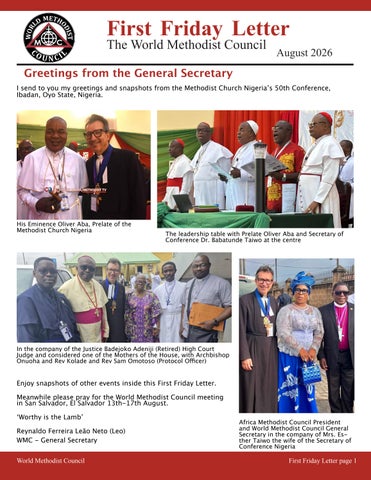
Greetings from the General Secretary I send to you my greetings and snapshots from the Methodist Church Nigeria’s 50th Conference, Ibadan, Oyo State, Nigeria.
His Eminence Oliver Aba, Prelate of the Methodist Church Nigeria
The leadership table with Prelate Oliver Aba and Secretary of Conference Dr. Babatunde Taiwo at the centre
In the company of the Justice Badejoko Adeniji (Retired) High Court Judge and considered one of the Mothers of the House, with Archbishop Onuoha and Rev Kolade and Rev Sam Omotoso (Protocol Officer)
Enjoy snapshots of other events inside this First Friday Letter. Meanwhile please pray for the World Methodist Council meeting in San Salvador, El Salvador 13th-17th August. ‘Worthy is the Lamb’ Reynaldo Ferreira Leão Neto (Leo) WMC - General Secretary World Methodist Council
Africa Methodist Council President and World Methodist Council General Secretary in the company of Mrs. Esther Taiwo the wife of the Secretary of Conference Nigeria
First Friday Letter page 1
From the Diary of the General Secretary
I had the privilege of attending the Ministerial Session and the opening day of the Representative Session of the 50th Conference of the Methodist Church Nigeria. The Conference took place at the beginning of August in Ibadan, Oyo State. It had before it the important task of reviewing the life of the Church in its entirety and discerning the way forward for its ministry and mission. It was socked in prayer and hymn singing, fellowship and even a sense of humour in which the most serious matters of accountability to one another in love were dealt with. The people called Methodists in Nigeria are vibrant, and the Methodist Church Nigeria is strong. I congratulate the current leadership, which has demonstrated both a clear understanding of the Church’s present situation and a compelling vision for its future. May the Lord continue to bless and guide them in their Christian service. On behalf of the World Methodist Council, I conveyed greetings to both the Ministerial and Representative Sessions. I was warmly welcomed, and our greetings were received in a genuine spirit of fellowship, friendship, and Christian love. It was also a joy to reconnect with old friends. Among them was Dr. Chikwendo Igwe, with whom I had the privilege of serving on the Methodist–Roman Catholic International Dialogue Commission for several years. Although it had not originally been part of my programme, I was invited to preach on two occasions—opportunities that I deeply cherished. The first was at Emmanuel Chapel in Lagos. There was a remarkable sense of the presence of the Holy Spirit throughout the service. It seemed a gracious response to the congregation’s heartfelt invocation of the Holy Spirit, sung in Yoruba:
Awe, Awe, Awe, Ẹmi Mimọ. Wa, Wa, Wa, Alágbára. Awo, Awo, Awo. Here is the link to the recording of the service, which also features the chapel’s marvellous choir: https://www.youtube.com/live/7i70hAIH1cc?si=WOVQor-Il9h-1Z24
My second opportunity to preach was during the Ordinands’ Retreat. This Eucharistic service was held in the Immanuel College Chapel in Ibadan, where the ordinands had gathered for a week of preparation before their ordination on Saturday, 8th August. The process followed by the Methodist Church Nigeria is both careful and rigorous. Those presented for ordination have undergone a thorough process of discernment and selection, completed their theological formation, and served faithfully as deacons for a couple of years at least before being brought to the Conference for ordination and reception into Full Connexion. Nigeria is home to five different Methodist Churches, some of which are also members of the World Methodist Council. The days I spent with the Methodist Church Nigeria were deeply encouraging and offered an impressive testimony to their vitality as a Conference. They reflected a Church firmly rooted in the Gospel and confidently looking to the future. May the Lord continue to bless the ministry and mission of the Methodist Church Nigeria. As they so joyfully proclaim in their gatherings: “Worthy is the Lamb!”
Rev. Dr. Reynaldo Ferreira Leão Neto (Léo) General Secretary World Methodist Council
Ordinands’ retreat Immanuel College Ibadan, Oyo State, Nigeria - 50th Conference of the Methodist Church Nigeria
World Methodist Council
First Friday Letter page 2
Africa Methodist Council Statement on Xenophobia/Afrophobia in South Africa and the Residents Returning Home “... Love your neighbor as yourself. All the Law and the Prophets hang on these two commandments.” (Matthew 22:39-40) For many weeks now, the media has been awash with campaigns against illegal and legal immigrants in South Africa to return to their countries. Foreign nationals are accused of competing for limited resources for South Africans, leading to poverty and unemployment of South Africans because the foreigners are “taking their jobs”, overpopulation because there is no control on the influx of migrants and poor service delivery. Afrophobia was well pronounced in the campaign as African immigrants were accused of crimes and drug dealings. The attacks were in the form of harassments, beatings, displacements, killings, lootings, and destruction of foreign-owned shops and homes. A deadline for concluding the March and March Campaign was set for June 30, 2026. The situation saw many Africans desperate to leave South Africa for their safety. Some have been in the country for many years as legal migrants, asylum seekers or illegal immigrants. Some of them had regarded South Africa as their new home. All the hopes were crumbled, and they are returning home to their country of origin. Some are returning empty-handed because whatever they had invested in was destroyed, some are coming with wounds that need to be bandaged, some are bringing children who were forcefully dropped from school, and some went to South Africa as couples, but they are returning as individuals. In summary, the people returning home have undergone emotional and psychological trauma. They were stripped of their dignity and integrity. The language of Ubuntu did not make sense in what they are going through. We implore the People Called Methodists, the Christian community at large, and the receiving governments to welcome the returnees with integrity, compassion, love, care and not condemn them for what happened, some of which was beyond their control. It is time to remember what the Lord Jesus taught in Matthew 25:35-39, “For I was hungry and you gave me something to eat, I was thirsty and you gave me something to drink, I was a stranger and you invited me in, I needed clothes and you clothed me, I was sick and you looked after me, I was in prison and you came to visit me..., ‘Truly I tell you, whatever you did for one of the least of these brothers and sisters of mine, you did for me. We also call upon the South African government to deal with the issue of migrants in a way that does not dehumanize those immigrants among them or strain the bilateral relationships among the African states. The Bible teaches us to love the sojourners because we were also migrants. Do not oppress foreigners, you yourself know how it feels to be foreigner because you were foreigners in Egypt.” Exodus 23:9 (NIV) “When a stranger sojourns with you in your land, you shall not do him wrong. 34 You shall treat the stranger who sojourns with you as the native among you, and you shall love him as yourself, for you were strangers in the land of Egypt: I am the Lord your God.” Leviticus 19:33-34 (ESV) May God bless you to live your faith as you minister to the needy and care for those who demand your attention, without counting the cost, for God calls us to such radical hospitality.
Most Revd Dr. Paul. K. Boafo
Revd Dr. Martin Mujinga
AMC PRESIDENT
AMC GENERAL SECRETARY
World Methodist Council
First Friday Letter page 3
Maori Methodist Leader Calls for Action on Climate Justice The President of the Methodist Church of New Zealand and Aotearoa, Dr Te Aroha Rountree, discusses Maori Christianity, bicultural leadership and the challenges facing Pacific Churches in this interview she gave to the World Council of Churches.
course at Trinity College, the Methodist theological college. The course focused on Maori society, which is compulsory for all ministry students because the Church is bicultural. Over the past 10 years, I’ve continued teaching there. During that time, I’ve also served on many boards and committees within the Church. Because we are a bicultural Church, Maori representation is required across all leadership structures — and since there are relatively few of us, we often serve in multiple roles. This gave me exposure to many different parts of the Church and allowed me to engage with people who were sometimes unfamiliar with, or even resistant to, Maori perspectives. Those experiences helped shape my understanding of where the Church needed to direct its attention, particularly in relation to my people.
Dr Te Aroha Rountree is President of the Methodist Church in New Zealand. (Te Hahi Weteriana o Aotearoa) (Photograph: Marcelo Schneider / WCC.)
Can you tell us about your journey? To begin with, I come from Ngai Tuteauru and Nga Puhi, two iwi (tribes) from the far north of Aotearoa New Zealand. My people were among the first to be converted to Christianity in the country, so we have a long history and tradition of engaging with Christian teachings. I say that deliberately because our experience and identity as Christians is somewhat different from what might be considered the mainstream. Our ways of understanding and practising Christianity are shaped by our own cultural worldview. Both of my parents were Methodist ministers and my family has a long history with the Methodist Church. I am currently serving as President of the Methodist Church until October this year. This role has given me insight into both the synergies and the tensions between Maori ways of knowing and being and Christian teachings — particularly in how we interpret the Bible. We tend to interpret Scripture differently, especially within our context and that can lead to interesting conversations as well as challenges within the life of the Church. In terms of my path into this work, I come from a Maori background. I was teaching at the University of Auckland when my aunt — who was head of the Maori division of the Church — asked me to teach a
World Methodist Council
Along the way, I’ve made many friends — and perhaps some enemies — because my theology doesn’t align with everyone’s, especially when it comes to integrating Maori cosmology with Christian teachings. Eventually, I was nominated for the Presidency by multiple groups within the Church, including both Maori and non-Maori communities. That was unusual. The Methodist Church in Aotearoa operates through a partnership model, so leadership reflects that bicultural relationship. As a result, our current leadership embodies that partnership: my colleague is Pākehā (non-Maori New Zealander of European descent) and I am Maori. Together, we represent that shared responsibility. This has brought challenges, particularly around new ways of thinking about the Church’s direction, but I believe the Church is in a place where it is ready to engage with and build on these ideas. How do you build relationships and bridges across the different communities? One of the fortunate opportunities I’ve had was being part of Te Runanga Whakawhanaunga i nga Haahi (the National Maori Council of Churches), which grew out of early ecumenical movements in Aotearoa. It represents an indigenous expression of ecumenism. This experience shaped how I understand ecumenism from a Maori perspective. A simple example comes from our cultural practices: when we gather, no one is excluded. Our customs require inclusion. Continued on next page ...
First Friday Letter page 4
Maori Methodist Leader Calls for Action on Climate Justice continued... In my own family, we have members from different Christian traditions … and when we come together, everyone participates. Our gatherings can last several days and all traditions are respected. So I often say that, as Maori, we are ecumenical by default. Our cultural values require us to be inclusive.
Pacific communities have contributed the least to climate change, yet they are among the most immediately and severely affected. This is not a distant issue — it is already happening. So it’s critical that these realities are addressed, both locally and globally.
From a young age, both in the Church and on the marae, I experienced how Christian teachings and Maori traditions coexist. We live in that overlap — where both frameworks inform our identity and practice.
There is also a responsibility for global organisations, such as the World Council of Churches, not only to talk about these issues or produce statements, but to truly engage with affected communities — to understand their lived experiences and take meaningful action.
Through the Maori Council of Churches, I’ve also engaged in broader ecumenical and global spaces. This has helped me understand not only my own context but also how we fit within global Christianity.
In my tradition, it’s not enough to talk — we must act. And that action must be collaborative, working alongside those most impacted rather than trying to “fix” things from the outside.
At the theological college, we also emphasise interfaith engagement. Students visit other faith communities — such as mosques and temples — to develop a basic understanding of different religious traditions, especially those often seen as “other” in relation to Christianity. I’ve had many opportunities to engage in these spaces myself. For example, I attended the World Council of Churches assembly, where I participated in discussions with the indigenous assembly. I was there representing the Maori Council of Churches rather than the Methodist Church directly, which allowed me to explore how indigenous voices can be strengthened in global forums. What are the main challenges facing Churches in the Pacific today? One of the greatest challenges is climate justice.
Another major challenge is social issues, particularly violence. In our context, family violence and domestic violence are significant concerns. Sometimes faith can be both a help and a hindrance. There can be a tendency to say, “just pray more and things will get better”, but that approach alone is not sufficient — it doesn’t address the root causes. In some cases, conservative interpretations of Christianity can prevent honest conversations about these realities. There can be a disconnect between what is preached publicly and what happens in private lives, even among Church leaders. We are still working through how to address these contradictions in meaningful and effective ways. This article was originally published on the website of the World Council of Churches (oikoumene.org).
Dr Te Aroha Rountree with the leader of the Maori arm of the Methodist Church in New Zealand, the Rev Dr Arapera (Bella) Ngaha. (Photograph: Methodist Church of New Zealand.)
World Methodist Council
First Friday Letter page 5
2nd International Congress on Human Mobility: “Faith, Dignity, and Justice in Motion”
Second International Congress on Human Mobility organised by the Faculty of Religious Sciences at the University of the Latin American Educational Centre Gathered in Panama from 22 to 24 July 2026, representatives of churches, universities, ecumenical bodies, United Nations agencies, faith-based organisations and other institutions from various countries across the Americas, we reaffirm our commitment to the defence of human dignity and to the recognition of human mobility as one of the greatest ethical, social and pastoral challenges of our time. During the Congress, we analysed the causes that force millions of people to migrate: poverty, violence, political conflicts, climate change, structural inequalities and forms of violence that particularly affect women, girls, boys and other vulnerable groups. We also highlighted the impact of punitive migration policies, the criminalisation of migrants, hate speech, xenophobia and the use of technologies that may infringe fundamental rights.
We appreciate international efforts to promote safer and more orderly migration, although we recognise that significant challenges remain in ensuring that the commitments made by States are effectively implemented. In this context, we emphasise the importance of strengthening comprehensive humanitarian responses that put people at the centre, promote communication, family reunification and support throughout the migration process.
risks during migration; creating opportunities for migrants to participate; to denounce xenophobia, racism and dehumanising policies; to drive forward concrete actions for humanitarian aid and family reunification; and to promote a spirituality of hospitality that transforms our communities. We also reaffirmed our commitment to continuing the process that began in Argentina in 2024 and was further developed in Panama in 2026, in the strong belief that the challenges posed by human mobility require ongoing, coordinated and collective action amongst churches, social organisations, academic institutions and migrant communities. Finally, we reaffirm that the right to migrate is an integral part of human dignity and that borders must be places of encounter, not of exclusion. We are called to reclaim a prophetic voice capable of denouncing injustices, inequalities and the structures that force people to leave their homes, defending both the right to migrate and the right to remain and live with dignity in one’s own territory. Only in this way can we build a society based on justice, hospitality and care for life. For all these reasons, and recognising God as a migrant God who walks alongside his people on their journey, we resonate with the words of the Guatemalan poet Julia Esquivel Velásquez in her poem “Cuando llegue la hora” (1981):
We are therefore committed to strengthening support and advocacy networks; promoting welcoming communities; generating research and knowledge that are grounded in reality; developing training materials; providing special protection for those facing the greatest
May your voice, O Gardener, awaken my ears each morning with the ever-new news: ‘Go and tell my brothers that I have conquered death, that there is room for everyone where the New Homeland is being forged. There, where the earth, love and joy cannot be bought or sold, where wine and milk are shared without money and without price, there, where all my little brothers and sisters sit like princes at the FATHER’S TABLE
We want to share with you the joy and gratitude for what we experienced during the 2nd International Congress on Human Mobility: “Faith, dignity and justice in motion”, held in Panama, at the Pan American Institute -IPA- and the Evangelical Methodist Church of Panama.
Among our upcoming initiatives, in March we will launch the International Diploma Program in Human Mobility. Additionally, materials with teaching suggestions on this topic are now available on the UCEL website.
Based on our faith, we understand that human mobility offers a unique opportunity to recognise God’s presence, and we reaffirm that encounter, hospitality and communion are ways of building fairer societies. Our commitment is not to speak on behalf of migrants, but to walk alongside them so that their own voices, experiences and proposals take centre stage in the processes of transformation.
The Congress was a valuable space for academic reflection, pastoral encounter, conversations and collaboration between churches, universities, social organizations, international bodies and people committed to accompanying those who go through different experiences of human mobility. We also had the opportunity to share this experience with students from the upper courses of the IPA, creating a very enriching space for conversation, awareness and joint learning.
World Methodist Council
We will also soon publish a digital book that will bring together the lectures, messages and main documents shared and produced during the Congress. We give thanks to our good God for his kindness, for the doors he has opened and for allowing us to continue building hospitable communities, committed to dignity, justice and the care of life. Greetings of peace and blessings.
Continued on next page...
First Friday Letter page 6
2nd International Congress on Human Mobility: “Faith, Dignity, and Justice in Motion” continued...
Organizing Leader: UCEL – Universidad del Centro Educativo Latinoamericano (Faculty of Religious Sciences) Supporting Organizations: · IEMA – Evangelical Methodist Church of Argentina · GBGM – General Board of Global Ministries (The United Methodist Church) · GBHEM – General Board of Higher Education and Ministry · UMCOR – United Methodist Committee on Relief · WCC – World Council of Churches · IEMPA – Evangelical Methodist Church of Panama · CIEMAL – Council of Evangelical Methodist Churches of Latin America and the Caribbean · Garrett-Evangelical Theological Seminary · MCCA / IMCA – Methodist Church in the Caribbean and the Americas Accompanying & Partnering Organizations: · World Methodist Council · Panamanian Red Cross · QONAKUY – Platform of Protestant and Evangelical Universities of Ibero-America and the Caribbean · IAPTR – Americas Initiative for Transformation and Reconciliation · Duke Divinity School (Hispanic House of Studies) · ALAIME – Latin American Association of Methodist Educational Institutions · CAREF – Argentine Commission for Refugees and Migrants · World Vision · AIPRAL – Alliance of Presbyterian and Reformed Churches of Latin America · Pastoral Care for Human Mobility · CLAMOR Network – Latin American and Caribbean Ecclesial Network on Migration, Displacement, Refuge and Human Trafficking · Tearfund · LWF – Lutheran World Federation (Latin America and the Caribbean) · IAMSCU – International Association of Methodist Schools, Colleges, and Universities · OSMECA – Socio-Pastoral Observatory of Human Mobility of Mesoamerica and the Caribbean · WACC – World Association for Christian Communication · UBL – Latin American Biblical University · Langham Preaching (Latin America) · FTL – Latin American Theological Fellowship · IOM – International Organization for Migration (UN Migration) · UNHCR – United Nations High Commissioner for Refugees · Methodist Seminary of Chile · ASIT – Association of Theological Seminaries and Institutions of the Southern Cone · CETELA – Ecumenical Theological Education Community of Latin America and the Caribbean · Migrant Assistance Foundation World Methodist Council
First Friday Letter page 7
Standing Together in Hope, DSPR’s Continuing Service in Gaza Dear Partners and Friends, Greetings from the Department of Service to Palestinian Refugees (DSPR) of the Middle East Council of Churches. With hearts carrying both pain and hope, we write to share with you a glimpse of the ongoing journey of DSPR in Gaza, where our teams continue to live out our calling and witness through service, compassion, and steadfast commitment to the dignity of every human being. Despite the overwhelming suffering, emotional pain, and the unbearable weight carried by our communities, with no visible prospect of a political solution on the horizon, DSPR continues to uphold its living mission and the spiritual and humanitarian vision of ecumenical service that has guided our work for decades. Even in the midst of devastation, we remain committed to being present with people in their suffering, extending compassion, and witnessing through action to the value of every human life. The reality in Gaza remains devastating. According to the United Nations Office for the Coordination of Humanitarian Affairs (OCHA), “people across the Gaza Strip, including humanitarian workers, remain exposed to airstrikes, other military activity, new or protracted displacement and persisting health risks. For most residents, displacement, overcrowding and limited access to basic services continue to undermine safety, dignity and well-being” (OCHA, Humanitarian Situation Report, 3 July 2026). Families continue to live in overcrowded displacement sites and tents, with very limited space for privacy, protection, or dignity. The intense summer heat has transformed many of these shelters into unbearable environments, where people struggle with extreme temperatures, inadequate shelter conditions, and the lack of basic necessities. The absence of any reconstruction has left many surrounded by destruction and rubble, carrying the painful memories of homes, communities, and a way of life that has been lost. Humanitarian reports continue to highlight the severe challenges facing civilians, including shortages of essential supplies, rising prices, limited access to food, clean water, medicines, and healthcare services. According to OCHA, humanitarian operations continue to face “significant constraints,” while people across Gaza experience “critical shortages of essential items and serviWorld Methodist Council
ces” (OCHA, Humanitarian Situation Report, 3 July 2026). The health situation remains extremely alarming. The World Health Organization (WHO) has repeatedly warned that the health system in Gaza continues to operate under extraordinary pressure, with healthcare workers facing shortages of medicines, medical supplies, fuel, and functioning health facilities while responding to overwhelming needs. The already fragile health situation has been further compounded by the spread of communicable diseases, including a significant increase in cases of chickenpox, particularly among displaced populations living in overcrowded shelters and tents. Limited access to clean water, inadequate sanitation, overcrowding, and the lack of proper living conditions have created an environment where infectious diseases can spread rapidly, placing additional pressure on an already overwhelmed healthcare system. (WHO, Gaza Strip: Health Emergency Situation Report No. 70, 2026). Yet, even amid this suffering, hope remains alive. Through our three primary healthcare clinics, one in Nuseirat and two in Gaza City, with the limited resources we have, DSPR continues to serve thousands of people every week, providing essential health services to those who have nowhere else to turn. Our clinics remain spaces of care, dignity, and compassion, where people receive not only medical support but also reassurance that they are not forgotten. Our teams also continue delivering psychosocial support programs to thousands of children and women, creating safe spaces where they can express their fears, process traumatic experiences, and rebuild a sense of resilience. In a reality where so many children have lost homes, loved ones, and a sense of security, these programs continue to plant seeds of hope and affirm that healing and a better future remain possible. Our commitment remains rooted in DSPR’s vision, to continue reaching the marginalized, extending a hand of compassion, and empowering people to preserve their dignity and live with hope and possibility, even under the most difficult circumstances. We believe that humanitarian service is not only about responding to immediate needs; it is also about affirming rights and the value of life, standing with communities in their darkest moments, and witnessing to God’s love through action. Continued on next page... First Friday Letter page 8
Standing Together in Hope, DSPR’s Continuing Service in Gaza continued...
At the same time, we remain deeply concerned for our dedicated staff in Gaza. For nearly three years, our teams have worked without real moments of rest, carrying not only the responsibility of serving others but also their own personal losses, losing family members, colleagues, relatives, neighbours, homes, memories, and the familiar world they once knew. They continue to serve among the ruins of their communities and amidst an overwhelming human reality of displacement and suffering.
We ask you to continue standing with Gaza, with our teams, and with the communities we serve. Your partnership is more than assistance; it is an expression of shared humanity, faith, and commitment to a world where dignity, justice, and peace prevail.
We extend our deepest gratitude to our partners, supporters, churches, and friends around the world. Without your presence, solidarity, prayers, trust, and commitment to justice and peace, we would not have been able to continue this mission. Your support has enabled DSPR to remain a sign of hope and a witness of compassionate service when hope often seems distant.
“They that sow with tears shall reap with rejoicing.” Psalms 126:5
Together, through faith, compassion, and solidarity, we continue to proclaim that even in the darkest valleys, hope can still be planted, nurtured, and shared.
Article submitted by Rev. David Hardman, Methodist Liaison Officer, Jerusalem on behalf of DSPR
Faith, Dignity and Justice in Motion: Reflections from Panama recalled Pope Francis’s words in Evangelii Gaudium: reality is greater than the idea. Policies may appear orderly on paper, yet their true meaning is revealed in a detention cell, an overcrowded shelter, a dangerous border crossing or a family waiting for news. His warning was clear: pastoral responses cannot be formed from a distance. They must begin in the places where people live, travel, wait and suffer. Without listening to migrants themselves, even compassionate initiatives risk being designed from above and imposed from outside.
From 22 to 24 July 2026, churches, universities, faith-based organisations and advocates met in Panama City for the Second International Congress on Human Mobility. Organised by UCEL’s Faculty of Religious Sciences, the gathering brought theology, public policy, pastoral practice and lived experience into conversation under the theme Faith, Dignity and Justice in Motion. One of its most powerful moments came during the presentation by Gerardo Cruz of Red CLAMOR. He began his contribution not with data, but with the names of migrants who had died in detention centres during the previous year. They were not figures in a report, but people whose lives had ended in places marked by an absence of humanity. Their families, too, were remembered in a spirit of communion. That act of remembrance gave weight to everything that followed. Reflection on human mobility must begin with those who carry its consequences in their bodies, relationships and memories. Cruz later
World Methodist Council
Gabriela Liguori of CAREF Argentina sharpened the argument further: migration is not the problem, and migrants are not the problem. The problem lies in political choices that make movement more dangerous, weaken access to protection and push people deeper into insecurity. Migration is shaped by conflict, persecution, inequality, poverty, environmental crisis and the decisions of states. Once this is recognised, the questions change. Instead of asking why people continue to arrive, attention turns to why safe routes remain so limited, why asylum systems are weakened and why governments invest more readily in surveillance, detention and militarised borders than in reception, legal assistance and integration. These questions resonate strongly in Europe. The Mediterranean Sea remains one of the world’s deadliest migration routes, while Lampedusa has become a symbol of both rescue and loss. Yet Europe’s borders do not end at the shoreline. They continue through externalisation agreements, prolonged asylum procedures, housing exclusion and exploitative labour.
Continued on next page... First Friday Letter page 9
Faith, Dignity and Justice in Motion: Reflections from Panama continued...
A border may take the form of a tent on a Dublin street, an overcrowded reception centre or years spent waiting for a decision that will shape the rest of a person’s life. The discussion also carried a quieter personal resonance. A life shaped by movement from the Philippines through Italy and Ireland—and still unfolding—offers a particular lens on identity, language, faith and belonging. Home can no longer be reduced to one place; it may be found in a familiar song, a remembered word, an aroma, or a community that receives a person’s story without requiring constant explanation. This lived dimension matters because people do not cross borders as empty recipients of assistance. They carry memories, responsibilities, abilities, faith, grief and hope. Any response that sees only vulnerability fails to recognise the fullness of the person. Nina Balmaceda Vargas of Duke University returned the discussion to the theological foundation of Christian responsibility. The defence of migrants’ rights, she argued, begins not with political preference, but with the conviction that every person is created in the image of God. Human dignity comes before legal status. A government may deny a visa or reject an asylum claim, but it cannot grant or remove the worth already present in every human life. Drawing on Lutheran, Anabaptist and Methodist traditions, she highlighted freedom of conscience, radical hospitality, non-violence and social holiness. For Methodists, holiness cannot remain private; it must become visible through mercy, justice and solidarity. The Church cannot proclaim one body in Christ while asking some members continually to justify their presence.
work together, protecting vulnerable people into the hands of traffickers or onto unsafe boats. Cruz summarised this vocation through four verbs: welcome, protect, promote and integrate. To welcome is to receive a person, not merely process a case. To protect is to defend rights and safety. To promote is to recognise gifts, experience and agency. To integrate is to create belonging without demanding the erasure of identity. The gathering in Panama offered no simple answer to the complexity of human mobility. It did, however, leave a demanding question for churches and societies alike: will compassion remain an emergency gesture, or will it become a public commitment capable of challenging the systems that repeatedly produce exclusion? Churches cannot be content only to treat wounds caused by unjust structures. They are also called to help change the conditions that keep inflicting them. Faith, dignity and justice remain in motion whenever a stranger is received as a neighbour, a migrant is heard as a participant, and hospitality becomes not only an act of kindness, but a shared responsibility. Article by: Ms. Stefanie Gabuyo WMC YYA Committee Chair (Co-ordinator)
(See above the Open letter and Greetings from the Congress found on page 6 & 7)
This vision becomes credible only through practice. Food, clothing and temporary shelter remain essential, but hospitality must reach further. It also means accompaniment, fair procedures, dignified housing, access to documentation and genuine participation. The Irish Refugee Council’s Home Befriending programme offers one example of accompaniment that begins with listening rather than assuming. Netz4 in Zürich supports young people, many of whom have experienced displacement, as they seek education, work, accommodation and stability. In Italy, humanitarian corridors promoted by Mediterranean Hope and the Community of Sant’Egidio have shown that legal entry, institutional co-operation and long-term integration can World Methodist Council
Ms. Stefanie Gabuyo, Youth and Young Adult Committee Chair Co-ordinator and Dr. Humberto Martin Shikiya 2026 Peace Award Laureate First Friday Letter page 10
Whose Neighbour Will You Become?
Voices from the Young Adults Pilgrimage of Peace in Colombia Reflections by WMC Youth and Young Adults Committee participants Blessy Grace M. De Leon, Ntobeko Dlamini and Rachel Barwise. Compiled and edited by Committee Chair (Co-ordinator) Stefanie Gabuyo. “Whose neighbour will you become?” This question, posed by Bishop Luis Andrés Caicedo Guayara, remained with participants throughout the World Methodist Council Young Adults Pilgrimage of Peace, held in Bogotá and Cali from 27 June to 2 July 2026.
Organised by the World Methodist Council through the Youth and Young Adults Committee in partnership with the Korean Methodist Church, the United Methodist Church–General Board of Global Ministries and the Iglesia Colombiana Metodista, the pilgrimage brought together young adults from across the worldwide Methodist family. Through worship, reflection and encounters with churches, peacebuilders and local communities, they listened to Colombia’s experiences of conflict, displacement, discrimination, disappearance and the search for justice. When opened eyes must not close again For Deaconess Blessy Grace M. De Leon of The UMC Philippines Regional Conference, the pilgrimage deepened a conviction expressed in a Filipino saying: “When your eyes are opened wide, it is a sin to shut them.” Blessy travelled prepared to share how churches and communities in the Philippines engage in peacebuilding. Instead, she found herself invited first to listen, set aside expectations and receive the stories of those she encountered. “In walking alongside Colombia’s memories of pain, lament, struggle, resilience, hope and triumph,” she reflected, “I affirmed that peace is not simply something we teach or advocate; it is something we learn and struggle for together.” Through conversations with peacebuilders and visits to places of remembrance in Bogotá and Cali, Blessy heard stories of lives shaped by armed conflict, forced displacement, sexual violence and the disappearance of loved ones. She was struck by how every testimony carried “a name, a face and a sacred story”. Memory, she realised, can itself be an act of justice: to speak names and preserve stories is to resist reducing human lives to statistics. “Peacebuilding is not about studying conflict from a distance,” she wrote. “It is about allowing the wounds of others to transform how we live, believe and serve.”
World Methodist Council
Standing beside those who refuse to be forgotten Reverend Ntobeko Dlamini of the Methodist Church of Southern Africa, also returned repeatedly to Bishop Caicedo’s question. For him, it was a call to kenosis—a Christ-like self-emptying expressed through attentive listening, lamentation, prayer and solidarity with victims of Colombia’s conflict.
One significant moment came during worship at the inclusive and affirming Iglesia Colombiana Metodista in Bogotá on the final Sunday of Pride Month. The congregation and pilgrims stood with the LGBTI+ community and mourned Stacey, a transgender woman murdered the day before the pilgrimage began. Her death confronted them with the continuing violence and discrimination experienced by LGBTI+ people in Colombia and the need for a Christian witness that does not overlook those whose lives are threatened. The visit to Siloé in Cali was another defining encounter. There, participants accompanied families whose loved ones had been killed during the 2021 social uprising. Ntobeko was moved by “the bravery of local people in sharing their narratives and giving names to the statistics”. By speaking about their children and young relatives, the families refused to allow them to be forgotten. The encounter also brought greater awareness of the thousands displaced or disappeared through Colombia’s conflict. Dr Humberto Shikiya stressed that lasting peace requires dialogue and the meaningful participation of local communities. Those who carry the consequences of violence must help shape reconciliation. Recalling Archbishop Desmond Tutu’s words, “We are made for togetherness,” Ntobeko called Christians to pray for Colombia, support the work of peace and reconciliation, and stand in solidarity with all who long for justice, healing and lasting peace. From compassionate observers to active peacebuilders Ms. Rachel Barwise of the Methodist Church in Britain from Cymru/Wales, travelled to Colombia without knowing fully what to expect. She chose to remain expectant—open to what the pilgrimage might teach her.
Continued on next page...
First Friday Letter page 11
Whose Neighbour Will You Become? Voices from the Young Adults Pilgrimage of Peace in Colombia continued... This openness became especially important during the Stations of the Cross at Monserrate. Although the Stations were familiar, walking them after meeting the families in Siloé gave the devotion new meaning. At the seventh station, where Jesus falls for the second time, Rachel remembered the families continuing to search for truth and justice. She imagined the question arising from both Christ’s suffering and their grief: “When will this be over?” Another followed: “What could we do to help?” For Rachel, this became a challenge to consider how Christians can become active peacebuilders rather than compassionate bystanders. “My learning as a pilgrim transforms me and my faith,” Rachel wrote. The experience became another step in learning what peacebuilding requires and how Christians can help bring God’s kingdom of love, hope and justice into the world. She compared returning home to a child arriving for a second day of school: carrying what has already been learned while remaining ready for further formation.
Bishop Caicedo’s reflection on the Good Samaritan gave this calling its clearest expression. The Gospel does not leave us asking only, “Who is my neighbour?” but challenges each of us: “Whose neighbour will you become?” The pilgrims returned home carrying Colombia’s stories, their encounters with one another and the responsibility that follows when one’s eyes have been opened. The journey may have ended, but its question continues to accompany them—and all who hear their witness. The World Methodist Council Youth and Young Adults Committee is deeply grateful to the wider WMC family and to all the partners, churches and individuals whose prayer, encouragement and support made this pilgrimage possible and continue to sustain this shared work of peacebuilding. Article by YYA Co-Ordinator Stefanie Gabuyo
A shared calling carried home Although Blessy, Ntobeko and Rachel were moved by different moments, their reflections offer a glimpse of the wider journey shared by all the young adults who took part in the pilgrimage. Together, their experiences point towards peace as something practised through truth, remembrance, solidarity and action. Peace begins when suffering is neither ignored nor reduced to statistics, but received through attentive listening and a willingness to accompany those whose stories are at risk of being forgotten.
YAPP Pilgrimage in Colombia, pictures by Rachel Barwise
World Methodist Council
First Friday Letter page 12
H.E., Seyi Makinde, Governor of Oyo State, addresses the Conference in Nigeria
Please send press releases, articles and resources! Submissions should be a page around 500 words, edited and ready to publish. Contact us by Friday, 21 August at mbryson@worldmethodistcouncil.org if you would like your story to be included in the September edition of the First Friday Letter.
About the First Friday Letter
On the Web This and past First Friday Letters can be found online at FirstFridayLetter.worldmethodistcouncil.org.
The First Friday Newsletter is a monthly publication of the World Methodist Council.
The World Methodist Council’s website may be found at Publisher: Rev. Dr. Reynaldo F. Leão Neto, General Secretary worldmethodistcouncil.org. Layout Design, Art, and Graphics: Mrs. Michaela Bryson, Staff To subscribe to this newsletter, please email communications@worldmethodistcouncil.org.
All stories and photos, unless otherwise stated, are protected by their respective copyrights. Please do not copy without expressed written permission from the Council.
Follow the Council on social media!! YouTube
@worldmethodistcouncil
World Methodist Council
Facebook @World Methodist Council
Instagram @wmcouncil
First Friday Letter page 13