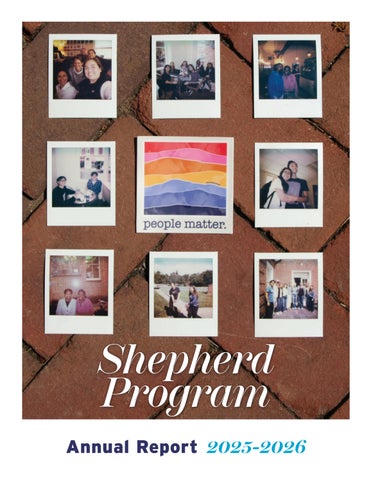
Shepherd Program Annual Report 2025-2026
BY THE NUMBERS
96
128
. Volunteer Venture Participants
. Students in the Gateway Course
17,391
46
. Bonner Service Hours
. Summer Interns
40
681
. Graduated Minors
. CKWL Backpack Program Recipients
letter from the director
Shepherd is turning 30! This year, as we celebrate the 30th anniversary of Shepherd at W&L — as well as the 25th anniversary of Bonner at W&L and the 20th anniversary of Campus Kitchen at W&L — we also remember founding director Harlan Beckley, who passed away on Oct. 21, 2025. From the beginning, Harlan and a handful of dedicated faculty, community partners and alumni, including Tom ’52 and Nancy Shepherd, had one overarching goal. The mission? To offer courses and community engagement opportunities that prepare students — whatever their backgrounds, majors, career paths, passions or political perspectives: To understand and address the causes and consequences of poverty and inequality in ways that respect the dignity of every person. And it’s that last bit — “respect for the dignity of every person” — that was, is, and will be central to the Shepherd experience. As I say to students on the first day of class — and on many days afterward: “Smart, good people can — and often will — disagree. But there’s one thing we won’t debate here: People matter.” But students sometimes ask: If we share a commitment to the dignity of every person, then why would we ever disagree about what we should do? 1) Practical Effectiveness. We may disagree about whether a particular policy or practice will work — whether it will have the positive effects planned, while minimizing its negative unintended consequences. 2) Political Feasibility. We may disagree about whether we can get sufficient support for the proposal — whether we can get enough people to take action to make the recommendation a reality. 3) Moral Permissibility. We may especially disagree about whether the proposed policy or practice will be morally permissible — whether it will respect the fundamental equality and dignity of all, those it aims to help as well as those it might hurt. It’s one thing to admit that smart, good people disagree. But it’s something else — something more valuable, especially at this time — to understand why we disagree and how to disagree in ways that respect the dignity of every person. If you are committed to a better, more just world for all, come join us here in Shepherd as we practice: The art of respect!
Howard Pickett Director of the Shepherd Program Professor of Ethics and Poverty Studies
3
education & perspectives
Voices
ACADEMICS AT W&L
“
I so appreciate what Shepherd Program students bring to elective classes. They
tend to be empathetic, curious and intrinsically motivated young scholars. And by working through the Shepherd curriculum, they practice joining ethical and social-scientific modes of inquiry with community engagement in ways that often make their class participation extra insightful.”
Professor Jon Eastwood William P. Ames Jr. Professor of Sociology
4
POV 296 Justice and Mercy Morgan Schuckman ’27 As a global politics major with minors in poverty and human capability studies and law, justice and society, the Shepherd Program’s emphasis on dignity has fundamentally influenced my ambitions. I look forward to serving as a prosecutor who seeks justice not only for victims and the state but also for defendants by promoting rehabilitation and restoration alongside accountability. I want to dignify those experiencing the criminal legal system by reducing unnecessary correctional control while strengthening reentry support through access to food, transportation, housing, employment and the restoration of rights. Professor Pickett’s Justice and Mercy course modeled what that vision looks like in practice. While we studied strategies of nonviolent resistance, the most valuable lesson came from confronting our own limits and asking whether we were willing to live out our beliefs when doing so was difficult. Through the writings of Martin Luther King Jr., Simon Wiesenthal and others, we grappled with questions of forgiveness and what it truly means to recognize the dignity of every person, even those who have caused harm. It was inspiring to read the words of people who desired a greater mission so deeply that they willingly placed it above their own wants and needs. The course challenged me to put my belief that every person is worthy of redemption and dignifying forgiveness into practice rather than simply affirming it in theory. Those lessons continue to shape not only the kind of legal system I hope to help build but also the kind of person I hope to become. n
SHEPHERD PROGRAM / 2025-2026
BIOL 275
POL 232
Food for Thought Kendall Schlueter ’26
Public Policy Riley Mitchelson ’27
I enrolled in Food for Thought Winter Term of my senior year as an opportunity to connect my neuroscience major and pre-medical studies with my poverty studies minor. After 3.5 years of volunteering with Campus Kitchen, culminating in serving as president, I brought to the course a strong appreciation for the importance of providing nutritious, balanced meals. However, learning how nutrition shapes nearly every aspect of health — from metabolism and disease prevention to even the brain’s ability to think — reinforced why access to high-quality, balanced meals is vitally important for the well-being and dignity of the clients we serve. The course further expanded my understanding of how food insecurity and barriers to healthy living vary across communities. Studying food access on American Indian reservations complemented my experiences with Campus Kitchen, Volunteer Venture, my Shepherd internship in Mexico and my global health semester abroad, underscoring the diverse structural factors that shape health outcomes across the U.S. and globally. As a student planning to attend medical school, this course also strengthened my conviction that medical care must be tailored to the realities of patients’ lives. The first quarter of the course centered on a case study of a woman living on a Native American reservation with diabetes and other metabolic conditions. As we evaluated different medical treatment options, we assessed how factors such as her insurance coverage, geography, work schedule and access to healthy food and fitness facilities could make treatment more or less realistic and effective. Ultimately, this course challenged me to investigate the intersection of medicine and social structures, both of which must be understood and leveraged to promote health, well-being and dignity. I will enthusiastically carry this perspective into medical school and beyond, striving to care for each patient as a whole person and to better understand and address the social factors that shape health locally, nationally and globally. n
I took Public Policy with Professor Harris during the Fall Term of my junior year. During that time, I had a huge interest in policy work, so the class was right up my alley and fit into my major. Overall, the class breaks up U.S. policy into sections like climate change, education, energy, etc. The class then goes through case studies of successes and failures of policy within these areas. This class setup allows students to understand how policymaking works in the U.S., and what tends to work and what doesn’t. The final project was my favorite part of the class; we had to examine a specific policy area and map out all the inner workings from the national to state level. Professor Harris does a great job of making this class a hands-on experience. She requires that for the project you interview two experts in the field and that you do so in person. This form of teaching helps the students grow their communication skills while opening them to a whole new world of possibilities. My project focused on the regulation of AI in rural areas, so I interviewed my hometown city manager, Jim Frydl. What was supposed to be a 30-minute chat turned into a two-hour conversation about how AI can seriously harm resources available in rural communities. Greene County, Virginia, my birthplace, has banned data centers from ever being built, though, unfortunately, the language within the ban allows for federal overrule. The class pushes you outside of your comfort zone while educating you about all aspects of policy within the U.S. Professor Harris gives her all to her students during this 12-week course, encouraging them to grow within the policy sector. n
5
SHEPHERD PROGRAM / 2025-2026
COURSEWORK FOR CREDIT Course
Title
Faculty
AFCA/HIST 269
Topics: History of the Civil Rights Movement
Dennie
ARTH 379
Mexico/U.S. Border Art: Contemporary U.S. Latinx Art
Lepage
BIOL 275
Food for Thought
Blythe
BUS 304
Seminar in Management: Consulting for Social Impact
Landry
Social Enterprise Storytelling
Landry & Staples
BUS 381
Social Entrepreneurship
Landry
BUS/SOAN 368
Tech for Good
Eastwood & Frimpong
CBL 100
Introduction to Community-Based Learning
Goluboff & Ozorak
CBSC 329
Stereotyping, Prejudice, and Discrimination
Woodzicka
ECON 229
Urban Economics
Shester
ECON 235
The Economics of Social Issues
Goldsmith
ECON 236
Economics of Education
Smith
ECON 250
Public Finance and Public Policy
Guse
ECON 280
Development Economics
Casey
ECON 288
Buddhist Economics
Casey
ECON 376
Health: A Social Science Exploration
Blunch
EDUC 230
Educating Citizens for Democracy
Moffa
ENGL 376
Postcolonial Literature and Theory
Chowdhury
BUS 366/ENGL 267
ENGL 394
African American U.S. Literature
Gray
ENV 203
Environmental Humanities
McCoy
ENV/PHIL 265
Seminar: Food Ethics
McCoy
ENV 295H
Environmental Justice in Appalachia
McCoy
ENV 295L
Plantations to Pollution
Passidomo
ENV 310
Food, Place, and Power
Passidomo
FREN 342D
Migration in France and the Francophone World
Cordova
HIST 229G
History of the Holocaust
Holland
HIST 229H
6
Topics: Native American and
Topics: What is a Child? Introduction to the History of Childhood
Fernández-Fontecha
HIST 235
Historical Memory in Latin America
Green
HIST 269Q
Between Paradise and Terror
Dennie
HIST 275
African Women in Comparative Perspective
Ballah
HIST 377
Terrorism in Contemporary Africa
Ballah
HIST/SOAN 239
Collective Memory: Society, Culture, Identity and Power
Bell
poverty studies
JOUR 268
The Framing of Race and Ethnicity in Mass Media
Deggans
JOUR 295V
Media, Culture, and Society in Tanzania
Abah & Kamara
LJS 295AG
Topics: Civil Disobedience, Pardon, and Punishment
Sayid
PHIL 253
Philosophy of Race
Sun
PHIL 260
Political Philosophy: The Social Contract
Taylor
PHIL 296
Reckoning with the Past
Ranweiler
PHIL 346
Medical Ethics
Taylor
PHIL/WGSS 242
Social Inequality and Fair Opportunity
Bell
PHIL/POV 245
Poverty, Dignity, and Human Rights
Pickett
PHIL/POV 247
Medicine, Research, and Poverty
Taylor
POL 232
Public Policy
Harris
POL 288
Food, Shelter, Space, Voice: Bologna
LeBlanc
POL 295N
Topics: Frederick Douglass
Barretta
POL 388
Architecture of Urban Community
LeBlanc
POV 101
Introduction to Poverty and Human Capability
POV 102
Introduction to Community-Based Poverty Studies
Davidson
POV 121
Effective Altruism
Pickett
POV 192
Blue Ridge Mile Training
Elrod
POV 193
Blue Ridge Mile Clinic
Elrod
POV 197
Bonner Program
Charley
POV 202
Respect, Community, and the Civic Life
Charley
POV 295
Child Abuse and Neglect Seminar
Hammond
POV 296
Justice & Mercy
Pickett
POV 423
Poverty and Human Capability: A Research Seminar
Pickett
SOAN 202
Contemporary Social Problems
Jones
SOAN 213
Sociology and Criminology of War
Shmatko
SOAN 222
Data Science Tools for Social Policy
Eastwood
SOAN 248
Producing Culture from the Margins
Sutton
SOAN 278
Introduction to Medical Sociology
Chin
SOAN 290F
Social Inequality in American Cinema
Sutton
SOAN 290H
Topic: Fines and Fees
Jones
SOAN 291
Global Migration
Oubou
WGSS 296A
Topics: Reproductive Justice: Beyond Abortion
Yang
WGSS 296B
Sexual Assault Intervention: Media and Reality
Yang
Eastwood, Pickett, Robinson
7
CAPSTONES Sylvia Agatako ’26
“Rwanda’s English Medium of Instruction Policy: Capability Deprivation, Structural Reproduction and the Case for Mother-Tongue-First Bilingual Reform”
LeAnna Baker ’26*
“Beyond the Charity-Justice Binary: The Catholic Worker Movement and the Limits of Secular Humanitarian Thought”
Meagan Baxley ’26
“Time Enclosure: Availability Exploitation in the Gig Economy”
Darby Burgett ’26
“Food for Thought: Explaining Child Malnutrition and What We Should Do”
Evan Clark ’26
“Rising from the Asphalt: Automobility, Capabilities, and the Built Environment of Phoenix, Arizona”
Addie-Grace Cook ’26
Emery Goerig ’26
“Under-Identification of Learning Disabilities in U.S. Schools”
Joanna Guevara-Hernandez ’26* “Revisiting the Oregon Health Insurance Experiment”
Reagan Radocesky ’26
Dani Hackman ’26
“‘It Takes a Village’: A Community-Based Approach to Ending MCDs in Rural Appalachia and the Gulf South”
Maddy Hayes ’26
Kat Repka ’26* “Talking with Screenagers: An Exploration of Gen Z’s Relationship with Digital Technology”
“Environmental Pollution and Mental Health in Economically Disadvantaged Communities” “‘A Child is a Child’: Harm, Dignity and Human Capability Threats Facing Immigrant and Refugee Children in the United States”
Rebecca Hoffman ’26
“From Dearth to Death: Investigating, Addressing and Alleviating the Disparate Suicide Gap and Mental Health Resources Between Urban and Rural American Communities”
Riho Iijima ’26
Natalie Richards ’26
“Ethical Representation in Nonprofit Advertising: How Communications Contribute to Global Poverty and Ways to Advertise with Impact and Dignity”
Emmy Richey ’26
“Gerrymandering: Legal Election Rigging”
John Santowski ’26
“The Difference Between You and U(ser): Freedom of Choice, Expression and Development in the Digital World”
“How Digital Platforms Shape Youth Capabilities Through Structure and Engagement”
“Falling Through the Cracks: Lacking Health Insurance in the U.S.”
Angeline Costello ’26*
Brian Kim ’26
“Building Equitable Surgical Systems: Structural Barriers, Human Consequences and Pathways to Reform”
“Medicalization and Stigma of Mental Health: The Impact of Labeling on Stigmatization of Mental Health Disorders”
“The Moral Price of Meat Consumption: Harms, Structures and Reforming Animal and Worker Suffering Under Factory Farming”
Autumn Crawford ’26*
Tetiana Kozachanska ’26
“Disabling Grief: How Grief was Considered Disabling in 19th-Century Virginia”
Cassandra Dalton ’26
“Neglected Dignity: Deficiencies in the U.S. Nursing Care Facility System”
Riley Debiec ’26
“Complexities and Solutions in Reintegration of Ukrainian Veterans”
Amelia Macholz ’26
Kendall Schlueter ’26
Emma Scott ’26* “Agroecology and the Metabolic Rift in Rockbridge County, Virginia: Integrating Farmers’ Perspectives” Chris Smith ’26
“Regulating Persuasion: Public Health Consequences of Pharmaceutical Advertising”
“Locked Away: The Harms Incarceration Places Upon Rural Areas”
Anna Maloof ’26
Patrick Solcher ’26
“Between Harm and Healing: Injection Drug Use and the Complex Reality of Needle Exchange Programs”
“Are Churches Really Welcome to All? How the Christian Church Excludes America’s Largest Minority Group”
“On the Basis of Disability: Addressing the Overpromotion of Disability-Selective Abortion”
Sydney Devory ’26
Dev Maniar ’26* “Poverty Beyond Income: A Capabilitarian Comparison of Jharkhand and Central Appalachia”
Jaeya Taxali ’26* “Examining the Food Vortex: Where Unhealthy Abundance Meets Healthy Absence”
Leyti Ndiaye ’26
“Flaky Foreign Aid: Understanding and Addressing the Harms Caused by the Removal of USAID”
“The Illusion of School Choice”
Cecelia Eklum ’26
“Smile to Stay Alive: Investigating the Complex Causes and Consequences of Oral Health Problems Among People with Substance Use Disorder and Exploring Dental Care in Substance Use Rehabilitation Centers as a Potential Solution”
“Remontada: Who Gets to Write the Rules?”
Olaide Olatunbosun ’26* “Perceptions of Academic Success: How Race and SES Impact Predictions of Academic Achievement” *Indicates a capstone project completed outside of POV 423
8
Diane Pierre-Louis ’26* “Unsung Heroes of Health Equity: A Comparative Analysis of Community Health Workers’ Impact and Recognition in South Africa and the United States”
Gibson Ward ’27
Austin Winslow ’26
“Sustainably Addressing the Housing Crisis of New York City”
community engagement
VOLUNTEER VENTURE
Volunteer Venture (VV) is a service-learning Leading Edge program for incoming students. Sponsored by the Shepherd Program, VV allows participants to build meaningful relationships and explore issues related to poverty, injustice and opportunity through service with community-based agencies, guest speakers and group discussions related to a thematic issue. Topics for the experience include food and housing insecurity, law and justice and the social determinants of health. n 8 Trips | 7 Cities | 38 Peer Leaders | 96 First-Year Participants
Service. I think the most valuable aspect [of VV] was working with people from the community. It was amazing to feel seen by the people we were working with. For example, at Habitat for Humanity, the experts there were happy to teach us how to construct houses and offered encouragement. This helped me remember that the purpose of our volunteering was to work with the community.”
— VV 2025 Local Immersion participant
At Rockbridge Area Habitat for Humanity, VV participants installed insulation at a new build.
Learning. The pre-trip lecture Professor Pickett gave to each group was extremely important in remembering that volunteer/service work can be an incredibly life-changing activity, but its success depends on respecting the dignity of all clients. I aimed to remind myself to listen to the clients and truly understand their needs and wants rather than just assuming what they need. By doing this, I started understanding the root causes of poverty we encountered and discovered ways in which it can possibly be prevented in the future.”
— VV 2025 Law and Justice participant
On the Washington, D.C., Food and Housing Insecurity trip, participants sort and bag fruit for clients.
Community. My VV trip has influenced me to continue to serve the community at large and play a role in bettering my surrounding community in any way necessary while still respecting their dignity.”
— VV 2025 Public Health participant
The Baltimore Law and Justice participants pose at the Maryland Food Bank.
community engagement
CAMPUS KITCHEN
The mission of the Campus Kitchen at Washington and Lee (CKWL) is to strengthen bodies, empower minds and build communities through food. Student leaders coordinate food preparation and delivery logistics, attend events and discussions, and work with staff to facilitate financial stewardship and development for the organization. n
Students on the Lexington Volunteer Venture trip assist with growing produce for Campus Kitchen in the W&L Campus Garden.
Students and staff enjoy a slice of pumpkin pie at the annual Campus Kitchen Pumpkin Pieve-K fundraiser.
Strengthening Bodies.
Building Community.
At CKWL, we promote nutrition and address the issues of food waste and food insecurity in Lexington and Rockbridge County. We work toward this by transforming food that would otherwise go to waste into balanced meals for low-income members of the community as well as collaborating with community organizations to provide groceries through our Mobile Food Pantry, Backpack and Produce Delivery Programs.
We collaborate with other student organizations at W&L and the wider Rockbridge area in joint events around relevant topics to the food system. During students’ time with CKWL, they develop meaningful relationships with clients that go beyond service. Our students learn to think critically about the variety of ways that they can have a lasting impact within our community by supporting existing organizations and projects.
Meals Delivered: 16,244 Pounds of Groceries Distributed: 36,760 Backpacks Filled: 18,681
Volunteer Hours: 4,461 Hunger Fighters Cohort Members: 12 Campus Kitchen Leadership Team Members: 41
Empowering Minds. This year, the Campus Kitchen developed student understanding of the context in which food insecurity and food waste arise through the Just Food event series. By cultivating an understanding of the broader system in which food insecurity persists, the Campus Kitchen fosters students’ abilities to identify the root of the issues they are passionate about addressing. This series encourages students to think beyond the meals they provide to the ways we can all work to ensure equitable access to food for everyone in our communities. Just Food Series Unique Attendees: 275 Average Event Attendees: 82 Members of the Hunger Fighters first-year cohort cook and package meals on a Campus Kitchen cooking shift.
10
SHEPHERD PROGRAM / 2025-2026
BLUE RIDGE MILE
The Blue Ridge Mile (BRM), in collaboration with the nonprofit law firm Drive-To-Work, was established in 2020. BRM assists clients in acquiring or maintaining Virginia driving privileges, which can be difficult due to hefty requirements, confusing rules, difficulty obtaining necessary documents and lack of finances. BRM advocates help clients navigate the process, access resources and offer encouragement. In 2025-2026, there were eight client-facing advocates who served 31 new clients. n
Clinic. Advocates updated the Blue Ridge Mile’s vision statement to refine how they view the core values of the Shepherd Program are reflected in the clinic’s work: The Blue Ridge Mile Clinic envisions a community where individuals facing barriers to obtaining or reinstating a driver’s license are empowered to overcome systemic challenges and achieve mobility with dignity. Our commitment extends beyond mere assistance; we strive to foster relationships and build a supportive environment where clients are empowered to navigate everyday problems they face in our community. Advocate Chloe Kim ’28 works with a BRM client.
New Developments. BRM had the opportunity to share its work through public presentations, including a conference in Arlington, Virginia, hosted by Projects for Peace and Blue Ridge Court Services, who became a new referral source. Additionally, the clinic added Rockbridge Regional Jail as a referral site where students meet with clients weekly.
Saaraim Núñez ’27, Jana Hulsey ’26 and Fran Elrod, adviser, present at the Projects for Peace conference.
Current and incoming BRM Advocates
11
community engagement
NABORS SERVICE LEAGUE
The Nabors Service League, in collaboration with community-based agencies, connects students with opportunities to learn, serve and reflect on issues of poverty and justice. The student leadership team includes members from these committees: Local Service, Educational Programming, Alternative Breaks, Friends of Nabors and Good Nabors Mentorship. n
Educational Programming. NSL’s educational series focuses on issues related to youth enrichment and education. The series included a panel of local community partners.
Ramsey Greene ’28 moderates the local community partner panel featuring Leyna Hansley with Maury River Middle School, Devan Nicely with Buena Vista City Schools and LaTonya Douglas with Head Start.
Community Engagement. NSL sponsored volunteerism throughout the year. The annual Nabors Service Day was held in March. Students also participated in an alternative break trip over the fall Reading Days, serving in Richmond, Virginia.
Good Nabors Program participants gather in the Mattingly House for their kickoff meeting in the fall. Students volunteer at the Greenwood Cemetery in Buena Vista alongside community partners Mike Guinn and Preston Evans. Eddie and Doris Nabors (far right), parents of NSL’s namesake, Jonathan Nabors ’02, visit annually for Nabors Service Day.
Good Nabors. Through the Good Nabors Program, NSL offers the opportunity for first-year students to intentionally commit to service in the Rockbridge community and learn and reflect on critical issues related to poverty and inequality with peers and peer mentors.
12
SHEPHERD PROGRAM / 2025-2026
BONNER
W&L’s Bonner Program is an initiative of the Corella and Bertram F. Bonner Foundation and the Shepherd Program. Bonner Scholars are committed to working alongside communities to develop as professional and civic leaders, foster relationships, cultivate community and work to create increasingly compassionate systems. Bonners serve in internship-style community partnerships for 8-10 hours per week throughout their time as a student and complete at least one summer of service. In addition to the professional development offered by these opportunities, students participate in a credit-bearing academic developmental model that is rooted in the poverty and inequality studies curriculum of the Shepherd Program. Critical and creative reflection, paired with transdisciplinary approaches to complex social issues, creates a rich landscape for exploring the problems associated with poverty and inequality and for developing a purposeful civic life. n
Bonner Highlights. This year, W&L Bonners had the opportunity to travel to Richmond, Virginia, for their First-Year Service Trip. This was a return to Richmond for several Bonners who had served there with Volunteer Venture, and students enjoyed working with Doorways, Goochland Cares, the Richmond SPCA and FeedMore.
First-year Bonners serve with Goochland Cares over Washington Break.
Student Growth.
Bonners enjoy coffee with Richard Harrill, Bonner Foundation vice president, during his recent visit.
It’s important for the group to spend time in an unfamiliar community to come to know and rely on each other. Returning to Richmond after Volunteer Venture to go on the First-Year Service Trip, it was interesting to see how much my perspective has changed. Since our Richmond service was removed from everything else going on in my life, I could really compare my experiences and learning across the two trips. During that second trip, it became clear to me that my capacity to care for a community outside of my own had changed.”
—Brennan Martin ’29
Community Partnership.
Kat Repka ’26 discusses with Carol Branscome, Hoofbeats executive director, the mural being added to the tack barn at Hoofbeats Therapeutic Riding Center.
Leading up to the capstone, I learned what it looked like to participate in community efforts; the capstone turned the leadership role over to me. Over the course of an academic year, I communicated with my community partner (Hoofbeats) to collaborate and visualize a (shared) plan for this project. I effectively led a group of volunteers over six consecutive weekends to finish the project, and I felt the warmth of Bonner love when the largest group came out to support me and my project. I learned when collaboration, creativity and community converge, something beautiful is created, made and lives on.”
— Kat Repka ’26
13
service-learning
SHEPHERD INTERNSHIP PROGRAM Number of participants: 46 The Shepherd Program internships provide students with opportunities to complicate their understanding of the causes and consequences of poverty and inequality in ways that respect the humanity of all people through eight-week summer internships. While students approach the experience with an eye toward professional development, it is equally important for them to understand that important lessons are learned outside the internship experience and will come in ways they least expect. Shepherd internships are located in various urban and rural sites in the United States and globally, with a focus on education, health care, legal services, housing, hunger, social and economic needs and community-building efforts. Many W&L students intern through the Shepherd Higher Education Consortium on Poverty (SHECP). Additional students support local organizations in the Lexington area, participate in international internship programs or propose internships in communities across the United States. n
Jayden Pautz ’28 Campus Kitchen
This summer, I stayed in Lexington working for Campus Kitchen, a long-running program at W&L that combats hunger and promotes nutrition by recovering and reusing food that would otherwise go to waste into balanced meals for low-income community members in Rockbridge County. As interns, we were responsible for gardening and harvesting produce from the campus garden to later be utilized by Campus Dining or Campus Kitchen; planning, preparing and packaging over 200 meals each week to be distributed to those in need within Rockbridge County; and volunteering time to provide meals and produce to local partner organizations such as The Community Table,
14
Rockbridge Connect & Nourish and the Rockbridge Baths Farmers Market. As a part of this experience, I worked closely with staff at Rockbridge Area Relief Association (RARA), Lexington’s local food bank, to teach kids in a summer program about healthy food. I spent my summer in Lexington because I wanted to meet and connect with people in the community. Since last year was my first year in college, I spent most of my time on campus, getting my bearings. Spending time in Lexington was equally valuable and worthwhile as I got to engage with the community on a deeper level compared to being in school during busy semesters. n
Jayden Pautz ’28, left, serves at the Community Table with fellow Campus Kitchen interns.
SHEPHERD PROGRAM / 2025-2026
Annabelle Sutliff ’27 Tharros Place
Nazaha Amatullah ’28 BRAC
During the summer, I was able to secure a placement with BRAC, an international NGO renowned for its work across education, health and social development, in my hometown of Dhaka, Bangladesh. I joined BRAC’s social compliance unit, a department dedicated to creating safe and inclusive workplaces in schools, universities, communities and, most notably, factories. This decision to join in on the work and mission of BRAC was both personal and practical. My experience highlighted the gender dynamics at the heart of Bangladesh’s garment industry. BRAC’s leadership trainings encourage women to step into supervisory roles, equipping them with knowledge of labor laws, factory policies and strategies for navigating workplace politics. I spent my time shadowing and assisting with these sessions, contributing reports, illustrations and logistical support. Something that really stuck with me was visiting a factory that produced jerseys for the World Cup. The clothes are the ones everyone across the world is wearing, and you get to see the lives of the women workers. Stories on labor exploitation or unfair wages are what we read about in books but seeing it in person, even in better-resourced factories, was very powerful. n
Nazaha Amatullah ’28, right, presenting on her Shepherd Internship.
Annabelle Sutliff ’27, far right, with fellow run club members
I spent my Shepherd summer at Tharros Place, a nonprofit organization supporting teenage survivors of human trafficking in Savannah, Georgia. My work involved direct engagement with the girls in the organization’s residential facility, initiatives aimed at improving their health and well-being and the outreach department’s work with volunteers, donors and community partnerships. My favorite project was organizing a run club for the residents involving various workouts and guest runners
each week, culminating in a community-based 5K at the end of the summer. Through this experience, I learned so much about the type of work that I enjoy. I'm most passionate about efforts that promote public health and wellness, but this internship taught me about the type of work that I enjoyed behind the mission I cared about. The Shepherd internship allowed me to work directly within the community while building useful skills and forming long-lasting professional relationships. n
Shepherd Higher Education Consortium on Poverty Founding Director of the Shepherd Program Harlan Beckley not only envisioned an academic program for poverty studies at W&L but also an opportunity for direct experience working with community-based agencies for students from W&L and beyond — this was the genesis of the Shepherd Alliance. To further his dream to expand poverty studies programs in undergraduate institutions, the Shepherd Alliance transitioned to an independent non-profit organization in 2012 — the Shepherd Higher Education Consortium on Poverty (SHECP). Since then, SHECP increased its membership from six to 17 higher education institutions and expanded programming, adding the Springboard events, Practitioner Insights series and Policy & Nonprofit Leadership (PNPL), a paid, second internship available to SHECP alumni, while continuing to run the Frueauff Annual Conference. Additionally, it serves as a space for poverty studies programs to network and collaborate. Since 1998, the Shepherd Alliance and then SHECP has placed over 2,000 students into cohort-based internships to work full-time with community partners engaged in anti-poverty work. In 2025, 16 W&L students completed their Shepherd internship through SHECP.
15
SHEPHERD PROGRAM / 2025-2026
2025 INTERNSHIPS Student
Internship Partner
Location
Debora Abera ’27
So Others May Eat*
Washington, DC
Martha Afoakwa ’27
Bradley Free Clinic*
Roanoke, VA
Ericka Aliaga ’28
CrossOver Ministries*
Richmond, VA
Nazaha Amatullah ’28
BRAC (Social Compliance & Safeguarding Program)
Mohakhali, Dhaka
Casey Arkoette ’28
Rescue Mission of Roanoke Fralin Free Clinic*
Roanoke, VA
Brandon Bishop ’26
Grameen Bank
Dhaka, Bangladesh
Olivia Close ’27
The Andy Center
Seattle, WA
Marett Cole ’27
Ronald McDonald House
Greenville, SC
Angeline Costello ’26
Good Samaritan*
Atlanta, GA
Mariyyah Daniel ’27
House of Ruth*
Baltimore, MD
Riley Debiec ’26
West Virginia Health Right*
Charleston, WV
Stella Ewald ’27
Fresh Air
Fishkill, NY
Makayla Foust ’26L
Public Defender Dekalb County
Atlanta, GA
Madi Gilgo ’27L
Legal Services of Northern Virginia
Fairfax, VA
Emery Goerig ’26
Kentucky Refugee Ministries*
Louisville, KY
Lily Ha ’28
PIDA: People's Initiative for Development Alternatives
Seoul, South Korea
Connor Holloway ’28
Mobile Integrative Navigation Team (MINT)
Grants Pass, OR
Catherine Keightley ’27
St. Francis Manchester, Assisted Living
Richmond, VA
Aiden Kelsey ’27
Blue Ridge Area Food Bank*
Lynchburg, VA
Chloe Kim ’28
Arlington Commonwealth Attorney’s Office
Washington, DC
Leandro Laperne ’28
Greensboro Urban Ministries*
Greensboro, NC
Melina LaPlante ’27
Project Horizon
Lexington, VA
Darcy Leight ’27
Guilford County Public Defender*
Greensboro, NC
Anna Maloof ’26
Hope Heals Camp
Nauvoo, AL
Fatma Nayer ’27
ReSOURCE LEAP*
Burlington, VT
Reese Nelson ’28
Broad Top Area Medical Center*
Huntingdon, PA
Alana O’Hanlon ’27
Morrison Family YMCA
Charlotte, NC
Jayden Pautz ’28
Campus Kitchen at W&L
Lexington, VA
Boris Pekar ’27
MUSC Health
Charleston, SC
Cody Pfeiffer ’27L
Legal Aid Justice Center
Richmond, VA
Abhishek Pradhan ’28
Canopy Nepal
Kathmandu, Nepal
Jackson Ransom ’28
Families Matter
Memphis, TN
Geena Ravelo Cepero ’27
Project Merilyn
Las Vegas, NV
Mia Remington ’28
New Arrivals Institute (SLAMM)*
Greensboro, NC
Alyssa Sanchez-Sine ’27
Campus Kitchen at W&L
Lexington, VA
John Santowski ’26
Taylors Free Medical Clinic
Greenville, SC
John Schiff ’27L
Georgia Justice Project
Atlanta, GA
16
Morgan Schuckman ’27
Rockbridge Area Relief Association and Blue Ridge Mile
Lexington, VA
Cecelia Schweitzer ’26
Campus Kitchen at W&L
Lexington, VA
Brianna Shuttlewood ’27
St. John Center*
Louisville, KY
Ciara Smith ’27
Camden Care Coalition
Camden, NJ
Emorie Stockton ’28
Ronald McDonald House
Charleston, SC
Annabelle Sutliff ’27
Tharros Place*
Savannah, GA
Xandy Veague ’27
Safe Sisters Circle
Washington, DC
Joaquín Villagran-Hernandez ’26
National Immigration Forum
Washington, DC
Gibson Ward ’27
Campus Kitchen at W&L
Lexington, VA
*Indicates SHECP Internship
SHEPHERD ALUMNI IN ACTION Shepherd Alumni in Action, a student-facing summit held in November, featured a poster session, workshops and three panels: Good People, Tough Questions: Working Together When We Disagree; The Art of Respect: Dignity in Practice; and Creatively Living the Mission. The summit also featured opportunities for personal connection between students and alumni. n
Mason Grist ’18 moderated the Good People, Tough Questions panel with Hernandez Stroud ’15L, Austin Piatt ’17, Charles Allen ’99 and Shiri Yadlin ’12 as panelists.
Adhip Adhikari ’27 shared about his internship with Shepherd Advisory Board chair Shiri Yadlin ’12.
Mariyyah Daniel ’27 presented on her internship with the House of Ruth legal team in Baltimore.
community engagement
W&L’s POV202 students mingle with community attendees of their Civic Health Club event.
Making Civic Magic
P
Colorado, said the the planning and execution of each ronto, a coffee shop on Main Street in civic health club event provided valuable lessons. Lexington, Virginia, attracted a larger “I’ve realized that I can’t just stand by and let community crowd than usual for a rainy Wednesday happen,” she says. “I have to be an active participant and afternoon in February. Washington and an active facilitator of it. This class has given me the Lee students spread art supplies, stickers tools to do that.” and other giveaways on tables covered in She says she also noticed something similar in the craft paper, waving people over as they people who showed up. In a small town, she came in the door to take a seat, mingle and notes, loneliness often looks different than engage in what their professor — Marisa I’ve realized it does in a city. Charley, instructor of poverty studies, Bonner “Because it’s so small, those people you’ve Program director and associate director of that I can’t just known forever, you continue to stay with that the Shepherd Program — calls “civic magic.” one group,” Huddleston explains. “This is an The gathering was the beginning of a series stand by and opportunity to grow that.” of events that represented the culminating let community Natalie Ochieng ’29, a biology major and project of POV 202: Respect, Community and poverty and human capability studies minor the Civic Life, a Shepherd Program course. happen. I have from Nairobi, Kenya, was excited for this For the Winter Term class, Charley asked course to build on the foundations that she students to design and facilitate what she calls to be an active learned in her introductory poverty and “civic health clubs” — casual, creative events participant.” human capability studies course during her that bring strangers together to talk about the first semester at Washington and Lee. place in which they live and talk directly to the OVELLA HUDDLESTON ’29 “Taking POV 101 was one of the most people they live alongside. In addition to the transformative and enriching experiences for me here event at Pronto, Charley’s class partnered with Leaf and Lore, at Washington and Lee,” she says. “It helped me truly a co-op bookstore in downtown Buena Vista, Virginia, and understand what poverty is and gave me a strong Rockbridge Barbell, a gym in Lexington that offers personal foundation for thinking about its impact. Moving into training and group classes. Students worked throughout POV 202, I was excited for a more hands-on experience. the term in small teams to partner with each venue and As someone who deeply cares not only about poverty shape an event around a civic question such as belonging but also its causes and consequences, I saw this class or loneliness. Each event offered hands-on activities such as as an opportunity to learn how to better understand potting plants or creating small art projects along with free community needs and how I can help meet those needs, refreshments and food. Participants were encouraged to even as a student.” talk informally, and students were tasked with event setup Ochieng says the course taught her how to practice and cleanup as well as welcoming attendees. civic engagement, often through simply having the Ovella Huddleston ’29, a classics major and poverty courage to take the first step. n By Kelsey Goodwin and human capability studies minor from Fort Collins,
“
To read the full article online, go to columns.wlu.edu.
SHEPHERD PROGRAM / 2025-2026
Shepherd Program graduates pose with the team in front of the beloved Mattingly House.
Commencement 2026
The Mattingly-based work-study graduates Cece Schweitzer, Evan Clark and Olaide Olatunbosun stand alongside the Shepherd team.
Nabors Service League (NSL) adviser Jenny Davidson ’08 with Evan Clark ’26, Algernon Sydney Sullivan Award recipient and NSL president, and Stacy McLoughlin Taylor ’02, Baccalaureate speaker and founder of NSL.
19
mentorship programs
SHEPHERD ALUMNI MENTORS
Shepherd is — and always has been — special because of the people involved! The connections and community here are invaluable to what we do and why we do it. In the Shepherd Alumni Mentor Program, our goal is to make and maintain meaningful connections that provide encouragement, advice, opportunities and enjoyment, especially during life’s transitions from college to career, from one career to another, and beyond. The program creates a supportive community of alumni and community partners with a shared interest in living out the Shepherd mission through their professional and civic lives. n
Alumni Mentors
2026 Graduates
Jennifer Strawbridge ’01
LeAnna Baker
Mary Wilson Grist ’22
Meagan Baxley
Shirley Keating ’17
Darby Burgett
Angelica Marmorstein ’14
Addie-Grace Cook
Cynthia Cheatham ’07
Autumn Crawford
Charlotte Collins ’14
Riley Debiec
Maisie Osteen ’14L
Sydney Devory
Shiri Yadlin ’12
Tom Finnegan
Hannah Witherell ’20
Joanna Guevara-Hernandez
Bowen Spottswood ’18
Maddy Hayes
Mason Grist ’18
Rebecca Hoffman
Bonnie Kibbie ’08
Brian Kim
Tyra Barrett ’18
Amelia Macholz
Jamila Seaton ’09
Olaide Olatunbosun
Jonathan Wortham ’04
Diane Pierre-Louis
Kelli Jarrell ’12
Kendall Schlueter
Kerriann Shabanowitz ’13, ’16L
Emma Scott
Duke Cancelmo ’80, P’12
Patrick Solcher
Ellen Wiencek ’15
Jaeya Taxali
Lorena Terroba ’21
Austin Winslow
Elizabeth Grist ’22
Joyce Yoo
SHEPHERD PROGRAM / 2025-2026
in memoriam
THE LEGACY OF HARLAN BECKLEY
Harlan Beckley, former acting president of Washington and Lee University, Fletcher Otey Thomas Professor of Religion Emeritus and founding director of the Shepherd Program for the Interdisciplinary Study of Poverty and Human Capability, died on Oct. 21. He was 81.
B
eckley was born to William and Bernadine Beckley on Nov. 27, 1943, in Bellflower, Illinois. His parents raised Beckley and his two brothers, Lelan and BJ, on a corn, soybean and livestock farm. Beckley graduated with a Bachelor of Science degree from the University of Illinois UrbanaChampaign in 1966. Upon graduation, he spent a year at Wesley Theological Seminary before moving to Tennessee, where he enrolled in Vanderbilt University for all his postgraduate degrees. He completed his Master of Divinity in 1972 and earned his Master of Arts there the following year. In 1978, he completed his Ph.D. in Christian theological ethics, writing his dissertation on “Economic Justice in a Pluralistic Society: A Study in Christian Social Ethics.” While working through his graduate studies, Beckley served as a Methodist minister for three churches in Kingston Springs, Tennessee, before accepting a position as instructor of religion at Washington and Lee. He was promoted to assistant professor of religion in 1978, associate professor of religion in 1984 and then professor of religion in 1989. While Beckley was conducting research and teaching a course on social justice and economic issues, he crossed paths with then W&L Board of Trustees member Tom Shepherd ’52. In conversations with Shepherd, Beckley expressed a vision of creating an interdisciplinary program at W&L that tackled the questions of poverty through coursework and community engagement. Not wanting to create a new major at W&L, Beckley hoped
to lean into the nature of the liberal arts, with colleagues across disciplines incorporating poverty into their teachings and coursework. Shepherd believed in Beckley’s idea and agreed to fund the pilot program for six years. In September 1997, Beckley taught his first POV 101 class, launching the Shepherd Program for the Interdisciplinary Study of Poverty and Human Capability. “Harlan had many gifts. One was the ability to see what others could not: a new approach to higher education that combines compassion and intellect to prepare students — whatever their backgrounds, majors, career paths or political perspectives — to address the problems associated with poverty and inequality. Another was the ability to work tirelessly with others to make that new approach a reality,” said Howard Pickett, director of the Shepherd Program, professor of ethics and poverty studies and adjunct professor of law at Washington and Lee. “I feel surrounded by Harlan’s legacy all day every day — but never more than when a new student tells me Shepherd is the reason they chose W&L, or when an alum stops by Mattingly House to tell me how Professor Beckley changed their lives.” “Thanks to his vision, energy and passion for justice, Harlan has left an impressive legacy,” Pickett added. “He has left W&L, Rockbridge County and every school that has joined the Shepherd Higher Education Consortium on Poverty better than he found them.” Beckley is survived by his wife of 54 years, Deborah Beckley, children Benjamin Beckley (Jess), Jonathan Beckley (Stephne) and Rachel Beckley Murray (Mark), grandchildren Houston, Scarlette and Sarah and brother Lelan Beckley (Char). He was predeceased by his brother BJ Beckley (Jackie). The family held a public remembrance at 11 a.m. April 25, 2026, at Lexington Presbyterian Church. n
21
SHEPHERD CORE MEMBERS
Melina Bell
Ryan Brink
Marisa Charley
Professor of Philosophy and Law
Assistant Director Campus Kitchen Coordinator
Associate Director Bonner Program Director Instructor of Poverty Studies
Jenny Davidson
Jon Eastwood
Fran Elrod
Associate Director Instructor of Poverty Studies
William P. Ames Jr. Professor of Sociology
Associate Director Instructor of Poverty Studies
Art Goldsmith
Joseph Guse
Molly Michelmore
Jackson T. Stephens Professor of Economics
John C. Winfrey Professor of Economics
S. Blount Mason Jr. Professor of History
Karla Murdock
Marcos Perez
Howard Pickett
Jo M. and James M. Ballengee Sr. Professor of Cognitive and Behavioral Science
Associate Professor of Sociology
Director of the Shepherd Program Professor of Ethics and Poverty Studies
Katie Shester
Alexander C. Sutton
Professor of Economics
Assistant Professor of Sociology
Candice Robinson Assistant Professor of Sociology
Erin Taylor Associate Professor of Philosophy
22
SHEPHERD PROGRAM / 2025-2026
ADVISORY BOARD Tyra Barrett ’18 (2028)
Joe Landry ’13 (2029)
Jamila Seaton ’09 (2026)
Atlanta, Georgia
Winchester, Massachusetts
Green Bay, Wisconsin
Samara Gibbs ’10 (2028)
Natasha Learner ’13 (2029)
Kiki Spiezio ’17 (2027)
Memphis, Tennessee
Winchester, Massachusetts
Boston, Massachusetts
David Foster ’98 (2029)
Melissa Medeiros ’09 (2026)
Alvin Thomas ’14 (2029), Chair Elect
Havertown, Pennsylvania
Washington, D.C.
Saint Louis, Missouri
Stephanie Harmon ’10 (2029)
Kelly Nichols ’00 (2028)
Christopher Washnock ’12 (2026)
Baltimore, Maryland
Austin, Texas
New York, New York
Kelli Jarrell ’12 (2027)
Maisie Osteen ’14L (2028)
Isaac Webb ’13 (2028)
Cincinnati, Ohio
Richmond, Virginia
Washington, D.C.
Shirley Keating ’17 (2029)
Madison Sanders ’16 (2027)
Shiri Yadlin ’12 (2024), Chair
Brooklyn, New York
Athens, Georgia
Washington, D.C.
Ex Officio Members Duke Cancelmo ’80, P’12*
Howard Pickett
Eric White ’74, P’10*
Houston, Texas
Director of the Shepherd Program
Richmond, Virginia
Paul Youngman ’87, P’21, P’27
Sonia Siu ’07*
Jonathan Wortham ’04*
Dean of the College and Professor of German
Boston, Massachusetts
Atlanta, Georgia
John Nolan ’70, P’99, P’01*
Stacy McLoughlin Taylor ’02*
Chevy Chase, Maryland
Philadelphia, Pennsylvania
* Former Board Chair
The Shepherd Advisory Board Welcomes New Members Ginny Hodges McLendon ’11 Elizabeth Mugo ’19 Joan Oguntimein ’11 Katherine Telfeyan ’10 Mike White ’10 Washington and Lee alumni and friends gathered to reflect on Harlan Beckley’s life and legacy.
23
ALUMNI SPOTLIGHT Dave Foster ’98 HAVERTOWN, PENNSYLVANIA
The Shepherd Program was established toward the end of my time at W&L, so I did not get to participate directly. I am proud, however, that I was able to play a small role in helping to bring it to campus, and my continued engagement with the program over the past 20-plus years has been deeply rewarding. I believe that it is among the most important advancements in the history of the university. My path has always been directed toward service, but I am very pleased that the Shepherd Program offers a way for great W&L leaders to consider opportunities for service that can run alongside their other career interests. I am the founder and CEO of BDP Impact Real Estate, a company that raises social-impact capital for projects that deliver important outcomes for communities across the country. Much of our work today focuses on privately financed affordable housing, with a specific focus on serving veterans experiencing homelessness. Our investors are health systems, banks, foundations, private individuals and others willing to accept a concessionary financial return in exchange for a measurable impact on affordable housing and homelessness. Housing is the essential foundation for anyone’s life success, and I believe that reducing the housing cost burden and homelessness across the U.S. is a precondition for addressing broader issues of poverty and inequality. I have had the great pleasure and honor to serve my community in many ways: as an officer in the Army, as the leader of a nonprofit economic development organization and now as the CEO of a social-impact real estate company. All of these roles have proved to be rewarding. I would encourage Shepherd students and alumni to think broadly about the wide range of opportunities that exist to make a meaningful contribution in their community and to find the one that is best aligned with their skills and life goals. n
Elizabeth Mugo ’19 DETROIT, MICHIGAN
Being involved in Shepherd was pivotal to my career in public policy. I came to W&L with a passion for public service, but Shepherd helped me figure out how to direct that professionally. In fact, a fellow Shepherd alum helped me get my start doing policy research at Mathematica. I was also introduced to the Master of Public Policy degree through the Public Policy and International Affairs (PPIA) program, which I learned about from a fellow Bonner alum. I now work as a Data Storyteller Fellow at The Skillman Foundation through a joint partnership between the Council of Michigan Foundations (CMF) and The Skillman Foundation. In my role, I translate research and data analysis into compelling visualizations and narratives to shape understanding, inform action and support education systems change informed by community organizations, policymakers and youth in Detroit. Additionally, I support evaluation and strategy at CMF to guide continuous improvement processes in Michigan’s philanthropic sector. n
Shepherd Program Annual Report 2025-2026