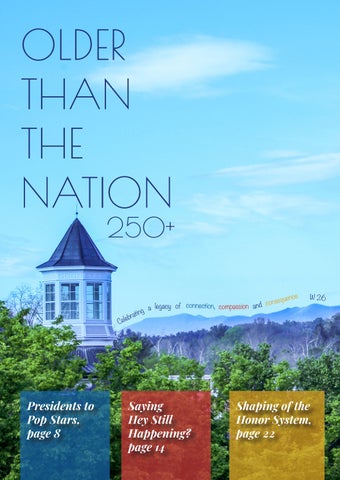
OLDER THAN THE NATION
TOTAL DOCUMENT SIZE (with bleed) 16.79” × 11.94” (426.47mm × 303.28mm)
250+
BOOK TRIM SIZE 8.27” × 11.69” (210.06mm × 296.93mm)
CENTER LINE Saddle stitch - No Spine g atin r b e el
a legacy of connection, compassion a
ce
en nsequ o c d n
W 26
C
Presidents to Pop Stars, page 8
Saying Hey Still Happening? page 14
Shaping of the Honor System, page 22
L by IFE Li IN zT T ru H E CO be C by L ck LA U A M | P SS na N g. RO be S 42 OM lS ,C O ch N W el C by HE ke R Pe RE | P ET rc H g. E A y I 33 N S M T as O D co RY G LA tte L SS E |P A g. VE 43 S CL U ES
This magazine is dedicated to connecting the W&L community to the history embedded on this campus. Through 15 stories, we capture the value of lifelong learning and celebrate a legacy of compassion and consequence.
RY
O
W
TO
IS
H E TH 30 : R g. I A P E p| m TH Shi N O ine LL rol I a ST y C b
HO by W F Ca AR rm en CAN LE Bu by GE nk YOU er Ca ND | P GO? rr S g. in IN 2 gt on LE TH Br XIN ow G by E B Vi EG n TO via IN an N d na N : Sy FR Va IN dn OM sq G O ey ue z| FC De PRE Pg AR vo SI .2 y | DE 8 E Pg N . 8 TS TO PO P ST AR S
F
R LU
KS
IN N JO
N E RA
TH
E OM W : S OOR 12 PUS D M A E . C g H ING 4 G T erts | P V L N I O N ob EV Pg. 1 | N o A OPE ecilia R c N he ON O ndra Pac I T by C I Y RAD nd Aleja T EGAC G L a N A I y F K O le GACY lling | Pg. 5 SPEA e Keight E L E E H T TH g Shi erin n i h t n n a a by C by Ch
Table of Contents designed by Carmen Bunker. Front Cover Photo by Viviana Vasquez. Back Cover Photo by Catherine Keightley.
ORY 26 T S I . E H el | Pg N I W&L L u T n D L a I A U HE liffie M HE B T C T by PPOR U S F POSE O R S U P N ATIO NEW g. 38 , R S E L WAL anier | P : GEN G D L N I O elia L GIV F m O A by NDS NOR | Pg. 20 A O H H THE e Smith , NEW T H n a G by L E NI M A S ESS: e | Pg. 35 R D ic CY FAN iott Van N l The final product for the Editing for Print and Online course is NOR by El O H F O a magazine. For Winter Term 2026, 17 journalism and strategic 2 ION Pg. 2 T | S communications majors began by collaboratively deciding on the E y A QU en Kelse magazine’s theme, name and mission, spinning off the nation’s id by A 250th birthday. From there, they envisioned, pitched, researched,
photographed, wrote, edited, designed and edited some more. Their stories reflect what they see as being important changes and influences on W&L over its 277 years. Ady Dewey, Reynolds Visiting Assistant Professor Strategic Communications Michael Todd, Manager of Technical Operations, Journalism and Mass Communications Department
HOW FAR CAN YOU GO? by CARMEN BUNKER
A W&L Student’s Expanding World, 1749-2026 For 277 years, Washington and Lee students have wanted the same thing: to take a break from their studies and explore the world beyond Lexington’s mountain-hemmed valley, even if just for a weekend.
1749-1874: The World Within Walking Distance
In the early decades of what would become Washington and Lee University, a student’s universe was measured in footsteps. The institution began in 1749 as Augusta Academy, perched in Virginia’s backcountry when “backcountry” meant something close to wilderness. Roads were Indigenous trails, often no more than the width of a horse. The James River offered passage, but only if you had days to spare and a stomach for rough water. For most students, Lexington was it. The classroom, the boardinghouse, the handful of shops on Main Street – that was the world for nine months of the year. Getting home for the holidays meant planning
weeks in advance. The Washington and Lee University Special Collections and Archives holds several records of what travel involved. In 1860, a man named George paid $5.93, roughly $200 in today’s money, for a journey that would take multiple days by stagecoach and rail, as recorded in an invoice from W. McLain. When Confederate soldier Ted Barclay wrote to his sister Hannah Moore Barclay on Jan. 26, 1864, about traveling from Lexington to Camp Stonewall, his account was matter-of-fact: “riding and walking.” That was the equation. If you had access to a horse, you would ride. If you didn’t, you walked. Natural Bridge, 15 miles south, was an ambitious day trip. Staunton, 35 miles north along the Valley Turnpike, was a genuine expedition. Even Robert E. Lee, as president of Washington College, moved through the South at this glacial pace. Writing to faculty member William Preston Johnston on April 21, 1870, during a trip meant to improve his failing health, Lee noted stopping in
Members of the Anderson family return from a berry-picking outing in this late 19th-century photograph — for most Washington and Lee students, the countryside was as far as thier world extended. Washington and Lee University Digital Archives.
Charleston for four days. He did so not because he wanted to linger, but because that’s how long it took to rest horses. The world was small because it had to be.
1874-1949: The Automobile Arrives, Slowly
By the 1920s, cars appeared on campus, gleaming symbols of modernity. Students pooled money for used Fords. The pages of the Ring-tum Phi were filled with car advertisements, articles about newly paved roads, sports stories about traveling to away games, and social columns mentioning road Before the automobile, a horse was a student’s fastest way of getting around trips. A 1929 issue Lexington, if they even had access noted students to one at all. Washington and Lee “riding about University Digital Archives.
4
|
OLDER THAN THE NATION
dusk Sunday evening on the river road south of Lynchburg.” One ad simply listed a phone number: “Phone 265 for Taxi or Transfer.” The infrastructure lagged behind the technology. Route 11 through Lexington was paved, but barely. Secondary roads were still dirt and gravel, turning to mud in spring rains. A trip to Roanoke, 50 miles west, was possible but required planning, daylight and luck. When the baseball team wanted to take an 11-day trip to Lynchburg on May 9, and then to Richmond, Kentucky, on May 20, 1901, it sparked campus controversy. Each player subscribed $5 toward expenses, far from pocket change during that time. In 1937, the car culture had matured enough to create new problems. That October, the Ring-tum Phi ran an editorial about automobile accidents: “In Lexington, in Virginia, in the United States at large, automobile accidents now take their yearly toll with careless regularity and seemingly unchecked force.” The paper called for the university to
A packed Washington and Lee parking lot illustrates the campus car culture that made parking — not distance — the defining limit of student travel by the early 2000s. Ring-tum Phi, Washington and Lee University Digital Archives.
fraternity houses and dorms, however, had begun stockpiling: “Already fraternity houses, lodgings and student garages are beginning to reek with odor of gasoline fumes from fuel stores in everything from pint bottles to 50-gallon containers.” A second story in the same issue put it plainly: “The second major federal restriction of a much-needed war commodity went into effect today with the beginning of gas rationing … The idea of the plan is to cut to a minimum all non-essential consumption of gas, and while it may seem to some that the weekend trips to Hollins and Lynchburg are essential.” Cars sat idle. Students walked again, caught rides when they could, or simply stayed put. After 1945, the floodgates opened. Returning veterans arrived on the GI Bill with money in their pockets and a hunger for normalcy that looked like a Ford sedan and an open highway. By 1955, state troopers were using radar guns on U.S. 11 – the main artery running north-south through the Shenandoah Valley – where most student-speeders were being picked up at night. The mountains still hemmed U.S. retail gasoline prices per gallon in Lexington in, but now students could current dollars, 1935-2025. U.S. Energy punch through them in under two Information Administration, U.S. hours. Department of Energy.
require driving tests and issue licenses “terminable at the discretion of the university authorities.” The same issue carried an ad “Rent a new car – Drive it yourself/Phone 660/ Chauffeur-less Taxi Co., Inc./107 North Main Street.” Freedom and danger sold side-by-side. World War II briefly reversed the trend. Gas rationing began on the Eastern Seaboard in 1942, as the federal government moved to limit civilian fuel consumption during the war. The Ring-tum Phi’s May 15, 1942, issue captured the campus effect under the headline “Car Owners Must Scrimp, Save for Gas to Get Home.” New restrictions on student gasoline ownership meant a student who needed 30 gallons to drive home “will get a certificate for only nine more gallons.” J. Alexander Veech, superintendent of building and grounds, had warned house presidents against storing gasoline anywhere on house property, a violation of both insurance clauses and a town ordinance. The
OLDER THAN THE NATION
|
5
a weekend destination. In December 1969, the Ringtum Phi reviewed a 192-page paperback guide to 59 eastern women’s colleges, from Maine to Virginia. The guide sold for $2 in the Washington and Lee’s 1925-26 Basketball schedule sent players as far as bookstore Washington, D.C., and Atlanta — distances that once required days of travel and was but now barely register for a program competing across the region in NCAA Divsion III. Ring-tum Phi, Washington and Lee University Library Digital marketed Archives. as essential reading The car brought new civic for “longer road trips in unfamiliar tensions, too. An April 13, 1954, issue territory, i.e., Radford, Sullins, of the Ring-tum Phi reported that Stratford, etc.” The casualness of the town officials, citing students’ use phrasing said everything about how far of Lexington streets, as justification the world had expanded. What would for an auto tax. The majority of have taken Ted Barclay three days on Washington and Lee students were not horseback now took 90 minutes on eligible to vote in Lexington elections, smooth asphalt. leaving them, as the paper argued, By the 1970s, parking became the powerless to fight “taxation without limiting factor, not distance. Students representation.” Cars with licenses complained about strict parking rules from other towns and cities would be and insufficient spaces. A May 19, exempt from the $5 tax, but that was 1978, issue described a green Pinto little comfort to the students footing station wagon parked on the road the bill. bending around the Woods Creek apartments toward the site of the new 1949-2024: The library, broken into with no one to take accountability. It was a mundane Interstate Opens the crime that only existed because cars Floodgates were everywhere. Interstate 81, which runs northThe gas crisis of 1973-74 barely south through Virginia’s Shenandoah slowed the momentum. Students Valley, opened through the region in grumbled about prices at the pump 1969, connecting Lexington to the but kept driving. By 2000, the annual broader mid-atlantic highway system. trek to Charlottesville for the Foxfield Interstate 64 followed, running eastRaces, a steeplechase event held each west toward Richmond and the coast. Suddenly, the entire Mid-Atlantic was spring that functions as much as a tailgating tradition as a horse race,
6
|
OLDER THAN THE NATION
drawing students from across the region, had become a fixture of the academic calendar. There were not enough parking spots for the number of cars that made the trip. Spring break meant Gulf Shores, Alabama, a thousand miles that felt routine. Low student airfare made even farther destinations possible. Then, quietly, the car culture began to fracture. In the mid-2010s, Uber and Lyft arrived in Lexington, offering something even more liberating than ownership: access without responsibility. Delivery services followed. DoorDash brought food from restaurants students had never visited. Amazon arrived at dorm room doors. Students could travel farther than before: weekend trips to the nation’s capital, the beach, a friend’s dorm room three states away. Fewer of them, however, owned the means to do it spontaneously. Distance collapsed, but in a fundamentally different way than the interstate had promised. The radius kept expanding, even as the center felt smaller—tighter course loads, busier schedules, and the creeping cost of gas made the open road more conditional than it looked.
Full Circle
In 1864, Ted Barclay walked from Lexington to Camp Stonewall because he had no other choice. In 2026, a student walks from their dorm to the library for the same reason – not because distance is prohibitive, but because parking is impossible and Uber costs $12. Lexington remains what it always was: beautiful, unhurried and just far enough from everywhere else to make leaving feel like an achievement. The difference is what “far enough” means. For 277 years, Washington and Lee students have been testing that distance, pushing against the limits of whatever transportation technology their era offered.
THE LEGACY OF A LEGACY
by CHANNING SHILLING The Washington and Lee University trident laced my entire childhood. It flew on the flag outside my grandparents’ home in Roanoke. It was sewn on the onesie my little sister wore as a newborn. It was on the cups my cousin and I sipped eggnog from on Christmas Eve. The symbol was a constant, a beacon, a code. Today, the trident is synonymous with family. My great-uncle, Dr. Charles Arnold Matthews, was the first in my family to attend Washington and Lee and graduated in 1937. His brother, my great-grandfather, Judge Joseph Aubrey Matthews, followed him, graduating in 1921. My greatgrandfather, whom I call Judge, was born in 1921 in Brunswick County, Virginia. He majored in business and graduated from W&L in 1942. Shortly after, he joined the Navy and fought in World War II. Once the war ended, Judge returned to W&L for law school and soon welcomed my grandfather, Joseph Aubrey Matthews Jr., into the world. My grandfather, whom I call Twodaddy, was born in downtown
Joseph Aubrey Matthews Jr. graduating from W&L in 1968. Courtesy of Ashley Shilling.
Lexington in Stonewall Jackson’s house, which had been converted into a hospital during the war. What had once been the family kitchen became the delivery room where Twodaddy took his first breath. With a new baby and a law degree, Judge moved to Marion, Virginia, in 1948. My granddad grew up in Marion with his three sisters. As children, their father would take them to W&L
Brown came to campus while I was there, too.” Twodaddy graduated cum laude and received the honorary economics award in 1968. “The small classes and relationships I built with my professors were the best thing,” he said. On July 3, 1972, Twodaddy and my grandmother, Gogo, welcomed their first daughter, Whitney. Two years later, my mom, Ashley, was born. Bradley, the last of the pack, arrived seven years after that. The three sisters grew up hearing stories of my grandfather’s time at W&L. “I have early memories of walking through campus and the Colonnade as a child and seeing the students interacting with each other and wanting to be them,” my mom said. “They all looked so engaged and happy, and I looked up to them so much.” W&L was a special place for Twodaddy, but it was not an option for any of his daughters until the school went coed in 1985. “I thought women coming to W&L was a great idea. I was in favor of it from the first time it was
“Dad and my grandfather having gone there was a big influence for me. The way Dad talked about it pulled me there.” football games and show them the campus he had called home. At 18, Twodaddy returned to Lexington as a student, majoring in economics and playing on the football team. “I wanted to get a good education and to have some fun in that order,” he said recounting why he decided to go to W&L. And that he did. “Mock Convention was important. We nominated Richard Nixon, and he got the nomination after that,” Twodaddy said. “There were so many good parties, and a lot of Motown bands came, like The Temptations. James
OLDER THAN THE NATION
|
8
discussed. It’s made it a much better school, and all of my friends feel the same way,” Twodaddy said. “A lot of them have had daughters who have gone there.” “It was this prestigious, male school, and it never felt like it was a possibility for me, but then all of a sudden it was,” my Aunt Whitney said. “Dad and my grandfather having gone there was a big influence for me. The way Dad talked about it pulled me there. He loved college. He loved his friends. He was an amazing athlete and leader. I wanted to be a leader, too,” she said. Whitney was the first woman in our family to attend W&L, joining the school in 1990. Two years later, my mom, Ashley, moved into Graham-Lees Hall. The two sisters shared the school, merging friends and memories. “Overlapping those two years really further connected us through our shared experiences at the school that we both adore so much,” my mom said. W&L brought family members together and introduced new ones,
too. Whitney met her future husband, Joe, at a Halloween party at Zollman’s Pavilion their freshman year. They did not know it then, but in 1996, he would propose on the Colonnade, and one year later, they would get married in the University Chapel. “My favorite memories include tubing on the river, sitting on our deck at Lower Windfall reading, jogging the Chessie Trail with friends, live music at Zollman’s, and just walking through the beautiful Colonnade, feeling all of the history there,” my mom said. “Thirty years later, seeing my daughter experience all of these things is surreal. While I firmly believe the school has made incredible progress with its integration of women and academic rigor, there is so much that is unchanged. I cannot imagine a school that ties people together as effectively as W&L.” The last of the Matthews girls made it to W&L in 1999. Bradley and my Uncle Michael found each other in
“Overlapping those two years really further connected us through our shared experiences at the school that we both adore so much.”
Joseph Aubrey Matthews. Whitney Ramsuer. and Joseph Aubrey Matthews Jr. graduating from W&L in 1994. Courtesy of Whitney Ramsuer.
8
|
OLDER THAN THE NATION
Ashley Shilling in 1996. Courtesy of Ashley Shilling.
Lexington. Their first kiss was outside of Sweet Things. Their wedding party in 2007 was made up of friends from college. “I still remember going to the mailbox in December 1992 and finding the letter with ‘Washington and Lee Admissions’ written on the upper left corner as the return address. I remember my fingers shaking as I ripped open the envelope and read the ‘Congratulations’ heading at the top. It was one of my very best days,” my mom said. I got into W&L at 8 p.m. on Dec. 15, 2022. My little sister ran around wearing a pink W&L shirt. My little brother threw blue and white glitter. My heart exploded, and my mom cried. At that moment, I saw the faces of every family member who loved the school before I did. “That said, awaiting the release of Early Decision for my own daughter held even more stress than my own because, like me, it was her one and only school. Thankfully, her online portal also brought good news – a moment of tears and confetti that I will never forget,” my mom said. During the past four years at W&L, I have made my own memories, relationships, and path. My experience has been different from my family’s,
but I have felt them around me every day. On my walk to class, I constantly think about their feet stepping on the same brick decades ago. At The Palms, as I sit with my friends, I picture my 20-year-old mom, laughing with hers in the booth across from us. When I sit on the Colonnade, I think about my grandfather running around as a boy, throwing a football on the grass. As I walk out of Sweet Things with my ice cream cone, I imagine my aunt and uncle on their first date, creating the beginning of their beautiful life together. I am proud to carry the legacy, to serve as a testament to how special
classmates whose children now attend is really a testament to how deep the W&L roots run,” my mom said. “Seeing my daughter loving the school the way that I loved the school has filled my heart, and revisiting the school and seeing her there surrounded by friends and challenged by the school has further affirmed why it is such a special place.” This is my family’s story, but it is also the story of countless other W&L families. David Mabe, the senior associate dean of admissions, said that, on average, about 10% of every class has a direct legacy tie to W&L. In Latin, “alma mater” means
Whitney Ramsuer, Joseph Aubrey Matthews Jr., and Ashley Shilling at Whitney’’s graduation in 1994. Courtesy of Whitney Ramsuer.
“Seeing my daughter loving the school the way that I loved the school has filled my heart, and revisiting the school and seeing her there surrounded by friends and challenged by the school has further affirmed why it is such a special place.” this place truly is. W&L formed my family, teaching each of us what it means to be generous, compassionate, driven and kind. We carry these lessons with us through graduation and into our lives after we leave. “Going back to the school and seeing so many of my former Ashley Shilling and Channing Shilling at 2026 Parents Weekend. Courtesy of Ashley Shilling.
“nourishing mother.” “The phrase suggests that your college should serve as a surrogate parent who helps you learn and grow. And mothers aren’t temporary. At W&L, especially, the idea of cultivating a college family that augments and extends your natural family is particularly powerful,” Mabe said. “It’s fitting that, when you’re a parent yourself, you’d hope for your own children to be challenged and supported as you were. Life is a cycle, and legacy admission can serve as a cycle, too … turning and returning to a place that has helped your family grow.” Learning my family’s language and being inducted into their shared history has meant everything to me. I am indebted to this school for showing me where I came from, who I am, and what I want to be. The trident is a symbol of my family, connecting us to our past and to each other. Lexington has been, and will always be, my family’s home, and I am grateful that I was able to spend the past four years surrounded by the magic it holds.
Ashley Shilling studying on the Colonnade. Courtesy of Ashley Shilling.
Ashley Shilling and Whitney Ramsuer at Whitney’s gradution in 1994. Courtesy of Whitney Ramsuer.
LEGENDS IN LEXINGTON
iii
From presidents to pop stars, some of W&L’s unforgettable visitors by CARRINGTON BROWN AND SYDNEY DEVORY Deep in the Shenandoah Valley, Washington and Lee University has brought some of the most prominent politicians and musicians in history to Lexington, Virginia. Stars have traveled from around the world to leave their mark on W&L’s campus in various ways, bringing lively performances and intellectual discussions, and connecting students to global conversations. Attracting big names in music and politics is up to the students, with the support of a strong university reputation, networking, and famed venues.
General Activities Board W&L books these prominent figures through student-led initiatives such as Mock Convention, the Contact Committee and the General Activities Board. Each organization receives funding from the Executive
Flyer advertising the Homecoming Concert of 1985, put on by the Student Activity Board. University Library Special Collections and Archives.
10
|
Committee and plans performances at various on- and off-campus venues. GAB’s Concert Administration and Operation Chair Mason Stanley ’28 said W&L has maintained strong relationships with many different booking agencies for years, making the booking process easier. He also said Lexington’s historic venues help attract talent. “Lime Kiln Theater is a draw for new acts looking for recognition,” said Stanley. Lime Kiln Theater was established in 1984 in an abandoned limestone quarry, not far from the university’s athletic fields. Each season, the venues’ two outdoor stages host folk and bluegrass performances, with a beautiful ambience provided by the surrounding nature. Similar to Lime Kiln, Zollman’s Pavilion, established in 1816, is a
OLDER THAN THE NATION
notable historic venue that hosts band parties and events. The pavilion has served as a gathering place for students at W&L for generations. “W&L students have a grand social tradition, and Zollman’s is
“W&L Students have a grand social tradition, and Zollman’s is an integral part of it” an integral part of it,” said Celeste Rasmussen ’95, in a Ring-tum Phi interview when she was a student on campus. A 15-minute drive from campus, passing through grassy fields, Zollman’s has hosted the Dave Matthews Band, Bill Clinton, Widespread Panic and many others. Through annual events like Lex Fest at the Lime Kiln and the Winter Concert, which is held on Cannon Green, GAB has continued to bring artists to campus and uphold longstanding traditions.
“I was amazed that political leaders would Take time for a 21-year-old college kid”
Former President Richard Nixon greets W&L students at 1968 Mock Con. Courtesy of Mock Con.
mock convention Every W&L student gets the opportunity to experience Mock Convention one time within their four years, but few understand the years of planning that goes on behind-thescenes to enable the production.
“The significance of Mock Convention is definitely highlighted by the fact that it is completely student-run and organized,” Elise Bryant ’92 said in a Ring-tum Phi interview when she was the Mock Con secretary. The convention started in 1908 when presidential candidate Williams Jennings Brian visited W&L’s campus, and a club of students decided to throw a convention to generate excitement about his visit. The accuracy, prestige, and strong alumni connections have made Mock Con a tradition for students to get politically involved and learn from international leaders. In 2023, more than 1,500 W&L students joined delegations, which represents over 80% of the student body – far above the national average, according to a Tufts University study that found some 53% of students are politically engaged. Students participate in various ways, such as performing research for their state, building floats, coordinating guest speakers, or covering the event for the student news organizations. The prestige of the event, built on a foundation of hard work from generations of students, is one of the ways Mock Con attracts important people to campus, making the event a
W&L students gather at Zollman’s Pavillion in 1973. University Library Special Collections and Archives.
memorable part o their four years. “I was amazed that political leaders would make time for a 21-yearold college kid,” George Kinkead ’85 said reflecting upon his experiences.
Contact Committee The Contact Committee, established in 1965, may not be as old as Mock Con, but it also adds significantly to campus culture and life. “The Contact Committee was created to prove W&L students value serious, intellectual engagement,” said Daniel Reiter ‘26, current president of the organization. “We don’t want to be seen as a political organization, so we try to spread out the viewpoints of the people we bring.” Reiter joined the Contact Committee his first year and applied for his current position at the end of his junior year. The Executive Committee chose him and Cate Brien ‘26 as chairs to lead the organization their senior year. They will pass the knowledge they have learned to the students who will inherit the leadership roles next year. The wide range of visitors appeals to the interests of many students on campus, promoting discourse among peers and connections over shared experiences. These organizations host events that make W&L’s campus intellectual, fun, and lively. Who knows who will pass through Lexington over the next 277 years – it could even be a student reading these words today.
1960s Duke Ellington Duke Ellington headlined at the 1961 Fancy Dress Ball, performing for over 1,400 students. Ellington’s legacy lives on as his music remains a key part of the university jazz ensemble. In fall 2025, his song “What Am I Here For?” was played in a student showcase. He stepped up after Louis Armstrong cancelled at the last minute. Armstrong, however, left a lasting mark with the last song he composed before he died, called “The Washington and Lee Swing.” University Library Special Collections and Archives.
iii
Harry Truman Former President Harry S. Truman delivered keynote speech at the 1960 Mock Convention, where W&L students correctly predicted John F. Kennedy as the Democratic nominee. Truman said, “This is a real convention, and I ought to know because I’ve been looking at them since 1912.” His speech started a long tradition of national recognition for Mock Con’s accuracy and legitimacy.
University Library Special Collections and Archives.
1970s
The Allman Brothers Band
The band performed months before its breakthrough album “At Fillmore East” was released. The Allman Brothers’ song “Ramblin’ Man” has transcended generations and remains a timeless classic, often still played at fraternity band parties.
iii
University Library Special Collections and Archives.
Jimmy Carter Unlike Truman, Jimmy Carter was not nationally known when he delivered the keynote speech at the 1972 Mock Con. The governor of Georgia encouraged the audience members to be politically active. “Join me in making our nation what it ought to be and making our government as good as our people are,” he said.
University Library Special Collections and Archives.
1980s The Four Tops Kicking off Fancy Dress weekend, The Four Tops brought the energy in 1985 in the Student Activites Pavilion, or as The Calyx yearbook referred to it: the “party barn.” The Four Tops were an American Motown quartet from Detroit, Michigan. The group was inducted into the Rock and Roll Hall of Fame in the 1990s, leaving a legacy for jazz and soul music. University Library Special Collections and Archives.
12
|
OLDER THAN THE NATION
iii
Joe Biden In 1984, then Sen. Joe Biden, D-Del., delivered Mock Con’s opening address. He discussed his campaigns for the U.S. Senate and his 1984 campaign for president, his first run for that office – a race he ultimately dropped out of. In his speech, he spoke about his first winning-run for U.S. Senate at age 30 and his experiences as a young politician.
University Library Special Collections and Archives.
1990s Dave Matthews Band
University Library Special Collections and Archives.
Named the “biggest band of the year,” by The Calyx yearbook in 1993, Dave Matthews always attracted a huge crowd, wrote Leslie Ratz ’93. Matthews lived in Charlottesville, Virginia, at the time, and students often drove over the mountain to see him perform. By 1994, his career took off and he received multiplatinum status. Office iii of Communications and Public Affairs.
Margret Thatcher Former British Prime Minister Margret Thatcher visited Lexington in 1992. She spoke at VMI about the political and military decisions she had to make throughout her term. She talked about how NATO and western nations worked together to fight communism. “Thatcher gave a chronology of the crises she faced during her term in office, all of which she said were unexpected,” said Rick Peltz ‘92 in a 1992 edition of the Ring-tum Phi.
2000s
Ross Lynch
Credited for his rise to fame as a Disney star, in 2025, Lynch was on tour with his brothers in their band, The Driver Era, and stopped between shows at the invitation of the Contact Committee. Tickets sold out in a day. “Every pew in the chapel was packed with students cheering as they enjoyed Lynch’s talk and performance of their childhood favorite songs,” Celeste Silva-Carrillo ’28 wrote for the Ring-tum Phi. iii Office of Communications and Public Affairs.
Ruth Bader Ginsburg
In 2017, Supreme Court Justice Ruth Bader Ginsburg was invited to Lexington in a joint invitation from the Washington and Lee School of Law and the Virginia Military Institute. Then age 83, she gave legal career advice, reflected on her time as a justice and uplifted women in the audience. According to The Columns, Ginsburg said, “Whatever you do in the law, do in addition something you are passionate about – do something outside yourself that will make things a little better for people who are less fortunate than you are.”
Office of Communications and Public Affairs.
OLDER THAN THE NATION
|
13
OPENING THE DOORS: WOMEN JOIN THE RANKS
by CECILIA ROBERTS
Women scholars first made their mark on Washington and Lee University 43 years before they were allowed to enroll as undergraduates. In 1942, W&L held a summer school program that 24 women attended. In 1972, the W&L School of Law admitted seven of its first female students. Finally, in 1985, 105 women entered W&L after a 17-7 vote from the board of trustees in favor of undergraduate coeducation.
I
Caroline Boone Mitchell ’89. Courtesy of Caroline Boone Mitchell.
mmediately after arriving on campus, women found ways to foster connection and create a sense of belonging among themselves. In the first year of coeducation, female students made up women’s varsity swimming, tennis, golf, and cross-country teams. In 1989, the Kappa Kappa Gamma, Chi Omega, and Kappa Alpha Theta sororities formed chapters on campus and the Panhellenic Council was established. These social and athletic groups were how women differentiated themselves from the men who were long-settled into the history and culture of W&L. Building sisterhoods and social outlets wasn’t just for fun. It was their livelihood. Caroline Boone Mitchell `89 P`23 P`25 P`28 was among W&L’s first class of undergraduate women. She was a member of Kappa Alpha Theta, and is currently involved with W&L through her roles as a parent to three Generals and as the chair of the Fund Council, which is a group that works to secure donations.
14
|
Mitchell said she decided to come to the university to be a part of the traditional W&L experience, not to change it. But because there was no preexisting social structure for female students, other than women from nearby colleges visiting on the weekends, it was up to Mitchell’s class to create it for themselves. Trident, a social club formed by these first female students, hosted social events that were separate from the social life dominated by fraternities.
Eleven members of Trident in 1989. Washington and Lee University Digital Archive.
Because sororities didn’t exist on campus until 1989, becoming a member of Trident was one of the few ways to be a part of a women-led social scene. Members met regularly
OLDER THAN THE NATION
Front page of Ring-tum Phi, July 1984. Washington and Lee University Digital Archive.
and asked the school for funding to host a few parties a year. Trident offered the women opportunities to define their own experiences as opposed to being dependent on only what the men wanted to do. “The school would not be where it is today without going coed,” said
“The school would not be where it is today without going coed” Mitchell. Mitchell said she and her W&L roommates stay in close touch by traveling to see each other and having a group call date every two weeks. Alston Parker Watt `89 was another trailblazer in finding women’s voices and inclusion on campus. During her time at W&L, Watt was
a member of Kappa Kappa Gamma, Trident, and the women’s varsity lacrosse and swimming and diving teams. Watt echoes Mitchell’s sentiment about the school admitting women who were interested in integration and change, who were resilient and flexible, but who did not want to completely abandon the tradition and culture of W&L. “By bringing women into the school, it became a much more
balanced culture of not just academics and social, but better town-and-gown relationships were built as a result, too,” Watt said. Her senior year, Watt was the first woman elected to the Executive Committee. She also became the first undergraduate woman appointed to the board of trustees in 2003. The men’s and women’s soccer teams and the women’s lacrosse teams play on Alston Parker Watt Field, which is named in her honor. Being a part of sports teams was important to Watt because, for most of her college experience, it was the only way she could practice leadership. She served as captain of the lacrosse team, which was that much more important because there were only four women’s varsity teams and limited leadership outlets on campus. As a pioneer of Trident, Watt said she knew how important it was to advocate for sororities to colonize on campus. Being a part of a chapter of a national organization was not just helpful for participating in
social events but also in providing every woman with leadership and philanthropy opportunities. “They’re not just social. They’re wonderful. You learn how to network. You learn how to live in a community with other women,” Watt said. “You have opportunities for leadership. You get to exert that leadership through philanthropy as well. I mean, it is so much more.” Today, the undergraduate population of W&L is 54% women. There are six Panhellenic sororities, which claim around three-quarters of the female undergraduate population as members, and 12 women’s varsity sports teams. This progress and integration wouldn’t be possible without Caroline Boone Mitchell, Alston Parker Watt, and their 103 female classmates. These women didn’t find a sense of belonging in social organizations and sororities. They made it themselves by fostering communities of like-minded women who led and enriched the community.
Kappa Kappa Gamma sorority’s founding chapter. Washington and Lee University Digital Archive.
Kappa Alpha Theta sorority’s founding chapter. Washington and Lee University Digital Archive.
Chi Omega sorority’s founding chapter. Washington and Lee University Digital Archive.
Alston Parker Watt ’89. Office of Communications and Public Affairs.
OLDER THAN THE NATION
|
15
THE SPEAKING TRADITION ON AN EVOLVING CAMPUS by CATHERINE KEIGHTLEY and ALEJANDRA PACHECO
A student reads along the colonnade as others socialize on the lawn behind her. Photo The Calyx 1994.
61 |
OLDER THAN THE NATION
said Laura Ulmer, Dean of Student Engagement. “I get a little bit sad when I see people passing each other without interacting.”
Seen and Heard: How the Speaking Tradition Levels the Playing Field
Alums during Young Alumni Weekend 2025. Photo Office of Communications and Public Affairs.
O
ne autumn afternoon in the late 19th century, Robert Doremus and his wife, Jessie, were wandering through the quiet streets of Lexington when a Washington and Lee University student stopped to say hello. The greeting turned into an offer to show the couple around campus. The New York stockbroker, who was used to the fast pace and hustle of the city, was shocked by the abundance of greetings received from all those whom they encountered during the tour. The experience impacted Doremus, who had been planning to make a sizeable donation to support a southern college. He eventually included W&L in his will, establishing a trust of $1.5 million that would revert to the school after his wife’s death. In 1936, the university received the gift, still one of the largest ever given. It was directly tied to the
knit community, so he encouraged students to greet each other when passing. Now, as the student body and culture at W&L continue to change, many argue that the 150-year-old tradition is slowly fading. “I feel like the Speaking Tradition is kind of slowing down a little, which is why events like ‘Say Hey Day’ are so important,” said Zachary Puckett ’26, a Kathekon member. Among other duties, Kathekon, the student organization that fosters student-alum relationships, sponsors “Say Hey Day” twice a year to promote the tradition. Kathekon hosted “Say Hey Week” in 2025, from Nov. 17-21, encouraging students to write signs promoting the Speaking Tradition while handing out prizes. However, members of W&L’s community question how changes in the student body, especially as it achieves greater inclusivity, and the impact of people’s relationship
“I get a little bit sad when I see people passing each other without interacting” Speaking Tradition, initiated by Robert E. Lee to embody traditional Virginia hospitality on campus. He wanted the university to have a close-
with technology, are affecting the tradition. “The Speaking Tradition is one of my favorite traditions on campus,”
Every student at W&L is told about the Speaking Tradition during orientation week. They learn about what it entails, the events that support it, and even get stickers they can glue to their Hydro Flasks. What fewer students know, however, is the history behind this tradition and why a simple hello carries so much weight. Many wonder if the Speaking Tradition is still strong enough to act as an equalizing instrument in the community. W&L’s student body and culture have changed significantly since it was founded by Scotch-Irish settlers in 1749 as Liberty Hall Academy. In 1798, the university was renamed Washington College after George Washington made a major gift to the school. The university was renamed once more in 1871 after Confederate General Robert E. Lee served as president of the university post-Civil War. The student body was all white and all male – a reality that started to change near the end of the 18th century. Around 1790, John Chavis enrolled and studied at Liberty Hall Academy becoming the first African American known to receive a college education in the United States. However, Washington and Lee didn’t become fully integrated until 1966 when it admitted two students of color. Dennis Haston was admitted as an undergraduate, and Leslie Smith was admitted to Washington and Lee’s School of Law, becoming the first woman to join the institution. Since then, the university’s profile has dramatically changed. Cayla Nelson ’28 as she walks along Stemmons Plaza. Photo Office of Communications and Public Affairs.
OLDER THAN THE NATION
|
17
18
|
OLDER THAN THE NATION
TECHNOLOGY MEETS TRADITION In an era of endless notifications, greeting strangers must compete with something much bigger: glowing phone screens, music blasting in headphones, and students moving quickly between classes. Cellphones are ubiquitous around W&L’s campus. From dining hall and classroom tables to students’ hands, mobile phones have a constant presence on campus. In an informal survey of around 50 students, threefourths of those who responded said they check their phones at least 100 times a day. One student said they pick up their phone more than 300 times. As mobile technology becomes more prevalent, students say it may be reshaping everyday interactions on campus, raising questions about whether the Speaking Tradition still holds the same place in student life. Almost all U.S. college-age students own cellphones. A 2025 Pew Research Center study found that 99% of Americans ages 18-29 own a cellphone, and 27% are dependent on them. The study also linked heavy
The Speaking Tradition Before Technology cellphone use with feelings of social isolation and reduced face-to-face interaction. Alum Caroline Adams ’95 said she remembers the Speaking Tradition as a natural part of everyday life on campus. “When I think of the Speaking Tradition, I think of friendly, smiling faces – people looking up to make eye contact and say hi as they pass by,” Adams said. Greeting strangers, she said, felt universal when she was a student. “It really felt like everybody did it,” she said. “I would say 95% to 98% of people looked up and at least nodded or said hi.”
Grace Brockenbrough ’27 walks through the center of campus on her phone while passing another person with their head down on the screen. Photo Catherine Keightley.
Without phones, Adams said walking across campus had no technological distractions, which is so unlike the current state. “If you were walking to class by yourself, you were just walking,” Adams said. “You weren’t having to do another task at the same time.”
Expectations Before and After Being on Campus Georgia Ball ’29 said the Speaking Tradition was one of the first things she heard about when considering W&L. “When I was visiting, they definitely emphasized the Speaking Tradition,” Ball said. “They talked about how we’re a small school, and we know our entire community.” But Ball said phones can be a way to avoid uncomfortable interactions. “People use their technology to get out of the awkwardness of walking past someone on a small campus where you’re supposed to say hi,” she said. Avery Lee ’27 said the reality of the tradition has not always matched her expectations, especially now with the increase in technology on campus. “I expected everyone to be much happier when they said hi. So many people don’t even follow the Speaking Tradition anymore,” Lee said. “I will try to say hi even when listening to music or someone’s on their phone.”
Lee said headphones have become a social signal that affects the Speaking Tradition. She thinks the more people walk around campus wearing noise-cancelling earbuds, they are less likely to engage with others. This reinforces the same disconnect on campus that cellphones have introduced. While some believe the tradition has weakened, others say it has evolved. Since the campus environment is now filled with digital distractions, saying hello might require
more intentional effort than it used to. So even if the Speaking Tradition isn’t disappearing, some students believe it will become an undertaking that requires more purpose and effort than it once did. It requires a simple action: to look up.
OLDER THAN THE NATION
|
19
In recent years, the university has started upping its efforts to increase diversity and enroll more students belonging to minority groups. In 2015, 11.8% of all enrolled students were domestic students of color. Now, counting the first-year class, 22.4% are students of color. The university has almost doubled its percentage of minority students in a decade through programs like Questbridge and investments to promote diversity. The Speaking Tradition has grown from its original purpose to become a tool of inclusion for students that are part of this wave of change. Winter Ashley ’25 said she misses the Speaking Tradition now that she is getting her master’s degree from Johns Hopkins University in Washington, D.C. “Something that I’ve learned while being in a city is that it’s not normal to look at people and smile when you walk past them every day the way it is in W&L,” Ashley said. “It embodies something positive for the community, even if we don’t always engage with it the right way.” Sharing greetings can be a powerful tool to build community and help students adapt to the culture at school, especially when they first arrive. “When I first started, I didn’t really know a lot of people,” Ashley said. “It was nice to have strangers remember my face and approach me with a friendly hi or ‘good to see you.’” But not all students are automatically comfortable participating in a tradition. “People who don’t participate might just not be comfortable with that kind of ‘Southernish’ way of
Claire DiChiaro ‘26 and Madison Kessack ‘26. Photo Alejandra Pacheco.
However, it can also have the opposite effect. After all, the Speaking Tradition is merely an instrument that reflects the community’s values, and it can be reshaped by different groups to fulfill different purposes. As a person of color, Ashley found that the Speaking Tradition allowed some minority groups on campus to build and strengthen their communities. “I think that students of color who go to the school have taken the Speaking Tradition and turned it into something that serves them,” Ashley said. “When I was a student, we would use the tradition as an opportunity
“I think that students of color who go to the school have taken the Speaking Tradition and turned it into something that serves them” communicating,” Ashley said. “We have to avoid singling out people who don’t participate by calling them ‘rude’ because they might come from a different cultural background where it’s not a common practice.”
20
|
to compliment each other when we would showcase our culturally salient outfits or hairstyles.” The tradition made Ashley feel more comfortable displaying her cultural roots in a predominantly
OLDER THAN THE NATION
white institution. “For me, a big part was wearing my natural curly hair on campus,” Ashley said. “When I did, I found that because of the Speaking Tradition other students of color would go out of their way to tell me that my hair looked nice.” The tradition also helps students solidify their connections with groups they already belong to. Cindy Xie ‘26 believes that the Speaking Tradition has helped her connect with peers from PAACE, the Pan-Asian Association for Cultural Exchange. “I feel like the Speaking Tradition helps me connect with people from the groups I already belong to,” Xie said. “It’s a natural way to solidify connections that already exist on campus.” She also believes the tradition allows her to bond with new people as well. “Even if we might not have anything in common, if we haven’t interacted in any way, we can always say ‘hey’ to each other,” Xie said.
Shaping What Comes Next The Speaking Tradition may not look exactly the way it did 150 years ago, but its core purpose remains the same: to welcome others and build connections across campus. As W&L’s student body becomes more diverse and technology continues to shape everyday interactions, the tradition will evolve. For some students, the tradition is a
way to build community, celebrate identity and acknowledge one another in a shared space. The Executive Committee recently created the Speaking Tradition Committee, which is a group of 10 students tasked with guiding the tradition’s evolution while also keeping its original values. Committee member Cora Villere ’27 said, “The goal is to make the Speaking Tradition more well-known and make sure it stays as intact as it
used to be.” She said they are just beginning their work with the Executive Committee president “to pitch ideas on how to raise awareness.” The future of the Speaking Tradition will depend on how today’s students choose to shape it. Even if the tradition is different from how it began, W&L students carry the responsibility of keeping the sense of connection and community alive.
Two students socialize on W&L campus. Photo The Calyx 1994.
OLDER THAN THE NATION
|
21
THE HONOR OF GIVING: GENERATIONS OF SUPPORT THAT BUILT W&L by LANE SMITH From the books in Leyburn Library to the classrooms where we study to the cafe we eat in, almost more than can be imagined at Washington and Lee University has been made possible by gifts from alumni, parents, friends and people who care about bettering our community.
“To promote literature in this rising empire, and to encourage the arts, have ever been amongst the warmest wishes of my heart.”
offerings because they understand the impact that the university has on so many lives. Although there is not an exact number to quantify how much money has been raised since its founding as Augusta Academy in 1749, the endowment value is $2.19 billion as of June 30, 2025. The W&L Fund, the university’s primary giving program that supports the operating budget, was the highest it has ever been at $10.89 million in 2025. While impressive numbers, the real significance are the names and stories behind each gift. There are thousands, if not millions, of such stories. Following are a few of them.
George Washington donates stock to Liberty Hall
- George Washington, Letter from June 17, 1798 W&L was built on a foundation of generosity spanning from George Washington’s donation to the current Leading Lives of Consequence Campaign. Significant individuals over the years have contributed to scholarships, buildings, programs, student life and other W&L campus
22
|
In 1796, George Washington decided he wanted to give to higher education, and he felt that Liberty Hall Academy was the right fit. This gift would form the largest portion of the Academy’s small endowment from which students still benefit. Washington exchanged letters with Liberty Hall trustees, and later that year, the school was renamed Washington Academy. The transfer took two years to finalize, and in 1798, his 100 shares of the James River Company, which is the equivalent of $20,000 today, was given to the Academy.
The Lettie Pate Evans Foundation
The Lettie Pate Evans Foundation’s donation to the university for the renovation of Reid Hall in 1965 prior to the journalism department moving in. Photo Lane Smith.
George Washington writes to Liberty Hall Trustees on June 17, 1798, thanking them for renaming the school Washington Academy on Dec. 7, 1798. University Special Collections and Archives.
OLDER THAN THE NATION
Letitia Pate Whitehead Evans was a philanthropist and businessperson. She succeeded her husband and took control of his Coca-Cola Bottling shares. She eventually sold the shares and dedicated the rest of her life to
philanthropy. Her first gift to W&L was in 1954, 31 years before women were admitted. Evans went on to become W&L’s largest benefactor, contributing to the renovation of Newcomb Hall, Reid Hall and other structures and initiatives. In 2025, The Lettie Pate Evans Society was established to encourage women in philanthropy. Today, Evans’ gift to W&L is valued at over $673 million, according to The Columns.
Dodson’s husband, Drew Dodson ’00, chose to focus their 25th reunion gift on programming and support for the Center. The campaign also supports improvements to university facilities such as the Williams School of Commerce, Economics and Politics building. It was constructed with sustainability in mind, and it provides state of the art classrooms and study spaces.
Radocesky wrote in an email. Students can give back to different parts of the W&L Fund that are most meaningful to them. Some of these include financial aid, academics, the arts, athletics, inclusion and engagement, and areas of greatest need.
“Giving back means paying The Leading Lives of The Next Generation forward the Over 100 years ago, the Class of Consequence Campaign 1925 sent a letter to the university’s In 2024, W&L launched its president, Henry L. Smith, with experiences Leading Lives of Consequence a gift of $1,800. That started the Campaign with a goal of $650 million. tradition of what was to become that shaped It has raised over $574 million from W&L’s Senior Gift Program. Two more than 23,000 individual donors representatives from each senior my time at according to the President’s Report class lead a committee to encourage for 2025-2026. It aims to strengthen and engage with their classmates every part of the W&L experience W&L. Alumni about giving, often raising money through a range of initiatives such as for a specific project. This helps scholarships, arts, athletics, student generosity students understand the power of life and much more. philanthrophy as they become alumni. Significant contributions have Reagan Radocesky ’26 and Will Knight has created already been made. Bill Miller ’72 ’26 are current co-chairs of the senior contributed a $132 million gift to class gift committee. countless support need-blind admissions. “As my alumni status is quickly This is the single largest gift in the approaching, I want to give back and opportunities university’s history and one of the pave the way for future students to largest dedicated to financial aid at have the same opportunities as me!” for students to any liberal arts college. The Lindley Center for Student Wellness, dedicated in October grow socially, academically, and professionally, and I’ve directly benefited from that support.” The Lindley Center for Student Wellness opened in August 2025 with counseling and health services. Photo Viviana Vasquez.
2025, houses health and counseling services and is named for Dr. Lindley Sphat Dodson ’99. According to The Columns, lead donors to the building include Holden and Claire Spaht P’26 and the Classes of 1996 and 1999. The Class of 2000, which includes Dr.
- Will Knight ‘26 George Washington’s indenture officially transfers 100 complete shares of the James River Company to Liberty Hall Academy on Dec. 7, 1978. University Special Collections and Archives.
OLDER THAN THE NATION
|
23
A QUESTION OF HONOR by AIDEN KELSEY
At the beginning of every semester, first-year students gather in University Chapel to learn about the Honor System. The student-led system’s roots trace back to 1844. Photo Aiden Kelsey.
24
|
OLDER THAN THE NATION
Codification, the single sanction and artificial intelligence all have students talking. But to understand where the Honor System is going, we also need to know where it started.
To codify, or not to codify? That is the question. But student leaders at Washington and Lee University say it’s only one of several concerns facing the school’s student-led Honor System, which has set standards for acceptable student behavior for well over a hundred years. “I think that the amount of conversation we’ve had about the Honor System this year is a great indicator of the fact that it’s still very strong,” said Executive Committee President Meaghan Endres ’26. Today, the Honor System is defined by its single-sanction rule. Any violation of the system is punishable by expulsion from the university. The White Book, the student body’s governing document, does not codify what actions constitute an honor violation. “Each new generation of students defines the Honor System by its actions and the behavior it deems dishonorable,” according to Article I of the White Book. “Any action deemed a breach of the community’s trust shall be considered an Honor Violation.” In the past year, community members have called into question both the lack of codification and the single sanction itself. Student leaders have responded. The Executive Committee consists of elected student representatives responsible for administering the Honor System. EC Vice President John Beekman Youngblood ’27 said the committee formed a Constitutional Review Committee in November 2025 to address student concerns about the
Samuel C. Smith added the honor pledge to his geometry exam in 1858, creating the oldest surviving record of the pledge at W&L. University Library Special Collections and Archives.
Honor System. “At the end of the day, my opinion doesn’t matter,” Youngblood said. “The whole idea is that we create an Honor System that fits the students’ idea of honor.” The Student Body Constitution, which structures student goverment at W&L, calls for the EC to appoint a Constitutional Review Committee every three years. But Youngblood said the EC also decided to give this year’s committee the power to review the White Book because of widespread debate over the Honor System. “It’s been a really good year for people just discussing honor in general,” Youngblood said. “We just want to take advantage of that sort of opportunity.” Currently, the review committee is gathering input from students, faculty and alumni. They’ve interviewed more than 100 students and 50 faculty members, Lilly Marshall ’26L, the committee chair, said in an email.
“Any action deemed a breach of the community’s trust shall be considered an Honor Violation.”
An honorable tradition The Honor System’s roots trace back to 1844. Faculty minutes from that year document a faculty-run demerit system with penalties including being “admonished,” placed on probation and expelled. The severity of punishment depended on the number of demerit points incurred. In the mid-1800s, the university was called Washington College. Instead of the White Book, students signed a matriculation pledge each year. The first mention of “honor” in the matriculation book came during the 1851-52 academic year. “I do solemnly promise and pledge my word and honor, that I will faithfully obey all the laws, rules and regulations of Washington College, so long as I continue a student of the same,” the pledge that year read. When Robert E. Lee became college president in 1865, he gave students more power to regulate their own behavior. Forty years later, students formed the EC to directly oversee the Honor System. “This uncommon assignment of trust is the hallmark of Washington and Lee’s Honor System, and it calls each generation of students to vigilant
OLDER THAN THE NATION
|
26
The Executive Committee meets in Elrod Commons on March 10. Photo Aiden Kelsey.
custodianship,” according to the White Book. That custodianship has seen significant changes to the White Book’s content. For many years, an honor violation was defined as “lying, cheating and stealing.” But in 2015, an amendment to the White Book removed those words. The most recent attempt to change the White Book came in 2024. That year, the White Book Review Committee chaired by Margaret Thompson ’24 proposed requiring the EC to document demographic data on students accused of honor violations to ensure equitable treatment of all students, according to reporting from the Ring-tum Phi. The proposal sparked concerns over data privacy and was never enacted.
Lying, cheating and stealing Houston Johnson ’27, an EC representative, said he thinks the lack of codification has hurt the Honor System. “I think the standard right now is too loose,” he said. “It allows for a lot of wiggle room.” Johnson said that because of the unclear definition of an honor violation, the EC must consider more than just the action itself when determining whether a student’s behavior is punishable. He said jurors
26
|
are more likely to be biased when the rules aren’t black and white. “I think codification would kind of allow more transparency to what is an honor violation,” Johnson said. “But also potentially more consistency.” Other students think the system shouldn’t go back to the way it was. Max Patterson ’26, who heads the Hearing Advisor program, said he thinks the White Book’s lack of specificity is a strength. Students’ perspectives change over time, and the Honor System should be able to adapt as well, he said. “Ambiguity is really necessary to make sure the system survives and is applicable to each new generation of students,” he said. “I think it’s really important for it to be a little malleable.” Endres said she can see both sides of the issue and hopes to find a middle ground between full codification and no codification at all. “I was talking with a couple people on my EC about the possibility of maybe even putting ‘lying, cheating, stealing,’ like those words, back in,” she said, “but keeping ‘community’s trust’ as a sort of modifier.”
A single strike Patterson said he thinks the single sanction is a source of fear for some students. “One of the criticisms, at least
OLDER THAN THE NATION
that I’ve seen, is that people are scared of the single sanction,” Patterson said. “They don’t want the consequences, which are very severe. I think that’s a really valid take.” Still, Patterson said he believes the single sanction is integral to the W&L community. “It’s so rare to find nowadays. And that certainly sets W&L apart,” he said. “Every student is connected by that, whether you’re currently here or whether you’re talking to alumni.” Johnson said the single sanction serves as a way to prove that W&L students can be trusted, even off campus. “Our alumni network is so tight because of that shared experience,” he said. “They know they can trust graduates of Washington and Lee to be held to that same standard of morality and honor.” For Youngblood, faith in the single sanction is essential to his role in student government. “I don’t think you should be on the EC if you believe otherwise,” he said. “If you don’t feel strongly about it, then your job as an EC member is basically ineffective.” Marshall said her committee has yet to find a conclusive result on how the community feels about the single sanction or codification. “From our sample size of interviews, opinions are across the board on how students view the
Honor System and the various components within it,” Marshall said.
New technology, new problems Since ChatGPT launched in November 2022, artificial intelligence has become readily accessible to students around the globe. And students said the change has been felt at W&L too. “Taking the easy path is so convenient to so many,” Johnson said. Expectations surrounding AI have changed rapidly over the past few years, Youngblood said. He remembers none of his classes allowing students to use AI during his first year. “Now, it’s like at least half my classes have some sort of incorporated AI guidance on how you should use it for certain assignments and whatnot,” he said. “It’s good that we’re getting exposed to it, but I think it has some problems. People can get confused; some people use it when they shouldn’t.” W&L doesn’t have a unified policy on AI use. Instead, the university’s academic technologies office offers online resources to help professors decide what level of AI use they should permit on a classby-class basis. Patterson said this puts pressure on the professors to be clear about their expectations. “Those conversations have definitely picked up, and they’re being a lot more explicit about it,” he said. Endres said she thinks submitting work done by AI is always wrong, regardless of whether it’s prohibited by an explicit AI policy. “Unauthorized aid is unauthorized aid,” she said. “It’s having someone else write something for you, which is plagiarism, which is cheating.” Using AI to do research, study material or help write early drafts may be permissible, Endres
“Unauthorized aid is unauthorized aid.” said. At the end of the day, she said, the responsibility falls on students to make sure they aren’t using unauthorized aid. “It’s really up to students to be asking about every professor, ‘Am I allowed to use it in the research process of my paper?’” she said.
Not unmindful of the future
an honor violation and how honor hearings should be conducted. “We really encourage every W&L student to make their voice heard & participate in the poll,” Marshall wrote in the email. “We would love to see every student fill this out!” Marshall said that once the poll closes, her committee will use the findings to draft possible amendments to the White Book. Looking forward, Patterson said he’s optimistic about the future. He said disagreements over the Honor System may be common – especially between law and undergraduate students – but he thinks the system will prevail. “I think everybody’s willing to work together and have the hard conversations,” he said. “Our Honor System’s looking okay.”
On March 10, 2026, the Constitutional Review Committee sent a poll to the student body to gauge public opinion about the Honor System. The poll asks how an honor violation should be defined and whether the school should consider switching to a multi-sanction system. Other questions deal with how the respondent would react to witnessing
Vice President John Beekman Youngblood ’27 speaks at an Executive Committee meeting on March 10. Photo Aiden Kelsey.
OLDER THAN THE NATION
|
27
HEADLINE HISTORY The Intersection of American History and the Ring-tum Phi by CLIFFIE MANUEL
October 29, 1929 The 250 years of the United States are defined by its history. But how has this national news been reported within the Lexington community? Important American days pierced the barrier of the Blue Ridge and made it to the student newsroom of Washington and Lee University’s Ring-tum Phi.
S
Stock Market Crash and the Start of the Great Depression
Pearl Harbor Attacks and the Entry into World War II
The stock market crash on Oct. 29, 1929, does not make the Phi’s cut for their Nov. 2 issue. While it was difficult to foresee where this event would lead the country, the drop in stock prices on Oct. 29 caused panic throughout the country. Journalists at W&L stayed local, however, focusing on the upcoming football season and Virginia’s election for governor.
W&L student journalist Joe Ellis writes somberly on Dec. 9, 1941, when describing the peaceful Sunday in Lexington when they heard of Japan attacking Pearl Harbor. Ellis said that “after 23 years and eight months of uneasy peace, another generation of W&L students – like those of 1776, 1812, 1840, 1861, 1898, and 1917 – realized the significance” of President Roosevelt declaring war on the Empire of Japan. The Phi ceased publishing during the war years from 1943 to 1946.
ince the first issue was published on Sept. 18, 1897, the Ringtum Phi has covered both campus and the city of Lexington. The paper has also written about national events capturing W&L students’ voices and perspectives. The Phi, as it is commonly known, has been run by students since its inception. Current Co-Editor-in-Chief Julianna Stephenson ‘26 said that the two-week cycle works with “lots of communication between writers and editors.” Story ideas are pitched by both editors and writers, with the final layout and editing decisions made by the editors-in-chief. As the entire staff is made up of students, the summer break between early June and late August creates a unique absence of coverage. Therefore, in this look at the Phi headlines from important dates in American history, some notable events are missing, as students were not on campus to report on them. This includes women’s suffrage on Aug. 18, 1920; the Civil Rights Act of July 2, 1964; and the moon landing on July 20, 1969. The following spread chronologizes some historical American days through the lens of student reporting.
28
|
December 7, 1941
OLDER THAN THE NATION
November 4, 2008 Election of the First Black U.S. President An issue from Nov. 3, 2008, prepared for the possible election of Barack Obama. One article included professors discussing what this would mean. The Phi’s entire front page reported on the students’ buzz surrounding the election from both Democrats and Republicans. The Mock Con convention in 2008, had incorrectly selected Hilary Clinton as being the candidate.
May 17, 1954
November 22, 1963
April 4, 1968
Brown v. Board of Education
Assassination of President Kennedy
Assassination of Martin Luther King Jr.
The issue published on June 2, 1954, followed the Brown v. Board of Education Supreme Court decision on May 17 that segregated education is not equal. The Ring-tum Phi did not address this step toward equality in their reporting. Their focus stayed instead on campus news: graduation celebrations and an Executive Committe investigation of cheating, resulting in the withdrawal of 15 students.
The Nov. 22, 1963, issue proclaims the news of President Kennedy’s death in a bold headline on the front of the Phi. The student journalists report on how and when the president was killed with breaking-news speed, as they published on the same day as his death. The surrounding articles reflect the normal campus life, such as top debaters and faculty opinions.
In an above-the-fold article, King’s murder is covered. One likely reason is that Richmond journalist Charles R. McDowell ’48 was on campus to speak to the Southern Interscholastic Press Association. He covered King’s legacy and what his death meant both emotionally and politically. Additionally, on page four of the issue, SIPA took out an advertisement to express their grief over King’s death and their appreciation for his work.
The Phi, as it is commonly known, has been run by students since its inception in 1897 September 11, 2001 9-11 Attacks The Ring-tum Phi issue from Sept. 17, 2001, details how the 9/11 attacks heavily impacted the Lexington community. The Ring-tum Phi included a list of alumni who survived, as well as a profile on an alum, James Gadiel, ‘00. Gadiel, likely the first W&L casualty of the attacks, was working at Cantor Fitzgerald, on 103rd floor of Tower One of the Trade Center.
January 28, 1986 Space Shuttle Challenger disaster Mike Allen, the Phi’s executive editor that year, detailed how every television on campus was playing footage of the shuttle’s explosion. Allen said the library, fraternity houses, and barber shops were full as students and community members watched the disaster. Christa McAuliffe, the 11th-grade teacher on board the shuttle, had connections to Lexington through her friendship with W&L journalism professor Clark R. Mollenhoff; in addition, her husband graduated from VMI in 1970. Mollenhoff said “[Christa] had no reservations” about the space expedition. McAuliffe planned to carry her husband’s VMI ring and one of Mollenhoff’s poems in her locker on the All Images from Washington and shuttle, which was adorned with a VMI decal. Lee University Digital Archive.
OLDER THAN THE NATION
|
29
THE BEGINNING OF CARE
The Evolution of W&L’s Counseling Services
A
t elite institutions, students can tend to be ambitious, driven and exhausted. Beneath the pressure, there lies a quiet tension, especially if they struggle with anxiety and depression. A national survey conducted in 2025 by The Healthy Minds Network found that rates of depression and anxiety have risen over the past decade, with 37% of college students reporting having moderate to severe depressive symptoms and 32% reporting having moderate to severe anxiety. As mental health awareness has increased, institutions, including Washington and Lee, have responded by developing counseling and wellness resources. At W&L, consistent and accessible student mental health support began to take shape in the early 1970s. Dr. James Worth wasn’t looking for a job when he came across a booth at an American Psychological Association convention. In September 1971, he and his then boss attended the convention to interview others for an open position at the clinic where he worked as a clinical psychologist. But after wandering the convention floor for a while, a sign caught his attention. It read that Washington and Lee University was looking for someone to start a new counseling service on its campus. Intrigued, he returned later to the booth to express his interest. At the end of September, he and his wife, Maureen, drove from South Bend, Indiana, to Lexington, Virginia, for an interview. In September 1972, he became the first clinical psychologist at W&L, marking the beginning of the gradual expansion of mental health services
30
|
OLDER THAN THE NATION
by VIVIANA VASQUEZ on campus and laying the foundation for what would eventually become the Lindley Center for Student Wellness, which opened in the fall of 2025. Over five decades later, Worth reflected on the start and growth of the university’s counseling services: Before Worth was hired to set up the counseling program at W&L, students seeking mental health support could see a university psychiatrist based in Lynchburg, Virginia. This psychiatrist split his time among several nearby schools, including W&L, Sweet Briar College and Mary Baldwin University, formerly Mary Baldwin College, dedicating each day to a specific campus. Because the psychiatrist was only on each campus one day a week, student access to care was limited. When he arrived at W&L, Worth decided he would see students during individual therapy sessions an unlimited number of times. Throughout his time at W&L, he worked with students facing a wide range of mental health concerns, including those with personality disorders and depression. He also conducted a few group Dr. James Worth. sessions The Calyx 1999. focused on minority coping, including groups for Black and LGBTQ+ students.
In 1985, W&L made a significant change by allowing women to attend the previously allmale institution. Around the same time, a female psychologist was hired, doubling the counseling services staff. The hire came at a critical moment as Worth recalled there were a growing number of issues on campus, and the demand for mental health support was increasing. In response, Worth looked for ways to expand student support beyond individual counseling. Inspired by a presentation by Dr. Donald Warner of the University of Lynchburg, formerly Lynchburg College, Worth launched a peer counseling program – now known as the Peer Connections program. Its purpose is to provide students with a supportive outlet among their peers. Worth made a point of recruiting some of the campus’s most respected student leaders to make it as impactful as it could be. They were trained not to become “mini psychologists,” as he put it, but to have basic listening, problem-solving and referral skills. Today, every first-year hall has two Peer Connectors, continuing the program’s legacy. As the demand for mental support continued to grow, Worth saw another shift in the scale of care students needed. Never before had he needed a waiting list; he could always see someone that day or the next. Suddenly, a waiting list and an on-call psychiatrist for nighttime emergencies were needed. Worth said that the increase in demand was likely due to several factors – counseling had become more socially acceptable, parental involvement had increased and psychiatric medication was becoming increasingly common. By the early 2000s, the counseling center staff had grown to three full-time counselors. Shortly after, counseling services were put under the direction of health services. Worth retired in 2004, marking the end of his decadeslong work shaping student mental health services at W&L. Today, the Lindley Center for Student Wellness houses both Lindley Health and Lindley Counseling. The staff presently consists of six counselors, continuing the growth of student mental health resources that started with just one psychologist in 1972.
Crossword Puzzle Answers Across Down 2. Honor Orientation 1. College Chapel 6. Mock Con 3. YMCA 7. Landmark 4. Honor System 10. Shenandoah 5. Washington 17. Executive Committee 8. Dubyuhnell 19. White Book 9. Futuri 20. Nineteenth 11. Tradition 22. University Chapel 12. Induction 24. Commencement 13. Limestone 25. National Historic 14. Heritage wwwLandmark 15. Unity 16. Speaking Tradition 18. Traveller
OLDER THAN THE NATION
|
31
A Washington and Lee student hosts a show in the WLUR studio. University Library Special Collections and Archives.
by CAROLINE SHIMP
STILL ON AIR: THE HISTORY OF WLUR
“This is radio Washington and Lee” More than once, people thought radio was vanishing. In the 1990s, Washington and Lee University discontinued radio classes. In 2001, construction forced the station off the air. In 2020, only seven student DJs returned after COVID-19. But W&L’s campus radio came back stronger and remains an enduring force in student life. WLUR is an outlet for students that lets their creativity thrive through a classic and powerful medium.
J
ournalism faculty founded WLUR in 1966 as a teaching laboratory in Reid Hall for their
32
|
Riegel defined WLUR’s sole purpose as providing “an educational and cultural service to the community of Lexington,” according to notes preserved in W&L’s Special Collections. President Fred Cole’s belief in “the value of a radio station as a cultural influence,” allowed WLUR to get the green light, much to Riegel’s surprise. This faith entrusted in the station’s cultural impact proved well placed, as The Beginning: student interest in the station quickly grew. A Teaching Tool “There was an overload of people In 1966, the Federal that wanted to get on there, and Communications Commission granted there was always a waiting list,” Doug W&L a construction permit for an Harwood ’74 said. Harwood is one of educational FM broadcasting station the station’s longest-running DJs. He’s with 10 watts of power. Journalism Professor Tom Riegel took this approval been hosting his own radio show since he graduated W&L 52 years ago. and began shaping the station into Back then, the original station something far larger than its wattage. students. Over the years, it’s evolved into one of the largest extracurricular activities on campus. Today, tucked into a corner of Elrod Commons, the station has outlasted curriculum and cultural changes. In an era of streaming platforms and algorithms, WLUR is a place on campus powered not by automation, but students’ voices.
OLDER THAN THE NATION
situated on the third floor of a which were the best songs to play. remodeled Reid Hall, emitted vibrant “I gained some of my best music for the time. A two-channel friends and an outlet to have another Western Electric audio control board, way to have a presence on campus a transcription turntable, and a police and do something creative,” Graf said. radio monitor powered the early “It was sort of a safe space to have station. creative freedom and experiment.” Riegel established the character of Music formats began to change the station from the start. too, and by the late ‘80s, CDs joined “The station should be an outlet the shelves alongside older vinyl. for everything that was interesting,” Back then, students discovered Riegel said. “WLUR should sound music through “word of mouth” as little as rather than possible algorithms. like any “The station should be an outlet for Reviews in other radio magazines, station in the everything that was interesting.” like the community.” College Music Riegel Journal, gave found establishing WLUR to be students the latest on new music, Graf a “complicated and somewhat said. anguishing business.” The station At this time, radio played a crucial persevered. Riegel secured FCC role in shaping the culture on college approval, recruited students and even campuses and how students connected survived the failed installation of the with new music. For some alums, the station’s antenna on the building’s habits they built at WLUR stayed with roof. them. On Feb. 27, 1967, at 7 p.m., the “I still listen to the radio every day. station aired the first broadcast, The medium itself became something marking the initial step in building that mattered to me,” Heffernan said. what would become WLUR’s By 1992, the Department of longstanding presence on campus. Journalism and Mass Communications discontinued the last remaining radio class, despite the stations’s steady The Heydays of College popularity.
Radio
By the mid-1980s, WLUR had become one of the largest extracurricular activities on campus. Unlike in the ‘60s and ‘70s, WLUR’s focus shifted primarily to music, while the journalism department turned its focus to TV news. Alums Mike Graf ’91 and Patrick Heffernan ’91 recall their time as student station managers filing vinyl records and reviewing albums sent to the station by companies. They were also responsible for writing notes on the album covers to signal
Digital Changes in the 2000s
In 2001, WLUR changed directions. The university transferred the station from the journalism department to the Office of Communications and Public Affairs. This was a decisive move away from the roots of the radio station in the journalism school. Around the same time, the station left its longtime home in Reid Hall and moved to the basement of Early-Fielding Center. During the construction of the new transmitter site, the station went dark for a year. In June 2004, after graduating from W&L, Jeremy Franklin ’04 stepped in as station manager. After being off the air for a year, the station had to be rebuilt in more
ways than one. “We had to rebuild the station from the physical standpoint and then just to recruit people to be involved,” Franklin said. Slowly but steadily, student participation grew again. Franklin had
Poster for Doug Harwood ’74’s radio show ‘Anti-Headache Machine’. University Library Special Collections and Archives.
already been deeply involved in the station as a student, hosting his own sports talk show. He would remain in the position for 17 years. At the same time, music consumption began to change. As streaming platforms like iTunes emerged, DJs gradually stopped using CDs and grabbed auxiliary cables instead.
Silence and Static: The Pandemic
For the second time in its history, the station fell silent as students left campus in March 2020 at the onset of the pandemic. Only seven student DJs stayed with the station when they got back to campus in the fall. At the height of this second rebuilding in 2022, the university hired the current station manager, Steve Cross, after Franklin retired. During the shutdown, WLUR was quiet. The station didn’t have an automation system that could play music 24/7. So, when students weren’t in the station, WLUR 91.5 was off the air.
OLDER THAN THE NATION
|
33
One of Cross’s main priorities was to install an automation system. This was a major development for the station. “This just gave us the ability to stay on the air with the student voice and presence all the time,” Cross said.
Emmie Amason ‘27 hosts her radio show with her dad, Bert Amason ’92 P ’27. Photo Caroline Shimp.
Cross took up instructing a class of his own, teaching students the ins and outs of audio production and how to develop their on-air voice, intertwining the course curriculum with the radio station. “We’ve been able to grow the excited of working at the radio station ever since,” Cross said.
WLUR Today
Decades after its founding, WLUR continues to thrive as one of W&L’s largest extracurriculars. The airwaves are filled with the voices of students hosting shows and bringing culture, good music, and entertainment to the community. Currently, about 97 students have an air show, according to Cross.
Students have full creative freedom for an hour. Some choose to play music while others talk. The station has transcended generations. For Emmie Amason ’27, her father, Bert Amason ’92 P ’27, inspired her to host her own radio show. “I like being on the radio because it makes me feel involved on campus and connected with my dad,” Amason said. Her show “Emmie Amazon – Shipping you tunes from 8 to 9 a.m. Friday mornings,” features a mix of songs she curates each week. “Even though our college paths may have been different, it’s fun to know that’s something that’s stayed consistent between the 35 years apart of us going here,” she said. The Princeton Review ranked WLUR the third best college radio station in the U.S. Many of the other colleges who made the list have double our student population. For those working behind the scenes, it is recognition of the energy and culture put into the station. “I’m just excited to walk into the station and work with students on a daily basis,” Cross said. WLUR’s reputation precedes itself. Alums look back fondly on their experiences and encourage the university to continue supporting the station — a reflection of the connection radio has created on this campus. “Radio can do that, it can touch them, and it can help them get through whatever they’re trying to get through,” Harwood said.
Doug Harwood ‘74 places a vinyl record onto the turntable of a record player inthe WLUR studio in the early 1990s. University Library Special Collections and Archives.
“Radio can do that , it can touch them. and it can help them get get through whatever they’re trying to get through.”
Every semester, students add their original show names and designs to a poster in the studio. Photo Caroline Shimp.
COLUMNS, CONCRETE, AND GLASS: STRUCTURES THAT TELL A STORY Lee graduate of 1897, and later architect, planned much of W&L’s campus between the years 1904 and 1929, designing many of its buildings. At the time, he declared the campus as a place where important thinking happens. Over a century later, walking along the Colonnade and exploring the grounds still evoke that feeling.
by ANABEL SCHELKE
At Washington and Lee University, history is seen in the bricks, columns and glass windows; an environment that mirrors the nation’s journey and the start of a future shaped by sustainability. Our campus parallels the evolving values of the nation, proving that storytelling is not just done in books but also in the buildings we walk into every day. Spanning the 325 acres of campus, there are thousands of bricks. Students walk on them to class, they form the walls of buildings, and they have seen generations of men and women come and go. Dining, parking, living, studying, experimenting and discovering – each building holds its own story while helping shape those still to come. From the historic columns that date back to 1824 to the bird-safe glass of the Williams School, W&L’s campus stands as a physical embodiment of American history and a reflection of the future it continues to build.
Columns (1824) When you walk around campus, you can’t help but notice the columns and feel the history around you. Columns line the Colonnade, frame the entrance to Graham-Lees, and stand tall outside Doremus Gymnasium, Holekamp Hall, and Huntley Hall. The columns are a defining feature of Washington Hall, the first construction following Liberty Hall’s move to Lexington from nearby Mulberry Hill. Built in 1824, Washington Hall is the centerpiece of the Colonnade and established the architectural elements that continue to shape the campus 200 years later. In the early 19th century, Greek Revival columns were architects’ way of showing that something important was happening inside. At a university, they are a symbol of higher education and imply critical thinking and engagement. B.C. Flournoy, a Washington and
James Graham Leyburn Library (1979) It is no secret that Leyburn Library does not match the rest of the campus. Gone were the soaring columns and in was a dark, flat concrete building. By the 1970s, W&L’s old library, which was built with money from
OLDER THAN THE NATION
|
36
philanthropist Andrew Carnegie, was bursting at the seams. The “information explosion” of the late 1960s and early 1970s had changed the way students were learning and required a change on campus. Huntley Hall, the library that preceded Leyburn, did not have space for the new computers, books, and a growing student body that, for the first time, would eventually include women. Leyburn Library began being built in 1976, and notably, without a single column in sight. The design of this new building, which opened in January 1979, reflected the clean geometry of modernist architecture that was popular at the time. Tucked behind the Colonnade and resting on the hills above Woods Creek, the flat roof and dark colors of the building kept it from competing with the Colonnade while also trying to blend in with the woods below. According to an undergraduate student paper from 2006 titled “Leyburn Library: A Contemporary Building on a Traditional Campus,” the glass windows purposefully face toward the South and West, “not only providing good natural lighting to library users but also providing spectacular views of Woods Creek and the mountain ranges in the background.”
The flat roof and dark colors of the building kept it from competing with the Colonnade 36
|
Each building reflects the evolution of our school and the nation
The Williams School (2025) The Williams School, completed in August 2025, represents the latest chapter in W&L’s architectural history. While Leyburn started to modernize the campus, the Williams School made sustainability efforts its foundation. The building earned LEED Gold certification, a rigorous standard that considers everything from energy efficiency to human and animal health in design. The building’s details may be overlooked when passing by, but the thought that went into each element was intentional. If you look closely, you may notice small polka dot patterns on the windows of the building. They are not just decoration but a research-based design that prevents birds from flying into the glass and injuring themselves, ultimately helping the ecosystem on campus. Outside, the Dark Skycompliant lighting reduces light pollution, which has been shown to harm human health and is associated with depression, diabetes, breast cancer and sleep disorders. Inside the
OLDER THAN THE NATION
classrooms, there are no trash cans – a small, but noticeable choice to reduce waste. While such choices may seem random and unimportant, the Williams School and its innovation in sustainability mirror a more energy conscious culture at large. Over the past 277 years, W&L has undergone significant architectural changes, with more still to come. There are proposals to expand the Science Center and plans for Founders Hall, a project that will bring together the offices of admissions, financial aid and the Johnson Program in Leadership and Integrity in a new building. Every brick, column, and pane of glass on this campus was placed with intention. From the classical columns around campus to the modern design of Leyburn Library and the Williams School’s polka-dot glass, each building reflects the evolution of our school and the nation. The architecture does not just house learning, it is a lesson itself.
All photos by Anabel Schelke
Students dressed to theme of “The Wizard of Oz” in 1965. Office of Communications and Public Affairs.
FANCY DRESS: SAME NIGHT, NEW HANDS by ELLIOTT VAN NICE For more than a century, students at Washington and Lee University have remade Fancy Dress, the school’s annual themed formal dance, into one of its signature traditions. That remaking is part of the tradition itself: each year, a new group of students inherits the event, reimagines it and leaves its own mark.
I
n 1907, Fancy Dress began as an elaborate costume ball, where students transformed campus spaces into themed environments filled with hand-painted scenery, decorations and live music. Guests arrived dressed in formal attire or costumes inspired by the evening’s theme. The night was considered one of the largest social gatherings of the year. Male students organized it with the help of women who
were invited from outside the university. Historical invitations preserved in university archives show that early Fancy Dress balls emphasized spectacle and creativity, with elaborate themes and illustrated invitations The event required weeks of preparation and hand-painted decor. Nearly a century later, the gym still fills with students in formal attire. There is still a theme. There is still music. In the days leading up to the event, the campus buzzes with anticipation as students plan outfits, discuss the theme and wait for the gym to reopen as a completely transformed space. There is still a sense that this is not just another weekend. While many parts of Fancy Dress may look different today, it is still run by students.
From Costume Ball to Campus Institution
Sally Ball Sharp ’96, whose grandfather helped lead Fancy Dress in the 1930s, said the event looked very different in its early years. Back then, Fancy Dress functioned largely as a costume party, and only men held leadership roles. Planning sometimes involved asking women in the community to help behind the scenes, even though they had no formal affiliation with the university. By the time Sharp attended W&L in 1992, the structure of the dance had evolved and women had begun taking on leadership roles. As a first-year, she remembers walking into an “Evening at the Oscars” themed Fancy Dress and being struck by its scale. “It was much bigger than prom,” she said.
“Lots and lots of sets.” Students reassembled. Documents, budgets staging, lighting and large-scale painted massive canvases. Some and advice are passed down from event infrastructure. “No one on were so large that they were stored year to year, even though the the committee works with Harry and repainted in following years. people organizing the event change. except for the tri-chairs,” Duff Near what is “We absolutely said, referring to Harry Forrest, now the tennis want the committee the production lead from Magic complex, there to have a say,” said Special Events. once stood a barn 2026 Fancy Dress More than 100 people with a metal roof tri-chair Marina contribute to the night, including where bands Duff ‘27. “But there catering staff, tent installers, performed before are things that production crews and security. Fancy Dress. Sharp just aren’t realistic remembers when because of budget the Spin Doctors and time.” Theme selection starts broad, played, drawing Safety then narrows quickly. Committee excitement well requirements have beyond campus. expanded, and there members generate ideas and talk through what each idea would Her role in is more oversight actually look like in the gym and the event was than there was surrounding spaces. The discussion informal. Since decades ago. Fire is not just about creativity, but she could draw, organizers asked marshals are present, and first-aid about what can realistically be her to design invitations and paint and recovery rooms are required. built. “If we did this theme, what scenery. Sharp also helped paint The scale has grown much larger, would it look like?” Duff said. decorations would the beer and design “Every single person went. There was no scramble What garden (for studenrs materials for 21 and older) become? for tickets. It was the formal of the year.” the event. What decorations Rather than sitting through months of and so has the responsibility placed could work? Is it culturally meetings, she said she preferred on student organizers coordinating appropriate? Is it timeless? Then, the committee narrows it down contributing her artistic skills. the event with university offices to six ideas. Executive members For Sharp, Fancy Dress stood and outside vendors. create presentations, and the top out because it brought the campus two ideas are sent to Magic Special together. “Every single person Events to see if they are feasible. went,” she recalled. “There was no The decision isn’t only about what scramble for tickets. It was the formal of the year.” Today, planning begins
How the Theme Is Chosen
The Party That Starts in June
months before students return to campus. In June, the tri-chairs book the band through East Coast Entertainment. They set a budget Today, Fancy Dress is range and review options before organized into marketing, logistics, making the final decision. Then, merchandising, and fundraising the rest of the planning begins. committees, with a finance The tri-chairs meet with the chair overseeing the budget. The Office of Student Activities to structure is led by three tri-chairs construct a timeline. They also and includes a secretary. coordinate with the facilities The organization recruits and catering departments. They heavily at the Activities Fair in work with Magic Special Events, September. Many committee a professional company that members are first-year students. supports major campus events like Each year, the structure is Mock Convention and assists with 38 | OLDER THAN THE NATION
A Structure That Resets Every Year
Above: Students crowded into the Warner Center—now the Duchossois Athletic Recreation Center—to dance to the music of the Lester Lanin Orchestra 1948. Office of Communications and Public Affairs. Top left: A student works on the decorations for the 1991 Fancy Dress, “A Royal Festival at King Arthur’s Court.” Office of Communications and Public Affairs.
would look good that year. There is a Fancy Dress archive that includes the past themes and that history shapes how students choose the next one. “We want something that will still look cool when people look back on it,” Duff said.
The Costs Behind The Party
What students see on Saturday night is only part of the story. A significant portion of the budget goes toward things most people never notice. The committee pays to protect the gym floor with temporary coverings, rents lighting and stage equipment, hires workers to construct and dismantle large decorations, and secures technology used for ticket scanning and entry. They hire outside workers to build and dismantle sets. “The money is absurd,” Duff said. “There are so many things people don’t realize we’re paying for.” Ticket sales help offset part of the event’s cost. W&L alum Sally Ball Sharp ’96 said the event was still expensive, but students built much of it themselves, painting sets and constructing decorations by hand.
When It Becomes Real
By February, the planning becomes visible. Tents are ordered. Portable bathrooms are confirmed. Vendors are approved. Song lists are finalized. Social media marketing posts are scheduled. Swipe machines are secured. The
marketing committee primarily uses Instagram and Fizz, which is a popular, anonymous social media app designed for college students to engage with their campus communities. “People are going to go to Fancy Dress,” Duff said. “It’s not about getting people there. It’s about getting people excited.” In the weeks leading up to the event, students talk about the theme, plan outfits and wait for the gym to reopen as the transformed space they have seen teased online.
together in one place. “There aren’t a lot of opportunities to be with pretty much the entire school in such a large setting,” Duff said. Sharp echoed that the same communal feeling defined Fancy Dress in her time, even as the social landscape around the event has changed. Students arrive dressed for the evening, often lining up outside before entering the gym, where months of work by their classmates are revealed all at once. Some details shift from year to year, but the basic experience is familiar. In June, a new set of tri-chairs will take over. The theme will change, and logistics will shift. But the basic process will be familiar: another group of students deciding how to build the next Fancy Dress.
The committee begins to set up on Wednesday. The event is Saturday night. “It’s hard to step back,” Duff said. “When you’re putting faith in someone else’s hands, that’s hard.” By Saturday night, most students see only the finished event, not the weeks of preparation behind it.
Why It Lasts
Across generations, certain parts of Fancy Dress have stayed consistent. It is still a formal event and brings much of the campus
Upper right: Men and women in 1948 dressed for the theme “Hampton Court Under Charles II.” Office of Communications and Public Affairs. Left: Students gathered on the dance floor, dancing to a band at the 1948 Fancy Dress. Office of Communications and Public Affairs.
OLD WALLS, NEW PURPOSE
How Washington and Lee’s Changing Space Reflects a New Purpose
by AMELIA LANIER
A building cannot change its walls, but the conversations held within them can transform its purpose. Many of the buildings on the W&L campus have stood for decades. Still, as W&L has changed throughout the passage of time, the spaces that contain it have been transformed to facilitate this growth.
During the past 277 years, buildings on W&L’s campus have undergone changes for new purposes. A former fraternity house provides a space to hold classes about poverty and inequality, and another serves as a place to host dry events that offers a different kind of social setting. The historic university chapel has become
a part of the expanding museum that tells the story of W&L’s history. This change has created space for new opportunities and values on campus and provided landmarks for the university’s continued transformation. The buildings have maintained the same brick exterior, but what happens inside them tells a new story.
Mattingly was home to the Sigma Chi fraternity house before it became an academic building. After Sigma Chi vacated the house in the ‘90s, and the building underwent intensive renovations, the Shepherd Program moved in. The rooms that were once used for fraternity parties have been repurposed as a space for students to discuss the complex causes of poverty
“When I see people wandering through the building, I like to go up to them and say, ‘Sigma Chi?’ And they’re like, ‘yeah, how’d you know?’”
Mattingly House Sitting on the corner of West Washington Street and Lee Avenue, Mattingly House is home to the Shepherd Program, which was established in 1997 and named for Tom Shepherd ’52. While students have taken poverty and human capability courses inside of Mattingly for the past several years, many of them may not know the history of the building.
Mattingly House, located on the corner of West Washington Street and Lee Avenue, now serves as the building for the Shepherd Program. Photo Amelia Lanier.
and inequality. Still, alumni of Sigma Chi continue to visit Mattingly to reminisce about their time at W&L, according to Howard Pickett, the director of the Shepherd Program. “When I see people wandering through the building, I like to go up to them and say, ‘Sigma Chi?’ And they’re like, ‘Yeah, how’d you know?’” said Pickett. The Shepherd Program’s mission is to “address the complex causes and consequences of poverty and inequality in ways that respect the dignity of every person.” This is achieved through several approaches, including the introduction of The Poverty and Human Capabilities Studies minor, which presents students with opportunities to focus on poverty through economic, sociological, and community lenses.
engagement is positioned at the intersection of W&L’s campus and the Lexington community.
Arts, Culture, and Recreation House
Lexington City Manager Noah Simon (2014-2019) talks to a class in Mattingly House. Photo Office of Communications and Public Affairs.
“It takes ethics, it takes social science, it takes natural science, it takes the humanities...it takes all the above.” The summer Shepherd Internship allows students to work with nonprofit organizations targeting poverty-related issues in fields they are interested in. Through the Bonnor Program, created in 2001, students can receive financial support for volunteer work. Pickett emphasized the importance of bringing different perspectives and areas of study to address poverty-related issues in such a way that respects every person’s dignity. “It takes ethics, it takes social science, it takes natural science, it takes the humanities ... it takes all the above,” Pickett said. Tom Shepherd served as the president of Sigma Chi while it was housed in Mattingly. He visited Mattingly after it was repurposed to house the Shepherd program and said he appreciated the way the space had been transformed. “He said something to the effect of he was glad that the students were
making better use of the downstairs seminar room than they did in his day,” Pickett said. It is also significant to Pickett that the building’s initial purpose was as a home. He explained that he thinks of class as a conversation between friends, so he often brings food and candy to class or begins lectures with dad jokes. “I think of class as kind of like everybody’s just coming over to dinner,” Pickett said. Pickett believes that Mattingly House is a suitable location for the Shepherd Program as it is fitting that a program focusing on community
On the other end of West Washington Street, another former fraternity house underwent its own conversion. The off-campus house served as the frateeity house for Sigma Alpha Epsilon, until the chapter was suspended after a member was arrested on charges of DUI in 2014. Now, the house operates as the ARC House, an off-campus theme house. The ARC House basement, once a space for fraternity parties, is still filled with students each Friday, but the nature of the social events has changed entirely. The ARC House now provides a space for Friday Underground, an organization that hosts weekly dry events for W&L students. FUDG President Leon Tong ‘28
“FUDG is for anyone, and we will welcome anyone who walks through our doors.”
The Arts, Culture, and Recreation House, located on Washington Street, now serves as community housing and a place for weekly dry events. Photo Amelia Lanier.
OLDER THAN THE NATION
|
41
said the group’s purpose is to provide a space for any student to decompress in a laid-back, inclusive environment. “FUDG is for anyone, and we will welcome anyone who walks through our doors,” Tong said. The student organization collaborates with other campus organizations to host a variety of events throughout the year. These have included Miracle Berry Tasting with the Washingtonian Society, game nights with the Gaming Club and a chuff-and-chug with the Chocolate Milk Society. On nights that they are not hosting special events, the organization opens the basement for a “Chill FUDG” where attendees can drink mocktails and socialize. Ayame Merkel ’28, vice president of FUDG, said she was drawn to the
“It’s a really great way for people to socialize that doesn’t have any affiliation. It’s different from the going out scene, so I really appreciated that
Iris Westerman ‘28, Aleah Schurr ‘28, Allison McAfee ‘28, and Astrid Schurr ‘27 try sour fruit at the Miracle Berry Tasting event. Courtesy of Leon Tong.
organization in her first year because of its unique environment compared to the typical W&L social scene. “It’s a really great way for people to socialize that doesn’t have any affiliation,” Merkel said. “It’s different from the going-out scene, so I really appreciated that that was an option.” Merkel acknowledged that FUDG is lesser known to much of the student body, but that is something that the organization is focusing on changing. “I also just feel like a lot of the student body doesn’t really know what FUDG is ... being able to clarify that would be great,” Merkel said. To gain more
Students gather in the basement of the ARC House for a Gaming Club event. Courtesy of Leon Tong.
42
|
OLDER THAN THE NATION
traction, the FUDG executive team plans to expand their advertising and collaborate with a greater variety of clubs. “We have high hopes for the future of FUDG and the house itself,” Merkel said. “I hope it’ll continue to be a place where people can gather and socialize and have fun.”
Institutional Musuem of History Exhibits for the Institutional History Museum are currently housed in the University Chapel and Washington Hall but will soon expand into a new building that will be constructed near the colonnade. Director of the Institutional History Museum and Galleries, Matthew Davis, said that the new space will allow the institution to tell more stories in greater depth. “Our exhibitions will provide a factual and balanced exploration of the complexities of our shared history,” Davis said, “allowing visitors to reflect on and learn more about them.” The new museum will serve as a supplement to the current facilities, rather than a replacement, according to Davis. The new space will include rotating exhibitions, educational programming, resource rooms, community gathering spaces, and storage for university collections.
A concept sketch shows the entrance to the planned Institutional History Museum. The building will supplement the existing museum exhibits housed in the University Chapel and Washington Hall. Photo Office of Communications and Public Affairs.
“Our exhibitions will provide a factual and balanced exploration of the complexities of our shared history allowing visitors to reflect on and learn more about them.” Davis explained that this is an expansion beyond what was previously possible. The University Chapel will serve as a main component of the broader museum system, as its own history is incorporated into a larger institutional narrative. “With the forthcoming Institutional History Museum, we look forward to having expanded space to tell additional stories and explore even more aspects of the university’s history,” Davis said.
The transformations of Mattingly House and the ARC House, as well as the anticipation of a new museum structure, are not only physical changes on the campus grounds,
A concept sketch shows plans for the new Institutional History Museum as seen from the colonnade of Washington and Lee. Photo Office of Communications and Public Affairs.
but also show how the university continues to expand its identity to be broader and more inclusive. The significance of these changes and how they reflect W&L’s growth beyond a
vision that began 277 years ago can be seen within the buildings we enter each day.
OLDER THAN THE NATION
|
43
Professor Steve Desjardins introduced his Disorder and Chaos course in 1989. Office of Communications and Public Affairs.
LIFE IN THE CLASSROOM From coeducation to COVID-19, one professor’s career traces the evolution of learning at W&L by LIZ TRUBECK
end of my career,” he said. “It will be the last course I teach here.” Desjardins said the course was inspired by James Gleick’s nonfiction book, “Chaos: Making a New Science.” The class explores two central When Steve Desjardins, PhD., and December 2025 worked at the questions: What’s the basis of walked into his first classroom at university for an average of 23.5 years. science if the world is described Washington and Lee University in Desjardins holds a Ph.D. and mathematically, and what answers can 1987, he was only 28 years old. specializes in physical chemistry, be obtained from that description? “I looked like them,” he said. which applies physics and Desjardins said finding laboratory Despite being less than a decade mathematics to chemical systems. experiments that could fit into older than his students, Desjardins He researches statistical mechanics, spring term’s four-week schedule said he never felt while still satisfying W&L’s he had to earn their “The thing with chemistry is the lab requirement was the respect, partly due to most challenging aspect of the subject matter he subject is terrifying enough” designing the course. teaches. “We had to find experiments that “The thing with chemistry is nonlinear dynamics and chemical we could do – it’s not easy to produce the subject is terrifying enough,” he kinetics, and regularly uses computer the chaotic systems, but we managed said. “You don’t have to like try to simulation models in his experiments. to do it,” he said. get them to believe you’re any good He teaches courses in general Beyond the classroom, Desjardins at something, because it’s not your chemistry, aqueous inorganic has held several administrative roles opinion.” chemistry and the physical chemistry during his time at the university. He Nearly four decades later, of biological systems. led the chemistry department for Desjardins is still teaching at the But students know Desjardins best five years, chaired the chemistry and university, a significant yet not for his nonmajor courses, such as the biochemistry departments for six years uncommon feat for W&L faculty. popular Spring Term chemistry lab on and served as associate dean of the According to W&L’s human disorder and chaos. college for three. resources department, professors “I introduced that in ’89 on a He said holding administrative retiring between January 2022 whim, and it has followed me to the roles can strain departments and limit
44
|
OLDER THAN THE NATION
the amount of time faculty can devote to research. Desjardins added that departments only receive temporary faculty as replacements when one of their members is a dean, requiring constant searches to keep the vacancy filled. Ultimately, Desjardins said his calling is to the classroom. “I truly love teaching science to students because it’s the weird stuff,” he said. “I teach all the weird things, and students go, ‘Oh!’”
“I introduced that in ’89 on a whim, and it has followed me to the end of my career, it will be the last course I teach here” It goes without saying that Desjardins has seen several changes since he came to campus in 1987. The overall number of faculty has more than doubled. In the fall of 2024, the university had 283 instructional staff on its payroll, half of whom held tenured status. This is a divergence from national trends where only 32% of faculty across the U.S. hold full-time tenured or tenure-track roles. The changes are even more significant when it comes to the student body. The originally all-male institution enrolled its first coeducational undergraduate class in 1985, which included 111 women. “When I got here, the junior and senior classes were all male, and the freshman and sophomore classes were coed,” he said. “The thing is, they couldn’t find 500 qualified men that
“I truly love teaching science to students because it’s the weird stuff” wanted to come to an all-male school. Whether you like it or not, you’re living in the past … and they could see the standards were dropping to get that pool.” While women helped bolster W&L’s academic position, Desjardins said the decision to end the all-male tradition resulted in community-wide resentment. “There was a lot of bitterness back then,” he said. “I think when they built the sororities, it just drove some – mostly alumni – crazy because it meant we’re not going back.” Desjardins said it wasn’t until the early 2000s that the chemistry department had a class with more women than men. “I saw all these transitions,” he said. “It was really weird.” While administrative moves, like the admission of women to the university, altered what his classroom looks like, geopolitical events transformed how it operates. Desjardins said scientific developments gradually reshape science curricula and procedures. The COVID-19 pandemic did it overnight.
Dr. Steve Desjardins has taught physical chemistry at W&L since 1987. Office of Communications and Public Affairs.
“COVID destroyed chemistry preparation completely,” Desjardins said, adding that students arrived from high school with varying understandings of chemistry. Despite their weak foundation, Desjardins said the students excelled. “Once they got past gen chem, they were great, and the reason was they realized suddenly they had no high school education, and they worked super hard,” he said. “They were a real good class.” Though he initially had reservations about moving to Lexington, Desjardins has spent nearly four decades intertwining himself with a community that he will now permanently call home. The 67-year-old professor said he and his wife of 46 years plan to remain in Rockbridge County after his retirement in May. He hopes that as an emeritus professor, he will be able to continue teaching his disorder and chaos course during the Spring Term.
OLDER THAN THE NATION
|
45
WHERE HISTORY LEAVES CLUES
by PERCY MASCOTTE
F
rom worship to offices to rites of passage, since its construction in 1868, the University Chapel has been a pillar of student life at Washington and Lee. The chapel, built of brick and local limestone, was commissioned by then college president Robert E. Lee. When it was completed, the building was named College Chapel and hosted weekday worship services. Lee and the college’s treasurer had their offices in the lower level, along with the YMCA, a place where students gathered. When Lee died in 1870, he was buried in the basement, leading to the chapel’s informal nickname, Lee Chapel. Lee’s horse, Traveller, died only nine months later and was buried in the Woods Creek ravine. In 1971, the horse was moved to a burial site close to the chapel, marked by a plaque donated by the United Daughters of the Confederacy. In 2023, Traveller’s plaque was replaced by the university without reference to Lee or the UDC.
University Chapel. University Library Special Collections and Archives.
In 1883, the chapel’s association with Lee was Honor System, as they are addressed by the president strengthened with the addition of Recumbent Lee, the of the Executive Committee before signing the Honor memorial statue sculpted by Edward Valentine. An System’s governing document, the White Book. annex was built that year to place the statue. Then four years later, graduating students sit facing The board of trustees changed the name of the chapel as the university president addresses them. the chapel to Lee Memorial Chapel in 1918. It has They are recognized for their academic achievements undergone various restorations and renovations over in front of the same building where they began as
“The University Chapel is a location that ties the campus’ history and traditions together” the years, continuing to serve the college as well as attracting visitors. In 1961, it was named a National Historic Landmark. In 2021, the board of trustees voted to restore the chapel to its original name and thus changed it to University Chapel. Today, the chapel serves as a location on campus that unifies the undergraduate experience from first year through graduation. The Honor Orientation marks the first-year students’ introduction to the 46
|
OLDER THAN THE NATION
students. The chapel’s significance lies in its ability to connect across the generations, according to Matthew Davis, the director of W&L’s Institutional History Museum. “The University Chapel is a location that ties the campus’ history and traditions together in a way that few locations on campus can accomplish, as students experience the shared tradition of beginning their journey at W&L in the same ways in which previous generations have done,” Davis said.
University Chapel Crossword 1 2
Test your knowledge of facts about the University Chapel and W&L as a whole
3 4 5 6
7
8
9
10 11
12
13
14
15 16
17 18
19
20
21 22
23
24
25
Across 25. Designation awarded to the 12. Formal introduction into a ACROSS DOWN University Chapel in 1961 community or system 2. First-year students' introduction 2. First-year students’ introduction to the Honor System 1. First name given to the chapel to the Honor System Down 13. Local rock used to build the 6. Historic student-run political convention on campus 3. Christian student association once based in the chapel University Chapel 1. First name given to the chapel 6. Historic student-run political 7. A siteon recognized 4. Student run code of integrity central tovalues campus lifehistor convention campus for historical importance 14. Traditions, and 3. Christian student5.association 10. Valley setting of W&L What other presidentpassed is recognized inside the Chapel down over time once based in the chapel 7. A site recognized for historical 17. Student body that upholds the Honor System 8. Phonetic spelling of “W&L” importance 15. Sense of togetherness within 4. Student run code of integrity 19. Governing document System to campus life 9. Future-focused part of W&L’s Latin motto community 10. Valley setting of W&L of the Honor central 20. Century theupholds University wasWhat built other president 11. Custom passed down through generations 16. W&L custom of acknowledgi is 17. Student bodythat that theChapel 5. everyone you passor system The chapel on W&L campus 12.Chapel Formal introduction into a community recognized inside the Honor22.System 24. Ceremony that marks graduation 8. Phonetic spelling13. rock used to build the University 18. What was the Chapel name of Lee's of Local how “W&L” 19. Governing document of the Horse? Designation awarded to the University Chapel in 14. Traditions, Honor25.System 9. Future-focused part of W&L’s values and history passed down over time 21. Traveller was moved outside 1961 15. Sense of togetherness within a community Latin motto 20. Century that the University the chapel in 197_ you pass Chapel was built W&L custom of acknowledging everyone 11. Custom passed 16. down through See answers on page 31. TheHorse? annex was built in 188 generations 22. The chapel on W&L campus 18. What was the name23. of Lee’s Lee Chapel, c. 1869-75. 21. Traveller was moved outside of the chapel in 197_ 24. Ceremony that marks graduation University Library Special Collections and Archives 23. The annex wasTHAN built inTHE 188_NATION | OLDER 47
SAFETY MARGIN (from trim edge) 0.5” (12.7mm) BLEED AREA (from trim edge) 0.125” (3.17mm)
48
|
OLDER THAN THE NATION