The Office of Financial Aid at Washington and Lee University has compiled the following information to aid you in preparation for this fall. This booklet provides you with information that we hope will clarify important steps in the aid process and details regarding your student account. We look forward to assisting you throughout the 2026-27 academic year. Please read all the following information carefully and do not hesitate to contact me at (540) 458-8032 or ebreeden@wlu �edu if you have questions.
Drake Breeden, Associate Director of Financial Aid — Law
FIRST-YEAR CHECKLIST
AND IMPORTANT DATES
o May 15-31: Review your 2026-27 Financial Aid Notification on the Financial Aid Portal.
o June 10: Priority deadline to “accept” loan offers online and to complete any required federal loan documents (See ”A Guide to Student Loans,” p. 13).
o June 30: Deadline for completing federal verification for those who were selected for verification.
o July 15: Add financial aid access for parents or others in Friends and Family. See p. 7 for “Guest/Parent Access (FERPA).”
o July 20: Review your billing account online to verify financial aid credits, pending/estimated aid, and to determine if you have a balance due.
o July 24: Final deadline to “accept” online any loan offers. Pending loans at this point are marked “decline.”
o August 10: Deadline to complete any required loan documents. All accepted loans with incomplete documents at this point are marked “decline” by the Office of Financial Aid.
FINANCIAL AID TERMINOLOGY
Academic Year
Cost of Attendance
Credit Balance/ Refund
Financial Aid Notification
Law Scholarship
Living Expenses
Loans
Pending or Estimated Aid
The period of time between August and April when classes are in session. Excludes summer.
The estimated total cost of attending W&L for one academic year. Includes: Tuition, fees, and living expenses (housing, food, books, etc.).
Aid funds or payments to your student account that exceed the charges. If your have a credit on your account, you can request this credit from the Business Office in the fall.
A document that lists all eligible aid options. Includes: scholarships, loans, and/or work-study.
A fund awarded by the Law School Office of Admission at the time of admission.
Expenses that are not charged by the university but are necessary for living off campus during the academic year (rent, utilities, food, etc). Summer expenses are not part of the living expenses budget.
A form of financial aid that must be repaid. Terms and fees vary depending on the type of loan.
Financial aid that has been awarded but has not yet disbursed to the student account.
THE FINANCIAL AID PORTAL
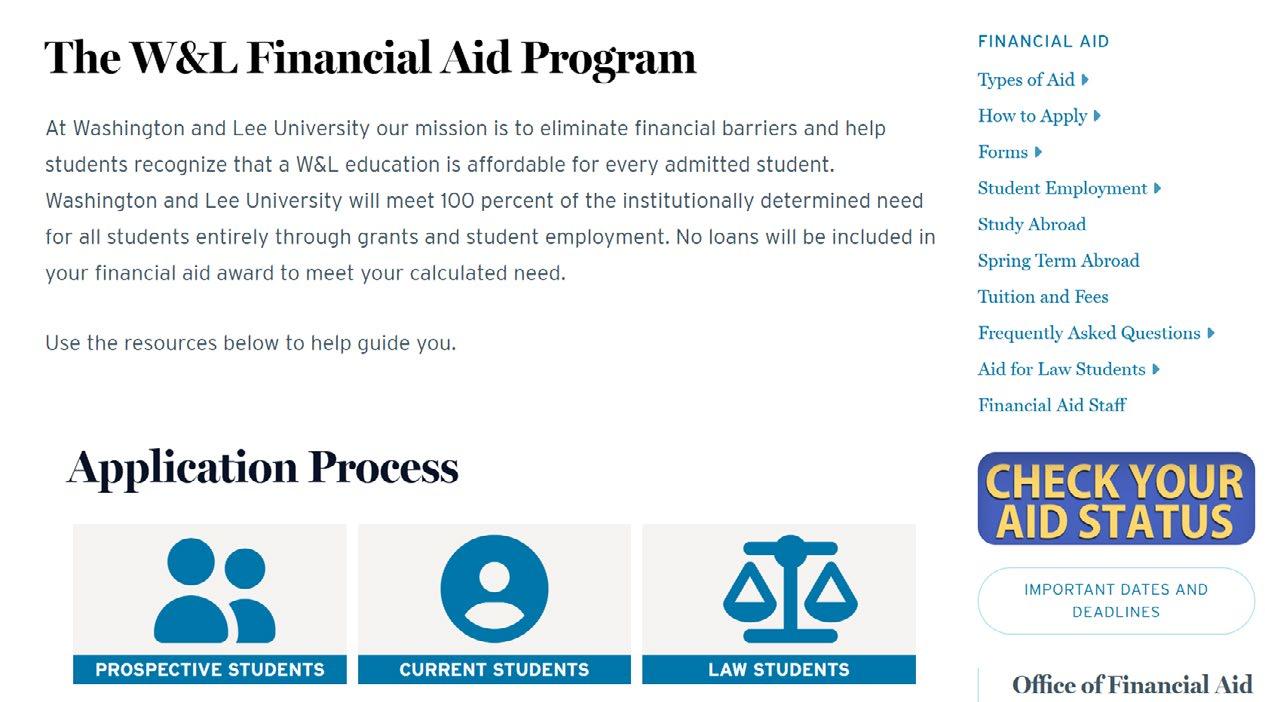
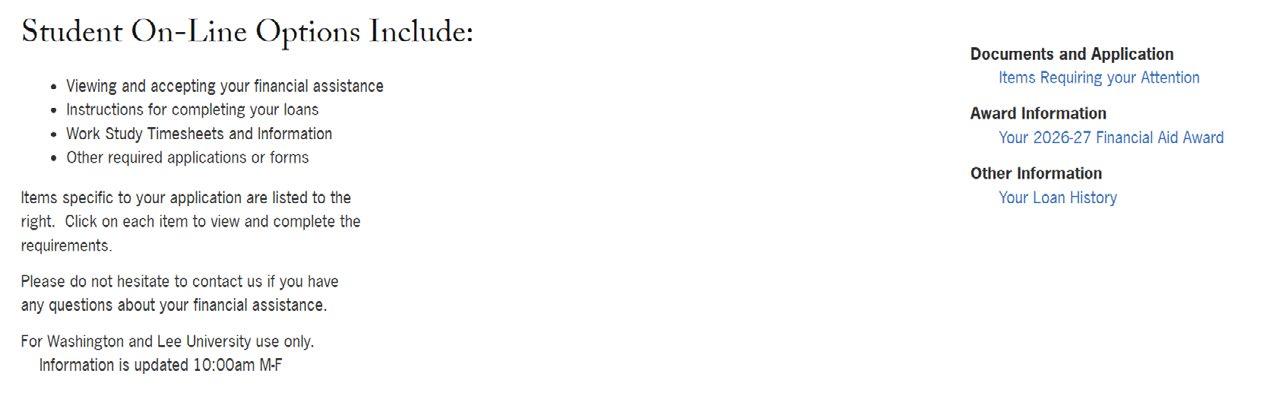
Up until this point, you have been viewing financial aid information on the Applicant Portal. Your aid information has now been transferred to the Financial Aid Portal, and you can access this portal using the “Check Your Aid Status” link on the Financial Aid home page: my�wlu �edu/office-of-financial-aid. To make the most of your financial aid offers, we encourage you to familiarize yourself with the Financial Aid Portal. A listing of documents and forms that may need to be completed to finalize your aid options. Periodic review of this page is recommended.
ITEMS REQUIRING YOUR ATTENTION
Signature Authorization
The Signature Authorization Process is a required component of student onboarding in Workday. Agreeing to this authorization allows our office to accept online submissions of financial aid documents and Work-Study hours and allows you to access your financial aid notification/s using the Financial Aid Portal. Authorizations are valid for one year, and Workday will prompt you to complete the authorization request annually.
Guest/Parent Third Party Access Access (FERPA)
This link will redirect you to the Friends and Family (F&F) instructions. Adding a parent or others to Friends and Family and giving them financial aid access will allow those individuals to view your Financial Aid Portal and allow the Office of Financial Aid to discuss financial aid issues with that individual.
Beginning the first day of the academic year, the Office of Financial Aid can share information only with individuals listed on your Friends and Family with the “View Financial Aid Package” option checked.
Federal Verification Documents
If your Free Application for Federal Student Aid (FAFSA) is selected for verification by the Department of Education, then the Office of Financial Aid must confirm the accuracy of the information reported on the FAFSA and/or the student’s identity. If selected, you will be required to complete and submit the Verification Worksheet and/or Identity Verification Form. You will be emailed a detailed list of the required forms. If you are selected for verification, you cannot, by federal regulation, receive loans until all verification is completed. Verification worksheets are due to the Office of Financial Aid by June 30.
Financial Aid Portal
Your 2026-27 Financial Aid Notification
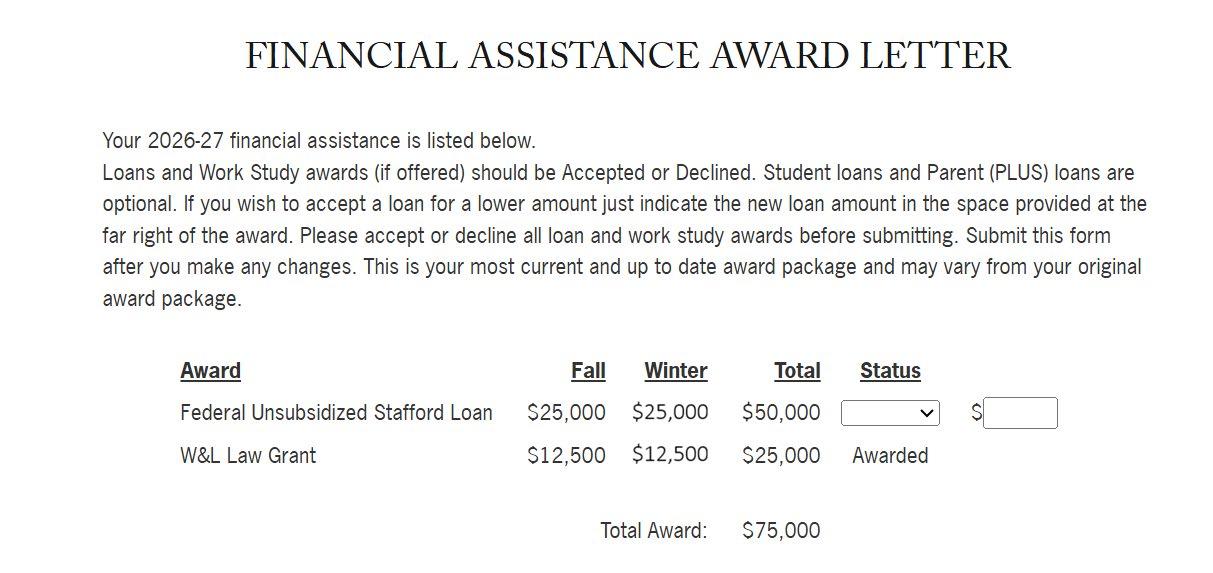
Access your 2026-27 Financial Aid Notification and mark all loans offers as “accept” or “decline” by the appropriate deadline listed in the checklist. If you wish to accept a loan for a lesser amount, mark the loan as “accept” and enter the updated amount in the box to the right of the loan offer. Do not forget to “submit” the form. Law scholarships are accepted by the Financial Aid Office. Some aid may require the receipt of additional documentation before showing as being accepted. Any submission you make may take up to 48 business hours to update online. Below is an example of the aid notification.
Federal Shopping Sheet
Clicking on the Federal Shopping Sheet takes you to the federal award template, which can be used to compare awards from various schools. It is not the official W&L aid notification.
Work-Study
This section of the Financial Aid Portal will list various links related to the WorkStudy program. Law students are not initially awarded Work-Study, so there will not be a WorkStudy section or any items listed under WorkStudy. Links to create an application and apply for open positions will appear if you are approved for a Work-Study award.
Scholarship and Resource Reporting
Allows you to enter details for any outside scholarship or benefit you receive. You are required to notify the Office of Financial Aid if you are receiving any scholarship or resource (tuition benefit, veteran benefit, etc.) from a source outside of the university. Outside scholarships and/or resources may affect your law scholarship if the total of all grant awards exceeds the W&L cost of attendance.
Your Loan History
Provides a breakdown by academic year of any federal student loan, private loan, and/or W&L loan funds you have received while enrolled at W&L. A grand total and estimated monthly payment are calculated for each loan type. Your loan history is available to you while enrolled and a short time after graduation.
Law School Cost LAW SCHOOL COST
2026-27 Cost of Attendance
Cost of Attendance is a list of the expected expenses you may incur during the academic year. These include tuition, fees, housing, food, books/ supplies, miscellaneous and personal expenses, and travel. Your financial aid offers are based on the full cost of attendance, i.e., if you applied for aid, then you have received aid offers that could include grant/scholarship, loans, and Work-Study.
Direct vs. Indirect Costs
The billed, or “direct cost,” for W&L includes tuition, fees, and mandatory dining. Your fall and winter term bills are posted in July and November. There are other expenses you will incur during the year such as books, supplies, and living expenses. These items are considered “indirect costs,” and in most cases will not be part of your semester bill. You will see book charges on your bill if you purchase your books or supplies from the University Store and choose to charge the purchase and charge the purchase to your account.
Buying Your Books
You can purchase your textbooks and supplies from the W&L University Store when you arrive on campus, and they can be charged directly to your student account. If you have a credit on your account because of your grant/scholarship or loan, then this charge will reduce that credit. If you do not have a credit, you can still charge the supplies to your student account. This charge will show as an amount due on your next university bill.
Health Insurance
Health insurance is required for all students. A university health insurance plan can be purchased if you are unable to obtain coverage that meets W&L requirements. If you purchase the W&L health insurance plan, you can receive loan to cover the additional cost. Once you have purchased the W&L plan the charge will appear on your student account. The Office of Financial Aid will email you in early fall semester to determine if you want loan to cover the cost of the insurance (if you submitted a FAFSA). If you authorize additional loan, the credit created by your loan will take place in late August/early September.
Types of Aid
TYPES OF AID
Law Grants and Scholarships
Law grants and scholarships are considered gift aid and do not need to be repaid. There may be specific requirements for renewing the award, and each award may have restrictions or associated benefits.
Taxes Related to Grants/Scholarships
Scholarships and grants that exceed qualified tuition, mandatory fees, and course-related expenses such as books and supplies may be considered taxable income. Questions regarding the taxability of your scholarships and grants should be directed to the IRS or to a qualified tax consultant.
Federal and Institutional Work-Study
Work-Study is a financial aid option that is available on a case-by-case basis. First-year law students are not encouraged to take a WorkStudy position. However, second- and third-year students can apply for positions. The addition of Work-Study to the aid package reduces loan eligibility.
Loans
Any law student who submits a valid FAFSA will be offered a Federal Unsubsidized Stafford loan up to the $50,000 maximum amount or the difference between the full cost of attendance minus all other student aid, whichever is less. Students are not required to accept offered loans and can also apply for non-federal private loans outside the university. Federal student loans are held in the student’s name and paid back to the Department of Education. All federal loans will be applied to the student account balance once the loan is accepted on the Financial Aid Portal. Required documents for processing and disbursing student loans are listed on the following page. If the required loan documents are not completed by the August 10 deadline, then loans will be marked “decline” and will not count toward the account balance. The removal of the loans may create a balance-owed on your account. The priority deadline for accepting a loan and submitting electronic documents is June 10.
A GUIDE TO LAW STUDENT LOANS
Federal Unsubsidized Stafford Loan
The Federal Unsubsidized Stafford loan accrues interest at the point of disbursement and is capped at $50,000 per year and $200,000 in the aggregate.
Processing and disbursement of the Stafford loan requires submission of the documents below and acceptance of the loan on the Financial Aid Portal.
Master Promissory Note (MPN)
Entrance Counseling
Federal Loan Interest and Fees (2026-27 Academic Year)
Unsubsidized Stafford Loan *Updated in July 2026
Interest: 7.94%*
Origination Fee: 1.057%*
Private Loans
Private education loans are credit-based loans that help cover educational costs not met by federal, state, or institutional aid. Students who seek private loans should visit ELM Select , a private loan platform that allows for comparing and applying for non-federal loans, and search for Washington and Lee University. You are not limited to the lenders that appear on ELM Select for W&L, and if you wish to borrow from a lender that is not within the ELM platform, you can apply for a loan directly on the lender’s website. To ensure timely processing, private loans should be submitted to W&L for certification by June 10. Loans applied for and certified before the July 15 billing date will be applied to the student account balance.
BILLING AND PAYMENTS
In early July, you will be contacted by the Business Office with details on how to access the online payment system. All W&L billing is completed online. Within the payment system, you will be able to create accounts for other users such as your parents. Around July 15, registered users will receive a notice that the Fall Term bill is available for review. Payment is due on August 10. Subsequent bills from the Business Office will be posted around the 15th of each month and should be reviewed for any new charges/credits. Spring Term charges will show on the November bill. Please contact the Business Office at (540)458-8730 or businessoffice@wlu �edu for billing or payment questions. The Office of Financial Aid does not process any student billing or payments.
Estimated/Pending Aid
Estimated/pending aid is an aid award that will reduce your bill but has not yet actually disbursed and will be applied to the account at a later date. Federal regulations prevent us from crediting federal grants and loans to your account in July when the fall bills are generated. However, these awards will display on your student account as estimated/pending aid once all requirements are met. Pending aid typically disburses the first week of classes or the following week.
Meal Plan Billing
W&L bills your meal plan based on the number of weeks in a term. However, financial aid grants, scholarships, and/or loans are credited evenly between terms. The aid you receive for the fall term is half of your total aid for the entire year, and you can expect your spring term aid to be equal or similar. However, the spring term bill in November will reflect a larger meal charge, because the spring term has more weeks. Since financial aid amounts do not vary between terms, but the meal plan charge does vary, you should be prepared for an amount due or credit on the spring term bill that will vary from what was reflected on your fall term bill.
Credit Balance
A credit is generated on your student account if credits from financial aid or other sources are greater than the charges on your student account. A credit balance appears as a negative amount due. Students can schedule a refund of their credit balance by contacting the Business Office when they arrive on campus in fall. Spring credit balance refunds can be scheduled in January. A credit balance can be used to pay for indirect expenses such as books, supplies, personal expenses, and travel.
Holds and Late Fees
If you have an outstanding balance for an extended period, the Business Office may place a hold and/or assign a late fee to your account. Holds may prevent a student from registering for a class. A Business Office hold can only be removed by contacting the Business Office and paying the entire past-due balance. If you want to use a loan option to pay an outstanding balance, you must accept the loan and complete all required documentation. An incomplete loan will not show as pending aid. You may wish to check your Items Requiring Your Attention to determine if any specific financial aid documents are incomplete. A student with an unpaid balance will continue to carry a hold and incur late fees until the balance is paid. It can take up to two weeks to process a loan, and during that period, any Business Office hold will remain on the student account.
Please be aware the Office of Financial Aid does not place holds and cannot remove a hold that has been placed on a student account.
A tool that helps you estimate monthly student loan payments and consider repayment plans.
studentaid.gov/loan-simulator/
Federal Aid Resources
Additional information about loans, grants, and the FAFSA.
finaid.org/loans/
Budgeting and Managing Your Funds
Many students find it valuable to reconcile the grant funds, loans, work earnings, and other income with the various expenses they will incur while attending W&L. The Law Budget Worksheet is a tool that will help you in the financial planning of your education for the nine–month academic year. A copy is also provided on the next page.
Am I required to take the full loan amount offered? No. You may decline the loans, take the loans in full, or accept them for less than the full amount.
Can I take a loan later in the year if I decline it originally? Yes. Loans originally declined may still be processed within the same academic year. To process a declined loan, contact Drake Breeden at ebreeden@wlu.edu.
Is it possible to adjust loan amounts after disbursement? Yes. If you have not borrowed your full loan eligibility, you can increase a loan to the full amount. Likewise, you can reduce the amount of a loan you borrowed.
How do I accept a loan that was previously declined? Contact Drake Breeden at ebreeden@wlu.edu and request that the loans be processed.
When will my loans disburse to my account? Loans in most cases are split between semesters. The fall disbursement of federal loans will occur during the first week of classes of the fall term. The second disbursement occurs soon after the beginning of spring term.
How do I use my loan funds for expenses that are not charged to my account (books, food, travel, rent)?
If your loan funds create a credit balance, you have the option of leaving your funds on your account or withdrawing the credit balance. In order to use your credit balance for off–campus expenses, you will need to transfer your money to your personal account or request a credit balance check from the Business Office. Contact the Business Office at businessoffice@wlu.edu for details. Credit balance funds are available one to two weeks after loan disbursement to the student account.
FINANCIAL AID STAFF
JAMES KASTER
Director of Financial Aid
W&L Need-Based Grants, International Grants
MEGAN HOBBS
Associate Director of Financial Aid
Johnson Scholarships, Spring Term Abroad
DRAKE BREEDEN
Associate Director of Financial Aid – Law Law School Student Aid, Endowed Scholarships
PASCALE COUTURIER
Assistant Director of Financial Aid
QuestBridge, Student and Parent Loans, Federal & State Grants