ENVIRONMENTAL STUDIES
FROM THE PROGRAM HEAD
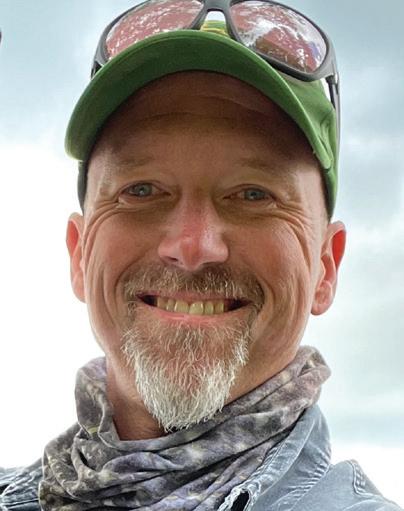
Robert Humston
John Kyle Spencer Director of Environmental Studies and Professor of Biology
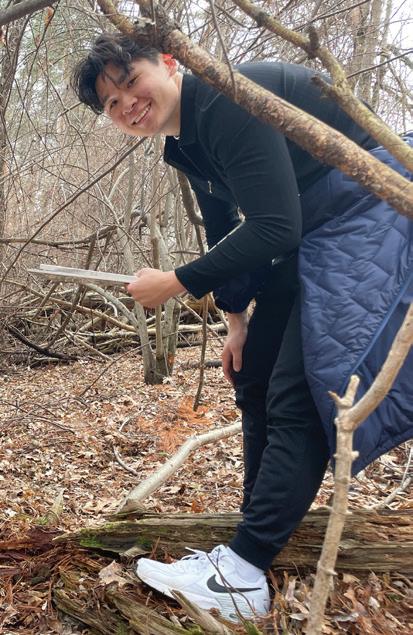
Greetings from a late winter afternoon in Lexington! As I look out my office window in the Science Center, I can see a heavy gray sky hovering above the trees on back campus. Tomorrow my students and I will be among those trees, tracing transects through the woods and looking for signs of deer and browse impacts on the understory. It’s my favorite part of the Applied Environmental Science class. We get to spend two weeks exploring the natural areas of campus and their ecology. I get to show students that despite advanced satellite sensing technologies, mind-spinning genomic analyses, or AI tools, sometimes the most fundamental questions are best investigated by the most fundamental approaches. Go outside. Walk through the woods. Examine the plants; look for signs of browse damage. And count all the piles of deer poop you see. Yes, seriously. Write it all down, we’ll make sense of it back in the classroom. Trust me.
I’m grateful that, in my experience, our students in the Environmental Studies Program are game for anything.
I am back in the classroom again after a year off for a research sabbatical, and it’s an exciting time to rejoin everyone. We now have three full-time faculty in the program and they are expanding our program in amazing new directions. New courses are getting added to our curriculum every semester, offering unique place-based learning experiences in environmental ethics, human geography, and environmental sociology. There’s a particularly strong emphasis emerging on agriculture as a nexus of human-environment relationships – and our area provides myriad opportunities to explore it. I think I’m most excited about the new spring term courses that have come together in the past two years: Ryan McCoy’s Environmental Justice in Appalachia, Catarina Passidomo’s Plantations to Pollution, Mauricio Betancourt’s Agroecology, and my own Science of Fly Fishing. All of these courses lean into regional / domestic travel to bring to life the places and concepts we are studying, and plans for new Spring Term Abroad courses are in the works. Our faculty are embracing the possibilities that Spring Term can offer and bringing new students into our program through these one-of-a-kind experiences.
Another encouraging bit of news is that the university has resumed plans for renovating the Science Center, and the plans include a new space for the Environmental Studies Program. Faculty from ENV have been invited to join the planning committee for the project, and we are excited for the chance to inform our future home. The projected completion date is several years down the road, and, in the meantime, we are making ourselves comfortable in our current space in Tucker Hall. The redecorating process is in full swing. Schedule some time to stop in on your next visit back to Lex!
There is lots to share from the program in this newsletter, so I’ll keep it short and sign off here. I hope you enjoy reading more about all the great stuff going on in our program. There’s more happening than we can fit in a newsletter, but perhaps you’ll have the chance to visit and see the rest of it first-hand for yourself. Be sure to let us know when you do.
Inset: Oliver Zeng ’28 conducting field work in Humston’s class
Back To School
BY DEBRA FREIN
On a warm early-September day in 2025, I found a seat in Science Addition G14. Should I keep a low profile and sit toward the back? Will no one want to sit by me? And what is with these new, wheeled chairs in this sloped auditorium, forcing one to slightly engage their core just to stay put? These were just a few of the anxieties I faced on my first day of class as a student in 25 years.
Back in August I approached Mauricio Betancourt, assistant professor of environmental studies, about auditing his ENV 110 Introduction to Environmental Studies class. Though I received a graduate degree in environmental resources from Arizona State University in 2000, my work was land-management specific, focusing heavily on wildlife and range management. I have little formal education about the crucial interdisciplinary aspects that make the Environmental Studies Program what it is. I am currently in my seventh year as the Program Coordinator for Environmental Studies, and I felt the desire to learn more about the other aspects our program teaches: sociology, philosophy, geography, and literature of the environment to name a few. The best place to start seemed to be the foundational intro class that is taken by all our majors and minors.

Great Acceleration, ecological paradoxes, sustainability, land ethics, ecosystem value and environmental justice. We debated complex issues through stakeholder roleplays, taking on the viewpoints of people on different sides of contentious issues. The class was a survey of each of the three pillars of the Environmental Studies Program: environmental sociology, environmental humanities, and environmental science, and I enjoyed every minute of it.
In the end I am both completely satisfied with the knowledge I gained and left yearning to learn more. Isn’t that the most one could ever ask from a class?
When I spoke with Betancourt, he wholeheartedly embraced my desire to take the class. I told him I could just listen and not participate, if he felt having someone of my age in class might change the dynamics of the class in a negative way. But he knew better than that. If I was going to take his class, he said he wanted me to fully experience it. I would participate in class discussions, do the homework, and write the papers, just as all the other students would do. I was all in.
As I write this on the very last day of Fall Term exams, I have turned in my final paper, and I am feeling both invigorated by what I have learned and proud of myself for stepping outside of my comfort zone. The learning experience was exceptional. I already knew that Betancourt was a wonderful human, but now I know firsthand that he is an incredible teacher. His contagious enthusiasm for the subject, coupled with his incredible knowledge, is truly impressive.
Throughout the semester, we read works by Leakey, Klein, Leopold, Costanza, Foster, Mohai, Chief Seattle, Norgaard, Fossey, Thunberg, and Carson, among others. We dove into key policy documents like the IPCC 2023 AR6 Summary and The Antarctic Treaty of 1959. We kept reflective reading journals and engaged in discussions about the ecological structure of the earth, climate change, the Anthropocene, the
Oh, and my initial fear that no one would want to sit by me was quickly proven wrong. I now know to give these amazing young people more credit. They made me feel welcome immediately — just like any other student in class.
I encourage anyone considering going “back to school” to take the leap. It was the best thing I have done for myself in a very long time. ■
Frein serves as the Environmental Studies Program coordinator.
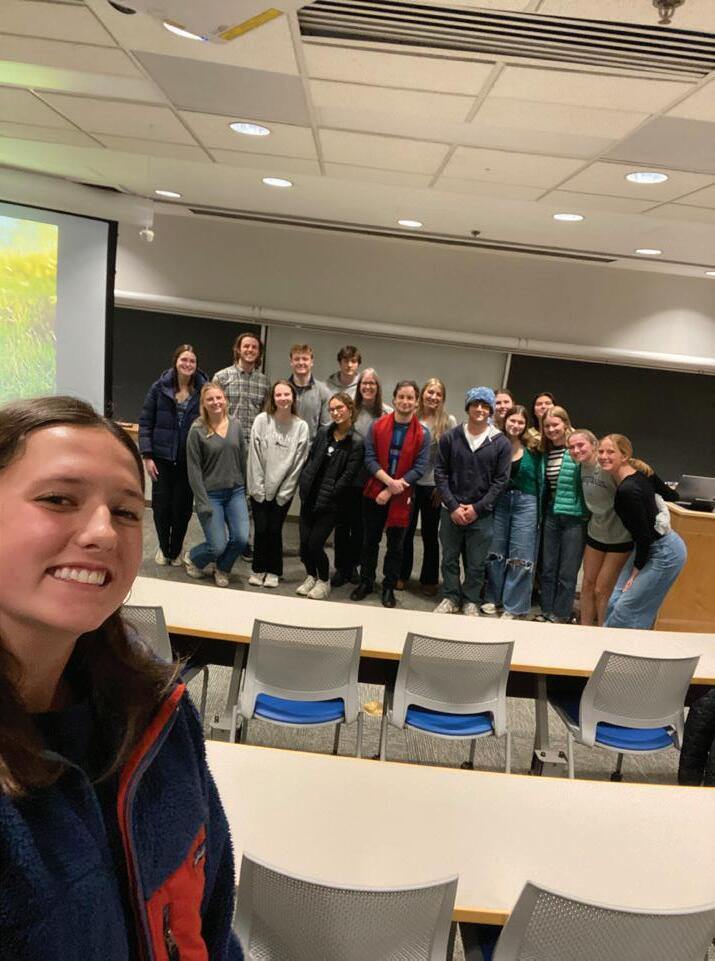
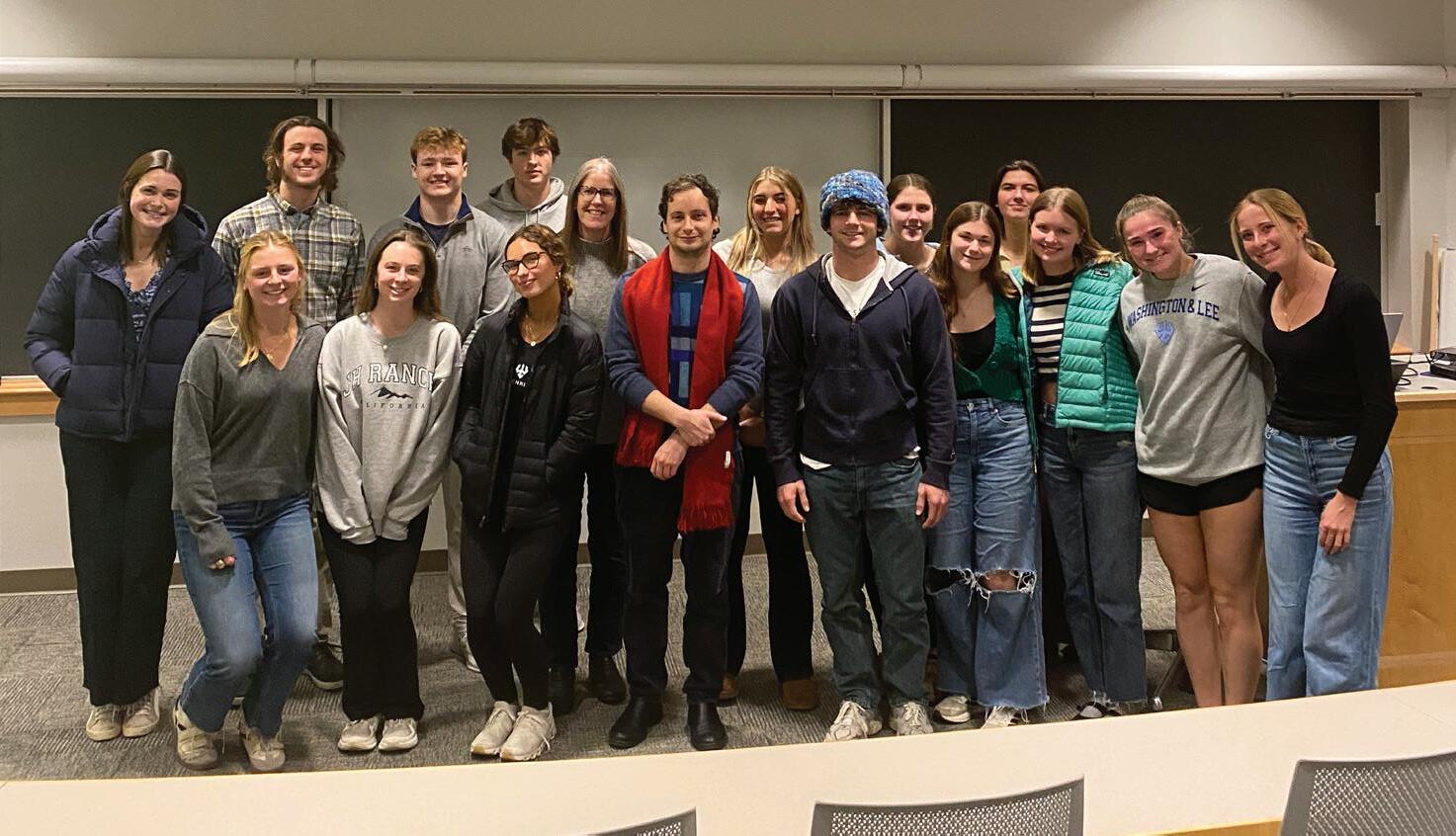
Betancourt’s fall 2025 ENV 110 Introduction to Environmental Studies class.

FACULTY SPOTLIGHT
Ryan McCoy
ASSOCIATE
PROFESSOR
OF ENVIRONMENTAL STUDIES
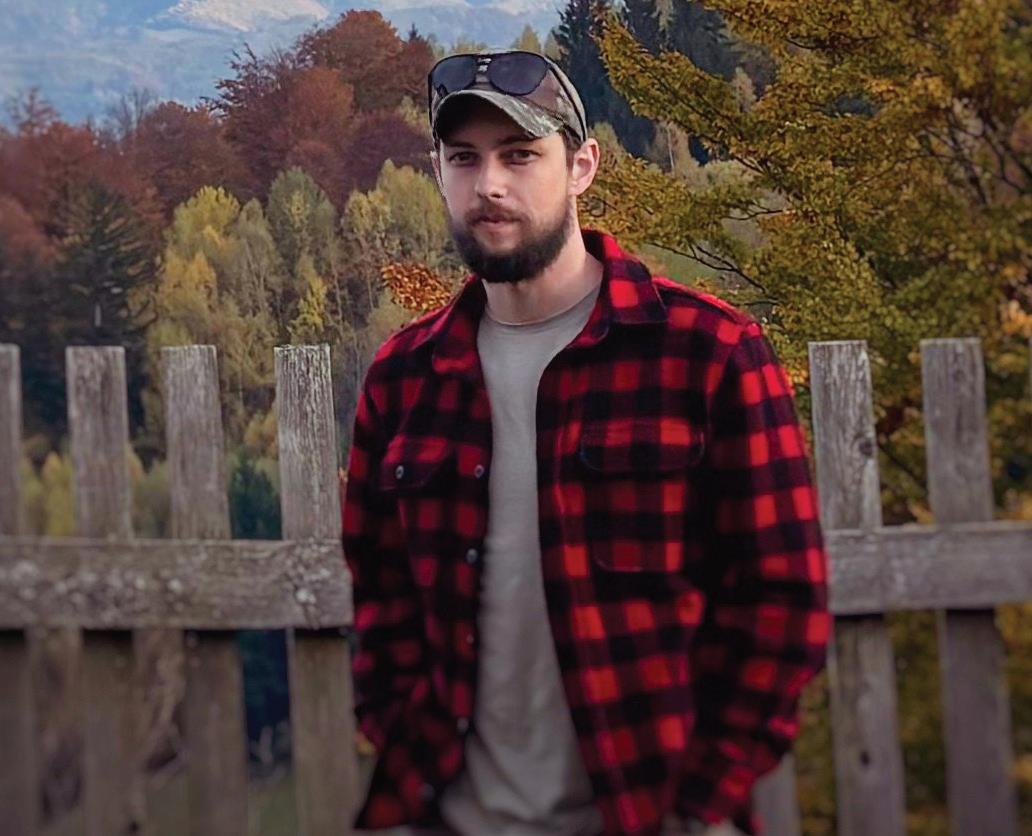
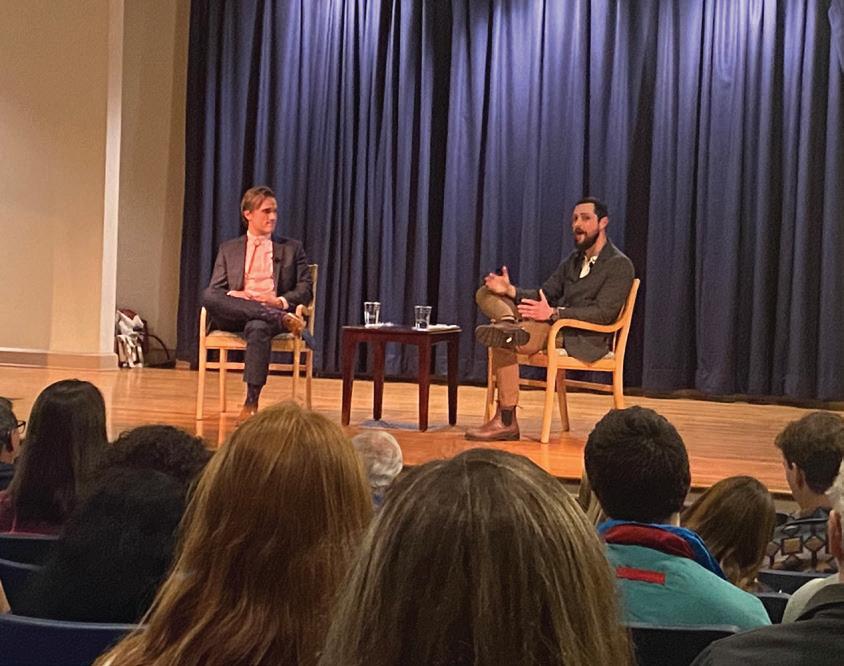
Left: Ryan McCoy interviews Benji Backer, CEO of Nature is Nonpartisan, in Stackhouse Theater.
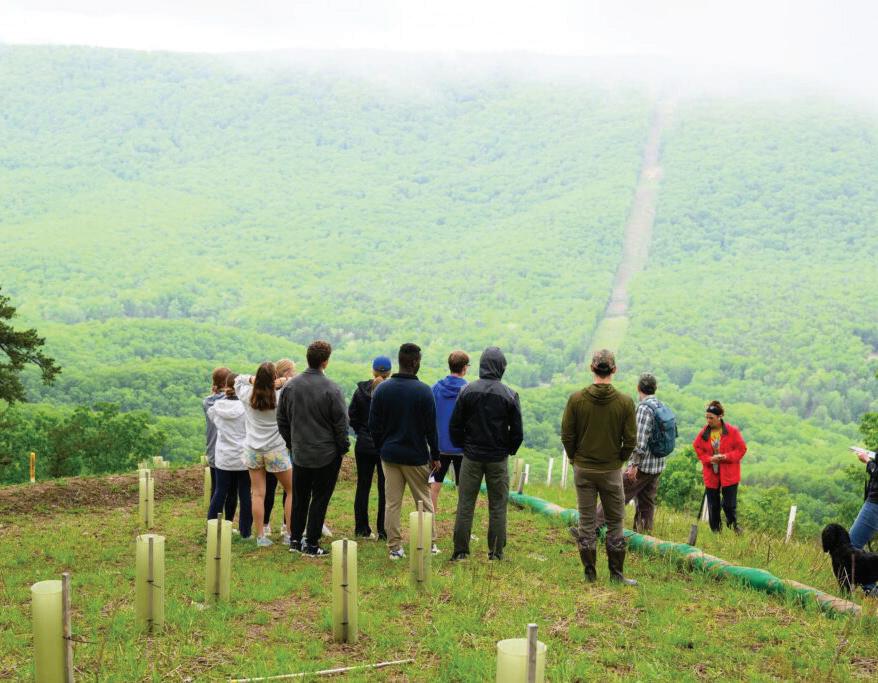
Right: Ryan McCoys’s Environmental Justice in Appalachia class visiting segments of the Mountain Valley Pipeline in Giles County, Virginia
What classes are you teaching?
I’m currently teaching Introduction to Environmental Studies as well as our Environmental Humanities course, and this past fall I taught a seminar on Food Ethics.
The general starting point for all my classes is that environmental issues are “wicked problems” — that is, complex problems that involve disagreements about their causes, solutions, and even the framing of the problems themselves. I try to show how the humanities and philosophy provide essential tools for analyzing these problems, as well as the need to engage with them through an interdisciplinary lens. This means that we read and hear from a variety of different perspectives and disciplines—ranging from climatologists and agronomists to activists and artists.
One of my favorite classes that I’ve had the opportunity to teach, and one that I think really exemplifies this approach, is the Environmental Justice in Appalachia Spring Term course. In that class we read theory and literature, watch films, listen to music, visit conflict sites, and hear directly from community members and activists in the Appalachian region who work at the intersection of environmental and social issues. Last year, our final projects included film and music playlists as well as StoryMaps that highlighted the resilience of Appalachian communities in response to environmental justice issues. To me, it has everything that I love about interdisciplinary environmental work.
As a native of Appalachia, it’s also a class that deals with issues that are deeply personal to me. I care about these things not solely as an academic curiosity but out of love for the region and its human and non-human inhabitants. While students might not feel the same affinities for Appalachia, my hope is that it provides a model for what it’s like to really commit yourself to a place and to do your best to care for it.
Can you tell us about the research/ scholarship projects you are working on right now (or projects recently completed)?
I recently published a paper in Studies in History and Philosophy of Science that highlights the need for localized climate
information and how the expertise and knowledge of local and Indigenous communities can play a pivotal role in furthering our understanding of climate change impacts as well as foster mitigation and adaptation efforts. As a rationale for community-engaged research, this paper really forms the theoretical basis for most of my work.
I’ve also been working on a grant project with the USDA Midwest Climate Hub, which is a continuation of some of the work that I was doing with the USDA prior to coming to W&L. For that project we’re doing an assessment of climate services that the Hub produces — which includes things like webinars, tools and reports that aid farmers and other ag professionals in decision-making. Our goal for the project is to figure out the impact that these services have on agriculture in the Midwest as well as how we can improve and tailor them to stakeholder needs.
Last summer I had a few W&L students working with me on the project (shoutout to Tania Kozachanska ’26 and Aleah Schurr ’28), and we were able to finish up data collection and produce a report on our findings. This summer I’ll have two more students involved as we polish up the report and develop other publications.
Studying the environment can sometimes be disheartening. What is something you have seen or read recently that makes you excited about the environment?
I am admittedly skeptical of top-down “solutions” to environmental issues. So long as “profit” is our north star, the landscape for addressing them seems bleak at the international and national level, and I think we have good reason to be disheartened when we look at environmental issues from these broader perspectives. But to paraphrase the environmental historian William Cronon, there’s no “one big problem” to solve but rather a near infinitude of smaller ones, and, as my dad often says, the only way to eat an elephant is one bite at a time.
I had the opportunity to attend a conference in Romania this past October that included folks from the Appalachian region as well as the Carpathian Mountains in Eastern Europe. Both regions
are home to extractive industries and the folks who live there are often stereotyped by outsiders. There are also parallel issues with economic development and poverty as the prominence of these industries continue to fade. These are complicated and messy problems for sure.
One of the things that struck me about the conference was the variety of different ways that people sought to address these issues — ranging from things like formal academic research in public health, music and the arts, to placebased education with local children. A common thread among these projects was the way in which people used their talents and offered up their time to give what they could to the people and places they care most about. Although it was an international conference, these weren’t seen as global or regional issues through the detached lens of policy, but rather as things impacting their neighbors and communities.
To me, when we begin to break down these “global” problems into bite-size pieces, the situation becomes less hopeless and instead becomes grounded in the everyday. It becomes a practice of care, awareness, and sacrifice — all of which are grounded by an unconditional love of place and our human and non-human neighbors. This is what gives me hope and what keeps me going, and examples of this work can be found all throughout our county and region and in communities across the world.
What music is getting the most play on your speakers lately?
My music is usually dictated by the whims of my 5-year-old son, Arlo. As of late this has included a lot of Dolly Parton (the patron saint of my home region, East Tennessee), some Yacht Rock (Michael McDonald, Christopher Cross, Steely Dan, Kenny Loggins, etc.), and the soundtrack to KPop Demon Hunters (Arlo’s favorite movie right now).
In the rare moments when I’m driving around by myself, I’m usually listening to bluegrass, folk and old-time music (Doc Watson, Ralph Stanley, Tia Blake, Hazel Dickens, Nimrod Workman, Ricky Skaggs, Gillian Welch, etc.), as well as newer stuff from folks like Sturgill Simpson, Tyler Childers, Colter Wall, S.G. Goodman and Jason Isbell. ■
2025 SENIOR CAPSTONES
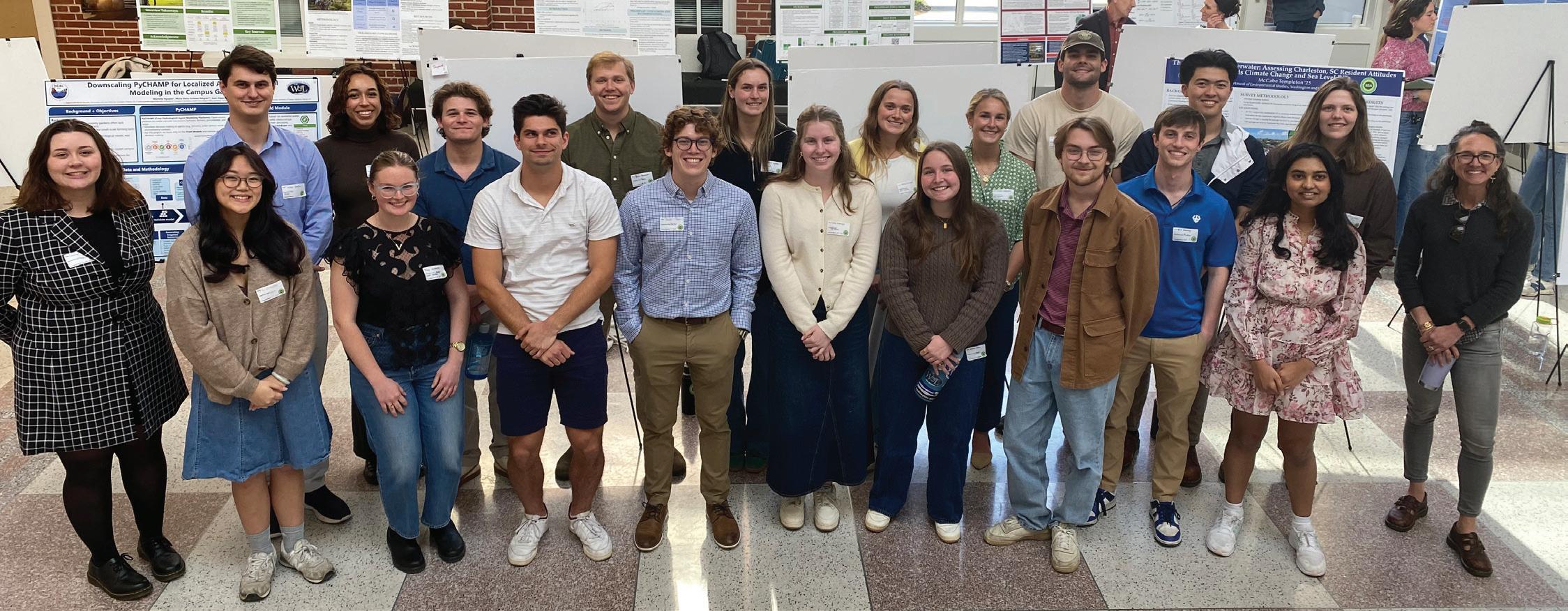
After many yearS of robert Humston teaching the Senior Capstone course, the program needed someone to teach the course while he was on sabbatical during the 2024-25 academic year. Our brand new (at the time) faculty member, Catarina Passidomo proved to be up for the challenge! The students were a little surprised to see her on that first day of the pre—capstone course in the fall because everyone was so accustomed to Humston teaching the class. Quickly, however, Passidomo got to know everybody and learn about their interests and help guide them through the process. A new aspect of the pre-capstone course was also added in which other faculty members from the Environmental Studies Program attended many of the classes and helped guide students that were interested in areas in which those faculty members have expertise. During any class workday the students might have access to a faculty member who has expertise in sociology, philosophy, geology, or business. It proved quite successful for the students to have regular access to a variety of faculty during the pre-capstone course, and it was decided to continue the model this year. Below are the titles of the capstone projects for the Class of 2025:
Lauren Achter — ESG Reporting vs. ESG Performance in the Pharmaceutical Industry
Marcie Bernard — Eastern (Woodland) Box Turtle Community Awareness Project in Rockbridge County
Camryn Bostick — Teaching Climate to Kids: Long-Term Effects of Climate Change Education
Sarah Eaton — Determining the Feasibility of High-speed Rail in the Northeast Corridor of the United States
Will Fearey — Renewable Energy Outlook and Climate Legislation Under the Trump Administration
Estelle Fisher — The Effects of Stress on Eastern Oysters (Crassostrea virginica) Following Exposure to Mud Crab (Panopeus herbstii) Predator Cues
Tate Harrison — Native Range: Reviving Brook Trout in the Appalachians
Paul Kargol — Environmental Field Assessment and Survey of Sinkholes on Peniel Farm
James Kurani and Asa Tuke — Sustainable Golf Course Design: Proposing W&L with Sustainable Renovation and Maintenance Practices for the Lexington Golf & Country Club
Thomas McRae — Eco-Poetry Portfolio
Kiki Mittner — Cover Crop Policy in the Northeast U.S.
Porter Neubauer — VCEA and the Effect of Solar Energy Development on Virginia’s Farmlands
Michelle Nguyen — Downscaling PyCHAMP for Localized
Agro—Hydrological Modeling in the Campus Garden
Shae Reinberg — Investigating “Climate-Smart Agriculture” in the Shenandoah Valley: Farmer and NGO Perspectives to Inform Agro-Policy
Haley Robinson — Exploring Perceptions of Consumerism and Climate Change: Factors Shaping Public Opinion and the Role of Decision Making in Climate-Related Concern
Stone Shepard — Water Wars: The Role of Statutes in Managing the Colorado River
Louise Strawn — Grapes of Wrath: Climate Change and Virginia’s Vineyards
Jacob Teer — Not Unmindful of the Future? Evaluating W&L’s Effectiveness at Climate Change Education
McCabe Templeton — The Lowcountry Underwater: Assessing Charleston, S.C. Resident Attitudes Towards Climate Change and Sea Level Rise
Turner Vaughn — Evaluating USDA Federal Inspections in American Zoos: A Comparative Analysis of the Trump and Biden Administrations
Nisha Walvekar — Simulating Drought in a Parasite Enhanced Ecosystem Using a Differential Equation Model
Michael Wang — Carbon Emissions of E-Tablets: An Academic Comparison of Tablets Versus Paper Alternatives for Students
Seniors and Catarina Passidomo gather for a photo just prior to the start of the Capstone Poster Session.
Capstone Turn-in
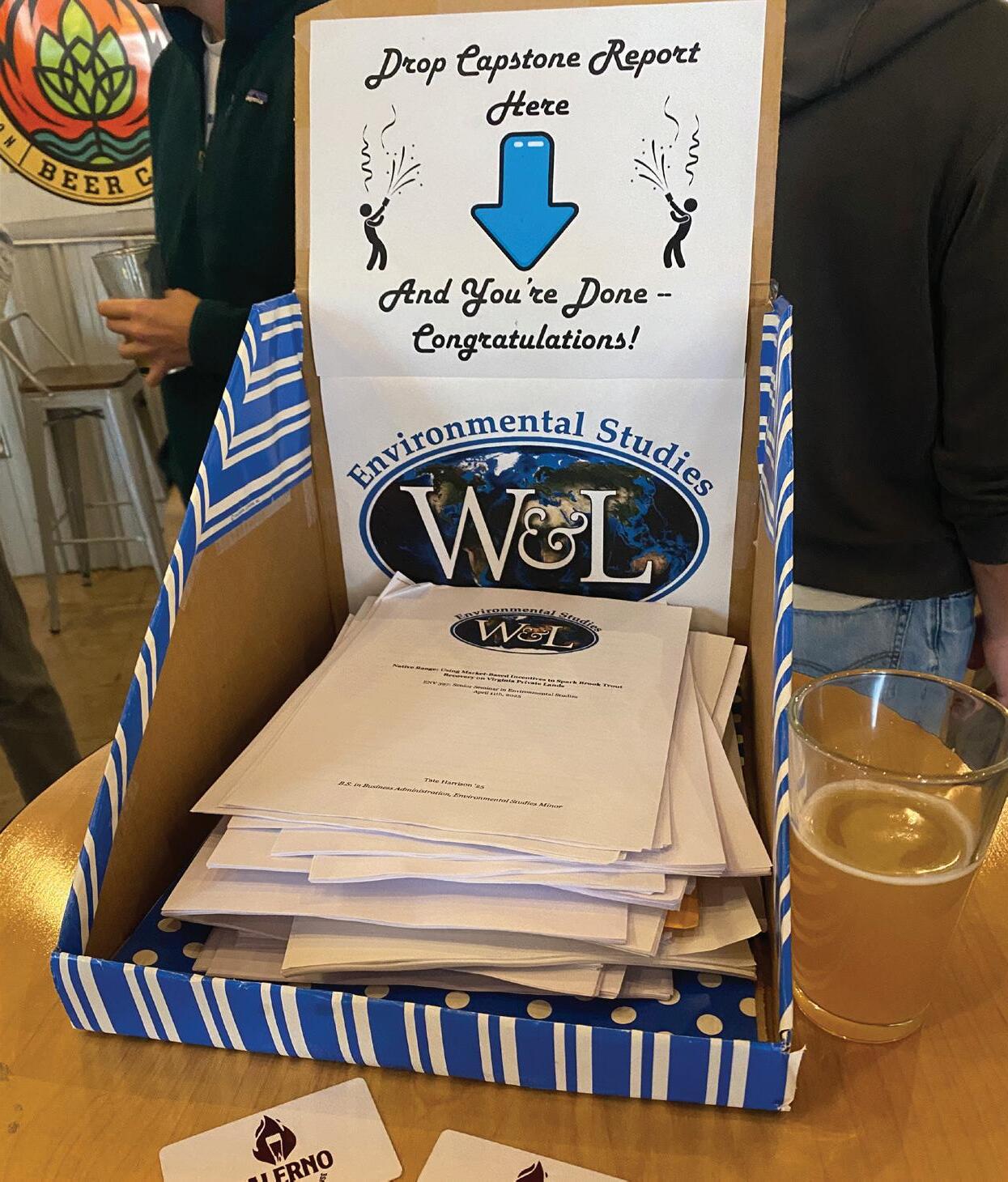
The third annual Capstone Turn-In Party was held at Salerno’s and was again a wonderful celebration. We continue to use the same box that the students put their papers in that Robert Humston hand-crafted in 2023. You’ve got to love a good tradition where everyone is happy (relieved!), eating pizza, and reminiscing about their time at W&L.
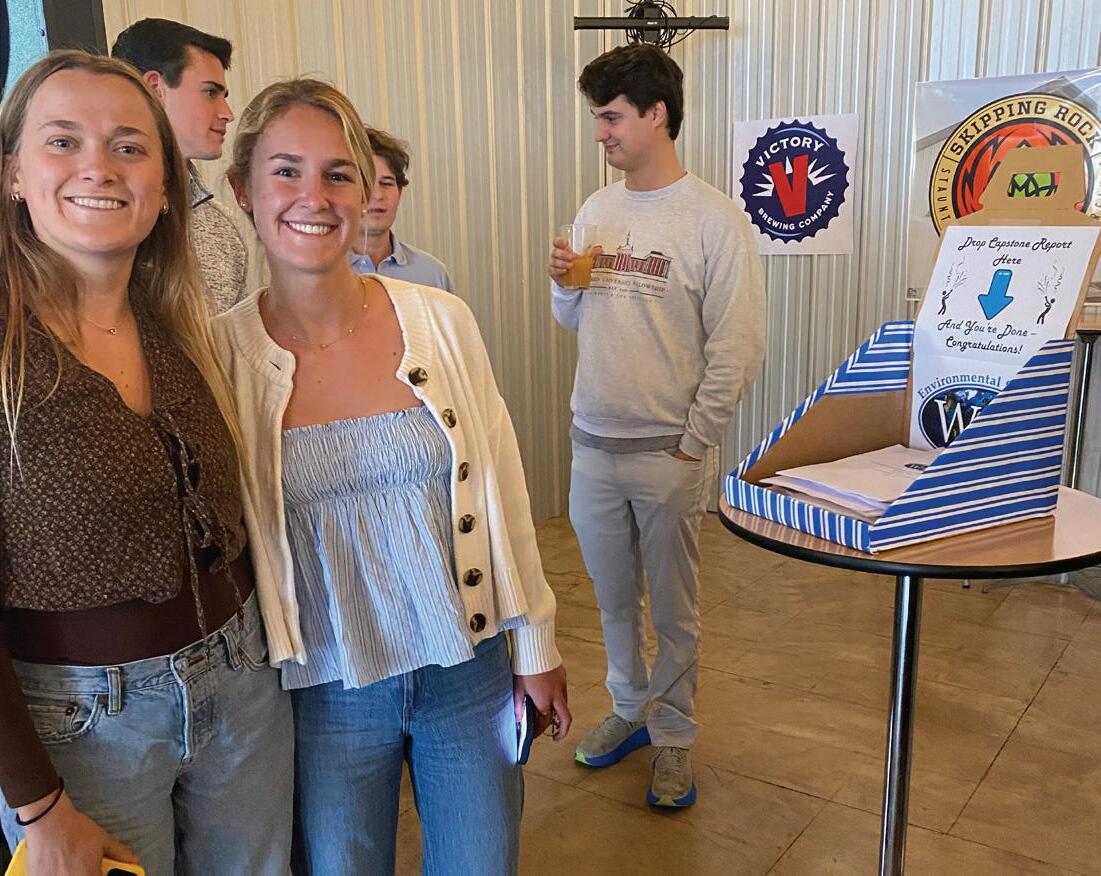
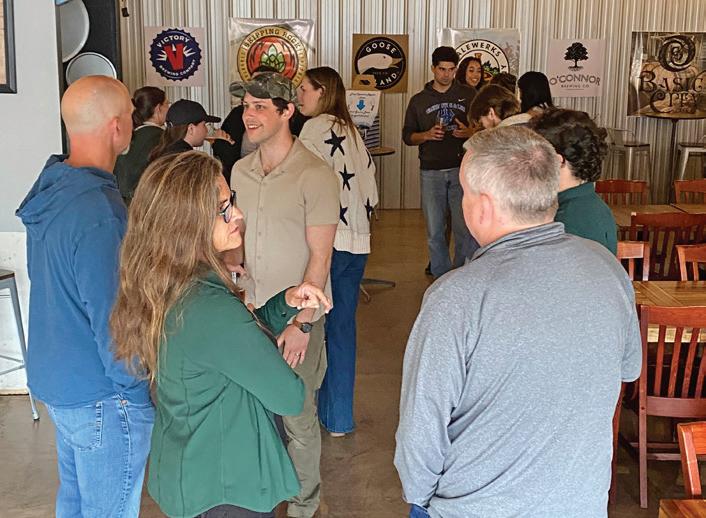
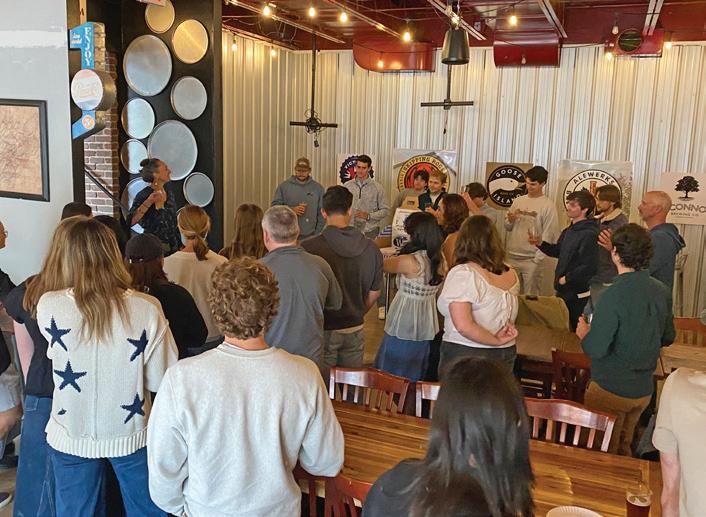
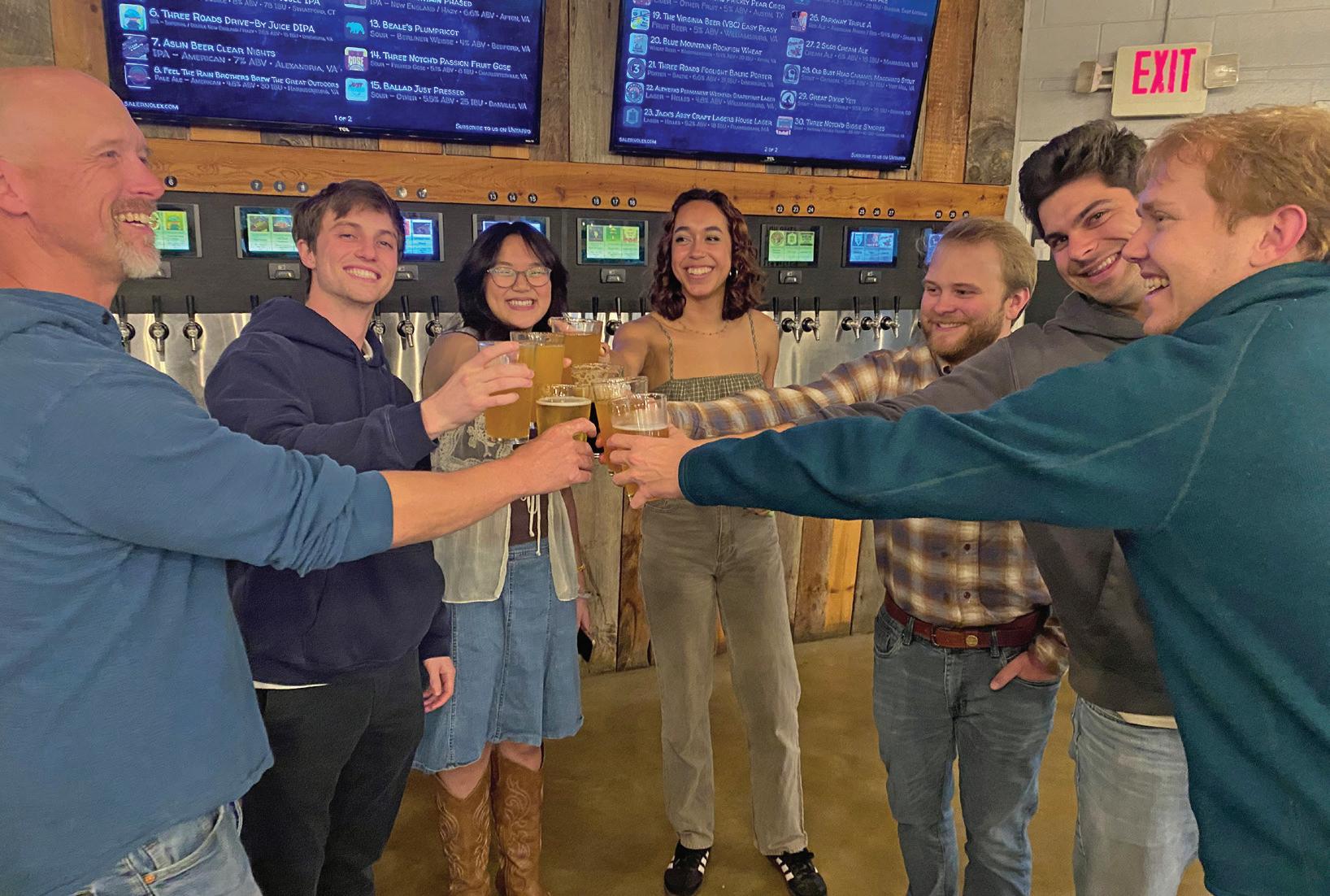
Can you spot the alum in this photo who joined us for the celebration?
Bill Hamilton Co-Authors Paper in Science
(excerpts from Aug. 8, 2025, The Columns article)
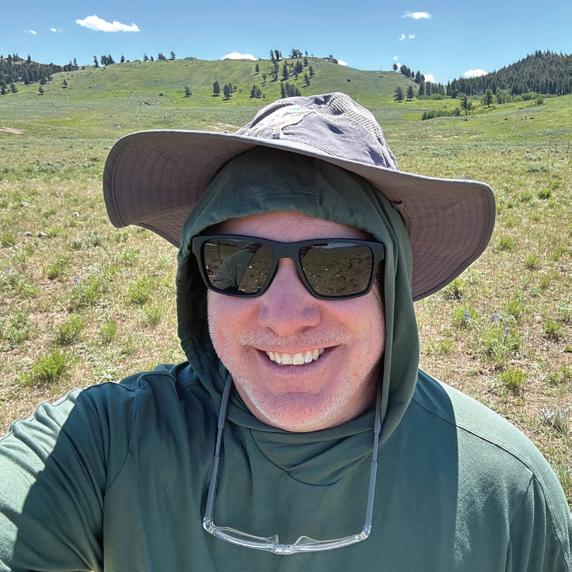
Bill Hamilton, the John T. Perry Jr. Professor in Research Science and core faculty member of the Environmental Studies Program, recently co-authored a paper published in Science magazine. The article, “Yellowstone’s free moving large bison herds provide a glimpse of their past ecosystem function,” was featured on the Aug. 28, 2025, cover and sheds new light on the value of bison recovery efforts in Yellowstone National Park.
While momentum is building to restore bison across North America, most efforts focus on small, managed herds, leaving it unclear how large, migrating herds shape landscapes and whether their effects enhance or degrade ecosystems. The study by Hamilton, Chris Geremia, a researcher with the National Park Service at Yellowstone, and Jerod Merkle, associate professor and Knobloch Professor in Migration Ecology and Conservation at the University of Wyoming, considered large migrating herds of bison at Yellowstone National Park, observing their grazing habits as they concentrate in the park’s river valleys during spring and summer.
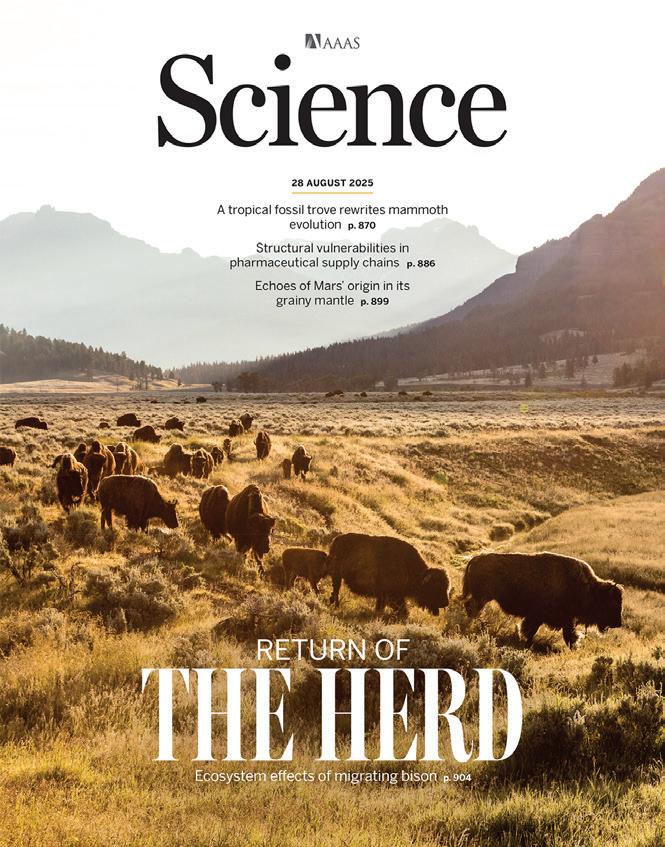
With a population of around 5,000 animals (stabilized since the mid-2010s, after recovering from a low of 23 animals in 1902), bison today travel about 1,000 miles each year, making back-and-forth movements along a 50-mile migration route. Along their route, the bison graze intensely, consuming young growing plants emerging after snow melts; to many, this might look overgrazed, but Hamilton and his team found that it is far from the whole story.
The research team’s study suggests that bison speed up the nitrogen cycle as they graze; the plants grow as much as they would if they weren’t grazed but, strikingly, are 150% more nutritious.
The nitrogen cycle is how nitrogen moves between the plants and animals of the ecosystem and the air and soil. Tiny organisms in the soil recycle nitrogen from decaying plants and animals into forms typically seen in common fertilizers (ammonium and nitrate). Those forms are favored by plants to reuse. The authors found that as bison graze, they increase the
amount of those tiny organisms, resulting in more nitrogen available for plants to use and, ultimately, more nutritious plants for plant-eating animals.
As the bison’s grazing continues throughout the summer, this cycle is reinforced, keeping plants short, dense, and nitrogen rich.
To understand how bison create these changes in the nitrogen cycle, the researchers conducted field experiments from 2015 to 2021, monitoring plant growth, nutrient cycling, plant and soil chemistry, herbivory, plant community composition and soil microbial populations. They used movable exclosures to compare grazed and ungrazed conditions, and they combined these experiments with landscape-scale satellite imagery and GPS collar data. This allowed them to map bison impacts across the entire migratory landscape.
“With the current large herds of bison, Yellowstone grasslands are functioning better than in their absence,” Hamilton said. “And this version is a glimpse of what was lost when bison were nearly wiped out across North America in the late 1800s.”
Yellowstone has long served as a model of ecological restoration, and this new research highlights the overlooked power of restoring large herbivores in large, free-moving numbers. Unlike traditional bison conservation efforts focused on small, fenced areas and controlled numbers based on grazing management principles, Yellowstone shows the value of restoring movement and scale. Migrating bison reshape the land not by being managed — but by moving.
Throughout the study, many of the Environmental Studies Program students have benefitted from working with Hamilton on his research, both at Yellowstone and at his lab on campus. ■

STUDENT AWARDS 2025
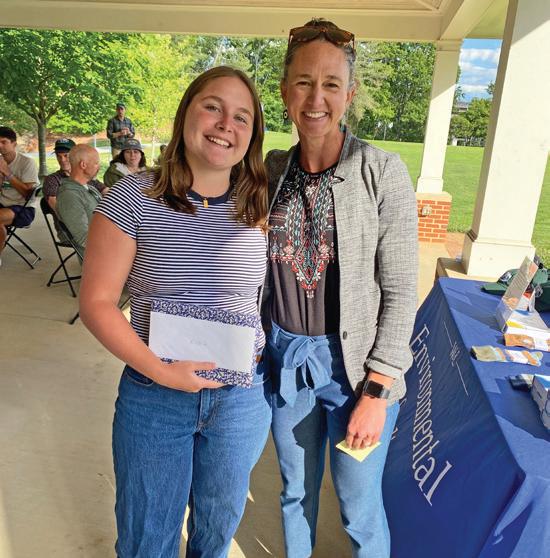
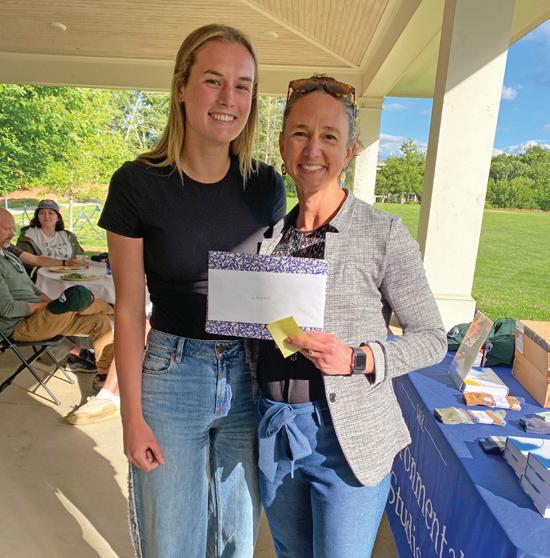
Estelle Fisher ’25
Bates Prize for Academic Achievement in Environmental Studies
thiS award recognized Fisher’s outstanding record of academic excellence throughout her time in the Environmental Studies Program. Her consistent academic success was also reflected in the outstanding work she completed in her capstone project and report. Fisher’s report on the effects of stress on eastern oysters following exposure to mud crab predator cues was both scientifically rigorous and extremely well written. The academic research in her project demonstrates her commitment to continued academic excellence and to applying that excellence in support of environmental progress.

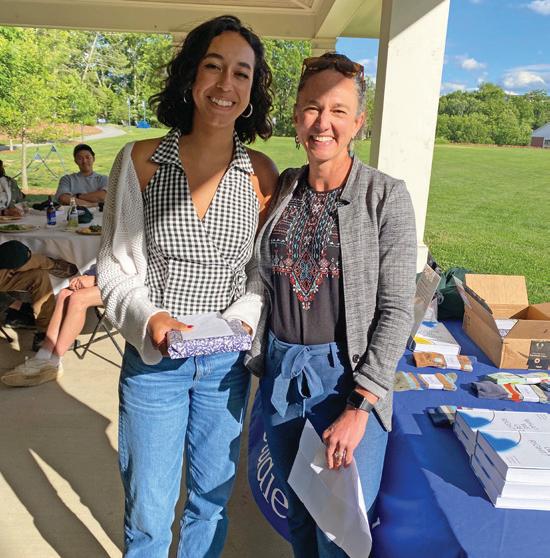
Shae Reinberg ’25
Bates Prize for Environmental Citizenship in Environmental
Studies
thiS award recognized Reignberg’s extensive co-curricular work in sustainability throughout her four years at W&L. From her first year, when she lead the effort to revitalize the Student Environmental Action League, to her years as a student representative on the University Sustainability Committee, to her leadership of the student organization DivestW&L (which campaigns for fossil fuel divestment), to her development and implementation of the eco-rep program for the Office of Sustainability during her senior year, Reinberg continuously showed strong leadership skills and a robust commitment to being an engaged and active environmental citizen.
Lauren Achter ’25
Bruce M. Flohr Sustainable Commerce Award
thiS award recognized Achter’s commitment and contributions to the field of sustainable commerce, particularly as demonstrated in her capstone project. In this work, Achter investigated ESG reporting in the U.S. pharmaceutical sector through a comprehensive quantitative analysis of ESG performance, resulting in an evaluation of the industry’s progress. Her report successfully highlighted the growing importance of ESG reporting in the pharmaceutical industry and revealed that greater transparency is positively associated with stronger ESG performance.
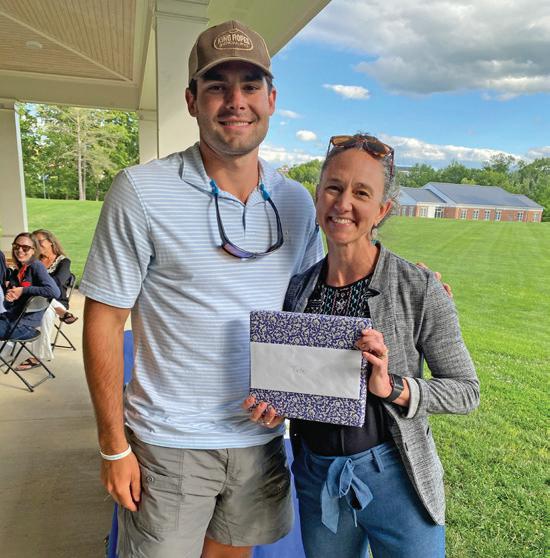
Tate Harrison ’25
Al Knight Conservation Award
thiS award recognized Harrison’s performance on his capstone project. Harrison’s capstone explored a sustainability strategy for restoring native brook trout populations in Virginia with market-based conservation, taking into account the financial realities that private landowners face when attempting fisheries restoration on their properties. His holistic approach to improving native brook trout populations showed his ability to incorporate his business administration coursework with his Environmental Studies Program minor coursework as well as his passion for fishing, which demonstrated the kind of interdisciplinary work that is integral to the Environmental Studies Program.
The Knight Internship Program Funding Campaign
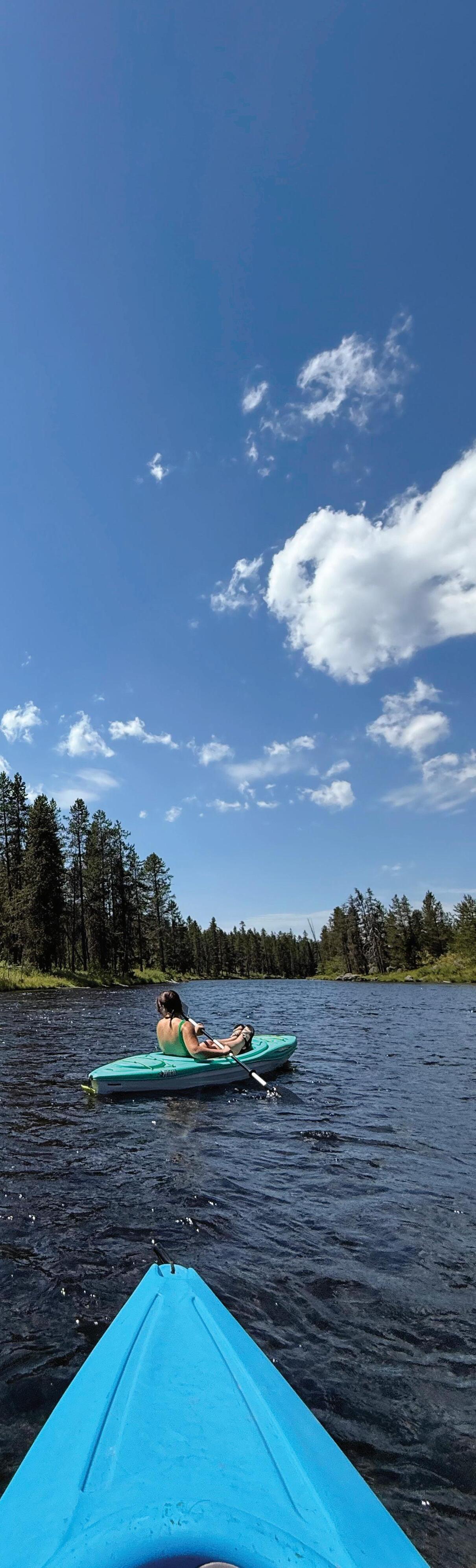
The A. Paul Knight ’85 Endowment in Conservation offers an extraordinary opportunity for students interested in environmental stewardship and conservation to travel the western United States and participate in conservation-related work. The internships are made possible by the endowment Al Knight ’51L and his wife established in 1988 to honor their son, Paul Knight ’85.
The program has continuously operated since 1988 and recently celebrated its 35th year of continuous service in the Henry’s Fork watershed in eastern Idaho. Over 135 students have benefitted from Knight Program internships, supporting a vast array of land and water conservation organizations.
Given the immense success of the program, the W&L community, lead by former interns and alumni passionate about conservation of our natural resources, an effort is underway to enhance the A. Paul Knight ’85 Endowment in Conservation. If successful, the fundraising will perpetuate and amplify opportunities for future generations of W&L students.
As of May 2025, the Knight Endowment stood at $400,000, providing annual, $3,500 stipends to four student and has historically provided stipends for up to six students (four undergrad and two law). While generous, the stipend has not been indexed for inflation and currently sits well below its benchmark, The National Science Foundation Research Experience for Undergraduates, which currently stands at $6,000, plus a travel allowance. The current Knight stipend also reportedly sits below the stipend amount provided by other universities who have emulated the Knight program, namely Stanford, Colgate and St. Lawrence universities.
W&L alumni are committed to raising the A. Paul Knight ’85 Endowment in Conservation to $1,000,000 and ask you to join them through your support.
While in early stages, they are already off to a great start as of yearend 2025, having grown the Endowment by over 50% from May 2025 level. Alumni would appreciate your support in continuing the momentum towards the $1,000,000 goal. ■
To give online, visit the Leading Lives of Consequence campaign donation page at campaign.wlu.edu/donate-now, choose “other” as the designation in the drop-down menu and then list: “The A. Paul Knight ’85 Endowment in Conservation” in the comment box. For questions on other giving options, please contact Jocelyn Lewis, executive director of development, at 540-458-8165 or jlewis@wlu.edu.
One Family: Two Generations of Knight Interns
In the summer of 1993, Rich Paini ’93 became one of the earliest participants in the A. Paul Knight Internships in Conservation. He traveled to Island Park, Idaho, unaware that the experience would redefine the trajectory of his life.
Thirty-two years later, history repeated itself as his daughter, Ella Paini ’28, followed in his footsteps to become a 2025 Knight Intern.
A LEGACY BUILT ON THE RIVER
For most Knight Interns, the trip to Idaho is a leap into the unknown. But for Ella, this was a homecoming. She grew up in the shadow of the program’s impact. In 1999, her dad and fellow W&L Knight Intern Jon Stiehl ’93 opened TroutHunter, a riverside lodge, fly shop and grill that has become the local “hub” of the community in Island Park. TroutHunter is also an unofficial W&L outpost. Thanks to the steady stream of interns who have fallen in love with the area over the decades, one can be hard-pressed to visit the bar and grill during the summer without running into a fellow General.
CLOSING THE CIRCLE
This past summer, Ella served as an intern for the Henry’s Fork Foundation. Working alongside fellow Knight Intern Dara Bage ’27 (Friends of Harriman State Park), Ella conducted vital visitor-use surveys for the Harriman State Park Trails Initiative.
In her post-internship reflection, Ella captured the weight of the experience:
“My path to Washington and Lee is tied directly to this place and this internship. Decades ago, my father and godfather were Knight interns — an experience that led them to build a life and business here on the Henry’s Fork. Their story and Al Knight’s vision ultimately made my own W&L journey possible. In many ways, this internship felt like closing a circle: I’m here because of their summer in 1993, and now I’ve had my own.”
A LASTING VISION
The significance of Ella’s internship was not lost on the Knight family. In a note to the program, Gail Knight shared that Al Knight “would have been so pleased” that Rich’s daughter was a Knight Intern.
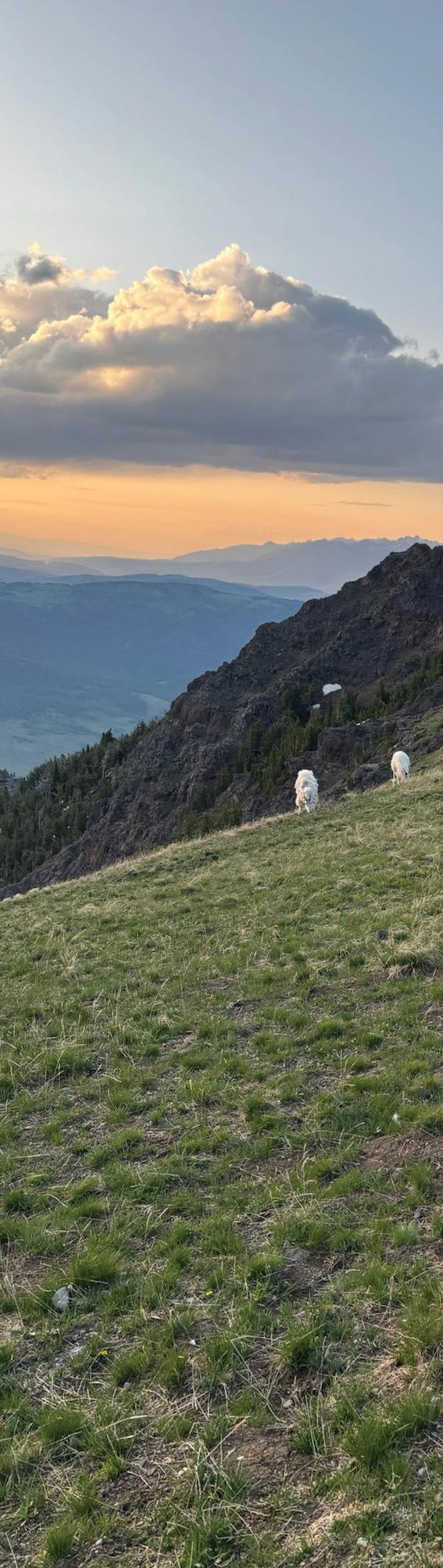
Ella and Bage were joined in Idaho by fellow interns Calla Andrews ’27 and Lily Youngman ’27. The cohort spent time at Pinehaven, the Knight family home, with Tom Benzing — Paul Knight’s childhood friend — marking another chapter in a program that bridges generations through a shared love of conservation and the American west. ■
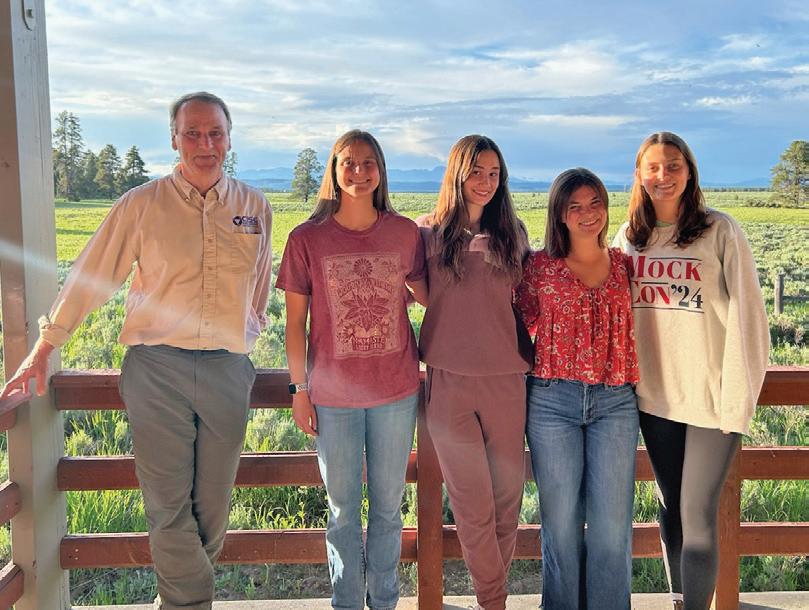
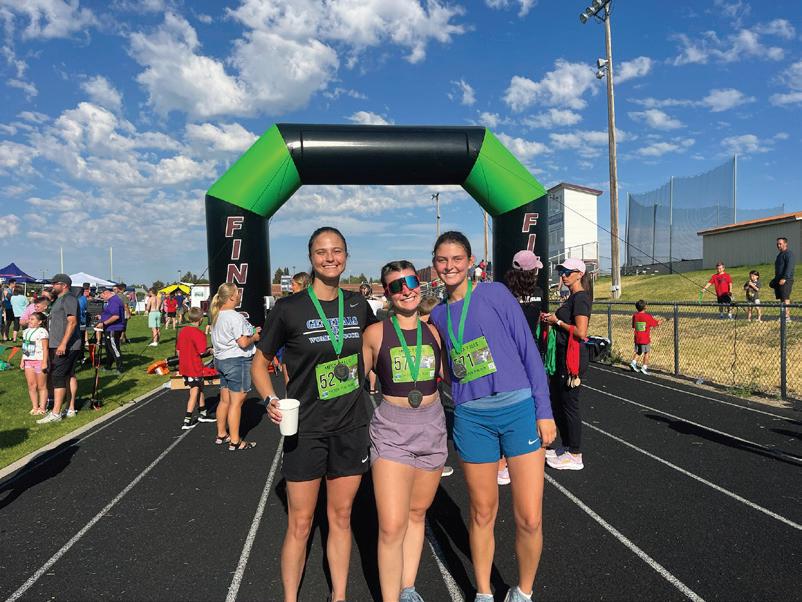
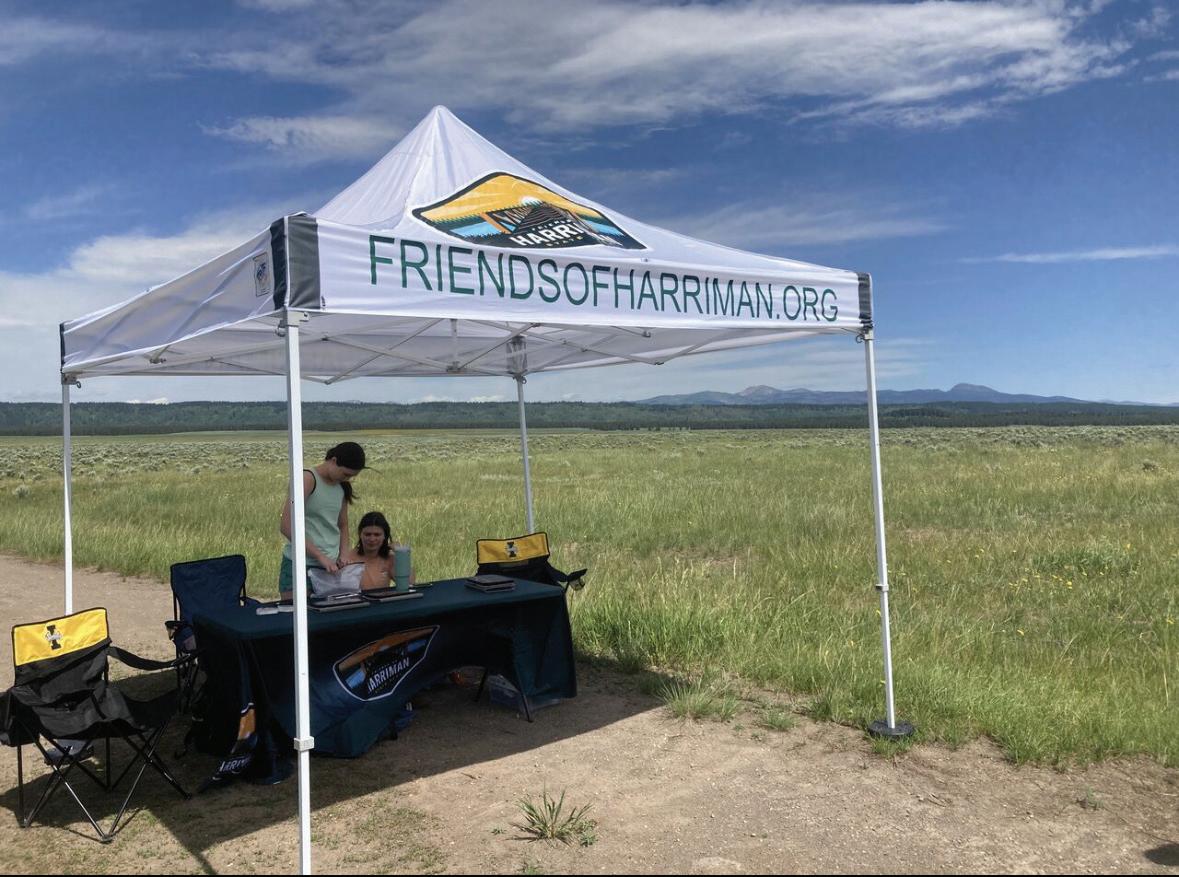
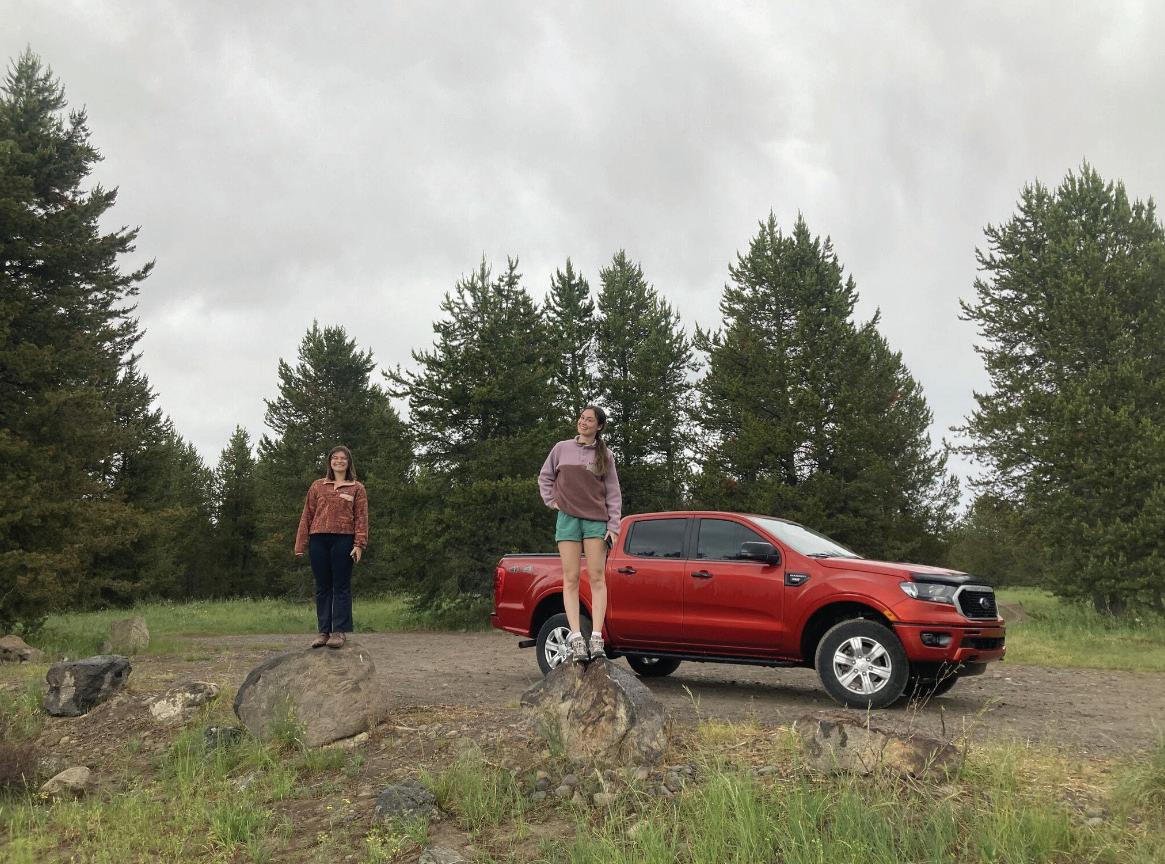
Left to right: Tom Benzing, Calla Andrews, Ella Paini, Dara Bage, and Lily Youngman.
Parties at the Pavilion
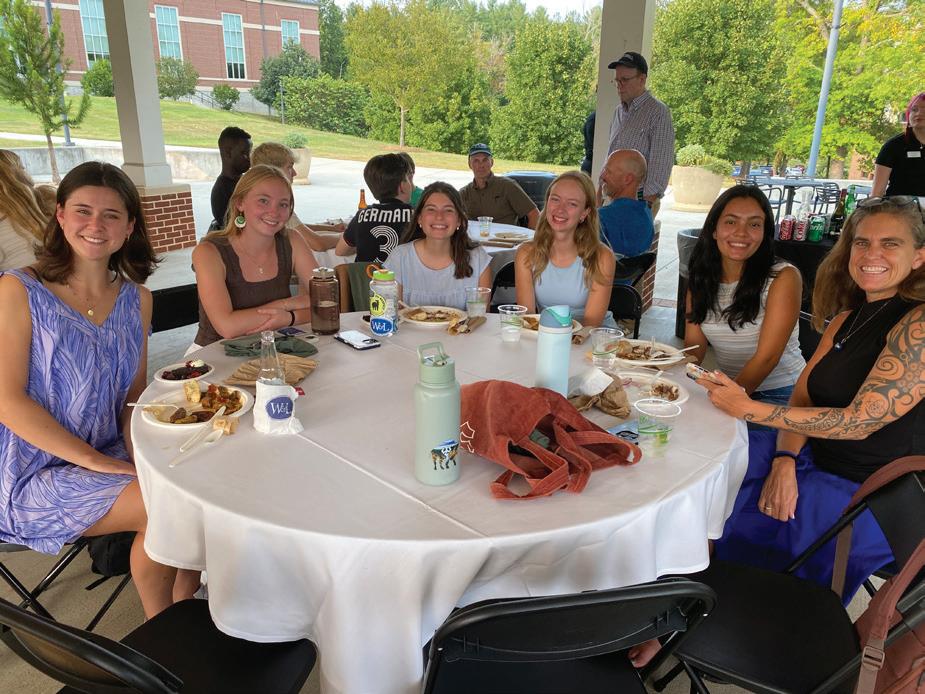
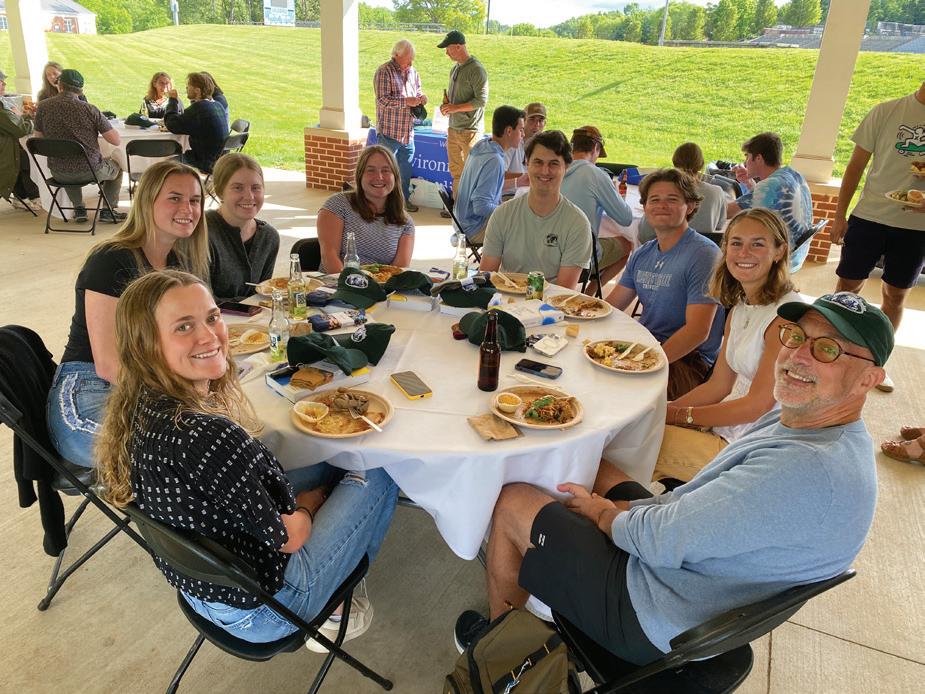
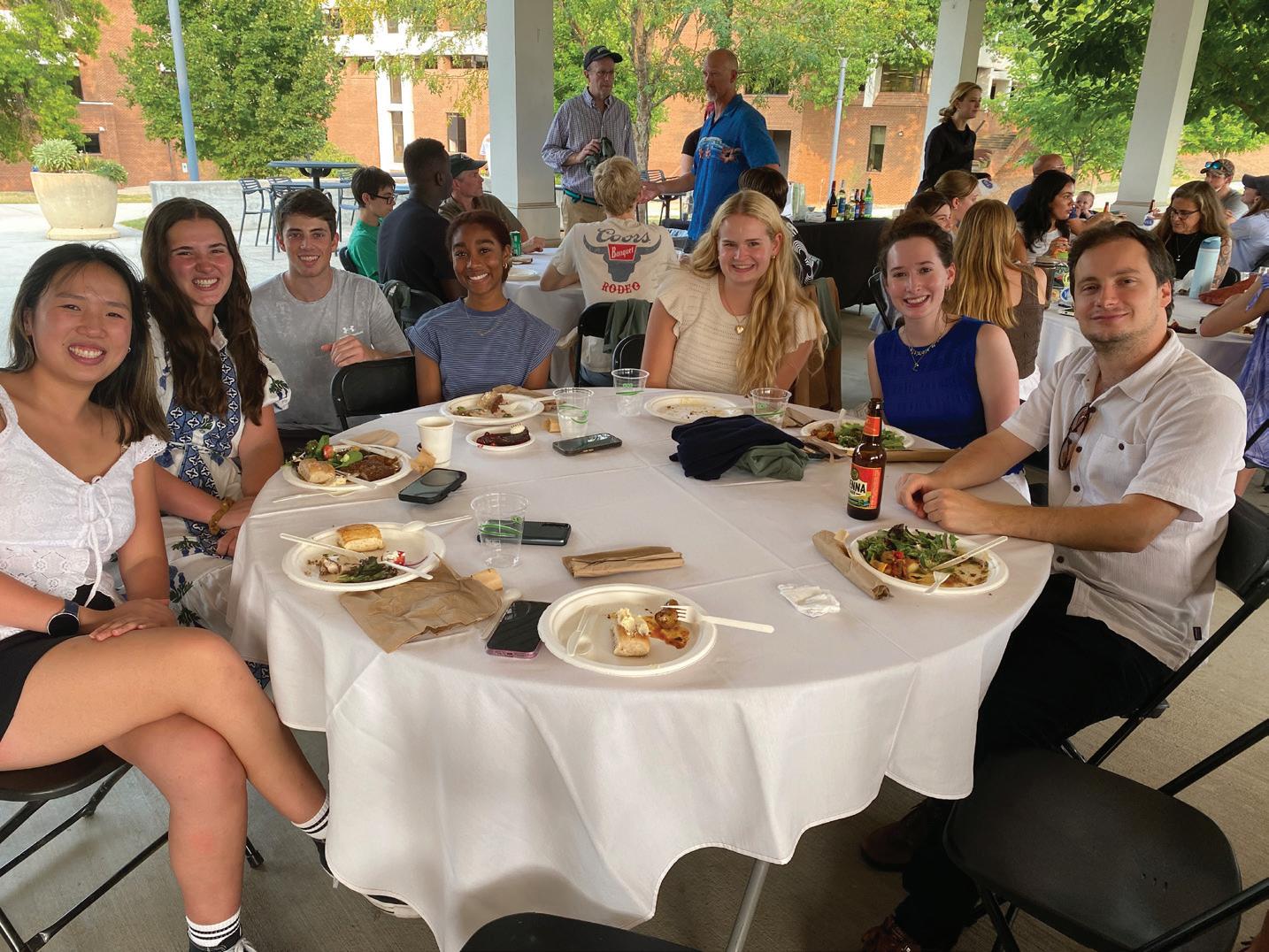
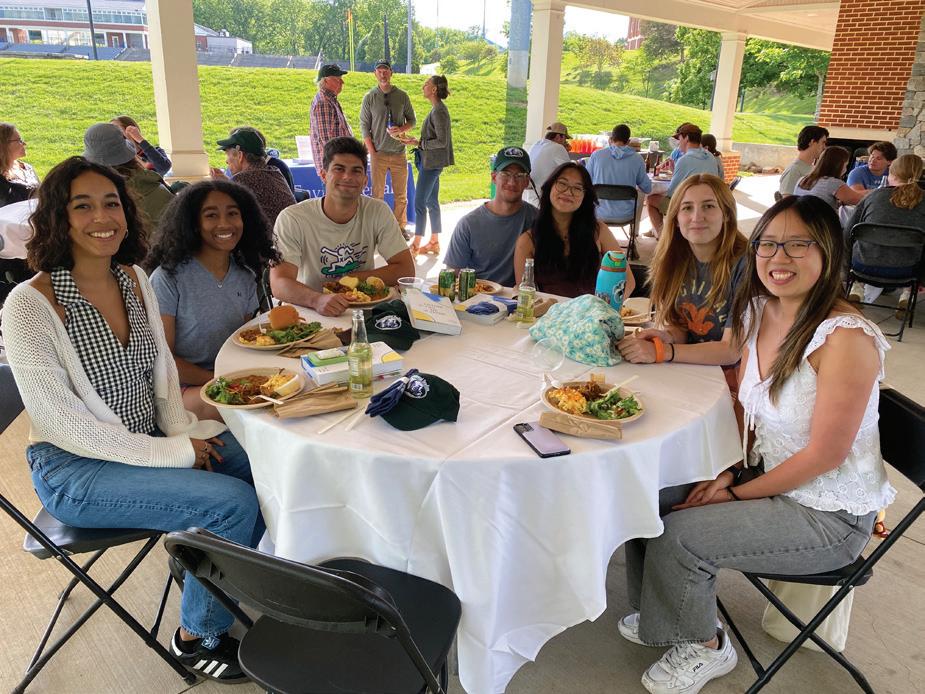
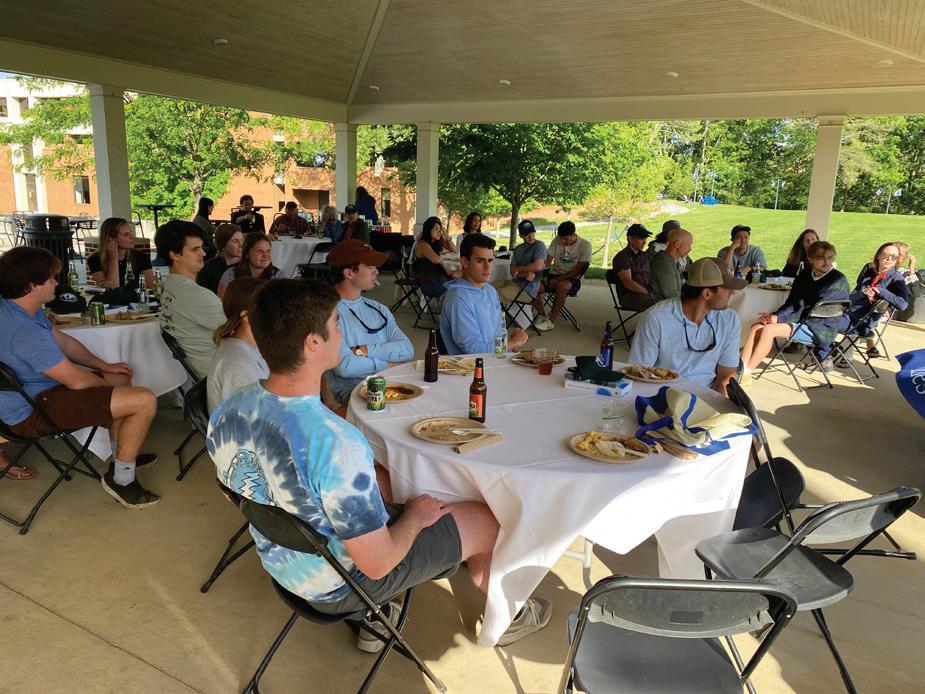
Our Welcome Back and End of Year celebrations at the Village Pavilion have become a tradition for us in the Environmental Studies Program. It feels significant that we start and end each academic year at the same location. We are always left with the sense of “weren’t we just here, starting, and now all of sudden we are here, ending” after an entire academic year has passed. Time really does fly by at college … for both the students and the faculty and staff!
Environmental Insight Through Art
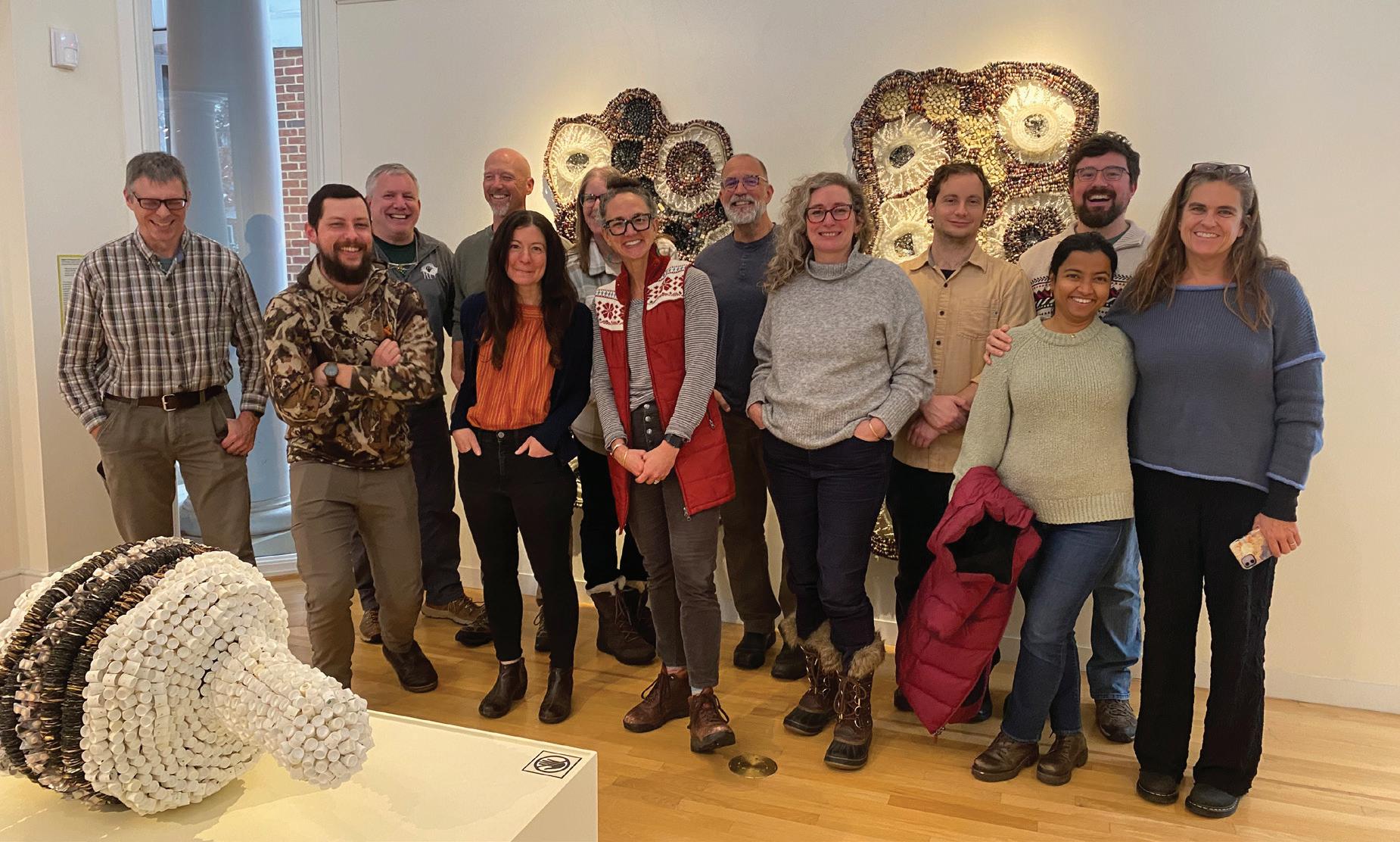
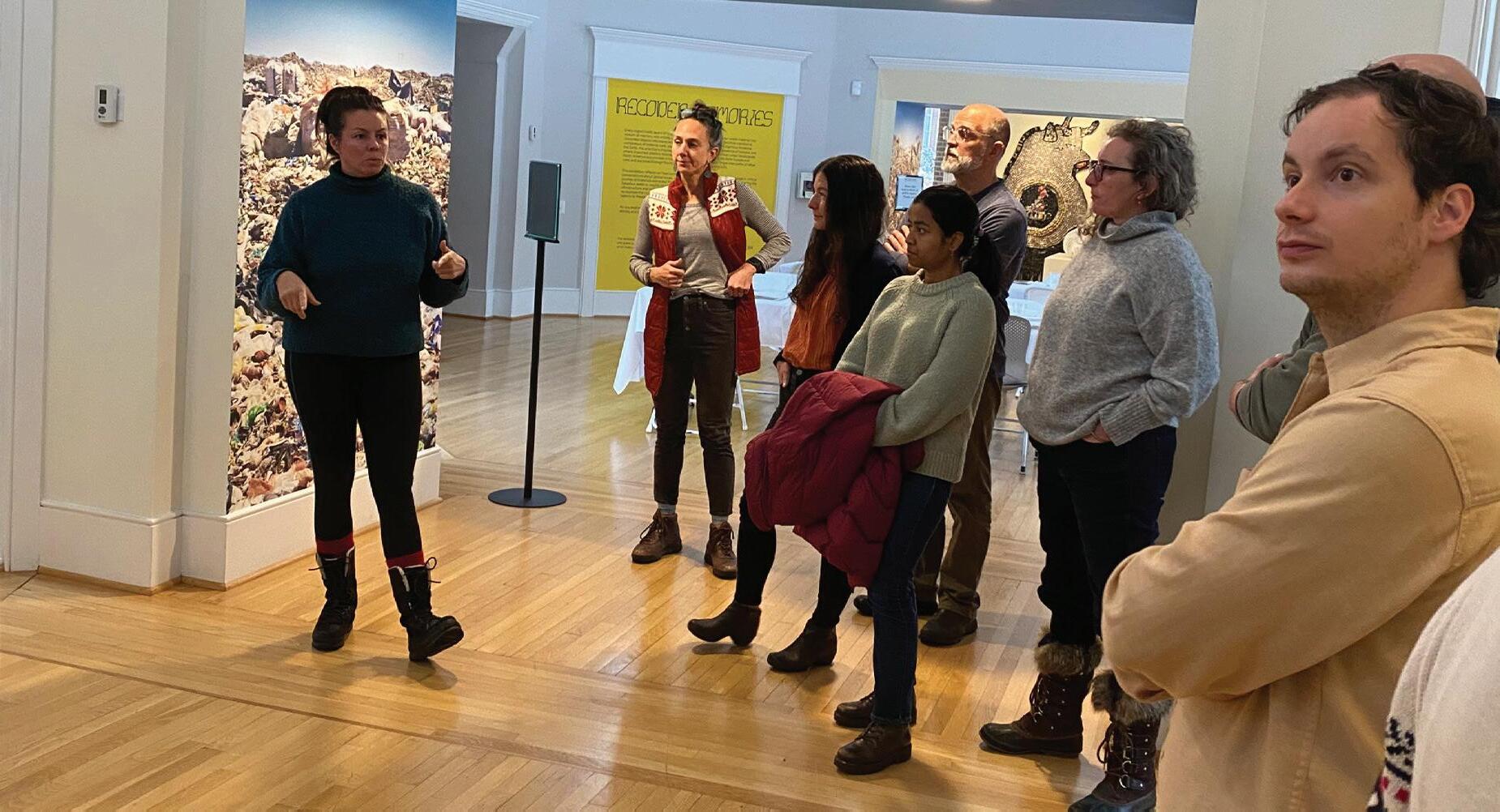
During the week of Fall Term final exams, the Environmental Studies Program faculty had the opportunity to tour and explore the Moffat Takadiwa exhibit in W&L’s Watson Galleries so that they could consider integrating the exhibit into their Winter Term classes, which many of them did. “Moffat Takadiwa: Recoded Memories” showcases the work of Zimbabwean artist Moffat Takadiwa (b. 1983), whose expansive sculptural installations repurpose discarded materials into intricate, tapestry-like forms. Working with objects such as computer keys, plastic bottles and VHS tapes, Takadiwa transforms technological debris and detritus into meditations on memory, language and the traces of human consumption. “Recoded Memories” urges us to reconsider the environmental and cultural imprints of everyday life, inviting us to reflect on the life cycle of materials and the global systems that shape what is used, valued and ultimately discarded. ■
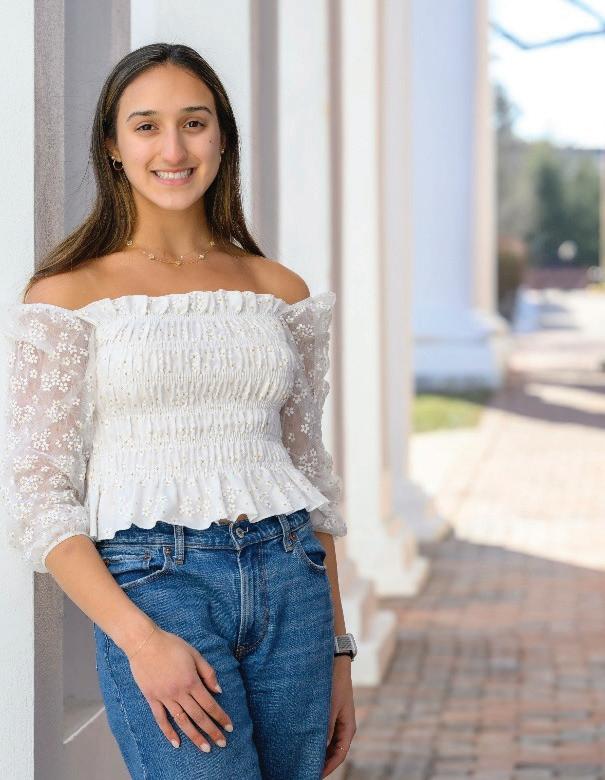
Sofia Iuteri ’27, founder and editorin-chief of The Experience Exchange

Storytelling as a Catalyst for Innovation and Environmental Connection
BY SOFIA IUTERI ’27
The ocean haS alwayS held intrinSic value in my life, so distinct and impenetrable that it continually provides me with a sense of solace and inspiration. As I became more immersed in competitive gymnastics, a sport I pursued intensely for over a decade, I slowly lost some of that everyday connection to nature. Achievement, structure and performance began to take up more space than reflection. It was not until I arrived at Washington and Lee University that I intentionally rebuilt my relationship with nature. Through daily walks, Outing Club trips, quiet moments with friends on the Colonnade and the academic framework of the Environmental Studies Program, I began to view connection to nature not as a luxury but as an essential component of human and ecological well-being. Professor Jay Margalus introduced me to the concept of the extinction of experience, the gradual loss of meaningful human interaction with the natural world. That concept challenged me, motivating me to take steps toward solving one of humanity’s largest challenges today. If we lose our lived experiences in nature, how can we expect to protect what we no longer feel connected to?
That question became the foundation for The Experience Exchange. During my sophomore year, I combined my love for writing, storytelling and social innovation with my background in environmental studies to create a student-run environmental publication structured as a limited liability company. My goal was not only to provide a formal space for sharing stories about nature but to build a financially sustainable venture capable of growing beyond campus. In its first year, TEE developed into a 40-person organization of writers, editors, designers, photographers and outreach and partnership coordinators. We secured over $4,000 in advertising and subscrip-
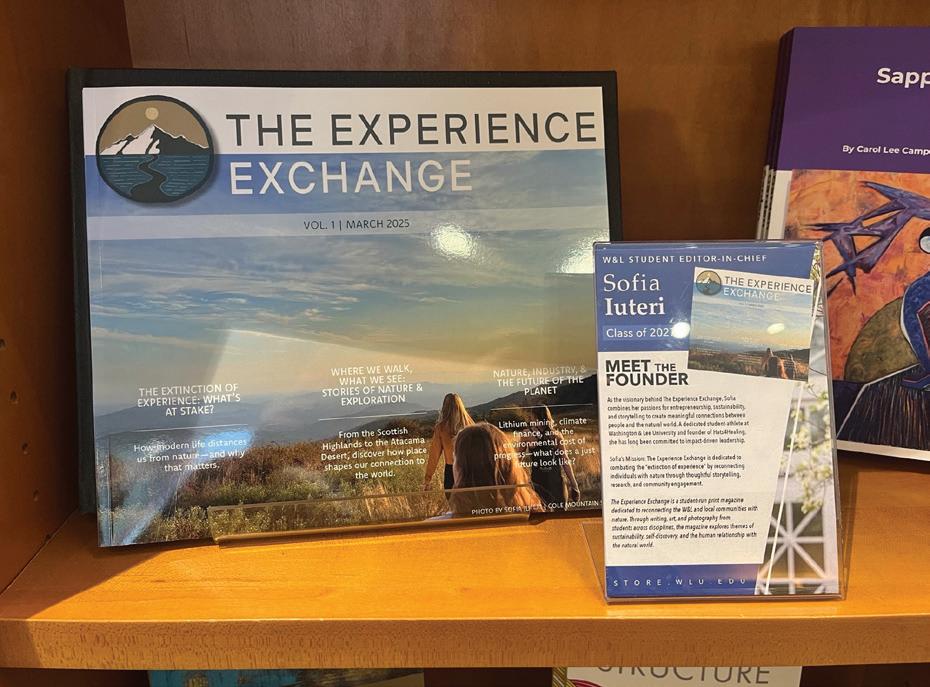
tion revenue in our first issue cycle, generated more than 50 paid subscriptions and wholesale orders and built multiple revenue streams through advertising, subscribers, wholesale distribution and grants. Survey data showed that over 90% of readers felt the publication enriched W&L’s intellectual community. We were selected to present at the W&L Entrepreneurship Summit Pitch Competition and advanced to the top 100 in a global pitch competition. Managing and scaling an organization of this size, including while studying abroad in Australia across time zones, has been one of the most formative leadership experiences of my college career.
The Environmental Studies Program has shaped both the mission and the model behind this venture. My coursework in environmental economics and sustainability has strengthened my ability to think critically about how environmentally oriented initiatives can be missiondriven and financially viable simultaneously. Studying abroad in Australia has further deepened my understanding of climate science and the psychology of nature reconnection, insights I plan to bring back to campus and future editions of the magazine. I aim to expand The Experience Exchange to other campuses, allowing advertisers and partners to reach a broader community committed to environmental storytelling. My long-term vision is for TEE to become more than a print and digital magazine, evolving into a national platform and digital hub that helps people reconnect with nature and translate that connection into action.
If you are interested in subscribing, advertising, mentoring or sharing your own experience with nature at Washington and Lee, I would love to connect. You can explore the magazine at theexperienceexchange.lovable.app or reach me directly at siuteri@mail.wlu.edu ■

204 W. Washington St. Lexington, Virginia 24450-2116 www.wlu.edu
DEPARTMENT HEAD
Robert Humston
John Kyle Spencer Director for Environmental Studies and Professor of Biology humstonr@wlu.edu, 540-458-8341
CORE FACULTY
Mauricio Betancourt
Assistant Professor of Environmental Studies mbetancourt@wlu.edu
Jamie Casey
Professor of Economics caseyj@wlu.edu
Lisa Greer
Earth and Environmental Geoscience Department Chair; Harry E. and Mary Jayne W. Redenbaugh Term Professor of Earth and Environmental Geosciencee greerl@wlu.edu
Bill Hamilton
Biology Department Chair; John T. Perry Jr. Professor in Research Science hamiltone@wlu.edu
Andrew M. Hess
Associate Provost for Academic Development and Operations; Professor of Business Administration hessa@wlu.edu
Megan F. Hess
Class of 1960 Professor of Ethics and Accounting hessm@wlu.edu
Ryan McCoy
Assistant Professor of Environmental Studies rmccoy2@wlu.edu
Catarina Passidomo
Associate Professor of Environmental Studies cpassidomo@wlu.edu
AFFILIATED FACULTY
Brian Alexander Associate Professor of Politics alexanderb@wlu.edu
Nicholas Barber
Assistant Professor of Earth and Environmental Geoscience nbarber@wlu.edu
Paul Cabe
Professor of Biology cabep@wlu.edu
Madhumita Chakraborty
Assistant Professor of Earth and Environmental Geoscience mchakraborty@wlu.edu
Leah Naomi Green
Harry E. and Mary Jayne W. Redenbaugh Term Professor of Earth and Environmental Geoscience greenl@wlu.edu
Joseph Guse
John C. Winfrey Associate Term Professor of Economics gusej@wlu.edu
Rebecca C. Harris Professor of Politics harrisr@wlu.edu
Margaret Anne Hinkle
Associate Professor of Earth and Environmental Geoscience hinklem@wlu.edu
Elizabeth Knapp
Director of the Johnson Program in Leadership and Integrity, Professor of Earth and Environmental Geoscience knappe@wlu.edu
Emily Landry
Assistant Professor of Business Administration elandry@wlu.edu
David Marsh Professor of Biology marshd@wlu.edu
Kary Smout
Associate Professor of English smoutk@wlu.edu
EMERITUS FACULTY
Greg Cooper
Professor of Philosophy Emeritus cooperg@wlu.edu
Lawrence E. Hurd
John T. Herwick M.D. Professor of Biology Emeritus hurdl@wlu.edu
Jim Kahn
John F. Hendon Professor of Economics Emeritus kahnj@wlu.edu