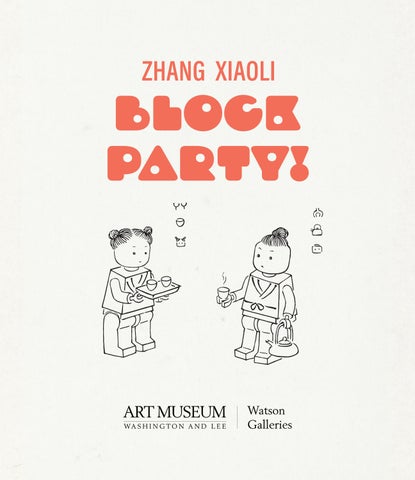
This catalogue is presented in conjunction with the exhibition Zhang Xiaoli | Block Party! at the Watson Galleries at Washington and Lee University, September 2, 2026 – December 12, 2026. The Art Museum at Washington and Lee advances learning through direct engagement with the collections and facilitates an interdisciplinary appreciation of art, history, and culture. Art Museum at Washington and Lee 204 West Washington St. Lexington, VA 24450 artmuseum.wlu.edu Copyright © 2026 by Art Museum at Washington and Lee, Lexington, Virginia All rights reserved. No part of this catalogue may be reproduced, stored in a retrieval system, or transmitted in any form or by any means, whether electronic or mechanical, including photocopying, recording, or otherwise, without written permission from the Art Museum at Washington and Lee. Published by Washington and Lee University Editor: Jack Green Layout: Billy Chase Content Editors: Jessica Luck and Laura Lemon Cover design by Aya Krisht after Zhang Xiaoli, Detail of Le Garden Manual, 2025. *A note on naming conventions: The Art Museum at Washington and Lee has included Chinese names with Chinese characters in reference to artists featured in the exhibition. In Chinese culture, the family name typically comes first. Westernized versions of Chinese names commonly reverse this format, placing the Chinese name last. Please note that in this exhibit guide and exhibition, Zhang Xiaoli is presented as family name first. I-Hsiung Ju, however, is presented with family name last, which is a convention from his time at Washington and Lee University and is also used by his family. Alternative phonetic spellings are also provided.
ZHANG XIAOLI
BLOCK PARTY! Contents Preface and Acknowledgments ������������������������������������������ iv About the Artist ���������������������������������������������������������������������������� 1 Curatorial Statement ����������������������������������������������������������������2 Exhibition Introduction ����������������������������������������������������������� 12 Artist-in-Residence Reflection �������������������������������������������� 13 Building Blocks: Legacy of I-Hsiung Ju ����������������������������20 Exhibition Checklist ���������������������������������������������������������������� 26 Artist Biography ����������������������������������������������������������������������� 27
Preface and Acknowledgments ISRA EL-BESHIR, DIRECTOR OF ART MUSEUM AT W&L
I am pleased to present Block Party!, a new body of work by the Art Museum at Washington and Lee’s second artist-in-residence, Zhang Xiaoli. I am profoundly grateful to those who have helped realize this exhibition and the accompanying catalogue; a heartfelt thank you to our former visiting curator of Asian art, Rachel Du, for introducing us to Zhang and to Daniel M. Greenberg, assistant professor of art history at the University of Minnesota Twin Cities, for guest-curating Block Party! and contributing an essay to deepen our understanding of Chinese art. A special note of thanks to the museum team: Fosca MaddaloniYu, the Euchlin D. Reeves curatorial fellow in ceramic art and Jack Green, associate director of collections and curatorial affairs for project managing; Patricia Hobbs, senior curator of art emerita who has been an indispensable resource to understanding I-Hsiung Ju’s impact at W&L; Jessica Wager, curator of academic engagement for supporting Zhang during her research visit and residency; and to James Ito, registrar, Kyra Swanson, collections manager, and student assistant Lucy Gates ’29 for working tirelessly to install a fantastic show. Thank you to Kimberly Sims, associate professor and associate university librarian for Special Collections and Archives, for providing us with resources about I-Hsiung Ju; Popcorn Cauley from the W&L Facilities team for assisting with installation; Kevin Remington and Brian Hamelman for photography; Aya Krisht and Billy Chase for graphic design; and Nadeen Kharputly, Jessica Luck, and Laura Lemon for copy editing.
iv
I am sincerely honored to be part of a community that has contributed to the success of our second residency program and that assisted Zhang throughout her eight-week summer 2025 residency in Lexington and her upcoming Fall teaching assignment as the I-Hsiung Ju and ChowSoon Chuang Ju Visiting Artist. A profound thank you goes to Mark Rush, the Waxberg professor of politics and law and director of the Center for International Education, whose deep admiration for I-Hsiung Ju’s academic legacy helped launch the 2024-2025 residency program. A special thank you to Andrea Lepage and Emma Steinkraus from the Art and Art History Department for providing equipment, studio space, and a Fall teaching opportunity. My appreciation goes to Zhang’s summer apprentices: Sylvia Churchill ’27 and Katie Lawson ’26 for their courage in choosing to learn a new artistic practice. On behalf of the Art Museum, we offer our warmest gratitude to Zhang Xiaoli for her commitment to the residency project, her mentorship of W&L students, and most importantly, for accepting our invitation to study I-Hsiung Ju’s oeuvre and our broader Chinese art collection. We wish to thank all those who continue to support the Artist-inResidence Program and for the financial support provided by the Center for International Education at Washington and Lee and the E. Rhodes and Leona B. Carpenter Foundation. ■
v
Beyond images, traditions, and categories, art is something living – something that grows from the place where it is made.” ZHANG XIAOLI
About the Artist Zhang Xiaoli (張小黎, b. 1989, Guiyang, China) is a contemporary ink painter who transforms classical Chinese painting traditions to create playful yet contemplative landscapes that bridge past and future. Trained at the Chinese University of Hong Kong (B.Sc, first-class honors) and the Central Academy of Fine Arts (MFA; Ph.D. candidate), she has received awards including the Liu Kuosung Ink Art Award (2023). Her Block Landscape series substitutes traditional motifs with contemporary elements — such as play bricks and minifigs — to create dialogues across cultures and visual traditions. Zhang has shown internationally and is represented by Fu Qiumeng Fine Art and Alisan Fine Arts. Her work has been collected by the Rhode Island School of Design Museum (Providence, RI); the Mark H. Reece Collection at Wake Forest University (Winston-Salem, NC); Harn Museum at the University of Florida (Gainesville, FL); and Zhejiang Art Museum (Hangzhou, China). She lives in Niagara, Canada, and serves as the Art Museum at Washington and Lee’s second artist-in-residence (2025–26). Reflecting on the legacy of the late I-Hsiung Ju, professor of art and artist-in-residence emeritus at W&L, and rooted in classical Chinese painting, Zhang’s current work explores themes of visual translation, cultural continuity, and migration experience. COURTESY OF ZHANG XIAOLI
1
Curatorial Statement DANIEL M. GREENBERG, PH.D., GUEST CURATOR
Fig. 3.1: Detail of Zhang Xiaoli, Mountain Passenger, 2025. 71 x 38 inches. Courtesy of the Artist.
2
Chinese artist Zhang Xiaoli (b. 1989) is known for her fine line paintings that playfully create imaginary worlds by combining the aesthetics of traditional landscape painting and lyrical surrealism with the rigid structures of play bricks (fig. 3.1). Block Party! is the product of a two-month artist’s residency at Washington and Lee University in the summer of 2025. During this time, she worked closely with objects from the Art Museum’s collection and had extended conversations with faculty and students, prompting her to reflect on Chinese painting and its ability to function across cultural divisions. This exhibition invites viewers to consider Zhang’s paintings together with the works that inspired them, showing how her work uses the traditional Chinese painting style of gongbi (工筆, fine line) to render imagined systems — block landscapes, printed manuals, and cross-cultural visual traditions — with the authority of careful observation. The Chinese tradition of gongbi painting is an ancient and technically demanding style, and Zhang adapts it to serve a distinctly contemporary perspective. Practitioners of this style use a fine brush, translucent silk, and mineral pigments to create figures and landscapes characterized by dynamic, delicate outlines and subtle shading. Traditionally, gongbi painting was used to represent historical figures, capturing subtleties of facial expression, ornamentation, and the play of floating silk garments. It was also used to render insects, animals, and birds with clarity and sensitivity, bringing the natural world into the hands of a viewer. Regardless of the subject, gongbi painting was valued for its ability to faithfully depict an artist’s engagement with the natural world. Painting did not passively record nature: The artist was understood to build the meticulous details within their works through close observation and careful artistry. Painting was therefore a lens through which a viewer could see both the world and the artist’s understanding of it. Zhang repurposes these classical ideas about gongbi painting and its power; rather than depicting the truth of nature through direct observation, she turns instead to abstract systems and
poetic visions, using gongbi to render these ideas as if they were observed realities, their forms determined through careful study. For example, Zhang’s work often appropriates the distinct visual language of play bricks and minifigs, using these represented blocks to build her landscape forms. The slick geometric surfaces of these bricks are set forth with a precision of line and shading that playfully suggests that these illusory landscapes were recorded from life. Other systems of visual representation are also the subject of Zhang’s exacting gaze. Her Le Garden Manual translates landscape and figures (fig. 3.2) from the Mustard Seed Garden Manual, a popular seventeenth-century reference work used by generations of Chinese artists learning the fundamentals of landscape painting, into her own block aesthetic. Using the fine lines of gongbi painting, the artist closely reproduces the structure of her printed model, down to the printers’ keys for folding and binding. She even includes invented page numbers, tacitly implying that these paintings are excerpts from a larger, non-existent manual of painting. Although she does not plan to make a complete Le Garden Manual, the aesthetics of gongbi painting give her imagined book a sense of structural coherence and material plausibility. Similarly, Blue Willow Plate (fig. 3.3) is a porcelain piece that functions as a condensed representation of Zhang’s own imagined system of image production filtered across cultural borders and historical time. It engages directly with two kinds of eighteenth-century ceramics drawn from the Washington and Lee collections (fig. 3.4). First, she considers Qing Chinese export wares that deliberately used self-Orientalizing images of mountains, pavilions, and Chinese figures to sell an exotic vision of China to Western consumers. Hand-painted by Chinese artists using cobalt on translucent white porcelain, these pieces were rare and expensive commodities in Europe. In the late eighteenthcentury, English makers began to produce earthenware in imitation of these imports, using transferware engravings to
Fig. 3.2: Zhang Xiaoli, Le Garden Manual: Staffage Figures (detail), 2025. 18 x 14 inches. Courtesy of the Artist.
3
Fig. 3.3: Zhang Xiaoli, Blue Willow Plate, 2026, diam. 16 inches. Courtesy of the Artist.
4
Fig. 3.4: Top: Unknown artist (China), Blue Willow Plate, 1780–1820, diam. 9 inches. Art Museum at Washington and Lee University, 2009.1039. Bottom: Unknown artist (England), Blue Willow Plate, 1800–1810, diam. 10 inches. Art Museum at Washington and Lee University, 2012.39.1.
standardize a Blue Willow pattern. In Blue Willow Plate, Zhang uses blocks, minifigs, and the techniques of gongbi painting to create her own imagined version of this now-archetypal expression of chinoiserie. Even as it returns to the original materials and methods used to create export porcelain, her painting emulates the visual qualities of printing to imagine and concretize a new pattern of mass-produced transferware. Although some of the works created for this exhibition move expansively across history and cultures, others respond more directly to the complex, cross-cultural histories of specific pieces from the Washington and Lee collection. Notably, three of Zhang’s works were directly inspired by paintings and calligraphy by I-Hsiung Ju (朱一雄, 1923–2012), professor of art and artist-inresidence emeritus, who taught Chinese art history and painting at the university from 1969 to 1989. Zhang’s Mountain Passenger reinterprets a teaching painting by Ju entitled Mountain Pass Traveler (figs. 6.2-6.3) that aggregates a range of basic landscape and figural elements from the Chinese literati painting tradition into one unified composition so that they could be used by his students to create imagined worlds of their own. This style of painting, characterized by abstracted landscapes executed in expressive monochrome brushwork, was historically associated with Chinese elite scholar-artists. More than just representations of mountains and rivers, the brush strokes in these paintings were understood to directly represent the scholar that created them. Zhang’s version retains the basic composition and iconography of its model but reimagines each piece through the lens of her own block-inspired system. Just as Ju’s painting depicted a microcosm of a boundless expanse, the mist and clouds at the borders of Zhang’s landscape invite a viewer to envision a block landscape that stretches beyond the painting’s borders. Furthermore, Zhang’s Blue Ridge Mountain Landscape (fig. 3.9) was inspired by a series of four paintings entitled Goshen Pass created by Ju in 1997 and a work of his calligraphy that reads, “Shadows of clouds over a thousand peaks, the sound of springs in ten thousand valleys.” Originally composed by the Tang dynasty poet Cui Shi (崔湜; 671–713), this couplet was popularized in the Ming and Qing dynasties. Ju’s version is
5
Fig. 3.5: Zhang Xiaoli, “May: Peanut at Large” from The Twelve Months of Washington and Lee, 2025, 12 x 9 inches. Courtesy of Zhang Xiaoli.
6
written in large seal script, an archaic style of writing over two thousand years old (fig. 6.5); his stylistic and textual choices explicitly connect the beauty of the Blue Ridge Mountains in his adopted home of Virginia to the timeless landscapes of China. Zhang’s painting extends from Ju’s layered artistic and poetic responses while leaving space for her own direct engagement with the natural landscapes that inspired them. Her work reflects her own journey of cross-cultural exchange while it seeks to represent what she calls “a shared imagination that crosses time and cultural boundaries.” This close engagement with the cultural rhythms of W&L is also present in the calendar, The Twelve Months of Washington and Lee (figs. 3.5-6), modeled on a series of twelve paintings created by Ju in 1985 as the basis for a printed calendar. Working with her apprentices during her summer residency, Zhang has represented each month with precision and humor. A beloved snapping turtle on campus is depicted with a mountain on its back like the mythological world-turtle Ao (鰲) (fig. 5.4); a lost cat jumps from a bridge into a literati-style Chinese landscape (fig. 3.5); and House Mountain rises in dreamlike shades of blue. Even as she engages with the past, Zhang finds space to use gongbi painting to reify the flights of imagination that arose from her own lived experiences. This same approach characterizes her Lingering Fragrance (fig. 3.7), which was inspired by two works from the Washington and Lee collections: a delicate Dehua ware incense burner and a small fan painting depicting an idyllic springtime landscape in southern China (fig. 3.8). Zhang describes her work in dialogue with the writing of the artist and philosopher Zong Bing (宗炳, 375-443), who wrote in his “Preface on Landscape Painting” (畫山 水序,hua shanshui xu) that despite his inability to travel due to old age and illness, he could still wander the famous mountains of China in his imagination by clarifying his mind and contemplating the Dao while reclining in his study. Here, swirling incense smoke rising from the represented form of Washington and Lee’s Dehua porcelain censer becomes an invitation for a similar imagined journey to a Southern landscape. Pavilions and boats filled with elegant figures are surrounded by blooming peach trees and craggy mountains. Although the heart of this vision
Fig. 3.6: Zhang Xiaoli, Katie Lawson (W&L Class of 2026), Sylvia Churchill (W&L Class of 2027), The Twelve Months of Washington and Lee, 2025. 16 1/2 x 209 inches. Courtesy of Zhang Xiaoli. Photo: Brian Hamelman.
7
Fig. 3.7: Zhang Xiaoli, Lingering Fragrance, 2025, 18 x 18 inches. Courtesy of Zhang Xiaoli.
8
is rendered with the precise lines of gongbi, the lucid reality of this "reclining travel" breaks down at the edges, where a bridge stretches through swirling clouds that dissolve back into the lingering fragrance of incense smoke. As Zhang writes, “Beyond images, traditions, and categories, art is something living — something that grows from the place where it is made.” The works in Block Party! have grown from her deep engagement with the art, history, and natural landscapes of Virginia, which inspired her to imagine poetic worlds that exist between observation and invention. Cutting across cultural and linguistic divides, Zhang’s gongbi paintings give these imagined systems the appearance of observed reality, demonstrating how painting can make invented worlds feel coherent, shared, and real.
Fig. 3.8a: Xu Rongxun, Untitled (Fan Painting Depicting Figures in a Riverscape), 1906, 5 3/4 x 18 inches. Art Museum at Washington and Lee University, R1994.15.98 Fig. 3.8b: Unknown artist (China), Censer, 1640–1700, 2 1/2 x 3 1/2 inches, Art Museum at Washington and Lee University, 2017.34.11
9
Fig. 3.9: Zhang Xiaoli, Blue Ridge Mountain Landscape, 2026, 18 x 94 inches. Courtesy of the Artist.
Exhibition Introduction DANIEL M. GREENBERG, PHD, GUEST CURATOR
In 2025, the Art Museum at Washington and Lee invited artist Zhang Xiaoli (張小黎, b. 1989, Guiyang, China) to serve as its second artist-in-residence. During her residency, Zhang studied the artistic legacy of professor I-Hsiung Ju, objects in the museum collection, and the landscapes of the Blue Ridge Mountains. Zhang creates art that depicts imaginary worlds inspired by Chinese landscape painting, printed books, and historical ceramics using modular toy blocks. She works in the traditional Chinese painting style known as gongbi (工筆, “fine line”), a method defined by precise outlines, careful brushwork, and layered color. Historically, this style was used to closely observe and record the natural world, including plants, animals, and people. Zhang uses the same careful technique to depict fictional subjects instead. Her works include invented books, ceramic patterns, calendars, and dream landscapes constructed from interlocking block forms. By painting imagined things with great precision, Zhang explores how painting can make invented worlds feel believable and real and how images move across cultures, materials, and history. This exhibition is organized by the Art Museum team and guest curated by Daniel M. Greenberg, assistant professor of art history at the University of Minnesota Twin Cities. This exhibition is made possible through the support of the E. Rhodes and Leona B. Carpenter Foundation, the Center for International Education, and the Reeves Endowment.
Daniel M. Greenberg is an assistant professor of art history at the University of Minnesota Twin Cities. He specializes in early modern Chinese art; his first book, Mapping Without Maps, examines the relationship between painting, state ritual, and the eighteenth-century Qing empire. He has also co-curated exhibitions, including Kelly Wang: Impressed and Layers of Joy: A Celebration of Black Art in Minneapolis at the University of Minnesota and C.C. Wang: Lines of Abstraction at Hunter College. Greenberg received his Ph.D. from Yale University in 2015 and holds a B.S. from Rutgers University. He also completed graduate coursework for an M.A. in the history of Chinese calligraphy at the Graduate Institute of Art History, National Taiwan University. He served as a United States Peace Corps volunteer in Sichuan, China, from 2000 to 2002.
12
Fig. 5.1 Zhang Xiaoli, Katie Lawson ’27 and Sylvia Churchill ’26. “January: Three Winter Friends” from The 12 Months at Washington and Lee, 2025, 12 x 9 inches. Courtesy of Zhang Xiaoli.
13
“Echoes of a Thousand Mountains” REFLECTIONS ON THE ARTIST-IN-RESIDENCE EXPERIENCE ZHANG XIAOLI, ARTIST-IN-RESIDENCE, ART MUSEUM AT WASHINGTON AND LEE, 2025-26.
During the summer residency at Washington and Lee University, I spent two months revisiting traditions of Chinese painting while developing new work in dialogue with my own practice and the legacy of I‑Hsiung Ju, professor of art and artist-in-residence emeritus. My focus is the contemporary transformation of Chinese media and its cross‑cultural resonances. The residency allowed me to test methods of working in presence, where the process of making is itself an encounter with a diverse academic community. I arrived with a project-oriented plan, including a translation of The Mustard Seed Garden Manual of Painting into what I termed Le Garden Manual and a sequence of 12 album leaves (figs. 3.6, 5.1) responding to local ecology and daily occurrences. My aim was both artistic and pedagogical: to produce new work that converses with East Asian traditions and to teach Chinese painting and calligraphy in a liberal arts environment rarely exposed to sustained studio practice in these media (fig. 5.2).
5.2: The artist in the studio with student apprentices Katie Lawson ’27 and Sylvia Churchill ’26. Photo: Kevin Remington.
14
15
Studio Practice and Creative Shifts
5.3: Student apprentices Katie Lawson ’27 and Sylvia Churchill ’26 painting at Woods Creek. Photo courtesy of Zhang Xiaoli.
5.4: Zhang Xiaoli, “April: Piggy the Snapping Turtle” from The Twelve Months of Washington and Lee, 2025, 12 x 9 inches. Courtesy of Zhang Xiaoli.
16
The residency challenged my habitual, slow methods of planning. Confronted with a new environment, I adapted by embracing spontaneity and improvisation. Rapid responses to observations produced works with a freshness I welcome; the translation project led me to invent pictographic “LEGO® texts” readable beyond language. Everyday local subjects, most notably the cat, Peanut (see fig. 3.5), and a snapping turtle named Piggy from Woods Creek (fig. 5.4), entered the 12‑month album, anchoring the work in Lexington’s lived landscape. Working publicly in an open studio reshaped how my art functioned. Rather than presenting only finished objects, my presence and process became part of the work’s meaning. Conversations with students, faculty, and museum staff made the studio a site of cultural exchange, allowing Chinese artistic practices to be experienced as tangible, living disciplines rather than as abstract topics in books. I mentored two apprentices, Katie Lawson ’26 and Sylvia Churchill ’27, and led public programs including an open studio and a calligraphy workshop. I approached calligraphy not primarily as linguistic literacy but as rhythm, form, and structure, presenting characters as symbols and patterns. This reframing addressed initial concerns about language barriers and the conventional copying pedagogy. Lawson responded playfully, treating animal‑like characters as opportunities for expressive signature and variation. Churchill pursued brushwork and compositional structure more analytically, later applying her studies to seal design and colophon writing. We studied historical models, such as Emperor Huizong, Chen Hongshou, and Bada Shanren, and used copying as a pathway to internalize technique and style. The apprentices integrated learned skills into original projects, demonstrating how Chinese media can become personally meaningful and creatively generative for American students.
Reflections and Acknowledgments I received strong logistical and collegial support from the Art Museum, the Art and Art History Department, the Center for International Education, and the University Library at W&L. The studio space, accommodation, and programmatic support facilitated rapid acclimation and interdisciplinary exploration. The invitation to engage the campus community prompted reflection on the broader significance of bringing a Chinese painting artist into residence three decades after Ju’s retirement. This residency expanded my practice in two principal ways: firstly, I started to realize that unlike an exhibition, where only finished artworks are presented to the audience, during the residency the working process itself became part of the interaction, encouraging risk through immediacy and adaptation; secondly, the teaching process affirmed that technical transmission can simultaneously create cross‑cultural dialogue when framed as embodied practice. For the W&L community, including faculty, staff, students, and alumni, I believe this residency was not only a presentation of my work but also a reconnection — with the legacy of Ju, with Chinese art and culture, and more broadly with East Asian traditions. I see this as a beginning, like echoes from distant mountains — resonances that carry forward.
5.5: Sylvia Churchill ’26 calligraphy work. Photo courtesy of Zhang Xiaoli.
5.6: Katie Lawson ’26 brushwork. Photo: Kevin Remington.
17
5.7: The Studio at Washington and Lee University used during the residency. Photo courtesy of Zhang Xiaoli.
20
Building Blocks: Legacy of I-Hsiung Ju PATRICIA HOBBS, SENIOR CURATOR OF ART EMERITA, WASHINGTON AND LEE UNIVERSITY
For decades, the late I-Hsiung Ju (Zhu Yixiong 朱一雄, b. 1923, Jiangyin, China; d. 2012, North Fort Myers, FL), professor of art and artist-in-residence emeritus at W&L, encouraged generations of students and artists as a teacher and cultural ambassador. His legacy continued in 2025 when his artwork, now held in the Art Museum at Washington and Lee, inspired Zhang Xiaoli during her artist residency. I-Hsiung Ju was a traditional Chinese scholar-painter trained in Eastern and Western traditions in China and the Philippines. He practiced literati painting or wenren hua (文人), a style based in calligraphy where spontaneous brushwork is a means of personal expression, a goal more highly valued than technical skill or realistic depiction. In contrast, Zhang follows the gongbi (工筆) painting tradition that is carefully planned, highly detailed, colorful, and narrative. The new work that Zhang produced in dialogue with Ju’s paintings and calligraphy she states, “captured a sense of spontaneity and freshness,” while retaining her own creative themes. Zhang chose three primary subjects of Ju’s work to contemplate: teaching, regional landscapes, and campus traditions.
“... a Chinese artist is not only a painter … he is also a philosopher and poet. His real aim is to depict a whole sweep, a continuity of life which would have the same meaning for his children as for himself. When I finish a work, I do not say ‘I painted this.’ I say, ‘I wrote this.’” I-HSIUNG JU, WASHINGTON AND LEE ACADEMIC CALENDAR, 1985-86
Teaching Ju’s Mountain Pass Traveler is a teaching tool, a sampler of Chinese brushstrokes based on instructions in The Mustard Seed Garden Manual of Painting, a foundational Chinese “how-to” book published in 1679. Ju also used the manual as a resource in writing four books on painting the “Four Gentlemen” (bamboo, orchid, plum, and chrysanthemum). Zhang reinterpreted Ju’s colorful landscape by “rebuilding” it as Mountain Passenger with her signature interlocking block forms. Inspired by Ju’s writing, she also created Le Garden Manual, her own version of The
Fig. 6.1: I-Hsiung Ju at work, no date. Washington and Lee University Special Collections.
21
Fig. 6.2: I-Hsiung Ju (Zhu Yixiong 朱一雄, b. 1923, Jiangyin, China; d. 2012, North Fort Myers, FL) Mountain Pass Traveler, 2006 (Year of the Dog) Spring. Hanging scroll; ink and brush on paper, 76 x 37 inches. Art Museum at Washington and Lee University Gift of the family of I-Hsiung Ju, 2015.35.3
22
Fig. 6.3: Zhang Xiaoli, Mountain Passenger, 2025, 71 x 38 inches. Courtesy of the artist.
Mustard Seed Garden Manual of Painting. Her representative block pictographs become a method of transcending language and cultural barriers, a challenge shared by both artists.
Regional Landscapes Zhang was inspired by both Ju’s local landscapes and calligraphy, including his Asian interpretation of Goshen Pass, a threemile-long mountain gorge formed by the Maury River. After contemplating the scenery, Ju interpreted it through the eyes of a literati painter, creating a series of four hanging scrolls that form a screen (fig. 6.4). A calligraphic scroll by Ju also impressed Zhang. Written in the zhuan (seal) style (fig. 6.5), the translation can be read: “Thousand peaks, clouds cast shadows; Ten thousand ravines, streams make sounds.” To which the artist added, “I lived in Virginia 33 years. This Chinese idiom really describes the Blue Ridge Mountains.” During her residency, Zhang responded in like manner to the region’s land, evoking the Blue Ridge Mountains while employing her more fine-lined Chinese artistic tradition (see fig. 3.9). Ju created his literati paintings by wetting paper and carefully controlling ink to create a wash with soft edges noting, “The strokes are spontaneous, but the execution of the whole is done under strict rules.” Another example, Winter Traveler (fig. 6.6), is monochromatic except for bright pops of tan, blue and green that draw the eye to the presence of a man on horseback. This
Fig. 6.4: I-Hsiung Ju (Zhu Yixiong 朱一雄, b. 1923, Jiangyin, China; d. 2012, North Fort Myers, FL) Goshen Pass (part 4 of 4), 1997. Hanging scroll; ink and wash on paper, 53 x 26 1/4 inches. Art Museum at Washington and Lee University Gift of the family of I-Hsiung Ju, 2015.35.4.d
Fig. 6.5: Detail of I-Hsiung Ju (Zhu Yixiong 朱一雄, b. 1923, Jiangyin, China; d. 2012, North Fort Myers, FL) Calligraphy (untitled), 1997. Hanging scroll; ink and wash on paper Art Museum at Washington and Lee University Gift of the family of I-Hsiung Ju, 2015.35.8
23
rider is echoed in Zhang’s Le Garden Manuscript figure riding a donkey.
Campus Traditions
Fig. 6.6: Detail of I-Hsiung Ju (Zhu Yixiong 朱一雄, b. 1923, Jiangyin, China; d. 2012, North Fort Myers, FL) Winter Traveler, 2002, Ink and wash on paper, 52 x 27 inches. Art Museum at Washington and Lee University, Gift of the family of I-Hsiung Ju, 2015.35.2.
Finally, one of Zhang’s projects that involved her two student apprentices, Katie Lawson ’26 and Sylvia Churchill ’27, responded to original artwork painted by Ju for the university’s 1985-86 academic calendar. Zhang’s interpretation illustrates her detailed and precise narrative style, while Ju’s freehand evocations of the seasons, athletics, and arts on campus are quite spontaneous. Comparing each version of September (see figs. 6.7-6.8) provides insight into their distinct painting traditions: Zhang’s colorful birds-eye expanse of the W&L Colonnade with swirls of decorative clouds contrasts dramatically with Ju’s monochromatic depiction of a single arched transom, evoking doors along the Colonnade, across which seven leaves drift down, incorporating a poem in the lower right. When there is one leaf falling. We know, in the whole world, Autumn is coming. Chinese Proverb
24
Fig. 6.8: I-Hsiung Ju (Zhu Yixiong 朱一雄, b. 1923, Jiangyin, China; d. 2012, North Fort Myers, FL) September from the 1985-86 W&L academic calendar, 1985 Ink and wash painting on paper, 10 1/2 x 14 inches University transfer, 2011.35.1
Fig. 6.7: Zhang Xiaoli (b. 1989), September: The Colonnade, from The Twelve Months of Washington and Lee, by Zhang Xiaoli, Katie Lawson (W&L ’26), and Sylvia Churchill (W&L ’27), 2025. Ink and color on Xuan paper and silk 12 x 9 inches. Courtesy of Zhang Xiaoli.
25
Exhibition Checklist Zhang Xiaoli | Block Party! Watson Galleries September 2, 2026 – December 12, 2026 Artworks by Zhang Xiaoli as Artist in Residence, Washington and Lee, 2025– 2026, on loan from Fu Qiumeng Fine Arts 1. Mountain Passenger, 2025 Ink and color on sized Xuan paper 71 x 38 inches 2. Lingering Fragrance, 2025 Ink and color on silk 18 x 18 inches 3. Blue Ridge Mountain Landscape, 2026 Ink and color on silk 18 x 94 inches. 4. With Katie Lawson ’26, Sylvia Churchill ’27 The Twelve Months of Washington and Lee, 2025 Ink, color, and gold leaf on Xuan paper and silk 16 1/2 x 209 inches 5. Le Garden Manual: Rock Studies, Staffage Figures, Tree Studies., 2025 Ink and color on silky paper Each 18 x 14 inches 6. Blue Willow Plate, 2026 Porcelain and underglaze blue Diameter 16 inches 7. Blue Willow Painting, 2025 (Reeves Museum of Ceramics) Color on Xuan paper Diameter 22 inches
26
Artworks from Art Museum at Washington and Lee collections Unknown artist (China) Blue Willow Plate, 1780–1820 Jingdezhen porcelain and underglaze blue Diameter: 9 inches. Former collection of William Price; George Washington Custis Lee, 2009.1039 Unknown artist (England) Blue Willow Plate, 1800–1810 Transferware Diameter: 10 inches. Museum Purchase, 2012.39.1 Xu Rongxun (許榮勳, China, b. 1873, d. 1955) Untitled (Fan Painting Depicting Figures in a Riverscape), 1906 Ink on paper 5 ¾ x 18 inches Gift of W. Groke Mickey, R1994.15.98 Unknown artist (China) Censer, 1640–1700 Dehua porcelain 2 ½ x 3 ½ inches Gift of Reverend Payton and Mary Craighill in Honor of Bishop Lloyd and Marian Craighill, 2017.34.11 I-Hsiung Ju (Zhu Yixiong 朱一雄, b. 1923, Jiangyin, China; d. 2012, North Fort Myers, Florida) Untitled (Calligraphy), 1997 Ink and wash on paper Dimensions, total scroll: 58 7/8 x 20 1/4 inches Gift of the family of I-Hsiung Ju, 2015.35.8
Artist Biography EDUCATION 2021: Master of Fine Arts, Central Academy of Fine Arts, Beijing, China. 2014: Bachelor of Science (honors) in fine arts and biology, Chinese University of Hong Kong, Hong Kong, China
SELECTED SOLO EXHIBITIONS 2026: Traveller, Fu Qiumeng Fine Art, New York City, NY Wandering Mindscape, Alisan Atelier, Hong Kong, China
2024: The 14th National Art Exhibition, National Art Museum of China, Beijing, China Kaleidoscope of Colors in Asian Art, Harn Museum of Art, FL Escape Velocities: New Acquisitions to the Reece Collection of Student-Acquired Contemporary Art, Hanes Art Gallery, Lake Forest University, NC 2023: Ink Asia: Liu Kuo-sung Ink Art Award Show, Ink Asia 2023, HKCEC, Hong Kong, China
2024: Whimsical Maze, Fu Qiumeng Fine Art, New York City, NY
Expectation @ Search @ Algorithm, Yiguan Art Centre, Nanjing, China
2023: Spectacular of Tanhausser Gate, Zhejiang Art Museum, Hangzhou, China
The Highest Virtue Resembles Water, United Nations Headquarters, New York, NY
2020: Li Galaxy, Tong Gallery + Projects, Beijing, China
Ink Alchemy: Beyond Tradition, Alisan Fine Art, Hong Kong, China
2019: Curio Boxes: Zhang Xiaoli’s Portable Landscapes, Daguan Gallery, Taipei, Taiwan
SELECTED GROUP EXHIBITIONS 2026: Reshaping Tradition: Contemporary Explorations in East Asia, Trinity College, Hartford, CT 2025: The 10th Beijing International Art Biennale, Beijing, China
2022: The Rain Freshens, Fu Qiumeng Fine Art, New York, NY Antiques x Art, Art Basel Hong Kong, HKCEC, Hong Kong, China 2021: Suzhou Garden Art Festival, Cang Lang Ting, Suzhou, China 2020: Contemporary Forms of Ink Painting, Alisan Fine Arts, Art Basel online viewing room, Hong Kong, China
Transmission, Central Academy of Fine Arts, Beijing, China
27
2019: The 13th National Art Exhibition, Guangdong Museum of Art, Guangzhou, China
RESIDENCIES
2018: HOPE, Alisan Fine Arts, Hong Kong, China
2025: Art Museum of Washington and Lee University, Lexington, VA
2017: Desiring: Post 97 Hong Kong Ink Art, Alisan Fine Arts, Hong Kong, China
SELECTED PUBLIC COLLECTIONS
2026: The Exchange, Niagara Falls, ON, Canada
Contemporary Neoclassic: Hong Kong Ink Art, Daguan Gallery, Taipei, Taiwan
Zhejiang Art Museum, Hangzhou, China
2016: Beijing Youth Art Biennial, Today Art Museum, Beijing, China
The Harn Museum, University of Florida, Gainesville, FL
2015: Senses: Exhibition of Works by Young Emerging Hong Kong Artists, University Museum & Art Gallery, Hong Kong University, Hong Kong, China
Mark H. Reece Collection, Wake Forest University, Winston-Salem, NC
2014: Graduation Show of Fine Arts Department 2014, The Art Museum of Chinese University of Hong Kong, Hong Kong, China
AWARDS 2023: Liu Kuo-sung Ink Art Award 2014: Y.S. Hui Fine Arts Award Wucius Wong Creative Ink Painting Award
28
Rhode Island School of Design Museum, Providence, RI
EXHIBITION RESOURCE GUIDE
Linktr.ee/block.party
29
Center for International Education