Discovery Summer 2026 % Volume 12, No. 2
the newsletter from washington and lee university school of law
COMMENCEMENT 2026
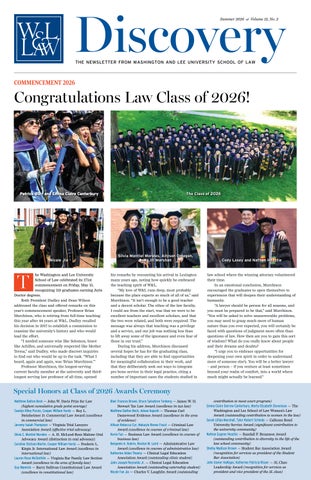
Congratulations Law Class of 2026!
The Class of 2026
Patrick Burr and Emma Claire Canterbury
Nicole Jia
Silvia Montiel Morales, Allyson Ortegon, and Lilli Marshall
Cody Losey and Nathan Heastie
he Washington and Lee University School of Law celebrated its 171st commencement on Friday, May 15, recognizing 119 graduates earning Juris Doctor degrees. Both President Dudley and Dean Wilson addressed the class and offered remarks on this year’s commencement speaker, Professor Brian Murchison, who is retiring from full-time teaching this year after 44 years at W&L. Dudley recalled his decision in 2017 to establish a commission to examine the university’s history and who would lead the effort. “I needed someone wise like Solomon, brave like Achilles, and universally respected like Mother Teresa,” said Dudley, who made discreet inquiries to find out who would be up to the task. “What I heard, again and again, was ‘Brian Murchison.’” Professor Murchison, the longest-serving current faculty member at the university and thirdlongest serving law professor of all time, opened
his remarks by recounting his arrival in Lexington many years ago, noting how quickly he embraced the teaching spirit of W&L. “My love of W&L runs deep, most probably because the place expects so much of all of us,” said Murchison. “It isn’t enough to be a good teacher and a decent scholar. The ethos of the law faculty, I could see from the start, was that we were to be excellent teachers and excellent scholars, and that the two were related, and both were required. The message was always that teaching was a privilege and a service, and our job was nothing less than to lift away some of the ignorance and even fear of those in our trust.” During his address, Murchison discussed several hopes he has for the graduating class, including that they are able to find opportunities for meaningful collaboration in their work, and that they deliberately seek out ways to integrate pro bono service in their legal practice, citing a number of important cases the students studied in
law school where the winning attorney volunteered their time. In an emotional conclusion, Murchison encouraged the graduates to open themselves to experiences that will deepen their understanding of humanity. “A lawyer should be person for all seasons, and you must be prepared to be that,” said Murchison. “You will be asked to solve unanswerable problems, you may need to grasp much more of human nature than you ever expected, you will certainly be faced with questions of judgment more often than questions of law. How then are you to gain this sort of wisdom? What do you really know about people and their dreams and doubts? “I urge you to embrace opportunities for deepening your own spirit in order to understand more of someone else’s. You will be a better lawyer – and person – if you venture at least sometimes beyond your realm of comfort, into a world where much might actually be learned.”
T
Special Honors at Class of 2026 Awards Ceremony Matthew Dalton Beck — John W. Davis Prize for Law (highest cumulative grade point average) Caedyn Riley Porzio, Cooper William Vardy — Roy L. Steinheimer Jr. Commercial Law Award (excellence in commercial law) Jeremy Isaiah Thompson — Virginia Trial Lawyers Association Award (effective trial advocacy) Silvia C. Montiel Morales — A. H. McLeod-Ross Malone Oral Advocacy Award (distinction in oral advocacy) Caroline Stetson Martin, Cooper William Vardy — Frederic L. Kirgis Jr. International Law Award (excellence in international law) Lauren Rose McGlothlin — Virginia Bar Family Law Section Award (excellence in the area of family law) Guy Mannick — Barry Sullivan Constitutional Law Award (excellence in constitutional law)
Blair Frances Brown, Bryce Salvatore Tenberg — James W. H. Stewart Tax Law Award (excellence in tax law) Matthew Dalton Beck, Adnan Kajoshi — Thomas Carl Damewood Evidence Award (excellence in the area of evidence) Allison Rebecca Cyr, Makayla Renee Foust — Criminal Law Award (excellence in courses of criminal law) Kevin Fan — Business Law Award (excellence in courses of business law) Benjamin A. Kobrin, Rexton M. Laird — Administrative Law Award (excellence in courses of administrative law) Katherine Aidan Thoeny — Clinical Legal Education Association Award (outstanding clinic student) John Joseph Reynolds Jr. — Clinical Legal Education Association Award (outstanding externship student) Nicole Fae Jia — Charles V. Laughlin Award (outstanding
contribution to moot court program) Emma Claire Darrow Canterbury, Marta Elizabeth Stevenson — The Washington and Lee School of Law Women’s Law Award (outstanding contribution to women in the law) Sarah Lillian Marshall, Tyler Robert Schieda — Calhoun Bond University Service Award (significant contribution to the university community) Nathan Eugene Heastie — Randall P. Bezanson Award (outstanding contribution to diversity in the life of the law school community) Shelby Madison Brown — Student Bar Association Award (recognition for services as president of the Student Bar Association) John Xavier Halligan, Katherine Patricia Risser — 3L Class Leadership Award (recognition for services as president and vice president of the 3L class)
EMPLOYMENT REPORT This spring, W&L Law released a report on employment rates for its class of 2025. The report, which measures employment 10 months after graduation, marks the fourth year in a row where more than 94 percent of the class is employed or in graduate school at this critical measuring point. According to the report, nearly 93 percent of the class of 2025 secured a job that either requires bar passage or for which a J.D. degree is an advantage. The overall employment rate, including all professional
employment types as well as students pursuing graduate school, is 94.5 percent. The report shows graduates working in a diverse range of jobs, with a significant number in larger
CLASS OF 2025 — BY FIRM SIZE
CLASS OF 2025 — BY SECTOR 17% Public Interest, Government, Other
57% 501+ 15% 100-500
28% 0-100
23% Clerkships
60% Firms
law firms and clerkships. Over 81 percent of those employed are heading to clerkships or law firms, and 64 percent of those graduates are working at firms with over 250 lawyers. The remainder of the class is split among government, business, higher education, and public interest. One particular area of strength for W&L Law has always been placement in federal and state clerkships, and this remains the case for the class of 2025. Twenty-four members of that class are clerking in state and federal courts, including nine in federal district courts in Florida, Kentucky, Maryland, Mississippi, New Jersey, North Carolina, Tennessee, the U.S. Virgin Islands, and Virginia (2).
Excellence Recognized PLACEMENT IN AMLAW 200 FIRMS
#16 in the U.S. Class of 2025
FEDERAL CLERKSHIPS
#14 in the U.S. Class of 2025
STUDENT SPOTLIGHT
Great Experiences, Great Outcomes
JEREMY THOMPSON’26L
LUCY CAO ’26L
BLAIR BROWN ’26L
REX LAIRD ’26L
A native of West Virginia, JEREMY THOMPSON ’26L graduated from High Point University in 2020 with a degree in criminal justice and business administration. Prior to beginning law school, Jeremy worked for three years with a federal agency in Washington, D.C. At W&L Law, Jeremy was very involved in moot court, winning the Mock Trial competition as a 2L and serving as chair of that competition as a member of the Moot Court Board. During his 3L year, Jeremy was a student clinician in the Civil Rights and Racial Justice Clinic.
difficulty of proving civil rights cases. There are laws, statutes, and procedures in place to help preserve and protect individuals from civil rights violations. However, satisfying the legal standard to adequately prove these cases seems to be more challenging than other suits that could be brought within the court system.
we were working on a case, but it was equally important to move on from a finished piece of work and let go of the obsession. I heard him say almost every time after we finished an opinion or order, “It’s done! Now onto the next one!” I try to adopt this onward mentality in my own life too. It sounds corny, but my favorite aspect was the people I got to work with. Besides how smart he is, VCL is also so charismatic and fun to be around, and he’s curious about almost everything! The clerks are also brilliant attorneys in this competitive field. I look up to them as role-model attorneys that I want to become. They taught me many useful skills, such as how to segment a big piece of work and how to mentally manage concurrent projects. VCL was intentional about team-building practices, and that helped us get to know each other on a much deeper level.
communication, with a concentration in public relations. Before law school, she taught ninth-grade Algebra I for one year and then spent nine years working in e-commerce content management and data analysis. During her 3L year, she was a student attorney in the Tax Clinic.
My favorite aspect of clinical work was learning about new areas of law that I had yet been exposed to. The clinic handles anything in the realm of civil rights and racial justice, but the clinic has an intentional focus on housing discrimination. Prior to the clinic, I had not been exposed to much litigation or law surrounding housing laws and its intersectionality with civil rights. It was fascinating to learn these new areas and see how they overlap, or even diverge, from one another and the areas of law that I am familiar with. One thing that surprised me was the sheer complexity and 2
W&L
Law
Discovery
LUCIE CAO ’26L is from Hunan, China. She earned her bachelor’s degree in sociology from The Chinese University of Hong Kong. At W&L, she serves on Law Review and as a Law Ambassador. During her 3L year, Lucie participated in an internship with the Delaware Court of Chancery through the Working in Law Full-time (WILF) Externship Program. I expected the level of work to be intense before I started, but I still felt amazed by it when I got to witness the process. What surprised me the most, though, was the Vice Chancellor Laster’s (VCL) ability to move on quickly from finished work. He cautioned us about the importance of being as thorough as possible while
BLAIR BROWN ’26L is from Gastonia, North Carolina. She attended the University of North Carolina at Chapel Hill, where she earned a B.A. in journalism and mass
Although about 90 percent of our work falls into two broad categories — helping individuals who owe tax balances they cannot pay and assisting those who are disputing their liability with the IRS — I’ve been surprised by how much variety exists within those cases. The circumstances that give rise to each controversy, as well as the way each matter is resolved, may differ significantly from client to client. Also, I’ve been pleasantly surprised by how often I’ve connected with clients on a personal level, learning about their lives, families, and challenges beyond the tax issues that brought them to the Clinic. My favorite aspect of working with the Clinic has been helping clients resolve their tax issues and sharing in their joy and relief when
we reach a positive outcome. Working and negotiating with the IRS requires a great deal of patience, to put it lightly, so even resolving a seemingly small issue can feel like a major victory for both the client and me. In addition, there are nine students in the Clinic this year, and our group has developed a strong rapport. We regularly exchange ideas, advice, and practical tips, and I think we’re better student attorneys for the collaborative environment we’ve built.
REX LAIRD ’26L is from New Orleans, Louisiana. He attended St. Olaf College, where he received a B.A. in Russian and philosophy. He went on to receive an M.A. in philosophy from Central European University. At W&L, Rex is a lead articles editor for the Journal of Civil Rights and Social Justice, a research assistant, and has served as an adviser to the law school’s Phillip C. Jessup International Law Moot Court team. During his 3L year, he worked for the U.S. Senate Permanent Subcommittee on Investigations through
WILL VARDY ’26L
RUSH LEE ’26L
WILL VARDY ’26L is from Guilford, Connecticut. He earned his BSFS in international politics and his MA in security studies from Georgetown University’s Walsh School of Foreign Service. Before law school, he was employed as a risk and compliance analyst in Reston, Virginia. At Washington and Lee School of Law, Will was a coauthor and research assistant to Professor Mark Drumbl, as well as a member of the Federalist Society and an editor for the German Law Journal. After graduation, Will Vardy will clerk for Judge Paul M. Black at the United States Bankruptcy Court for the Western District of Virginia.
RUSH LEE ’26L is from Atlanta, Georgia. She attended the College of William & Mary, where she received a B.A. in government with a minor in history. Before law school, she worked as a litigation project assistant at Nelson Mullins Riley & Scarborough LLP in Atlanta. At W&L, she was a managing online editor of the Washington and Lee Law Review. After graduation, Rush Lee will join Hunton Andrews Kurth LLP in its Washington, D.C. office.
Judge Connelly and Professor Chaplain’s bankruptcy course certainly guided me towards a practice I would never have otherwise been exposed to and introduced me to a distinct segment of law implicating unique code and procedure, a distinct body of common law, and a fascinating combination of intersecting practices. I highly recommend giving it a go if one has even a passing interest in the subject — bankruptcy needs new blood! I am, above all, keen on getting into the thick of it and assisting residents of the Shenandoah after a financial disaster. Bankruptcy is often the only option for some in regaining any sort of stability in their lives after a medical catastrophe, job termination, credit collapse, messy divorce, protracted lawsuit, or particularly hard quarter, and I greatly look forward to offering some kind of assistance. Beyond that, it will be a privilege to learn the tools of the trade directly from an accomplished practitioner and jurist, Judge Black. I am also looking forward to wrestling with and familiarizing myself with the Code in his chambers.
I came into law school knowing that I wanted to do litigation based on my previous experience as a litigation project assistant, where I worked on mass tort and breach of contract matters. I knew I wanted to delve into complex commercial litigation, but antitrust was a welcome surprise. I took Professor Eggert’s Antitrust class, which really increased my interest in the field and prepared me for some of my work this past summer. My 2L summer at Hunton exposed me to a variety of practice groups and fascinating overlapping legal issues. I had wonderful mentors who encouraged me and gave great advice about growing my career, which further confirmed my desire to practice litigation. I am looking forward to continue working and learning from the attorneys I worked with this past summer. It will be exciting to continue to build relationships and contribute to the team. I am excited to hopefully engage more with antitrust while also getting more experience with discovery and deposition skills. I am also looking forward to exploring more of D.C. as it will be my new home!
One of my main goals over the semester was to become more skilled and confident at presenting my finished work product and findings. I had many opportunities over the course of the semester to hone these professional communications skills. In addition, I got a lot more experience with document review, which will be a useful and transferable skill for practice.
Finally, I think I gained insight into the procedures and operations of the legislative branch. Given the gravity of the government oversight and investigatory work PSI is responsible for, I was surprised how everyone made me feel like part of the team. The attorneys were always helpful, from helping the law clerks figure out how to navigate the Senate office buildings in the beginning, to getting the clerks integrated into the office’s workflows as the semester went on.
MAKAYLA FOUST ’26L
TYLER SCHIEDA ’26L
MAKAYLA FOUST ’26L is from Fredericksburg, Virginia. She earned her B.A. in politics with a minor in psychology from the University of Virginia. At W&L Law, Makayla was a note editor on the Journal of Civil Rights and Social Justice, a student attorney in the Criminal Justice Clinic, a member of the Black Law Students Association (BLSA), and a fellow with Professor Lawlor’s Academic Excellence program. After graduation, Makayla Foust will work in Misdemeanor Early Representation Unit at the DeKalb County Public Defender’s Office.
TYLER SCHIEDA ’26L is from Monroe Township, New Jersey. He attended Villanova University, where he received a B.A. in economics. After college, he worked as a paralegal for two years in Washington, D.C. At W&L, he was a Burks Scholar, hearing advisor, co-chair of the John W. Davis Moot Court Competition, Law Ambassador, sports czar, and member of the W&L Law Review. After graduation, he will work at Sidley Austin in the firm’s Washington, D.C. office.
the Working in Law Full-time (WILF) Externship Program.
I spent my 2L summer interning at DeKalb PD’s. While there, I was able to gain hands-on experience working on cases, observing court proceedings, and assisting attorneys with client interactions, which gave me a deeper understanding of the day-to-day responsibilities of a public defender. I was also able to tour several Georgia facilities, including the DeKalb County Jail, Georgia Regional Hospital, and the Medical Examiner’s Office, which provided valuable insight into the broader systems the clients interact with. Everyone in DeKalb was incredibly helpful and insightful, and they showed me what it truly means to be a strong advocate. What I am most looking forward to about this job is the opportunity to serve clients directly and advocate for people who often do not have a voice in the system. I am excited to continue developing as a trial attorney, building strong client relationships, and working on meaningful cases that have a real impact on people’s lives. I also look forward to learning from experienced defenders and being part of a team that is committed to protecting constitutional rights and ensuring fair representation.
Before law school, I did litigation work as a paralegal, and I enjoyed it. I liked the team-oriented environment and the process of advocacy. After seeing the work that litigators did, I was confident that I wanted to take my career in that direction. I knew I wanted to work in New York or Washington, D.C., so I focused my search on those markets. I also wanted to work at a big firm, but one with a positive work environment where I would get along with my colleagues. Sidley struck a perfect balance between these priorities. It is a big firm that will give me opportunities to work on complex litigation and is a firm where colleagues treat each other with respect. This past summer, I formed friendships with members of my summer associate class, and I am excited to begin my legal career with them. It was easy to interact with lawyers of all tenure at the firm. I had many candid conversations with partners and associates — people were happy to share their experiences and offer advice. I was also able to work on interesting cases that involved novel legal issues. The work I did this summer is work that I hope to do as an associate, so it was reassuring to get experience with it right off the bat.
Summer
2026
law.wlu.edu
3
STUDENT SPOTLIGHT
Against the Odds The Parole Advocacy Practicum continues the parole work of VC3, but it’s tough in a state where parole has largely been abolished. BY JEFF HANNA
FOR THE EIGHT 3L STUDENTS in Washington and Lee School of Law’s Parole Advocacy Practicum, the odds are daunting. Although successful parole petitions have always been rare for Virginia’s incarcerated population, the annual grant rate has fallen to between 1% and 2% in the last few years. Still, the students are undeterred as they connect with their clients and their clients’ families and friends, familiarize themselves with the crimes and the sentences, gather letters of support, and draft the parole packets. They dare not lose hope. “Every single day that I work on my case, I have the mindset that we’re going to do it,” says Nathan Howell ’26L. “You don’t reflect on the odds being stacked against you until you’re done.” Allison Wexler Weiss, professor of practice at W&L, has taught the practicum the past five years. In the first four years, her students successfully gained parole for two clients — not a bad average considering the odds. “We all know what the grant rate is,” Weiss says. “But there are people being released. So, it could be your client. That’s how we go into it.” There is additional reason for hope this year since a new parole board has been appointed by Governor Abigail Spanberger. That has led to increased optimism among the students and their clients. “In the prison they’ve all been talking about what the shakeup with the new governor and the new parole board might mean,” says Evan Dodys ’26L, whose 71-year-old client has been up for parole 21
Professor Allison Weiss took over the prison parole project when the Virginia Capital Case Clearinghouse closed.
that they don’t want to engage in the process,” she says. Another criterion is that the inmates are able and willing to talk with the students regularly. In fact, Weiss says the weekly phone calls the students have with their clients offer a surprisingly important lesson for them. “It sounds basic,” she says, “but in this day and age, students don’t talk on the phone very much. There is no texting with people in prison. Students must set up a specific time when the client calls them
“We all know what the grant rate is,” Weiss says. “But there are people being released. So, it could be your client. That’s how we go into it.” times. “My client seems positive, and I’m positive, too. I mean, it can’t get worse than the way it’s been.” The Parole Advocacy Practicum evolved from the Virginia Capital Case Clearinghouse (VC3), which assisted defense attorneys who represented capital murder defendants. VC3 had been operating for 32 years when, in 2017, David Bruck, then its director, began shifting the clinic students to parole cases since death penalty cases were declining in the commonwealth. When the death penalty was abolished in 2021, VC3 closed, but Bruck saw value in continuing to work on the parole cases. “After VC3 ended, I spoke with David, and he was really sad to see the parole work go because it was such a net positive for the students and for the clients,” Weiss says. “I had been teaching a practicum based on post-conviction work and thought maybe I should take on some of that parole work VC3 had been doing.” Thus began the Parole Advocacy Practicum, which enrolls eight students each spring semester. The students work in pairs so that they have backup, but each student takes the lead with one client. Weiss goes through a painstaking process of selecting those clients. To begin, they must be going up for review in the first or second quarter of the year when the class is in session. Since parole has largely been abolished in Virginia, she focuses on what she terms “old law clients,” referring to individuals sentenced before 1995. Consequently, most clients have been in prison a very long time with only a few exceptions. Weiss looks for those who have not had an infraction in the last two years, have not had prior parole representation, and are truly interested in pursuing parole. “There are individuals who are so demoralized 4
W&L
Law
Discovery
on the office phone here in Lewis Hall, which is a number approved by the prison and isn’t recorded.” Weiss says this personal, one-on-one contact is important on a human level for the students but also for the clients. All have been incarcerated for at least 20 years, often more. They might not have had anyone involved in their case for two decades and now have someone advocating for them. At the outset, students must establish rapport and gain their client’s trust through the weekly phone conversations. That can be a concern. Malia Devencenzi ’26L has the only female client in this spring’s class. She says she knew from the first phone call that the woman would feel more comfortable talking with another woman. “I was very surprised with the sense that she trusts me enough to be open with me and relate some of the things that happened in her life,” Devencenzi says. As they discuss their interactions with their clients, the differences in their experiences become apparent. For example, Michael Powell’s client has been in prison for 46 years, and this will be the 25th time he’s come up for parole. Powell has found him to be inherently quiet, which could be a detriment. “I think his quiet nature combined with the fact that he’s had no luck with parole after many, many, many attempts means that he’s not terribly forthcoming,” says Powell. “Frankly I don’t know how hopeful he is that, even with my help, he’s got a shot at this.” Then there is Dodys’s client. He has a positive outlook but doesn’t want to be a burden to anyone, least of all his new advocate.
“In our first conversation, he was just, ’Do what you can,’” says Dodys. “But our conversations are shorter because he does not want to impose on me. He might have been able to get more documentation, more letters of support, but he doesn’t want to request anybody to go out of their way to help him.” On the other end of that scale is Amanda Mulligan’s client who, she says, commands every conversation and has lots of ideas regarding her representation of him. Her challenge has been figuring out how to voice her opinion in a way that doesn’t seem contrary to him and his ideas. “I want to honor his wishes because he is my client and I’m working for him,” Mulligan says. “We talk a long time every week, which has been helpful as I get to know him and figure out how to say something that’s receptive to him.” These often-difficult conversations between the students and their clients are crucial, says Weiss. These are lessons they are not going to get anywhere in law school. The practicum includes legal research, advocacy, and drafting, but what is unique are the real-world considerations — what does the client want and how can they understand and implement that. “You look into their past and describe where they were in their lives that led them to commit usually a horrific crime,” Weiss says. “You do realize that people are more than the worst things they’ve done in their lives. It makes us think and discuss as a class — what is the purpose of prison? Do we believe in rehabilitation? Does the system believe in rehabilitation?” Benjamin Neal noted that “it has been great to get to know my client, beyond the headlines. If you only know about the crime and the circumstances surrounding it, it gives you one idea of a person. But when you talk to someone week after week, you get a fuller picture of the person. We found a lot of common ground. We talked about sports and our faith.” For the most part, the practicum clients are not usually claiming that they’re innocent, but two members of this year’s class are representing inmates who are expressing actual innocence, which makes the students’ jobs trickier. Genuine, heartfelt expressions of remorse are a major factor in successful parole bids. During one class session on a chilly February morning in Classroom F of Lewis Hall, Weiss has raised remorse with the students. She shares a New York Times article about a prisoner who has spent three decades in New York prisons where he has been a model inmate and is eligible for parole. According to the article, the only thing holding him back is his lack of remorse for a crime he insists he did not commit.
How, Weiss asks, do you navigate this issue with your clients? What advice do you offer clients who may not be giving the parole board exactly what they want in terms of their remorse? “You can’t tell them to lie, of course,” she says. “But, as lawyers you do coach your clients, right? You do prepare them for how they can tell their story most effectively to a jury or the parole board. That is not lying. That’s giving somebody tools they might not otherwise have.” Giving the parole board the level of remorse that it wants is challenging when a client asserts his innocence. Is it possible to say both, I’m sorry that this occurred, and also, I didn’t do it, in a way that is effective? For the next hour of the class session, Weiss and the students confront the conundrum, batting around the narratives that they might use in developing the parole package. Throughout the conversations, the students reveal other lessons that they might not have learned in any other of their classes. Nathan Heastie’s client was given 40 years for robbing a Dollar General. The sentence was suspended down to 22 years, and he’s served 12. He’s 70 and has significant health issues. Heastie says the hardest part for him is that this is all post-conviction work, and there are so many things he would have done differently had he been representing the client in the first place. “The length of his sentence is really confusing to me, especially because he pled guilty,” says Heastie. “There are things that, looking back, I wish I could have done for him, but we can’t.” In Symone Gibbs’s case, there are the moments when she finishes a phone call with her client and realizes that while he is headed back to his cell, she’s
on to her daily activities. Her client recently was married in prison, so she has had calls with his new wife, too. “His wife goes through a wide range of emotions on the phone,” says Gibbs. “Having to navigate that has been a little bit difficult.” Those personal interactions can be heavy, and there are plenty of them. As the class is preparing to end for the day, Howell says he’s headed downstairs to the telephone where he’ll start four hours of calls with his client’s 11 family members. “I’m trying to corral them. I’m trying to compile a complete timeline of my client’s life,” says Howell. “Gathering the vast amount of information you get and then deciding what to write down has been quite a challenge. This is my client’s first time up for parole, so he doesn’t know what to expect and goes on a roller coaster — some days he’s depressed, others it’s a slam dunk. It’s been quite the journey.” Clare Williams ’22L knows that journey well. She had one of the practicum’s two successful outcomes when her client was granted parole in 2024. Williams is now a deputy district attorney at the 5th Judicial District Attorney’s Office in Breckinridge, Colorado. Even three years removed from the process, she remembers all the calls and says the type of client interaction is quite different from what you get in another type of practicum. “I could talk about the different technical skills I was able to apply in terms of putting together the application, making a persuasive argument, prepping those who spoke on my client’s behalf before the parole board, and making my own argument to the board,” says Williams. “Those are legal skills that have now been useful to me in my role as an advocate. But what really strikes me
about the experience is what a community effort it was. It was something that took a village.” Williams’s client, Tywon Briscoe, was granted parole in 2024 and released in 2025. He had served almost 30 years of the 35-year sentence he received as an 18-year-old. He was eligible under the socalled “Fishback” law, named for a 2001 Virginia Supreme Court ruling requiring judges to tell juries that parole had been abolished — so they would not lengthen sentences based on the assumption that defendants would serve only a fraction of their time. Williams has stayed in touch with Tywon since his release and talks with him regularly. The level of relationship she developed with Tywon and his family is, Williams says, unlike the nature of the relationship with other clients. “The law school is providing a really critical service by connecting people who are parole eligible with advocates through the practicum,” Williams says. “It also raises awareness about the state of parole in Virginia, which is something people, even in the legal field, don’t know about.” If she could, Willliams would love to share the secret to her success with Briscoe’s appeal with this year’s students. “But it’s hard to say what the magic formula is that you could apply to other parole applications.” Absent that secret formula, then, this year’s students will simply have to keep making calls, reaching out to friends and families of their clients, fashioning the most compelling applications that they can, and drafting the remarks that they will make on their client’s behalf to the parole board. Ultimately, they’ll find out whether they can beat the odds.
Inside the 1L Year with Brigitte Arcoite ’28L OF ALL THE EXPERIENCES I HAVE willingly put myself through, law school has without a doubt been the toughest. A close second was a 20-day backpacking expedition with an alternative intervention program called the Wilderness School. What made those 20 days so challenging wasn’t the nonstop mosquitoes or the lack of access to running water. Instead, it was the emotional intensity that comes from pushing
by how eager so many people were to meet one another and how open they were to building an inclusive community. And while Lexington may be small, there has been no shortage of opportunities to connect with other students and professors in deeply meaningful ways. For example, students quickly created clubs of common interest to help keep us sane — pickleball, climbing, run club, to
When I first arrived for orientation, I was struck by how eager so many people were to meet one another and how open they were to building an inclusive community. yourself past limits you didn’t even know existed. Coming out of a 36-hour “solo day,” I created a list of lessons that I wanted to take with me into the “real world.” In fact, as I write this, my 20-day lessons are still in view, pinned up in the corner of my carrel. In this way those 20 days were also some of the most meaningful experiences of my life. My 1L year here at W&L Law has, so far, brought on much the same kind of challenges, lessons, and self-discovery as my 20-day and other backcountry excursions — just with a lot less walking and a lot more reading. W&L Law reminds me of the community I have been searching for since I left the Wilderness School. When I first arrived for orientation, I was struck
Enjoying a run with fellow law students helps Brigitte balance the demands of law school.
name a few. Students will often congregate in the carrels when they can’t stuff anymore reading into their brains. The professors are just as deeply embedded in the community as the students. If a professor says they are there as a resource it’s not an empty promise — they make it a priority to provide guidance and space to explore a deeper personal reflection of the material. The smallness of the school combined with the community buy-in creates an atmosphere that seems quite unique to W&L Law. In outdoor education, “fun” is often broken up into two categories. Type 1 fun is fun that you experience in the moment. Type 2 fun is not fun in the moment, but makes a great story after the fact. It might seem like there’s not a lot of opportunity to enjoy yourself in law school, but there’s actually a good mix of both of these types of “fun” — especially type 2. One thing that is special here is that people actually care about connection, they aren’t studying all the time, and there is always an opportunity to do any number of other things — whether in the town or at home. If I’ve (re)discovered anything this year, it is that law school and life move way too fast to justify studying constantly for marginal gains. For as much time as I’ve spent in the backcountry and for as much love as I have for something as nerdy as geography and maps, I can’t seem to stop getting lost on trails — even on the ones that are wonderfully well-marked. As a result,
Brigitte tackling an assignment at her carrel. I have had my fair share of wild hitchhiking stories. Just like getting lost on the trail, “getting lost” in law school has tended to be the most meaningful experiences of my 1L year. After years of thinking I’d end up as an outdoor educator, I would have never expected to end up on the path of public defense. But if law school isn’t the place to challenge your thinking and approach your learning from an openminded perspective then I don’t know what is. Paradoxically, one of the parts I love most about backpacking is the experience of getting back into town after being in the backcountry for days on end. The everyday experience I had come to expect and accept didn’t feel so normal anymore. I have found the experience of leaving the small world of Lexington and W&L Law to feel much the same. While I find the smallness of the community wildly helpful during the school year, I also appreciate when it’s time to leave for the shift in perspective it brings. Law school will always be about learning the black letter law and the skills necessary to be an effective advocate for your client. But if you care to slow down and look carefully enough, there are also a lot of life lessons. Maybe you could even write them down and pin them up in the corner of your carrel.
Summer
2026
law.wlu.edu
5
44 YEARS OF DISTINGUISHED SERVICE
Celebrating Brian Murchison: 1982–2026
6
W&L
Law
Discovery
“My love of W&L runs deep, most probably because the place expects so much of all of us.”
—Brian Murchison, Commencement 2026
To hear his address, scan QR code or visit vimeo.com/1194056466
From his first class in the fall, to several special events, to his final class where his students saluted him by dressing in robes, it was a wonderful year celebrating the extraordinary career of Brian Murchison. Alumni can help honor him by supporting the Brian C. Murchison Law Scholarship Endowment, created in 2021 by the Law Class of 1996 in honor of their 25th Law School Reunion. To recognize Professor Murchison’s extraordinary impact on the community, W&L Law aims to raise this endowment to $1.6 million to provide full tuition and fees for a law student each year. Contact Law Advancement at 540-458-8587 to make your gift.
Summer
2026
law.wlu.edu
7
THE CAMPAIGN FOR WASHINGTON AND LEE UNIVERSITY
Campaign Investment Opportunities Washington and Lee School of Law
Washington and Lee School of Law is dedicated to providing a rigorous education that develops broad-minded, highly skilled, and honorable lawyers. Beyond classroom excellence, W&L Law offers unmatched experiential learning opportunities. Students represent actual clients through community-based lawyering, cultural immersions, rigorous externships, and clinical opportunities under the guiding hands of faculty experts. W&L Law emphasizes personalized attention from professors, both inside and outside the classroom, as a cornerstone of its educational approach. In the competitive landscape of legal education, scholarships and other forms of financial support are essential for attracting top-tier students.
Artificial Intelligence Research Fund $50,000 ANNUALLY $1,000,000 TO ENDOW PROGRAM
Professor Josh Fairfield is the William Donald Bain Family Professor of Law and director of Artificial Intelligence Legal Innovation Strategy at W&L. Professor Fairfield is nationally known for his work at the intersection of law and technology, specializing in digital property, electronic contracts, big data privacy, and virtual communities. Through Professor Fairfield’s leadership, the AI Law Institute at W&L Law was established in 2025 to help the legal profession navigate the rapidly evolving intersection of artificial intelligence, legal ethics, and professional responsibility. The mission of the Institute is to bridge the gap between a lawyer’s ethical duties in using AI tools and their obligation to achieve technological competence as AI becomes central to modern legal practice. The Institute prepares law students, faculty, attorneys and judges to understand the inner workings of AI systems, enabling them to use machine learning effectively, safely and defensibly. This includes examining how AI training data, model design and user interactions influence outcomes, as well as teaching lawyers how to reduce the risks of AI hallucinations, bias, misinformation, privacy breaches and manipulation. By equipping the profession with this knowledge, the Institute supports the development of responsible AI governance and empowers legal professionals to deploy AI with confidence, ethical clarity and strategic insight.
Contact Law Advancement at 540-458-8587 for additional information. 8
W&L
Law
Discovery
Academic Excellence Programming for Law Students
3L Immersion Program $175,000 ANNUALLY $3.5 MILLION TO FULLY ENDOW AND NAME PROGRAM
$32,000 ANNUALLY $750,000 TO FULLY ENDOW PROGRAM
W&L Law has placed new focus on providing students with a variety of academic success programs to ensure high levels of achievement in law school. These offerings include guest speakers and academic workshops, mental health guidance, time management programs, and the pre-orientation “Winning 1L” program. This program is designed to support students, including veterans, who are coming back to the classroom after a significant pause in their education. However, Winning 1L is open to all incoming students, and in August 2025, about 30 percent of the incoming 1L class participated in the program. This holistic Law School readiness program offers academic skills, wellness preparation, study tactics, and time management skills that pay dividends for students throughout their W&L Law experience. The Winning 1L Program, and all academic excellence support programs, are provided at no cost to students.
Our curriculum for the 3L year has evolved over time, allowing W&L Law to continue to offer a “liberal arts” approach to legal education. We hear from alumni and employers time and again that W&L Law graduates are well prepared to practice law, not just to pass the bar exam. One avenue for this professional preparation is the 3L Immersion Program. Immediately following their 2L year, W&L Law students must undertake a two-week intensive course focused on either transactional or litigation practice. Through the litigation immersion, students develop trial practice skills, following a single case from initial client interview to the end of bench trial. In the transactional immersion, students undertake a complex legal acquisition, working with clients and opposing counsel to draft contracts and negotiate a business purchase. Alumni and expert practitioners from a variety of fields — along with members of our full-time faculty — serve as instructors for the Immersion Program, providing current perspectives and valuable feedback.
Celebrating Alumni Hundreds of W&L Law alumni and guests returned for this year’s reunion celebration, making it the best-attended alumni weekend since the law school began holding separate reunions almost 20 years ago. Nan ’76L and Hal Clarke ’76L were honored with the Outstanding Alumnus Award. Kristin Ray ’96L and MK Mallery ’21L were recognized for volunteer work.
Dean Melanie Wilson presents special awards to ( from left), Kristin Ray ’96L, Nan ’76L and Hal ’76L Clarke, and MK Mallery ’21L.
2027
SAVE THE DATE • APRIL 9–11
LAW ALUMNI WEEKEND
Summer
2026
law.wlu.edu
9
70s
grow his remit to include legal, policy, sustainability, strategy, corporate affairs and public advocacy.
Alan Chipperfield ’76L, Blair Kooi ’76L, and Clifford Logan Walters III ’71, ’76L, P’01 were among the members of the Florida Bar who were honored as 50-year members of the Florida Bar or whose cumulative legal practice with the Florida Bar and one or more United States jurisdiction(s) totals 50 years.
80s
Jonathan Snare ’86L was sworn in Nov. 3, 2025, as a commissioner of the Occupational Safety & Health Review Commission. He was elevated by the president as chairman of the Commission on Nov. 20, 2025. Previously, he served as acting solicitor of the U.S. Department of Labor and was a partner in the Washington, D.C., office of Morgan Lewis & Bockius in the labor/employment group.
On Nov. 5, 2025, Mary Beth Naumann ’99L was sworn in as a United States bankruptcy judge for the Western District of Kentucky in Louisville. She practiced with Jackson Kelly PLLC for 25 years before this appointment to the federal bench.
90s
Lee Garlove ’90, ’93L served as the quarterbacks coach this year for the Kentucky Country Day Bearcats who won their first state championship in football. The Bearcats also became the first Louisville school to win the Class 1A state title.
00s
David Dardis ’00L, executive vice president and chief legal and policy officer at Constellation Energy, was promoted to senior executive vice president, chief external affairs and growth officer. In his new role, Dardis will lead the company’s new generation development business and
Andrew Morton ’09L joined Miller Nash as special counsel with the firm’s bankruptcy and creditors’ rights team. He counsels corporate clients, including financial institutions, creditors’ committees, investment funds, third-party purchasers, and creditors on complex financial restructurings, reorganizations, workouts, financing transactions, and related commercial matters. Kathryn Shurin ’09L, a partner at Sheppard Mullin in Houston, was named co-leader of the firm’s Energy and Infrastructure industry team and Digital Infrastructure industry team.
10s
Matthew Fielding ’11L joined the Newark, New Jersey, office FBT Gibbons as a
partner, focusing his practice on complex commercial real estate and real estate finance transactions. He represents financial institutions, real estate developers, and corporate clients in the structuring, negotiation, and closing of sophisticated real estate transactions across a range of asset classes and markets. Amanda Dufraine ’12L recently opened her own bankruptcy firm with W&L adjunct professor Caleb Chaplain. The firm, Chaplain Dufraine, PLLC helps people throughout the Western District of Virginia and has offices in Roanoke and Harrisonburg. Suzanne Peters-Erlick ’12L was promoted to assistant general counsel of the Hearst Corporation, one of the nation’s largest global, diversified information, services and media companies. At Hearst, she oversees the labor employment team in the Office of General Counsel and advises Hearst’s 360 businesses on labor and employment laws.
Alumni Weekend Spotlight
10
W&L
Law
Class of 1981
Class of 1986
Class of 1991
Class of 1996
Class of 2001
Class of 2006
Class of 2011
Class of 2016
Class of 2021
Discovery
Madyson Kent ’25L joined the Roanoke office of Woods Rogers as an associate in the Intellectual Property and Cybersecurity and Data Privacy practices. She focuses on intellectual property protection, including patents, trademarks, copyrights and trade secrets. Matthew J. Radford ’25L joined the Nashville office of Bradley Arant as an associate in the Litigation Practice Group.
BIRTHS Chip Skinner ’84, Jim Clark ’84, Eric Anderson ’82L, and Rich Vieser ’76 joined Dean Melanie Wilson for a golf outing at Baltusrol.
Keith Jaworski ’14L joined the Charlottesville office of Woods Rogers as Of Counsel in the Construction and Government Contracts practice group. He is a former U.S. Army ranger and served in the U.S. Army JAG Corps as a prosecutor and legal adviser to the 75th Ranger Regiment. Krystal Swendsboe ’15L was named partner at Wiley Rein in Washington, D.C. She represents and advises clients in a variety of complex litigation and appellate matters in state and federal courts. Eric Santos ’16L has been elected partner at Rivkin Radler in Poughkeepsie, New York. Santos devotes much of his practice to commercial litigation and general liability defense. Solomon Gonzalez ’17L of the Montgomery County (Texas) District Attorney’s Office has been promoted to felony prosecutor. Alan Carrillo ’18L was named partner at Brown Fox in Dallas. His practice is focused on commercial litigation across a range of industries. Spencer Wiles ’18L was recognized in NCLW’s Excellence in Law Awards. An shareholder with Robinson Bradshaw in Charlotte, Wiles focuses his practice on complex business litigation and arbitration across construction, insurance, land use, sports and
Bethny Barrett ’19L has been named the executive director of the Grove on Patterson, a substance recovery home for pregnant and postpartum women in Roanoke.
20s
Russel Wade ’22L joined the Richmond office of Woods Rogers as an associate in the Bankruptcy and Creditors’ Rights practice. He counsels debtors, creditors and lenders across a range of industries navigate in- and out-of-court restructurings and related commercial litigation. Scott Koven ’24L joined the Charlottesville office of Woods Rogers as an associate in the Labor and Employment and Litigation and Dispute Resolution practices. He counsels clients in preventing and defending against employment and other commercial disputes. Before joining Woods Rogers, Scott served as a judicial law clerk for the Hon. Daniel E. Ortiz on the Court of Appeals in Virginia.
Wyatt Durrette ’64L of Urbanna, Virginia, died on Sept. 30, 2025. At W&L Law, he was chair of the Moot Court and an editor of the Law Review. Cassel Adamson ’65, ’68L of Richmond, Virginia, died on Dec. 12, 2025. J.D. Humphries ’66, ’69L of Atlanta, Georgia, died on Jan. 3, 2026. At W&L Law, he was an editor of the Law Review and an honors graduate. He practiced law in Atlanta 52 years, retiring in 2021. In 2016, W&L honored him with its Distinguished Alumnus Award.
entertainment, real estate and employment law.
Matt Kaminer ’18, ’22L joined Dunn Isaacson Rhee as an associate in New York City.
to use the beach were unreasonable and discriminatory against non-residents. The guidelines he established from that case more than 30 years ago, on the fees a governing body may charge to use the beach, is still binding.
To Gabriella Passidomo Smith ’19L and her husband, a daughter, Adelina Grace Smith, born April 26, 2026.
DEATHS Ben Albert ’52L of Arlington, Virginia, died on Oct. 30, 2022. Al Milberg ’54L of Palm Beach, Florida, died on April 20, 2025. At W&L Law, he served on the editorial board of the Law Review. He began his legal career by joining his father and uncles at the Jersey City law firm of Milberg & Milberg. He opened his own office in Asbury Park, N.J., in 1956. In December 1980, after 25 years in private practice, he was appointed to the state judiciary. He began his judicial career in Juvenile and Domestic Relations Court. His most renowned case was the suit filed by the State Public Advocate alleging that the fees charged by the Borough of Belmar
Eric Sisler ’66, ’69L of Lexington, Virginia, died on April 14, 2026. At W&L, he was a member of the Order of the Coif, Omicron Delta Kappa, and was editor of the Law Review. He opened a law practice in Lexington in 1970 and served a single, initial term as commonwealth’s attorney from 1972 to 1976. He was appointed commonwealth’s attorney in 1986 to fill a vacancy and was elected in 1987, serving through 1995, before returning to private practice. Paul Thomson ’77, ’83L of Winchester, Virginia, died on Dec. 24, 2025. At W&L, he where he was a member of Phi Kappa Psi fraternity and served as captain of the cross country and track teams. Before beginning his legal career, Paul served in the United States Army Field Artillery, attaining the rank of captain. His service included assignments in Alaska with Arctic and Mountain units, where he also served as an intelligence officer. He started practicing law in Winchester and was elected Winchester commonwealth’s attorney in 1986, serving four terms before returning to private practice as a criminal defense attorney. Debera Conlon ’81L of Carrollton, Virginia, died on Feb. 28, 2026.
All in the Family
1
2
3 1.
Peter Mitchell with father Tom Mitchell ’93L
2. Allison Herman with father Todd Hermann ’85 3. Jack Halligan with brother Ben Halligan ’23L 4. Lilli Marshall with special guests Daniel ’93L and Patricia ’94L Munroe 5. Caroline Martin and father James Martin ’85L
4
5 Summer
2026
law.wlu.edu
11
James Larrick ’81L of Winchester, Virginia, died on Sept. 24, 2024. Jeanne Hamrick ’90L of Albuquerque, New Mexico, died on Jan. 13, 2026. Jeanne practiced bankruptcy and commercial law, and she was a long-time
advocate and mentor for people like her that were living with multiple sclerosis (MS). She founded the MS Government Relations Committee for the New Mexico chapter of the National MS Society. In her role as the chair, Jeanne frequented the New Mexico State Legislature and
the U.S. Capitol Hill to advocate for policies that positively impacted people living with MS and other disabilities. Holly Farris ’17L of Roanoke, Virginia, died on Feb. 21, 2026. At W&L Law, she was a student attorney in the Virginia
Capital Case Clearinghouse. During her undergraduate and law school summers, Holly interned with the Roanoke City Police Department, the Roanoke City Commonwealth’s Attorney’s Office, and the Roanoke City Public Defender’s Office. She worked at OPN Law in Roanoke.
IN MEMORIAM
Doug Rendleman, Robert E.R. Huntley Professor of Law, Emeritus Doug Rendleman, a legendary teacher and scholar at Washington and Lee University School of Law, died on Sunday, March 8, in Lexington, Virginia. He was 86. A celebration of his life will be planned for a later date. Professor Rendleman grew up in rural Iowa, where his parents ran a small country store and his mother taught neighborhood children in a one-room schoolhouse. He and his wife, Carol, had four children while he pursued his undergraduate and law studies at the University of Iowa. Together, the Rendlemans managed a rooming house to provide their lodging, and to make ends meet, Professor Rendleman operated the motion picture projectors at several local theaters, working six or seven days a week while also serving as president of a local union. He estimated that he saw about 1,000 movies before he was finished. Professor Rendleman’s work ethic during his early studies foreshadowed the productivity and impact that would define his more than 50-year academic career. He authored over 60 articles and books, including his well-known casebook on remedies, as well as numerous amicus briefs to the U.S. Supreme Court. This work continued even after his retirement from full-time teaching in 2020. Professor Rendleman’s expertise was instrumental to the legal team representing the estate of Henrietta
Lacks in a winning lawsuit against pharmaceutical and biotechnology companies for unjustly profiting off products made using cells taken without her consent or compensation. And this past fall, he joined W&L’s other civil procedure scholars in authoring a brief to the U.S. Supreme Court on universal injunctions in Trump v. CASA. After receiving his J.D., Professor Rendleman completed a clerkship at the Iowa Supreme Court and then earned an LL.M. from the University of Michigan, where he was a Cook Fellow. He taught law at the University of Alabama and William & Mary before joining W&L in 1988 as a full professor, serving as director of the Frances Lewis Law Center
from 1988 to 1991. He was a leading scholar in the fields of remedies, civil procedure, and complex litigation, and was widely respected for his rigorous scholarship, thoughtful teaching, and deep commitment to his students. As a member of the American Law Institute (ALI), Professor Rendleman lent his considerable expertise, serving as an adviser on several important Institute projects, including the Third Restatement of the Law on Torts: Remedies and the Third Restatement of the Law of Restitution and Unjust Enrichment. The ALI memorial announcement noted that Professor Rendleman’s “teaching, scholarship, and casebooks shaped generations of students and
lawyers, and his work on injunctions, restitution, and the enforcement of judgments remains widely influential.” He was also active in the Association of American Law Schools, serving as an executive committee member and chair of the sections on remedies and civil procedure. In 2021, he was recognized with a Lifetime Scholarly Achievement Award from the Remedies Section of the AALS. As a member of the law school community, Professor Rendleman was a constant presence in Sydney Lewis Hall. Students and colleagues will recall him strolling the hallways during breaks from research and student meetings with his hands clasped behind his back, greeting all whom he passed as he recruited companions for lunch in the Marketplace — usually younger faculty members he had taken under his wing. For many years, he rode his bike to work daily, leaving it propped (and unlocked) in the front courtyard. This scene is the subject of one of the iconic photos of the law school.
IN MEMORIAM
Frances Lewis P’66, Trustee Emerita
Frances Aaronson Lewis P’66, trustee emerita of Washington and Lee University, died on Jan. 10, 2026, in Richmond, Virginia. She was 103. Frances Lewis was born on June 27, 1922, in Brooklyn, New York, to Nathaniel and Lillian Beller Aaronson. She graduated from Woodrow Wilson High School in 12
W&L
Law
Discovery
Washington, D.C., in 1938, before earning her Bachelor of Arts degree at the University of Michigan. Frances Lewis married Sydney Lewis ’40, ’43L, P’66 in 1942. The couple had three children, Sydney Lewis Jr. ’66, Andrew Lewis and Susan Butler, who served on the Washington and Lee board of
trustees from 1998 to 2003. The Lewises founded Best Products Company, Inc. in the mid1950s. What started as a mail order catalog retailer in Henrico County, Virginia, grew to have showrooms across America, reaching $1 billion in sales in 1982. Sydney Lewis and Frances Lewis served as chairman and vice chairman of Best Products, respectively. At the time, Best Products offered an entirely new business concept where they sold discounted merchandise at wholesale prices, avoiding fair-trade laws that required retailers to sell products at manufacturer-set prices. This brought them a loyal customer base, which expanded with the repeal of fairtrade laws in the 1970s. They then used the success of their company to give back philanthropically to educational and artistic institutions. Sydney Lewis served on the board of trustees at Washington and Lee University from 1972 to 1983, becoming an emeritus member in 1984. Frances Lewis joined the board
in 1984 and served until 1989. In 1990, the couple were members of the university’s National Campaign Steering Committee for the On the Shoulders of Giants capital campaign. In 1972, the Lewises gave $9 million to the W&L School of Law toward the construction of a new law building and a permanent endowment for a law center. Sydney Lewis Hall opened in 1976, and the Frances Lewis Law Center, which supports research and scholarship of W&L Law faculty, opened in 1978. Additionally, the Lewises donated generously to W&L’s Leyburn Library and for the Lewis F. Powell Jr. Archives at the Wilbur C. Hall Law Library. The couple made substantial gifts to support student financial aid, including endowing a scholarship in honor of former university president John D. Wilson and creating the Frances and Sydney Lewis Honor Scholarship program. They were honored on the university’s Benefactors Wall in 1982 for their generous and longstanding support of Washington and Lee.
IN MEMORIAM
Jessine A. Monaghan ’79L, Trustee Emerita and Former Adjunct Professor of Law Jessine M. Monaghan was born to Jessine M. Monaghan and Francis A. Monaghan on May 5, 1953. Monaghan graduated from Wellesley College in 1975 with a Bachelor of Arts in art history with honors and a second degree in history. She enrolled in W&L Law School in 1976 and obtained her J.D. in 1979. While at W&L, Monaghan was a Burks Scholar and member of the international moot court team, the Women Law Students Association and Omicron Delta Kappa. Monaghan practiced law with Hunton & Williams LLP, now Hunton Andrews Kurth LLP, for several years before joining General Electric Company in 1992. During her first stint at GE Plastics, a division of General Electric, she worked as the European environmental, health and safety attorney, which covered the firm’s 80 manufacturing plants in Europe. For two years, she worked as director and European compliance officer for Sotheby’s in London, where she helped the auction
house develop a compliance program and implement it across its European offices. Shen then returned to GE to be manager and counsel of regulatory programs. In 2007, she became director and senior counsel of government relations in the Americas for SABIC Innovative Plastics, a global chemical and plastics company with employees
in 40 countries. After retiring in 2017, Monaghan taught at the law school as an adjunct professor, focusing on art law, until 2022. Monaghan served on the W&L board of trustees from 2007 until 2016. She was a member of the Law School Committee and the Capital Projects Committee during her board tenure, as well as a member of the Law Dean Search Committee in 2010-11. She served as a Reunion Class Committee member for her 35th, 40th and 45th law reunions. She was a campaign council member for the university’s Leading Lives of Consequence capital campaign and was vice chair of For the Rising Generation Area Campaign Committee for Washington, D.C. In addition, Monaghan was a law class agent for the W&L Fund and a member of the Law Council, the George Washington Society, the Lettie Pate Evans Society Committee and Women’s Event Host Committee, as well as a SPEAK volunteer.
Inspired by Gerry Lenfest ’53, ’55L and John Huss ’65L, Monaghan created the Jessine A. Monaghan Fund in support of law faculty bringing experiential learning to the third-year curriculum. Her endowment, which tripled in size because of the Lenfest Challenge for Faculty Support and the Huss challenge gift for the third-year curriculum, supports faculty in their curricula development, and those who receive such grants are designated as Monaghan Fellows. She also created the Monaghan Family Law Scholarship Endowment Fund in 2017, helped her law school class create the Archibald Carter “Chip” Magee Class of 1979L Scholarship in memory of their classmate who died in 2019, and supported the Lewis Hall renovations. She was named an honorary member of the Order of the Coif in 2009 and was recognized on the W&L Honored Benefactors Wall in 2019.
IN MEMORIAM
Edward Henneman, Associate Professor of Law Emeritus
Edward “Ned” Olmsted Henneman, associate
professor of law emeritus and former associate dean of the Washington and Lee University School of Law, died on March 16, 2026. He was 88. Born on Sept. 5, 1937, he was raised in New York City by parents John Bell Henneman and Esther Ogden Henneman. He graduated from Woodberry Forest School in 1955 before entering Yale University, where he earned his Bachelor of Arts in 1959. He
then graduated from Harvard Law School in 1962. At the same time, he met Penelope “Penny” Case at a wedding in Savannah, Georgia, and they later married on July 28, 1962. Upon completing law school, Henneman practiced in New York City for a decade while he and his wife welcomed children Neeltje Van Bergen Henneman, Edward Olmsted Henneman Jr. and Robert Haile Henneman. By the early 1970s, Henneman and Penny decided they didn’t want to raise their family in the city or in suburbia. So, he left Winthrop, Stimson, Putman & Roberts in 1972 and moved with his family to Lexington, Virginia, to work as W&L’s director of deferred giving, a title which changed to associate director of development. At the time, W&L was in the early stages of creating a development department, and Henneman used his background in trusts and estates to help build a planned giving program. He served in this capacity for six years until joining the Washington and Lee University School of Law faculty in 1978 as assistant professor of law at the request of Roy Steinheimer, dean of the law school. Henneman taught at the law school for 27
years, specializing in trusts and estates. Over his tenure, he also taught property law, real estate law, family law and elder law, sprinkling in his famous “Hennemanisms” in lectures. He was promoted to associate professor of law in 1987. While simultaneously teaching full time, he served as assistant dean of law in 1981 and then held the role of associate dean of law for eight years until 1992. He retired as associate professor of law emeritus in 2005. Outside of W&L, Henneman gave back to the local community. He helped found the local chapter of Meals on Wheels, delivering meals for over 20 years. He served as vice chair and then chair of the Lexington School Board. He belonged to the Lexington Retirement Community board, which lead to the founding of Kendal at Lexington where he and Penny resided for over 15 years. He was a board member of many local organizations including the then Stonewall Jackson Hospital, Yellow Brick Road, Rockbridge Area Relief Association and the Virginia Skyline Girl Scout Council. He was also a member of the vestry of Grace Episcopal Church. In addition, he loved sports – he was a devoted New York Mets fan – as well as opera, composer and lyricist Stephen Sondheim and reading nonfiction.
ALUMNI CLASS NOTES
Sharing Your Story with the W&L Law Community K E E P O U R CO M M U NI TY CO NNE CTE D
Your milestones, career moves, publications, family updates, and life moments help tell the story of our alumni community. Let your classmates celebrate with you. SUBMIT YOUR CLASS NOTES VIA EMAIL TO: KATIE KIRBY AT KKIRBY@WLU.EDU
Summer
2026
law.wlu.edu
13
Commencement, pg. 1
Against the Odds, pg. 4
Celebrating Murch, pg. 6
Alumni Weekend 2026, pg. 9
Discovery Washington and Lee University School of Law 204 W. Washington Street Lexington, VA 24450-2116
Francis Lewis P’66, pg. 12
THE NEWSLETTER FROM WASHINGTON AND LEE UNIVERSITY SCHOOL OF LAW LAW.WLU.EDU
Non-Profit U.S. Postage
PAID Bedford, VA Permit No. 3