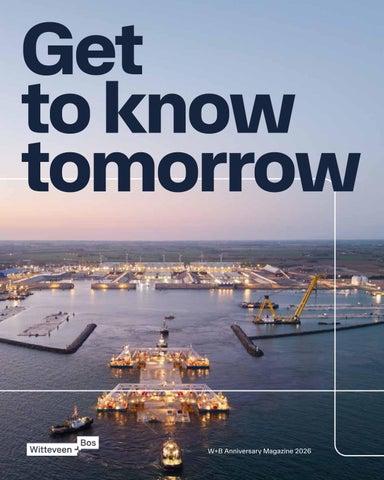
Get to know tomorrow
W+B Anniversary Magazine 2026
Get to know the new Witteveen+Bos
Contents Slow travel or fast forward?
10
Now with the ferry, soon through a tunnel
Wouter’s dream
22
How do you hold course when the company and the outside world keep changing?
PFAS not forever after all?
32
The quest to destroy seemingly indestructible substances
A smarter look
42
Jeroen Grit and Wouter Klein Wolterink on complex living environments
80 years of Witteveen+Bos
48
1946 to 2026: Witteveen+Bos through the years
10
Charlotte in Oman
56
Working with water on location
78
eDNA: disruptive
66
From groundbreaking research to practical application
Seaports
78
Pivotal role in energy transition
Nature as starting point
92
Wilderszijde area development project
Murder mystery
96
One victim, eight suspects
On location in Drenthe
102
TenneT is future-proofing grid in northeastern Netherlands
On the road together Ecologists Marcel Klinge and Lennart Turlings on 25 years of intensive collaboration
80 years of Witteveen+Bos
108
Two worlds Tom Pinceel
20
‘I enjoy dialogue.’
Floris Besseling
60
‘I don’t want to be an island.’
Annemiek Hermans
74
74
‘My enthusiasm took over.’
Shan He
90
‘The concrete repairs itself.’
28 Stephanie Lamerichs
100
‘Failure is a valuable outcome too.’
+ Working together Connections
18
Water management
28
Life in the soil
40
Bio-based
62
Infrastructure
76
Impact
88
20
Young and enthusiastic Femke Middeldorp
30
Structural engineer with a mission
Jasmine Oosterlinck
46
A connector in Flanders
Rik Jansen
64
Historian among the dykes
Tiara Salsabila
96
Coastal engineer versus the ocean
Patrick Bruijnes
106
Technician underground
Columns Ingrid Bolier
27
Wouter Claassen
37
Cathelijne Brunnekreef
87
Hannie Dierx
113
+ Out and about Visit the Dutch Water Defence Lines 40 Be amazed at Naturalis Biodiversity Center or take a break at Groenplaats
Explore seaside Middelkerke Fresh air at the Sand Motor or boating through De Biesbosch
80 years of Witteveen+Bos
72
30 40
Foreword If you’ve worked here long enough, you can sometimes think that change happens slowly. We’re mainly concerned with ongoing projects, our clients and colleagues, and how we can do our work as effectively as possible. But if you look back to how things were a few years earlier, you can see how much change has taken place. New disciplines, new colleagues, new countries, new forms of collaboration – we’re constantly changing; we just don’t always realise it. I made this discovery once again when I started working in Belgium a few years ago. Initially, it felt like being back at the Witteveen+Bos I started at: smaller, more informal, and with projects of a different kind. It made me realise just how much we’ve grown as an organisation. Three years on, I now see how much has changed in Belgium too. The great thing about a development like that is that it’s usually not the result of a master plan. It begins with curiosity: colleagues who want to understand something, or who start a collaboration with a new partner or follow a different path after the first one hasn’t worked out. It’s how we’ve been developing knowledge for eighty years now: step by step, on projects, together. I think it’s fantastic that this magazine makes that development visible. I can feel the passion in the stories and see the enormous diversity of our work. This magazine illustrates how we’re constantly reinventing ourselves – without losing our identity. I look forward to sharing these stories with all the associates we’ve known for many years. But I think this magazine, above all, is a gift to our colleagues – a moment for us all to be proud of what we do together and to delight in the joy and curiosity that for eighty years have characterised Witteveen+Bos.
Maarten-Kees van Breukelen Director of Operations
1946
Connections
Slow travel or fast for— ward?
Now with the ferry, soon through a tunnel Construction of the 18-kilometre-long tunnel that will connect Germany and Denmark through the Baltic Sea is well underway. Engineers from joint venture TEC (Haskoning and Witteveen+Bos) are working as part of the RAT consortium (Ramboll, Arup, TEC) on the design and construction of the world’s longest immersed tunnel – the Fehmarnbelt Tunnel. Editor Eric Sleeuwits travelled to Rødbyhavn in Denmark to take a closer look.
Images: Sund & Bælt
80 years of Witteveen+Bos
11
Connections
After nearly six hours in the car, passing ‘Stau’ and ‘Baustelle’ signs and the occasional ‘Raststätte’ on the autobahn, I finally arrive at the ferry terminal toll gates in Puttgarden, Germany. Unlike the first part of the journey, things happen quickly and efficiently here. I check in and then manoeuvre my car through the hold of the Prins Richard, the ferry that will take me to Rødbyhavn in Denmark. There, colleagues Piet Barten and Arjen van Dalfsen are helping build the Fehmarnbelt Tunnel.
For Piet Barten, a technical expert whose extensive knowledge of the project has made him its custodian, the Fehmarnbelt Tunnel has become his life’s work. He was involved at the very beginning and has remained on the project from its exploratory studies and design stage through to its current implementation. Last year, Piet moved to Denmark so that he could be even more involved in ‘his’ project. In his role, he ensures on behalf of Femern that the design, construction and immersion of the tunnel follow the agreements made with contractors and the German authorities. In 2008, when the project started, he faced a decision: the Fehmarnbelt Tunnel or the Hong Kong–Zhuhai–Macau Bridge. ‘I’d just finished a tunnel project in Mexico, and I was ready for a new challenge. If I chose Hong Kong, I knew I could be away from home for weeks on end, so I chose Denmark. Hans de Wit, TEC’s director until last summer, went to Hong Kong.’
After such a long drive, I enjoy the opportunity to switch off for a bit. Relaxing on deck with a latte macchiato, I have a close encounter with a seagull that glides effortlessly alongside us on a current of warm air. I hear German, Danish and Swedish, but I also notice a strong American English accent. When I leave the boat three-quarters of an hour later, having calmly made headway on the swells of the Baltic Sea, I appreciate the appeal of ‘slow travel’.
Ferry or tunnel After all, people have been crossing the sea by boat for centuries. But now, just a few kilometres from the ferry terminal, a tunnel is being built that will facilitate travel underwater from Germany to Denmark in just ten minutes. Once the tunnel has been completed in 2032, I wonder whether I will still take the ferry to Copenhagen, Malmö, Stockholm, or any other Scandinavian destination I might want to visit. Or will I travel by car or train and opt for an efficient underwater tunnel trip?
Fehmarnbelt’s custodian I meet Piet and Arjen at the office of Femern – Denmark’s Rijkswaterstaat and the client for the tunnel’s construction. They tell me that during my visit the second tunnel element will be immersed. Perfect timing!
12
Because it was unclear at that stage what type of connection should be built, a design competition was held that permitted submissions for either a bridge or tunnel. TEC opted for the latter. ‘A design study had shown that Danish people wanted a bridge,’ explains Piet. ‘We thought: if they want something iconic in the form of a bridge, we don’t stand a chance. We can only compete if the design is for a tunnel. So we focused all our efforts on that. Initially, we got involved mainly to experiment, not because we thought we could produce the winning design. It gave us the opportunity to develop new techniques for two or three years that we could use on future immersed tunnel projects.’
18 kilometres underwater In 2010, it became apparent that a bridge was not feasible for various reasons. Femern elected to continue the project with ‘local’ parties and chose the tunnel option. Piet and his team began working on an immersed tunnel design: ‘The treaty between Sweden and Denmark stipulates a link between Fehmarn in Germany and Lolland in Denmark, stating that it should be a cable-stayed bridge. In the design competition, a suspension bridge and an immersed tunnel were added as options two and three. We also seriously considered a bored tunnel, but the client’s preference was clear.’ So an immersed tunnel was chosen to span the 18 kilometres of Baltic Sea separating Germany from Denmark. ‘An immersed tunnel of that length had never been built before, so we knew right away what kind of challenge lay ahead of us.’
Two for the price of one With the implementation phase now underway, Piet is determined to stick as closely as possible to the original design while exploiting contemporary knowledge. Initially, the tunnel
80 years of Witteveen+Bos
13
Connections
was supposed to streamline rail traffic exiting Denmark, both towards Sweden and mainland Europe. ‘For the people in Denmark and Sweden, a rail tunnel is an absolute necessity. Currently, all rail traffic from Germany and Sweden crosses two enormous bridges in Denmark: the Little Belt and Great Belt bridges. Delays are common and regular maintenance is required. There’s currently no alternative rail link from the European mainland to Scandinavia. The Fehmarnbelt Tunnel will reduce travel between Hamburg and Copenhagen by around two and a half hours. In Denmark, the thinking is that if you’re going to build a fixed link to the mainland, you might as well make it a combined rail and road tunnel to accommodate road traffic as well. The road traffic is then supposed to fund the rail link – after all, you don’t pay toll on the train.’
From locks and flood defences to immersed tunnels Whereas Piet is an established name in the world of tunnels, Arjen van Dalfsen is just getting started in the field. Although not a tunnel designer, he feels like a proverbial fish in the waters of the Baltic Sea: ‘I’m a hydraulic engineer. During the first six years of my career, I worked on lots of projects for locks, weirs and other flood defences. After that, I worked on a tunnel project for a year, and then the Fehmarnbelt project came along. I’d always wanted to work abroad on a project, so I seized the opportunity with both hands. It’s different to locks, where you’re stopping the flow of water on the inside – with immersed tunnels, it’s on the outside. But there’s also plenty of overlap: both are large concrete structures involving water, situated in a maritime environment.’
Fehmarn— fact
1,300
Next to the factory in Rødbyhavn where the tunnel is being constructed, an entire village has been built. More than 1,300 workers from across Europe live in this ‘FLC Village’, named after the consortium building the tunnel. At the massive construction site, concrete workers and welders as well as engineers and planners are working together on one of Europe’s largest infrastructure projects.
Arjen has been working on the project for three years now. For the first two he was in Copenhagen, but recently he moved back to the Netherlands with his family: ‘For my wife, who’s a general practitioner, it’s more convenient to work in the Netherlands. So now I work in Denmark every other week, and in between I’m at the Witteveen+Bos office in Rotterdam. That combination works really well.’ During his first year on the Fehmarnbelt project, Arjen performed design reviews and assessed design changes. Over the past year, he has been more involved in works execution, assessing activities at the construction site and identifying areas for improvement. ‘From the summer of 2025, the number of reports being made each month reached several hundred. It was difficult to know what to expect,’ says Arjen about that hectic period. ‘It was clear that the first immersion was approaching.’ Currently, Arjen is managing a team of ten people at Femern who perform quality reviews on the works execution: ‘Although it isn’t really what I trained to do, it gives me lots of insight into what’s involved in constructing such enormous structures. I’ll use that when working on designs on future projects. And who wouldn’t want to walk around on one of Europe’s most impressive construction sites?’
Engagement and dedication Working on a large, complex project like the Fehmarnbelt Tunnel requires high levels of engagement and dedication from employees. After more than sixteen years on the project, Piet Barten has become so closely attached to it that it is difficult for him to let go: ‘If you want to do it properly, you can’t combine it with other things. Newcomers need at least nine months to familiarise themselves with everything, and then another three years to really get on top of it all.’ Last year, the project manager at Femern asked Piet about his future plans. It ultimately led to him relocating to Denmark. ‘During the tender phase in 2008, I sometimes thought about moving here. But at that time, my family circumstances didn’t allow it. Also, I didn’t think the tunnel would be the winning design, as Danish people wanted their gateway to Scandinavia to be an iconic design. Now, the situation is completely different. My children don’t live at home anymore, and me living here gives Bo (Femern’s project manager, ed.) the reassurance that I won’t be leaving for another project in three months’ time.’
Saying goodbye But both Piet and Arjen will eventually have to say goodbye to ‘their’ Fehmarnbelt. The tunnel is expected to be completed in mid-2032. Piet will have retired by then, and Arjen does not yet know what his career will look like at that time. One thing is certain: as soon as the tunnel is open for traffic, they will proudly
80 years of Witteveen+Bos
15
‘An immersed tunnel of that length had never been built before, so we knew right away what kind of challenge lay ahead of us.’ Piet Barten
Connections
—fact
45
As soon as an element is ready, it is floated into the Fehmarnbelt via specially created basins. Tugboats then use offshore equipment specifically developed for this project – such as guiding pontoons, positioning systems, and immersion rigs – to move the element to its exact position. Once there, it is immersed with millimetre precision to a depth of 45 metres below sea level.
make the trip below the ocean’s surface. For me, the time has already come to say goodbye to the Fehmarnbelt Tunnel. On the Prins Richard, I am offered one last look at the huge construction site. In the distance, I can see the tugboats and pontoons guiding the second tunnel element to where it will be immersed and joined to the first element. All around them, boats are coming and going. While the immersion operation is underway, I enjoy the sunshine, the serenely lapping sea, and my latte macchiato. The busyness of the tunnel immersion slowly gives way to the ultimate slow travel experience of travelling by ferry.
—fact
217
The tunnel’s construction has also been made accessible to the public. A scale model of the tunnel can be viewed in the Danish visitor centre in Rødbyhavn (Femern Exhibition Centre). The equipment used for the immersion, such as cranes, pontoons and tugboats, is constructed from Lego bricks (of course!). Another highlight is the Pilen viewing platform, right next to the tunnel access road. The platform is 217 metres long, the same length as a tunnel element. It offers fantastic views of the construction site, the factory where the elements are built, and – the thing everybody wants to see – the immersion of the tunnel elements.
80 years of Witteveen+Bos
17
Working together
Connecting In Antwerp, one of the biggest contemporary infrastructure projects in Europe is currently underway: the Oosterweel Link. It is a complex inner-city challenge that will significantly improve the city.
18
Antwerp The Oosterweel Link – an important part of Antwerp’s 2020 master plan – will complete the ring road around Antwerp, removing a major bottleneck and helping distribute traffic more evenly across the city. But it will also create new public spaces, with parks, cycling routes, and links between city districts being created above the tunnels that will soon send traffic underground. The Oosterweel Link is also a great example of a multidisciplinary project on which a range of expertise is brought
80 years of Witteveen+Bos
together. The various fields involved include geotechnical engineering and geohydrology, landscape integration and ecology, tunnelling and tunnel safety expertise, and hydraulic engineering structures and traffic and tunnel systems. Witteveen+Bos has been involved in the project since 2012 as part of the THV ATLAS joint venture with Sweco. This began with a design study for the right bank of the Scheldt River, and in 2015 the assignment for the left bank was added.
19
Two worlds
Tom Pinceel Is guest lecturer At KU Leuven And ecologist and group leader of Design and Management of Nature
20
For 80 years now, Witteveen+Bos has been working on the complex challenges of tomorrow. This requires continuous knowledge development and a strong connection with the academic world. Accordingly, many of our colleagues are active at the intersection between practice and research. In this series of portraits, five colleagues tell us how these two worlds reinforce one another.
‘I enjoy dialogue.’ ‘Both my parents are biologists, and so is my brother. We grew up in an environment that made it easy to develop a fascination for nature. Personally, I became interested at a young age in how we humans alter our living environment. Despite all the knowledge we possess, we often get it wrong. That’s why I wanted to learn about how we can restore ecosystems. ‘That’s the common theme in all my work. It’s not just about repairing damage done in the past, but also about making systems resilient to future disruptions such as climate change and increasing uncertainty in water and climate systems. When conditions are easily predictable, we often have technical solutions ready to go. But because variation and unpredictability are increasing, it’s becoming more and more challenging to design ecosystems that can cope with change. ‘When I sent an open application letter to Witteveen+Bos in 2022, I was working as a lecturer at KU Leuven. I thought it would be great to combine those two worlds, and that’s what I now do. At the university, I incorporate practical examples into my classes and supervise students who conduct part of their research on Witteveen+Bos projects. This allows them to get to know the field early
80 years of Witteveen+Bos
on. At the same time, the projects benefit from new academic insights. The quality of academic research continues to provide direction to practice: only a well-supported argument carries weight in the public debate, where results are regularly viewed critically. ‘In the academic world, we devise optimal solutions – for example, to protect a particular animal species. In practice, though, solutions have to be socially and financially feasible too. That realistic aspect is essential to ensuring nature projects actually get carried out. ‘On projects, we can create room for additional research questions which clients don’t always ask directly but which can improve our insights. We’re conducting research, for example, on the ecological function of peat-forming freshwater systems and the services we can derive from them. Relatively little knowledge is available on this topic at the moment, but it’s crucial for nature restoration in Europe. ‘I enjoy dialogue. It energises me to tell a story to a diverse audience and, as a result, discover different perspectives. It’s in the discussions that follow that we develop solutions which really work and are supported by a broad group.’
21
Interview
Wouter’s dream How do you hold course when the company and the outside world keep changing?
22
Interview
He was appointed director in the middle of the corona pandemic. A rapidly growing company transitioning from never working from home to doing it entirely: not exactly a typical starting point. But that was the context in which Wouter Bijman began, and he did not let it distract him from realising his dream for Witteveen+Bos. It is a dream that he shares with colleagues every few years, so that even those new to Witteveen+Bos are aware of our mutual goal. And now, sitting at his desk on the second floor of the head office in Deventer, he is more than happy to share it with us. Dreams and reality ‘My dream was always very clear: contributing with Witteveen+Bos to a circular and climateneutral society while working in diverse teams and making an impact internationally. But every element of this dream presents huge challenges. How do you move towards maximally climateneutral projects and greater biodiversity, and how do you get the whole company to support it? How do you become a company that a much wider range of people feels comfortable working at? And how do you operate globally and make an impact when you can’t charge the same rates internationally as we do in the Netherlands?’ ‘What I’m focusing on now is our qualitative growth. You see that, over the years, we remained more or less the same size until 2018. In that year, we experienced a massive growth spurt. The number of employees increased and the profitability went down. That makes sense, of course, because all those new employees first need to be onboarded and become deployable. But how do you turn that declining profitability around? Because, after all, you can only realise the other aspects of the dream if the company is financially healthy.’
‘Working on the basis of trust sounds simple, but it only becomes visible when things get challenging. You don’t notice culture when everything’s easy. What it comes down to is: How do we treat one another when we don’t agree? What happens if someone makes a mistake? And how do we handle emotions? For me, those are the real indicators.’
Portfolio. We’re looking for the optimal position between being socially relevant and remaining profitable with pleasant, expert employees.’
80 years of Witteveen+Bos ‘It all started with trust. Immediately after the Second World War, Willem Witteveen and Goosen Bos started with literally just a single A4 sheet of agreements. Their starting point was mutual trust. That remained the case until Witteveen’s retirement, and I believe that trust as the core element is still the foundation of our organisational culture.’ He laughs: ‘I found it really funny that last spring I used trust as the central theme of my annual speech, and in that speech we showed an AIgenerated animation of our founders. Afterwards, a young colleague told me that all they saw were ‘grey-haired men who didn’t have any better ideas and so just left it up to trust’.’
Diversity
‘With our corporate strategy, we’re not really doing anything more than translating the dream into practical, meaningful choices. At the heart of the strategy lie impact and returns. A tension exists between these which is similar to the one between dreams and reality. We’re using three intrinsically connected pillars to search for a balance between impact and returns: Talent and Knowledge, Organisation and Culture, and
‘Working in diverse teams is also part of the dream and an important point of attention. Although our organisation is becoming increasingly international and diverse, there are definitely still areas for improvement. One example is women: we’re currently not seeing enough progression by women to management positions. We must acknowledge this inequality, and by 2030 we aim to reduce it to a difference of no greater than 5 % relative to the percentage of women at W+B. Of course, the difference eventually needs to disappear completely, but we have a preference for developing our own people and training
24
80 years of Witteveen+Bos
Wouter Bijman
‘We’re looking for the optimal position between being socially relevant and remaining profitable with pleasant, expert employees.’ Wouter Bijman
25
Interview
managers takes time. And sometimes decisions will be made that are experienced as painful. We need to have the courage to discuss these decisions openly, without resorting to ‘Yes, but…’. ‘And, of course, diversity is about more than just reducing inequality between men and women. Our approach is that if you address it effectively for the largest minority group, then the next step becomes easier.’
Times change ‘When I started working here in 2004, it was a very different time. Witteveen+Bos has changed enormously since then. The directors nowadays have a very different vibe to those of the past too. We lead in a different way to previous generations – you’re a director appropriate to the time you live in.’ ‘If you ask me what mark I’ve made on the company as a director… I started at the beginning of that incredibly turbulent corona period, and I think we were successful in restoring some calm. Then, once society reopened, we went from zero employee turnover to high turnover. We had to make various decisions to regain the balance between impact, profitability and humanity. Take, for example, the
‘As a company, we work on really great projects involving major stakes and technical challenges.’ Wouter Bijman 26
climate policy we drew up, which includes targets for our business operations as well as our influence within the supply chain. Or our governance model, which we significantly changed last year, moving from a three-member board of directors to an eight-person executive committee. We’ve grown to such a large size now that we need to lead the company differently. It really is different to previous years.’ ‘But at the same time, we remain a company with lots and lots of good, clever, driven people. They only need a small nudge to get them doing good things. As a director, your main job is to ensure that everyone is doing what they do best. Above all, the current directors want to exploit the collective strength of Witteveen+Bos.’
Life after… ‘At Witteveen+Bos, directors step down after eight years in the role. That means I’ll be stepping down at the time of the 2028 annual general meeting. I think it would be nice to then go back to working in a PMC on projects and with colleagues and clients. I sometimes miss that in my current role. As a company, we work on really great projects involving major stakes and technical challenges, like the Fehmarn Belt Fixed Link between Germany and Denmark. That genuine engineering – the technical side of it – still fascinates me.’ ‘I’ll never forget this: we had put together a tender board at TEC for a very large project in the Middle East. Both myself and then co-director Stephan van der Biezen were part of it – that’s how big it was. A few people from Haskoning were part of it too. During the meeting, Stephan and I got straight down to project execution. We started discussing the technical aspects of wave conditions, tides, the subsurface, and how unpredictable it was or wasn’t at the proposed location... You could see the people from Haskoning on the other side of the table thinking: these guys are crazy! On a tender board like that, you’re only supposed to look at the legal aspects: risks, permits, contracts, that sort of thing. So you see that we really enjoy understanding the technical side of projects. That project didn’t go ahead, by the way – for technical reasons.’ ‘I have no idea what I’m going to do after this. I started here ultimately because I wanted to go abroad. At that time, I hardly spent a single day in Deventer. I immediately left for a project in Serbia involving inland waterways. After that, I went to Kazakhstan. And then, following a period in Rotterdam, I moved to Dubai with my family to set up a Witteveen+Bos office there. In 2018, we came back. That international experience certainly was a lot of fun and I’d love to do it again. But maybe that’s just a dream.’
The innovation paradox
Ingrid Bolier
Do you know that feeling of soaring with an innovative team? It makes me think of birds swirling through the air at sunset. One bird changes direction and the rest of the flock naturally adjusts. The swirling dance of the flock comes from those small changes by individual birds. That’s what innovation feels like to me: unforeseen initiatives that change the collective course. Like birds, we adapt ourselves to one another’s needs, giving space and later taking it. With a single look during a meeting, we know which way to head. The information I need to make my contribution flows to me unimpeded, giving me a feeling of ‘one for all and all for one’! But that feeling can’t be taken for granted. At home in my parents’ orchid nursery, I learned that exceptional flowers don’t grow by chance. You need to create and maintain the right environment: controlled enough to monitor but free enough to experiment with. I apply that idea in our work. Cultivating innovation isn’t about one-off luck; it’s a conscious effort. In our project-based world, we work in temporary teams, and projects and contexts constantly change. There are lots of people with brilliant ideas, but they’re not usually the ones who implement or standardise them. That’s the innovation paradox: organisations with the knowledge, resources and intentions don’t produce much structural innovation. Too often, it goes no further than experimentation – a clever idea and a pilot that never gets scaled up. Why is that? Because it’s not just about technology or money – it’s about people, culture, timing and collaboration. That’s the breeding ground for innovation – how we move from experimentation to cultivation. At the core, it’s simple: in our industry, innovation is a collective effort. So ensure a good mix of complementary innovation skills and value one another’s strengths. Give people room to experiment and look for signs that differ from expectations – that’s where the clues to the next step often lie. I’m convinced it’s possible to fly with a close-knit team in spite of organisational boundaries and day-to-day challenges. I also believe in the added value of our collective: I maintain my position and keep an eye on the seven birds flying closest to me. And when we land, we go our separate ways with the promise to take flight together again next time: one for all and all for one. The sky is ours!
80 years of Witteveen+Bos
27
Working together
Water management In the Grenspark Kalmthoutse Heide nature reserve, Dutch and Belgian neighbours are working together to improve the water quality of this Natura 2000 site, particularly in and around the Groote Meer section of the reserve. Grenspark Kalmthoutse Heide spans both sides of the Dutch-Belgian border, covering an area of approximately 60 km². It is home to a wealth of flora and fauna, but decreasing groundwater levels and the flow of phosphate-rich water from the Belgian side are putting pressure on the natural environment.
28
Kalmthoutse Heide
In recent years, various measures have been implemented to improve the water quality, including an iron-enhanced sand filter. This proved successful, but it was not enough. So now a second filter has been installed on the Belgian side of the reserve. The filter is based on a simple but effective principle. Rainwater flows naturally through a bed of iron-enhanced sand, which is a by-product of drinking water extraction. The phosphates in the water bind to the sand, after which clean water
80 years of Witteveen+Bos
flows into the natural environment. This natural flow means that no pumps or energy are required. The filter was designed by our colleagues at Witteveen+Bos Belgium, who also carefully integrated it into the landscape to ensure that the natural value of the historic Evertandven wetlands was preserved. This project demonstrates how innovative technology and cross-border collaboration can effectively contribute to the sustainable management of water and the natural environment.
29
Femke Middeldorp Structural engineer with a mission
Young and enthusiastic
‘I walked past a building site in Amsterdam recently, and all the original construction materials were being ground down to powder. That really hurt,’ explains Femke Middeldorp, a structural engineer at Witteveen+Bos. Her graduation thesis was on reusing concrete cast in situ on newbuild projects. Like many of her generation, Femke is all about sustainability. The topic received significant attention during her studies. ‘Sustainability is an important topic in design subjects,’ she says. After completing her master’s degree, Femke started working at Witteveen+Bos, becoming one of the many young engineers bringing their views on sustainability and reusing materials to the organisations they join.
Room for creativity ‘We think less rigidly now than we did a few decades ago. You’re given plenty of freedom during your studies to be creative and come up with solutions using new technologies. Ultimately, it’s about combining traditional knowledge with new insights to make reusing existing materials possible. That allows us to further optimise designs and reduces the amount of materials we need.’ Despite representing the spirit of the times, Femke has great admiration for traditional techniques: ‘That traditional knowledge is still needed today, because physics remains the basis for calculating structures according to standards. While researching my thesis, I came across lots of archived drawings done by hand. It’s great that they’ve all been preserved.’
80 years of Witteveen+Bos
They are young, enterprising and ambitious. Today’s engineers are busy working on the solutions to tomorrow’s challenges. They seek breakthroughs using the latest technologies and ideas. But they also make use of proven methods – conventional techniques that are the foundation of civil engineering. Curious to know what drives them? Get to know the engineers of today.
Reusing materials can save money When choosing between new or used materials, project developers often still focus on cost. That frustrates her: ‘We need to convince clients that reusing materials can save money. We already have so much concrete and steel – why would we produce more? If you can sort and manage construction waste properly, it can end up saving, not costing money.’ This is especially true when structural engineers are involved in designs from the start. ‘Currently, we don’t always know when a building’s going to be demolished.’
Internal marketplace for used materials Femke believes there is plenty of support at Witteveen+Bos for reusing construction materials: ‘We’ve created a marketplace on Viva Engage. It’s a database where we list used construction materials that could potentially be reused on other projects by other sectors. It helps us find matches internally.’
Legislation on employing used materials How will reusing construction materials be managed in ten years’ time? ‘Hopefully, by that time we’ll have a portfolio of projects that largely employ used materials. That would make it easier for us to convince other clients to get involved. It would also help if there was legislation that specified what amount of materials on projects needs to be reused. The challenge of reusing materials is not the technology, but how people think about it.’
31
PFAS not forever after all? 32
The quest to destroy seemingly indestructible substances People’s choice prize: De Vernufteling 2026
80 years of Witteveen+Bos
33
People’s choice prize: De Vernufteling 2026
How great is it when a project on which Murphy’s Law occasionally seemed to rule ends up winning a fantastic award! Four Witteveen+Bos colleagues talk about the highly relevant social challenge of removing PFAS from the water supply chain and destroying them. Because their project had not been nominated for the jury prize at De Vernufteling 2026, they chose to skip the ceremony and instead go out to dinner with Cyclopure, the manufacturer of DEXSORB and a key partner on the project. So it was even more surprising when a phone call informed them that they had won the people’s choice prize. Tiza: ‘Unsurprisingly, we started the dinner with champagne.’
Jordi
Victor
Two techniques, one solution The project they submitted for the prestigious engineering award was described on the De Vernufteling longlist as ‘a new system that removes PFAS from wastewater and then breaks the compounds down almost completely.’ In truth, their entry concerned two separate pilot projects that together form an integrated solution. Submitting the projects as a single entry in De Vernufteling was a deliberate decision. Jaïr: ‘There are already various techniques for removing PFAS from water. But generally, they just shift the problem. Just look at the news on the incinerators in Flanders. The real challenge is to destroy PFAS and remove them from the environment.’ For knowledge centre STOWA, Witteveen+Bos developed a system that removes PFAS (per- and polyfluoroalkyl substances) from water using DEXSORB. This bio-based adsorbent is derived from maize and acts as a kind of ‘PFAS sponge’. Once the DEXSORB is saturated, it is rinsed with an alcohol mixture. This releases the PFAS and allows the material to be reused. The released PFAS are then destroyed in a ball mill: a centrifuge filled with steel balls to which a chemical is added. In this ball mill, the (concentrated and dried) PFAS are pulverised by a combination of mechanical and chemical forces: the carbon-fluorine chains are broken down, and the molecules revert back to their harmless building blocks.
34
In a pilot installation at the Dordrecht sewage treatment plant, DEXSORB proved to be effective, removing up to 99 % of PFAS. In the laboratory, the ball mill achieved a 98 % reduction of PFAS in a sample taken from the water supply chain.
Real challenges Together, these techniques form a comprehensive solution to an urgent problem: PFAS are among the most persistent and concerning substances in our environment. They contain extremely strong carbon-fluorine compounds and hardly degrade at all. This makes them very useful in all sorts of products, but it also means that they accumulate in soil, surface water, and even in people’s blood. PFAS have been linked to adverse health effects, and they can also harm other mammals and birds. The social relevance of this challenge explains why a broad consortium is participating in the research. Water authorities, drinking water companies, provincial authorities, waste processor Renewi, and research institutes are jointly investing in developing the ball mill technology. The research lies at the interface between theory and practice: the theory needs to work in the laboratory, but what ultimately matters is whether the solution meets the real challenges of the water supply chain.
Jaïr
Tiza Jordi: ‘Water authorities normally prefer practice-oriented research. No one expects a ball mill at every sewage treatment plant – preventing PFAS emissions at their source remains the primary solution. But by investing in technological development, the parties want to show that destruction is possible. They are also sending a message to the industry: look, it’s possible.’
Witteveen+Bos’s role The origins of the research date back more than ten years. During a conference in Singapore, Witteveen+Bos colleagues were introduced to a promising new adsorbent capable of removing PFAS from water. Jaïr: ‘We brought Cyclopure to the Netherlands to investigate whether their DEXSORB technology could be used here. That was the start of several feasibility studies, pilots, and follow-up studies.’ It was only later that the question of which technique could most effectively destroy the captured PFAS arose: ‘That search eventually led to ball mill technology. The first step was demonstrating that PFAS in groundwater could be broken down. This was followed by trials with more complex samples from the water supply chain, such as wastewater.’
80 years of Witteveen+Bos
‘The real challenge is to destroy PFAS and remove them from the environment.’ Jaïr Dan
Tiza Spit worked as an intern at Witteveen+Bos on the first feasibility study for removing PFAS and pharmaceutical residues from water with DEXSORB. She is now group leader of Drinking Water Technology and is involved in various innovative pilots for DEXSORB technology. Jordi Wevers began as an intern on the DEXSORB research project in Lelystad and later took charge of destruction research with the ball mill. On this prize-winning project, he took on his first major project management role at Witteveen+Bos. Since the DEXSORB pilot in Lelystad, Jaïr Dan has been involved as a project manager in various PFAS studies at Witteveen+Bos. He is group leader of Wastewater Technology in Rotterdam, and he played a key role in setting up research on PFAS removal using DEXSORB, and on PFAS destruction using a ball mill. Victor Helsloot has been lead engineer on the DEXSORB pilot at the Dordrecht sewage treatment plant since the summer of 2024. He carried out most of the decontamination research on site himself, and he is responsible for day-to-day operations as well as the research.
35
People’s choice prize: De Vernufteling 2026
One area of focus for the researchers is application in more complex wastewater streams, where organic substances and other micropollutants can influence the process. Pre-treatment of the PFAS-rich residue flow will also be further optimised. Ultimately, the result should be a robust technology capable of destroying even the most persistent PFAS compounds, including the difficultto-capture ultra-shortchain PFAS. Then, even they will have proved not to be ‘forever chemicals’ after all.
Notably, Witteveen+Bos is not focusing on owning the technology. Jaïr: ‘We’re not developing this method with the aim of selling ball mills or managing patents in the future. Our goal is to solve a social problem. That’s why we’re sharing our knowledge and actively seeking collaboration.’
Murphy’s Law Behind the award lies a process that was anything but straightforward. Every step brought new insights, but also new questions and setbacks. Tiza: ‘Innovation is hard work and requires a firm belief that all the effort will eventually pay off. You also don’t get regular confirmation that you’re on the right path. We had to contend with disappointing results, delays, and unforeseen circumstances. Murphy’s Law was often applicable: if something could go wrong, it did.’ She speaks proudly of her colleagues’ perseverance: ‘Research operators Julianne Goense and Victor Helsloot kept coming up with new, creative solutions, from a mesh laundry bag to catch the material during backflushing to a massage gun to add vibrations.’ In those difficult moments, you not only have to stay positive yourself and investigate the technical aspects; you also have to keep all the stakeholders involved. For Jaïr, that is the appeal of innovation: ‘What makes this project special to me is the urgency of the problem and the collaboration it produces. I’ve never worked in such a broad consortium before. Everyone brings different expertise, and that’s why you really make progress together.’ Following the initial feasibility study, Jordi took over the role of project leader from Jaïr, who was impressed by Jordi’s approach. ‘It was the first project on which Jordi managed a large team, and it was anything but a routine assignment. You’re constantly moving between theory and practice, and at the same time you’re involved in intensive stakeholder management. He really did that incredibly well.’
What next? In the years ahead, research will focus on further optimising the various process stages. A key point of attention is the manner of converting the PFAS concentrate into a dry solid suitable for the ball mill. Jordi: ‘As a society, we’re still busy seeking ways to deal with PFAS. This research shows that there’s hope. The key message is that it’s possible not only to capture PFAS, but also to destroy them.’
36
‘Innovation is hard work and requires a firm belief that all the effort will eventually pay off.’ Tiza Spit
Mistakes
Wouter Claassen
We’ve all heard stories about brilliant engineers and scientists who changed the world. But what you don’t always hear is that sometimes their greatest discoveries began with a mistake. Often, genuine progress isn’t the result of a strict plan; it comes from people who achieve other results than they’d been expecting and have the courage to take that unexpected outcome seriously. Alexander Fleming, the British doctor, is one example. In 1928, he left a culture plate unattended on his laboratory bench. When he returned, he noticed that a mould had killed all the bacteria in its vicinity. Not a disaster, not a failed experiment, but the discovery of penicillin and the dawn of modern medicine. Thomas Edison is another. He tested hundreds of filaments for his light bulb, declaring: ‘I haven’t failed; I’ve discovered a thousand ways that don’t work.’ It’s no different in the world of engineering. A few years ago, I worked on the design of a flax fibre-reinforced composite bridge. During production, the project failed completely. Basically everything that could go wrong did go wrong. Usually, failure isn’t due to a single factor, but to a chain reaction of small mistakes, miscommunication, and underestimated requirements. This column is too short to explain exactly what happened, but our failure turned out to be a blessing. We never learned more or obtained more crucial data than during that one failed attempt. I was present during production when the resin was being injected, a process that takes a full day including curing. Until just before the exothermic reaction – the critical moment when the resin undergoes a chemical reaction – everything seemed to go according to plan. I gave the client a reassuring update and then drove back to Deventer. But soon after I’d got there, the phone rang: everything had gone completely wrong. The reaction in the resin was too aggressive and the bridge was unusable. How do you then convince the mayor that a second attempt is going to work? He asked me directly: ‘Are you 100 % sure that your team will succeed if you try again?’ I said yes with complete confidence, and it’s exactly what happened. The completed bridge was delivered to everyone’s total satisfaction: lighter, more sustainable, and of a much higher quality than the initial design. It won awards and even did well in the innovation pavilion at the world’s largest composites exhibition: JEC World in Paris. The failure wasn’t the end of the project, but the start of a much better design. At Witteveen+Bos, the biggest projects often result from the courage to try, fail, and then re-examine. Mistakes aren’t a blot on an engineer’s CV; they’re proof of curiosity and developing mastery. If you never make a mistake, you’re probably not trying hard enough to do something new. And throughout Witteveen+Bos’s eighty-year existence, that attitude has perhaps been our greatest tradition.
80 years of Witteveen+Bos
37
Out and about 2. Be amazed at Naturalis Biodiversity Center
In 2021, the Dutch Water Defence Lines were granted World Heritage Site status by UNESCO. Five years later, the anniversary of this event is being celebrated in style. From forts and fortified towns to walking routes through unique landscape, there is plenty to discover along this 200-kilometre-long defensive line, which has also been the site of climate opportunity studies by Witteveen+Bos.
Naturalis shows how nature is both remarkable and fragile. From imposing dinosaurs to interactive biodiversity exhibitions, there is much to discover for young and old. Behind the scenes at Naturalis, researchers are working on developing new knowledge, including in collaboration with Witteveen+Bos on programmes such as OBN Natuurkennis and Biodiversiteit in Beeld.
Image: Mike Bink Fotografie
1. Visit forts and fortified towns along the Dutch Water Defence Lines
38
3. Hiking in De Maashorst Grab your backpack, put on your walking shoes, and head out into the De Maashorst nature reserve in Noord-Brabant. Discover archaeological treasures, meet Docus the badger, or visit one of the reserve’s natural playgrounds. The Municipality of Maashorst was supported by Witteveen+Bos in developing its 2050 vision for De Maashorst.
4. Explore the Marker Wadden The Marker Wadden is a unique group of islands in the middle of the Markermeer lake. Created with sand, clay and silt from the lake, it is a paradise for birds and hikers alike, featuring a variety of routes through a constantly changing landscape. Witteveen+Bos contributed to the design and construction of the islands as well as research into their further development.
80 years of Witteveen+Bos
5. Experience the wilderness of De Boschplaat Situated on the island of Terschelling, De Boschplaat is one of the darkest places in the Netherlands and has been designated a Dark Sky Park. Hike or cycle through this unique mudflat landscape and experience how the wind, sand and sea dictate proceedings. Witteveen+Bos is contributing to research and plans for preserving the area’s natural dynamics for the future.
6. Take a break at Groenplaats For centuries now, Groenplaats has been a meeting place in the heart of Antwerp. Nowadays, it is not only a vibrant square; it is also ready for the city of the future. More greenery and smart solutions to deal with heat and rain have increased its appeal as well as its climate resilience. Witteveen+Bos was involved in designing the redevelopment.
39
Working together
Life in the soil How do you inventory life in the soil? An interesting question that is keeping Bart, Sem and Sjoerd busy. In the Twistvlietpark park in Zwolle, they are listening to organisms hidden from view. Their aim: to gain a better understanding of underground biodiversity.
‘This looks like a good spot,’ says Sjoerd. He knows the park well, having carried out the first measurements here as an intern. Sound engineer Sem and ecologist Bart unpack their case and stick two probes in the ground. The probes are fitted with covers to prevent noise from above ground
40
reaching them. Sem uses a receiver that also records the underground sounds. He plays back a portion: static interrupted every now and then by a faint tap. It sounds like someone accidentally kicking something. ‘We use different measurements to create a rough profile of life in the soil,’
Twistvlietpark
explains Bart. ‘It’s kind of a preliminary screening, on which further investigation can be based. The technology is still under development, but we expect a lot from it.’ Understanding life underground is a highly relevant topic. Soil-based ecosystems
80 years of Witteveen+Bos
are of great importance to nature’s functioning and, as a result, the natural processes that society depends on. Bart: ‘The better we understand the world beneath us, the better we can ensure that soil retains its vital function.’
41
The whole picture A smarter look at complex living environments
Building a new residential area, constructing a high-voltage connection, reinforcing a dyke – challenges such as these are increasingly impacting on one another. A new route runs through a Natura 2000 site, a housing development is held up by grid congestion, a dyke reinforcement demands careful weighing up of water security, ecology, and land use: the living environment has become one big system – a system too complex to understand without digital support.
42
80 years of Witteveen+Bos
Wouter Jeroen
The whole picture
A new business unit at Witteveen+Bos – Digital Living Environments and Systems Insights (DLS) – is making the connections in that system visible for clients. Business unit manager Jeroen Grit: ‘Data is everywhere in our living environment. Whatever you can think of – there’s information on it.’ He compares today’s reality to a case board in a TV crime series: ‘There are all these lines running between different leads, and no one can make any sense of it until the main character suddenly has a brilliant idea. But rather than wait for a flash of inspiration, we’re convinced that digitalisation can explain all the connections. It can give engineers and consultants the information they need to make better decisions.’ The tense relationships between issues such as nitrogen, housing construction, electricity supply, water security, and biodiversity are increasingly halting progress in the Netherlands. No single issue has priority – it is about understanding the entire system: ‘We bring together information from different systems and make it accessible. That allows people to compare scenarios, make better-informed choices, and above all have productive conversations with one another.’
Speaking the same language In order to have that conversation, though, everyone has to speak the same language. That might sound obvious, but in reality different organisations, governments and disciplines use their own terminology, classifications and methods. That is why, according to software architect Wouter Klein Wolterink, digitalisation begins with standardisation: ‘Suppose you want to dig a trench somewhere to lay a cable. First, you have to consult the archaeological policy map. What is and isn’t allowed varies from one municipality to the other, and some municipalities use six categories with corresponding rules to determine what’s allowed, whereas others use three colours. It’s already complicated enough for professionals to come up with a plan – trying to automate the process is even harder. If the starting point isn’t the same, you can’t speed things up.’ But a common language can mean compromises. To effectively link information from different sources, agreements need to be made by people and organisations on how they record data. That means sometimes having to make concessions. Wouter believes this is why standardisation is sometimes seen as an infringement on individual methods – in his opinion, a misconception. ‘Standardisation isn’t a restriction on freedom; it actually supports innovation.’
44
‘Standardisation isn’t a restriction on freedom; it actually supports innovation.’ Wouter Klein Wolterink
Smart solutions Only when different organisations use similar ways to record their data can software automatically retrieve, combine and analyse information from different sources. For this reason, standardisation is the foundation of virtually every digital application DLS develops. One such application is Tracis, a tool developed by Witteveen+Bos for TenneT. As soon as a project area is marked on the map in Tracis, the application automatically collects all the available information about that area. This makes it possible to see whether, for example, a proposed route crosses a Natura 2000 site, impacts on existing infrastructure, or is subject to other spatial constraints. Jeroen: ‘Engineers no longer first need to spend multiple days gathering and organising information – the application does that. This creates more time for what really matters: making the right assessment.’ That sounds good, but such a solution is only possible if the project allows it: ‘Everyone acknowledges that standardisation and digitalisation are necessary. But a project manager is accountable for delivering a tunnel or dyke, not for improving the way we exchange data. Nevertheless, if we can invest in how we collaborate, all future projects will benefit.’ Jeroen believes the way information is presented is also crucial. Drawing on his background in experience design, he constantly seeks a balance between technical complexity and intuitive use: ‘It’s like the hamburger menu on a website: three short horizontal lines on top of one another. Almost everyone knows what that means. Good interfaces use patterns that people are familiar with. It lets people focus on their work rather than how to use the application. That’s another aspect we have to take into account: finding the right balance between simplicity and technology.’
Room for creativity If you lay the various challenges facing society on top of one another, you see a map filled with constraints. Housing construction, nature, water, energy, and infrastructure seem constantly to be getting in one another’s way. Jeroen increasingly sees this as an opportunity for Witteveen+Bos’s added value: ‘If you only look at the constraints, the whole map seems to be red. But providing a digital overview of the entire living environment creates room for creativity. Then it’s up to the knowledge and experience of our people to produce solutions that genuinely get things moving.’
80 years of Witteveen+Bos
Spotlight on three tools by DLS These applications help clients model energy scenarios, perform automated BIM checks, and compare design options. Tracis Automatically collects all relevant spatial information along a given route. Analyses are run within seconds of simply drawing or adjusting a line on the map, with the tool processing all available geodata – both public and non-public. This immediately reveals how many homes, protected nature and heritage sites, existing infrastructure, and other relevant objects are located within the defined zone. The results are given both as useful figures and directly on the map. In short, Tracis supports efficient and well-informed discussions on the most suitable route – from the very first sketch. BIM Control Centre A BIM model has to satisfy many requirements, from naming conventions and coding to the completeness of the information provided. The BIM Control Centre allows you to perform an automated check on all these requirements. Mistakes in the model are highlighted, allowing design teams to rectify them early. This improves quality, reduces the time spent on manual checks, and minimises the number of surprises later in the project. Tool for Integrated Programming What would happen to the energy system if a municipality decided to build 10,000 additional homes, install more wind turbines, or make existing homes more sustainable faster? The Tool for Integrated Programming (TIP) provides the answer. Using an interactive map, users can alter scenarios and immediately see what impact this has on energy demand, energy generation, and energy infrastructure load. This helps municipalities, provinces, RES regions, and grid operators jointly design a future-proof regional energy system.
Jasmine Oosterlinck A connector in Flanders
Young and enthusiastic Five years ago, she joined Witteveen+Bos Belgium after graduating as a bioengineer in environmental technology: ‘That degree has evolved from a technical discipline into a field that increasingly focuses on the effects of projects on people and the local environment, and on how these are interrelated.’
No guarantee She works on water treatment plants and industrial wastewater management: ‘Especially enquiries from businesses about wastewater and process water, both from a technical perspective and in relation to discharge levels and permits.’ One interesting case is Greenyard Frozen, a company that produces frozen food (vegetables, fruit, etc.) and has the ambition of drastically reducing its drinking water consumption. ‘They also wanted to expand on to an industrial terrain covered in trees – land that was also prone to flooding,’ explains Jasmine. ‘So getting a permit was no guarantee. That’s why we opted for an integrated approach that involved geohydrologists, ecologists, and permit experts. I get a lot of energy from bringing together colleagues from different disciplines on projects that genuinely help businesses progress and increase sustainability. It makes me proud, at the end of the workday, to have been able to contribute to a more sustainable future.’
Minimal impact In the case of Greenyard, the sustainable solution lay in the approach to nature: ‘We have to cut down trees, but in their place an area of high value will be created: a newly designed green zone with room for water and nature that perfectly fits in with the adjacent Vijverbos forest, enhancing its natural value.’ Greenyard also plans to halve its water consumption, saving 200,000 m³ of drinking water each year: ‘And
80 years of Witteveen+Bos
They are young, enterprising and ambitious. Today’s engineers are busy working on the solutions to tomorrow’s challenges. They seek breakthroughs using the latest technologies and ideas. But they also make use of proven methods – conventional techniques that are the foundation of civil engineering. Curious to know what drives them? Get to know the engineers of today.
because reusing water will mean that significantly fewer chemicals – such as disinfectants – are required, they’re also going to reduce their salt discharge by 60 %.’ Jasmine believes that a multidisciplinary approach to this type of project is essential: ‘The vegetable and fruit processing industry in West Flanders is seen as part of the intensive agriculture supply chain and faces pressure from various environmental organisations. Factories are getting bigger and bigger and putting a large strain on the environment. In West Flanders, there are environmental organisations that appeal against every project that companies in the industry propose. So to ensure that such a project goes ahead, you need experts from various fields.’ ‘We knew this project would be contentious,’ she continues. ‘Before we’d even submitted a permit request, we consulted with as many stakeholders and impacted parties as possible. This included action groups, environmental organisations, and government parties. It involved asking which compromises we could all make so that the project ended up being as positive as possible. That proactive approach meant we were able to complete the permit process in a single attempt.’
Path to the future When those efforts succeed, it gives her a lot of satisfaction. Ultimately, her personal drive on projects is sustainability: ‘50 years ago, companies could do what they wanted and didn’t have to provide much justification for a project like this. Nowadays, you need to consider the local environment as well as the technical aspects. Many companies realise this, and they want to make their business operations more sustainable so that they can continue their activities. That means they’re increasingly getting us involved to help them map out the path to the future.’
47
80 years 19
Formation of Witteveen+Bos
First steps abroad
On 1 January 1946, Willem Gerrit Witteveen (1891-1979) and Goosen Siger Bos (1908-2004) establish ‘Stedebouwkundig advies- en ingenieursbureau Witteveen en Bos c.i.’. Chance and chemistry both play a role in the engineers’ first meeting. Towards the end of 1945, a mutual acquaintance advises Witteveen to have a chat with Bos sometime, and what happens next is later described by Bos as ‘unbelievable’: ‘Half a day after receiving this advice, the renowned urban designer meets with a completely unknown civil engineer seventeen years his junior. Then, during an hour’s conversation after lunch, they decide to form a partnership and jointly establish an engineering firm for urban design and public works.’
Although Witteveen+Bos has only existed for five years, in 1951 the young firm sets its first steps abroad. In that year, co-founder Goosen Bos conducts a feasibility study for a metro network in Istanbul. The Turkish city, home to millions, is growing rapidly, and the authorities are looking at how to effectively manage the increasing traffic. A metro network is seen as a key solution for the metropolis.
First project: Prince Bernhard Lock In the years after the Second World War, Witteveen+Bos focuses above all on reconstruction of the Netherlands. The young partnership’s first project is the design for the Prince Bernhard Lock in Deventer. The contract is so significant that Witteveen and Bos decide to establish their office in Deventer, where the company’s head office is still located today. The lock is part of a plan to modernise Deventer’s out-of-date industrial port. Because of strongly fluctuating water levels and limited opportunities for loading and unloading, a new lock is needed to increase the port’s accessibility for the growing industry. The choice of materials reflects the austerity and resourcefulness of the postwar period: old tram tracks from the Deventer–Borculo line are used as rebar, saving 230,000 guilders. On 3 August 1951, Prince Bernhard personally opens the lock named after him.
48
The study marks Witteveen+Bos’s first international project, at a time when most activities are in the interest of reconstructing the Netherlands. Over the following decades, what began with a single project in Turkey would grow into an international organisation working on projects in dozens of countries around the world.
Willem Witteveen says goodbye On 1 January 1958, co-founder Willem Gerrit Witteveen leaves the partnership he had founded twelve years earlier with Goosen Bos. With this step, his active involvement in the firm comes to an end. Witteveen had brought a wealth of experience to the young engineering firm. As an urban designer, he had played an important role in the development of Rotterdam, being tasked with creating the first reconstruction plan for the devastated city centre immediately after the bombing of 1940. Later, as a government adviser, he had been involved in the reconstruction of the Netherlands.
First major sewage treatment plant In the 1950s, the realisation grows that clean water and effective wastewater treatment plants are essential for public health and the living environment. For Witteveen+Bos, the construction of the sewage treatment plant in Alkmaar is an important milestone: it is the first treatment plant of considerable capacity designed by Witteveen+Bos.
80 years of Witteveen+Bos
The project falls within the expertise of co-founder Goosen Bos, who had already been working on sewers and wastewater treatment before the firm’s founding. With the Alkmaar plant, Witteveen+Bos laid the foundation for a field of work that would grow significantly in the following decades. For the firm itself, what began with one major treatment plant would develop into a broad specialisation with activities in all phases of wastewater transport and treatment – from studies and designs to construction and operation.
Following Witteveen’s departure, Bos would continue developing Witteveen+Bos further, with Witteveen’s name remaining connected to the firm. The website wederopbouwrotterdam.nl includes a fascinating article on ‘Plan Witteveen’, the first reconstruction plan following the bombing in 1940.
49
80 years 19
Goosen Bos becomes professor at TU Delft For many years, everybody had known that Goosen Siger Bos would retire at the age of 65. But that is not what happens. At age 63, he is given the chance to take up the new, longcalled-for position of general civil engineering chair at TU Delft. By this stage, Bos already has an impressive career to look back on. As an engineer, entrepreneur and co-founder of Witteveen+Bos, he has played a key role in the development of sanitation, infrastructure and urban development in the Netherlands. After consulting with his colleagues and family, he decides to take on the challenge. In March 1972, Bos begins his professorship. This makes him the first professor affiliated with Witteveen+Bos, and his appointment marks the start of a tradition at our company in which the academic world and industry practice reinforce one another. In subsequent years, several colleagues would follow his example, including Gerd Scherpbier, Jaap van der Graaf, François Clemens, and Theo Salet. Ultimately, the connection between academia and engineering practice would develop into an integral part of Witteveen+Bos’s identity.
50
The plus sign is added Alongside the colour blue, which is firmly embedded in Witteveen+Bos’s corporate style and symbolises our connection with water, the plus sign (+) in our company name is also symbolic. In 1975, the + replaces the Dutch ‘en’ and the ampersand (&), which had both been used in our name up to that point. Some sticklers at the company have since pronounced the name ‘Witteveen plus Bos’. Although strictly speaking they are right, most people say (but do not write) ‘Witteveen en Bos’. The + in Witteveen+Bos refers to the added value we aim to deliver. It suggests that the whole is greater than the sum of its parts, and it shows that we believe in equal partnerships – both internally and with our project partners and clients. Unlike ‘and’, which can sometimes sound like an addition, the + expresses a union, such as the one formed by our two founders. Of course, from a design perspective, there are also many creative possibilities with the +. In 2011, for example, we distributed limited-edition bronze ‘plus cubes’ as an anniversary gift. In our new corporate style (2026), the + takes on an even more prominent role.
First EIA in the Netherlands In the 1970s, environmental awareness grows rapidly. Governments and citizens no longer want to only know whether a project is technically feasible, but also what impact it will have on nature, the landscape, and the living environment. Against this background, Witteveen+Bos works on an environmental impact assessment (EIA) for the site selection of a sewage treatment plant in Tiel. It is one of the first projects in the Netherlands on which environmental impact is explicitly part of the decision-making process. Witteveen+Bos is thus at the forefront of a development that only years later would become part of law. It marks the transition to a more integrated approach to spatial issues, in which technology, the environment, and the local community are considered together. In the years that followed, the EIA would became an important component of Witteveen+Bos’s services.
Creation of odour lab In the 1980s, complaints about odours near sewage treatment plants increase. For Witteveen+Bos, it is the impetus to start investigating the origin, dispersion and measurement of odours. What begins as a search for solutions to a practical problem develops into a new area of expertise at the firm.
First international office In 1978, an organisational change at Nedeco (Netherlands Engineering Consultants) presents Witteveen+Bos with a unique opportunity. The firm takes over Nedeco’s office in Indonesia, together with various projects relating to ports, dredging, and land reclamation. It is Witteveen+Bos’s first office outside the Netherlands. The projects are ideal for the Dutch expertise on hydraulic engineering and coastal development, and in the years that followed Indonesia would develop into a key base of operations for Witteveen+Bos’s international activities.
80 years of Witteveen+Bos
The step marks a new phase in the firm’s development. Whereas international assignments had previously been carried out for the most part from the Netherlands, a permanent international presence had now been established. Jakarta thus represents the starting point for an international network that would steadily expand over the following decades. Nowadays, Witteveen+Bos works from offices in Europe, Asia, Africa and the Middle Easton on projects in water, infrastructure, energy, and the living environment.
To be better able to investigate and assess odours, Witteveen+Bos establishes its own odour lab. This results in a specialist field of expertise that helps clients with issues relating to industry, wastewater treatment, and the living environment. Today, Witteveen+Bos’s odour lab is one of only three in the Netherlands, and it continues to play an important role in investigations into odours and the problems they cause.
51
80 years 19
Founding of TEC In 1988, Witteveen+Bos and Royal Haskoning – nowadays just ‘Haskoning’ – jointly found Tunnel Engineering Consultants (TEC). In this permanent collaboration, the firms combine their knowledge and experience in tunnel design and underground infrastructure, with the aim of developing and retaining specialist expertise in a field in which experience is invaluable. What began as a Dutch collaboration would later grow into an international player in the tunnelling world. TEC would go on to work on some of the world’s most complex tunnelling projects, including the Øresund Link between Denmark and Sweden, the Busan–Geoje Fixed Link in South Korea, the Hong Kong–Zhuhai– Macau Bridge in China, and the Fehmarn Belt Fixed Link between Germany and Denmark. These efforts would see TEC develop into a leading worldwide specialist in the field of immersed tunnels.
52
Preparations for Heemskerk ultrafiltration plant In 1993, Witteveen+Bos begins preparations for an innovative drinking water production plant in Heemskerk. This involves investigating whether surface water can safely be converted into drinking water using membrane technology, without the use of chemical disinfection.
At this time, combining ultrafiltration and reverse osmosis is a very new development. Years of research, testing and design are needed to determine whether the technology is reliable enough for large-scale application. The project would prove to be a success, and the plant that is eventually built would become one of the largest membrane water treatment plants in the world, representing a major breakthrough in the development of modern drinking water treatment.
Engineering contract: North/South Line In 1995, Witteveen+Bos is appointed main contractor on the engineering contract for the North/South Line in Amsterdam. The new metro line aims to improve accessibility to the city and provide a direct link from Amsterdam-Noord to the rest of the metro network.
Design of artificial islands in Caspian Sea
Framework agreement for Vinex site in Haarlemmermeer
In 1997, Witteveen+Bos works on the design of twelve artificial islands in the Kashagan field, off the coast of Kazakhstan in the Caspian Sea. The project requires innovative solutions in hydraulic and geotechnical engineering as well as land reclamation. The islands need to be designed for an area with shallow waters, extreme temperature variations, and heavy ice loads in winter.
In the 1990s, the Netherlands faces a major housing challenge. To meet the growing demand for housing, the government designates largescale development sites: the ‘Vinex districts’. In 1998, Witteveen+Bos signs a framework agreement for the development of Floriande in Haarlemmermeer. Floriande is to be one of the largest Vinex locations in the Netherlands.
The project is one of the largest international assignments at the time and shows how Witteveen+Bos’s expertise is increasingly being utilised outside the Netherlands. Whereas the first international projects were mainly supported from within the Netherlands, today the firm works on large-scale and technically complex assignments all over the world. Kashagan thus marks the next step in Witteveen+Bos’s international development.
But the challenge goes beyond just building houses. New residential areas also need roads, water management strategies, and green spaces and other public facilities. Witteveen+Bos’s designs for Floriande include 25 bridges that link the different neighbourhoods with one another. The project illustrates how Witteveen+Bos is increasingly becoming involved in integrated area development, in which technology, design of the living environment, and social developments are closely connected.
80 years of Witteveen+Bos
Image: Theo Baart
The task is exceptionally complex. The planned route runs underneath the historic urban centre, past heritage buildings, and through a densely built-up area. Accordingly, the North/South Line demands innovative solutions in tunnel construction, geotechnical engineering, and urban infrastructure. Construction would start in 2003, and in 2018 – after years of preparation, design and construction – the North/South Line would officially open. Though ultimately taking (considerably) longer than planned, it is one of the most iconic Dutch infrastructure projects of recent decades.
53
80 years 20
Start of construction on Maasvlakte 2, Rotterdam In 2008, construction begins for Maasvlakte 2. This expansion of the Port of Rotterdam would see it develop into one of Europe’s most important logistics hubs. The project involves creating around 2,000 hectares of land in the North Sea. To achieve this, approximately 240 million cubic metres of sand is deposited, creating a completely new area of the Netherlands. Witteveen+Bos contributes to planning, design and execution on the project. The works involve large-scale land reclamation, coastal defences, and complex hydraulic engineering solutions. Maasvlakte 2 would not only increase the Port of Rotterdam’s capacity; it would show that, more than half a century after the Delta Works, the Netherlands still ranks among the world’s best in hydraulic engineering.
54
Oosterweel Link, Antwerp In 2012, Witteveen+Bos begins its collaboration with Sweco on the Oosterweel Link in Antwerp. The project is intended complete the ring road around Antwerp and improve access to the city and the surrounding region for millions of road users. The project involves tunnels, connections, transport infrastructure, and complex integration into a densely built-up urban environment. By distributing traffic more evenly and relieving pressure on residential areas, the Oosterweel Link is intended to not only improve traffic flow but also enhance the city’s liveability. For many years, the project has been the subject of public and political debate, demonstrating how infrastructure is increasingly being linked to issues including health, the living environment, and spatial quality.
Afsluitdijk: planning study and construction In 2017, works execution starts on the renovation of the Afsluitdijk. Almost a century after its construction, this iconic hydraulic engineering structure is being adapted to the demands of the future. Witteveen+Bos is involved in both the planning study and works execution. The project combines water security, innovation, ecology, and infrastructure. Besides reinforcing the dyke, new control locks and pumps are being added to ensure the Netherlands remains protected against flooding in the future. At the same time, work is being carried out on measures to enhance the ecological quality of the area, including the creation of the Fish Migration River. This innovative link will facilitate the passage of migrating fish between salt and fresh water.
Vernufteling award In 2025, Witteveen+Bos is awarded both the jury and the people’s choice prizes at De Vernufteling – the foremost award for innovation in the Dutch engineering industry – for its eDNA Meets Toxicity. This innovative measurement method makes it possible to identify the influence of pollutants on water quality and biodiversity by analysing environmental DNA (eDNA). The method’s strength is that it not only identifies the presence of pollutants but also examines their effect on aquatic life. Combining eDNA with toxicity analysis results in a new method for gaining insight into the health of complete ecosystems faster, more cheaply, and in a more reliable way. With just one water sample, information on hundreds of species of plants and animals can be collected. The jury describes the approach as a groundbreaking innovation with huge value for society, and a promising contribution to the restoration and conservation of biodiversity.
80 years of Witteveen+Bos
Immersion of first Fehmarn Belt tunnel elements In 2026, the first elements of the Fehmarn Belt Fixed Link between Germany and Denmark are immersed. Since 2009, TEC – the collaboration between Witteveen+Bos and Haskoning – has worked on the design for this megaproject.
At eighteen kilometres in length, the Fehmarn Belt Fixed Link will be the longest immersed roadand-rail tunnel in the world when it is completed. The tunnel will replace the current ferry service between Germany and Denmark, significantly reducing times for both passenger travel and goods transport. The individual tunnel elements are among the largest concrete structures ever built. Each one is towed to its final position and then immersed. The immersion of the first tunnel element constitutes a visible milestone on a project that brings together decades of knowledge development, collaboration, and innovation.
55
Boundless
Char— lotte in Oman Working with water on location ‘Projects in other countries are best managed on location. Physical distance combined with cultural differences can result in miscommunication, which can make progress more difficult and slower to achieve than planned.’ Images: Charlotte Mekel
80 years of Witteveen+Bos
57
‘It was a complex task, because you’re typically making calculations and drawings for an undeveloped area that’s characterised by mountain ranges and vast plains. And phasing is crucial. The population’s growing but the rate of growth is hard to predict. You don’t want to overestimate it, but you definitely don’t want to underestimate it either. There are also lots of other factors you need to take into account.’ Apart from the technical challenges, there were also several organisational difficulties. ‘Communication’s a key factor. You’re not only dealing with a language barrier but also with differing communication styles. In the Netherlands, we’re rather direct; in other cultures, that can be seen as impolite. So it helps to have face-to-face contact and not discuss things via Teams or email.’ In 2025, Charlotte Mekel spent three months in Oman. During this time, she worked intensively with representatives from client Nama Water Services (NWS) and local partner Muscat Engineering Consultancy.
Rising demand ‘For NWS, we’re working on drinking water and wastewater. Oman is experiencing rapid urbanisation, which is putting extra strain on its infrastructure. Currently, the population is heavily reliant on tank trucks that separately supply drinking water and remove wastewater.’ A mobile wastewater removal system poses significant risks to public health, the environment, and plans to increase urban sustainability. ‘In short, the infrastructure for drinking water and wastewater needs to be expanded.’
Complex During her time in the Middle East, Charlotte focused on developing the sewer system, the treated effluent network, and the planned sewage treatment plants, working on concept designs for the relevant projects.
Snorkelling with turtles Did Charlotte get any time to explore the country outside her busy work schedule? ‘Definitely! Another expat and I went out and explored Oman together. The country’s nature is stunning and you can do all sorts of activities in it, like snorkelling with turtles or desert trips. It also has beautiful world-famous wadis, such as Wadi Shab. You just have to see it, especially if you work with water!’
Learning to swim Charlotte also had a connection to the local people through a former intern from Oman, who brought her in contact with some locals. ‘Those contacts, together with lessons on the culture, were extremely valuable to me. Omanis are very family-oriented, which means it isn’t always easy to make contact. So it helps if you have a liaison.’ For Charlotte, the months flew by in Oman. ‘It was very intense and, looking back, very educational. You’re thrown in at the deep end, so you learn to swim quickly. All in all, it was a wonderful adventure that gave me pride, energy, and new insights!’
Boundless
Knowledge transfer In our work for NWS, knowledge transfer plays a central role. Charlotte’s colleagues Michel Bretveld, Evelien Martens and Marlies Christiaens, for example, have mentored and supported young Omani engineers in NWS’s drinking water department. NWS attaches great importance to knowledge transfer in the further professionalisation of its departments. We are also providing top-quality advice in areas including hydraulic modelling, water demand calculations, network layouts, and cost estimates, and we are teaching them how to develop both soft and hard skills, such as report writing and risk and stakeholder management.
‘In the Netherlands, we’re rather direct; in other cultures, that can be seen as impolite.’ Charlotte Mekel 80 years of Witteveen+Bos
59
Two worlds
Floris Besseling Is PhD candidate in structural monitoring and identification At TU Delft And specialist in structural dynamics
60
For 80 years now, Witteveen+Bos has been working on the complex challenges of tomorrow. This requires continuous knowledge development and a strong connection with the academic world. Accordingly, many of our colleagues are active at the intersection between practice and research. In this series of portraits, five colleagues tell us how these two worlds reinforce one another.
‘I don’t want to be an island.’ ‘Doing a PhD full-time isn’t for me. I need the link to practice – with test projects, dynamics, and people around me. I also wanted to extend my role as an expert, so the 50/50 solution is perfect. I can now investigate my questions on monitoring infrastructure in my PhD research, with guidance from people I know and trust. ‘At Witteveen+Bos, I’ve always been given lots of freedom to explore new directions. That suits me. I’m curious by nature and enjoy exploring topics thoroughly, especially when they concern mechanics, dynamics or vibrations – topics that probably require you to be a bit of a nerd. At the same time, it’s important for me that the work remains visible and tangible. ‘My research focuses on monitoring bridges, with the first case being the Zeeland Bridge. More specifically, it addresses the question of how measurement data can be used to better determine the structural properties and safety of existing bridges. We use sensors to collect data on vibrations and deformations, whether influenced by known loads or not. We then develop statistical models which convert that measurement data into reliable statements concerning, for example, stiffness, weak points, or internal load transfer. This results in a more realistic picture of the bridge’s actual condition.
80 years of Witteveen+Bos
‘In the start-up phase of my research, I learned how important it is to first define the problem and not start too quickly. But on projects, I sometimes see impatience towards the academic world: it takes a long time and the benefits are not always immediately visible. If you want practice and the academic world to work together, you need expectation management, patience, and respect for one another’s interests. And on complex issues in particular, we really need each other. If we can manage to find the right partners, it strengthens our projects enormously. ‘I don’t want to be an island, which is why I share the insights from my research with colleagues and use ideas from my role at TU Delft for new applied research on projects. In collaboration with TU Delft, we can take on new projects and extend our expertise. Our projects also provide opportunities for new academic research and thus for the disciplines at TU Delft, where we have good contacts. That might sound like I’m an avid networker, but the opposite is true. I believe in trusting people and working together for the long term. Loyalty and patience play a big role in that – in my work and beyond. Good things take time.’
61
Working together
62
Ulm Bio-based A bridge made of flax: in Ulm, Germany, pedestrians and cyclists cross it every day. It is a tangible example of how bio-based materials can be applied to build an intensively used structure.
The bridge’s elegant handrail was manufactured in fully automated fashion by a robotic arm. Fibres were passed through a resin bath and then applied layer by layer according to a computercontrolled pattern. The handrail’s fluid form is thus the combined result of architecture, parametric design, and advanced production techniques. But the greatest innovation is beneath your feet. The bridge’s deck is made from a composite of flax fibres and bio-based
80 years of Witteveen+Bos
polyester resin. Designed to safely withstand traffic loads, this relatively new construction material has been fitted with a network of smart sensors that constantly monitor how the structure responds to loads, temperature, and weather conditions. The collected data is helping researchers and designers further develop bio-based bridges and forms the basis for a new generation of sustainable infrastructure.
63
Rik Jansen A historian among the dykes
Young and enthusiastic If there is one young colleague who knows a thing or two about the past, it is Rik Jansen. A history graduate, he now works at Witteveen+Bos as an engagement and stakeholder manager. Seemingly two completely different disciplines – or are they? As a history student, Rik was interested in the different ways people give meaning to their living environment. ‘Things get interesting when different ideas and motivations come in contact with one another. It leads to exchange, but sometimes to friction too.’ Now, Rik not only wants to study the dynamics of this process, but also apply the knowledge that results to the contemporary challenges facing society.
Collaborating on sustainable projects After gaining experience at the Municipality of The Hague in designing public spaces sustainably, Rik’s girlfriend alerted him to an engagement and stakeholder manager vacancy at Witteveen+Bos. ‘Here, I was given the chance to design a participatory process and collaborate with stakeholders on future-proof projects – the perfect mix of everything I’m interested in.’
Empathy and support The role of engagement and stakeholder manager, as we know it today, first emerged around fifteen to twenty years ago. In the period before then, decision-making was not always a democratic process: ‘In light of the challenges facing society at the time – such as coal mining and the exploitation of natural gas fields for our energy supply, but also the post-war reconstruction and the Delta Works – it was understandable. But advances in our knowledge have led to us now listening more to people directly affected by plans or decisions. It’s not just about explaining; it’s also about listening.’
80 years of Witteveen+Bos
They are young, enterprising and ambitious. Today’s engineers are busy working on the solutions to tomorrow’s challenges. They seek breakthroughs using the latest technologies and ideas. But they also make use of proven methods – conventional techniques that are the foundation of civil engineering. Curious to know what drives them? Get to know the engineers of today.
Whereas the personal views and individual complaints of local residents were often given a lower priority in the past, Rik observes that the current generation of planners – influenced by democratisation and consumer advocacy – now take a different view. He notes that engagement and stakeholder managers have to be able to empathise with and appreciate what motivates people. It helps you understand any complaints or arguments they might have: ‘Residents often know their local area very well, and they see things the project team doesn’t. You should initiate discussions with them as early as possible, show genuine interest, and above all take them seriously. That will give you the input you need to make the project a success. It’s how strategic engagement and stakeholder management became a discipline.’
The impact of raising a dyke Rik cites the example of a project to raise a dyke: ‘That has a significant impact on the community behind the dyke. Residents have an emotional connection to the area in which they live. Does raising the dyke mean they’ll have to give up part of their property, or that their land will be taken away from them? What are the consequences for their safety or health? By listening carefully, paying genuine attention to residents and stakeholders, and actually doing something with the input they provide, you can win their trust.’ When reinforcing dykes or designing a neighbourhood or district to be future-proof, Rik believes that we have to not only look to the future but also to the area’s past: ‘What do we want to preserve and what’s important for bringing the past into the future? The past is the foundation of our culture, our living environment, and our identity. You have to weigh that up as carefully as possible against any future benefits or challenges.’
65
Groundbreaking
eDNA: disrup— tive From research to practical application
Whenever Sebastiaan Schep gets the chance to talk about environmental DNA – the innovation he has been trying to get people excited about for more than ten years – his eyes light up. His words tumble over one another in his eagerness to explain how significant and versatile this tool can be for improving biodiversity and much more. Fortunately, there are like-minded people who help him evangelise eDNA: fellow Witteveen+Bos employees like Frederike Bijlmer, and people outside the organisation like Kees Bochove at Datura Environment Solutions. Thanks to their vision, perseverance and collaboration, momentum finally seems to be gaining. And that is of vital importance. 66
80 years of Witteveen+Bos
Image: EcoPulse
Groundbreaking
To those paying attention, the problem is obvious: biodiversity is declining worldwide at an alarming rate. It is a problem because it makes the ecosystem on which humans are dependent increasingly vulnerable. It is also a challenge – because although we have a rough idea of the causes, there is still a lot we do not know. As an aquatic ecologist, that keeps Sebastiaan awake at night: ‘In around 40 % of all waterbodies, environmental pollution by toxic substances appears to be the main factor. But the exact extent and effects of this toxicity are hard to determine, because measuring biodiversity and assessing toxicity with existing methodologies is challenging and costly.’
The technology
eDNA analyses make it possible to assess biodiversity and its relationship with the living environment in a relatively simple and affordable way. eDNA refers to genetic traces left behind by organisms (animals, plants, bacteria) in their environment – for example, in faeces, skin flakes, hair, or saliva. These traces can be collected in water, air or soil samples, and then analysed.
This makes eDNA a powerful indicator not only of an ecosystem’s current state but also of future risks, such as acidification, eutrophication, or climate change. It can also be used to analyse the microbial basis of the food pyramid, which consists of organisms such as bacteria and fungi. Frederike: ‘The dataset of DNA sequences for each water sample forms a unique fingerprint. Comparing these fingerprints reveals relationships between species diversity, the presence or absence of indicator species, and strain factors such as toxins or nutrients. A sudden increase or decrease in a specific organism can be significant. In one litre of water, we can detect around 5,000 unique DNA sequences, which can all be traced back to individual organisms. In our eDNA Meets Toxicity study, we showed how this provides detailed insight into biodiversity, water quality, and toxicity.’
‘Our current work on eDNA focuses on three key themes: biodiversity, water, and the climate. And all these fall under the umbrella of ‘system understanding’. Our goal is to bring eDNA as a monitoring tool from research into practice. It all started with water samples, but in recent years air and soil samples have become increasingly important too. The insights from eDNA provide opportunities to improve the living environment and thus halt the loss of biodiversity or even restore it.’
68
The presence of organisms in a living environment gives us information about that environment and its biodiversity. Patterns in the presence or absence of species tells us how the ecosystem is responding – positively or negatively – to contaminants. ‘eDNA lets us ‘read’ the ecosystem,’ explains molecular ecologist Frederike Bijlmer. ‘Instead of measuring which levels are being exceeded, we look at what the life is telling us itself. That biological response is often the best measure of ecological health, and an early warning sign that something is about to go wrong.’
Image: Arjan Otten
‘I’d definitely call it a disruptive development.’ Sebastiaan Schep
Water The strength of our eDNA methodology lies in its practical application for water management – not in the laboratory, but in collaboration with water authorities and Rijkswaterstaat in actual lakes, ditches, streams, rivers and, eventually, marine waters. Frederike: ‘The next step is extending the scope to saltwater systems, such as coastal areas, seas, and oceans. Biodiversity loss is an urgent issue in these areas too. Problems include the rapid warming and acidification of the oceans, pollution from microplastics and chemicals, the loss of habitats due to extraction of rare metals, and overfishing. In saltwater systems, in particular, early ecological warning signs can be the difference between conservation and degradation. But just measuring isn’t enough: the warning signs we detect have to be turned into action.’
Research at offshore wind farms Annemiek Hermans’ PhD research builds a bridge between the academic world and practical application, with the Witteveen+Bos marine ecologist gladly making use of the eDNA technique. At Wageningen University, Annemiek studies fish species that are sensitive to electric and magnetic fields. She also researches the impact on marine environments of constructing wind farms and laying power cables. The North Sea is home to 145 different species of fish. These include sharks and rays, also known as
80 years of Witteveen+Bos
69
Groundbreaking
Presentation by Koninklijke NLingenieurs of jury and people’s choice prizes for De Vernufteling 2025.
and by using ecological models for data analysis, you can provide advice on improving biodiversity within that system.’
Biodiversiteit in Beeld
‘elasmobranches’. Elasmobranches are sensitive to electricity and magnetic fields, and are protected animals. Because many wind farms are planned for the North Sea, extra attention is being paid to these species and the potential negative effects of the farms on their habitat. Annemiek: ‘This helps us protect valuable natural areas and build the offshore energy network as efficiently as possible.’ Her research also led to the incidental discovery of basking sharks in the waters off the Dutch coastline.
Predictive ecological insight essential At the UN Ocean Conference, held in June 2025 in Nice, the central topic was: How do we keep oceans liveable in a time of biodiversity loss caused by human activities – such as seafloor destruction through bottom trawling and overfishing – climate change, and pollution? The conference highlighted what has long been known on the eDNA project: we must look beyond the current situation, and change from monitoring to forecasting, from identifying to understanding, and above all from repairing afterwards to intervening beforehand. Sebastiaan: ‘That’s the role we see for ourselves at Witteveen+Bos and the area we can advise on. I’ve been involved in aquatic system analyses for years: Why is the ecological situation the way it is? What are the interdependencies? What roles do different types of organisms play and how do they interact? What are the consequences of climate or environmental changes? That’s hugely complex. But with accurate information obtained through eDNA and a thorough understanding of ecosystems,
70
At Witteveen+Bos, we are investigating the application of eDNA in other fields, such as drinking water and wastewater. The wide range of eDNA’s potential applications calls for collaboration between various disciplines, including molecular biologists, ecologists, data scientists, chemists, hydrologists, and also designers – internally, but also with external partners. In other words, precisely the kind of multidisciplinary approach that Witteveen+Bos prefers.
In 2025, the eDNA Meets Toxicity project won both the people’s choice and the jury prizes for the renowned engineering award De Vernufteling. A prestigious accolade, but more importantly it helped the innovation gain momentum. Sebastiaan: ‘People could no longer ignore the potential of the method, and I was soon given the freedom to expand eDNA’s use – to other Witteveen+Bos projects, but also beyond. In spring, for example, we launched the BiB – ‘Biodiversity in Beeld’ – project in collaboration with Deltares. The academic world, governments, and market participants work together on the project to develop cost-effective measurement strategies for monitoring biodiversity. This isn’t limited to eDNA; it can also involve cameras, remote sensing, acoustic sensors, and so on. Companies take part in BiB partly because of their own ambitions, but also because they’re required to meet certain CSRD reporting obligations. There’s a great deal of interest: the current project is full – with eight trial environments where measurement strategies are being tested – and we’re discussing further expansion.’
Practical application ‘The eDNA technique is quickly finding its way into practice. Sometimes, using it’s a no-brainer. Currently, for example, fish stock surveys in the North Sea Canal – which is required by the government – are done with large nets stretched between two vessels. This requires shipping to be temporarily halted, causing a great deal of inconvenience, including economically. But you can assess the situation just as effectively or even better with a few water samples. We’ve already demonstrated that in the Port of Rotterdam. eDNA makes things so much easier – I’d definitely call it a disruptive development.’
Land, sea and air Besides water, we are also looking concertedly at potential applications of eDNA in the soil and air. In summer, a unique trial began to measure biodiversity in the Reevediep water link. At Witteveen+Bos’s initiative, EcoPulse is collecting air samples using a vehicle specially developed for this purpose; TNO is deploying an innovative, fixed installation for air; and Datura Environment Solutions is collecting water and soil samples. To top it off, Datura is also testing a range of eDNA techniques. Frederike: ‘There’s a reason why we’re doing this. The Reevediep is a new water link beneath Kampen that’s part of the Room for the River programme. Witteveen+Bos was closely involved in the design. Besides water security, the design placed a strong emphasis on spatial quality, and on conserving and enhancing the area’s unique natural value. By analysing eDNA samples collected from the air, a clear picture will hopefully emerge of the variety of plant and animal species that has resulted from our design measures. If the trial is successful, it will be a great new step in increasing the accessibility of applying eDNA. And more importantly, it will mean that we can demonstrate improvements in biodiversity at a scale as large as the Reevediep. That, in turn, means we can show that investments in spatial quality pay off.’
The future Sebastiaan: ‘Ultimately, we don’t just want to monitor with eDNA; we also want to investigate whether nature restoration is possible and then demonstrate what actions are needed. The challenges in the areas of water, climate and biodiversity are significant. They call for a reorientation to our landscape and projects, and for thinking big. If we can combine challenges – like drought, water security, and spatial quality – in policies and on projects, it will help enormously. eDNA can act as a catalyst: by teaching us what works and what doesn’t, by making biodiversity gains measurable and demonstrable, and by making it possible to provide substantiated design advice on effective biodiversity measures. That would be motivating and encourage greater investment in green solutions.’
80 years of Witteveen+Bos
How it all began Ten years ago at a conference on innovative techniques, Kees van Bochove from Datura Environment Solutions and Sebastiaan Schep from Witteveen+Bos were ‘matched up’ by colleague Marloes van der Kamp. They made an excellent match. Sebastiaan, with his knowledge of water management and ecosystems, and Kees, with his laboratory background and knowledge of DNA analysis, shared a tendency for systems thinking. They soon realised that their combined knowledge could be useful for water and nature managers. This essentially chance encounter between Kees and Sebastiaan marked the start of our eDNA analyses of biodiversity in freshwater areas in the Netherlands. After that, things happened quickly. But technological progress is only valuable when the entire supply chain – from ecologists to policymakers and land managers – is speaking the same language. To help achieve that, the Witteveen+Bos Academy regularly hosts information sessions and workshops, inviting supply chain partners such as Staatsbosbeheer and Naturalis Biodiversity Centre to attend.
71
Out and about 1. A day at Middelkerke beach For a relaxing day on the Belgian coast, Middelkerke is the perfect destination. Stroll along the wide beach or refurbished sea wall, or take a seat at a café overlooking the sea. Witteveen+Bos was involved in the area development project for this seaside location, where quality of life, recreation, and future-proof design go hand in hand.
72
2. See the city through different eyes
3. Birdwatching at Makkumer Noordwaard
Can a metropolis also be a national park? At Rotterdam’s Natural History Museum, the ‘National Park Rotterdam’ exhibition offers you a surprising vision of the future in which city and nature are intertwined. Witteveen+Bos contributed to this vision, which is brought to life by exhibits that include an impressive bird’s eye view of the envisioned future.
Calm, space, and sweeping views: Makkumer Noordwaard is an exceptional location for a walk along the IJsselmeer lake. This new nature reserve is home to many species of birds, offering an excellent example of how new landscapes can arise. Witteveen+Bos contributed to the development of this unique landscape.
4. Explore Kalmthoutse Heide
5. Fresh air at the Sand Motor
6. Boating through De Biesbosch
In the Grenspark Kalmthoutse Heide park, you will cross from the Netherlands into Belgium without even noticing, walking past vast heaths, tranquil ponds, and old forests. The area is a haven for unique plants and animals, but it also faces a number of challenges. Witteveen+Bos is involved in nature restoration projects to make this valuable landscape future-proof.
The Sand Motor is a unique piece of Dutch coastline: an artificial peninsula that lets the wind, sea and currents do the work. Take a walk across the beach and dunes and enjoy the view of the North Sea. As part of the Building with Nature programme, Witteveen+Bos is contributing to research and knowledge development for this innovative concept aimed at conserving the coast.
Jump into a canoe or small electric boat and explore the De Biesbosch national park – a maze of inlets, willow forests, and reed fields. Europe’s largest freshwater tidal area, it has seen nature and water coexist for centuries. Witteveen+Bos is involved in projects in De Biesbosch for water security, nature development, and future-proof landscape design.
80 years of Witteveen+Bos
73
Two worlds
Annemiek Hermans Is recent PhD graduate and now part-time researcher At Wageningen University & Research And biological oceanographer and project manager on marine environment projects
74
For 80 years now, Witteveen+Bos has been working on the complex challenges of tomorrow. This requires continuous knowledge development and a strong connection with the academic world. Accordingly, many of our colleagues are active at the intersection between practice and research. In this series of portraits, five colleagues tell us how these two worlds reinforce one another.
‘My enthusiasm took over.’ ‘For an environmental impact assessment I was working on, I made an appointment with Professor Tinka Murk. I wanted to ask her about the ecological effects of electromagnetic fields from cables in the sea – a subject about which much is still unknown. During our conversation, she asked: ‘Why don’t you research it yourself?’ My first reaction was: I can’t – I have a job. But then my enthusiasm took over.
‘Because I work at the university, I can quickly find out who to approach when an expertise question arises. That increases the quality of our work. Also, the outcomes of my research are put directly into practice: we use them in our advice. At the same time, I can help my university colleagues with things that are very normal at Witteveen+Bos, such as projectbased work, planning, and cost awareness. I really enjoy doing that too.
‘I think rays and sharks are fantastic animals. I feel a strong urge to protect them. The oldest species have been around for 400 million years. They’re older than dinosaurs and trees, and they’ve hardly changed in all that time. They possess senses that are foreign to us. They can detect electrical signals which help them find prey under sand and navigate over long distances using the earth’s magnetic field. We wanted to know the extent to which power cables in the sea affect those survival mechanisms.
‘I followed a long study pathway – from the Dutch mbo system to a PhD. As a result, I can easily operate in different worlds. If cofinancing is needed for a project, I can usually figure out quickly which parties would benefit from it. On the North Sea Power project, for example, we were able to find additional resources for research into underwater noise by linking it to a concrete need for knowledge at TenneT.
‘Before the research could begin, sufficient funding had to be secured. Witteveen+Bos contributed, as did other parties. From 2020, I was allowed to devote 20 % of my time to my PhD research. Those were fantastic years for me. I submitted my dissertation in February of this year; I’ll defend it in June. I’m now continuing on at WUR as a part-time researcher.
80 years of Witteveen+Bos
‘I think that, as an organisation, we can do even more with that connection to the academic world. We work on complex projects with new forms of engineering and are constantly pushing the boundaries of knowledge. By sharing that knowledge with the academic community too, we can contribute to the world and strengthen our position. I’m certain this pathway can be an opportunity for others. It doesn’t require anything extraordinary, and it’s great fun to do.’
75
Working together
Infrastructure In Amsterdam, more than 200 kilometres of canal wall need to be repaired or replaced in the coming decades. To help the city tackle one of the biggest infrastructural challenges in the Netherlands, Witteveen+Bos is providing engineering services as part of a multiyear framework agreement.
76
Amsterdam The task is particularly challenging because no two canal walls are the same: cables and pipes run under the street; rainwater drains criss-cross the walls; houseboats have to remain accessible; and trees, parking spaces, businesses, and residents also need to be taken into account. Though the basic solution is similar in most cases, the specific surroundings make each location unique. On top of this, the solution not only has to be safe and sustainable; it
80 years of Witteveen+Bos
also needs to be appropriate for a historic urban centre that must continue functioning while work is underway. This requires flexibility, consideration of the surroundings, and the experience to deal with unexpected situations. Thanks to their many years of experience, our colleagues know how to integrate such a solution into a city that never stops. Step by step, they are helping keep Amsterdam safe and future-proof.
77
Sea— ports Pivotal role in energy transition
In 2026, the transloading of petrochemicals remains a prominent feature of seaport operations. Nevertheless, seaports have a pivotal role to play in the gradual shift to non-fossil energy sources, such as hydrogen and electricity from offshore wind parks. Witteveen+Bos is contributing to this transition on projects both in the Netherlands and abroad.
78
80 years of Witteveen+Bos
Solid track record Witteveen+Bos has built up a solid track record in both greenfield and brownfield maritime infrastructure in the Netherlands and elsewhere. Our services include (feasibility) studies, master plans, designs, tender documents and construction cost estimates, as well as construction management and supervision. In this article, we highlight a number of illustrative domestic and international projects.
80
Seaports
The rise of fossil fuels and, later, container transport saw seaports develop into major industrial clusters. With the flow of oil and natural gas increasing, petrochemical companies and related industries – such as plastics and synthetics manufacturers – established facilities at or near seaports. The activities involved in this industry, including oil refining and the use of chemicals generally, require a great deal of energy. Although currently generated primarily by fossil fuels, non-fossil sources are expected to increasingly replace natural gas, oil and coal as the source of this energy.
Logistical hubs for offshore energy This development can already be seen around the world. Seaports are supporting offshore wind farms by acting as logistical hubs, storing and transloading components for turbines and their foundations and facilitating assembly and maintenance. Seaports also play a role in the landfall of electricity generated offshore. Their proximity to offshore wind farms is one reason for this; another is the need to balance supply and demand. The presence of energy-intensive industries at seaports – as well as their location in urban environments – make them ideally suited to receive, use and distribute ‘offshore electrons’.
Green hydrogen The possibilities for storing electricity generated at sea are also evolving. One current option is converting it to green hydrogen, which can be used for industrial processes and other purposes. Various seaports in the Netherlands and abroad see opportunities to develop hydrogen hubs. These hubs use electrolysis to convert wind energy to green hydrogen, store it, and then transport it to chemical industry parties, such as fertiliser producers. The conversion can take place either at sea or on land.
Ammonia Another promising non-fossil gas in the energy transition is ammonia. Not only a raw material for industry, it also has the potential to fuel both cargo and container ships. Various manufacturers are developing marine engines that run on ammonia. These engines emit no CO₂ – a major advantage over traditional fuels and biofuels. Another advantage of ammonia is that the infrastructure for storing it already exists – primarily in seaports. Finally, ammonia is a cheaper energy carrier than green hydrogen,
80 years of Witteveen+Bos
Sustainability ambitions Seaports all over the world are increasingly looking at fully electrifying their operations. This development is partly being driven by laws and regulations – including for the climate and environment – and partly by the sustainability ambitions of port authorities and terminal operators. This not only involves replacing diesel-powered onshore equipment, such as cranes, vehicles and refrigeration systems, but also electrifying ships. Currently, most ships use diesel fuel to generate their own energy. Switching to shore power would reduce CO₂ emissions and eliminate air pollution. Electrification does, however, require major changes to both civil and electrical engineering infrastructure to ensure the electrons reach terminals, quays and ships.
81
Seaports
Ventspils seeks ‘second wind’ When it comes to the energy market, seaports in the Baltic states tend to look more to the sea than inland. Whereas previously their focus was on oil and gas, attention is now turning to offshore wind. The port of Ventspils, a former Hanseatic city in eastern Latvia, is no exception. The port authority is exploring various avenues and roles in the energy transition, including wind energy and Power-2-X, which involves converting electricity to a gas (such as hydrogen) or a liquid (ammonia). Given its geographical location, Ventspils is well suited to serve as an offshore wind hub for (planned) wind farms to its southwest. But before it can fill this role, preparations are required. Witteveen+Bos investigated whether the existing terminals, quays and access roads can be adapted to make them suitable for storing and transloading wind turbine components. The facilities for maintenance and repair were also examined. A second option is the construction of a brand-new terminal at a greenfield site, similar to Maasvlakte. This would be designed specifically for offshore wind and its associated infrastructure.
as it can be stored and transported at a lower pressure and higher temperatures.
CO2 storage Capturing and storing CO₂ also has an important role to play in the energy transition. This is particularly the case for energy-intensive industries, such as fertiliser, cement and steel production. By capturing and storing CO₂ – a process known as CCS – companies can reduce their CO₂ emissions relatively quickly. Seaports act as hubs that collect CO₂ generated onshore and transport it to storage facilities. Several CCS initiatives are underway in the North Sea region. These include Porthos, Aramis, and CO₂ Highway Europe. Porthos – a collaboration between the Port of Rotterdam Authority, Gasunie, and EBN – is currently being constructed. From 2027, it is expected to capture and store CO₂ from four companies at the Port of Rotterdam. Over a period of fifteen years, Porthos’s annual capacity will be 2.5 million tonnes of CO₂.
80 years of Witteveen+Bos
Waste heat Productively using waste heat is also becoming increasingly attractive for energy-intensive companies. By utilising the surplus heat they produce, these companies can reduce their CO₂ footprint. The emissions they produce would then not enter the atmosphere, instead being used to heat homes or greenhouses. WarmtelinQ is one example. Via this proposed transport network, nearby municipalities in Zuid-Holland will be able to use the waste heat produced by companies in the Port of Rotterdam. Ultimately, the transported heat will warm 120,000 homes and businesses. So whether it concerns electrons or molecules, seaports are busy preparing for a future that is less reliant on fossil fuels. In light of the pivotal role seaports play in global logistics chains and our energy supply, these preparations could not be more important.
83
Seaports
Expanding vital traffic artery The Yangtze Canal is a major marine traffic artery in the Port of Rotterdam. It connects the Beer Canal with the harbours of Maasvlakte 2, serving as the gateway to harbours including the Prinses Amalia, Prinses Ariane and Prinses Alexia. In response to increasing container traffic and upscaling, the Port of Rotterdam Authority is both widening and deepening the Yangtze Canal along its entire length. Two new quay walls need to be constructed, with Witteveen+Bos responsible for a design that must have the lowest possible carbon footprint. The second of the new quay walls, which will be 1,450 metres long, will feature an upper structure constructed entirely from geopolymer concrete. Because it is cement-free, this material has a 50 % lower carbon footprint than traditional concrete. The project is expected to be completed in 2029. It constitutes an important contribution to the port authority’s goal of being climate-neutral by 2050 while remaining economically healthy and competitive.
From diesel to fully electric When it opened in the mid-1990s, the ECT Delta terminal at Maasvlakte was the world’s first automated container terminal. More than thirty years later, owner Hutchison Ports ECT Rotterdam (ECT) is taking the next visionary step: full electrification of the terminal. As part of its sustainability ambition to operate emission-free by 2035, ECT has launched a programme to electrify all of its mobile dieselpowered equipment. This will reduce diesel consumption at the terminal – which has already been halved by various optimisations over the past ten years – to zero. At the same time, shore power facilities will be installed in collaboration with the Port of Rotterdam Authority and Rotterdam Shore Power. This will allow container ships to receive power from an onshore cable and eliminate the need for them to obtain electricity from their own diesel-powered generators. These projects require the capacity of ECT Delta terminal’s electricity network to be tripled, with Witteveen+Bos having produced a design and tender documents for this increase. The design includes a new procurement station, distribution stations, and the underground cable infrastructure required for connections to charging stations and quays. All of this needs to be realised while the terminal continues operating practically 24/7.
Seaports
Electrification of container terminal in Oman As part of Hutchison Ports’ net-zero sustainability targets for 2035, the Oman International Container Terminal is going to be fully electrified. Currently, the terminal – which has a capacity of approximately 2.4 million TEUs (standard containers) per year – is powered primarily by diesel fuel. Witteveen+Bos is responsible for designing the civil and electrical infrastructure and is also supervising the tender process. Construction of the infrastructure will be coordinated with plans for new and retrofitted vehicles and cranes, ensuring the terminal can one day be fully electric. Charging infrastructure is also being built, and the electricity grid is being made stronger and futureproof.
86
Master plan for maritime hub in Gulf Thanks to its strategic location just outside the Strait of Hormuz, Oman’s Port of Sohar has experienced impressive growth. The port requires more space and is currently investigating a possible expansion. Witteveen+Bos created a master plan for expansion on the northern side of the port, using various studies – including forecasts for both cargo and container transport – to develop a blueprint for the site. This blueprint offers the port authority a framework for targeted investments in infrastructure, equipment and services at the port that will preserve its competitiveness. The master plan study also included a preliminary design for a fully automated and electrified container terminal, as well as implementation of the green port concept. This reserves space at the port for importing hydrogen and/or ammonia and transporting captured CO₂.
Values
Cathelijne Brunnekreef
When Witteveen+Bos was founded in 1946, my profession didn’t exist. Communications adviser was something we came up with later, together with communications strategy, employer branding, thought leadership, and a whole lot of other new terms. As a communications professional, I’m not the least bit averse to new words. In our field, we’re more inclined than most to search for new things – for words that stand out. But some things have changed remarkably little. Witteveen+Bos’s core values are an example: ‘expert, reliable and engaged’. I’ve been hearing these words for years. And to be honest, from a communications perspective I found them about as exciting as a user manual. In the world of communications, we prefer bigger words – like purpose, impact, transformation, ecosystems and moonshots, ideally as part of a three-page manifesto. So against that background, ‘expert, reliable and engaged’ didn’t instantly strike me as marketing brilliance. It could just as easily have been describing my dentist. Or a wi-fi router: expert (technically wellmade), reliable (does what it’s supposed to), engaged (if there’s a problem, someone can help). But maybe that’s where I was wrong. Words don’t become distinctive because you invent them, but because you stick with them. And I’ll give Witteveen+Bos credit for that. Even though ‘expert, reliable and engaged’ won’t win you any communications awards, after eighty years of use it still seems to fit. Perhaps values are like good pieces of furniture, old buildings, and certain colleagues: if they stick around long enough, they naturally become emblematic. In a world where everything is moving faster, communication channels are drowning each other out, and every organisation seems to be looking for the next catchy slogan, these three words have remained. And maybe that’s Witteveen+Bos in a nutshell: not always the loudest voice in the room, not an organisation of grand gestures, just a place where words have value because each day people turn them into deeds. And OK, if I had to choose, I’d take values that sound like a reliable wi-fi router but are put into action over a spectacular slogan that crashes during the first update.
80 years of Witteveen+Bos
87
Working together
Impact Increasing production while reducing impact on the local environment – it sounds like a contradiction, but it is precisely what the Duvel Moortgat brewery in Breendonk, Belgium, wants to do. The family-run business is aiming for a 60 % reduction in carbon emissions by 2030 and wants to use energy, water, and raw materials more efficiently.
At the same time, its production capacity is being increased from one million hectolitres per year to one-and-a-half million. The impact of this increase on the local environment needed be assessed, and Witteveen+Bos was tasked with guiding the permit process and
88
drafting the environmental statement. This involved assessing factors such as air quality, noise, odour, water, soil, nature, mobility, and the climate. The assessment’s findings provided the basis for the permit as well as a series of practical improvements. The brewery is now
Duvel Moortgat
investing in cleaner steam generation, process water is being treated and reused more efficiently, chemical use is being reduced, and the sources of odour and emissions are being further minimised. Alongside the technical analysis, Witteveen+Bos also guided the participation and
80 years of Witteveen+Bos
communication processes, including residents’ evenings, consultations with permit authorities, and clear documentation. From the start, therefore, technical investigations proceeded hand in hand with permits and participation.
89
Two worlds
Shan He Is recent cum laude PhD recipient and part-time researcher At TU Delft And consultant on sustainable concrete and 3D concrete printing
90
For 80 years now, Witteveen+Bos has been working on the complex challenges of tomorrow. This requires continuous knowledge development and a strong connection with the academic world. Accordingly, many of our colleagues are active at the intersection between practice and research. In this series of portraits, five colleagues tell us how these two worlds reinforce one another.
‘The concrete repairs itself.’ ‘For my PhD, I researched self-healing concrete – a material that can seal small cracks itself. The concrete contains bacterial spores that can remain dormant for years. Only when a crack forms and water penetrates do they become active, producing limestone which fills the crack. So the concrete basically repairs itself. ‘The idea that a construction material can repair itself is fascinating to many materials researchers. Normally, structural damage accumulates and we eventually have to repair or replace the structure. With selfhealing concrete, you’re trying to change that process. Sometimes, the material’s even stronger after repairing itself. It’s like how muscles work – after healing, a damaged muscle can be stronger. Could you imagine a bridge that actually gets stronger over time? In practice, though, it’s very complex: the repair mechanism only works under the right conditions, and it’s not yet reliably predictable. ‘Towards the end of my PhD, I had the opportunity to apply the knowledge on an actual project, including in a self-healing top layer for the line 19 tramway to TU Delft Campus. In the lab, materials are tested under controlled environments, and usually for a relatively short period of time. But on a project, they have to be effective in varying conditions, over decades, and within existing design rules.
80 years of Witteveen+Bos
‘New materials only get widely accepted after they’ve worked on actual projects – but those first projects only happen if someone dares to take them on. Because I work in both research and practice, we’re sometimes able to help stimulate pilot projects. ‘At Witteveen+Bos, two of the fields I work in are sustainable concrete and 3D concrete printing. At TU Delft, I research new testing methods for innovative concrete materials. A common misconception is that sustainable concrete is simply a greener version of traditional concrete. But its different composition also changes its properties – and therefore the way it needs to be designed and tested. ‘That’s why, through our research, we want to better understand how these new materials behave. If we can determine their properties faster and more reliably, engineers can apply them more easily in designs and on projects. Concrete is used in enormous quantities all over the world. If we can reduce carbon emissions per cubic metre of concrete by even just a few per cent, it could make a big difference globally. ‘But for that to happen, engineers need to know what they can rely on. Ultimately, it’s not just about developing new materials, but also about understanding them well enough to use them effectively in actual structures.’
91
Area development
Nature as starting point
Wilderszijde area development project ‘How many people are going to live there? How will they get around? What facilities are needed? All logical questions when you’re working on an area development project. But if we really want to increase biodiversity, we need to think in a completely different way.’
80 years of Witteveen+Bos
93
Area development
It is a statement typical of Louisa van den Brink. On her LinkedIn profile, she describes herself as an urban designer with a passion for ecology. Anyone she meets can see that: today she is wearing mustard-yellow-coloured trousers and a shirt featuring colourful plants. ‘Actually, I always wear something that references nature,’ she laughs.
Start with the landscape Louisa joined Witteveen+Bos during the corona pandemic, in the year of our 75th anniversary. In the middle of that extraordinary period, she was asked to carry out a design study into natureenhancing urban design. ‘That gave us the freedom to consider what that would look like,’ she explains. ‘To not ask how we can design a residential area that incorporates nature, but how you would design a residential area if nature were the starting point.’ ‘Actually, we were reverse-engineering,’ says Louisa. Instead of starting with houses, roads and parking spaces, they began by identifying the area’s ecological structure. ‘Where does the water flow? What animals live there and how do they move around the landscape? Which existing pathways can we improve and where can we create new ones?’
The Wilderszijde approach That philosophy became more than just a good idea: it was put into practice on the Wilderszijde area development project. Situated north of Rotterdam, on a map the area resembles a bow-tie: the Lage Bergse Bos forest and the Schieveen nature reserve lie at each end, with Wilderszijde the knot that connects the two natural areas. Currently under development, it will feature around 3,000 homes divided into sixteen neighbourhoods. The Municipality of Lansingerland has high sustainability ambitions for the new residential area: an integrated design for public spaces, primary infrastructure, engineering structures and construction plots needed to ensure that living, home and nature would reinforce one another. For Louisa and project manager David Biron, that formed the starting point. As a Canadian, David brings a fresh perspective: ‘People sometimes complain about the Dutch
94
‘Unlike traditional consulting firms, Witteveen+Bos’s experts don’t just come up with a single definitive solution for each challenge. That’s unique. Instead, they analyse objectives from an integrated perspective and offer a range of choices in various scenarios, providing insight into the pros and cons. This ensures that the project team produces the best solutions – with maximum synergy – and that everyone works together to promote integration and sustainability. That’s genuine added value: consultancy 2.0.’ Bregje van Spaendonck, Municipality of Lansingerland’s project manager for Wilderszijde area development
preference for consultation,’ he says cheerfully. ‘But I think it’s great and unique. So many people are able to live in such a small area and there’s still room for nature – isn’t that fantastic? That’s only possible if you continually consult and optimise.’ That collaborative approach also formed the basis for Wilderszijde. ‘We started with the soil-and-water system,’ explains Louisa. ‘That determined the form of the integrated design.’ ‘The landscape has a polder structure, so that wasn’t necessarily very challenging,’ adds David. ‘But we focused on exploiting and enhancing its ecological value.’
Lighting for bats From that initial analysis, they then worked on developing a robust structure of green spaces that connects the neighbourhoods with one another as well as the surrounding landscape. At every scale level – from the cross-neighbourhood structure to individual buildings – consideration was given to how people and nature could strengthen one another. Bridges function as wildlife crossings, houses incorporate space for nesting facilities, and hedges offer safe passageways for hedgehogs. The lighting was also designed to accommodate bats, and places were created along the banks where fish can shelter. Even the vegetation was chosen on the basis of various animal species’ dietary needs. Louisa: ‘We didn’t apply isolated measures – systems thinking was the foundation.’ David: ‘On area development projects, temporary facilities are often built which are later altered. That costs time, money and materials. From the start, we were committed to thinking in terms of the natural system and doing everything right the first time. That sounds logical, but it requires a huge amount of coordination between all parties. Because we always involved the right disciplines at the right time, we were able to build the infrastructure without any additional costs due to errors. To me, that’s sustainability too.’
Sand martins alongside excavators As with any area development project, there was a constant tension between making progress and maintaining flexibility. Ultimately, the basic structure was designed and realised in a single effort. Even the trees were definitively planted early on. David: ‘Now that people can move in, those trees are already much more mature. And we were all surprised by how quickly the animals started utilising the new structure. That happened within a single season.’ Before the area had even been finished, sand martins took up residence in the specially constructed nesting facilities. Excavators were still being operated right next to their new
Ecological Design Principles Good ideas become even better when you share them. That is why we have taken the lessons learned from projects such as Wilderszijde and used them to create the Ecological Design Principles. Factsheets are available for a range of disciplines, including urban design, infrastructure and dykes. Scan the QR code to view them.
homes. ‘I thought that was great,’ says Louisa. ‘It shows that you don’t have to wait until a project is finished. If you create the right conditions, nature will do the rest.’ It also shows that ecology does not stop at the boundaries of a project. Louisa: ‘A hedgehog can’t read a zoning plan.’ According to her, we still too often think in terms of an assignment’s scope, whereas nature pays no regard to such considerations. Those who really want to make an impact therefore need to look beyond the boundaries of individual projects and design with the landscape as a whole in mind.
Dare to be annoying ‘For me, one of the key success factors was that eventually we just took action,’ says David. ‘An integrated design starts with collaborative thinking, but at a certain point you need to have the courage to act. You can’t let every decision be open to discussion. At the start, we invested a lot of time in involving all disciplines and the municipality in our approach. That resulted in trust in our choices, which has enabled us to make progress fast and so far realise everything on time.’ Louisa nods. ‘Getting things done is important, but you also have to dare to be annoying and keep asking why we’re doing the things we are. Sometimes that means different
80 years of Witteveen+Bos
discussions with clients and a different kind of collaboration in project teams. Ask how a design can contribute to the ecology of the area. Dare to re-examine the assignment. Of course, there are always commercial interests and practical constraints, but asking those questions at the start often leads to the best solutions later on.’
From ambition to implementation To ensure that ecological ambitions are actually realised, it helps to have someone on the team who actively promotes measures during the implementation plan phase. On Wilderszijde, that is civil engineering works planner Tim Kerkhof. Louisa on her teammate: ‘In practice, ecological measures are often threatened by budget and management constraints in the later phases of a project. That’s often the moment that ultimately leads to plans not being fully realised or even abandoned – unless someone defends them. I haven’t met many colleagues who defend my plans the way Tim does.’ Tim: ‘Essentially, I ensure that the ideas from the preliminary phase of a project get translated into action. In doing that, it’s important to ensure that the ecological elements of a design are incorporated into works contracts and management plans.’ Thanks to the efficient collaboration between Louisa, David, Tim and the client, the Wilderszijde area development project even had room to implement additional ecological measures and monitor their effectiveness.
95
Tiara Salsabila Coastal engineer versus the ocean
Young and enthusiastic Tiara Salasabilla grew up less than 300 metres from the coast of North Jakarta. Due to subsidence and rising sea levels, this area is increasingly subject to flooding. Now, as a coastal engineer at Witteveen+Bos, she is working on solutions to precisely this challenge. ‘I’m part of the community here,’ she says. Tiara came into contact with Witteveen+Bos during an internship at another organisation while she was studying marine engineering. The two companies were collaborating on a project in Indonesia. Her attention was caught, in particular, by Witteveen+Bos’s involvement in NCICD, a large-scale programme of projects to protect Jakarta from flooding caused by rising sea levels and extreme subsidence. As a resident of North Jakarta, Tiara was curious about a project that could directly impact on her own living environment. When a vacancy for a junior coastal engineer came up, she decided to apply. ‘Since a young age, I’ve been aware of the dangers of flooding due to tidal waves, rising sea levels, and subsidence. The issue personally affects me and the area I’m from. The closeness of the ocean inspired me to study marine engineering. Now, as a coastal engineer, I can contribute to solutions for the community I grew up in – not only by protecting its people against the ocean, but also by helping to create a pleasant and greener living environment.’
Protect and improve Tiara believes that combining traditional coastal defence with nature-based solutions, which employ natural processes such as mangroves and vegetation, can improve the quality of life in North Jakarta: ‘By planting vegetation on the landward side of a coastal embankment or introducing mangroves, we’re not only
80 years of Witteveen+Bos
They are young, enterprising and ambitious. Today’s engineers are busy working on the solutions to tomorrow’s challenges. They seek breakthroughs using the latest technologies and ideas. But they also make use of proven methods – conventional techniques that are the foundation of civil engineering. Curious to know what drives them? Get to know the engineers of today.
protecting an area against flooding; we’re also creating more space for people, strengthening biodiversity, and improving the quality of the living environment.’
Outside the comfort zone By integrating green solutions into plans for tackling the challenges of the future, Tiara demonstrates her modern way of thinking: ‘I’m stepping outside the comfort zone of a typical civil engineer, whose reasoning is: OK, we’ll build a sloping coastal dyke because that’s what it says to do in the guidelines. If you want to apply naturebased solutions, you have to think creatively and take unconventional steps. You can propose mangroves as a form of coastal protection, for example, but there are few if any guidelines that quantify the reduction in wave energy they achieve. That leaves you with a real challenge, and I love challenges.’
Old-school civil engineering as a foundation At the same time, she is aware of the role that conventional civil engineering can still play: ‘If you want to apply nature-based solutions for coastal protection or flood defence, at some point you’ll also need traditional civil engineering knowledge. That still forms the basis. We’re now building on that with new technologies.’ And what kind of impact does she hope to make as a young engineer? ‘I hope that future generations can live and work here safely, without having to constantly worry about the ocean. That’s why, in our designs, we take future subsidence, extreme wave conditions, and rising sea levels into account. We aren’t designing coastal defences for today; we’re designing them to protect communities against scenarios in the next 50 to 100 years.’
97
Murdoku: who was the killer? For 80 years now, we’ve been solving complex challenges at Witteveen+Bos using analyses, models and calculations. Now, there’s a different kind of puzzle to solve: a murder mystery! Eight suspects – all of them, remarkably, members of W+B’s executive committee – and one victim. Use the clues below to find out who was responsible for this (fortunately fictional) murder. Have fun and good luck!
Marc Scheres
Wouter Bijman
Hannie Dierx
was in the pond
was sitting on the wooden bench or the bed
was standing next to a cupboard in the office
Leonie Koops
Evelien Peeters
Harry Mols
was sitting on a chair in the restaurant
was next to the tent
was in the meeting room
Maarten-Kees van Breukelen
Edgar Rijsdijk
Emile Jager
was alone with a woman
was sitting on a chair or camping chair
the victim. Was in the same room as the killer
98
Pond
Site office
Forest
Restaurant
Construction site
Meeting room
Office
Spelregels:
Solved the puzzle?
• One person per column. • One person per row. • ‘Next to’ means above, below, or to the left or right of an object. • More than one person can be present in a room (or pond, forest, etc.). • Squares with cupboards, trees, stones, ducks, tables, desks or signs cannot be occupied. • The victim must be placed on the last available square. • The victim must be in the same room as the killer.
Then you clearly have a sharp, analytical mind. And we’re always looking for those at Witteveen+Bos! Do you want to work on challenging, important issues together with passionate colleagues from a wide range of disciplines? Then we want to meet you. The coffee is waiting! Visit our website to view the current vacancies and opportunities.
80 years of Witteveen+Bos
99
Two worlds
Stephanie Lamerichs Was lecturer and researcher At HAN and Eindhoven University of Technology Is business unit manager, Circular & Net Zero Solutions
100
For 80 years now, Witteveen+Bos has been working on the complex challenges of tomorrow. This requires continuous knowledge development and a strong connection with the academic world. Accordingly, many of our colleagues are active at the intersection between practice and research. In this series of portraits, five colleagues tell us how these two worlds reinforce one another.
‘Failure is a valuable outcome too.’ ‘I used to be able to do maths exercises all day long. It’s nice when something is correct – when a calculation is complete – but complex puzzles are OK too. Still, at Witteveen+Bos I discovered I’m more of a generalist than a specialist. The complexity I deal with nowadays is increasingly on projects with interdependencies and diverging interests. ‘I taught structural mechanics at HAN. By explaining the material to students, you come to understand it even better yourself. That role led to me being asked, together with my colleague Wouter Claassen, to contribute to research for the Smart Circular Bridge project. We did that in a consortium initiated by Eindhoven University of Technology. The ambition was to build three bicycle bridges made of biocomposite material – a mix of flax and a special bio-resin. ‘The first bridge is in Almere and the third in Ulm, Germany. The second...failed. At the time, it was terrible. But in retrospect, that experience turned out to be the most instructive by far. I now know that that’s also what research is about. ‘Doesn’t work’ is a valuable outcome too. And that intense period made Wouter and me an even stronger team. ‘The two bridges that did get built contain around 100 different sensors. They provide
80 years of Witteveen+Bos
information on how the materials behave during the day-to-day use of the bridge. What happens when hundreds of people walk over it at the same time? Or what happens during different seasons of the year or in different weather conditions? We can use that kind of data to refine materials models and design more sustainable bridges and other structures in the future. ‘What I learned from research is that innovation takes time, and that you can only move forward by bringing different perspectives together. In the academic world, you often go deep into the theory. But in practice, we have to keep asking: What is actually going to be done with this later? It’s exactly that combination that makes our solutions stronger. ‘In my current role – I’m now fully focused on Witteveen+Bos again – I see this every day. Steps towards sustainability are often small, as they involve large and high-risk structures. Technical specialists and sustainability experts don’t always speak the same language, but they need one another. That requires patience and genuine curiosity about one another. For me, that’s the core: discussing things, exploring together what is needed, and constantly searching for the steps that can be taken.’
101
Energy transition
On location in Drenthe On an extremely hot day in late July, delegations from TenneT and Witteveen+Bos visited the Veenoord high-voltage substation in Drenthe. With the substation set to be renovated, a site visit was essential. Discovering cables not exactly where they should be, experiencing the dimensions of the facilities first-hand: all useful information for the new design.
102
Image: TenneT’s archives
80 years of Witteveen+Bos
TenneT is future-proofing grid in northeastern Netherlands
Energy transition
The planned future-proofing of the substation involves three aspects: primary components, secondary components, and the civil engineering parts. Witteveen+Bos is advising TenneT on all substations in the planned Emmen subgrid (see box). Kenan Zhang, Vishakha Marathe and Ségolène Blanchard from Witteveen+Bos visited the site last summer with technical managers from TenneT. ‘A site visit is extremely valuable,’ explains TenneT’s Edwin Mombarg. ‘Sometimes, certain aspects of drawings raise questions, and a visit to the location is the best way to answer them.’
Good impression Civil engineer Ségolène agrees: ‘During the inspection, we saw that the branch cables – the cables that branch off from the main cable – weren’t in a cable duct but in the ground. Details like that don’t appear on as-built drawings.’ Kenan, on the other hand, who is responsible for the substation’s primary components, did not encounter any major surprises during the site visit: ‘Existing documentation and a 3D scan had already given me a good impression of the substation. But it still helped – with the new design in mind – to see the configuration in real life.
104
Reorganisation The complexity of the planned renovation lies primarily in separating the components managed by TenneT from those of Enexis. Edwin: ‘In Veenoord, switching cabinets belonging to TenneT are located in Enexis’s facilities. In line with the Splitsingswet, this has to change: all the components behind the transformers have to be Enexis’s, and everything in front of them TenneT’s. This requires a thorough reorganisation of how the facilities are shared, and the relocation of secondary components – such as telecom connections and safety and security systems – to TenneT’s section.’
All disciplines under one roof ‘This requires coordination with Enexis,’ explains Vishakha, ‘because the layout of their part of the substation will change. TenneT’s equipment will be moved, and Enexis is going to replace three existing transformers with two larger ones. This has implications for how the secondary components will be placed in TenneT’s section.’ This rearrangement of both internal and external components naturally has implications for the civil engineering parts. ‘The layout of both companies’ facilities will radically change,’ explains Ségolène. ‘That’s why it’s so important to bring all relevant parties together on a site visit. It helps you gain insights faster for an optimal design.’
80 years of Witteveen+Bos
The 110 kV grid in the northeastern Netherlands requires significant expansion and reinforcement. It is currently overloaded as a result of the growing supply and demand of sustainably generated electricity. Wind farms and, in particular, solar parks have grown considerably in both number and size. In 2020, there were around 3,100 solar parks in the Netherlands; five years later, that had quadrupled to over 12,000. This growth is mainly occurring in provinces with the space for such parks, including Groningen and Drenthe. On the supply side, this means that sustainable energy cannot always be fed back into the grid. On the demand side, there are waiting lists for companies that want to expand and new homes that need to be connected to the grid. To address this, new high- and medium-voltage substations need to be built, and changes need to be made to existing energy infrastructure, including at Veenoord.
Image: Pieter-Jan Krijnen
Veenoord from above. The construction of the new Veenoord-Boerdijk substation has consequences for the surrounding energy infrastructure – including for Veenoord, which will be connected to Veenoord-Boerdijk by an underground cable.
Drenthe: future subgrids
(TenneT province map of Drenthe)
The planned Emmen subgrid will be a crucial intersection in the northeastern Netherlands electricity grid. The grid will be divided up around this city in Drenthe and integrated into a regional subgrid. The subgrid will be connected to the 380 kV line between Zwolle and Meeden via the planned VeenoordBoerdijk high-voltage substation, situated outside the subgrid. Two new high-voltage substations are also planned for Emmen: Emmen Noord and Emmen Bargerweg. Finally, underground cable connections will link the high-voltage substations to the existing high-voltage grid, the substations will be connected via overhead and underground highvoltage lines, and underground cable connections that are no longer operational will be removed.
105
Patrick Bruijnes Technician undergrounds
Young and enthusiastic For two years now, Patrick Bruijnes has worked in the Smart Infrastructure Systems group, part of the Infrastructure and Mobility business line. His background is in electrical and mechanical engineering: he obtained a master’s degree in automotive technology at Eindhoven University of Technology, and he completed an internship at Lightyear.
They are young, enterprising and ambitious. Today’s engineers are busy working on the solutions to tomorrow’s challenges. They seek breakthroughs using the latest technologies and ideas. But they also make use of proven methods – conventional techniques that are the foundation of civil engineering. Curious to know what drives them? Get to know the engineers of today.
capable of blowing away smoke from a large fire of 200 megawatts. Those options didn’t exist in the past. We can now ensure almost everything is safe and devise a solution for any situation. But is that efficient? Forty years ago, you did what was possible in practical terms. Now, you have to consider a lot more.’
Remote-controlled After finishing his studies, he immediately put them into practice at Witteveen+Bos: ‘I didn’t want to just do research in a lab or at a computer – I wanted to work with people. Here, technology and practical application come together on almost every project. I find that interesting.’ He is now applying his expertise on various projects, including the large-scale renovation and maintenance of tunnels in Zuid-Holland: ‘I get a lot of satisfaction from helping develop infrastructure projects, implementing innovations, and integrating AI.’ Modern tunnels contain over 50 different mechanical and electrical engineering subsystems. ‘When you look at a tunnel nowadays, it contains a complete, advanced and innovative energy system connected to fans, cameras, loudspeakers, and lots of other technology. Thirty to fifty years ago, when most of these tunnels were built, you couldn’t have imagined that.’
Unlimited technical possibilities In recent decades, the amount of road traffic has significantly increased. With cities also becoming more densely populated, tunnels need to operate safely and efficiently to ensure they remain accessible in the future. Technology is playing an increasingly important role in this. Patrick: ‘The question is how you apply technical knowledge in practice, because that’s where it has to work. This applies to tunnels, but also to bridges, locks and pumping stations. Nowadays, we can digitally record every detail of a structure. In tunnels, we can install fans
80 years of Witteveen+Bos
Forty years ago, bridges were controlled from within the bridge tender’s house. Since then, surprisingly little has changed in the control and drive systems of civil engineering structures. Proven technology, such as the actuator used to open a bridge, is still in use. ‘What’s different is the technology around it,’ explains Patrick. ‘Nowadays, dozens of structures are controlled remotely from traffic and control centres. As a result, the system requirements have changed. You can no longer look out of the window to see if anything’s approaching; you have to use cameras and video links. If the link drops out, then you can’t operate the bridge anymore. That’s why reliable systems and backups are essential.’
Who’s responsible? ‘Imagine you replaced the operator of the video system with AI,’ continues Patrick. ‘The possibilities are many, but is it really desirable? What if a bridge opens while there’s still traffic on it? Who’s responsible? The driver who didn’t stop for the red light, or the system that misjudged the situation?’ Despite the rise of AI, engineering remains people’s work: ‘AI is great at gathering and organising information. But, ultimately, it’s also about weighing things up, making judgements, and trying to discover the underlying question. AI can provide lots of answers, but formulating the right question remains people’s work. By continuing to think critically, engineers can make a real difference.’
107
Interview
On the road together Ecologists Marcel Klinge and Lennart Turlings on 25 years of intensive collaboration
They both still remember the first time they met, now 25 years ago. It was just before Christmas, at a cafe in a train station hall that was cold in every way possible. ‘Right away, I found Lennart to be an incredibly pleasant person. But I was actually looking for an ecotoxicologist, and he wasn’t one,’ explains Marcel. Nevertheless, it quickly became apparent that their paths were linked. Lennart: ‘Everything we talked about that day ended up happening.’
108
80 years of Witteveen+Bos
Marcel Lennart
80 years of Witteveen+Bos
109
‘Every project we do is a building block’ Marcel Klinge
110
Interview
When Marcel started working at Witteveen+Bos in 1990, ecology was a niche discipline. He and a few other ecologists formed a remarkable subculture in an organisation that primarily consisted of ‘real engineers’, as he calls them. ‘Lots of men in suits with briefcases – we walked around in jeans. In terms of expertise, too, there wasn’t much connection with the rest of the company. We were happy doing our work, but it had no impact on the company’s course.’ For Marcel, recently graduated and full of ideals, that required an adjustment: ‘I was thinking: we have to improve the quality of water and nature, and we have to do it now. But I quickly realised it was going to be a long-term process.’ What followed was a fantastic time working hard in a close team filled with complementary qualities. Assignments from the market kept coming in, and the team slowly expanded. In 2001, Marcel brought Lennart in: ‘I immediately thought: this is someone who can uncover the underlying question. And that’s a huge quality when it comes to contact with clients.’
Lennart, why did you choose Witteveen+Bos? L: ‘During that first conversation, Marcel described his team’s role as a bridge between knowledge development and practice. Working so close to the academic world appealed to me enormously. Also, right from the start the conversation was personal. I wasn’t used to that, but I liked it a lot.’
What does ‘working close to the academic world’ look like in practice?
market was growing, but a lot was happening internally too. Ecologists were needed for permits, infrastructure projects, and nature-inclusive designs. We needed to acquire less and less work ourselves – it was coming to us.’ L: ‘A change like that brings new challenges with it, and it requires different capacities from the team.’ M: ‘In the past, you’d primarily choose people for their entrepreneurial spirit – the work had to be acquired.’ L: ‘Other qualities have since become more important. We now have a good mix of skilled people who are strong in practice, and colleagues with a more entrepreneurial profile. This combination makes the company future-proof.’
M: ‘In terms of knowledge, there’s still a lot to be discovered in ecology. That’s why we try to expand our expertise on each project. It also makes collaborating with research institutes a logical move. And working in that way is very stable – it’s still how we work.’ L: ‘It might sound logical, but the academic world and practice don’t form a natural combination. They really are different worlds. There has to be trust and appreciation for each other’s role.’ M: ‘A lot of innovations are taking place here, which is one reason for our market position. We’re the ideal partner for implementing the latest insights on projects. We’ve been building up knowledge of ecological systems for 35 years, and every project we do is a building block.’
In early 2021, Marcel stepped down as PMC leader and Lennart took over. What was that period like?
In 2010, Ecology became an official business unit at Witteveen+Bos – a ‘PMC’, as it is called at the organisation. What did that mean for the work you both do?
Does he approach it differently to you?
M: ‘At that time, society really started to suffer from the poor quality of water and nature in our country. The external
80 years of Witteveen+Bos
M: ‘After more than a decade, I wanted to get back to spending more time on the subject matter and give up the leadership tasks. For me, Lennart was the perfect successor. But I wasn’t allowed to interfere too much. Eventually, following an internal process, he was chosen.’ L: ‘It was a challenge, but after the first year I thought: if I do this and that a bit differently, it should all work out fine.’ M: ‘At that time, I consciously chose to leave the PMC and became a sector adviser for a while – to give Lennart as much space as possible.’
M: ‘Lennart is calmer and more organised. He’s a good manager; I’m more of an entrepreneur.’ L: ‘In my role, I can give the entrepreneurial types like Marcel the chance to do what they excel at. I find that a very rewarding task.’
111
Interview M: ‘What we have in common is that we’re not impatient career hunters. We enjoy doing what we do every day, and we’ve never been overly concerned with our careers. And, in fact, that patience has led to career steps coming our way at the right moments.’ L: ‘Above all, we’re good friends. We’ve never actually said it before, but that’s what we are.’ M: ‘Yes, we are. The click was already there in the station hall. It’s not just about what you can do here – you’re challenged on who you are. How do you behave in project contact moments and how do you handle difficult meetings? Those interpersonal qualities are very important.’ L: ‘We’ve also exchanged words at times. There was once a project I was having trouble with. I told Marcel about it, and he came to me and said, ‘What do you call this? It’s terrible!’. And I knew he was right. Personally, I would never do it that way, because I’m not that confrontational. But it helped me. He tells it like it is. It didn’t bother me too much, and then we started looking for the solution together.’ M: ‘You know, I don’t remember that at all? But it could be true. I can be very passionate. Lennart is more watchful – I’ve tried to learn from that.’
What do you see as the biggest challenge in the years ahead?
Can you relate to what Marcel says about wanting to return to a more specialised role? L: ‘No, I can’t actually. I’m involved enough with the content – I always get to see what’s going on. As the project director, I like filtering large amounts of information to discover what something is essentially about and how we can optimally get it up and running. It’s precisely because you’re at a distance that that works well.’ M: ‘That’s exactly the quality that makes clients and colleagues value Lennart so much. He listens and quickly figures out where the issue lies. He then calmly and professionally brings it to light, sparing everybody a great deal of hassle.’
The two of you have been working together at Witteveen+Bos for a quarter of a century. With Marcel leaving this year, how would you sum up your collaboration? L: ‘The first thing that comes to mind is all the great projects we’ve done, but also all the hours we spent on the road together – talking in the car.’
112
L: ‘A big challenge is ensuring that we keep up with new developments and innovations, and that we continue reserving capacity for that. You can be overwhelmed by everything that comes at you.’ M: ‘Market demand is growing so fast. You have to make sure you’ve really got things right organisationally.’ L: ‘The transition has been made internally too: from resistance to acceptance and now to engagement. Colleagues want to contribute to biodiversity and climate through their own projects. The next step is effectiveness. Because although we have the right intention, we don’t always know how. And sometimes – for example, with concrete or steel – we simply lack the knowledge, regulations or technology to achieve fully climate-neutral designs.’ M: ‘That’s precisely why we need to keep stimulating innovation – so that we get what we need to really make a difference.’ L: ‘And another challenge: Marcel has played an important inspirational role. He’s a role model – someone who energises you. Now that he’s leaving, we have to make sure that someone takes over that role.’
Watch the video interview with Marcel on our website.
Ideas
Hannie Dierx
A few weeks ago, my sister uploaded a document to our family group chat: ‘Dad wrote this once.’ I poured myself a cup of coffee, sat down at the kitchen table, and started reading. What my father had written was a look back on his youth in a large miners’ family in Limburg. It described hard work, authority, frugality, and community. But he didn’t only write about his own generation. What moved me most was his portrayal of how he and his peers had influenced the generation before them. He also wrote about how we, his children, had later taught him to look at the world differently too. That last thought stayed with me. I’d always thought that parents shaped their children, but the opposite happens too. Recently, I heard one of my children tell someone: ‘Mum isn’t dumb; she just has trouble thinking sometimes.’ That made me laugh. But later I thought: there’s more wisdom in that than I first realised. If you never have trouble thinking, you’re probably just thinking familiar thoughts. We’re constantly changing each other. Not because one person has the questions and another the answers, but because all of us see things that others hadn’t. Since reading my father’s story, I look at communities differently: not as places where knowledge is stored, but as living memories. We all leave something behind: an experience, a question, a way of looking at things. Someone else then picks it up and expands on it – or challenges it. That’s how, with each new generation, communities grow. The same applies to Witteveen+Bos. As engineers, we build structures that last for generations: bridges, dykes, pumping stations, infrastructure. We’re good at it. But the best structure we’ve built over the past 80 years is harder to see. It’s a community in which we never stop learning from one another. Where a young colleague can introduce an experienced engineer to a new perspective. Where ideas aren’t just created; they’re also shared, examined and enriched. My father didn’t know his story, years later, would lead me to re-examine things. And my child didn’t know that one remark from them would do the same. ‘What if everything matters?’ – that line from a Typhoon song keeps running through my head. Because you never know which of your thoughts will end up becoming someone else’s too.
80 years of Witteveen+Bos
113
Colophon Get to know tomorrow 80 years of Witteveen+Bos One-time publication, September 2026 Witteveen+Bos (N.V.) www.witteveenbos.com Editors at Witteveen+Bos Sam van Middendorp Lucien Joppen Eric Sleeuwits Bart-Jan Keizer Inez van Slooten Josine Hof We would like to thank all the colleagues who contributed to this publication and invested time and effort in it. Design and layout Houdbaar Printing Drukkerij Rijser B.V. Images Viorica Cernica (portraits) Sund & Bælt (cover and Fehmarn Belt images) W+B Image Team: Donald Böing, Julia Versteden and Martijn Asbroek Paper MultiDesign® Original Soft White 120/300 g/m2 (Papyrus) Edition 5,500 copies © Witteveen+Bos, 2026 Great care has been taken in preparing the content of this magazine. Nevertheless, no rights may be derived from this content. The included texts and images may only be reproduced with acknowledgement of the source and the permission of Witteveen+Bos.
+ witteveenbos.com