Sam Nhlengethwa is one of the most highly regarded artists working in South Africa today. Throughout his prolific career of more than forty years,Nhlengethwa has worked in many media, including paint,collage and printmaking.This exhibition shows examples of Nhlengethwa’s printmaking over the past four decades.It is a celebration of Nhlengethwa’s work and his enormous contribution to South African art.This booklet will guide you along your journey of discovery in the exhibition.It has spaces for you to draw and write down your thoughts about what you see,think and feel.Through engaging with the artworks and activities in this booklet you will learn different ways to interpret art and develop thinking skills.
This book belongs to:
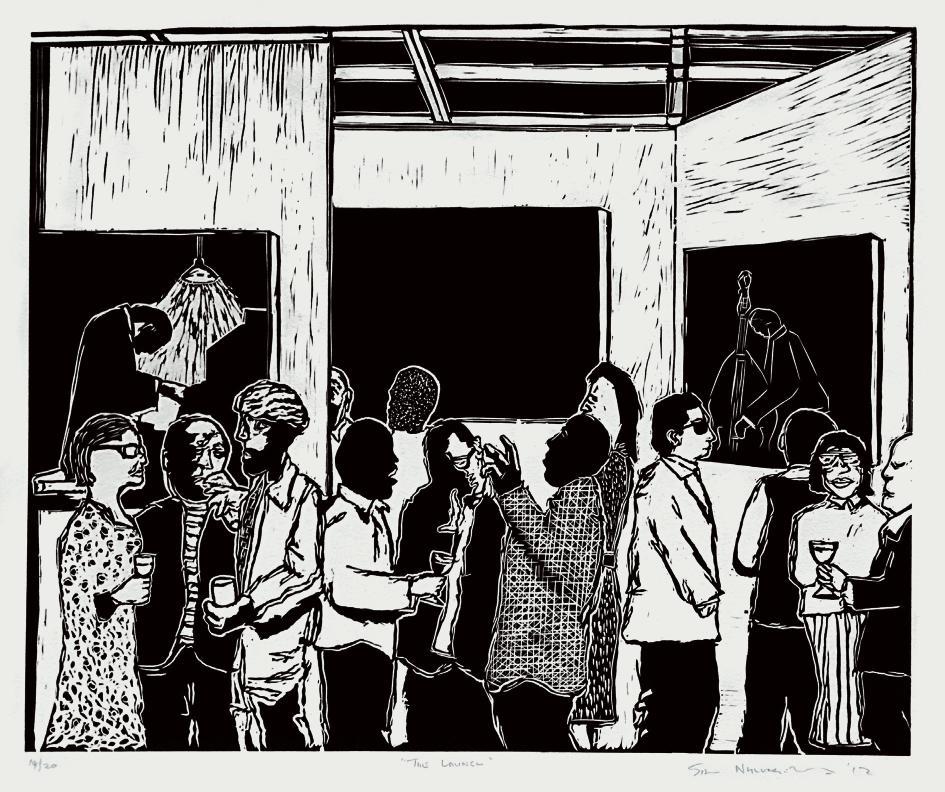
The exhibition launch, 2012.Linocut,67 x 76 cm.Image courtesy of Mo Editions.
Introducing Sam Nhlengethwa
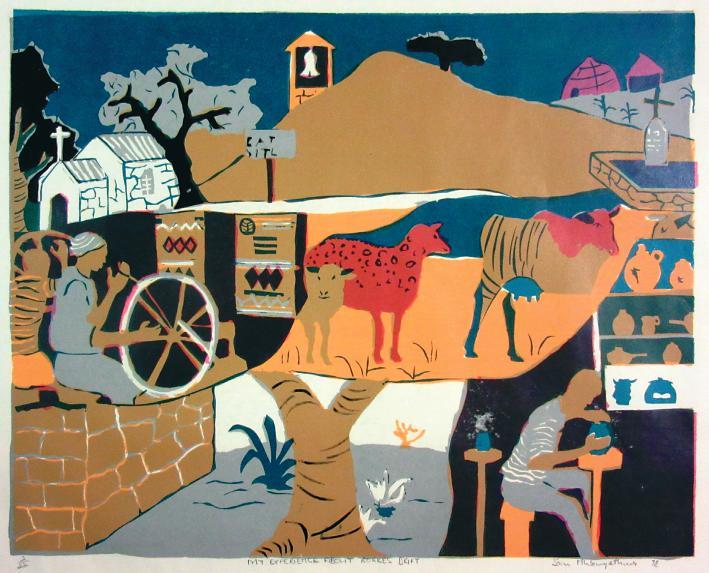
Sam Nhlengethwa was born in 1955,on the East Rand of Johannesburg.Despite growing up during apartheid when Black South African artists were restricted in terms of opportunities to study and exhibit their work,Nhlengethwa was determined to be an artist.He studied art at The Evangelical Lutheran Church Art and Craft Centre at Rorke’s Drift from 1977–1978. At the time,it was one of the few spaces where Black South African artists could learn art making because it operated outside of the government controlled universities and colleges. Nhlengethwa has dedicated over forty years to making art. Through his art works he explores themes that are important to him such as jazz,everyday life,and the challenges faced by mineworkers and waste-pickers.
My experience about Rorke’s Drift, 1978.Screenprint,32 x 40,2cm.Image courtesy ofWilliam Humpreys Art Gallery.
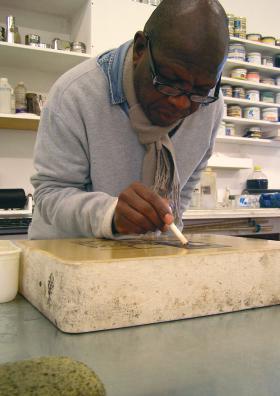
Sam Nhlengethwa working atThe Artists’ Press in Mpumalanga,2018.Image courtesy of TheArtists’ Press.
Becoming an expert
Printmaking requires specialised skills that Nhlengethwa has perfected through continuous and sustained practice over many years.To create his unique prints, Nhlengethwa uses a range of techniques such as collage,drawing and lithography.
Lithography is a method of printing based on the principle that oil and water do not mix.Traditional lithographs are made when an oily substance (for example a wax crayon) is used to draw an image onto the surface of a smooth,level,lithographic limestone.The stone is then treated with a mixture of acid and gum arabic that etches away the areas that have not been drawn on.The stone is then made wet. The etched areas retain the water.An oil-based ink is applied and is repelled by the water,sticking only to the original drawing.The ink is transferred to a sheet of paper,producing a print.
Let’s talk
Discuss what you think it requires ‘to excel’ at something?What skill or practice would you like to be expert at one day? How many hours do you think it would take?
Glossary
Collage is a method of art making that involves sticking images cut out from sources like photographs, newspapers or magazines on to a surface to create a new image.
Gum arabic is harden-ed sap from a tree.To etch is to corrode or eat away the surface.
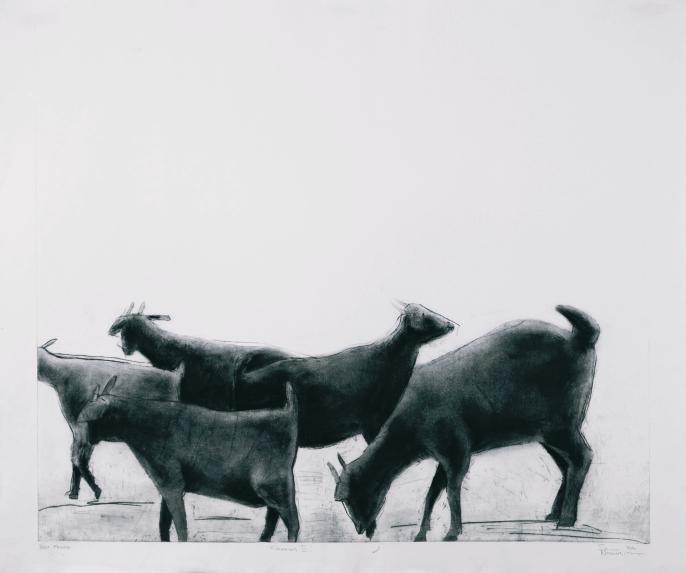
Grazing III, 2006.Three colour chine collé lithograph,78 x 94 cm.Image courtesy of Goodman Gallery.
Homage to people and places
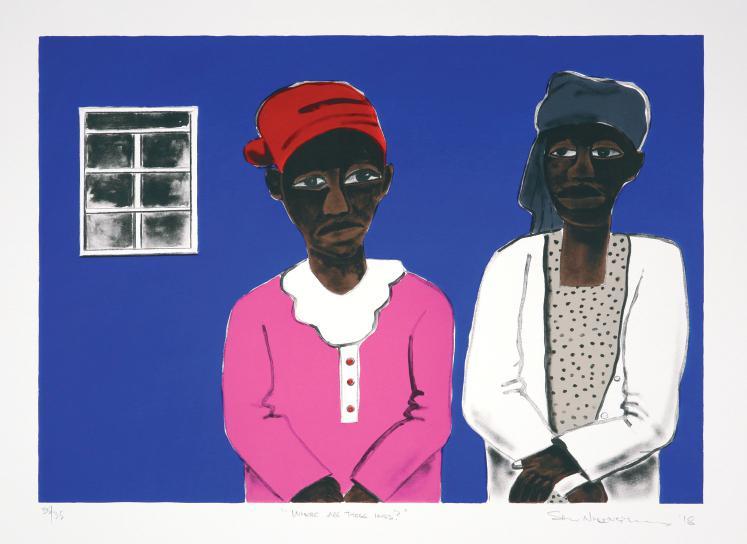
Nhlengethwa is inspired by people and places around him.He often depicts ordinary people going about their daily business,as can be seen in Where are those kids? (2018).Nhlengethwa has said:
“Throughout the years,all my pieces have dealt with the movement of people.I enjoy paying homage to people and places through my art.”
By focussing on people engaged in commonplace activities,Nhlengethwa helps us gain new perspectives on everyday life,people interacting and the relationships between social and political issues.
Let’s find
Find an artwork that you think reflects Nhlengethwa’s interest in people and places.Write down the:
Title:
Date:
Medium:
Glossary
Homage is to respect or honour someone publicly.
Where are those kids? 2018.Colour lithograph,50 x 65 cm.Image courtesy ofTheArtists’ Press.
Seeing differently
To create his Waste Pickers series Nhlengethwa got to know a few people who make their living from informal recycling.Of this experience he said:
“I got to see another side of waste pickers.A group of hard-working people who are selfmotivated.Their day starts very early.They are on their feet till very late.They work as a team and share the waste”.
Through making works about daily life in South Africa Nhlengethwa reminds viewers that despite 25 years of democracy,we still live in a very unequal society.
Let’s write
Make a poster for a street pole with a headline that brings attention to the challenges waste pickers experience or the importance of recycling.Use no more than 140 characters (letters).
Write your headline here:
Let’s reflect
List some of the challenges waste pickers face:
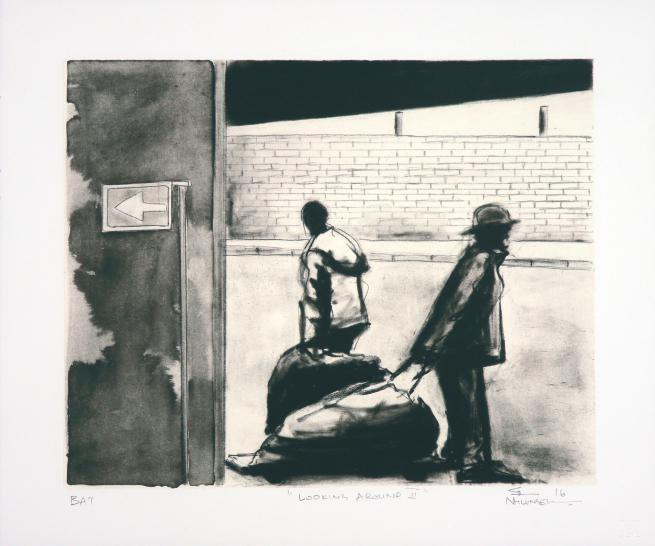
Looking Around II, 2016.Single colour chine collé lithograph,33 x 39 cm.Image courtesy ofTheArtists’ Press.
Artworks are good to think with
We all have different life experiences which impact on our persepctives on the world and how we interpret art works.When we want to think about what an artist is trying to say the first step is to look closely and slowly at an artwork.The next step is to describe in detail what we see.Then we can think about what the artwork means for us,and consider what it might mean to the artist and others around us.
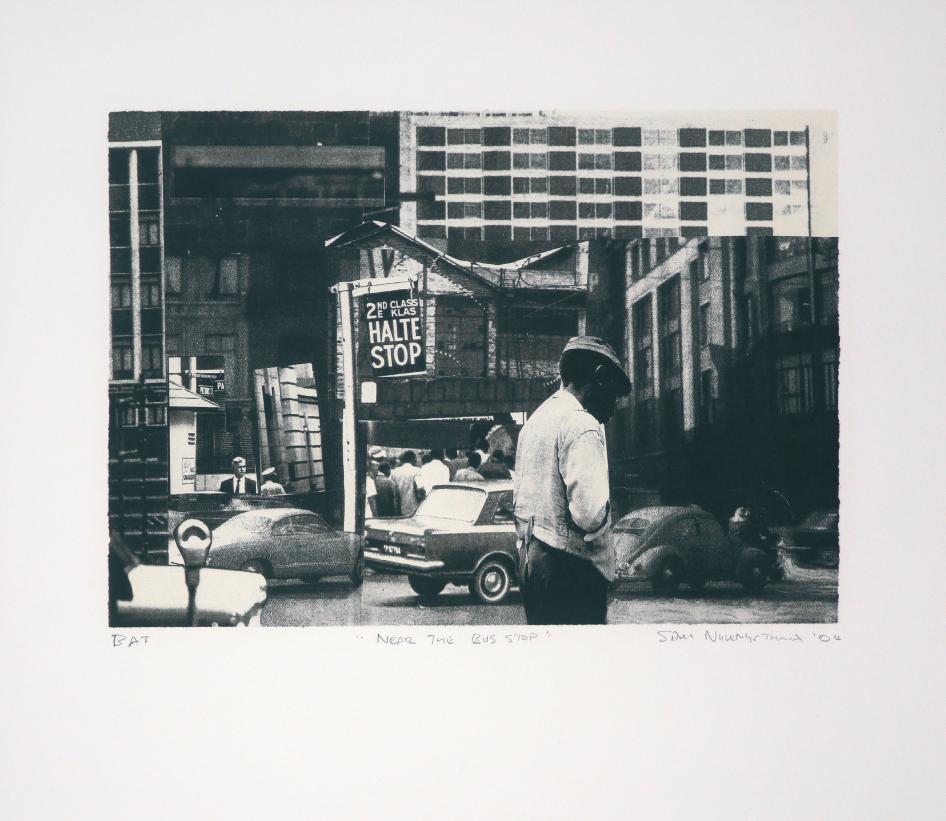
Near the bus stop, 2004.Photolithograph,30 x 50 cm.Image courtesy ofTheArtists’ Press.
Look, think, wonder
Look carefully at Near the bus stop 2004,and then write down your answers to the questions in the spaces provided:
What do you see? Describe the space,colours,shapes,and textures:
Write at least five words that describe how you feel when looking at this artwork:
What questions do you have when looking at this work?
Why do you think Nhlengethwa assembled (collaged) a number of separate images to create this work?
What effect does the appearance of collage have on our understanding of the artwork?
What do you think Nhlengethwa is trying to say to us through this artwork?
The beat of Drum
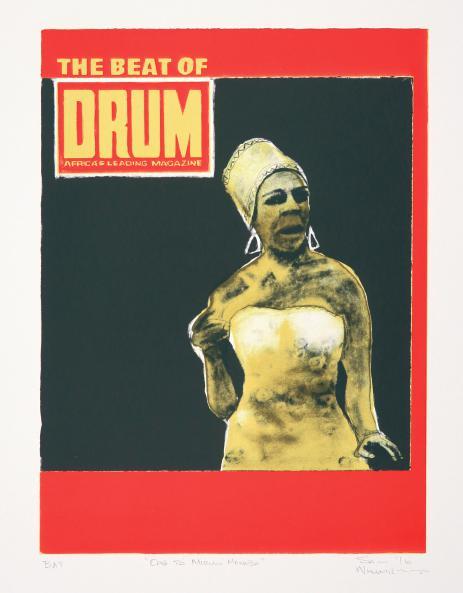
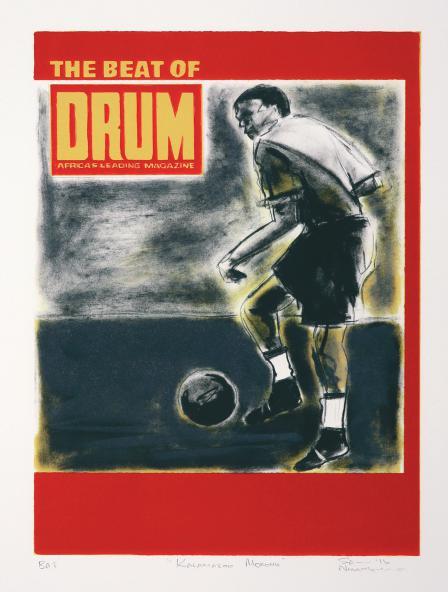
In addition to drawing inspiration from contemporary everyday life,Nhlengethwa makes use of a range of sources,like newspaper photographs,and past Drum magazine covers to create his images. Drum was a famous magazine that was first published in1951.It reflected the urban Black South African community,and became an important platform for changing the way that Black people were represented in South African society. Drum featured prominent Black South Africans like Miriam Makeba,the singer known as Mama Africa,who was also a prominent anti-apartheid spokesperson, and Kalamazoo Mokone,the first Black South African footballer to play soccer in Europe.
Let’s talk
It is interesting that Nhlengethwa re-interprets magazine covers in his prints.Discuss the role the media plays in highlighting what is news-worthy,and what role the artist plays in suggesting what is important to think about?
Ode to Miriam Makeba, 2016.Four colour lithograph,52.2 x 40.2 cm. Image courtesy ofTheArtists’ Press.
Kalamazoo Mokone, 2016.Four colour lithograph,52.2 x 40.2 cm. Image courtesy ofTheArtists’ Press.
The past and the present
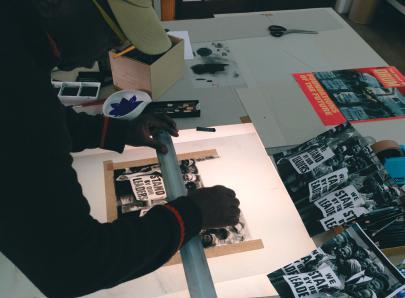
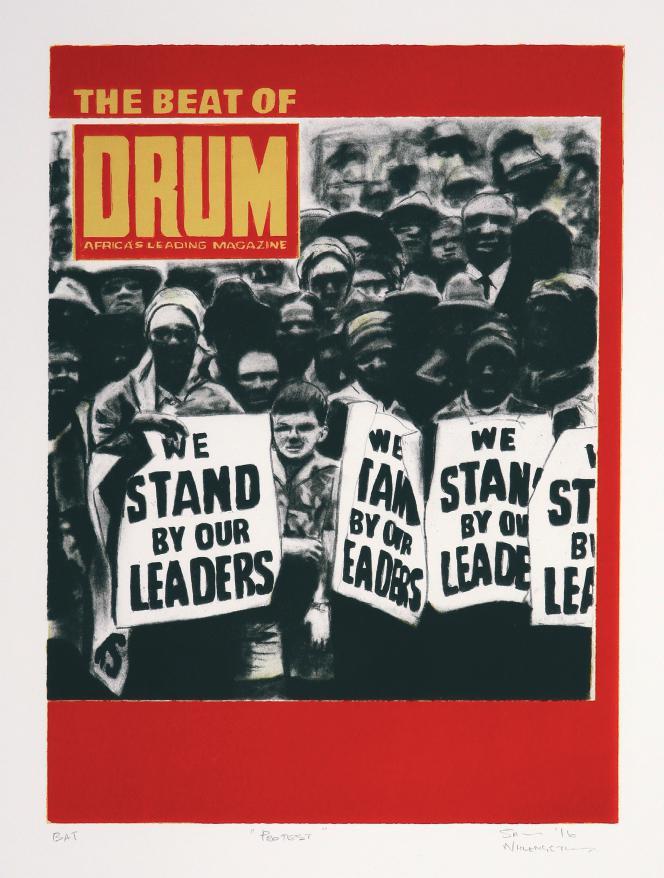
Nhlengethwa’s Druminspired images of antiapartheid protests are strikingly similar to protests against government corruption and lack of service delivery today.By revisiting past magazine covers and past newspaper photographs Nhlengethwa alerts viewers to the ways in which some of the same issues still plague us today.Even though the press photograph appears more truthful, both the press photographer and the artist make choices about what to select to communicate the message.
Sam Nhlengethwa working on Protestat The Artists’ Press in Mpumalanga,2016.Image courtesy of The Artists’ Press.
Protest, 2016.Three colour lithograph,52.2 x 40.2 cm.Courtesy ofTheArtists’ Press.
Celebrating jazz
One of Nhlengethwa’s most important sources of inspiration is his passion for jazz music.Jazz musicians experiment with repeating certain sounds,making slight adjustments with each new version as they create their music. Nhlengethwa said:
“Jazz simply inspires me.Of all the subjects that I have dealt with,none has been re-visited like jazz.Jazz is second nature to me … I think at heart I am a non-practicing jazz musician!”
Nhlengethwa listens to jazz music while he works,and is influenced by its rhythms,energy, and repetitions.He says “Painting jazz pieces is an avenue or outlet for expressing my love for the music.As I paint,I listen to jazz and visualise the performance.”
Let’s reflect
What is your favourite kind of music?
Do you enjoy listening to music while you are studying or working? If so,what impact does it have on you?
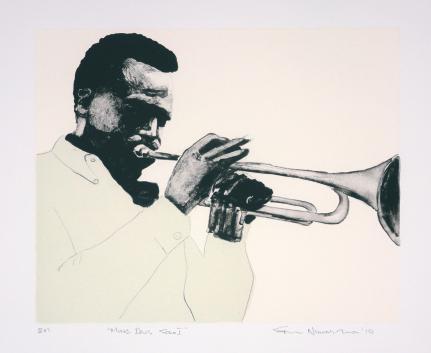
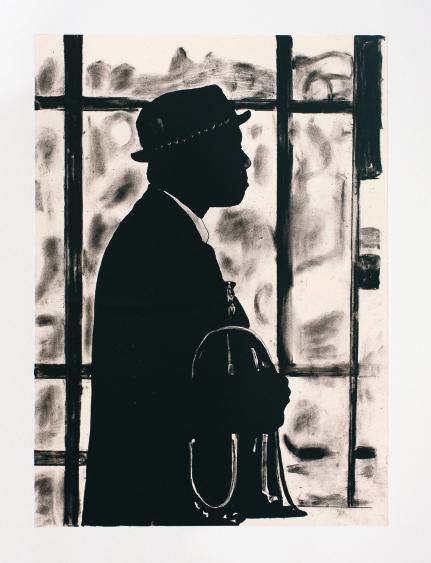
Miles Davis Solo I, 2010.Single colour chine collé lithograph 38 x 45 cm. Image courtesy ofTheArtists’ Press.
Feya Faku, 2018.Chine collé lithograph,41.5 x 39.5 cm. Image courtesy of LL Editions.
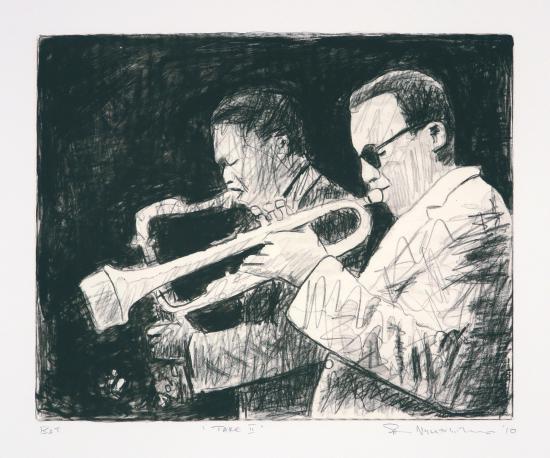
Nhlengethwa explores the theme of jazz in multiple ways.For example,in some works he celebrates the musicians who inspire him such as Feya Faku,a world-famous South African trumpet player.In other works,Nhlengethwa emulates the way that jazz musicians work with repetition and improvisation. Nhlengethwa returns to the same subject matter again and again.In each version he experiments with different lines,marks,textures and colours.Each artwork is a variation on the theme that communicates Nhlengethwa’s experience of jazz through visual expression.
Glossary
Improvisation is to arrange something without preparation. It involves skill,creativity and imagination.
Let’s draw
Look carefully at Take II, 2010.Copy some of the different lines and marks that Nhlengethwa has used in the space alongside:
Let’s reflect
Write down at least five words that describe the lines and marks you drew.If your lines and marks could make a sound,what sounds do you imagine they would make? Share these sounds with a partner.
Improvisation on a theme
Take II, 2010.Single colour chine collé lithograph,38 x 45 cm. Image courtesy ofTheArtists’ Press.
Your turn ...
Throughout this booklet we have considered the ways that art can help us expand our understanding of everyday life,and important social issues.We have also explored how Sam Nhlengethwa finds inspiration from what is around him,like his passion for music,and his interest in people and places.
Share what you have learnt with us by completing the following sentence on the card provided:
Before I came to Wits Art Museum and looked at this exhibition of Sam Nhlengethwa’s works I thought that art was:
Now I think art is:
This education resource was compiled by Alison Kearney,edited by Lesley Cohen and produced by Wits Art Museum to accompany Leeto:A Sam Nhlengethwa Print Retrospective held atWits Art Museum from 11 June to 18 August,2019.It is made possible through generous support from Merrill Lynch South Africa.