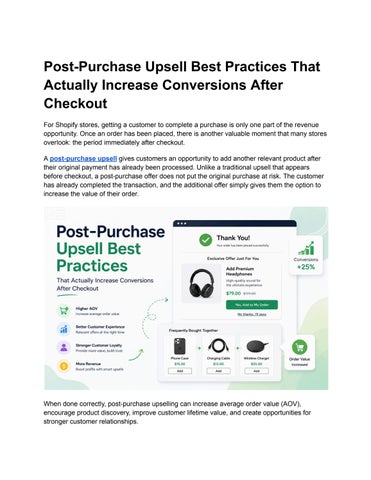
Post-Purchase Upsell Best Practices That Actually Increase Conversions After Checkout For Shopify stores, getting a customer to complete a purchase is only one part of the revenue opportunity. Once an order has been placed, there is another valuable moment that many stores overlook: the period immediately after checkout. A post-purchase upsell gives customers an opportunity to add another relevant product after their original payment has already been processed. Unlike a traditional upsell that appears before checkout, a post-purchase offer does not put the original purchase at risk. The customer has already completed the transaction, and the additional offer simply gives them the option to increase the value of their order.
When done correctly, post-purchase upselling can increase average order value (AOV), encourage product discovery, improve customer lifetime value, and create opportunities for stronger customer relationships.
What Is a Post-Purchase Upsell? A post-purchase upsell is an offer presented to a customer after they have placed an order, typically before they reach the final thank-you page. The offer can take several forms. It might be a related product, a subscription upgrade, a bundle add-on, or an offer such as buying additional products at a special price. The important difference is timing. A regular upsell is presented while the customer is still shopping or moving toward checkout. At that point, an aggressive or poorly designed offer can potentially distract the customer from completing the original purchase. A post-purchase upsell happens after payment has already been processed. The customer gets their original order regardless of whether they accept the additional offer. This creates a much safer opportunity to encourage an additional purchase. The customer can also add the recommended product without going through the entire payment process again, making the experience considerably simpler.
Upsell vs. Cross-Sell: What's the Difference? Upselling and cross-selling are related, but they are not exactly the same. An upsell generally encourages a customer to choose a higher-value version or upgrade. A cross-sell recommends an additional product that complements what the customer has already purchased. For example, if someone purchases a basic product, an upsell could encourage them to upgrade to a premium version. A cross-sell, meanwhile, could recommend an accessory or complementary item. Post-purchase strategies can use both approaches. The key is making sure that the recommendation makes sense for the customer's purchase.
Why the Post-Purchase Moment Is So Powerful The period immediately after checkout is valuable because the customer has already made a buying decision. They have demonstrated trust in the store by completing a purchase. They have also shown interest in a particular product or category. This gives the store useful information about what might be relevant to recommend next.
Instead of trying to convince a completely new visitor to buy something, the store is speaking to someone who has already become a customer. That makes relevance especially important. A post-purchase offer should feel like a useful continuation of the original purchase rather than an unrelated sales pitch. When the recommendation naturally fits the customer's order, the additional product can feel like a helpful suggestion.
The Structure of a High-Converting Post-Purchase Upsell Funnel A strong post-purchase experience does not have to stop at a single offer. The document outlines a broader flow that can include several stages.
1. The Primary Upsell The first offer should be highly relevant to the product the customer has just purchased. The recommendation should be easy to understand, with clear messaging about why the additional product is useful.
2. The Downsell Not every customer will accept the primary offer. Instead of ending the journey immediately after a rejection, stores can present a fallback offer. This might be a smaller product, a lower-priced option, a complementary item, or another alternative. The purpose is to capture additional value without making the customer feel that they have reached a dead end.
3. The Thank-You Page Once the upsell process is complete, whether the customer accepts the offer or declines it, the thank-you page remains valuable real estate. Stores can use this page for personalized product recommendations, loyalty-program enrollment, review requests, and referral prompts. This reinforces an important principle: the post-purchase experience does not end with the upsell popup. Every interaction after the order can contribute to customer engagement.
Best Post-Purchase Upsell Strategies to Increase AOV Knowing when to show a post-purchase offer is important, but the offer itself determines whether customers actually accept it. Here are the key strategies highlighted in the document.
1. Let Your Data Tell You What to Offer One of the most important principles is to use customer data rather than relying purely on assumptions. Browsing behavior and purchase history can provide useful signals about which products are likely to be relevant. Instead of showing the same recommendation to every customer, stores can use purchase patterns to create more personalized offers. The objective is simple: show customers products that make sense based on what they have already demonstrated an interest in.
2. Make the Offer Relevant Relevance is one of the strongest factors behind a successful post-purchase upsell. Consider a customer who purchases a linen button-down shirt. A post-purchase offer for matching shorts could say: "Complete the look, add the matching shorts for $15 only." This works because the recommendation has a logical relationship with the original purchase. The customer already trusts the store's aesthetic, and the complementary product feels more like useful styling advice than an unrelated sales pitch.
3. Help Customers Complete a Routine Certain product categories naturally lend themselves to complementary recommendations. Beauty and skincare are a good example.
If a customer purchases a facial cleanser, the store could recommend a toner with messaging such as: "Most skincare routines pair this with our toner. Add it for $18 – 20% off your first bottle." The value of this approach is that the recommendation helps the customer complete a routine rather than simply encouraging them to buy another product.
4. Use the Moment to Introduce Subscriptions Subscription offers can be particularly relevant for products that customers regularly need to replenish. For example, a customer purchasing a 250g bag of single-origin coffee could receive an offer such as: "Never run out – subscribe and get this coffee delivered monthly for 15% less. Cancel anytime." The customer has already demonstrated interest in the product by purchasing it. Presenting the subscription immediately after the purchase can therefore be more effective than waiting until later to introduce the idea.
5. Optimize the Mobile Experience The post-purchase offer needs to work well on mobile devices. The document emphasizes practical design elements such as large tap targets, short copy, fast-loading product images, a prominent full-width CTA button, and a layout that minimizes unnecessary scrolling. The entire post-purchase flow should be tested across at least two different mobile screen sizes before it goes live. A technically strong offer will not perform well if customers struggle to interact with it.
6. Add Social Proof Social proof can reduce hesitation. A genuine four- or five-star customer review displayed alongside the recommended product can help customers feel more confident about accepting the offer.
The principle is straightforward: rather than leaving customers to wonder whether an additional product is worthwhile, show evidence that other customers have found value in it. The review should be authentic and connected to the product being recommended.
7. A/B Test Relentlessly The first version of an upsell offer is rarely the final version. Successful stores should treat post-purchase optimization as an ongoing process rather than something that can simply be configured once and forgotten. The document recommends testing individual variables, including: ● ● ● ● ● ●
The product being offered The price point Headline copy Button text Layout Discount size
Testing one variable at a time makes it easier to determine what actually influenced performance. Changing several elements simultaneously makes the results much harder to interpret.
The Best Tool for Post-Purchase Upsells on Shopify The technology behind the offer also matters because the recommendation needs to integrate smoothly into the customer's shopping experience. Wiser AI is presented in the document as a Shopify upsell and product recommendation app designed to provide intelligent recommendations across different stages of the customer journey, including post-purchase and thank-you-page experiences. Instead of relying only on static "also bought" rules, the platform uses individual browsing behavior and purchase history to determine which products are more likely to be relevant to each customer. Its post-purchase functionality can operate immediately after checkout, while thank-you-page recommendations can continue providing product suggestions afterward.
The broader system also includes cart upsells, checkout upsells, email recommendations, smart popups, and frequently-bought-together widgets. The document notes that the solution supports Shopify Plus, offers a 14-day free trial, and is used by brands including Netflix Shop, BBC Shop, and Philips.
How to Measure Whether Your Strategy Is Working Installing a post-purchase upsell is not enough. Store owners need to measure its performance. Several metrics are particularly useful.
1. Upsell Acceptance Rate This measures the percentage of customers who see the upsell and accept it. The document identifies 10–15% as a solid baseline, while an acceptance rate above 20% indicates that the offer is highly relevant and well presented. If the rate is below 5%, the product, price, or copy may need improvement.
2. Average Order Value Lift Compare the AOV of orders containing an accepted upsell with orders that do not. The difference shows the AOV lift generated by the strategy. Tracking this over time helps determine whether the approach is producing sustained improvement.
3. Revenue Generated From Upsells Track the gross revenue generated directly from accepted post-purchase offers. This provides a clear view of how much additional revenue the strategy contributes.
4. Customer Lifetime Value by Segment Customer lifetime value can take longer to evaluate, but it is an important metric. Compare customers who accept post-purchase offers with those who do not. If customers accepting upsells demonstrate higher LTV, it can indicate that the strategy is contributing to deeper customer engagement and investment in the brand.
5. Downsell Acceptance Rate
If a customer rejects the primary upsell and receives a fallback offer, measure the downsell acceptance rate separately. This shows whether the secondary offer is appropriately matched to customers who rejected the original recommendation.
6. A/B Test Results Finally, use A/B testing to understand which changes actually improve performance. Testing should remain continuous, with individual variables evaluated systematically.
Final Thoughts Post-purchase upselling gives Shopify stores an opportunity to generate additional value after the original transaction has already been completed. The strongest strategies are not about showing customers as many products as possible. They are about showing the right product at the right moment. Data-driven recommendations, relevant complementary products, subscription offers, downsells, social proof, mobile-friendly design, and continuous A/B testing can all contribute to a stronger post-purchase experience. Most importantly, stores should measure the results rather than assuming that an upsell is working. Acceptance rate, AOV lift, upsell revenue, customer lifetime value, downsell acceptance, and A/B-test performance provide a clearer picture of whether the strategy is genuinely contributing to business growth. When post-purchase recommendations are relevant and easy to accept, the checkout does not have to be the end of the customer's buying journey. It can become the beginning of another valuable opportunity to increase AOV and strengthen the overall customer relationship.