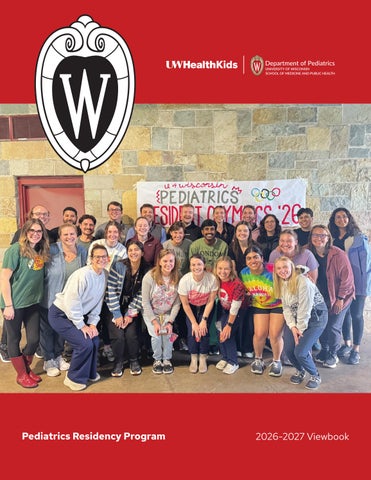
Pediatrics Residency Program
2026-2027 Viewbook
Facts and figures Fiscal year 2025
UW Health Kids includes all pediatric services and programs provided at our two children’s hospitals, our ambulatory sites and regional clinics in Wisconsin and Illinois.
CANCER AND BLOOD DISEASES
NEUROSCIENCES
Our Pediatric Cancer and Blood Disorders Program is part of UW Health | Carbone Cancer Center—a National Cancer Institute-designated Comprehensive Cancer Center. We are leaders in cellular and gene therapy, neuro-oncology and novel clinical trials. We offer the latest treatments for leukemia, brain tumors and neuroblastoma.
We offer a comprehensive neurosciences program that includes our Level IV Epilepsy Center with neurosurgical intervention services. Our nationally recognized experts provide the latest diagnostic and therapeutic options for the most complex neurological conditions. They pioneer the use of innovative techniques for spine tumors, spinal deformities and spinal trauma.
COMPREHENSIVE HEART CARE
TRANSPLANT SERVICES
Our Congenital Heart Program is dedicated to the diagnosis, treatment and prevention of congenital and acquired heart conditions from fetal life through adulthood. This includes our collaboration with Children’s Wisconsin called Forward Pediatric Alliance that offers comprehensive high quality care at two hospitals and multiple clinics. The collaboration broadens our geographic reach and commitment to the best outcomes for more patients.
The UW Health Transplant Center is nationally respected and the only center in Wisconsin that is UNOS certified for pediatric heart, kidney, liver, lung and pancreas transplant.
Learn more at uwhealth.org/kids
Team 240+ pediatric physicians 100+ pediatric APPs 540+ pediatric RNs 80+ pediatric residents and fellows 65 specialty care programs
Research and education 18th in nation for NIH funding* $41.93M research funding**
Locations American Family Children’s Hospital, Madison, WI Women and Children’s Hospital, Rockford, IL 34 primary care locations 3 urgent care centers
Regional services 150+ agreements 170+ providers 34 pediatric specialties providing onsite and remote services 50 locations in 32 cities Med Flight air and ground critical care transport for children and neonates * 2024 ranking **University of Wisconsin School of Medicine and Public Health, Department of Pediatrics CH-2535650-25
Services of distinction
American Family Children’s Hospital Facts and figures Fiscal year 2025
Our world-class hospital is designed around the needs of children and families. It is home to some of the nation’s foremost experts in pediatric medicine. We are nationally ranked in Neonatology, Pediatric Cardiology and Heart Surgery, and Pediatric Gastroenterology and GI Surgery by U.S. News & World Report for 2025–2026. Our teams provide remarkable care for all types of patients, including the sickest and most seriously injured infants, children
Location 1675 Highland Ave. Madison, WI 53792
and adolescents.
Key services
Special support
Level I Pediatric Trauma Center
24/7 Child Life services to help kids be kids while in the hospital
Level IV Neonatal Intensive Care Unit 111 beds 7.3 days average length of stay
American College of Surgeons and American Burn Association Verified Pediatric Burn Center Ambulatory Surgery Center
9,960+ surgical procedures 8 operating rooms 4,000+ inpatient admissions
Pediatric Intensive Care Unit
Hybrid Catheterization/Angioplasty Suite with emphasis on no- or low-dose radiation Level IV Epilepsy Center Pediatric Sedation Program
17,700+ ED visits
Learn more at uwhealth.org/AFCH
Diagnostic Therapy Center Pediatric Emergency Department
Hospital-based school, with a library, staffed by three Madison Metropolitan School District teachers Positive Image Center for children experiencing anxiety from appearance-altering illnesses Facility dogs who are trained to work in health care settings to support and uplift children receiving care Family dinners and sibling childcare to ease stress on patients and families Family kitchen, lounges, playrooms and an exercise room to provide patients and families with the comforts of home
CH-2535650-25
Fast facts
ELECTIVES
We care deeply about enabling residents to tailor their curriculum to fit intellectual curiosity and career needs. Residents can choose from a broad range of elective experiences during their three years - and some trainees even choose to craft their own!
BY YEAR The amount of elective time allotted to residents increases each year: PGY-1: six weeks PGY-2: ten weeks PGY-3: thirteen weeks How many different electives you take depends in part on which electives you choose. Elective rotations are different lengths, ranging from 1 to 4 weeks. Some are flexible but others require a certain length (e.g., Rural Pediatrics can only be taken as a 4-week elective).
A SAMPLING OF ELECTIVE OPTIONS This list is not exhaustive! Below are some of our most popular electives, including several interdisciplinary experiences. Advanced Subspecialty Can be taken for any subspecialty in 2nd/3rd years
Breastfeeding Medicine Cardiovascular ICU Child Protection Child Psychiatry Complex Care Ethics Musculoskeletal Outpatient Heme/Onc Outpatient Pulmonology Palliative Care Pediatric Dermatology Pediatric Hospital Medicine Pediatric Urology Primary Care Radiology Research Resident as Teacher Rural Health Sedation Sleep Medicine
Make It Your Own! Some residents have chosen to create their own electives, including experiences with POCUS (pictured: PGY-2 Tim Lee), MedFlight, and shadowing SpanishEnglish translators in clinic.
CLINICAL EXPERIENCE GENERAL INFO Vacation: Three 1-week vacations per year plus one 5-day holiday break; 1 week leave after intern year PGY-1 Call: 1-2 weekends/month (assisting with ward rounds); 1-2 weeks primary backup for interns January-June PGY-2 Call: Two call-free months and 1-2 weekends/month (NICU or ward nights) PGY-3 Call: One call-free month and 1-2 weekends/month (NICU or ward nights) Backup Call (PGY-2 and PGY-3 only): Primary backup coverage: provided by 2-week Swing Backup rotation. Secondary coverage: call assigned (but not necessarily used) 2-4x/month for residents on subspecialty/elective rotations.
SAMPLE BLOCK SCHEDULES 2026-2027 ACADEMIC YEAR
PGY-1
PGY-2
PGY-3
Note: Vacations, holiday breaks, and post-internship break are not shown in these sample block schedules. Vacations generally occur during Elective, GI, Endocrinology, ID, Cardiology, Nephrology and/or CPAAX blocks. Continuity clinics occur weekly throughout the year except for on the following rotations: Ward Nights, Emergency Medicine, Heme/Onc Nights, and NICU and PICU
PGY-1 ROTATION OVERVIEW Wards (Red and White teams): Weekdays are generally 6 am to 6 pm, and residents also work 4 weekend days across the block. Red: Care for hospitalist, nephrology, and cardiology patients White: Care for hospitalist and GI patients Blue (PGY-2): Care for pulmonary and endocrinology patients
Wards Nights (aka Mole): Monday through Friday nights, 5 pm to 7 am. All weekends (Saturday and Sunday) are off. Normal Newborn Nursery (NNN): Cover the normal newborn nursery at UnityPoint Health-Meriter Hospital (also the primary NICU site for residents). Round on healthy newborns and attend deliveries. Weekdays are approximately 6:30 am to 5 pm.
Behavior and Development: Time with the developmental pediatricians at the Waisman Center. Learn about neuropsychiatric testing as well as diagnosis of autism spectrum disorder and developmental delay. Opportunity to participate in multi-disciplinary clinics (i.e., Down Syndrome clinic, neuromuscular clinic).
Emergency Department: Dedicated pediatric ED, staffing with pediatric-trained EM attendings, and working with pediatric EM nurses. Weekly simulation experience.
Oncology: Inpatient oncology service. The schedule includes weekdays 6 am to 6 pm, as well as 4 weekend days across the block. PGY-2 residents serves as seniors and cover hematology patients. Pediatric Acute Care Clinic (PACC): General acute care pediatrics in the clinic setting, including practice with general peds triage and outpatient procedures.
CPAAX: Community Pediatrics, Advocacy, and Ambulatory eXperience. Longitudinal outpatient rotation consisting of a block of multiple experiences in community pediatrics Monday through Friday, as well as oppotunity for additional ambulatory clinic time. Opportunity to complete your required advocacy project.
Endocrinology and Gastroenterology: All interns rotate through Endo and GI, which are both a combination of outpatient clinic and inpatient consulting services designed to provide a good foundation of the subspecialty for the practice of general pediatrics. Other subspecialty rotations occur in 2nd or 3rd year and can include time with: infectious disease, adolescent, cardiology, neurology, nephrology, rheumatology, and allergy. Advanced electives in each specialty are available to residents who desire a more in-depth experience.
CHECK OUT OUR WEBSITE FOR MORE IN-DEPTH INFORMATION AND DETAILS ON PGY-2 AND PGY-3 ROTATIONS!
GLOBAL HEALTH MISSION
The Department of Pediatrics boasts a robust, long-established Division of Global Health, and a Global Health Track for residents. Attending physicians within the division are national and international leaders in pediatric global health advocacy and practice, and they are committed to passing this knowledge along to trainees.
To foster personal and individualized growth with the goal of developing physician leaders who will have the skills, knowledge, and desire to improve the health of children worldwide.
CURRICULUM Fundamentals of Global Health Course Protected rotation held 2 weeks annually in the fall, including 1 week multidisciplinary and 1 week Pediatric-specific education Small group sessions led by faculty and Global Health Chief Resident 1 evening/month Global Health-specific PEARL 1-2 sessions/year; all residents attend Global Health simulation sessions UW Global Health Institute Series and additional lectures (available in-person and online) Annual UW Global Health Institute Symposium Supplemental readings and videos, including journal club and annual book club
Fundamentals of Global Health Course participants (left). During the course they have the opportunity to hone their skills in the Clinical Simulation Center (below)
Fundamentals of Global Health didactic session (below)
Clinical sites in Uganda
EXPERIENTIAL OPPORTUNITIES Global Health Track residents complete a Global Health Elective. This experience: Can be domestic (opportunities include Indian Health Services, immigrant clinics, adoption/travel clinics, and Plain Community-focused rural health) or international Occurs in the PL-3 year, with planning beginning in PL-2 year Is individualized based on future career goals Can be funded via the departmental Global Health Elective stipend and AAP International Travel Grant Includes optional participation in a scholarly project during the elective In the past several years, residents have rotated in Uganda, Guatemala, Lebanon, Rwanda, and the Center for Special Children in La Farge, Wisconsin.
Clockwise from upper left: Mbale Regional Referral Hospital, the program’s main clinical site in Uganda; supplies in Pediatric Ward at MRRH; Sipi Falls; Dr. Christiana Ekezie (class of 2023)
PUBLISH PATHWAY
PUBLISH (Producing Understanding in the Basics of Literature, Inquiry, and Scholarship in Healthcare) is a longitudinal, three-year pathway within the residency program that seeks to devlop trainees' expertise in schoarly work.
CURRICULUM Residents in the PUBLISH Pathway build their scholarship expertise through introduction to core research principles exposure to varied types of scholarship engagement in structured mentorship from experienced faculty on a research project building skills to communicate and disseminate scholarly work
WHAT ACTIVITIES ARE PART OF PUBLISH? Working with a mentor on a project that is interesting, relevant, and doable, and that provides experience in the fundamentals of research Meeting directly with one's mentor a minimum of 8 times/year Attending PUBLISH retreats and meetings for didactic instruction, workshops, guided project work, and peer mentoring Committing a minimum of one 2-week elective to deep participation in scholarly work Participating in PUBLISH retreats Working with a mentor toward project dissemination, including: Abstract submission to UW's annual Pediatrics Research Week Abstract submission to a regional or national meeting, with protected time and funding available to attend if accepted Begin writing a manuscript Social events like the annual picnic (above right)
PRIMARY CARE PATHWAY The PCP (Primary Care in Pediatrics) Pathway is a longitudinal, three-year pathway within the residency program designed for residents interested in careers outpatient primary care.
CURRICULUM Residents in the PCP Pathway complete a minimum of 45 continuity clinics per year participate in quarterly meetings with teaching on PCP topics participate in elective and flex opportunities targeted to primary care, including the Primary Care Elective as a PGY-3 develop a primary care QI project work with a primary care mentor
OMM PATHWAY
The OMM (Osteopathic Manipulative Medicine) Pathway gives residents a structured mechanism to maintain and build upon their osteopathic knowledge and skills with a pediatric focus. It was designed in partnership with the University of Wisconsin Department of Family Medicine and Community Health residency program which is part of the Wisconsin Statewide Osteopathic Collaborative.
CURRICULUM Residents in the OMM Pathway Orientation to using osteopathic skills during residency Hands-on patient care in OMM clinics with several providers in Madison Attend statewide quarterly conferences and monthly study group sessions Complete an osteopathic scholarly project or presentation
PATHWAY FAQS Q: How do I become a part of Global Health, PUBLISH, Primary Care, and/or OMM Pathway(s)? A: Incoming interns receive information on applying during the weeks after the Match.
Q: Can a resident participate in more than one pathway? A: We work to accommodate dual pathway partcipation as much as possible. For scheduling purposes, we will ask residents to identify a “primary pathway.” The primary pathway designation is used to prioritize scheduling if a conflict arises.
Q: How much prior research experience do PUBLISH participatants need? A: PUBLISH welcomes residents of all levels of expertise, from those who are dipping their toes into research for the first time to those who have participated in many previous projects! Many of the pathway activities can be tailored to an individual resident’s level of experience. Those with particularly extensive research experience may find some aspects of the pathway redundant.
Q: How is participation in the Primary Care Pathway different than the typical expectations for continuity clinic? A: Residents in the PCP complete more clinic sessions per year, attend evening educations sessions related to primary care, dedicate their QI and academic projects to a primary-care related topic, and complete an intensive third-year elective in clinic.
Q: How do residents have time to practice OMM in their busy schedules? A: In an effort to make sure interns can focus on adjusting to residency, most requirements for the OMM Pathway do not begin until the second year of residency. Interns are still welcome to participate if they are able, however. As seniors, residents in the OMM Pathway have the opportunity to perform OMT in continuity clinic and other clinical settings, as well as to practice their skills at any time using the residency program's OMT tables.
PATHWAY LEADERS Osteopathic Manipulative Medicine Pathway
PUBLISH Dan Sklansky, MD
Kelly McGregory, DO
Primary Care Pathway Ande Jones, MD
Kristen Marten, DO
Sammi Tyler, DO
Global Health DeMarco Bowen, MD
Nikki St. Clair, MD
ADVOCACY
A central part of the mission of the University of Wisconsin Department of Pediatrics is to "promote and enhances the health of children" through advocacy at the individual, local, state, and national levels. Residents have the opportunity to become deeply involved in advocacy work during their training.
CURRICULUM PGY-1 and -3 residents spend parts of 8 weeks learning about advocacy and our community partners during the longitudinal Community Pediatrics, Advocacy, and Ambulatory Experience (CPAAX) I and II rotations. We also dedicate one academic half-day (PEARL Conference) each year to teaching residents how to be effective advocates for their patients and communities. There are also various opportunities during all three years to build advocacy skills including: interacting and working with community partners on projects learning how to use your voice as a pediatrician on social media and in news outlets participating in health policy and legislative advocacy efforts
COMMITTEE FOR ADVOCACY AND RESIDENT EDUCATION (CARE)
Vision: For all pediatric trainees to be effective advocates for all children. Mission: Educate residents about creating and sustaining community partnerships Provide a framework to approach and participate in legislative advocacy Develop advocacy-related media communication skills Learn how to address the holistic needs of our patients, including social determinants of health Connect residents and faculty to local advocacy opportunities in our community
CARE is open to all pediatric residents! It is a resident-led advocacy group that provides extra opportunities to learn about advocacy throughout your time in residency. We strive to develop even more opportunities for advocacy training and involvement, based on resident interest and current topics. CARE meets monthly in the evening (currently online) to work on advocacy projects, discuss new opportunities, and listen to guest speakers share their advocacy experiences in their respective careers. Faculty mentors are Drs. Mala Mathur & Laura Houser.
ADVOCACY OPPORTUNITIES Community Advocacy Our residents enjoy organizing volunteer opportunities in the community. Some examples include: making dinners for families staying at the Ronald McDonald House, holding a toy and book drive for Head Start programs, and educating kids with Down Syndrome and their families about various health topics at GiGi’s Playhouse. Recently, residents have focused on promoting voting and creating virtual education sessions about health for local schools.
Legislative Advocacy Our location in the state capital gives residents the unique opportunity to advocate with legislators on a personal basis. Many residents attend the annual Doctor Day and Pediatric Advocacy Day to practice their advocacy skills. There are so many ways to connect with your state representatives to address pediatric health and promote policy change!
Media Advocacy Current and former residents have used their voice to speak on behalf of children by writing op-eds that have been published in local news outlets. Recent examples include: "Sex ed needs to include contraception" - Dr. Alex Wolf (July 12, 2022)
JUST A FEW OF OUR COMMUNITY PARTNERS
RESIDENT LEADERS Help develop advocacy curriculum Serve as WIAAP resident representatives Develop advocacy scholarly projects Serve as program liaisons to AAP for district VI and nationally Attend AAP Legislative Conference and AAP Section on Pediatric Trainees meeting Lead CARE 2026-2027 Lead Resident for Advocacy Marissa Swenson, DO
2026-2027 AAP Delegate Juliette McAllister, MD
LOOKING FORWARD There are so many ongoing advocacy efforts within the University of Wisconsin Department of Pediatrics and the Pediatric Residency Program. Looking ahead, we hope to enhance our advocacy experience through a more centralized Advocacy Hub. This initiative will help build an infrastructure for advocacy engagement among medical students, residents, faculty, and our community partners so we can collaborate most effectively. Madison is a resource-rich area, and we hope to continue to build relationships with the community that reflect this. We look forward to continuing to educate residents to be great child advocates now and in their future careers.
CORE MENTORS
Even the all-time greats – from Simone Biles to Dr. Atul Gawande – have a coach. At UW-Madison, every Pediatrics resident has one, too! Through the CORE Mentor program, every intern is paired with a faculty member who serves as a coach and mentor for all three years of residency.
MEET THE TEAM
Lindsey Boyke, MD, MPH Non-Op. Peds Ortho
Laura Chen, MD PHM
Anjali Rao, MD Dev. Pediatrics
Ellen Connor, MD Endo
Danielle Rodgers, MD Gen. Peds
Katie Kastner, MD Dev. Pediatrics
Carolyn Sleeth, MD, MPH Gen. Peds
Victoria Nicksic, MD Endo
Nikki St. Clair, MD, MS PHM
ABOUT THE PROGRAM CORE Mentors provide direct observation, coaching, and mentorship, as well as help with goalsetting and career advice. CORE Mentors conduct at least 2 direct clinical observations per resident each year in various settings, then offer coaching immediately or very soon after the encounter. If there’s something specific a resident would like to work on, the direct observation can be tailored to that.
Direct Observation Settings CORE Mentors conduct 2 observations per year in pre-determined settings (although some residents schedule more!) PGY-1: Inpatient Wards & Continuity Clinic PGY-2: Specialty Clinic & ED PGY-3: Continuity Clinic & Resident Choice
RESIDENT LIFE Madison has a variety of living options, and residents are able to find housing that ideally suits their needs. Some residents rent while others own, and housing ranges from apartments to single family homes. Madison's many neighborhoods have unique characteristics, allowing residents to find an area that matches their preferences. For example, some neighborhoods are well-integrated with the campus and downtown, while others are quieter and more suburban in layout.
WHERE RESIDENTS LIVE
10%
DOWNTOWN/ ISTHMUS
25%
WEST MADISON OR MIDDLETON
12%
10%
25%
HILLDALE/ SHOREWOOD HILLS/ GREENBUSH
EAST MADISON OR MONONA
18%
SOUTH MADISON OR FITCHBURG
VERONA OR SW MADISON
2% - OTHER
BY THE NUMBERS Our residents are a diverse group of trainees from different backgrounds, both experiential and geographic. They lead varied lives outside of work. There is no 'typical resident' in our program, and we consider that a huge strength.
Percent of Current Residents Who ARE FROM WISCONSIN
Percent of Current Residents Who
23%
own a house 23% HAD NO WISCONSIN CONNECTION BEFORE RESIDENCY
rent a house, townhouse, or condo 12%
rent an apartment 65%
60%
HAVE KIDS
16% ABOUT 1/4 OF RESIDENTS BIKE, WALK, OR BUS TO WORK
1 IN 4 RESIDENTS EARNED THEIR UNDERGRAD DEGREE IN WISCONSIN
WHERE ARE WE FROM? WHERE WE'RE FROM MEDICAL SCHOOL TYPE CLASSES OF 2025-2027
Caribbean 1%
ABOUT 1/3 OF RESIDENTS HAD A DIFFERENT CAREER PRIOR TO MED SCHOOL
IMG (US and int'l.)
13%
DO 20%
MD 66%
1 IN 4 US RESIDENTS WENT TO MED SCHOOL IN WISCONSIN
RESIDENT MEDICAL SCHOOLS BY REGION
11%
64%
US MD/DO
CLASSES OF 2026-2028
8%
1%
Academics
UW–MADISON
A Top-Ranked Public University
POINTS OF PRIDE Institution
123
Countries represented by students
12,534
A Leader in Higher
Degrees awarded (2023–24)
Education Since 1848
50
268
321
Undergraduate majors/certificates (fall 2024)
States represented by students
Graduate programs (fall 2024)
490,780 52,097 Living alumni (fall 2024)
Total students (fall 2024)
Outreach A Commitment to Public Service
#1
Peace Corps volunteers (2023)
Average class size
Research
#12
A World-Class Research Enterprise
91%
#7
Study abroad participants among U.S. universities (2021–22)
Student participation in service learning/high-impact practice (2023–24)
$30.8B 20 Economic impact to the state (9% of economy; 2021)
33
Nobel Prize winners (faculty/ alumni)
$1. 52B Research expenditures (2022)
Most doctorates granted among U.S. universities (2023)
#8
National research ranking among U.S. universities (2022)
Badger Athletics • A Big Ten Athletics Powerhouse
744 Student-athletes
229 Individual NCAA championships
23
NCAA Division 1 teams
#12
Patents granted among U.S. universities (2023)
400+ Startups formed from UW research
33
Team NCAA national championships
Prepared by the Office of Strategic Communication © 2024 Board of Regents of the University of Wisconsin System Fall 2024
#1: National public university (Washington Monthly, 2024) #1: Best hospitals in Wisconsin (U.S. News & World Report, 2024–25) #13: America’s Best Colleges among public universities (U.S. News & World Report, 2024–25) #28: Best university worldwide (Center for World University Rankings, 2024)
Affordability A Promise to Make College Attainable
#7
Best Schools for Financial Aid among public universities (Princeton Review, 2024)
65.5% Students graduating debt-free (2022–23)
3.86
Years to earn a degree on average (2023–24)
Innovation A University of Firsts
• Bone marrow transplant (UW Hospital) • Academic dance program • Department of wildlife management • Poverty research center • Projection world map that reflects true continent size
A Legacy of Discovery
• Vitamins A and B and use of Vitamin D • Blood-thinner Warfarin • Homo naledi human ancestor • Cosmic neutrinos at South Pole • Creation of synthetic genes • Cultivation of embryonic stem cells in a lab
MADISON
Magazines and websites consistently name Madison of the best places to live in the entire country! Our lovely city offers plenty for residents to explore in their time away from American Family Children’s Hospital. There is something for everyone in Madison, including great restaurants, thriving music and theater scenes, outdoor pursuits, and Wisconsin Badgers sports. Here are just a few of our favorite activities in and near the city.
Baraboo & Devil's Lake State Park
Sun Prairie
Olbrich Botanical Gardens
Memorial AFCH Union Terrace Capitol Square Henry Vilas Zoo
UW Arboretum Blue Mound State Park
Stoughton & Lake Kegonsa State Park
IN AND AROUND THE CITY Concerts on (and off!) the Square A Madison favorite, the Concerts on the Square series takes place on Wednesday nights in the summer. Concertgoers set down a blanket on the Capitol lawn and enjoy the summer evening while listening to a live performance from the Wisconsin Chamber Orchestra. Just off the Square, Overture Hall hosts Broadway productions and orchestral concerts throughout the year.
Farmers' Market Every Saturday during the summer and fall, check out the Dane County Farmers’ Market around the Capitol Square. There are always varieties of fresh produce, flowers, baked goods, and cheeses to sample and buy. There are also farmers' markets throughout the week in neighborhoods around the city!
Memorial Union Terrace The Memorial Union Terrace is a great place to enjoy Lake Mendota, get some Babcock Ice Cream or a microbrew, and listen to local music. It is a Madison icon and a favorite among all of the residents. Walk, drive, or paddle up to the dock!
Festivals Madison is the home to over 300 outdoor events and festivals yearly ranging from Brat Fest to the CrossFit Games. How many can you make it to?
UW Badger Athletics Wisconsin fans turn out by the thousands to cheer on the Badgers in football, basketball, and hockey. Camp Randall is home to “Jump Around,” one of the most well-known traditions in college football.
UW- Madison Arboretum The arboretum has over 1,000 acres to explore, whether on foot or cross-country skis!
Picnic Point Picnic Point is a great place for a run, a late-night bonfire, or a beautiful view of the Capitol. The trail leaves directly from the hospital parking lot and leads to a peninsula on Lake Mendota.
Devil's Lake State Park Less than an hour northwest of Madison, Devil's Lake offers a plethora of outdoor activities, including camping, fishing, swimming, paddling, and 29 miles of hiking trails. The park draws 3 million visitors per year from all over the state and country!
All images except Devil's Lake and residents on Terrace (c) University of Wisconsin-Madison.
MADTOWN FACTS 300,000
The present-day city of Madison occupies ancestral Ho-Chunk land, a place their nation has called Teejop (day-JOPE) since time immemorial. We respect the inherent sovereignty of the Ho-Chunk Nation.
Population
Land Acknowledgment
250,000 200,000 150,000
City of Madison: 285,300 Madison Metro Area: 680,796
100,000 50,000 0
1990
2000
2010
2020
Madison is the fastest growing city in Wisconsin, with a 16% population increase in the last decade alone.
Madison boasts 23 craft breweries!
#1 - Best Place to Live in the US Livability, 2021 & 2022
#1 - Most Neighborly City in America
50,0000 15,000 270 12
UW - Madison students
acres of lakes
public parks
public beaches
Neighbor.com, 2023
#6 - Best Places to Live for Quality of Life US News, 2022
...and an overall “Happiest Place to Live”! Outside (2023), WalletHub (2023), Men’s Health (2020)
If you don't want to spend your time stuck in traffic, Madison is the place for you! The average commute is just 20 minutes, 5 minutes less than the national average, making it 11th among the top 100 metro areas in the U.S...
Getting Around
...or hop on a bicycle and avoid auto traffic altogether! Madison is the 2nd best city in the U.S. for cycling.
AFTER RESIDENCY While our primary goal is to train outstanding general pediatricians, our residents go on to pursue a number of career paths in both academic and non-academic settings.
Other* 16%
Hospitalist 14%
CAREER PATHS CLASSES OF 2023-2026 *Includes additional residency training **Includes urgent care
Fellowship 48%
General Pediatrics** 22%
WHERE OUR RESIDENTS GO FOR FELLOWSHIP CLASSES OF 2023-2026
Our graduates matriculate into outstanding fellowship programs around the country, consistently matching into their top choices. U. Washington
U. Minnesota U. California San Francisco
Med. College of Wisconsin U. Michigan
U. of Utah Northwestern
U. Colorado
Indiana Children's Washington U. Mercy U.
U. Alabama
Case Western Nationwide Children's Cincinnati Children's
WHERE OUR RESIDENTS PRACTICE GENERAL PEDIATRICS CLASSES OF 2022-2026
Our generalist graduates go on to work in a variety of practice types, including academic, private, and group practices. They are in rural, suburban, and urban areas across Wisconsin and the entire country.
Eau Claire
Marshfield
De Pere Appleton
Milwaukee Metro Mazomanie
Madison
Monroe
Bemidji, MN St. Paul, MN
Butte, MT
Grand Rapids, MI
Sioux Falls, SD Iowa City, Chicago Cleveland, OH IA Metro Area Denver, CO
Kansas City, MO
PROGRAM LEADERSHIP
Our program is fortunate to have an incredible group of faculty members who love practicing pediatrics, teaching trainees, and living in Madison. Leading our residency program lets them do all three!
Ande Jones, MD Continuity Clinic Director Practice Area: General Pediatrics Residency Program Domains: Continuity clinics; co-director of Primary Care in Pediatrics (PCP) Pathway; co-rotation director for Primary Care Elective Favorite Madison Activity: I love Art Fair on the Square, which happens annually in July!
Heidi Kloster, MD Associate Program Director Practice Area: Complex Care/Pediatric Hospital Medicine Residency Program Domains: Burnout prevention and well-being promotion; mentorship; rotation director for Ambulatory Rotation and Complex Care and Resident As Teacher electives Favorite Madison Activities: Hiking, biking, or running around the many beautiful Madison-area trails (current fave is biking around Lake Monona and sometimes stopping for ice cream along the way )
😉
Kelly McGregory, DO Associate Program Director Practice Area: Child Abuse Residency Program Domains: Director of Osteopathic Manipulative Medicine (OMM) Pathway; rotation director for Child Protection elective; advisor for residents interested in entering private practice Favorite Madison Activity: I love Art Fair on the Square, which happens annually in July!
Derek Spindler, MD Associate Program Director Practice Area: Pediatric Hospital Medicine Residency Program Domains: Director of Quality Improvement and Patient Safety Curriculum; rotation director for the Inpatient Health Systems Curriculum; professional and scholarly mentorship; attending on inpatient resident services
Megan Yanny, MD Associate Program Director
Favorite Madison Activities: Biking around Madison, Memorial Union Terrace, Badger sports, Olbrich Gardens, exploring the amazing restaurant scene, attending concerts
Practice Area: General Pediatrics Residency Program Domains: Advocacy and community partnership, including rotation director for CPAAX I and II, PEARL and medical education, primary care mentorship Favorite Madison Activity: any Badger athletics, checking out local breweries, and more recently, scoping out thrift/vintage stores for cool home décor and furniture Dan Sklansky, MD Program Director Practice Area: Pediatric Hospital Medicine Residency Program Domains: Program innovation; clinical curriculum; resident assessment; mentorship; frequent attending on the inpatient wards Favorite Madison Activities: Badger basketball games, gardening, community festivals, enjoying the range of the full four seasons, and finding the best cheese curds
Kari Bruckner, MEd Program Manager Favorite Madison Activities: In the summer I spend a lot of my time swimming (Madison has plenty of beautiful lakes) and recently got certified to scuba dive. Fall is the perfect time for hiking, and Devil’s Lake is only an hour away, but there are plenty of local trails to explore too. I also enjoy kayaking and paddleboarding on the lakes, and watching the occasional sunset at the Memorial Union Terrace!
Ronni Peterson Program Administrative Assistant Favorite Madison Activities: My family and I love to go downtown on Saturday mornings to the farmer’s market, see a Broadway show at the Overture Center, take our dog on walks on the Ice Age and have great food at one of the many great restaurants in Madison.
Mick Edwards Program Coordinator Favorite Madison Activities: In the summer I spend a lot of my time swimming (Madison has plenty of beautiful lakes) and recently got certified to scuba dive. Fall is the perfect time for hiking, and Devil’s Lake is only an hour away, but there are plenty of local trails to explore too. I also enjoy kayaking and paddleboarding on the lakes, and watching the occasional sunset at the Memorial Union Terrace!
Serving Wisconsin
Our commitment to being diverse and inclusive • Madison is on the aboriginal homeland of the Ho-Chunk people, who call it TeeJop, meaning four lakes in the Hocak language • In addition to the Ho-Chunk, Wisconsin is now home to another 10 federally recognized Tribal Nations, one state recognized Tribal Nation and other non-federally recognized Native American communities • The Native American Center for Health Professions (NACHP) is located within the University of Wisconsin School of Medicine and Public Health. NACHP’s mission is to improve recruitment, retention and graduation rates of Native American health professional students and to promote health education, research and community-academic partnerships with Native communities
Deer Park is the only full-scale monastic and teaching center upholding the Dalai Lama’s tradition in the Midwest
UW Health’s Interpreter Services provides Interpreters for over 400 appointments a day. An average of 18 languages are requested each day
Latinx are the largest non-white/racial ethnic group in Dane County, comprising 7.8% of the population
UW Health prioritizes partnering with community organizations led by and/or specifically serving people of color or the LGBTQ community
100 UW Health is consistently named an LGBTQ leader in healthcare by the Human Rights Campaign
Madison scored a maximum 100 on the Municipal Equality Index, rating the inclusiveness of the city’s laws, policies, and services*
61% of students in the Madison Metropolitan School District are children of color
Wisconsin has the third largest Hmong community in the nation
uwhealth.org/equity
* Municipal Equality Index 2024: A Nationwide Evaluation of Municipal Law, Human Rights Campaign Foundation and the Equality Federation Institute
U002381 February 2025 DI-2139750-25
Wisconsin has the fourth largest Amish population in the country