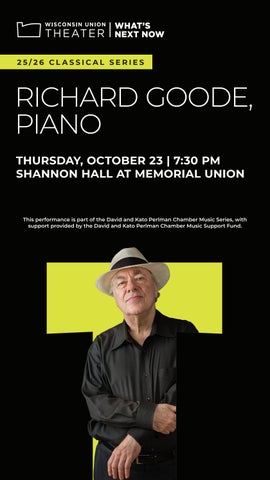
25/26 CLASSICAL SERIES
RICHARD GOODE, PIANO THURSDAY, OCTOBER 23 | 7:30 PM SHANNON HALL AT MEMORIAL UNION
This performance is part of the David and Kato Perlman Chamber Music Series, with support provided by the David and Kato Perlman Chamber Music Support Fund.
1
Please silence all devices while viewing this program. We also invite you to reduce your screen brightness if you are able. We appreciate your help in maintaining a quiet hall that is conducive to music-making and listening. In an effort to increase our sustainability efforts, the Wisconsin Union Theater is now utilizing digital programs. Printed PDFs of the program and large print copies are available upon request. Please ask an usher.
2
TABLE OF CONTENTS Click below to jump to a section: Wisconsin Union Directorate Performing Arts Committee. . . . . . . . . . . . . . . . . . . . . . 4 Program . . . . . . . . . . . . . . . . . . . . . . . . . . . . . . . . . . . . . . . . . . 5 Program Notes . . . . . . . . . . . . . . . . . . . . . . . . . . . . . . . . . . . 6 Artist Bio. . . . . . . . . . . . . . . . . . . . . . . . . . . . . . . . . . . . . . . . . 13 Donors. . . . . . . . . . . . . . . . . . . . . . . . . . . . . . . . . . . . . . . . . . . 15 Coming Up at the Theater. . . . . . . . . . . . . . . . . . . . . . . 18 Our Team. . . . . . . . . . . . . . . . . . . . . . . . . . . . . . . . . . . . . . . 20
3
PROGRAMMED BY THE PERFORMING ARTS COMMITTEE The Wisconsin Union Directorate Performing Arts Committee (WUD PAC) is a student-run organization that brings world-class artists to campus by programming the Wisconsin Union Theater’s annual season of events. WUD PAC focuses on pushing range and diversity in its programming while connecting to students and the broader Madison community. In addition to planning the Wisconsin Union Theater’s season, WUD PAC programs and produces studentcentered events that take place in the Wisconsin Union Theater’s Play Circle. WUD PAC makes it a priority to connect students to performing artists through educational engagement activities and more. WUD PAC is part of the Wisconsin Union Directorate’s Leadership and Engagement Program and is central to the Wisconsin Union’s purpose of developing the leaders of tomorrow and creating community in a place where all belong.
4
PROGRAM Ludwig van Beethoven (16 December 1770– 26 March 1827)
Sonata No. 30 in E Major, Op. 109 Vivace ma non troppo—Adagio espressivo Prestissimo Gesangvoll, mit innigster Empfindung: Andante molto cantabile ed espressivo
Beethoven
Sonata No. 31 in A-flat Major, Op. 110 Moderato cantabile molto espressivo Allegro molto Adagio ma non troppo—Allegro ma non troppo
I NTE R MISSION Beethoven
Selections from Bagatelles, Op. 119 VI. Andante—Allegretto VII. Allegro, ma non troppo VIII. Moderato cantabile IX. Vivace moderato X. Allegramente XI. Andante, ma non troppoo
Beethoven
Sonata No. 32 in C Minor, Op. 111 Maestoso—Allegro con brio ed appassionato Arietta: Adagio molto semplice e cantabile
5
PROGRAM NOTES Today, the works of Beethoven’s late style stand at the pinnacle of Western music, comparable to Michelangelo’s Pietà and The Creation of Adam; to Shakespeare’s Hamlet and Romeo and Juliet; to Tolstoy’s War and Peace and Anna Karenina. Despite spanning the last 15 years of his life, the late style has gained such a monumental reputation based mostly upon just a few works: his two large public works from the time, Symphony No. 9 and Missa solemnis, and his final compositions for string quartet, including the Grosse Fuge (which was intended to conclude String Quartet No. 13 until his publisher encouraged him to excise it for something more commercial). These works all share grand, universalist ambition. Symphony No. 9 famously heralds a universal fellowship of humanity with its “Ode to Joy” chorus; the Missa solemnis aspires to personal spiritual transcendence; and the Grosse Fuge turns the sophisticated contrapuntal techniques of the fugue into a symbol of the integration of individuality into a greater whole. While we may continue to marvel at these works and appreciate them as Beethoven’s greatest musical achievements, they are not necessarily representative of the totality of the late style. Unfortunately, nothing really is. Even for scholars today, the late style remains the most difficult to characterize because the works are complex and fundamentally experimental, and as a result, each is also highly individual. Some traits are common: Moving away from the supremacy of sonata form, Beethoven focused increasingly on fugues and sets of variations. Despite his lofty philosophical ambitions, Beethoven also showed a greater interest in lyricism— specifically with vocal styles like folk song, aria, recitative, and chorale—lending many of the late works an air of simplicity and sincerity. In the four works Richard Goode performs on this evening’s recital—Beethoven’s final three piano sonatas and a selection of bagatelles from Op. 119, all composed between 1820–1822—the softer side of Beethoven’s late style comes to the fore, as the composer tried to balance personal sincerity with experimental, even spiritual, profundity.
6
SONATAS SUBVERTED: OPP. 109 AND 110 Experimental is a covertly deceptive word for a style because it defines the music through negation: It tells us what the works are not (that is, they are not normal) and little about what they are. It is an appropriate term for Beethoven’s late style nonetheless, because often, Beethoven seems to narrate his own process of experimentation with starts and stops, and even that surprise baritone soloist singing “O friends, not these tones!” (essentially dismissing the first three movements of the Ninth Symphony before launching into “Ode to Joy”). But for works like the sonatas on this evening’s program, it is necessary to understand the conventions of the sonata genre that Beethoven defied in order to write something more personally authentic. Standardized in the Classical era, a piano sonata usually consists of three movements: fast, slow, and fast. The first movement is the most substantial in terms of “ideas” or musical content, and also, more prosaically, in length. Considered discursive or rhetorical, the first movement follows a strict sonata-allegro form: an exposition with two contrasting themes in opposing keys; a development where those themes are modified, expanded, and manipulated; and a recapitulation that resolves the drama by transposing the contrasting second theme to the home key of the first. After this fast, intellectual movement, the second movement is slow—often a simplified instrumental version of an aria (usually in a modified sonata allegro form that omits the development). The final movement may be a dance movement (like a minuet and trio) or another sonata-allegro movement, but it tends to be lighter in spirit and mood than the first movement. Both Op. 109 and Op. 110 defy this format in similar ways. First, both have extremely asymmetrical proportions, wherein the first two movements combined are shorter than the final movement, shifting the priority away from the first movement to the last. Both also start with ostensibly slow movements, whose lyricism suggests sentimentality rather than rhetorical intellectualism, and both have energetic dance movements in the second position. In contrast to these humble and restrained beginnings, the third movements of both sonatas are each remarkable, but in very different ways.
7
SONATA NO. 30 IN E MAJOR, OP. 109 Op. 109 is hardly intimidating, as its tuneful and mostly delicate ethos wins out. The first movement contrasts a very short, fast, first theme with a compound melody (one that is dispersed across a wide range and sounds like multiple lines happening at once) with a longer, slower second theme in the style of an improvisatory fantasia. The return of the opening transposed to the dominant marks the start of the development section, but it is only the improvisatory second theme that really explores any new ideas, and even then, only briefly. When the first theme returns for a third time, it signals the recapitulation. Back in the home key, the theme is transposed an octave higher, suggesting a narrative of transcendence. In the brief Prestissimo, which is in the parallel minor, a turbulent and driving opening moves into a dark second theme, and ultimately provides the stronger emotions characteristic of Romanticism at large, which were largely absent from the first movement. After these two compact movements, the third movement is undeniably monumental, but rather than awe and gravitas, this theme and variations connotes deeply personal sincerity. The theme is marked “songlike with inner feeling,” recalling Beethoven’s inward-looking works of his middle period. In six variations, Beethoven applies techniques from the previous movements, as though he now has found a more satisfactory expression of form and content than earlier. In the second variation, Beethoven creates another compound melody by distributing the theme across a wide range in the two hands. Variation 5 makes the theme the subject of a tuneful fugue, reminiscent of the contrapuntal second movement. The final variation sits in the highest register, suggesting another transcendent ascent.
8
SONATA NO. 31 IN A-FLAT MAJOR, OP. 110 Although it does follow a standard sonata-allegro form, the first movement of Op. 110 remains radically simple. Starting, it would seem, in the middle of things, the opening is a brief cadenza—something that would typically come before the final restatement of the main melody in an opera aria, and not at the beginning. The cadenza frames the highly lyrical, homophonic theme that follows as a reminiscence of a song, which then proceeds to an improvisatory fantasia of sprawling runs for the second theme. The scherzo second movement is also very tuneful. It follows a typical ABA pattern of most dance movements: The square and conjunct melody of the A section evokes a folk dance, and contrasts the light and leaping B section. The third movement represents one Beethoven’s great achievements in the late style. The opening is a slow Adagio, followed by a section marked “recitativo” (“recitative,” or the speech-like singing used in opera). Mimicking speech, the recitativo has meditative and searching moments of repeating a single pitch, which seem innocuous but prove significant later. After this extended slow and metrically free opening, Beethoven shifts to 6/8 for a complete fugue. But he’s not done yet: The opening meditative material comes back and culminates by repeating one chord 10 times in a dramatic crescendo—as though time has stopped—before leading into a second fugue, this one built on an inversion of the subject of the first fugue. Beethoven develops the motives of the second fugue organically to create a flourishing finale to the whole movement. Despite its radical form, as well as its otherworldly repeating chords between the two fugues, Beethoven’s focus on vocal styles, recitative and arioso, further lends a degree of interiority to the movement.
9
SMALL EXPERIMENTS: BAGATELLES NOS. 6–11, OP. 119 In Beethoven’s time, the term “bagatelle” implied a musical trifle. They had no prescribed form, and were merely smallscale, lightweight works. Even after Beethoven lent the genre some degree of importance (he published three sets: Opp. 33, 119, and 126) they remained musical trifles—but now when composers write bagatelles, they trifle with intention. And so did Beethoven, for what it’s worth. Whereas he turned to vocal styles to create moments of simplicity and purity in the Opp. 109 and 110 sonatas, Beethoven used the bagatelle genre to make radical simplicity the ambition of Op. 119. Across the set of 11, he both meets and foils the genre’s lightweight expectations. The first five of the set—not to be played on this evening’s program—are simple and tuneful in a refined Classical spirit. Nos. 6–11, however, are something else: Although each is short and necessarily sparse, they are notably darker than the opening five. No. 6 starts with a free, cadenza-like passage before breaking into a rhythmic Allegretto that moves through a few styles before ending quietly. No. 7 contrasts a tumultuous opening, featuring atmospheric trills, with a fun, contrapuntal middle section. No. 8 is tuneful and calm, while No. 9 is fast and emotional. No. 10, the shortest of the bunch, clamors frenetically and uncontrollably until it is snuffed out right at the end. Finally, No. 11 has a purity and simplicity that grows in drama, ending transcendently in the highest tessitura. While the bagatelles of Op. 119 were not composed as a set for performance (unlike the six of Op. 126), the work suggests a move from refined Classicism to emotional Romanticism. In this light, the final bagatelle is less of a finale than a deus ex machina: Pure dénouement, it offers closure, but does little to resolve any previous tumult.
10
SONATA ABANDONED: SONATA NO. 32 IN C MINOR, OP. 111 If Opp. 109 and 110 subvert genre conventions, the twomovement Op. 111 abandons them entirely. Again notably asymmetrical in proportion, the short first movement begins slowly and meditatively before a compelling three-note motive in minor takes hold and quickly begins to develop. A return of the opening marks the start of the brief second theme, which continues through a short development and recapitulation, modulating through major and minor keys to add color and uplift in a movement otherwise riddled with angst. The second and final movement is another monumental theme and variations, but while the concluding movement of Op. 109 focused on sincerity through lyricism, in Op. 111, the six variations have a cumulative narrative effect of rising to climax and relaxing to conclusion. The rhythmic unity of the harmony and melody of the theme (marked “Arietta,” another reference to vocal music) simplifies the tune to its essentials. The first variation maintains this simplicity but displaces the harmony to the weak beats. In the second variation, the melody also moves to the weak beats, becoming fully syncopated. The third variation demonstrates one of the confounding mysteries of Beethoven’s late works: The syncopation continues, paired with cascading melodies and off-beat harmonic responses, which inevitably and inexplicably start to sound like ragtime or early swing music. While Beethoven has arrived at this style organically through ongoing rhythmic displacement, the result sounds literally like something from a different era, exemplifying why Beethoven has so often been seen as prophetic. Variation 4 becomes atmospheric and diffuse, with low tremolos against a fragmented version of the theme in the high register. Variation 5 is the beginning of the end, wherein the theme takes a heroic, soaring vocal role against rumbling accompaniment, before spinning into a free interlude. A coda, Variation 6 provides another transcendent dénouement in the highest register of the piano before a final restatement of the original arietta to end the work. Although some have speculated that he intended to write a third movement, Beethoven concludes the work with this monumental and indeed mystifying theme and variations,
11
leaving behind convention in favor of something more personal and, at the same time, so much more profound. —Eric Lubarsky
12
ARTIST BIO Richard Goode has been hailed for music-making of tremendous emotional power, depth, and expressiveness, and has been acknowledged worldwide as one of today’s leading interpreters of Classical and Romantic music. In regular performances with the major orchestras, recitals in the world’s music capitals, and through his extensive and acclaimed Nonesuch recordings, he has won a large and devoted following. One of today’s most revered recitalists, Goode is a favorite of audiences in Boston, San Francisco, Philadelphia, New York, Houston, Portland, and Chicago, and colleges and universities around the country. In Europe, appearances at Wigmore Hall, the Edinburgh Festival, Berlin, and throughout Germany, Italy, Switzerland, and the UK are always highlights. His master classes, in person or online, continue to be hailed as truly memorable events. The current season brings return visits to Wigmore Hall, Chipping Campden Music Festival, Philadelphia Chamber Music Society, Shriver Hall, the 92nd Street Y, Gilmore Piano Festival (with soprano Sarah Shafer), and Saint Paul Chamber Orchestra as its 2025–26 artistic partner, among others. An exclusive Nonesuch recording artist, Goode has made more than two dozen recordings that range from solo and chamber works to lieder and concertos. His recording of the five Beethoven concertos with the Budapest Festival Orchestra and Iván Fischer was released in 2009 to exceptional critical acclaim, described as “a landmark recording” by the Financial Times and nominated for a Grammy award. His 10-CD set of the complete Beethoven sonata cycle—the first-ever by an American-born pianist—was nominated for a Grammy and has been ranked among the most distinguished recordings of this repertoire. To mark these historic recordings’ 25th anniversary in 2018–19, Nonesuch Records re-released them to great acclaim. Other recording highlights include a series of Bach partitas, a duo recording with Dawn Upshaw, and Mozart piano concertos with the Orpheus Chamber Orchestra.
13
A native of New York, Goode studied with Elvira Szigeti and Claude Frank, with Nadia Reisenberg at the Mannes College of Music, and with Rudolf Serkin at the Curtis Institute. His numerous prizes over the years include the Young Concert Artists Award, first prize in the Clara Haskil Competition, the Avery Fisher Prize, and a Grammy award for his recording of the Brahms sonatas with clarinetist Richard Stoltzman. His first public performances of the complete Beethoven sonatas at Kansas City’s Folly Theater and New York’s 92Y in 1987–88 earned him a Grammy nomination and brought him to international attention, hailed by The New York Times as “among the season’s most important and memorable events.” The cycle was later performed with great success at London’s Queen Elizabeth Hall in 1994 and 1995. Goode served, together with Mitsuko Uchida, as co– artistic director of the Marlboro Music School and Festival in Marlboro, Vermont—”the classical world’s most coveted retreat" (The New Yorker)—from 1999 to 2013. He first participated in the festival at the age of 14, and has made a notable contribution to this unique community over the 28 summers he spent there. In fall 2021, Goode joined the Peabody Institute as Distinguished Artist Faculty. He is married to the violinist Marcia Weinfeld, and, when the Goodes are not on tour, they live with their collection of some 5,000 volumes in New York City. Please visit Richard Goode online at RichardGoodePiano. com for additional information about touring, recordings, and special projects.
14
THANK YOU TO OUR GENEROUS DONORS Anonymous
Margaret Douma & Wallace Douma
Margaret Alferi & Eugene Kim
James Doyle Jr & Jessica Doyle
Robin Axel & Jacob Axel Mohamed Bacchus
Rae Erdahl
Martin Baggott & Jennine Baggott
Deborah Fairchild Hildy Feen
Robert Bell & Jeanne Bell
Marlene Fiske
Bennett Berson & Rebecca Holmes
Jeffrey Fritsche & Carol Fritsche
James Bigwood & Jay Cha
Deirdre Garton
Diane Bless
Neil Geminder & Joan Geminder
Cassandra Book Michael Brody & Elizabeth Ester
Jean Gessl & Douglas Gessl Michelle Gregoire & Tim Gregoire
Daniel Burrell Jr & Jenice Burrell
Mark Guthier & Amy Guthier
James Carlson
Kristine Hallisy
Peggy Chane
Justin Hein & Paige Hein
Janet Cohen
Brent Helt
Charles Cohen & Christine Schindler
John Hirsh & Lynnette Tenorio
Mary Crosby
Seth Hoff
George Cutlip
Matthew Huston
Heather Daniels & Alan Hiebert
Carol Hyland
Kelly De Haven & David Cooper
Arnold Jacobson Kelly Kahl & Kimberly Kahl
André De Shields
Elisabeth Kasdorf
Mark Dettmann & Cathleen Dettmann
Kate Kingery Daniel Koehn & Mark Koehn
Jaimie Dockray & Brian Dockray
Diane Kostecke & Nancy Ciezki
Elizabeth Douma
Kathleen Kotnour
15
Iris Kurman & Seth Dailey
Lynn Stathas
Sandra Lee & Jun Lee
Jonathan Stenger
Christopher Louderback
Jason Stephens & Ana Stephens
Douglas Mackaman & Margaret O'Hara
Andrew Stevens & Erika Stevens
Edward Manuel & Marian Holton-Manuel
Millard Susman & Barbara Susman
Shibani Munshi
Kimberly Svetin & Todd Svetin
Eric Nathan
Thompson Investment Management
Glenda Noel-Ney & William Ney
Elizabeth Van Ness
Mitchell Nussbaum & Eugenia Ogden
Daniel Van Note
Ann Pehle
Rachel Waner
David and Kato Perlman
Glenn Watts & Jane Watts
Lisa Pfaff
Shane Wealti
Nicholas Pjevach
Kathleen Williams
M Thomas Record Jr & Voula Kodoyianni
Janell Wise
Sharon Rouse
James Wockenfuss & Lena Wockenfuss
Ralph Russo & Lauren Cnare
Debbie Wong
Peter Ryan Joshua Rybaski Morgan Sachs J Gail Meyst Sahney & Vinod Sahney Steven Schaffer & Beth Schaffer Carol Schroeder Daniel Schultz & Patricia Schultz Sarah Schutt & Donald Schutt Jr Margaret Shields Elizabeth Snodgrass Polly Snodgrass Monica St Angelo & Mark Levandoski Mark Stanley & Krista Stanley
Donors as of July 31, 2025
16
COMING UP IN THEATER PARTYOF2
Thursday, October 30 8 PM Play Circle at Memorial Union Special Event
THE WOOD BROTHERS
Friday, November 14 8 PM Shannon Hall at Memorial Union Special Event
SAMARA JOY
Saturday, November 15 7:30 PM Shannon Hall at Memorial Union Jazz Event
17
BEFORE THE SHOW, ENJOY ALL THE UNION HAS TO OFFER! COCKTAIL LOUNGE BAR SERVICE IN SHANNON SUNSET LOUNGE BEFORE THE PERFORMANCE AND AT INTERMISSION DINNER AND DRINKS AT THE HISTORIC RATHSKELLER PIZZA AND PASTA FROM STRADA ICE CREAM FROM THE DAILY SCOOP AND MORE 18
WISCONSIN UNION THEATER Elizabeth Snodgrass, Director Kate Schwartz, Artist Services Manager George Hommowun, Assistant Director of Theater Event Operations Zane Enloe, Production Manager Jeff Macheel, Technical Director Heather Macheel, Technical Director Sean Danner, Assistant Director of Ticketing and Patron Services Ted Harks, Arts Ticketing Website Systems Administrator Eric Henkes, Lead House Manager Yareli Gutierrez, Rentals Assistant Kelsey Fleckenstein, Special Projects Assistant Paige Verbsky, Bolz Center for Arts Administration Intern WISCONSIN UNION DIRECTORATE PERFORMING ARTS COMMITTEE Jordan Waters, Director Thomas Wieland, Programming Associate Director Lucy Kenavan, Programming Associate Director Sabrina Ortiz, Production Associate Director Cosette Wildermuth, External Relations Associate Director Kalia Gordon, Marketing Associate Director
Wisconsin Union Theater
WisconsinUnionTheater
800 Langdon St. Madison, WI 53706
@wiuniontheater @wisconsinuniontheater
608-262-2202 (Main Office) 608-265-ARTS (Box Office) uniontheater.wisc.edu
19