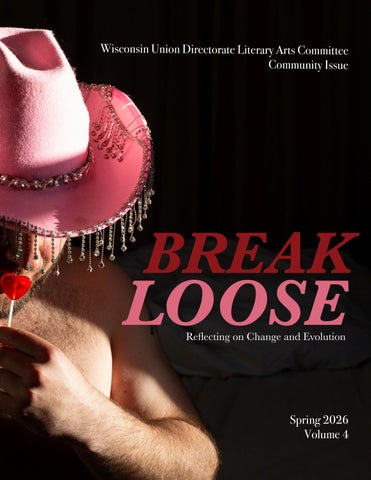
Wisconsin Union Directorate Literary Arts Committee Community Issue
BREAK
LOOSE Reflecting on Change and Evolution
Spring 2026 Volume 4
Letter from the Director Dear Reader, Welcome to the Spring 2026 Community Issue! The WUD Literary Arts Committee is excited to bring you written and visual work created by students from across the UW-Madison campus. Volume 4 revolves around the theme Break Loose, and we encouraged submissions to “Get down, get funky, and celebrate the many changes that uplift UW students and members of the greater Madison community.” However, with the theme Break Loose, we were excited to receive submissions that broke loose from our definition, as well. In the end, break loose means to escape restraint, become something unexpected, to search for meaning and find it, to settle into a space of knowing that you didn’t anticipate. As you work through this publication, I encourage you to consider the times in your life that you may have broken loose. Was it an impressive triumph or a matter of fact? Did you emerge victorious or meekly return to the situation from which you escaped? There is no right or wrong and no good or bad answer. Regardless of your responses to these questions, I can assure you that your feelings are known by many, and through this collection of creative work, I hope you find a sense of community amongst your classmates near and far. Everyone who submitted their work for consideration for the Community Issue, thank you for sharing your artistry and points of view with our campus. This publication wouldn’t exist without your bravery and care. Editors-In-Chief of The Dish, EMMIE, and Illumination Journal, thank you for designing and creating this publication. James, Ian, and Lilah, I’ve learned a lot from each of you, and I’m very excited to see what great things your respective publications continue to create this year. Members of the Literary Arts Committee, getting to know you over the past few months has been wonderful. From first years to graduate students, you bring a diversity of thought, experience, and interests to our group that make the work we do all the more impactful. I am eager to continue working with you to explore all the ways that the literary arts can enrich our campus and our lives. Friends at other campus publications, thank you for the inspiration, collaboration, and continued commitment to promoting journalism, literature, and the arts. We are proud to be a part of this community. Finally, thank you to the Wisconsin Union Directorate and our Literary Arts Committee Advisor, Tony. WUD has been an opportunity like no other in my life, and I couldn’t navigate it without your expert guidance. It has been a great privilege to be a part of this tradition. With enthusiasm and appreciation, Sophie Reader
2
Contents New Hits �����������������������������������������1 Letter from the Director ������������������������������2 Go Ahead ����������������������������������������4 WINNER ����������������������������������������5 American City �������������������������������������7 Impure ������������������������������������������8 FORGET-ME-NOTS AT YOUR CONVENIENCE �����������9 The Priest ���������������������������������������14 We’re All Bones Here �������������������������������15 Crowd ������������������������������������������16 I hate humanity, but still, I love humans ������������������17 The Conflicting Identities of South Asian Women �����������19 In my Twenties ������������������������������������24 Seeking �����������������������������������������25 The Ways I Love Corners ����������������������������27 Maybe (it’s in the heart) ������������������������������29 An Ode to the House Show ���������������������������32 Transmutation ������������������������������������33 Whatever you can ����������������������������������34 The Hanging Father ��������������������������������38 Creating the consciousness of others ��������������������39 White Noise �������������������������������������44 Mangoes and Poetry ��������������������������������45 CONFESSIONS OF AN ART ADDICT ������������������46 Mistakes Are History �������������������������������49 Literary Arts Committee �����������������������������50 3
WINNER Ayana Lupoli-Rojas
I am afraid of my laptop. It sounds crazy, doesn’t it? I should fear the dark, or heights, or public speaking. But no, my worst fears exist in my laptop—a barrage of light, emails, notifications, distraction after distraction after distraction keeping me from a destination I must reach. And why do I care? Because I am a winner. Because I journey towards a destination. A dream, you might call it. I want to become a singer, a singer whose name everyone knows, a singer who sings her heart out to audiences on a bright and beautiful stage, one that doesn’t need to worry about anything anymore because she has it all. I want to go to college to be successful and perfect, and the person who makes people think, how did she do it? The one who balanced a singing career with valedictorian grades, the one who says she had to stay up late to do it. That dream is why I have become afraid of my computer and everything it represents: distraction. That dream is why I must stop myself from getting behind, from losing a single day to the present. That dream is why I use a planner, why I control what I eat, why I tell myself positive affirmations in the mirror, why I set timers to get things done that I can never follow because I want perfection and perfection takes time, why I write “DON’T HIT SNOOZE!” on a sticky note and put it on my alarm clock. Why I sat myself down and convinced myself to not go out, to not go to the pool, to not talk with my family after dinner, because go and work. Work for your dream. Drop everything and work until you drop from working and start worrying instead. And when the worrying happens is when I unravel-where I stop working and start thinking, and stopping means I’m weak. And when distractions overcome ambition, when I open my laptop and pause and start doing something productive it means I don’t want it badly enough and I’m not dedicated enough and I’m not enough this and not enough that until I’m not enough at all. I stare at the ceiling, so afraid of opening my laptop and so afraid of not reaching what I want to reach that I cannot even see the ceiling anymore. I see the laptop in my head, right behind me, but I do not see the desk it is on. I stopped seeing the blue of my walls long ago. I stopped feeling excited about movie 5
night or even watching Star Wars because I don’t do movie night anymore; why waste two hours that I could spend trying to be productive? Birds sing, but I can’t hear them through my headphones because the birds will remind me of the outside, outside when the sun shines, where the “now” is. The birds will distract me from my destination. I live for my dream, and I am always in that dream because forget the “now”, forget the little things, forget everything, and work hard because if you do, then you’ll win, and I’ll look at everyone else and know I’m the one who won. They can be happy with their nice families and their quiet evenings and their peace and I will stand instead and face a storm because on the other side is winning. They say winners must suffer to win, so of course I am not happy. They say the ambitious will always want more, so of course I will never be enough for myself. The years will pass and I will win and have won and as I grow old in my riches and they grow old in their joy I got my dream and they settled for less. But what have I won? I won for a dream. I won for a stage that never existed, I won for spectators, and now when I look at them their faces are blank, their expressions painted. I won to hide, to hide in fear of losing what I have, and I can’t be seen in fear, so I keep hiding. My family can’t see me this way, so I hide from them too, and I come out on the stage wearing a mask made of glass, and I sing my heart out until I have no heart anymore and now they look at me and they know who I am. I want nothing more than to play badminton outside again. I want nothing more than blue walls again, and stuffed animals on my bed, and to hear my sisters in my living room to be with my sisters in my living room. To watch Star Wars for two hours. To live, and then I realize that in my effort to live, I stopped living. The spectators become all the people who I said had lost, but they won, and now they are chanting, you’ve made it to the end, you’ve made it to the end, and now it is my end— My eyes snap open to the morning light. My heart stops racing. It was a dream. I am still young. It was just a nightmare. It is not over. I look to my side. There sits my laptop, the lid shut closed. Perhaps I am still afraid to open it. But there are worse things to fear. It is the journey that matters, in the end... I hear my sisters, already in the hallway, getting ready for school. They are here, in the present. In the now. But now is not forever. No more stage. No more of a fantasy. Since when did we stop living for what we have? Since when did we start living for something we didn’t have? So I open my mind. I open my eyes. And I see the most beautiful shade of blue on my walls. 6
American City Angeline Morgado
I feel connected to this city, to its unwavering hope amid the chaos. It reminds me of myself, as it is unable to define itself amid its chaotic narrative. As it becomes unable to defend itself from those who proclaim to be its leaders amid the exuberance of power. As its independence is not recognized, despite how much it tries, despite how much its people try. As the threat of independence is unthinkable amid the political chaos. As its colors brighten the day despite the gray morals of its leaders, as its beautiful chants try to muffle the sound of the marching guards. As it changes so fast, it can barely keep up, as it tries so hard and fails not to feel very different from what it once was, as the seasons change and the people who care leave. As it tries to help the country, its hands are tied, as its pains do not make the news as much as its mistakes do. As it gets destroyed, invaded, blamed, and closed up, D.C.’s internal chaos reminds me of my own.
7
Impure Rhushil Vasavada In the most populous nation in the world, there lies a population who are invisible and untouchable. Their sorrows and sufferings are cast in the dark, compounded further and further like rocks aging into fossils. The pain has not been for years, nor centuries, but rather millennia; emerging from a society of superiority and inferiority, in the name of false religion. He walks around in the endless fields of shacks and huts and trash, scavenging, just like his siblings, parents, grandparents and ancestors. They don’t have any hope left, when others around them don’t have hope either; they are shunned, branded as unlucky and inauspicious. The rich relax in their high-rises, selfish, offering heaps of sweets and riches to idols of god, turning a blind-eye to virtues of compassion and to those who really need it. The vast diaspora, too, lives in the comforts their counterparts can’t dream of— yet even they cannot stop judgement when it’s subtler than looks and names. It continues because it has been this way for so, so long, and change carries the burden of altering our identities. Waste has always been associated with the notion of caste purity, and in a country so large, it will never stop being produced. And so, we dream of a time when someone’s caste is not determined by their birth, but rather how they lead their life. We envision a time where caste is no longer synonymous with money or lack of it, but instead what one does with their wealth. When our focus is directed inwards to what pure really means, only then can change occur, for those who hail from the most populous nation.
8
FORGET-ME-NOTS AT YOUR CONVENIENCE ACT 1
Q Cortez 12/20/02 11:05 pm Marie’s phone number on a post-it note lies on the rear-view mirror of my car. She hasn’t answered any calls today. The spongy leather cushions cloud with spores whenever I rest. The employer calls it “The Lifeboat.” On a pitiful stop off the minor Minnesota road lies a grungy concrete Exxon gas station and buzzing convenience store. A place for drying tanks and desperate people to drink and rest their weary bodies in the middle of desolation. Of course, it needs someone to work at the oasis, and for this invaluable life-giving service, I am paid $7.25 an hour. So little is sold, product shipments are nonexistent; the newspapers here have only just learned of the Beltway snipers. There’s no profitable reason for it to remain open. The gas rose to over a dollar and thirty cents a gallon, so it eats too much pay to drive back to the city every day. Technically, I can sustain myself fine enough here. Two months ago, my parents temporarily relocated south to nurse my grandparents. Three days ago, I visited the storage unit they left behind and found it contained all of my childhood room’s property organized around my childhood desk and fuzzy ottoman. The boxes unearthed contents of old test papers with red ink, and shabby pencil drawings of Sailor Neptune, sloppy 9
adolescent letters, and the dusty scent of weevils and moth hairs—including the absence of a house key. The clinical childhood cubicle was swept through for what must’ve been an hour with the desk facing the stark white corrugated metal panel. A slight pride surges at their absence. My parents always thought I was self-sufficient enough to be a bragging right since age fourteen, yet, like proud topiary, the newly budding branches are threatened with sheared off limbs when crossing the aesthetic owner-drawn borders. My Motorola chimes with their calls, crackling over with white noise and lies, but I will be caught dead before I ask for their aid. They didn’t care when I tried before.
12/21/02 2:11 am The roof is no issue to get on. If I get my boot settled on the dumpster behind the store, and the rusty ladder can be leaped to with the right grip. The snowflakes scatter and slip like dry sands. Where my hand expected to slip on early ice, my knobby wrists clacked against the metal and bitterly collected needles completely through my palm. A red scrape waned and waxed on the knuckle of my left thumb as the bones tested its fragility, but the dry frost did not allow it the privilege to bleed. No pain, no sting, and no single weeping drop draining down my hand, only stillness under the surface, unable to be scooped up like thick clay; it may even be pleasant as the icy northern wind gauzes it under my reapplied glove. The flat roof is symmetrical with two locked electrical boxes, heavy wire, and two tight silver goose-necked vents. If I needed to, I could slither inside one and lurch back inside the store. This body was not built for survival. If I were trapped inside, I’d only be noticed when the spring warms out the preserved animal and the melting stench unnerves the next worker. I’d be 10
known as a tale parents bestow to children like a frozen fox exhumed above a lake. The sky is too polluted to see any stars. The horrid fluorescent orange and Scheele’s green 7-Eleven sign doesn’t help at all. As sailors would use the stars to travel to places unknown, the matte, smoky purple sky absent of them guides to places where there is civilization. The blank horizon too cloaks the city out of eye’s reach, shadowless solitude of flat artificial light like a Hopper painting. The comforting lone corner diner of Nighthawks, where Marie and I could catch cups of steaming late-night coffee in thick woolly gloves. Marie could’ve been lounging against the goose-necked vent. Her hand could’ve been carefully slipped into my coat—her arms serving as my scarf. We could travel the empty Hopper subways, windowless office buildings glaring with naked sun, and nowhere lightposts where I am the only person in her eyes.
12/23/02 1:14 am Another trip to the grocery provides a can of lima beans, boxes of instant brown rice, and La Preferida lentils. Only four customers have entered in the past week. My career began at sixteen at the convenience store in the core of the city, working swing shift on the weekends. Even with the other girl on the shift, it was barely manageable. Perhaps I was just too young, but the gas money was too important. My internship must have sent a letter warm with tears on how the selection was far too treacherous for them to give me a résumé builder, a wage, housing, or steady meals. This time, I only need the money to live. The camera’s bulbous black squid eye looks from the farthest corner in the direction of the register. They’ll see me flipping through my textbooks and babbling to myself, but nothing will come of it. Always mopping, sanitizing the counters, fixing the coffee machine when it 11
breaks again, checking for absent product boxes, and preparing for a similarly ghostly void of 4 am people. After using the coffee machine, I found two dead curled silverfish underneath the heated filter paper; history has proven I’ve put worse things in my body. The manager declared over the phone there is a day shift employee with the first name “Natalie,” but I’ve yet to see a car besides my own park here long term. The energy to look at anything has escaped me. My intro to Malay textbook has hardly even been opened. My grandparents might pass before I am confident enough to speak their words in front of them. My mother’s Indonesian cords should get as stuck as mine but I have yet to hear her sing about the troubles of learning English. There is only so long I can nervously clamour at the telephone before they call me a useless girl and request my mother to translate. Good work should get done here despite everything. It has less distractions than a Swiss patent office. As a baby girl, I wanted to be a veterinarian proudly wielding a clean white coat and “Dr.” heralding my name. The “Physical Chemistry” box was checked in the SAT when it came with actual thought. However, the boom of splitting cassettes convinced my parents to switch to computer engineering, eager to harvest the virgin, bewildering crop of the new millennium. Classes get by well enough with Bs and the rare A. If I could sleep through the nights without terrors jerking up my body and eyes creaking open by instinct, they might improve.
12/25/02 4:12 am In fifth grade, she was taken away by whirlwind and knew as much about her disa pearance as I did. The last day we played together was absolutely uneventful without cel bration, condolenc12
es, or tiny girl sobs. She was ever-present, not by intention, but just by existence. In a life of smooth, dim, dreamless nights, sometimes I awoke with her in my mind like the wind creaking a curtain to the side, carrying the invisible scents of vanilla, milky rice water, and lotion sticky on the nape of her neck. We met as small children. Our weary teacher used to confuse our names together, so when it came to arrange children in pairs for activities, they lumped us together for convenience. More convenient than a cumbersome cleaved “Sastro-wah-doi-yo,” chopped to bitesized pieces more forgiving on the American tongue, often still incorrectly as it’s winced and avoided altogether—sounds painful like swishing a mouthful of toothpicks. No other child had to correct teachers in advance when a discomforting silence grew over attendance sheets. The child was simply content with writing Sastr wardoyo as a piece of legal literature and not a name to ever expect to be called before stumbling back to the safer “Mae” (It must’ve been my mother’s grace to give a short name as some linguistic relief). With names like sisters, I imagine a new incestuous nausea was birthed wet from my mind when I desired to kiss her. I want to be buried inside you, and when I lay sp raled into a centipede and dissolve into the loamy soil, the botanist will wonder why the pillowy-white lilies that sprout smell so sweet. Sleeplessly for the nth time, I’ve wished to be a man so I may date her without preying upon her.
13
The Priest Rhushil Vasavada
The priest has a sacred thread around his neck and wears a religious mark on his forehead. His voice is peaceful and smooth as he recites various mantras and holy verses. A mouse dashes inside the room. He loses his calm, swearing, violently knocking over the altar as he tries to get rid of it.
14
We’re All Bones Here Meghan Kemper
Crowd Evan Randle
I had been part of crowds before. They ranged from momentous, like the mass of screaming faced at a concert, to the mundane, like the idle perusers and last-minute shoppers at the mall. But I had never lived in a crowd, been part of one every day, moved with it as part of one massive amoebic organism. I had traveled to the university from a small school, so small that one could drive past it and think it was some front for a laundering scheme. I was among eighty who graduated, received a cap and gown, and traveled to some other place where we would surely assimilate the same as we had. Or hadn’t. Isolation is astonishingly easy when everyone knows each other’s faces. When groups of friends become iron-locked gates, whispers and rumors their weapons against would-be intruders. Alienation is most effective when everyone knows who you are. Being in the crowd was different. Every day hundreds — if not thousands — of us walked back and forth on campus, called family or checked our texts, and struggled and strained to climb the hill if we couldn’t fit into the hotly contested buses. I barely knew any of them, and it was an event worth noting when someone I was familiar with happened to appear in the mass of my peers. One day, while headed toward just a single destination out of the hundreds those around me were traveling toward, I began to sing. I cannot place the song now, other than it being a favorite I had always felt embarrassment for adoring. My voice strained and cracked, a tragic lack of training exposing itself bare for all to hear. Yet it soon found itself in harmony with one voice. Then another. A third soon followed. Most of the others in the crowd continued onward to their respective destinations. Some smiled briefly, others remained unaware thanks to the pods in their ears. None judged the voices — perhaps because they did not know the identities of the singers and had no need to. I craned my head, awkwardness fading as I continued to freely belt out my song. I could not identify my fellow singers any more than I could replicate their voices. They were faceless, featureless, sunken deep within the sea of humans. That was fine. Almost comforting, even. I continued to sing alongside them, basking in the brief ephemeral moment before we headed in different directions — perhaps never to hear one another again. We were drawn together in that one beautiful experience, nameless to the masses and faceless to each other, but identifiable through the peculiarities of our voices. 16
I hate humanity, but still, I love humans Samantha Kent
I’ve seen how easy it is for humanity to turn away, how practiced we are at not noticing. We build machines that listen better than we do. We declare empathy in headlines, then scroll past the wreckage. We turn each other into symbols; numbers, usernames, profiles, and forget there are hands beneath the screen. Still, I love humans; their individuality, their souls, how they smile at each other, complement each other, show up for each other. The man who leaves his porch light on for strangers driving through the storm. The teacher who remembers a detail you mentioned once, just to ask how it’s going. A neighbor shoveling the driveway next door, knowing someone’s morning will be a little easier. None of them make the headlines, but somehow it all feels like proof. We are chaotic, fragile, disagreeable beings. We break down in our bedrooms, wipe away our tears, then step back into the world to show up at a friend’s birthday party. We write the most beautiful poetry from days that nearly broke us, just for others to learn a lesson, to express ourselves.
17
We scream at our friends because we care, then spend our entire lifetime trying to make up for it. We say terrible things to the people we love, but they stay anyway, knowing that’s the moment we need them most. We struggle to get out of bed, make a coffee we don’t even want because it’s something to do, look in the mirror, hoping we’ve changed overnight. You can dig yourself down to bedrock, and still someone’s presence finds its way there. They bring you your favorite soup when you’re sick. Listen to your favorite music, because they want to know why you like things. Send a “thinking of you” text, they’ll never admit took hours to write. Maybe all salvation ever was, is one person deciding not to look away. Someone is always reaching out a hand. Someone is always saying, without saying it: We’re still here. We’re still trying. So yes, I hate humanity. But I love the individual so fiercely that I can’t help but hope; maybe that’s the most human thing of all.
18
The Conflicting Identities of South Asian Women in America: An Analysis of DIVA Magazine (1988-1994) Annika Khosla Unequal Sisters: A Revolutionary Reader in U.S. Women’s History claims to provide an unparalleled resource for understanding women’s history in the United States today.1 Critics such as Michele Mitchell applaud the editors for challenging boundaries and highlight its “cuttingedge” work. Yet while the latest edition covers race, ethnicity, and sexuality, nowhere to be found is the history of South Asian American women. The struggles of South Asian women are oftentimes overlooked by historians and journalists alike, as well as within the South Asian community itself. As members of the “model minority,” it is difficult for South Asians to speak out about their struggles and to accept that the private life of such an “exemplary group could be blemished”.2 South Asian American women have complex stories and vibrant identities that are complicated by the intersection of the traditions and cultures they bring with them from their home country and the unfamiliar social and cultural norms they must face in America. The contrasting standards imposed on South Asian women have profound effects on their lives, most importantly impacting their identity and sense of self, as well
as how they find and build community in America. By focusing on DIVA, a magazine focused on South Asian women, I will highlight the most consequential issues that impacted the lives and identities of South Asian American women in order to broaden the understanding of women in America. Defining South Asian America On February 19th, 1923, the Supreme Court of the United States unanimously ruled that Bhagat Singh Thind, an Indian Sikh man who identified himself as an Aryan, was ineligible for citizenship, i.e. that he was not a “white person.” The Court maintained that he was not qualified for naturalization, as by simply looking at him the average man knows perfectly well that he is not white.3 In 1922, Abdul Fara, a South Asian man, was attacked by a white World War I vet, Fitzhugh Davis, for sitting in the White section of a streetcar. When Fara later sued Davis, the white judge stated that Davis had been justified in striking Fara, as it was reasonable that Davis might have presumed him to be African American.4
_______________ 1 edited by Vicki L. Ruiz & Ellen Carol DuBois. Unequal Sisters: a Multicultural Reader in U.S. Women’s History. (Routledge, 2000). 2 Rinita Mazumdar, “Marital Rape: Some Ethical and Cultural Considerations” in A patchwork shawl: Chronicles of South Asian women in America. ed. Shamita Das DasGupta (Rutgers University Press, 1998), 140. 3 Sridevi Menon. “Disrupting Asian America: South Asian American Histories as Strategic Sites of Narration.” Alternatives: Global, Local, Political 31, no. 3 (2006): 359. http://www.jstor.org/stable/40645189. 4 Abdul Fara had identified himself as a native of Calcutta, India prior to the attack. This case was originally recorded in The Negro in Louisiana, an unpublished manuscript written by African American poet and historian Marcus Christian. Vivek Bald. Bengali Harlem and the Lost Histories of South Asian America. (Harvard University Press, 2013). 63.
19
South Asians face the issue of being Caucasian, yet not white, and simultaneously find their “Asianness” questioned. The term “Asian,” which should include South Asians, typically refers to East or Southeast Asians, thereby making South Asians the nonexistent Asians among Asians and non-Asians alike. Some East Asians have stated that they do not consider South Asians to be Asians because they never recognized “that part of the world.”5 South Asians have had to make an effort to be included in Asian American coalitions, as they have widely been perceived as being outside the histories of racial struggle in the United States, thus remaining largely invisible in mobilizations of the Asian American community.6 In a country where race has a profound impact on assigning an immigrant’s position within the nation,7 the ambiguity of the very term “South Asian American” has impacted the livelihoods and identities of South Asians in America. As an ethnic minority, South Asian American women must partially internalize the norms and values of White Eurocentric mainstream culture, while still being on the outside, not being allowed full membership into the dominant White culture. Ethnicity then becomes the most manifest marker of an immigrant woman’s social identity, which is further complicated by her gender.8 The specific concerns of ethnic minority women have been frequently excluded by white US feminists, thus marginalizing women like South Asian immigrant women. South Asian women felt an increased need to organize and address the problems faced by the women in their community, resulting in the emergence of a new set of South Asian organizations in the US whose focus was South Asian women, such as DIVA.9 DIVA is a magazine published in Toronto specifically focusing on women of South Asian descent, with issues published up to four times a year. These issues include poetry and artwork from South Asian Women, as well as essays on political and other social issues.
While primarily discussing issues that affect the South Asian community, DIVA does not create a divide between South Asians and other ethnic groups, instead attempting to create a sense of community between ethnic groups. DIVA discusses how older South Asian women are forcibly cast into English10, causing them to lose their individual cultures, yet also prints many articles of similar issues Chinese American women face11. Later articles also discuss racist World War I immigration policies and issues faced by Dutch and Irish American women.12 Instead of isolating issues faced by South Asian American women, DIVA instead broadens the discussion to include various other ethnic minority groups. The simultaneous discussion of similar issues affecting various ethnic groups creates a sense of community, emphasizing that these struggles are not unique to South Asian women, thus allowing South Asian women to feel less isolated. Marital Violence and the Traditional South Asian Woman In patriarchal societies, marital violence has long been perceived as part of the normative structure.13 The internalization of the values that permit this generally prevents South Asian women in the US from speaking out against this sexual abuse.14 While feminists in the United States frequently condemn marital violence, the experiences of South Asian women and the patriarchal norms they have been forced to internalize are ignored, thereby creating an isolating environment for South Asian women who are victims of domestic abuse. DIVA attempts to bridge the gap between Western and South Asian characterization of rape. Beginning in the very first issue of DIVA, published in 1988, the editors focus on the patriarchal views that plague the everyday lives of South Asian women, highlighting through narratives and personal stories that these women face oppression at home and at work.
_______________ 5 Grace Poore, “The Language of Identity” in A patchwork shawl: Chronicles of South Asian women in America. ed. (Rutgers University Press, 1998), 25. 6 Menon “Disrupting Asian America,” 349. 7 Menon “Disrupting Asian America,” 349. 8 Margaret Abraham. “Ethnicity, Gender, and Marital Violence: South Asian Women’s Organizations in the United States.” Gender and Society 9, no. 4 (1995): 453. http://www.jstor.org/stable/189783 9 Abraham “Ethnicity, Gender, and Marital Violence,” 456. 10 Jyoti Sanghera, “Passing Through Whorls of Memory,” DIVA, January 1990. 11 May Yee, “Struggle for Place and Voice,” DIVA, January 1990. 12 Dominica Dileo, “Looking at the Tree and Not the Forest,” DIVA, January 1990. 13 Abraham “Ethnicity, Gender, and Marital Violence,” 451. 14 Mazumdar, “Marital Rape,” 130.
20
In Volume 1, Issue 2 Bhoomya Bhayana discusses the Hindu equivalents to Madonna and Whore, claiming the “primary difference is women staying silent about their marital abuse.” Multiple other authors also highlight the isolating nature of marital abuse in the South Asian community, where a traditional woman is expected to stay silent, based on patriarchal norms where power relationships are based on gender domination.15 Yet, the editors of DIVA include stories that challenge this widely accepted practice, faulting the patriarchy for instilling these norms and calling on women to challenge “the oppressive grasp of patriarchy”.16 To leave no doubt in the mind of its readers of what marital violence is, DIVA defines Wife Assault, categorizes it into emotional, psychological, economical, physical, and sexual AND gives definitions and examples of each.17 This ensures that women can recognize what they’re going through isn’t a normal part of marriage as culture dictates, but is in fact abuse. Subsequent volumes dig deeper into the issue of rape, with the inclusion of articles such as Why do men rape women? The language with which the issue is discussed centers the issue around men and patriarchal society, condemning the normality of the situation and emphasizing that it is not the fault of women. DIVA also discusses marital violence in a broader American context, including the stories of white women18, which once again contributes to South Asian women being able to connect with their diverse communities, calling attention to the fact that this is not a uniquely South Asian problem, but a societal issue. DIVA also offers resources such as centers and networks dedicated to survivors of abuse, emphasizing that it is a concern of the center for white and ethnic families, bridging the gap between South Asian women and their communities. A South Asian victim of domestic abuse is able to recognize herself in these essays, and an issue that is isolating, and reinforcing her inferiority to her husband, can now be
viewed as a means to connect with her community. DIVA additionally encouraged readers to respond to articles to be published in subsequent editions, giving marginalized everyday women a chance to share their voices and be part of the conversation. Many South Asian Women’s organizations were formed to focus attention on the problem of marital violence in the South Asian community19 and the sheer number of DIVA issues which discuss marital violence emphasizes the prevalence of this issue within the community, as well as its isolating impact on women’s identity. In South Asia, a woman is not considered to have an individual identity20, rather her identity is tied to the male relationships in her life; she is a wife, a mother, a daughter, a sister, but never herself, and a good wife treats her husband like her lord and master.21 The insinuation is that women are seen as subservient to men, which is reinforced through various other cultural practices, including sati and female infanticide22, and the view that females are liabilities that have to be cared for (and eventually provided with a dowry). The inclusion and repetitive mention of these issues in DIVA calls attention to the fact that these issues significantly affected the lives of South Asian women, even in America. Yet, the broadening discussion around such topics diminish the view that a woman is defined by her familial roles, and is in fact an individual. The Voices of the Second Generation More progressive South Asian women reject their communities of origin, feeling betrayed and ashamed by what the cultures’ traditions and practices have done to women. This cultural criticism and subsequent rejection is more pronounced for second generation South Asian American women, who claim that their own culture has only limited them and they have gained strength as activists by rejecting their traditions.23
_______________ 15 Bhoomya Bhayana, “Sexual Normality? Abnormality?,” DIVA, October 1988. 16 Reeta Kohli, “Living on the Edge,” DIVA, March 1989 17 Reeta Kohli, “Living on the Edge,” DIVA, March 1989. 18 Anonymous, “My Personal Story,” DIVA, September 1992. 19 Abraham “Ethnicity, Gender, and Marital Violence,” 456 20 Shamita Das DasGupta, “Introduction” in A patchwork shawl: Chronicles of South Asian women in America, ed. Shamita Das DasGupta, 8. 21 Sunaina Maira, and Rajini Srikanth. Contours of the heart: South Asians Map North America. (Rutgers University Press, 1996), 98. 22 For a further discussion on the practices of sati, female infanticide, and other misogynistic South Asian cultural practices see: Abraham “Ethnicity, Gender, and Marital Violence,” 450-68. 23 DasGupta, “Introduction”, 8-11.
21
Young South Asian American women also feel that to find their place in American society they must reject their South Asian heritage, but they must simultaneously be “proper South Asians”24 to appease their parents. DIVA issues highlight the identity crisis of the second generation, focusing on issues which divide South Asian and Western communities, such as dating. South Asian girls realize that while dating is a normal practice for young girls and boys, they are not to participate as they come from a different value system. They are told of the “badness” of Western values and the “goodness” of their own culture.25 This oppression usually forces young women to submit to the unexplained value system or to rebel– either by openly disobeying her parents or by sneaking and lying. If she does manage to fit into American ideals, her family is living through their worst fears. A questionnaire conducted and published by the DIVA Editorial Committee asked young South Asian women about dating. The responses revealed that girls hid dating from their parents, yet felt immature amongst their peers at school, and as though they were missing out on a fundamental part of their youth. South Asian American girls also revealed they were pitied, and looked down upon by their classmates due to their parent’s restrictions and their cultural views on dating. One girl even stated that this made her feel suicidal.26 The cultural dissonance experienced by young South Asian women is not limited to the issue of dating and sexual relationships, although this is primarily what DIVA focuses on. The second generation not only has to fight prejudice outside of their cultures, but within their communities as well.27 Another issue for second generation South Asian American women is losing their language. A distraught mother in DIVA refers to language as “the most essential identity and link to their culture.”28 Children must adopt the English language and culture to survive in school, but it is then hard to retain their South Asian culture which does not exist past the doors of their house. Their school, media, and peers
do not have any information about the child’s culture or country of origin. Interestingly, later issues of DIVA include the experiences of young immigrant women from other ethnicities. Volume 3, Issue 4 of DIVA highlights a story from Jayanti Negi, discussing the rejection of Chinese culture, language, religion, and traditions as children come to regard their culture with disgust, due to the alienation that comes with it.29 I believe this is in part to normalize the issue, as well as encourage young South Asian women to engage in this discussion with their peers, who may be going through similar issues. Mainstream culture objectifies and appropriates South Asian culture– leading to further alienation from a child’s culture because it is not reinforced. The primary view of South Asian culture by Westernized media is that it is inferior to American culture. These events are extremely isolating for a young South Asian American woman who feels that she cannot be accepted by her classmates or by her family, and thus is pressured into choosing one culture and rejecting the other. The discussion of this choice that is forced upon young women is normalized in the magazine, highlighting how common this identity crisis is. For instance, in the questionnaire of young women, DIVA made sure to include the fact that most women in their questionnaire could not resolve conflicts between the two cultures, and instead had to encompass both conflicting ideologies into their identity. The discussion of this internal war throughout multiple issues of DIVA discloses that this is far from resolved, and continues to be a prevalent issue for South Asian American women. However, DIVA also includes articles supporting the other side of the argument, highlighting that it is necessary to recognize that both cultures can co-exist, in a manner that proves beneficial to young women. While South Asian children consistently complain that their excelling academically,30 empirical findings show that all South Asian Women had supportive parents who actively encouraged them in education, irrespective of religion and economic factors.31
_______________ 24 Maira and Srikanth. Contours of the heart, 210. 25 DIVA Editorial Committee, “Dating: The South Asian Experience,” DIVA, October 1988. 26 DIVA Editorial Committee, “Dating.” 27 Maira and Srikanth. Contours of the heart, 211. 28 Pamela Suman Goyal, “Broken Past- Fragmented Future,” DIVA, June 1989. 29 Jayanti Negi, “Do I Know How to Use a Fork and Knife,” DIVA, January 1993. 30 Bhooma Bhayana, “Children: A Female Physician’s Perspective,” DIVA, June 1989. 31 Important to note that these findings were from a study conducted in Britain. Tahir Abbas. “The Impact of Religio-Cultural Norms and Values on the Education of Young South Asian Women.” British Journal of Sociology of Education 24, no. 4 (2003): 411. http://www.jstor.org/stable/3593312.
22
Both mothers and fathers of young women viewed education as fundamentally important for their daughters. Hindu and Sikh mothers impart values onto their daughters that encourage them to attain higher education and subsequent professional employment. The support and encouragement of their parents results in young Hindu women tending to perform exceptionally well, compared to their White counterparts, which is stated to be due to their higher social class status and higher parental education levels.32 Concluding Thoughts South Asian American women have dynamic identities which are complicated by the conflicting and overlapping standards imposed on them by both Western and South Asian cultures. The effect of this overlap is oftentimes isolating for a South Asian woman, particularly younger South Asian women who feel that they must choose either their American or South Asian identity in order to fit in. By analyzing issues of DIVA, we can gain a better understanding of the most prevalent concerns among
South Asian women in America, thus broadening our understanding of women’s history. Additionally, DIVA delves into topics such as marital violence which is a prevalent issue that women are generally discouraged from discussing, often isolating South Asian women. Yet the inclusion of such topics in DIVA destigmatizes the topic, and contributes to a greater sense of community amongst readers. Further research should dissect the designation “South Asian American” as it homogenizes peoples with very distinct national loyalties and regional affiliations. The classification comes from being placed outside the Euroamerican center rather than having a shared culture.33 Thus, many South Asians dislike their designation as South Asian, instead opting to redefine themselves by their specific ethnicity or religion. South Asian women from different countries, as well as differing religions, may have different histories and experiences in America, which is crucial to consider and understand when discussing South Asian women as a broad group in America.
_______________ 32 For a more in depth discussion on the impact of religion and culture on the education of young South Asian women see Abbas. “The Impact of Religio-Cultural Norms and Value” 411–28. 33 Menon “Disrupting Asian America,” 355.
Works Cited Abbas, Tahir. “The Impact of Religio-Cultural Norms and Values on the Education of Young South Asian Women.” British Journal of Sociology of Education 24, no. 4 (2003): 411–28. http://www.jstor.org/stable/3593312. Abraham, Margaret. “Ethnicity, Gender, and Marital Violence: South Asian Women’s Organizations in the United States.” Gender and Society 9, no. 4 (1995): 450–68. http://www.jstor.org/stable/189783. Bald, Vivek. Bengali Harlem and the Lost Histories of South Asian America. Cambridge, MA: Harvard University Press, 2013. Craney, Brenda, Suman Goyal, Fauzia Rafiq, Jeeti Sahota, and Jan Wilson, eds. DIVA: A Quarterly Journal of South Asian Women. Guild Graphics, 1988-1990. Craney, Brenda, Suman Goyal, Fauzia Rafiq, Jeeti Sahota, and Jan Wilson, eds. DIVA: A Quarterly Journal of South Asian Women. Guild Graphics, 1991-1994. Dasgupta, Shamita Das, Grace Poore, Naheed Hasnat, Lubna Chaudhry, Surina Khan, Naheed Islam, Manisha Roy, et al. A patchwork shawl: Chronicles of South Asian women in America. Rutgers University Press, 1998. Maira, Sunaina, and Rajini Srikanth. Contours of the heart: South Asians Map North America. New York, NY: Asian American Writers’ Workshop: Distributed by Rutgers University Press, 1996. Menon, Sridevi. “Disrupting Asian America: South Asian American Histories as Strategic Sites of Narration.” Alternatives: Global, Local, Political 31, no. 3 (2006): 345–66. http://www.jstor.org/stable/40645189. Ruíz, Vicki and Ellen Carol DuBois. 2000. Unequal Sisters: A Multicultural Reader in U.S. Women’s History. Routledge.
23
In my Twenties Jensen Rindy When my pen touches my paper I know there is something to be said Or my fingers meet my keys You’ll see what’s in my head. The words pour out All my worries And all my qualms I can’t really hold them with my own two palms! I need help. I’m stuck in this loop I can never do enough The ball won’t land inside the hoop. I’m hardly an artist I’m not good at school I haven’t been a great friend I can’t keep my cool I’m never happy in my body And I stay up far too late I don’t really want to talk about my mental state I’m worried for the future And frustrated that I’m not doing enough I don’t want to quit
I’m just scared it will always be this rough. Don’t get me wrong I know that life is good, I just feel like like I’m living in a State of “I wish I would” Or could I mean, I know I should So then, Why am I stuck? It seems as if I’m getting comfortable In my own muck. I don’t remember how I got here, I’m not sure if I’ve been here before But, I know I’m destined for more. Afterall, I hold my pen to the paper And I decide what to write. Maybe, My future actually looks quite bright. I need to practice what I preach And make changes where changes are due Like going to bed at a reasonable time And remembering to say I love you.
24
Seeking Swan Ferraro
The Ways I Love Corners Yichen Li “I mean, ---Sorry, can I sit here?” “I mean, ---Yes, I love sitting in the back row.” “I mean, ---Yes, I can see the board from here.” “I mean, --- Corner is a good place to move in.” “I mean, ---The Corner is a good place for those who arrive late.” “I mean, ---My name is……” “I mean ---Yes, you can just call me li.” “I mean ---Yes, Lee is also OK.” “I mean ---Yes, I forgot to bring my nametag.” “I mean ---Yes, the corner is a good place for studying.” “I mean ---corner is a good place to stay silent.” “I mean ---The Corner is a good place to build a fence.”
27
“I mean ---Yeah, Sir, I’m here to learn.” “I mean ---Yeah, sir, I’m here only for my degree.” “I mean ---Yeah, Sir, I’m searching for my I-20.” “I mean ---Sure, Sir, my parents make enough money for my tuition.” “I mean ---Sure, Sir, I can sit here and wait.” “I mean ---The Corner is a good place to hold my back.” “I mean ---The Corner is a good place for two lines to end.” “I mean ---Sorry, I can’t work longer.” “I mean ---Yeah, I’m an international student.” “I mean ---from the corner of hometown.” “I mean --- yeah, to the corner of America.” “I mean --- Oh, I’m so sorry, I almost forgot I’m here to learn.” “I mean ---Yeah, the corner is a good place for two lines to intersect. “I mean ---The Corner is a good place for two lines to fight each other.”
28
Maybe (it’s in the heart) Justin Russell
How could Motel 6 feel more like home Then stone and bricks I live in now? Maybe…it was the mold in the couch smells we couldn’t get out Moms shouts— my cry’s, Crack pipe, lights,illuminating the night sky, Oh,the nostalgia of a broken home. They ask Justin why complain about life your people white, Don’t you know shadows cast no matter the skin tone Our Shadows have shadows, Deep black, darker then my red bone, Earth shattered Heart worse I know pain but pain still don’t know how it equates to the hurt, Maybe, Every place I visit I stay until the doors closed and locked, love burned and chopped like bodies, The cops came to knock, I don’t resist nothing, I could only give what I could get, Hands up ready to evict, For I deserve it after all.
29
Maybe, They say we must remain nuclear, subatomic households Binding Cancer causing blood, nuclear decay spreads to every other particle watching over us through our white picket fences. There, The Motel didn’t have a fence, But drapes Drapes just dark enough to hide the abuse But let in enough light for reality, Is Evil is still evil in a wing? It sure looks a little better, Spoken or unspoken, Elevated or manipulated, Revealed or concealed Sane or contained It’s all the same. Maybe, In another world I find peace in everything, But Here The walls crumble, From holes in the shape of O’s We neglect the neglect it stares back steady, I’m grown but sinking This heavy heavy, Blood Ain’t Thicker Than Shit. 30
Maybe This poem started with a lie, I hate the Model 6, But it taught me how to chase light, stupid, I was spoon feed bold faced lies, Family steady saying that my home is where the roof is, My heart is my bed My family my blanket, blood as my bedframe flawed but functional enough, Maybe Everything was spoke softly to leave space for something greater, Somewhere to come back to, A shelter from the coldest hearts, Where blood can flow just as freely as the love can, No drapes required, A home, Maybe…just maybe.
31
An Ode to the House Show Emily Collins An ode to the house show begins with the crumpled cash handed over at the door, A trip down the stairs into a musty concrete basement which reverberates with music’s sound.
It washes over you in waves, the bass rattles in your chest cavity, One with the crowd, you dance with the Sweat that is so slick and drips off of your face, Condensation builds on the instruments ahead, we are Steeped in it, the air is thick with cigarettes and bodies ebbing, flowing, seething, Pushing against one another in the name of Some physical love for it.
A sudden silence falls, the entity of the crowd Moves upstairs with the rush of air And lingering adrenaline, a drop in humidity when stepping outside to say farewell to the friends and the music You spent an evening so precious. 32
Whatever you can Gillian Hollis In April of 2024, I was diagnosed with Hodgkin’s Lymphoma. My family and I set up an online group so that we could easily update folks throughout my treatment. Much to my surprise, over 400 people joined it. I began to write them letters, talking about what I was going through, making jokes and telling stories, mostly thanking them for caring. I posted as often as I could, but this one I never shared, until now. I’m going to talk about something that may surprise a lot of you. Let’s start here: Since my cancer diagnosis, my family and I have received countless offers of help. Indeed, an unexpected silver lining for me has been connecting with people- some very old friends, some new acquaintances, some folks I have never met, who simply care for me because they care for someone I love. What magic! What an overpowering cyclone of love! Flowers, cards, messages, gift cards, money, gifts!? People willing to cook, lift heavy things, sit with me. Offers to help in the garden, fetch groceries, do laundry, hang out, talk. Floods of resources: house cleaning, diet and nutrition, massages, wigs, scarves, things I didn’t know I might need. Socks! Friends who have been through this offering frank and open conversations, bearing their hearts, their hardships, and their hopes. I am not entirely surprised. I know that the circles of my life contain incredible people. I know that they are broad, these circles, and that they fan out, quite literally, across the globe. I know that I and mine are well loved. But I am astonished. My flabbers, as they say, are gasted. My ability to be a helper has been severely limited in recent years. I am reeling from this help, these offers, things I couldn’t imagine offering myself. I am astonished that people, hurting people, sick people, regular old-fashioned tired people, people who are watching the world shudder and burn, just like me, are not only willing but capable of the help they have offered. So here I am, astonished. I am buoyed, I am helped. I am, at times, elated. I am full to the brim with glimmering hope. So, the thing I want to tell you: This is not my first bout with a chronic, life-threatening illness. In 2016, my spouse and I moved from Chicago, a place we adored and where we thrived, to Cleveland, OH. We pursued his ordination as a Presbyterian pastor and first call to a beautiful church, right downtown in the heart of the city. We rented a beautiful house, we made plans to visit friends, and I carried a fairly full performance schedule. We found a great grocery store, restaurants, and coffee shops. We did everything right. But something changed. A shadow had been lurking within me, something I now know was likely always there, not unlike cancer. Pain and heaviness overtook my body, static and snow flooded my mind. I have to say this plainly to you: I struggled with the will to live. I sat on the kitchen floor, looking out our pretty kitchen windows, wondering why I couldn’t get up, and wishing I would just melt away. In 2017, I was diagnosed with Major Depressive Disorder. I went to therapy weekly- a 40 minute drive from our house that at first felt like the most pointless waste of gas, but later became my raft, then my ship, then my dry land. I loved my work, I loved my spouse, I loved my family, I loved the blue sky and pink flowers and the bagel shop across the street. But for a long, long time, I believed that all of them would be better off without me. 33
33
I never got around to making an attempt on my own life, for which I am grateful and, frankly, lucky. You see, I was there, inside my body, inside my mind. But mostly, I could only watch from afar, some days with barely a passing interest. Depression stood beside me and within me like the most faithful friend. It was sinister, yes, but also quiet, and strong. Caves may be dank and lightless, but they are safe, for the most part. So I stayed in the static, in the dark. I was eventually prescribed an SSRI, and with continued therapy, I began to believe that I didn’t need to live in the cave full-time. My journey with depression has been one of the cornerstones of my adult life. Did you know that you can actually learn to love yourself? That it can be taught? Did you know that loving others does not mean sacrificing yourself? Did you know that people actually, generally, really like you and want you around? Did you know that you are worth your own love? Did you know that your power comes from saying no as much as it comes from yes? Did you?? I thought I did. I do now. I genuinely believe that I am awesome, that I make people around me happy, that I am allowed to just enjoy existence, without payment. These lessons were revolutionary. Things I “knew” but didn’t know how to believe, because a wall or a shadow or a tower of thorns surrounded the part of me that needed to believe it. Depression is an illness. I am a very privileged person, with so many keys to so many doors, chief among them money and insurance. I was (and am) pursuing a frivolous, special unicorn existence as an opera singer! It was actually going WELL at the time! What on earth did I have to be sad about? Well, plenty of things, as it turns out. Valid things like loneliness and isolation, feeling stuck, imposter syndrome, self-hatred, to name a very few. But these things, like tumors, fester. So here is what I would like to tell you. I did it, over weeks at first, then months, then years. It subsided, it returned. Remission, recurrence. Meds adjusted, new therapists in a new town, agonizing, tedious self-care. I pulled out of the scariest and darkest parts of myself and my life, with help from professionals and medication, and support from my family, especially Mark- the only ones who knew. I can count on one hand the people who knew, acutely, what was going on with me. What a warrior, huh? When I received my cancer diagnosis, the very next question after “Is it treatable?” was “How do we tell everyone?” It was obvious. Parents, partners, siblings, cousins, churches, coworkers- we automatically felt they needed to know. Partially to protect us: we are going through a hard season, please cut us some slack. But we also knew there would be support, boy howdy were we right, and we knew that those we love would want, at the very least, to love us through this. I’m lucky again, with a treatable cancer, and a reasonable expectation that the treatment, however brutal, will end in six months. You’ve probably guessed where I am going with this. It is not my intention to shame anyone. I’m not here to unleash a tirade about how we treat the mentally ill, how society prefers us to suffer invisibly, how we are helpless to help one another with these things, so much so that we don’t even recognize them in ourselves. Of course, if you sneeze in my direction, I will happily hop on that soap box. But these days, I am feeling gold-clad in love. In help. In food, in friendship. It is an astonishing feeling. I can think of ten people I could call right now to change my socks, tell me a joke, or rush me to the hospital. In depression, I could think of none. Part of that is the depression itself: lymphoma robs my bone marrow of its ability to fight, depression robs your brain of the ability to ask for help, or even to believe it could come at all. But you know, if I had had a facebook group of nearly 400 people INSISTING that they loved me and practically begging to help us? Might that have been different? I am not angry about any of this, for what it’s worth. No one knew. The norm with depression is very much the opposite of cancer. Don’t tell. Don’t be a downer. Don’t tell any of your colleagues, if they know you struggle with mental illness you will never work again. Don’t let your friends know or they won’t want to hang out with you. Don’t let your music network see, you’ll never get hired again. Don’t show. Don’t make people uncomfortable talking about the day your shrink told you to have your spouse hide the knives. If you can’t fake the smile, don’t go out. 34
34
These thoughts are NORMAL for those with mental illness. I cannot stress this enough. I know these thoughts were not just from my ailing brain because those in my support system thought them too. Everyone I had known with mental illnesses, I found out about years later. One I found out about after it was already too late, after the illness- depression, same as me- had killed him. Health is a private thing. It can be gross and scary, and make others uncomfortable, that’s just the nature of being human and having a body. It’s just the nature of living in a world with lipstick and fun hats, trudging around in life-giving mud, worrying about things like taxes and laundry detergent. The choice to share anything scary in the face of all that is an intensely personal one. I now have practice being bold, and I believe that my sharing all this may help someone. But that was not the case at diagnosis. We have made legions of support for cancer. Free wigs! Free massages! Free cleaning! Free hats! Meal trains and errands, outright cash and cards and flowers. Art classes and yoga, canoeing trips, mediation, counseling. One of my gifts, from a treasured friend and cancer survivor, is an amazingly detailed planner for treatment, including pages and pages of resources. 24 hours after my official diagnosis, I had three people on my oncology team, standing in my hospital room, answering all my questions and telling me what to expect. There was an army of nurses who really actually did care if I was even a little uncomfortable. And you, all of you, I have all of you. Astonishing. These are the very things they tell you to do when you have depression. Intensive, strenuous self-care, when you least care for yourself, when it’s harder than ever before. And the thing is? It’s all. On. You. You pay for the yoga, you drive yourself, if you can. You buy the massages, if you can afford them, they will probably help. A therapist- if you can afford one, if you go- tells you to make art, to shower every day, to eat. You have to eat. You have to make yourself healthy meals. You have to do your laundry, change your clothes every day. YOU have pick up the phone and reach out. YOU have to call the hotlines. YOU see the memes about going on a hike to cure depression and YOU have to chew on them, alone. YOU find the therapist. YOU decide if they’re helpful. YOU decide if your meds are working or not. You have to try to tell the truth, when you have no idea what the truth is, and there is no one there to tell you that nausea is normal after chemo, that everyone loses their hair. Nobody shows up with a casserole. There are support groups, yes- but I think you know: it is not the same. What if the massages were free, easy to access for thorny bodies and a roaring mind? What if therapy included time in a quiet room where a dog visits you and snuffles your feet? Where a woman with gentle hands hands you a snack and tells you to take your time? What if an army of acquaintances showed up, shoes off and voices low, to do your laundry, take out the trash? What if cleaning services were free to depressed people? Schizophrenic people? What if, hilariously, counseling was actually truly free to us? Like it is during chemo? What if we posted on Facebook that we are fighting an illness, and then suddenly cards, flowers, love, help and food and action flooded our doorstep? Old friends, new besties, extended family? What if we knew what to do, like we (mostly) do with cancer? I can tell you that I am safe now. But it was not easy, and at no point in my struggle did I believe, did I hope, that it would be over. I am still medicated, thank god, but there is no scan that will show a recurrence, and a recurrence can happen at any time. Say, for example, after a new and life-threatening medical diagnosis. I must decide if I am still well, or if I need help. Depression, for me, will be a lifelong companion, a problematic pal. I check her like I check my blood pressure now. I ask myself every day if I want to live. Yes, yes I do, and I love it. I redirect spiraling thoughts, I call a friend when I can’t do it alone. I am resilient, and even in the midst of this terrifying new chapter, I am happy. It took years to get here, and the treatment was not easy. Chemo is not easy, but at least, this time, I am not so alone. This time, I have a team, and I have you, and I have this astonishing feeling of being loved. I know it in my aching, beleaguered bone marrow. I believe I will get better, even if I 35
35
fear that I might not, or that a recurrence lurks years down the line. I have hope. It even feels easy, to hope. It feels simple to do what needs to be done, even knowing that it will be hard. I feel able to ask for help, and completely assured that help will come. What might have been different if, while I was sitting on the kitchen floor wishing to be gone, my phone constantly dinged with “A new person has joined your group” or “New MyChart message.” “A new person wants you to feel whole and worthy. A professional is checking on you, unprompted.” I am lucky. I made it. It was, actually, the worst, but I made it, and I know how to fight now. Not everyone is as lucky as me. Not in cancer, not in depression, bipolar, borderline. What if they didn’t have to be lucky? What if they could just be, astonishingly, abundantly, loved? Like me, lucky me. Love, as it turns out, is so easy when practiced, when shared. I don’t have a directive for you. If you struggle with mental health, likely nothing I have said is news to you. If you feel like you can be brave and tell the world-or literally anyone- what you’re going through, be brave. If you can’t, screw that, you eat whatever you can during chemo, so I have learned. You do whatever you can do during depression, so I have learned. If you’ve never struggled with mental health, congratulations (truly), and again, I can’t tell you what to do. Mental illness is down and dirty and we are making the maps as fast as we can, but all this care and attention is new. It is scary and uncomfortable and maybe even a little contagious. But if we can simply show up and do laundry for a chemo patient, why not a depressed person? Maybe bring her a casserole. Make sure she actually eats some of it. Take her to the park. Do her dishes. Give her a sticker. I don’t know. Something, anything. She might not smile, she might not even be able to accept it, and you must respect that. Heaven knows during chemo I couldn’t eat the damn casserole. But try. Do whatever you can. I just wanted you to know. If I had felt loved like that, helped like that, right away? So much agony, for me, for my loved ones, might have been spared. Maybe even lives can be spared, if we can love like this, like I am loved? I don’t have an answer, or blame, or a thread to pull from the tangle that makes this all true. I just wanted you to know exactly how astonishingly lucky I am. I just wanted to offer my help in this way, and my love. And in case you need to hear it again: Thank you. Thank you. Thank you, for loving me. I love you, too. Gillian Hollis is a first year Doctor of Musical Arts student in voice at the UW-Madison Mead Witter School of Music. You can see her in their upcoming show, Le Nozze di Figaro, Nov. 21-23 & 25. Her cancer is currently in full remission, and so is her depression.
If you struggle with mental illness, UW-Madison has an abundance of resources available. I know, because I checked. Make the call, ask for help, bring a buddy.
36
36
The Hanging Father Yichen Li
Orange flies, aiming for the sky, angry, glaring, spear-holding alike, a kid who, for the first time, seeks for the working-late father’s holding, but is dropping toward me. Trying to to dodge, for a second, I mistook The orange with the sun. Spare me for missing the hug; he waited so long. The sun flies over my head, peeping without knocking. I, irritated, pray for his death on a summer day. He never died. Orange, weeping, bleeding, and peeling, filled the mouths of praying people. Juice incarnate to angels, if they’re pious. “Sweetness is the kindness”, partisans may say, “It is the mercy of our father”. The sacrifice of the orange blessed us. The bigger one in the sky gleamed once to be satisfied with the eaten one. The orange is right in my eyes, the color of the Signs “ CAUTION” around the pool. I remembered I learned how to cut an orange from my father. “Stop the noise of the knife, can’t bear it.” He yelled at me, so I threw an orange toward him in a trajectory that the sun bends, lowering his head every night, feigning to kiss his beloved: growing oranges. “Stop, you need to shave, it’s too hot.” Little boys love to say something like this. 37
Creating the consciousness of others: James Baldwin’s deliberative disagreement Parker Wall “Your history has led you to this moment, and you can only begin to change yourself and save yourself by looking at what you are doing in the name of your history.” James Baldwin1 Introduction This paper puts into conversation the works of James Baldwin, the Civil Rights Era author who gave a voice to disenfranchised classes of the 1960s, and William Graham Sumner, a Yale professor and leading proponent of Social Darwinism. Baldwin theorized that the foundational problem of American life was a reliance on a constructed identity which ties Americans to white supremacy at the expense of genuine connection. To counter this, he argued, Americans must recognize their shared humanity and engage in the kind of debate that can “create the consciousness of others.”2 I argue that Baldwin’s constructive debate is a lost practice that needs to be rediscovered to confront polarization in America. I will develop this theory by using Sumner’s Social Darwinism as a foil to Baldwin’s ethos of a shared humanity. William Graham Sumner developed the budding field of sociology at Yale University from 1872 to 1909: a warm professor, he idolized hard logic and viewed the worlds of industry and academia as stages upon which upper-class elites could display their natural superiority. Baldwin, the preacher-turned novelist born in Harlem in 1924, published endless writings defending and criticizing the work of friends such as Martin Luther King and Malcolm X; his writing channeled a wellspring of turbulent emotion in himself and his generation to argue for connection across racial and class divides. Of course, there is a historiographical problem in comparing thinkers from different eras. The political climates of 1880 and 1960 were vastly different, and their works never directly intersected. However, although Sumner died before Baldwin was born, much of Baldwin’s career _______________ 1 James Baldwin, “How Can We Get the Black People to Cool It?” Esquire, July 1 1968. https://classic.esquire.com/article/1968/7/1/how-can-we-get-the-black-people-to-cool-it 2 James Baldwin, The Fire Next Time (Vintage International, 1993), 105.
38
was spent fighting the ideas of elitism and white supremacy that Sumner supported. By setting their arguments shoulder-to-shoulder, we can imagine a conversation between two thinkers whose works represent large portions of American thought up to the present day. Holding antitheses such as Baldwin and Sumner in conversation may offer a way to confront modern polarization, instead relearning the deliberative disagreement that is a cornerstone of democracy. I. Divergence From the desk of his professorship at Yale, Sumner was developing the new field of sociology “[for] the re-establishment of a sound and natural social order”3 – in his eyes, the “natural social order” was dominated by white wealth. Sumner was deeply concerned that the lower class was fomenting a class war against the “virtuous, respectable, educated” elites to steal resources through a welfare state. Sumner insisted that the State could never be used to solve social problems; government could only be asked to provide “peace, order, and the guarantees of rights.” Anything more was a perversion of the natural social order.4 Eighty years later in the most poverty-stricken neighborhood of New York City, James Baldwin did not worry about a group victimizing America – America for Baldwin was the progenitor, not the victim, of injustice. From the country’s violent inception, Baldwin wrote, white Americans had been “a desperate, divided, and rapacious horde of people who were determined to forget their pasts and determined to make money.”5 Large swaths of Baldwin’s writings can be read as a direct response to Sumner, who generations earlier offered an academic defense of white supremacy (couched in terms of class, society, or luck) as an unfortunate but demonstrable fact. Sumner had sarcastically bemoaned the plight of former slaves who “used to be assured care, medicine, and support;” post-Civil War, they “are assured of nothing but what they earn. In escaping from subjection they have lost claims,” and floundered under the weight of responsibility. Facetiously he asked, “Will any one say that the black men have not gained?”6 Baldwin, across time, fired back: “If they think that I am flattered by their generosity in allowing me to become a sharecropper in a system which I know to be criminal,” then this white-supremacist parody of history was beyond saving.7 Sumner was well-insulated in the comforts of Connecticut circa 1880. The entirety of his life was spent in New England, including a lifelong tenure at Yale. If pressed, he could _______________ 3 William Graham Sumner, What Social Classes Owe to Each Other (Harper & Brothers, 1883), 119-120. 4 Sumner, What Social Classes Owe to Each Other, 9, 12, 119-120. 5 James Baldwin, Nothing Personal (Beacon Press, 2021), 7-8. 6 Sumner, What Social Classes Owe to Each Other, 65. 7 Baldwin, “The Price May Be Too High.”
39
argue, as many white Americans would during the Civil Rights Era of the 1960s, innocence regarding racial issues. Segregation had made equity a non-issue in the worlds of many well-off northerners. This rosy-cheeked white ignorance would become one of Baldwin’s major fixations across his literary career: “It is not permissible,” Baldwin wrote, “that the authors of devastation should also be innocent. It is the innocence which constitutes the crime.”8 II. Convergence Interestingly, many of Sumner’s core beliefs could seem at face value to align quite strongly with Baldwin’s. We have heard already Sumner’s simple expectation for a hands-off government, asking for nothing except “peace, order, and the guarantees of rights.” Baldwin might have fought for the same. Of course, the undertones were vastly different – Sumner’s ideal was to conserve the status quo that had shored up his ivory tower, while Baldwin fantasized about a radical elimination of the racist policing and residential segregation that made Harlem what it was – but even a sliver of neutral ground can give space for constructive debate, and the conversation that breeds conversion. A core tenet of Baldwin’s philosophy, developed most prominently in The Fire Next Time, is an insistence that “the relatively conscious whites and the relatively conscious blacks [must] create the consciousness of the others.”9 He advocated for a shared social responsibility, with a burden on Black Americans to demonstrate maturity for their white countrymen. As he understood it, white Americans have been “trapped in a history which they do not understand, and until they understand it, they cannot be released from it.” Baldwin could empathize with the ear of losing one’s identity, even if that identity is built on fantasy, but equally understood that this white-supremacist identity was wholly incompatible with Black life. “The really terrible thing, old buddy,” he wrote in a letter to his nephew, “is that you must accept them... We cannot be free until they are free.”10 The sliver of neutral ground – “peace, order, and the guarantees of rights” – may be a starting point for Baldwin’s proposed “acceptance.” An adherent of Sumner’s philosophy may have no interest in Baldwin’s battle for social justice, but they would claim a vested interest in “the guarantees of rights.” Highlighting this as a shared core value opens the door for deliberation, and allows the speakers to reframe the issue of identity altogether – this conversation doesn’t threaten your identity as an affluent person, but rather reinforces your _______________ 8 Baldwin, The Fire Next Time, 6. 9 Baldwin, The Fire Next Time, 105. 10 Baldwin, The Fire Next Time, 8-10.
40
identity as a protector of liberty. From here, more possible points of convergence can arise. Sumner, ever the worshipper of economics and social science, ardently defended Americans’ right to build capital as “an indispensable prerequisite of educational, scientific, and moral goods,” and the price of obtaining capital “can be summed up in one word – selfcontrol.”11 This line of thinking has historically been used to justify racism, claiming that Black Americans lack capital as a result of their moral failings; and even if residential segregation has been long-recognized in the Black community as a major cause of poverty along racial lines, adequate scholarship on these issues was missing until relatively recently.12 With the aid of modern research that demonstrates the economic and sociological effects of segregation on Black communities, a neutral-ground deliberation between a Sumnerian and a Baldwinian could be bolstered with empirical data, building on shared core values like “the guarantees of rights.” III. Counterpoint I recognize that calling for middle-ground discussion in the face of blatant bigotry is a dangerous line to walk. Sumner was a proud proponent of Social Darwinism (a way of justifying white supremacy and economic callousness with psuedo-science, valuing “survival of the fittest” against communal or governmental support), and some argue that extending camaraderie to such a harmful ideology is akin to justifying it. One theory that has regained traction in light of recent American politics is Karl Popper’s 1945 paradox of tolerance, which asserts that “unlimited tolerance must lead to the disappearance of tolerance.”13 There is certainly merit to Popper’s paradox, but there also are limits around it. In the same paragraph, Popper stipulates: “I do not imply... that we should always suppress the utterance of intolerant philosophies; as long as we can counter them by rational argument and keep them in check by public opinion, suppression would certainly be most unwise.” The theorist who warns us of the dangers of tolerance in the same breath reminds us of its strength: not to make space for corrosive beliefs, but to make space to challenge them and persuade some adherents of a better way. Conversation will not always inspire conversion, and Popper reminds us that “it may easily turn out that they are not prepared to meet us on the level of rational argument, but... answer arguments by the use of their fists or pistols,” in which case each citizen _______________ 11 Sumner, What Social Classes Owe to Each Other, 78, 75. 12 Douglas S. Massey and Nancy A. Denton, American Apartheid: Segregation and the Making of the Underclass (Harvard University Press, 1993). 13 Karl R. Popper, The Open Society and its Enemies (Princeton University Press, 2020), 581.
41
has “the right not to tolerate the intolerant.”14 Baldwin himself perennially struggled to keep faith in constructive deliberation, especially later in his life. The crackling grief in all of Baldwin’s works reached a higher frequency as he saw the hard-won Civil Rights Act fail to spur substantive social change. His earlier emphasis on shared social responsibility shifted to lay squarely on white Americans’ willingness to confront their own deadly reality: “[Black Panthers are] not, you know, bombing a country out of existence. Nor menacing your children. White power is doing that.” He still recognized the shared fate of white and Black America, but pivoted to refuse the task of creating consciousness in others after seeing how even a bastion of peace like Martin Luther King could be executed for his beliefs. “I don’t believe in the morality of this people at all... to the black people in this country [King’s death] means that you have declared war.”15 Conclusion A few years after King’s assassination, Baldwin began his final novel: a reflection on notable Black assassinations. This novel was never finished, but his notes were used to create the 2016 documentary I Am Not Your Negro. The film captures a near-coalescence of Baldwin the rageful, Baldwin the grieving, and Baldwin the preacher. In it, he retains the belief that white America has an outsized responsibility to absolve its crimes. In a callback to his younger brand of tempered optimism, he repeats a line originally published ten years earlier: “Not everything that is faced can be changed, but nothing can be changed until it is faced.”16 The heart of Baldwin’s argument, across all of his writings, lies in the letter he wrote to his nephew: “We cannot be free until they are free.” The way to make this actionable is through constructive debate. In The Fire Next Time and other writings, Baldwin chose to highlight Americans’ shared humanity, which is the same as their mutual destruction. He offered no promise of a brighter future, but he refused to concede to animosity. “We are a loveless nation,” he wrote at the height of the Civil Rights Movement, and “the best that can be said is that some of us are struggling. And what we are struggling against is that death in the heart which leads not only to the shedding of blood, but which reduces human beings to corpses while they live.”17
_______________ 14 Popper, The Open Society and its Enemies, 581. 15 Baldwin, “How Can We Get the Black People to Cool It?” 16 Baldwin, “I Am Not Your Negro,” 1:25:55; James Baldwin, “As Much Truth As One Can Bear,” New York Times, January 14 1962, www.nytimes.com/1962/01/14/archives/as-much-truth-as-one-can-bear-to-speak-out-about-the-worldas-it-is 17 Nothing Personal, 29.
42
White Noise
Aiden Grudich
Mangoes and Poetry Rhushil Vasavada
What’s true about mangoes is true about poetry. As one can tell, by the splash of vibrant reds, oranges, and greens on the skin of a mango, how ripe and delicious it will be, so too can one quickly come to know, by the structure, shape, and length of a poem, how interesting and entertaining it will be. Just as one can peel a mango into strips, slice a mango into cubes, or make juice from a mango, to enjoy its sweet and refreshing flavor in unique combinations, so too can one look at word choice, stylistic devices, and quaint additions to a poem, to appreciate its wise and profound meaning in various interpretations. Similar to how the enticing and aromatic fragrances of mangoes, can create a dreamy reverie of old joyous summer evenings, so too can a poem’s beauty and grace, transport one’s mind to a world of new ideas and contemplation. So I believe, what’s true about mangoes is also true about poetry.
44
Confessions of an Art Addict Act 1 Q Cortez
My mother fancied fine art. She appreciated the subtleties in verdant to Aegean blue shadows in leaves, the succulent wine-red and white contrast in pomegranate still lifes, and the paint highlights of dew dripping off a chamomile’s dainty petal, and made no effort to hide such passion from my father. He detested that my mother spent the little money she got on “banal wall clutter” instead of creating her own savings. Nevertheless, the house very much continued to be my mother’s garden. Wherever possible, the garden of golden marigolds, pursing pink tulips, and decadent jasmine decorated any wall of our home. Every Sunday, she would drag me out to the communal space chipping with paint laid directly on top of concrete. With the melting pot of families’ mothers engaged over tea, my mother always boasted of our family’s security while damning others disguised as genuine questions. Pulling my arm when relevant to show her child’s progress in school, I was forbidden to talk, interject, or gaze at the children outside cheerfully kicking a ball down the street. Visiting American women always went back to praising her for being cultured. It was offensively apparent that the compliment only came from the fact they thought her half-Polish blood was “exotic” along with her equally first-generation husband, treating them first and only as fancy overseas vanities. They played the part of an American household in a tight apartment. My father worked at an unremarkable sector of the city’s political franchise, bringing home post hocs and false dichotomies before retiring to scratch something in a journal. Started two years before my birth, he’d record any significant event, expense, and therapeutic release, bookmarked by an unused fly fishing lure. Those books now 45
exist in an indistinguishable cardboard box pushed into extended family’s storage; it may have even been tossed and I would never notice. The only way I knew of their existence was accidentally picking one out in boyhood, and they were subsequently hidden much better. Once glimpsed in that journal were the details of lamenting American schools, remarks of the flimsy wall’s echo of the neighbors, and their contractual agreements from the past weeks. They’d routinely find something at fault to attribute to each other, and I was sent to my room with my dinner plate while they yelled then coldly negotiated. The next day, I’d look at my mother’s chewed nails and she’d tell me that everything was as usual, and as far as recurrence, it was. The poisonous smell of ants endlessly ran through the walls. After heavy dissection of the floor, baseboard, and wooden gore, like with many things my parents did, gave up and left it to rot. The wallpaper spiraled up by the door frames like hangnails and I had the nasty habit of peeling them off just to feel the rough burlap underside. All living room furniture was wrapped in cellophane that never gave a single silent action, covering up the noise of the buzzing television trying to sell fluffy Shasta Shampoo or steaming Maxwell House Coffee, or squandering around rereading The Little Prince. My mother dryly droned but desperately tried to make watching the television from afar a family activity. My mother could’ve read The Awakening or my father read The Metamorphosis, but something lures me to wish it was more wayward; more time to be alone with nothing but the rotting walls; and while I’d like to have a fulfilling life, my disastrously malformed mind much prefers to get drunk off my lover’s carcinogenic lacquer. Milking euphoria from the most fly-ridden of fruits must be better than subsisting off of none at all. One school day, my mother took it upon herself to decorate my room with art prints. She judged that flowers and fruit were too girlish for me, and instead, dressed my walls in the dramatic-edged shapes and colors of Kandinsky. Of course, I never knew it was Kandinsky’s then, but identified each one with the help of a catalog and her intensity’s afterimage still dancing beneath my eyelids. Their vivacity was strikingly alien like a signal of toxicity to ward off predators. As the nights rolled on, they grew to be familiar as if not more than those blooming flowers. My favorite became On White II. She was a smaller print—of only my two spread palms—crafted of proud French vanilla paper and raised weaved cardstock that rewarded people with an acute feel. There’s a boyish infatuation I recognize where he gets a crush on the first actress who winks at the screen. There were boys in my class who cut up magazines with their favorites and plastered them in their rooms and inside their lockers. My 46
best friend then obsessed over Katharine Hepburn in a picture of her lounging in a white dress sprawled like a Chinese fan. I was similarly convinced Kandinsky’s daughter was angelic. She is layered cathedral glass. Her black ribs shoot to points and morph into the mast of a ship, bursting lines of movement, broken shards of checkerboard, and bold subtraction. She was the shattering of an atom. She was everything in space compressed at one point. Oh, how we describe first love! A boy ages in such a peculiar way that I doubt that they can be the same species as little girls. A girl gracefully blossoms from an innocent skinny stem to a hearty cherry tree, the beautiful strong bark circling a soul in auburn wood and growing sweet fruit-flesh. A little boy ages repulsively. Newly produced chemicals in the mind bubble up and curdle, congealing into a slimy film on the surface only fit for mosquito spawn. Wittgenstein’s beetle in my box is a deliquescing stain. My friend returned my copy of The Catcher in the Rye that day with the two middle-most pages stuck together. Neither parent appeared to pick me up, so I simply walked home which they explicitly prohibited. The kitchen floor was crawling with a splattering of one of my parent’s blood, slipping through and infesting the grout like a spawning of carmine scale bugs. My father stayed at a coworker’s that evening, my mother told me. They never identified who it belonged to or at least hid it well. She lectured me for walking home alone despite everything. Still, only the skeleton of a legal agreement, did not begin to question marital removal as Saint John’s blood was so much more a tie than only enduring each other. The rest of the day was spent enclosed in my room; my knees faltered too much outside it. The floor drying with viscous ancestry, I could not choke the words to request food, so I subsisted on cold white bread. It must have been the dark stagnant hours of the morning when I shifted again. My bedroom then did not have a window yet I could tell the sun hadn’t crowned over the horizon like a burrowing mammal. Kandinsky’s daughter and I layed in silence before I untacked her from the wall. My young self could speak without repercussion and I knew she understood. After all, she was so complex. She needn’t say a word—entire novels could be written in her presence. My face nestled next to her with all the scratchy, burlap skin clutched in my hand. The difference between tears, sweat, or some other dirty bodily fluid was indeterminate; all the same, I did not return the defiled wrinkled version of her to the wall. My young self didn’t process it then. My self didn’t process it the day after either, although I believed it did. I believe I never processed it at all in my boyhood, and maybe I still haven’t. My mother proudly asserted that my wet eyes proved I caught an illness walking home. 47
Director �������������������������������� Sophie Reader The Dish Editor-in-Chief ������������������ James O’Toole EMMIE Editor-in-Chief �������������������� Ian Hoffman Illumination Journal Editor-in-Chief ����������� Lilah Grubb Marketing Associate Director ���������������� Soleil Rumpit Access and Outreach Associate Director ��������Bailey Krause Programming Associate Director ���������������Jackie Beck Advisor ����������������������������������� Tony Wise
49