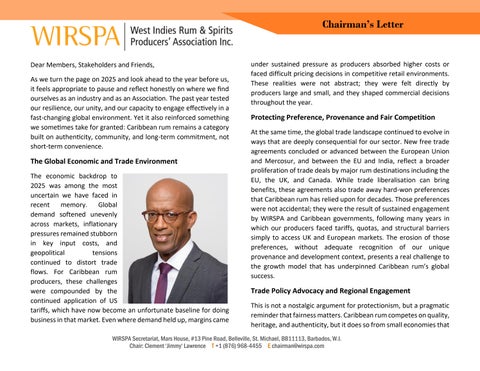

Dear Members, Stakeholders and Friends,
As we turn the page on 2025 and look ahead to the year before us, it feels appropriate to pause and reflect honestly on where we find ourselves as an industry and as an Association. The past year tested our resilience, our unity, and our capacity to engage effectively in a fast-changing global environment. Yet it also reinforced something we sometimes take for granted: Caribbean rum remains a category built on authenticity, community, and long-term commitment, not short-term convenience.
The Global Economic and Trade Environment

under sustained pressure as producers absorbed higher costs or faced difficult pricing decisions in competitive retail environments. These realities were not abstract; they were felt directly by producers large and small, and they shaped commercial decisions throughout the year.
Protecting Preference, Provenance and Fair Competition

The economic backdrop to 2025 was among the most uncertain we have faced in recent memory. Global demand softened unevenly across markets, inflationary pressures remained stubborn in key input costs, and geopolitical tensions continued to distort trade flows. For Caribbean rum producers, these challenges were compounded by the continued application of US tariffs, which have now become an unfortunate baseline for doing business in that market. Even wheredemand heldup, margins came
At the same time, the global trade landscape continued to evolve in ways that are deeply consequential for our sector. New free trade agreements concluded or advanced between the European Union and Mercosur, and between the EU and India, reflect a broader proliferation of trade deals by major rum destinations including the EU, the UK, and Canada. While trade liberalisation can bring benefits, these agreements also trade away hard-won preferences that Caribbean rum has relied upon for decades. Those preferences were not accidental; they were the result of sustained engagement by WIRSPA and Caribbean governments, following many years in which our producers faced tariffs, quotas, and structural barriers simply to access UK and European markets. The erosion of those preferences, without adequate recognition of our unique provenance and development context, presents a real challenge to the growth model that has underpinned Caribbean rum’s global success.
Trade Policy Advocacy and Regional Engagement
This is not a nostalgic argument for protectionism, but a pragmatic reminderthatfairnessmatters.Caribbeanrumcompetesonquality, heritage, and authenticity, but it does so from small economies that
WIRSPA Secretariat, Mars House, #13 Pine Road, Belleville, St. Michael, BB11113, Barbados, W.I.
Chair: Clement ‘Jimmy‘ Lawrence T +1 (876) 968-4455 E chairman@wirspa.com
remain vulnerable to external shocks. As trade deals multiply, ensuring that origin rules are meaningful and that provenance is protected is not optional; it is essential. Throughout 2025, WIRSPA remained deeply engaged on these issues, working with CARICOM, CARIFORUM, and international partners to defend space for our producers in an increasingly crowded global market.
Alcohol, Health Policy, and Responsible Consumption
A second defining issue of the year was the global debate around alcohol, health, and responsible consumption, culminating in the UN High-Level Meeting on Non-Communicable Diseases. There was a very real risk that this process could be used to further entrench narratives promoted by anti-alcohol temperance organisations, including the notion that there is “no safe level” of alcohol consumption. Such messaging, while superficially simple, is deeply impractical. It fails to reflect how people actually live, socialise, and make choices, and it risks alienating consumers who are seeking sensible guidance rather than prohibition by another name.
Advocacy Outcomes at the Global Level
WIRSPA, working closely with international partners, played an active and constructive role in advocating for a final political declaration that did not demonise beverage alcohol producers or elevate ideology over evidence. The outcome was significant: explicit references to “no safe level” were removed, preserving space for balanced, proportionate policy approaches. This mattered not only for our industry, but for public trust in health advice more broadly.
It is also important to be clear that this outcome did not represent a watering down of the Political Declaration. On the contrary, the
final text contains meaningful and far-reaching commitments for the private sector in how beverage alcohol is marketed, promoted, and made available. These commitments rightly emphasise responsible commercial behaviour, respect for public health objectives, and continued engagement to reduce alcohol-related harm. What was avoided was not responsibility, but oversimplification. The Declaration recognises that effective public health outcomes are best achieved through partnership, evidencebased measures, and shared accountability, rather than through blanket narratives that ignore the realities of consumer behaviour and cultural context.
We continue to believe that responsible drinking is best supported through credible, practical guidance and through a culture of moderation that people can sustain over time. Initiatives such as Dry January have their place and can be useful prompts for reflection. However, long-term moderation, informed choice, and shared responsibility offer a more realistic and effective path to reducing alcohol-related harm. Caribbean rum has always been a product consumed with intention and respect, and our advocacy in this space reflects that reality.
Against this complex backdrop, WIRSPA made meaningful progress across a wide range of priorities in 2025.
On trade, several of our key “asks” were accepted by our regional governments which will hopefully lead to strengthened agreements with the EU and into revisions of Caricom trade rules, helping to close loopholes and protect authentic Caribbean origin. We also closely monitored developments around a regional glass supply study by Trinidad and Tobago, recognising how critical competitive inputs are as our brands build and sustain a global presence. In the region, we continued to engage on the new excise tax regime in
Trinidad and Tobago, which has created unequal treatment for regional goods in that important market. Trinidad has long been a supporter of regional integration, and we remain hopeful that these issues can be resolved in a manner consistent with that tradition.
Strengthening Sustainability and ESG Credibility
Sustainability was another area where we worked to tell a fuller and more accurate story. Our ESG digest published at year end brings together actions across environmental stewardship, social investment, and governance that are too often overlooked. By embedding direct links to the activities themselves, the publication moves beyond aspiration and demonstrates what producers are actually doing on the ground.
Technical Collaboration and Knowledge Exchange
Technical exchange and knowledge development remained central to our mission. The technical conference hosted by Jamaica in May was a standout success, bringing together producers and suppliers from across the region for practical exchange and best practice sharing.Theseforumsmatterbecausetheystrengthenthetechnical foundations of our industry and foster collaboration that extends well beyond the conference room. We look forward to continuing that tradition in Trinidad in May 2026. Alongside this, efforts towards the establishment of communities of practice among WIRSPA members marks an important step toward more structured information sharing, collaborative research and development, and ongoing virtual learning.
Building Visibility, Storytelling and Category Value
Telling our story continues to be a priority. The Rum Makers interview series, our collaboration with the International Trade
Centre at BCB Berlin, and our work with the Academy of Wines and Spirits all contribute to deeper understanding of Caribbean rum among trade and enthusiasts alike. The Caribbean Rum Trail, now featuring 24 distilleries, has become a unique offering that links tourism, education, and heritage in a way few categories can replicate. Our social media channels have amplified these efforts, sharing the best stories from our members and their brands throughout the year.
Climate Risk, Resilience and Industry Solidarity
Finally, we cannot reflect on 2025 without acknowledging the impact of Hurricane Melissa on Jamaica. Beyond damage to facilities, the storm disrupted communities and families, reminding us that climate risk is not theoretical for the Caribbean. The response of the industry, in supporting staff and surrounding communities, was a powerful demonstration of the social compact that underpins our indigenous brands. As extreme weather events become more frequent, these experiences will inform how we prepare, adapt, and support one another going forward.
Looking Ahead with Confidence
As we enter the new year, there is no illusion that the challenges ahead will be simple. But there is confidence in the strength of our collective voice, the credibility of our advocacy, and the enduring appeal of Caribbean rum. On behalf of the Board, I thank you for yourengagement,yourresilience,andyourcontinuedbeliefinwhat we are building together. With best wishes for the year ahead,

Clement (Jimmy) Lawrence, CD – WIRSPA Chairman February 2026