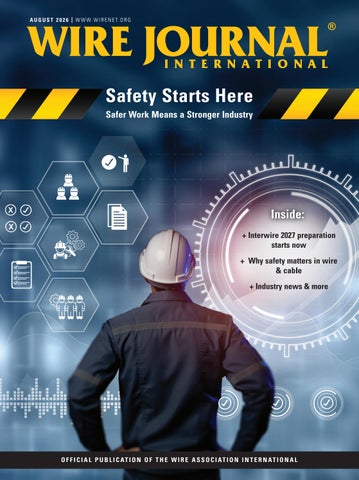

Safety Starts Here
Safer Work Means a Stronger Industry



+ Interwire 2027 preparation starts now
+ Why safety matters in wire & cable + Industry news & more
CALL FOR PRESENTATIONS Interwire 2027 &
The Wire Association International (WAI) invites you to share practical knowledge, proven strategies, and real-world experience to improve wire and cable manufacturing safety by presenting at the Interwire 2027 Conference.
Choose from the:
• Safety Starts Here Track; or
• Technical Innovation Track.
Abstract submissions should focus on actionable insights that help protect people, strengthen operations, and advance the wire making industry.
}Accepted presenters to either the Interwire Conference or the REWIREcable Forum receive conference registration and a one-year WAI membership.


ABSTRACTS DUE: NOVEMBER 2, 2026
ACCEPTANCE NOTIFICATION: DECEMBER 1, 2026
MATERIALS DUE: MARCH 26, 2027
SUGGESTED TOPICS:
• Machine & Process Safety
• Operational Safety on the Plant Floor
• Electrical & Thermal Safety
• Material, Chemical & Environmental Safety
• Designing Safety into Equipment & Facilities
• Safety Training, Culture & Workforce Development
• Incident Prevention, Investigation & Continuous Improvement
• Safety, Productivity & Quality: Making the Business Case
PANEL DISCUSSION OPPORTUNITIES:
• Safety Challenges in Small vs. Large Operations
• Global Safety Standards & Best Practices

REWIREcable Forum
@ Interwire
WAI and INNOVITES®, its educational partner, seek presentations for the REWIREcable Forum that will be co-located with Interwire 2027.
This one-day educational forum will explore the technologies, strategies, and digital transformation initiatives shaping the future of wire and cable manufacturing.
The program serves as a bridge between traditional wire and cable industry manufacturing excellence and the broader industrial ecosystem.
Intended audience: production leaders, supply chain professionals, IT/OT specialists, digital transformation teams, and operational decision-makers.
Submit your abstract today: interwire27.com
DIGITAL TRANSFORMATION
MAY 6, 2027
CO-LOCATED WITH INTERWIRE 2027
EDUCATIONAL PARTNER:

SUGGESTED TOPICS:
• Digital Transformation in Wire & Cable Manufacturing
• Smart Factory & Industry 4.0 Applications
• MES, ERP & Connected Manufacturing Systems
• Industrial Data & Analytics
• Artificial Intelligence & Machine Learning
• Digital Quality Management
• Production Planning & Scheduling
• Supply Chain Visibility & Optimization
• Cybersecurity for Manufacturing Operations
• IT/OT Convergence
• Industrial Automation & Connectivity
• Digital Twins & Simulation Technologies
• Change Management & Technology Adoption
• Case Studies and Lessons Learned from Digital Initiatives
Accepted presenters elevate their companies through conference publicity. They enjoy the career-building benefits of expert status; receive complimentary registration; and a WAI membership for one year.

Safety
By Mark Marselli, WJI contributing editor
If there’s an industry mantra for safety, it’s that it should never be seen as a given. This feature updates the industry’s injury records and includes a comparison of two safety tool options, perspectives from both a small and a large manufacturer, the essence of a Prysmian presentation made at Wire Expo 2026, advice from a former OSHA inspector, a report on why AI still has a ways to go, and more, including the Patents column on p. 25.
Safety staffing has exploded, but so has the burden
In 2026, companies are investing more in safety, but that has not helped as much as one might expect. Yes, employment of OHS specialists and technicians has increased impressively, only it has not offset the added responsibilities. Below are some statistics and observations from TraceOne, reported by Risk & Insurance, that reflect this shift in safety staffing.
Disparity in different states: Rhode Island has just 5.2 safety managers per 10,000 workers, versus 7.2 in Connecticut and 23.5 in Wyoming, meaning safety pros in some states oversee far larger workforces.
Disparity by industry: mining, quarrying, and oil and gas extraction lead with 83.8 safety managers per 10,000 workers, while manufacturing employs the largest absolute number of safety managers at 30,200 but with a lower per-worker ratio.
Expanded scope of duties: 97% of EHS professionals are involved in ESG activities, so safety roles now include sustainability, health, and well-being metrics alongside traditional compliance.
Growth in safety staffing: employment of OHS specialists and technicians rose 165% from 2010 to 2025, yet many safety managers now oversee larger spans of control than in 2010.
AI demands without full integration: 90% plan moderate to significant AI investment in EHS, but only 20% have extensive AI integration, leaving safety staff to manage new tools without mature systems.
Safety as a strategic function: safety is increasingly framed as a talent and productivity driver, with manufacturers using strong safety programs to attract and retain workers and to support operational reliability.
Gaps between investment and capability: many firms are pouring money into new tools and data systems but have not yet built the organizational muscle—clear strategy, governance and incident-response plans—to fully leverage those investments.
Digital maturity gap: just 11% of organizations are fully digital in EHS, meaning many safety teams still rely on manual processes and spreadsheets even as expectations grow.
OSHA data list of severe injuries includes wire & cable field
OSHA’s website (www.osha.gov) presents a wealth of industry information, including the total number of severe injury reports, hospitalizations and amputations shown below. However, as explained in the accompanying boxed item, this is far from a complete tally.
NAICS uses a six-digit hierarchical coding system to classify all economic activity into 20 industry sectors (five goods-producing, 15 services-producing). The current NAICS revision identifies 1,012 six-digit industries, compared with 1,004 in the four-digit SIC structure. Its Severe Injury Report Dashboard—found at www.osha.gov/ severe-injury-reports—provided the details presented here.
For all U.S. sectors from Jan. 1, 2015, to Oct. 31, 2025, there were a total of 105,355 reported severe injuries, with 85,978 workers hospitalized and 27,789 workers who had amputations. For 2025, there were 8,034 total severe injuries, 6,619 workers hospitalized and 1,982 amputations.
For steel wiredrawing, NAICS 331222, there were a total of 109 reports of severe injuries from Jan. 1, 2015, through Oct. 31, 2025, with 67 workers hospitalized and 57 amputations. In 2025, there were eight severe injury reports, seven workers hospitalized and two amputations. See p. 58.
For copper rolling, drawing, extruding and alloying, NAICS 331420, for the same period, there were a total of 62 reports, with 34 workers hospitalized and 36 amputations. In 2025, there were 13 total severe injury reports, four workers hospitalized and 10 amputations. See p. 59.
For springs, NAICS 332613, for the same period, there were a total of 29 reports, with 14 workers hospitalized and 18 amputations. In 2025, there was only 1 severe injury report, one worker hospitalized and no amputations.
Key cited categories include workers: caught in running equipment or machinery during regular operation; caught
in or compressed by equipment or objects, unspecified; compressed or pinched by shifting objects or equipment; struck by a dislodged flying object/particle; struck by object falling from vehicle or machinery other than vehicle; struck by a falling object or equipment, unspecified; and from a fall on same level due to slipping.
OSHA’s data has a notable gap
While OSHA’s severe injury data are extensive, they do not present a complete picture of the full U.S. wire and cable industry. A number of states (and Puerto Rico) maintain their own reporting systems for the same NAICS categories, but those records are housed on separate state websites and even there, are often not presented in a consistent or easily accessible format.
States and jurisdictions that operate separate reporting systems include Alaska, Arizona, California, Connecticut, Hawaii, Illinois, Indiana, Iowa, Kentucky, Maine, Maryland, Massachusetts, Michigan, Minnesota, Nevada, New Jersey, New Mexico, New York, North Carolina, Oregon, Puerto Rico, South Carolina, Tennessee, Utah, Vermont, the Virgin Islands, Virginia, Washington and Wyoming.
SMALL MANUFACTURER
Lexco Cable Manufacturing
The majority of wire and cable companies have fewer than a thousand employees and less resources than the world’s biggest companies, but even within that range, when it comes to safety, each small, medium and larger operation needs to determine how to best handle this. Below, Vice President David Karbin shares his thoughts on his company’s award-winning approach.
WJI: How does your company approach safety, and has that changed over the last 10 years?
Karbin: We’ve shifted from a reactive mindset to a proactive one, making safety part of our culture and standard operating procedures. Over the past decade, we’ve embedded safety into daily routines through work zones, clear PPE rules, and training so that it’s not an add-on but how we do business every day. Technology, including software for preventative maintenance, supports that effort by helping us keep equipment in safe working order.
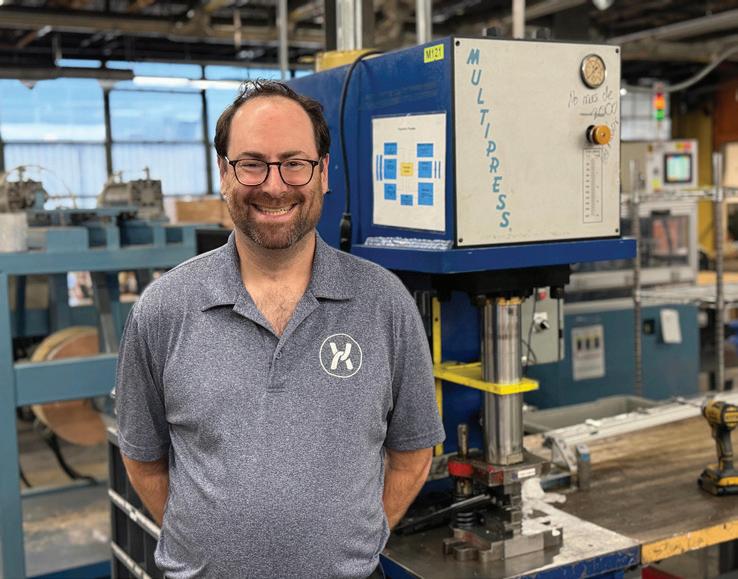
Lexco Cable Manufacturing
1 Location: Norridge, Illinois
2025 Employees: Approx. 100
WJI: What makes a safety plan successful? Is it mainly about enforcing directives or finding ways to make employees more engaged? Can technology (including AI) play any role in that?
Karbin: A successful plan must be ongoing and rooted in engagement, not just enforcement. Employees need to understand why we do things, not just what to do. We build that by requiring operators, for stations like Test Bed and Wirop, to read safety warning signs before starting machines, and by training them on safe operation, tool use, and hazard awareness. Software can help us plan preventive maintenance on machines and track hazards, but people create the culture.
WJI: How do you prepare a new employee to be a safe employee from day one?
Karbin: We integrate safety directly into training rather than treating it as a separate orientation topic. From day one, new hires learn which machine areas require PPE, how to work around work zones, and what rules apply, such as steel-toed shoes on certain machines, no loose jewelry, and hair tied up before operating equipment. Safety auditors conduct walkthroughs about twice a week, so new employees see expectations being reinforced and modeled by experienced operators.
WJI: What do you do when you encounter employees who are not engaged in safety?
Karbin: We start with clear expectations and coaching, but we also have a defined process. If an employee refuses
to wear required PPE—such as safety glasses in production areas, including rewind, extruder, QC benches, and CNC—there are warnings followed by consequences, such as being sent home for the day per the company handbook policy. Active participation in safety is a condition of employ ment, and performance expecta tions reflect that.
WJI: How critical is visible, active involvement from top management in making safety work?
Karbin: It’s absolutely critical. Employees pay far more attention to what leaders do than what they say. At Lexco, that means managers and owners are regularly in production areas, reminding crews to use PPE, ensuring machines are properly locked out and tagged out, and making sure equipment investments like guarding, laser curtains, and safety sensors are actually used. That kind of visibility is key on our specialty machines. For example, Test Bed and Wirop are critical wire-rope testing and assembly stations where operators handle high-tension controls and precise alignments. Because the hazards are more complex there, having leaders step in to reinforce training, checking that warning signs are read, and watching that work zones are respected helps operators see that safety isn’t just a rule but an expectation. When leadership visibly models safe behavior, it sets the standard for everyone.
WJI: What safety accomplishment or milestone are you most proud of, and why?
Karbin: We’re especially proud that this work earned us recognition from the Associated Wire Rope Fabricators Safety Committee for achieving an exceptional safety record in 2024. That award is a peer-industry benchmark for industry-leading safety standards and sets a positive example for manufacturing safety practices. The recognition reflects daily commitment to consistency and vigilance, and that managers, team leaders and employees have all followed protocols and fostered a culture of looking out for one another.
For a smaller operation, winning that kind of recognition validates the incremental changes we’ve made—tighter work zones, clearer PPE requirements, more frequent safety walkthroughs, and continuous training—and shows that even without the resources of the largest manufacturers, we can lead in safety within our sector.
LARGE MANUFACTURER
International Wire Group, a Pantheon Electric company
The majority of wire and cable companies have fewer than a thousand employees and less resources than the world’s biggest companies, but within that range, when it comes to safety, each small, medium and larger operation needs to determine how best to handle this. Below, IWG Chief Operating Officer Michael Dellefave shares his thoughts on his company’s approach.
WJI: How does your company approach safety, and has that changed over the last 10 years?
Dellefave: Our approach has changed dramatically. The biggest shift is that our leadership team genuinely believes every injury is avoidable. That belief led us to develop What Good Looks Like (WGLL), a safety management system built on communication, accountability, and employee engagement. WGLL defines and measures the behaviors that create a high-performing safety culture. Since its launch, we’ve reduced our OSHA recordable rate by more than 50%, with several facilities achieving years without a recordable injury.
International Wire Group, a Pantheon Electric company
15
WJI: What makes a safety plan successful? Is it mainly about enforcing directives or finding ways to make employees more engaged? Can technology (including AI) play any role in that?
Dellefave: A successful safety plan is built on employee engagement. Rules establish expectations, but culture determines what people do when no one is watching. Engagement is created through leadership touchpoints, peer observations, workforce safety ambassadors, safety committees, and open communication.
One of our best ideas started at a single plant, where leaders introduced brief mid-shift safety meetings to discuss hazards and encourage questions. The idea proved so effective that it quickly spread company wide. That’s the culture we want: when people see something that works, they adopt it.
Technology supports that effort, but only people create culture.
WJI: How do you prepare a new employee to be a safe employee from day one?
Dellefave: Orientation is only the beginning. We know employees face their greatest safety risk during their first year, so coaching continues well beyond onboarding. From
day one, they’re immersed in daily safety communications, meetings, observations, and discussions while working alongside experienced employees who model safe behaviors and explain why we work safely. Leaders reinforce that speaking up is expected. By the end of their first quarter, participation in safety is already part of their performance evaluation because developing safe habits is just as important as developing job skills.

WJI: What do you do when you encounter employees who are not engaged in safety?
Dellefave: Sometimes it’s a training issue, sometimes it’s a communication issue, and sometimes it’s simply a coaching opportunity. We believe most employees want to do the right thing when expectations are clear and leaders are engaged.
That said, active participation in safety is a condition of employment. Employees are expected to participate in safety discussions, identify hazards, and help protect one another. We reinforce that expectation through quarterly performance evaluations where safety participation is measured alongside other performance expectations.
WJI: How critical is visible, active involvement from top management in making safety work?
Dellefave: It’s essential. Employees pay far more attention to what leaders do than what they say. When leaders participate in safety meetings, coach employees, recognize safe behaviors, stop unsafe work, and address concerns, employees understand that safety is a core value. We’ve themed our last two annual Safety Summits “Safety Follows the Leader” because leaders don’t just support safety culture, they create it.
WJI: What safety accomplishment or milestone are you most proud of, and why?
Dellefave: I’m most proud of the cultural transformation we’ve built. The turning point came when safety stopped being management’s responsibility and became everyone’s responsibility. Today, what makes me proud isn’t an OSHA statistic, it’s seeing employees speak up, protect one another, and take personal ownership for safety. That’s how I know the culture has changed.
Dellefave
AI’s safety potential should be more than a tech upgrade
AI is everywhere in manufacturing discussions, but less proven where it matters most: safety. A Grant Thornton report says AI has real potential on the plant floor, but at this point it is not delivering consistent results for reasons that have less to do with what may be feasible than how it is being approached. Below is an edited version of its findings.
Per Grant Thornton’s 2026 AI Impact Survey, more companies believe AI can bolster their efforts, but for many, expected returns have been lacking in some areas.
The survey shows that manufacturers are leaning into AI on the plant floor, especially where safety, throughput and quality converge. About 60% say operations is the area most in need of AI focus. Many report genuine efficiency gains. Roughly 40% say AI has improved staffing decisions, while 38% say it has helped with production scheduling. AI is already helping manufacturers adjust schedules, tune procurement and guide quality inspections. So, if AI can provide more eyes on risk, more data for decisions and more early warning of problems, why has it not become a natural extension of traditional safety programs?
The survey suggests most manufacturers have treated AI as a technology upgrade, not as part of the safety system they rigorously govern. Very few have a tested AI incident-response plan: only about 15% say they have a formal plan for handling AI-related incidents. Even fewer are confident they could pass an independent governance review; roughly one in four express confidence. In an industry that runs fire drills and tests backup generators, AI tools near workers and machines have never had their own “what if it fails?” rehearsal. AI is plugged into operations where failure can hurt people, but the organizational muscle for handling those failures hasn’t been built.
The survey also shows that this governance gap shows up in performance. Many manufacturers say AI has improved efficiency, but almost none report major revenue or cost benefits. Only about 10% say AI has delivered significant cost reductions, and roughly the same share report notable
revenue gains. They are stuck in pilot mode: running local trials, adding tools from vendors, but not fully integrating AI into how decisions are made and evaluated across the business. In safety terms, this means plants are adding AI-powered cameras, sensors and scheduling engines without clearly defining who owns those systems, how they are monitored, and how they are rolled back or overridden when something goes wrong.
Still, the survey points to genuine safety potential. AI can spot patterns that people miss: clusters of near misses in a specific zone, repeated shortcuts by certain teams, or equipment behaviors that precede a failure. Vision systems can detect a worker entering a hazardous area; predictive analytics can flag a machine that needs attention before it breaks. Used deliberately, AI can move safety from reactive—investigating incidents after they happen—to proactive, where emerging risks are flagged early and mitigated before anyone gets hurt. About 42% rate AI’s potential impact on safety as high or very high, and 35% say AI is contributing to safer operations in at least some areas. Even as AI vision systems are deployed for quality and inspection in wire-and-cable plants, few named manufacturers have publicly reported safety-specific results.
Per the survey, the story here is not simple optimism or pessimism. AI is a powerful tool that can strengthen manufacturing safety, but only if companies treat it the way they treat physical safety systems: with clear strategy, strong governance and tested incident response. The good news is that manufacturers are investing; the bad news is that too many are doing so without building those controls first.

Streaming reports of citations/fines for 3 NAICS Categories
Below is a list of some of the 2024 and 2025 OSHA citations/fines from Jan. 1, 2024 to Oct. 31, 2025, for three categories: steel wiredrawing, copper wire and cable processing and springs.
Machine hazards. 2 citations. Machine guarding lacking to prevent hazards such as those created by point of operation, ingoing nip points, rotating parts, flying chips and sparks. Repeat violation. Issued penalties: $30,644, informal settlement $17,000. Machine hazard. 1 citation, 1 fine. At a wire mill, employees were required to hold their hand flat on a pin as the wire stretcher loaded wire, and one employee’s finger became caught between the wire and a block, resulting in amputation. Issued penalty: $29,790; informal settlement penalty: $8,937.
Control of hazardous energy (lockout/tagout). 6 citations, 1 repeat. No details provided. Initial penalty $30,450 (includes $9,800 repeat), current penalty $21,315.
Plant safety must be much more than talk: it must have structure
At Wire Expo 2026, Aaron Wright, regional director of HSE for Prysmian North America, made a memorable presentation, “Leading safety through structure: my visual management board journey.” Below is a condensed, edited version.
Every leader will say that safety is their number one priority in a LinkedIn post. But if you were to ask them what they do while sitting next to them on an airplane, the word safety rarely comes up.
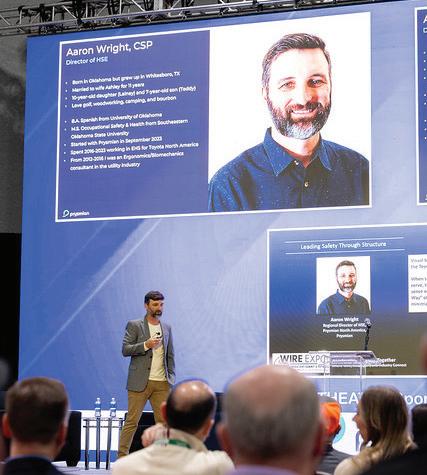
I’ve been with Prysmian since 2023, and before that I worked for Toyota North America in a regional safety engineering role for seven years. It was a formative company for me. It taught me how to manage HSE performance in a detailed, structured way so that today’s priorities aren’t forgotten tomorrow. But most importantly, they instilled in me the value of “respect for people.” If keeping people safe is our top priority then productivity, quality, turnover, and all of those other critical metrics will follow.
Everyone is likely to have some degree of exposure to visual management boards, but there are identifiable differences between the ones that are successful and the ones that receive eye rolls. I’ve seen ones that are so overly complex that the burden of keeping them updated prevents
them from ever gaining any traction. And on the opposite end of the spectrum, I’ve worked with ones that are so simplistic that they aren’t tracking anything actionable. They essentially serve as a report out on lagging indicators. We tried to split ours down the middle and develop a Visual Management Board for safety that’s simple but still drives progress with actionable updates from week to week. There are benefits of developing a visual management system across all levels of the organization:
Benefits for Leaders: If you manage multiple plants/locations, these boards let you walk into a facility without the site HSE and immediately see where they’re doing well, where they’re behind on targets, what their priorities are, and where you might need to support them.
Benefits for Safety Professionals: For newer safety leaders, it teaches them how to manage safety in a methodical way. It instills that thinking way of “here is our goal, here are some activities that will help us get there, here is how well we’re doing against those goals, and here is where we need to pivot.” But one of the biggest wins is the accountability that these boards create. Safety can come up with the best ideas in the world, but if maintenance, operations, engineering, and all of our other partners are prioritizing other things then we’re doomed to fail. When designed correctly, the board creates a weekly cadence where all stakeholders speak to their progress on critical safety items. If something’s in a “behind” condition, that gets bubbled up. Facility leadership sees it. Regional leadership sees it. And we can help drive change.
Benefits for Operators: Transparency and bottom-up communication are critical when creating a strong safety culture. If your board is managed in a location where all

Inadequate energy-control procedures. At a wire straightener, employees performed servicing and maintenance on equipment with electric and pneumatic energy sources without machine-specific lockout/tagout procedures. Issued penalty: $15,322; informal settlement: $15,000.
Multiple citations for servicing moving machinery/equipment. General machine requirements and respiratory protection; ladders. No details provided. Initial penalties $30,000, current penalties $20,000.
Missing machine guarding. 2 citations, 1 fine. Employer did not conduct annual inspection of energy control procedure. No penalty. Company did not electronically submit information from OSHA Form 300A Summary of Work-Related Injuries and Illnesses by the specified date. Issued penalty: $946; informal settlement penalty: $666.20.
Multiple citations. 6 for control of hazardous energy (lockout/tagout) and mechanical power-transmission apparatus. No details provided. Initial penalties $39,200, current penalty $39,200.
Selection and use of work practices. 1 citation; safeguards for personnel protection. 3 citations. No details provided. Initial penalties, $26,400, current penalties, $26,400.
(continued on p. 56)

employees have access to it, they can see the status of the safety items that we have promised them in our plantwide communications. If a corrective action from a near miss report has been in “red/behind condition” for 2 months, then they have an opportunity to push us to complete the things we promised.
On any Visual Management Board, you’ll typically see five columns l-r for a Key Performance Indicator (KPI).
The Main KPI: Typically a lagging indicator like Total Recordable Incident Rate (TRIR) that executives measure us against. A reduction target will also be identified here.
The Sub KPI: This displays whether we’re on track to meet our target year to date. Continuing with the same TRIR example, you might look at how many recordables and first aid incidents compared to last year.
The Analysis: Based on the latest data that we have, is there any identifiable trend that we can chase? Are accidents happening on certain shifts, in certain areas, to certain body parts, etc.?
The Activities: This column is the meat of the conversation. What are we going to do about what we’re seeing? A key element that drives accountability here is the visible red/yellow/green status. When I walk into a plant and see red elements on the board, it tells me where I need to spend my time during the visit.
The Results: This displays month over month results for the primary KPI. If your trend is negative, you need to reassess the Sub KPIs, Analysis, and Activities.
Our boards typically have four Main KPI rows. You can have more as long as you’re measuring and managing what’s important to you.
Four KPI triangles can be used to drive improvement in areas that are common across most manufacturers.
Man vs. Machine: Reducing interactions between forklifts and pedestrians is one of the most challenging yet impactful goals you can have in manufacturing safety.
Non-Standard Work: We all value standardization and risk assessment but some of the more serious injuries in our industry come from non-standard, unplanned activities.
Hand Safety: Everything rotates, and we work with our hands. At one point, the idea of getting rid of all open blades in McKinney, Texas, would have been laughable. But our organization wants us to take on challenging goals, and we are now well on our way to meeting that goal.
Ergonomics: The manual nature of our industry presents a lot of opportunity for overexertion risk. Such injuries may not garner the same attention as a traumatic hand injury, but they often result in the most days away from work and highest worker’s compensation costs.
In the KPI forklift triangle below, the top represents the main KPI. Replacing “recordable injuries” in the OSHA TRIR formula with “powered equipment incidents” is a simple way of measuring the frequency of forklift incidents at your facility and giving yourself a target to chase.
The middle section provides good sub-KPIs that you can use to track your progress over time. This is the data that you will use to identify trends.
Finally, the bottom section spells out activities that can help you achieve your reduction target.
Ultimately, safety is about demonstrating respect for people. If you aren’t managing safety in the same structured, methodical way that you manage production, you will get distracted and you won’t move the needle. Visual management boards are a great tool to keep leaders engaged, keep your HSE teams on track, and create floor-up accountability with your workforce.
The KPI board presents four elements that are designed to present a path to the desired results (outcome).
2 toolkits for wire and cable safety: AI video vs. EHS software
The shop floor of any wire and cable manufacturing plant can host a slew of potential safety hazards. This section compares two different yet complementary toolkits: AI-powered video safety monitoring and traditional EHS (environmental, health, and safety) software.
AI video-based safety platforms
AI video safety platforms such as those offered by Intenseye, Ailytics, Voxel, Arvist, Urbint, TuMeke, Protex AI and Everguard.ai are positioned as real-time monitoring systems. They reuse existing CCTV or industrial cameras and run machine-learning models to spot unsafe acts and conditions. In wire and cable plants, these systems typically check PPE compliance for helmets, goggles, gloves, and flame-resistant clothing. They also watch for unsafe behavior near stranding lines or extrusion equipment, detect vehicle–pedestrian conflicts in yards and warehouses, and flag blocked exits, spills, or fire hazards. The idea is simple: let the system see what people might miss during routine checks and flag issues before they become incidents.
From the vendors’ perspective, the main advantages are continuous, real-time hazard detection and objective, datarich evidence. A typical example is an extrusion line where a worker briefly removes safety goggles to adjust a guide. The system logs the violation with time-stamped video and an alert, giving supervisors a concrete moment to coach instead of relying on memory or a post-incident story. As many plants already have mature security camera systems, vendors often say deployment can be faster and cheaper than rolling out new hardware. Some also talk about predictive value beyond pure safety, such as detecting belt slippage, overheating, or vapor and steam leaks that correlate with downtime or quality issues. That could help improve operational reliability as well as reduce injuries.
Vendors acknowledge higher technical complexity and cost. Deployment requires reliable camera coverage, edge or cloud compute for AI models, and integration with alerting systems and possibly EHS systems. That means a larger upfront investment and more ongoing maintenance. Model limitations and false positives are real concerns. PPE and behavior detection can struggle with occlusion, lighting changes, and edge cases. Too many false alerts can make operators ignore the system entirely. Data and privacy are another layer. Continuous video monitoring raises questions about worker consent, the feeling of being watched, and how data is stored and accessed. That requires strong governance and clear communication. Finally, AI video is not a process system. It tells you what is happening but does not structure incident investigations, manage corrective actions, or track training, audits, or compliance documentation.
In practice, first-year costs for a single wire or cable plant are typically in the $90,000 to $270,000 range, depending on camera count, hardware needs, and integration depth. Multi-site projects can run $300,000 to $1 million or more. Initial training is roughly eight to 16 hours for safety and EHS leadership and 16 to 40 hours for IT or operations staff, depending on integration complexity. Ongoing operational effort per plant is about 100 to 250 hours per year across safety, IT and management, including dashboard reviews, rule tuning, system health checks and reporting.
EHS software platforms
EHS software platforms are offered by companies such as Intelex, Sphera Solutions, SafetyCulture (iAuditor), Vector Solutions, Irth Solutions, EcoOnline, Cority and EHS Insight. Their systems manage incident and near-miss reporting, digitize inspections, audits and risk assessments,


Machine hazard. 1 citation, 1 fine. Machine guarding was not provided to prevent hazards such as those created by point of operation, ingoing nip points, rotating parts, flying chips and sparks. Repeat violation. Issue penalty: $27,804.
Inadequate energy-control procedures and stair safety. 2 citations, 2 fines. Employee did maintenance on a pipe connected to a sulfuric tank without proper written procedure. Area stairs had risers above the 9.5-inch max. Issued penalties: $11,823 and $16,550; informal settlement penalties: $11,823 and $2,367.
Machine guarding. 4 citations. Guards not affixed on drum packers. Hinged door lacked interlock mechanism and employees routinely opened the barrier guard to start and remove product from the equipment as needed. A previous violation had been cited. Initial penalties, $182,064; current penalty $13,100.
Missing machine guarding. 1 citation, 1 fine. Bead wire employees were exposed to struck-by and caught-in hazards as no guarding protected them from the automated overhead crane picking up and moving loads. Issued penalty: $8,040; informal settlement penalty: $4,824.
Machine guarding violation. 1 citation, 1 fine. A machine operator ran a wire draw machine with the guard open. As the employer was similarly cited before for this, it was classified as repeat offense. Issued penalty: $27,804.
track training, compliance and corrective actions, and provide dashboards and analytics for safety performance.
For wire and cable manufacturing, these tools standardize shift inspections of extrusion, stranding, and finishing lines, manage lockout and tagout procedures and machinery safety checks, track chemical handling for coatings and extrusion compounds, and document training on crane operation, hazardous energy control, and fire safety. The value is structured, human-driven safety management, turning policy and best practice into repeatable workflows.
corporate EHS, with environmental, health and quality modules in addition to safety.
The trade-offs are that EHS systems are human-driven and not continuous. They rely on supervisors filling out inspections and workers reporting incidents and near misses, so gaps appear when checklists are skipped or near misses are not reported. Because they tend to focus on lagging indicators, capturing what already happened rather than preventing incidents in real time, patterns may only be recognized after injuries occur unless there is strong proactive data collection.
AI Video Safety EHS Software
• Real-time detection
• CCTV / cameras
• PPE and hazard alerts
• Higher tech effort
Per vendor materials, the main advantage of EHS software is structured safety management across the enterprise. Core workflows for incidents, near misses, inspections, audits, risk assessments, training, and compliance help standardize how hazards are managed across multiple plants. For example, the system can ensure that every extrusion shift completes the same inspection checklist and that lockout/tagout records are consistent across sites. These systems also support regulatory and audit readiness, with digital records for lockout and tagout checks, chemical handling, and fire and emergency drills that are directly useful for OSHA, ISO 45001, and customer audits.
• Inspections & incidents
• Training & actions
• Audit-ready records
• Easier to deploy
Best together: AI feeds EHS
From a technical standpoint, EHS software typically has a lower barrier. It is mostly web or cloud-based with userfriendly interfaces and minimal IT overhead compared to AI video systems, making it faster to deploy and easier for non-technical safety staff to manage. It is also scalable across sites and functions, with one platform able to cover production, warehouses, maintenance and sometimes
Success is also culture-dependent. It depends on management commitment and worker participation, and in plants with a weak safety culture, EHS software can become a checkbox exercise rather than a real improvement tool. In addition, many EHS platforms do not connect tightly to real-time operations. They may not integrate with PLCs, SCADA or MES, limiting their ability to influence operational decisions on the line.
Typical first-year costs for a single wire or cable plant are in the $30,000 to $90,000 range, including software, implementation, and basic hardware such as tablets for inspections. Initial training generally involves 8 to 16 hours for safety and EHS professionals, two to four hours per supervisor or inspector, and 8 to 16 hours for administrators on workflow configuration and reporting. Ongoing operational effort per plant is roughly 150 to 300 hours per year across safety, supervisors, and management, but this is more normal work time than a dedicated tech effort.
(continued on p. 58)
Lead exposure and respirator compliance. 2 citations, 2 fines. At a patenting department, an employee exposed to lead wore a tight-fitting respirator despite facial hair interfering with the seal. Company’s lead compliance program had not been updated annually. Issued penalties: $8,511 and $8,511.
Repeat machine guarding violation. 1 citation, 1 fine. Effective guarding was missing on mills, drum packers and small wire winder/bundler, leaving employees exposed to nip points, rotating parts and other moving-machine hazards. Treated as repeat violation because of similar past violation. Issued penalty: $165,514; informal settlement penalty: $16,550.
A range of production elements. 10 citations, 10 with fines. Flammable liquids, machine guarding, electrical hazards, and record keeping issues. Issued penalties: $58,875.
A range of production elements. Multiple citations, 4 with fines. Electrical safeguards, chemical hazards, machine guarding, and electrical protection. Issued penalties: $7,760; current penalties: $3,880.
A range of production elements. 5 citations, 5 fines. Electrical work practices and machine-related safeguards/procedures. Total issued fines: $24,500; current fines: $15,925.
(continued on p. 59)
Most effective, most cost-effective and least difficult
The answer to what makes the most sense depends on the maturity of the safety program and the size of the company, but a clear pattern emerges for wire and cable manufacturers. The most effective approach overall is a combined approach using both AI video and EHS software.
AI video provides continuous, real-time visibility into hazards and behaviors, while EHS software provides structured management of incidents, inspections, training, and compliance. When AI alerts feed into EHS workflows such as auto-creating observations or corrective actions, the two systems close the loop between detection and prevention, delivering the greatest safety and operational gains. If a company must choose one initially, EHS software is the most effective for core safety management and compliance, while AI video safety is the most effective for realtime hazard detection and proactive prevention.
The most cost-effective approach is EHS software, which typically costs $30,000 to $90,000 per plant in the first year, compared to $90,000 to $270,000 or more for a similar scope of AI video. For most wire and cable producers, EHS software is the more rational first investment, especially when safety budgets are tight or the program is still maturing. The simplest approach to implement and operate is also EHS software, due to its lower technical complexity, lighter training burden, and faster deployment, with workflows, forms, and reports configurable and rolled out in weeks rather than months. AI video safety is more difficult due to camera coverage and network requirements, configuration of AI models and safety rules, ongoing IT and OT effort, and change management around worker monitoring.
Practical recommendations
For a wire and cable manufacturer evaluating these tools, a practical path is to start with EHS software or upgrade an existing system to ensure solid incident, inspection, training, and risk management. This is the most cost-effective and least difficult entry point, and it is also the most effective foundation for compliance and audit readiness, though an AI system could prove to be the better choice if one wants to achieve an even higher level of safety.
Once that foundation is in place, the company can pilot AI video safety in one or two high-risk areas such as extrusion, stranding, or warehouse and yard operations, and measure reduction in near misses, changes in PPE compliance, and operator and supervisor feedback. Where possible, the two systems should be integrated, with AI alerts linked to EHS records and corrective actions so that real-time detection feeds directly into structured safety management.
In short, EHS software is the non-negotiable foundation and the most cost-effective, least difficult starting point. AI video safety is a powerful augmentation for larger, more advanced producers, and can be the better choice for organizations targeting an even higher level of safety. And the most effective long-term strategy is to use both, with AI feeding into EHS, turning continuous visibility into continuous improvement.
A manufacturer that chooses neither may be able to meet basic compliance through manual processes, but it is ultimately taking its chances in a setting where the price tag may come in the form of serious employee injuries and OSHA fines.

NAICS 331222 statistics for steel wire drawing from 2015 to Oct. 31, 2025.
NAICS 331420 statistics for copper rolling, drawing, extruding and alloying from 2015 to Oct. 31, 2025.
A range of production elements. Multiple citations, 10 with fines. Machine safety and employee procedures under the 408 code series, plus hazard-communication categories. Total issued fines: $17,500; current fines: $8,750.
Inadequate energy-control training. 1 citation, 1 fine. Employees periodically changed saw blades without locking out. Issued penalty: $12,059; current penalty: $7,500.



A range of production elements. 5 citations, 3 with fines. Machine guarding, mechanical power-transmission equipment, and industrial ventilation-related issues. Total current penalty: $11,970; total initial penalty: $17,100.
Missing machine guarding. 1 citation, 1 fine. A drill press was unguarded, resulting in a partial finger amputation. Issued penalty: $16,550.

Inadequate machine guarding and anchoring. 1 citation, 1 fine. Machine guarding was not provided, and fixed equipment was not securely anchored. Total issued penalties: $44,926; current penalty: $33,695.
Missing wire-line safeguards. 1 citation, 1 fine. Employees operating a wire line were exposed to ingoing nip-point and struck-by hazards while coiled wire under tension was advanced and formed without safeguarding. Issued penalty: $35,465; current penalty: $24,465.


Missing point-of-operation guarding. 1 citation, 1 fine. The operator and nearby employees were not protected from hazards created by the machine’s moving parts. Issued penalty: $10,853; current penalty: $5,600.

Poor beryllium housekeeping. 1 citation, 1 fine. Eating and drinking areas were not kept clean from beryllium contamination. Issued penalty: $7,235; current penalty: $3,650.

Lockout/tagout failures and weak training. 3 citations, 3 fines. Workers were exposed to hazardous mechanical energy and unexpected startup during die setting and wire adjustments, with additional guarding and entanglement concerns. Initial penalties: $49,485; current penalty: $6,000.
Lockout/tagout failures and weak training. 3 citations, 2 with fines. The employer failed to develop and use energy-control procedures during die setting on the D1 wire pointer, exposing employees to unexpected startup, and did not ensure authorized employees were properly trained to recognize hazardous mechanical energy during setup and wire readjustment. Initial penalties: $49,485; current penalty: $6,000.

What an OSHA inspector looks for in a wire or cable plant
Terry Carroll, M.S., principal of Enviroworld Consulting, LLC, has been working in the safety and health field for 40+ years, with clients in wire production. Below, the former OSHA inspector shares his thoughts on safety. He can be contacted at tel. 314-640-0756.
From my 40+ years in safety and health, including time as an OSHA inspector, I can tell you that the fundamentals I focused on then are still what matter today. However, new industry software and the broader adoption of AI have changed what companies can do to stay ahead of problems and inspections.
As an OSHA inspector, I would focus on whether a plant was living its safety program, not just writing one. I’ve worked with wire companies that have gone years without a recordable lost time accident. Those included wire and cable manufacturers among my consulting clients in prior years. But I don’t want that success to come from pressure to hide injuries. Most results, good or bad, still stem from people’s safe and unsafe behaviors.
An audit should be performed annually by an outside or inside knowledgeable consultant to review the previous year’s training records, complaints, inspections, accidents, near miss investigations, air and noise sampling results, written safety programs needing updates, and OSHA activities. An inspection is something you “do” at whatever frequency your safety program calls for. An audit checks that the “do’s” have actually been “done.”
In wiredrawing, my OSHA inspection emphasis was on machine guarding, housekeeping, use of PPE (eyes, hearing, breathing protection from dust and fumes), overall worker and management attitudes, and whether the organization’s safety culture is positive or negative. I can tell whether a safety culture is positive or negative by what people actually do. A negative culture can be seen in workers who bypass guards, skip PPE, or talk about “not wanting to get the company in trouble” when reporting injuries.
floor, correct unsafe behavior promptly, and stop production when there’s a serious safety concern show a positive culture.

All companies need safety training so workers understand job hazards and how to protect themselves. The plan must detail when training is done, who conducts it, where, and how. It will vary by type of production, but employees must sign off that the training was provided.
Paperwork logs should be a habit. Depending on the reason for the visit, OSHA will want to see logs to gauge injury frequency. If logs are required and there are none, or they are incomplete or outdated, citations will follow.
A solid, positive safety culture takes time. It combines ongoing safety activities with management setting an example of consistent application of the 3 Es: education, engineering, and enforcement. My job is to remind clients of that. When everything is going well for months, it’s human nature to relax.
“... And that can mean a visit from someone like me, and we will be able to tell whether your safety program has been a success.”
The 3 Es are still the foundation, but AI is having—and will continue to have—a major impact on everyday safety and how those three keys are applied. It can monitor wire drawing machines, spooling equipment, cutters, annealing furnaces, and tension systems for early signs of wear, overheating, vibration changes, or misalignment. That helps prevent snapped wire, sudden machine failure, dangerous recoil, and fire hazards.
How hazards are handled over time matters too. Are corrective actions from inspections and near misses completed on schedule? Do the same problems recur, or are they fixed and then rechecked? Positive culture: problems are addressed quickly and roots are investigated. Negative culture: fixes are delayed, inconsistent, or ignored. Training must show up in behavior. Workers should be able to explain what the hazards are in their jobs and how they protect themselves. If training records match what’s actually happening—ventilation used, respirators worn correctly, guarding in place—then training is real.
A plant that’s consistently clean, guarded, and PPE compliant is demonstrating a culture that values safety. One with chronic clutter, missing guards, or lax PPE use is demonstrating the opposite. Management presence also matters: supervisors and managers who walk the
AI-connected cameras and sensors can spot workers entering restricted areas, missing PPE, unsafe proximity to pinch points, loose clothing near rotating equipment, sparks, or smoke. Systems can alert supervisors or even auto shutdown equipment. Wire under tension is also a major hazard. If tension spikes or a wire begins to fray, AI can slow or stop the machine before a dangerous snap occurs.
AI cannot replace safety protocols, but it can strengthen them. AI acts like a second set of eyes that never gets tired. Still, safety ultimately depends on people who are trained, properly protected by engineering controls, and consistently held accountable. And that can mean a visit from someone like me, and we will be able to tell whether your safety program has been a success. And if not, there could well be a price to pay.
Carroll