WIREE JOU JOURNAL JULY 2017
®
50 RS YEA 8-2017 196
INTERNATIONAL www.wirenet.org
EQUIPMENT OFFICIAL PUBLICATION OF THE WIRE ASSOCIATION INTERNATIONAL
SEEM FAMILIAR? SEEM FAMILIAR?
DOESN’T HAVE TO. SEEMIT FAMILIAR? IT DOESN’T HAVE TO. IT DOESN’T HAVE TO.
Don't let old equipment keep you from being competitive. From stranders and bunchers Don't let old keep youyou from being competitive. strandersand andbunchers bunchers to pay-off and take-ups our innovation solutions can makeFrom the difference. Don't letequipment old equipment keep from being competitive. From stranders to pay-off and take-ups our our innovation solutions difference. to pay-off and take-ups innovation solutionscan canmake make the the difference. Ask about our financing options. Ask about our financing options. Ask about our financing options. • PAY-OFFS & TAKE-UPS • CATERPULLERS & CAPSTANS • STRANDING SYSTEMS • STRIP ARMORING • PAY-OFFS & TAKE-UPS • CATERPULLERS & CAPSTANS • STRANDING SYSTEMS • STRIP ARMORING • PAY-OFFS & TAKE-UPS • CATERPULLERS & CAPSTANS • STRANDING SYSTEMS • STRIP ARMORING
315.336.7600 315.336.0947 315.336.7600 315.336.0947www.bartellmachinery.com www.bartellmachinery.com 315.336.7600 315.336.0947 www.bartellmachinery.com
5 YEA0R S 1968 -201 CONTENTS
7
Volume 50 | Number 7 | July 2017
Editorial . . . . . . . . . . . . . . . . . 6
FEATURES
Calendar . . . . . . . . . . . . . . . . 8 Industry News . . . . . . . . . . . 10 Perspectives . . . . . . . . . . . . 18 Patent Report . . . . . . . . . . . 20 Asian Focus . . . . . . . . . . . . . 24
11
24
48
People . . . . . . . . . . . . . . . . . 27 Fiber Watch . . . . . . . . . . . . . 28
Wire Link Scholar . . . . . . . . . . . 36
Fastener Update . . . . . . . . . 29
Bruce Jones, the 2017 scholar from British Steel, shares the account of his two weeks spent in the U.S., visiting plants, attending Interwire and more.
WAI News . . . . . . . . . . . . . . 30 Chapter Corner . . . . . . . . . . 34 Products . . . . . . . . . . . . . . . 62
Equipment . . . . . . . . . . . . . . . . 42 If you weren’t able to attend Interwire, this feature presents a range of the technology that suppliers either displayed on the show floor in Atlanta, or were ready to discuss at their booths.
Technical Papers . . . . . . . 66-83 Classified . . . . . . . . . . . . . . . 85 Career Opportunities . . . . . . 85 Advertisers’ Index . . . . . . . . 87
Next issue August 2017 • Asia Outlook • Preview: wire Southeast Asia • Wrapup: wire Russia
Editor’s note: Due to the timing of wire Russia, the wrapup will appear in the August issue.
TECHNICAL PAPERS IWCS Paper: Evolving Methods of Evaluating Cable Heating Wayne Hopkinson. . . . . . . . . . . . . . . . . . . . . . . . . . . . . . . .66 IWCS Paper: Raising the Bar on Patch Cord Performance in the Real World Randy Ivans . . . . . . . . . . . . . . . . . . . . . . . . . . . . . . . . . . . . . .74 The Influence of the Dies Geometry on the Drawing Force for Steel Wires Marius Tintelecan, Ioana Monica Sas-Boca and Dana-Adriana Ilutiu-Varvara . . . . . . . . . . . . . . . . . . . . . 78
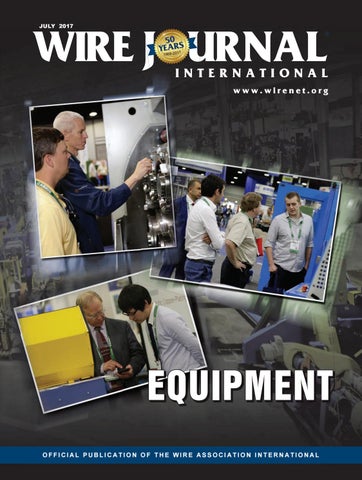
Cover: Images from the show floor of some of the equipment that was shown at Interwire 2017, where some 400 industry suppliers were represented at the Georgia World Congress Center. JULY 2017 | 3
CONTENTS
INSIDE THIS ISSUE Taking a steel stand...but whose? . .6
Scholar gets a ‘reel’ education . . .36
U.S. Commerce Secretary Wilbur Ross is shepherding a Section 232 investigation into whether steel exports represent a national security threat to the U.S., a case that splits domestic producers. See p. 6. What’s likely to happen? By the time you read this, it could be old news. Speaking at a June 19 summit, Ross said that he expected a decision to be made shortly, and that President Trump would take swift action that could include tariffs or quotas. “The president being the president, I don’t think he will dilly dally very long on making his decision, whatever it turns out to be,” Ross was quoted as saying in an article in Reuters. “I would expect this to come to a head during the month of June.”
RSCC Senior Vice President Luke Thompson withWire Link Scholar Bruce Jones at the company’s plant in East Granby, Connecticut. It was one of multiple stops he made during his two-week trip in the U.S. Jones, a technical account manager for U.K.-based British Steel, got to see first-hand how different wire and cable plants operate. He also got to spend time at Interwire 2017 as well as enjoy some fun stops, from a racetrack and an auto museum to a battleship and Fenway Park. His report starts on p. 36.
4 | WIRE JOURNAL INTERNATIONAL
It Never Calls In Sick. Never Filed A Worker’s Comp Claim. Never Asks For A Raise And Saves The Company $150,000 A Year. Windak’s AutoReeler AR24-D makes automatic spooling, packaging, and palletizing simple, efficient and affordable. Automatically load, wind, stretch wrap, unload and palletize wire and cable on spools - eliminating the labor, wages and benefits of 3-4 operators. This “affordable automation” not only helps you reduce your packaging costs, but also helps increase productivity by up to 40%.
www.windakgroup.com windak inc, usa 221-b s.mclin creek rd conover, nc 28613 usa tel +1 828 322 2292 fax +1 828 322 1716 infoamericas@windakgroup.com
EDITORIAL EDITORIAL
U.S. investigation of exported steel: it’s a matter of timing, perspective & politics The steel sector has been used as a political football more than once, so when the U.S. Commerce Dept. on June 20 held the first Section 232 investigation on steel since 2001, it was a telling moment, one that largely splits the industry between those that produce their own steel and those that must buy it to process. Per Section 232 of the Trade Expansion Act of 1962, the Secretary of Commerce can investigate the effects of imports on national security and recommend actions that include tariffs and quotas. Since 1980, 14 such investigations have been held. By law, Commerce has 270 days to present its recommendations. Commerce Secretary Wilbur Ross has already indicated that the investigation would soon be concluded, while the rules allowed a decision to be made as late as January 2018. Richard Chriss, president of the American Institute for International Steel (AIIS)—which maintains that duties would harm steel consumers more than it would benefit producers—has called for more hearings. Opponents counter that would only allow more damage. Nucor Corporation President John Ferriola said that China was the key to the crisis, but other countries, like Korea, Brazil, Russia and Turkey, have also driven excess steel capacity. “These governments continue to flood the world with artificially cheap steel, and much of it finds its way to the U.S., where markets are open and the government doesn’t keep mills in business for political reasons.” Some three dozen speakers spoke on the merits of the matter. A 2017 Commerce Department’s Steel Industry Executive Summary found that overall U.S. capacity use was 71% in 2016, a drop from 77.5% in 2014. March 2017 steel imports to the U.S. are 34% higher than those in March 2016, a dramatic increase. The above is a “big steel” issue, but the same dilemma—what happens if a “remedy” results in even more damage—is also at the heart of a separate matter on steel wire rod exported by 10 countries. In addition to the above 232 investigation, which stems from a campaign pledge by President Donald Trump, there is a parallel Section 232 action that covers aluminum. Each side has a long list of supporting facts, but at the end of the day, it seems that the issue is only crystal clear to those who have a decided interest in the outcome.
Mark Marselli Editor-in-chief
6 | WIRE JOURNAL INTERNATIONAL
WIRE JOURNAL
I N T E R N A T I O N A L
®
Quality in its sparkling form. With passion, we develop future-oriented measuring and control devices for quality assurance of wires and cables, such as the SPARK 6000. A high-frequency, high-voltage spark tester for DC and AC voltage that is typically installed after the cooling section or in rewinding lines. An essential component to reliably detect pin holes and bare patches in the insulation, ensuring that only flawless cables are delivered. - Processor controlled test-voltage for highest precision - Integrated 3-step self-test and calibration system with exchangeable module - Wi-Fi interface and SIKORA App for flexible diagnosis and connectivity - Fulfills all important test and safety standards
www.sikora.net/spark6000
Visit us from October 3-5, 2017 at wire South America, SĂŁo Paulo, Brazil
CALENDAR
CALENDAR Sept. 19-21, 2017: wire Southeast Asia 2017 Bangkok, Thailand. To be held at the Bangkok International Trade & Exhibition Centre (BITEC), it is organized by Messe Düsseldorf. Contact: Messe Düsseldorf North America, tel. 312-781-5180, info@mdna.com, www.mdna.com. Oct. 3-5, 2017: Wire South America São Paulo, Brazil. To be held at the Imigrantes Exhibition & Convention Center. Contact: Messe Düsseldorf North America, tel. 312-781-5180, info@mdna.com, www.mdna.com. Oct. 8-11, 2017: 66th IWCS International Cable & Connectivity Symposium Orlando, Florida, USA. Contact: Pat Hudak, IWCS, tel. 717-993-9500, phudak@iwcs.org, www.iwcs.org. Nov. 7, 2017: CabWire World Conference 2017 Düsseldorf, Germany. To be held at the Congress Center, this event is organized by U.K.-based IWMA. Contact: IWMA, tel. 44-121-781-7367, info@iwma.org, www.iwma.org. Dec. 6-9, 2017: Iran Wire 2017 Tehran, Iran. This event, which is owned and organized by the Aria Group, has both a new date and location: the Exhibiran International Exhibition Center. Messe Düsseldorf is the exclusive overseas associate.
Contact: Messe Düsseldorf North America, tel. 312-781-5180, info@mdna.com, www.mdna.com. May 14-16, 2018: WAI Operations Summit & Wire Expo 2018 Nashville, Tennessee, USA. This WAI event, to be held at the Gaylord Opryland Resort & Convention Center, includes the Association’s trade show, technical programs and 88th Annual Convention, www.wirenet.org. Sept. 26-29, 2016: wire China 2018 Shanghai, China. The 8th All China International Wire & Cable Industry Trade Fair will be held at the Shanghai New International Expo Center (SNIEC). Contact: Messe Düsseldorf North America, tel. 312-781-5180, info@mdna.com, www.mdna.com. Nov. 27-29, 2018: Wire & Cable India Mumbai, India. This event will be held at the Bombay Convention & Exhibition Center. Contact: Messe Düsseldorf North America, tel. 312-781-5180, info@mdna.com, www.mdna.com. May 13-16, 2019: Interwire 2019 & WAI’s 89th Annual Convention Atlanta, Georgia, USA. This WAI event, which will be held at the Georgia World Congress Center, includes its trade show, technical programs and 89th Annual Convention, www.wirenet.org.
WIRE ASSOCIATION INTERNATIONAL EVENTS Sept. 12, 2017: New England Chapter 23rd Annual Golf Tournament Avon, Connecticut. To be held at the Golf Club of Avon. Contact: Jenn LaValley, tel. 203-453-2777, ext. 118, jlavalley@wirenet.org. Sept. 21, 2017: The Vannais Southeast Chapter 16th Annual Golf Tournament Conover, North Carolina, USA.
8 | WIRE JOURNAL INTERNATIONAL
To be held at the Rock Barn Golf and Spa, Conover, North Carolina. Contact: Steve Fetteroll, tel. 203-453-2777, ext. 115, sfetteroll@wirenet.org.
May 14-16, 2018: WAI Operations Summit & Wire Expo 2018 Nashville, Tennessee, USA. See above.
Oct. 5, 2017: Ohio Valley 14th Annual Golf Tournament Solon, Ohio. The chapter will return to Grantwood Golf Course. Contact: Steve Fetteroll, tel. 203-453-2777, ext. 115, sfetteroll@wirenet.org.
May 13-16, 2019: Interwire 2019 & WAI’s 89th Annual Convention Atlanta, Georgia, USA. See above.
Whether you want to Whether you want to
Form, Form, Coil, Coil, Swage, Swage, Shape Shape or or Draw Draw
FENN has over 100 years of expertise in creating customized metal forming FENN has over 100 years of expertise in creating customized metal forming equipment for a wide variety of applications. Learn more and see videos equipment for a wide variety of applications. Learn more and see videos of FENN’s robust, precise line of equipment at www.fenn-torin.com. of FENN’s robust, precise line of equipment at www.fenn-torin.com.
Turks Heads Turks Heads Torin Spring Coilers Torin Spring Coilers
Rolling Mills Rolling Mills Wire Flattening Wire andFlattening Shaping and Shaping
sales@fenn-torin.com sales@fenn-torin.com
Drawbenches Drawbenches Swagers Swagers
www.fenn-torin.com www.fenn-torin.com
INDUSTRY NEWS
INDUSTRY NEWS ASN to supply submarine cable system to connect India and South Africa Alcatel Submarine Networks (ASN) will supply a submarine cable system spanning more than 8,850 km that will be the first open cable connecting Mauritius and Rodrigues Islands to South Africa and India.
sub-Saharian Africa. The cable system will stretch from Mauritius to Rodrigues, to the east coast of South Africa and then on to the east coast of India. Per the release, the design calls for ultimate capacity of more than 13 Tbits-per second per fiber pair. ASN will also be in charge of project management, system design, marine operations and system commissioning, supported by IOX personnel. The project will result in “easy connectivity to current and future undersea cables on the east and west coast of Africa, delivering a gateway to the continent and a new alternate route between Asia and Africa.”
LS Cable & System wins contract to supply UHV cable to DONG Energy
Route of the proposed IOX Cable System. A press release from African Media Agency said that the cable system operator, Mauritius-based IOX Cable System, is launching a cable route that will provide the island of Mauritius and the nearby island of Rodrigues— midway between South Africa and India—with access for the first time to a submarine cable. The turnkey agreement will see the IOX Cable System increase the availability of ultra-high speed broadband services, and reinforce Mauritius as a communication hub in
LS Cable & System Asia, a holding company for South Korea’s LS Cable & System, has won a US$10 million deal to supply ultra-high voltage cables (UHV) to DONG Energy, a state-run energy company in Denmark. A press release said that the contract calls for providing 1.5 km-long cables that are approximately three times the length of traditional high-voltage cables. The advantage of the long-distance cables, preferred in Europe, is that they cut down on construction costs such as connection material and installation cost and periods.
Do you have an industry hotshot? A slew of “30 under 30” profiles of up-and-coming newcomers to a given field have become very popular in recent years. The WAI’s Board of Directors believes that such recognition should extend to professionals in the wire and cable industry. With that mindset, the WAI is issuing a call for Industry Hotshots. If you have someone in your ranks, under age 40, whose smarts and work ethic make that person a star in your company, we encourage you to nominate that person. If selected, the person will be profiled in the September issue of WJI. For details on the process, either call WJI Editor Mark Marselli at tel. 203-453-2777, ext. 132, or send him an e-mail at mmarselli@wirenet.org. A link to an on-line application can be accessed at the home page of www.wirenet.org.
The LS Cable & System’s LSCV plant in Vietnam, which is undergoing expansion. Per the company’s website, LS Cable & System Asia has two operations in Vietnam: LS Cable Vietnam (LSCV) and LS-VINA-Cable (LS-VINA), which collectively supply building wire, higher-voltage power cable, telecom cable and more. This marks the second contract that LS & Cable has received from DONG Energy, which last year gave it an order to supply 132 kV cable. That deal represented the company’s first foray into the European high-voltage market. Being awarded the new
Got news? E-mail it to the WJI at editor@wirenet.org.
10 | WIRE JOURNAL INTERNATIONAL
will empower LS Cable’s sales and operating profits to grow 15% year-on-year to the highest level ever this year.” A report in The Korea Times said that there appears to be steadily rising demand for cable, sparked by economic growth in Vietnam. Foreign direct investment (FDI) registered from January to April increased to $10.95 billion, up 40.5% year-on-year, according to the Vietnamese government. Southern Vietnam, in which LSCV is located, has ongoing projects, including building a power plant and foreign firms’ factories, increasing demand for cables.
Wire & cable in the news British Steel: a success story for the ages What a difference a year can make. In a stunning reversal of fortunes, the ailing U.K. longsteel business of Tata Steel—which posted a record £79 million annual loss at the end of March 31, 2016—has seen stunning success. On June 1, 2016, the entity was sold for £1 to Greybull Capital LLC, and the results for the new business with an old name—British Steel—have been the stuff of a Horatio Alger novel. To younger readers, let’s just say that Horatio Alger means a wishes-come-true turnaround that seems to defy the harshness of the real world. And that seems to define what has happened at British Steel. Jobs have been restored, pay cuts ended, staffers given a stake in the company and more capital investment committed for future growth. The good news knows no bounds, as even the new employee publication just won an award. “In 12 months we have started transforming from an inward-looking production hub into a profitable, more agile business by controlling costs, improving our product range and quality, and through strategic investments,” said British Steel Executive Chairman Roland Junck. “The transformation in this business is (due to) our remarkable people who have embraced, engineered and led change. ... (They) are the reason I have great optimism for the future of British Steel.” Below are some of the highlights: • Operating as an independent business, British Steel reported a £47 million profit (EBITDA), its best performance in a decade for its five independent business units. The business’s financial turnaround started shortly before British Steel was launched by Greybull Capital, which made £400 million available. • One of those five sectors, wire rod activities, achieved the highest sales and manufacturing output in six years, with continuing success in automotive sales growth. The product range has been expanded, with significant sales success into the bright drawing markets.
The British Steel flag is flying briskly. • Staff pay cuts of 3% that were a key to the sale and turnaround plan have ended, and since June 1, 2016, 500 new employees have joined the company. • Employees are being given 5% of the business. “As we look to further grow the business it is important our employees, who have played such a vital role... should share in our future success,” Junck said. • The company has been awarded International Standard ISO 9001:2015, Quality Management Systems by Lloyd’s Register Quality Assurance (LRQA), among the first 6% of LRQA’s U.K. clients to transition to the 2015 standard. • The turnaround has enabled the company to announce plans to invest a further £40 million in capital investment 2017-18. • In June, the new monthly employee newspaper, Steel Matters, won the Chartered Institute of Public Relations’s Excellence Award for Best Internal Publication. In March, the company won six awards at Transform Awards Europe, including the Grand Prix award for overall excellence in rebranding. • And, in a timely coincidence, Bruce Jones, a technical account manager for British Steel, was chosen to serve as the 2017 Wire Link Scholar, a unique U.K./ U.S. industry program. A report on his two-weeks spent in the U.S., touring different plants as well as attending Interwire 2017, starts on p. 36 in this issue.
JULY 2017 | 11
INDUSTRY NEWS
contract shows that the Vietnam plant is seen as being able to provide the same quality of products and safety management system as that of South Korea’s LS Cable, the parent company. Per reports in BusinessKorea, The Korea Times and Pulse News, once the expansion of telecom cable production lines at the LSCV plant in Ho Chi Minh City—due to be completed this quarter—is completed, “our sales to Viettel, the largest telecom operator in Vietnam, will balloon beginning in the second half of this year,” said Shin Yong-hyun, CEO of LS Cable & System Asia. “A boom in the Vietnamese economy and a hike in copper prices
INDUSTRY NEWS
JDR has been named a preferred cable supplier for floating wind farm project U.K.-based JDR, a supplier of subsea power cables and umbilicals to the global offshore energy industry, reports that it has been selected by WindPlus as the preferred cable supplier for the Windfloat Atlantic (WFA) 25 MW floating wind farm.
JDR is a preferred supplier for the WFA wind farm. A press release said that the project, located off the coast of Viana de Castelo in Northern Portugal, will see the industry’s first application of dynamic cables operating at 66 kV. The scope of supply includes the design and manufacture of array cables to suit V164 floating turbines. The floating wind turbines will be connected via a network of inter-array cables to one export cable. A company representative informed WJI that JDR is the lone preferred cable supplier. Also, that the amount of cable was not cited as that will depend on final layout of the wind farm. The release said that JDR will deploy its dynamic cable break-away system that protects the floating platform as well as HV termination and testing. James Young, Chief Technology Officer at JDR, said that a key to landing the contract was the company’s experience “in designing and optimizing the cable configuration and accessories to meet the needs of this floating offshore wind project.” The release said that WFA brings together two pioneering developments in array cables: dynamic cable design for floating offshore wind and high-voltage power trans-
12 | WIRE JOURNAL INTERNATIONAL
mission, through 66kV cable technology. JDR was recently awarded the world’s first large-scale commercial 66 kV project, for the East Anglia One wind farm, in the U.K.
Craig Wire acquires Von Roll Austral Craig Wire Products (CWP) announced that it has acquired Von Roll Austral, Inc. (VRA), a manufacturer of shaped and heavy round copper magnet wire. The two U.S. companies are both based in Georgia: CWP in Temple and VRA in Douglasville, with a combined 40 years of experience of providing shaped and heavy round magnet wire for quick delivery and short run requirements. The acquisition combines the strength and assets of the two companies and allows Craig Wire to enhance its “Quick Time” manufacturing capabilities. Per Craig Wire Products, which specializes in short runs (250 lb) of copper magnet wire, Von Roll wanted to exit magnet wire in the U.S. as it was not in their long-term
strategy. The production equipment at VRA, which owns its plant, was described as being in good condition. The plant has 42 staffers while CWP, which has 33 employees, is now managing the VRA operations. “Our focus and main priority at this time is to integrate the two (operations).” VRA is one of four U.S. businesses that is part of the Swiss-based Von Roll Group, which notes at its website that it will continue to operate in the wire business, particularly in France and India.
Chinese company plans JV to build stainless steel factory in Indonesia China’s Delong Holdings Limited plans to build a stainless steel factory in the Morowali Industrial Park in Central Sulawesi in Indonesia, a joint-venture project that will cost approximately US$950 million. A report in the Jakarta Times said that the proposed plant will have production capacity of 3.5 million metric tons of steel bars, wire and slab. The production will serve demand in eastern Indonesia, said A map of Central Sulawesi, a thriving Gusti Putu Suryawirawan, industrial area in Indonesia.
the Industry Ministry’s director general for metals, machinery, transportation and electronic equipment. Suryawirawan said that the 2,000 hectare industrial park already has a nickel smelter that will supply raw materials for steel factories. Once completed, the steel factory complex will be the second such one in Indonesia, which has another one in Cilegon in Banten. The proposed joint venture, to be named PT Dexin Steel Indonesia, would have approximately 45% of the shares owned by Delong’s subsidiary, Delong Steel Singapore Projects Pte. Ltd., 43% owned by Shanghai Decent and 12% by PT Indonesia Morowali Industrial Park. Chinese investment in Indonesia’s manufacturing sector has seen tremendous growth since 2014, the article said.
Mid-West Wire Products closed Mid-West Wire Products, a family business founded in 1927 that manufactured steel and wire fabricated products for industrial and commercial applications, has closed operations at its plant in Ferndale, Michigan. Per the company’s website, Mid-West Wire Products had over 100,000 sq ft of manufacturing capacity as well as a powder coating facility. “Our diverse manufacturing products include: wire containers, wire displays, sporting good displays, retail store fixtures, custom wire baskets, nursery carts, shelving, display racks, commercial roll
30,000+
HOT SUMMER DEALS!
Davis Standard (2”, 24:1) Hi-Temp Extrusion Line
Cortinovis 630mm (24”) 6+18 DIN 630 Planetary cabling line
American Kuhne (1 1/2”, 24:1) Hi-Temp Extrusion Line
EXPL423
CBR1290
EXPL422
EJR Dual Concentric Head Taping Line
Nokia Maillefer EKP-100 1m Dual Take-up
Jennings 2 ½” PTFE Ram Extruder
TPR366
TKU1520
EXP1313
Visit wireandplastic.com to view our complete inventory or contact us at info@wireandplastic.com TEL: +1.860.583.4646 JULY 2017 | 13
INDUSTRY NEWS
Per CWP, the plan is to continue to manufacture in both locations. “We look forward to providing superior service and product quality as never before.”
INDUSTRY NEWS
carts, major refrigeration appliance products and custom designed products to name a few.” Heritage Global Partners auctioned off much of the equipment, which included welding and bending equipment, in late June. There were some 600 lots for sale. The company’s entry in the WJI Reference Guide showed as many as 110 employees at one time. Company officials declined to talk to WJI.
Taihan Electric Wire reports winning contracts, plans for JV in Saudi Arabia Earlier this year, South Korea’s Taihan Electric Wire Co., Ltd., (TEW), reported winning two power cable contracts in the Middle East, and also announced that it will create a joint venture in Saudi Arabia for HV cable accessories. Per two press releases, TEW reported that it has won an order worth US$43 million for a 380 kV Extra-High Voltage (EHV) cable project in Saudi Arabia. The order, from Saudi Electricity Company-EOA, calls for TEW to install a 118-km underground power line to link substations between Doha and Qurayyah. The large-scale project also calls for TEW to supply cable accessories, make connections and perform testing. The second order, worth US$19 million, is for a 300 kV EHV cable project in Kuwait to be installed at a new oil refinery in Al-Zour. The turnkey system project will also include connections, civil engineering and even testing. In related news, TEW announced that it will establish a production company for HV in Riyadh, the capital of Saudi Arabia, as part of its localization strategy. The JV, to be called SAUDI TAIHAN, is being jointly funded by the Mohammed Al-Ojami Group, a local cable accessory company in Saudi Arabia. TEW plans to build a basic production facility that covers about 8,000 sq m before year’s end.
The new JV will be the first HV-class cable accessory company located in Saudi Arabia, the release said. It noted that Saudi Arabia has previously had to import HV-class cable accessories from Germany and the U.S. The new venture will increase TEW’s “competitive edge by localizing production based on its technical prowess,” it said. It noted that TEW now has production plants and corporations, including cable and cable accessory factories in South Korea, TCV in Vietnam and M-TEC in South Africa. Per Wikipedia, TEC was established in 1955 as the first wire and cable company in South Korea.
14 | WIRE JOURNAL INTERNATIONAL
World Bank to provide the funding for subsea cable system in Pacific The World Bank announced that it has approved $36 million in grants to help provide reliable fiber-optic broadband internet in Kiribati and the Federated States of Micronesia (FSM). A press release said that the grants—$20 million for Kiribati and $16.26 million for FSM—will finance the installation of a subsea cable system that will connect Tarawa, Kiribati, to Nauru and Kosrae state, FSM, to Pohnpei state, FSM, which is connected to global networks. The Asian Development Bank is preparing finance to support Nauru’s participation in the cable system.
The projects are part of the Pacific regional connectivity program that seeks to bring more reliable and affordable internet to the majority of countries in the Pacific Islands. Kiribati and Micronesia are two of the world’s most remote island nations, covering six million square km of the Pacific Ocean, making access to information, services and economic opportunities a massive challenge. The projects will help to provide broadband internet to approximately 80,000 people. In the FSM, the states of both Yap and Chuuk already part of the Pacific regional connectivity program through the Palau-FSM Connectivity phase. The underwater cable systems for the two states are scheduled to be installed late this year, and be operational in early 2018. When completed, all four states in Micronesia will have access to broadband internet. “Just a few short years ago, no one would have believed such a project was possible,” said Yosiwo George, vice president of the FSM national government. The $36.26 million grants are provided through the International Development Association (IDA), the World Bank’s fund for countries most in need.
New Zealand to support project for a submarine cable to serve 3 islands New Zealand will contribute US$15 million toward connecting the Cook Islands of Rarotonga and Aitutaki and the island nation of Niue by a submarine cable. Per a report in Cook Islands News, Cook Island Prime Minister Henry Puna said at a ceremony that the cable system would link the two islands to faster, low-cost internet, which he said was essential for economic and social development. “The project will extend the existing Honatua subsea cable in the Pacific to Samoa, Niue and the Cook Islands, hopefully bringing us faster, more affordable and reliable internet services.”
Engineered to your extrusion needs, cost-effectively …IN insulating and jacketing … Insulating lines … Jacketing lines … Capstans and caterpillars … Accumulators … Payoffs and take-ups
CCV lines for low, medium and high voltage power cables
Black Sea Technology Inc. Black Sea Technology
6100 Corporate Dr., Houston, TX 77036 info@blackseatech.net, +1 832 913 9826 www.blackseatech.net
INDUSTRY NEWS
a total land area of 240 sq km and a population of FROM T. FUKASE TOhave STEEL AND about 20,000. Niue, anCORD island country west of the Cook Islands, has 260 sq km and a population, predominantly STAINLESS STEELPolynesian, WIRE of lessDRAWERS than 1,700.
The Manatua cable will have three fiber pairs operating at 30 Tbits per second. The main cable trunk will run between Apia and French Polynesia with branching units to Niue, Rarotonga, Aitutaki and Borabora. A consortium made up of the participating countries will construct, manage and own the cable. The final signing process for the Manatua cable agreement between the government of the French Republic on behalf of French Polynesia and the governments of Niue, Samoa and the Cook Islands coincided with the PITA 21st AGM and Tradeshow. Attending the event was New Zealand Prime Minister Bill English, who said that the project will enable Cook Islander citizens of New Zealand to benefit from the continuing and rapid advances in global technology. “In fact I’m sure, Prime Minister, you’ll have better connectivity here than in parts of New Zealand.” The cost for the project is estimated to be around $34.4 million, and with New Zealand providing $15 million, the remainder of the costs for the Cook Islands will be from the ADB, the report said. The expectation was that the cable would be ready in 2019. Puna said the signing was a significant demonstration of trust and between T. cooperation FUKASE & CO., “our LTDPolynesian brothers and sisters” to improve telecommunications and connectivity among the Cook Islands and the rest of the world. A self-governing country in the South Pacific Ocean in free association with New Zealand, the Cook Islands
16 | WIRE JOURNAL INTERNATIONAL
Danieli to upgrade wire rod mill for Riva Group plant in France Danieli reports that it has received an order to upgrade a wire rod mill for a plant in France for Societé Aciers Armature Pour Beton, part of the Riva Group. A press release said that the contract calls for Danieli to provide its patented HSS High-Speed Shear that will enable automatic wire rod head and tail cropping at * Accurate pre-sized T/C speeds up to 130 m/s for wire rodNib from 5.0 to 20 mm. The technology was described as representing * Accurate Reliable T/C die Machines“the most advanced solution available for improving coil * Long Shaving Die quality, andLife reducing transformation costs.” for Stainless Steel Wire said, includes serThe supplied package, the release vo-assisted “Active Pinch Rolls” to be installed in front of the high-speed shear to control the speed and eliminate vibrations, allowing the shear to achieve the best cut. The design permits trimming and chopping to be performed by blades mounted on a single blade holder, through a single driving group, while the control system allows repeatable trimming of the out-of-tolerance or uncooled head and tail portions of the rolled stock.
INDUSTRY NEWS
WCMA annual golf tourney dodges rain hazard, scores splendid tourney The beauty of golf is that as long as one can play, it is a very good day. That was the story for the Wire & Cable Manufacturers’ Alliance (WCMA), as its Ed Fenton (love the shirt!) with June 5 annual WCMA Board President Tom Rosen. spring general membership meeting and golf outing at the Wethersfield Country Club was fortuitously sandwiched between two rainy days. WCMA Executive Director Ed Fenton thanked the 140 players and the sponsors for their generosity at the networking/dinner program, which included 10 non-playing guests. Proceeds for the event, which included a raffle and silent auction, go to cancer research at UConn. WCMA raised close to $3,000, and will match the funds, he said. The winning low-gross team was Jim Stocking, John Netta, Bob Smith and Sue Welsh while the first low net team was Mark Normandin, Bob Auger, Jim Hobensack and Joe Barry. Major sponsors for the event included Carris Reels, W. Gillies Technologies, Chase Corp. and James Monroe Wire & Cable.
The winning low net team of Mark Normandin, Bob Auger, Jim Hobensack and Joe Barry. WCMA Board President Tom Rosen, Wire & Cable Consulting LLC/Ulbrich Specialty Wire, reported that the organization, which now has 92 members, continues to grow, and that it will continue to provide valuable information resources and networking opportunities to manufacturers of electrical and electronic wire and cable while collaborating fully with like organizations. During 2017, WCMA will transition in new Board Members Paul Gemelli, Gem Gravure; Gary Stanitis, Daikin America; and Ron Reed, Lloyd and Bouvier. Rosen is scheduled to be succeeded as president by Bob Canny, TE Wire & Cable, in 2018. JULY 2017 | 17
PERSPECTIVES
PERSPECTIVES How to fathom the price of copper The publisher of The Copper Journal, John Gross is president of J.E. Gross & Co., Inc., a management consulting firm established in 1987, has worked with global leaders in the metals industry for more than 35 years. A highly decorated Vietnam Veteran, he has served as a director of the American Copper Council and as a member of the Comex Advisory Committee. Below is a recent column, followed by some questions from WJI. He can be contacted at john.gross@jegross.com, www.jegross.com.
What’s wrong with this picture?
1.8% to 23.461 mmt, resulting in a net deficit of some 55,000 mt last year. John E. Gross Thus, for the seventh consecutive year, the global copper market experienced a net deficit position, while the annual average price notched its fifth consecutive decline after peaking at $4 in 2011. How do we reconcile this apparent anomaly? Well, we can’t very easily, and this incongruity demonstrates the deepening complexity in attempting to logically analyze
Take a look at the below chart, which illustrates the relationship between the global market balance for copper and the Spot Comex annual average price. Based on the latest report from our friends at the International Copper Study Group, global production of refined copper rose 534,000 million metric tons (mmt), or 2.3% during 2016 from the prior year, to 23.406 mmt. Consumption on the other hand climbed 426,000 mt, or
The Copper Journal Global Copper Market Balance Vs Spot Comex Annual Average Price $4.50
800
$4.00
600
$3.50
400
$3.00
200
$2.50
0
$2.00
(200)
$1.50
(400)
$1.00
(600)
$0.50
(800)
$0.00
(1000) 2000
Source: ICSG
2001
2002
2003
2004
2005
2006
2007
Global Market Balance
2008
2009
2010
2012
2013
Comex Copper Annual Average
Comparison of global market balance and Comex copper annual average.
18 | WIRE JOURNAL INTERNATIONAL
2011
2014
2015
2016
JE Gross
To state the obvious, the bigger the numbers become, the more difficult it is to decipher them. WJI: Who are the winners and losers when the market acts as it currently does? Gross: I hesitate to say there are specific winners or losers, but those organizations that are acutely focused on managing their price risk in a disciplined, and consistent manner will typically come out ahead.
Further, it is startling when we look at the numbers from a more macro point of view. As the statistics below illustrate, between 1990 and 2015, global consumption of refined copper rose 111%; U.S. consumption fell 17%, while China saw a 2,137% increase. Let’s not talk about the production side. John E. Gross. Editor/Publisher, The Copper Journal
Copper
1990
2015
MT
Percent %
U.S.
Production Consumption Net
2,017 2,150 (133)
1,135 1,792 (657)
(882) (358)
(44%) (17%)
China
Production Consumption Net
562 512 50
7,964 11,451 (3487)
7,402 10,939
1317% 2137%
Global
Production Consumption Net
10,809 10,780 29
23,097 22,736 361
12,288 11,956
114% 111%
WJI: Can copper prices Three periodic views of changes in copper consumption and production. continue to fluctuate in ways that seem to defy WJI: Have you expected some sense of “market norinexorable market forces, or will there inevitably come a malcy” to have been restored by now? Do you have any time when the relationship between supply and demand confidence whether it ever will? is restored? Gross: The markets – all markets are always full of surGross: We like to think that the fundamentals ultimateprises, and at times illogical behavior. This is one reason ly dictate prices, but over the past eight years, following why technical analysis of price patterns has become so the economic crisis, and subsequent quantitative easing important. by central bankers throughout the world contributed to a severe distortion in prices that remains with us today. The WJI: What action can wire and cable companies take secretive nature of the Chinese government regarding stato mitigate the impact of volatility in the copper and tistics is another factor in the distortion, and there is little aluminum markets? we can do about it. Gross: It is imperative that companies have clear understanding of their exposure to price risk, as relates to WJI: Does this happen to any degree to other highly procurement, inventory valuations, and firm price sales. traded metals (gold, silver, platinum)? At the end of the day, wire & cable companies are buyGross: It seems that the greatest impact is felt in ing metal, adding value, and selling metal contained in non-ferrous metals and other industrial materials. The product. The critical importance of price risk management precious metals, we believe are more influenced by a cannot be understated. variety of other financial considerations.
Perspectives is an occasional section to present notable information about subjects that may be directly or indirectly related to the wire and cable industry. If your company has information that it believes should be included, send an e-mail explaining why to editorial@wirenet.org.
JULY 2017 | 19
PERSPECTIVES
the global fundamentals for copper, as well as many other markets. In fact, on the numbers, between 2010 and 2016, the global copper market racked up a cumulative deficit of 1.48 mmt. Where did the metal come from? Here again, it is hard to say, but perhaps part of the answer may lie in the transparency, or lack thereof in statistics from China, which has evolved to become the world’s largest producer and consumer of copper, among other industrial materials.
PATENTS
Patent REPORT Technical advances are a necessity for any industry, and to that end, companies invest considerable resources in R&D. This monthly section will list the abstracts of recently approved U.S. patents. Most are direct to wire and cable while a few may be more indirect/downstream. Shielded electrical cable U.S. Patent No.: 9,672,957 Patent date: June 6, 2017 Filed: Nov. 24, 2014 Assignee: 3M Innovative Properties Company, USA Inventors: David Kordecki, Douglas Gundel, Saujit Bandhu A shielded electrical cable (50) includes conductor sets (51a, 51b) spaced apart along a width of the cable and extending along a length of the cable. Each conductor set includes first and second insulated conductors (52a, 52b), one or two drain grounding wires (54) disposed between the first and second insulated conductors, first and second conductive shielding films (56a, 56b) disposed on opposite first and second sides of the conductor set, and an adhesive layer (59) bonding the first shielding film to the second shielding film.
Visual tracer system for fiber optic cable U.S. Patent No.: 9,671,551 Patent date: June 6, 2017 Filed: Nov. 22, 2013 Assignee: Corning Cable Systems LLC, USA Inventors: David Dean, Jr., William Hurley A fiber optic cable includes a first optical fiber, a jacket, and a second optical fiber. The first optical fiber includes a glass core and cladding. The glass core is configured to provide controlled transmission of light through the fiber optic cable for high-speed data communication. The jacket has an interior surface that defines a conduit through which the first optical fiber extends. The jacket further has an exterior surface that defines the outside of the fiber optic cable. The second optical fiber is integrated with the exterior surface of the jacket.
Optical fiber cable components U.S. Patent No.: 9,670,345 Patent date: June 6, 2017 Filed: Oct. 18, 2013 Assignee: Dow Global Technologies LLC, USA Inventors: Mohamed Esseghir, Gangwei Sun, Jeffrey Cogen, Gary Marchand
20 | WIRE JOURNAL INTERNATIONAL
Optical cable components fabricated from an extrudable polymeric blend of crystalline polypropylene modified with one or more impact-modifying polymers. The impact-modifying polymers are crosslinked and can be selected from a polyolefin elastomer, an olefin multi-block interpolymer, an olefin block composite, and combinations thereof. Optionally, the polymeric blend can further comprise a compatibilizer. The polymeric blend may also contain one or more additives. The optical fiber cable components can be selected from buffer tubes, core tubes, and slotted core tubes.
Method of manufacturing a fiber optic drop cable U.S. Patent No.: 9,669,592 Patent date: June 6, 2017 Filed: March 12, 2014 Assignee: Corning Optical Communications LLC, USA Inventors: Bradley Blazer, Andrew Dodd, Dieter Kundis, Sebastian Olszewski A method of manufacturing a fiber optic cable includes manufacturing a subunit and manufacturing an outer portion. Manufacturing the subunit includes extruding a subunit jacket over a first reinforcement material constraining an optical fiber. Manufacturing the outer portion of the fiber optic cable includes extruding an outer jacket over a second reinforcement material between the outer jacket and the subunit jacket. Hoop stress is applied to the second reinforcement material by the outer jacket, which constrains the second reinforcement material such that it is positioned and oriented to provide anti-buckling support to the fiber optic cable and mitigate effects on the optical fiber of jacket shrinkage due to low temperatures.
Microwave cable and method for producing and using such a microwave cable U.S. Patent No.: 9,666,335 Patent date: May 30, 2017 Filed: Oct. 17, 2013 Assignee: Huber+Suhner AG , Switzerland Inventors: Michael Rupflin, Matias Klarer A microwave cable (10), intended for a frequency range from 0 Hz up to at least a few 10 GHz, comprises a central
inner conductor (11), a dielectric (12) concentrically surrounding the inner conductor, an outer conductor (13, 14) concentrically enclosing the dielectric (12), and a sheathing concentrically enclosing the microwave cable (10) externally. Stable electrical and mechanical properties, particularly when making up cables, are achieved in that the outer conductor has two electrically conducting bands (13, 14) wound over each other, in that the bands (13, 14) are each wound in an overlapping manner and in that the bands (13, 14) are wound progressively in opposite directions.
Shielded electric wire and wire harness using the same U.S. Patent No.: 9,666,333 Patent date: May 30, 2017 Filed: April 13, 2016 Assignee: Yazaki Corporation, Japan Inventors: Yakeyuki Omura, Hidenobu Oka A shielded electric wire includes an electric wire; a shielding member that forms a shielding layer by covering a periphery of the electric wire; a sheet-shaped member that covers a periphery of the shielding member; and a protective member spirally wound on a periphery of the sheet-shaped member. The sheet-shaped member includes a first sheet material and a second sheet material. One surface of the first and second sheet materials is formed with an adhesive layer. The first and second sheet materials have a width longer than a half circumferential distance of the shielding member provided on the periphery of the
High density shielded electrical cable and other shielded cables, systems, and methods U.S. Patent No.: 9,666,332 Patent date: May 30, 2017 Filed: Feb. 8, 2017 Assignee: 3M Innovative Properties Company, USA Inventors: Douglas Gundel, Rocky Edwards, Mark Lettang, Charles Staley A shielded electrical ribbon cable includes adjacent first and second longitudinal conductor sets where each conductor set includes two or more insulated conductors. The first conductor set also includes a ground conductor that generally lies in the plane of the insulated conductors of the first conductor set. At least 90% of the periphery of each conductor set is encompassed by a shielding film. First and second non-conductive polymeric films are disposed on opposite sides of the cable and form cover portions substantially surrounding each conductor set, and pinched portions on each side of each conductor set. When the cable is laid flat, the distance between the center of the ground conductor of the first conductor set and the center of the nearest insulated conductor of the second conductor set is .sigma.1, the center-to-center spacing of the insulated conductors of the second conductor set is .sigma.2, and .sigma.1/.sigma.2 is greater than 0.7.
Fiber optic cables with extruded access features for access to a cable cavity U.S. Patent No.: 9,664,872 Patent date: May 30, 2017 Filed: Feb. 11, 2016
JULY 2017 | 21
PATENTS
electric wire, and are stuck on the shielding member to sandwich the shielding member. The adhesive layers of the first and second sheet materials are opposingly stuck in extra length portions protruding the shielding member in a width direction.
PATENTS
Assignee: Corning Optical Communications LLC, USA Inventors: Michael John Gimblet, Julian Greenwoods III Cables are constructed with embedded discontinuities in the cable jacket that allow the jacket to be torn to provide access to the cable core. The discontinuities can be longitudinally extending strips of polymer material coextruded in the cable jacket.
Optical fiber cable components U.S. Patent No.: 9,663,645 Patent date: May 30, 2017 Filed: Oct. 18, 2013 Assignee: Dow Global Technologies LLC, USA Inventors: Mohamed Esseghir, Gangwei Sun, Bharat Chaudhary, Chester Kmiec, Gary Marchand, Yushan Hu Optical cable components fabricated from an extrudable polymeric blend of crystalline polypropylene modified with one or more impact-modifying polymers. The impact-modifying polymers are selected from an olefin multi-block interpolymer, an olefin block composite, and combinations thereof. Optionally, the polymeric blend can
22 | WIRE JOURNAL INTERNATIONAL
further comprise an elastomer other than the impact-modifying polymer. The polymeric blend may also contain one or more additives. The optical fiber cable components can be selected from buffer tubes, core tubes, and slotted core tubes.
Method for production of alloyed titanium welding wire U.S. Patent No.: 9,662,749 Patent date: May 23, 2017 Filed: March 21, 2012 Assignee: Norsk Titanium AS, Norway Inventors: Ola Jensrud, Arne Kolbu,
Coaxial cable interface to outdoor broadband unit U.S. Patent No.: 9,661,687 Patent date: May 23, 2017 Filed: April 11, 2014 Assignee: Verizon Patent and Licensing Inc., USA Inventors: Sergio Aguirre, Raafat Kamel,
NEW!
PATENT PENDING
for 2017
AMDD2000 ™ 2” Down Draft Air Wipe
Lalit Kotecha, Kamlesh Kamdar A network device within an outdoor broadband unit receives, via Ethernet over coaxial cable signals, Internet Protocol (IP) data traffic originating from a device within a local area network (LAN). The IP data traffic is buffered in a memory within the outdoor broadband unit. A forwarding plane module of the network device sends the IP data traffic toward a destination via an air interface for a wide area network (WAN). The network device receives, via different Ethernet over coaxial cable signals, IP control traffic originating from the device within the LAN. A control plane module of the network device implements the instructions in the IP control traffic to initiate a test function for the network device.
Vibration resistant cable U.S. Patent No.: 9,660,431 Patent date: May 23, 2017 Filed: Dec. 2, 2015 Assignee: Southwire Company, LLC, USA Inventor: Stephen Lee Spruell Vibration resistant cables containing a first conductor and a second conductor, each having a diameter d, are (section cont’d. on p. 64)
Because you asked for it, our NEW two-inch version joins the ranks of our already legendary Huestis Down Draft™ Air Wipes. The AMDD2000 will dry larger wire and cables with superior performance — as only Huestis Industrial Air Wipes can!
Huestis Industrial machines – our performance is legendary!
ISO9001 REGISTERED
For more details or to place an order, call us at 800-972-9222, or email us at sales@huestis.com
www.huestisindustrial.com Air Wipes, Pay-offs, Take-ups, Buncher Pay-offs, Cold Pressure Welders, Accumulators, Spoolers, Cable Jacket Strippers, Custom Machinery 2C_BW_HUESTIS_NEW_2-inchDownDraftAirWipe_WJI_halfHoriz_v3_06132017_press.indd 1
6/13/17 4:02:33 PM
JULY 2017 | 23
PATENTS
Sverre Gulbrandsen-Dahl, Kevin Dring A method for producing a weldable titanium alloy and/or composite wire. The method includes: a) forming a green object by blending particulates of titanium sponge with one or more powdered alloying additions and cold compacting the blended mixture and subjecting the blended mixture including lubricant to pressure; b) forming a work body of alloyed titanium by heating the green object in a protected atmosphere and holding the temperature for a period of at least 4 hours, and then hot working the green object at a temperature of less than 200.degree. C. apart from the beta transition temperature of the titanium alloy and shaping the green object to obtain an elongated profile; and c) forming the welding wire by placing the elongated profile of the work body in a rolling mill having one or more rolls disposed in series.
ASIAN FOCUS
ASIAN FOCUS Former Chinese steel executive among many sent to prison for taking bribes May 31 was a day or reckoning in China for some high-ranking officials, both in industry and public service, referred to by one report as “the single biggest day of judgment for high-level officials since President Xi Jinping came to power nearly five years ago.”
Deng Qilin in the courtroom where he was sentenced. Photo Xinhua/Zuma Press. A former chairman of Wuhan Iron and Steel (Group) Corp., Deng Qilin, was among those sentenced by the Intermediate People’s Court of Foshan in southern China’s Guangdong Province for taking bribes. The sentencing was one series of such actions taken as part of an anti-graft campaign. Per articles in Xinhua and The Wall Street Journal, on May 31 the court sentenced a range of individuals, including former provincial vice governors, senior bureaucrats and ex-chiefs of major state enterprises. “The point of these heavy sentences now is perhaps a warning to all the political elite that the current leadership can take down and severely punish anyone who does not toe the line,” said Victor Shih, a professor of political economy at the University of California at San Diego. Qilin, whose former company’s scope includes wire rod and wire for tire cord, was sentenced to 15 years in prison for accepting money for business favors and promotions. China Telecom’s Chang Xiaobing received a six-year sentence for taking bribes. Wang Baoan, a former head of the statistics agency, was given a life sentence, also for bribery. Deng was also fined approximately US$728,500, and his “illicit gains” will be turned over to the state treasury. He was found to have accepted bribes worth about US$8.15 million for favors in business, project construction and promotions, while holding a series of posts in the steel company between 2000 and 2015.
24 | WIRE JOURNAL INTERNATIONAL
The court said Deng was given relatively lenient treatment for cooperating with investigators, handing over the proceeds of his crime, and providing information about crimes committed by others. Song Lin, the ousted chairman of major state-owned enterprise China Resources Holdings Co., received a 14-year prison sentence for embezzlement and bribery. Three former officials received life sentences: Lu Ziyue, former mayor of Ningbo in Zhejiang Province, for taking bribes worth US$21.6 million between 1999 and 2016; Chen Xuefeng, former member of the standing committee of the Communist Party in Henan province, for taking bribes worth US$18.4 million between 2000 and 2015 and embezzling US$809,000 of public funds; and Liu Zhigeng, former vice governor of Guangdong Province, for taking money and gifts worth US$4.4 million; former Sichuan Province Vice Governor Li Chengyun received 10 years for taking US$$976,000 in bribes; and former Guangdong Province senior legislator Wang Yang received 16-1/2 years for taking US$9.3 million in bribes and vote buying. Xinhua reported that the above actions follow prior steps taken by the top disciplinary arm of the Communist Party of China (CPC), which has “named and shamed 88 officials in 71 corruption cases that directly undermined public interests.” The CPC Central Commission for Discipline Inspection (CCDI) said the cases involved extortion of state subsidies, embezzlement of poverty relief funds, misappropriation of compensation for land requisitions, abuses of power and receipt of kickbacks. Those named on the list were not as high profile, but the scope was quite wide. A total of 3,333 officials in 2,412 cases have been named since the CCDI established the monthly reporting system to disclose such violations in July 2015. Investigation found that extortion of state subsidies for agriculture was the most common misdemeanor, followed by misappropriation of compensation for land requisitions and embezzlement of allowances for house renovation, according to the CCDI.
Work progresses on Asian submarine cable system as surveys are completed Huawei Marine Networks Co., Limited (Huawei) and Super Sea Cable Networks Pte. Ltd (SEAX) report the completion of offshore and inshore marine surveys that covering the full route of its SEAX-1 submarine cable system between the Eastern seaboard of Peninsular Malaysia, Singapore and Indonesia. A press release said that Huawei Marine has commenced manufacturing of the submarine cable, and that the SEAX-1 Cable System is well on its way as scheduled for Ready-For-Service (RFS) date of the first quarter of 2018.
The route for the SEAX-1 submarine cable system, which is scheduled to be completed early next year. The new system, to be known as SEA Cable Exchange-1 (SeaX-1), includes a 250-km high-speed, large capacity, 24-fiber pair undersea fiber optic cable that will connect Mersing (Malaysia), Changi (Singapore), and Batam (Indonesia). Once commissioned, the system
The Oden Factory Platform
+1 (800) 230-9063
hello@oden.io www.oden.io
JULY 2017 | 25
ASIAN FOCUS
will be fully owned and operated by Super Sea Cable Networks Pte. Ltd. It will serve operators in the region to meet increasing bandwidth demand. SEAX-1 is fully funded and possesses the necessary licenses to operate submarine and terrestrial cable systems within the territories of Singapore, Indonesia and Malaysia. Huawei Marine Networks Co., Limited (Huawei Marine) is a joint venture established by Huawei Technologies Co., Ltd. and Global Marine Systems Limited. “We are proud to work on this groundbreaking project which will significantly boost connectivity between these three nations that lie at the heart of South East Asian region,” said Mike Constable, CEO of Huawei Marine. “With this announcement, we are one step closer to bringing SEAX-1 new submarine cable system to Asia Pacific,” said Joseph Lim, CEO of Super Sea Cable Networks Pte Ltd. “We believe this cable system will enable high-speed and reliable connectivity that are foundational to the realization of smarter cities and smarter futures in this region. The professional and experienced team at Huawei Marine has been integral to the smooth running of this project.” Huawei Marine is headquartered in Tianjin, China, with its manufacturing base in Dongguan, China, with R&D institutes in Beijing and in the U.K. in Chelmsford.
Wire is everywhere.
Play.Watch & Share.
The Wire Association International, Inc. Telephone: (001) 203-453-2777 | www.wirenet.org
Craig Wire Products (CWP) announced that Jason Craig, who joined the company as an international account manager, has been promoted to vice president of marketing. Prior to joining CWP, he was a territory account manager for Isovolta in the Midwest and Canada. Before that, he was a terriCraig tory account manager for Von Roll USA, where he worked from 2002 to 2007. He holds a marketing degree from the Boston University Questrom School of Business. Located in Temple, Georgia, USA, Craig Wire Products is a manufacturer of copper magnet wire specializing in small quantity orders. See related news item on p. 12.
Eric Tremblay will head the Montreal office of Allied Wire & Cable. Prior to his new post, he had worked for more than 21 years for A.E. Petsche Co., Inc., most recently as a national account manager. He has extensive experience in the MIL-aerospace wire and cable industry in North America and Tremblay Europe, serving in sales, both inside and outside, account management and office/branch management. Based in Collegeville, Pennnsylvania, Allied Wire & Cable is a specialty manufacturer and distributor of wire and cable products for markets from that include government, military, aerospace, automotive and telecom.
OBITUARY also honored with the Charles D. Scott Distinguished Otto “Moe” Fuhrman, a long-time fixture in the Career Award in 1995. die industry, died June 15, 2017, at age 87 at Lutheran When Decatur Wire Die was sold to the Diamond Hospital in Fort Wayne, Indiana, USA. Tools Group (now Esteves), Fuhrman was one of the Known for his big presence and even bigger smile, founders of DWD Industries LLC—the real estate Fuhrman was the owner and operator—along with holding company for the five original locations of Duane Melcher and Larry Saalfrank—of Decatur Decatur Wire Die Services—and maintained an active Wire Die from 1979 to 1998, when the company was role there through 2014, thus keeping the family formally sold to Diamond Tools Group (DTG). He industry tie. A WAI was named managing Life Member, he served director, retiring at age for many years as an 70 in 2000. He had preadvisor/consultant for viously worked at Dana Heritage Wire Die, Corp., Wayne Hardware, which was bought by Addressographhis son, Jon, in 2003. Multigraph Co., and The last industry event Hoosier Wire Die, the he attended was Wire latter of which he joined Expo 2014, but he conin a family tradition that tinued as a consultant to has long been the hallthe time he passed. mark of the die indusFuhrman served in try. When his brother the U.S. Army National in-law, Fritz Aumann, Guard for 12 years. the sales manager of He was a member of Hoosier, chose to leave American Legion Post the company in the mid Jon Fuhrman and his dad, Otto Fuhrman, at Wire Expo 2014. 43, an active member 1960s, he recommendof St. John Lutheran Church, and served more than a ed Fuhrman. Another brother-in-law, Gillie Hoffman, thousand volunteer hours for Lutheran Homes. the manager of Hoosier, hired him. Fuhrman was He is survived by his wife of 60 years, Marlene A. definitely a sales person, but he was widely regarded Aumann; a son, Jon Martin Fuhrman; who is presiby his peers as having an excellent knowledge of the dent of Heritage Wire Die; a grandson, Jon William technical side of wire drawing dies. Upon retiring Fuhrman; a granddaughter, Emily Fuhrman; two sisfrom DTG, he served for over a year as a consultant ters, Ruth Eggers and Shirley Hormann; and a brother, to Sumitomo, during which time he helped the comJames Fuhrman. pany redesign its PCD die insert product line. He was
JULY 2017 | 27
PEOPLE
PEOPLE
FIBER WATCH
FIBER WATCH The country of Uzbekistan has plans to produce its first-ever fiber optical cable The country of Uzbekistan plans to start producing fiber optical cables in Tashkent so the country can become more independent in meeting its bandwidth needs. Per a report in uzdaily.com, the plant will have annual production capacity of 50,000 km of cable. That production will be used by national operator Uztelecom, which plans to use 277,000 km of cable by 2021. The announcement, by Sherzod Shermatov, acting Minister of Development of Information Technologies and Communications of Uzbekistan, calls for the plant to be built in the Chilanzar district on the premises of the joint stock company “Rele I Avtomatika.” He said that the project will save Uzbekistan some US$150 million. Per the report, the country plans to expand its internet gateway to 200 Gbps, up substantially from the current figure of 65.7 Gbps. The project furthers the country’s stated goals. An on-line government report said that it fits into the Strategy for Actions for the Republic of Uzbekistan, which has set five priority directions for 2017-2021. In an address by the Minister of Foreign Affairs of the Republic of Uzbekistan, H.E. Abdulaziz Kamilov, at the Senior Officials Meeting of the Member-States of the OIC Preparatory, the goals were outlined. The ministry seeks
The flag of the country of Uzbekistan, which plans to start production of fiber optical cables. “to intensify efforts on creation of high-quality communication links with high capacity in the field, especially in remote and isolated areas of the country. To do this, the ministry will lay new fiber optic cables and replace the existing terrestrial channels, upgrading software and hardware systems and telephone stations.” Per the Rele I Avtomatika website, the Chilanzar location, has 3.91 hectares of area, including a production site of 2.26 hectares where metal and plastic products are manufactured. That includes about a hundred types of low-voltage devices as well as corresponding services that are provided at the factory. There is a necessary infrastructure for further ramping up of the industry.
ISO9001 REGISTERED
DESIGNERS & MANUFACTURERS OF PAYOFF & TENSION CONTROL EQUIPMENT FOR WIRE & CABLE
Where can you buy specialized tension controls and pay-offs? Or custom pulleys with different inserts, coatings and sizes? Wyrepak Industries has the answer for all of your manufacturing needs! For more details on any of our manufacturing product solutions, call us at 800-972-9222 or email sales@wyrepak.com WYREPAK INDUSTRIES — A Huestis Industrial Company • www.WYREPAK.com
68 Buttonwood Street, Bristol, Rhode Island 02809-0718 USA • tel: 800.972.9222 or 401.253.5500 fax: 401.253.7350 2C_WYREPAKHuestis_WhereCanYouBuySpecialized_WJI_halfHoriz_VariousCombos_ShowInfoAdded_v2_02142017_press.indd 1
28 | WIRE JOURNAL INTERNATIONAL
6/13/17 4:21:46 PM
NORMA Group buys majority interest in Chinese fastener manufacturer Earlier this year, Germany’s NORMA Group announced that it has acquired an 80% stake in a Chinese manufacturer of joining products. A press release said that the NORMA Group, based in Germany, agreed to buy Fengfan Fastener (Shaoxing) Co., Ltd. (Fengfan), which is based in Shaoxing City, China. Founded in 1988, Fengfan manufactures joining products made of stainless steel, nylon and specialty materials. “With (this) acquisition, we are expanding our product portfolio and our position in the Chinese market,” said NORMA Group CEO Werner Deggim. With some 190 employees, Fengfan supplies shipbuilding, heavy industries and transport vehicle markets. Its preliminary annual sales amounted to approximately 15 million euros in 2016. Fengfan has a production and sales site in Shaoxing City in the Zhejiang Province.
Fastener maker nears completion of expansion of larger U.K. plant Hague Fasteners, a privately owned U.K.-based company founded in 1971 that makes threaded and milled special fasteners, reports that it has made very good progress on its plans to expand in a new nearby location.
A press release said that the company, based in Willenhall, is expanding into a new facility near its current location that is nearly triple the size. That move is expected to double production for the business. One of the company’s special focuses is on small batch critical special fasteners.
Jon and Claire Hague stoutly believe in U.K. potential. Earlier this year, company owners Jon and Claire Hague said that despite the decision by British voters to exit the EU, they believed that niche manufacturers would continue to grow, and decided to make a major investment. The company reports that its Quality Management System meets ISO 9001:2015, which makes it “one of the few specialist manufacturers that have seamlessly upgraded to the latest QMS standard and are proud to lead the way in the bolt & nut manufacturing sector.”
Lake in the Hills, IL Tel: (815) 356-5306 www.epsione.com AUTOMATED EQUIPMENT MANUFACTURER SPECIALIZING IN WIRE EQUIPMENT
• Spoolers • Troughs • Capstans
Mark Hallenbeck, President Email: info@epsione.com
MADE IN THE USA
• Auto-packaging • Labor Reduction • Improved Safety JULY 2017 | 29
FASTENER UPDATE
FASTENER UPDATE
WAI NEWS
WAI July 2017
LIFE
MEMBERSHIP
SPOTLIGHT Normally, this section introduces a new WAI member each issue. This time the focus is on a new WAI Life member.
Richard Medoff General Manager Ace Metal, Inc. A 2017 WAI Life Member
Q: What year did you join WAI and why did you do it? What were you doing at the time? A: I joined the WAI in 1980, the year before Ace Metal exhibited at the first Interwire show. I was assistant plant manager and sales manager. Q: Did you have any sense that you had found a life-long career? A: I started working for Ace Metal in 1975 after finishing my military obligations and college. As my father had started the business, he was grooming me to eventually run the company. Q: What did you do and how did your career proceed over the years? A: I started out as a punch press operator, then assistant plant manager and continued up the ladder over the years. Ace Metal has been the only company I have ever worked for, which must seem pretty unusual. Q: What has been the best part of being in the wire and cable industry? Ever come close to leaving? A: The industry is expansive and offers many challenges. The camaraderie has been enjoyable, interesting and informative. I have met and worked with so many people over the years and the resulting friendships have lasted equally long. Over the years there were a few times when I thought of changing my line of work, but I’ve always been drawn back by the various hats that I wear here at Ace Metal. It keeps me engaged. Q: Looking back, how has being a WAI member contributed to your career? A: First, I want to note that I feel honored to be part of the wire and cable industry. It’s been a part of my life for most of my life, and to me it makes sense to be a member of the Association that represents it, and not just because we exhibit at its shows. When I travel for business—and not just in this great country, but to other countries as well—I am part of the U.S. wire and cable industry, and that carries some recognition, and the WAI is a part of that legacy.
30 | WIRE JOURNAL INTERNATIONAL
The following individuals either recently joined WAI or became Platinum Members through their companies. Zubair Ahmed Nexans Canada Inc.
Robert James Gagnon Sales Engineer Manager Accurate Precision Wire Inc.
Maximliano Libedinsky Sales Manager Enkotec Co. Inc.
Brad Sprague Regional Sales Manager American Kuhne Inc.
John Renteria Ludena Technical Services Manager Enkotec Co. Inc.
Glenn Michael Stensaker Technical Services Engineer Charter Steel
Brandt Carroll Fort Wayne Metals Research Products Corp.
George Hotton Manufacturing Engineer Times Microwave Systems
Steve Maxson Director of Global Business Develop Graham Engineering Corp.
Ramos Torres Service Technician Enkotec Co. Inc.
William Costanza Director CME Wire and Cable
Terry Hughes Director of Procurement Bekaert Corp.
Ken J. Michonski General Manager Major Wire Inc.
Christopher Cunningham ISO/Quality Supervisor Bekaert Corp.
Patrick Johnsen MW Regional Sales Manager Graham Engineering Corp.
Matt Mitteer Process Engineer General Cable
Dr. LuĂs Manuel Amorim FEUP Keith Burnett Maintenance Supervisor Nexans Energy
Allan Currie Maintenance Manager Electro Cables Inc. Dave Lloyd Deming Engineering Manager Essex Group Canada Craig DiSano President Teknikor Automation & Controls Inc. Daniel Frowerk Electrical Engineer Lincoln Electric Co. Kyle Frye Engineer Lincoln Electric Co.
Craig Hlady Superintendent, Supply Chain Cascade Steel Rolling Mill
Rich Johnson ZD Wire Products Alan Jones SW Regional Sales Manager Graham Engineering Corp.
Mark F. Nuculaj Sales Representative Kreher Steel Dr. Jeeyong Park LS Cable & System Ltd. Phil Pelletier CEO Teknikor
Lisa A. Knepshield Production Manager Bekaert Corp.
David Reed Mechanical Engineer Lincoln Electric Co.
Dr. Richard Jay Larson Director of R&D New England Wire Technologies
Karen Schroyens Technical Manager Bekaert NV
Matthew Leach Vice President Innovation Superior Essex
Alberto Troiani District Sales Manager Schnell SpA Kevin Walsh Macsteel International USA Corp. Justin Werley DBE Supervisor East Penn Mfg Co. Inc. Andrea Zaccagnino Chief Engineer & Developer SNA Manufacturing LLC Jingwei Zhuang Shenzhen Altech Co. Ltd.
Gary Siy Regional Sales Manager American Kuhne Inc.
JULY 2017 | 31
WAI NEWS
MEET YOUR PEERS. ACHIEVE YOUR GOALS. JOIN WAI TODAY.
WAI NEWS
From the WAI Ferrous Wire Handbook With 36 chapters over 1,168 pages, the Ferrous Wire Handbook, published in 2008, remains the Association’s most-ever comprehensive literature project, written by three dozen wire industry experts and edited by former WAI President Robert M. Shemenski, an industry consultant and president of RMS Consulting, Inc. The book is a modern-day reference tool for those working directly in the steel wire or manufacturing, engineering and operations sectors of the industry. The chapters present straightforward explanations of different process, supported by charts and photos. The content covers a full spectrum of sectors, with individual chapters—from wire rod production and deformation in cold drawing to patenting and straightening and cutting wire—that explain the process in practical terms. A company that just wants one or two chapters need not pay for the entire book ($235/$195 for WAI members). A PDF of a single chapter, from 4 through 36, can be ordered for $25, $20 for WAI members. Each order will include an additional free PDF with the first three chapters (A short history of the Ferrous Wire Industry, Evolution of
32 | WIRE JOURNAL INTERNATIONAL
Modern Steel Manufacture, and Modern Steel Manufacturing), which serve as an industry introduction and overview. To get the first three chapters for free, go to www.mywai.org. There you can see and order the other individual chapters. Future issues will present additional chapter summations here.
CHAPTER 14: Wiredrawing Dies SUMMARY: This chapter, 32 pages, discusses the subjects in the below subheads. It includes 22 pictures and figures, five charts and references.
ON SALE NOW!
Types of topics covered: • Die Design • Delta Factor • Variations in Die Design for Wire Products that Fall Outside the Normal Die Design • and more. Available at www.wirenet.org through the WAI Store.
CO U N T RY . B LU E S . JA Z Z . S O U L . P O P . R O C K .
Even Bach began with heavy metal.
classical
nashville
Join WAI in Music City for practical wiremaking solutions, standards & equipment. The Wire Association’s programs for the ferrous, nonferrous, and electrical wire sectors are instrumental in bringing industry professionals together. Music has a similar effect. No matter your industry segment or musical preference you’ll find the perfect range at WAI’s next meeting.
SAVE THE DATE:
Conference: May 14-16 • 2018 Exhibits: May 15-16 • 2018
Gaylord Opryland Resort & Convention Center Nashville, Tennessee, USA
Presentations | Exhibits | Plant Tour Details coming soon.
Organized by
The Wire Association International, Inc.
CHAPTER CORNER
CHAPTER CORNER The Midwest Chapter Scholarships for 2017 have a brotherly touch For the first time in the history of the WAI Scholarship Program, there are two winners from the same family in the same year. This rare designation belongs to the Stepanovic brothers—Scott and Eric—who were selected to receive the 2017 awards from the Midwest Chapter. The Stepanovic name may sound familiar as their mother, Lynn, is purchasing manager at Major Wire, Inc., and their father is the global strategic sourcing manager at Magnum Metalsource. Also, Scott was a recipient of the award in 2015. This time, he and his younger brother, Eric—who will also go to Loyola University Chicago, to study Eric Stepanovic finance—were both chosen. Fort Wayne Metals’ Dennis Rohrs, part of the selection committee, explained the choices. “It was clear to me that the Stepanovic brothers were outstanding candidates for our scholarships. I was mindful of the perception that we would be giving both scholarships to recipients in the same family, but they truly are outstanding candidates. After reviewing Scott Stepanovic their applications, I remarked to a colleague that I would like to meet the parents of these young men since I believe the apple doesn’t fall too far from the tree. Congratulations to the Stepanovic family!” Lynn Stepanovic was thrilled at the news. “Many thanks to the Midwest Chapter for recognizing both Scott and Eric for their achievements in high school and college. They have both worked very hard, and having that acknowledged is truly an honor!”
34 | WIRE JOURNAL INTERNATIONAL
The Midwest Chapter has now awarded 18 scholarships since the program started in 2008, with its annual golf tournament a key “driver” for making that possible.
A good day for the Midwest Chapter golf tourney, and for a good cause The Midwest Chapter returned on June 16 to West Chicago, Illinois, to stage its 15th Annual Golf Tournament, and while the forecast had been iffy, the weather golfing gods were generous as it turned out to be a perfect day at the St. Andrews Golf & Country Club. The team of Jamey Ford and Doug Grover (Chemetall), Doug Hoersten (Leggett & Platt) and Bob Tulloch (Ivaco) shot a six under par 65 to walk away with top honors. Contest winners included the following. Closest to the Pin: Dan Borst; Tom Ruschek (Keystone); Jamey Ford (Leggett & Platt); and Steve Schultz (Lake Cable); Longest Drive: Jamey Ford (Leggett & Platt); and Bob Bender; Accurate Drive: Dennis Ryan (Kreuger Steel & Wire); and Travis Canfield (Suzuki Garphyttan). “It was a very busy day, but all in all a very successful outing,” said Kevin Sopczak, Leggett & Platt, who organized the event. “It’s hard to believe that this was the 15th Annual WAI Midwest Chapter golf outing,” said John Dabbelt, Fort Wayne Wire Die, Inc. “It was good to see some old friends and meet new acquaintances.” Key sponsors for the event included Beta Steel (2), Charter Steel, Ladky Associates Foundation, Lake Michigan Metals, Rio Tinto, Teknikor and Western Engineered Products. Other sponsors included Breen Color Concentrates, CASMI, D & S Wire Inc., Fort Wayne Wire Die, Krueger Steel & Wire, Leggett & Platt, Major Wire, OMCG, Inc., Omnisource Corporation, P & R Specialty, SACO AEI Polymers, Inc., Sonoco Plastics, Suzuki Garphyttan Corp. and Worth Steel and Machinery.
CHAPTER CORNER
Chapter president makes pitch for players at the WCMA golf tournament New England Chapter President Derek Olson was among those who took part in the recent golf tournament of the Wire & Cable Manufacturers Alliance (see report on p. 17). Speaking to members at the dinner following the event at the Wethersfield Country Club, Olson encouraged the players to continue their generous ways by taking part in the chapter’s 23rd annual tourney on Sept. 12. Below he discusses the upcoming event. WJI: The chapter went to a new golf course last year and is now returning: what makes it a good site? What was the overall reaction to it? Olson: One big reason for moving to the Golf Club of Avon is that it has a 27-hole course, which allows more golfers to play while speeding up the pace of play. The course is one of the best groomed in New England, with some of the nicest fairways around. It can be very challenging, but due to the scramble format you don’t have to be a golf pro to really enjoy the day. We went from a limit of 144 to as many as 200 players without any marathon waits. At the same time, we don’t want people to wait till the last minute to register, because we have to finalize our arrangements long before Sept. 12. WJI: How important is this event to supporting the chapter’s scholarship fund?
WCMA Director Ed Fenton watches as Derek Olson reminds golfers that another tourney will soon be held. Olson: 100% of the proceeds go to our Chapter Scholarship fund. We have given out $56,000 in scholarships to date. Last year, five children or grandchildren of members received $2,000 each. The long-term goal is to have the scholarship fund be self sustainable. WJI: Why should companies want to contribute prizes for the auction or sponsor a hole or specific prizes? Olson: It’s a great way to give back to the industry and to get your company name out there. The exposure to wire and cable industry professionals in New England is unmatched.
JULY 2017 | 35
WIRE LINK REPORT Bruce Jones with Plant Manager Bob Macario in front of the iconic wire rope flag outside of Bridon Bekaert.
2017 Wire Link Scholar Report By Bruce Jones, photos by John Drummond As a technical account manager for British Steel, understanding the process of making steel into wire is essential in supporting the wire rod business. My major responsibility in this role is the sale of material into the U.S. When making decisions for new products or new customers or even for a change in supply, it is just as crucial to have knowledge of downstream processes. This is something that is recognized by The Worshipful Company of Tin Plate Workers alias Wire Workers and the Wire Association International through the creation of the Wire Link Scholarship, which I was lucky enough to win, and resulted in an experience I will never forget. I was lucky to be able to spend this trip with John Drummond, a WAI Past President who also happens to be the president of the Wire Foundation, which also supports the program. Having spent his career in various roles in the wire industry, John has a great deal of knowledge. Over my two weeks in the U.S., he shared it with me, while making sure that I also had a most enjoyable stay in the States. My journey began on Friday, April 28, when I landed in Boston, Massachusetts. After a short evening, shaking off the jet lag, the following morning was spent exploring some Colonial history on Boston’s famous Freedom Trail, where I saw how a spot of tea led to the American Revolution. The agenda also included a visit to Fenway Park for a baseball game between the Boston Red Sox and the Chicago Cubs, with the visitors winning a close game with the help of a couple of double plays. A big thank you to Gem Gravure’s David Gemelli for donating 36 | WIRE JOURNAL INTERNATIONAL
the tickets. The next morning, we traveled to Fall River to see Battleship Cove, where I got to step foot on the USS Massachusetts (a ship similar to the one my granddad served on in WW II). John’s knowledge of the history really brought the static battleship to life. However, it was really John’s brother-in-law, Ed, who most impressed me that day, by serving up a lobster meal to remember! On Monday, May 1, we climbed into John’s truck and battled the I-495 traffic en route to East Granby, Connecticut, for a tour of RSCC Wire & Cable, part of the Marmon Group. Having never seen nonferrous products or processes before, I wasn’t sure what to expect. I soon realized that there are many similarities in cable production between steel, copper and aluminum. Vice President of Operations Luke Thompson explained the paying off, back twisting and cabling process. While what I saw was different, it did provide me a broader understanding of processes in general. I was particularly interested in the engineering solutions the company had developed to service the logistical and technical needs of sensor cables for the oil industry. We also visited the Innovation & Technology Center, where Marmon staffers—Senior Chemist Dan Masakowski and Chief Innovation Officer Rob Konnik—provided an interesting insight into the development of the polymer jackets that are critical in the success of the company’s extreme environment cable products. I had plenty of questions for Konnik, who explained the differences between the processes and why they are required for the different applications. From there, we went to visit Luvata—the Finnish translation of that word is “to promise”—in Waterbury,
WIRE LINK REPORT A side trip during the two-week tour included a visit aboard the USS Massachusetts.
At RSSC with Dan Masakowski and Rob Konnik.
Connecticut, at one of their special products sites. The main products produced at the site are electrodes, superconducting cables and photovoltaic ribbons. These are used in applications requiring high magnetic fields such as NMR spectroscopy, MRI scanners and nuclear fusion reactors as well as the large Hadron collider. We were greeted there by President James Lajewski and Technical Manager Robert Schaedler, who gave me a crash course in superconducting principles before the plant tour. They explained the theory behind the product, and I was in awe at the cutting-edge process they had designed to produce a vast array of assemblies. We also toured the laborato-
ry, where I was shown how product quality is ensured through rigorous testing, a consideration that is close to my role. On Tuesday, May 5, we drove to the FreeportMcMoRan Norwich rod and wire plant, also in Connecticut. Our tour guide was Plant Manager Jim Hodson, who explained the operations. The plant has two main product lines, and I got to see the continuous casting equipment on a down day. That turned out to be a plus as I got a better look at the equipment, and could ask questions about the differences from the same process for continuous casting of steel, which I had previously learned
Bruce Jones with Luvata Waterbury President James Lajewski, l, and Technical Manager Robert Schaedler.
A view of modern technology, circa the American revolution, at Mystic Seaport.
Want to be a Wire link Scholar? The WAI is accepting applications for the 2018 Wire Link Scholarship. Candidates must have been employed in the industry for more than two years, be able to travel to Europe for two weeks in April 2018, and at the time of application be a member of WAI. For more details, e-mail WAI Director of Education & Member Services Marc Murray at mmurray@wirenet.org.
JULY 2017 | 37
WIRE LINK REPORT Plant Manager Jim Hodson was the guide for the tour of the Freeport-McMoRan copper rod mill. during a technical rotation at British Steel. The concept of melting, casting and rolling the material in one step is where the processes differ greatly and really takes advantage of a single product analysis. The second product line is the 99.99% oxygen-free rod, produced electrolytically in a sealed environment. That afternoon, we drove to the Nucor Steel wire rod and mesh plant in Wallingford, Connecticut. There, Operations Manager Jon Rowley proved to be an insightful tour guide. We discussed the British Steel’s four-strand rod mill and Nucor’s single-strand mill. While the two
Nucor Steel Connecticut Operations Manager Jon Rowley explained the fine points of production.
38 | WIRE JOURNAL INTERNATIONAL
plants differ greatly in design, execution and product types, they share the ingenuity of the technical and manufacturing teams in improving the capability of the process. I was interested in how Nucor handled the payoff process, knowledge that I believe can be applied to help benefit our customers. This is as concrete an example as you could ever ask for to show the value of the Wire Link Scholarship program. Due to the rich itinerary planned by John, who is most certainly a morning person, Wednesday, May 3, was the first of a few early starts on the road. We drove to Bridon Bekaert in Scranton, Pennsylvania, and our first stop was at the wire rope plant, where we met Plant Manager Bob Macario, who provided a most insightful and relevant tour. I saw the stranding process that produces ropes used in a wide array of applications. The highlight was when the machines were stopped, allowing me to see a “freeze frame” of the payoff, stranding and drawing processes that produce varied assemblies, lengths and diameter ropes. I got a shop-floor education on how swaging, double-twisting and optimizing lay length each work. That experience was invaluable as it will help me better understand when customers discuss their stranding operations and requirements. We then went on to the wire drawing facility, where by chance we arrived alongside a contingent from my homeland: a team of managers from Bekaert, the new owner of the Bridon group. The tour, led by Plant Manager David White, first looked at the “recipe” of wire rod, which was similar to that which British Steel produces. Then, there was a walk through the annealing and lead patenting steps. I was very interested
Who doesn’t like museums...for racing?
ALL COMPAX® ARE POLYCRYSTALLINE DIAMOND, BUT NOT ALL POLYCRYSTALLINE DIAMOND ARE COMPAX® Compax® is a leading brand of PCD die blanks in the wire drawing industry and is rated as a premium product.The unique material properties provide excellent abrasion resistance in addition to superior surface finish on a wide-range of materials in wire-drawing and extruding applications: - Aluminum - Sawing wire - Welding wire - Stainless steel - Exotic wire materials
- Tire cord - Copper - Resistance-heating wire elements - Galvanized steel
Every Compax® product comes with a brand protection QR Code to ensure its authenticity. Please ask your supplier for Brand Protection Label on your next purchase.
Make sure it’s an authentic Compax®
SANDVIK HYPERION w w w.hyperion. sandvik.com info. sandvikhyperion@s andvik . com
JULY 2017 | 39
WIRE LINK REPORT
in this as it is a crucial process in the majority of the products that I support. I was able to see how the in-line system worked and discuss the influence of the heating and cooling rates on the final product properties. A short (by John’s standards) in-state hop then took us to Insteel’s Tarah Hall and Shane Presley served as tour guides at the Mount Airy plant. Williamsport for a remarkable tour of General Cable, a domesMaple, where we met Rob, John’s brother, for breakfast. tic leader in high- and low-voltage aluminum power lines. In good company and over the three ensuing impressive The plant has gone above the call of duty to ensure the courses, we discussed the local area, its history and the safety of its workforce. I was impressed to the degree events that followed the colonization of the U.S. that safety has been ingrained into operations, including A change in plans on Thursday, May 4, led to a threeextensive use of barriers to reduce the man-machine hour drive from Pennsylvania, through Maryland, past interfaces. Process Engineer Matt Mitteer explained the Washington D.C. and into Chantilly, Virginia, where I advantages and disadvantages of the two cabling methods discovered how many awe-inspiring planes you can fit they used (ridged and tube frame), and how they related into a single hanger: a lot! The Air and Space Museum to the requirements of the end product. We then enjoyed was a stunning presentation of historic aeronautic events the evening in Lancaster, where we had a great Mexican that shaped the world today. I was intrigued to discovdinner at El Serrano’s. As good as that experience was, er that the Brits helped out the U.S. by donating Rolls it was topped the following morning by a visit to Shady
WIRE LINK REPORT
tions on a range of topics, including one on the principles Royce Merlin engines that helped the P-51 make its mark of thermo-mechanical rolling and wire microstructure that in the Korean conflict and World War II. I was impressed I found of much interest. I also talked with a local British by the Blackbird, a plane capable of speeds up to 2,250 Steel sales agent, Bill Shields; met with a few customers mph; the Concord; and the Discovery space shuttle. for lunch; joined in the Welcome Reception at the Omni That evening we arrived in Washington, D.C., to meet Hotel Atrium; and then mingled at the WAI President with Kimberly Korbel, the executive director for the Reception, all of which made for quite a busy day. AWPA. Over dessert, we discussed the organization’s I sat in on more of the GFRWS on Wednesday. That perspective regarding anti-dumping legislation that could afternoon, I went to the Awards Luncheon, where I spoke affect the sale of U.K.-made wire rod in the U.S. briefly about my Wire Link experiences, giving my The following morning, Friday, May 5, saw us cross thanks to all who made it possible. It was a nervous but into North Carolina for the final plant visit: the Insteel enjoyable experience, and a useful skill to practice. That wire mesh plant in Mount Airy. It was a most gracious afternoon was spent at the exhibits on the show floor. visit as we first had lunch at the local golf club before Aside from taking in new wire technology and products, the tour. The plant’s production focus is on reinforceI also handed out a few busiment for the construction ness cards to potential cusindustry. I was shown by tomers! Overall, the Interwire Master Production Scheduler experience was incredibly Tarah Hall and Inside Sales useful and I genuinely hope to Supervisor Shane Presley how return in the future. the industry has advanced in My U.S. industry experience regards to automation and officially ended there, but my time saving. It was amazing to Wire Link experience still see how a single machine can had one more stop. Four days pay off wire, cut to length and after I returned, on Tuesday, assemble to produce whatever May 16, my manager, Paul shapes and sizes the operaCockram and I, attended a tor codes in. We also were black-tie dinner with The given an interesting insight Worshipful Company of Tin into the company’s portfolio Plate Workers alias Wire and operations afterwards by Workers Livery. It was a Vice President and General thoroughly enjoyable experiManager Richard Wagner, ence. We felt most welcome who also happens to be 1st and took part in some of Vice President of the WAI. Wire Link Scholar Bruce Jones with John Drummond their longstanding traditions, I would see him and others at the Awards Ceremony at Interwire 2017. Photo by including taking a drink from I had met on my final leg of Terence Rushin. the “Loving Cup.” It was a the trip at Interwire 2017 in Atlanta. great opportunity for me to On Saturday, May 6, John and I visited the NASCAR show my thanks to the British Association for their Hall of Fame Museum, where I received a crash course support. in racing heritage, before heading down to Atlanta. On I would like to thank The Worshipful Company of Tin Sunday, May 7, we left for Talladega, Alabama, where Plate Workers Alias Wire Workers and the WAI. I will we saw Ricky Stenhouse and his Ford Triumph. As a not forget the charitable nature of the industry veterans I British Formula 1 fan, I was ecstatic to have this oncemet who shared their knowledge, and made this once-inin-a-lifetime experience, which was made even better a-lifetime opportunity possible. I would like to thank my as we had pre-race pit access. I talked to the pit crew team at British Steel for allowing me the time out of the about strategy, but it turned out not to be as big a factor department, and again to all the staffers and individuals in the race as was the incredible crash in the late stages that made the insightful tours possible. Thank you also of the race. to Executive Director Steve Fetteroll for supporting the The following Monday, May 8, I was at the Georgia trip. Last, but most certainly not least, I would like to say World Congress Center, where I attended the day-long a great thank you to John Drummond, who gave up so Fundamentals of Wire Drawing program, which covmuch of his time to plan every tour and mile of the two ered a lot of topics, some of which are important to weeks. Without your time and efforts, this trip would not my job. Some of what I learned about wire breaks has have been possible. I truly hope that other young memalready been applied in my first week back at British bers in the industry will continue to have an opportunity Steel. On Tuesday, I attended the Global Ferrous Rod & to take part in this incredible program because it was both Wire Symposium (GFRWS), which included presentaan adventure and experience.
40 | WIRE JOURNAL INTERNATIONAL
The Wire Association introduces the next trend in work...
...play
And...replay Learn about: Bull Blocks • Die Angles • Wrap Testing • Central Bursting • Machinery • Safety • Abrasion Damage • Wire Drawing Chatter • Torsion Twist Testing • Extrusion Screw Cleaning • Safety • and more!
HARDWIRED is a new, free, educational e-newsletter and companion website from the Wire Association that is the fastest way to learn about wire and cable manufacturing specifics. It is lively...complete with instructional videos that you can play {and replay} if you miss an important detail. Each segment is comprehensive and only minutes long so you can apply what you learn right away. The best part? HardWIRED comes to you. Double check your e-mail in case you missed its speedy introduction. Or subscribe now: www.waihardwired.com.
WWW.WAIHARDWIRED.COM //////////////
Innovation in education live & archived
The Wire Association International, Inc. | www.wirenet.org
FEATURE
EQUIPMENT
For attendees at Interwire 2017, there was a goodly amount of equipment to explore. If you weren’t there, this section presents descriptions from suppliers of a range of technology and/or services that they either showed or discussed on the show floor. Automated Industrial Machinery, Inc. USA
AWT Machinery USA
At Interwire 2017, AIM presented a new product: the AccuTrack technology platform, which enables customers to connect to all of their AIM machines in real time.
AWT Machinery promoted welding technology from South Africa’s Clifford Machines & Technology (CMT) at Interwire 2017, most notably a new mesh welder that is especially flexible. CMT, which continues to deliver state-of-the-art, high quality, reliable and efficient machinery, recently supplied a high-production fencing mesh welder to a large reputable mesh producer. The mesh line, model MWPA34 for direct AC welding, is extremely versatile, offering the ability to produce a large range of mesh fencing products along with other more general purpose wire mesh. What makes this current line superior to the market is its ability to weld the new 4D high security mesh, which features alternating crosswires on the front and back of the mesh panel.
AIM President Constantine Grapsas by a display of the company’s new AccuTrack technology platform. The value of doing so, explained AIM President Constantine Grapsas, is that it provides information about processes as well as profitability that answer such questions as: are you utilizing your capital investment in the most efficient manner? is there a problem with your bending operations? does it take too long to set up your production? what was produced? when? how long did it take? which shift was more productive? which bender had the most troubles? what was the total wire weight used yesterday, last week, last month, etc.? and how many pieces of part “A” did we produce last month? The new AccuTrack technology platform can answer all the above questions. It remotely monitors all AIM CNC benders in real time, while managing equipment utilization, uptime, idle time and many other production properties. The system, which automatically “discovers” all of the AIM equipment in the same network, can start working in minutes. It has easy-to-comprehend graphics that enables a user to pinpoint problems while providing production reports in a touch of a button. For more details, contact your local AIM representative, or call tel. 630-458-0008, sales@aimmachines.com.
42 | WIRE JOURNAL INTERNATIONAL
AWT Machinery’s Clive White had details to share about Clifford’s model MWPA34 mesh welder. This requirement offered several challenges to the CMT engineering team, which had to ensure absolutely flat and flush trimmed edges all around the mesh panel. The machine can also produce the more traditional, “V-Bend” fencing, high security 358 mesh (as used on the Mexico/ U.S. border fence), and the popular German “double wire” mesh fencing. CMT also supplies a range of mesh welders, to produce reinforcing mesh, engineering mesh, mine mesh and a variety of industrial meshes.
Black Sea Technology Inc. China/USA Black Sea Technology, Inc., exhibited the key equipment for a CCV triple extrusion line for making XLPE cables at Interwire, where it displayed a heavy-duty takeup unit, a caterpillar, a 150 mm extruder and crossheads. The triple-extrusion CCV line is designed for making 6-35 kV XLPE cables for diameters up to 75 mm with conductor sizes from 35 sq mm to 800 sq mm. The 150-mm main extruder on display was designed for extruding insulations with thicknesses from 2 mm to 15 mm. The 80 mm and 100 mm ancillary extruders are for inner and outer conductors with a thickness from 0.5 mm to 2 mm. The caterpillar had pulling force capacity up to 30 kN and line speeds up to 30 m/min. The take-up unit on display was of a floor-traversing style specially designed for heavy-duty reels with up to a 3150-mm-flange diameter and a capacity of up to 30 tons. The triple-extrusion crosshead has a flexible design and small footprint, and requires minimum maintenance. Black Sea Technology, a subsidiary of Baicheng Fujia Technology Co., Ltd. (PAMPAS), services the U.S.
and other American markets, providing sales and technical support to customers. The company specializes in extrusion equipment for plastic and rubber insulated cables, particularly CCV lines for 6 to 500 kV XLPE cables. In addition, the company makes 45 mm to 200 mm Austin Zhao by a component of a CCV extruders; tri- triple extrusion line. ple extrusion crossheads; wheel type and belt wrap capstans; caterpillars; rotating caterpillars; cooling troughs; payoffs and take-ups, and horizontal and vertical accumulators.
Used equipment may be a perfect match for new manufacturing needs There’s no finish line to advances in technology, but Erik Macs, director of sales for Wire and Plastic Machinery Corp., believes that used and refurbished equipment can also be a good way to go for many manufacturers seeking more capacity. Below he explains why. New equipment manufacturers around the world can provide the latest and greatest equipment for wire and cable production. Typically, that comes with a minimum one-year warranty for parts and labor, and a customer can expect to get years of production capability. Those are definite pluses, only it can come with a staggering price tag in some cases. If cost is not a factor, then there are a lot of OEMs that would like very much to hear from you. But if the bottom line does matter, you should consider contacting a supplier of used and refurbished equipment—such as Wire and Plastic Machinery Corp. (WPMC)—that purchases surplus machinery and recycles it back into the industry in a refurbished state. The biggest reason for going this route is that the savings for buying a used refurbished machine can be anywhere from 20% to 70% of that of a new machine, the range depending on the initial condition of the used machinery. Another reason is that the delivery time likely will be many months less. The performance speeds may not match the newest technology, but an overall analysis
may find that there are significant advantages to buy refurbished. Technology advances can be critical in certain areas of our industry, but not all processes need cutting edge hardware and software. For instance, there may be no need to replace a tensioning system in a rotating cabler system if Erik Macs it has little effect on overall cable performance. Aside from needing a new screw and barrel, most extruders can easily be resurrected. Most machinery will require an electrical overhaul. Sometimes the mechanical enhancements and upgrade of electronic controls allow the refurbished machinery performance to exceed that of the original OEM. However, one other consideration is that newer technologies can also add to maintenance concerns and cost. For all the above reasons, it could be time well spent for a customer to find out what may be possible with refurbished equipment. WPMC can offer a wide range of equipment from its five U.S. warehouses, and offer flexible options. For more details, go to www.wireandplastic.com.
JULY 2017 | 43
FEATURE
For more information, contact Clive White or Scott Liebenberg at AWT Machinery at tel. 815-315-4260, ext. 102, whitec@awtmach.com, www.awtmach.com.
FEATURE
For more information, contact Dean Zhang, tel. 832-913-9826, zhang@blackseatech.net, www.blackseatech.net.
Davis-Standard USA Davis-Standard’s display at Interwire 2017 included the company’s new cut-feed station, which is ideal for low-voltage wire and cable processes for insulating applications. Engineered for efficiency and longevity, this unit facilitates timely transfers between one take-up to the other while minimizing operator involvement. This expedites the take-up reel change process during insulation and enables manufacturers to boost outputs. The robust design features a deflection pulley arrangement and helper caterpillar with Davis-Standard’s Orlando Martinez by a cutting system to streamline the company’s cut-feed station. the insulation process and ensure quality. The pulley arrangement sits between two portal take-ups. It includes pulleys for round cables with integrated clamping, feeding and cutting devices. A pre-programmed length of cable can be pulled out of the accumulator enabling the operator to affix the end of the cable to an empty reel after being cut. Pneumatic clamping during take-up changeover is delivered via the helper caterpillar. The caterpillar pulls the cable from the accumulator, transferring it from one take-up cut-feed station, up to the other. Other advantages include adjustable vertical and horizontal guiding rollers at the inlet and outlet sides of the machine, and adjustable upper and lower belts on pneumatic cylinders with pressure rollers. An AC gear motor delivers power with an automatic “off” feature when the winding drives are activated. For more information about Davis-Standard’s new cutfeed wire and cable station or the company’s well-known range of extrusion technology, contact John Zachow at jzachow@davis-standard.com.
44 | WIRE JOURNAL INTERNATIONAL
DEM SpA Italy DEM SpA displayed a four-rolls-type-profile rolling stand, cold rolling and micro rolling cassettes that attracted significant attention at Interwire 2017 from a highly specialized audience. The profile rolling stand, in particular, received significant feedback from the most experienced visitors for its specific characteristics. It can produce precision square wire down to 0.35 mm x 0.35 mm at a noteworthy tolerance of 0.003 mm at 1,200 m/min. The unit can roll bronze, brass, copper-nickel-zinc alloys and copper. DEM’s four-roll profile rolling stand. Stronger materials, such as stainless steel and high-carbon steel, can also be processed with DEM stands, with unrivaled tolerance repeatability of the spooled wire. Robust design, trouble-free maintenance and fine rolls adjustment, mark the difference with traditional technology. In addition, design flexibility in adapting such unit to existing plants and to different final geometries boosts its application possibilities. The stand on display generally is part of a complete rolling mill for profile or flat wire. The concept behind its drawing is a modular-concept plant, where different standard units can be interchanged and assembled to provide the end user with a customized result, within the guarantee of well-proven basic units. This is an innovation that was made possible by the company’s solid technical basis. With 20 years of experience in design and manufacture of rolling machinery for the production of wires, DEM provides the steel industry with a wide array of applications for metal forming. For more information, contact DEM SpA at info@demgroup.com, www.demgroup.com.
Dynamex Corporation USA At Interwire 2017, Dynamex Corporation President Ben Bravin displayed a new auto-splicing tape payoff. The machine is used all over the world where continuous in-line taping is used in extrusion lines. The payoff—which is patented in the U.S., Canada and in the EU—enables continuous, uninterrupted extrusion taping, and eliminates the need to slow down or stop the extruder
Dynamex President Ben Bravin by the company’s new on-the-fly, auto-splicing tape payoff. when the tape pad runs out. Bravin explained the process as follows. The traditional form of tape pads is the flat pad, or pancake type. But more and more cable makers started using traversed pads, also called coils or spools. These hold two to three times more tape, and are more stable and less likely to collapse, which is especially important for narrow tapes. Usually, tapes narrower than .625 in. or .500 in. are only available in traversed pads. One problem that can happen when tape is paid off a traversed pad is that the angle the tape exits the pad gets worse the closer to the pad edges the exit point is. This
Gimax Srl Italy Cable Consultants Corp. USA At Interwire 2017, Gimax Srl showcased the company’s expanded range of equipment for the wire and cable industry. Per Gimax, the company’s redesign of its entire range of drawing equipment has proved to be very successful, resulting in a solid increase in sales as well as penetration of market segments, including some that were little known to the business. One such example is specialized cobalt-based tubular wires, which can be produced on Gimax’s dry TRD line, or titanium wires drawn down to 0.2 mm (AWG 32) on the company’s new TRS wet draw line.
Toroidal® Steel Reel
JULY 2017 | 45
FEATURE
exit angle may stretch one edge of the tape, or the other, and that lowers the quality of the taping process. The new version Dynamex displayed eliminates this problem. It deploys a patent-pending device, called the “ZERO-ANGLE TAPE EXIT,” which is housed in the “black box” in the photo. This device makes the tape exit the traversed pad perpendicularly across its full width, which leaves the device at a fixed location, in the center of the pad width. This technical advances may be available in the future as a stand-alone to retrofit existing machines. For more information, contact Ben Bravin at tel. 310-329-0399, sales@dynamex.com.
FEATURE
Gimax could not present a complete drawbench at Interwire due to the size, and also because the machinery in the factory had to be delivered. So, an example was brought: a segment of a TRS wet draw lines, a double-deck block used as the last block on the line, complete with dancer, rotating skin pass diebox A TRS line from Italy’s Gimax Srl. and straightening rollers; this MBDD double deck unit is part of line to be used for aluminum welding wire. The TRS is a totally non-slip wet drawbench, where the lubricant is “sprayed” onto the die, die box and capstan. Several of these are now in production for aluminum welding wire as well as ferrous wire. The TRS has a reduced footprint as well as easily accessible parts and components that offer cost savings in terms of floorspace and labor (operation and maintenance). All those advantages help to decrease downtime and consequently increase productivity. The TRD line also includes a dry drawbench with vertically positioned capstans (horizontal shaft). This nonslip line offers further benefits than can be had on more traditional lines that use horizontally mounted capstans (vertical shaft). The maintenance of this line is a lot easier since the machine is far more accessible, particularly on the rear of the line where the motors, gearboxes, piping, cabling, etc., are housed. This line is designed to always maintain the temperature under constant control through an extremely efficient water cooling circuit of the capstan and the dies. For more information, contact Italy’s Gimax Srl at www.gimaxgroup.com or U.S.’s Cable Consultants Corp. at www.cableconsultantscorp.com.
Honta Machinery Co., Ltd. China/USA Honta Machinery Co., Ltd., exhibited a new generation of high-speed, double-twist bunching machines at Interwire 2017. The company, represented in the U.S. by Honta USA, displayed a 630-mm, double-twist buncher, model HT DMB630, for processing bare copper wire, tinned copper wire, and silver-plated copper wire. It is designed for bunching or stranding wires from 0.10 sq mm to 6 sq mm from individual wire sizes from 0.1 mm to 0.6 mm. The machine can operate at speeds up to 6,000 twists per minute.
46 | WIRE JOURNAL INTERNATIONAL
The company also displayed a motorized double-head payoff system with precise wire guide. Honta Machinery also designs and manufactures a series of multiwire drawing systems, such as 28, 24, 16, 14, 8, 4-wire drawing machines, depending on the product applications, to facilitate the production flexibility of copper conductors for different output wire sizes. Standard outputs are: 8/16 wires, inlet diameters 1.55 mm to 1.80 mm, outlet diameters 0.10 mm to 0.40 mm, 25 drafts; 8/16 wires, inlet diameters 1.60 mm to 2.0 mm, outlet diameters 0.15 mm to 0.50 mm 22 drafts; 8/16/24 wires, inlet diameter 2.60 mm, outlet diameters 0.15 mm to 0.40 mm, 27 drafts; and 8/14/28 wires, inlet diameter 2.60 mm, outlet diameters 0.28 mm to 1.05 mm, 19 drafts.
Dean Zhang, Honta USA, by Honta’s HT DMB630 double-twist buncher shown at Interwire. Honta Machinery offers rod breakdown drawing machines, intermediate wire drawing machines and fine wire drawing machines as well as in-line annealers. To meet the needs for tinned copper wires, Honta Machinery also supplies tinning/plating machines for different wires sizes, line speeds and coating thicknesses. For more information, contact Dean Zhang, Honta USA, deanzhang5@gmail.com.
IDEAL Welding Systems Germany/USA At Interwire 2017, IDEAL Welding Systems exhibited one of the company’s new-generation, quick-change mesh welders, the GAM400. The GAM400 has a unique “open” portal design that enables it to produce a diverse range of complex mesh products, such as wire displays, deck mesh, white-goods, cable trays, shelving, etc. The advantage of an open portal design is that no secondary connections are required between the upper welding cylinder and the lower electrode holder. That means that meshes with frames and even complex wire products in jigs are not an issue. The production of grids with different linewire diameters or a combination of linewires and other components—such as flatstock bar and profiles—is possible
FEATURE IDEAL’s staff by the company’s GAM400 mesh welder, at Interwire 2017. Below, a closeup of the unit.
thanks to the open portal solution with different welding circuits. The GAM400 series mesh welder is highly flexible due to a patented, laser-supported handling device for a quick change setup. No tools are required for the repositioning of the welding presses, so change-over times can be drastically reduced. The new welder is also designed for high speed mesh production, with cycle time up to 150 crosswires per minute, making it suitable for producing small to large runs with a high degree of automation. The new equipment is supplied with a high quality and reliable medium frequency (1,000 Hz) welding source. The MF technology offers advantages over conventional welding, including lower power consumption, shorter welding time and no sparking that result in a flatter and more precise product. For more information, contact Christian Kloeckner, general manager, Ideal Welding Systems LP, tel. 815-8744349, christian@idealweld.com, www.idealweld.com.
Kalmark Integrated Systems, Ltd. Canada At Interwire 2017, the Kalmark Integrated Systems booth displayed an element of the company’s high-speed 50-mm interlock strip-armoring machine The company’s standard model is suitable for producing metal-clad (MC), armored cable (BX) or hollow conduit, typically from aluminum, aluminum alloy, bronze, copper,
DESIGNERS & MANUFACTURERS ISO9001 OF PAYOFF & TENSION CONTROL REGISTERED EQUIPMENT FOR WIRE & CABLE
Got manufacturing tension? Let Wyrepak Industries show you how to control your tension issues! With our many cost-effective manufacturing applications, backed by a solid guarantee and excellent customer service – Wyrepak has the answer for all of your manufacturing needs! For more details on any of our manufacturing product solutions, call us at 800-972-9222 or email sales@wyrepak.com
WYREPAK INDUSTRIES — A Huestis Industrial Company • www.WYREPAK.com
68 Buttonwood Street, Bristol, Rhode Island 02809-0718 USA • tel: 800.972.9222 or 401.253.5500 fax: 401.253.7350 2C_WYREPAKHuestis_GotManufacturingTension_WJI_halfHoriz_VariousCombos_wSHOWinfo_v3_02142017_press.indd 1
48 | WIRE JOURNAL INTERNATIONAL
6/13/17 4:15:56 PM
Kalmark Business Development Manager Lily Zhang and President Louis Kalmar by an element of the company’s strip-armoring machine. monel, steel, galvanized steel, stainless steel, and other specialty metallic alloys. The full continuous line is suitable for the manufacturing of both round and submersible pump cables to the requirements of UL & CSA specifications, and the technology can be used to produce a wide range of other products, from coaxial cables and power cables to automotive brake cables and conduit. The model, which can operate at speeds up to 1200 rpm, features an adjustable angle tooling face plate; quick change tooling and forming rollers; and pneumatic clamp release of strip coil, with no tools required for coil clamp-
Lämneå Bruk AB Sweden Lämneå Bruk AB discussed the company’s newest innovation at Interwire 2017: the company’s No Twist Coiler (NTC) for spring wire. The ground-breaking machine is designed to set a new standard for bedding and seating wire coiling, and offers an advanced solution for spring wire coiling. Lämneå Bruk’s NTC reverses the pre-twist and the wire comes out twist-free and straight. The wire drum is placed directly on the floor with no rotation. The wire is then uncoiled over the top and guided through a conduit into the wire coiling machine. One big advantage of the machine is that no further straighteners are needed in the process, saving space and
JULY 2017 | 49
FEATURE
ing. It offers constant-tension strip braking with a digital release of strip coil, with no tools required for coil clamping. It offers constant-tension strip braking with a digital strip tension setting. No electrical slip ring is needed with the machine, as the company’s tension-control system is fully pneumatic, with accurate, electronic, automatic control, that improves reliability and eliminates associated maintenance. The machine is powered by a digital-drive system with touch-sensitive HMI for ease of machine operation. It has integral strip lubrication and a product cooling system. For more information, go to www.kalmarkltd.com.
FEATURE
resources since no power is needed for the payoff. Due to that and the fact that there is no driven payout, there is constant back tension in the wire. This has been proven beneficial in producing springs of consistent and even quality at the highest standard while wire consumption per Lämneå Bruk’s NTC model. spring can be reduced at the same time. The coiling speed is increased with this machine for more efficient and high-quality outputs. Further, the company’s NTC is equipped with an advanced PLC control system with eye-level display and user-friendly operator control. All of Lämneå Bruk’s machines are CE marked and regularly tested according to the latest European safety standards. For more information, contact Lämneå Bruk AB, Jonas Hagstedt, tel. 46-122-232-00, info@lamnea.se, www.lamnea.se
Niehoff Endex North America USA Niehoff GmbH Germany At Interwire 2017, Niehoff showcased three large machines: an MMH 121 multiwire drawing machine with annealer RM 201; a buncher, type D 801, for maximum 800 mm spool sizes; and a module of a 13-draft MSM 85 rod break-down machine, which is described below. The rod break-down line, type MSM with individual driven capstans, is designed for wires made of copper, aluminum, aluminum alloys, copper alloys and special materials. The modular design of the MSM offers users more options in terms of process technology. The controls allow drawing and annealing with minimized slip, resulting in high quality wire surfaces, low energy consumption and a long operational life of dies and capstans. It is also possible to work with different wire elongations for each draft according to the wires’ material, properties and shapes. The optimized wire path, the innovative high pressure cooling of the drawing die holders and the optimized reliable fully submerged drawing basin for lubricant cooling, all contribute to the high wire surface quality. The machine can be combined with an inline annealer type R 502 and RA 501 (version for Al, Al-Alloys) and can operate at speeds up to 40 m/s (7874 fpm). Depending on the required package, Niehoff offers down-coilers, double spoolers and single spoolers (man-
50 | WIRE JOURNAL INTERNATIONAL
Niehoff booth personnel in front of a module of the company’s MSM 85 rod breakdown machine. ual and with automatic spool change) in different sizes to match all needs. Visitors also benefited from Niehoff’s collaboration with Buehler Redex, Schmidt Maschinenbau, H. Folke Sandelin AB (HFSAB) and Reber Systematic, which were co-exhibitors at the booth. “Overall, we had a lot of project discussions and traffic was good,” said NEMA CEO Robert Wild. “It looks like business is picking up or is already strong for many of our customers. This year, due to the many projects to be discussed, we actually could have used more time at the show.” For more information, go to www.niehoff-usa.com.
OMCG, Inc. Italy/USA At Interwire 2017, OMCG, Inc., which in 1986 invented the all-electric CNC forming system, introduced another first: its proprietary Easy Program 4, based upon Microsoft Windows® 10, using an industrial computer which offers an incredible degree of flexibility. The EP4 program system— which includes a solid-state hard drive OMCG North America President Bob requiring no Sears focused on new software for the fan and—was company’s equipment lines. operating on the OMCG CNC 31-10 mm eccentric bend head system that allows out of sequence bending as require, a big plus. The EP4 station for offline office programming and pre-part simulation can maintain a production database to keep track of what has been produced. The drawing module allows Full 3D part drawing, using the industry standard of Polar coordinates (LRAR) or Cartesian coor-
Extrusion Solutions Extrusion Solutions for High-Temperature Extrusion Solutions Cables for High-Temperature Cables for High-Temperature Cables
Aerospace and rocket applications require insulation materials with temperature resistance of more than 200°C (392°F) and excellent quality level. Aerospace and rocket applications require insulation materials SAMP innovative solutions are specifi cally200°C engineered toand with temperature resistance of more than (392°F) Aerospace and rocket applications require insulation materials process these materials andof improve your200°C production capacity excellent quality level. with temperature resistance more than (392°F) and guaranteeing thelevel. highest performance of your cables. excellent quality SAMP innovative solutions are specifically engineered to Thanks to a combination ofare research, high-technology process these materials and improve your production capacity SAMP innovative solutions specifically engineered to machinery andthe process linescapacity are guaranteeing highestknowledge, performance ofextrusion your cables. process these materials and improveour your production durable over time, ensureperformance scrap reduction and cables. the easiest line guaranteeing the highest of your Thanks to a combination of research, high-technology set-up. machinery process knowledge, extrusion lines are Thanks to aand combination of research,our high-technology durable over time, ensure scrap reduction and thelines easiest machinery and process knowledge, our areline Contact us today for more information, extrusion set-up. durable over time, ensure scrap reduction and the easiest line visit www.sampsistemi.com set-up. Contact us today for more information, visit www.sampsistemi.com Contact us today for more information, visit www.sampsistemi.com
FEATURE
dinates (XYZR). Other important Smart functions include Mirror, Symmetry, Copy, Paste and Insert data. To import drawing data, OMCG accepts STP CAD file import/ export data. The EP4’s program/machine modules are especially helpful for making changes for updating components. The part simulation program can determine the feasibility of an operation on a given system via a “collision check” that identifies possible errors and allows corrections to be made before production errors ever happen. When production commences, real-time program adjustments are able be made on the fly for the next part, they can also be done so as to meet needed variations in elasticity and tensile characteristics of the wire. The operator control station uses a touch screen and/or key board for efficient data input. Remote program and machine diagnostic through internet connection plus IIoT (Industrial Internet of Things) ready. Integration of 3rd party auxiliary units (i.e., robots, presses, welders, headers, etc.) can be controlled through the I/O module by the operator and then by the EP4 software. OMCG began in Italy in 1963, with service in the U.S. first offered in 1981. For more information, contact Bob Sears, OMCG, Inc., tel. 630-860-1016, b.sears@omcg.com, www.omcg.com.
ReelPower Wire & Cable USA At Interwire 2017, ReelPower Wire & Cable (ReelPower) introduced one of the company’s newest models, the GTU-30A, a heavy-duty, 24/7, manufacturing take-up. The GTU-30A model provides the manufacturer with a zero fleeting angle—both horizontally and vertically— during operation. This isolates any movement of the product as it is being wound onto a process reel at the end of the manufacturing process. Zerohorizontal fleeting angles are not unique in the industry, but ReelPower’s zero-vertical fleeting ReelPower Account Sales Manager Bill angle soluSchmerheim. tion allows the gantry to be adjusted in height while the wire is building onto the reel without having to stop the manufacturing process to accomplish this task.
52 | WIRE JOURNAL INTERNATIONAL
ReelPower also provides a color touch screen control system, complete with a menu that allows personalization and an easy operator interface. This unique control system feature allows operators to program in reel sizes with a selection picture based on the customer’s requirements. Other important new features include smart phone capability, integrated guarding, integrated maintenance ports for lubrication, safety scanners and an integrated camera system as well as safety foot guides at the bottom edge of each gantry system. ReelPower, which was formed by the merger of ReelO-Matic and Tulsa Power, moved into its new manufacturing facility last July. All customers and friends are welcome to tour the new facility. Reel Power International is the parent company of three industry-leading brands: Tulsa Power®, Reel-O-Matic® and Radoil. For more details, go to www.reelpowerwc.com.
Roteq Machinery, Inc. Canada At Interwire 2017, Roteq Machinery personnel had many discussions related to aluminum and copper stranding, cabling and taping, with a key focus at the booth being the company’s new generation V16 strip-armoring machine used for the production of interlocked armor on cables up to 2 in./50 mm in diameter. The V16 model incorporates advanced features to reduce conversion cost, improve operator experience, increase productivity, minimize maintenance, improve Roteq Sales Engineer Kevin Dancy had safety and details to share about the company’s reduce trainV16 strip armoring machine. ing time. Strip coil changes are “tool-less,” completed without the use of hand tools, reducing coil change time and improving productivity. The pneumatic release, spring engaged coil chuck automatically centers the coil. The front coil plate automatically adjusts for minor variations in coil width. No operator adjustment is required when changing coils. The motorized strip tension system automatically controls and maintains constant strip tension as coil is depleted. Setting of the strip tension is an input on the touch
The innovative and compact R1 model was designed to cope with limited space, which often is a challenge in drawing plants. Capstans are arranged onto two superimposed rows that are individually motor-driven to perform limited-slip drawing. The features include submerged lubrication on the lower row of capstans and exclusive spray lubrication on the upper row.
SAMP USA USA/Italy The display of equipment at the SAMP booth at Interwire 2017 included the company’s R1 Rod Breakdown Machine.
SAMP USA’s Marco Gerardo by the company’s R1 rod breakdown machine.
WIRE MACHINERY KOCH and WIRE always the superior solutions
We supply: Dry drawing machines Single block drawing machines Coilers and Spoolers Reinforcing steel lines Auxiliary machines Project planning
www.koch-ihmert.de www.morgan-koch.com
JULY 2017 | 53
FEATURE
screen control HMI. Maintenance is minimal as there are no slip rings or rotary unions to maintain, and the motorized strip tension system does not require calibration. These features increase equipment production time and reduce costs. The V16 features a strong interlocked enclosure with excellent lubricant containment, and mist evacuation with lubricant separation and air exhausted through a HEPA filter. The result is that the standard system allows for excellent air quality in the armoring department. Roteq also offers off-line tooling setup to support SMED and standard work initiatives. The tooling block is set up using a jig for centering, and just one screw secures the tooling block to the machine head. From its facility in Concord, Ontario, Canada, Roteq Machinery provides equipment, field service and spare parts worldwide for sectors that include wire and cable, umbilical, and hose manufacturing. For more information, contact the company at tel. 905-660-8800, www.roteqmachinery.com.
FEATURE
Thanks to its innovative design, the R1 rod breakdown machine provides performance and wire quality that are absolutely comparable with the ones of conventional rod breakdown machines, with capstans arranged onto a single straight-line and submerged into the drawing lubricant, but against lower operational costs. The R1 does represent the most cost-effective solution to draw copper rod, as for capital investment and operational expenses. The machine is combined with the AH600 horizontal multi-motor annealer, as well as with any model of take up belonging to the Sampsistemi product range. Also shown was the EDT 1250 double-twist strander, a multi-purpose stranding machine suitable to produce semi-rigid strands with heavy compacting up to 19 wires, flexible strands as well as insulated cables lay-up. The EDT 1250 represents a high-productivity and price-effective alternative to rigid cage stranders for a wide range of applications. The machine features an innovative mechanical architecture to achieve solidity, easy access to the various parts, minimal floor space (space occupation) and easy installation (no pit required). In addition, its single-bow design reduces energy consumptions. Special twisting pulleys are available for the production of high-quality flexible strands and insulated cores laid-up. For more information, go to www.sampinc.com.
Shanghai HOSN China At Interwire 2017, Shanghai HOSN exhibited the company’s newest design rigid frame stranding machine. The new-generation product was designed and developed together with the clients based on their operations. The design avoids the deficiencies of the main designs in the market as it pursues simple operation, a low-failure rate and easy maintenance. The model is suitable for stranding or compact round conductors, shaped conductors or segmental conductors. The machine got good comments from the chief engineers of a cable company that also provided more valuable ideas for further improvements that are now offered in this advanced strander. The main capability characteristics are as follows. Each cage and capstan is driven by a separate motor, and the pitch can be adjusted freely, which allows a rotating speed as high as 300 rpm; the cage’s transmission is by reducer from motor instead of by a timing belt, with cage loading/unloading driven by a cage motor with a low-speed mode; the pintle on the cage is opened pneumatically and clamped by a spring device with a mechanical safety lock system, which increases the cage rotate speed without an air-package system; the position-point fixing design guarantees an accurate match for the cage and bobbin loading and unloading system, and the loading and unloading device can be either motorized or hydraulic; energy generation during braking can be fed back to the power system to achieve further energy-saving purposes; the electric system can be run by a remote mode, and a wire break can be displayed on the touch screen to show the bobbin position on the cage; the intelligent controller
54 | WIRE JOURNAL INTERNATIONAL
Shanghai HOSN’s Edison Qin and Paul Zu by the company’s rigid strander. system can monitor energy meters, DP communication, on-site checking PLC system and on-line monitoring, with the data able to be uploaded to the host by PLC; and via the internet, it is possible to get on-site production data reading and ladder diagram analysis, remote diagnosis, program upgrades, remote maintenance, commissioning guidance and so on. For more information, contact www.hosnglobe.com.
Shanghai Xiaoxuan M&E Technology Co., Ltd. China At Interwire 2017, Shanghai Xiaoxuan M&E Technology Co., Ltd. (SXME), extolled the multiple advantages offered by the company’s new wire drawing machine. Chen Shenpei, SXME’s vice general manager, said that the most important aspect about the machine is that it is powered by a servo motor that is built in the capstan. In the photo, he points out the comparative advantages that this results in. The direct connection eliminates the need for a gear box, belt and brake as well as for an electric cabinet. Instead, the system is truly plug and play. The
SXME’s Chen Shenpei points out the advantages of the company’s new drawing machine.
Wire goes in. REELEX® comes out.
Introducing the D-2050 fully-automated REELEX packaging machine.
For more information, visit us at
www.REELEX.com
www.REELEX.com
REELEX
P A C K A G I N G
S O L U T I O N S
I N C.
Patterson, NY USA
FEATURE
result of the above advantages is that there are significant savings: the system uses 20% less energy, requires half the space and maintenance is reduced by 40%. The SXME wiredrawing system also has Industry Internet of Things (IIoT) intelligent management. It allows the use of a mobile phone to track a product for just about any production aspect, from who is working on it, the current work status, the machine’s productivity for a given period, the output of certain diameters in a certain period, power consumption per ton in a certain period, the maintenance status, and so on. Another characteristic is that if the emergency stop button has to be used, the wire on the machine will not break because of the way the system is controlled. SXME began research on the new drawing machine in 2013, and the first model was finished in 2015. To date, more than 50 drawing machines have been sold and are now in production. For more information, contact Chen Shenpei at csp@shxiaoxuan.com, or go to www.shxiaoxuan.com.
seamless. All servos are Yaskawa, facilitating robust and accurate production components. For more information, call 847-947-2241 or e-mail info@vinstonus.com, or go to www.vinstonus.com.
WAFIOS USA In the shape of iQsmartbend, WAFIOS has developed a patented, award-winning software solution designed to optimize bending processes for wire and tubes that it showcased at Interwire 2017. Below, it discusses the thinking behind its product development. The phenomenon of vibrations can be observed in almost every area of our daily lives. In some cases it is undesirable and may even be dangerous, but in others, it is the intended result of a conscious action. Intervening
Vinston US Corp. USA At Interwire 2017, Vinston US Corp. showcased the company’s new hybrid bender, the CMM-8-600 WB. The eight-axis table bender can deploy up to three servo-driven slides that can be used for various stabilization and completion tasks. The eight-axes model supports wire sizes of up to 6 mm for soft wire and 4 mm for spring wire. The table is adjustable on the Z axis based on the need of the wire form. Smaller components can be produced with speed and stability when the table is close to the machine body. Larger components can be cleared by extending the table away from the machine body. The vertical movement of the table along with the servo slide assist facilitates the completion of many complex wire forms with ease. An example would be the end hook for a wire form, which would be difficult to complete with a standard tabletop bender. The servo slide, in this case, can stabilize and hold the wire in place while the end hook is completed. The new bender will utilize the same software architecture as Vinston’s wire formers, making cross training
Vinston US Corp.’s Billy Lin by the company’s new hybrid bender. 56 | WIRE JOURNAL INTERNATIONAL
Thomas Madelung, regional sales manager, by the company’s BM30 wire bending system. measures can be put in place in both cases, as a means of either absorbing (or at least minimizing) vibrations in the former case, or generating (or amplifying) them in the latter. The pendulum of a grandfather clock and the swinging-out motion of the seats on a fairground swing ride are both examples of controlled, stimulated vibrations. One example of where absorption can be found is in the tuned mass dampers used in high-rise structures. Installed in buildings such as the Taipei 101 tower, which measures 500 meters in height, dampers of this kind absorb building vibrations—particularly those caused by wind, but also those caused by earth tremors or human influences— and prevent the building from rocking. As a result, they serve a dual purpose: both ensuring the building remains safe and providing comfort for its inhabitants. Another example can be found in construction cranes. The natural vibrations that occur in the boom, cable and load need to be balanced out so that the boom can position the load in exactly the right place. Then there are the controlled and guided vibration movements created in a wrecking ball. Analytical calculations and control systems can be used to minimize or absorb vibrations in tuned mass dampers, wrecking balls, and cranes, but the vibrations that affect CNC machines are subject to many influencing factors that rule out methods of this kind.
FEATURE
When long wire and tube parts are being shaped, the workpieces frequently vibrate heavily due to the process. To hold the required quality usually means manually adjusting (in other words, slowing down) each bending step, a time-consuming, cost-intensive process. Generally, conventional criteria such as flexibility, output rate and quality are used to assess how profitable a wire-bending machine is. Often, however, it is not the machine that is the limiting factor, but rather the geometry of the bent part. Significant vibrations can occur in long bent parts with slim geometries as the process means that an increasing amount of the bent part’s mass hangs freely in the air each time a bending step is completed. These vibrations cause unwanted deformation in areas of wire that have already been bent, and excessively strong swinging motions can also lead to the wire springing out of the tool that is open at the top: a machine operator has just two options: either reduce speed or factor in waiting times. Both strategies, however, impact output. Up to now, it has not been possible to find a solution in which an optimization algorithm, operating by means of a direct link between the production machine and a computer, is able to automatically reduce or even eliminate the natural vibrations that the bent part experiences. WAFIOS, we are pleased to note, through iQsmartbend, has achieved this. For more information, contact WAFIOS at 203-4815555 or sales@wafios.us.
58 | WIRE JOURNAL INTERNATIONAL
Morgan-Koch’s Al Kozlowski and Marc Heberlein by the WiTech wire rod sander displayed at Interwire 2017.
WiTech Wire Technologies Srl Spain/USA At Interwire, WiTech Wire Technologies, represented in the U.S. by Morgan-Koch Corp., displayed the company’s updated sander, Model SEZ-2-450, for steel wire rod. The single-head machine, first introduced in 2016, has a new two-roller flyer system (2-RFS). The abrasive belt rolls are extended by 50% for use with high-performance sanding belts (single 450 mm or double 200 mm for rough/fine processing) that can operate at speeds up to 4.0 m/s. The roll diameter, 12% larger, allows for excellent belt tracking. A new wire guiding arm provides fine adjustability to either guiding rails or guiding rolls for extremely straight and vibration-free wire guidance. The SEZ-2-450 has a new bearing system with a higher dynamic load for significantly longer lifetime and reduced bearing wear through the center support of sanding belt rolls. It offers excellent lifetime because of tungsten carbide flame-sprayed sand belt rolls, and the modular body provides easy machine access. There are no problems with no sanding dust in the motor room because of the use of water-cooled motors, and if a problem occurs, an emergency stop for the line is simple. Earlier this year, WiTechs carried out a test series with some well-reputed manufacturers. The in-line model had to meet varied customer requirements for steel wire rod qualities. That included sizes, from 3.0 mm to 13.0 mm, and different surface cleaning and abrasion processes, and for different market sectors: automotive, railway and high precision wire rod applications. The initial results were quite good, and a second series of tests is planned for September. WiTechs will be pleased to share the results with you and welcomes your support and any input/ requests your company might have. The booth also included a WiTech wet cleaning and coating machine, model HSBE-3301, that provides substantial energy savings by using up to 45% less compressed-air, thanks to innovative proportional valve technology. It offers a higher layer support, up to 30%, due to the intelligent combination of hot rinsing and coating. The tank is optimized for energy-efficiency, with an innovative double-chamber system for excellent coating results. It has automatic filling control via touch-panel with user-friendly visualization, a compact design with an
FEATURE
autonomous electrical switch cabinet, the latest Siemens CPU module 7500 and a clever design that allows easy machine access. It can be integrated into any existing wiredrawing line. For more information, contact WiTech Wire Technologies, info@witech.com, or Al Kozlowski, Morgan-Koch Corp., tel. 508-793-1945, akozlowski@morgan-koch.com.
W.T.M. Srl Italy At its recent third participation at Interwire in Atlanta, W.T.M exhibited the company’s high-speed wrapping unit arranged with the last generation of taping head type TWM/220. Provided with the patented triple-motorized control, thanks to the high sensitivity of W.T.M.’s DYNAMIC DANCER, this head is particularly suitable for the production of special cables. This device controls the tension directly on the tape during the wrapping process: the result is extremely high precision, increased production speed and scraps reduction. With the application of specialized tools, the unit is the best solution in the market for the production of high frequency and connecting cables for different High-Tech applications: cloud computing technology, server farms connections, wireless communications, military applications, aerospace interconnect solutions, aircraft connections. This is our answer to the increasing demand of per-
W.T.M. reported good visits at its booth at Interwire 2017. forming cables in terms of reliability, efficiency, low-loss and high transmission speed rates. Another highlight at the W.T.M. booth was our consolidated VISIO System®, which generated much interest from visitors. It is a combination of powerful HW and SW designed for emphasizing the cable surface during the taping process and collecting useful data with the aim of gathering useful statistic indexes necessary for production control and final product certifications. Beyond supplying fine equipment, W.T.M. has another mission, and that is for our process experts to be ready to help customers meet their products requirements. For more details, contact W.T.M., tel. 39-049-8705566, info@wtmachinery.com, www.wtmachinery.com.
The smartest way to find an energy-efficient rod welder World leader in cold weld technology
See our precision-engineered machines in action at www.pwmltd.co.uk. Or speak to one of our experts on +44 (0) 1233 820847. North America inquiries: Tel: 774-991-0504 Email: joe@jsnee.com Pressure Welding Machines Ltd Tel: +44 (0) 1233 820847 Email: pwm@btinternet.com MADE IN THE UK
New PWM welders and dies available only from PWM or its authorised distributors.
JULY 2017 | 59
PRODUCTS & MEDIA
PRODUCTS TECHNOLOGY Hitachi Cable America reports that it is 1st to offer 3-party verified Cat. 8 cable Hitachi Cable America, Inc., (HCA) reports that it is the first cable manufacturer in North America to offer a three-party verified Cat. 8 cable, meeting the ANSI/ TIA 568-C.2-1 standard provided by Underwriters Laboratories. A press release said that UL also verified that the U.S.made cable meets Cat. 8.2 requirements per IEC 61156-9 for use in Class II applications according to ISO/IEC TR 11801-9901. HCA’s Cat. 8 (8.2) cable is U.S. made. The Cat. 8 (8.2) cables are tested to 2000 MHz and will support high speed data applications such as 40 Gbit Ethernet up to 30 m, and can auto-negotiate to support other applications, such as 10 and 25 Gbit Ethernet. The new cable is also Riser (CMR) rated, permitting installation in indoor riser environments.
Based in Manchester, New Hampshire, USA, HCA manufactures a complete line of high-performance copper and fiber optic cables for the communication industry, offering more than 4,000 different cable products. HCA is a unit of Hitachi Metals, Ltd., which is held by Hitachi, Ltd., Japan. Contact: Hitachi Cable America, Inc., tel. 603-6694347, www.hca.hitachi-cable.com.
Off-line ‘purity detector’ offers testing benefits for material inspection/analysis At Interwire, Sikora AG exhibited its on-line PURITY CONCEPT system, but the company also displayed an off-line model for inspection and analysis of pellets, flakes and tapes. The off-line models are designed for smaller material throughputs as well as for production lines where sample testing is sufficient, or the control of incoming goods is required, said Harry Prunk, a member of the executive board at Sikora AG. Depending on application and expected contamination, the systems—equipped with X-ray technology (X), Infrared technology (IR) or optical sensors (V)—are used for the detection and analysis of contamination in plastic material. 60 | WIRE JOURNAL INTERNATIONAL
The operation is simple, Prunk said. “If we take, for example, our laboratory PURITY CONCEPT X with X-ray technology, it inspects up to 3,000 pellets (equal to 200 ml) that are placed on a tray. Within seconds, these pellets are inspected for contamination. Contaminated pellets are optically highlighted for further analysis.” Prunk explained that, for cable manufacturers, the use of inspection, sorting and analysis devices is not a decision for an online or an offline system. “We see in the industry that for comprehensive process optimization, cable manufacturers combine the online inspection and sorting system PURITY SCANNER with an offline inspection and analysis device of the PURITY CONCEPT system. This interaction ensures the monitoring of material purity as well as the creation of a database to avoid contamination in the future. Quality assurance cannot be any more professional as with this combination.” Contact Sikora AG, www.sikora.net.
NEMA revises its cable installation standards to comply with 2017 NEC The National Electrical Manufacturers Association (NEMA) announced that it has revised NEMA RV 4-2016 Application Guidelines for Service-Entrance Cable and NEMA RV 1-2016 Application and Installation Guidelines for Armored Cable and Metal-Clad Cable to comply with the 2017 National Electrical Code® (NEC). Per a press release, both standards provide the building wire industry practical information on the correct usage and industry-recommended practices for the installation of cables. RV 4 covers service-entrance cable (Type SE) while RV 1 addresses Type AC (Armored) and Type MC
2 new materials have been introduced for use in wire and cable applications Dow Corning, a wholly owned subsidiary of The Dow Chemical Company, recently introduced two new products at Chinaplas 2017, where the company co-exhibited for the first time with Dow Chemical.
CrimpCenters option improves accuracy Schleuniger reports that Wire Cam, the company’s new option for its wire processing systems, an innovative quality assurance option for the CrimpCenter machine family. A press release said that the WireCam system monitors the stripping results and certain properties of positioned seals. A camera takes a picture of the processed wire end while the wire is in motion, or “on-the-fly.” Based on a two-dimensional top view picture, the software inspects each single wire end and compares it with the reference in real time. Therefore, the production quality is increased while maintaining high machine performance. The complete integration of WireCam in “EASY,” the CrimpCenter’s user interface, ensures simple programming and control. The tolerance settings refer to physical units such as millimeters or inches, thereby making the system understandable and easy to use. In combination with SmartDetect and CFM20, all quality relevant processes of the wire processing can be monitored in realtime. Schleuniger, part of Switzerland’s Schleuniger Group, supplies the wire processing industry, primarily for sectors that include automotive, entertainment, information industries and communications. Contact: Schleuniger, tel. 603-668-8117, sales@schleuniger.com, www.schleuniger-na.com.
A press release said that the advances were a “groundbreaking new flame-retardant (FR) synergist” for polyamide (PA) compounds and the company’s MB25-502 Masterbatch (pictured), a new product that significantly improves the processability of highly loaded FR polyethylene (PE) compounds for wire and cable applications at an affordable cost. “These products, which continue Dow Corning’s long history of customer collaboration and innovation, are the latest in a steady stream of new silicone additives for plastics and composites,” said Christophe Paulo, global segment leader, Plastics Solutions for Dow Corning. “To assist compounders and manufacturers across multiple industries, we are devoting major resources to solving performance and processing problems that our competitors have not successfully addressed. At the same time, we are adding value to widely used materials such as PE and PA by increasing their performance and improving their overall benefit/cost ratio.” Both the new FR synergist for PA and Dow Corning MB25-502 Masterbatch leverage the unique attributes of silicone technology—such as high effectiveness at very low loadings—to address growing industry demand for additives that more precisely balance performance with cost, the release said. Contact: Dow Corning, www.dowcorning.com.
Coloring system offers more options, can enable higher production speeds Nextrom announced that the company’s advanced coloring system, OFC 52i, is a reliable solution for optical fiber coloring for multiple reasons. A press release said that a robust mechanical and electrical design—in combination with optimized tooling, UV monitoring instrumentation and increased spool sizes— provides the capability to produce longer fiber lengths with JULY 2017 | 61
PRODUCTS & MEDIA
(Metal-Clad) cables. “NEMA RV 4 reflects requirements found in the most recent edition of the NEC and in stateof-the-art cable application and installation practices,” said Christel Hunter, Director of Codes and Standards at Cerro Wire LLC, who chaired the Building Wire and Cable Technical Committee Task Group that prepared the new edition of RV 4. “Installers and code authorities should download a copy of RV 1 to have the latest industry guidance on the proper use and installation of AC and MC cables,” said Kevin Porter, Supervisor of Codes and Standards at Encore Wire, who chaired the Building Wire and Cable Task Group that updated RV 1. Hard copies can be bought for of NEMA RV 4-2016 ($66) and NEMA RV 1-2016 ($97). They can be accessed for free at www.nema.org.
PRODUCTS & MEDIA
fast set-ups. It provides flexibility to manufacture a variety of quality products efficiently in a compact machine where user friendliness is a high priority. The latest OFC 52/52i development is focused on the ring-marking process and how to achieve higher production speeds. In the ring marking process, the marks are printed on the fiber with a high-speed ink jet and the marks are dried with heated airflow before the color is applied to the fiber. Using solvent-based ink makes the system very cost-effective for the customer. High-quality black marks are printed at equal intervals and the interval of the marks is accurate for ramps as well. A wide range of mark patterns can be produced. The high-speed machine vision system ensures the quality of ring marking. It inspects mark quality and helps customers to reduce costs at production facilities through reduced rework and quality assurance.
In addition to new coloring lines, the benefits of an improved ring marking process can be gained with old coloring lines. The Nextrom ring-marking process can be an upgrade for all coloring lines, even for non-Nextrom lines, as a standalone unit. The system can process high-speed coloring at speeds of up to 3000 m/min, with ring marking up to 1000 m/min and upcoating up to 900 m/min. Contact: Nextrom, www.rosendahlnextrom.com.
4 small flexible cables are offered for Vector Network Analyzer (VNA) testing Pasternack, a provider of RF, microwave and millimeter wave products, has released four new 1.0 mm flexible cables that are designed to deliver precision testing results for Vector Network Analyzer (VNA) testing, semiconductor probe testing, automotive radar testing and military radar testing. A press release said that the cables are ideal for applications such as test benches, radar, microwave radio and millimeter wave radio. The four high-performance, flexible VNA test cables can operate at up to 110 GHz, and deliver precise results for testing, using a coaxial cable and 1.0 mm stainless steel connector interfaces. The coaxial cable is covered by a non-conductive Nomex® outer sleeve. The light-duty armoring protects the small, 0.27 in. diameter cable and improves stability during flexure. The cables fea-
62 | WIRE JOURNAL INTERNATIONAL
ture 50 Ohm impedance, a maximum VSWR of 1.5:1 and excellent phase/amplitude stability under flexure. The VNA test cables can operate over a wide range of temperatures from -65°C to +125°C. They are RoHS and REACH compliant. Each cable assembly is fully tested and comes with serialized test data. These cables are available in standard 6-inch and 12-inch lengths with male-to-male or male-to-female configurations. “We are extremely excited to add these 110 GHz test cables to our growing line of test & measurement products. As the number of millimeter wave applications continues to grow, our customers can take advantage of our off-the-shelf solutions and quickly fulfill their needs,” said Pasternack Product Manager Dan Birch. Contact: Pasternack, tel. 949-261-1920, www.pasternack.com.
Fiber optic reels meet telecom needs U.S.-based Hannay Reels recently introduced a new package of specialized fiber optic reels to address the unique needs of the communications industry. A press release said that the reel packages are designed specifically for use with tactical and hybrid fiber optic cable types, including Broadcast SMPTE, TAC and/or opticalCON. A lightweight metal construction includes external and/or internal drum storage with a protective grommet for easy access to cable, while also provide protection from dirt and debris. Featuring a non-reflective black matte finish to resist harsh outdoor elements, the new Series AVF-14 (pictured) and AVF-18 are well-suited for live events, mobile broadcast units, mining operations, and military communication. The packages include the Series AVF-14, a lightweight aluminum
PRODUCTS & MEDIA
reel under 10 lb designed for easy transport and handling, with a modular frame style, replaceable handle and leg and reel capacity from 350 ft of SMPTE cable up to 3,500 feet of fiber optic cable; and the Series AVF-18, a durable aluminum/steel reel under 25 lb that has a unique frame style that allows the stacking of multiple reels, and optional four in. caster that enables easy transport with large capacities of camera cable and has reel capacity from 1,000 ft of SMPTE cable to 9,250 feet of fiber optic cable. Hannay Reels manufactures durable hose and cable reels for both OEM and aftermarket applications, offering thousands of standard models along with a wide range of custom design capabilities. Contact: Hannay Reels, catalogs@hannay.com or www.hannay.com.
Clad-metal wire offers high degree of reliability for a range of applications U.S.-based Anomet reports that the company’s custom precious Clad Metal Wire (CMW) that can be manufactured to OEM requirements for use in fuel cells, batteries, and other military, medical, and commercial electrical storage and power distribution requirements. A press release said that the CMW is metallurgically bonded with up to three layers to combine properties such as high conductivity with corrosion resistance or high strength with corrosion resistance and light weight. Suitable for use in high-reliability fuel cells and batteries, a typical application includes titanium-clad-copper for corrosion resistance and high conductivity. Ideal for fabricating connectors, micro-switches, and bus bars, Anomet CMW can include, platinum, gold, palladium, or silver clad to copper, stainless steel, KovarŽ, niobium, nickel-iron, molybdenum, tantalum, and titanium core materials. Offered as wire and rod from 0.002 in. to 0.125 in. OD and as ribbon to 1 in. wide, they can have 2% or more cladding thickness. The company notes that its CMW products are typically 10 times less expensive than solid precious metal products. Price quotations and samples are available. Contact: Daniel F. Lambert, Anomet Products, Inc., tel. 508-842-3069, dlambert@anometproducts.com, www.anometproducts.com.
Fro ext m sin rud ers gle scr rea to co ew d ext y-for- mplete rusi on use line s
SIEBE COLOR MATCH
JULY 2017 | 63
PATENTS
Patent Update (Cont’d. from p. 23)
disclosed. The second conductor is twisted around the first conductor at a lay length between 3 feet and 6 feet to eliminate bagging of the vibration resistant cable during installation.
Electrical wire protection tube and wire harness U.S. Patent No.: 9,660,429 Patent date: May 23, 2017 Filed: June 24, 2016 Assignee: Sumitomo Wiring Systems, Ltd., Japan Inventor: Morichika Yamamoto An electrical wire protection tube and a wire harness that can prevent breakage of a wire arranged in the handle swing portion of a two-wheeled vehicle. The electrical wire protection tube includes a tube main body portion made up of ring-shaped ribs and small-diameter short tube portions that are a resin molded body and are alternatingly arranged in a single line so as to form one passageway for an electrical wire. Each ring-shaped ribs has a maximum-diameter ridgeline portion and first and second truncated cone surface portions that are respectively located on different sides of the ridgeline portion and are inclined toward the small-diameter short tube portions. When the tube main body portion is bent into a U shape, the small-diameter short tube portions stretch on one side such that the first and second truncated cone surface portions of adjacent ring-shaped ribs come into close contact on the opposite side.
Differential signaling cable, transmission cable assembly using same, and production method for differential signaling cable U.S. Patent No.: 9,660,318 Patent date: May 23, 2017 Filed: July 6, 2015 Assignee: Hitachi Metals, Ltd., Japan Inventors: Takahiro Sugiyama, Hideki Nounen, Takashi Kumakura, Yosuke Ishimatsu, Watanabe Haruyuki A differential signaling cable includes a pair of signal conductors provided in parallel, longitudinally within the differential signaling cable, an insulator covering a periphery of the pair of signal conductors as a whole, wherein only the insulator is between the pair of signal conductors, and a shield conductor provided on an outer
64 | WIRE JOURNAL INTERNATIONAL
periphery of the insulator. An interval between the pair of signal conductors is set so that an even-mode impedance of the pair of signal conductors having the interval fixed by embedment within the insulator and covered by the shield conductor, is in a range from 1.5 to 1.9 times an odd-mode impedance for improved skew and differential mode insertion loss experienced during a transmission of high-speed signals of at least 10 Gbps.
Noise reduction cable U.S. Patent No.: 9,659,687 Patent date: May 23, 2017 Filed: April 8, 2016 Assignee: Hitachi Metals, Ltd., Japan Inventors: Katsutoshi Nakatani, Yosuke Sumi, Katsuya Akimoto, Kenji Ajima, Hiroshi Okikawa A noise reduction cable includes an insulated wire including an insulator and a wire conductor, an outer circumference of which is coated with the insulator, a magnetic-material layer including a magnetic-material-containing member wound around an outer circumference of the insulated wire, a shield layer with which an outer circumference of the magnetic-material layer is coated, a magnetic-material-fixing-and-insulating tape layer that is disposed between the magnetic-material layer and the shield layer. The magnetic-material-fixing-and-insulating tape layer fixes the magnetic-material layer and insulates the magnetic-material layer and the shield layer from each other.
Coaxial cable and medical cable using the same U.S. Patent No.: 9,659,683 Patent date: May 23, 2017 Filed: Sept. 8, 2015 Assignee: Hitachi Metals, Ltd., Japan Inventors: Detian Huang, Takanobu Watanabe, Kimika Kudo, Haruyuki Watanabe A coaxial cable includes a center conductor, and an insulation formed surrounding the center conductor. The insulation includes an insulating tape that includes a mesh layer including a plurality of threads woven and a reinforcement layer attached to the mesh layer. The insulating tape is wound, with an overlap, around the center conductor such that the mesh layer is arranged as an outer peripheral surface.
PATENTS
Coaxial cable and medical cable using the same U.S. Patent No.: 9,659,683 Patent date: May 23, 2017 Filed: Sept. 8, 2015 Assignee: Hitachi Metals, Ltd., Japan Inventors: Detian Huang, Takanobu Watanabe, Kimika Kudo, Haruyuki Watanabe A coaxial cable includes a center conductor, and an insulation formed surrounding the center conductor. The insulation includes an insulating tape that includes a mesh layer including a plurality of threads woven and a reinforcement layer attached to the mesh layer. The insulating tape is wound, with an overlap, around the center conductor such that the mesh layer is arranged as an outer peripheral surface.
Method for producing a strand or cable U.S. Patent No.: 9,657,439 Patent date: May 23, 2017 Filed: Feb. 13, 2012 Assignee: Casar Drahtseilwerk Saar GmbH, Germany Inventor: Bruno Lauer A method for producing a strand or cable, in which fibers and/or wires are twisted at a twisting point to form the strand or cable. The fibers and/or wires are coated with a liquefied matrix material before and/or at the twisting point and are embedded in the matrix material during twisting. The fibers and/or wires are immersed in the matrix material before and/or at the twisting point and the formed strand or the formed cable is cooled after the twisting in order for the matrix material to solidify, preferably by air or in a cooling liquid, for example water.
Method for influencing a cable winch force acting on a cable drive and device for carrying out a method of this type U.S. Patent No.: 9,655,838 Patent date: May 23, 2017 Filed: Feb. 13, 2012 Assignee: Casar Drahtseilwerk Saar GmbH, Germany Inventor: Bruno Lauer A method for influencing a cable winch force acting on a cable drive, comprises the method steps providing a cable drive with a drivable winch and with a cable that can be wound on the winch, providing a device for producing a traction sheave cable force on the cable, determining an outer cable force, predetermining a cable drive operating state, providing a control-regulating unit to influence the traction sheave cable force, producing a control-regulating variable by means of the control-regulating unit depending on the outer cable force and the predetermined cable drive operating state, producing the traction sheave cable force by means of the device and influencing the traction sheave cable force by means of the control-regulating unit in such a way that the cable winch force acting on the cable drive can be controlled depending on the respective cable drive operating state and the outer cable force, wherein the device is a traction sheave drive, wherein a four-quadrant operation of the traction sheave drive is reproduced by means of the control-regulating unit, and wherein the four traction sheave drive operating states are no-load lifting, no-load lowering, load lifting and load lowering.
JULY 2017 | 65
TECHNICAL PAPERS
TECHNICAL PAPERS Evolving Methods of Evaluating Cable Heating Wayne Hopkinson CommScope
Claremont, North Carolina +1-828-459-5122 wayne.hopkinson@commscope.com
Abstract
A refinement is offered that accounts for the effect of increased ambient temperature on temperature rise. A well-known function is identified as the factor used to translate the temperature rise at a reference temperature ሺʹͲԨሻ to a temperature rise at any ambient temperature.
This paper builds on the previous year’s work which attempted to establish a series of best practices when evaluating the temperature rise of bundled cable. In the previous paper a simplified model was introduced and used to characterize the temperature rise of cable bundles supporting PoE-style applications. In this paper, the simplified model is re-interpreted in terms of the more elaborate CENELEC model before being recast into a concise matrix model. The use of the more elaborate models suggests a change to the earlier recommendation that only center-of-bundle measurements be recorded. The introduction of temperature measurements on the surface of the bundle permits different methods of determining the coefficients used to characterize bundled cable temperature rise.
The assumptions that were used to develop the iteratively solved CENELEC model are employed to establish a closed form matrix model describing the temperature rise of similarly shaped cable bundles. Next, the assumptions on the distribution of temperature within the bundle are examined and a refinement to the matrix model is offered resulting in a nearly equivalent model that takes into consideration the temperature at any point within the bundle.
The topic of practically measuring the temperature rise in bundled cable is also discussed. The one-measurement-onmultiple-bundles method discussed last year is reviewed. A case study is offered to demonstrate the suitability of the method for determining the fit coefficients that estimate the maximum temperature of the cable bundle. The same example is used to demonstrate that in the absence of a previously identified error correction and/or data from the surface of the bundle, the obtained coefficients are unlikely to represent the temperature profile of the complete cable bundle. An alternative measurement method is implemented and shown to be effective but still include errors which jeopardize the interpretation of the data. A method of accounting for these errors is established and when implemented, results in harmonized coefficients regardless of the measurement method chosen.
It is shown that a previously introduced error-correction method can be extended to surface temperature measurements resulting in good agreement between the different methods of determining temperature rise coefficients. Finally, the coefficients determined through this process and in use in standards committees are used to extend the simplified model in the direction of non-round cable bundles.
Keywords: PoE, Power over Ethernet, cable heating, cable bundle, temperature rise, measurement, thermocouple, resistance remote powering
1. Introduction
A previous paper attempted to publish some best practices for establishing the temperature rise of bundled cable supporting a constant DC current [1]. Though not explicitly covered in the paper, the goal was to provide methods of determining the temperature of the cable bundle used to support PoE-style applications. In the year since the last paper, the discussion surrounding the use of remote powering and cable heating has continued. While many of the practices introduced in the last paper continue to be useful, there have been further developments leading to a deeper understanding of the topic. This improved understanding has benefited cable manufacturers, standards organizations and customers alike.
Finally, the simplified model and the coefficients mentioned above are used to examine the temperature rise of nonhexagonal cable bundles. This is carried out by reinterpreting the simplified model in terms of an integral rather than a polynomial. An equivalent form of the simplified model is developed as an integral around a circle. Manipulating the path of this integration makes possible the prediction of the temperature rise of bundles whose cross section deviates somewhat from the traditional hexagonal bundle.
2. Cable Heating Models 2.1 Existing Models
This paper discusses some of the topics which, while touched upon in the last paper, have been developed further contributing to a deeper understanding of the temperature rise of bundled cable. It begins by reintroducing the basic model used to describe the temperature rise as a function of the number of cables and current supported by the conductors in a hexagonal bundle. This basic model employed by TIA is compared to the CENELEC model and the two are shown to be equivalent in structure but to differ in the way they empower the user to predict temperature rise.
66 | 65TH IWCS CONFERENCE PAPER
International Wire & Cable Symposium
In a previous paper, experimental data was gathered on 7, 19, 37, 61 and 91 cable bundles driven using five different current levels. The data from this and other similar bundles was used to verify the behavior of cable bundle temperature rise as a function of both current and number of cables. One conclusion from this investigation was that the temperature rise at the center of a cable bundle was best approximated using a function of the form οܶሺ݊ ǡ ܰǡ ܫሻ ൌ ሺ݊ Τͺሻ൫ܥଵ ܰ ܥଶ ξܰ൯ܫଶ
504
(1)
Proceedings of the 65th IWCS Conference
2.3 Use of the Models at Other Than Ԩ.
The model described by (1) is intended to be used at an ambient temperature of ʹͲԨ. While the temperature rise of bundled cable supporting PoE-style applications is predominantly a function of the energizing current, changes in ambient temperature also affect the temperature rise of the cable bundle due to a change in the resistance of the conductors. It would be convenient to have a method of determining the temperature rise at ambient temperatures greater than ʹͲԨ. This can be accomplished by recognizing (1) as a form of Joule’s law and expressing the temperature rise as a function of current and dimensional parameters (grouped into a function ݄ሺܫǡ ܰǡ ݊ ǡ ݀ሻ) and resistance or
Cables in a bundle 20
40
60
80
100
120
(3)
∆ T (C)
οܶ ൌ ݄ሺܫǡ ܰǡ ݊ ǡ ݀ሻܴ.
As the ambient temperature, ܶ , changes, the dimensional characteristics of the bundle and the current sourced by the application remain constant. The resistance on the right side of (3) will change based on the ambient temperature and by a known amount given by ܴ ൌ ܴ ்ೌ ൌ ܴଶԨ ሾͳ ߙሺܶ െ ʹͲԨሻሿ. This requires that the temperature rise, οܶ, also change by the same amount when operating at a temperature other than ʹͲԨ. In other words, for any ܶ
10
0.25 A 0.375 A 0.5 A 0.75 A 1.0 A
1
݄ሺܫǡ ܰǡ ݊ ǡ ݀ሻ ்ೌ ൌ ݄ሺܫǡ ܰǡ ݊ ǡ ݀ሻଶԨ
which allows for the ratio of ο்ܶೌ ΤοܶଶԨ to be written as ο்ೌ
Figure 1. Temperature rise versus cables in a bundle with polynomial constant current curves displayed.
ο்మబԨ
οܶሺݔሻ ൌ ቀͳ െ
ଶξଷேௗ మ
ቁ
ఘ ோሺ்ሻ ସగ
ܰ
ఘೠ ோሺ்ሻ ర య ర
ௗቆ ට గల ቇ
ξܰ ܫଶ
οܶ ൌ ቀ ቁ ൫ܥଵ ܰ ܥଶ ξܰ൯ܫଶ ሾͳ ߙሺܶ െ ʹͲԨሻሿ. ଼
(6)
The model described by (2) has no apparent accommodation for operation at temperatures other than 20C but does include the term for conductor resistance as one of its parameters. For ambient temperatures other than 20C and for significant temperature rises, the model is best implemented using an iterated solution which starts with ܴሺܶሻ ൌ ܴଶԨ ሾͳ ߙሺܶ െ ʹͲԨሻሿ and accommodates changes due to self-heating on subsequent iterations.
(2)
which is also a function dependent on ܰ and ξܰ. In (2) ݔis the position in the bundle as measured from the bundle’s axis, ݀ is the diameter of the cable and ܴ is the average resistance of the conductors in the bundle. Note that in (2) the model specifies ߩ௧ and ߩ௨ as constants related to cable construction and installation environment respectively [2].
2.4 Reformulation of the CENELEC Model
In (2) the value of ܴሺܶሻ is assumed to be the resistance of the conductors at a temperature which is an average of the center ሺܶ ሻ and surface ሺܶ௦ ሻ temperatures or
2.2 Practical Use of Existing Models
Though similar in form, the two models that have been adopted separately by different standards organizations are intended for different uses. The model in equation (1), adopted by TIA, does not require knowledge of the resistance or diameter of the cable. The coefficients ܥଵ and ܥଶ in the current draft of TIA TSB-184A [3] are intended to give the user a method of determining the anticipated worst-case temperature rise for a category of cable in air or contained within conduit. The model described by equation (2), adopted by CENELEC, requires that the user have information about the cable construction, resistance of the conductors and cable diameter thereby introducing degrees of
International Wire & Cable Symposium
(5)
and (1) modified to account for other than ʹͲԨ ambient temperatures as
The data and simplified model given by (1) align with the more elaborate model presented in CENELEC CLC/TR 50174-99-1 described by ସగ௫ మ
ൌ ሾͳ ߙሺܶ െ ʹͲԨሻሿ
(4)
ܴሺܶሻ ൌ ܴଶԨ ቂͳ ߙ ቀ
் ା்ೞ ଶ
െ ʹͲԨቁቃ ȳ .
(7)
Further, the change in temperature when ݔൌ Ͳ is understood to be the change in temperature from the ambient to the center of the bundle1 or οܶ ൌ ȟܶ௨ௗ ȟܶ௦௨ where ȟܶ௨ௗ ܰ ן and ȟܶ௦௨ ןξܰ. Given that the model has identifiable 1
505
οܶ ൌ ȟܶ௨ௗ ȟܶ௦௨ ൌ ሺܶ െ ܶ௦ ሻ ሺܶ௦ െ ܶ ሻ
Proceedings of the 65th IWCS Conference JULY 2017 | 67
TECHNICAL PAPERS
freedom in temperature prediction which are absent in (1). Both provide a means of estimating the temperature rise of bundled cable supporting PoE-style applications.
where ݊ is the number of current-supporting conductors, N is the number of cables in the bundle, I is the current per conductor and ܥଵ and ܥଶ are coefficients related to the design of the cable and installation environment. In addition to the form of the model, strategies for efficiently evaluating the temperature profile of cable bundles were proposed. Specifically, it was argued that the temperature rise of a cable bundle of any size due to any current energizing any number of pairs could be estimated by measuring the temperature rise of two differently sized bundles driven using relatively high current levels on an arbitrary number of conductors. The data gathered in the study relating temperature rise to the number of cables in a bundle for different energizing current levels is represented in Figure 1.
TECHNICAL PAPERS
components that are a function of the temperature on the surface and center of the bundle, an expression for the temperature difference between the center and surface can be written as Č&#x;ܜ௕௨௥ௗŕŻ&#x;ŕŻ˜ ŕľŒ ܜ௖ ྆ ܜௌ ŕľŒ
ŕ°˜ŕł&#x;ŕł“ ௥೎ ŕŻ‹áˆşŕŻ?áˆť ŕŹ¸ŕ°—
Ü°â€ŤÜŤâ€ŹŕŹś
bundle of cable containing ‍ ܯ‏layers surrounding a center cable this expression is ܜ௠؆ ܜ௖ ྆
(8)
Íł
‍ ÜŁâ€ŹŕľŒ ŕľŚŕľ†ŕľŤâ€ŤÜĽâ€ŹŕŹľ Ü° ŕľ… â€ŤÜĽâ€ŹŕŹś ÎžÜ°ŕľŻâ€ŤÜŤâ€ŹŕŹś â€ŤÜĽâ€ŹŕŹľ ܰ‍܍‏
ଶ
ÜžŕľŒŕľĽ
where
â€ŤÜĽâ€ŹŕŹś ŕľŒ
ଶ
ͳ ྆ͳ
ŕŹżŕ°ˆŕŻ‹ŕ°Žŕ°ŹÔ¨
ܴଶ଴Ԩ áˆžÍł ྆ ß™Í´Í˛Ô¨áˆż ྊ ʹͲԨ Ͳ
â€ŤÜĽâ€ŹŕŹľ ŕľŒ
Íł
‍ ÜŁâ€ŹŕľŒ ŕľŚŕľ†ŕľŤâ€ŤÜĽâ€ŹŕŹľ Ü° ŕľ… â€ŤÜĽâ€ŹŕŹś ÎžÜ°ŕľŻâ€ŤÜŤâ€ŹŕŹś
(9a)
ŕŹżŕ°ˆŕŻ‹ŕ°Žŕ°ŹÔ¨
ଶ
Ͳ ͳ
ྪ
ŕ°˜ŕł ŕŻĄŕłŽ ŕ°° ŕ°Ż ŕ°°
ௗቆ ට ŕ°—ŕ°˛ ቇ ŕ°˜ŕł&#x;ŕł“ ௥೎ ŕŹ¸ŕ°—
â€ŤÜĽâ€ŹŕŹľ ܰ‍܍‏
(9b)
Ü´áˆşÜśáˆť ŕľŒ ܴଶ଴Ԩ
where
ଵ
where Ý‚áˆşâ€ŤÜŻâ€Źáˆť ŕľŒ â€ŤÜŻâ€ŹŕŹś ŕľ… ‍ ܯ‏྅ Íł.
(11)
Ü´ŕŻ&#x;ŕŻ”ŕŻŹŕŻ˜ŕŻĽ ଵ ŕľŒ ܴଶ଴Ԩ áˆžÍł ŕľ… ß™áˆşÜśŕŹľ ྆ Í´Í˛Ô¨áˆťáˆż
(14)
Ü´ŕŻ&#x;ŕŻ”ŕŻŹŕŻ˜ŕŻĽ ଷ ŕľŒ ܴଶ଴Ԩ áˆžÍł ŕľ… ß™áˆşÜśŕŹˇ ྆ Í´Í˛Ô¨áˆťáˆż
(15)
68 | 65TH IWCS CONFERENCE PAPER
(18)
ྪ
(19)
ŕŻ™áˆşŕŻ†áˆťŕ°ˆŕŻ‹ŕ°Žŕ°ŹÔ¨ ŕŹśŕŹżŕŹˇŕŻ™áˆşŕŻ†áˆť
ͳ ྆ͳ
áˆşŕŹśŕŻ™áˆşŕŻ†áˆťŕŹżŕŹśáˆťŕ°ˆŕŻ‹ŕ°Žŕ°ŹÔ¨ ŕŹśŕŹżŕŹˇŕŻ™áˆşŕŻ†áˆť
Ͳ ͳ
‍Ű?‏ ‍( ۑ‏20) ‍ۑ‏ ‍ے‏
,WHUDWLYH PHWKRG 0DWUL[ PHWKRG 5HILQHG PDWUL[ PHWKRG 500
,QWHUSRODWLRQ WR 500
(16)
1
Figure 2. Predicted temperature rise for bundle of NCat 6 cables supporting 1A/pair using the iterative method, matrix method and refined matrix method (RMM).
A 37 cable bundle consists of a single cable with 3 complete surrounding layers of cable.
International Wire & Cable Symposium
ଷ଻
Ͳ ͳ
Conveniently, the temperatures ܶଵ ÇĄ ܶଶ , ܶଷ ‌ found in equations (14) through (16) can be expressed as linear functions of the temperatures ܜ௖ and ܜௌ . While still an approximation, the inclusion of weighting based on the number of cables in a given layer does form a better estimate of the resistance in the bundle and potentially a better estimate of the temperature rise of the bundle. When considering the resistance of the ݉௧௛ layer of a 2
ŕŹśŕŹ¸ŕ°ˆŕŻ‹ŕ°Žŕ°ŹÔ¨
The temperatures of layers 1, 2, 3‌ denoted by the variables ܶଵ ÇĄ ܶଶ , ܶଷ ‌ in equation (12) are written as Ü´ŕŻ&#x;ŕŻ”ŕŻŹŕŻ˜ŕŻĽ ଶ ŕľŒ ܴଶ଴Ԩ áˆžÍł ŕľ… ß™áˆşÜśŕŹś ྆ Í´Í˛Ô¨áˆťáˆż
ͳ ྆ͳ
྆
A plot of the three solutions obtained using the iterative, matrix and refined matrix models is provided in Figure 2 for the case of Cat 6 cables in bundles ranging from 1 to 100 cables3 and shows that the three solutions are nearly identical. To numerical precision, the iterative (2) and matrix (9a, 9b, 9c) model provide the same results. The refined matrix model described by (9a, 20, 9c) predicts a slightly smaller temperature rise than the other two (Figure 3). One might conclude that the refined matrix model requires full layers to determine the function Ý‚áˆşâ€ŤÜŻâ€Źáˆť. In truth, all of the models are best suited to bundles comprised of full layers with points intermediate being interpolated versions of the full layer cases. This point is exploited in section 4 of this paper.
ŕľŤÜ´ŕŻ–ŕŻ˜ŕŻĄŕŻ§ŕŻ˜ŕŻĽ ŕľ… ͸ܴŕŻ&#x;ŕŻ”ŕŻŹŕŻ˜ŕŻĽ ଵ ŕľ… ͳʹܴŕŻ&#x;ŕŻ”ŕŻŹŕŻ˜ŕŻĽ ଶ ŕľ… ͳͺܴŕŻ&#x;ŕŻ”ŕŻŹŕŻ˜ŕŻĽ ଷ ྯ (12) (13)
ଷ଻
ŕŻ™áˆşŕŻ†áˆťŕŹżŕŹś
Íł ‍Ű?‏ ‍ ÜŁâ€ŹŕľŒ ‍ێ‏྆ྍ‍ Ü° ܼ‏྅ ‍ ÜĽâ€ŹÎžÜ°ŕľŻâ€ŤÜŤâ€ŹŕŹś ଵ ଶ ‍ێ‏ ‍Ű?‏ â€ŤÜĽâ€ŹŕŹľ Ü°â€ŤÜŤâ€ŹŕŹś
(10)
Ü´ŕŻ–ŕŻ˜ŕŻĄŕŻ§ŕŻ˜ŕŻĽ ŕľŒ ܴଶ଴Ԩ áˆžÍł ŕľ… ß™áˆşÜśŕŻ– ྆ Í´Í˛Ô¨áˆťáˆż
ŕŹľŕŹˇŕ°ˆŕŻ‹ŕ°Žŕ°ŹÔ¨
áˆžŕŻ™áˆşŕŻ†áˆťáˆşŕ°ˆŕŻ?೎ ŕŹżŕŹˇŕ°ˆŕŹśŕŹ´Ô¨ŕŹžŕŹśŕ°ˆŕŻ?ŕłž ŕŹžŕŹˇáˆťŕŹżŕŹśŕ°ˆŕŻ?ŕłž áˆż
and (18) becomes
(9c)
While equation (9) eliminates the need to iterate, the result represents an approximation because the resistance of the bundle is not appropriately described by equation (7). A better approximation for the resistance of the cables in the bundle takes the form of a weighted function of the resistances of the layers of cables surrounding the center cable. In the case of a 37 cable bundle2, the weighted function would be ଷ଻
ଶ
྆
The case of a 37 cable bundle can be generalized to any cable bundle containing ‍ ܯ‏layers surrounding a center cable, in which case Ü´áˆşÜśáˆť becomes
and represents a closed form solution for the resistance of the conductors in the bundle and the temperature at the center and surface of the bundle.
Ü´ŕľŒ
(17)
áˆşÜśŕŻ– ྆ ܜௌ áˆť
For the case of a bundle of 37 cables (9b) becomes
Equations 2, 7 and 8 can be collected into the form ‍ Ý”â€ŹŕľŒ â€ŤŕŹżÜŁâ€ŹŕŹľ Üž where Ü´áˆşÜśáˆť ‍ Ý”â€ŹŕľŒ ྼ ܜ௖ ྊ ܜௌ
ଶŕŻ
ŕŹśŕŻ†ŕŹžŕŹľ
3
506
ß™ ŕľŒ ͲǤͲͲ;͝; Ԩିଵ ÇĄ ܴଶ଴Ԩ ŕľŒ ͲǤͲ͝ ȳΤ݉ ÇĄ ߊ௨ ŕľŒ ͲǤͳ͡ǥ ߊ௧௛ ŕľŒ ͡
Proceedings of the 65th IWCS Conference
͸ͳ Ξ͸ͳ ;͚Ǥ͡͝ ྆ ʹʹǤͺ͝ ‍ܼ‏ ቎;͚ Ξ;͚á‰? ྤ ଵ ྨ ŕľŒ ྼ;;ǤͲʹ ྆ ʹ;Ǥ͜Ͳྊ â€ŤÜĽâ€ŹŕŹś ʹ͝Ǥʹ͜ ྆ ʹ;Ǥ͚; ͳ͝ Ξͳ͝
Note that in (22) only the difference between the data from the center of the cable bundle and the ambient some distance from the bundle was used to establish the coefficients â€ŤÜĽâ€ŹŕŹľ ŕľŒ ͲǤͳ͚ͺ and â€ŤÜĽâ€ŹŕŹś ŕľŒ ͲǤ͜͝; (ܜௌ is not used). In fairness, these coefficients accurately represent the temperature recorded at the center of all three cable bundles as shown by the circles and fitted line in Figure 4. Considering equation (8) the term which depends on Ü° should describe the temperature differential ܜ௖ ྆ ܜௌ . This implies that the term which depends on Ξܰ describes ܜௌ ྆ ܜ௔ . However, a plot of the data from Table 1 and the fit to both οܜ and ÎżÜśŕŻŚŕŻ¨ŕŻĽŕŻ™ŕŻ”ŕŻ–ŕŻ˜ demonstrates that the fit coefficients obtained when the uncorrected data at the center of the cable bundle are used to generate the coefficients underestimate ÎżÜśŕŻŚŕŻ¨ŕŻĽŕŻ™ŕŻ”ŕŻ–ŕŻ˜ (Figure 4). In this case, the fit to the center of bundle temperature data predicts less than a 5 degree difference between the surface of the bundle and the ambient for upwards of 100 cable bundles when the measured difference between the surface of the bundle and ambient was closer to 8 degrees when only 61 cables were used to form the bundle.
Figure 3. Percent error between iterated and refined matrix results.
3. Practical Measurement Concerns 3.1 Review of Measurement Procedure
The need to establish the temperature rise of differently sized bundles of different categories of cable means that a number of measurements need to be carried out. In practical terms, this means establishing the two terms which largely describe the temperature characteristics of a cable bundle. In the case of equation (1) the two terms are â€ŤÜĽâ€ŹŕŹľ and â€ŤÜĽâ€ŹŕŹś . In the case of (2) the two terms are ߊ௧௛ and ߊ௨ .
Confining attention to the case of (1) and in an attempt to reduce the number of required measurements, a two-measurement method of establishing the behavior of a particular type of cable was proposed. The first measurement recorded the temperature difference between the center of a cable bundle (of ܰଵ cables) and the ambient, or οܶଵ . The second measurement was similar to the first but was carried out on a cable bundle of ܰଶ ŕľ? ܰଵ cables resulting in οܶଶ . From these two measurements the coefficients â€ŤÜĽâ€ŹŕŹľ and â€ŤÜĽâ€ŹŕŹś necessary to characterize the behavior of a type of cable (bundle) could be established using ܰଵ â€ŤÜŤâ€ŹŕŹś ‍ܼ‏ ྤ ଵ൨ ŕľŒ ቈ â€ŤÜĽâ€ŹŕŹś Ü° â€ŤÜŤâ€ŹŕŹś ଶ
ඥܰଵ â€ŤÜŤâ€ŹŕŹś
ඥܰଶ ‍܍‏
቉ ଶ
ିଵ
ྤ
οܶଵ ൨ οܶଶ
Íł Í´ Íľ
͸ͳ ;͚ ͳ͝
;͚Ǥ͡͝ ;;ǤͲʹ ʹ͝Ǥʹ͜
•
;ͳǤ͜͜ ʹ͝Ǥ͚͜ ʹ͚Ǥ͜͝
(21)
1 Figure 4. Data and center-of-bundle fit for Cat 5e cable bundles.
3.2 Intra-bundle Measurement Correction
In the previous paper, the temperature rise for differently sized cable bundles was established using a comparison of two independent measurement methods. In the first, thermocouples located at the center of the bundle were used to gather temperature data. In the second, the resistance of the center conductor in the cable bundle was monitored and the change in resistance was used to establish the conductor temperature. A systematic error between the two methods was discovered which correlated with the size of the cable bundle under investigation (Figure 5). The collected data showed that for 7 cable bundles, the deviation from agreement between the two methods is as much as 5% while the deviation between methods for a 91 cable bundle is reduced to a value closer to 3%. Believing the change in resistance method to be the more accurate of the two, the thermocouple measurement method underestimated the true temperature change by an amount which depended linearly on the size of the cable bundle.
ƒ
ʹʹǤͺ͝ ʹ;Ǥ͜Ͳ ʹ;Ǥ͚;
International Wire & Cable Symposium
ÂĽ1
Table 1. Data from 61, 37 and 19 cable bundles of Cat 5e Â…
7 VXUIDFH 7 V 7 D
As an example, consider the case of a 61, 37 and 19 cable bundle of commercially available Cat 5e. The uncorrected temperature data gathered from the center, surface and some distance from the bundle is provided in Table 1.
1 ÂĽ1 7 7 F 7 D
This procedure was/is effective at establishing the coefficients necessary to predict the temperature at the center of the cable bundle and for bundles similar in size to the values used to establish the coefficients. However, because both of the measurements were carried out at the center of the cable bundle, the coefficients â€ŤÜĽâ€ŹŕŹľ and â€ŤÜĽâ€ŹŕŹś are predisposed to accurately predict the center-of-bundle temperature. In cases where errorcorrection is not suitably applied, the resulting coefficients incorrectly predict the temperature on the surface of the bundle.
—�†Ž‡
(22)
507
Proceedings of the 65th IWCS Conference JULY 2017 | 69
TECHNICAL PAPERS
An overdetermined form of equation (21) can be used to determine the coefficients â€ŤÜĽâ€ŹŕŹľ and â€ŤÜĽâ€ŹŕŹś satisfying
0.97 (Ttherm/Tres )j
TECHNICAL PAPERS
errors present in the exterior temperature data which also need correction. The need for error correction is also supported when one considers that the thermocouple only tangentially contacts the surface of the cable jacket (Figure 7). Thermocouples are intended to be used in regions where the thermocouple junction is surrounded by a constant temperature (not at the boundary between two media). Therefore, it is conceivable and even likely that the thermocouple is reporting a temperature which is less than the temperature of the surface of the bundle. An argument can be made that any correction introduced should (like the correction used for the temperature data gathered inside the bundle) be a function of the bundle size because as the diameter of the bundle increases, the boundary between the ambient and surface of the bundle more closely approximates a plane reducing the temperature gradient around the thermocouple.
0.96
0.95
0.94
0
20
40
Nj
60
80
100
Figure 5. Ratio of observed temperature rise using the thermocouple method to calculated temperature rises using the change in resistance method If this error correction is applied to the case considered in Table 1, the temperature rise data or the quality of fit does not change significantly. What does change is the shape of the curve dictated by the data points. This change in shape, though subtle allows for the calculation of coefficients [â€ŤÜĽâ€ŹŕŹľ ŕľŒ ͲǤͳͳ͝ and â€ŤÜĽâ€ŹŕŹś ŕľŒ ͳǤͲ͝] that better approximate the value of ÎżÜśŕŻŚŕŻ¨ŕŻĽŕŻ™ŕŻ”ŕŻ–ŕŻ˜ . For illustrative purposes, Figure 6 contains the corrected data alongside the original uncorrected center-of-bundle data and fits (in gray and dotted lines). In other words, a suitable correction to the data obtained at the center of the cable bundle results in a better fit to the data collected on the exterior of the cable bundle. This observation supports the conclusion obtained in the earlier paper.
Figure 7. Photograph of fine wire thermocouple placed on surface of cable jacket
3.4 Amount of Required Correction
In (22), the coefficients describing the temperature rise of the cable bundle were determined using a center-of-bundle fit. The same two coefficients could have been determined using a measurement of the temperature at the center and exterior of a single cable bundle comprised of Ü° cables. In this case (21) takes either of the forms described by
1 ÂĽ1 7 7 F 7 D
7 VXUIDFH 7 V 7 D
ଶ ‍ܼ‏ ྤ ଵ ྨ ŕľŒ ྤܰ â€ŤÜŤâ€ŹŕŹś â€ŤÜĽâ€ŹŕŹś Ü° ‍܍‏
ÂĽ1
‍ܼ‏ Ü° â€ŤÜŤâ€ŹŕŹś ྤ ଵ൨ ŕľŒ ྤ â€ŤÜĽâ€ŹŕŹś Ͳ
1
3.3 Inter-bundle Measurement Correction
To a large extent, the fitting procedure with error correction demonstrated on the intra-bundle data improved the prediction of the temperature predicted on the exterior of the bundle. However, there still exists a discrepancy between the data recorded on the exterior of the bundle and that predicted by the linear-with-respect-to-cable-count term in equation (8). Given that the temperature data recorded on the exterior of the cable bundle was gathered using thermocouples similar to those used on the interior of the bundle, one might expect that there are
70 | 65TH IWCS CONFERENCE PAPER
ྤ
ܜ௖ ྆ ܜ௔ ྨ ܜ௖ ྆ ܜௌ
ÎžÜ°â€ŤÜŤâ€ŹŕŹś ྨ ÎžÜ°â€ŤÜŤâ€ŹŕŹś
ྤ
ܜ௖ ྆ ܜ௔ ྨ ܜௌ ྆ ܜ௔
or
ିଵ
(23)
(24)
It was suggested that the data recorded using thermocouples may be in error by an amount related to the size of the cable bundle. In the case of data recorded at the center of the bundle, this error was estimated to be linear or ܜ௖ ŕľŒ ÜśŕŻ–ŕł˜ áˆşâ€Ť ݒ‏྅ â€ŤÜ°Ý“â€Źáˆť where ÜśŕŻ–ŕł˜ is the measured temperature rise and the constants ‍ݒ‏ and ‍ ݓ‏are subject to the constraints ‍ ݒ‏؆ ͳǥ ‍ ݒ‏ŕľ? ͳǥ Č â€ŤÝ“â€ŹČ â€ŤÍł ا‏ǥ ‍ ݓ‏ŕľ? Ͳ and áˆşâ€Ť ݒ‏྅ â€ŤÜ°Ý“â€Źáˆť ŕľ? Íł which indicates that the true value, ܜ௖ , is slightly greater than the measured value4.
Figure 6. Error corrected intra-cable temperature data and center-of-bundle fit for Cat 5e cable bundles.
International Wire & Cable Symposium
ିଵ
ÎžÜ°â€ŤÜŤâ€ŹŕŹś ྨ Ͳ
4
508
This neglects the possibility that the thermocouple is poorly calibrated which would remove the constraint described by áˆşâ€Ť ݒ‏྅ â€ŤÜ°Ý“â€Źáˆť ŕľ? ͳǤ
Proceedings of the 65th IWCS Conference
—�†Ž‡
â€ŤÜŁâ€Źáˆžâ€ŤÜĽâ€ŹŕŹľ
where
and
Ü° â€ŤÜŤâ€ŹŕŹś â€ŤÜŁâ€ŹŕľŒŕľ¤ Ͳ
â€ŤÜĽâ€ŹŕŹś
ÎžÜ°â€ŤÜŤâ€ŹŕŹś ÎžÜ°â€ŤÜŤâ€ŹŕŹś
‍ݓ‏
྆ܜ௖ ܰ Ͳ
‍ݒ‏
â€ŤÝŒâ€Ź
྆ܜ௖ Ͳ
Üž ŕľŒ ŕľ†áˆžÍł
‍ Ý?â€ŹáˆżŕŻ?
Ͳ ྆ܜௌ ܰ
Ͳ ྨ ྆ܜௌ
ÍłáˆżŕŻ? ܜ௔
and
ඥܰଵ â€ŤÜŤâ€ŹŕŹś ඥܰଵ
ඥܰଶ â€ŤÜŤâ€ŹŕŹś ඥܰଶ
â€ŤÜŤâ€ŹŕŹś
ඥܰଷ â€ŤÜŤâ€ŹŕŹś ඥܰଷ
ŕľ†áˆžÜśŕŻ”ŕ°
respectively.
â€ŤÜŤâ€ŹŕŹś
â€ŤÜŤâ€ŹŕŹś
ܜ௔ŕ°
ŕľ†ÜśŕŻ–ŕ° Ü°ŕŹľ Ͳ
྆ܜ௖ఠͲ
Ͳ ŕľ†ÜśŕŻŚŕ° Ü°ŕŹľ
྆ܜ௖య ܰଷ Ͳ
྆ܜ௖య Ͳ
Ͳ ྆ܜௌయ ܰଷ
྆ܜ௖ఎ ܰଵ Ͳ
ܜ௔ఎ
ܜ௔ఎ
྆ܜ௖ఎ Ͳ
ܜ௔య
Ͳ ྆ܜௌఎ ܰଶ
ܜ௔య áˆżŕŻ?
ʹͺǤ͜͡
ʹ;Ǥ͜Ͳ ʹ;Ǥ͚;
ÂĽ1
(26)
1 Figure 8. Error corrected intra- and inter-cable temperature data and fit for Cat 5e cable bundles.
4. Reinterpretation of the Model
The measurement techniques identified in this paper have been used to develop a set of coefficients â€ŤÜĽâ€ŹŕŹľ and â€ŤÜĽâ€ŹŕŹś describing the anticipated temperature rise of bundled cable in open air and conduit environments. These coefficients and others introduced by other participating companies have been used to establish the coefficients in the latest draft of TIA TSB-184-A. These coefficients were developed for use in the equations of the form (1) or (6) and allow the user to predict the anticipated worst-case temperature rise of a hexagonal bundle of cable operating at 100% duty cycle at steady-state with any number of pairs in each cable energized by the current I in open air or in an enclosed conduit filled to less than 40% by volume.
(28)
While this is useful, there is the possibility that this hexagonal model is also useful for determining the temperature rise of cable bundles that deviate somewhat from the largely hexagonal shape.
(29)
To accomplish this, the hexagonal distribution is replaced with a circular distribution which yields an equivalent temperature rise. The concept of a radius of temperature rise, ‍ݎ‏οŕŻ? , is introduced for this purpose and can be visualized by setting the area of a circular region equal to the anticipated temperature rise or ŕŹśŕ°—
For clarity, the uncorrected temperature data gathered from the center, surface and some distance from the bundle originally provided in Table 1 are repeated after error correction in Table 2.
௼
Îżŕł… â€Ť×Źâ€ŹŕŹ´ â€Ť×Źâ€ŹŕŹ´ ‍ ß Ý€ÝŽÝ€ÝŽâ€ŹŕľŒ ߨ‍ݎ‏οŕŻ? ଶ ŕľŒ â€ŤÜĽâ€ŹŕŹľ Ü° ŕľ… â€ŤÜĽâ€ŹŕŹś Ξܰ ŕľŒ ÎżÜśáˆşÜ°áˆť
(30)
In this way, the temperature at the center of the bundle is determined by summing the contributions of small wedgeshaped slices of the overall bundle analogous to integrating around a circular path to determine the area of a circle. This expression can be used to express (1) in the form of a double integral which is independent of ‍ݎ‏ο� , or
Although the matrix equation has been expressed as n equations and n unknowns, the reader is cautioned that a solution of the form ‍ Ý”â€ŹŕľŒ â€ŤŕŹżÜŁâ€ŹŕŹľ Üž, while mathematically correct, does not automatically invoke the constraints on â€ŤÝŒâ€ŹÇĄ ‍Ý?‏ǥ ‍ ݒ‏and ‍ݓ‏.
International Wire & Cable Symposium
;ͲǤ͚ͺ
;ͲǤͲ͸
7 VXUIDFH 7 V 7 D
Figure 8 contains a plot of the data and fit when both the intraand inter-bundle data have been error corrected using (25, 28, 29). Note that even though the gathered temperature data has been adjusted upward, the predicted temperature rise for a 100 cable bundle is the same and (for bundles larger than 100 cables will be less than that predicted using the lower in magnitude but uncorrected data.
5
ͳ͝
ƒ
ʹʹǤͺ͝
1 ÂĽ1 7 7 F 7 D
(27)
Ͳ ‍Ű?‏ ྆ܜௌఠ‍ۑ‏ ‍ۑ‏ Ͳ ‍ۑ‏ ྆ܜௌఎ ‍ۑ‏ ‍ۑ‏ Ͳ ‍ۑ‏ ྆ܜௌయ ‍ے‏
;͜Ǥ͜͜
•
;ͳǤ͜͜
This error correction can be implemented via a trial and error process5. The determination of the coefficients can also be improved by considering more than one bundle size of the same type of cable bundle. In the latter case ‍ ܣ‏and Üž described by (26) and (27) become ଶ ‍ܰ Ű?â€ŹŕŹľ ‍܍‏ ‍Ͳ ێ‏ ‍ێ‏ Ü° â€ŤÜŤâ€ŹŕŹś ‍ ŰŽâ€ŹŕŹś ‍Ͳ ێ‏ ‍܍ Ü°ŰŽâ€ŹŕŹś ‍ ŰŽâ€ŹŕŹˇ ‍Ͳ Ű?‏
;ͺǤ͚͜
;͚
Íľ
(25)
ŕľŒÜž
͸ͳ
Í´
It is also possible that the same error model used to correct the data on the measurements of ÜśŕŻ–ŕł˜ is valid for ÜśŕŻŚŕł˜ or the data collected on the surface of the bundle. That is to say that ܜௌ ŕľŒ ÜśŕŻŚŕł˜ áˆşâ€Ť Ý?‏྅ â€ŤÜ°ÝŒâ€Źáˆť where ÜśŕŻŚŕł˜ is the measured temperature rise and the constants ‍ Ý?‏and ‍ ÝŒâ€Źare subject to the constraints ‍ Ý?‏؆ ͳǥ ‍ Ý?‏ŕľ? ͳǥ Č â€ŤÝŒâ€ŹČ â€ŤÍł ا‏ǥ ‍ ÝŒâ€Źŕľ? Ͳ and áˆşâ€Ť Ý?‏྅ â€ŤÜ°ÝŒâ€Źáˆť ŕľ? Íł. The implications for the temperature model described by equation (24) change to
Â…
Íł
ÎżÜśŕŻ–ŕŻœŕŻĽŕŻ–ŕŻ&#x;ŕŻ˜ áˆşÜ°áˆť ŕľŒ
509
áˆşŕŻĄŕłŽ Î¤ŕŹźáˆť ŕŹ¸ŕ°—
ŕŹśŕ°—
ே
஼
â€Ť×Źâ€ŹŕŹ´ â€Ť×Źâ€ŹŕŹ´ á‰€Í´â€ŤÜĽâ€ŹŕŹľ ŕľ… Ξேఎ በ݀ܰ݀ß
(31)
Proceedings of the 65th IWCS Conference JULY 2017 | 71
TECHNICAL PAPERS
Table 2. Error corrected data from 61, 37 and 19 cable bundles of Cat 5e
The argument made surrounding Figure 7 suggests that the thermocouple readings taken at the bundle surface may also be in error and that a correction to their values may be in order. This possibility is also supported when the data from the bundle surface in Figure 6 is considered. Keep in mind that there is no established second method for determining the true temperature at the surface of the bundle such as was the case with the change in resistance method of determining the temperature at the center of the bundle.
TECHNICAL PAPERS
with no increase in inputs or loss of accuracy between (1) and (31). Recasting the polynomial in (1) as a double integration of the form ݂ ሺܰሻ݀ܰ݀ߠ seems like a complicating step but conceptually, it permits the function ݂ሺܰሻ to be used as the integrand along different non-circular paths of integration. Each differential wedge ݀ߠ is a contribution approximated by an equivalent wedge in a circular bundle of ܰ cables.
applications. It began by considering a simple model and then compared the model to the more elaborate CENELEC model. The two are shown to be similar in structure but (per the standards organizations which have adopted them) are intended to be used differently. The more flexible and computationally intensive CENELC model is recast in matrix form eliminating the need to determine a solution iteratively. Further, the assumptions used to estimate the resistance of the conductors in the CENELEC model are developed and incorporated into a revised matrix model. This revised model is compared to the CENELC and original matrix model and the three are shown to be virtually identical.
As an example, consider the case of a 19 cable hexagonal bundle formed using Category 6 cables (ܥଵ ൌ ͲǤͳͲͷ and ܥଶ ൌ ͲǤͲ ) with a diameter of ݀ ൌ ͲǤʹͷ̶ ሺǤ͵ͷ ݉݉ሻ. Equation (1) [and equation (31)] predict that the temperature rise of the 19 cable bundle will be οܶሺͳͻሻ ൌ ͷǤͲͻԨ. If the same cable bundle were placed in a tray equivalent in height to the 19 cable bundle but wider such that it accommodated 4 additional cable diameters, a total of 43 cables would fit within (Figure 9).
All of the models considered make use of empirically determined coefficients. These coefficients are obtained by analyzing the temperature data recorded on physical bundles of cable. In most cases, this data is most conveniently gathered using thermocouples. Previous results demonstrated that thermocouple data gathered at the center of a cable bundle underestimated the temperature by an amount which could be related to the number of cables in the cable bundle. A proposed correction was reviewed and extended to the case of data gathered on the exterior of the cable bundle. The correction was shown to improve the accuracy with which the coefficients predict the behavior of both the internal and exterior temperatures of the cable bundle. Finally, the coefficients determined through this process and the simplified model are used to examine the temperature rise of non-hexagonal cable bundles. This is carried out by reinterpreting the simplified hexagonal polynomial model in terms of an integral around a circle. A change in the path of integration is introduced and the circular model adapted to geometrically deviant cases with results that align with expectations of the physical system.
Figure 9. Rectangular bundle with 43 cables (19-cable hexagonal bundle at center). Equation (1) predicts οܶሺͶ͵ሻ ൌ ͻǤʹԨ. However, the bundle under consideration is no longer a hexagonal (or round) bundle but rectangular in shape. The expectation is that the cable at the centroid of the rectangle would experience the greatest temperature rise [4] but that the temperature rise should be less than if the bundle contained the same number of cables but was more uniformly hexagonal or round. In such a case the integrand and limits in (31) can be modified so that the integration is carried out over the perimeter of the rectangle. An alternative expression for (31) then becomes ଵ
οܶ௧ ሺܰሻ ൌ గ
ఉ
ே
ೢ ቀʹܥଵ ξேమ ቁ ሺߠሻ݀ܰ݀ߠ ڮ ഏ మ
ே ڮఉ ቀʹܥଵ
మ
ξே
ቁ ሺߠሻ݀ܰ݀ߠ
6. References
[1] “Methods of Evaluating Cable Heating for PoE Applications”, Hopkinson, Wayne and Hayes, Trent, Proceedings of the 64th International Wire and Cable Symposium, pp. 95-101. [2] CENELEC CLC/TR 50174-99-1; Information technology – Cabling installation – Part 99-1: Remote powering; April 2015.
(32)
[3] TIA TSB-184A D7.1. Guidelines for Supporting Power Delivery Over Balanced Twisted-Pair Cabling.
where ݄ and ݓare the height and width of the rectangular region, ߚ ൌ ି݊ܽݐଵ ሺ݄Τݓሻ, ܰ௪ is the number of cables in an equivalent hexagonal bundle spanning the width ݓand ܰ is the number of cables in an equivalent hexagonal bundle spanning the height ݄ of the rectangle6. The temperature rise predicted by (32) is οܶ௧ ሺͶ͵ሻ ൌ ͺǤ͵Ԩ. While the difference between οܶሺܰሻ and οܶ௧ ሺܰሻ is small, it demonstrates the potential to use the coefficients obtained using the traditional hexagonalbased models to estimate the upper bound of the temperature rise of hexagonally deviant geometries.
[4] “A Theoretical Model of Transient Heat Transfer in a Firestopped Cable Bundle”, P. B. Grimado, The Bell System Technical Journal; Vol. 61, No. 9, November 1982, pp. 23132331.
7. Bio of Author
Wayne Hopkinson is an Engineer with CommScope Inc. Claremont, North Carolina. Wayne received an MS in Applied Math from the University of Washington and a PhD in Electrical Engineering from Florida State University. Wayne is involved with product/process engineering, RF test engineering, and applications engineering within CommScope.
5. Conclusions
This paper reviewed previous results on determining the temperature rise of cable bundles supporting PoE-style
6
ܰ ൌ ͳͻǡ ܰ௪ ൌ ͳǡ ݄ ൌ ൫ʹξ͵ ͳ൯݀ǡ ݓൌ ͻ݀ǡ ݊ ൌ ͳ
International Wire & Cable Symposium 72 | 65TH IWCS CONFERENCE PAPER
510
Proceedings of the 65th IWCS Conference
WORK IN THE WIRE AND CABLE INDUSTRY? Subscribe FREE to the
WIRE JOURNAL
®
INTERNATIONAL
Receive the Wire Journal International every month FREE of charge! Provide the following information and return this form by mail to The Wire Association International. Or go online to http://wirenet.org/t/wji to subscribe fast!
LAST NAME
FIRST NAME
M.I. .
TITLE
COMPANY
ADDRESS
o BUSINESS OR o PERSONAL STATE
CITY OR TOWN PHONE (include area code — when applicable include country and city code)
ZIP/POSTAL CODE
COUNTRY
E-MAIL ADDRESS (Required)
A. Which ONE of the following best describes your company’s type of business? WIRE & CABLE MANUFACTURING
FASTENERS, WIRE FORMING, FABRICATING
WIRE END-USER
10 o 20 o 30 o 40 o 50 o 53 o 55 o
61 o 62 o 64 o 66 o 68 o 69 o
11 o 12 o 13 o 14 o 15 o 16 o 17 o
Aluminum & Aluminum Alloys (Rod/Bar, Bare Wire, Both ) Copper & Copper Alloys (Rod/Bar, Bare Wire, Both) Steel & Steel Alloys (Rod/Bar, Bare Wire, Both) Other Metal (Rod/Bar, Bare Wire, Both) Electrical Wire & Cable (Insulated Wire) Communications Wire & Cable (Insulated Wire) Fiber Optics
Fastener Manufacture Four-Slide Forming Hot and/or Cold Forming & Heading Spring Manufacture Wire Cloth Mesh Screening Other Forming and Fabricating (please specify): _________________________________
Appliance Communications (Voice/Data) Computer Construction/Building Electrical (Equipment/Components/Power) Transportation/Vehicular Wire Formed Durable Goods
SUPPLIER TO THE WIRE & CABLE INDUSTRY
OTHER
72 o Machinery 74 o Process, Accessories, Materials
80 o 90 o 91 o 92 o
Service Centers, Distributors & Warehouses Consultants Student/Faculty Government, Library & Allied
B. Which ONE of the following best describes your primary job function? 10 o General/Administrative Management 20 o Engineering, Operations, Production 30 o Technical, Research & Development, Quality Control
40 o Purchasing 50 o Sales & Marketing 60 o Student/Faculty
90 o Other (please specify): _________________________________
C. YES! I wish to receive a FREE subscription to the Wire Journal International. o Print only o Digital only o Both print & digital SIGNATURE REQUIRED
DATE
The Wire Association International, Inc. 71 Bradley Road | Suite 9 | Madison, CT 06443 | Telephone: (001) 203-453-2777 | Web site: www.wirenet.org 2017
TECHNICAL PAPERS
TECHNICAL PAPERS 4CKUKPI VJG $CT QP 2CVEJ %QTF 2GTHQTOCPEG KP VJG 4GCN 9QTNF Randy Ivans UL LLC
Melville, New York +1-631-546-2269 · randy.ivans@ul.com
#DUVTCEV
7KLV SDSHU H[DPLQHV SDWFK FRUG ILHOG SHUIRUPDQFH SUREOHPV UHODWLQJ WR WKH SLQ PRGXODU FRQQHFWRU DQG FDEOH DVVHPEO\ FRQVWUXFWLRQ LQ JHQHUDO $SSOLFDEOH VWDQGDUGV VXFK DV $16, 7,$ ,(& DQG ,(& DUH UHYLHZHG &RPSOLDQFH DQG YHULILFDWLRQ LVVXHV DQG KRZ WKH\ UHODWH WR SDWFK FRUG SHUIRUPDQFH DUH GLVFXVVHG 7KLV SDSHU DOVR ORRNV DW WKH GDUNHU VLGH RI SDWFK FRUGV LQ WKH PDUNHWSODFH KRZ IDOVH FODLPV LQIHULRU SURGXFWV DQG FRXQWHUIHLWLQJ KDYH WKH SRWHQWLDO WR VORZ GRZQ RU GLVUXSW QHWZRUN FRPPXQLFDWLRQV ZLWK SRWHQWLDOO\ GLVDVWURXV UHVXOWV 3RVVLEOH VROXWLRQV DUH H[DPLQHG
-G[YQTFU :LUH FDEOH V\PSRVLXP SDWFK FRUG SDWFK FRUG
IDLOXUHV WKDW ZRXOG QRW EH DSSDUHQW ZKHQ D SDWFK FRUG LV ILUVW LQVWDOOHG $ VWXG\ LQ E\ 4XDEELQ :LUH &DEOH &R WHVWHG QLQHW\ VL[ &DWHJRU\ H DQG ILIW\ WKUHH &DWHJRU\ UDWHG SDWFK FRUGV IRU FRPSOLDQFH ZLWK 7,$ (,$ % > @ 7KH FRUGV ZHUH SXUFKDVHG IURP GLIIHUHQW YHQGRUV WKURXJKRXW 1RUWK $PHULFD 7KH WHVW UHVXOWV VKRZHG WKDW RI &DW H DQG RI &DW FRUGV IDLOHG ,Q WKH &RPPXQLFDWLRQV &DEOH DQG &RQQHFWLYLW\ $VVRFLDWLRQ &&&$ FRPSOHWHG D VWXG\ RQ &DWHJRU\ FRSSHU SDWFK FRUGV WKDW IRXQG RI SDWFK FRUGV SURGXFHG RIIVKRUH E\ OLWWOH NQRZQ FRPSDQLHV IDLOHG WR PHHW PLQLPXP LQGXVWU\ HOHFWULFDO SHUIRUPDQFH UHTXLUHPHQWV DV VSHFLILHG LQ 7,$ & 7KDW¶V DQ IDLOXUH UDWH > @ 6RPH LQGXVWU\ H[SHUWV VD\ WKDW WKH QXPEHU RI SURGXFWV LQ WKH 86 PDUNHW WKDW GR QRW PHHW LQGXVWU\ VDIHW\ DQG RU SHUIRUPDQFH UHTXLUHPHQWV FDQ EH DV KLJK DV 2I SDUW QXPEHUV VSHF VKHHWV UHYLHZHG RQO\ PHW WKH SUHVFULEHG UHTXLUHPHQWV LQ $16, 7,$ $ > @ IRUPHUO\ )&& 3DUW
SHUIRUPDQFH 7,$ ,(& ,(& 5- PRGXODU SOXJV
2TQDNGOU CPF 2QUUKDNG 5QNWVKQPU
+PVTQFWEVKQP
(CKNWTGU FWG VQ KORTQRGT CUUGODN[
$ FKDLQ LV RQO\ DV VWURQJ DV LWV ZHDNHVW OLQN /LNHZLVH D QHWZRUN LV RQO\ DV IDVW DV LWV VORZHVW FRQQHFWLRQ DQG LV RQO\ DV UHOLDEOH DV LWV PRVW XQUHOLDEOH FRPSRQHQW :KLOH JUHDW FDUH LV WDNHQ LQ WKH GHVLJQ DQG LQVWDOODWLRQ RI WKH VWUXFWXUHG FDEOLQJ EDFNERQH SDWFK FRUG VHOHFWLRQ LV RIWHQ OHVV ULJRURXV UHVXOWLQJ LQ WKHVH FDEOH DVVHPEOLHV RIWHQ EHLQJ WKH QHWZRUN¶V ZHDNHVW OLQN <HV WKH\ DUH XVXDOO\ WKH FKHDSHVW SDUW RI D FDEOLQJ V\VWHP DQG HDV\ WR UHSODFH EXW D SDWFK FRUG RI TXHVWLRQDEOH TXDOLW\ ZLOO ZLWKRXW D GRXEW VHULRXVO\ DIIHFW QHWZRUN SHUIRUPDQFH
3DWFK FRUGV DUH QRWRULRXVO\ GLIILFXOW WR PDQXIDFWXUH FRQVLVWHQWO\ 6PDOO GLIIHUHQFHV LQ FRQGXFWRU SRVLWLRQ ZLWKLQ WKH SOXJ FDQ FDXVH ODUJH GLIIHUHQFHV LQ FURVVWDON SHUIRUPDQFH $VVHPEOLQJ D PRGXODU SDWFK FRUG UHTXLUHV VNLOO DQG SDWLHQFH &DEOH DVVHPEOHUV PXVW EH FDSDEOH RI HQVXULQJ SURSHU FDEOH SUHSDUDWLRQ PDLQWDLQLQJ WKH LQWHJULW\ RI WKH SDLU WZLVWV SUHFLVH DOLJQPHQW RI FRQGXFWRUV DQG FRUUHFW SOXJ WHUPLQDWLRQV 0DLQWDLQLQJ WKH LQWHJULW\ RI WKH SDLU WZLVWV DQG PLQLPL]LQJ SDLU GLVWXUEDQFH DW WKH FRQQHFWRU LV FULWLFDO IRU JRRG FDEOH SHUIRUPDQFH
$ SDWFK FRUG LV DQ HOHFWULFDO FDEOH ZLWK FRQQHFWRUV RQ ERWK HQGV 7KH\ DUH XVHG WR FRQQHFW WZR SLHFHV RI HTXLSPHQW WRJHWKHU RU D SLHFH RI HTXLSPHQW WR D QHWZRUN IRU GDWD VKDULQJ ,Q WKH FRPSXWLQJ DQG FRPPXQLFDWLRQV ZRUOG WKH PRVW FRPPRQ W\SH RI SDWFK FRUG FRQVLVWV RI D SDLU EDODQFHG WZLVWHG SDLU FDEOH DQG SLQ PRGXODU ³5- ´ VW\OH SOXJV 7R PDLQWDLQ IOH[LELOLW\ DQG IRU HDVH RI LQVWDOODWLRQ SDWFK FRUGV DUH XVXDOO\ FRQVWUXFWHG ZLWK VWUDQGHG ZLUH UDWKHU WKDQ WKH VROLG FRSSHU FRQGXFWRUV FRPPRQO\ XVHG IRU VWUXFWXUHG FDEOLQJ
7R RYHUFRPH WKHVH PDQXIDFWXULQJ FKDOOHQJHV SURSHU WUDLQLQJ RI DVVHPEO\ WHFKQLFLDQV LV PDQGDWRU\ 7KLV FDQ WDNH D VXEVWDQWLDO DPRXQW RI WLPH (YHQ ZLWK VNLOOHG RSHUDWRUV PDQ\ PDQXIDFWXUHUV LPSOHPHQW DW OHDVW VRPH SURGXFWLRQ OLQH WHVWLQJ RI WKHLU DVVHPEOHG FRUGV 7KLV FDQ UDQJH IURP EDWFK WHVWLQJ WR FRPSOHWH WUDQVPLVVLRQ WHVWLQJ WR HQVXUH SURSHU DVVHPEO\ )LQDOO\ TXDOLW\ FRQWURO 4& LQVSHFWLRQV RI WKH SURFHVVHV PDQXIDFWXULQJ HTXLSPHQW DQG SURGXFWV DUH GHVLUDEOH
(CKNWTGU FWG VQ Å‘UNQRR[Å’ NQQUG EQPPGEVKQPU
$CEMITQWPF
/RRVH FRQQHFWLRQV FDQ FDXVH LQWHUPLWWHQW RU SHUPDQHQW HOHFWULFDO VLJQDO IDLOXUHV 0HFKDQLFDO VWUHVVHV FDXVHG E\ WKH LQVWDOODWLRQ DQG URXWLQJ RI WKH SDWFK FRUG FDQ VKLIW DQG WZLVW WKH SOXJ WR WKH SRLQW WKDW WKH FRQQHFWLRQ DW RQH RU PRUH RI WKH FRQWDFWV LV ORVW 9LEUDWLRQ IURP ORFDO WUDIILF RU PDFKLQHU\ FDQ DOVR FDXVH D VORSS\ FRQQHFWLRQ WR IDLO
6LQFH SDWFK FRUGV DUH HDVLO\ UHSODFHDEOH WKHUH LV IUHTXHQWO\ QR UHTXLUHPHQW WKDW SDWFK FRUGV EH YHULILHG DV PHHWLQJ SHUIRUPDQFH UHTXLUHPHQWV $V IDU DV LQVWDOOHUV DUH FRQFHUQHG LI LW ZRUNV WKH\ XVH LW DQG LI LW GRHVQ¶W WKH\ UHSODFH LW +RZHYHU RIWHQ WKHUH LV OLWWOH FRQVLGHUDWLRQ JLYHQ WR WKH IDFW WKDW QRQ FRPSOLDQW SDWFK FRUGV PLJKW VWLOO ZRUN EXW VHYHUHO\ GHJUDGH WKH SHUIRUPDQFH RI WKH QHWZRUN 3RRU TXDOLW\ SOXJV FDQ FDXVH LQWHUPLWWHQW IDLOXUHV GXH WR ORRVH PDWLQJ RI WKH FRQQHFWRUV &RUURVLRQ RYHU WLPH FDQ FDXVH
74 | 65TH IWCS CONFERENCE PAPER
/RRVH FRQQHFWLRQV DUH WKH UHVXOW RI D GLPHQVLRQDO PLVPDWFK EHWZHHQ WKH SOXJ DQG MDFN 7KLV FDQ EH FDXVHG E\ D QXPEHU RI IDFWRUV
7KH EHVW ZD\ RYHUFRPH WKLV VKRUWFRPLQJ LV WR PDNH VXUH WKDW WKH DSSURSULDWH VSHFLILFDWLRQV DUH UHIHUHQFHG DQG WKDW WKH VSHFLILFDWLRQV FRQWDLQ WKH GLPHQVLRQV DQG WROHUDQFHV QHFHVVDU\ IRU D SURSHU ILW )RU H[DPSOH $16, 7,$ $ > @ DQG (1 > @ ERWK FRQWDLQ GLPHQVLRQDO LQIRUPDWLRQ IRU SOXJV DQG MDFNV ZLWK WROHUDQFHV 6HH )LJXUH +RZHYHU VRPH VD\ WKDW WKH WROHUDQFHV IRU WKH MDFNV DUH QRW VXIILFLHQW IRU WRGD\¶V JLJDELW VSHHG DSSOLFDWLRQV DQG QHHG WR EH WLJKWHQHG
Figure 1. Example of a Mechanical Specification for an 8Pin Modular Plug from ANSI/TIA 1096-A [3] 3.2.2 Not manufacturing to specified tolerances 1RW PXFK FDQ EH VDLG DERXW WKLV H[FHSW WKDW VRPHWLPHV PDQXIDFWXUHUV FXW FRUQHUV DQG GRQ¶W PDQXIDFWXUH WKH FRQQHFWRUV LQ FRPSOLDQFH ZLWK WKH VSHFLILFDWLRQV 7KLV FDQ UHVXOW LQ SRRU FRQQHFWLRQV LQ WKH ILHOG 7KH EHVW VROXWLRQ IRU WKLV LV WR PDNH VXUH VXSSOLHUV HPSOR\ D TXDOLW\ V\VWHP LQ FRPSOLDQFH ZLWK ,62 WKDW LQFOXGHV PDQXIDFWXULQJ WR VSHFLILHG GLPHQVLRQV DQG WROHUDQFHV &HUWLILFDWLRQ E\ DQ LQGHSHQGHQW UG SDUW\ WKDW LQFOXGHV WHVWLQJ LQVSHFWLRQV DQG PDUNHW VXUYHLOODQFH DGGV DQRWKHU OHYHO RI DVVXUDQFH WKDW WKH SDUWV DUH PDQXIDFWXUHG FRUUHFWO\
0RVW SHRSOH DJUHH WKDW WKHUH LV QRWKLQJ OLNH JROG SODWLQJ WR ILJKW FRUURVLRQ +RZHYHU JROG SODWLQJ LV H[SHQVLYH DQG GLIILFXOW WR LPSOHPHQW DQG FRQWURO $ QXPEHU RI \HDUV DJR WKH $GPLQLVWUDWLYH &RXQFLO IRU 7HUPLQDO $WWDFKPHQWV $&7$ PDGH WKH IROORZLQJ VWDWHPHQW UHJDUGLQJ *ROG ³&RVW SUHVVXUHV KDYH LQFUHDVHG RQ DOO FRPSRQHQWV HVSHFLDOO\ WKRVH ZLWK JROG DQG SUHFLRXV PHWDOV LQYROYHG 0DQ\ RI WKHVH SURGXFWV DUH VXEMHFW WR RIIVKRUH RXWVRXUFLQJ DQG VXEFRQWUDFWRU PDQXIDFWXULQJ LQ WKH VXSSO\ FKDLQ WR PHHW WKHVH FRVW SUHVVXUHV 8QIRUWXQDWHO\ TXDOLW\ VWDQGDUGV DUH EHLQJ FRPSURPLVHG $V D UHVXOW WKHUH LV D 7,&.,1* 7,0( %20% :,7+ 32526,7< 2;,'$7,21 &21'8&7,9,7< &217$&7 5(6,67$1&( $1' &25526,21 WKDW PD\ FDXVH FRPSOHWH VLJQDO WUDQVPLVVLRQ ORVV RU LQWHUPLWWHQW FRQWDFW WKDW DOWHUQDWHV UDSLGO\ EHWZHHQ D KLJK DQG ORZ UHVLVWDQFH ZKLFK LV WKH ZRUVW QLJKWPDUH IRU DQ\RQH ZKR KDV WR WURXEOHVKRRW QHWZRUN HTXLSPHQW ´ 7R DGGUHVV WKLV LVVXH WKH ILUVW VWHS LV WR UHTXLUH JROG SODWLQJ $16, 7,$ $ FRQWDLQV GHWDLOHG VSHFLILFDWLRQV UHODWLQJ WR JROG SODWLQJ 7KLV LQFOXGHV JROG SXULW\ WKLFNQHVV PLQ ȝLQ KDUGQHVV DQG SRURVLW\ ,W DOVR UHTXLUHV D QLFNHO EDUULHU OD\HU EHWZHHQ WKH JROG OD\HU DQG WKH EDVH PDWHULDO WR SUHYHQW PDWHULDO PLJUDWLRQ ,Q RUGHU WR EH HIIHFWLYH WKH LQWHJULW\ RI WKH SODWHG VXUIDFH PXVW EH PDLQWDLQHG 4XDOLW\ FRQWURO LV RI WKH XWPRVW LPSRUWDQFH ZKHQ LW FRPHV WR JROG SODWLQJ 0RVW RI WKH SDUDPHWHUV FDQQRW EH FKHFNHG DW WKH SODFH RI FRQQHFWRU PDQXIDFWXULQJ VR D V\VWHP PXVW EH LQ SODFH WR GR SHULRGLF FKHFNV RI WKH YHQGRUV UHODWHG WR WKH SODWLQJ SURFHVV 7KLV PLJKW LQYROYH UHTXLULQJ SHULRGLF WHVWV RI WKH PDWHULDO ZLWK WHVW UHSRUWV DWWHVWDWLRQV FHUWLILFDWHV RI FRQIRUPLW\ DQG WKH OLNH 6LPLODU WR RWKHU PDQXIDFWXULQJ UHODWHG LVVXHV HPSOR\LQJ D TXDOLW\ V\VWHP LQ FRPSOLDQFH ZLWK ,62 DQG FHUWLILFDWLRQ E\ DQ LQGHSHQGHQW UG SDUW\ FDQ KHOS HQVXUH WKH TXDOLW\ RI WKH SODWLQJ
(CKNWTGU FWG VQ ECDNG VGTOKPCVKQPU CPF KPVGTPCN EQPPGEVKQPU 7KH 5- VW\OH SOXJV DUH QRUPDOO\ PDGH IRU HLWKHU VROLG FRQGXFWRUV RU VWUDQGHG FRQGXFWRUV ,W LV YHU\ LPSRUWDQW WR EH VXUH WKDW WKH SOXJ¶V LQWHUQDO FRQQHFWLRQV DUH GHVLJQHG IRU ERWK WKH W\SH DQG JDXJH RI FRQGXFWRU EHLQJ XVHG 6SHFLILFDWLRQV PXVW EH FDUHIXOO\ UHYLHZHG VLQFH LW LV YHU\ GLIILFXOW LI QRW LPSRVVLEOH WR GHWHUPLQH WKLV E\ ORRNLQJ DW WKHP ,Q DGGLWLRQ WKH RYHUDOO FDEOH GLDPHWHU DOVR QHHGV WR EH FRQVLGHUHG DQG D SOXJ ZLWK WKH FRUUHFW GLPHQVLRQV VHOHFWHG
3.2.3 Poor manufacturing quality control 7KLV FDQ LQFOXGH WKLQJV OLNH XVLQJ PROGV EH\RQG WKHLU UHFRPPHQGHG OLIH DQG SRRU PDFKLQHU\ PDLQWHQDQFH UHVXOWLQJ LQ GLPHQVLRQDO GULIW DZD\ IURP WKH RULJLQDO VSHFLILFDWLRQV $OVR LQIHULRU DVVHPEO\ SUDFWLFHV ZRXOG DOVR IDOO XQGHU WKLV FDWHJRU\
7HVWLQJ RI WKH FRQQHFWLRQV DQG SUHYHQWLQJ VWUHVV EHLQJ WUDQVPLWWHG WR WKH FRQQHFWLRQV GXULQJ LQVWDOODWLRQ DQG KDQGOLQJ ZLOO JR D ORQJ ZD\ WR PLQLPL]LQJ FRQQHFWLRQ IDLOXUHV &RQGXFWRU FRQQHFWLRQV FDQ EH HYDOXDWHG LQ DFFRUGDQFH ZLWK VWDQGDUGV VXFK DV ,(& > @ &DEOH VWUDLQ UHOLHI DQG UHVLVWDQFH WR IOH[LQJ VWUHVVHV VKRXOG DOVR EH HYDOXDWHG XVLQJ D VWDQGDUG VXFK DV (1 > @
7KH VROXWLRQV IRU WKLV LWHP ZRXOG EH WKH VDPH DV DERYH
(CKNWTGU FWG VQ PQP EQORNKCPV ECDNG
(CKNWTGU FWG VQ EQPVCEV OCVGTKCN RNCVKPI EQPVCEV FGUKIP :KHQ DOO LV VDLG DQG GRQH LW LV WKH HOHFWULFDO FRQWDFWV WKDW DOORZ WKH WUDQVPLVVLRQ RI WKH VLJQDOV WKURXJK WKH SOXJ MDFN LQWHUIDFH 7KH TXDOLW\ RI WKH LQWHUIDFH LV GHSHQGHQW RQ PDLQWDLQLQJ JRRG SK\VLFDO FRQWDFW EHWZHHQ WKH FRQWDFWV RI WKH SOXJ DQG MDFN DQG NHHSLQJ WKH FRQWDFW VXUIDFHV IUHH IURP FRUURVLRQ
(OHFWULFDO DQG PHFKDQLFDO SHUIRUPDQFH WHVWLQJ FDQ JR D ORQJ ZD\ WR PDNLQJ VXUH JRRG SK\VLFDO FRQWDFW LV PDLQWDLQHG )RU H[DPSOH GHWHUPLQLQJ LI D SDUW FDQ VWLOO PHHW WUDQVPLVVLRQ UHTXLUHPHQWV DIWHU LQVHUWLRQV ZLWKGUDZDOV FDQ VKRZ WKDW WKH GHVLJQ DQG PDWHULDOV DUH VXLWDEOH IRU WKH WDVN ,Q DGGLWLRQ GHILQLQJ WKH ³ZLSH´ DQG FRQWDFW DUHDV FDQ HQVXUH JRRG HOHFWULFDO FRQWDFW
$OWKRXJK WKH SOXJ DQG LWV DVVHPEO\ SURYLGH WKH JUHDWHVW RSSRUWXQLWLHV IRU SUREOHPV LW LV WKH FDEOH WKDW WUDQVSRUWV WKH VLJQDO IURP RQH HQG RI WKH FDEOH WR WKH RWKHU +HQFH D EDG FDEOH PHDQV D EDG SDWFK FRUG 7R JLYH \RX WKH EHVW FKDQFH RI VXFFHVV FDEOHV VKRXOG EH WHVWHG IRU FRPSOLDQFH ZLWK 7,$ & > @ +RZHYHU RIWHQ FODLPV RI FRPSOLDQFH DUH XQIRXQGHG DQG WKHUH LV D ODUJH LQGXVWU\ DVVRFLDWHG ZLWK PDNLQJ DQG VHOOLQJ LQIHULRU FDEOHV &DEOHV FRQVWUXFWHG ZLWK FRSSHU FODG DOXPLQXP FRQGXFWRUV QRW SHUPLWWHG E\ 7,$ RU TXHVWLRQDEOH LQVXODWLQJ PDWHULDOV DQG MDFNHWV ERWK D SHUIRUPDQFH DQG ILUH VDIHW\ LVVXH DUH QRW HDVLO\ LGHQWLILDEOH 1HLWKHU LV D SRRUO\ SHUIRUPLQJ FDEOH WKDW LV VWLOO PDUNHG ZLWK D ³&DWHJRU\´ W\SH
JULY 2017 | 75
TECHNICAL PAPERS
3.2.1 Specification not sufficient with respect to dimensions and/or tolerances ,I GLPHQVLRQV DQG WROHUDQFHV DUH QRW FRQWUROOHG WLJKW HQRXJK D ORRVH ILW FDQ UHVXOW 6LQFH SOXJV DQG MDFNV DUH QRW XVXDOO\ LQVWDOOHG DV D PDWFKHG SDLU IURP WKH VDPH PDQXIDFWXUHU \RX DOVR KDYH WR FRQVLGHU WKH VLWXDWLRQ ZKHUH WKH SOXJ PHHWV WKH PLQLPXP WROHUDQFH DQG WKH MDFN PHHWV WKH PD[LPXP WROHUDQFH
TECHNICAL PAPERS
GHVLJQDWLRQ <HW WKHVH DUH HDVLO\ REWDLQHG RQ OLQH RU IURP GXELRXV GLVWULEXWHUV 7KH EHVW GHIHQVH DJDLQVW WKLV LV WR REWDLQ WKH FDEOHV IURP UHSXWDEOH VRXUFHV DQG PDNH VXUH WKH\ DUH YHULILHG IRU SHUIRUPDQFH DQG FHUWLILHG IRU VDIHW\ E\ D ZHOO NQRZQ WKLUG SDUW\ FHUWLILFDWLRQ ODERUDWRU\ $V DQ H[WUD PHDVXUH RI FRQILGHQFH FDEOHV FDQ EH WHVWHG DV SDUW RI D SDWFK FRUG PDQXIDFWXUHU¶V TXDOLW\ FRQWURO SURFHVV
/CVGTKCNU
7KH PDWHULDO WKDW D FRQQHFWRU LV FRQVWUXFWHG RI IRUPV WKH EDVLV RI WKH PHFKDQLFDO VWUXFWXUH RI WKH GHYLFH DQG SURYLGHV LQVXODWLRQ EHWZHHQ WKH HOHFWULFDO FRQWDFWV ,QIHULRU PDWHULDOV RU SRRU PDQXIDFWXULQJ FRQWUROV FDQ DIIHFW WKH PDWHULDO¶V VKRUW DQG ORQJ WHUP SURSHUWLHV OHDGLQJ WR PHFKDQLFDO IDLOXUH DQG LQDGHTXDWH HOHFWULFDO SHUIRUPDQFH ,Q DGGLWLRQ IODPPDEOH PDWHULDOV FDQ SRVH D ULVN RI ILUH &HUWLILHG PDWHULDOV KDYH EHHQ HYDOXDWHG IRU WKHLU DELOLW\ WR PDLQWDLQ SK\VLFDO DQG HOHFWULFDO SURSHUWLHV RYHU WLPH DUH VXLWDEO\ UDWHG IRU H[SHFWHG WHPSHUDWXUHV DQG ZLOO KDYH DQ DSSURSULDWH IODPPDELOLW\ UDWLQJ WR UHGXFH WKH ULVN RI ILUH /LNHZLVH FHUWLILHG FRQQHFWRUV DUH HYDOXDWHG DQG LQVSHFWHG WR PDNH VXUH DSSURSULDWH PDWHULDOV DUH XVHG LQ WKHLU FRQVWUXFWLRQ DQG VXLWDEOH PDQXIDFWXULQJ SURFHVVHV DUH LQ SODFH
2QYGTKPI QXGT .#0 ECDNKPI
:LWK WKH IDVW JURZWK RI SRZHULQJ RYHU /$1 FDEOH WHFKQRORJLHV QHZ SHUIRUPDQFH DQG VDIHW\ LVVXHV DULVH $UFLQJ RI WKH FRQWDFWV ZKHQ FRQQHFWRUV DUH GLV FRQQHFWHG XQGHU ORDG FDQ GDPDJH WKH FRQWDFWV DQG DIIHFW SHUIRUPDQFH &RQQHFWRUV FDUU\LQJ FXUUHQW FDQ RYHUKHDW VRIWHQ DQG GLVWRUW UHVXOWLQJ LQ SUHPDWXUH IDLOXUHV &DEOHV FDUU\LQJ FXUUHQW FDQ JHW KRW HQRXJK WR H[FHHG WKH WHPSHUDWXUH UDWLQJ RI WKH FDEOH UHVXOWLQJ LQ GDPDJH DQG ORQJ WHUP PDWHULDO GHJUDGDWLRQ 3HUIRUPDQFH LV DIIHFWHG E\ LQFUHDVHG LQVHUWLRQ ORVV GXH WR WKH KHDWHG FRSSHU FRQGXFWRUV 7R DGGUHVV WKH DUFLQJ FRQFHUQ FRQQHFWRUV VKRXOG EH HYDOXDWHG LQ DFFRUGDQFH ZLWK ,(& > @ 'HVLJQV WKDW VHSDUDWH WKH FRQQHFW GLVFRQQHFW SRLQW RI WKH FRQWDFWV ZKHUH WKH DUF RFFXUV IURP WKH PDWHG LQWHUIDFH SRLQW RI WKH FRQWDFWV ZKHUH WKH VLJQDOV DUH FDUULHG ZLOO DOVR PLQLPL]H WKLV SUREOHP &RQQHFWRUV VKRXOG EH UDWHG DQG FHUWLILHG WR KDQGOH WKH DQWLFLSDWHG FXUUHQW &DEOHV VKRXOG EH FRQVWUXFWHG ZLWK FRQGXFWRUV VL]HG DFFRUGLQJ WR WDEOH RI WKH 1DWLRQDO (OHFWULFDO &RGH Š > @ RU EH SURYLGHG ZLWK DQ ³ /3´ UDWLQJ LQGLFDWLQJ WKDW WKH FDEOH KDV EHHQ VSHFLILFDOO\ HYDOXDWHG IRU SRZHULQJ RYHU /$1 FDEOH DSSOLFDWLRQV
%QWPVGTHGKVKPI
Figure 2. Authenticating a Certification Mark
%QPENWUKQPU
$OWKRXJK SDWFK FRUGV DUH D FULWLFDO SDUW RI WKH QHWZRUN WKH\ DUH RIWHQ RYHUORRNHG 7KHUH LV D PLVFRQFHSWLRQ WKDW VLQFH SDWFK FRUGV DUH HDVLO\ UHSODFHDEOH WKH\ GR QRW QHHG WKH VFUXWLQ\ WKDW LV XVXDOO\ DSSOLHG WR WKH VWUXFWXUHG FDEOH SODQW +RZHYHU D WULDO DQG HUURU DSSURDFK WR SHUIRUPDQFH FDQ EH WLPH FRQVXPLQJ DQG H[SHQVLYH DQG V\VWHP IDLOXUHV GRZQ WKH URDG FDXVHG E\ LQIHULRU SDWFK FRUGV FDQ EH GHYDVWDWLQJ ,Q WKH FRQQHFWHG ZRUOG RI WKH LQWHUQHW RI WKLQJV ,R7 HYHU\ VHJPHQW RI WKH QHWZRUN LV FULWLFDO )RU SDWFK FRUGV WKLV PHDQV WKDW DSSURSULDWH VSHFLILFDWLRQV QHHG WR EH GHYHORSHG IROORZHG YHULILHG DQG VSHFLILHG WR HQVXUH WKDW H[SHFWHG SHUIRUPDQFH LV DFKLHYHG DW WKH WLPH RI LQVWDOODWLRQ DQG IRU \HDUV WR FRPH
4GHGTGPEGU
> @ 4XDEELQ :LUH &DEOH &R ,QF 7HFKQRORJ\ %ULHI ³0RVW 3DWFK &RUGV )DLO 7HVWLQJ´ KWWS ZZZ TXDEELQ FRP WHFK EULHIV PRVW SDWFK FRUGV IDLO WHVWLQJ > @ &RPPXQLFDWLRQV &DEOH DQG &RQQHFWLYLW\ $VVRFLDWLRQ &&&$ ³7HVWLQJ E\ &&&$ )LQGV +LJK )DLOXUH 5DWH LQ (OHFWULFDO 3HUIRUPDQFH RI ,PSRUWHG &DWHJRU\ &RSSHU 3DWFK &RUGV´ 'HFHPEHU KWWS FFFDVVRF RUJ QHZV SUHVV UHOHDVHV WHVWLQJ FFFD ILQGV KLJK IDLOXUH UDWH HOHFWULFDO SHUIRUPDQFH LPSRUWHG FDWHJRU\ FRSSHU SDWFK FRUGV > @ $16, 7,$ $ ³7HOHFRPPXQLFDWLRQV 7HOHSKRQH 7HUPLQDO (TXLSPHQW &RQQHFWRU 5HTXLUHPHQWV IRU &RQQHFWLRQ RI 7HUPLQDO (TXLSPHQW WR WKH 7HOHSKRQH 1HWZRUN´ 0DUFK
(YHQ ZLWK WKH EHVW RI LQWHQWLRQV DQG FDUHIXO GXH GLOLJHQFH DW VRPH SRLQW FRXQWHUIHLW SURGXFWV ZLOO FUHHS LQWR WKH VXSSO\ FKDLQ RI PDQXIDFWXUHUV DVVHPEOHUV YHQGRUV GLVWULEXWHUV DQG XVHUV 7KH ILUVW GHIHQVH DJDLQVW WKLV WR XVH UHSXWDEOH VRXUFHV DQG VSHFLI\ WKDW SDUWV DQG PDWHULDOV QHHG WR EH UG SDUW\ FHUWLILHG 7KLV HQVXUHV WKDW WKHUH DUH URXWLQH LQVSHFWLRQV NHHSLQJ DQ H\H RQ WKLQJV 6HOHFW FHUWLILFDWLRQ SURJUDPV WKDW LQFOXGH PDUNHW VXUYHLOODQFH WHVWLQJ DQG FHUWLILFDWLRQ RUJDQL]DWLRQV WKDW DUH IDQDWLFDO DERXW SURWHFWLQJ WKHLU PDUN DQG JRLQJ DIWHU FRXQWHUIHLWHUV
> @ (1 ³&RQQHFWRUV IRU HOHFWURQLF HTXLSPHQW 3DUW 'HWDLO VSHFLILFDWLRQ IRU ZD\ XQVKLHOGHG IUHH DQG IL[HG FRQQHFWRUV´ 1RYHPEHU
6XSSOLHU FXVWRPHU GLVWULEXWRU HGXFDWLRQ FDQ JR D ORQJ ZD\ LQ LGHQWLI\LQJ ³UHDO´ SURGXFWV DQG FRQWUROOLQJ WKH VSUHDG RI FRXQWHUIHLW RQHV )RU H[DPSOH HYHU\RQH VKRXOG NQRZ ZKDW FHUWLILFDWLRQ PDUNV WR ORRN IRU DQG KRZ WR WHOO D OHJLWLPDWH FHUWLILFDWLRQ PDUN IURP D IDNH RQH )LJXUH VKRZV DQ H[DPSOH RI DXWKHQWLFDWLQJ D FHUWLILFDWLRQ PDUN 1RWH KRZ WKH V\PERO LV EODQNHG RXW XQWLO YLHZHG LQ WKH ZLQGRZ RI WKH DXWKHQWLFDWRU
> @ (1 ³*HQHULF FDEOLQJ V\VWHPV ± 6SHFLILFDWLRQ IRU WKH WHVWLQJ RI EDODQFHG FRPPXQLFDWLRQ FDEOLQJ LQ DFFRUGDQFH ZLWK (1 3DUW 3DWFK FRUGV DQG ZRUN DUHD FRUGV´ 6HSWHPEHU
76 | 65TH IWCS CONFERENCE PAPER
> @ ,62 ³4XDOLW\ PDQDJHPHQW V\VWHPV ± 5HTXLUHPHQWV´ > @ ,(& ³6ROGHUOHVV FRQQHFWLRQV 3DUW 6ROGHUOHVV QRQ DFFHVVLEOH LQVXODWLRQ GLVSODFHPHQW FRQQHFWLRQV *HQHUDO UHTXLUHPHQWV WHVW PHWKRGV DQG SUDFWLFDO JXLGDQFH´
7ZLVWHG 3DLU > @ 7,$ & ³%DODQFHG 7HOHFRPPXQLFDWLRQV &DEOLQJ DQG &RPSRQHQWV 6WDQGDUG´ -XO\
5DQG\ ,YDQV LV D SURJUDP SURMHFW PDQDJHU LQ WKH ZLUH DQG FDEOH GLYLVLRQ RI 8/ //& +H KDV EHHQ ZLWK 8/ IRU \HDUV DQG LV FXUUHQWO\ SDUW RI D WHDP UHVSRQVLEOH IRU WKH GHYHORSPHQW LPSOHPHQWDWLRQ DQG PDLQWHQDQFH RI YDULRXV 8/ SURJUDPV LQ WKH ZLUH FDEOH DUHD
> @ 1DWLRQDO )LUH 3URWHFWLRQ $VVRFLDWLRQ 1)3$ Š ³1DWLRQDO (OHFWULFDO &RGH Š 1(& ´ (GLWLRQ 6HFWLRQ
5DQG\ VHUYHG DV FKDLUPDQ RI WKH 7HOHFRPPXQLFDWLRQV ,QGXVWU\ $VVRFLDWLRQ 7,$ FRPPLWWHH 75 ³(QYLURQPHQWDO DQG 6DIHW\ ,VVXHV´ DQG VXEFRPPLWWHH 75 ³+DUPRQL]DWLRQ RI ,QWHUQDWLRQDO 6DIHW\ 6WDQGDUGV´ +H ZDV DOVR D FRQWULEXWLQJ PHPEHU RI 75 ³7HFKQLFDO DQG $GPLQLVWUDWLYH 5HJXODWRU\ &RQVLGHUDWLRQV´ WKDW LV UHVSRQVLEOH IRU WKH GHYHORSPHQW DQG PDLQWHQDQFH RI $16, 7,$ $
#WVJQT 5DQG\ ,YDQV 8/ //& :DOW :KLWPDQ 5RDG 0HOYLOOH 1<
+H ZDV WKH SURMHFW OHDGHU IRU D )DFW )LQGLQJ LQYHVWLJDWLRQ RQ 3RZHU RYHU /RFDO $UHD 1HWZRUN 7\SH &DEOHV 3DLU 'DWD &RPPXQLFDWLRQV &DEOHV DQG DXWKRUHG WKH )DFW )LQGLQJ 5HSRUW RQ WKDW LQYHVWLJDWLRQ
JULY 2017 | 77
TECHNICAL PAPERS
> @ ,(& ³&RQQHFWRUV IRU HOHFWURQLF HTXLSPHQW ± 7HVWV DQG PHDVXUHPHQWV ± 3DUW 7HVW VFKHGXOH IRU HQJDJLQJ DQG VHSDUDWLQJ FRQQHFWRUV XQGHU HOHFWULFDO ORDG ± 7HVW D &RQQHFWRUV XVHG LQ WZLVWHG SDLU FRPPXQLFDWLRQ FDEOLQJ ZLWK UHPRWH SRZHU´
TECHNICAL PAPERS TECHNICAL PAPERS
Available online at www.sciencedirect.com
ScienceDirect Procedia Engineering 181 (2017) 193 – 199
Available online at www.sciencedirect.com
ScienceDirect
WK ,QWHUQDWLRQDO &RQIHUHQFH ,QWHUGLVFLSOLQDULW\ LQ (QJLQHHULQJ ,17(5 (1*
7KH ,QIOXHQFH RI WKH 'LHV *HRPHWU\ RQ WKH 'UDZLQJ )RUFH IRU 6WHHO :LUHV Procedia Engineering 181 (2017) 193 – 199
WK ,QWHUQDWLRQDO &RQIHUHQFH ,QWHUGLVFLSOLQDULW\ LQ (QJLQHHULQJ ,17(5 (1*
0DULXV 7LQWHOHFDQD ,RDQD 0RQLFD 6DV %RFDD 'DQD $GULDQD ,OX‫܊‬LX 9DUYDUDD
7KH ,QIOXHQFH RI WKH 'LHV *HRPHWU\ RQ WKH 'UDZLQJ )RUFH IRU 6WHHO Technical University of Cluj-Napoca, 28 Memorandumului Street, Cluj-Napoca 400114, Romania :LUHV a
$EVWUDFW 0DULXV 7LQWHOHFDQD ,RDQD 0RQLFD 6DV %RFDD 'DQD $GULDQD ,OX‫܊‬LX 9DUYDUDD 1RZDGD\V WKH aH[WUHPHO\ FRQWURO RI WKH LQGXVWULDO LV D SUDFWLFH EHFRPLQJ 400114, PRUH DQG PRUH FRPPRQ OHDGLQJ WR WKH Technical University of Cluj-Napoca, 28 SURFHVVHV Memorandumului Street, Cluj-Napoca Romania FRPSRQHQW JUHHQ WHFKQRORJ\ SURFHVVHV DQG SURGXFWV ,Q WKH ZLUH GUDZLQJ SURFHVV WKDW FRPSRQHQW LV UHDFKHG VSHFLDOO\ E\ WKH PLQLPL]LQJ RI WKH HOHFWULFLW\ FRQVXPSWLRQ DQG WKH QXPEHU RI QHHGHG GLHV 9LUWXDOO\ HYHU\ GLH¶V JHRPHWU\ LV FRPSRVHG RI ILYH GLVWLQFW DUHDV 7ZR KDYH VLJQLILFDQW LPSOLFDWLRQV RQ WKH OHYHO RI WKH GUDZLQJ $EVWUDFW IRUFH WKH LWVHOI GHIRUPDWLRQ DUHD DSSURDFK DUHD DQG FDOLEUDWLRQ ]RQH EHDULQJ DUHD :HUH EXLOW FRQFUHWH FDVHV ZKLFK FRQVLVWHG LQ GLHV ZLWK GLIIHUHQW JHRPHWULHV PHDQLQJ GLIIHUHQW YDOXHV RI KDOI DSSURDFK DQJOH DQG GLIIHUHQW YDOXHV IRU WKH OHQJWK RI WKH 1RZDGD\V WKH H[WUHPHO\ FRQWURO RI WKH LQGXVWULDO SURFHVVHV LV D SUDFWLFH EHFRPLQJ PRUH DQG PRUH FRPPRQ OHDGLQJ WR WKH EHDULQJ DUHD 7KH FRPSDULQJ RI WKH WKHRUHWLFDO UHVXOWV IRU GUDZLQJ IRUFH OHYHO FDOFXODWHG XVLQJ 3HUVVRQ V PDWKHPDWLFDO IRUPXOD FRPSRQHQW JUHHQ WHFKQRORJ\ SURFHVVHV DQG SURGXFWV ,Q WKH ZLUH GUDZLQJ SURFHVV WKDW FRPSRQHQW LV UHDFKHG VSHFLDOO\ E\ WKH ZLWK WKH H[SHULPHQWDO UHVXOWV UHFRUGHG RQ DQ H[SHULPHQWDO VWDQG OHG WR FRQFOXVLRQV UHJDUGLQJ WKH RSWLPDO JHRPHWU\ RI WKH GLH DQG PLQLPL]LQJ RI WKH HOHFWULFLW\ FRQVXPSWLRQ DQG WKH QXPEHU RI QHHGHG GLHV DFWXDOO\ LQ WKLV DVSHFW OLHV WKH HVVHQFH RI WKH ZRUN 9LUWXDOO\ HYHU\ GLH¶V JHRPHWU\ LV FRPSRVHG RI ILYH GLVWLQFW DUHDV 7ZR KDYH VLJQLILFDQW LPSOLFDWLRQV RQ WKH OHYHO RI WKH GUDZLQJ ‹ 7KH $XWKRUV 3XEOLVKHG E\ (OVHYLHU /WG © 2017 The Authors. Published by Elsevier Ltd. This is an open access article under the CC BY-NC-ND license IRUFH WKH LWVHOI GHIRUPDWLRQ DUHD DSSURDFK DUHD DQG FDOLEUDWLRQ ]RQH EHDULQJ DUHD :HUH EXLOW FRQFUHWH FDVHV ZKLFK FRQVLVWHG (http://creativecommons.org/licenses/by-nc-nd/4.0/). 3HHU UHYLHZ XQGHU UHVSRQVLELOLW\ RI WKH RUJDQL]LQJ FRPPLWWHH RI ,17(5 (1* LQ GLHV ZLWK GLIIHUHQW JHRPHWULHV of PHDQLQJ GLIIHUHQW YDOXHV ofRI INTER-ENG KDOI DSSURDFK Peer-review under responsibility the organizing committee 2016DQJOH DQG GLIIHUHQW YDOXHV IRU WKH OHQJWK RI WKH EHDULQJ DUHD 7KH FRPSDULQJ RI WKH WKHRUHWLFDO UHVXOWV IRU GUDZLQJ IRUFH OHYHO FDOFXODWHG XVLQJ 3HUVVRQ V PDWKHPDWLFDO IRUPXOD Keywords: 'UDZLQJ SURFHVV VWHHO ZLUHV 3HUVVRQ¶V IRUPXOD H[SHULPHQWDO VWDQG GLHV ZLWK WKH H[SHULPHQWDO UHVXOWV UHFRUGHG RQ DQ H[SHULPHQWDO VWDQG OHG WR FRQFOXVLRQV UHJDUGLQJ WKH RSWLPDO JHRPHWU\ RI WKH GLH DQG DFWXDOO\ LQ WKLV DVSHFW OLHV WKH HVVHQFH RI WKH ZRUN ‹ 7KH $XWKRUV 3XEOLVKHG E\ (OVHYLHU /WG © 2017 The Authors. Published by Elsevier Ltd. This is an open access article under the CC BY-NC-ND license ,QWURGXFWLRQ (http://creativecommons.org/licenses/by-nc-nd/4.0/). 3HHU UHYLHZ XQGHU UHVSRQVLELOLW\ RI WKH RUJDQL]LQJ FRPPLWWHH RI ,17(5 (1* Peer-review under responsibility of the organizing committee of INTER-ENG 2016
,Q RUGHU WR DFKLHYH WKH FRPSDULVRQ EHWZHHQ WKH OHYHO RI GUDZLQJ IRUFH IRU VWHHO ZLUHV WKH WKHRUHWLFDO FHGHG E\ 3HUVVRQ¶V PDWKHPDWLFDO IRUPXOD DQG WKH H[SHULPHQWDO ZDV EXLOW DQ H[SHULPHQWDO VWDQG DQG PDGH RQ LW VWHHO ZLUHV GUDZLQJV
Keywords: 'UDZLQJ SURFHVV VWHHO ZLUHV 3HUVVRQ¶V IRUPXOD H[SHULPHQWDO VWDQG GLHV
,QWURGXFWLRQ
,Q RUGHU WR DFKLHYH WKH FRPSDULVRQ EHWZHHQ WKH OHYHO RI GUDZLQJ IRUFH IRU VWHHO ZLUHV WKH WKHRUHWLFDO FHGHG E\ 3HUVVRQ¶V PDWKHPDWLFDO IRUPXOD DQG WKH H[SHULPHQWDO ZDV EXLOW DQ H[SHULPHQWDO VWDQG DQG PDGH RQ LW VWHHO ZLUHV GUDZLQJV &RUUHVSRQGLQJ DXWKRU 7HO E-mail address: PDULXV WLQWHOHFDQ#LSP XWFOXM UR
&RUUHVSRQGLQJ DXWKRU 7HO E-mail address: PDULXV WLQWHOHFDQ#LSP XWFOXM UR
1877-7058 © 2017 The Authors. Published by Elsevier Ltd. This is an open access article under the CC BY-NC-ND license
(http://creativecommons.org/licenses/by-nc-nd/4.0/). Peer-review under responsibility of the organizing committee of INTER-ENG 2016
doi:10.1016/j.proeng.2017.02.369
1877-7058 © 2017 The Authors. Published by Elsevier Ltd. This is an open access article under the CC BY-NC-ND license
78 | INTER-ENG 2016 / ROMANIA (http://creativecommons.org/licenses/by-nc-nd/4.0/).
Peer-review under responsibility of the organizing committee of INTER-ENG 2016
doi:10.1016/j.proeng.2017.02.369
Marius Tintelecan et al. / Procedia Engineering 181 (2017) 193 – 199
7KH H[SHULPHQWV ZHUH QHFHVVDU\ EHFDXVH ZHUH VL[ YDULDWLRQV RI KDOI DSSURDFK DQJOH IRU HDFK XVHG GLH ž ž ž ž ž DQG ž ZHUH WKUHH YDULDWLRQV RI WKH OHQJWK EHDULQJ DUHD [ d1 [ d1 DQG [ d1 ZKHUH d1 LV WKH GLDPHWHU RI WKH ZLUH DIWHU LWV GUDZLQJ DQG ILYH YDULDWLRQV RI WKH ZLUH GLDPHWHU DFFRUGLQJ WR WKH GUDZLQJ VHULHV ‘ PP ĺ ‘ PP ĺ ‘ PP ĺ ‘ PP ĺ ‘ PP ĺ ‘ PP [ [ ,Q WKH ZLUH GUDZLQJ SURFHVV ZHUH XVHG VL[ VWHHO ZLUHV KDYLQJ WKH GLDPHWHU ‘ PP DQG WKH LQLWLDO OHQJKW DERXW P ZDV XVHG RQH NLQG RI VWHHO ZLUH FRQWDLQLQJ & RQH W\SH RI OXEULFDQW RQH GUDZLQJ VSHHG DERXW P V DQG RQH ZD\ RI SUHSDULQJ WKH ZLUH VXUIDFH LQ RUGHU WR ZLUHGUDZ WKHP WUDYHOHG WKH VDPH URXWH RI VXUIDFH SUHSDUDWLRQ SKRVSKDWLQJ ERUD[LQJ 1RPHQFODWXUH F t WRWDO GUDZLQJ IRUFH >1@ F1 KRPRJHQRXV IRUFH >1@ F2 IULFWLRQ IRUFH >1@ F3 KHWHURJHQRXV IRUFH >1@ F4 IULFWLRQ IRUFH SURGXFHG LQ F\OLQGULFDO EHDULQJ DUHD IURP GLH >1@ A0 FURVV VHFWLRQ RI WKH ZLUH EHIRUH LWV GUDZLQJ SURFHVV >PP @ A1 FURVV VHFWLRQ RI WKH ZLUH DIWHU LWV GUDZLQJ SURFHVV >PP @ Vc PHDQ RI WKH \LHOG WHQVLRQV EHIRUH DQG DIWHU LWV GUDZLQJ SURFHVV >1 PP @ 2ÂD DSSURDFKLQJ DQJOH >5DGLDQV@ P IULFWLRQ FRHIILFLHQW > @ d1 GLDPHWHU RI WKH ZLUH DIWHU LWV GUDZLQJ >PP@ l1 OHQJKW RI WKH F\OLQGULFDO EHDULQJ DUHD IURP GLH >PP@ Re \LHOG WHQVLRQ IRU VWHHO ZLUH DIWHU GUDZLQJ SURFHVV >1 PP @ 7KH GUDZLQJ WKHRU\ 7KH GUDZLQJ IRUFH LV DQ LPSRUWDQW SDUDPHWHU RI WKH GUDZLQJ SURFHVV ZKLFK VHWV WKH OHYHO RI LWV HQHUJ\ FRQVXPSWLRQ ,Q HDFK VWDJH RI LWV GHWHUPLQDWLRQV ZDV SHUIRUPHG WKH FRPSDULVRQ EHWZHHQ WKHRUHWLFDO YDOXH Ft GHWHUPLQHG XVLQJ 3HUVVRQ¶V PDWKHPDWLFDO IRUPXOD DQG H[SHULPHQWDO YDOXHV ,Q WKH 3HUVVRQ¶V PDWKHPDWLFDO IRUPXOD WKH WKHRUHWLFDO YDOXH RI Ft LV WKH VXP RI IRXU GLVWLQFW WHUPV Ft F F F F
ZKHUH Ft –WKH WRWDO GUDZLQJ IRUFH >1@ F –WKH KRPRJHQRXV IRUFH >1@ F –WKH IULFWLRQ IRUFH >1@ F –WKH KHWHURJHQRXV IRUFH >1@ F –WKH IULFWLRQ IRUFH SURGXFHG LQ F\OLQGULFDO EHDULQJ DUHD IURP GLH >1@ 7KH OHYHO RI WKH IRXU FRPSRQHQWV ZDV GHWHUPLQHG E\ WKH IROORZLQJ DQDO\WLFDO IRUPXOD > @ F A ÂVc ln(A A )
F = A ÂVcÂ(P/D)Âln(A A )
F3 = A ÂVc D
F = S d l ÂRe ÂP
JULY 2017 | 79
TECHNICAL PAPERS
194
PHDQLQJV RI XVHG V\PEROV DUH A ± WKH FURVV VHFWLRQ RI WKH ZLUH EHIRUH LWV GUDZLQJ SURFHVV >PP @ A ± WKH FURVV VHFWLRQ RI WKH ZLUH DIWHU LWV GUDZLQJ SURFHVV >PP @ Vc ± WKH PHDQ RI WKH \LHOG WHQVLRQV EHIRUH DQG DIWHU LWV GUDZLQJ SURFHVV >1 PP @ ÂD WKH DSSURDFKLQJ DQJOH >5DGLDQV@ P WKH IULFWLRQ FRHIILFLHQW > @ d ± WKH GLDPHWHU RI WKH ZLUH DIWHU LWV GUDZLQJ >PP@ l ± WKH OHQJKW RI WKH FLOLQGULFDO FDOLEUDWLRQ DUHD IRU WKH GLH >PP@ Re ± WKH \LHOG WHQVLRQ DIWHU GUDZLQJ SURFHVV >1 PP @ ,Q WKLV YDULDQW § A A P D · ¸ + S d1 Âl1 ÂRe — [1] Ft = A ˜ V c ˜ ¨¨ OQ ˜ OQ ¸¹ A © A D
,Q JUDSKLFDO YHUVLRQ DQDO\WLFDO IRUPXOD VKRZV OLNH LQ )LJ 5000 6HFWLRQ UHGXFWLRQ RI
6HFWLRQ UHGXFWLRQ RI The total drawing force [N]
TECHNICAL PAPERS
195
Marius Tintelecan et al. / Procedia Engineering 181 (2017) 193 – 199
4000
6HFWLRQ UHGXFWLRQ RI 6HFWLRQ UHGXFWLRQ RI
3000
2000 1000 0 0
5
10
15
The half approaching angle [degrees]
)LJ 7KH GUDZLQJ IRUFH YDULDWLRQ IRU D VWHHO ZLUH GUDZLQJ
8VLQJ WKH PDWKHPDWLFDO IRUPXODV RI WKH GUDZLQJ WKHRU\ ZHUH PDGH FRPSDULVRQV ZLWK SUDFWLFDO YDOXHV GHGXFHG LQ WKH IROORZLQJ VHFWLRQ 0HWKRG IRU H[SHULPHQWDO UHFRUGV )RU H[SHULPHQWDO UHFRUGV ZDV EXLOW DQ H[SHULPHQWDO VWDQG )LJ ZKHUH ZHUH GHIRUPHG E\ GUDZLQJ SURFHVV WKH VDPSOHV :H H[SODLQHG LQ ,QWURGXFWLRQ ZK\ ZHUH QHFHVVDU\ H[SHULPHQWV 7R EH GHIRUPHG RQ WKLV VWDQG HDFK VDPSOH ZDV VKDUSHQHG E\ FROG UROOLQJ $IWHU WKDW WKH VKDUSHQHU SDUW ZDV LQWURGXFHG WURXJK WKH OXEULFDQW WKURXJK WKH GLH IURP WKH V\VWHP EURXJKW WR GUXP DQG VROLGDULW\ ZLWK D VFUHZ PRXQWHG RQ WKH GUXP 7R HOHFWULF HQJLQH VWDUW WKURXJK WKH SXOOH\ EHOW V\VWHP ZDV RSHUDWHG E\ JHDUER[ DQG E\ WKH GUDZLQJ GUXP PDNLQJ VDPSOH GUDZLQJ
80 | INTER-ENG 2016 / ROMANIA
Marius Tintelecan et al. / Procedia Engineering 181 (2017) 193 – 199
7KLV SURFHVV FDXVHG ³WKH ORDGLQJ´ RI WKH DUWLFXODWH VXSSRUW VLQFH WKH VWUDLQ HTXLSPHQW DWWDFKHG VWDPS JHQHUDWHG DQ HOHFWULFDO VLJQDO ZKLFK ZDV GLIIHUHQW IURP EDFNJURXQG DV UHVXOW IURP VWUDLQ UHFRUGLQJ HTXLSPHQW EDODQFLQJ 7KLV HOHFWULFDO VLJQDO ZDV DQDO\VHG E\ WKH VWUDLQ UHFRUGLQJ HTXLSPHQW SURFHVVHG DQG VWRUHG E\ WKH FRPSXWHU DQG GLVSOD\HG E\ WKH PRQLWRU
)LJ 7KH HTXLSPHQW RI GUDZLQJ IRUFH GHWHUPLQDWLRQ
$IWHU H[SHULPHQWDO WHVWV WKHUH ZHUH REWDLQHG UHFRUGV DV LQ )LJ 7KH GUDZLQJ IRUFH ZDV PHDVXUHG ZLWK D SUHFLVLRQ WKDW DFWXDOO\ DIIHFW WKH VHFRQG GHFLPDO SODFH
)LJ 7KH H[SHULPHQWDO UHFRUGV RI WKH GUDZLQJ IRUFH DFTXLVLWLRQ GDWD LQ ([FHO
JULY 2017 | 81
TECHNICAL PAPERS
196
TECHNICAL PAPERS
197
Marius Tintelecan et al. / Procedia Engineering 181 (2017) 193 – 199
3UDFWLFDO UHVXOWV 'HSHQGLQJ RQ WKH YHUVLRQ RI WKH EHDULQJ DUHD OHQJWK DQG WKH KDOI DSSURDFKLQJ DQJOH RI XVHG GLHV SUDFWLFDO UHVXOWV DUH VKRZHG LQ WKH IROORZLQJ WDEOHV 7DEOH WR 7DEOH 7DEOH 7KH GUDZLQJ IRUFH YDOXH IRU Į ž Į EHLQJ WKH KDOI DSSURDFKLQJ DQJOH RI XVHG GLHV SUHVHQWHG FRPSDUHG IRU WKH WKUHH YHUVLRQV IRU WKH OHQJWK RI WKH EHDULQJ DUHD YHUVLRQ WKH OHQJWK LV [d1 YHUVLRQ WKH OHQJWK LV [d1 YHUVLRQ WKH OHQJWK LV [d1 7KH GLDPHWHU RI ZLUH VDPSOH >PP@
7KH WRWDO UHGXFWLRQ RI WKH VHFWLRQ > @
7KH WRWDO GUDZLQJ IRUFH >1@ 3HUVVRQ¶V WKHRUHWLFDO YDOXH
([SHULPHQWDO YDOXH YHUVLRQ
([SHULPHQWDO YDOXH YHUVLRQ
([SHULPHQWDO YDOXH YHUVLRQ
7DEOH 7KH GUDZLQJ IRUFH YDOXH IRU Į ž Į EHLQJ WKH KDOI DSSURDFKLQJ DQJOH RI XVHG GLHV SUHVHQWHG FRPSDUHG IRU WKH WKUHH YHUVLRQV IRU WKH OHQJWK RI WKH EHDULQJ DUHD YHUVLRQ WKH OHQJWK LV [G YHUVLRQ WKH OHQJWK LV [G YHUVLRQ WKH OHQJWK LV [G 7KH GLDPHWHU RI ZLUH VDPSOH >PP@
7KH WRWDO UHGXFWLRQ RI WKH VHFWLRQ > @
82 | INTER-ENG 2016 / ROMANIA
7KH WRWDO GUDZLQJ IRUFH >1@ 3HUVVRQ¶V WKHRUHWLFDO YDOXH
([SHULPHQWDO YDOXH YHUVLRQ
([SHULPHQWDO YDOXH YHUVLRQ
([SHULPHQWDO YDOXH YHUVLRQ
Marius Tintelecan et al. / Procedia Engineering 181 (2017) 193 – 199 7DEOH 7KH GUDZLQJ IRUFH YDOXH IRU Į ž Į EHLQJ WKH KDOI DSSURDFKLQJ DQJOH RI XVHG GLHV SUHVHQWHG FRPSDUHG IRU WKH WKUHH YHUVLRQV IRU WKH OHQJWK RI WKH EHDULQJ DUHD YHUVLRQ WKH OHQJWK LV [G YHUVLRQ WKH OHQJWK LV [G YHUVLRQ WKH OHQJWK LV [G 7KH GLDPHWHU RI ZLUH VDPSOH >PP@
7KH WRWDO UHGXFWLRQ RI WKH VHFWLRQ > @
7KH WRWDO GUDZLQJ IRUFH >1@ 3HUVVRQ¶V WKHRUHWLFDO YDOXH
([SHULPHQWDO YDOXH YHUVLRQ
([SHULPHQWDO YDOXH YHUVLRQ
([SHULPHQWDO YDOXH YHUVLRQ
7DEOH 7KH GUDZLQJ IRUFH YDOXH IRU Į ž Į EHLQJ WKH KDOI DSSURDFKLQJ DQJOH RI XVHG GLHV SUHVHQWHG FRPSDUHG IRU WKH WKUHH YHUVLRQV IRU WKH OHQJWK RI WKH EHDULQJ DUHD YHUVLRQ WKH OHQJWK LV [G YHUVLRQ WKH OHQJWK LV [G YHUVLRQ WKH OHQJWK LV [G 7KH GLDPHWHU RI ZLUH VDPSOH >PP@
7KH WRWDO UHGXFWLRQ RI WKH VHFWLRQ > @
7KH WRWDO GUDZLQJ IRUFH >1@ 3HUVVRQ¶V WKHRUHWLFDO YDOXH
([SHULPHQWDO YDOXH YHUVLRQ
([SHULPHQWDO YDOXH YHUVLRQ
([SHULPHQWDO YDOXH YHUVLRQ
$OO SUDFWLFDO UHVXOWV IURP WDEOHV ZKHUH ZDV SXW WKH V\PERO ³ ³ PHDQV WKH EUHDN RI WKH ZLUH IRU WKDW GLPHQVLRQ ,W LV REVHUYHG WKDW WKH VL]H RI WKH WKHRUHWLFDO GUDZLQJ IRUFH YDULHV GHSHQGLQJ RQ WKH D LQ WKH ILHOG IURP ž XQWLO ž LQ DFFRUGDQFH ZLWK 3HUVVRQ IRUPXOD YDULHV GHSHQGLQJ RQ WKH OHQJKW RI WKH EHDULQJ DUHD LQ DFFRUGDQFH ZLWK WDEOHV DQG GHFUHDVH ZLWK ZLUH GLDPHWHU DIWHU GUDZLQJ &RQFOXVLRQV 7KH UHVXOWHG GUDZLQJ IRUFHV ZHUH FRPSDUHG IRU WKH WKUHH YHUVLRQV RI WKH EHDULQJ DUHD OHQJWK DQG ZHUH REVHUYHG x 7KH VPDOOHVW YDOXHV IRU H[SHULPHQWDO GUDZLQJ IRUFH DUH REWDLQHG IRU Į ž« ž
JULY 2017 | 83
TECHNICAL PAPERS
198
TECHNICAL PAPERS
Marius Tintelecan et al. / Procedia Engineering 181 (2017) 193 – 199
x 7KH VPDOOHVW YDOXHV IRU H[SHULPHQWDO GUDZLQJ IRUFH DUH REWDLQHG IRU YHUVLRQ WKDW PHDQV WKDW WKH RSWLPXP OHQJWK RI WKH EHDULQJ DUHD LV [d 2I FRXUVH UHVHDUFKHV FDQ JR RQ WR HVWLPDWH WKH LPSDFW RI RWKHU PHDVXUHV RQ WKH WRWDO GUDZLQJ IRUFH 3HUVVRQ V PDWKHPDWLFDO IRUPXOD IRU HVWLPDWLQJ WKH YDOXH RI GUDZLQJ IRUFH SURYLGH FRQVLVWHQW LQ D KLJK PHDVXUH ZLWK H[SHULPHQWDO UHDOLW\ NHHSLQJ LQ PLQG WKDW WKH PLQLPXP YDOXH IRU WKH GUDZLQJ IRUFH LV SURYLGHG IRU WKH DSSURDFKLQJ DQJOH RI ž« ž DQG IRU WKH OHQJWK RI WKH EHDULQJ DUHD RI DERXW [d 5HIHUHQFHV > @ 3 (QJKDJ 6WHHO :LUH 7HFKQRORJ\ $SSOLHG 0DWHULDOV 7HFKQRORJ\ 2UHEUR > @ 2 &XLGD 0 7LQWHOHFDQ DQG RWKHUV +RW 'LS &RQWUDFW > @ $ 0 0LKX , 0 6DV %RFD , 0DULDQ ' $ ,OXÄ LX 9DUYDUD / 1LVWRU 7KH ,QIOXHQFH RI 3URFHVV 3DUDPHWHUV RQ 1RQ &RQYHQWLRQDO 7HFKQRORJ\ LQ 'UDZLQJ &DVVHWWH 5ROOHU 'LH 3DUW 3URFHGLD 7HFKQRORJ\ > @ $ 0 0LKX , 0 6DV %RFD , 0DULDQ , 6 0LKX ' 6 ,DQF / 1LVWRU ' $ ,OXWLX 9DUYDUD )LQLWH (OHPHQW $QDO\VLV RI 'UDZLQJ :LUH LQ &DVVHWWH 5ROOHU 'LH 3DUW 3URFHGLD 7HFKQRORJ\ > @ 65 (1 1RQ IHUURXV PHWDOOLF FRDWLQJV RQ VWHHO ZLUH > @ $60 +DQGERRN 6XUIDFH (QJLQHHULQJ > @ 5 1 :ULJKW :LUH 7HFKQRORJ\ 3URFHVV (QJLQHHULQJ DQG 0HWDOOXUJ\ (OVHYLHU 2[IRUG
84 | INTER-ENG 2016 / ROMANIA
199
WAI MEMBERS seeking positions are entitled to free “Position Wanted” classified ads. CLASSIFIED AD RATES: • $1.30 per word for WJI and on-line classifieds at wirenet.org (20-word minimum). • Blind box numbers, add $25. • Boldface headlines, add $6 per line (up to 18 characters per line). Specify category.
BLIND BOX INFO: Address responses to Blind Box to: WJI, Box number (as it appears in print or on-line), 71 Bradley Road, Suite 9, Madison, CT 06443-2662 USA. PAYMENT POLICY: All ads must be pre-paid. DEADLINES: Copy is due a full month in advance. Contact: classified@wirenet.org for more details.
POSITION WANTED
PERSONNEL SERVICES
SALES POSITION SOUGHT. Wire operations professional with over 35 years’ experience in both Round and shaped wire is seeking an Operations or territory Sales position in North Central US. Offering Broad-Based Experience and a Track Record of Success in Driving Performance Gains and Innovative Product Development for Start-up and Established Operations. Experience in engineering, manufacturing, tooling, and field operations management within start-up, turnaround, and highgrowth environments. Able to deliver breakthrough developments through strategic hands-on leadership and participative management style. Skilled manager, negotiator, communicator, and leader; bring out the best in diverse, cross-functional work teams. Expert at sizing up organizational needs and areas for improvement to implement win-win strategies and tactical action plans fulfilling production improvement and bottom-line objectives. Goal-setter and visionary leader. Contact wireinterest52@ yahoo.com
“LET OUR SUCCESS BE YOUR SUCCESS” Wire Resources is the foremost recruiting firm in the Wire & Cable Industry. Since 1967 we have partnered with industry Manufacturers to secure the services of executives, managers, and thousands of key individual contributors. Contact: Peter Carino, pcarino@ wireresources.com or online at www.linkedin.com/in/petercarino1/ Wire Resources Inc., PO Box 593, Riverside, CT 06878, tel. 203-6223000. www.wireresources.com.
CAREER OPPORTUNITIES SALES REPRESENTATIVE. U.S. manufacturer of tungsten carbide drawing dies seeks a sales individual for territories in the USA and in Canada. Interested parties please respond to classified@wirenet.org
MACHINERY USED MORGAN-KOCH 26” DEAD BLOCK TAKEUPS For sale galvanizing line take ups Twenty-four (24) V-groove take up units: • Block/capstan dia. 26 inches • Wire working Range: 0.060” to 0.250” • Wire material: Low to high-carbon steel • Maximum speed 240/FPM • Take-ups are individually driven by 3 HP AC motors • Includes pattern-lay turntables • 4 (3+3 symmetric) wire payoff positions that complete 24 positions • All motors are 230 VAC/3PH/60Hz • AC drives to regulate speed • Each capstan is fitted with a speed and meter counter indicator. • Air operated coil holding arms provided to accumulate wire while coils are removed. • Coil weight: 500-2,000 lbs. Please contact Ida Pardo at pardo@knottco.com.
WWW.URBANOASSOCIATES. COM. For New (Hakusan Heat Pressure Welders, Ferrous & NonFerrous; Marldon Rolling Ring Traverses) & Used Wire & Cable Equipment (buttwelders, coldwelders, and pointers). Tel: 727-863-4700 or by e-mail, please send to urbassoc@ verizon.net. AA ENTERPRISE. MÉXICO. Proveedores de soldadoras eléctricas y manuales; impresoras y discos; cilindros, bandas y anillos para recocedores, bobinas/ carretes de plástico y acero; carretes p/ enmalladoras; bandas para caterpillar; tapes; conos y anillos de cerámica y tungsteno p/ estiradoras; maquinaria p/ producción; cabezas de extrusión, etc.ayala1953@ gmail.com.
MEDIA FERROUS WIRE HANDBOOK. Written by WAI members and edited by Dr. Robert M. Shemenski, this 1,168 page, hard-cover, indexed publication is a definitive industry resource for ferrous wire. It is a modern-day reference tool for those working directly in the steel wire or manufacturing, engineering, or operations sectors of the industry. The publication includes 36 chapters on a broad range of topics including many of the equipment types, processes, and specialty applications of steel wire manufacturing. The book begins with a history of the steel industry and its evolution, followed by details on: continuous casting; controlled rod cooling; rod defects; pickling and coating; mechanical descaling; deformation in cold drawing;
JULY 2017 | 85
CLASSIFIEDS
CLASSIFIEDS
CLASSIFIEDS
wiredrawing theory, machinery, and finishing equipment; lubrication; heat treatment; stress relief; annealing; oil tempering; patenting; corrosion; galvanizing; statistical process control; bridge rope and strand; nails, barbed wire, mechanical springs. The price is $235, $195 for WAI members. To purchase, go to wirenet.org and click on The WAI Store. SIX SIGMA AND OTHER IMPROVEMENT TOOLS FOR THE PRACTICAL APPLICATION OF THE PROCESS CAPABILITY STUDY. Creating a universal language for problem solving, this 135page indexed book (published in 2011) was written by industry expert Douglas B. Relyea, founder of Quality Principle Associates, a New Englandbased consulting firm specializing in the education and application of data analysis techniques to industrial problem solving. The book includes:
the benefits of statistical process control over statistical product control; real-world industrial examples and case studies showing how to use the techniques; ways for management to determine if the investment in process capability studies is providing an appropriate return; methods to correct lack of stability and capability once either condition has been identified, such as the ANOVA technique and the simple three-factor designed experiment; and a flow chart that enables machine operators to execute a process capability study without interfering with productivity. The list price is $45, $40 for WAI members, plus shipping. To purchase, go to wirenet. org and click on The WAI Store. THE PRACTICAL APPLICATION OF THE PROCESS CAPABILITY STUDY. Creating a universal language for problem solving, this 2011 135-page booth by industry expert Douglas Relyea, founder of Quality
FOR SALE 3 - KALMARK 50mm, 70mm, 100mm BX Machines 1 - CEECO 4” BX Machines 1 - NEB 72-C #2 Braider, Long Legs, Motor 1 - NEB 48-C Harness Braider, Motor 1 - HACOBA Model DF24 24-Carrier Braider 5 - SPIRKA Model DFT24A 24-Carrier Braiders 1 - CEECO 60” Rotating Cabler 1 - REEL-O-MATIC 24” Caterpuller Capstan 1 - ROYLE 48” Belt Wrap Capstan 1 - VITECK 36” Belt Wrap Capstan, CBW-36-D 1 - BARTELL 36” Dual Wheel Capstan 2 - NEB 12-Wire 8”Vertical Planetary Cablers 1 - ALLARD 36” Closer, Model STC-36 1 - DAVIS STANDARD 4.5” 24:1 Extruder 1 - KUHNE 3.5” 24:1 Extruder Line 1 - ENTWISTLE 2” 24:1 Extruder 1 - DAVIS STANDARD 1.5” 24:1 Extruder 1 - BRABENDER 1.25” 24:1 HiTemp Extruder 1 - WUXI SUNAN 2500mm Portal Payoff 1 - SKALTEK 2000mm Payoff, Model AX20-4K-1 1 - SKALTEK 1600mm Payoff, Model A16-4K Commission
B r o k e r s
1 - DYNAMEX Tape Payoff, Model TPB30-2-D 1 - SKALTEK 2500mm Take-up, Model UX25-T-1 1 - TULSA 96” Gantry Traversing Take-up, GTU-30 1 - CLIPPER Model SP16 Dual Spooler 1 - AL-BE Model MS12 Respooler, 18” Reels 2 - REEL-O-MATIC HJ/CVS Reel to Coil Machines 1 - SKALTEK MP360 PURE Packaging Line 1 - WINDHAK AR24-D “SpoolWind” Spooling Line 2 - WINDHAK UW612 48”Take-ups 1 - WUXI SUNAN 2500mm Portal Take-up 1 - CEECO Tape Line 1 - NASHOBA 3-Head Taper 1 - USM Single Head Tape Line 7 - KINREI 560mm D.T. Twisters 1 - METEOR Model ME301 3-Head Winder 1 - ALLARD 4-Wire 30” Bow Twister Line 1 - ENTWISTLE 4WDT24 4-W 24” D.T. Twister 2 - NEWMCO 16” D.T. Quadders 1 - HALL Tape Accumulator 2 - IMCS Bulk Bag Unloaders, 4,000lb capacity 1 - ARTOS MTX10 Wire Processor
Commission Brokers Inc., Cranston, RI 02920 • 401-943-3777 www.CommissionBrokers.com • marty137@aol.com
86 | WIRE JOURNAL INTERNATIONAL
Principle Associates, a consulting firm specializing in the education and application of data analysis techniques to industrial problem solving. The list price is $45, $40 for WAI members, plus shipping. To buy, go to wirenet.org and click on The WAI Store. THE SMALL SHOP. This book, 327 pages, by Gary Conner, the author of Lean Manufacturing for the Small Shop, describes Six Sigma and its use by smaller companies. Published by the Society of Manufacturing Engineers, it shows the relationship between continuous improvement, lean, and quality, and focuses on implementation for operators, managers, and owners. It includes a supplementary CD-ROM. Price, $95, $75 for WAI members, plus shipping. To purchase, go to wirenet.org and click on The WAI Store.
ADVERTISER............................. PAGE
ADVERTISER............................. PAGE
Anbao Wire & Mesh Co Ltd ..............................22
Honta America ...................................................57
Bartell Machinery Systems LLC .........................1
Howar Equipment Inc/Boxy ..............................32
Black Sea Technology Inc ................................15
Howar Equipment Inc/Metavan ........................22
Boxy/Howar Equipment Inc ..............................32
Huestis Industrial ..............................................23
Cable Consultants Corp....................................63
Inosym Ltd ...................................................12, 34
Carris Reels Inc ....................................... Cover 4
KEIR Manufacturing Inc ....................................86
Cemanco ............................................................16
Metal Link Inc .....................................................65
Commission Brokers Inc ..................................86
Metavan/Howar Equipment Inc ........................22
DRUIDS Process Technology SL .....................21
Mexichem Specialty Compounds Inc .... Cover 2
Effective Production Solutions Inc ..................29
Morgan-Koch Corp ............................................53
Electron Beam Technologies Inc .....................58
Oden Technologies ...........................................25
George Evans Corp ...........................................45
Paramount Die Co ...............................................4
Fenn LLC ..............................................................9
Pressure Welding Machines Ltd ......................59
Flymca & Flyro ...................................................35
Queins Machines GmbH ...................................17
Gem Gravure Co Inc ..........................................49
Rainbow Rubber & Plastics Inc..........................2
Read this on your own screen. Free. Convenient. (And no bugs.)
sign up & receive the Wire Journal digital edition each month: http://wirenet.org/t/wji JULY 2017 | 87
ADVERTISERS’ INDEX
ADVERTISERS’ INDEX
ADVERTISERS’ INDEX PEOPLE
ADVERTISER............................. PAGE REELEX Packaging Solutions Inc....................55 SAMP USA Inc....................................................51 Sandvik Hyperion ..............................................39 SIKORA AG ..........................................................7 Steel Cable Reels/Tektapes ..............................47 WAFIOS Machinery Corp ........................ Cover 3
September 2017 • Industry Hotshots • wire South America and IWCS preview
Windak Group ......................................................5 Wire & Plastic Machinery Corp ........................13 Wyrepak Industries .....................................28, 48
WIRE ASSOCIATION INT’L ADS WAI Membership................................................26 Wire Expo 2018 ..................................................33 WAI HardWIRED.................................................41
WIRE JOURNAL
I N T E R N A T I O N A L
SALES OFFICES NORTH AMERICA
EUROPE
Robert J. Xeller Wire Journal International Tel: 203-453-2777 Fax: 203-453-8384 sales@wirenet.org
U.K., France, Italy, Spain, Holland, Belgium, Denmark & Scandinavia Jennie Franks David Franks & Co. Tel/fax: 44-1223-360472 franksco @btopenworld.com
ASIA/ WAI INDIA OFFICE India Office Wire & Cable Services Pvt. Ltd. Rahatani, Pune - 411017, India Huned Contractor mobile - +91 988 1084 202 hcontractor@wirenet.org China Office Zhuang (Frank) zhilu Shanghai, China 200331 mobile - 0086-18018681117 zzs12151116@163.com
Germany, Austria, & Switzerland Dagmar Melcher Media Service Int. Tel: 49-8801-914682 Fax: 49-8801-914683 dmelcher@t-online.de
88 | WIRE JOURNAL INTERNATIONAL
Advertising Deadline: August 1
“Forming Better Solutions”
HILGELAND KIESERLING EWMENN NUTAP
The WAFIOS Advantage
WAFIOS has the experience and machinery to help you meet all your production needs. • Precision machinery for wire, tube and formed parts • User-friendly software solutions for setup and operating efficiencies • Optical and mechanical controls for process monitoring and quality control • Worldwide and local support • WEB SERVICE : Call • Connect • Immediate Support
Economical • Versatile • Profitable
Engineered for What’s Next Spring Coiling & Forming Machines
WAFIOS Machinery Corporation 27 NE Industrial Road, Branford, CT 06405 WAFIOS Midwest Technical Center 9830 W. 190th Street, Mokena, IL 60448 USA www.wafios.us / 203 481 5555 / sales@wafios.us Canada www.wafios.ca / sales@wafios.ca WAFIOS Machinery Corporation is a subsidiary of WAFIOS AG
Wire Bending & Forming Machines
Wire Straightening, Cutting & End Working Machines
Tube Bending & Forming Nail, Fastener & Chain Machines Machines
One call does it ALL.
Your dependable source of custom reels, spools and packaging since 1951. ///////////// Vermont California Connecticut Indiana North Carolina Texas Virginia Canada Mexico
WWW.CARRIS.COM Rutland, VT Madera, CA Enfield, CT New Carlisle, IN Statesville, NC McKinney, TX Fincastle, VA St. Jerome, QC Monterrey, Mexico
(802) (802) (802) (802) (802) (972) (802) (450) (011)
773-9111 • 2,1 773-9111 • 2,6 773-9111 • 2,3 773-9111 • 2,4 773-9111 • 2,2 542-3221 773-9111 • 2,5 431-3221 52-81-83-16-73-90
(802) (559) (860) (574) (704) (972) (540) (450) (011)
770-3551 Fax 674-1614 Fax 749-8558 Fax 654-3149 Fax 873-0654 Fax 548-7335 Fax 473-2878 Fax 431-2433 Fax 52-81-83-16-73-95 Fax
PLYWOOD | NAILED WOOD | HARDBOARD | PLASTIC | WOOD/METAL | STAMPED METAL
Custom Solutions for the Reel World.
/////////////