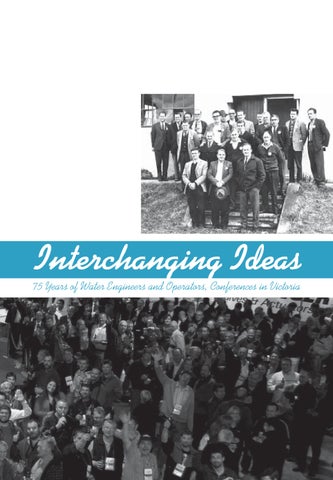
Interchanging Ideas 75 Years of Water Engineers and Operators, Conferences in Victoria
Interchanging Ideas 75 Years of Water Engineers and Operators, Conferences in Victoria
Interchanging Ideas has been produced by the Water Industry Operators Association of Australia (WIOA) in conjunction with the Water Industry Training Centre and the Victorian Department of Health. It recognises the important role the Victorian Water Industry Engineers and Operators Conference plays in the water industry.
Contributors George Wall John Park Ron Bergmeier David Sheehan Anne Unger Craig Mathisen Anthony Evans Cynthia Lim John Day
Executive Officer, WIOA Water Industry Training Centre WIOA Chairman Team Leader - Water Regulation, Department of Health, (Victoria) Senior Research Librarian, Victorian Government Library Service Chief Operations Officer, WIOA Wannon Water, WIOA Immediate Past President WIOA, Past President and staff member North East Water, WIOA President
Edited by Sonja King Designed by Craig Mathisen Foreword by Dr Rosemary Lester, Chief Health Officer, Department of Health (Victoria) State Library of Victoria With assistance from: Ann Austin, Marilyn Wall, Russell Mack, Peter Tolsher, Sherryn Wall, Steve Wilson
Printed August 2012
Weirs across river and dry river bed and construction workers. (ca.1915-1940 Victoria. State Rivers and Water Supply Commission and the State Library of Victoria. rrwls/u843)
Contents Foreword............................................................................................. 3 The Early Years (1938 - 1978)............................................................. 4 Water Industry Training Centre (1979 - 1988)..................................... 22 AWWOA / WIOA (1989 - present)...................................................... 30 Conference moments and reflections................................................. 70 Conference history & award winners.................................................. 88 2
Interchanging Ideas
Foreword The provision of reticulated water and wastewater services, and the treatment processes that support the provision of safe drinking water and the safe disposal of wastewater, are some of the most recognisable symbols of a developed nation, and have a significant influence on the health and wellbeing of communities. The provision of these services does not happen by accident; many dedicated individuals design, build and operate these services, to ensure that they operate each day, every day. Over time, technologies and techniques change, processes improve, and new risks and challenges emerge. One of the most effective ways to share this new knowledge, and keep abreast of change, is to meet with one’s peers, exchange views, learn from mistakes and be exposed to new ideas and innovative concepts. This is typically done through workshops, seminars and conferences. In 1938, the Sanitary Engineer of the Victorian Commission of Public Health, Mr E. A. Hepburn, B.C.E, A.M. Inst. C.E., recognised the need for a forum for sewage engineers and operators to meet and discuss issues in relation to “the design and control of sewerage and sewage treatment works, and of treatment works operators.” The first conference, held in the boardroom of the Melbourne and Metropolitan Board of Works, took place on 30 September 1938. There were 37 engineers and operators in attendance. From humble beginnings, what started as the Conference of Sewerage Engineers and Operators, now celebrates its 75th anniversary in 2012, with a much broader scope, as the Victorian Water Industry Engineers and Operators Conference. The conference now runs over two days, attracts around 1200 attendees, and is well established as the primary conference for Victorian water and wastewater operators to meet and discuss water and wastewater issues. Quoting again from Mr Hepburn, this time commenting on the 1948 conference: “This conference is very popular with operators of provincial sewage works, who benefit not only from the papers and discussions in the official program, but by the interchange of ideas and experiences with their fellows from distant towns.” This interchange of ideas continues today. The direct involvement of the Department of Health’s predecessor organisations concluded in 1978. It is fair to say that the issues discussed at these conferences remain as relevant today to the health and wellbeing of Victorian communities, as was the case in 1938, and are of ongoing interest to the department. I would like to congratulate the various convening agencies who have, over the past 74 years, helped to develop and sustain the Victorian Water Industry Engineers and Operators Conference, and I would like to wish the conference every success into the future.
Dr Rosemary Lester Chief Health Officer Department of Health (Victoria) 3
Construction of Yarrawonga Weir. (ca.1932-1938. State Rivers and Water Supply Commission and the State Library of Victoria. rwg/u2226)
4
Interchanging Ideas
The Early Years
1938 to 1978
5
Opening Address at the first conference by Mr. L. R. East 6
Interchanging Ideas
Mr. L. R. East Lewis Ronald East was born in Melbourne in 1899 and educated at Ringwood and Malvern State Schools, at Scotch College and at the Melbourne University, from which, after an interruption for war service with the Australian Flying Corps, he graduated in Civil Engineering with Honours in 1922. He joined the staff of the State Rivers and Water Supply Commission and was associated with many rural and urban water supply projects throughout the State of Victoria. In 1935 he was appointed a Commissioner and the following year to be the Chairman of the Commission, a position, with that of Commissioner of the River Murray Commission, he held for the next 28 years until his retirement in 1965. As Chairman, he directed the planning and construction of developmental works of very great magnitude including the Eildon Dam storing 2,750,000 acre feet, and the Rocklands Cairn Curran, Tullaroop, Lauriston, Eppalock and other reservoirs and irrigation works, town water supplies, river improvement and drainage undertakings and other works involving the expenditure of some $250,000,000 over the period of his leadership. He was also a member of the CommonwealthState Committee which evolved the great Snowy Mountains Project. His work was recognised by the C.B.E. in 1951 and a Knighthood in 1966.
Mr. L. R. East astride the River Murray before the construction of the Hume Reservoir. (State Library of Victoria. RWP/9538)
7
1938 Delegates
The Argus (Melbourne, Vic.: 13 September 1938). Argus - Melbourne)
The Argus (Melbourne, Vic.: 1 October 1938).
8
Interchanging Ideas
1938 Delegates 9
Resolutions from the first conference 10
Interchanging Ideas
Conference Founder Mr. Edward Andrew Hepburn The following editorial was printed in the Victorian Health Bulletin in 1950. Perhaps no event in the Department of Public Health has caused such a feeling of despondency and utter loss as news of the death of Mr. Hepburn, Chief Engineer. Although he had been seriously ill for some time, nevertheless his death left the impression that suddenly a bulwark of the Department had been swept away. His loss is mourned by all Mr. Hepburn was born at Williamstown on 6th October, 1890 and attended North Williamstown State School. His education was carried on at Scotch College and later at Melbourne University, where he graduated B.C.E. with first-class honours. Prior to this, Mr. Hepburn had won eight exhibitions and had held Junior and Senior Government Scholarships. Following graduation Mr. Hepburn worked on railway construction in Victoria and the Northern Territory. He enlisted in the A.I.F. in 1915 and served in Egypt and France and was mentioned in despatches. He was commissioned as a lieutenant. His First appointment to the Public Health Department was in 1919 as Assistant Inspector and Engineer. In 1932 he was promoted to Sanitary Engineer, a position which was later classified as Chief Engineer, In recent years Mr. Hepburn was a member of the Architectural Committee and the Donald Cameron Homes Committee of the Presbyterian Church. Mr. Hepburn applied in August, 1950 for long-service leave to travel to England and he had planned to leave in April 1951. Unfortunately, the illness from which he did not recover supervened. A prolific writer, a profound thinker, and a tireless reader, Mr. Hepburn was never too busy to listen to others’ problems, and his advice and sound judgment were as freely given to people outside the Public Service as to those in it. Insofar as the problems of outside people and organizations were concerned, Mr. Hepburn‘s high standard of efficiency, his cooperation , and his unfailing courtesy were factors of inestimable value in the completion of such matters to the satisfaction of all parties concerned. No journey was too long or too arduous in investigating a problem, and his calmness, perseverance and fortitude, his shrewd observations, and his assiduous labours commanded the respect and admiration of those who worked with him. Mr. Hepburn’s work, his nature, and his accomplishments bear testimony to a life well lived in the interests of the public and his colleagues, and serve as an example for all public servants to follow. To quote the words of a District Health Inspector: “Mr. Hepburn was a champion chap.”
11
Weirs across river and dry river bed and construction workers. (ca.1915-1940 Victoria. State Rivers and Water Supply Commission and the State Library of Victoria. rrwls/u843)
12
Interchanging Ideas
13
Construction of embankment, showing outlet syphon pipe - Malmsbury
(ca.1900-1953 Victoria, State Rivers and Water Supply Commission and the State Library of Victoria. rwg/1998 )
1939-1940 “This conference may now be considered to be firmly established as an annual event...”
1940-1941
14
Interchanging Ideas
Morwell Advertiser (11 September 1941).
The Argus (12 November 1941).
“The dropping of this conference until after the war was mooted, but so much disappointment was expressed by operators that it was decided to hold it as usual.”
1941-1942
1942-1943
15
Crusoe Reservoir construction - Coliban system (ca.1900-1953 Victoria. State Rivers and Water Supply Commission and the State Library of Victoria. rwg/1997 )
1944-1945
1947-1948
“Consideration is being given to the question of replacing the present loose arrangement after the war by a properly constituted institution, with membership open to persons engaged in design, construction, or operation of sewerage systems and sewage treatment works.” 16
Interchanging Ideas
1948-1949
1949-1950
17
Morwell Advertiser (26 July 1951).
1950-1951
18
The Horsham Times (5 September 1952).
1951-1952
Interchanging Ideas
Portland Guardian (17 August 1953).
1952-1953
Morwell Advertiser (20 September 1954).
1953-1954
19
Welding on 36” diameter cooling water pipe. (ca.1953-1954. Helmut Newton 1920-2004. H2006.47/540)
20
Interchanging Ideas
1976
1977
21
(ca.1970. Le Dawn Studios archive, State Library of Victoria. H2006.100/1211)
22
Interchanging Ideas
Water Industry Training Centre
1979 to 1988
The 1970s saw changes in the water and sewerage industry at government level that altered the way departments ran. In the late 1970’s, Charles Berkely, Chief Engineer, Department of Health; Jack Lang, Chief Engineer Town Water, State Rivers and Water Supply Commission; and Ray Holloway, Bairnsdale Sewerage Authority, were on the Committee of Management of the fledgling Operator Training Centre, Chaired by Wal Whiteside. Due to re-organisation in the Department of Health, it seems that the transition of the Conference from the Department of Health to the Operator Training Centre occurred at one of the Committee of Management meetings in the late 1970s. The Department of Health had responsibilities for sewerage treatment plant effluent quality prior to the establishment of the EPA in the 1970’s and it was part of their role to support Sewerage Authorities and their staff in this regard. This was probably a motivating factor behind the Department of Health convening and running the Conference for so many years. By the 1970’s with Government moving towards more regulating roles, it is likely that this support was no longer seen as required. The Operator Training Centre not only had the resources to convene such a conference but it was seen as an extension of the services the Centre was set up to provide to the industry.
23
The Operator Training Centre was established in Werribee in 1978 by the Victorian State Rivers and Water Supply Commission (SRWSC) using funding under the National Sewerage Program to provide training courses for sewerage treatment plant operators. The Centre was to bring together previous operator training courses in sewerage treatment conducted by the Australian Water and Wastewater Association (AWWA) using trainers from the State Rivers and Water Supply Commission and other member organisations. The AWWA did have a sub-committee for operator training from the mid 1960’s evidenced by some Minutes of meetings. The Conference was specifically designed to provide a forum for sewerage operators and engineers to get together and share information and it was thought the conference organisation would be a good fit for the Operator Training Centre. In 1979 responsibility for the conference organisation was formally taken on by the Ministry of Water Resources and Water Supply’s Operator Training Centre with the first Operator Training Centre run conference (the 42nd conference) held in Ballarat.
A new name In 1983 the Operator Training Centre’s name was changed to the Water Training Centre reflecting the range of courses which included both water treatment and sewerage (or wastewater as it was then known). The Conference name was broadened to the Annual Conference of Water Engineers and Operators. During the Water Training Centre years, the Conference was convened by the Manager of the Centre, initially Robin Povey until 1985 and then Ken Herbert. Ken delegated the conference organisation to John Park who ran the Conference until 1988 with assistance from staff of the Host water businesses. The Conference during the Water Training Centre years was organised as a “non-profit cost accountable” event. This meant ensuring that Registration Fees met all costs without “too much profit” and local host authorities were relied upon to accept monies and pay accounts.
24
Interchanging Ideas
The changing conference From 1979 to 1988 each Conference had a theme which was usually covered in the opening session, with the rest of the conference taken up by general papers some of which were submitted by operators. The themes included: • Development of new wastewater treatment plants • Sewerage and the public • Sunraysia, sewerage and the Murray • Water and wastewater treatment and safety • Monitoring treatment processes • Management/staff communications • Water industry development • Occupational health and safety in the water industry • Programmed maintenance- efficient operation • Innovation in the water industry The operator papers came about as a result of Water Training Centre encouraging trainees to write about their experiences. It was identified from Department of Health days that operators were not submitting many papers.
Victoria, State Rivers and Water Supply Commission and the State Library of Victoria
The conference format also saw some changes due to feedback from attendees. In the Water Training Centre days the conference was a one and a half day event, starting Thursday morning and ending early afternoon on the Friday. The format involved the Opening, Keynote Address and Paper Sessions on the Thursday with the Conference Dinner that evening with Friday set aside for site inspections of local treatment facilities. The Australian Wastewater Operators Association (AWWOA) Annual General Meeting was also conducted following the Thursday sessions prior to the evening dinner. At the same time the Victorian Branch of the AWWA was holding a Regional SubGroup Seminar on the Wednesday night which became a regular event attracting further delegates to the conference. Up until this time, there had been no trade displays associated with the Conference. However with the safety theme at the 45th Conference in 1982, invited organisations put on a display of their safety equipment on the Friday morning prior to the site visits. One supplier decided a truck load of equipment would be suitable! Another said the conference was more successful for him than a larger expo he had just attended. The following year a display of pumps and process control equipment was set up to match the theme. In 1984 with the theme on communications, the Friday format changed again to run workshops instead of site visits and delegates were presented with several case studies to discuss in syndicates followed by a report session.
25
Issues discussed included: • how assistant operators could get their message for improved plant operation past the disregarding superintendant • a rostering scenario where the operators had been presented with an unworkable roster for the Easter period and how it could be resolved • communication difficulties between operations staff and administrators with regards to salaries and conditions • an example of a lagoon treatment system where the operator’s practical solutions were being overlooked in favour of more complex design solutions • a new plant construction where operators were not given the opportunity to participate in the design, construction or commissioning phases only to be left with heaps of problems once the commissioning personnel left the site. Whilst the outcomes of the syndicate discussions no longer exist the issues may be just as topical today. In the 1980s there were further changes to the conference structure with local site inspections scheduled for Thursday afternoon and the Friday morning sessions divided between further platform papers and shorter discussion group sessions following the theme.
The funny side of water and sewerage The number of Platform Papers during this era was about nine per year with generally a good range and number of operator papers. The papers still provide an excellent resource for anyone wanting information and ideas regarding treatment plant operation. Some of the papers are worth mentioning, often due to their entertainment value as much as content included. At the 42nd Conference in Ballarat an excellent paper, “Design Considerations for New Sewerage Treatment Works” was presented by Mike Cornell. It gave an overview of the investigation phase, including constituents of sewerage, effluent criteria based on beneficial uses of waterways to the range of treatment options available and their principal purposes. Schematic flow diagrams in the paper would not be out of place in any up to date sewerage treatment operations manual.
Conventional Activated Sludge diagram by Mike Cornell, 1979. Vic Jones, the original Secretary of AWWOA supported the 43rd Conference in Geelong with his paper, “Sewerage and the Public”. Vic talked about the operator being the butt of friends’ jokes and the need for an operator to not only have a good sense of humour but an ability to form good relations with the public in informing them about this very necessary public service. His paper started with a quote which very definitely introduced his theme: Thou shalt have a place also without the camp, whither thou shalt go forth abroad. And thou shalt have a paddle upon they weapon, and it shall be, when thou shalt ease thyself abroad, thou shalt dig therewith, and turn back and cover that which cometh from thee. (Deuteronomy, 23 – 12/13). Vic got his message across! 26
Interchanging Ideas In Mildura in 1981 Stan Franzi, another AWWOA stalwart, seemed to follow Vic’s lead with his opening lines in an informative paper on operating techniques for complex anaerobic digesters: “The necessity for further treatment of the “settleable solids” component of raw wastewater is readily appreciated by all, the very first time they view a quantity of raw sludge- a truly moving experience.” The paper identified Stan as a leading expert in the operation of these processes. In 1984 in keeping with the theme, conference legend of the day, Len Morris delivered an excellent paper on effective communication within a local Victorian Sewerage Authority: “I would like to commend the organisers on the choice of the theme, Management- Staff Communication, as I believe it to be the single most important factor in the advancement of our industry.” Ray Holloway, long remembered as the founding President of AWWOA, weighed into the theme with his viewpoint as a Superintendent but also based on his involvement and support of operator training. Ray went so far as to define what he thought an Operator was: “An operator is any person involved in any aspect of water or wastewater treatment plant operation from being fully responsible for the management of the plant to any section of process control, unit operations and plant maintenance. Ray wanted all personnel to have the opportunity to receive training and play their part in effective communications.” Future themes brought out ever more creative papers with Neil Phyland providing the 48th Conference in Swan Hill with an entertaining insight into the history of toilets and the development of the Swan Hill sewerage system. In his paper, “Pompeii, Plagues, Privies and Pellets” he stated: “……in 1547 a commode covered in black velvet garnished with ribbons and quilted involving the use of 2000 gilt nails, was built so as Edward VI could relieve himself in comfort”. He further informed the gathering that Sir John Harrington (and not the fictitious Mr Crapper) designed the flushing toilet. Other papers included a young Ron Bergmeier displaying his commitment to safety in his paper complete with caricatures to emphasise his point. Ron singled out eight safety achievers in the wastewater industry and described safety initiatives for which they were individually responsible. These personnel were from different water boards throughout the state reflecting the research Ron carried out in preparing this paper. It included John Phyland a dedicated AWWOA member and positive safety achiever who was tragically killed in a confined space accident in 1991. Laidback/Casual Safety Officer
Conscientious/Efficient Safety Officer
Militant/Standover Type Safety Officer
Cartoons from Ron Bergmeiers paper “Your Job, Your Attitude, Your Safety” in 1986. In Warrnambool a number of experienced operators presented papers on innovation in both wastewater and water treatment. John Harris provided local interest with his paper on the process he used in piloting the use of bentonite clay to improve clarifier performance. John’s admission that he did about 40 jar tests to get the dose right should send a message to younger operators that this might be tedious but it gets the results in the long run. 27
Technology in the 80’s The Water Training Centre’s “up-to-date” technology was important to the successful running of the conference. The ubiquitous overhead projector (OHP), slide projector and folding white board were utilised by presenters to impress the gatherings. The OHP was so up to date, it had spare globes internally which could easily be swung into position if failure occurred! Mobile phones had not been invented so speakers were not interrupted and delegates had no reason to leave the room during the presentations.
Awards, conference traditions and memories The AWWA initiated the Wastewater Operator of the Year Award in 1980 and established a precedent of presenting it at the Conference with the inaugural award going to Stan Franzi who also became a Life Member of AWWOA. The Award was first made during the paper sessions of the conference, but later at the conference dinner. The AWWA Wastewater Operator of the Year Award went on to become the Water Operator of the Year Award in the mid 1980’s to enable water treatment plant operators to qualify. In 1995, the Award name was further changed to commemorate Wal Whiteside, a conference stalwart and past Chairman of the Geelong and District Water Board. In 1981 Sue Lefebvre scooped the pool receiving the Operator of the Year Award and winning the Hepburn Prize. This rare double was completed again in 1992 by Wayne Murdoch. Delegates recall that in Mildura that year most Conference delegates spent more time in their motel pools than at the pub. Somewhere in the early 1980’s, conference legend Len Morris and his mate Huey, who were regular attendees, began entertaining conference stayers after the dinner with recitations of “Said Hanrahan”, “The Man From Snowy River” and other classics. The obligatory passing of the port bottle was a vital part of this segment. The tradition of a night cap glass of port at the conference dinner is maintained today.
28
R. W. (Wal) Whiteside O.A.M. Wal Whiteside was a member of the Australian Water and Wastewater Association (AWWA) now known as the Australian Water Association (AWA) for 20 years and 33 years as a member of the Geelong and District Water Board, the last 21 as Chairman. His service to the water industry was recognised in 1992 with the AWWA Service Award and 1993 with the Medal of the Order of Australia. Wal was a stalwart of the Engineers and Operators Conference over many years and was very highly regarded by both operators and engineers who had the opportunity to meet him. He was Chairman of the Hepburn Prize Judging Panel for many years. He was the inaugural Chairman of the Water Training Centre following corporatisation in 1994. In 1995 in recognition of Wal’s contribution to the water industry and his commitment to the conference and development of operators, AWA renamed the Victorian operator of the year award to the “AWA Victorian Operator of the Year, Wal Whiteside Award”.
Inaugural winner of the Wal Whiteside Operator of the Year Award, Stan Franzi in 1980.
Interchanging Ideas Perhaps because of this tradition, loud hailers were needed to herd delegates onto buses for the site visits on the Friday morning. This did not go down too well with delegates suffering the effects of the night before. The conferences were not without the occasional drama with a bomb scare at the Paynesville Country Club where the conference dinner was underway resulting in a building evacuation and police attendance. Less dramatic but possibly more traumatic for the interviewee was a 1986 regional television interview where the conference organiser stumbled over the first question posed by the interviewer. Rather than a constructive question regarding the OH&S theme of the conference, the question fielded the possible introduction of fluoride into the water supply. A following interview with ABC radio was less controversial and involved the reporter lugging in a large reel to reel tape recorder! The 50th conference was held by the Melbourne Metropolitan Board of Works with its history of hosting most of the early Department of Health convened conferences. The paper sessions involved snippets of history about the event. Ray Holloway attended his last conference having retired and capped off a long career as AWWOA President from 1972-1984.
More changes In 1988 the last conference was convened by the Water Training Centre before handing over the organisation to AWWOA but not without some concern. Records from 1988 contain a lengthy memo emphasising the importance of the continuation of the conference within the industry and justifying the Water Training Centre’s involvement as conference convener. The memo went so far as to say that “the AWWOA are considered not to have the available members or resources to organise this conference”. The memo was recently put before its author by the current WIOA leadership with a “please explain”. Not to be intimidated, the author stated that it was his belief at the time and clearly times have changed! The AWWOA, and later the WIOA committees have included a dedicated lot of operators whose personal development through planning and executing this conference has contributed greatly to its growth and success as a premier water industry annual event. Ironically, “the die had been cast”- the Government had already written to the AWWOA, AWU and MEU inviting submissions to take on the role of convening and organising this conference.
29
30
Interchanging Ideas
AWWOA - WIOA
1989 to present
In 1988, the name of the organisation we now know as the Water Industry Operators Association of Australia (WIOA) was the Australian Water and Wastewater Operators’ Association, Victorian Branch (AWWOA). AWWOA Committee meeting minutes from September 1988 reveal the then Victorian Department of Water Resources (DWR) had written to the Association requesting a submission regarding taking on the administration of the conference. Not surprisingly, the Committee’s view was to strongly support the retention of the Water Training Centre (WTC) as organiser. When it became obvious the WTC were not going to be successful in retaining the organising role, Ron Bergmeier had confidence that AWWOA could take on DWR’s request and run the conference. Ron clearly remembers the meeting in Sunbury where the AWWOA was advised the Water Training Centre (WTC) would no longer be organising the conference. At the time there was even mention of inviting a trade union type organisation to take it over. Ron Bergmeier recalls the move to transfer the conference to the AWWOA: “I was only relatively new to the water industry at that stage and didn’t really have an understanding of the politics involved in the decision. To me, it just seemed to be an unnecessary end to something that brought a huge benefit to the industry and something that already had a great deal of history behind it. From memory, I think I was the youngest person in the room. The water industry at that stage was populated by older members and those members worked in reasonably constrained positions within their workplaces. The operators didn’t have the freedom, flexibility and resources within their work environment that many of us take for granted today. When I look back now, for these men to embark on an entrepreneurial exercise outside the defined work boundaries was an extraordinary leap of faith. The WTC also suggested that the conference expenditure exceeded $10,000 annually but revenue from delegate fees should cover that. At that stage there was little trade involvement or sponsorship to speak of. AWWOA bank records show that there was $1,548.18 in the bank at the time. It was therefore totally illogical that an underfunded and relatively small organisation should take on the main administration role, but we did!” 31
32
Interchanging Ideas
The prospect of the AWWOA undertaking the role was carefully considered. There was some hesitation and a number of concerns raised by the Committee about taking on the role, including the added workload on a voluntary organisation. The AWWOA Committee’s main role was lobbying for better training, assisting to rate all the water and wastewater systems from a responsibility and wage perspective, and producing newsletters and other publications. Ron foresaw many opportunities for the AWWOA taking on the administrative role and convinced the Committee they should try running the conference. He and Stan Franzi were tasked with the responsibility of writing a submission to DWR outlining the reasons why the conference should be assigned to AWWOA. Clearly, the submission was successful with AWWOA taking responsibility for the organisation of the conference from 1989 onwards. DWR recognised the need for the event organisers to be resourced appropriately and provided an annual grant of $2000 to help offset the costs of the event organisation. A conference organising committee was established which included three AWWOA Members, a WTC and an Australian Water and Wastewater Association (AWWA) representative. The initial organising Committee consisted of Ian Ruscoe, Ron Bergmeier and John Anderson with John Park the WTC representative and John Graham the AWWA representative.
33
New roles and responsibilities Largely because Ron raised the idea, he was given the role to co-ordinate trade displays, sell trade display sites and raise sponsorship to help offset the costs associated with staging the conference. The role of trade display co-ordinator included sourcing and measuring up suitable venues, preparing floor plans, selling trade sites and liaising with the exhibitors, finding sponsors and then making sure that everything fell into place at the time of the conference. Everything to do with the organisation of the trade display each year was undertaken by himself and his staff. At this time, Ron wasn’t officially on the AWWOA Committee, although he did attend and contribute significantly to all the meetings. Given that Ron was also running and growing his own wastewater engineering company, his personal contribution of time and finances was substantial and all for the betterment of the industry and the operators. There is no question that Ron’s personal contribution in the early years was integral to the success and growth of the conference and ultimately the success of WIOA as an organisation. Once the Association took on conference organisation, the role of the AWWOA voluntary Secretary also took on a new dimension with not only the usual Association duties but an added workload from the conference. Fortunately, for the first few years until 1994, much of the event organisation and delegate registration was undertaken by staff from the conference host water business under the direction of the AWWOA organising committee. The Secretary still had the major role of coordinating everything to make the conference run smoothly. 34
Interchanging Ideas
A separate voluntary conference organising sub-committee existed from 1989 to 1994 to try to even out the workload, but with limited time to help. The task of organising the technical program and speakers plus a range of other logistics, including liaison with the host water business, remained with the organising Committee, and was usually undertaken annually by the Secretary. The sub-committee was dropped after 1995 in favour of everyone on the AWWOA general Committee pitching in and helping out when required. After 1995, amalgamations of water businesses and a reduced appetite to take on non-core functions meant the reliance on the water business to organise parts of the conference needed to be reduced. When George Wall became Secretary/Treasurer in 1995, George simply took on the role of doing all the other stuff and Ron organised everything to do with the trade display. In general, the hosting water business input was reduced mainly to some sponsorship and supplying some administration staff to help run the registration desk. It is fair to say that the Ron and George team established the basic conference model as it is today and simply up-scaled it over the years to meet demand. 35
36
Interchanging Ideas
The modern trade expo The first conference organised by AWWOA was held in Shepparton in 1989 and consisted of the AWWOA AGM and a Members only dinner on the Wednesday evening. Technical papers were presented Thursday until lunch time followed by a tour of the Shepparton water and wastewater treatment plants in the afternoon. More papers were presented in the afternoon following the tours. The conference dinner was held at a local hotel on the Thursday evening, with delegates attending again for more papers on Friday morning. The last item on the program was the presentation of the Hepburn Prize for Best Paper. Conference registration costs in 1989 were $80 for delegates and $100 plus a delegate registration for trade exhibitors. The Shepparton conference is recognised as the birth of the Trade Expo. There had been a small product display at a number of conferences throughout the 1980’s but 1989 was recognised as the start of the modern expo as we know it, with 19 exhibitors. There were no formal booths as we have now and all companies displayed their products off tables and used their corporate banners to identify their sites.
37
Entertaining the crowd The Thursday conference dinner in Shepparton is the first time formal entertainment was provided. A local Shepparton identity - Graeme “Pee Wee” Young - had the assembled delegates in stitches of laughter with his dubious but apparently “true stories!” Pee Wee was ably backed up by Sonia Gash, a local singer who belted out a number of songs for everyone’s enjoyment. This started a tradition which has continued. Following the success of Pee Wee and Sonia in 1989, they were booked to provide the entertainment at the 1990 conference dinner in Hamilton. Unfortunately, a massive thunderstorm hit the Shepparton area and the light plane due to fly them to Hamilton and back was grounded. Unperturbed, a number of delegates and exhibitors took up the challenge to provide the entertainment for the evening themselves. Of note, Leigh Strange and a few others delivered a repertoire of priceless yarns and a couple of tradies belted out some tunes on the old piano found covered at the far side of the stage. Although a great night was had by all, a Committee resolution in 1991 was to only use local talent thereafter.
38
Interchanging Ideas
A range of entertainers local to the area of the conference were secured from 1991 to 1996. In 1997, a specialist booking agent, Westside Talent from Werribee, was employed to source the entertainers annually. Westside Talent has been used ever since, and due to the relationship, some excellent acts secured at reasonable prices have entertained the audience. Initially, the formal entertainment was only secured for the Thursday dinner but in 2000, a second entertainer was permanently added to the Wednesday dinner program. Over the years there has been a range of comedians, ventriloquists, magicians, motivational speakers and sports persons engaged. No matter whom the entertainer, our booking agent advises them we are mindful of our mixed audience and we expect them to do their “strictly corporate” show.
39
40
Interchanging Ideas
Entertainers at the Victorian conference Year 1989 1990 1991 1992 1993 1994 1995 1996 1997 1998 1999 2000 2001 2002 2003 2004 2005 2006 2007 2008 2009 2010 2011 2012
Venue Wednesday Night Shepparton Hamilton Sale Bendigo Ballarat Stan Alves Melbourne Bill Lawry Mulwala Geelong Bairnsdale Shepparton Wodonga Warrnambool Mark Jackson Bendigo Tom Hafey Geelong Bill Brownless Shepparton Denise Drysdale Wodonga Mark Mitchell (Con the Fruiterer) Bendigo Elliott Goblet Bendigo Harry Houdidnt Bendigo Darren Carr Bendigo Peter Dee Bendigo Lauren Burns Bendigo Bizzarre Gazzard Bendigo Warren Jackman Bendigo Rusty & Another Guy
Thursday Night Pee Wee Young & Sonya Gash Operators Themselves!! John Cousens John Cousens Rodney Vincent Coodabeen Champions Rodney Vincent Ray Gilson Dave Butler Paul Jennings Colin Cole Marty Fields Dave Grant Harry Houdidnt Martin Ralph Pee Wee Young (Guest MC) Gavin Wood Mike Brady Brian Doyle Marty Fields Danny McMaster Scared Weird Little Guys Tripod Brendan O’Reilly 41
A new formula The 1990 conference in Hamilton ran in the same format as Shepparton, but with a “Meet the Trade Dinner” on the Wednesday evening. There were sponsored speaking spots for three companies each year and the trade expo was also growing with more than 30 companies exhibiting. To participate in the expo, companies were requested to provide their own table, chairs and backdrop to display their products. Conference registration costs in 1990 were $85 for delegates and $200 plus a delegate registration for trade exhibitors. In 1993, the expo was transformed into today’s format with individual display booths, fascia signs and lighting for each company. The meals area was incorporated into the centre of the trade exhibition, and a separate room was organised for the paper sessions. Having all the conference meals within the trade area was another important initiative that is still an integral part of the event today. This was done to encourage delegates to stay at the venue all day and to maximise the exposure and interaction between the exhibitors and delegates. Since the earliest days with AWWOA, the conference has comprised two very distinct but related components – the technical paper sessions including platform and poster papers, and the trade exhibition, with the opportunity to be introduced first hand to new technology and services. As the conference grew, and in particular, as the size and range of equipment which was being displayed expanded, it became more difficult logistically to build the expo sites and move all the equipment in on Wednesday and then load it all out again Friday afternoon. To better manage the removal of all the equipment from the expo, the 1992 conference structure was changed from all day Thursday and half Friday, to half Wednesday and all day Thursday providing all of Friday to pack up. The plant tours were removed from the formal program and offered as an optional extra on the Friday morning. The conference proper got underway with the Opening and Keynote Addresses at lunch time on the Wednesday, and concluded on the Thursday evening at the end of the renamed “Conference Awards Dinner”. 42
Interchanging Ideas
Host locations During the period from 1989-2003, the conference was moved around the State and was held in a variety of venues which met the criteria of being suitably sized, and with a financial commitment and administrative support from the local water business. Understanding the issues and needs of all parties involved are critical to event logistics. Although many towns/cities and venues were suggested as potential hosts, in many cases they were declined as they did not have suitable facilities. Finding large venues in regional Victoria often meant taking the conference to sites not normally associated with events such as this, including sporting complexes. The sporting complexes usually had varnished, sprung timber floors which the venue managers were justifiably very protective of. Venues with timber floors had management imposed weight restrictions and meant that forklifts could not be driven on them. All the trade expo and booth equipment, often in excess of two full semi trailer loads, needed to be loaded in and out by hand, using pallet jacks or flat bed trolleys with manpower to move them around. The timber floors were prone to dings, dents and scratches with some not understanding that getting a nail or screw stuck under the wheel of a pallet jack while they were moving their equipment had the potential to cost AWWOA thousands of dollars in repairs after the event. AWWOA volunteers were often assigned responsibility for operating the pallet jacks exclusively to try to avoid damage. Using sporting venues also posed catering problems as they often didn’t have a commercial kitchen on site capable of feeding 400 plus people. In many cases, a temporary kitchen needed to be established for the duration of the event. The caterers did a magnificent job to feed everyone each day from these less than optimum amenities. The rotating nature of the conference and the variability in the size and quality of the facilities available from year to year, saw the expo fluctuate around 40-50 booths. In some years the expo sites sold fairly quickly but in others, it was still possible to obtain a booth only a week or so out from the event or even at the event itself. In some venues where space was available, the expo supply company was requested to bring along extra panels and we were able to fit some last minute companies into the floor plan. From 2002 on, sites sold out rapidly and a number of companies were placed on a waiting list in the hope that they could join the event. 43
44
Interchanging Ideas
Encouraging operators The Hepburn Prize for the best platform paper presented at the conference was initiated in the years the Department of Health convened the event. The Committee felt that an award should be made exclusively available to operators to encourage them to submit and deliver technical papers. In 1992, the Best Paper by an Operator award was instigated and carried with it substantial cash prizes for the authors of the papers judged first, second and third. This award is still presented today and by the same company.
Venue swap drama There was a small hiccup in 1993 when the AWWOA committee somehow decided the conference was going to be held in a small town that had an unfinished convention centre (two separate buildings transported to a vacant block sitting on packing timbers). The owner of the convention centre certainly had grand plans, but very little experience and virtually no time to get the venue finished and have it operational before our event. Ron inspected the proposed site and advised the AWWOA Committee they could have the conference as planned at the unfinished convention centre if they liked, but he had already booked another venue in Ballarat. The Ballarat conference was a resounding success and ushered in a new era with the use of professionally built booths.
Hiring Harry A company called Harry the Hirer (HTH) from Melbourne was contracted to supply the expo booths, furniture and lighting from 1993 onwards. Harry the Hirer is now the expo and equipment supplier for WIOA’s conferences in Victoria, New South Wales and Queensland. Staff from the two organisations have forged a long lasting, strong and co-operative working relationship. The familiarity with WIOA’s needs and expectations allows HTH to deliver the desired result at each event with a minimum of supervision and stress. The role of expo contractor has been tendered a few times since 1993 in order to guarantee that booth and furniture prices are competitive. Harry the Hirer has submitted the most competitive tender on every occasion. “Harry the Hirer has had a great relationship with the Water Industry Operators Association over the past 20 years and have enjoyed seeing both businesses grow together as the conferences continue to get bigger each year. It’s a relationship that Harry’s very much look forward to continuing for the next 20 years and beyond.” Paul Herman, original Harry’s account manager for WIOA, who is still involved in the business today. 45
Melbourne conference The 1994 conference was held at the then Radisson hotel in Melbourne with the dinners and expo held in the grand ballroom, for many years the venue for the AFL’s Brownlow Medal count. It was a significant event as it was the only time the conference was run at a financial loss. The cost of catering and hiring the venue was significantly more than in the regional centres and with many of the exhibition companies based in Melbourne, head office did not support their staff in attending the dinners, preferring that they went home each afternoon. As the venue was booked on a per head basis, the low numbers attending the dinners and participating in the meals caused the overall costs to increase significantly. In their post event survey, staff from some exhibiting companies indicated part of the attraction and value for them of the event was to get away from the city and interact with the operators, both at the expo and socially at the dinners. Many would miss out on this networking opportunity if the event was in Melbourne and requested that we hold the event in regional centres from then on, an ideal the Committee agreed to and implemented.
Water authority amalgamations Through the early to mid 1990’s, amalgamations of Victorian Water Authorities were in full swing with a number of operational people offered redundancy packages or retrenched as the new bigger businesses reorganised their structures and how they wanted to deliver services. In many cases, those taking the packages were the older operators, many of whom were long term WIOA members and strong supporters of the conference over the years. The amalgamations drove significant changes to water authority boundaries with a number of smaller organisations integrated into bigger entities. Depending on where the amalgamations took place, the amalgamations had a major impact on delegate numbers attending the 1994 and 1995 conferences. Some of the smaller councils in an area used to send one or two staff each to the conference, often meaning around 10-15 delegates from the broader area covered by the new business. 46
Interchanging Ideas After the amalgamations, many of the new organisations moved into cost reduction and savings mode and training and staff development budgets were often the first to be cut. As a result, attendee numbers were cut back often to about four or five and in some cases less from the new bigger authorities. The viability of the conference with lower attendance numbers and reduced water authority support was a major discussion item at AWWOA committee meetings of the time.
Jumping the state border The Victorian conference was actually held in New South Wales in 1995. The amalgamation process was the main priority for the new water businesses and the AWWOA Committee could not find a business prepared to put up their hand to host the conference. This posed two issues, where to hold the conference and more importantly, who would host it and assist with part time help to share the workload required to organise and run the event. After holding the previous four events in the south of the State, it was preferred to have the 1995 conference in the northern region. After driving considerable kilometres looking for a venue, the most suitable location found was the Mulwala RSL in NSW. This caused a few insurance and fleet management issues for water businesses due to the need for staff to take company vehicles out of the State! Ron Bergmeier came to the rescue and again put up his hand in a time of need. His company, Australian Pollution Engineering took on the role of host and major sponsor for the event. Taking on the host role added even more pressure to Ron and his staff as other conference logistics including managing the delegate registrations, event marketing and catering were added to the trade expo tasks.
Crises talks in Lorne An Executive Committee meeting between Leigh Strange (AWWOA President), George Wall (AWWOA Secretary), Ron Bergmeier (trade expo co-ordinator) and Richard Greenhough (AWWOA Executive Committee member) was held in Lorne in 1995. Apart from inspecting potential venues for the 1996 conference, the group held a serious discussion about the state of the Association given that cash reserves had taken a hit in 1994 and 1995 and there was only about $5,000 in the bank. Most significantly, Association member numbers had reduced to around 80 and appeared to be dwindling. Discussions revolved around what should happen with the AWWOA cash and assets, in the event that the trends continued and the organisation needed to be disbanded. The outcome from the meeting was the AWWOA had too much to offer and all stops needed to be pulled out in an effort to reinvigorate the conference and the Association. Importantly, the need to gain the strong support of the senior managers of the various new water authorities was vital for the conference to succeed. A few strings were pulled with some influential authority CEO’s and in early 1996, the AWWOA was afforded a speaking spot at the Institute of Water Administration (Vic) conference in Ballarat. The spot was used to describe the new vision for the Association - driving improvement in the industry from the ground up and also the intent to make the conference a viable, proactive learning experience. This had an immediate impact with the 1996 and subsequent events much better supported. A strategy was also developed to commit extra resources to providing a broader range of services and benefits in order to increase the value proposition of being a Member. A campaign to use the remaining members to promote the benefits of AWWOA in order to rebuild member numbers was also put in place and eventually was successful. 47
48
Interchanging Ideas
New management With the generous and understanding support of his employer Goulburn Valley Water (GVW), George Wall took over as Secretary of AWWOA from Colin Sandeman in 1995 when Colin was offered a redundancy package from his role in Sale. It was a steep learning curve to jump from Committee member to Secretary and to take on responsibility for organising a conference. With Ron concentrating on the trade expo, the registrations and sponsorship, George’s role was to look after the technical program, publications, promotional material, catering and the venue. In noting the contribution of George and Ron, an event the size and scale of the Victorian conference is impossible for just two people to run. The strength of AWWOA over the years has been the commitment of the Committee members, the volunteers, the water business managers, the industry leaders, and the operators all coming together and giving their time and expertise freely to run an industry event. It would require tens of people and many thousands of dollars to organise such an event in the commercial world. The volunteer army is still going strong now, and is fundamentally why the event is the success that it is - it is run by the operators for the operators.
Gaining water authority support Organising the conference through much of the 1990’s was a tough gig. The computer age was only just establishing itself and without email, there was a strong reliance on the telephone, fax and hard copy mailed correspondence. The managers at GVW understood some conference things just had to be organised during the day and accommodated it. It was not uncommon for George to spend many hours late into the night catching up on his GVW tasks. Until the late 1990’s, paper presenters were required to provide a hard copy final version of their paper. Although all authors were given concise instructions setting out the font and layout requirements, a number of presenters didn’t follow them which made the presentation of the papers book untidy and unprofessional. In 1998, to improve the professional appearance of the printed manuscript, papers were submitted electronically and were edited into the conference manuscript, all with exactly the same format. At the time, GVW also provided access to one of the Executive Assistants who taught George some of the tricks and helped collate and finish off the conference papers into a professional looking final version ready for printing. In those days, Barwon Water had an internal print shop that did all the graphic design and printing work for the Authority. From 1996 to 2004, Barwon Water also provided substantial support to the conference through a sponsorship of the copying and binding of the conference manuscripts. It was not until 2005 that the true value of this support was evident. After outsourcing the print department, Barwon Water could not continue the sponsorship so quotes were sought to have the copying done commercially. The 2005 bill was almost $10,000. These days, WIOA does all this work in-house at a substantial saving. Additionally, WIOA Committee Member and Past President, Richard Greenhough was the photographer at the conference from 1992 until 2004 and the printing of the photos was undertaken by Barwon Water. The digital age of recording and storing of photos began in 2004.
49
Social responsibility Each year, AWWOA presented a cheque to a local charity in the region where the conference was held, derived from the conference profits. Usually it was for $250 and was presented to the conference host to pass on to a charity of their choice, allowing the host some recognition and to give something back to the community. In 1999, the first ever event designed to raise funds for charity was held in the form of a golf day at Broadford Golf Club. A number of companies sponsored the day and apart from a very rainy day out, $500 was raised for charity. The Tradies Cup was developed and awarded to the representative from a sponsoring company that had the best score. The cup is presented annually at the “Meet the Trade Dinner”. There have been some other fundraising activities over the years with the most notable being the donation in 2010 and 2011 of a signed Don Bradman print, generously provided by one of the exhibitors. The prints were raffled and both raised almost $2000. Amid cries of “rigged” the winner of the 2010 raffle was none other than Ron Bergmeier and the print holds pride of place in his home. Since the fundraising initiatives kicked off in 1999, with the generous support of many individuals and companies, WIOA has been able to distribute over $50,000 to worthy charities around the country.
50
Interchanging Ideas
Hidden treasures The suppliers have only limited space to display their products, equipment or inventions. In many cases, they have significantly more items which they could show but are either too big or less mainstream and are often shown as photos on the booth wall. The inquisitive nature of operators has sometimes led to discussions with exhibitors that delivered unexpected outcomes or even fostered the developments of new or modified equipment. It was not uncommon for discussions around the expo to be “that is designed to do this, but if we changed this… added this… or tweaked that…, could it do this?” One example where ingenuity produced an unexpected outcome occurred in 1996 when Neil Healey from Goulburn Valley Water, District Manager Western Area, had problems with poor raw water in off-stream storages supplied from irrigation channels. In looking at photos at the Earth Systems website he noticed a photo of the neutra-mill, a machine more commonly used for dosing chemicals into mining tailings dams. After some discussions with the supplier and subsequent modifications to the design and operation of the unit, they were able to add an outboard motor and power plant on board to make it mobile and used it to dose lime and alum into the raw water storages. This resulted in significant improvement in the raw water quality and much better water treatment plant performance. On the back of this idea, Neil did a paper at the 1997 conference and won the Actizyme Prize for best paper by an operator. He was invited to present the paper again at the American Water and Wastes Conference in Phoenix, Arizona in January 2000, dealing with drinking water Innovative Technology.
51
52
Interchanging Ideas
2000 poster David Dickson.
2004 poster David Reyne.
2004 poster Brooke Anderson.
2005 poster Barry Waddell.
Adding poster papers In 1998, a new Operator Poster Paper category was introduced to the conference technical program. Not all operations staff felt comfortable with the idea of standing up in front of their peers and delivering a formal platform presentation. Some operators had an idea or a project they have completed which may not provide sufficient information to allow for a written paper and a 20 minute presentation. The Committee hoped that by delivering a poster paper, the self confidence of the operator would increase and they might have a go at a platform paper in the future. Cash prizes are supplied by a sponsor as an added encouragement and the original organisation is still the sponsor now.
53
AWWOA AGM moved Until 2001, the AWWOA AGM was held following the last paper session on the Wednesday afternoon. Member numbers attending the AGM was declining but more importantly, the workload on the voluntary Secretary to have the accounts completed and audited and all the other paperwork ready for the AGM was impacting on the time available for the organisation of the conference. By necessity, from 2002 the AGM was moved to the AWWOA Members Weekend Seminar, normally held in March.
Another name change and national expansion For a number of years, the AWWOA Committee had worked with and encouraged operators outside Victoria to establish association branches in their respective states. It became obvious that champions who were prepared to do the hard yards to establish and run branches in other states were not forthcoming. In 2002, AWWOA changed its name to the Water Industry Operators Association of Australia (WIOA). The change to Water Industry meant that membership was opened up to anyone in an operational role in the industry and not just water and wastewater treatment. In addition, removing Victoria and replacing it with Australia opened the door for the national expansion of the Association and the provision of services that operators in the other States wanted to access.
54
Interchanging Ideas
Technology updates The use of the big screen on the main stage in the trade area to display the conference papers was another innovation which started from necessity. The 2002 conference venue in Geelong had limited space in the upstairs papers room and there were concerns that not everyone would be able to be seated for the Opening session. As a result, the papers were shown by video and audio feed onto the big screen in the trade area. It was surprising that a number of delegates chose to watch not only the opening session, but all the papers from there instead of the upstairs papers room. There were a number of positive comments from exhibitors indicating that they were pleased to be able to see and hear specific papers they were interested in, whilst at the same time, they could keep an eye on their trade booth and not miss out on talking with delegates potentially interested in their products. The main stage was also used for the conference Opening Session in 2005. The Committee felt the presentation by Dave Neru and Les Collins outlining their relief work after the 2004 tsunami in Banda Aceh was so important they wanted everyone to be able to see it. The decision was vindicated with an extraordinary number of delegates and exhibitors sitting in the central meals area watching on, as well as many others standing around the outside of the booths.
55
56
Interchanging Ideas
Expanded trade show In 2004, the Committee decided it shouldn’t be turning away companies if they wanted to exhibit, so the event was moved to a much bigger venue – the Wodonga Basketball Complex. This venue had space to accommodate around 150 companies but the expectation of the Committee was to try to fill 70 or 80 sites. In all, there were 110 booths filled with 92 companies involved in the Wodonga exhibition, a number that surprised and excited everyone. In 2005, the conference was moved to the Bendigo Schweppes Centre, another large sporting complex. The numbers increased to 144 booths filled by 110 companies. Also in 2005, the new Bendigo Exhibition Centre was completed and the event has been staged there since 2006. Bendigo is an ideal location, is reasonably central within the State, has an excellent venue with a concrete floor, good access for trucks and equipment, no weight restrictions, plenty of parking space and most importantly, there is ample accommodation available in the city.
Opening up the expo In recognition of the importance of the exhibition to the water industry, another major change in 2005 was to open up the expo to visitors with free entry for anyone with an interest in the technology on display. Until 2005, entry to the event was for delegates only, although operators from the host business were invited to look over the expo as part of the host benefits. This change saw the numbers of people attending the event annually grow by 125 in the first year. By 2011, some businesses were sending bus loads of staff just to look over the expo and the number of visitors had increased to more than 500.
Tweaking the conference formula The Committee had long recognised that the most equitable formula for the event was to treat both the trade expo and the papers section as equally important. The number of technical papers presented in one and half days and the massive growth in the expo meant there was very little time left for delegates to engage with the exhibitors and look over the range of products and services on display. In 2005 the conference program was extended to two full days. The technical presentations in the papers room got under way at 9am on both Wednesday and Thursday mornings with papers generally in blocks of three, spread over the entire day. The most important change was time gaps were strategically placed in the program to give delegates time to explore the trade expo and discuss their issues with the exhibitors. In order to minimise disruption to the water businesses, it was deemed not practical to extend the event past a two day conference. To make more time for the expo, the actual number of papers presented was kept the same as 2004, providing an extra four hours over the two days to be dedicated to the trade expo. Over the years, the length of time allocated to each paper was frequently reviewed by the Committee. The 20 minute paper, including time for an introduction and questions at the end, has been adopted as the standard. This length of time forces presenters to seriously review what they need to say and then stick to the point without rambling on. Given that many operational people are outdoors oriented in their job role, sitting in a darkened room and concentrating on presentations for around one hour at a time is manageable.
57
Expo floor plan As the expo grew in size, floor plans were made up to create a layout that assisted the flow of delegates and visitors through the expo area to ensure no exhibitors were disadvantaged regardless of where they were located. The booths that surround the meals area and the ones near the main entry were considered the best locations and usually filled quickly. These sites had lots of traffic with people coming and going all day. In order to draw delegates to the far extremes of the venue, the tea and coffee stations were deliberately placed there. In addition, in 2007 a barista and pie van were added to the far end of the expo area to give attendees the opportunity to purchase a brewed rather than instant coffee and a snack. This also draws extra people to the booths located in the area. In 2008 the large equipment display area was added to the floor plan allowing companies to exhibit bigger items that would not fit inside a standard trade site.
37
38
55
59
60
61
75
74
73
72
71
70
69
64
176 175 174 173 172 171
76
77
78
79
80
81
82
65
164 165 166 167 168 169 170
89
88
87
86
85
84
83
67
163 162 161 160 159 158 157
90
91
92
93
94
95
96
68
99
98
97
39 46
36 35
179 180
40
34
178 177
41
42
43
44
56
57
58
62 63
54
47
45
48
49
50
51
52
53
33 31
32
66
30
148 149 150
151 152 153
154 155 156
102 101 100
29
147 146 145
144 143 142
141 140 139
103 104 105 106 107 108
M
28 27
131 132 133
134 135 136 137 138
115 114 113 112 111 110 109
1
26
130 129 128
127 126 125 124 123
116 117 118 119 120 121 122
2 3
25 24
1999 Wodonga. 58
23
22
21
2012 Bendigo.
20
19
18
17
16
15
14
13
12
11
10
9
8
7
6
5
4
F
Interchanging Ideas
Conference competition Another initiative is the Conference Competition with 10 trade sites randomly selected, evenly spaced around the expo area, with the companies occupying each site invited to participate. Teams of delegates visit each of the 10 sites during the conference. The teams are required to undertake some sort of challenge at each site and some of the companies show a lot of creativity in what they expect the teams to do. The winning teams receive great prizes from the competition sponsor. Delegates get to visit sites they may not normally go to and equally, the companies get the opportunity to talk to some delegates who may not usually visit their site or have a specific interest in their products. There are also spin off benefits to the neighbouring exhibitors as sometimes there are queues of teams waiting to do the challenge and they get to talk to the delegates while they wait.
59
Sponsors For any industry event, some degree of sponsorship is vital to keep the cost affordable for everyone. WIOA has been able to build an excellent working relationship with a number of companies over the years and developed initiatives that provide a win-win result for both the sponsor and WIOA. For many years, a variety of companies have sponsored different segments of the conference such as the satchels, the dinners, the welcome reception, the entertainers, the courtesy buses, the drinks at the dinners, the after dinner port and the various awards for best papers and posters to name a few. The AWWOA and WIOA philosophy has always been to involve any company that wanted to participate, through a combination of both large and smaller sponsorship opportunities. The quite considerable list of sponsors for each event takes a while to read out, but the support of every one of the companies is valuable and deserving of appropriate recognition. As WIOA expanded and took on the role of staging conferences in New South Wales and Queensland it prompted a review of the overall sponsorship formula. The most obvious point for consideration was the opportunity for a company to sponsor a similar item at all three events. From 2007, any company prepared to sponsor an item at all three events was given preference. The new category of “Prime Sponsor” was developed and implemented from 2007. The items attached to this category included the satchels, the Conference Dinner, the Meet the Trade Dinner and the neck wallets for name tags. The cost to each company was significantly more, but the range of sponsor benefits made available to each was also increased.
60
Interchanging Ideas
2012 Prime sponsor contributions
Automation Group
Acromet
Peerless Industrial Systems
Adrian Nesbit, Automation Group
Tim Sells, Acromet Australia
Bruce Bowles, Peerless Industrial Systems
Automation Group has been a proud supporter of WIOA for a number of years, having first been introduced to the organisation at a weekend seminar. At this first meeting it was Rad-tel Engineering presenting on SCADA and telemetry, and having had a chance to meet all the operators and WIOA committee members over that weekend it became obvious that WIOA would be the perfect organisation for Rad-tel to become involved with. It was at the very next conference in Bendigo Radtel had their first WIOA stand and from this point, Rad-tels involvement with WIOA grew quickly. Before long Rad-tel was a prime sponsor at the event across New South Wales, Queensland and Victoria and of course as the Automation Group brand was established as the parent Company to Radtel, WIOA became the perfect mechanism for this new brand to be established in the market.
Acromet are exceptionally proud of our long association with the WIOA. As a major sponsor of all three annual conferences over the last five years we thoroughly enjoy a great affinity with the operators and engineers we have met, over our 10 plus years as a corporate member.
Peerless Industrial Systems has enjoyed providing sponsorship to and being a member of WIOA for many years. All three yearly conferences have provided great venues for our company and enable our branch operations to maintain an involvement, and allows many of our customers and potential customers to attend.
Automation Group now continues to be a prime sponsor at the events as well as having three display stands, one for each of the companies – Rad-tel Engineering, RN Baker Switchboards and Latitude Products. Automation group has found that attending the events is a fantastic way to get so many of our clients together with the sales and support staff, thus allowing us to introduce new ways of engineering and new products to the market as well as gain feedback from our clients about the company’s performance on projects and customer support. As a direct result of feedback from operations staff at WIOA, Rad-tel has recently established a new dedicated service and support department and by interacting with the engineering delegates at WIOA the products offered by Latitude and RN Baker have been fine tuned to meet their needs.
Prior to sponsoring the “Meet the Trade” dinner we provided sponsorship to a couple of operators from Gippsland Water. Russell Mack and Wayne Mumford wanted to race their “Belly Tank” Salt Lake Racer and needed assistance. Acromet helped them along their journey. In return Russell and Wayne displayed their race car on the Acromet stand at the Bendigo conference in 2006. Acromet received the best display award that year – thanks guys.
Sponsorship of WIOA has allowed all the companies in the Automation group to be closer to the water and sewerage operators as well as engineers, which has helped the significant growth that the group has seen over the last five years. As a result of that success Automation Group sees WIOA as a key part of their marketing strategy to continue growth into the next five years.
We have always found the WIOA to be a progressive, well organised and highly respected organisation. This is most evident to us when attending the conferences and seminars around the country. The networking opportunities provide us with a valuable insight into the Water Industry of which we are all part. Mutual benefits include keeping us up to date with industry trends and keeping the operators and engineers in touch with the latest technology. Acromet feel it is paramount to have an industry association and we consider it an essential part of our business.
Since then Acromet have stepped up our sponsorship dollar so that all can benefit. 2012 sees WIOA and Acromet both celebrating significant milestones. We would like to take this opportunity to congratulate WIOA on their 75th Anniversary of Conferences in Victoria. Acromet is celebrating 50 years of Service to Australian industry and to mark the occasion the famous green Acromet stubby holder has been released as a 50th anniversary edition – make sure you pick one up!
At the WIOA event we have contact with personnel from many companies who have in turn utilised our products. All WIOA conferences have given Peerless Industrial Systems the scope to discuss any problems with operators and engineers, find a solution and follow up with their management. We appreciate the opportunities WIOA conferences provide us such as introducing our product range to visitors we would not be able to visit normally. It goes without saying that the past conferences have been a very good path to maintain and update our commercial and industrial contact base with the bonus of a great grounding for our new staff. Many long standing and strong relationships have been born at the WIOA conferences and we are proud and pleased to give back to and support an Association that supports and lends itself to so many companies. WIOA provides a great vehicle for us to reach out to our customers, and to provide them with an awareness of our products and technical services.
Acromet view the sponsorship as a means of thanking all of our customers, and look forward to a long association with the WIOA and its members.
61
62
Interchanging Ideas
President’s/Sponsor’s dinner The number of WIOA Committee and volunteer helpers that give freely of their time to get the conference ready continued to grow over the years. For many years, the Committee had an informal dinner at a local hotel on the Tuesday night before the conference. In 2005, as a way of further recognising and thanking the valued conference sponsors, the President’s Dinner was introduced with all sponsors invited to send along a representative. They joined the Committee members and all the volunteer helpers for an informal dinner in a relaxed environment. This has been a great chance for the Committee to meet the sponsors in a social setting away from the conference, and some lasting friendships have been forged at this event.
Project showcase 2008 Discussions with some water authority managers indicated they perceived the conference to be purely about water and wastewater treatment and not relevant to the teams working in the distribution, construction or maintenance sectors of the water industry. Despite the encouragement of the Committee members, there were rarely any papers submitted from operators employed in these areas and although much of the equipment on display could be used universally, there was no specific attraction for these operators to come along. In 2008, “Project Showcase” was trialled. It was based on the home show idea of having expert presenters from selected companies doing small workshops on use or features of their products in a dedicated area open to all delegates and visitors. A separate presentation room was constructed within the exhibition area with companies supplying equipment or services related to the maintenance side of the industry participating. Some of the companies provided pumps, sewer odour control experts, valve and flow control devices, flow measurement systems and electrical equipment. Although some of the sessions were well supported, it was felt that overall the idea was not worth pursuing. It is worth noting there have been significantly more papers and posters submitted in recent years from the reticulation and maintenance side of the industry. 63
64
Interchanging Ideas
Private enterprise jumps in The move to Bendigo caused some issues in finding a host business willing to be a major financial sponsor. Coliban Water had been a magnificent supporter of the conference and hosted it in conjunction with their operations contractor, Serco, in 2001. They hosted again in 2005 with new contractor CAMS and again in 2007, also with CAMS. It was obvious to the Committee it wasn’t fair to expect Coliban Water to continually sponsor the event year after year. An approach was made individually to the Victorian Water Authorities to see if any would be interested in hosting the event if it was continued to be held in Bendigo. The few replies received indicated that they could not justify spending a considerable sum of money on an event outside their region that did not directly benefit their customer base, an understandable position. Using the precedent of 1995 when Australian Pollution Engineering hosted the event, WIOA approached and was excited to be able to work with Veolia Water in 2006 and North East Water in conjunction with Environmental Group Limited (EGL) in 2008 as event hosts.
VicWater offer In 2008, discussions were held with the VicWater CEO and the case for more permanent support for the conference was made. The strength of the conference for many years had been the support and ownership of the event by the water authorities. WIOA needed a host and major sponsor annually to ensure the conference would remain financially viable and affordable for everyone to attend. If WIOA offered the event to private enterprise, the name of the event would need to change and the direct link to the water authorities would be lost. The suggestion was that with 15 participating organisations, the role of hosting could be rotated around the State and the sponsorship sum could be split evenly over all the businesses annually. This meant it would not be a large financial burden on any one organisation. The proposal was put to the VicWater meeting and adopted, with the 2009 conference sponsored and hosted under the Regional Water Corporations banner.
AWA involvement AWA (then AWWA), supported the conference in the early years as a member of the organising sub-committee and has co-badged the conference from 1989 with AWWOA and later WIOA. AWA has maintained its support of the event each year since 1989 by sending out the Call for Papers and also the Delegate Registrations to its members. Another contribution to the conference annually since 1980, has been the presentation of what is now known as the “AWA Victorian Operator of the Year, Wal Whiteside Award”. This is recognised as the most prestigious award from the operational side of the industry. Representatives of the Executive Committees of AWA Victoria and WIOA have met on numerous occasions over the years to discuss and build on the relationship between the two organisations. In 2009, an AWA special interest seminar with selected speakers was held in conjunction with the conference. It was envisaged this would provide an event for AWA members in northern Victoria and it was also hoped that it might attract some other AWA members to the conference that may not have attended, giving them the opportunity to look over the trade displays. Unfortunately, the event was not that well supported and given the proximity of timing between the annual AWA Victorian Dinner and the WIOA conference, it was decided not to continue. 65
66
66
Interchanging Ideas
WIOA with full time staff The partnership between Ron and George and the Committee really just seemed to roll along. Each knew what they had to do and each did what had to be done to make the conference run smoothly. Ron was growing his own business at the time and George was working full time for Goulburn Valley Water and also undertaking further studies. There was very little spare time available from either side but the conference grew each year. After the bigger expo in 2004 and the growing delegate numbers, the resultant workload made the task of organising the conference and expo too big to be done on a voluntary basis. George Wall was offered the position of inaugural Executive Officer of WIOA. He accepted and commenced in the role in early 2005. The appointment of George was a pivotal moment in the history of WIOA and therefore had a direct effect on the continuation and viability of the Victorian Conference. From 2005, the responsibility for organising the expo was transferred to the WIOA staff, although Ron maintained his role as sponsorship co-ordinator until 2009 when the role was undertaken by WIOA staff member Cynthia Lim. Commercialisation of the Victorian conference, growth in the expo and sponsorship has played a big part in funding WIOA to be the entity that it is today and working nationally. As WIOA expanded and commenced staging events in Queensland and New South Wales as well, out of necessity, more full-time employees were added to the staff team. As of 2012, the WIOA staff consists of five employees all of whom are dedicated to ensuring the success of the organisation and our events.
Conference software From 1989 to 2007, all conference attendees were recorded using spread sheets, invoices and payments were generated by other software, and name tags were produced by yet another program. There was no integration between all these systems. The team at the conference registration desk recorded delegates, exhibitor staff and pre-registered visitors on paper lists. This system was fine in the early days when limited numbers of people were attending but in 2007, the combined attendance in Bendigo exceeded 1000 for the first time. In 2008, WIOA invested a considerable sum into the purchase of a dedicated conference software package. The software solution allowed name badges to be produced, better tracking of the increasing numbers of people attending the event, streamlined the registration process and assisted in the invoicing and payment processes.
67
68
Interchanging Ideas
Name badges and lanyards In mentioning name badges, it is amazing how such an apparently small item can generate so much discussion and angst, particularly with older delegates with failing eyesight and fading memories for names. Over the years, the amount of detail printed onto the name badges has gone from heaps in tiny fonts that most people couldn’t read, to our current system of purely name (in as big a font as possible) and employer underneath. Over the years a variety of lanyards, some sponsored and supplied by companies, have been used. Many of them had a single swivel point just above the name tag and more often than not, when trying to sneak a peek at the name of someone you should remember (or who knows you) their name tag had spun around leaving a white slab. To get around this, names were printed on both sides of the tags and in later years, the neck wallet was adopted. The neck wallet has an added benefit in that for the forgetful people, it is a great place to store meals tickets, business cards and more.
Transferring the model to other states The model that has been trialled and further developed over the years in Victoria has been extended successfully to the events which WIOA now runs in both New South Wales and Queensland. Importantly, participants, whether a delegate, visitor or trade exhibitor, will be able to attend any of the WIOA conferences and will know exactly what to expect.
2012 NSW conference.
2012 Queensland conference.
69
70
Interchanging Ideas
Conference moments & reflections International delegates WIOA has built a very close working relationship with our New Zealand cousins, the Water Industry Operations Group. The relationship started in the early 2000’s and in the majority of years since, a group of Kiwis have travelled to Australia and participated in a tour of various water and wastewater facilities in Victoria. After the tour they all attend the conference. The same thing happens in NZ each year, with the Kiwis graciously looking after a bunch of Aussies. A formal Memorandum of Understanding (MoU) between WIOA and WIOG was signed on the main stage in 2007 and updated in 2010, by the Presidents of both organisations. Among other undertakings, the main intent of the MoU is to promote the advancement of water or wastewater systems operation and management to improve the quality of service to customers, protect the environment, and optimise the sustained use of plant assets in our respective countries.
71
Media coverage The conference has been able to attract some very good media coverage over the years with big spreads in local newspapers along with WIN and Prime TV arriving regularly to record some news footage and a story. ABC radio has also taken a strong interest in the event with a number of recorded interviews aired during morning drive times. Invariably, all the interviews end up moving away from the conference and turning to the most topical issues of the day – the drought, the floods, the amalgamations, desalination and so on.
Where’s Bracksy Barry? One year the Victorian Premier Mr Steve Bracks, was visiting town on other official business and through connections at the other meeting who knew about the conference, Mr Bracks was convinced to spend a few minutes and have a look around. This was an exciting time as no-one could recall as prominent a person ever visiting the conference before. WIOA Life Member Barry Waddell was afforded the very special task of recording the exciting event for posterity and he borrowed the Water Training Centre’s brand new digital camera. Barry lined up the Premier and pushed the go button. While he was looking through the viewfinder, Barry saw the shutter move, so job done. He took a couple of extra photos just to make sure he would have a good one. Unfortunately, the shutter moving was the auto focus and to actually take a photo, the go button had to be held down for a few more seconds after. When the Training Centre guys checked Barry’s handy work, there was nothing there at all. Needless to say, Barry was banned from all subsequent photographic duties.
Articulation agreement In 1996 at the conference held in Geelong an articulation agreement was signed between the Water Training Centre (WTC) and the Deakin University School of Engineering and Technology. This agreement ultimately articulated to a Bachelor of Technology (Environmental).
72
Interchanging Ideas
John Harris – MC of many hats Former WIOA President John Harris was frequently called on to be the MC at the conference dinners. John had his own unique way of having fun attending the dinners with a range of different hats and often an accent to go with them. It was amusing to see what would come out of his bag next. Most importantly, John made the dinner and the awards presentation more fun for everyone whilst having the knack of keeping the attention of the delegates for an extended period.
A chill in the air Bendigo in September can be very chilly in the mornings. WIOA always has a number of heaters spread around the expo area to be used when needed. Ron usually arrived at the venue very early to get all the heaters going and warm the place up before everyone arrived. There are photos of him found asleep on an exhibitors couch but at least the venue was getting warmed for the start of each day.
Men in suits on forklifts at 1.00am With the growth of the conference exhibition, getting the exhibitor’s freight out of the venue and onto trucks on the Friday morning became increasingly difficult. The Friday process involved collecting up all the freight out of the booths and putting it into stacks specific to each designated freight company ready for pick up. At the same time, the HTH guys were pulling down the exhibition booths, repacking the furniture and pulling up the carpet. There was stuff all over the floors and people everywhere making it almost impossible to drive a forklift from one side of the venue to the other. The only real solution to make all this easier was for a couple of people not to drink alcohol at the Thursday Dinner. They then jump on the forklifts for a couple of hours straight after the dinner (in their suits) while the caterers cleaned up. They brought all the freight to the main doorway to make it easier to get out on Friday. The speed, agility and precision that funny men in suits driving the forklifts demonstrated was a spectacle to behold but unfortunately, there was no one else there to see them. 73
Pollies drop in In 2007, the then Opposition Leader Mr Ted Ballieau and other politicians dropped in to look over the Bendigo Exhibition Centre with members of the Agricultural Society. Interestingly, WIOA President John Day was well known to Mr Baillieau as they regularly competed in ocean swimming competitions. Needless to say, Barry was kept away from the camera!
Best practice guidelines launched The Victorian Department of Health used the 2010 Victorian conference to launch the Victorian Framework for Water Treatment Operator Competencies - Best Practice Guidelines, a culmination of three years work and consultation, with WIOA an integral part of the process. For the first time in Australia, there were guidelines for the operators of systems and a requirement that all water treatment operators be trained to a specified level. This outcome was exactly the reason the AWWOA was formed way back in 1973 and vindicates years of hard work by many. The WIOA looks forward to the roll out of a national operator certification scheme in the future.
VSORG meeting From 2006, the Victorian Storage Operators Reference Group (VSORG) held a meeting at the conference each year. The VSORG members include operational staff responsible for operating and maintaining a number of the large dams and water storage reservoirs right across the State. The meeting included a number of presentations on dam operational and maintenance issues and inspection of infrastructure and facilities in the Bendigo region. 74
Interchanging Ideas
Attracting attention – novel trade sites Over the years companies have found novel ways to display their products or interesting ways to attract delegates. Draws for a fishing rod, bottles of wine and other items; pogo stick races; golf putting; masseurs; dart boards; electric slot car races; remote control helicopters are a selection of ways exhibitors have found to engage with the delegates. A number of other companies have either used their products themselves for impact or done something out of the ordinary. A few worth a mention include: • Link Pumps arrived one year with a very old car as part of their display which created lots of interest. • As part of the pre-dinner drinks, Alldos (now Grundfos Pumps) used their small chemical dosing pumps to accurately measure out 10ml of scotch or bourbon into a glass then added some ice and maybe cola for the delegate to enjoy. (All with prior approval of the committee and appropriate licences in place!) • Acromet Australia sponsored salt lake racers Russell Mack and Wayne Mumford who in return displayed their race car on the Acromet stand at the Bendigo conference in 2006. Acromet received the best display award that year. • DCM Process Control brought along their robot and magician who walked the floors for the two days of the conference entertaining delegates at random. On another occasion they brought a Sega Rally arcade style racing game which was incorporated into the conference competition. • ITT Flygt often brought along Brad Blaze, an artist who drew caricatures of anyone prepared to sit still long enough. Brad has recently made a name for himself as a speed painter of international standing, doing exceptional quality paintings of celebrities and 75 sports people in around three minutes.
Information fairies As exhibitor, delegate and visitor numbers increased, there were increasingly long lines at the registration desk, particularly early on the Wednesday and Thursday mornings. In order to make the registration process quicker and to help determine who was who, who had pre-registered and who needed to fill in visitor paperwork, a welcoming team of Cynthia Lim and Barry Waddell was arranged for the 2005 event. They were both geared up with wands and wings and armed with all the right answers, became the conference “information fairies”. This only ran one year but made its mark.
Embarrassing audio There has been the odd occasion where the MC has put the roving microphone into his pants pocket without realising that it was still switched on. On another occasion, the audio feed from the papers room to the main expo area was left on with some choice discussions coming through the PA system from a couple of unsuspecting Committee members. It was amusing to see other Committee members madly racing around the venue looking for the culprit with the microphone in the pocket, or watching someone shut down every button on the AV control board until the right one was located.
76
Interchanging Ideas
Colourful character Pat Davis is one of WIOA’s long term members and a regular Victorian conference attendee, renowned for wearing the brightest Hawaiian shirts to the conference dinners. There is always anticipation to find out what the current year’s shirt would look like. The unknowing might assume Pat spent his holidays overseas each year and brought back some new shirts, such was the range. However it was later discovered that Pat’s wife was good with the sewing machine and made the shirts up especially for the occasion.
Environmentally aware For many years, pallet loads of bottled water was supplied to quench the thirst of delegates and exhibitors. To reduce waste and to do our bit for the environment, refillable water coolers utilising chilled tap water were introduced in 2009. Every delegate is now supplied a reusable bottle and encouraged to drink up.
Queuing up One of the most amusing and encouraging conference moments from a female perspective occurred in 2006. After many years of attending WIOA seminars, conferences and events, there was great excitement when it was reported that women finally had to queue for the toilet. A strange milestone, indeed, but when you work in such a heavily male dominated industry, these things tend to be noticed! 77
“It’s little wonder that most people are now unavailable...”
78
Interchanging Ideas
Top three conference jobs As nominated by former WIOA president Anthony Evans Favourite job 3 - Sweeping the floors This used to be a very arduous task in the early days requiring the upper body strength of an Olympic weight lifter to accurately guide a broom across the entire venue floor for a very long time, until the arrival of the mini floor sweeper. Suddenly everybody wanted to sweep the floor, cruising around picking up little bits of paper, nails and clips from Harry’s crew and whatever could be physically swept, picked up or wrapped around the internal workings of this wonderful machine. But alas, the novelty was soon to wear off as each volunteer realised that up to five kilometres needed to be covered to keep the work space in a constant state of cleanliness. Favourite job 2 – Setting up the tables & chairs in the meals area There is usually a fair mess in the meals area on Tuesday afternoon consisting of empty boxes, bubble wrap, furniture that has yet to be distributed to the booths and more. A truck, loaded high with chairs and tables winds its way to the only clear area, unloads faster than the Ferrari racing team can change a tyre, and leaves the building quicker than Elvis. With enthusiasm waning, anyone not looking busy is cajoled into setting the beastly, finger snapping tables up and ensuring that there are 10 chairs at every table. After a lot of hard work we all sit back and enjoy the fruits of our labour, until George arrives. The tables aren’t straight, in the right spot, too many at the front, not enough at the back etc, etc, etc. After a lot of moving and shuffling they all end up back where we started and everyone is happy again! Favourite job 1 - Satchel packing In past years most Committee members and volunteers arrived around midday on the Monday before the conference and after the usual greetings, look around the venue, more greetings and chit chat its over to the office to see what jobs need to be done. It’s usually at this point that everyone is overcome, not with excitement but an empty hollow feeling that occurs annually, at this precise time, similar to a David Attenborough documentary. The satchels need to be packed, around 500, filled with glossy brochures and merchandise extolling the virtues of some of our wonderful supporters, and lots of other bits and pieces as well. There is no easy way to go about the task and it cannot start until we have all items to be packed, heaven forbid if we have started and something arrives late for insertion in the satchel. Anthony and Ian’s idea of duplicating each side of the table worked reasonably well until somebody went the wrong way and was banned from the satchel filling. Everyone else then did the same thing in an effort to also be banned but to no avail. The job requires about three hours of seamless teamwork, collecting the brochures, neatly stacking them and finally the insertion in to the satchel held in perfect position and stacking in the box. Needless to say they never fit back where they came from and end up stacked precariously against the wall of the rego desk awaiting the arrival of our delegates and exhibitors. When you get your satchel please refrain from picking out the brochures and turfing them in the bin, it may make more room for contraband but its upsets the satchel packers no end! It’s little wonder that most people are now unavailable until midday or after on Tuesday as they try to avoid this favourite job. Even the Kiwis have caught on and either hang laps of Bendigo in their rental van or arrange a plant visit in some remote area of Victoria arriving just in time for the welcoming nibbles and drinks. This is a job where sometimes many hands don’t make light work and is truly deserving of first place.
79
reflections
Contributed by Ron Bergmeier My very first reaction to the news in 1988 that the engineers and operators conference was potentially at an end was that someone else should just pick up the reigns and keep it going. The AWWOA (now WIOA) thankfully took up the challenge and allowed me to be involved with the development and management of the trade display and sponsorship role for many years. The incorporation of a trade display into the conference program added a new dimension and purpose to the conference. Not only did the delegates get to hear technical papers and network with their industry colleagues, but they now had the opportunity to see, compare and in many cases, actually test the latest equipment from a range of suppliers. Here was a whole new opportunity for the operators to engage with the trade suppliers and attend a conference at the same time. The trade display in the early days was relatively crude compared to what we have now. Exhibitors shared a table against the wall and some promotional material as a background. It is fair to say that the trade exhibition has experienced massive growth since the early days. We now have an extremely professionally run event that provides an opportunity for the exhibitors to display their products and the delegates to see what is available and what is new. The conference also provides an opportunity for the product manufacturers to spend time with their distributors, some distributors have found new products and people have even been known to find a new job. There are a lot of things happening at a WIOA conference.
80
Interchanging Ideas
The only constant has been the WIOA philosophy that all the conference activities such as lunches, morning and afternoon teas and the dinners should be conducted within the trade display. This strategy ensures that the delegates and exhibitors can make the most of every opportunity to network and discuss specific projects and needs. WIOA’s primary aim is to ensure that both delegates and exhibitors feel comfortable with the conference format and that we can meet the needs of the majority of people. What I have personally observed at the conference over the years is the bonding of many people from all forms of life into a cohesive volunteer group who put hours of their own time into making the event successful. From the water side the volunteers may be operators, supervisors or managers and from the product and services side, we have company representatives, business managers and even company directors. They all happily pack satchels, sweep floors, drive forklifts and carry boxes without prompting. It is a truly amazing sight to see the volunteers working, joking, and having fun together at every conference. The really interesting thing is that there are no egos to been seen anywhere. I have to say that there is a strong sense of friendship, respect and mateship at every WIOA conference and I truly believe that this is certainly one of the reasons that the delegates and exhibitors enjoy attending the WIOA conference.
81
Contributed by George Wall I started in the water industry in 1989, coincidentally, the same year that AWWOA took over the organisation of the conference. I actually attended that conference and hosted a tour of the Shepparton wastewater treatment plant for delegates, but at the time had no idea what AWWOA was, or what all the fuss was about. I have been fortunate to have attended every conference since, except for the 1991 event when I was ill. My recollections of the first few conferences as a “newby” in the industry is driven more to the social networking side of the event than the learning outcomes. Basically, we couldn’t wait for September to roll around for another couple of good days away. In 1993, much to my horror, my boss nominated me to do a platform paper at the Ballarat conference on a project we had completed at the Shepparton wastewater plant. Like almost all operators, I was happy and confident in my little patch at the plant, but having to get up and talk in front of maybe 200 or so conference delegates was about as palatable as brain surgery without anaesthetic. With a pounding heart, a few stuff ups and a dry mouth, the 20 minutes came and went and I survived. The feeling of euphoria (and relief) immediately after the presentation was something I’ll never forget. The other thing I won’t forget is the friendliness and supportive nature of the delegates, with a number taking the time just to say well done. I had already considered myself a winner by doing the paper, but was fortunate that year to be awarded the Hepburn and Actizyme Prizes as well. With the benefit of hindsight, doing the paper was one of the real turning points in my career and definitely changed my appreciation of the conference and AWWOA. In late 1993, I joined the AWWOA Committee and have been on it ever since. Being afforded the opportunity to take on the Secretary role in 1995 after having only been on the Committee a short time, was another pivotal moment. The Committee showed great faith in me and I intended to do everything in my power to return the favour.
82
Interchanging Ideas
reflections
Thinking back, I am convinced that this conference has had a positive impact on the careers of many others in our industry as well. I have seen lots of operators over the last 20 years, who just like me, have done a paper or presentation for the first time at this event. It is not a surprise that many of these people are now the leaders in our industry – operations managers, treatment managers or senior water technologists to name a few. The conference and in particular, the exhibition really is a treasure trove of information. Although my hands-on operating days ended some time ago, I am still amazed at the changes in technology and the new products that are exhibited each year. Attending this event and being exposed to new ideas and technology is vitally important for operational people in today’s water industry. I just hope that all operators learn to use the time allocated to the trade to do just that - find something new at every event and see if you can implement it. The conference has had some ups and downs over the years and on a few occasions, has been plain hard work getting it over the line. I know first hand that the contribution and generosity of Ron Bergmeier and his company will never be accurately portrayed in writing. It would embarrass Ron if we tried, but rest assured that his contribution has been remarkable. Working with Ron, the Committee, staff, volunteers, sponsors and exhibiting companies to see the conference develop and grow so much over the years has filled me with pride and a great deal of satisfaction. The camaraderie of everyone at the event is another thing to behold. There is no pretence here, just down to earth people doing something they love and in what is often described as one big family atmosphere. I have met lots of people and made many friends over the years, a number of whom are still in the industry now. I look forward to catching up with all of them each year and also to meeting new people at the conference. I have totally enjoyed contributing to the event as both a Committee and WIOA staff member. It is true that the conference has developed, morphed and evolved over the years but most importantly, the concept set by EA Hepburn and compatriots in 1938 has stood the test of time. Being staged for 75 consecutive years really is something amazing and here’s hoping that many of us will be around to see the 100th event in 2037! 83
84
Interchanging Ideas
reflections
Contributed by Cynthia Lim The Victorian WIOA conference is one event on the water industry calendar that everyone really looks forward to. Operators, engineers, tradies and the who’s who of the water industry all come together for this annual event. For me, the conferences are always filled with laughter and there is real joy, particularly when catching up with old colleagues you usually only get to see at conference time. The conference atmosphere is always buzzing with chatter and the exchange of stories and recent experiences. Even when you’re not there attempting to learn something new, you still tend to leave the event richer in knowledge and experience. To cry at a conference may be viewed as an odd thing, but I must admit it has happened to me more than once over the last decade and a half. The primary trigger is usually the stories from colleagues, who over time have become good friends, retelling their personal life experiences. One story I vividly remember was in 2005 when our New Zealand cousins Dave Neru and Les Collins delivered the Keynote Address about their experiences in Aceh Province after the tsunami. For these tough men to share such heartfelt and private feelings with the entire WIOA audience was an astonishingly special moment. These are the moments that I look back on now and feel that the WIOA conferences are more than just a work related event, it’s a gathering of contemporaries who over time have become a family. I feel very privileged to be associated with this annual event both as a volunteer and as a WIOA staff member. So many people have generously given of their time and energy to make it what it is today. It is truly something to take pride in. The WIOA conference is an amazing achievement and I salute our industry predecessors who had the vision to inaugurate the conference and congratulate those who continue to contribute to it now.
85
86
Interchanging Ideas
Conclusion From its humble beginnings with a very tight intent, the Victorian Water Industry Engineers and Operators Conference has grown over the years to the very broadly based event that it is today. This growth has not been through luck. It is the result of many hours of hard work and commitment, much of it on a voluntary basis. Successive organising Committees have been proactive in their review of the event. Every aspect of the conference is critically examined to ensure future events will be delivered to the highest possible standard. The Committee has had many a firm and robust discussion about getting the balance right. The WIOA Committee and staff continually engage the delegates and exhibitors through on-site discussion and surveys following each event to understand what worked, what didn’t, what could be better and what is expected. Over the years the conference has changed format, structure and even focus, but it continues to remain relevant and topical to the water industry. The technology has certainly changed, the environment and governments have changed and systems and processes have been updated to meet the increasingly complex nature of the industry. What hasn’t changed is the commitment of the WIOA and its predecessors to providing an opportunity for water industry operators and representatives from related industries to get together at an annual conference and share important information with one another. With the increasing importance of water to our economy and environment it is vital that the conference continues in order to support operators and water authorities. It is with a great deal of pride that the current Committee of WIOA continues to be entrusted with the role of organising and staging such a great event. From an albeit hesitant beginning in 1989, the growth of the conference under the AWWOA/WIOA guidance and banner has in many ways mirrored the growth of WIOA the organisation, seeing it become the significant and well respected national body it is today. In 2012, the inaugural Victorian Water Taste Test is being introduced to raise awareness of the quality of Victoria’s drinking water and to recognise the efforts of local water service providers in delivering valuable water services to their communities. New initiative such as this will continue to be added to the conference to ensure it remains relevant. WIOA looks forward to celebrating many more milestones in the future as we maintain the tradition established in 1938 of bringing engineers and operators together at an annual conference to facilitate the interchanging of ideas.
87
88
Interchanging Ideas
Conference history & award winners
89
Victorian Conference Details Year Venue Convenor 2012 Bendigo WIOA 2011 Bendigo WIOA 2010 Bendigo WIOA Bendigo WIOA 2009 2008 Bendigo WIOA 2007 Bendigo WIOA 2006 Bendigo WIOA 2005 Bendigo WIOA 2004 Wodonga WIOA 2003 Shepparton WIOA 2002 Geelong WIOA 2001 Bendigo AWWOA 2000 Warrnambool AWWOA 1999 Wodonga AWWOA 1998 Shepparton AWWOA 1997 Bairnsdale AWWOA 1996 Geelong AWWOA 1995 Mulwala AWWOA 1994 Melbourne AWWOA 1993 Ballarat AWWOA 1992 Bendigo AWWOA Sale AWWOA 1991 1990 Hamilton AWWOA Shepparton AWWOA 1989 1988 Warrnambool Water Training Centre Ringwood Water Training Centre 1987 1986 Wodonga Water Training Centre 1985 Swan Hill Water Training Centre 1984 Bairnsdale Water Training Centre 1983 Melton Operator Training Centre 1982 Mt Elisa Operator Training Centre 1981 Mildura Operator Training Centre 1980 Geelong Operator Training Centre 1979 Ballarat Operator Training Centre 90
Host Victorian Regional Water Corporations represented by Gippsland Water & East Gippsland Water Victorian Regional Water Corporations represented by Western Water Victorian Regional Water Corporations represented by Central Highlands Water & Coliban Water Victorian Regional Water Corporations represented by Barwon Water & Wannon Water North East Water / EGL Coliban Water / CAMS Veolia Water Coliban Water / CAMS North East Water Goulburn Valley Water Barwon Water Coliban Water / Serco South West Water North East Water Goulburn Valley Water East Gippsland Water Barwon Water Australian Pollution Engineering Water Training Centre Ballarat Water Board Coliban Water City of Sale Hamilton Water Board Shepparton Water Board City of Warrnambool MMBW Rural City of Wodonga Swan Hill Water Board Mitchell Water Board Operator Training Centre Operator Training Centre Mildura Sewage Authority Geelong Water & Sewage Trust
2000’s 1990’s 1980’s 1970’s 1960’s 1950’s
Convenor Department of Health Department of Health Department of Health Department of Health Department of Health Department of Health Department of Health Department of Health Department of Health Department of Health Department of Health Department of Health Department of Health Department of Health Department of Health Department of Health Department of Health Department of Health Department of Health Department of Health Department of Health Department of Health Department of Health Department of Health Department of Health Department of Health Department of Health Department of Health Department of Health Department of Health Department of Health Department of Health Department of Health Department of Health Department of Health Department of Public Health Department of Public Health Department of Public Health Department of Public Health Department of Public Health Department of Public Health
1940’s
Venue MMBW Bendigo MMBW MMBW MMBW MMBW MMBW MMBW MMBW MMBW MMBW MMBW MMBW MMBW MMBW MMBW MMBW MMBW MMBW MMBW MMBW MMBW MMBW MMBW MMBW MMBW MMBW MMBW MMBW MMBW MMBW MMBW MMBW MMBW MMBW MMBW MMBW MMBW MMBW MMBW MMBW
1930’s
Year 1978 1977 1976 1975 1974 1973 1972 1971 1970 1969 1968 1967 1966 1965 1964 1963 1962 1961 1960 1959 1958 1957 1956 1955 1954 1953 1952 1951 1950 1949 1948 1947 1946 1945 1944 1943 1942 1941 1940 1939 1938
2010’s
Interchanging Ideas
91
Victorian Operator of the Year The “AWA Victorian Operator of the Year, Wal Whiteside Award” is the most prestigious award on offer at the Victorian conference with the award presented continuously since 1980. The award is presented to an operator working in Victoria with direct responsibility for operational decisions at community water, sewer or recycled water systems / networks and/or water, wastewater or recycled water treatment plants or industrial water or wastewater plants. Nominations are sought annually from Water Authorities and water companies throughout Victoria and the winners will have demonstrated a continued high level of performance, initiative and all round attention to detail in the execution of their duties. Year 2011 2010 2009 2008 2007 2006 2005 2004 2003 2002 2001 2000 1999 1998 1997 1996 1995 1994 1993 1992 1991 1990 1989 1988 1987 1986 1985 1984 1983 1982 1981 1980
92
Venue Bendigo Bendigo Bendigo Bendigo Bendigo Bendigo Bendigo Wodonga Shepparton Geelong Bendigo Warrnambool Wodonga Shepparton Bairnsdale Geelong Mulwala Melbourne Ballarat Bendigo Sale Hamiilton Shepparton Warrnambool Ringwood Wodonga Swan Hill Bairnsdale Melton Mt Elisa Mildura Geelong
AWA Victorian Operator of the Year, Wal Whiteside Award Greg Comer John De Boer Steve Hunter Jeff Roscoe Owen Roberts Rod Curtis Simon McCracken Inaugural winner of the Peter Tolsher Wal Whiteside Operator of the Year Award, Stan Gerrard Barry Franzi in 1980. Paul Keating Roland Passuello Neil Healey Russell Mack George Wall Ray Crilly Sean Meehan/Phil Keady Barry Waddell Colin Sandeman John Harris Wayne Murdoch B. Mick Cook Mark Closter Peter Waddell Ed Deugd John Phyland T. Jack Hanna Len Morris Carl D’Herville Len Wyhoon Ron Emmet/E. Vic Jones John Park (WITC) and Beryl Whiteside, Sue Lefebvre with the Operator of the Year Award named in Stan Franzi recognition of Wal.
Interchanging Ideas
2011 Greg Comer
2010 John De Boer
2009 Steve Hunter
2008 Jeff Roscoe
2007 Owen Roberts
2006 Rod Curtis
2005 Simon McCracken
2004 Peter Tolsher
2003 Gerrard Barry
2002 Paul Keating
2001 Roland Passuello
2000 Neil Healey
1999 Russell Mack
1998 George Wall
1997 Ray Crilly
1996 Sean Meehan & Phil Keady
1995 Barry Waddell
1994 Colin Sandeman
1993 John Harris
1992 Wayne Murdoch
93
Best Platform Paper Overall - Hepburn Prize Mr. Edward Andrew Hepburn was Chief Engineer of the Health Department of Victoria from 1932 until his death in 1950. Health Department records reveal that E.A Hepburn was a prolific writer and regular attendee and contributor to the conference discussions. Although the exact date is uncertain, at some time believed to be in the 1970’s, the Hepburn Prize was developed in recognition of the contribution of Hepburn to the conference and the promotion of its ideals to inform and exchange information. Each year since, the technical paper judged to be the best of all the papers presented at the conference is recognised by being awarded the Hepburn Prize. Year 2011 2010 2009 2008 2007 2006 2005 2004 2003 2002 2001 2000 1999 1998 1997 1996 1995 1994 1993 1992 1991 1990 1986 1983 1982 1981 1980 1979 1978 1977 1976 1975 94
Venue Bendigo Bendigo Bendigo Bendigo Bendigo Bendigo Bendigo Wodonga Shepparton Geelong Bendigo Warrnambool Wodonga Shepparton Bairnsdale Geelong Mulwala Melbourne Ballarat Bendigo Sale Hamiilton Swan Hill Melton Mt. Eliza Mildura Geelong Ballarat MMBW Offices Bendigo MMBW Offices MMBW Offices
Hepburn Prize Darren Sharman Kathy Northcott Greg Comer David Errey Mark Samblebe Jason McGregor Mark Jarvis Jason Whittaker John Day Anthony Evans Andrew Chapman Michelle Colwell David McKenzie Kimberley Davies Peter Smyth Sean Meehan Dene Denny Colin Schulz George Wall Wayne Murdoch Roger Wrigley John Park Ron Bergmeier John Anderson Keith Brown Sue Lefebvre Carl D’Herrille David Orbell Ron Emmett Lindsay Whitelaw Neil Phyland Stan Franzi & Fred Manning
Organisation Goulburn Valley Water Veolia Water Australia Goulburn Valley Water Yarra Valley Water Gippsland Water Central Highlands Water Melbourne Water Goulburn Valley Water Norske Skog South West Water PPK Environmental & Infrastructure Gippsland Water Australian Separation Technologies Group Goulburn Valley Water Works Filter Systems NZ Barwon Water Barwon Water Fisher & Porter P/L Shepparton Water Board Bendigo Water Board Dookie Agricultural College Water Training Centre Bendigo Water Board Sunbury Hurstbridge Mornington Pakenham Melton Sewerage Authority Lilydale Sewerage Authority Mooroopna Swan Hill MMBW
Interchanging Ideas
2011 Darren Sharman
2010 Kathy Northcott
2009 Greg Comer
2007 Mark Samblebe
2006 Jason McGregor
2005 Mark Jarvis
2004 Jason Whittaker
2003 John Day
2002 Anthony Evans
2001 Andrew Chapman
2000 Michelle Colwell
1999 David McKenzie
1998 Kimberley Davies
1997 Peter Smyth
1996 Sean Meehan
1995 Dene Denny
1993 George Wall
1992 Wayne Murdoch
95
Best Operator Platform Paper - Ecolab Prize In 1992, thanks to the generous support of Ecolab (formerly Actizyme) the award for Best Paper by an Operator was established. The award was originally provided as an incentive to encourage “grass roots” operational staff to share their knowledge and experience by delivering a platform paper. To be eligible for the substantial cash prizes, the primary author must be a WIOA member and must not hold a tertiary (Bachelor level) qualification. Year 2011 2010 2009 2008 2007 2006 2005 2004 2003 2002 2001 2000 1999 1998 1997 1996 1995 1994 1993 1992 96
First Darren Sharman Goulburn Valley Water Tony McKean East Gippsland Water Greg Comer North East Water Rex Humphreys North East Water John Cameron Southern Rural Water Jason McGregor Central Highlands Water Jarrah Feather East Gippsland Water Jason Whittaker Goulburn Valley Water John Day Norske-Skog Anthony Evans South West Water Wes Wittick Western Water George Wall Goulburn Valley Water Peter Tolsher North East Water Russell Mack Gippsland Water Neil Healey Goulburn Valley Water Sean Meehan Barwon Water Dene Denny Barwon Water Ray Watson Gippsland Water George Wall Goulburn Valley Water Wayne Murdoch Coliban Water
Second Third Wayne Shaw Peter Field Gippsland Water Central Highlands Water Wayne Shaw John Day Gippsland Water Goulburn Valley Water Gwynn Hatton Bert Pynappels Barwon Water GWM Water Russell Mack Craig Griggs Gippsland Water Kingborough Council, Tas Greg Hall David Reyne Goulburn Valley Water Central Highlands Water Paul Balassone Ian Syer Melbourne Water ‘us’ - Utility Services Jason Whittaker Jeff Nock Goulburn Valley Water Aqwest WA Bruce Tyler Jason McGregor North East Water Central Highlands Water Michael Naughton Neil Healey Barwon Water Goulburn Valley Water David Reyne Jeff Roscoe Central Highlands Water North East Water Len Ablett Roland Passuello Gippsland Water North East Water John Harris Gavan Keir South West Water Goulburn Valley Water John Berkelmans South East Water John Day Phil de Groot Aust. Newsprint Mills North West Water, SA John Berkelmans Chris Andrew South East Water Nestle, Tongala Ross Barton Peter Ebner Barwon Water Lower Murray Water George Wall Stephen Wilson Goulburn Valley Water WTC Ray James Gippsland Water Ray James Graham Abbott Gippsland Water Gippsland Water
Interchanging Ideas
2011 Darren Sharman
2010 Tony McKean
2009 Greg Comer
2008 Rex Humphreys
2007 John Cameron
2006 Jason McGregor
2005 Jarrah Feather
2004 Jason Whittaker
2003 John Day
2002 Anthony Evans
2001 Wes Wittick
2000 George Wall
1999 Peter Tolsher
1998 Russell Mack
1997 Neil Healey
1996 Sean Meehan
1995 Dene Denny
1994 Ray Watson
1993 George Wall
1992 Wayne Murdoch
97
Best Operator Poster It was recognised that not all “operations” staff feel comfortable with the idea of standing up in front of their peers and delivering a formal platform presentation. Others have an idea or a project they have completed which does not provide sufficient information to allow for a written paper and a 20 minute presentation. For these reasons, a Poster Paper section was introduced into the program at the Victorian conference in 1998. Each poster author presents a short (5 minute) description of their work as well as answering any questions about the poster. Year 2011 2010 2009 2008 2007 2006 2005 2004 2003 2002 2001 2000 1999 1998
98
First Terry Watt East Gippsland Water Ian Syer ‘us’-Utility Services Peter Tolsher EGL (Operations) Trevor Hayes Western Water Dale Yeates Gippsland Water John Day PowerWater NT Barry Waddell East Gippsland Water Karl Williams South Gippsland Water Gerard Kavenagh Barwon Water Len Ablett Gippsland Water Trevor Gordon Goulburn Valley Water Ken Turner Gippsland Water Karen Weatherill Goulburn Valley Water Ray James Gippsland Water
Second Geoff Enever Goulburn-Murray Water Tony McKean East Gippsland Water Sean Doyle Barwon Water Barry Dullard CAMS Andrew McPherson Coliban Water Tim Tanner Goulburn Valley Water Belinda Streader Goulburn Valley Water Helen Friend GWM Water Jamie Madgwick Goulburn Valley Water Wayne Mumford Gippsland Water Neil Collins Goulburn Valley Water Ben Evans South East Water Richard Greenhough Barwon Water Paul Keating Gippsland Water
Third Daryl Nish ‘us’ - Utility Services Chris Spokes Goulburn Valley Water Bill Mackrell Wannon Water Heath Vine Goulburn Valley Water Rachael Lawlor Goulburn Valley Water Bob Millar GWM Water Lou Wilson ‘us’ - Utility Services Ron Peters South East Water Peter Huggins Goulburn Valley Water Wayne Reither Goulburn Valley Water Wayne Shaw Gippsland Water Karen Weatherill Goulburn Valley Water Wes Wittick Western Water Peter Marshall Gippsland Water
Interchanging Ideas
2011 Terry Watt
2010 Ian Syer 2009 Peter Tolsher accepted by Craig Doughty
2008 Trevor Hayes
2007 Dale Yeates
2006 John Day
2005 Barry Waddell
2004 Karl Williams
2003 Gerard Kavenagh
2002 Len Ablett
2001 Trevor Gordon accepted by Wayne Reither
2000 Ken Turner
1999 Karen Weatherill
1998 Ray James
99
Young Victorian Operator of the Year This award, sponsored by the Institution of Water Administration (Vic) was first presented in 2005 and was originally awarded to the Operator who presented the best Platform Paper at the WIOA Victorian conference. The award was amended in 2007 to “Young Operator of the Year” and is designed to provide encouragement to young water industry employees by recognising excellent performance, initiative and all round attention to detail. Water businesses are invited to nominate staff who are aged under 30 years and have been employed in the water industry for less than 4 years. Nominations are judged on the basis of submissions from employers covering areas such as a strong OHS ethic in all work performed, commitment to training and implementation of skills learned into the workplace, meeting Corporation and regulatory requirements in the course of all work and use of initiative or suggestions leading to efficiency or safety improvements. Nominations are judged by an independent panel and the winner receives a perpetual trophy for his or her organisation to keep for 12 months, a personal trophy to keep permanently, as well as an all expenses paid trip to an overseas water conference, usually to join the WIOA tour of New Zealand. Year 2011 2010 2009 2008 2007 2006 2005
Venue Bendigo Bendigo Bendigo Bendigo Bendigo Bendigo Bendigo
IWA (Vic) Prize Winner Organisation Michael Wright Veolia Water Australia Andrew Cooper Goulburn-Murray Water Lee Franke North East Water Adrian Rijnbeek EGL Operations Craig Atwell Wannon Water Jason McGregor Central Highlands Water Jarrah Feather East Gippsland Water
2011 Michael Wright
2010 Andrew Cooper
2009 Lee Franke
2007 Craig Atwell
2006 Jason McGregor
2005 Jarrah Feather
100
2008 Adrian Rijnbeek
Interchanging Ideas
Trade Exhibition & Best Trade Site Some exhibitors spare no time, money or effort in order to display their product or services at the conference. It can be a major logistical undertaking with some organisations transporting their products and equipment thousands of kilometres to be at the expo. In recognition of the commitment and effort involved, the award for Best Trade Site was established in 2005. A panel of independent people inspect every trade site and judge them on presentation of the booth, the use of active displays, novel ideas and staff enthusiasm and approachability. The winner is announced at the conference Awards Dinner. Year 2012 2011 2010 2009 2008 2007 2006 2005 2004 2003 2002 2001 2000 1999 1998 1997 1996 1995 1994 1993 1992 1991 1990 1989
Venue Companies Sites 151 182 Bendigo Bendigo 138 181 Bendigo 140 181 Bendigo 138 180 Bendigo 140 176 Bendigo 136 166 Bendigo 136 169 Bendigo 125 144 Wodonga 94 110 Shepparton 50 62 Geelong 52 59 Bendigo 48 57 Warrnambool 48 56 Wodonga 40 45 Shepparton 51 52 Bairnsdale 41 50 Geelong 45 56 Mulwala 42 46 Melbourne 53 60 Ballarat 40 43 Bendigo 36 Sale 35 Hamilton 31 Shepparton 19
Best Trade Site Starky MJK Automation Australian Valve & Filter Industries ABB Australia NHP Electrical Engineering Products Acromet ‘us’- Utility Services
2011 Starky
2010 MJK Automation
2009 Australian Valve & Filter Industries
2008 ABB Australia
2007 NHP Electrical Engineering Products
2006 Acromet
Trade display sites were first introduced in 1993.
2005 ‘us’- Utility Services
101
Kwatye Prize The Kwatye (Water) Prize commenced in 2005 and is open to all WIOA Members. There is $6000 available for the winner to use on a water industry related project. The entries are judged by an independent panel with the winner announced at the WIOA Victorian Conference Awards Dinner in September. Participating in the Kwatye process provides an opportunity to help the Australian water industry. This award has been designed to encourage creativity, recognise innovation and celebrate passion within the water industry. We want to encourage lateral thinking by giving individual WIOA Members an opportunity to increase their knowledge and pursue a water related idea. The prize selection criteria include: creativity/innovation, practicality, benefit to the personal development of the applicant and benefit to the water industry, community and/or employer. Year 2011 2010 2009 2008 2007 2006 2005
Winner Rod Curtis Russell Evans Bernd Vetter Paulus des Anges & Nick Bray Graham Thomson Anthony Evans Eddy Ostarcevic
2011 Rod Curtis
2010 Russell Evans
2009 Bernd Vetter
2007 Graham Thomson
2006 Anthony Evans
2005 Eddy Ostarcevic
102
2008 Paulus des Anges & Nick Bray
Interchanging Ideas
103
Image references
104
Page Reference
Accession Number
2
Victoria, State Rivers and Water Supply Commission and the State Library of Victoria
rwls/u843
4
Victoria, State Rivers and Water Supply Commission and the State Library of Victoria
rwg/u2226
7
State Library of Victoria
rwp/9538
12
Victoria, State Rivers and Water Supply Commission and the State Library of Victoria
rwls/u843
14
Victoria, State Rivers and Water Supply Commission and the State Library of Victoria
rwg/1998
16
Victoria, State Rivers and Water Supply Commission and the State Library of Victoria
rwg/1997
20
Helmut Newton 1920-2004
H2006.47/540
22
Le Dawn Studios archive, State Library of Victoria
H2006.100/1211)
25
Victoria, State Rivers and Water Supply Commission and the State Library of Victoria
rw005108
Water Industry Operators Association of Australia PO Box 6012, Shepparton 3632 22 Wyndham Street, Shepparton 3630 Phone: 03 5821 6744 Fax: 03 5821 6033
www.wioa.org.au