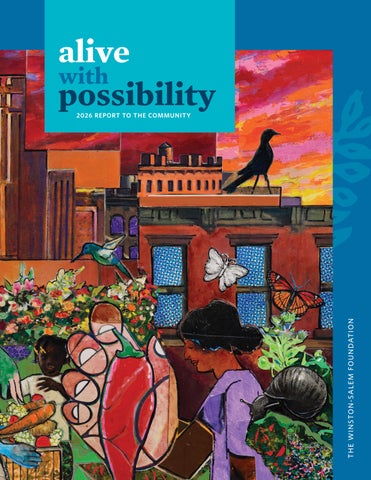
alive with possibility 2026 REPORT TO THE COMMUNITY
The Winston-Salem Foundation’s charitable history and local knowledge run deep. Since our founding in 1919, we’ve partnered with generous community members to build a better future for residents of Forsyth County and beyond. We are a nonprofit community foundation, the oldest foundation in North Carolina, and we consistently rank among the largest community foundations in the United States. OUR MISSION We foster meaningful connections and link resources to purposeful action, creating a brighter future for all who call Forsyth County home.
OUR VISION A vibrant, sustainable community where everyone thrives.
OUR BELIEFS Relationships are our most valuable resource. Equity makes our vision possible. Learning is an ongoing journey. Philanthropy is a powerful tool for change.
Foundation staff members snap a photo before the 2026 Community Gathering at the Benton Convention Center.
message to our community
FPO
Friends, In a time shaped by uncertainty, challenge, and change, we have found ourselves returning often to a question at the heart of our work: What becomes possible when our community chooses to imagine a different future together? That question shaped our annual Community Gathering with the 24th U.S. Poet Laureate Ada Limón, whose reflections on poetry, place, and possibility invited us to pay closer attention to one another, to this community, and to the futures we have the power to create. We saw that spirit come to life through All In For Our Schools when our community responded to a crisis in our Winston-Salem/Forsyth County Schools with generosity, determination, and shared purpose. Yet our story is not only about responding to challenges. It is also about investing in opportunity. This year, as we marked 20 years of the Women’s Fund and five years of local impact investing, we celebrated what is possible when values, resources and vision come together in service of community. For more than a century, The Winston-Salem Foundation has worked alongside donors, nonprofit partners, and community leaders to meet today’s needs while investing in tomorrow’s possibilities. At a time when so much in the world can feel uncertain, we remain inspired by what we witness every day: neighbors caring for one another, organizations responding with creativity and compassion, and people choosing to invest in the future of this community. Thank you for your partnership, your generosity, and your belief in what our community can accomplish. Together, we continue the work of meeting today’s challenges while imagining and creating what is possible. In community,
LaTida Smith President
Peggy Reingold Chair
The Winston-Salem Foundation
The Winston-Salem Foundation Committee
2026 COMMUNITY GATHERING
hope is
something you DO
The Winston-Salem Foundation’s 2026 Community Gathering invited neighbors, partners, and civic leaders to pause together and ask what becomes possible when a community chooses connection over isolation and imagination over despair.
“Poetry has quite a huge power to galvanize us with what we share in common.” ADA LIMÓN
24th Poet Laureate of the United States
Hundreds of people gathered at the Benton Convention Center for Poetry, Place, Possibility, an evening featuring Ada Limón, award-winning author and the 24th Poet Laureate of the United States. In a keynote and conversation with Foundation President LaTida Smith, Limón reflected on poetry as a practice of attention, belonging, delight, and hope—offering language for how people can remain fully human while doing the difficult work of caring for one another and the places they call home. The evening began with a commissioned poem by local poet and writer Jacinta V. White and continued with reflections on the Foundation’s role as a convener, partner, and permanent resource for Forsyth County. Together, the program underscored a belief at the heart of the Foundation’s work: We were never meant to do this great work alone.
ALIVE TO PLACE Limón’s work often treats the natural world not as scenery, but as a living force that shapes how people understand themselves and one another. Her signature project as poet laureate, You Are Here: Poetry in the Natural World, invites people to encounter poetry in national parks and to consider the relationship between language, landscape, and care.
Staff and volunteers pose for a photo during the community social hour, including Brenda Sanders, Shamika Munnings, Joy Nelson Thomas, and Brianna Holland.
A SPACE TO CONNECT At the Foundation, community begins with the belief that people are strongest when they come together to shape a shared vision where everyone can thrive. Limón offered poetry as one way to make that togetherness more honest and more possible—not by promising easy answers, but by creating space for people to breathe, pay attention, and tell the truth about their lives. She described the page as a “safe and sacred” space where a person can be completely honest with themselves. When those private truths are shared in community, she said, poetry becomes a bridge between individual experience and collective understanding. “Poetry has quite a huge power to galvanize us with what we share in common.”
At the gathering, she reminded the audience that attention itself can be a form of connection. In a culture that often rewards speed, distraction, and constant productivity, the simple act of looking closely can restore a sense of belonging to the world around us. “Looking out and being present and receiving the world is such a beautiful way to go through life.” That message echoed the Foundation’s place-based commitment to Forsyth County. To invest in a community is to pay attention to it—to its neighborhoods and schools, its stories and systems, its strengths and inequities, its grief and possibility.
Attendees make art inspired by Limón’s poetry in partnership with Sawtooth School for Visual Art (right) and listen to her keynote address (below).
For a room filled with people who care deeply about Winston-Salem and Forsyth County, that invitation felt especially resonant. The work of community change requires more than strategies and resources. It requires trust, vulnerability, and the willingness to see one another clearly.
2 026 R E P O RT TO T H E CO M M U N I T Y
3
BELONGING AS WHOLENESS As Limón reflected on her experience as poet laureate, she spoke about moving through public spaces as one’s whole self. On the day she began her laureateship, she wrote “joyful service” in her journal. For her, joyful did not mean uncomplicated. It meant whole. She described showing up with grief, humor, anger, tenderness, and delight all in the room. That wholeness can open a path for others to imagine themselves more fully.
Speakers gather before the event, including WS/FCS educator Stephen Langford, local poet Jacinta V. White, keynote speaker Ada Limón, Foundation president LaTida Smith, and board chair Peggy Reingold.
“I wanted to show people they could move through the world while being holistically themselves.”
HOPE IN ACTION
For the Foundation, belonging means bringing the fullness of one’s humanity into shaping the future. Limón also challenged the audience to make room for delight. In her poem “Give Me This,” she asks, “Why am I not allowed delight?” Joy belongs alongside grief and responsibility because it helps sustain action. “Showing up wholly means showing up also in my joy.”
“I wanted to show people they could move through the world while being holistically themselves.” ADA LIMÓN
24th Poet Laureate of the United States
Limón offered a definition of hope rooted not in optimism, but in practice. She spoke about small acts that return a person to agency: cooking a meal, cleaning a creek bed before it rains, writing a poem, witnessing someone else’s good work. “Hope is not something you have. It is not something you hold. It is something you do.” That message carried special meaning in a year when the Foundation and its partners continued to respond to urgent needs while investing in long-term possibility. Across Forsyth County, neighbors, nonprofits, donors, educators, advocates, and civic leaders are doing the work every day—often quietly, often together. The 2026 Community Gathering offered a shared language for courage, care, and connection. As Limón’s words settled over the room, the program became an invitation—to notice who is missing, tend what is fragile, celebrate what is beautiful, and keep choosing purposeful action in service of the place we call home.
WATCH THE RECAP Watch the video recap and check out the live event illustration created by Yen Azzaro on our website. wsfoundation.org/event/2026-community-gathering
4
T H E W I N STO N -SA L E M FO U N DAT I O N
inside
possibility BY JACINTA V. WHITE
Maybe there is a knowing beneath the knowing. Beneath and after the meetings, the exchanges, the numbers, the names there is something more. Something we see as object is really subject alive, forming, breathing not for, but with. Maybe beneath the sun’s rising and its setting there is something we can touch and call our own not as possession or pride but stewardship. Maybe beneath the stones and stories found and unearthed— some still waiting to breathe— we know something deeper hold it closer, see more clearly who we are to be. This is not a perfect city, a polished community but one alive with possibility, tender as thunder carrying anger through a sky still dreaming.
What if possibility is not future-driven but now— current, here, present, today? What if it lives beneath the names of streets, and sides of town? May we then be more the kind of people who notice who is missing. May we build and tend something tall, wide enough to hold both grief and laughter. May we remember we were never meant to do this great work alone. May we, in this holy moment, meet each other and all of who we are— not across distance but here, now together inside possibility.
2 026 R E P O RT TO T H E CO M M U N I T Y
5
WS/FCS students take notes in the classroom (left). Checks for classroom supplies being delivered to schools across the district (above). A young student receives support and guidance (right).
when the
community goesALL IN When Winston-Salem/Forsyth County Schools faced a financial crisis so large and urgent that it threatened to overshadow the future of our public school district, the community responded with an extraordinary show of generosity. In a matter of months, the All In For Our Schools campaign raised more than $9.8 million, proving once again that Winston-Salem does not walk away from its children. For many who responded, the campaign was never only about closing a deficit. It affirmed a belief that had long shaped their giving and civic service. John Burress, a longtime donor and public education advocate, traced his commitment to values learned from his parents and years of local board service. His support grew from concern that North Carolina had fallen behind in teacher pay and public education investment, even as education remains central to the state’s future. “The future of our communities and our country are dependent on educating our young people,” Burress said. To him, public schools are the linchpin of opportunity.
6
T H E W I N STO N -SA L E M FO U N DAT I O N
Supporting them is not a narrow cause—it is a community responsibility. That shared responsibility was also clear to Marni Eisner, executive director of our local Education Foundation. When the crisis emerged, the Education Foundation knew it had to mobilize. The work would require partnership, trust, credibility, and a willingness to bring people together quickly. Eisner had been talking separately with advocates, donors, civic leaders, foundations, and communications professionals. That changed when The Winston-Salem Foundation convened an early meeting at its Burress Family Center for Philanthropy. Separate concerns began to coalesce into a shared sense of purpose, and a coordinated campaign took shape. What had felt overwhelming became an actionable effort in which people could contribute time, talent, relationships, resources, and resolve. “It felt like an all-hands-on-deck moment,” Eisner said.
The Winston-Salem Foundation’s early $1 million commitment made that turning point unmistakable. Its role mattered not only because of the dollars, but because of what community foundations are built to do: hold relationships across sectors, understand local needs, steward donor generosity, and deploy flexible resources when responsive leadership is needed. By stepping forward early, the Foundation gave the effort momentum, credibility, and a public signal that Winston-Salem would not leave its students and teachers to face the crisis alone. For Burress, that commitment showed the community that this was not someone else’s problem—it was a shared responsibility, and the moment to act was now.
“How did this happen?” to “What happens to our children if we do nothing?”
Eisner saw the same strength from a partner’s perspective. The Winston-Salem Foundation, she said, was uniquely positioned to respond with speed and flexibility. Its support went beyond dollars, offering infrastructure, credibility, and trust as the Education Foundation was emerging and building capacity.
The lesson extends beyond the campaign itself. All In For Our Schools demonstrated how philanthropy can respond in crisis and pointed toward the need for investment before crisis arrives. Paul Fulton, whose philanthropy centers on education, has long advocated for public schools and teacher pay as a founder of Public Ed Works. He connected the campaign to long-standing concerns about underfunding, vouchers, teacher retention, and
Donors who had supported public schools for decades found a way to act on long-held convictions. Foundations, businesses, individuals, educators, and communications partners aligned around a common message. Iris Cole, co-owner of local strategic communications firm M Creative and member of the Education Foundation board, noted that All In For Our Schools gave people not just a name, but a pathway to understand the stakes and take action. Cole likened the early response to “the stages of grief.” But as information became clearer and leaders outlined a path forward, the question changed from
Eisner said people across North Carolina and beyond were surprised by the speed and scale of Winston-Salem’s response. What stood out was not only that people gave, but who gave: retirees, families without children in the system, longtime education advocates, and neighbors who did not want students and teachers to carry the consequences of a crisis they did not create. For Burress, the response reflected a generosity that has long defined Winston-Salem. The campaign showed what can happen when people focus on the future.
“Every goal that we have as a community is tied to strong public education.” IRIS COLE
Board Member, Education Foundation for WS/FCS
A teaching moment between WS/FCS educator and student.
competitive salaries. To him, strong public education is essential to community vitality, democracy, and attracting industry. Cole saw the campaign as critical to supporting a stronger education continuum, from early childhood through postsecondary pathways, and our economic vitality. “Every goal that we have as a community is tied to strong public education,” she said. Without continued investment at the scale of the community’s aspirations, she argued, Winston-Salem cannot reach the outcomes it wants for families, employers, neighborhoods, or students.
What remains is more than a debt addressed or a goal met—it is the infrastructure of relationships that can be activated again and a clearer story about why public education matters to everyone, whether or not you have children in the classroom. The real achievement of All in For Our Schools was not the $9.8 million raised in eight months, but the renewed understanding of who Winston-Salem can be when the community chooses to move together.
That broader commitment is already visible across The Winston-Salem Foundation’s ongoing commitment to equity in education. In 2025 alone, the Foundation and its donors provided $1.7 million in scholarships for students pursuing college and nearly $17 million in grants to schools and education-based nonprofits. Donor-advised funds offer convenience, tax advantages, and record keeping, but Burress said their greatest value emerges when they are paired with a community foundation’s ability to mobilize charitable dollars for local needs. Through donor-advised and unrestricted funds alike, the Foundation can respond to emergencies, address emerging challenges, and invest in long-term opportunities. In that way, All In For Our Schools became both an urgent response and a reminder of what sustained generosity makes possible. The Foundation could act because generations of donors had entrusted it with resources, relationships, and a mandate to serve the whole community.
8
T H E W I N STO N -SA L E M FO U N DAT I O N
READ THE REPORT Read more about the impact we made together in the All In For Our Schools Closeout Report.
The Luviano family proudly stands in front of their home, purchased with support from Latino Community Credit Union.
Investing in
possibility
When The Winston-Salem Foundation launched its local impact investing program in 2020, the idea was both practical and ambitious: use more of the Foundation’s resources—not only grant dollars, but a portion of its endowment—to support businesses and nonprofits working for social change in Forsyth County. Five years later, that decision has helped turn capital into homes, small-business loans, apprenticeships, and new models of community wealth building. The program has made more than $4.2 million in direct investments and helped spur more than $40 million in additional investment in Forsyth County, supporting 120 mortgages, 324 affordable apartment units, 16 businesses through loans and equity, and sustaining more than 70 jobs and 12 apprenticeships. But the numbers tell only part of the story. At its core, impact investing asks what could happen if capital could grow for the future and support social change simultaneously—helping families buy homes, entrepreneurs access opportunity, neighborhoods preserve history, and local partners prove what is possible now.
The approach grew out of a broader shift toward more proactive, mission-aligned work rooted in racial equity and economic mobility. Traditional grantmaking remains essential, but impact investing adds another tool to generate both social and financial return that can be reinvested in the community. Randall Tuttle, a longtime Foundation board member, donor, and member of the Impact Investing Committee since its beginning, describes the program as “an important and innovative tool in the toolbox.” With a background in private equity, Tuttle saw impact investing as a natural way to align financial stewardship with community purpose. Tynesia Boyea-Robinson, a national impact investing leader who now serves on the Foundation’s Impact Investing Committee, puts it this way: “You can’t grant your way out of the size and scale of the challenges we face as a society.” Impact investing, she said, creates evergreen funding—dollars that can return and go back out again—and can act as catalytic capital that helps prove markets and attract more investors.
2 026 R E P O RT TO T H E CO M M U N I T Y
9
That idea—capital circulating locally again and again— is visible in the Foundation’s partnership with Latino Community Credit Union. LCCU is a member-owned, bilingual, federally insured financial institution founded in 2000 as a grassroots response to a growing need: Latino and immigrant families across North Carolina were looking for fair, affordable ways to enter the financial mainstream, establish credit, and build long-term stability. The credit union opened its Winston-Salem branch in 2008 with early grant support from the Foundation and now serves 130,000 members statewide. In 2023, the Foundation grew its impact deposit to help capitalize affordable mortgages in Forsyth County. For LCCU, deposits are not static; they become lending power. “Because of the deposit that The Winston-Salem Foundation keeps at LCCU, many local families have been able to access credit-building loans,” said Gabriel Treves-Kagan of Latino Community Credit Union. Those loans help members establish credit, purchase homes, create equity, and build generational wealth.
“You can’t grant your way out of the size and scale of the challenges we face as a society.” TYNESIA BOYEA-ROBINSON
Impact Investing Committee, The Winston-Salem Foundation Treves-Kagan said the credit union’s model is built on trust-based relationships, financial education, and products designed to empower its members. Members making major financial decisions need a partner that offers clear guidance in their home language and does not profit from pushing products that do not fit their needs. That approach has allowed LCCU to demonstrate what is possible when capital is paired with relationship and readiness. Members repay their loans, strengthen the credit union, and make it possible for the same dollars to support more families over time. In that way, the Foundation’s deposit does more than sit in an account; it moves through households and neighborhoods to create opportunity.
10
T H E W I N STO N -SA L E M FO U N DAT I O N
Impact investing can take many forms: deposits in Community Development Financial Institutions (CDFIs), loan guarantees, bridge loans, direct loans, and equity investments in funds. The Foundation has used this flexibility to support housing, homeownership, small-business growth, apprenticeship training, and cultural preservation. Investments have supported small businesses through funds such as Equilibrium Impact Ventures, workforce housing through Metropolitan Village, and the restoration of a historic shotgun house in Happy Hill through Triad Cultural Arts. For Triad Cultural Arts, the Foundation’s $75,000 bridge loan helped move the shotgun house restoration from a long-held vision into something visible, tangible, and rooted in place. Executive Director Abrea Armstrong said the project was planted by many people before her, and what the community is seeing now is that effort “breaking through the soil and blossoming.” Armstrong describes herself as “the seed and bloom of Winston-Salem”—born and raised here, shaped by the city, and now committed to giving back to the place that shaped her. Her connection to Triad Cultural Arts began in childhood, through memories of attending its Juneteenth celebrations. “When you think Black history, you think of us. When you think Black culture, you think of us,” Armstrong said. For her, that means elevating local history alongside national narratives and helping residents understand the people, places, and freedom stories that belong specifically to this community. Armstrong said the bridge loan created momentum that would have been hard to build otherwise. The completed shotgun house has increased media coverage, donor excitement, community awareness, and confidence in Triad Cultural Arts’ capacity to steward significant projects. It helped turn a long-held vision into proof of concept and gave the organization room to build on community enthusiasm. “It’s just being able to have that runway to really dream,” she said. Boyea-Robinson said this kind of flexibility is often the difference between meeting a timely opportunity and missing it. Entrepreneurs and organizations need accessible capital that lets them seize an opportunity already in front of them.
Impact Investing at a glance
$4.2
MILLION
invested in
Abrea Armstrong (left) and community members (right) gather to celebrate the grand opening of the Shotgun House Legacy Site in the Happy Hill neighborhood.
The Foundation’s impact investments are focused in Forsyth County and intended to build civic, social, and financial capital in communities that have been harmed by redlining, urban renewal, and segregation. Because the Foundation is rooted in Winston-Salem, it brings something that national investment platforms cannot: local knowledge of community needs, relationships, opportunities, and risks. Boyea-Robinson noted that local and regional philanthropy is “so much closer to the people and the solutions.” That proximity creates a multiplier effect: The same institution that sees community challenges through grantmaking can also align its investment capital to help address them. The first five years have shown that impact investing can help make mortgages possible, preserve neighborhood assets, support entrepreneurs, create jobs, and expand opportunity. The next step is to explore donor and fundholder participation—putting capital to work again and again. In Forsyth County, impact investing makes a simple but powerful case: When dollars are aligned with mission, rooted in place, and guided by equity, they can do more than sit in a portfolio. They can move through neighborhoods, families, businesses, and institutions—helping build a more inclusive economy, one investment at a time.
WATCH THE VIDEO: CATALYZING COMMUNITY CHANGE Learn other ways the Foundation has helped create quality homes for residents in Forsyth County. wsfoundation.org/catalyst
11
LOCAL BUSINESS/NONPROFITS
unlocking
$40
MILLION
in additional investment in Forsyth County
Investment Types
3 Direct Loans 2 Loan Guarantees 3 Equity Investments 6 Intermediary Investments
Top Categories Quality Jobs Business Ownership Affordable Housing Place-Based Community Development
Partners Supported Equilibrium Ventures Housing Justice Now Institute Capital Latino Community Credit Union Metropolitan Village Partners in Equity Piedmont Business Capital The Do School Triad Cultural Arts Self-Help Credit Union S.G. Atkins Community Development Corporation *as of 6/30/2026 To learn more about the Foundation’s impact investing program, visit wsfoundation.org/impact-investing
LEAD Girls Ambassadors provide mentorship and support to girls preparing to enter high school (left and right). Women’s Fund founding members gather together (below).
giving
TOGETHER
for lasting change
Founded in 2005, The Women’s Fund of WinstonSalem began with five friends—Janie Wilson, Sarah Holthouser, Mary Jamis, Lynn Eisenberg, and Michelle Cook—who believed that the community could work together to make a real difference in the lives of women and girls in Forsyth County. From that shared conviction came a simple but powerful idea: When people pool their resources, relationships, and voices, they can help shape a more equitable future together. What started as a collective giving effort has grown into a lasting community of nearly 300 members from many walks of life—corporate and nonprofit leaders, educators, entrepreneurs, students, volunteers, advocates, and neighbors—united by the belief that everyone should have the opportunities, skills, and resources to be
12
T H E W I N STO N -SA L E M FO U N DAT I O N
independent, self-sufficient, and fully engaged in community life. Members do more than contribute; they actively participate in the grantmaking process by learning about prospective grantees and ultimately voting to select the programs that will receive funding. Over two decades, a shared commitment has translated into more than $2.6 million in grants to programs directly benefiting local women and girls. Investments have supported organizations working across the issues that shape economic security, from leadership development and education to basic needs, family stability, and health and safety. Just as important, the Fund has created a space where members learn together, listen to community voices, and use philanthropy as a tool for long-term social change.
Women’s Fund members, including Freida Mitchell, Nikita Wallace, and Joy Nelson Thomas, gather at a Summer Sips event (above).
“The Women’s Fund said yes to me before I said yes to them. They were one of the first foundations to support LEAD Girls. They believed in me when all we had was my vision.” JOY NELSON THOMAS
Founder and Executive Director of LEAD Girls of NC
The vision comes to life through the people and organizations The Women’s Fund has supported over the years. For Joy Nelson Thomas, founder and executive director of LEAD Girls of NC, it began with someone saying yes. “The Women’s Fund said yes to me before I said yes to them,” Thomas said. “They were one of the first foundations to support LEAD Girls. They believed in me when all we had was my vision.” The Fund’s early support helped launch an organization that now empowers girls through leadership development, mentorship, and confidence-building programs. It also illustrates the ripple effect of The Women’s Fund’s approach: A grant can help an idea take root, but trust can help a leader and an organization grow. Today, Thomas serves on The Women’s Fund Advisory
Board and co-chairs its Membership Committee, giving her a unique perspective on the organization’s continued impact. Looking back, she believes that early investment reflects the values that continue to shape The Women’s Fund today. “Trust has to happen to really get the work done,” she said. “It’s about giving people who are doing really good work a chance.” Relationships built on trust continue to shape The Women’s Fund’s work today. Beyond grantmaking, the organization has expanded opportunities to listen, learn, and partner with the community, recognizing that meaningful solutions are strongest when they are informed by the people closest to the issues. Over time, the Fund has become not only a source of financial support, but also a
2 026 R E P O RT TO T H E CO M M U N I T Y
13
convener and hub for learning—helping its members better understand the barriers women and girls face and how collective action can make a difference. One example is the 2026 Gender Lens report, which brought together research and community perspectives to help inform conversations about the challenges and opportunities facing women and girls across Forsyth County. Cat Mizzi-Orrell, director of communications at Forsyth Futures and a Women’s Fund Advisory Board member, was part of that collaborative process. “Everything you see in the Gender Lens report is there because the community said it needed to be there,” Mizzi-Orrell said. “The story that’s been crafted spans many different lived experiences.” For Mizzi-Orrell, the report reflects The Women’s Fund’s commitment to ensuring community voices help shape its understanding of local needs. Rather than assuming solutions, the organization has created opportunities for residents, nonprofit leaders, and community partners to help guide the conversation. Thomas has seen that same commitment reflected in The Women’s Fund’s relationships with nonprofit organizations. Over the years, she has watched the Fund continue to simplify grant processes, strengthen partnerships, and create more opportunities for organizations to learn from one another. “You have to be willing to meet people where they are, build trust, and walk alongside them,” she said. “There’s been a real shift toward shared learning, and that’s impactful.”
That willingness to listen and learn together has become an important part of how The Women’s Fund approaches its work. Whether convening nonprofit leaders, supporting community-informed research, or investing in organizations with bold ideas, the focus extends beyond individual grants to building stronger relationships and creating lasting impact. In that way, the Fund’s history is not simply a record of dollars awarded; it is a story of members using collective giving to strengthen the systems, organizations, and relationships that help women and girls thrive. Mizzi-Orrell believes that collaborative approach is what makes The Women’s Fund so effective. “The Women’s Fund can’t solve these issues on its own,” she said. “But because it’s willing to invest alongside the community, it becomes a catalyst that helps move the work forward.” Twenty years after its founding, The Women’s Fund continues to invest in women and girls across Forsyth County with the same spirit that launched the effort in 2005: a belief that collective generosity can become collective power. Its impact is measured not only by the grants it’s awarded, but by the trust it has built, the partnerships it has strengthened, the leaders it has encouraged, and the opportunities it has created for people to shape the future of their community. Looking ahead, The Women’s Fund remains committed to investing in people, believing that lasting change begins by listening, learning, and working together.
THROUGH A GENDER LENS 2026: THE ECONOMIC SECURITY OF WOMEN AND GIRLS IN FORSYTH COUNTY This report looks at economic well-being through a gender lens, recognizing that women, particularly Black and Latine women, single mothers, immigrants, LGBTQ+ people, caregivers, and women living with disabilities, experience these pressures more intensely and more often.
R E AD T HE R E P ORT
Founding members of the Do All the Good You Can Fund discuss their giving, including: Tom Lawson, Ken Kumpe, Dudley Watts, Jim Mabry, Dr. Malcolm Chaney, and Jim Tate (right). A young student prepares for a new school year during a neighborhood fund drive (below).
where
generosity
meets TRUST When Centenary United Methodist Church restarted its men’s ministry after the isolation of the COVID-19 pandemic, the first gatherings were modest: a handful of men, biscuits, a speaker, a reminder to serve. But as the group began meeting more regularly, something started to shift. The men were not only looking for fellowship; they were looking for a way to put their faith and love for Winston-Salem into action. The group began adding a “mission moment” to its gatherings. Participants brought diapers for the North Carolina Diaper Bank, canned food for a pantry, flood buckets after Hurricane Helene, or other practical items for neighbors in need. Then, as Tom Lawson tells it, people began asking if they could write a check when they forgot to bring an item or missed a collection. That practical question led Mark Dunnagan, executive vice president at Blum Construction, to suggest creating a fund at The Winston-Salem Foundation. A donor-advised fund, he said, gives people space to be charitable now and more time to be thoughtful about where the money can do the most good. It creates a shared place to give, track impact, and invite others in. “It was certainly not a new idea,” Mark said, noting that the Foundation already offered a structure for collective giving which his company uses for its annual corporate giving. But putting the money into a named fund gave the effort clarity.
2 026 R E P O RT TO T H E CO M M U N I T Y
15
Founding members of the Do All the Good You Can Fund gather outside Centenary United Methodist Church (left). Students socialize during a Piedmont Circle neighborhood event (above and below).
The Do All the Good You Can Fund—named for the well-known words attributed to Methodist leader John Wesley—created a place where anyone could contribute and where the men could see what they had raised, what they had granted, and what more they might do. Wesley’s words encouraged the men to “Do all the good you can. By all the means you can. In all the ways you can. In all the places you can. At all the times you can. To all the people you can. As long as ever you can.” For Lawson, who has long been connected to local philanthropy as a Foundation staff member in the 1990s and board member in the 2020s, the fund became more than a financial tool. It helped “organize compassion.” In 2025, the men granted about $10,000 to public charities in and around Winston-Salem and raised $27,000 to donate in the following years. Alongside the giving, 89 men served nearly 500 hours at 61 places, providing more than 1,800 meals and supporting organizations such as the Winston-Salem Street School, Samaritan Ministries, Forsyth Jail and Prison Ministries, and Full Circle Mentoring. It is the relationship with Full Circle Mentoring that has become one of the clearest examples of what the fund makes possible. Founded and directed by Shantae Graham, Full Circle works with youth, families, and organizations to help dismantle the school-to-prison pipeline. Its work is broad by design: mentoring, tutoring, clothing, food, employment support, housing connections, mutual aid, and whatever else families may need to thrive.
16
T H E W I N STO N -SA L E M FO U N DAT I O N
Graham is a lifelong Winston-Salem resident who grew up near Piedmont Park, where Full Circle’s program is now housed. She believes deeply in the city’s potential, but she is clear that thriving requires shared responsibility. “This is a place that families and children and individuals could thrive,” she said, “but that’s only possible if community is working together.” Through donor-advised support, partnership, and community collaboration, Full Circle helped bring new life to a recreation space at Piedmont Park. Graham spearheaded an effort to revamp a basketball court in the community, resulting in a full-size court with bleachers, picnic tables, and grills. She still remembers seeing young people using it in the cold of winter, proof that the space was serving its purpose. But Graham is also careful about how people show up. She has shared with Lawson and the men what she calls the “wet sandwich” theory: the idea that giving should never be about a photo opportunity or offering something second-rate to people in vulnerable situations. “If we’re going to show up, let’s show up in our fullness,” she said. “Let’s show up 100%.”
Lawson heard the message. He describes the relationship with Graham and Full Circle as one built slowly, through listening first. “Seek to understand before you seek to be understood,” he said, quoting author Stephen Covey. The men have served meals, spent time with young people, made introductions, and helped connect families and students to educational opportunities. Through relationships with the Winston-Salem Street School, Forsyth Tech, and others, practical possibilities have opened: a student exploring college, another finding a path back toward a diploma, conversations about bringing adult education closer to the neighborhood. For Graham, that matters because real solutions require trust. “To get to the root cause of problems, there has to be a level of trust,” she said. “People need to know, ‘I see you. I’m here to support you and I hear you.’ ” In her view, trusting relationships allow us to see our neighbors more fully—not as problems to be solved, but as people with gifts, potential, and dreams.
Lawson sees the Foundation as the fertile ground where those connections can take root. It is, he said, a trusted place that encourages generosity, relationship-building, and cumulative good. The Do All the Good You Can Fund began with men bringing canned goods and writing small checks. Now it has become a vehicle for service, grants, introductions, and a deeper understanding of neighbors across Winston-Salem. And that may be the heart of the story: Generosity grows when people are willing to move beyond transaction into relationship. The fund allows the men to leverage their individual and collective gifts. Graham and Full Circle show them where trust and presence are needed. The Foundation provides the structure that lets compassion become organized and multiplied. Together, they are learning what it means, in all the ways they can, to do all the good they can.
“To get to the root cause of problems, there has to be a level of trust. People need to know, ‘I see you. I’m here to support you and I hear you.’ ” SHANTAE GRAHAM
Founder and Director, Full Circle Mentoring
Shantae Graham engages residents at an event hosted by Full Circle Mentoring (left) and young friends sit together (above).
2 026 R E P O RT TO T H E CO M M U N I T Y
17
2025 by the numbers TOTAL ASSETS*
GIFTS
693,638,076
$
$62,952,952
CHARITABLE FUNDS*
DONORS
1,683
1,579
FOUNDATION-DIRECTED (24%) Funds include:
$166.5M
2025 ASSETS
(by fund type)
Unrestricted
9%
Field of Interest
6.5%
Scholarships
8%
Strategic Initiatives
0.5%
OTHER (2%) $13.8M DONOR-DIRECTED (74%) Funds include:
$513.3M
*as of 12/31/25
18
T H E W I N STO N -SA L E M FO U N DAT I O N
Donor-Advised
34%
Designated
32%
Organizational Endowments
5%
Charitable Trusts
3%
DONOR-DIRECTED (93.5%)
$92.4M
Grants advised by donors to support local and non-local organizations
2025 GRANTS
$6.4M
(by fund type)
FOUNDATION-DIRECTED (6.5%) Grants the Foundation activates to strengthen Forsyth County
TOTAL CHARITABLE GRANTS
ORGANIZATIONS SUPPORTED
STUDENTS & TEACHERS SUPPORTED
$98,786,967
2,166
626
We’re committed to growing Foundation-directed resources to be able to respond to Winston-Salem’s opportunities and challenges, both now and in the future. If you’d like to learn more about directing your giving locally, get in touch with our team. For more detailed financial information, visit wsfoundation.org/financials To see a list of endowed funds that support our community, visit wsfoundation.org/funds
2 026 R E P O RT TO T H E CO M M U N I T Y
19
Ways TO PARTNER 1
Support Our Community Investments Make a donation of any size to support The Next Century Fund, Scholarships, the Black Philanthropy Initiative, The Women’s Fund of Winston-Salem, or Youth Grantmakers in Action. Make a gift to any of the 1,600+ funds administered by the Foundation.
Visit wsfoundation.org/give
2
Become a Fundholder Set up a Donor-Advised Fund or Designated Fund to support nonprofits that align with your philanthropic goals. Establish an Unrestricted Fund, Field of Interest Fund, or Scholarship Fund to invest directly in local nonprofits and students. Include the Foundation in your will or charitable gift plans.
Contact us at giving@wsfoundation.org or call (336) 725-2382
3
Apply for Funding Whether you’re a nonprofit, a local educator, or a student seeking higher education, we have ongoing grant and scholarship opportunities to help support your goals.
Visit wsfoundation.org to learn more
4
Share Your Time, Talent & Treasure Volunteer with the Black Philanthropy Initiative, The Women’s Fund, or as a Foundation Scholarship Reviewer. Support our nonprofit partners with time, expertise, or donations.
Call us at (336) 725-2382 to get connected or visit wsfoundation.org/volunteer
Let’s make more possible together. The Winston-Salem Foundation is your community foundation and just like you, our staff and board share a deep love and commitment to this place we call home. By working together and sharing powerful stories, we can unlock endless possibilities.
Get in touch at wsfoundation.org/staff
THE BURRESS FAMILY CENTER FOR PHILANTHROPY Nonprofit organizations and groups are invited to use this collaborative meeting space to learn, connect, and share ideas. For more information on the facility, visit wsfoundation.org/meeting-space
ARTWORK Community Garden Eric McRay ( front cover) Dancing on Trade Street Karen Kopf (inside back cover)
PHOTOGRAPHY Gwen Fletcher Kiara Harris C. Stephen Hurst Christine Rucker
DESIGN M Creative
751 West Fourth St., Suite 200 Winston-Salem, NC 27101 (336) 725-2382 info@wsfoundation.org wsfoundation.org winstonsalemfoundation wsfoundation winstonsalemfoundation