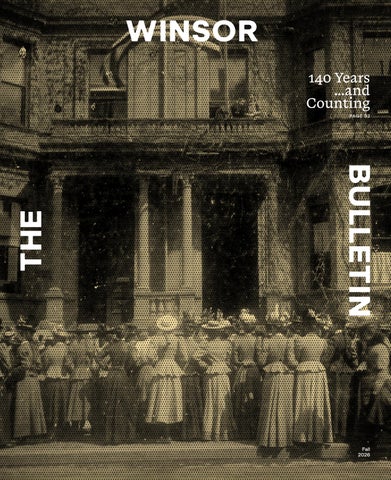
140 Years …and Counting PAG E 3 2
Fall 2026
FEATURES
32
140 Years and Counting Reflecting on the enduring events, competitions, publications, and iconic objects that have helped shape this inimitable school.
52
Leading the Field A History of Athletics Leadership at Winsor
58
Commencement
“Authentic Joy:” Celebrating the Class of 2026
BULLETIN: NEWS FROM PILGRIM ROAD
4
On Campus
Asian American Footsteps Conference; Celebrating Spring Sports; A Living Symbol of the Civil Rights Movement Comes to Campus; and more
CONTINUUM: ALUMNAE
64
Portrait of a “Winsor Woman”
Elizabeth “Betsy” Partridge Heald ’57, P’87, GP’18, ’20, ’21 IN EVERY ISSUE
2 From the Head of School 3 Op/Ed 84 First Person
FA L L / WINTER 2026
Looking Back, Moving Forward
F RO M THE HEAD OF SCHOOL
The Winsor Bulletin
2
Last year, my first priority was to learn about Winsor through the eyes of our students. I spent hours talking to students about their Winsor experience. Students shared stories of deep friendships with classmates forged. They shared the joy they feel coming to campus every day to be a part of this special community of learners. And they shared the ways that Winsor has pushed them to expand their intellectual capacities. A Class VII student told me about how inspired she is to be in a school with peers and teachers driving her forward, pushing her to “reach her best,” and a Class VI student told me about how, through her time at Winsor, she has realized a confidence in her own abilities she never expected. She spoke proudly of how she knows she has the strength and the skills to conquer any problem. In 1886, Mary Pickard Winsor founded her school in Boston’s Back Bay to educate girls with the idea that girls could—and should—go on to the highest levels of education. Just 14 years later, the Winsor School moved to 103 Pilgrim Road, where the school remains strong and vibrant today, continuing Miss Winsor’s legacy of empowering girls to reach for the highest goals. Throughout our history, as the world has changed and a bustling city neighborhood has risen around the campus, Winsor has remained true to the Miss Winsor’s original mission: to empower girls’ intellect. Like the Lamp of Learning, which serves as an enduring symbol of the pursuit of knowledge that lives at the heart of Winsor, the spark that drove Miss Winsor to start her school 140 years ago burns bright today in the students, faculty, and staff on our campus each day. Winsor graduates are connected by experiences that have endured decades—some for more than a century. Whether through the Class I play, Shakespeare Project, class rings, or painting the Class VIII homeroom, these special moments form the backbone of our students’ time at Winsor. While today’s students differ in many ways from those arriving at Miss Winsor’s school in 1886, they have an essential quality in common: they believe in themselves, and want to be challenged to strive for excellence. As I start my second year as head of school, I am especially grateful for the generations of faculty, staff, trustees, parents, alumnae, and benefactors who built the foundation upon which we now stand. We are at the threshold of a new chapter in Winsor’s history; together, we will continue to shape this remarkable school, steadfast in our enduring mission to empower girls to lead lives of purpose, engagement, and curiosity.
THE WINSOR BULLETIN FALL 2026
THE WINSOR BULLETIN
FALL/WINTER 2026 Meredith Legg P’32 HEAD OF SCHOOL DIRECTOR OF STRATEGIC COMMUNICATIONS Janelle Browning HEAD OF SCHOOL Meredith Legg P’32 CREATIVE DIRECTOR Nicole Barbuto CHIEF COMMUNICATIONS DESIGN Patrick OFFICER JanelleMitchell/MO–D Browning ASSOCIATE DIRECTOR OF DIRECTOR OF COMMUNICATIONS COMMUNICATIONS Raquel Hitt AND MARKETING Raquel Hitt INTERIM ASSOCIATE DIRECTOR OF DESIGN Patrick Mitchell/ModMag Studio COMMUNICATIONS John Mirisola CHIEF ADVANCEMENT OFFICER Emily Gurry DIRECTOR OF ENGAGEMENT SENIOR DIRECTOR OF ENGAGEMENT AND EVENTS Becky Withiam AND EVENTS Becky Withiam PHOTOGRAPHY PHOTOGRAPHY
Kelly Davidson, Dave Green Kelly Davidson, Dave Green, Natalie Hoang, Jon Verney BOARD OF TRUSTEES 2025–26 BOARD OF TRUSTEES 2026–27 PRESIDENT Allison Kaneb Pellegrino ’89, P’21, ’22 PRESIDENT VICE PRESIDENT Allison Kaneb Pellegrino ’89, P’21, ’22
Larry Cheng P’23, ’25, ’28 VICE PRESIDENT TREASURER Larry Cheng P’23, ’25, ’28
Lori Whelan P’23, ’25
TREASURER ASSISTANT TREASURER Ashley Marlenga Herbst ’01
David E. Goel P’23
CLERK CLERK Russell ’91, P ’22, ’25 Marion
Marion Russell ’91, P ’22, ’25 Armine Afeyan ’08 Susan Alexander P’03, ’05, ’08 Casey Chris Andrews O’Donnell P’26, Buckley ex officio ’07 Polly Elizabeth Crozier Bennett ’92, P’30 Carroll ’89 Nuha CaseyA. O’Donnell El Sayed Buckley P’33 ’07 Nicole Polly Crozier Fitzpatrick ’92, P’30 P’25, ’27, ’29, ’33 Linda Jennifer Dorcena DolinsForry P’23,P’28 ’26 Risteard Linda Dorcena HoganForry P’23 P’28 David Claire Humphrey PasternackP’28, Goldsmith ’31 ’01 Sam Ashley Kennedy Marlenga P’23 Herbst ’01 Masu Risteard Haque Hogan Khan P’23 P’27 Elise DavidMcDonald HumphreyP’26, P’28,’28 ’31 Kevin Sam Kennedy Mohan, P’30, P’23 ’32, ex officio Suzanne Jessica Lutzker RanereP’25 Norris ’94 Paresh Mallika Patel Marshall P’27, P’27 ’29, ’30 Richard Elise McDonald ScarinciP’26, P’30,’28 ’32 Sidra Suzanne Smith Ranere ’88 Norris ’94 Folashade Paresh Patel Solomon P’27, ’29, P’26 ’30 Ricky Sidra Smith Sun P’27 ’88 Perry Folashade M. Traquina Solomon P’09, P’26’13 Meghan Perry M. Weeks Traquina ’04, P’09, ex officio ’13 Lori Meghan Whelan Weeks P’23, ’04, ’25ex officio Emily Lubin Woods ’91, P’26, P’26 ’32 The Winsor School does not unlawfully discriminate on the basis of race, creed, national origin, or sexual orientation in the administration of its educational policies, scholars programs, athletic programs, and other school-administered programs. COVER ILLUSTRATION
Dana Smith
We’ve Come a Long Way, Baby
As Winsor’s 140th year anniversary starts, we want to appreciate how far the school has come. As this year’s Lower School council heads, we want to do our best to continue Miss Winsor’s dream. As students who have been here since Class I, we have celebrated many traditions that showcase Winsor’s pride, like Under the Lights and spirit week! We have seen many extraordinary students, from those who are on the robotics team, to those who excel in writing, to those who have amazing athletic skills. Everywhere in the Winsor School, there is talent. But what makes Winsor special is the fact that everyone excels in their own way. No one person is the same or has the exact same goals, yet Winsor still empowers everyone to be their best selves. As heads of council this year, we hope to continue that experience. One of the ways Winsor has empowered us was when we ran for the Lower School council head position itself. We were given the opportunity to become leaders and help in our community, and that really inspired us to do our best to help our peers thrive in Winsor’s environment. We hope that the students and council heads after us will also experience the opportunities that Winsor provides. Following the previous heads, our goal is to continue their legacy, and those of the many council heads before us. Whether that means listening to suggestions for the Lower School and taking action, or just being there when a classmate needs help or someone to talk to. Our focus is making sure every student feels like they have been heard and that they are supported at school. We are so excited to plan for future events as well! Whether that is spirit week, field day, or normal town halls and assemblies, we are thrilled to contribute and make sure everyone has a great time! We’ve heard from every grade before us that Class IV is like no other. We are honored to get to experience the lasting traditions as eighth graders. In particular, we cannot wait to begin our Shakespeare play in January. As mentioned earlier, Under the Lights, coming up shortly, is one of our favorite traditions as well! A pep rally of cheers and spirit, watching our friends shine in the sports they love, enjoying the other activities out on the courtyard, what’s not to love? Another aspect of being a Class IV that we are ecstatic about are our buddies in Class I! A fabulous way of making connections through the Lower School! Most of all, we are so proud of our Class of 2031 and cannot wait to finish off middle school with our peers. We’re super excited for the year to come and are ready to support the Lower School in whatever ways necessary!
O P/ E D ALEXANDRA CHEN ’31 & SHYLEE FEINGOLD ’31
Fall 2026
3
N E WS F RO M P I LG R I M ROA D
The Winsor Bulletin
4
Students at the Spring Rally
Winsor Hosts Asian American Footsteps Conference
BULLETIN EVENT S P OT L I G H T BY K AT I E GIBSON
“The joy and community is the most important part.”
In April 2026, Winsor hosted the Asian American Footsteps Conference, which brings together Asian, Asian American, and mixed-heritage Asian students from schools across New England. Founded in 2011, the conference provides students with a space to explore issues specific to their experiences. This year’s planning committee chose the theme “Creating Common Ground: Connecting with Our Communities” to highlight the importance of shared experience and true connection. “The joy and community is the most important part,” says Jessica Wang, Upper School mathematics faculty and community and inclusion coordinator. “This is why students and adults from different schools keep coming back—especially the ones who traveled two or three hours to get here.” The conference, which is hosted by different participating schools on a rotating basis, comprises a full day of workshops and affinity group sessions, allowing students to dive into particular topics and connect with other attendees. This year’s Winsor planning committee, which was led by Ms. Wang and included six students, added a slate of opening games before the morning keynote speech, allowing attendees to mingle and meet one another before the formal program began. “Planning the conference was one of the highlights of my Winsor experience,” says Ella
Paterniti ’26, one of the student directors. “It was really cool to bring in so many people from other schools to participate.” Ella and her fellow student directors focused on fostering connection among attendees, as well as curating a broad range of workshops and sessions. On the day, they visited multiple workshops to observe and lend their support (including the History of Ramen workshop, which had the bonus of a ramen tasting). Student-facilitated workshops included such weighty topics as mental wellness and dealing with microaggressions, as well as lighter subjects, including a history of Asian drinks and finding oneself through K-pop dance. Ms. Wang calls the conference “a great leadership opportunity” for students who facilitated workshops, as well as for the student planners. The committee met many times to determine the event’s values and focus, and then to hammer out logistics and other details. They designed and sold t-shirts bearing the conference logo, with the proceeds going to Rice Sticks and Tea, an Asian-focused food pantry in Boston. “It was a great experience to host the conference,” says Ella. Ms. Wang agrees: “The students were proud to show that Winsor could put on a great conference. And they got to connect with one another in both serious and joyful ways: having meaningful discussions about shared identities, and also having fun together.” ● Winsor students and faculty at AAFC.
The Winsor Bulletin
6
Bela Patel ’27 shares her presentation Framing a Nation: Indian Stamps and the Politics of Representation
Fall 2026
7
The Winsor Bulletin
8
Spirit in Season: Celebrating Spring Sports
On Saturday, April 11, Winsor brought student-athletes, families, and fans together for a day of clinics, competition, and school spirit at the first-ever Spring Rally, a celebration of Winsor’s spring sports. The day began with members of the varsity lacrosse and softball teams leading clinics for groups of Lower School players before the varsity teams took the field to play a slate of afternoon games in front of supporters. “This experience was about building relationships across divisions and giving our younger students a glimpse into the culture and commitment of our Upper School programs,” Director of Athletics Trina Hable said. “Our varsity athletes demonstrated outstanding leadership throughout the morning. They led warm-ups and drills, and they created an environment that was both supportive and inspiring.” One of the athletes participating in the clinic was Sana Khan ’27, who said the experience was “super fun” for the team. “I didn’t know a lot of the lower schoolers, so this was a great opportunity to get to know and meet them,” she said. Following the clinics, students ate a catered lunch together in the Wildcat Room. Varsity teams then got ready to take on EIL opponents Portsmouth Abbey, while the lower schoolers stepped into the spirit of the event. Before the games began, they gathered around tables to make posters and pick out rally items—
red sunglasses, red hair bows, red pom-poms, and more—to cheer on their fellow Wildcats. The sidelines during the varsity games that afternoon were filled with energy, a sense of Winsor pride, and a whole lot of red as the younger Wildcats got to support their older counterparts who had coached and encouraged them earlier in the day. “We were also incredibly grateful for the outstanding showing and support from our parents and the broader Winsor community,” Ms. Hable reflected. “Their presence and enthusiasm helped elevate the entire experience, reinforcing the strength of our community and the shared pride in our student athletes.” Both lacrosse and softball competed hard in their matches to finish out the day. The work of all the athletes involved in Spring Rally, both on and off the field, raised the bar for representing their programs with kindness and leadership. The Winsor students and families in attendance were also model supporters, bringing a tremendous amount of energy and spirit to Pilgrim Road. “This experience captured exactly what we strive for in Winsor Athletics—connection across grade levels, student leadership, and a program where athletes feel supported and proud to be part of something bigger than themselves.” ●
BULLETIN SPRING R A L LY
Fall 2026
9
Lower School Closing Ceremony
Processing to Pachelbel’s Canon and holding a single white rose tied with a red ribbon, Class LOW E R S C H O O L IV students made their entrance to the David C LO S I N G E. and Stacey L. Goel Theater for the 36th annual Lower School closing ceremony on June 8, marking the end of the school year and their time in the Lower School. “Gratitude…. We hear the word often, but I wonder if we spend enough time thinking about what it really means,” said Head of Lower School Sharon Jones Phinney, who provided the welcoming address to assembled families. “Gratitude is the process of noticing…. As we come to the end of this year’s school year, I hope you will take a moment to notice what we have received from one another,” she said. Ms. Phinney also recited the poem “When Giving Is All We Have” by Alberto Rios. Reflecting on the rich texture of Winsor’s Class IV community, she said, “Each of us brings something different. Different strengths, different experiences…alone, those gifts matter, but together— yes, together, they become something greater.” Selected by Class IV, this year’s musical offering was “The Climb,” originally recorded “If aging and growing up is by Miley Cyrus and written by Jessi Alexander an art, then and Jon Mabe. As Class IV sang this moving balthese past four lad, they were accompanied by Performing Arts years, our class has made a Department Head Felicia Brady-Lopez on the masterpiece.” piano and directed by Performing Arts Faculty Andrew Marshall. Class IV speaker Clara Go ’30 began her speech referring to the famous rapper/singer Bad Bunny’s “old man”–costumed look at this year’s Met Gala. She reflected on his idea that aging could be an art. “If aging and growing up is an art, then these past four years, our class has made a masterpiece,” she said. “Growing up isn’t just about getting older or moving onto the next thing, it’s about the people and experiences that shape us along the way.” Outgoing Lower School Council heads Dani Peskin ’30 and Carys Musto ’30 then transferred school leadership to the newly elected Lower School Council Heads, Shylee Feingold ’31 and Alex Chen ’31. “Do not be scared The Winsor to try new things…. Make the most of every moBulletin ment with your friends,” Dani urged her Lower 10 School classmates. BULLETIN
Rising 2026–27 Class VIII President emma roFFman ’27 encouraged the incoming freshmen to make new friends and try new things. “Keep an open mind, and drop any assumptions you’ve made about your classmates these past four years, and just be kind to everyone,” she said. Class IV Coordinators Josh Constant and Emily Moran also offered bits of advice. “Continue to work to be your best selves. Know that it is an ongoing journey, and there will be bumps along the road. When things get hard, take a deep breath and make the best choice you can with the information you have,” Mr. Constant said. After Ms. Phinney and Ms. Legg conferred the certificates to members of Class IV, new Lower School Council Heads Shylee and Alex rang Miss Winsor’s bell to officially close the school year. ●
Fall 2026
11
A Living Symbol of the Civil Rights Movement Comes to Campus
BULLETIN AS S E M B LY
“ Terrence Roberts’s visit is one of those rare assemblies that students and faculty will talk about for years to come.”
The Winsor Bulletin
12
On Friday, May 22, Winsor hosted a special assembly with Dr. Terrence Roberts, a clinical psychologist and member of the Little Rock Nine, whose enrollment at Central High School in Little Rock, Arkansas, helped fight for school integration and became a symbol of the Civil Rights Movement. Joined by students from Boston Latin School, Winsor gathered in the David E. and Stacey L. Goel Theater for a conversation between Dr. Roberts and student panelists. Caroline Specht ’28, Josie Go ’28, and Bailey Hall ’28 introduced Dr. Roberts, speaking about their Class VI United States History research coursework on the Civil Rights Movement. “The names we tend to remember are often the ones in positions of power…. But the people who actually walked through the doors of Central High School are sometimes remembered more as a group than as individuals,” explained Caroline, who researched the years-long struggle to desegregate Southern schools before Little Rock made national headlines. Upper and Lower School panelists then joined Dr. Roberts on stage. When asked what gave him strength to keep attending school amid intense hostility and isolation, Dr. Roberts shared: “Whatever happens, I will learn how to confront it.… People who don’t have an opportunity to develop in that sense tend to shrink, dissolve, disappear—I didn’t want to disappear.”
Dr. Roberts recalled taking a “vow of nonviolence” as the Nine organized, inspired by lieutenants who worked for Dr. Martin Luther King Jr. He said community was a central tenet of the Civil Rights Movement, bringing people together to fight for change. The bond he found within the Nine has lasted: the seven living members, he confirmed, are “like a small family.” Following the Q&A, Illumina, Winsor’s Upper School choral group, led by Performing Arts Faculty Andrew Marshall, performed “Hope Lingers Here” with a spoken word section featuring Nia Lawrence ’26. Boston Latin students and several Winsor classes later met with Dr. Roberts in smaller discussions, and he closed his Winsor visit with lunch alongside Lower School students. These smaller sessions provided yet another forum for students to connect and learn from Dr. Roberts’s inspiring life and work. “Terrence Roberts’s visit is one of those rare assemblies that students and faculty will talk about for years to come,” said Director of Community and Inclusion Julian Braxton. “His wisdom and keen insights about both the past and the present were incredibly powerful. At the same time, his wit and humor came through in such authentic ways. He is the kind of person whose stories, reflections, and perspective hold your attention from beginning to end. I am so grateful that he came to Winsor.” ●
Fabienne Norvin ’32 and Terrence Roberts at allschool assmbly
Fall 2026
13
Parents, Alum Join Winsor’s Board of Trustees
BULLETIN NEW T R U ST E E S
The Winsor Bulletin
14
ARMINE AFEYAN ’08
NICOLE FITZPATRICK P’25, ’27, ’29, ’33
NUHA A. EL SAYED P’33
Armine Afeyan is a first-generation American with Armenian and Swedish nationalities. She is the CEO of the Aurora Humanitarian Initiative, which celebrates and funds grassroots humanitarians who have collectively impacted the lives of tens of millions. Prior to Aurora, Armine scaled consumer-oriented technology companies, most recently Wayfair, where she led businesses in London and Boston. She holds a B.A. in political science from Yale University and an M.B.A. from INSEAD. She proudly serves on the boards of organizations advancing refugee resettlement, philanthropy, Armenian advocacy, and girls’ education. Armine lives in Washington, D.C. with her husband and daughter. As a Winsor trustee, she is the chair of the Advancement Committee and a member of the Executive Committee.
Nicole Fitzpatrick is executive vice president and chief legal officer at Dynatrace. Prior to joining Dynatrace, Nicole spent 13 years with Akamai Technologies, most recently serving as the chief ESG officer and deputy general counsel, and 12 years working in private practice, including as a partner at Goodwin Procter and as a junior partner and associate at WilmerHale. She was honored with a Leader in the Law Award by Massachusetts Lawyers Weekly. Nicole earned degrees from the University of Virginia School of Law and Boston College. Nicole and her husband, Robert, have four daughters, three of whom are Winsor students and one who is a recent graduate. As a Winsor trustee, she is the chair of the Audit and Risk Committee and a member of the Executive Committee and the Committee on Trustees.
Dr. Nuha A. El Sayed is a physician-scientist and endocrinologist on the faculty of Harvard Medical School and Brigham and Women’s Hospital, where she specializes in diabetes and obesity. Her research and teaching at Harvard Medical School spans complexity science, clinical guidelines development/ implementation, evidence synthesis, and the application of artificial intelligence in medicine. Prior to joining the Brigham, she spent more than a decade at the Joslin Diabetes Center/Harvard Medical Faculty Physicians leading the export of the Harvard/ Joslin know-how nationally and globally. She is the founder and chair of DEFA (Diabetes Education for All), a nonprofit advancing diabetes capacity, care, and education globally with a focus on humanitarian and low-income settings. She and her husband, Hythem, are the parents of a current Winsor student. As a Winsor trustee, she is a member of the Advancement Committee and the Committee on Trustees.
MASU HAQUE KHAN P’27
KEVIN MOHAN P’30, ’32, EX OFFICIO
RICHARD SCARINCI P’30, ’32
RICKY SUN P’27
Masu Haque Khan is a lawyer and consultant with a background in employment litigation, career counseling, and education. Masu is the beneficiary of 14 years of single-sex education, having attended the Columbus School for Girls from pre-K through 12th grade. Thereafter, she obtained her B.A. with honors in psychology from Yale College and her J.D. from Georgetown University Law Center. Masu has served on multiple nonprofit boards and was recently appointed to be a commissioner for the town of Brookline’s Commission on Diversity, Equity, Inclusion and Community Relations. She lives in Chestnut Hill with her husband, Badar Khan, and their three children, one of whom attends Winsor. At Winsor, Masu has served as a Parents’ Association class rep for Class III and Class IV, and she is a Winsor Leads Parent Committee co-chair. As a Winsor trustee, she is a member of the Advancement Committee and the Equity Committee.
Kevin Mohan joined the Harvard Business School faculty in 2012 after a long career as a private equity investor. He teaches entrepreneurship and negotiation courses to M.B.A. and executive education students. He joined growth-equity firm Summit Partners in 1994 and led over 20 investments. He served as a managing director for many years and is now a senior advisor for the firm. He graduated with honors from Harvard College, Harvard Business School, and Harvard Law School. He is a faculty advisor for the Harvard College wrestling team and volunteers for The Roxbury Latin School. He and his wife, Anne Williams, have been active members of the Winsor community, including serving on the Winsor Leads Parent Committee. They have three children, including two current Winsor students. Kevin serves ex officio on the board as chair of the Annual Giving Committee and is a member of the Advancement Committee.
Rich Scarinci joined Partners Capital in 2016 and is head of North America and a member of the Executive Committee. He is also a member of the Global Investment Committee, which focuses on firmwide investment strategy and asset allocation. Rich is responsible for the investment programs of many of the largest North American relationships, both institutions and private clients. Rich holds a B.A. in economics with a concentration in finance from Princeton University. He and his spouse, Ulli Sitter, are the parents of two Winsor students. They reside in the South End in Boston. As a Winsor trustee, Rich is the chair of the Investment Committee and a member of the Executive Committee and Finance Committee.
Ricky Sun is a partner at Bain Capital Life Sciences, investing and building companies that drive medical innovation. Ricky began his career as a senior scientist at Ironwood Pharmaceutical, where he was involved in the discovery and development of the drug Linzess for irritable bowel syndrome. He received a Ph.D. degree in chemistry and chemical biology from Harvard University and was an NIH postdoctoral fellow in biological chemistry and molecular pharmacology at Harvard Medical School. He also received an M.B.A. from New York University Stern School of Business, where he was a Mildred Elperin Scholar. He graduated summa cum laude from Berea College with a B.A. in chemistry. He and his wife, Cathy He, are the parents of two children, including one Winsor student. As a Winsor trustee, he is a member of the Finance Committee. Fall 2026
15
Honoring 250 Years of American History with a New Civics Curriculum
IN THE C L AS S RO O M
Photographs by Natalie Hoang and Ann-Marie Holland
The Winsor Bulletin
16
2026 marks both the 250th anniversary of the Declaration of Independence and, coincidentally, the debut of a new civics curriculum for Class III at Winsor. Under the new curriculum, civics will be taught for a full year in Class III and revisited during United States History in Class VI. An internal review of Winsor’s broader curriculum resulted in several specific recommendations for history. Building on these recommendations, the History Department began a review of its curriculum and made adjustments designed to provide students with a stronger foundation in U.S. history and an increased focus on civic engagement, something the History Department recognized would best meet the needs of today’s Winsor student. According to Ann-Marie Holland, head of the History Department and the Alice C. Jenckes Chair in History, the new framework allows students to explore political and civic life in greater depth throughout their middle and early high
school years. For example, Class III will be introduced to the Constitution and the concepts of federalism, the separation of powers, checks and balances, political rights, different branches of government, and the Enlightenment ideals that inspired the American system. In Class V, students will have a unit on Enlightenment thinkers as part of their year studying modern European history. By Class VI, they will be prepared to examine the articles of the Constitution in greater detail. WHY NOW?
“Following the most recent accreditation process, one of the recommendations for the school was to undertake a curriculum review,” says Ms. Holland. “As we began that work in the History Department and broader school community, it quickly became clear just how valuable and necessary a comprehensive review would be.” The resulting internal three-year review concluded At left, Class III students at the Boston Public Library. At right, History Faculty Josh Constant and students in Class III History.
Fall 2026
17
FAC U LT Y F E AT U R E
that the History Department should add a more robust civics program in the Lower School. The broader Lower School community/civics theme aligns with the desire for more opportunities for meaningful community engagement and could culminate in a Lower School capstone project. The History Department used the Democratic Knowledge Project’s (DKP) curriculum as the foundation to structure the new course. The DKP provides resources for schools to develop civics curriculum that deepens knowledge of, and support for, constitutional democracy. In addition, the department worked with Primary Source, a local nonprofit that collaborates with teachers to foster students’ skills for thoughtful and engaged citizenship. THE NEW SEQUENCING
The Winsor Bulletin
18
Integrating the new civics curriculum not only added a new course, it also led to restructuring history education from Class I all the way through Class VI. Prior to this year, Class I studied early American history, Class II learned about ancient civilizations, and Class III explored the Silk Road. Now, Class I will study ancient civilizations (starting from Mesopotamia), Class II will take a course called Cultural Traditions and Encounters, looking at the Silk Road and Africa, and Class III will have Civics: Foundations and Practice of American Democratic Ideals. The curriculum for Classes IV and V will remain the same: The Birth of Modern Europe followed by Modern Europe and the Problems of Power. Then, Class VI will devote a full year to the United States His-
tory course. While the new curricula for Classes I, II, and III are in the process of being implemented, the department is now turning its attention to the later grades, considering how those courses can evolve to complement and build upon the changes made in the earlier grades. What will be gained, in addition to giving students a stronger foundation in U.S. history, is a sweeping civics education covering not only American government, but also the media literacy skills needed to navigate today’s news and social media landscape, and the tools for productive, open dialogue across differences of opinion. History faculty are also working with colleagues across Class III to integrate civics-related themes into lessons on science, wellness, math, art, library studies, and world languages. For example, a science unit on environmental policy might examine how policy is shaped by media coverage, government priorities, and diverse values. Math class might cover sampling and polling, misleading graphs, and Electoral College math. Ms. Holland says she’s looking forward to seeing how the students will integrate civics ideas into their final capstone projects. Throughout the year, students will keep journals reflecting on their personal, community, and national values, building toward a capstone project in which they identify a cause they care about and lay out a course of action they could take. To start the school year, Class III used their annual retreat day to visit the Boston Public Library, where they viewed a copy of the Declaration of Independence on display as a part of the nation’s semiquincentennial celebration. The History Department is also working on setting up field trips to the Edward M. Kennedy Institute for students to participate in a simulated U.S. Senate session, along with a mock trial at the John Adams Courthouse. With new sequencing and a new civics course now firmly in place, the History Department’s next task, Ms. Holland says, will be to “fine-tune our approach as we go.” Over the course of the 2026–27 academic year, faculty will be taking dedicated time to evaluate progress as they pioneer a fresh approach to teaching history. ●
At left, students in Class III History. At right, Class III students visit the Boston Public Library.
Fall 2026
19
The Gift of a Lifetime: Introducing The Marion D. de B. Kilson ’54 Endowed Scholarship Fund P RO F I L E S I N GIVING BY J OA N Y E N AW I N E
“ Children who are as bright as Winsor girls need a balance in their life.”
The Winsor Bulletin
20
on christmas eve 2025, Marion d. de B. Kilson ’54 died suddenly, leaving her three adult children, Jennifer Kilson-Page, Peter Kilson, and Hannah Kilson simultaneously reeling from their loss and yet profoundly aware of how fortunate they were. “Both of my parents were great role models,” said Mr. Kilson. “My mother was the glue that held our family together.” The next day, they unwrapped Christmas gifts she had left for them, a soothing ritual that helped them in the earliest stage of their grief. Soon after, they would find solace in giving a gift of their own in her honor. This year, they established The Marion D. de B. Kilson ’54 Endowed Scholarship Fund at Winsor, something they say was an easy choice. “It was a way to leave a mark, to say that Marion Kilson, her legacy of commitment to the education and advancement of women continues,” said Ms. Kilson. Ms. Kilson-Page agreed. “Losing your parents, you try to figure out how to keep them with you. And this was a way to not only keep her with us, but to also pay back, with our thanks, for what Winsor did for her.” The siblings say that their mother was nurtured in important ways during her time at the school. First and foremost, she gained friendships that lasted through every season of her life. “There was a core group of women who she went to Winsor with who were still a very important part of her life,” said Ms. Kilson-Page. “Part of my mom’s legacy to me is her example of lifelong friendships and bonds with women.” Beyond the friendships, they credit Winsor with sparking her intellectual curiosity and developing her quiet leadership style that would eventually help her earn her doctorate degree from Harvard University and lead to a distinguished career in anthropology and academia. Along the way, she met and married Dr. Martin Kilson (who predeceased her in 2019), the first African American to receive full tenure at Harvard in 1969. Their successful, dual-career, interracial, 60-year marriage defied societal expectations of the day and thrived in part because of their shared love of education. “Both my parents felt that education was
the cornerstone for opportunity. I think every opportunity my parents had, and frankly, every opportunity I’ve had, has been because of the education we received,” said Ms. Kilson-Page. The Kilson family used their mother’s values as a guide for how to structure the scholarship criteria. Marion was a scholarship student at Winsor, and so understood firsthand the impact that reliable financial assistance can make. The scholarship will provide tuition assistance to a student with demonstrated need, with preference given to a student from an urban area and who would be among the first in their family to attend an independent school. Once the scholarship is awarded, it will stay with the student as long as they attend Winsor. “We want to support Winsor in diversifying its community, opening doors, not just for people who have a history of being there, but also allowing new people to be there and create their own history,” said Ms. Kilson-Page. “As a white woman, my mother had a certain access and entrée,” adds Ms. Kilson. “But as the mother of three African American children, she had a lot of sensitivity to creating opportunity for all kinds of people. We’re the beneficiaries of that, and we want to give others an incredible education that they are completely capable of thriving in. I think this would make my mom really happy.” As they think about the future and their ultimate goals for The Marion D. de B. Kilson ’54 Endowed Scholarship Fund, the Kilsons have Winsor students on their minds. As for Ms. Kilson-Page, her dream is that in 10 or 20 years, teachers in Boston Public Schools will know about the Kilson Scholarship and encourage talented students to apply. “I would like to see it as a pathway, and that we can put the pieces together for a child who might otherwise not have the economic capacity to attend.” “I would like for scholarship recipients to be able to pursue careers that they want, and at the same time, I hope they can also learn the power of giving back,” said Mr. Kilson. Giving back and learning are recurring themes in the Kilson family, taught by example. They are paying those lessons forward to benefit the next generation of Winsor students. ●
At right, above: entries from the yearbooks of Marion D. de B. Kilson ’54 and Emily Greene Dusser de Barenne ’33. At right, below: the 1950 cast of A Midsummer Night’s Dream, Marion D. de B. Kilson’s Class IV Shakespeare play.
Fall 2026
21
The Winsor Bulletin
22
A Lifelong Habit of Helping
G E N E RO U S MINDED ANNABEL JONES ’27
Photograph by Natalie Hoang
When Miss Winsor founded her school in 1886, she wanted to prepare women to be self-supporting and hoped they would be competent, responsible, and generous minded. Current senior ANNABEL JONES ’27 ably personifies that goal with a range of volunteer activities through organizations close to her heart, the ripple effects of which are felt throughout her community. Annabel’s interest in service predates her arrival at Winsor. At a young age, she turned her love of baking with her mother into an opportunity to thank the firefighters who worked to save her grandparents’ home from a fire, walking batches of cookies and brownies down the street to the local fire station in Cambridge. Eventually, Annabel’s delivery range expanded to the Pine Street Inn, Boston’s largest provider of services for people experiencing homelessness, where residents are served dessert only when there is a surprise drop-off. Donating treats to Pine Street requires an adherence to strict guidelines: sharing a minimum of 250 individually wrapped treats and clearly listing their ingredients on the packaging. To these treats, Annabel also added a hand-written note in hopes of further brightening the day of their recipients, noting, “Maybe reading the little note reminds someone that they are appreciated and loved.” Years later, she joined her mother, Bryn Zeckhauser ’89, P’24, ’27, wrapping presents during a holiday gift drive at the Tierney Learning Center, a community resource center located at the Anne M. Lynch Homes at Old Colony in South Boston. The hub serves low-income residents of all ages, providing free collaborative programs and supportive services for the more than 1,400 residents at Old Colony. Initially planned as a single-day volunteer gig, Annabel’s visit to the Tierney Center sparked a connection to the community that has grown steadily since. It was during her sophomore year that Annabel, along with her sister, charlotte ’24, deepened their involvement by helping create Tierney’s Mobile Garden Project. With an eye toward accessibility and ease of use by the students, they fundraised for wheeled gardens that could move among classrooms. The proj-
ect teaches children about plant life cycles and nutrition while giving them hands-on experience growing fruits and vegetables, and students are welcome to take some of what they grow home to share with their families. Annabel and Charlotte helped plan the curriculum, identify needed materials, fundraise, and follow the gardens’ progress. The Mobile Garden Project continues today, with plans to move the gardens outdoors. This summer marked a turning point in Annabel’s relationship with Tierney. For the first time, she spent several full days each week working directly with approximately 20 rising fourth-graders. In the mornings, she helped students with math, reading comprehension, and critical thinking, noting that her eight years of Spanish at Winsor helped her more easily communicate with bilingual students. In the afternoons, she played games at Moakley Park, taught the children to play Spoons, judged chalk-drawing contests, and earned the title of “best swing-pusher ever.” While her time baking and assembling donations allowed Annabel to make meaningful, tangible contributions; working directly with young students forged a deeper emotional investment. Reflecting on the time spent this summer, she shares, “I was helping them learn and grow as students, but I was also getting to know them as people.” A lively and insightful student named Faith made a particular impression on Annabel. On a rainy afternoon, she asked Annabel if they might create matching Rainbow Loom bracelets. Annabel now keeps her bracelet pinned to the bulletin board in her bedroom, where she sees it each morning. “It’s a reminder of these amazing fourth graders and the entire Tierney community. This summer especially, they had such a meaningful impact on me and my life,” she explains. Annabel has long participated in service through Lower School clubs at Winsor and she is now a co-head of the Upper School club Conserve Our World (COW), which she coincidentally learned was founded by none other than her own mother during her time as a Winsor student.
Fall 2026
23
Annabel (above, right) with a member of the Black Earth crew. Opposite: Annabel at work with Black Earth Compost.
The Winsor Bulletin
24
As a leader of COW, Annabel sought to learn how people beyond Winsor’s walls turned environmental concern into practical action. This summer, she secured an internship with Black Earth Compost, New England’s largest waste collection and composting company that processes material from residential and commercial sites into nutrient-dense garden compost for redistribution to individuals, local farms, non-profit organizations, and landscapers. She learned about composting operations, municipal partnerships, and public education. Annabel drew on her experience with writing and AP photography to help people see the story behind sustainability. She created flyers and educational materials, and developed social media content for Black Earth. She profiled members of their team, riding along to photograph the collection process to help members of the larger community feel a sense of connection to the individuals doing this critical environmental work. She explains, “You can look at statistics all day, but as soon as you read someone’s story, you form a personal connection to them and their work.” Though her return to school for her senior year has decreased the time she has to volunteer, Annabel continues to support Black Earth
as much as she can, and she plans to bring what she has learned back to COW club, hoping that other Winsor students might decide to become involved with Black Earth themselves. She stays connected to her community at the Tierney Center, and she and her father recently dropped a batch of goodies at the Pine Street Inn. Underlying her varied commitments is an awareness of both the opportunities she has received and the responsibility that accompanies them. “I grew up with an understanding that I was in a position to help others,” she reflects. For Annabel, these varied acts are expressions of the same instinct: finding a community, understanding its needs, and forming lasting relationships with the people within it through meaningful service. Annabel believes students can serve in ways suited to their personalities. Some may prefer baking, writing, fundraising, or other behind-the-scenes work; others may enjoy working directly with children or older adults. What matters is beginning with something one genuinely cares about. Encouraging others to find what is meaningful to them and get involved, she says, “Don’t be afraid to jump into a community and see what happens. Immersing yourself makes all the difference.”
IT RUNS IN THE FAMILY In 1989, growing environmental concerns including climate change, ozone depletion, and water pollution led a group of motivated Winsor students to take action, channeling their passion for environmental conservation into a new student organization focused on sustainability. Inspired by a semester away at the Mountain School, and with support from Science Faculty Ileana Jones, Bryn Zeckhauser ’89 P’24, 27 (pictured here with her brother, Ben) partnered with her peers to launch and lead Conserve Our World (COW), aiming to make a local impact at Winsor and expand educational opportunities beyond campus. The club lobbied to rid the campus of styrofoam cups, started recycling and “lights out” programs, and brought in speakers to raise awareness about environmental issues. The club has been going strong for more than 35 years, and now has the distinction of having been led by two generations from the same family: Bryn and her daughter Annabel Jones ’27.
Winsor Giving: Part of an Intellectual Odyssey
WINSOR LEADS BY R E B E C CA DIDIER
To learn more and read stories from our community, visit winsorleads.org
The Winsor Bulletin
26
the tradition of giving—of time, expertise, and financial support—has been fundamental to the Winsor School since 1907, when a group of early supporters first formed the Winsor Corporation and the Winsor Board of Trustees. These prescient parents and supporters understood that building a legacy of giving and an endowment would add structural strength and encourage the kind of steady evolution to keep the school relevant in an ever-changing world. While tuition-based funding had allowed Mary Pickard Winsor’s school to continue and grow in modest ways for its first two decades, the possibilities expanded exponentially with a system in place that encouraged the cultivation, allocation, and use of financial contributions, grants, and gifts. “Philanthropy is quite simply an integral part of the Winsor operation,” says F. Warren McFarlan P’92, Albert H. Gordon Professor of Business Administration Emeritus at Harvard Business School. It “is the absolute lifeblood of a nonprofit,” he shared. “Without securing financial giving, the physical and curricular backbones of the school cannot stand tall; it is hard to expand on and grow the programs and facilities that set your school apart.” Warren, whose daughter Elizabeth ’92 graduated from Winsor (his mother ETHEL WARREN MCFARLAN ’26, and his sister, ETHEL MCFARLAN HAMANN ’58, also attended), was a Harvard Business School faculty member from 1962 to 2018. As its first information technology appointment, he made significant impact with his early adoption and promotion of information technology in the Harvard Business School’s teaching programs. For over two decades, he also studied and wrote about the developing global influence of China’s economy. Social enterprise was an additional subject of study and intense interest—he has spent 37 consecutive years serving on secondary school boards, including those of Winsor and Milton Academy (his alma mater), as well as those of hospitals, religious organizations, and museums. He and his wife Karen have given generously to Winsor—they have supported every major campaign in the school’s history—establishing funds and supporting initiatives throughout his years of involvement. Warren’s dedication is based in philan-
thropic interest, but he is also fascinated by what has become a lifelong study on how nonprofit boards function—and how they can function well—tending to the needs and goals of an institution. His accrued knowledge has enabled him to not only directly contribute to numerous groups, foundations, and corporations, but also to write on the subject. “With a school like Winsor that understands its mission, the board is responsible to the students, the faculty, and the alums in terms of its progress towards mission fulfillment,” Warren says. “You’re making hiring choices to find the people who can shape the school and move it forward. A lot of discussion needs to take place. The board is also responsible for raising financial resources to support investment in staff and assets. Development is what allows you to execute.” “When my daughter was in school, I was glad to head up the Annual Fund,” Warren shares. “The trustees agreed we needed a board that was a little more receptive to development. If we added every year for several years one development-oriented trustee, it would constructively change the discussion. So we did that and it was very effective. The addition of these trustees also helped other trustees feel more comfortable ‘making the ask.’ You have to have people who
Karen McFarlan, Elizabeth McFarlan Scott ’92 and F. Warren McFarlan
can explain the ways individuals can make an impact on the institution. You have to find the right kind of donors for the right kind of projects. Infrastructure, for example, is a hard thing to raise money for, but it is absolutely necessary. I can think back to one instance when the first project I had to address on a school board was paving the parking lot for safety reasons. As you can imagine, there was not a lot of enthusiasm on the part of donors for this project, no matter how vital it was. That’s where you have to have people on the board who can find support and resources for these essential, not glamorous, expenditures. There is an art to it. Winsor has been able to do this over a long time.” Warren and Karen are enthusiastic advocates for the Winsor Leads campaign priority of increasing student support. From its earliest days, Winsor has strived to enroll a socio-economically diverse population. Its current campaign seeks to further that legacy by “welcoming the most qualified students to an increasingly equitable and inclusive community.” By expanding Winsor’s financial aid budget, the school is supporting the admission team to focus their outreach on the most extraordinary girls in and around Boston, regardless of financial means. Additionally, expanded financial aid resources allow the school to ensure that every student has the opportunity to experience all that the school has to offer. “I applaud the various initiatives that Winsor has put in to build socio-economic diversity,” Warren says, referring to the student body, the faculty, and the staff. When asked about his family’s financial commitment to Winsor Leads, he adds, “We hope to provide extra resources to help facilitate the process that Winsor already intends. You have to say, ‘I’m going to be socio-economically diverse,’ and then be able to operationalize it. There need to be seminars, lectures, a new mix of hires, et cetera. These resources are intended to support where the head of school is trying to lead Winsor on that ‘softer’ part of education. It is easier to think about science buildings and such when giving funds, but this is just as critical. “I lived this experience as a faculty member. Implementing these kinds of changes was
an important part of my life at the Harvard Business School. I saw Winsor had worked to address effectively these issues in its environment…so I wanted to provide resources that would allow Winsor to continue to succeed in that domain.” Warren speaks of the time he has given to board service with both conviction and openly stated affection. Helping to establish sustainable, highly functional systems of institutional governance and support is his avocation. “Each board I have been on has added to the tapestry of what I’ve learned about nonprofit governance,” he acknowledges. “It was part of my intellectual odyssey.” But how did the Winsor School get so lucky as to secure three decades of not only Warren’s time expertise, but his family’s consistent and significant financial support? It begins, of course, with his mother and his sister, who he says both spoke so highly of their time at Winsor that when it came time for his daughter Elizabeth to find the right secondary school, 103 Pilgrim Road seemed an ideal place to start. “We have actually had somebody in the school under the first six heads,” he remarks with a laugh. “That only changed when we stopped producing daughters.” (Warren notes he is very proud of his two grandsons.) He knew Winsor was the right fit for Elizabeth from the beginning, when over family meals he found her making independent decisions about her best path forward at the school. In the ensuing years, he watched as those decisions yielded change, maturity, and confidence. It is this, he emphasizes, that has led to him continuing to give. “It is very simple,” Warren states with the same assurance and depth of understanding he gives his various subjects of expertise. “Winsor set my youngest daughter on a different path. It was deeply transformative. The key to her success at Winsor, and later in life, started with decisions made on her first day of Class V. Her experience on the crew team [and] in an academically challenging environment changed her expectations. Winsor opened the door to imagining new horizons and goals. She had just a tremendous experience at Winsor.” ●
Fall 2026
27
Exploring The Winsor Bulletin’s Publication History
F RO M T H E A RC H I V E S BY C H E LS E A MCNEIL, WINSOR A R C H I V I ST
Volume one, issue one of the Winsor School Graduates Bulletin was published in March of 1934, and begins with the following rationale: “ This Bulletin is being launched by the Winsor Graduate Club, experimentally and somewhat tentatively, because we believe that there are many graduates like ourselves who would be interested in the changes of the school since their departure, in news of the accomplishments of other graduates and in the work of the Graduate Club. This first issue has been planned with these three aims in mind, and we are sanguinely hoping that, whether you are professionally, parentally, or merely abstractly interested in education, or whether you are merely curious about the experiences of your former schoolmates, you will find something in it to read and interest you.”
Following this section titled “Why the Bulletin?”, there is a letter from Winsor’s second director, Katherine Lord, an article about “The New Plan of Study” 1 by (future head of school) valeria A. Knapp ’16, Winsor Graduate Club news, general graduate news contributed by class secretaries, and a list of Winsor graduates currently enrolled in college. It concludes with a notice that the Winsor tennis courts are accessible to any graduate “if she has an identification card.” This close examination of the very first Bulletin reveals why this vital school publication has persisted for over 92 years. By communicating both school-wide changes and functional information, the Winsor Bulletin has long been an agent to inform, connect, and inspire Winsor’s community at-large. Beyond the rationale written in the first Bulletin, we do not have further documentation about the publication’s chartering. However, alumni organizations of other private schools and universities had long distributed bulletins of their own,2 so the Winsor Graduate Club (founded 1907) certainly would have been following in this publishing tradition. In its first decade of distribution, the Winsor Club Bulletin was published annually in some years, and biannually in others, but its contents were fairly consistent. As
The Winsor Bulletin
28
¹ In 1932–1940, Winsor took part in an eight-year national study conducted by the Progressive Education Association, funded by the Carnegie Foundation, “to find out whether the traditional college entrance requirements and examinations made any difference of success in college, and what secondary schools would do if these requirements and examinations were abandoned.” This is referred to as The New Plan, and consisted of somewhat interdisciplinary and localized curricular revisions. 2 The Harvard Bulletin was first published in 1898, the Radcliffe Bulletin was first published in 1906, and Dana Hall School’s Bulletin has been published since at least 1912.
F RO M T H E A RC H I V E S
The Winsor Bulletin
30
in the first Bulletin, there were typically notes about Winsor Graduate Club activities, an article by the Winsor School director, brief articles of general interest, and news about Winsor graduates. From an archivist’s perspective, our collection of the Winsor Bulletin (1934–present) holds tremendous historical research value. In addition to cataloging important biographical data about Winsor alumnae, the Bulletin’s stories shed light on timely school activities and concerns. For example, Volume XII of the Bulletin, published June, 1945, notes that “The Winsor Graduate Club has again had a quiet year because of the war.” World War II would have dominated much civic life and volunteer-based activities during this time. Through such details, the Winsor Bulletin can help us learn about the rhythms and activities of alumnae. The Winsor archives maintains one “access copy” and two “preservation copies” of each issue. With this collecting strategy, there is always an issue kept readily available for researcher use and digitization, as well as two mint copies designated for longterm storage. Small editorial changes ensued during the following decades of the Bulletin’s publication. Its cover, for example, was first adorned by Winsor’s “lux veritatis” crest in June 1946, marking a departure from the traditional, text-based covers of the past. Issue 28, June 1961, was a special 75th-anniversary issue. This magazine brought the Bulletin into its larger, letter-sized page format, which it has largely maintained to this day. In addition, this 1961 issue changed the publication credit from the Winsor Graduate Club
to the Winsor School, itself. Stylistically, the 1961 magazine ushered in an era of much more photography and editorial layout creativity. The Winsor Graduate Club was renamed to the Winsor Alumnae Association in 1964–1965. In 1972, the Bulletin first adopted a more pictorial cover design, featuring an abstract painting by lisa bailey ’75 in Class V. Successive issues featured student artwork on the front and back covers until 1985–1986, which were special Centennial issues. The Bulletin has, since the 1970s, continuously featured student, faculty, and alumnae artwork. The Bulletin continued to develop slightly over the years, in both form and function. One notable contributor to the Bulletin’s publication history is JANE HOEFFEL OTTE ’57, P’84, ’86, GP’25, whose work as Winsor’s first official director of publications lasted from 1986 to 1994. For eight years, she served as the Bulletin’s editor. During this time, the magazine transitioned back to photography-based cover designs. Born of the ongoing desire for awareness and connection, the Winsor Bulletin is indeed a remarkable publication with a rich history. It can prove challenging to collect periodical collections such as the Winsor Bulletin, thanks to disruptions such as mailing errors, publication schedule changes, and volume/issue enumeration changes. For these reasons, the Winsor Archives is missing copies of several issues. If you have copies of the Winsor Bulletin or any other archival materials you’d be interested in donating to the Winsor Archives, please reach out to me at cmcneil@winsor.edu.
We value and appreciate your Winsor memories, such as those shared here. For inquiries, or if you believe you have materials or memorabilia to donate to the Winsor Archives, please call or email Chelsea McNeil at 617.912.1369, cmcneil@ winsor.edu.
Fall 2026
31
THE BIG STO RY
140 YEARS
AND COUNTING
Students in front of the Winsor School at its former home at 21 Marlborough Street (1896–1899).
The Winsor Bulletin
32
140 0
YEARS
TKTKTKT TKTK
THE WINSOR SCHOOL HAS BEEN devoted to excellent education for girls in
Boston since its founding in 1886. Throughout these past 140 years, Winsor has prepared girls to speak powerfully, rewrite the rules, and guide decision-making to make the world better. While the professional opportunities available to women have multiplied exponentially since our founding, our faculty have long prepared students to thrive in careers—including those that were once reserved for men. As society has changed, we have evolved to ensure we remain on the leading edge. While new science wings and refreshed athletic spaces are equally important to our evolution, Winsor traditions form the backbone of every student experience—traditions that make Winsor, Winsor. In celebration of 140 years, we reflect on some of the enduring events, competitions, publications, and iconic objects that have helped shape this inimitable school.
Fall 2026
33
116 YEARS
THE BIG STO RY
MISS WINSOR’S BELL
The Winsor Bulletin
34
The gentle chime of Miss Winsor’s Bell has opened and closed each school year since 1910. Made of brass with a leather strap, the bell is displayed (along with the lamp) in the head of school’s office year-round. The honor of ringing the bell was first given to the Class IV Lower School Council heads in 2005. At the Lower School Closing Ceremony, a pair of newly elected rising Class IV students take the stage in the David E. and Stacey L. Goel Theater. One of their first tasks in office is to ring Miss Winsor’s bell, signaling the end of the school year, the conclusion of the Lower School Closing Ceremony, and the beginning of summer. The following fall, on the first day of school, the same Lower School Council heads ring the bell on stage again, this time officially kicking off the year as students transition from Convocation back to academic classes.
On the left: Valeria Knapp ’16, eventual director of the Winsor School.
116 YEARS
THE LAMP
A gift from the Class of 1910—the last class to graduate from Miss Winsor’s on Beacon Street— the lamp is a cherished and handmade Winsor artifact. At the 1910 dedication of the new schoolhouse on Pilgrim Road, the lamp rested on a pedestal, as it still does at Convocation each fall and at Commencement each spring. At the initial dedication, SUSAN HALLOWELL BROOKS, Class of 1901, referred to it as “the Lamp of Learning whose product is the Light of Truth.” In the fall, the senior class president carries the lamp and leads the procession of students into the David E. and Stacey L. Goel Theater for Convocation. Again in the spring, they lead the procession of students and faculty into the Commencement tent. At Commencement, during the singing of “The Lamp of Learning” by GRETCHEN HOWES WALDO, Class of 1902, care of the lamp is transferred from the current senior class president to their recently elected successor. Lamp iconography is a symbol of Winsor and is featured on the Winsor class ring, the official Winsor seal, and also in the newly redesigned Winsor logo.
Fall 2026
35
115 YEARS
THE BIG STO RY
HEAD OF SCHOOL PORTRAITS
1 Mary Pickard Winsor (1860–1950)
The Winsor School’s founder and first director, serving 1886–1922. The artist, Cecilia Beaux, was a celebrated portrait painter and the first woman to teach art at the Pennsylvania Academy of Fine Arts. This portrait was presented to Miss Winsor in 1911 by Winsor School graduates and undergraduates.
1 Katherine Lord (1880–1959)
The Winsor School’s second director, serving 1922–1939. This portrait was commissioned by Winsor’s Board of Trustees in 1939, and was painted by Charles S. Hopkinson, a portrait painter and landscape watercolorist. He maintained a studio in the Fenway Studios building in Boston 1906–1962. The Winsor Bulletin
36
7 Francis Dorwin Dugan (1891–1967)
The Winsor School’s third director, serving 1939–1951. She began her career at Winsor as an English teacher in 1918. This portrait was commissioned by Winsor’s Board of Trustees around 1951, and painted by Lillian Westcott Hale P’26 at her studio in Rockport, MA.
PHOTOGRAPHY BY JON VERNEY
Only nine women have led the school during its 140-year history, a sign and source of Winsor’s leadership stability. As each leader closes her time at Winsor, her tenure is marked with a portrait. The portraits hang on the third floor of the Virginia Wing Library.
7 Carolyn McClintock Peter (1942–)
8 Valeria Addams Knapp ’16 (1898–1984)
The Winsor School’s fourth director—and sole alumna who has served in the role— serving 1951–1963. This photo originally belonged to Virginia Wing. It was commissioned to be enlarged by the Winsor School Board of Trustees in honor of Knapp’s retirement.
5 Virginia Wing (1923–2018)
The Winsor School’s fifth director, serving 1963–1988. She began her career at Winsor as associate director and a college advisor in 1952. The Winsor School Board of Trustees commissioned this photo portrait by Bachrach Studios in 1988 on the occasion of her retirement.
The Winsor School’s sixth director, serving 1988–2004. The artist, George Augusta, worked as a painter in Boston for 60 years. He studied portraiture for several years under Ernest Lee Major, one of the founding members of the Boston School. Augusta’s official portrait of Rosalyn Carter is in the First Ladies’ portrait gallery of the White House.
5 Rachel Friis Stettler (1956–)
The Winsor School’s seventh head of school, serving 2004–2016. The school commissioned Boston-based artist Ed Stitt to paint this portrait in 2016, which is rendered in his characteristic light and colorful style. The portrait was painted primarily from life, with Ms. Stettler sitting for numerous sessions.
1 Sarah Pelmas (1964–)
The Winsor School’s eighth head of school, serving 2016–2025. The creative process behind this work was highly collaborative. Portraitist Jie Ruan graduated from the well-known China Academy of Fine Arts, and worked as a professional artist at the Shanghai Oil Painting and Sculpture Research Institute.
Fall 2026
37
113 YEARS
THE BIG STO RY
H E M E N W AY PRIZE FOR SPEAKING COMPETITION
The Winsor Bulletin
38
Established by an original corporator, Harriett Hemenway, the Hemenway Prize for Speaking Competition traces its roots to 1913. The competition challenges seniors to develop and deliver a speech of substance, and reflects Winsor’s long-held belief in the importance of public speaking skills and the ability to speak one’s mind. A strong, outspoken woman and animal rights activist, Miss Hemenway founded the Mass Audubon Society in the late 1800s. Each March, the entire senior class comes together in the David E. and Stacey L. Goel Theater and listens intently as members of the class deliver their own thoughtfully crafted, five-minute speeches. More than just a platform for soon-to-be graduates to showcase writing and presentation skills, the competition is a unique and powerful bonding experience for the seniors. The head of school, head of Upper School, and senior class dean attend the special day while advisors drop in to hear speeches from their student advisees through-
out the day. Through their speeches, the seniors are challenged to share something that they have learned, something that matters to them, or something they want others to understand from their perspective. Ranging from heartfelt to lighthearted, students share stories that bring listeners to tears and to their feet. After hearing speeches from the entire class of over 60 students, five finalists are selected by a panel of judges along with input from every member of Class VIII. During an all-school assembly, finalists present their speeches again, this time to the entire school. It is truly the speech of a lifetime. Indeed, crowd support is often deafening in volume. The judges are typically two faculty members and one alumna (often a former Hemenway Prize winner). The speeches are judged based on substance, organization, style, presentation, and clarity. The winner of the Hemenway Prize for Speaking Competition is announced at the Awards Celebration each June.
111 YEARS
THE LAMP
The Lamp dropped its first issue in December 1915. Described as a magazine to be “issued quarterly by the girls of the Winsor School, Longwood, Mass.” and “run” by them, a year’s subscription was $1. Early editions included stories and poetry alongside editorials, essays, school news, and alumnae class notes, which later migrated to the Bulletin magazine. Today, the Student Association of Fine Arts (SAFA) publishes a yearly issue of Lamp, which has evolved into an arts and writing magazine. As an Upper School club, SAFA is dedicated to fostering artistic engagement at Winsor by creating a community to share and create art. During club meetings, students explore different types of art and discuss art history and current events. Each spring, SAFA opens up submissions. “If you draw, write, paint, sculpt, take photographs, or create any kind of visual art, we encourage you to submit to Lamp!” read last year’s call for submissions, which was shared with the student body via email. In recent years, Lamp submissions have included drawings, paintings, photography, short stories, poems, and pictures of sculptures and ceramic pieces.
Fall 2026
39
106 YEARS
THE BIG STO RY
CLASS I P L AY
As bright and eager Class I students begin their Winsor careers in fifth grade, programs such as the Class I play are intentionally designed to develop student bonds, forge friendships, and bring the class together. As far back as 1920 and annually since 1939, Class I students have spent a good portion of the year working together on a full-blown production as actors, singers, and dancers, with sets, props, costumes, and lighting, which is later performed for the whole school. Longtime Choral/Music Director and former Eleanor T. Nelson Chair in Fine Arts Lisa Taillacq, who taught at Winsor from 1978 to 2020, recalls the Class I play was often a selection from the Gilbert and Sullivan opera repertoire of the Victorian-era theatrical duo dramatist W. S. Gilbert and composer Arthur Sullivan. The Class I play “became a bonding experience for the newest students entering the school,” said Ms. Taillacq. “It showcased the talents of Class I students and introduced them to our Winsor family in a very special way, making it a very beloved tradition.” Today, the Class I play is a Winsor world premiere. Inspired by global folk tales and stories, Theater Director Jeremy Johnson writes an original play, while Choral Director Andrew Marshall composes original songs. Costume Designer Jessica Pribble makes the vision come to life, Dance Faculty Anne-Marie Caraldi creates choreography, and Technical Director Andrés Puigbó, along with the stagecraft crew, works behind the scenes. The never-before-seen performance debuts at an all-school assembly with an encore performance for families.
The Winsor Bulletin
40
104 YEARS
ALUMNAE WEEKEND
As many as 250 alumnae return for Alumane Weekend each May. The tradition of the weekend and class reunions traces its beginnings to the early 1920s. As early as 1907, a desire for connection to each other and the school spurred passionate alumnae to establish the Graduate Club of Miss Winsor’s School, now the Alumnae Association. The year of Miss Winsor’s retirement in 1922 marked the first of what became annual luncheons for alumnae. The events have grown in scope through the years—and shifted to the evening in 1987. Today, there are reunion dinners on Friday night and programming on Saturday for alums to take classes with Winsor faculty, peek into the archives, hear from students, and take tours of the school. From noon to nine, campus comes alive with opportunities to celebrate alumnae accomplishments through the Alumnae Service Award, Young Alumnae Award, and Julia Lyman Simonds Distinguished Alumnae Award. Alums share reflections on the past and hopes for the future through our 25th and 50th reunion speeches, and enjoy the laughter, stories, and timeless bonds that make Winsor feel like home. For more Alumnae Weekend coverage, turn to page 64.
Above, students from the Class of 1997 at Alumnae Weekend. Far left: an alumna (left) and Elizabeth Saltonstall ’18. Near left: Mary Louise “Jib” Beale ’41 and former Winsor School Director Virginia Wing.
Fall 2026
41
100 YEARS
THE BIG STO RY
WINSOR RINGS
Each fall, juniors have the opportunity to purchase a Winsor School signet ring engraved with the enduring symbol of the lamp of learning. According to a February 1926 issue of The Lamp, Winsor rings were discussed in heated homeroom debates. The Lamp editorialized: “Doesn’t it seem a trifle lacking in that elusive quality defined as ‘school spirit’ not to want a school ring, as an eternal, lasting bond between ourselves and all other classes of Winsor, those that have gone before and those that will come after?” By the end of that academic year, a committee selected a plain gold ring with a W in the center. “The school is to discuss the ring and vote as to whether we are to keep it,” read an entry in the 1926 graduation issue. The discussion must have led to the design we know today. Winsor rings continue to be a memento that links generations of Winsor students. In recent years, “Ring Day” has become an exciting spring event on campus where seniors present juniors with their class rings. While the special day is supposed to be a surprise, juniors always seem to find out when it’s happening. In practice, a senior is matched with a junior and prepares a colorful poster or stages a proposal. While the seniors line up in the courtyard, the juniors rush outside to find their match and receive their ring. The scene is joyful (and boisterous) and has become a favorite Winsor tradition marking junior spring. The Winsor Bulletin
42
While students are not required to purchase rings, most students do. Rings are available in several different metals and at different price points. Some families generously contribute funds toward a financial assistance program for rings. If you want to contribute to the ring assistance program, please visit winsor.edu/giving and specify that your gift is for The Ring Fund.
A longheld tradition dating back to 1931, Class IV students have the incredible opportunity to study the Bard of Avon together. “Shakespeare is a major capstone event for the entire class,” explains Theater Director Jeremy Johnson. “It allows them to work with each other on a common goal.” Twelfth Night (the first play produced), The Tempest, and A Midsummer Night’s Dream hold a three-way tie for the most productions at 14 each. Since a different play is selected each year, alumnae across generations often compare the tragedies, comedies, and histories they participated in, forging instant connections with classmates decades apart. The theater program at Winsor has grown a great deal since the Lubin-O’Donnell Center opened in 2015. Historically, there was just one version of a play, with some students on stage and many others behind the scenes. With the exception of a single filmed production during the pandemic, since 2017 and under the guidance of Mr. Johnson, there is now a dual play format. For example, during the 2025–26 school year, Class IV performed two separate productions of Romeo and Juliet—one set in Renaissance Verona, Italy, in keeping with the original script, and one set a bit further afield, in the Wild West of the mid-1800s. The dual-play format is a clever and practical solution to ensure all Class IV students are equally involved in the production of a play with a limited cast. “Each student acts in one play and then serves on a committee supporting the other play,” explains Head of Performing Arts Felicia Brady-Lopez. Committees include those responsible for the set, costumes, and music. “The sets are painted, the music is played, and all backstage work is completely done by the Class IV students,” says Mr. Johnson—with preparatory teaching and guidance from Technical Director Andrés Puigbó, Costume Designer Jessica Pribble, and Music Director Andrew Marshall.
95 YEARS
CLASS IV SHAKESPEARE P L AY
Fall 2026
43
YEARS
THE BIG STO RY
The Winsor Bulletin
44
CLASS BANNERS
PHOTOGRAPHS BY JON VERNEY
95
Since 1931, handsewn banners made by Winsor sophomores have been presented to Winsor seniors. After creatively honoring the year’s seniors, the makers get to enjoy the tradition from the other side two years later. Today, Costume Designer Jessica Pribble assists with the sketching and sewing process, often teaching students how to use a sewing machine for the very first time. The ceremonial unveiling has changed through the years and now takes place during a special allschool assembly. The tradition of making and receiving a banner remains among the most vivid memories for alumnae, and reunion classes still relish seeing their own banners on display at Alumnae Weekend.
Fall 2026
45
53 YEARS
THE BIG STO RY
The Winsor Bulletin
46
THE BANNER
In 1973, Winsor journalists joined forces with peers from the Belmont Hill School for the first coordinated edition of The Panel newspaper. The boys’ school launched a school newspaper in the 1950s, so called to honor the longstanding tradition of Form VI boys carving their own panel to be hung on the walls of the school. Over the years, Winsor began publishing its version of The Panel and engaged in switch days with Belmont Hill where Winsor’s executive staff shadowed the day-to-day lives of their Belmont Hill counterparts, and vice versa. Of the five issues printed a year, joint issues and now collaborative articles echo the tradition that began in 1973. The editor in chief had always been a Belmont Hill senior, that is, until 1979 when Winsor’s own ELIZABETH HARDING ’82
became a coeditor. The newspaper continued to evolve, and in 2012 students even launched a website. Then, in the spring of 2019, after thoughtful discussion around the history and future of the student newspaper, Winsor students voted to usher in a new era and change the name of the publication from The Panel to The Banner. Winsor senior and then Editor-in-Chief TERESA LAWLOR ’19 helped lead the initiative to make a change. “We wanted to change the name of the newspaper in order to reflect the traditions and characteristics of our own community,” said Teresa. “Collaborating with BH students on joint issues is a valuable experience and will certainly continue, but we believe that it is time for Winsor’s school newspaper to have a name that represents how
the publication has developed into its own entity.” From among several studentproposed names, the vote went to The Banner, named for the long-standing annual tradition of Class VI sewing a class banner for Class VIII that is displayed at Commencement,
and again at milestone 10th, 25th, and 50th reunions. Today, The Banner is a student-run newspaper that publishes online articles and five print issues a year across five pods: News, Opinions, Arts & Lifestyle, Sports, and Backpage.
51 YEARS
HEAD OF THE CHARLES R E G AT TA
While the Head of the Charles Regatta (HOCR) has welcomed crews to the Charles River since 1965 and the first woman rowed at HOCR in 1969, official dedicated women’s events were not formally introduced until 1972—the same year Title IX was passed. According to HOCR digitized programs, Winsor entered a crew not long after, in 1975. The Winsor and Belmont Hill Boathouse, located at 5 Greenough Boulevard on the Charles River in Cambridge, Massachusetts, was built and expanded in 2001. The site originally housed an older structure (c. 1974) before undergoing major renovations and additions by Architectural Resources Cambridge. While many of the 20+ boathouses along the Charles River belong to universities or private clubs, Winsor is one of just a handful of high schools with a boathouse along the historic stretch (others belong to Noble and Greenough School, Dexter Southfield School, and Buckingham Browne & Nichols School). Today, Winsor and Belmont Hill crews practice and compete out of the boathouse in the fall and spring. A highlight of the season is when Winsor competes in the HOCR, the largest rowing competition in the world. Many alums and their families return to the Winsor Belmont Hill Boathouse, which boasts a prime view of the course
at a pivotal turn by the Eliot Bridge, to watch the races. In 2025, more than 250 supporters gathered on the dock. Alums often share that their favorite part about the HOCR is coming back to the dock— even though they don’t know the current athletes, seeing the Winsor oars makes them feel at home. The timing of Under the Lights coincides with the HOCR so that on-campus contests on Friday are paired with weekend races on the Charles River, creating a weekend-long celebration of Winsor athletics.
Fall 2026
47
33 YEARS
THE BIG STO RY
WINSOR A N D R OX B U RY L AT I N J O I N T CONCERT
The Winsor Bulletin
48
With Winsor girls learning the soprano and alto, and Roxbury Latin boys learning the tenor and bass, students are able to combine their voices once a year to perform a full-length masterwork. Each school prepares the music separately until the week of the concert, when the schools’ singers are finally brought together in choral and choral-orchestral dress rehearsals to refine the piece. “Together, we were able to do a full-length masterwork, which otherwise we could not do,” explains former Winsor Choral/Music Director Lisa Taillacq. Ms. Taillacq founded the annual March concert in 1993 with former Roxbury Latin Director of Music Ethan Sperry after several years of successful musical collaborations with the school’s eventual headmaster, Kerry Brennan. From historical pieces by Mozart, Brahms, and Haydn to modern pieces by John Rutter and Randall Thompson, the breadth of sacred and secular masterworks over the years has been extraordinary. Student singers and soloists perform alongside orchestras assembled from freelance adult professionals, graduate students, and Roxbury Latin or Winsor students (and sometimes faculty or parents). The schools alternate years and take turns hosting the concert. Since 2020, the host school handles conducting and artistic director
duties (previously, the conductors took the podium for about half of the movements). Today, the beloved collaboration is led by Winsor Choral Director Andrew Marshall and Roxbury Latin Director of Music and Kerry P. Brennan Chairholder in Music Rob Opdycke. “Our joint collaboration is a highlight of the year, and the students look forward to it with much anticipation,” explains Mr. Marshall. Mr. Opdycke recalls his first year at Roxbury Latin when, in the fall of 1999, the Roxbury Latin Glee Club, the Winsor Chorale, and Winsor Small Chorus (now called Illumina), were invited, separately, to perform on stage at Carnegie Hall in New York City as part of a MidAmerica Productions high school showcase. “In preparation, they performed Randall Thompson’s Frostiana as their annual joint concert piece. Then instead of performing individually at Carnegie Hall, they decided to perform the Frostiana piece—along with several other choruses and a professional orchestra—together. ” The tradition endures perhaps most especially because together the choral programs can do something neither school can do individually. Mr. Marshall explains, “Students appreciate the exposure to the masterworks literature and enjoy interacting with each other while preparing and performing the music.”
Fall 2026
49
32 YEARS
THE BIG STO RY
SPIRIT WEEK AND UNDER THE LIGHTS
The Winsor Bulletin
50
For over three decades, Under the Lights (UTL) has endured as one of Winsor’s newer campus traditions. The annual fall event developed organically over several years, growing out of the simple excitement of a night game beneath shiny new lights. The first “official” UTL is often cited as 1994, and files found by Winsor Archivist Chelsea McNeil support this conclusion. One 1994 invitation reads, “The Winsor School cordially invites you to a new event, ‘Under the Lights.’” Today, athletic contests include mid, junior varsity, and varsity teams
across soccer, field hockey, and volleyball, with 11 games against 7 area schools. Hundreds of onlookers including current families and alums come to watch the games on campus. Carolyn McClintock Peter, who served as Winsor’s head of school from 1988 until 2004, recalls the tradition’s origins. When the new fields were first constructed, she says, Winsor was trading athletic spaces with nearby Simmons College. In order to make the schedule work without sacrificing any of Winsor’s field sports, Winsor became
the first among its cohort of Boston-area independent schools to have field lights. “And as soon as we had lights, the kids wanted to establish a night game,” explains Ms. Peter. The night game has evolved into a weeklong celebration. In the days leading up to UTL, “Spirit Week” takes over the school with students, faculty, and staff dressing in costume according to student-selected themes. Spirit Week always cul-
minates in Red Day, where the entire school becomes a veritable sea of red: red hair, red clothing, and red accessories. Abbreviated classes add to the excitement of a pep rally on Friday afternoon with competitions for class cheers. As UTL gets underway, hundreds of spectators come out to support Winsor athletes, enjoy the festivities in the courtyard, and dine on a cozy fall menu in the dining room. The Parents’ Association
(PA) makes the atmosphere particularly celebratory with decorations and spirit tables stocked with items such as red heart sunglasses, foam fingers, and beads. For the past few years, the PA, in collaboration with the Student Association of Fine Arts club and SASS, also staffs and supplies activity tables such as face painting, tote-bag decorating, bracelet making, and even a photobooth. Blending athletics, community, school spirit, and fall fun, the event continues to bring everyone together for one Friday in October under the lights at Winsor.
Fall 2026
51
Leading the Field: A History of Athletic Leadership
BY A N YA W E E R A PA N A ’25
The Winsor Bulletin
52
Earliest extant image of a Winsor athletic team (c. 1913–14)
IF ONE WERE TO WALK in Boston Common in
“ Children who are as bright as Winsor girls need a balance in their life.”
The Winsor Bulletin
54
1886, they would’ve seen Winsor students engaging in Swedish gymnastics and calisthenics during their breaks. Today, a Winsor athlete looks slightly different, playing for one—or more—of Winsor’s 14 competitive sports teams, donning red and white uniforms, and being cheered on by fans at events like Under the Lights. Athletics have always been integral to the Winsor experience. But how did we move from calisthenics on the Common to winning as a Wildcat? The answer lies with the leaders of Winsor Athletics, who are remembered fondly by those they taught, but whose work has largely gone underrecognized. Winsor’s earliest documented director of physical education was May P. Fogg, who also worked as a teacher and coach from 1938 to 1960. Fogg was a graduate of Sargent College at Boston University and a 1938 founder of Camp Merestead, originally a sleepaway sports camp for girls, in Camden, Maine. Working alongside her was Barbara Goss, who chaired the Physical Education Department at Winsor from 1942 to 1962. Miss Goss, who graduated from the Boston School of Physical Education in 1924, spent time at Melrose High School in Melrose, Massachusetts, and at the Masters School in Dobbs Ferry, New York, before coming to Winsor. Miss Goss introduced field hockey to Massachusetts in 1925 and was a fervent advocate for the establishment of girls’ interscholastic sports in Massachusetts. But it was Chloe King, who arrived at Winsor in 1962 as the head of the Physical Education Department, and Nancy Bilodeau, Winsor’s eventual director of athletics, who spent much of their combined 60 years at Winsor expanding the number of competitive sports offered and shaping Winsor Athletics into what it looks like today. Miss King and Miss Bilodeau’s paths to Winsor looked very different. Miss King came by way of Tufts University and the Women’s College at the University of North Carolina, where she earned a master’s degree in physical education. Her passion for coaching girls centered especially on field hockey, which she took charge of each fall. Miss Bilodeau, by contrast, was hired in 1975 straight out of Ithaca College, where she’d
earned her own degree in physical education. Largely unfamiliar with the independent school ecosystem, Miss Bilodeau arrived at Winsor ready to learn the ropes.
A NEW ERA
For Miss King, coming to Pilgrim Road was the fulfillment of a dream that began in her junior year at Tufts University. During that time, she was a student teacher at Winsor, and she quickly fell in love with Winsor’s commitment to girls’ education. Following her graduation, Miss King had waited nearly three years for a position to open before she set out to head Winsor’s department of five physical educators. “It was really luxurious, because no school with 400 students at that time had that many physical education people teaching,” Miss King reflects. “We all did coaching and we all did everything.” In a time before Title IX, Winsor was a leader in promoting girls’ athletics. Students enthusiastically participated in PE class and also a few interscholastic sports like field hockey, basketball, and tennis. Still, particularly in her early years, Miss King had to contend with parents whose “cultural differences” wouldn’t allow their daughters to play sports. “We had several wonderful children who would have enjoyed sports and would have had so much success in them,” she says. “But sometimes, a mother was so eager for her child to succeed at Winsor, that she said, ‘No, no, no, she has to come right home and do her homework.’ So what could you do? We couldn’t fight that.” When Miss Bilodeau arrived on campus in 1975, she initially held a part-time position coaching at Winsor. Eventually, she became Winsor’s first officially titled director of athletics. Given the limited athletics facilities on campus, her early days were spent educating students throughout the Longwood area, which she called an “interesting learning experience.” “It was just a different atmosphere for me,” Miss Bilodeau says. “I would have to get dressed in dress clothes to come to school, then I would
At left, Chloe King. Below, Nancy Bilodeau.
have to change into my warm-up suit to teach. If I went across the street to the gym, I’d have to change back into my dress clothes again…. All I felt like I did was change all day.” One of Miss Bilodeau’s biggest surprises upon coming to Winsor were the school’s limited options for interscholastic athletics programs— she felt as though there needed to be more variety than the few Winsor offered. “There weren’t a lot of teams,” Miss Bilodeau says. “There was field hockey; there was no soccer. And if it was fall and you didn’t play field hockey, you really didn’t play for a team.” Miss King and Miss Bilodeau worked to establish many of Winsor’s modern-day offerings—including competitive crew, squash, cross country, ice hockey, and track programs—over the course of the next 25 years. This increase in sports teams encouraged more students to participate in athletics, a core tenet of Miss King and Miss Bilodeau’s pedagogies that continues to resonate today at Winsor. “Children who are as bright as Winsor girls need a balance in their life,” Miss King says. “They need music, art, drama, sports, all of those what they call ‘peripheral things’ that are absolutely vital for their development…. And if they can’t sing and they can’t play sports, their life is not full.”
P I C K I N G U P T H E B AT O N
Miss King left Winsor in 1997, and Miss Bilodeau departed Pilgrim Road in 2001. Succeeding Miss Bilodeau was Karen Geromini, a former Division I field hockey and lacrosse player at the University of New Hampshire. In college, Ms. Geromini was a team captain and three-time D1 All-American. She also competed at the highest levels for the United States National Women’s Field Hockey and lacrosse teams from 1983 to 1989. Before moving to work at independent schools, Ms. Geromini was an assistant coach for UNH’s field hockey and lacrosse teams from 1988 to 1992. Given her high-level athletic background, Ms. Geromini arrived at Winsor from Thayer Academy with an immense amount of passion for Winsor’s athletic potential.
Fall 2026
55
“When I came to Winsor, I wasn’t sure that students looked at themselves in the mirror and saw themselves as anything other than just students,” Ms. Geromini says. Ms. Geromini sought to raise Winsor’s standards for athletics, knowing that stronger athletics could enhance the student experience without compromising the school’s emphasis on academic excellence. One of her biggest undertakings as director of athletics was replacing the school’s meticulously maintained grass fields with turf in 2008—a change critical for outdoor sports in notoriously erratic Boston weather. “The turf fields really enabled us to sustain a program of consistent practices and game schedules, because we didn’t have to cancel practices and games when it rained,” Ms. Geromini explains. “They also enhanced our physical education program because students were able to do more outside as well.” “ What I love about Winsor is that we’re built for the many and the few at the same time.”
The Winsor Bulletin
56
HOME FIELD
In 2015, Ms. Geromini left her position as director of athletics to become Winsor’s director of operations—now chief operating officer. Sherren Granese, a former field hockey player at Springfield College with Hall of Fame honors and former Boston College Field Hockey and Lacrosse coach, assumed Ms. Geromini’s role. Ms. Granese had come to Winsor in 2009 as assistant director of athletics after spending five years in the same role at Simmons College. She then moved up to associate director of athletics in 2012. Ms. Granese’s appointment as Winsor’s director of athletics in 2015 coincided with the opening of the Lubin-O’Donnell Center, an infrastructure improvement that Ms. Granese says allowed “programs to take off.” “With squash, we had a varsity team with maybe 15 to 20 kids,” Ms. Granese says. “When the LOC opened, we suddenly had three teams and a club team with 60 kids involved.” Squash wasn’t the only program that benefited from the new construction. In 2017, Winsor’s
newest varsity sport, volleyball, was established after two students, Samantha Chin ’19 and Michelle Pu ’20, went to Ms. Granese and asked her about starting a volleyball program. The idea quickly grew from one small, unofficial team to a full program with varsity, JV, and middle school teams. In 2024, the team won an EIL championship on its home court in the LOC. “It was really special,” Ms. Granese says about the championship-winning team. “To see them celebrate, it brought tears to my eyes to see them work so hard and be rewarded. That was incredibly special.”
S U R G I N G F O RWA R D
After spending the past decade as a coach, assistant director, and associate director of athletics, Trina Hable is stepping up into the director of athletics role this fall. Ms. Hable was a fouryear starter and captain for the women’s lacrosse program at Syracuse University, and a founding member of the team, arriving the year the program launched. She earned All-American honors, set program records that still stand, and competed on a full athletic scholarship. Ms. Hable says she sees the value of Winsor Athletics’ versatility and aims to preserve it. “What I love about Winsor is that we’re built for the many and the few at the same time,” she says. “A student here can pick up a field hockey stick for the first time in seventh grade, or she can arrive as a serious club athlete with college aspirations, and both will be challenged, coached, and cared for.” And while her previous 10 years at Winsor have seen teams earn 34 EIL championships across six sports and 13 additional regional titles, Ms. Hable is interested in promoting the whole athlete image to every Winsor student. “The championships are wonderful, and we’ll keep chasing them,” she says. “But the trophy I care about most is the woman who walks into any room in her life afterward knowing she belongs there.” ●
At left, Karen Geromini with students; Sherren Granese. At right, Trina Hable.
COMMENCEMENT Photographs by Kelly Davidson and Dave Green
The Winsor Bulletin
58
“Authentic Joy.” Celebrating the Class of 2026
COMMENCEMENT 2025–26 Award Winners — The Cross Country Cup Gracie Zhou ’26 The Field Hockey Cup Grayson Dolins ’26 The Soccer Cup Annie Frigerio ’26 The Volleyball Cup Avery Kerble ’26 The Basketball Cup Emily Yakoobian ’27 The Ice Hockey Cup Ani Andersen ’29 The Squash Cup Amanda He ’26 The Swimming Cup Sophia Cukras ’26 The Crew Cup Zaara Mehra ’26 The Lacrosse Cup Kate Perkins ’26 The Sailing Cup Paige Fenton ’26 The Softball Cup Mackenzie Cogavin ’27 The Tennis Cup Maya Cukras ’27
The Winsor Bulletin
60
WINSOR’S 132ND COMMENCEMENT CEREMONY on June 9 honored
the 65 members of Class of 2026. Family and friends, teachers and classmates, and Classes I–VII gathered in the Winsor courtyard to celebrate the graduates’ hard work that led them to this milestone. Yemisi Adetowubo ’26 and Alisa Ross ’26 read a passage selected by the class from A. A. Milne’s The House at Pooh Corner. In Milne’s scene, Christopher Robin asks Pooh to promise he’ll never forget him, “not even when I’m a hundred,” drawing a parallel to the seniors’ end of their enchanted Winsor experience and to their class theme, “Once Upon a Time.” Led by Choral Director Andrew Marshall, Illumina then performed “Blessing” by Katie Moran Bart before Allison Kaneb Pellegrino ’89, P’21, ’22, president of the Winsor Board of Trustees, took to the podium. Ms. Pellegrino commended this year’s seniors for acting as hosts of institutional knowledge for Head of School Meredith Legg P’32 in her first year at Winsor and highlighted the professional, social, and emotional “permanent safety net” of the Winsor community. “Winsor is always here for you,” she said. The seniors’ pick for their class song, “We’re Going to Be Friends” by Jack White and originally performed by the White Stripes, shaped Ms. Legg’s address to the graduating class. Ms Legg said the song “encapsulates the way you have approached your time together, seniors…with wonder—that insatiable curiosity, that thirst for knowledge, that appreciation for the world expanding before you.” Following a performance of “Jerusalem” by C. Hubert H. Parry and accompanied by Head of Performing Arts Felicia Brady-Lopez, selected speaker Alessa Andrews ’26 spoke to her peers about the role of their class community in their future journeys. “As we create new communities, we must replicate the lessons we learned and the moments that made our class great,” she said. “Find things you can agree on, like the fairy-tale theme. Build a community around your core values, and bring them to life in all of your experiences.”
Meredith Legg P’32 and Liana Min ’26
Alessa Andrews ’26
The Track and Field Cup Yemisi Adetowubo ’26 The Bremer Athletic Prize Yemisi Adetowubo ’26 The Class of 1972 Prize Lucy Condron ’26 The Linda Alles ’71 Memorial Award Josie Go ’27 The Nancy Shelmerdine ’72 Memorial Prize Lauren Folker ’26 The Ann Nowell Kramer ’48 Drama Prize Luisa GriffithGorgati ’26 The Brooks Parkman Woodard ’48 Memorial Prize Liana Min ’26 The Peggy Stuart-Coolidge ’32 Memorial Music Prize Angelina Fang ’26 The Dance Prize Saratu Waya ’26 The Clare Cutler ’62 Memorial Prize for Excellence in the Dramatic Arts—Acting Leomana Addo-Fung ’30
Fall 2026
61
COMMENCEMENT The Clare Cutler ’62 Memorial Prize for Excellence in the Dramatic Arts—Tech Lucy Mohan ’30 and Rory Neal ’30 The Brooks Prize for Poetry Reading in Class IV Kaiya Goud ’30 The Brooks Prize for Poetry Reading in Class V Helina Adugna ’29 The Annie Lawrie Fabens Crozier ’47 Memorial Prize Elise Hychong ’26 The Ruth Sabine 1924 Prize Bella Holt ’27 The Frances Dorwin Dugan Prize Demira Parekh ’26 The Adele Bockstedt Spanish Prize Lara do Rosario ’26 The Frances Cabot Putnam 1915 French Prize Lilo Grassl ’27
The Winsor Bulletin
62
Senior Class President Liana Min ’26 then introduced this year’s commencement speaker, Dr. Leslie Dewan ’02, CEO of the nuclear technology consulting firm Neutronic Designs. Liana described how the senior class was drawn to Leslie’s “authentic joy” in their first meeting in the early spring, and how she “met every question we asked with one of her own, replying with genuine interest and sharp wit.” Recalling sitting in the seats of the graduating class twenty-four years ago, Leslie described how she always knew she wanted to work in science. Yet, she said, “I did not expect how much of my career would come to depend on connecting with people.” Leslie said her work requires trust, conversation, and an ability to explain complicated ideas clearly. “When I think about where I first learned to do that, I think about Winsor,” she said, commending Winsor for allowing her “to move comfortably between different ways of thinking and different ways of being in the world.” In closing, Leslie called on the Class of 2026: “Protect your sense of wonder, your joy, and your curiosity. Keep creating community and connection wherever you go. Carry forward the habit of explaining what you know clearly and generously, because some of the most important work you will ever do will involve helping other people see something they could not see before. And carry forward the breadth that Winsor has given you: the ability to move among fields, among communities, and among different ways of thinking,” she said. “And wherever life takes you next, know that Winsor goes with you.” Walking (or, in one case, moonwalking) onstage to accept their diplomas, the Class of 2026 then received hugs, high-fives or proud nods from Ms. Legg, Class VIII Dean David Griffin, and Head of Upper School Kimberly Ramos. “Friends and family, on behalf of the faculty and staff, and the trustees of the Winsor School, I present the graduates of the Class of 2026,” said Ms. Legg, which was met by the applause of some 1,200 community members and a flurry of 65 red roses tossed into the air. ●
Senior Class President Liana Min ’26
2026 Commencement speaker Leslie Dewan ’02
“ Protect your sense of wonder, your joy, and your curiosity. Keep creating community and connection wherever you go.”
The Nora Saltonstall 1911 Memorial Scholarship Jackie Belliveau ’27 The Ruth S. Thayer Prize for Excellence in Latin Julica Hatabu ’28 The World Languages Department Prize for Excellence in Mandarin Zora Chirunga ’26 The Madras Science Prize Zara Sword ’26 The Richard P. Binzel Prize Gracie Zhou ’26 The Mathematics Prize Gracie Zhou ’26 The Class of 2002 Award Winsor Robotics The Hemenway Prize for Speaking Kendal Pauyo ’26 The Class of 1994 Leadership Prize Liana Min ’26 The Nina Cies ’68 Memorial Award Ori Feingold ’26 The Virginia Wing Outstanding Teacher Award Jessica Wang
Fall 2026
63
Jenni Vega ’22, Madeline Sovie ’12, Haley Kwoun ’20, Sonia Kumar-Critz ’13, Sarah Prickett ’13, and Visual Arts Department Head Sara Macaulay.
The Winsor Bulletin
64
A LU M N A E N E WS + N OT E S
Portrait of a “Winsor Woman”
CONTINUUM A LU M N A E N E WS
A LU M N A E B OA R D 2026–27 President Meghan Weeks ’04 Vice President Armine Afeyan ’08 Secretary Ambika Patni ’98 Members at Large Taleen Afeyan ‘10 Fatima Aziz ’06 Holly Breuer ’14
CO-CHAIR, YOUNG ALUMNAE COMMITTEE
Alison Geyer ’75 Anushree Gupta ‘13
CO-CHAIR, YOUNG ALUMNAE COMMITTEE CO-CHAIR, ALUMNAE GIVING
Danielle Johns ‘05 Johanna Mendillo ’96 Alexandra Mitropoulos ’08 Sarah Marlenga Powers ’05 Lacey Janet Rose ’06 Jennifer Slingerland Skeele ’71, P’98, ’02 Robin Smith ’74 Elizabeth Tillman ’83 Martha Wales ‘75 Alexis Hasiotis Wintersteen ’91 Ex-Officio Past President Ashley Marlenga Herbst ‘01 Co-Chair, Alumnae Giving Caitlin Crowe ’89 Co-Chair, Alumnae Giving Julia Livingston ’66, P’85, ’07 Senior Director of Engagement and Events Becky Withiam Assistant Director of Alumnae Engagement Myriam Poznar
The Winsor Bulletin
66
in 1907, 21 years after Mary Pickard Winsor started her school for eight girls in a private home in Boston, a group of parents and supporters formed the Winsor Corporation and the first Board of Trustees of the Winsor School. Fifty years later Elizabeth “Betsy” Partridge heald ’57, P’87, GP’18, ’20, ’21 would graduate from Winsor, one of 42 students educated on the landmark campus in the Fenway. But it was 1988 when, alongside the Calgary Olympic Games and the induction of The Beatles into the Rock & Roll Hall of Fame, what was perhaps a more singular moment in the evolution of an institution with a mission centered on the education of girls occurred: Betsy Partridge Heald became the first woman to serve as president of the Winsor School’s Board of Trustees and only the second woman to hold a position of that nature at Winsor. Prior to the creation of Winsor’s board, Sarah Wharton Hallowell ’59 (1846–1934) served as president of the Winsor School Corporation and its Executive Committee from 1914 to 1920. Despite a legacy of female heads of school, and decades of growth and change in the school and in the world, there was a 68-year gap in female leadership of the corporation. All of that changed with Betsy, a force of generosity, thoughtfulness, and resiliency, who helped guide Winsor through this important transition and the years of progress that followed. Once Betsy took up the mantle of president of the Winsor board, there has been a female successor in the role of president ever since. “She loved Winsor deeply,” former Head of School Carolyn McClintock Peter says of Betsy Heald, who passed peacefully after a long illness on June 12, 2026. “She was always thinking about how to preserve its strengths and its history.” But Betsy’s dedication to Winsor’s legacy was as receptive as it was steadfast, as Ms. Peter, who began her tenure as head of school at the same time Betsy assumed the board presidency, is sure to note: “Betsy was also open to the inclusive community I was striving to develop.” Betsy came to the Winsor Board of Trustees having attended Smith College of Northampton, Massachusetts, marrying her first husband Gordon Heald, teaching first and second grade at Dedham Country Day School, and raising a family. She gave five years to the board before assuming the role of president after her daughter kimberly heald krawshuk ’87 graduated from Winsor. “She provided the best possible introduction [to the school],” emphasizes Ms. Peter, who says Betsy was instrumental in helping her succeed as a new head. “She was cheerful, optimistic, loyal, and trusting…and always ready to listen.” At the end of her first decade on Winsor’s board, Betsy’s husband Gordon was diagnosed with amyotrophic lateral sclerosis (ALS), and after losing him in 1998, she co-founded the Gordon T. Heald ALS Fund to help provide support to ALS patients and their caregivers. (This fund evolved into Compassionate Care ALS, which now serves thousands of ALS patients throughout the world.) Giving to others was of primary importance to Betsy, and she contributed to many additional nonprofit and volunteer organizations, including the Junior League of Boston (to advance women’s leadership), The Vincent Club (supporting women’s health and well-being), and the Museum of Fine Arts. However, it was said she found her involvement with the Winsor School most rewarding. “As a member of the very special Class of 1957, she helped to keep those friendships alive, as well as lead other alumnae to support Winsor,” says Ms. Peter. “She immersed herself in Winsor activities, enjoying the Class IV play, Under the Lights, commencement…even board meetings, which she always ran effi-
Elizabeth “Betsy” Partridge Heald ’57, P’87, GP’18, ’20, ’21 at the Museum of Fine Arts, Boston.
“She was truly a ‘Winsor Woman,’ through and through.” CAROLYN MCCLINTOCK PETER, FORMER HEAD OF SCHOOL
The Winsor Bulletin
68
ciently and gracefully.” Betsy was the driving force behind the Class of 1957’s efforts to establish the Class of 1957 Endowment Fund for the Virginia Wing Library—which supports library operations, resource acquisitions, and programs—in honor of the class’s 50th reunion. Today, students know the Virginia Wing Library as one of the most popular spaces to linger and learn on the Winsor School campus, and it boasts an ever-growing and diversifying collection of print and digital resources and educational programming. Together with her daughter Kimberly, Betsy also established the Elizabeth Partridge Heald ’57 and kimberly heald krawshuk ’87 Chair in Mathematics, one of the first endowed faculty chairs at Winsor, intended to support the acquisition, retention, and scholarly development of outstanding Winsor teachers. “Betsy and her daughter Kim endowed the math chair at a time when we had few endowed chairs,” says Ms. Peter, acknowledging the setting of an important precedent at a school that values instruction of the highest quality as well as continuity of faculty through the long-term. Betsy’s granddaughters Rose Heald ’18, Ashley Krawshuk ’20, and Sarah Heald ’21, followed in her and Kimberly’s footsteps, extending the Heald family’s relationship with Winsor to a new generation, and further exhibiting their deep belief in Winsor’s mission. They also added another role to the list Betsy filled at Winsor in her lifetime. “Alumna, trustee, parent, grandparent, volunteer, and donor,” wrote Winsor Head of School and O’Donnell Family Chair Meredith Legg P’32 in her remembrance. “Betsy embodied the values of intellectual engagement, service, generosity, and community that have long defined Winsor. Even through significant health challenges later in life, she remained optimistic, deeply interested in the life of the school, and always eager to hear Winsor news.” “Betsy overcame many obstacles with courage, never feeling sorry for herself,” remembers Ms. Peter. “She was truly a ‘Winsor Woman,’ through and through.” ●
At left: Betsy delivering a speech at Alumnae Day c. 1983. Below, Betsy’s senior yearbook page from 1957.
LEADING WINSOR Women Presidents of the Winsor School Corporation
Sarah Wharton Hallowell ’59 (1846–1934)
Elizabeth “Betsy” Partridge Heald ’57, P’87, GP ’18, ’20, ’21 (1939–2026)
Marlyn McGrath ’66, P’96, ’03
1914–1920
1988–1995
1995–2004
2015–Present
2011–2015
2004–2011
Allison Kaneb Pellegrino ’89, P’21, ’22
linda h. thomas P’02, ’06
Nancy B. Gardiner P’04, ’09 Fall 2026
69
Community Service in Action at Cradles to Crayons
CONTINUUM A LU M N A E N E WS
In January, Winsor alumnae spanning the Classes of 1955 through 2025 came together for a morning of community service at Cradles to Crayons in Newton, combining meaningful volunteer work with the opportunity to reconnect across generations. Working alongside Cradles to Crayons staff, volunteers helped inspect, clean, and refurbish donated shoes and winter boots as part of the organization’s “Quality = Dignity” process, which ensures every child receives thoughtfully prepared essential items. By the end of the morning, the group had refurbished 70 pairs of shoes and boots for local children in need. The event also built on the generosity of the Winsor community. Donations collected at the Alum Holiday Party helped support the effort, allowing alums to extend their impact be-
yond the volunteer shift itself. For many attendees, the morning was just as much about community as it was about service. “It was a real pleasure to spend some time with other Winsor alums at the Cradles to Crayons Community Service event this past January,” shared betsy parrot ’65. Adding, “I was so glad that I signed up and would do this again! The best part of the time was reconnecting with other alums from so many different classes—we had a great day!” The community service outing reflected a shared commitment to giving back while strengthening connections within the alumnae community. We look forward to offering more opportunities for alums to volunteer together in the future. ●
Young Alums Connect Through Art After Dark
CONTINUUM A LU M N A E N E WS
Young alums from the Classes of 2011 through 2025 gathered in Boston in May for Art After Dark, an evening of contemporary art, conversation, and community. The evening began at the Institute of Contemporary Art, where attendees explored the galleries and had the opportunity to spend time with Sara Macaulay, longtime Visual Arts Department head and Eleanor Thomas Nelson ’49 Chair in Fine Arts, ahead of her retirement at the end of the 2025–26 school year. Afterward, the group continued to Trillium Brewing Company Fort Point, where they enjoyed drinks and conversation with classmates and fellow alums. Hosted by Young Alumnae Committee co-chairs Anu Gupta ’13 and Holly Breuer ’14, and planned with support from alum intern Jenni Vega ’22, the event welcomed recent graduates from across 15 class years. Art After Dark concluded this year’s Young Alumnae Committee events, which offer recent graduates opportunities to gather throughout the year. Other events this year included an Under the Lights Happy Hour in the fall, and win-
ter cocktails and mocktails where young alums assembled care packages for the recently graduated Class of 2025. Together, these gatherings help young alums strengthen existing friendships, network with fellow graduates across class years, and stay engaged with the Winsor community. Although the ICA’s exhibitions provided the backdrop for the evening, the highlight for Sara Macaulay was spending time with former students. “The Young Alum event at the ICA was wonderful. When I initially heard about the event, I was excited about the opportunity to see some art, especially the Carrie Mae Weems exhibit, as she is an artist that I include in my art history classes. In reality, connecting and catching up with my former students and advisees was far more interesting than the art, and I never made it past the lobby!” Despite the rainy evening, young alums embraced the chance to catch up with one another, spend time with faculty, and celebrate the friendships and connections that continue long after graduation. ●
Fall 2026
71
The Pride of Winsor: Alumnae Honored at Inaugural Commonwealth Pride Awards
CONTINUUM N E WS MAKERS
Left to right: Polly Crozier ’92 and Lisa Krinsky ’81.
The Winsor Bulletin
72
This summer, Winsor alumnae POLLY CROZIER ’92 and LISA KRINSKY ’81 both received inaugural Commonwealth Pride awards from the Mssachusetts LGBTQ+ Legislative Caucus at the State House. The LGBTQ+ Legislative Caucus hosted the event “to highlight and celebrate the outstanding accomplishments of LGBTQ+ individuals in our Commonwealth.” Polly and Lisa were among more than 100 honorees whose work has touched the LGBTQ+ community in every area of life in Massachusetts. Polly, a Winsor trustee and graduate of Yale University and Boston College Law School, received the award for her work on LGBTQ+ rights with GLAD Law, where she
has worked since 2016. Before GLAD, her work in private practice focused on LGBTQ+ probate and family law, and she has been involved in landmark trial court and appellate litigation involving assisted reproduction and parentage. Polly’s work focuses on youth and family issues, including updated family laws in several states (including Massachusetts) that ensure LGBTQ+ families have equal access to the legal recognition of their relationship to their children. Lisa was honored for her leadership of the LGBTQIA+ Aging Project at Fenway Health and the Arlington LGBTQIA+ Rainbow Commission. The project, which Lisa directs, works toward community, inclusion, and equity for
LGBTQIA+ older adults, ensuring that they can age with dignity and respect. A leader in the field of LGBTQIA+ aging, Lisa has also developed multiple trainings on LGBTQIA+ cultural competency for aging service providers, and has worked on a variety of practice and policy issues in Massachusetts, improving the lives of LGBTQIA+ and HIV-positive older adults. She is a founding commissioner of theMassachusetts Commission on LGBTQ Aging and the Arlington LGBTQIA+ Rainbow Commission. Lisa is also a founding board member of LGBTQ Senior Housing Inc., which developed The Pryde, New England’s first LGBTQ friendly affordable senior housing community.
Leading at Law School: Alumna Elected Co-President at H.L.S.
Winsor alumna IFEANYI UMUNNA ’20 has been elected student body co-president at Harvard Law School for the 2026–27 school year. After graduating from Winsor, where she served as class president and Model United Nations club president, Ifeanyi attended American University. Graduating in 2023, she earned a Bachelor of Arts in political science and government with a minor in African American and African Diaspora Studies. During her undergraduate years, she served as president of the Black Student Union and student director in the School of Public Affairs Leadership Program, earning summa cum laude honours and induction into Phi Beta Kappa. In 2024, Ifeanyi headed across the pond to Cambridge University, earning a master of philosophy in criminology as a Gates Cambridge Scholar. Ifeanyi’s work experience has included an internship in the office of Congresswoman Ayanna Pressley, and a year spent working in the offices of U.S. Representative Stephen Lynch. She has also held roles with the American Civil Liberties Union and the Center for Policing Equity, as well as an internship with the Office of the Public Defender in Maryland, where she worked on juvenile justice matters. As an undergraduate, she founded ZeEntry, a nonprofit initiative focused on bridging technological gaps in the criminal justice system by connecting justice-involved individuals with Gen Z volunteers. Ifeanyi spent the summer of 2026 working at the UK’s Public Defender Service in London, supported by the Chayes Fellowship, awarded by Harvard Law. As she returns to Harvard, she will continue to focus her studies on criminal justice reform while advocating for her fellow students as co-president.
Fall 2026
73
Alumnae Weekend CONTINUUM A LU M N A E WEEKEND
The Winsor Bulletin
74
Fall 2026
75
Coming Home for Alumnae Weekend
CONTINUUM A LU M N A E WEEKEND
alumnae weekend 2026 welcomed Winsor graduates back to campus for a full slate of events: award presentations, panel discussions, campus tours, a lacrosse game, and a set of science-themed master classes taking place in the newly renovated science wing. Attendees had the chance to reconnect with classmates and faculty, mingle with other alumnae, and reaffirm their commitment to supporting Winsor’s work in the world. The Alumnae Weekend luncheon included presentations of two awards: the Alumnae Service Award, presented by Director of Engagement and Events Becky Withiam to Ashley Marlenga Herbst ’01, past president of the Alumnae Board and a Winsor trustee. Ms. Withiam praised Ashley’s dedication to service during her time on the board, noting that Ashley’s relocation to Texas for a new job has proven a challenge, but never a barrier. “Ashley approaches everything she does with both practicality and enthusiasm,” Ms. Withiam noted. “Your dedication, drive, perseverance, and deep loyalty to Winsor have made a lasting impact on this community.”
Myriam Poznar, assistant director of alumnae engagement, presented this year’s Young Alumnae Service Award to Holly Breuer ’14, co-chair of the Young Alumnae Committee and the Community Engagement Committee on the Alumnae Board. “She is incredibly organized, full of creative ideas, and possesses a ‘can-do’ spirit that makes every project better just by her being involved,” Ms. Poznar said of Holly. “She doesn’t just fill a seat on a committee; she drives the conversation forward and makes sure every alum feels welcome.” The weekend’s master classes included a deep dive into the history of science education at Winsor with a pop-up exhibit and other interactive elements spearheaded by Winsor Archivist and Library Assistant Chelsea McNeil. Attendees were invited to share their own “eureka” moments by recording mini oral interviews, identifying archival photos, and sharing their own scientific knowledge. Ken Schopf, science faculty and Essential Chair in Science, led a session called “Set in Stone,” a paleobiology class featuring a display of fossils At left: Lacey Janet Rose ’06 and former Winsor School Director Carolyn McClintock Peter.
The Winsor Bulletin
76
more than 350 million years old. Mr. Schopf also shared some of the questions and approaches that inform Winsor’s Upper School paleobiology elective. Kimberly Ramos, assistant head of school and science faculty, taught a session titled “Out of Thin Air: Gas Laws in Action,” which focused on the behavior of gaseous molecules and the myriad roles they play in everyday life. This year’s Alumnae Weekend dinner included remarks from Allison Kaneb Pellegrino ’89, P’21, ’22, president of the Winsor School Corporation. Allison took a moment to honor Winsor’s retiring faculty and staff, then introduced Head of School Meredith Legg P’32, who presented the Julia Lyman Simonds Award to Dr. Kristine Guleserian ’86, director of the Congenital Heart Surgery Program at Medical City Children’s Hospital in Dallas. “Kris understands service: not only saving lives when possible, but honoring them always,” Ms. Legg noted. “It is a gesture of tenderness from someone whose work requires both extraordinary toughness and extraordinary heart.” Ms. Legg also shared some of the lessons from her first year leading Winsor. “There is magic in Winsor—but not the mystical kind,” Ms. Legg told the audience. “Winsor magic is the kind that amazes because it comes from deep study and consistent practice on the part of the magician.” Ms. Legg highlighted the extraordinary educators working at Winsor, and the need to continue investing in both faculty members and stu-
dents through the Winsor Leads campaign. “Girls’ schools are paramount to our future,” she said. “As our girls rise to meet the challenge of the day, so too does Winsor rise.” The evening continued with remarks from Lisa Margulies ’01 and Cathy Klema ’76, celebrating their 25th and 50th reunions, respectively. Lisa spoke of being “challenged and stretched” at Winsor, adding, “Winsor embedded in me this belief that I could do just about anything. That I could choose any path, and I could choose that path for myself. The moment in history felt bright, and the future was ours.” Lisa spoke of the contrasting challenges facing Americans—especially women—in the current political moment, but concluded, “We can all get involved in any of the fights we care about in this moment, and there are so many ways to do that.” She urged her fellow alumnae to get involved: to donate their time and money, serve their communities, tell their stories and listen to others’ stories, and to vote. Cathy also reflected on social issues in her speech, noting historic shifts in business, technology, social issues, and other areas both during her time at Winsor and more recently. She shared anecdotes from her law and investment banking, and added, “Winsor brings me deep appreciation and immense gratitude for the power of community, friendship, and the example of women in leadership roles.” The entire weekend provided shining examples of all of the above. ●
Fall 2026
77
CONTINUUM A LU M N A E WEEKEND
●
5th Reunion Saturday Class Photo
5th Reunion Class of 2021 Saturday Photo Back row (L–R): Ava Nace, Kelsey Abbrecht, Kaitlin Kolb, Anjali Palepu, Elizabeth (Bis) Macenka, Reah Donohue, Lillian Gibson, Catherine Friendly, Caitlin Smith, Anna Murphy Front row (L–R): Nora Estrada, Olivia Hall, Isabella Santamaria-Dehni, Ellie Pellegrino, Charlotte Dewitt, Rani Balakrishna, Alex Gorham
●
5th Reunion Friday Night Class Dinner
10th Reunion Class of 2016 Back row (L–R): Victoria Ontiveros, Adriana Jacobsen, Pallavi Krishnamurthy, Ann McDonald Middle row (L–R): Samantha Plante, Junnat Anwar, Kiara Witter, Natalia Lindsey, Caitlin Weldon, Eliza Beebe, Charlotte Pollard, Caroline Nahill, Hailey Yetman, Anya Keomurjian Front row (L–R): Brigitte Schmittlein, Luisa Perez Lacera, Maya Gordon, Eliza McNay, Grace Eysenbach, Michelle Walsh, Hanna Sharpe nee Borgestedt, Abigail Simon
The Winsor Bulletin
78
10th Reunion Saturday Class Photo
15th Reunion Friday Night Class DInner
●
15th Reunion Class of 2011 Friday Photo Back row (L–R): Stephanie Brock-Wilson, Eleanore MacLean, Gianna Guarino, Amina Bulman, Phoebe Lev, Merry Chin, Kriti Subramanyam Front row (L–R): Rebekah Benjamin-Pollak, Julia Hyman, Hannah Murray, Haley Moulton, Selin Eyuboglu
15th Reunion Saturday Class Photo
Saturday Photo Back row (L–R): Lisa Luo, Eleanore MacLean, Hannah Murray, Haley Moulton, Gianna Guarino, Stephanie Brock-Wilson Front row (L–R): Caroline Farkas, Selin Eyuboglu, Adrija Navarro, Julia Hyman, Rebekah Benjamin-Pollak, Amina Edwards Bulman
Fall 2026
79
●
20th Reunion Class of 2006 Friday Photo Back row (L–R): Whitney Zelee, Fatima Zia, Sarah Dunworth, Libbey David Hunt, Nina Suresh, Lacey Janet Rose, Lisa Manoogian, Susannah Ford, M. Cooper Lloyd, Mary Schnoor, Eliza Dewey, Emma Johnson, Karina Rahardja, Grace Price, Weslie Turner, Abby Schiff Front row (L–R): Sarah Mascioli, Maia Monteagudo, Colleen Munkley, Courtney Sung, Megan Savage Saturday Photo Back row (L–R): Karina Rahardja, Sarah Dunworth, Sydney Howland, Fatima Aziz Zia, Libbey Davis Hunt, Alex Phillips Middle row (L–R): Robyn Gibson, Jackie Kustan, Grace Price, Nina Suresh, Courtney Sung, Lacey Rose, Lydia Damon, Julia Feldburg (Klein), Kelly Tellis-Warren, Eliza Dewey Front row (L–R): M. Cooper Lloyd, Mary Schnoor, Abby Schiff, Colleen Munkley, Maia Monteagudo, Emma Thomas, Megan Savage, Weslie Turner
●
25th Reunion Class of 2001 Friday Photo Back row (L–R): Cassie Gerrity, Lizzie Rossin, Meghan Sullivan Girard, Kate Guydan, Keely Lowe Welch, Abbie Johnson McKeon, Erica Panis, Erika Pabo, Kate Mulley, Kara Mann, Jade Harrelson, Julia Mansfield, Lauren Greenberg, Stasia Patwell Front row (L–R): Lily Maltz, Alexa Friedman-Cohen, Ashley Marlenga Herbst, Sarah Fink Kokko, Katie Stevens, Nupur Chaudhury Goldson, Lynn Guerra, Ashley Ferullo
The Winsor Bulletin
80
20th Reunion Friday Night Class Dinner
20th Reunion Saturday Class Photo
25th Reunion Saturday Class Photo
Saturday Photo Back row (L–R): Jade Harrelson, Kara Mann, Keely Lowe Welch, Catherine Guydan, Lisa Margulies, Katherine Mulley Front row (L–R): Lynn Guerra , Alexa Friedman-Cohen, Ashley Ferullo, Meghan Sullivan Girard, Nupur Chaudhury, Abigail Johnson McKeon, Stasia Patwell, Claire Pasternack Goldsmith
●
30th Reunion Class of 1996 Friday Photo Back row (L–R): Andrea Cherkerzian, Susannah Tobin, Arden O’Connor, Shaleah Grice Fourth row (L–R): Angela SarangoPetruccelli Portal, Miriam Mohiuddin Stason, Elizabeth Lewis, Kara Chisholm, Julia Topalian, Adrienne Penta Lissner Third row (L–R): Mariama WhiteHammond, Liese Fritze Brown, Molly D’Ambra Michael, Elinor Springer, Johanna Mendillo, Abigail Day, Caitlin Murphy Second row (L–R): Alyssa Chick Penwell, Shawna Holiday, Catherine Connolly, Sarah Boxer Shapiro, Zamile Vilakazi Front row (L–R): Keziah Robinson, Sarah Flier, Sasha Polonsky Tulgan
25th Reunion Friday Night Class DInner
30th Reunion Saturday Class Photo
30th Reunion Friday Night Class Dinner
Saturday Photo Back row (L–R): Julia Topalian, Zamile Vilakazi, Catherine Connolly Middle row (L–R): Shaleah Grice, Lydia Walsh, Sarah Boardman, Caitlin Murphy, Abigail Day, Shawna Holiday, Kara Chisholm, Adrienne Penta Lissner, Andrea Cherkerzian, Alyssa Chick Front row (L–R): Jennifer Harding, Meghan Cleary, Sarah Flier, Elinor Springer, Angela Sarango-Petruccelli, Sasha Polonsky, Keziah Robinson, Johanna Mendillo
Fall 2026
81
●
40th Reunion Saturday Class Photo
35th Reunion Class of 1991 Back row (L–R): Meghan Baker, Kianga Ellis, Laurie Healy Ewald, Lauren Bianchi Cronin, Alexandra Adams Wheelock Middle row (L–R): Marion Pantazelos Russell, Alix Miller Keating, Amanda McColl, Erica Mayer, Charlotte Finley Maynard Front row (L–R): Alexis Hasiotis Wintersteen, Lisa Perry Harrison, Emily Lubin Woods
●
40th Reunion Class of 1986 Back row (L–R): Connie Wong, Lynne Cohen Koreman Front row (L–R): Lynn Harris, Kristine Guleserian, Pamela Webb Mearsheimer
35th Reunion Friday Night Dinner
●
45th Reunion Class of 1981 Friday Photo Back row (L–R): Nancy Fiore, Lisa Krinsky, Rachel King Middle (L–R): Maura Abate Front row (L–R): Marion Ryder Webster, Nell O’Donnell, Sara Rowbotham Cornell, Andrea Dow Keough, Judy O’Brien Saturday Photo (L–R): Rachel King, Lisa Krinsky, Helen Robbins. (Maura Abate was there as well, but not in the photo)
The Winsor Bulletin
82
45th Reunion Saturday Class Photo
45th Reunion Friday Night Dinner
50th Reunion Friday Night Dinner
●
50th Reunion Class of 1976 Friday Photo Includes Polly Scannell, Sara Washburn Jorgensen, Judy Jackson and Genevieve Laforet
50th Reunion Saturday Class Photo
Saturday Photo Back row (L–R): Caroline Bennett Grady, Merrill Robbins Woodworth, Carlotta Wells, Lisa Schrader Bedell, Gail Kelley, Alison Coolidge, Elizabeth Yntema, Eleanor Powers, Gail Pendleton, Lyra Ward Hankins, Martha Swetzoff, Julia Hunt Zylstra, Beverly Salhanick, Elliott Hunnewell Front row (L–R): Olivia Garfield, Cathy Klema, Andrée Robert, Elizabeth Moore Faria, Pamela Blake Kates, Suzanne Connolly Levere, Molly Lyne
●
60th Reunion Class of 1966 Back row (L–R): Marlyn McGrath Third row (L–R): Joan Feinberg Berns, Deborah Clark Robbins Second row (L–R): Ann Bainbridge Simonds, Julia Livingston Front row (L–R): Alice Perry, Nancy Adams Roth, Virginia Woodworth Brooks
60th Reunion Friday Night Dinner
Planning Committee Meeting Mad Hatters Tea: Includes Anne Ogilby and Michelle Macrakis
Fall 2026
83
“ I Felt Ready for a Next Step.”
F I R ST PERSON NINA GERSON ‘27
“ I wanted to explore something new and different. It’s an academically rigorous program, and I feel I was set up very well for that at Winsor.”
The Winsor Bulletin
80
Winsor students today have the opportunity to spend a semester or year studying abroad or away. One domestic program on offer is a semester-long program at the School for Ethics and Global Leadership in Washington, D.C., which provides “intellectually motivated high school juniors who represent the diversity of the United States with the best possible opportunity to shape themselves into ethical leaders who create positive change in our world.” Senior Nina gerson ’27 spent the first semester of her junior year at SEGL; below are excerpts from her conversation with the Bulletin. What informed your decision to spend part of your junior year at SEGL in Washington, D.C.? I’m interested in politics and the world, so it really aligned with my interests. And while Winsor has provided a great education in these areas, I felt ready for a next step. Having been at Winsor since fifth grade, I wanted to explore something new and different. It’s an academically rigorous program, and I feel I was set up very well for that at Winsor. SEGL also has programs in London and Johannesberg, but I was really interested in being able to talk to these experts, do these things, and live in D.C. Did your time at SEGL help you hone your interest in any specific direction? Yes, it did. In addition to politics, I’m also really interested in journalism. Before going to SEGL, I thought that [the program] would appeal more to my interest in politics, but [it] really connected both of those things for me, and I was able to find ways to learn or talk about journalism in this context. I also think it gave me insight into what is actually happening in D.C., what is going on in think tanks, the State Department, and the Senate—things like that. I’d always been interested in politics, but I never really knew what that would look
like in college or after, or if I might want to pursue a career in it; it was just sort of something that fascinated me and that I cared about. But… after going to SEGL, I have a much better understanding of what [a career in politics] could look like, and the sort of things I might want to do. If you could drop our readers into a specific moment of this experience that really exemplifies what it felt like to be there, what would it be? Simulations are a big part of the curriculum. There’s a culminating simulation called the Crisis Simulation, and everyone plays a different role in the Executive Branch of government. The head of school and the ethics faculty choose who’ll act as president, and I was selected from among my cohort. That was a defining moment for me. I never expected to be the person selected for this sort of thing. It was a lot of work. I had to write a speech and record a video—I was worried, going into it. Then when the simulation started, I just sort of snapped into it. I started calling meetings and addressing the things I had to do: holding a press conference with questions from reporters, calling foreign dignitaries on the phone. The head of school was on the phone with me speaking in a Russian accent, pretending to be [President Vladimir] Putin. I was able to really take control, delegate, and direct people. I think that was the moment where I was really able to see how much I had learned and changed, and that I was capable of dealing with all of these things. [We were simulating] crises in Africa, and had to go to the Situation Room to prevent a genocide, direct a SEAL team mission, things like that. It was very complex. I felt proud of myself, and realized how much I have grown. It was amazing to have people—the teachers and advisors, as well as the members of my cohort—really trust me and support me. It felt like my big moment. ●
Photograph by Natalie Hoang
Winsor Fund Gifts: Immediate Need Gifts through the Winsor Fund provide flexible, current-use funding to cover the gap between tuition revenue and the full cost of a Winsor education. Consistent, annual participation at all gift levels fuels daily student life.
The Winsor Endowment: Long-Term Support Gifts through Winsor’s endowment generate perpetual income for specific priorities like financial aid and faculty chairs. The principal balance remains invested, while annual earnings support the school year after year.
Planned Giving: Future Legacy Planned gifts include estate bequests and life-income gifts such as charitable gift annuities that provide lasting support for future generations while offering financial benefits to the donor.
The Winsor Leads Campaign: Comprehensive Impact Our multi-year campaign encompasses all giving—whether an annual gift, an endowed gift, or an estate commitment—toward our strategic priorities.
Have you remembered Winsor in your will or retirement plan? Let us know and we’ll welcome you to the Lamp of Learning Society.
THE WINSOR SCHOOL 103 Pilgrim Road Boston, Massachusetts 02215 ADDRESS SERVICE REQUESTED
NONPROFIT ORG US POSTAGE PAID NORWOOD, MA PERMIT NO 20
If you have received this for your alumna daughter who is living elsewhere, please let us know by contacting Alumnae Relations at (617) 912-1320 or alumnae@winsor.edu.
“A lot of input from the students and science faculty was really key to building a great project that will last another 35 years.” SEE PAGE 34