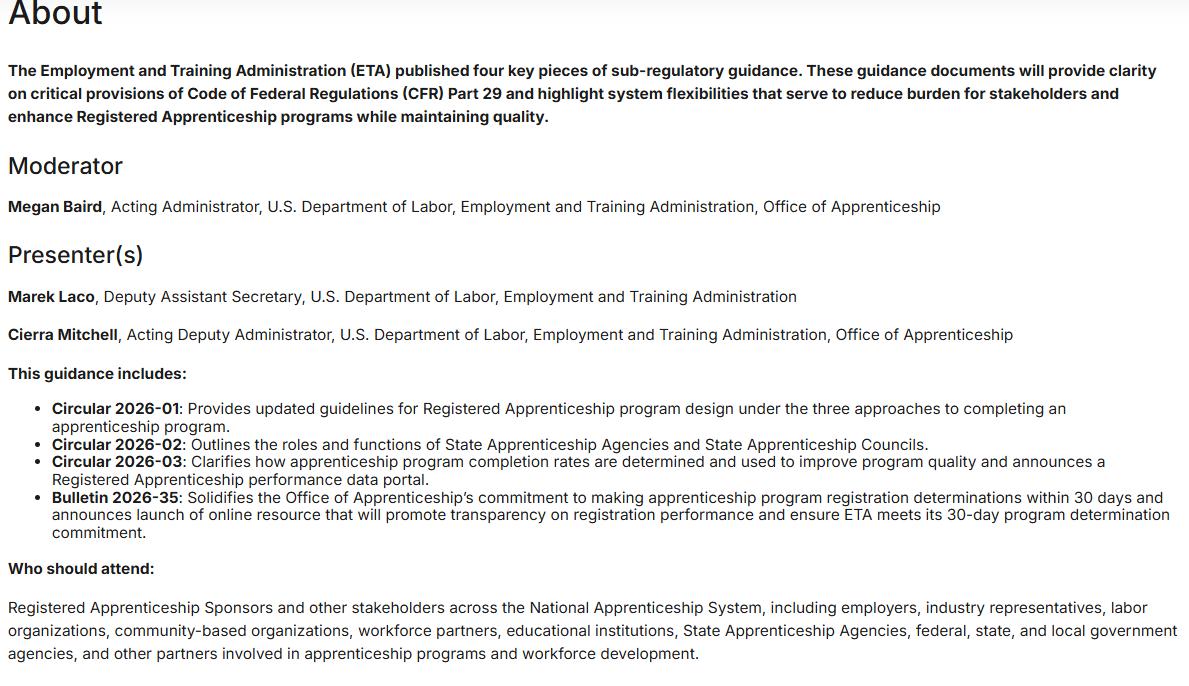
ADVISORY: OFFICE OF APPRENTICESHIP CIRCULAR NO.
2026-01
SUBJECT: Registered Apprenticeship Training Approaches
Key takeaway:
This 2026 OA Circular replaces the old 2016 guidance and gives sponsors more flexibility, while putting more weight on having clear written standards, consistent policies, documentation, and Registration Agency approval.
What Matters Most for an Intermediary / Group Sponsor:
• You can structure programs competency-based, hybrid, or time-based, but your standards must clearly spell out how OJL, competencies, work processes, and evaluation will work.
• Federal OA rescinded several old limits that were not actually in regulation, but the MI Office of Apprenticeship may still enforce this rule.
o no fixed 12-month minimum for competency-based programs
o no strict 25% limit on time-based or hybrid term adjustments
o no 50% cap on previous-learning or previous experience credit, and
o no 6-month/1,000-hour minimum for issuing a completion certificate.
• For advanced standing, sponsors need an objective, uniformly applied written policy adhering to 29 CFR 29.5(b)(12), matching wage progression, and documentation to back every credit decision. Advanced standing may be granted based on an apprentice’s prior experience, an apprentice’s demonstrated competency during on-the-job learning, or both.
• Related instruction is still required in all models. The 144-hours-per-year is recommended, not mandatory, and delivery can be front-loaded, segmented, concurrent, online, self-study, etc., if appropriate and approved. All apprenticeship instructors must have training in teaching techniques and adult learning styles.
• Completion decisions hinge on whether the apprentice met the approved standards, and the sponsor must certify and document that completion.
Bottom Line:
This Circular gives more design flexibility, but it also raises the bar on policy discipline, documentation, consistency across employer partners, and defensible standards review.
ADVISORY: OFFICE OF APPRENTICESHIP CIRCULAR NO.
2026-03
SUBJECT: Registered Apprenticeship Program Completion Rates
Key Takeaway:
The Office of Apprenticeship is standardizing how Registered Apprenticeship Program completion rates are calculated and reported and making them a clearer part of how program performance is evaluated. The guidance also increases transparency by adding public completion and cancellation rate data.
What Matters Most for an Intermediary / Group Sponsor:
• Completion rates are now a more formal performance signal. Registration Agencies will use them when evaluating RAP performance, comparing programs to the national average.
• The calculation is cohort-based and standardized.
o A cohort is apprentices registered in a program during a fiscal year, excluding those canceled during probation.
o The completion rate formula is: x / (y-z)
x = total number of apprentices in the cohort who completed their program requirements on or before one full year after the program’s ECD.
y = total number of registered apprentices in the cohort with an ECD for a set period of time (e.g., FY 2024) plus one full year.
z = total number of apprentices in the cohort who exited the program, for whatever reason, during the probationary period.
• Low completion rates trigger technical assistance first. The point is improvement, not immediate penalty. Deregistration is only contemplated when there is an ongoing pattern of very low completion rates over several years.
• There will be public benchmarking data. OA is releasing a data portal with average completion rates nationally, by state, and by industry, along with cancellation rates.
• There is a built-in one-year lag. Completion and cancellation rates for a given fiscal year are not released until the following year, because apprentices are given an extra year beyond their expected completion date to finish.
Bottom Line:
Group sponsors and intermediaries should closely track cohorts, expected completion dates, probationary exits, and post-probation retention across participating employers. This guidance makes completion rates a more visible quality metric, so intermediaries should use the new benchmarking data to identify weak spots early, target retention supports, and help employers improve long-term completion outcomes.